Final Fantasy: The Spirits Within (2001)
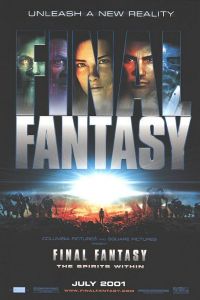 Final Fantasy is an exciting venture in the history of animation. It’s the second video game to be turned into a feature film this summer, though exponentially better than Tomb Raider. It took the makers of Final Fantasy four years and the creation of new technology to capture what will be a benchmark in animation for years to come.
The story concerns a future Earth where aliens have crashed and invaded long ago. These “phantoms” are slightly invisible energy creatures of different size and roam around various areas with the ability to suck the life force or soul from a human being. General Hein (James Woods) is trying to convince the Earth council to allow him to fire a satellite called the Zeus Cannon to obliterate the alien menace. In opposition to Hein is Dr. Sid (Donald Sutherland) who believes with his adventurous pupil Aki Ross (Ming-Na) that the Zeus Cannon will obliterate the “spirit” of Earth. Their solution it to collect eight spirits in whatever forms they might be including plants and small animals to gather together and… do something that will send the alien life force repelling.
 Now I know Hein is supposed to be the bad guy as he’s a military man complete with the evil looking black leather cloak, but I couldn’t help but find myself agreeing with his logic. He wants to use something that has already been proven to kill the aliens whereas these two new age scientists want to collect a bunch of plants and animals and have their collective spirits ward off the interplanetary menace. I’d stand in my chair and say thank you to Hein when he dismisses the doctor’s plot. I know that Aki and Sid are the heroes and of course whatever theories they have will be proven true, but hell, I found myself agreeing more with General Hein than these two.
Complicating matters Aki is infected with a piece of the alien phantom that is slowly taking control over her body. Along in her quest to discover the final spirits is aided by a military commander Grey (Alec Baldwin) and his company of men. Turns out Grey and Aki are former sweethearts, so of course expect them to reconcile before the end credits.
The plot consists of something that could be an average episode on Star Trek: Voyager but does meander along at times. The dialogue is typical sci-fi buzzwords like “Fire in the hole” “The perimeter’s been breached” and the sort. Final Fantasy does have great excitement to it and some terrific action sequences better than most anything this summer. The ending is a disappointment as all the action hinges on two globs of energy propelled against one another. Globs or energy are not exciting. I thought we would have learned this by now.
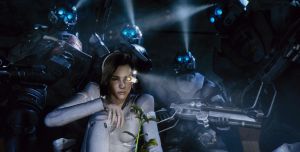 Final Fantasy is a landmark in animation. Never has so much detail been put into a movie and pulled off so amazingly well. To the nit-pickers out there the animation isn’t exactly the Holy Grail of photo-realism, but it’s closer than anything ever before. At times the characters come off as too plasticy (like Jude Law in A.I.) and tend to move too much, notwithstanding that their mouths don’t always follow the words coming out of them. Put aside these small grievances and what you have is stunning animation that makes one constantly forget it is animation. There are numerous moments of eerie precision like when a character’s nostril flares and their nose scrunches up in response, and the movement of every one of Aki’s 60,000 strands of gorgeous hair, to even a kiss between two characters. Even inanimate objects like a crumbled wall, a glass of alcohol, or a gun and its rounds are given startling accuracy. Backgrounds and scenic vistas are beautifully rendered with great care. There has been nothing ever like Final Fantasy before and it is the first movements toward an exciting area in animation.
The discussion must be raised can actors be phased out by computers now and will they ever? No, never. Actors can portray nuances that computers will never be able to master. Despite some actors best attempts to prove otherwise, we will always need actors. Now that you have the near photo realism one might be led to question what is the greatness of creating a fully realistic looking CGI tree when one can just be shot on film for millions of dollars cheaper. The all CGI world will not replace the real world of film making.
The mediocre story can be excused by the awe-inspiring animation. Despite the clunker of a plot Final Fantasy is entirely enjoyable because it always gives the viewer something to sit in wonder and take in. There’s always something to mesmerize the eyes on screen.
Nate’s Grade: B
Reviewed 20 years later as part of the “Reviews Re-View: 2001” article.
Share this:

A.I. (2001)
 A.I. is the merger of two powerhouses of cinema – Stanley Kubrick and Steven Spielberg. The very mysterious film was given to Spielberg by Kubrick himself who thought ole’ Steven would be a better fit to direct it. The two did keep communication open for like a decade on their ideas for the project until Kubrick’s death in March of 1999. What follows is an imaginative futuristic fairy tale that almost grabs the brass ring but falls short due to an inferior ending. More on that later.
In the future technological advances allow for intelligent robotic creatures (called “mechas”) to be constructed and implemented in society. William Hurt has the vision to create a robot more real than any his company has ever embarked on before. He wants to make a robot that can know real love. Flash ahead several months to Henry and Monica Swinton (Sam Robards and Frances O’Conner) who are dealing with their own son in an indefinite coma. Henry is given the opportunity to try out a prototype from his company of a new mecha boy. His wife naturally believes that her son could not be replaced and her emotions smoothed over. Soon enough they both decide to give the boy a try and on delivery comes David (Haley Joel Osment) ready to begin new life in a family. David struggles to fit in with his human counterparts and even goes to lengths to belong like mimicking the motions of eating despite his lack of need to consume. Gradually David becomes a true part of the family and Monica has warmed up to him and ready to bestow real love onto their mecha son.
 It’s at this point when things are going well for David that the Swinton’s son Martin comes out of his coma and returns back to his parents. Sibling rivalry between the two develops for the attention and adoration of their parents. Through mounting unfortunate circumstances the Swintons believe that David is a threat and decide to take him away. The corporation that manufactured David had implicit instructions that the loving David if desired to be returned had to be destroyed. Monica takes too much pity on David that she ditches him in the woods and speeds off instead of allowing him to be destroyed.
David wanders around searching for the Blue Fairy he remembers from the child’s book Pinocchio read to him at the Swinton home. He is looking for this magical creature with the desire she will turn him into a real boy and his human mother will love him again. Along David’s path he buddies up with Gigolo Joe (Jude Law), a pleasure ‘bot that tells the ladies they’re never the same once he’s through. The two traverse such sights as a mecha-destroying circus called ‘Flesh Fairs’ complete with what must be the WWF fans of the future, as well as the bright lights of flashy sin cities and the submerged remains of a flooded New York. David’s journey is almost like Alice’s, minus of course the gigolo robot of pleasure.
There are many startling scenes of visual wonder in A.I. and some truly magical moments onscreen. Spielberg goes darker than he’s even been and the territory does him good. Osment is magnificent as the robotic boy yearning to become real, but Jude Law steals the show. His physical movement, gestures, and vocal mannerisms are highly entertaining to watch as he fully inhibits the body and programmed mind of Gigolo Joe. Every time Law is allowed to be onscreen the movie sparkles.
 It’s not too difficult to figure out which plot elements belong to Spielberg and which belong to Kubrick, since both are almost polar opposites when it comes to the feelings of their films. Spielberg is an idealistic imaginative child while Kubrick was a colder yet more methodical storyteller with his tales of woe and thought. The collaboration of two master artists of cinema is the biggest draw going here. A.I.‘s feel ends up being Spielberg interpreting Kubrick, since the late great Stanley was dead and gone before he could get his pet project for over a decade ready. The war of giants has more Spielberg but you can definitely tell the Kubrick elements running around, and they are a gift from beyond the grave.
I thought at one point with the first half of A.I. I was seeing possibly the best film of the year, and the second half didn’t have the pull of the first half but still moves along nicely and entertained. But then came the ending, which ruined everything. There is a moment in the film where it feels like the movie is set to end and it would’ve ended with an appropriate ending that could have produced lingering talk afterwards. I’m positive this is the ending Kubrick had in mind. But this perfect ending point is NOT the ending, no sir! Instead another twenty minutes follows that destroys the realm of belief for this film. The tacked on cloying happy ending feels so contrived and so inane. It doesn’t just stop but keeps going and only gets dumber and more preposterous form there. I won’t go to the liberty of spoiling the ending but I’ll give this warning to ensure better enjoyment of the film: when you think the movie has ended RUN OUT OF THE THEATER! Don’t look back or pay attention to what you hear. You’ll be glad you did later on when you discover what really happens.
The whole Blue Fairy search is far too whimsical for its own good. It could have just been given to the audience in a form of a symbolic idea instead of building the last half of the film for the search for this fictional creature’s whereabouts. The idea is being pounded into the heads of the audience by Spielberg with a damn sledge hammer. He just can’t leave well enough alone and lets it take off even more in those last atrocious twenty minutes.
A.I. is a generally involving film with some wonderfully fantastic sequences and some excellent performances. But sadly the ending really ruins the movie like none other I can remember recently. What could have been a stupendous film with Kubrick’s imprint all over turns out to be a good film with Spielberg’s hands all over the end.
Nate’s Grade: B
Reviewed 20 years later as part of the “Reviews Re-View: 2001” article.
Share this:

Tomb Raider (2001)
 Lara Croft is an adventurer with a taste for action along the lines of the Raiders of the Lost Ark kind. It seems that time is drawing close to a planetary alignment that occurs once every 5,000 years as they always do in movies. This alignment supposedly unleashes an ancient object that has the ability to alter time itself. Croft is drawn in by a secret society that wants a mysterious artifact she discovers in her property that can lead to the locations for the time altering device. Now Croft must step out and try and beat the big bad guy (Ian Glenn) to the chase and get to the device before he and his society get their grubby hands all over it.
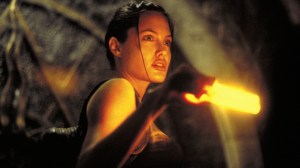 This is a movie that is light on characters yet at the same time has so many extraneous ones. The bad men are being led by fellow tomb raider Alex Cross (Daniel Craig), who also happens to be a former flame of Croft’s. Lara is saddled with a geeky computer whiz who just happens to be British, because he keeps spouting phrases like “blimey” and “bugger” all the freakin’ time. Croft also employs a butler, because, someone has to take care of that huge house. If this wasn’t enough the big bad employs an assortment of typical evil henchmen that are distinguishable by tattoos alone. Add on top of this heap the flashbacks Croft has of her long missing father Lord Croft (played by Jolie’s real father, Jon Voight). All of these dueling personalities clog the action and the pacing.
Front and center, Angelina Jolie is the living embodiment of Lara Croft. She fills out the attitude and the look to a perfected T. Jolie gives Croft the muscle but the screenwriters fail her in giving her the flesh and blood. Tomb Raider falls into the “rule of five”: if there are five or more people credited with the script (including in this instance the director himself) then there was no script at all.
The action of Tomb Raider is loud and explosive but rather lifeless and dull. West has managed to create bombastically mundane action sequences. Never once did anything from the screen arouse my interest, except for the female lead of course. The story has its characters travel to exotic locales and impressive sets of ancient caves and temples, but it’s all window dressing. The pretty scenery and locations only mask how ineffective and boring the action is. And for an action picture, when the audience begins to notice how pretty the scenery is compared with the action – you’re not doing your job.
 Simon West is not exactly a director to be trusted with any sort of project. West brought audiences Con Air and The General’s Daughter, a film that tried to decry rape but then took sadistic pleasure in recreating it again and again. So what better man to helm the project of the buxom video game heroine than a man who has brought us cartoonish violence and horrific rape? The camera framing of Tomb Raider takes a few notes from the Jennifer Love Hewitt experiment that was I Still Know What You Did Last Summer. Jolie’s breasts are always in frame, and at certain times it seems like the camera is lowering just to get them in there for the sake of exposure.
Despite the attempt this video game turned into a movie feels exactly like a video game turned into a movie. It’s complete with some laughably atrocious dialogue (“You know what today is?” “The 15th.” “And that is never a good day.”), and despite the running time of an hour and a half, it feels like an eternity longer. Tomb Raider never gets off the ground even with the added push of some pretty good special effects. Jolie may have an action vehicle at her helm and that’s fine with me. Keep her. Just make sure to get rid of everyone else.
Nate’s Grade: D
Share this:

Atlantis: The Lost Empire (2001)
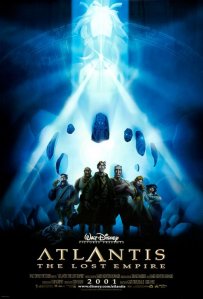 A joke me and my friend Adam Kipp had going in a script we never started was about an elite tactical force known as the Superhuman Samurai Stereotype Squad. They were a group contained of all different minority killers but each was a bad stereotype of that minority – like the black man was a gangster rapper with one incredible fro, the Asian was a martial arts expert, the gay person was flaming etc. (this is not an example of how I feel toward minorities, just lampooning the lame stereotypes). So imagine my surprise when watching Disney’s Atlantis I see our joke played out in front of me, except it’s supposed to be taken seriously.
Nerdy historian and dreamer Milo (Michael J. Fox) gets teamed up with a ragtag group on an exploration to hunt for the missing land of Atlantis with the aid of a book his grandfather gave to him. Anyone else getting Indiana Jones and the Last Crusade déjà vu? This group features a tough blonde German girl Helga, a Latina mechanic who also happens to be a boxer, a crazy and dirty Frenchman, a kindly heroic black doctor that resembles Disney’s own John Henry, a lovably kooky Southerner cook, an old no-nonsense woman, and even a quirky Italian explosives expert. Assemble Superhuman Samurai Stereotype Squad!
 Through some underwater mishaps the crew finally does get to the fabled city of Atlantis and is met by the King and Princess Kida, who takes a shine to clumsy Milo. They discover secrets of the lost civilization and, as always, members of the crew turn on each other in an attempt to plunder the city of its riches. The double-dealing is led by the ship’s captain Lyle Tiberius Rourke (James Garner) who has a chin that would make Kirk Douglas drop dead with envy.
There are plot holes in Atlantis big enough to build a Disney theme ride through. It turns out as revealed in the opening minutes of Atlantis that the Atlantians had mastered the technology of flight, mechanics, energy fusion, and other such scientific marvels. A race of people before even the Minoans around 800 BC had mastered the art of mechanical flight? And WE don’t even have flying cars yet but these people 2800 years ago had flying fish made with metals that they had no way of getting their hands upon? Or take for example the fact that Princess Kida greets the group in English, saying that they somehow know all languages. But if their civilization was plunged to the bottom of the sea a freaking 2800 years ago how can they remotely know languages that never existed until hundreds and hundreds of years afterwards?
Want more plot holes? Please, you know you do. How about when a character hurtles to their supposed death when they fall something like 250 feet down onto hard rock. Except later we return to this fallen character who still manages not only to live but also to turn around and fire one last perfect shot. There are so many others that they can’t all fully be mentioned.
 Atlantis is supposed to be like one of the old 50s adventure films like 20,000 Leagues Under the Sea except it never manages to be adventurous at all. The film does allow for people to actually die, though all off camera, which I can’t remember happening in a Disney picture unless it was the villain. There are some moments of excitement but they end too quickly and give the audience back to the characters and story it doesn’t want to return to. The animation is surprisingly sub-par with a few awkward moments that seem very rigid and static.
Atlantis is a general waste of talent and strung together with a bad script. The fact that not one kid in the audience, nor myself, laughed once in indicative of how this movie is flopping. The movie is not engaging for kids and the opening sequence with subtitles will surely go over their heads. This film is not a fun ride. It seems like the profitable-yet-creatively-stagnant Disney formula for the last decade is finally imploding. If you do have a choice go see Shrek instead.
Nate’s Grade: C
Share this:

Swordfish (2001)
 Swordfish starts off with a helluva wallop. John Travolta opens with a monologue about why “Hollywood is full of shit,” specifically the problems with Dog Day Afternoon and what a real criminal with hostages could have done. When the conversation ends and Travolta finishes his coffee, he stands up, thanks his gentlemen, and then we quickly discover Travolta is holding hostages in a bank each strapped with powerful explosives. During some miscommunication and arrogance from the FBI brass (as always) snipers take out one of Travolta’s baddies and try and whisk away a hostage. As they try and rush her out in slow motion the pounds of C4 strapped to her chest detonate and a monumental explosion erupts. But as it slowly does the camera whips around in a circle, even entering various buildings, to give a full picture of the destructive wave of the explosion. The effect is magnificent and wonderfully pulled off. The beginning ten or so minutes really wake you up and keep your eyes open.
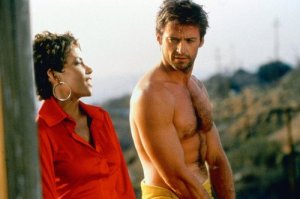
 A few days prior to this incident is where the story then sets off to fill in. Gabriel Shear (Travolta) is a powerful man with the world at his fingertips. He sends out his seductive siren Ginger (Halle Berry) to recruit the recently released Stanley Jobson (Hugh Jackman) for a special mission. Stanley is a hacking genius and has been ordered to stay clear of any computer as well as from his young daughter. Gabriel’s offer comes with a cash advance just for a meeting that is too good to pass up. After an initiation of Stanley’s skills he is set up to create a super virus that will drain the CIA of billions of dollars in unused and unknown funds. All the while FBI agent A.D. Roberts (Don Cheadle) is on the trail of Gabriel the super spy and trying to coerce Stanley into helping him bring the superman crashing.
The script is nothing new. It is complete with the familiar double crossings and surprise affiliations to render out the duration of our film. Some moments are just over-the-top stupid, like Jackman’s initiation test which requires him to break a computer code whilst a gun is pressed to his head and a blonde gives him a blowjob. Stanley has a boozing ex-wife now remarried to a porn king with custody of his daughter, and he doesn’t think he can win because he was in prison?
Dominic Sena gave us the driving-on-empty Gone in 60 Seconds last summer. Sena seems to really love florescent lighting when it comes to his films. The actors are bathed in bevy of bright greens and oranges for two hours. Sena delivers a film that pretty much has an idea its nothing but fast food, and it seem to not let something like that drag it down but actually help improve itself. It’s like Wild Things in the aspect it knows it’s just slick trash but damn if it isn’t going to be a fun ride.
Swordfish has been made critic proof. One could complain about the plot contrivances and the pat ending, but you can always go back to Travolta’s opening dissertation. Certain revelations occur in the film that will make you question who really is the bad guy in the end. The makers of Swordfish have gone about and made their action flick critic proof.
 A disappointment is that there really is only three action sequences in the entire movie. I will say this now and may it be heard clear – TYPING IS NOT EXCITING! Watching someone type fast at a keyboard is never entertaining. Do not build an action movie around typing. If you do you might as well have action while people play Turbo Pong.
The acting is irrelevant, though Jackman is a winning face and actor. Travolta looks like the lower half of his face has freakishly widened. Much has been made about Halle Berry going topless for the movie. This was entirely gratuitous and used for comic effect for God’s sake. But the movie is unabashedly about sleek violence and sex, so it can be forgiven.
Swordfish is the right kind of mindless action for the summer. It keeps you awake and engaged. And I’d rather see this eighty times again before seeing Tomb Raider one more time.
Nate’s Grade: B-
Share this:

Pearl Harbor (2001)
 It turns out we went to war in 1941 not because of Japanese aggression, Hitler’s dominance in Europe, or the protection of freedom and democracy. Sorry kids. The real reason we went to war was to complicate and then clear up Kate Beckinsale’s love life. At least that’s what director Michael Bay and screenwriter Randall Wallace would tell you with their indulgent epic Pearl Harbor.
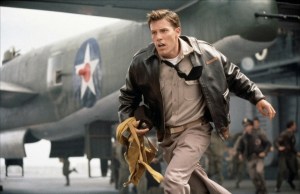
We open in Tennessee in the 20s with two boys who dream of being pilots. Rafe (Ben Affleck) and Danny (Josh Hartnett) grow into strapping young lads who flash their hot dog flyin’ skills at basic training, which brings them chagrin from superiors but admiration from peers. Rafe falls in love with a young nurse named Evelyn (Kate Beckinsale), who goes against ARMY rule and passes Rafe in his eye exam portion when he has a slight case of dyslexia. But he’s just so cuuuute. The romance builds but Rafe feels like he’s grounded when all he wants to do is fly, and volunteers to fight in the RAF over in Europe. He promises he’ll be back to see his lovely Evelyn. Of course he gets into an accident and everyone assumes that poor dyslexic Rafe is fertilizing a lawn somewhere with his remains. Hence Danny slowly but surely develops something for Evelyn in their periods of mourning, and the two consummate their puppy love with a tango in parachute sheets.
All seems well until Rafe returns back from the dead throwing a wrench into Evelyn’s second date parachute plans. Thus the Hollywood favorite of the love triangle endures until the end when the two fly boys enlist in the Doolittle attack against Japan, months after the ferocious attack on Pearl Harbor. The real purpose of the Doolittle attack was not militarily, but merely for morale. The real purpose it serves in the movie is to shave off an end on our love triangle.
 Pearl Harbor allows us to follow a group of youthful and innocent starry-eyed kids from training to combat. Each seems pretty much exactly the same to each other. It’s near impossible to distinguish which character is which. It’s like the screenwriter didn’t even have the gall to resort to cliche supporting character roles, and he just made one character and duplicated it. The only one who was noticeable for me was the character of Red (Ewen Bremner, julien donkey boy himself), but that was simply because the man had a speech impediment. We also have our handful of young nurses alongside Beckinsale, and I had an easier time distinguishing between them; everyone had different hair colors.
]If you look in the pic, or the credits, you’ll see that two of the nurses would turn out to be Jennifer Garner (Alias) and Sara Rue (Less than Perfect), both stars of ABC shows, and ABC is owned by, yep, Disney. Coincidence? Probably. When they ran this on TV they actually advertised Jennifer Garner above Kate Beckinsale. That reminded me of when Seven ran on TV shortly after Kevin Spacey had won his well-deserved 1999 Best Actor Oscar for American Beauty, and they gave him second-billing in the advertisement over Morgan Freeman, the movie’s true main character.
Affleck has a hayseed Southern twang, but seems to mysteriously disappear for long stretches. Hartnett seems to talk with a deep creak, like a door desperately trying to be pushed open. Beckinsale manages to do okay with her material, but more magnificently manages to never smear a drop of that lipstick of hers during the entire war. We could learn a lot from her smear-defying efforts. Gooding Jr. is pretty much given nothing to work with. I’m just eternally grateful he didn’t go into a usual Cuba frenzy when he shot down a Zero.
Michael Bay has brought us the ADD screenings that are the past, loud hits of The Rock and Armageddon. Teamed up with his overactive man-child producer Jerry Bruckheimer once more, Pearl Harbor is less Bay restrained to work on narrative film as it is Bay free-wheeling. His camera is loose and zig-zagging once more to a thousand edits and explosions. Bay is a child at heart that just loves to see things explode. When he should show patience and restraint he decides to just go for the gusto and make everything as pretty or explosive as possible. This is not a mature filmmaker.
Despite the sledge hammer of bad reviews, Pearl Harbor is not as bad as it has been made out to be. The love story is inept and the acting is sleep-inducing, unless when it’s just funny. It doesn’t start off too badly, but twenty minutes in the movie begins sinking. The centerpiece of the film is the actual Pearl Harbor bombing that clocks in after ninety minutes of the movie. The forty-minute attack sequence is something to behold. The pacing is good and the action is exciting with some fantastic special effects. The movie is bloated with a running time a small bit over three hours total. Maybe, if they left the first twenty minutes in, then gave us the forty minute attack sequence, followed by a subsequent five minute ending to clear up our love triangle’s loose ends… why we’d have an 80 minute blockbuster!
 Pearl Harbor doesn’t demonize the Japanese, but it feels rather false with their open-minded attempts to show both sides as fair minded. It gets to the point where they keep pushing the Japanese further into less of a bad light that it feels incredibly manipulative and just insulting. It seems like the producers really didn’t want to offend any potential Pacific ticket buyers so the picture bends backwards to not be insulting. The only people who could be offended by Pearl Harbor are those who enjoy good stories. Oh yeah, and war veterans too.
The cast of Pearl Harbor almost reads like another Hollywood 40s war movie where all the big stars had small roles throughout, kind of like The Longest Day for the Pepsi generation. Alec Baldwin plays General Doolittle and is given the worst lines in the film to say. Tom Sizemore shows up as a sergeant ready to train the men entering Pearl Harbor. He has five minutes of screen time but does manage to kill people in that short window. Dan Akroyd is in this for some reason or other, likely because Blues Brothers 3000 has yet to be green lighted. John Voight is easily the most entertaining actor to watch in the entire film. He gives a very authentic portrayal of President Roosevelt. I still find trouble believing it was Voight under the makeup.
The blueprint for Pearl Harbor is so transparent. They took the Titanic formula of setting a fictional romance against a disaster, with the first half establishing characters and our love story, and then relegating the second half to dealing with the aftermath of the disaster. It worked in Titanic (yes, I liked the film for the most part), but it doesn’t work here. Pearl Harbor is a passable film, but the mediocre acting, inept romance, square writing, and slack pacing stop it from being anything more. Fans of war epics might find more to enjoy, especially if they don’t regularly have quibbles over things like “characters” and “plot.” To paraphrase that know-it-all Shakespeare: “Pearl Harbor is a tale told by an idiot. It is full of sound and fury, signifying nothing.
Nate’s Grade: C
Reviewed 20 years later as part of the “Reviews Re-View: 2001” article.
Share this:

Moulin Rouge! (2001)
 Director Baz Luhrmann’s last project was the MTV-friendly William Shakespeare’s Romeo + Juliet (like someone else has a Romeo and Juliet) which was adored by the under 15 set that now buy N*SYNC merchandise. Luhrmann waited a long time for his follow up with Moulin Rogue, a manic musical that seems like candy for the eyes. It may have been a long time but it was well worth the wait.
The sparkling world of Moulin Rogue is around turn of the century France. Christian (Ewan McGregor), an aspiring writer, has traveled to this place against his father’s wishes. Christian believes in the beauty of love and the pull of the heart. Within minutes of setting foot in France he gets wrapped up into a production by a dwarf (John Leguizamo) and his cadre of assistants. Christian is sent to the most provocative club in town, the Moulin Rogue. Here he attempts to persuade the most famous showgirl Satine (Nicole Kidman) to help push for their musical to get financial backing. Satine inadvertently confuses Christian for the man she is supposed to seduce for a large some of money, the Duke (Richard Roxburgh). And thus the merry band of misfits get their play the backing while Christian blossoms a love for Satine. But their love must remain hidden for the Duke is led to believe that Satine is his and his alone.
 Kidman owns this movie, plain and simple. From her first shattering entrance being lowered from the ceiling to the last scene, she is absolutely magnificent. McGregor gives a nice performance as the dough-eyed lover. Jim Broadbent plays the Moulin Rogue’s owner, Zidler with howling delight in all his manic expressions. Even Roxburgh gives an underwritten antagonist the right amount of weasely twitch.
One of the more surprising features is how well the two leads can actually sing. Kidman gives a soft and sexy take on “Diamonds are a Girl’s Best Friend” and McGregor can belt out a tune with some admirably throaty pipes. As these two veer in and out of songs it’s a pleasure to watch and hear.
Luhrmann has crafted a musical with ADD, but I say this as a compliment. Moulin Rogue‘s pace is fast and pounding. People twirl above the sky, the camera zooms wildly through town streets, and dump trucks worth of confetti fly through the air. Moulin Rouge is exploding with glitz and never lets up. The editing and visual artistry is stirring. By about ten minutes into the proceedings when a green fairy starts singing a seductive version of “The Hills are Alive” you know you are in for something else. And what a something else the film delivers. There was not a moment I didn’t have a smile glued to my stupid face.
 Moulin Rogue could be described as a musical for people who dislike traditional musicals. In traditional musicals people go along stuffy formula, then break out into great choreography song-and-dance. With Lurhmann’s musical is a breakneck of pomp where the characters zip around to exaggerated Hanna-Barbara sound effects and start chiming away with 70s and 80s pop songs that we all know. After the initial shock/humor of hearing characters belt out renditions of “Roxanne” and “Like A Virgin,” a familiarity sets in and it blends in to produce a surprising artistic addition.
The story of the movie is nothing new or extraordinary; it’s well worn territory. But where Moulin Rouge breaks apart and shines are with its style and exposure. The visuals are astoundingly lush and lively, the music is game and pumping, and the movie is just screaming to be seen. This was a true work of love.
The movie is bursting to the seams with life. I loved every single second, every single frame, every single moment of Moulin Rouge. I can’t wait to go see it again.
Nate’s Grade: A
Reviewed 20 years later as part of the “Reviews Re-View: 2001” article.
Share this:

Shrek (2001)
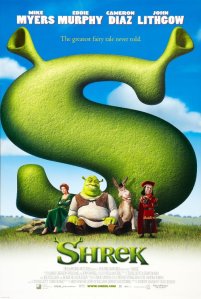 Shrek is Dreamworks’ kick in the pants to fairy tales and some of the staple creations of the Mouse house. There’s nothing a bug eating green ogre named Shrek likes more than his peaceful privacy. But this is brought to an immediate halt when all sorts of fairy tale creatures invade his swampy domain. To regain his privacy Shrek takes it up with Lord Farquad (say the name fast) who agrees to relocate the fairy tale creatures he outlawed to Shrek’s swamp in the first place if he travels to a castle and rescue a princess. Shrek agrees and along the way gets a buddy for the trip with a talking donkey, named appropriately enough, Donkey.
Shrek is amazing world of computer artistry. The characters move so life like and the detail is so magnified that it is a living and breathing world all its own. Mike Myers and Eddie Murphy are the comic duo of Shrek and Donkey and provide a good portion of laughs on their journey. With Mulan and now Shrek, Murphy seems like a natural when it comes to animation voicing. He gives it his all. Cameron Diaz is also a nice contributor as the voice of Princess Fiona, which kinda’ looks like her too creepily enough. Rounding out the cast is the always over-the-top John Lithgow as the stilted Farquad.
The humor of Shrek is enough to please kids with the fart and burp jokes, but lends its aim for more adult humor as well. There are a few jabs at the Disney Empire that are more than hilarious and the story keeps them coming. Shrek turns out to be a delightful tale of an ogre who’s a green softy at heart.
Nate’s Grade: A
Share this:

The Mummy Returns (2001)
 Does this mean the following sequels will be called The Mummy Forever and The Mummy and Robin? Our tale takes place ten years after the first. Our archeological heroes in Brendan Fraser and Rachel Weisz are now married and the proud parents of a blonde English boy (Freddie Boath) – who of course, gets into as much trouble as his parents do. Supposedly there’s this buried army of dog warriors from an Egyptian God. The trick is, you have to defeat their leader The Scorpion King to gain control over their ranks. So our good guys stumble upon setting things in motion accidentally, while our bad guys raise Imhotep (our mummy from the first one) with plans of him toppling The Insect Marvel.
 The story of Mummy redux deals a lot with past lives and destinies. It seems miraculously everyone in our story is related to one another be it past or present (and we ain’t talking inbreeding). They fulfill their destinies – or whatever, mainly just fight with pointy things.
Many of the same characters return from the first one, almost like an ongoing serial. There’s the cowardly bumbling brother-in-law (John Hannah), the Arabic prince sworn to protect society form the evils of mummy-ness (Oded Fehr), and hell, even the damn mummy himself (Arnold Vosloo). We even get more of Vosloo’s dead girlfriend from the first picture. She has the honor of sharing a grotesque screen lip-lock with the decaying mummy. Talk about commitment.
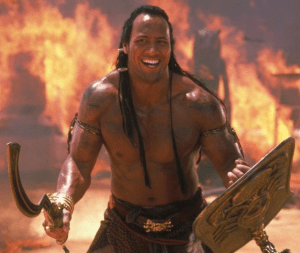
Somehow pro wrestler The Rock (Is he in the phone book as “Rock, The”?) got into this film. His role is The Scorpion King, a cursed uber warrior of ancient Egypt. As you would expect from someone so elegantly named after a large, un-moving, mineral – The Rock’s acting is largely un-moving. He has one line in a different language, poorly delivered as well, then has five minutes of screen time battling people two feet smaller than him with the pearliest whites this side of the Nile. He shows up again later as a scorpion/human hybrid but is replaced with (say it with me class) CGI.
The acting is pure cornball, but to some degrees pleasantly so. We can’t have people taking themselves too seriously while being chased by little dead pygmy babies. Fraser seems to be leading the way for the next generation of action stars. Adewale Akinnuoye-Agbaje appears in a small role as one of the big bad’s henchmen. After watching him for years on Oz it was a personal pleasure to see him on screen. Boath is the real surprise. If he were grating (like some lil’ Star Wars kid) I’d root for any undead creature to suck his nine year-old bones dry. He is fun to watch and acts like a kid, not a child actor acting like a kid.
 The Mummy Returns will enchant you if you were enchanted by the first one. My stance on the mummy’s predecessor was that it was a tongue-in-cheek dose of cheese and adventure. It was nothing to write home about but it was a fun popcorn flick. However, The Mummy Returns throws the gauntlet down with the “bigger is better” rule of thumb almost tripling everything the first tried. It practically throws everything at you in its onslaught including a CGI kitchen sink. You’ll get computer everything. It’s almost like the producers are having a mummy wholesale – “everything must go!” As in reference to there is so much computer generated images in this film that it could be classified as the first living cartoon.
The action in The Mummy Returns is relentless. The pacing is fast and must be the bane to all those people who must squirm in their chair afraid they will miss something – you will. Most movies move through plot points, like from A to B. With The Mummy Returns, on the other hand, everything just bleeds together in a linear mess. It’s rather exhausting to watch.
The Mummy Returns continues to have its tongue firmly planted in cheek. Except with its onslaught it almost resembles a scene from Species with said tongue going in cheek then outside of brain cavity. If you’re hungry for an all-you-can-eat version of a movie, then The Mummy Returns might whet your appetite.
Nate’s Grade: C+
Share this:

Freddy Got Fingered (2001)
 The beauty of Tom Green (if you’ll cal it such) works in the realm of television. His bizarre humor and meddling nuisance on the streets worked in a “Can’t believe he’s doing this” way. He thrives in this environment where he can wreck havoc amongst the unknowing. Take him out of this environment into a scripted venture where people are acting against him, and the reality is killed along with why it was funny in the first place. It’s not so much funny that Tom Green can hump dead animals on camera, it’s so much funny that he’ll do it in front of bystanders.
As it stands, Freddy Got Fingered is plot-less. It is basically Green doing one weird and bizarre antic after another with little relation to anything. It’s basically a meandering mess, almost like an abstract artist’s work if that artist were insane. Freddy Got Fingered is Green’s attempt at cinematic gross-out stardom. Sure, he does things that would be considered in poor taste but they are scripted and lose their appeal. Green guts an animal and wears its skin like a poncho, he bites the umbilical cord of a birth, he even eroticises a horse and aids in its… release. But all the charm is gone when it’s Green just doing zany things in a closed environment. What is the fun of seeing people do scripted reactions to Green’s antics? He needs to be in the real world, he needs to piss people off, he NEEDS reality. A movie will do no justice to Tom Green and this one surely does not.
Nate’s Grade: F
Reviewed 20 years later as part of the “Reviews Re-View: 2001” article.


 nathanzoebl
You must be logged in to post a comment.