Blow (2001)
 The tale of Blow follows a kid named George Jung (Johnny Depp) as he travels to the sunshiny coasts of California. Here he finds everyone with a David Cassidy haircut and an insatiable appetite for pot. He strikes a small scale dealing business with some help from a flamboyant hair dresser (Paul Rubens) and rocket in riches. They eventually discover the powers of cocaine, a.k.a. blow to the uninitiated, and set it loose upon 1970s America. Jung becomes the top trafficker of cocaine and practically single-handily leads to its explosion. And of course, these good times can’t last as Jung’s life falls apart as the 80s go.
 Blow is too stylistically similar to earlier 70s epics of violence and music like Boogie Nights and Goodfellas. The same moves and looks are evident, even the same overall tone, but it is missing all of the feel. Blow moves along and feels like something is missing as it continues to ape the flavor of those earlier excellent films. There’s a distinct feeling while viewing that you aren’t viewing something complete. The sense of loss permeates the screen with Blow.
Depp uses a subtle acting approach making Jung one real mellow dude man. One can never feel a connection for any of the characters because the plot is not interested in the characters and only a masochistic orchestra of bad events that happens to Depp. You feel unattached to the characters as a whole, but you do manage to feel a level of sympathy for Jung. His mother is a card to watch, and it seems history repeats itself when it comes to family squabbles.
Penelope Cruz plays one spoiled hell-cat of a drug lord’s girl, who later becomes Depp’s wife. Cruz’s character is possibly the most horrible love interest I have ever seen on film. She shrieks about money and wealth, acts apathetic to their innocent daughter, and single-handily gets Depp busted a few times without guilt. Upon deeper reflection she seems (if she happened not to actually exist, which she does) like a cheap foil to make the audience sympathy sway dramatically to our “tryin’ to do good” flawed hero in Jung. It almost seems insulting.
 Ray Liotta (who was IN Goodfellas by the way) gets the pleasure of aging through the years with makeup, which basically consists of slapping gray and more skin to his neck. It’s rather humorous that Liotta is playing Depp’s father in the flick when in reality they are roughly the same age. Though I guess it’s better for Liotta to age after seeing Depp’s character age drastically and gain twenty pounds all in his neck. Older Depp looks like a zombie Ludwig von Beethoven.
Blow is written and directed by Ted Demme and is based on the memoirs of Jung while in prison. It is fairly entertaining in its own right but you can’t help but feel you’ve seen it all before and better. Still, with this lackluster year as it is Blow is a decent pic to sit down and chew through a box of overpriced popcorn. Any movie with Franka Potente (my titular hero in Run Lola Run) and Paul Ruebens is worth the price of admission.
Nate’s Grade: B-
Share this:

Along Came a Spider (2001)
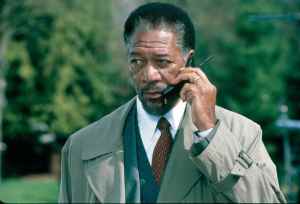
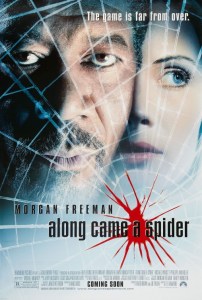 Anybody not tired of the serial killer genre yet? To that one out of the millions who raised their hand in the far back – you’re in luck! Enjoy Kiss the Girls? That same one in the back is even more fortunate. Here comes Along Came a Spider and its banality will knock you off any tuffet. Is that a word even used anymore? Spider is a continuation of the characters in Kiss the Girls (even though Spider was written before Girls). Morgan Freeman returns as Alex Cross, a hard-nosed police detective and best-selling novelist on criminal profiling. He’s suffering from Cliffhanger syndrome: the amassing of guilt from seeing someone close die in the line of duty and blaming themselves for it. See Morgan lost a female partner in a botched sting that opens the film with the worst CGI scene I’ve ever seen. He has a scene of regret then moves on to the case at hand, only to inevitably have the situation come up again and be the test of his nerves. It’s all standard cliche.
The crime that draws all our characters in revolves around the kidnapping of a Senator’s daughter at a lofty private school in Washington D.C. This is no serial killer movie, no, it’s a kidnap movie. Whatever the crime this flick centers on it still follows the superfluous serial killer movie rules to a grizzled T.
 Monica Potter plays a Secret Service agent assigned to protect the girl who becomes involved with the case with her extensive knowledge of the kidnapper, Professor Sonje (Michael Wincott). Potter has previously been seen as the sad wife in Con Air, the dead chick in Patch Adams, and the girl who stars next to the guy whose acting is all about flat-lining in Head Over Heels. So in these terms Along Came a Spider is a step up. Her character is pedestrian and un-involved. She has no edge or depth and every time she’s on screen.
Freeman, God love him, needs to start learning how to say “no” to any serial killer (kidnap film) offered to him. He’s a great actor but the Alex Cross solves killers (kidnappers) franchise isn’t one to tie his rope around. Freeman does his best and brightens the film when it sags, but even he can’t save it. And his Executive Producer credit seems all the more ominous.
Naturally, an audience is left to disbelieve some of the absurdities of the genre but Along Came a Spider piles them too high and too fast to disbelieve. The kidnapper disguises himself as a plump British history teacher for a whole two YEARS in preparation for his act. Two years?! What would happen if she ever transferred? The worst part is his name – Sonje. Every time I hear the name it makes me giggle a bit. I cannot take anything seriously when the bad guy is named Sonje (“We’ll do whatever you want Sonje, just don’t harm the girl!”). Sprinkle unintentional laughter throughout. And for kidnappers and criminals these have got to be the dumbest since Colonel Klink. There is a scene where the kidnapper gives the detained child a meal… with a fork and knife! It’s like going to a prison and giving certain members scissors and leaving them alone for two hours.
 If you are having a serial whatever movie you must make your serial whatever man intriguing or turn the flick into a guessing game until the end credits. The serial killer (I’m saying this now because he does kill multiple people – so there!) in Along Came a Spider is bland as can be, despite the wonderfully rich and venomous voice of Wincott. How as an audience are we to be enthralled with a whiny adversary that bores us?
There are numerous other head-smacking absurdities. Like when our ace Morgan Freeman looks to a computer belonging to a suspect and instantly remembers an off-hand remark in one conversation that of course is the password. And he even spells it correctly with an inclusion of a symbol!
The movie is based on James Patterson’s novels all seeming to have nursery rhyme style titles. Directed by Lee Tamahori (Mullholland Falls, The Edge), it has moments of briskness that at least keep the pacing alive. On its whole the film still does not work. It feels like reheated serial killer (kidnapper) movie just out of a Tupperware container. Along Came a Spider is nothing new, nothing different, and nothing truly entertaining. Pray for Morgan Freeman please.
Nate’s Grade: C-
Share this:

Memento (2001)
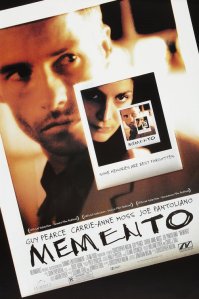 A film is taking the nation by storm and it isn’t anything from a big studio. In fact it’s the first release of a new indie production house called New Market, and these people have lassoed a real winner. Memento is a murder mystery bubbling with perfect elements of noir, suspense, and trickery. Memento is the tale of Leonard Shelby (Guy Pearce) who is searching desperately for John G., the culprit he believes that raped and murdered his wife. Along the way Leonard gets assistance from his friend Teddy (Joe Pantoliano) and Natalie (Carrie Anne-Moss), a down on her luck bartender.
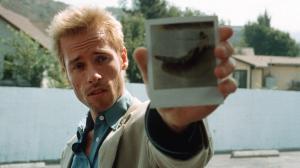 Except Leonard has a peculiar problem plaguing his one-man investigation for justice. After the attack on his wife the assailant knocked him out, and Leonard was left with no short-term memory whatsoever. Leonard cannot develop new memories. So if something happens to him, he is liable to immediately forget it within five minutes. To aid himself he write on small post-its telling him which car is his, what hotel he’s at, etc. all over his body are tattoos of clues he has amassed. He takes Polaroids of people and writes their names on them to remind him of the faces he sees that he won’t remember. Leonard’s investigation is about what his notes tell him. He doesn’t know whom he can trust and whom he cannot.
If this wasn’t enough to make Memento interesting the entire tale is told out of sequence and run from end to beginning. The entire film is told backwards. This action robs the audience of the same information that escapes Leonard. We too know neither who to trust. The effect could fall into gimmick territory but makes the movie fresh and adds for some great comic situations as well, like when Leonard awakens with a bottle of champagne in his hand and tells himself he doesn’t feel drunk.
 Pearce is gripping as the emotionally shattered and fractured Leonard. He is a man that can trust nothing and must live from repetition, but is intent on bringing his wife’s killer to bloody justice. Pantoliano and Moss provide good support as the weary characters that weave into Leonard’s plight. The acting it excellent all around. They leave us guessing and reassembling our perceptions as more of the puzzle unravels.
Memento is top-notch film noir. It’s a breathless thriller of a first rate caliber. The direction given by Christopher Nolan from his screenplay is tight and highly effective. The character of Leonard is fleshed out in all his paranoia, pain, and frustration. Nolan has delivered a gift to movie audiences always hungry for fresh material. One has to see the film a second time just to see how well the segments play together.
Memento is the coolest movie around. Rush out and see it, then see it again, and then again. It’s the best movie of 2001 by far as of now and has the Best Original Screenplay Oscar locked [Editor’s note: it lost to Gosford Park of all things.] It’s destined to be a cinematic classic people will talk about for years.
Nate’s Grade: A
Reviewed 20 years later as part of the “Reviews Re-View: 2001” article.
Share this:

Enemy at the Gates (2001)
 Enemy at the Gates tells its tale over the pivotal Battle of Stalingrad where over a million Russians lost their lives to repel the German advancement. The Russians at this point were throwing boys as young as school kids into the battle and arming some of them with nothing. It was an attempt to create wave upon human wave to overrun the Germans. The Battle of Stalingrad was a decisive moment in WWII, but how Enemy of the Gates portrays it – the battle was nothing. The entire war was turned by two men.
The beginning to the film (and also the best part) shows the immediacy of the war and is very parallel to the Omaha invasion. People are shepherded into box cars onto a train, then arrive on the river and travel by barge to the ports of Stalingrad, then are sent up a hill one with a rifle and one with the rifle’s ammunition, and then thrown into the battle on the other side. Literally, an hour could pass from leaving home and death. Enemy at the Gates doesn’t paint a pretty picture of the Russians themselves (this is a Hollywood film after all) and displays the Russian war tactic of firing on your own men if they have the gall to retreat.
 A survivor of the slaughter is Vassily Zaitsev (Jude Law), a rural farm boy with a great shot. He takes out a slew of Germans that have him and fellow Russian Danilov (Joseph Fiennes) trapped in the ruins of a city. Once back to friendly quarters Danilov decides to turn Vassily into a hero and prints numerous propaganda fliers and articles about his many triumphs to increase the morale of the faltering Russian army. Vesilly becomes a hero and a celebrity, though he continues to have his doubts if he can live up to his inflated image.
Rachel Weisz (The Mummy) plays the peppy patriotic girl who comes between our two mates creating an awkward Hollywood favorite: the love triangle. The very fact that she, and other women, are out there on the front lines defending their Motherland should not be taken as something in the advancement of feminist ideals in WWII Russia – at this point in the war them Ruskies would arm dogs and squirrels if they could.
Enemy at the Gates introduces its villain as an expert Nazi sniper played by recently Oscar nominated actor Ed Harris. Harris plays the character cold, yet sincere, like he is following the ways of war but not because he wishes to. He has a duty and he will accomplish it, down to the meticulous wire if he must. Harris’ sniper is sent in to assassinate Vassily Zaitsev and more importantly kill the morale of the Russians. This sets up the film’s showdown between the Law and Harris. Two men who are patient and silent killers dueling to see which one of them blinks first. A cat and mouse game amongst the fallen remains of a once proud city.
At least that’s how it happened in real life. The two men played a waiting game that went on for over two days to see whom would move first. The Nazi slipped and wound up dead. But this standoff where you couldn’t move for fear of being shot at any moment of weakness would’ve been fascinating alone to tell, especially if done straight. Instead we get Hollywood’s Saving Private Ryan.
 A rather peculiar aspect associated with Enemy of the Gates is the amount of people that die from being shot in the head. I mean, I actually looked and counted, there was maybe two people in this film that did not die from bullets that were not exploding through their heads. It gets a little silly as it goes and almost becomes an unintentional joke as we go on with 15… 20… 40 some CGI shots of bullets zipping through people’s foreheads. And the way the snipers are portrayed has it seem like a slasher film – you duck your head around that corner you are instantly dead!
Director Jean-Jacques Annaud’s previous film was the pretty but oh-so-mind-numbing-long Seven Years in Tibet. Here he takes the torch from Spielberg and plays with all the Ryan elements; dabbling with some blues, and muddy browns, and wreckage and what not. Annaud’s film is less a war film and more of a war propaganda film showing the strong effects it can attribute. Annaud also has the distinction of having the most awkward sex scene I’ve ever seen in a film. Weisz comes into where Law is sleeping and sneaks under his blanket. Except Law is sleeping in a row of other soldiers all lying on the cold cement ground with rubble all around them. The scene is very awkward to sit through and I feel will become notorious for it.
The movie isn’t all bad. Some scenes do have good tension and excitement. Law and Harris give credible performances, and Bob Hoskins appears for a very memorable role as Nikita Khrushchev. Enemy at the Gates is a war movie played with Hollywood elements that are as clear as day and weigh down whatever chance the film had. And would it have killed the cast if they could have tried a Russian accent!?
Nate’s Grade: C+
Share this:

15 Minutes (2001)
 Let me say this now and clear so everyone knows – DO NOT PUT EDWARD BURNS IN THE LEAD OF ANYTHING! Burns falls under that league of actors that can contribute and possibly do fine as supporting players but cannot carry a film. Now, moving on…
Robert DeNiro plays the head of a police force, but he’s also a local celebrity with his face everywhere from newspapers, to People magazine, to his own coffee franchise (I made up one, guess it). The woman from the NBC show ‘Providence’ with the gigantic Jersey hair plays the reporter that fawns over him and the girlfriend that reports him. She’s meaningless. Kelsey Grammar plays a heavy-handed out for blood journalist of a tabloid TV show that panders to our primal desires of violence. The show is seen as exploitative and possibly subversive – not to mention in poor taste. You may be asking how does Edward Burns get caught up in this? Well he’s an ace arson investigator that crosses paths with mega-star DeNiro. But see, Burns’ character HATES the media. Quite a contrast, eh?
 Burns and DeNiro form an unlikely team and go through the rigid “Buddy Cop Movie” drill that’s been played numerous times before. They dislike each other, they tease and try to show up one another, they come to respect and appreciate the other and work as a team. Yawn.
DeNiro phones in a performance in like none he has ever done before, even Rocky and Bullwinkle. Grammar hams up his over-killed role. Burns is his typical atrociousness. If you look closely you’ll find the actor who played the older brother in Family Matters a.k.a. The Urkle Show in this flick. Man, his career time with Jaleel White must be paying off.
The real spirit of the film is in its two debut actors who also serve as the villains. These two are from Eastern Europe and search for old friends that seem not so friendly anymore. Some altercations happen and a killing spree begets them trying to rub out the lone red-headed witness of their murders. Along the way they discover they can sell the videotapes of their crimes to the top bidder and make a fortune. The two baddies are fun to watch and a joy to see whenever they return back to the screen. They seem to punch up 15 Minutes particularly during the tedious dead spots. These two actors seem to be the only life of the film, and it’s a terrible shame when we must veer off back to our lame storyline with Burns. credit this as another case of the villains being far more interesting than the heroes — the Austin Powers syndrome.
 The major disappointment of 15 Minutes is what it looked like it would be. With the early teaser trailer it looked like it would be a scathing satire on media and our glorification of criminals as heroes. When the full length trailer came out it dropped to looking like another crazy serial killer flick. Sadly, it never rises above this. There are a few moments with some bite but 15 Minutes gums it along as far as satire is concerned. It’s more concerned with a standard by the book plot. The whole notion of using the videotapes and selling them to Grammar’s TV tabloid doesn’t even show up until twenty minutes before the film is over!
15 Minutes is a thriller that tries to be smart and savvy but tries to be by staying under standard conventions. The very ending to this film could have gone in a million different ways, some very satisfying, but it goes the predictable action-thriller way. Yawn. That’s what you’ll be doing a lot with 15 Minutes – regaining lost sleep.
Nate’s Grade: C
Share this:

Panic (2000)
 The story behind Panic goes something like this. The film was dropped by Artisan because they got test screening results back and apparently it wasn’t what they wanted. After this set-back it was going to be dumped to the wasteland of direct-to-cable like so many other troublesome pictures studios feel would not earn a buck if they were bleeding on the side of the road. After some fighting, particularly from critic Roger Ebert, a production house decided to distribute Panic in a very limited release. So what does this cinematic game of musical chairs mean? It means if you have a chance see this film.
Panic is a story about characters first and foremost. William H. Macy plays the son end of a father-son team of hitmen, with Donald Sutherland as the oppressive patriarch. Macy is a man who is never truly happy, almost like it is an impossibility for him at this point in his life. His wife (Tracey Ullman) is flaky and gives into her paranoia of her hubby having an affair with a younger chickadee. Macy meets an attractive and mysterious ingenue (Neve Campbell) while waiting for therapy. He begins on an obsession he can’t explain and fantasizes about her as the escape and ticket to happiness that is outside his reach.
 The acting is as rich as the characters. Macy plays low-key but suits the subservient ghost that his character has become. Sutherland is haunting as the controlling father figure and the flashbacks between him and young Macy are disturbing as he plants his seed of control. Even at age six Macy’s character is referring to his father with “sir” tagged to the end of every sentence.
Neve’s character is the most in depth she’s ever been dealt, though her runner-up is a girl constantly chased by men in black robes with knives. Ullman is a nice presence and the audience really can sympathize with her. The child who plays the son of Macy and Ullman is one of the most adorable child actors I have ever seen. He lights up the screen every time he is present.
The story is brisk at a mere hour and a half. It is written and directed by a former writer of ‘Northern Exposure’ and ‘Homicide’ and the attention to characters shows. The film moves not through plot occurrences but through characters acting. When Macy discovers that the final hit he has to do is on his own therapist (John Ritter) his journey is one involving everyone around him in his life. The strains and pulls on this man are encompassing to watch.
Panic is a glimpse at a quiet movie told about the life of a man caught in his father’s grasp. Macy is a man conditioned to saying “he’s sorry” even if it is not deserved. His character is rich and Panic is a strongly acted gem if you can locate it.
Nate’s Grade: B+
Share this:

Hannibal (2001)
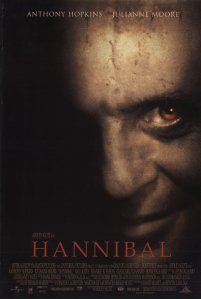 Trying to sequelize Silence of the Lambs is surely harder than trying to sequelize The Blair Witch Project. The novel Hannibal by Thomas Harris I don’t think will be confused as a necessary burst of creative ambition, and more of a chance to cash in on the love of Hannibal Lector. Though I’ve not read a line from the book from what I’m told the movie is faithful until the much hated ending. Starting a film off a so-so book isn’t a good way to begin, especially when you lose four of the components that made it shine Oscar gold.
 The element that Silence of the Lambs carried with it was stealthily gripping psychological horror. It hung with you in every closed breath you would take, surrounding you and blanketing your mind. I mean, there aren’t many serial killer movies that win a slew of Oscars. Lambs excelled at psychological horror, but with Hannibal the horror turns into a slasher film more or less. What Lambs held back and left us terrified Hannibal joyfully bathes in excess and gore.
Julianne Moore, a competent actress, takes over from the ditching Jodie Foster to fill the shoes of FBI agent Clarice Starling. Throughout the picture you know she’s trying her damndest to get that Foster backwoods drawl she used on the original down. The problem for poor Moore though is that her character spends half of the film in the FBI basement being oogled by higher-up Ray Liotta. She doesn’t even meet Hannibal Lector until 3/4 through. Then again, the title of the film isn’t Starling.
Anthony Hopkins returns back to the devil in the flesh and seems to have a grand old time de-boweling everyone. Lector worked in Lambs because he was caged up, like a wild animal not meant for four glass walls, and you never knew what would happen. He’d get in your head and he would know what to do with your grey matter – not that he doesn’t have a culinary degree in that department in this film. Lector on the loose is no better than a man with a chainsaw and a hockey mask, though he has a better knowledge of Dante and Florentine romantic literature. Lector worked bottled up, staring at you with dead unblinking calm. He doesn’t work saying goofy “goody-goody” lines and popping out of the shadows.
 Since the director, screenwriter, and female lead didn’t show up for the Lambs rehash, it feels a tad chilled with Ridley Scott’s fluid and smooth direction. The cinematography is lush and very warm.
Gary Oldman steals the show as the horribly disfigured former client of Lector’s seeking out revenge. His make-up is utterly magnificent and the best part of the film, he is made to look like a human peeled grape. Oldman instills a Texan drawl into the character yet making him the Meryl Streep of villainy.
Hannibal is no where near the landmark in excellence that Silence of the Lambs was but it’s not too bad. It might even be good if it wasn’t the sequel to a great film. As it is, it stands as it stands.
Nate’s Grade: B-
Reviewed 20 years later as part of the “Reviews Re-View: 2001” article.
Share this:

Snatch (2001)
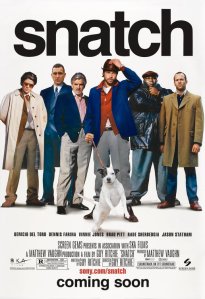 Snatch is really more of the same for writer/director Guy Richie as he retreats back to his magical land of London gangsters with Dick Tracy-esque names and thick cockney accents intermixing in comically violent and ironic ways. He’s like a more stylized version of Tarantino, if Tarantino ever got to have sex with Madonna. So if you like the niche Richie has trapped himself in for the moment (like myself) then you’ll like Snatch. The film is coursing with energy to spare and never loses its sense of fun, which carries over into audience smiles (at least for me and my gal it did). Brad Pitt is a riot as the hardly intelligible Irish gypsy and part time boxer.
Nate’s Grade: B+
Share this:

Crouching Tiger Hidden Dragon (2000)
 Ang Lee’s mythical tale of ancient… (Taiwan?) is full of visual marvels and plenty of moments of awe that make the audience believe in the power of cinema to transport once again. However, upon further viewings and more butt pain because of the large length, the film is not “one of the best ever made” as has been praised. When you get down to it and think the film really isn’t about anything but retrieving a sword and feminist roles. The visuals are striking poetry and the action is exciting and top-notch and that’s what really counts in the end.
Nate’s Grade: B
Share this:

Shadow of the Vampire (2000)
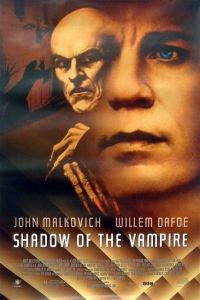 Darkly comical with great stabs of satire at the film industry (bloodsuckers in the movies anyone? Hmmmmmm). Willem Dafoe retains his title as Creepiest Actor Alive and goes for broke with a tour de force performance that should have you checking under the bed. Shadow of the Vampire is alive, to use the term sparingly, with wit and a slow but maturely steadied pace. Dafoe deserves an Oscar and your fear.
Nate’s Grade: A


 nathanzoebl
You must be logged in to post a comment.