Man of Steel (2013)
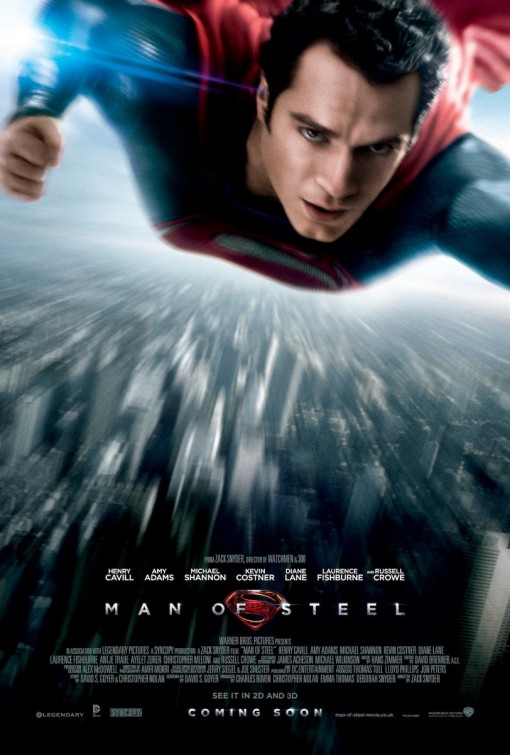 I think I began my review for 2006’s Superman Returns the same way but I don’t care. Does Superman have any relevant appeal in today’s society? I understand being a moral pinnacle has been his MO from the start, and I understand that today’s generation likes its heroes dark and broody and tortured. I know you can make Superman into an interesting figure (the man just celebrated his 75th anniversary, so there have to be some people who identify), though it is a bigger challenge, surely. I think taking a darker tack can be achievable but needs finesse. Christopher Nolan and David Goyer, having fashioned the highly successful Dark Knight trilogy, seem like a formidable pair to shepherd a darker Superman into the twenty-first century. Combine that with director Zack Snyder (300, Watchmen), and you’re guaranteed a pretty movie. Where does Man of Steel go wrong?
You know the drill at this point: Superman a.k.a. Clark Kent (Henry Cavill) was originally born on the doomed alien planet Krypton. His biological father, Jor-El (Russell Crowe), sent his son to Earth with the hope that he could survive and achieve great things. Raised by Jonathan and Martha Kent (Kevin Costner and Diane Lane), he then accepts his destiny to be mankind’s protector, butting heads and flirting with dogged reporter Lois Lane (Amy Adams). Except now Superman has the entire genetic code of Krypton’s history (?) transported into him via a “codex” (whish resembles a charred baby skull). General Zod (Michael Shannon), imprisoned off planet when Krypton was destroyed, is determined to retrieve that code and start his race anew. He and his crew travel to Earth and demand superman turn himself in, or else Earth will suffer.
 Where this movie gets into deep trouble is that it fashions Superman into an inactive loner, turning him into a super bore. He has such superhuman strength at his command but his doubtful dad has taught him that humanity would lose its mind if he revealed himself. And so Superman goes through half this movie hiding his super ability. He actively avoids conflict and confrontation. It’s basically the same formula as the Incredible Hulk TV show, where Bruce Banner would drift from town to town, warning others not to make him angry, then mournfully have to leave yet again. He can’t help himself save lives but, in flashback, dearly departed dad admonishes him for it (Clark: “Should I just have let them die?” Pa Kent: “Maybe.”). I think the isolation the character endures is essential to understanding his heavy burden, but at the same time this was compensated by Clark Kent, Superman’s opportunity to blend in with the natives, assume a frail phony identity, and to flash some much needed personality. In Man of Steel, he doesn’t become Clark Kent, news reporter, until the very last scene. It’s not a movie about a man becoming Superman but Clark Kent, experience-free reporter.
Two of the chief complaints about Bryan Singer’s 2006 Superman movie were that it was too reverent to its source material, namely the Richard Donner films, and it lacked sufficient action. Well, both of those issues are tackled in the very opening of Man of Steel. Goyer reworks plenty of Superman mythology from a science fiction angle, and so we get stuff about alien invaders, genetic bloodlines, clone baby labs, teraforming, and all sorts of spaceships. The characters keep referring to Superman as “the alien,” and dad worries that the knowledge of his super son will upset people’s worldviews about humanity and God (have no fear, there’s still messianic imagery to sledgehammer you with). I’m fine with Goyer playing fast and loose with Superman’s history but his alterations need to have solid reasoning. Nolan played around with Batman’s history and it worked because, in the context of the world and characters he developed, it fit. Does Jor-El riding a dragon like a live-action Heavy Metal fit? Does a billion people’s DNA transposed into Superman’s cells fit? Do Superman’s actions during the quite controversial ending fit? Does Clark’s stepdad, Jonathan Kent, willingly dying in a tornado fit? Does Lois Lane immediately knowing who Superman is, before he even adopts the Clark Kent disguise, fit? I doubt it, though it still could have worked. However, Goyer’s script is a mess structurally, preventing the story from gaining serious traction. First, we start with twenty-something minutes on Krypton, which could be condensed in half, then we slam into the present and this new formula appears: present, flashback, present, flashback, present. That happens for another twenty minutes. Then there’s 40 minutes of Superman dithering as the reluctant hero. Then the last hour plus is a nonstop barrage of meaningless action that squeezes out room for character growth.
I’ll credit Snyder and company for likely tripling the action quotient of any previous Superman movie (maybe even all of them combined), but I never thought such action would be so boring. Oh sure, it delights for a while with advanced special effects and Snyder’s eye for visuals, but the action sequences drag out far too long. A long action sequence? Isn’t that what you’re always demanding, critic Nate? Well anonymous and theoretical detractor, yes, I enjoy a well-developed and sustained action sequence. The problem with action sequences is that they have to matter. They have to accomplish something even if it’s just there are less enemies or the hero got from point A to point B. There has to be, at bare minimum, something that is accomplished. Sadly, this is not the case with the action in Man of Steel, which is why the sequences drag and feel like they are twice as long as their already bloated length. There’s a brawl between two evil Kryptonians and Superman and after a whole 10-15 minutes of sparring, the bad guys get on a ship and leave. Come on, Zod has like a crew of twelve henchmen. Can’t one of them at least die in a preliminary battle? Worse, the final confrontation between Zod and Superman could just as easily been eliminated. They punch and yell and punch and yell and stuff gets all smashy, but by the end of the fight, nothing has substantially changed, except the foundational surroundings (more on that below). Having two invincible beings punch each other for a half hour is not engrossing. For a lengthy action sequence to work there need to be complications, organic to the situation, and the stakes should escalate. James Cameron and Steven Spielberg are masters at crafting escalating action. J.J. Abrams is pretty good himself. Even Michael Bay has his merits. I don’t know whether to lay the crux of the blame on Snyder or the screenplay he had to give life.
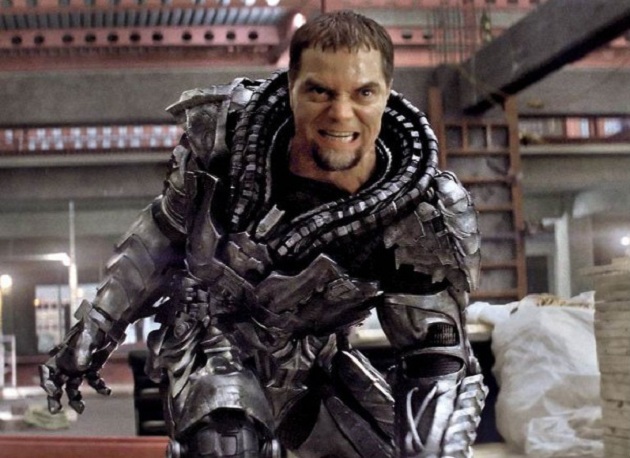 As the plodding action continued to pound me senseless, I was left to seriously ponder just how epic the scale of Superman’s collateral damage truly is. At one point, when Supes is fighting in the small-town center of Smallville, he tells the residents to, “Stay inside. It’s not safe.” What then proceeds to happen is a fight that rips up almost all the pavement in town, takes down a helicopter, a few fighter jets that crash in town, exploding, as well as a train car, plenty of ricocheting gunfire, and debris everywhere. But have no fear because those citizens stayed away from the windows and locked their doors! More than likely they are dead. The concluding clash in Metropolis is like 9/11 times eight. I counted three different skyscrapers that came tumbling down, and this is after the Krypton gravity field has ripped up the city and smashed it to dust, as well as missiles exploding around the city and Zod’s various spaceships. Then there’s the fight where Zod and Superman are blasting through just about every high-rise office building, and even when they collide outside it creates such force that buildings crater. They even fly into space, destroy a satellite, which then comes down as fiery debris that rains down on poor Metropolis. The final plan to foil the bad guys involves, get this, opening a black hole above a major city. It’s not like that sounds as if it will have catastrophic blowback.
The 9/11 imagery is unmistakable and I don’t care if it has been 12 years now. Couldn’t Superman at least react to the desolation he was causing? I really hope some enterprising soul via the Internet tallies the number of estimated deaths because I sincerely believe it would reach into the millions (Update: Ask and ye shall receive). Superman decimates the city and I thought less about the gee-whiz factor of the special effects and more about the innocent lives being lost amidst the CGI devastation. It looks like an atomic bomb went off. Perhaps a sequel will start with Lex Luthor rebuilding Metropolis.
And that’s the problem when you try and make sense of Man of Steel’s more realistic, grounded approach. This is a Superman that came of age in the 80/90s. While touches like young Clark experiencing sensory overload with his powers, like a scared autistic child, are clever and nice avenues toward relatability, you still have to square the more bombastic, over-the-top, and downright stupid moments that clash with that refined tone of greater realism. Nolan wanted Batman to exist in a recognizable world, so it makes sense that he and Goyer would attempt to do likewise with DC’s other champion. The prospect of an invincible alien among us is a potent source for some thoughtful and topical drama. It’s just not going to happen when Superman can demolish cities without blinking an eye or when anyone else fails to register the scale of this tremendous trauma. We don’t even have outside reactions or opinions to the earth-shattering revelation that we are not alone in the universe.
Then there are just the little things that annoyed me. Jonathan Kent dies in an effort to save the family dog. This comes off as lame, especially when Superman could save dad but has to hold back, per pa’s wishes, so as not to expose himself. Except, by the end, when the United States accepts Superman, doesn’t this invalidate all of Pa Kent’s worldview? If so, then the man died for nothing. Also, General Zod wants to transform Earth into Krypton. Except… on Earth all Kryptonians have godlike powers. Wouldn’t the man just want to keep that? Also, why does Zod never dispatch more than two Krypton lackeys to fight Superman? He has all these godlike warriors and decides to just keep them locked away in his spaceship. That just doesn’t make sense from a tactical standpoint. Also, Pa Kent tells his son to do his best to blend in, but in one scene bullies harass Clark as he’s reading from Plato. Yes, because your typical teenager can’t rip himself or herself away from the likes of Plato. Careful: Plato is a gateway read to Epicurus. Then there’s the overbearing product placement. Usually I give movies a pass if they’re not obnoxious with product placement; however, Man of Steel stages entire action sequences so we can get long-lasting looks at the logos for Sears, 7-11, and IHOP: “This callous destruction brought to you by the good (surviving) people at Sears.”
 Cavill (Immortals, TV’s The Tudors) sure has the look for the part. He’s appropriately bulky but because the role is too often inactive loner, always holding back, that makes his performance somewhat bland and more reticent than necessary. Part of this is also that Snyder has historically been a poor actor’s director. You can tell throughout the film as talented, Oscar-nominated and winning thespians like Crowe and Shannon will just give off deliveries, little tinny trills that clunk, moments that a director should have stepped in for. Shannon (Take Shelter, Premium Rush) is one of our best working wacko actors, but even he comes across as a bit too unrestrained and stiff, especially when he has to scream “I will find HIM” half a dozen times in a row. I thought Zod’s second-in-command played by German actress Antje Traue (Pandorum) had more personality and better moments. Adams (The Master, Trouble with the Curve) is a good choice for a plucky Lois Lane, especially one sharp enough to see through Clark’s disguise. The movie is packed with good character actors like Laurence Fishburne, Harry Lennix, Christopher Meloni, Michael Kelly, Richard Schiff, Mackenzie Gray, and two actors from Battlestar Galactica. That’s nice. The best actor in the movie is Dylan Sprayberry as teen Clark.
Snyder’s reworked Superman for our modern age just doesn’t cut it as popular entertainment. Its misshapen structure, heavy with exposition, doesn’t provide enough space for the characters to develop, and the general edict to make Superman an inactive loner on the fringes of society is a surefire way to keep an audience at bay. The CGI-heavy action sequences feel like they go on for an eternity, straining and struggling to keep your attention because the stakes fail to escalate or have consequences outside ridiculous amounts of collateral damage to rival the worst of Mother Nature. The over-amped sci-fi reworking tries to make a clean break from the demands of Superman’s mythology, and while some revamps work, most feel needless and ham-fisted, like Pa Kent’s somewhat pointless death. But the worst charge is that the movie is just too boring. I know people have levied this charge against Superman movies in the past, particularly the 2006 Singer film that I will still stand by my positive review for. Man of Steel is a good looking movie for certain, often a great looking movie, but all those pretty pictures are for naught because of a flawed approach and overindulgence with tedious action sequences. Given its box-office riches, I expect this Superman retread will garner the sequel that Singer’s film did not. I just hope the next chapter in the new adventures of Superman experiences a Dark Knight-level rise in quality.
Nate’s Grade: C+
Share this:

This Is The End (2013)
 There are three apocalyptic comedies this year and Seth Rogen’s This Is The End is undoubtedly the biggest in profile. The plot is simple: Rogen and his pals, Jonah Hill, Jay Baruchel, Craig Robinson, and Danny McBride, are holed up in James Franco’s lavish home while the world comes to an end outside. Your enjoyment level for this movie will largely depend on your enjoyment level of the cast since they are playing self-involved, idiotic versions of themselves. While it dithers with the occasional self-indulgent sidetrack, I found Rogen to be savvy about providing enough for an audience to invest in. There’s a slew of Entourage-style cameos, though mostly pre-apocalypse, to ease us into the film. It’s fun seeing Michael Cera and Emma Watson (Perks of Being a Wallflower) play against type, but there’s so many blink-and-you’ll-miss-them figures that it can be tiring. But once it rains fire, demons emerge, and the righteous are Raptured, the movie gets outlandish and even better. For a solid hour it’s a survival tale where egotistical actors are at one another’s throats and it genuinely gets funnier as it goes. The comedy is, as you would expect, completely vulgar but hilarious often enough. A shouting match between Franco and McBride over masturbation habits, complete with angry, enthusiastic miming, is a thing of comic glory. I was not prepared for how well Rogen and his collaborator Evan Goldberg (they wrote and directed the movie) are able to handle suspense, special effects, and a climax that is equal parts silly and heartwarming. There is a rewarding payoff to a character arc amidst all the talk about penises, human and satanic, and cannibalism, and that’s saying something. I only wish the ending had more punch, settling for an extended and mostly lame pop-culture cameo that seems to sap the good times. Still, if you had to spend the apocalypse with a bunch of guys, you could do worse.
Nate’s Grade: B
Share this:

After Earth (2013)
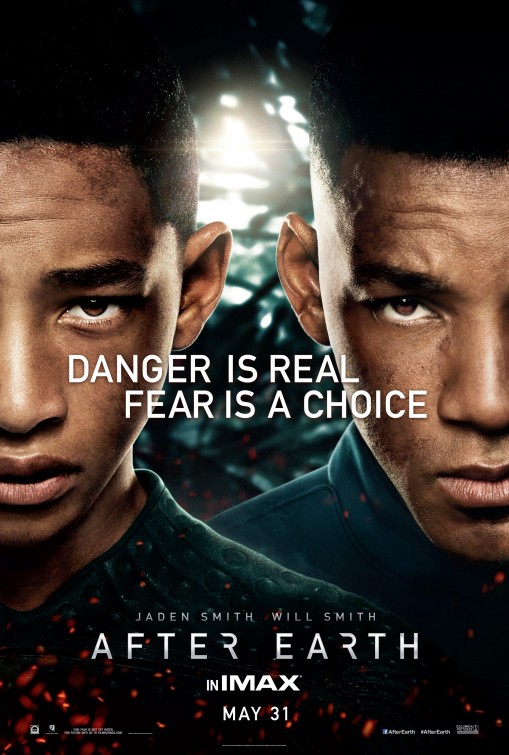 Rare is the movie that just seems to fail at every level of filmmaking, from writing to direction to pacing to casting to production design to logic to, well, you name it (perhaps the craft services were the exception to the rule). Director M. Night Shyamalan’s After Earth is one of those exceptional, big-budget passion project failures that just mystify on every account, making you scratch your head and wonder who could possibly be passionate about something this utterly terrible? I’m reminded of John Travolta’s 2000 sci-fi Scientology-ode, Battlefield Earth, for a comparison that comes close to approaching After Earth’s star-powered ineptitude (this movie also has plenty of vague Scientology references as well). While I doubt this will kill anyone’s careers associated, though it probably eliminates some good will for the Smith clan, it definitely piles more dirt on the grave that was Shyamalan’s film career. Enough preface, let’s get into the meat of why After Earth is one of the worst sci-fi films in years.
In a sloppy bit of exposition, we’re told that humans left planet Earth after we made it too unsustainable. The human race then colonized an alien world except that the indigenous aliens weren’t too happy about this. The aliens made a space monster, known as an Ursa, which would track and kill human beings by sniffing out their fear pheromones. Cypher Raige (Will Smith) rises in the ranks of the Ranger corps because he has the unique ability to “ghost.” Because the man does not register fear he is able to sneak around the Ursa as if invisible. His relationship with his teenage son, Kitai (Jaden Smith), is strained at best. Dad has been gone a long time and has high standards for his boy; the kid has to refer to him as “sir” even at the dinner table. Father and son are traveling through space when their ship crash-lands on good old Earth. Cypher’s legs are broken and he entrusts his son to make the trek to send out the distress call. The dangers of Earth, we’re told, have only magnified since humans left, and the Ursa onboard their ship has escaped.
Oh boy, where to even start with this one?
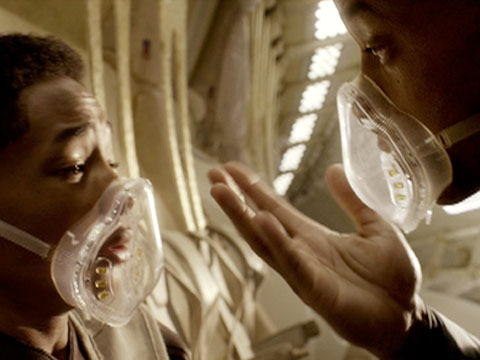 I’ve got a great idea, let’s take one of the world’s most charismatic actors and then turn him into a stone-faced hardass, terse with words of encouragement, and mostly sidelined so that his son can go on his stupid hero’s journey. I suppose Smith deserves some credit for stepping outside his comfort zone to play against type, but that praise only matters when the portrayal works. Smith is arguably miscast in his own passion project. That’s because this was really a $130 million dollar birthday present to his son, trying to use dad’s star power to establish Jaden as a star. It’s less a movie and more like a product launch. On its face, I don’t really have an issue with this. Nepotism has been alive and well in Hollywood for over 100 years and those in power have been producing vanity vehicles for their beloved for even longer. What I chafe at is that the finished product is so lacking and unconvincing. Jaden was cute in 2010’s The Karate Kid remake, a movie that was far better than it ever should have been. Unfortunately, After Earth came at that special time in his life known as puberty, so he gets his lanky, squeaky-voiced, awkward growth stage forever captured on film. Thus when he gets into a huff, squeals at his dad, and then become the world’s most improbable super warrior by film’s end, it mostly brings about snickers. You don’t buy a second of this character’s ascent to hero.
Let’s tackle the ultimate elephant in the room here, namely the involvement of Shyamalan. This is his first project he didn’t conceive; Smith himself came up with the story and personally hired Shyamalan. Who deserves more of the blame? There’s a reason why the marketing for After Earth has not breathed a word about Shyamalan’s involvement. In my theater, when the end credits appeared and it opened with Shyamalan’s director credit, the guy behind me remarked, “Well, that figures.” His sense of dissatisfaction now had a tangible culprit. It’s almost become a joke how much of a critical punching bag Shyamalan has become as a filmmaker. The man has genuine talent but it’s five duds in a row (I am counting The Village) and not even the world’s most bankable star could have saved this movie. As anyone who witnessed the atrocious Last Airbender can attest, Shyamalan is not a filmmaker who works well with a big special effects canvas. I’d suggest that Shyamalan, besides taking some time off, which may be a self-prescribed death sentence in Hollywood, find a smaller project to foster, perhaps something more personal and intimate. Nobody except the sadistic enjoys watching once-promising talents keep hitting a brick wall. Then again, people also dislike having to pay for terrible movies, especially when the director of said terrible movies keeps getting the opportunity to deliver more disappointment.
The plot, which Shyamalan is credited as a co-writer for, is so dull that I found myself almost falling asleep. You would think father and son surviving crash on a hostile alien world would be packed with survival thrills and excitement. You’d be wrong. It’s as if Shyamalan takes a page from Smith’s ranger character, and just goes about its business in the most thankless, ho-hum, undeterred manner. When we have characters that don’t react to the danger they’re in it has the misfortune of feeling less real, less urgent, and less dangerous. This was a problem with The Matrix films when Neo became a super being because then the stakes evaporated. It’s hard to sympathize with characters that don’t reflect the reality of their setting. With that said, so much of this script is just Kitai running off and running into different animals. He meets baboons. He meets a tiger. He meets an eagle. He meets a slug. Scintillating stuff. Such ambition. If this is what the execution was going to be like, why didn’t Smith and Shyamalan just make the planet an actual alien world? It would certainly open up the storytelling options. Or they could have gone in the opposite direction, setting this survival tale on a modern Earth. That would probably have made it much more relatable and resonant and also far cheaper.
 The character back-story is also woefully familiar and just as ineffective. Before it even happened, I knew that there would have to be some tragic personal history so that Kitai could overcome his past. We’re given some cringe-worthy moments of flashbacks to the family’s happier times, when Kitai’s older sister Senshi (Zoe Kravitz) was still alive. It’s a plodding and contrived plot device for the father to preposterously blame his son for, who was like seven years old at the time. I kid you not, during one of these oh-so-necessary flashbacks, Senshi tells dad she got a copy of Moby Dick and a boy let her hold it. Dad doesn’t get it, though I don’t know if this is meant to be some lame sex joke. This back-story is ladled in with no real logical connection to events. All of a sudden, Cypher will be thinking about his broken leg and then, whoosh, we’re thinking about Moby Dick.
There’s also the issue of its tenuous grasp on reality. I know this quality is a give-and-take depending upon the tone of the sci-fi film, but After Earth is so drearily self-serious that it becomes even more unbearable when it so clearly conflicts with credulity. This movie’s big message that it pounds into your head repeatedly is that fear is a choice, fear is not real, and that fear is a hindrance for mankind’s progress. This is nonsense. Fear is what kept our ancestors alive rather than trying to play with larger predators. Fearlessness is a great way for your species to end. You know an animal without fear? Lemmings. The fact that the movie has to literalize this conflict in the form of a fear-smelling alien monster is just beyond absurd. Let’s keep this literalizing-of-theme going; maybe next the aliens will fashion a monster that smells intolerance or illiteracy. Why are these aliens even genetically creating a monster to do their dirty work? If they have the superior scientific prowess to create a gnarly beast, I’m pretty sure they can take care of mankind. On top of this assertion, why would you make a beast that is effectively blind and only reliant upon one sense and then you limit that one sense to “fear”? Why not just have the alien monster smell human beings? That seems to make a lot more sense.
What also buggers my mind is the fact that, according to After Earth, everything on the planet has evolved to kill humans. First, I don’t think substantial leaps in evolution work in meager thousand-year spans; secondly, these evolved creatures are really just slightly larger versions of familiar animals, which doesn’t really make much sense either; and lastly, if humans have been off planet for a thousand years, how did these animals evolve to kill something they no longer have any interaction with? Then there’s the fact that the Earth drops rapidly into freezing temperatures overnight, for no good reason. How do all those plants survive? As an extension, Kitai’s super suit is just a prime example of a poorly developed idea that just as easily could have been abandoned. He has a special leotard that changes to his environment. We’ll watch it change colors though we’re never given any worthwhile reason why this is happening. However, Kitai’s suit will not shield him from Earth’s sudden temperature drops. So he’s wearing this super suit that adjusts to his environment… except temperature? If you’re going to present something all super scientific and then give it such obvious limitations, then you never should have introduced it in the first place. This is an ongoing theme with the film.
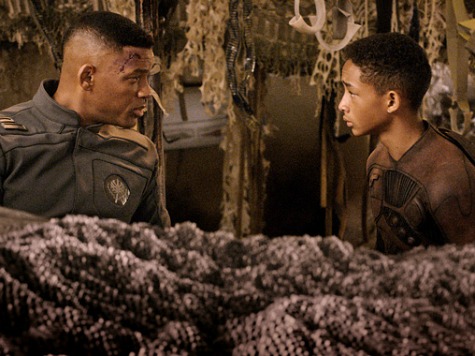 Then there are just nit-picky things like my total distaste for the production design of this movie. The spaceships look so chintzy. They have plastic flaps separating sections, like what you’d see in an office building when there’s construction. The spaceship interiors, as well as home interiors, also look like some bizarre mix of honeycomb and bamboo. I’m all for thinking outside the box when it comes to futuristic design, but this is just stupid. One of the great possibilities of sci-fi is to capture our imagination with out-of-this-world visuals, the unfamiliar, the spectacle of the alien. If your spectacle is good enough, it can even save a so-so movie, like last year’s Prometheus. Being stuck on Earth, only slightly different, emphasis on slightly, fails to deliver anything visually that will captivate an audience too often settling into boredom. Apparently After Earth looks pretty much like Earth except for Mount Doom popping up. The special effects are also lackluster and the score by James Newton Howard will try and trick you at every turn into thinking what’s happening onscreen is a lot more interesting than it is.
If you value your entertainment, please ignore After Earth. It doesn’t even work from a derisive enjoyment angle. The movie is lethargic and unimaginative to its core. It’s predictable at every turn and underwhelming throughout. The plot consists of the most boring father-son team in recent memory and a hero’s journey that feels false at every step. This big-budget star vehicle doesn’t work when its star doesn’t have the intangibles to be a star, nor does it help when the story is so poorly developed. The science feels boneheaded, the characters are dreary, the pacing sluggish, the spectacle clipped, and the world building to be bland. The shame is that this premise, even this exact same premise on a future Earth, could have easily worked as a suspense thriller. Smith seemed more interested in building an After Earth enterprise, since companion books were commissioned, and extending the reach of the Smith family empire. Making a good movie, it seems, was secondary. Being fearless also has its disadvantages.
Nate’s Grade: D
Share this:

Now You See Me (2013)
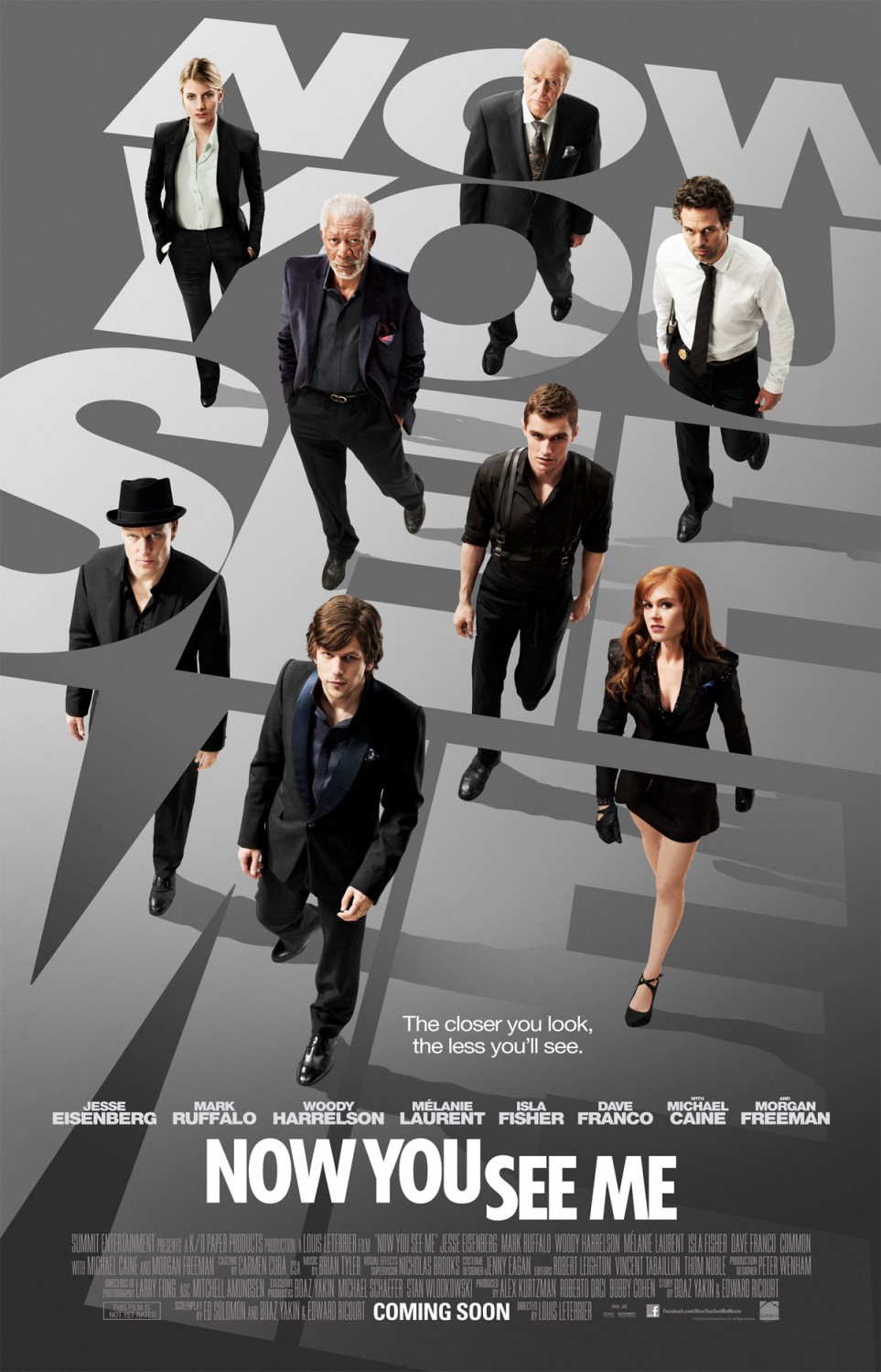 Everybody loves magic, right? At least the prospect of being surprised and delighted. Now You See Me takes something everybody loves (magic) and mixes it with a genre everybody loves (heist movie) and has already profited from the results at the box-office. Mix an ensemble of actors, though all of them white, and look over in this direction for a diverting, entertaining, and ultimately frustrating film that is too breezy to hate.
Four different magicians (Jesse Eisenberg, Woody Harrelson, Isla Fisher, Dave Franco) have teamed up to form a super team, The Horsemen, and they’ve taken Vegas by storm. A year into their reign, the insurance magnet and casino owner, Arthur Tressler (Michael Caine), is sitting pretty with his investment until the Horsemen turn their targets on him. With each new fantastic trick, the quartet fleeces the shady businessman of his money, returning it to wronged parties and the public at large. FBI Agent Dylan Rhodes (Mark Ruffalo) and Interpol Agent Alma Dray (Melanie Laurent) are tasked with finding the magical fugitives and figuring out their greater scheme. Just as one of the magicians notes, every time they think they’re one step ahead, they’re actually three behind.
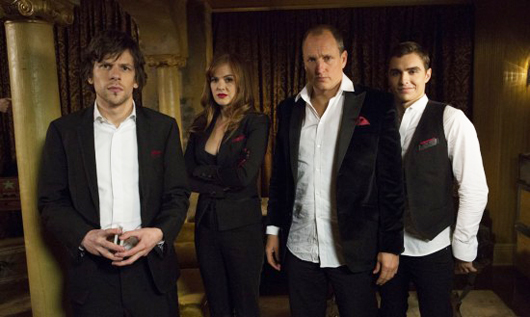 Let’s begin by admitting that the premise of a group of magicians performing heists is excellent. Seriously, on that alone I’d be hooked. Wouldn’t an Ocean’s 11-style movie about a group of magicians working a big score just be awesome? There’s so much fun to be had with such a breezy premise and for the most part Now You See Me lives up to its breezy potential. It works in segments, presenting a magical set piece, watching it unfold, and then unpacking it, sort of like a reverse heist sequence. It provides a bite-size moment of satisfaction, and then the movie goes off and repeats the process. The Horsemen elude the police and we start to get a broader sense of their aims, namely a slice of class warfare vigilante justice. There’s a genuine thrill to watching smart, talented types outfox their antagonists, and Now You See Me is no different. Under Louis Leterrier’s (Clash of the Titans) direction, the results are fast-paced, constantly shifting and surprising, and so cheery in tone that it’s hard to fault the movie for its lack of substance. Here is an example of a summer movie that’s just fun to watch. It taps into the desire we all have to be fooled, the same willful disbelief we process when watching magic or movies themselves, the modern artistic equivalent of magic. For a solid hour-plus, Now You See Me is a diverting and entertaining action thriller.
There are only a handful of traditional action sequences in the movie as most of the thrills are comprised of the illusions and some foot chases. I do want to single out a great moment, namely a magic fight where Jack Wilder (Franco) runs al over an apartment subduing police officers with magic. At first he relies on stealth to get the drop on them, but then the guy resorts to what is practically magic kung fu, using his sleight-of-hand to disarm his attackers. He then uses playing cards and flash paper at his disposal. I only wish that Rhodes, Wilder’s main adversary in the scene, tried to fight fire with fire, so to speak, and make use of the magical accessories in comical matters. The scene’s imagination reminded me of the final confrontation in Who Framed Roger Rabbit? where a selection of toon-specific tools were brought back for a unique showdown.
But with most magic acts, the good times start to fade once you find out how the trick is done. What hampers Now You See Me from being a stronger movie is a convoluted third act that goes to great preposterous lengths to explain the source behind the Horsemen. It’s pretty much who you’d assume it would be but I’ll still refrain from spoilers. Suffice to say, it’s an ending that doesn’t really work especially since it’s one of those reveals that makes you think back and question ordinary scenes. The movie muffs the landing, relying on twists to satisfy what was really just a high-concept heist movie. Another issue I had with the film is how quickly it marginalizes our would-be Robin Hoods of magic. After about the 45-minute mark, the Horsemen get sidelined as supporting characters and the movie is almost entirely told from the perspective of Rhodes. I understand there’s got to be some narrative discipline so that we don’t know the protagonists’ tricks before they perform them, but if I’m going to stuck with the dogged cop then make it his movie from the start. Compounding this problem is that the Horsemen, through no fault of the actors, barely register as characters. The actors are given one-note, and in the case of Fisher (The Great Gatsby) it was Woman, and that’s it. We see them as they perform their tricks and their daring escapes, but that doesn’t count as character development. In this regard, it’s less bothersome that these poorly conceived people get sidelined but then you stop and think that the only character you actually feel some interest in is Laurent’s Interpol agent.
 My suggestion for any possible future installments (Now You See Me Again? Now You Don’t?) is to focus more on our core team of magicians rather than their mysterious benefactor. I would also stress less time spent talking about The Eye of Horus or whatever through-the-centuries secret club of magicians the film was hinting at. I liked that, while completely elaborate and with endless fortune in preparation, that the illusions still had some tenuous foot in reality, that the magic tricks could be done in a somewhat recognizable world of ours (ignore the hologram junk). I strongly feel that even hinting about secret magical orders is just a step too far, breaking the film’s credulity, and taking what was fun and making it silly. I was worried before seeing the movie that the magic, as advertised, was going to be too supernatural. I was relieved that there wasn’t going to be a late reveal where some character rolls their eyes, probably Eisenberg, sand says, “Well, yeah, magic is real. Stupid.” When you’re playing around with larger-than-life figures that deal in theatricality and misdirection, I think it’s paramount not to get too carried away, failing to ground your movie for the audience.
If you’re looking for a fun time out at the movies, Now You See Me will serve its purpose well enough until it begins to fall apart by the end. You may find yourself looking back and the earlier mystery and thrill of the unknown will dissipate upon reflection, leaving you with little. It’s fun while it lasts but when it’s all over you’re left with substandard characters and an overly convoluted plot that doesn’t satisfy in the clinch. Magicians-plan-heist is such a juicy premise that I hope someone else makes better use of it. I would still love to see that movie, only well developed and giving me characters to actually care about. Now You See Me is as substantial as a magic trick itself but it’s an inoffensive, carefree, and mostly fun ride at the movies, though I think so much more could have been done with this concept and this budget. For a $75 million dollar magic trick, I want a better result.
Nate’s Grade: B-
Share this:

Frances Ha (2013)
 Noah Baumbach is a filmmaker I generally don’t care for. I quite enjoyed his first feature, the college comedy Kicking and Screaming, and his co-authorship of Wes Anderson’s Fantastic Mr. Fox was a worthy venture. But I normally associate such unrepentant misery with this guy’s movies, chiefly because they’re generally about miserable people being miserable (The Squid and the Whale, Margot at the Wedding, Greenberg). I was surprised then when his new movie Frances Ha got ringing endorsements from several of my trusted female friends, the kind who would not cotton to Baumbach’s usual pedigree of filmmaking. I took the plunge and was captivated by the shrewd, funny, and surprisingly affectionate portrayal of a twenty-something woman finding herself late (ish) in life.
Frances (Greta Gerwig) is an apprentice for a dance company in New York City waiting her turn at much in life. She’s waiting for her post-college life to fall into place; however, her world gets shaken up when her roommate and best friend since college, Sophie (Mickey Sumner), moves out. The distance grows beyond physical proximity and Frances feels like she’s drifting away from her closest friend. In the meantime, she sputters trying to become an adult herself, swapping roommates and living conditions, and getting into trouble with guys, money, and Sophie.
 While a bit freeform in its plot momentum, Frances Ha is a perceptive and ultimately poignant film exploring female friendship dynamics and the perils of growing up. Frances is something of an adorable mess but she’s been treading water for some time, bouncing around, but her window for avoiding the adult world is coming to a close and she knows it, which is why she feels the anxiety that she does. There’s something completely relatable about the anxiety of entering into the “adult world,” and yet it’s a transition we must all endure. Frances, now 27, has put it off as long as she could but even her “other half,” Sophie, is making the transition, and with it growing apart from her BFF. Frances may be living in New York City but she hasn’t had a charmed existence, the kind of hipster nouveau rich experience we see detailed in Lena Dunham’s Girls (a show I genuinely enjoy, though the second season was a bit iffy). When Frances is out on a date, an event she engineered because she just got her tax return, she discovers she has to pay in cash. She then runs several blocks looking for an ATM. When she finds one she stands in great deliberation at the screen. She’ll incur a $3 fee for withdrawing. When she returns, she apologizes to her date, saying, “I’m sorry. I’m not a real person yet.” Despite these economic bearings, she makes impulsive decisions but pays for them. A spontaneous weekend getaway to Paris, which she spends most of it sleeping or moping, results in Frances working back at her alma mater in a menial fashion.
There’s also Baumbach’s signature dark humor that follows Frances like a dark cloud, her life regularly a series of more downs than ups. However, Baumbach’s caustic sensibilities have been sanded down, perhaps thanks to co-writer/girlfriend Gerwig’s involvement, and the movie adopts a tone less scabrous and more knowing. It doesn’t position us to laugh at Frances as a self-involved moron who makes poor decisions; we’re laughing from the standpoint of perspective. I noticed little judgment (when she says “my friends make fun of me because I can’t explain where my bruises come from,” I thought of a few female friends in my life who could relate). Not much goes right for Frances through the duration of the movie, but by the end she appears to have come out the stronger. She’s got the beginnings of her entrance into the adult world and the movie leaves the impression that she’s going to be okay. I appreciated that she didn’t abandon her passion with dance as if becoming a grown-up meant stepping away from what you care about. That concluding uplift provides a reward for the audience and Frances after so many missteps and struggles. There’s a tenderness here that’s refreshing for Baumbach.
I also thought Frances Ha was a very insightful and interesting look at female dynamics, something that rarely gets such a thoughtful and high profile examination. Friendships, especially those between women, can function like romantic relationships when it comes to intimacy, minus the sex. Frances and Sophie comment that their relationship is like an old lesbian couple that has stopped having sex. They are each other’s other half, attuned perfectly to one another’s peculiar sensibilities. When Frances tries to recreate these sensibilities with another woman, she responds in annoyance. At the very beginning, Frances gets into a fight and breaks up with her boyfriend all because he wanted her to move in with him and thus away from Sophie. We feel her grief then when this important person, this long-standing friend that Frances has defined her own sense of identity with, is moving on and moving out. We’ve all had those people in our lives whose personal successes force us to reflect upon our own life trajectories, and we may grimace. It’s an unavoidable part of growing up but our relationships will alter and the people important in our lives will fluctuate, many times through no fault to either party. Frances and Sophie are at that crossroads as Sophie settles down with a career and an emerging and serious relationship, while Frances is sputtering and trying to hold onto the past. The end even borrows a literal nod from 2011 Bridesmaids, one of my favorite films of that year. Frances yearns for a love that is so powerful so transcendent, that all it needs is a look, a silent nod of communication that both parties share, invisible to all others. It doesn’t take a genius to infer that this look will be between Frances and Sophie by film’s end.
 Gerwig (Arthur, To Rome with Love) has been an up-and-coming It Girl for some time in Hollywood, rising in the ranks of mumblecore cinema and becoming a muse for Baumbach. Frances Ha is tailor-made to her amiable strengths; the woman is easy to fall in love with. Watch her skip and dance through the streets of New York, set to David Bowie’s “Modern Love,” and try not to smile. Gerwig has a natural, easy-going charisma and a screen presence that grabs you. Her cheerful, unmannered dorkiness grounds Frances’ vanity, making her far more relatable and worthy of our rooting. France sis no mere Manic Pixie Dream Girl sketch of a woman; here is a three-dimensional figure for the taking. Gerwig also has fantastic chemistry with Sumner (TV’s The Borgias), daughter of Sting. You instantly get a feel for the history these two have shared with their relaxed interactions. And speaking of HBO’s Girls, Adam Driver, a.k.a. Adam, has a substantial supporting role and another Frances Ha actor, Michael Zegen (TV’s Boardwalk Empire), will appear in season 3. Small world.
Frances Ha owes as much to the French New Wave as it does to the observational mumblecore movies of Gerwig’s early roots. Here is a film that’s perceptive, dryly funny, poignant, and relatively lovely in its quieter moments of everyday life and relationships, rich with feeling. It’s angst and ennui without overpowering self-absorption. Your ultimate judgment is going to rest on your opinion of Gerwig and the Frances character, but I found both to be charming and easy to relate with. We want this woman to land on her feet, find her place in the world so to speak, but the movie refrains from casting condescension. Frances isn’t stupid; she’s a bit naïve and a bit impulsive and oblivious, but this woman is also hopeful, passionate, persistent, and a good person at heart. Losing her closest female friend is akin to the worst breakup of her life. She’s sputtering to redefine herself, to find traction with the adult world she knows she cannot hold off any longer. In that sense, Frances Ha is also a winning look at late-bloomers. It’s Baumbach’s best film since Kicking and Screaming and one of the best films of 2013 thus far.
Nate’s Grade: A-
Share this:

The Hangover Part III (2013)
 I was no huge fan of the first Hangover movie and I cited its 2011 sequel, a carbon copy of the original, as one of the worst films of the year. The supposed final chapter ditches the blackout formula, which on its face seems like a step in the right direction, but now we have a Hangover movie with no titular hangover and at heart this is a movie for no one, even hardcore Hangover fans. I became quite cognizant how little I was laughing, not just because the jokes were badly misfiring, which they were, but also because there were so few jokes. You’d be hard-pressed to label this a comedy. It’s really more of an action thriller. What humor does arise is usually mean-spirited, curdled, or just off-putting, particular the reoccurring theme of animal cruelty (maybe opening your film with a decapitated giraffe is not the best idea). The other major hurdle is that annoying supporting characters played by Ken Jeong and Zach Galifianakis are elevated to co-leads. Both of these characters are best when reacting to others rather than being the main actors in the story. This movie is so abysmal as a comedy that you start to think director Todd Phillips should try his hand at a straight action thriller; the guy has a strong eye for visual composition. The actors all look extremely bored. Could Justin Bartha, the character who always gets sidelined, just get murdered and they have to hide his body? Oh no, I think I just came up with The Hangover 4. I apologize already.
Nate’s Grade: D
Share this:

What Maisie Knew (2013)
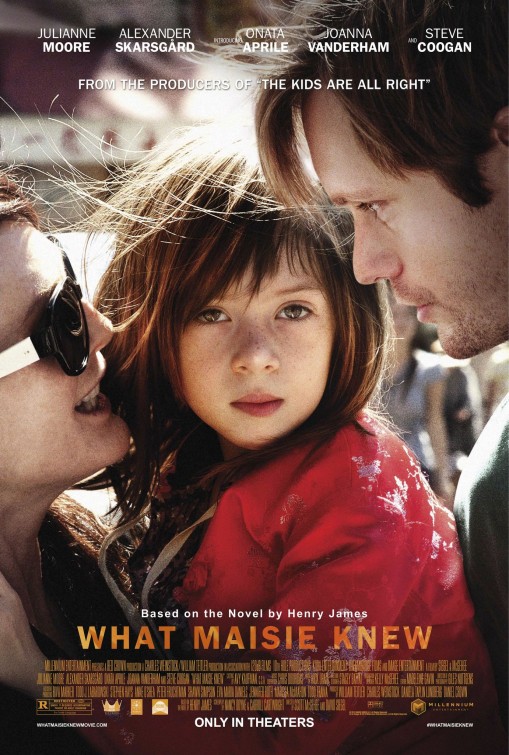 Did you know that What Maisie Knew is based on a novel by Henry James that was published in 1897? I sure didn’t, but then again my knowledge of Mr. James is somewhat limited. James’ tale of negligent parents passing off their daughter back and forth was controversial when the novel was first published. Updated to modern-day New York City, seven-year-old Maisie (Onata Aprile) is the pawn in her parents’ contentious divorce. Her father, Beale (Steve Coogan) is an art dealer who is constantly on his phone and making out-of-country trips. Her mother, Susanna (Julianne Moore), is an aging lead singer for a 90s alt rock band who also likes to party. Beale remarries Margo (Joanna Vanderham), a young woman who previously served as Maisie’s nanny. Not to be outdone, Susanna remarries Lincoln (Alexander Skarsgard), an affable bartender who’s somewhat clueless around kids. Everyone is trying to navigate the tricky new relationships and what they think is best for Maisie, though Lincoln and Margo seem to be the only ones who actually care.
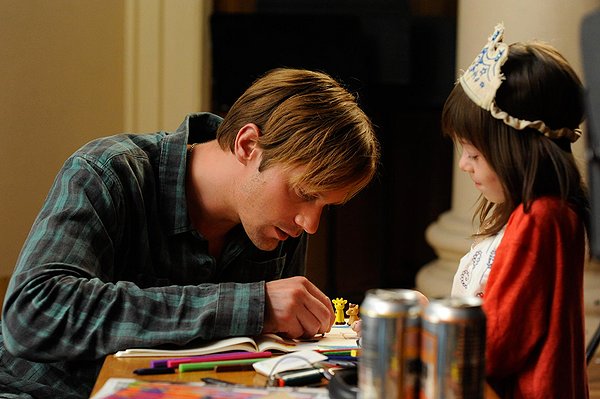 When it comes to divorce dramas, the easy way is to go big, to ramp up the emotions of such an emotionally distraught experience, and to tip into the overwrought territory of melodrama. I can already imagine the animated shouting fests and crying fests. Then there’s the impulse to go the bitterness route, like 2005’s The Squid and the Whale, where the movie takes a cue from its feuding parents and infuses the film with a dark, overpowering sense of acrimony. I credit directors Scott McGehee and David Siegel (The Deep End, Bee Season) for making arguably one of the most subdued movies about divorce I’ve ever seen. It’s certainly not flippant in the slightest, treating the subject, and mainly the toxic effect on Maisie, with sincerity and good taste. But as far as overblown shouting matches, they’re kept to a minimum and mostly comprise the first fifteen minutes of the movie, establishing the inevitable divorce of Susanna and Beale. The movie ignores the sensational and focuses on the ordinary, little moments of complete believability that serve to build, like brick by brick, the overall reality of the story. You’ll watch the film and think to yourself that, even with parents with completely outlandishly rich professions, that everything in this movie could realistically happen. Weird to think that James wrote his tale over 100 years ago and yet how relatable his conflicts still are to this day. However, because of this subdued, naturalistic approach, What Maisie Knew can’t quite find a proper ending. The one presented seems a tad too pat and tidy for this movie. It almost approaches a“happy ending,” though not quite. Still, knowing how thick-skulled both Susanna and Beale are, it’s hard to think that they will ever come to their senses and do what’s in the best interest of Maisie.
This can be an uncomfortable movie to watch because Maisie’s mom and dad are so destructively neglectful and self-involved. There’s a perverse rubbernecking draw to seeing the antics of truly awful parenting. You’ll find yourself getting very mad at how terrible these people are at being human beings. Susanna and Beale interrogate their daughter for ammo they can use against the other, twisting and manipulating the kid that we wonder if either truly cares about. Dad’s always full of excuses and mom’s looking to flee from responsibility at a moment’s notice, dumping her daughter on her latest boyfriend. You’ll find yourself easily sympathizing with Lincoln and Margo, the two people who love Maisie most and would make the best parents for her. I began rooting that they just abduct Maisie and start a new life as a family in a different country. The unchecked narcissism of both Susanna and Beale could serve as a clinical study. It’s a wonder that Maisie seems like a bright, playful, and relatively normal kid. For now.
Another aspect of McGehee and Siegel’s joint direction that I really enjoyed was how the movie takes on the perspective of little Maisie; she is our eyes and ears, and often the camera framing will instinctively mirror her own point of view, cutting off adults. It’s an interesting visual approach but it also further tethers us to this girl, forcing us to think even deeper about Maisie’s perspective, and how she’s interpreting the angry words. I suppose there is a valid argument to be had that a seven-year-old child is going to be a rather limited perspective on such a contentious conflict. There’s also the nature of Maisie. She’s a relatively quiet child, given to poking her head around corners and staring with those big glassy eyes of hers. Given the fact that she’s a child, and processing a painful life experience, don’t expect her to divulge too much about her thoughts and feelings. She’s an opaque presence and I realize that that can get frustrating for some. She’s not the kind of kid that’s going to burst into tantrums. This girl is internalizing all the pain and confusion. Having a passive prism for your movie might be akin to telling a love story from the point of view of a potted fern. Literally anchoring the camerawork to Maisie (I don’t want to oversell this as if it’s a stylistic gimmick) forces us to constantly think of every action through its impact upon Maisie. It’s not exactly a coming of age or loss of innocence tale but more a combination of the two.
 If you’re going to have a child be the star of your movie, you better choose wisely. I’ve found that as I grow older I have less tolerance for poor child actors. Perhaps it’s my inner Scrooge. Good thing that little Aprile (Yellow) is so effortlessly heartbreaking as she tries to find her way amidst her changing home life. One day she has a mom and dad, then she’s splitting time, then her daddy has a new mommy, who happens to be her old nanny, and then mommy has a new husband as well (Susanna admits she got remarried simply to improve her court standing). Aprile nicely underplays her character’s innate vulnerability while still reminding you of her youth. She’ll get scared and ask to go home, crying alone in her bed, and your heart will ache. I cannot say whether the strength of Aprile’s performance lies more with her legitimate skills as an actress, good direction, or the general reticence of the character, and thus the lesser demands for a child.
Moore (The Kids Are All Right) and Coogan (The Trip) give surprisingly textured performances, at least more so than the opening fifteen minutes would have you believe. They can both be monstrous and callously indifferent to their daughter’s well being, but as the movie concludes, each one of them has a small moment where they realize the damage they are inflicting upon their child, how poor a parent they have been (Susanna even lashes out at Lincoln’s encouragement to Maisie as “undermining her as a parent”). It’s much more than I was anticipating and both actors do good work at being unlikable without going overboard. Fans of TV’s True Blood might just swoon a little harder thanks to Skarsgard’s good-natured, humble, and mildly affecting performance as a man who becomes profoundly attached to Maisie. He may not know what he’s doing but isn’t that parenting as a whole? Skarsgard and the charming Vanderham make a great onscreen pair and their genuine affection for Maisie provide the most uplifting moments.
When it comes to parenting, there are no magic instructions to insure a responsible, loving, thoughtful, and independent human being. It’s a leap of blind faith. However, it’s much easier to predict the events that can screw up an impressionable child (do not misconstrue this as my declaration that children of divorce are, at heart, broken somehow). The thought of collateral damage is fresh in our minds as we track little Maisie trying to survive the reach of her terrible parents. The terse arguments can be painful but even more painful is the overall negligence of her rich and mostly absent, self-involved parents. What Maisie Knew isn’t a downer of a movie and its subject matter is given proper seriousness and reflection. You’ll likely cringe at points, may even grumble under your breath, but in the end it ends on a hopeful note, the possibility that Maisie, under the right guidance, could turn out to be the bright kid we see glimpses of at her school. There’s something quite moving about the resiliency of a child. This is, of course, just one interpretation of the movie, but What Maisie Knew is an emotionally engaging, subdued, sincere, and poignant film that trades on naturalistic waves of human interaction rather than cartoonish bluster, all the while forgoing cheap sentimentality or unpleasant bitterness. For the performances, the deft handling of sensitive material, and the quality direction, give What Maisie Knew a chance when able.
Nate’s Grade: B+
Share this:

Pitch Perfect (2012)
 Take the plot of Bring it On, add remixes and mash-ups of popular music thrown through the Glee grinder, Rebel Wilson’s adlibbed one-liners, and shake, and you have Pitch Perfect, an a cappella singing comedy that was a sleeper hit last fall. My female friends raved about it. It’s from a 30 Rock writer. It’s from the director of the irreverent musical Avenue Q. I like Wilson and the movie’s star, Anna Kendrick (Up in the Air). I wanted to like it, and while I found most of it passably cute, I could not get too attached and the chief reason was Kendrick’s character. She’s so surly and standoffish and just plain bratty, and for no good reason. It gets really annoying. Her rote romance with a bland hunky guy is made even more incredulous because Kendrick, get this, hates movies. Not certain kinds of movies or movies with certain actors, just the entire medium. Who is like this? That’s like disliking all of music entirely. The overall comedic spirit of the movie is amiable with a few oddball touches that keep things interesting, notably one girl who talks very quietly and says outrageous confessions. Listen well. The performance segments are impressive in their own right enough so that I wish there were more of them. There’s also a level of reality to projectile vomit that I was not prepared for. Overall, Pitch Perfect is a fitfully amusing comedy that never really settles down a functional tone, and Kendrick’s bratty character drags the movie down. It’s far from perfect but depending upon your love of a cappella, it could be good enough.
Nate’s Grade: B-
Share this:

Fast and Furious 6 (2013)
 I’ll confess something upfront: I have no interest in cars whatsoever. Never have. I don’t care. Seeing sexy cars with their gleaming and purring engines, well it does nothing for me. Hearing people talk about American vs. import or different engine capabilities, well it puts me to sleep. I get no thrill from cars alone. What I do get thrills from are when the cars are utilized in exciting action sequences that are well developed. I enjoy the role the cars play rather than the mechanics of the cars themselves. I’ve never watched a full Fast and Furious movie until the 2009 sequel, the fifth, which added notable franchise-lifter The Rock. I was won over by the wow-factor of director Justin Lin’s bombastic action. This is not a franchise for me from the gearhead content; however, I have become a fan thanks to the talents of Lin, the inclusion of my man crush The Rock, and some truly spectacular action set pieces. Fast and Furious 6, or Furious 6 as the onscreen title declares, is pretty much everything I thought it would be: dumb, loud, physics-free, and boasting remarkable action sequences, and it delivers.
It’s years after Dom (Vin Diesel) and Brian (Paul Walker) and their crew pulled off their epic heist in Rio. Hobbs (Dwayne “The Rock” Johnson) recruits Dom’s team for help nabbing a really bad guy with his own really bad team. Owen Shaw (Luke Evans) is a military-trained Brit who is hijacking advanced weapon parts to put together a super weapon that can knock out the power grid for a country. Dom’s ready to turn down the offer, content to live it up in paradise, when Hobbs shares a photo of Letty (Michelle Rodriguez), alive and well, and part of Shaw’s wrecking crew. Letty, Dom’s old squeeze, was thought dead, but it turns out she has amnesia, and Dom is determined to foil the bad guy and reclaim his girlfriend.
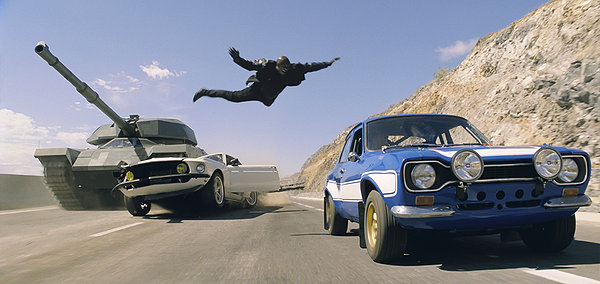
 When I say Fast and the Furious 6 is a ridiculous movie in the extreme, I mean that as a compliment and a detriment. The movie never attempts to be anything outside of a loony, high-octane action thriller that gleefully ignores reality. Characters will fly off cars at great speeds, crashing into parked motor vehicles as “safe landings.” Brian will get himself thrown in the same prison as a notorious criminal, gather his needed intel, and escape all within a couple of days. The bad guy’s plan is also one of those only-in-the-movies super weapons. For goodness sake there’s even the hoariest of plot devices – amnesia. Really, Letty can’t remember anything. How prevalent is amnesia? Movies make it seem like it’s one Flintstones-style bump on the head away. Then there’s the massive amounts of wear and tear the heroes take on, their cars take on, and in general their superhuman status. But anyone expecting these films to adhere to a recognizable reality, especially after five movies, is adrift. Part of the appeal of the franchise is exactly its over-the-top lunacy with its action.
Having only really checked into the franchise one movie prior, I’m sure that there are plenty of moviegoers who are wrapped up in the ongoing saga of Dom and Brian and their motorin’ crew. I didn’t care about the characters; well, I generally liked most of them in an abstract way, but I was never that involved with them. I enjoyed The Rock’s character the most but that is also due to the innate magnetism of The Rock, someone Diesel could take some serious notes from. I say all this because there is a lot of time spent on the ongoing character relationships between Dom and his amnesiac love, Letty. He’s trying to pull her back, reminding her of the memories he thinks are tucked away, and they talk and drive and talk and I was bored. Perhaps if I had four movies worth of investment I would care more, but I don’t. Then again, we’re talking about a romance between Diesel and Rodriguez, both fine genetic specimens, but neither of them are what you would call gifted thespians outside of their defacto tough guy roles. The rest of Dom’s team are given throwaway bits, though even with those meager offerings Tyrese Gibson (Transformers) comes close to wearing out his welcome as a nagging naysayer. The multiracial cast is so large that it makes it hard for any of them to actually develop as characters. Plus, this movie provides a matching evil cast that doubles the number of characters.
Ignoring all the dumb plot points and repetitious messages, when it comes time to unleash some top-draw action, that’s when Lin earns his mettle. The man has guided the franchise through four sequels ever since 2006’s Tokyo Drift, which dovetails with the timeline of this film in a surprising way (did you know these were prequels and not sequels?). I can forgive all the lapses in logic and physics when I get action sequences so good I don’t want to blink. The last two extended action set pieces in Fast and Furious 6 are stunners, massive, constantly evolving, and ridiculous in the best ways possible. The first is a freeway chase involving a tank and along a coastal Spanish highway high above cliffs. The phrase “freeway chase involving a tank” should immediately put a smile to your face. There is such over-the-top vehicular carnage, all along a trepidatious path, and the pacing just keeps things fully amped. The finale involves a giant military aircraft and a seemingly endless runway (seriously, this thing has to be like 80 miles long). Dom and his team are driving cars inside the plane, out of it, zipping around, snagging wings, being carried off with the plane; it’s a glorious sequence that involves multiple points of action, different team members, and develops organically while still escalating the awesome. Lin handles these sequences like a pro. I’m tempted to say that the greatness of these concluding action set pieces is reason enough to see Fast and Furious 6 in the theater on the big screen.
 I’ve never really understood the appeal of Diesel (Babylon A.D.). I felt like I was asleep when it was decided that he had become a major action star. I don’t get it. The man grumbles just about every line of dialogue into an almost indecipherable growl. He also has the habit of getting very quiet when he’s supposed to be serious, thus making it even harder to understand what the guy is saying. I know at this point Diesel is a package deal with the franchise, but I wouldn’t mind if the far more charismatic Johnson (Pain and Gain) were to slide over and replace him as lead. Rodriguez (Battle: Los Angeles) seems to have a habit of dying in franchises and being resurrected (see: TV’s Lost, Resident Evil 5). The rest of the franchise players do their parts well enough with what little they have. Evans (Immortals) makes for a suitable sneering if forgettable villain. My favorite new actor is Gina Carano (Haywire), not necessarily because she’s a great actress, though she’s better than you’d think for an MMA-fighter-turned-actor, but because this woman is a born movie star. She’s got screen presence, a fierce look, and the lady does her own stunts. She is an impressive beast of an action star and hopefully somebody will get her the right project to make her break out big time (Haywire wasn’t it, folks).
While I prefer Fast Five, a more fun flick where the team play their parts in a convoluted but entertaining heist, Fast and Furious 6 is a highly enjoyable summer movie with some top-class action sequences. This franchise is the epitome of the popcorn thriller, its vaunting heights of ridiculousness also its most laudable quality. Six movies in, I imagine most moviegoers know what they’re getting with this franchise and they must like it because every sequel seems to outperform the last at the box-office. The formula of fast cars, sexy ladies, and hyperactive action make for a surefire, turn-off-your-brain summer spectacle. Lin has a real knack for directing large-scale destruction that’s easy to follow and easy to get caught up in. He has a strong tentpole mentality and I imagine he will be tapped to helm some other big-budget action picture. Whatever it is, his involvement guarantees my interest. I don’t know about Fast and Furious 7, scheduled to come out speedily next summer. Lin is being replaced by James Wan of horror fame, notably Saw and Insidious (his DePalma-esque work on 2007’s Death Sentence was actually striking). Considering Lin made one feature before jumping into Furious mode, a small indie crime drama, I won’t discount Wan’s potential, but I’ll miss Lin all the same. In the end, the director could be just as interchangeable as any other part of this franchise as long as it sticks to its tested formula and delivers the goods when it comes to ridiculous action.
Nate’s Grade: B
Share this:

The Iceman (2013)
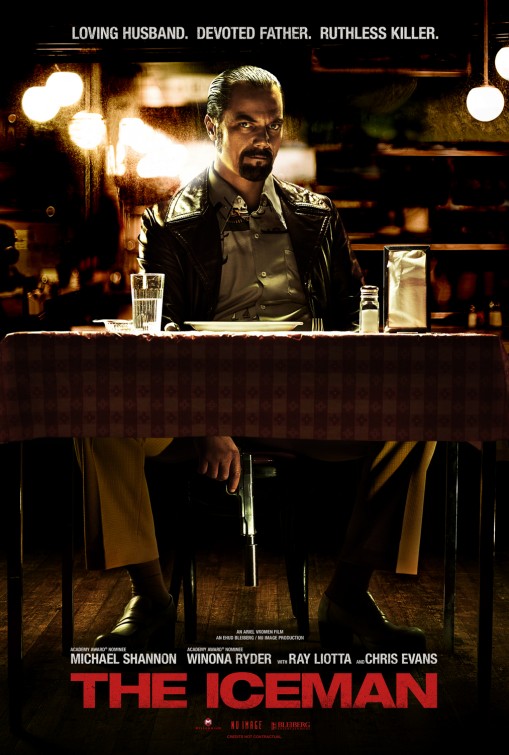 We’re fascinated by hired killers. Chalk it up to morbid curiosity or perhaps perverse, secret wish fulfillment, but we’re all titillated a tad by the murderous for hire. The Iceman is all about Richard Kuklinski (Michael Shannon), who worked as a contract killer for the mob from 1966 to 1988. He’s estimated to have killed over 100 people. A mob middleman (Ray Liotta) is impressed that Kuklinski shows no fear with a gun in his face, and so the guy gets hired to rack up the bodies. At the same time, Kuklinski has a wife (Winona Ryder) and two daughters, all of whom have no clue what daddy does for a living until he’s finally brought to justice.
The main issue at play with The Iceman is that it’s trying to draw out a character study for a rather impenetrable person. It’s hard to get a solid read on the character of Richard Kuklinski. The compartmentalizing of these two very distinct lives is a fascinating psychology to explore, one I wish the filmmakers had spent a majority of the screen time upon. The internal justifications, struggles and compromises would make for an excellent and insightful look into the psychology of killer rationalization. However, I don’t know if this movie would even be possible from this subject. Kuklinski is by all accounts a pretty detached guy. There just doesn’t seem like there’s a lot to him. His circumstances are interesting, beaten into an emotionless cipher by his father, brother to a fellow sociopath, and trying to make a reasonable life for himself while keeping his inner urges at bay. The sociopath-tries-to-make-good storyline is reminiscent to fans of TV’s Dexter, and there’s plenty of room to work there. It’s an intriguing contradiction, the man who cares for so little protecting his family. In the end, we don’t really get a sense of why beyond the illusion of the American Family that Kuklinski wants to hold onto, to make himself seem normal, to prove to his family he could break free from their influence. Even typing this I feel like I’m giving the film more depth than it actually illustrates. Even though he tries to play the part of devoted family man, we rarely see any evidence of devotion. He provides, yes, puts his kids in private school, but he puts his family at risk and doesn’t seem to have affection for them as much as propriety. They are his things and nobody will mess with them. Your guess is as good as mine if he genuinely loves any of them.
 Too much of the film gets mired in standard mob clichés. This guy upsets that guy; this guy wants the other guy dead. It all becomes the focal point of the movie, Kuklinski getting caught up in, essentially, office politics. Even the true-life details of the grisly methods of death feel like wasted potential for a better story. He goes on a job, he botches a job, he gets let go, so to speak, he strikes up a new partnership with another contract killer, Mr. Freezy (Chris Evans in a bad wig). That last part could have been a movie unto itself, watching an odd couple of hitmen plan, execute, and then dispose of their targets. The Iceman nickname comes from their process, freezing the dismembered corpses for months so that coroners cannot get a read on when the bodies were slain. While Evans is entertaining, this entire portion of the movie could have been eliminated, its bearing on the plot minimal. Likewise, the movie has several small roles populated by recognizable actors, which become a series of one-scene distractions. Kuklinski goes out on a hit and it’s… James Franco. Then there’s Friends actor David Schwimmer as a sleazy, ponytailed, nebbish mob screw-up. Stephen Dorff has one moment as Kuklinski’s angry, desperate, murderous brother in prison. The actors are all fine, with the exception of Franco, but many of them are just another reminder of the film’s disjointed attention.
I mentioned in Pain and Gain the notion of portraying true-life criminals as sympathetic figures, and the queasy nature of this complicit interpretation. The Iceman never really tries to make Kuklinski sympathetic or some form of an antihero, and I think the movie is better for it. One of the earliest moments in the film is Kuklinski slitting the throat of a guy who harassed him and defamed his lady. This is BEFORE the guy is even hired as a contract killer too. It seems like when the guy can’t murder he becomes a worse family man. Even in the end, he’s testing a new batch of cyanide on the neighborhood cat. The movie presents Kuklinski as he is, though you’ll be forgiven for feeling some initial pings of sympathy when you seem him try and protect his family. Granted his family could also very well use protection from him.
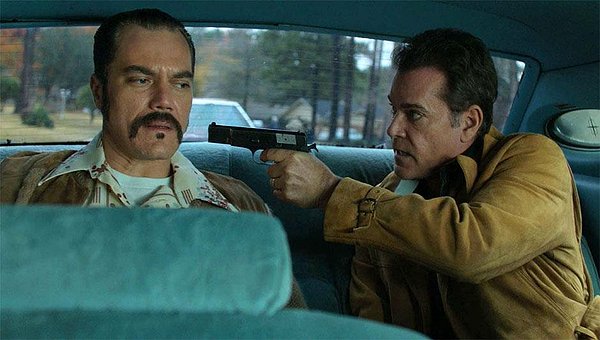 Shannon’s (Premium Rush) performance is what keeps you watching. There are few actors who are as intense as this guy, though I’m used to seeing him play unhinged psychos bouncing off the walls. Kuklinski is just as troubled as his other roles but he’s all reserve, steely nerves, and anger that eventually bubbles over into violent rage. Shannon is still such a good actor that even with a thin character, or at least thin characterization, he can be completely compelling to watch onscreen. One of the more peculiar, inconsistent elements of the film is Shannon’s constantly-changing facial hair. I think I lost count at about nine or ten different facial topiary variations. There were times where it will be different in consecutive scenes. I guess that’s a tipoff of a time jump, but his morphing, period-appropriate facial hair also became a point of amusement.
What makes The Iceman so disappointing in retrospect is how much potential it seems to squander. There’s a great story to be had with a contract killer by night and a family man by day. That contradiction, the struggle, the psychology is all rich material to work with. It’s just that Kuklinski is not necessarily that guy; he’s not too deep, at least not in this version, and his killer work problems are just not that compelling. If this is what the filmmakers were going to do with their real-life subject, then they might as well have just used Kuklinski as inspiration. Take the best parts and then compose a different lead character, someone more emotionally transparent or relatable or just plain old interesting. Just because it’s a real story doesn’t mean you’re indebted to telling every true facet of it, especially when a better story is within sight. Shannon is a terrific actor and does his best to make the film worth watching, but from distracted plotting to unmet analysis and emotional exploration, it’s hard to walk away from The Iceman and not feel a bit chilly.
Nate’s Grade: C+


 nathanzoebl
You must be logged in to post a comment.