Star Trek Into Darkness (2013)
J.J. Abrams’ return to the final frontier had me extremely excited for what the sequel to 2009’s smash Star Trek would be. It’s a different sort of Trek, a more rough-and-tumble, popcorn entertainment with the recognizable flavor of that other famous space opera that Abrams is steering into theaters come 2015. Having seen Star Trek Into Darkness twice, certain things became very clear to me. First, this is about everything you could ask for in a summer popcorn action movie. The set pieces are thrilling (my fave may be a human bullet shoot through a field of debris), there’s something new and dangerous going on just about every fifteen minutes, the stakes are constantly changing, and there are a bevy of well plotted character arcs for a deep and well acted ensemble. It’s about everything you’d want in a Star Trek movie… if you were a big fan of the 2009 film. If you’re a lifelong fan, you may have some reservations, notably the inclusion of a famous villain that shouldn’t be too hard to guess. The second half references to Trek cannon, especially Star Trek 2, feel weird for a film that broke away into a parallel universe so that it could chart its own course rather than relive the old stories. There’s homage and then there’s just subservience. Still, there are plenty of resonant themes, like friendship, sacrifice, and family, that are given adequate attention, amidst all the big-budget escapist thrills. There are even some surprisingly poignant moments that the actors ace. Benedict Cumberbatch (TV’s Sherlock) is incredible as the villain, a terrorist with a menacing, velvety voice that I could listen to all day. The vast majority of Into Darkness is tremendously entertaining, with a great pulse and sense of scene construction. The Abrams team knows how to make blockbusters in the old Spielberg variety, spectacle with humanity and humor and sweep. If this is what he can do with the Trek universe, just wait until Episode VII people.
Nate’s Grade: A-
Share this:

House at the End of the Street (2012)
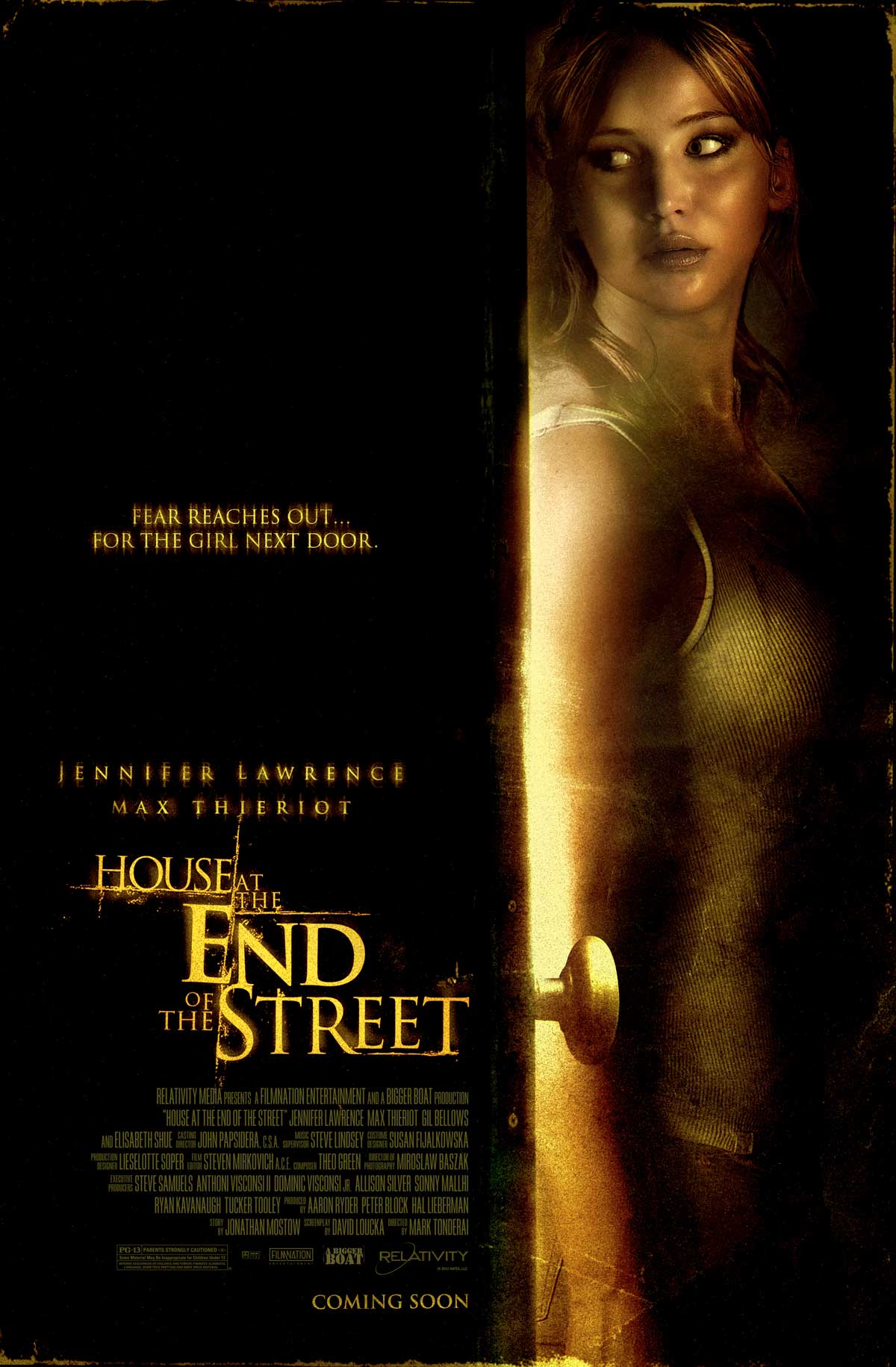 As readers will attest, I am a fan of actress Jennifer Lawrence. Some of my pals might say limiting the word to “fan” is being too modest on my part, but I don’t want to alarm anyone. I think she’s a terrifically talented actress and her Best Actress Oscar was well deserved for a film I unabashedly adore. With all of this being said, good actors can still make really bad movies, and that’s what we have with the stillborn horror flick, House at the End of the Street, referred to by marketing by the Twitter-friendly acronym HATES. That seemed like a tip-off, didn’t it? The problem is that for a good hour this movie is more of a drama than a horror movie, and everyone in town seems to be jerks to this guy in town whose sister murdered his family. Apparently him still residing in town lowers their property values… for some reason. I think it wants to be a psychological thriller, but even giving it that much credit assumes there’s some degree of competent execution. It’s not scary, the twists should be easily telegraphed to anyone with a modicum of sense, and Lawrence’s presence is just downright questionable. Why did she agree to do this? What about this clunky script, with its obvious padding to its “shocking” revelation, appealed to this woman? I suppose with her fast ascent to the top of Hollywood, Lawrence now has the clout to never again star in something as drecky as this would-be thriller. Then again, if she does, it’ll be by choice. Or a fat paycheck.
Nate’s Grade: C-
Share this:

The Great Gatsby (2013)
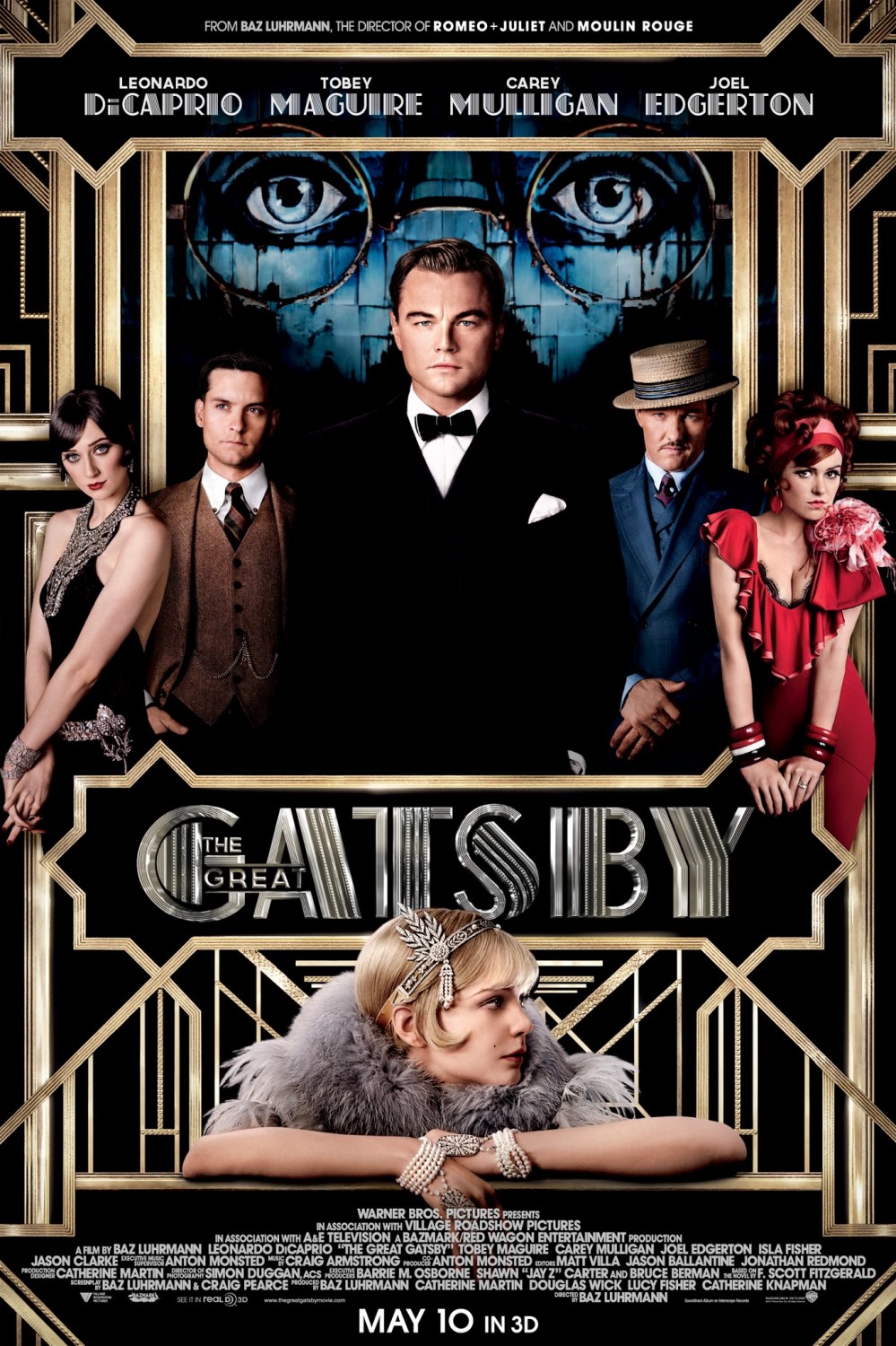 It seemed like some sort of educational mandate that every child in the United States was forced to read F. Scott Fitzgerald’s novel, The Great Gatsby, when they were in high school. In my highly unscientific number crunching, it appears that those who actually enjoyed the book are in the minority. I recall loathing it, but then again, when you’re fifteen, you sort of loath everything. Enter Australian director Baz Luhrmann, the showman who exploded the screen in razzle-dazzle run amok with Romeo and Juliet and Moulin Rouge!. Not exactly the kind of filmmaker one would fathom helming an adaptation of a classic of American literature, but the man’s style of excess seems like a suitable match for Fitzgerald’s tale of high-class overindulgence.
In 1922, young Nick Carraway (Tobey Maguire) moves to the hustle and bustle of New York City, living close to his cousin Daisy (Carey Mulligan) and her rich husband Tom Buchanan (Joel Edgerton). He’s also the neighbor to the mysterious and newly rich Jay Gatsby (Leonardo DiCaprio), a reclusive man who opens his mansion up to prolific bacchanals. Rumors persist in who he is and how he accrued his enormous fortune. He’s an old flame of Daisy’s and is secretly hoping she’ll attend one of his raucous soirees. He enlists Nick to help arrange a reunion for them, and soon enough Gatsby is already planning their happy future together again. Trouble is, Tom isn’t willing to lose his wife without a fight.
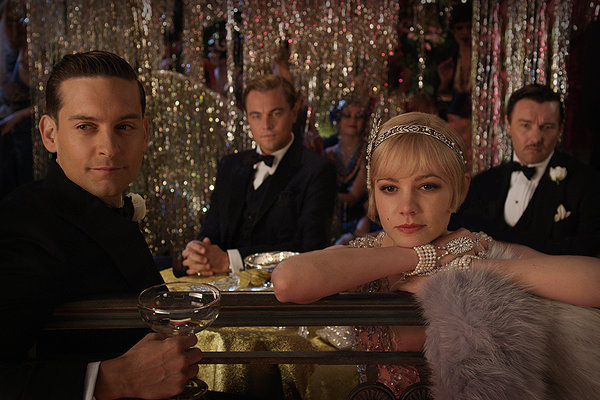 Luhrmann’s helming of The Great Gatsby gave me exactly what I desired and expected. The movie is convulsing with energy and the first hour just moves; be it the camerawork or people onscreen, for long stretches there always seems to be some degree of onscreen movement. Luhrmann’s signature theatrical visual atmosphere is vibrant, joyous, and a perfect translator of the lavish lifestyles of the noveau rich in the Roaring ‘20s. The man brings to startling life the sensations of being young, privileged, and carefree, and the use of anachronistic music, while not nearly as textured and thematically relevant as Moulin Rouge!, adds to the fun. I quite enjoyed a low-key, jazzy rendition of Beyonce’s “Crazy in Love.” Luhrmann’s style treks in excess but it’s a much more pleasant, dreamy, and altogether beguiling form of artistic indulgence than, say, Michael Bay or Tony Scott and their respective macho visual fetishes. Luhrmann’s campy sense of style doesn’t come across as overly suffocating or distracting, at least to my eyes, and instead the man injects his movies with tremendous energy, immersing you into a new world of old and modern. This is what Luhrmann was meant for. While other canonical classics of American literature may not survive a glitzy Lurhmann treatment, it’s a good match for the extravagant excess of Fitzgerald’s setting. Lurhmann’s visuals are glorious, and the 1920s era is brought to glamorous life. You get the sense it was one giant party without any lasting consequences (if you were rich enough).
The second half of the movie slows down considerably after the amped-up introduction. We’re caught up in the characters at this point, as we should be, and the Gatsby/Daisy reunion dominates the plot. I suppose there are only so many Busby Berkeley numbers and confetti explosions one can encounter before the plot has to set in. Lurhmann and company stick pretty faithfully to Fitzgerald’s plot (rest easy, lazy high school students of today and tomorrow). Interestingly, they are far more explicit about Gatsby’s securities fraud, knowingly making a fortune off junk bonds, all in the name to impress Daisy. There’s a genuine sense of respect for the source material even with Luhrmann’s visual flourishes; at several points, Fitzgerald’s text floats onscreen. The problem is that Luhrmann’s Gatsby is almost entirely focused on the romantic coupling of its title figure and Daisy. Gone is the class criticism, the indictment of the follies of the rich, the examination of the dark side of the American Dream, and the subtext. You’ll get plenty of shots of that famous green light, 20th century literature’s most famous and unsophisticated symbol (pay attention kids: green means go), but there’s little time for complexity. It’s not a screen romance worth this much attention, which is kind of the point, but when the movie clocks at over 2 hours and 20 minutes, drawing out a lackluster romance can become rather grating.
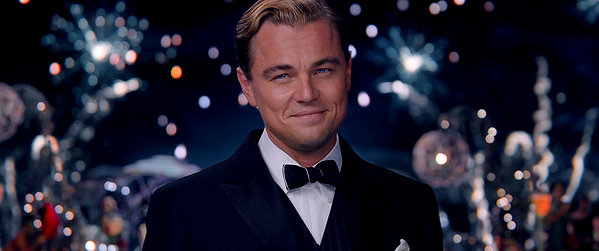 If I were top cite one major fault in Luhrmann’s incarnation, it’s that it adopts Nick’s fawning perspective and treats Gatsby as this tragic romantic figure. I acknowledge with every adaption there is a degree of interpretation, and romantic hero is certainly one facet of Gatsby, certainly how he sees himself, but by the end of Fitzgerald’s novel, Gatsby is really more a naïve man who really only sees Daisy as trophy, a prize for his reinvention and jumping up to the storied moneyed class. Daisy herself is certainly weak-willed but her emptiness (she says there’s nothing better than for a girl to be a “beautiful, young fool”) is part of the appeal to Gatsby because he can remake her however he wants. He’s not interested insomuch as her as a person. I don’t think that the Gatsby/Daisy escapades fall into the ranks of Great Tragic Couples of Literature, but that’s how Luhrmann interprets the novel, transforming Gatsby into a revered, honorable, and heartbreaking romantic we’re meant to shed a tear for. I suppose since we’re reliving the story through Nick’s perspective that events could be colored differently. Beyond just a simplistic analysis, it also misses the greater and more futile tragedy of a man trying to escape his past by obsessively recreating it.
The acting is fairly good all around, though the standout is certainly not whom you’d expect. DiCaprio (Django Unchained) is a good fit for the handsome social-climber, but the movie only asks him to play a limited range of emotions, rarely breaking free to show glimpses of the darker, less polished side of Gatsby’s carefully crafted image. He doesn’t exactly exude the charisma you would think necessary for the man, plus his use of “old sport” is so overly abundant it approaches farce. Maguire (Brothers) is a bit too earnest even for his role. It becomes readily clear within minutes that Maguire does not possess a voice for narration. The man is also a bit too old, at 37, to play the naïve, stars-in-his-eyes Nick Carraway. Mulligan (Shame) is given the least to work with since Daisy is meant to be rather opaque but she brings an extra amount of sympathy for a character trapped by her indecision and the demands of men. Easily the best actor in the bunch is Edgerton (Warrior). It would be easy for the guy to simply be the brutish heavy, the angry husband and easy to hate antagonist. Edgerton showcases a surprising depth, and you may find yourself feeling some smidge of sympathy for the lout.
Much like Luhrmann’s Moulin Rouge!, it’s an easy prediction that his Great Gatsby will be equally divisive. There will probably be as many critics decrying Luhrmann’s blitzkrieg of confetti and style as a campy cannibalization of an American classic as there will be celebrating the mad energy and obsequious reverence exhibited in a handsomely mounted, big-budget adaptation. The movie is even being presented in 3D, and did you ever think you’d hear the phrase “The Great Gatsby in 3D” in your life? I enjoyed Luhrmann’s gaudiness and indulgences, painting the screen with his vivid imagination. The impressive production design, costumes, visual effects, and overall visual aesthetic of the movie are a feast for the eyes. Now there are plenty of indulgences and excesses in the movie, particularly the emphasis on grand romance, but Gatsby entertains with few lags. Having read the book once and disliked it heartily in my youth, I can readily say that here is an example of where the movie is better than the book. Now if someone could go about making an improved version of The Lord of the Flies and A Tale of Two Cities, whatever you have to do, my teenage self will thank you kindly.
Nate’s Grade: B
Share this:

Iron Man 3 (2013)
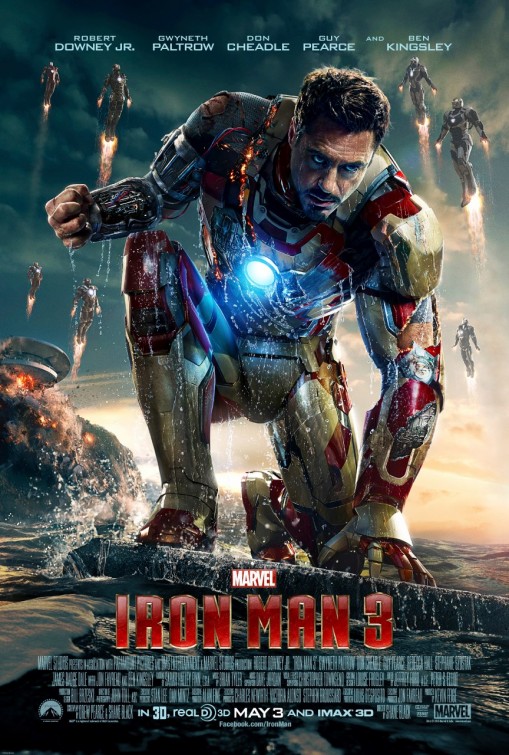 Third movies in superhero franchises always seem to be a precarious proposition; X-Men 3, Spider-Man 3, Superman 3, all graveyards of rushed productions, artistic compromises, and general complacency. Usually the third movie is when the hero has what he or she (but mostly he) has built up stripped down. It’s the same case with Iron Man 3, which short of a noisy finale has a surprisingly small amount of actual Iron Man, much like the scant amount of Batman in last year’s The Dark Knight Rises. That’s fine with me because the appeal of this franchise has been Tony Stark the character, not the mechanical heroics. Iron Man 3 is co-written and directed by super Hollywood scribe Shane Black, the man who gave us Lethal Weapon, The Last Boy Scout, The Long Kiss Goodnight, and the 2005 gem that resuscitated Robert Downey Jr.’s career, Kiss Kiss Bang Bang. It was this fact alone, especially after how disappointing Iron Man 2 was, that got me jazzed about a third outing. Black’s characteristic sense of humor, genre blending, and mass appeal thrills helps to make Iron Man 3 an enjoyable if flawed movie-going experience and a suitable kickoff to the summer movie season.
Tony Stark (Downey Jr.) is having trouble sleeping, haunted by the near world-ending events in New York City from his time with the Avengers. Pepper Potts (Gwyneth Paltrow), head of Stark Industries and Tony’s main squeeze, wants her man to take a mental health break. He’s spending as much time as possible in his lab, concocting a whole army of different Iron Man suits. His latest invention allows him to control a suit prototype with his body, compelling pieces of his amour to his person with a wave of his arms. He’ll need the help because the Mandarin (Ben Kingsley), a fearful terrorist leader, is staging a series of bombings around the United States, leaving behind videos taunting his foes. After an attack that hits close to home, Stark challenges the Mandarin and the bad guy brings the fight to the man of iron, decimating his home and forcing Stark to flee. In Tennessee, Stark unravels the mystery behind the Mandarin, which involves a brilliant scientist (Rebecca Hall), a nefarious biotechnology businessman (Guy Pearce), and even the president of the United States himself.
 The best part of the first film was watching a brilliant guy become Iron Man; sure the superhero stuff was fun but it wasn’t what made the movie special. Downey Jr. as a charismatic, egotistical, self-involved but ultimately redeemable middle-aged playboy is what made the movie special. With Iron Man 3, he has to rely on his wits for large portions, which are still considerable. It’s a clever way to make a billionaire playboy with out-of-this-world technology empathetic. He’s never going to be an everyman but that doesn’t mean we can’t empathize. With that said, I still find his whole PTSD ordeal after events from The Avengers to be shaky. He’s already had near death experiences before so unless we get a bigger explanation (proof of alien existence and superiority? Knowing a return is inevitable?) I find it hard to fathom that a guy as outwardly unflappable as Tony Stark would be hobbled by his super team-up activities. Also, now that we exist in a post-Avengers universe, wouldn’t the ongoing attacks by the Mandarin warrant some sort of S.H.I.E.L.D. response or monitoring?
Likewise, I really appreciated how Black developed his action sequences, routinely giving Stark limitations. The concept of a suit that can assemble by itself and fly hundreds of miles is silly, sure, but it also opens up fun possibilities and questions of identity. At one point, Stark has one arm and one leg of his suit, allowing him to fight back but having to get creative with his moves. A fight while he’s handcuffed also provides enjoyable thrills. During the home attack, Stark’s suit is a prototype and will not allow him to fly, so he has to get inventive, literally shooting a grand piano at a helicopter. The best action scene is when Iron Man has to save a dozen people from plummeting to their deaths after being sucked out of Air Force One in midair. I wish the solution hadn’t been so quick but it’s a thrilling sequence with terrific aerial photography.
Until the finale, which is all-robot action, you could accuse the film of being too shrift in its action sequences, rarely lasting longer than a few brief minutes. They’re still quite entertaining, and well directed, with Black nicely drawing out organic complications and making good use of geography. We know that Black can write a glorious action sequence, but unless you were one of the lucky souls who saw Kiss Kiss Bang Bang, it’s a surprise that the man can direct one so well. There’s a nice sense of style on display but it never becomes overpowering, and thankfully it’s presented in a manner that you can, shocker, tell what is happening onscreen. Black definitely has a good eye for visuals and scene compositions but he also knows how to deliver great crowd-pleasing moments that we want in our summer movies. The climax is pretty busy with lots of keen Iron Man suits that you just know are there to be purchasable toys first and foremost. The sustained action is pretty involving, and Black is an expert at establishing mini-goals and developing naturally. Even as it starts to devolve into a hectic video game-like frenzy, there are enough changing goals and reversals to keep you satisfied for the long haul.
The movie’s villains are somewhat nebulous and employ an Evil Plot that is too convoluted by half. The Mandarin is an intriguing figure but undergoes some changes that will surely leave fans of the comic steaming mad. I accept that movies are an adaptation from the source material, and have no real personal affinity for Iron Man or his rogues’ gallery, so I wasn’t bothered by the notable change. It fits the tone of the movie as well as becomes another plot point in a convoluted Evil Plot. I will agree with detractors on this point: after the invasion in The Avengers, alien technology, the source of the Mandarin’s powers in the comic, is credible. I don’t really understand the political commentary at play with the Mandarin either. More so, and I’m trying to be delicate with spoilers, Iron Man 3 is really a movie about Tony Stark versus… lava people. Sure they have superhuman brains that provide regeneration and superior human ability. It just seems that all these super humans decide to do is… heat things up. They glow red, melt through walls, and are essentially lava creatures. Apparently Tony Stark needs to take some cues from that old U.S. Marines ad where the guy fights a giant lava monster (“Have you been attacked by a lava monster recently? No? You’re welcome – signed, the Marines”). The villains, while weak, are still probably the best in the series. It’s been a fairly weak franchise for antagonists.
 Coming from Black, you’d expect an increase in the implementation of comedy, though Iron Man 3 probably walks just up to the line. It almost gets too jokey but pulls back enough. Adam Pally’s (TV’s criminally underseen Happy Endings) small bit as an obsessed fan of Stark is probably the testing point. Tony Stark has issues sure, especially if Disney will ever let the movies explore his history with alcoholism, but the man is never going to challenge Bruce Wayne for the brooding loner throne. Stark is a quipper, a loudmouth who uses humor as a weapon and a shield, and brought to vivid life by Downey Jr., the man will always be a comedian. That’s not to say that the drama lacks proper seriousness. However, Black pushes a lot more comedy into the film than we’ve seen in the earlier installments. Most of it is welcome and even when the movie goes into mass appeal mode, especially in Act Two when a plucky kid aids Stark, Black covers the familiar without losing his edge. You’ll likely recognize the buddy cop patter from Black’s other movies but it still works. There are several setups that look like we’re getting Big Hero Moments, and then Black decides to undercut them for a good laugh. Iron Man 3’s consistent sense of humor makes the movie feel even faster paced.
Downey Jr. (The Avengers) is still the MVP of the modern Marvel-verse in my eyes, and even two years removed from 50, he’s still got enough energy to power a small army. He’s still pulling the same schtick so to speak, which may wear thin for others after four starring appearances as Tony Stark, but I still find him naturally appealing. Paltrow (Contagion) gets a chance to do more than the standard damsel in distress that the women function in these movies. I regret that after being given a tantalizing new direction the movie reverts her back to standard damsel sidekick so speedily. Ho hum. Kingsley (Hugo) just seemed wrong for the part from the start, never mind the nebulous ethnicity issues. His vocal fluctuations and strange emphasis proved too distracting for me. However, he proves to be a better match after the Mandarin’s twist. Pearce (Lawless) is a pretty solid, smarmy bad guy and man has he got an impressive physique going on. It’s just nice to see great character actors from Hall (The Town) to Miguel Ferrer (Traffic) to Dale Dickey (Winter’s Bone) in a high-profile mega blockbuster. Even little Ty Simpkins (Insidious) is pretty good as the kid who helps out Stark. My tolerance for child acting has gone downhill as I have gotten older, but the kid is genuinely good without falling into the common trappings of being cloying or overly precocious.
Iron Man 3 is a definite improvement over the overstuffed, undernourished 2010 sequel. It ends on a moment that feels like something close to closure, but you know, as the credits helpfully indicate, that Tony Stark will appear again, at least in 2015’s Avengers 2. The bigger question is can this franchise exist without the participation of Downey Jr.? I’m sure we’ll all find out eventually considering the character is too profitable to simply retire once Downey Jr. decides he’s had enough. We’ve had five Batmans after all, not counting Adam West. However, never has a character seemed so intrinsically linked with an actor before. Downey Jr. just is Tony Stark, and while some capable young male lead out there in Hollywood will put up a valiant effort, it will never be the same. Iron Man 3 is further proof that the appeal of the franchise is not the explosions and action set pieces, which it does a fine job with; it’s the man inside the suit and the formidable actor that gives this franchise its juice. Spending more time with Stark is a bonus, and Black’s zippy sense of comedy and acute knowledge of the architecture of popcorn thrills allows the movie to fly by with ease. While the first film reigns supreme, Iron Man 3 is a fitting and pleasurable enough blockbuster that reminds you why we still love this guy.
Nate’s Grade: B
Share this:

Pain & Gain (2013)
 I think the audience for Pain and Gain is going to know exactly who they are, and I count myself amongst that number. The latest from director Michael Bay, often treated tantamount to Satan in many critical circles, has the based-on-a-true-story hook but really it’s the big stars, stylish violence, peculiar criminal antics, and overall overflowing machismo of the picture that will draw its audience. I knew after one watch of the trailer that I wanted to see it, though I was somewhat ashamed of the level of my interest (don’t want to taint your critical credentials with too much sympathy for the devil, after all). Pain and Gain is a trashy and entertaining jaunt, just as I hoped it would be, but it overstays its welcome and may leave you fatigued and possibly dejected (so… a typical Michael Bay movie? Still got it).
In 1995, three Miami, Florida goons enacted one of the most bizarre and sordid criminal schemes, a story that could supply a tabloid with enough juicy exposes for a year. Daniel Lugo (Mark Wahlberg) and his co-worker Adrian Doorbal (Anthony Mackie) are personal trainers at Sun Gym. Their days consist of pumping iron and hitting on ladies. One of Lugo’s clients is Victor Kershaw (Tony Shalhoub), a wealthy businessman with a nasty temper. Lugo and Doorbal, with the help of an ex-con and ex-junkie (Dwayne “The Rock” Johnson), kidnap Kershaw, hold him hostage for weeks, torture him, and eventually get him to sign over his assets to them. Afterwards they try to stage his “accidental” death, though like most things, it does not go according to plan. Penniless and broken, Kershaw seeks out help from a retired private eye, ED DuBois (Ed Harris), to provide validation for his case. The Miami police are laughing off his claims. Kershaw is concerned that the Sun Gym gang will strike again when their lavish lifestyle dips, and he’s right. Lugo and company get into even more trouble and the body count rises.
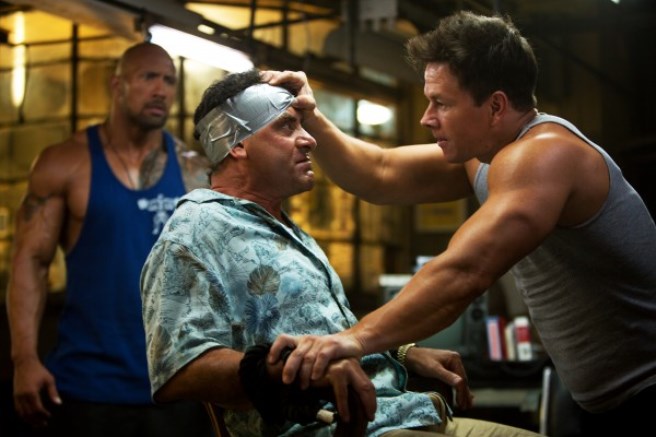 The results on screen are often entertaining in an over-the-top fashion, sustaining a rubbernecking captivation much like a horrendous car wreck. You just have to see how much crazier this thing gets, all the while muttering to yourself, “This was a true story?” It even gets to the point where the movie will remind you, via onscreen text as a man barbecues a batch of severed hands, that yes this is still a true story. Naturally there have been fictional inventions, character composites, and some details have been dropped to fit into the confines of a film narrative, but online research shows me that most of the larger plot beats are accurate, thus making the film even more compelling and disturbing. When the film is on, it feels manically alive with intrigue and absurdity. The problem is that it cannot keep this manic tone alive forever especially when actual innocent bodies start piling up (more on that later). There’s a certain uncomfortable tonal incongruity as the film develops and the comedy picks up a distasteful resonance. I love a well-executed dark comedy but just because something is macabre or unexpected does not automatically make it funny. Still, the movie has enough high-energy antisocial antics to keep you planted in your seat, laughing through bafflement.
Pain and Gain isn’t subtle in the slightest and yet it’s easily the most nuanced film of Bay’s career. Of course there are still the sleek cars, sexy babes, emphasis on style, and wanton destruction that are hallmarks of the man’s career, but the perspective is given a satirical prism, dropping us into the deluded, sub-American Psycho perspective of Lugo, a man with a very cracked view of the American Dream. The moral message reminds me of Marge Gunderson’s concluding musing in Fargo, telling a captured criminal, “There’s more to life than a little money, you know.” There’s some slight social commentary on wealth and the dirty tricks of capitalism, but really it’s the narcissistic delusions of a jacked-up criminal who believes he can succeed because he’s “seen a lot of movies.” You may even find yourself sympathizing with some of these knuckleheads, that is, until things get way out of hand. The screenplay by Christopher Markus and Stephen McFeely (Captain America: The First Avenger) is briskly paced and packed with bizarre details and even jumps into six different characters for voice over (Wahlberg, Johnson, Mackie, Shalhoub, Harris, and Bar Paly). For some characters it works as a great insight into their twisted logic but for others it’s just an easy set up for ridicule. The juvenile humor (did we really need a visual pubic hair joke?), candy-coated film palate, and sugar-rush, roid-rage plotting feel like a suitable match for the talents of the bombastic Bay.
The last thirty minutes of the movie will test your sensibilities of good taste. I’m all for having unlikable central characters just as long as the writer makes them interesting (what good is likeable but boring, the “friend zone” of characterization?). Some of movie history’s most fascinating characters have been scumbags and psychos. However, with that being said, I need my unlikeable characters to at least progress. When I’m stuck with a bad dude who keeps making the same bad mistakes, it can grow tiresome, and that’s where Pain and Gain ultimately lost me. Bay can’t quite keep up the charade of ironic bemusement forever, and a saggy second half starts to tread water, forcing the characters to act even more outlandish and inept. Did we need The Rock losing his big toe and then inexplicably giving it to a dog? It feels like the movie is filling time until the accidental murders come into being, raising the stakes. For a movie that’s 130 minutes, there should not be any need to fill time. During that long sad stretch, you start to feel disquiet, like the movie has lost its sense of perspective and the jokes have gotten too mean, too ugly, too outlandish. It doesn’t feel funny any more, and maybe that’s ultimately the point, but by the end Pain and Gain has soured. It overstays its welcome and then some.
 Its tone and connection to the real world raises an interesting and thorny question over whether something like this is appropriate. Should a story that involved the murders of innocent people end up becoming an over-the-top, stylized, lavishly glamorized Hollywood crime comedy? It has been over 15 years since the events of the Sun Gym gang, but is there a statue of limitations on good taste? Are we eventually destined for a vulgar film tackling the poor lives of the victims of 9/11? The answer is almost certain. What is off limits, or more pressingly, should anything be off limits to a comedic narrative? Is anyone really furious with Trey Parker and Matt Stone over their first film, Cannibal the Musical, transforming nineteenth century murder into song and dance? I doubt it, and yet there was something very off-putting about 2011’s 30 Minutes or Less, an unfunny comedy based around the true story of a pizza guy strapped with a bomb and ordered to rob a bank. The guy was blown to bits in real life (ha ha?). I guess I, as well as audiences, would have been more forgiving if the movie had been funny. I’m sure there would be fewer objections if Bay’s film had been more of a sober, contemplative drama on the sad acts of a bunch of desperate criminals, but with all the hyperbolic elements, machismo, and so-crazy-it-must-be-true plot turns, how could you turn this story into a serious drama? Not from the perspective of the nitwit criminals, at least. I don’t think the movie is ever positioning these guys as anti-heroes or excuses their excess.
Wahlberg (Ted) broke out as an actor thanks to a similar role as a wannabe star whose ambitions exceeded his grasp, and the man does dumb as good as just about anyone in Hollywood. It’s a specific kind of dumb, the angry, arrogant, pissy, self-involved kind of dumb that makes it acceptable to ridicule his character to no end. Johnson (G.I. Joe: Retaliation) gets to explore some interesting range as an actor, pacing around the demons of his character before just going hog-wild with the excess. Mackie (Gangster Squad) is arguable the most sympathetic of the group but also with the most to lose. Compared to his peers, he’s practically mild-mannered even though he takes injections into his penis. Shalhoub (TV’s Monk) is amusingly apoplectic and just enough of a jerk that you excuse his misfortune, at least for a little while. Ken Jeong (The Hangover) and Israeli model-turned-actor Bar Paly give the exact performances you would expect them to deliver. The best actor in the whole movie, though truth be told there isn’t a stinker in the bunch, is Emily Rutherford (Elizabethtown, TV’s The New Adventures of Old Christine) who plays Dubois’ wife. She has this calming, down-to-earth presence that seems to bring a small sense of peace to the madcap antics. She doesn’t have a lot of screen time but you’ll wish she had lots more.
Perhaps I’m being unfair to a movie that clearly isn’t intending to be anything but naughty, tacky, and gleefully excessive. In a way Pain and Gain reminds me of Tony Scott’s Domino, loosely based upon a true story but crushed to death by narrative kabuki and Scott’s characteristic excess. If I wanted to defend the much maligned Michael Bay, I’d argue what the real difference is between his excess and the excess of the more critically lauded Scott? Bay doesn’t have a slate of movies to his credit the likes of Top Gun, Crimson Tide, or True Romance. But isn’t flashy, artistic excess all the same when in the name of empty storytelling? Domino is also an apt comparison because it’s ultimately tiresome and far overstays its welcome, losing its audience with an endless array of odd sidesteps and moronic, deviant characters. While Pain and Gain has enough quirk and style to justify consideration, you may not respect yourself once it’s over.
Nate’s Grade: C+
Share this:

Mud (2013)
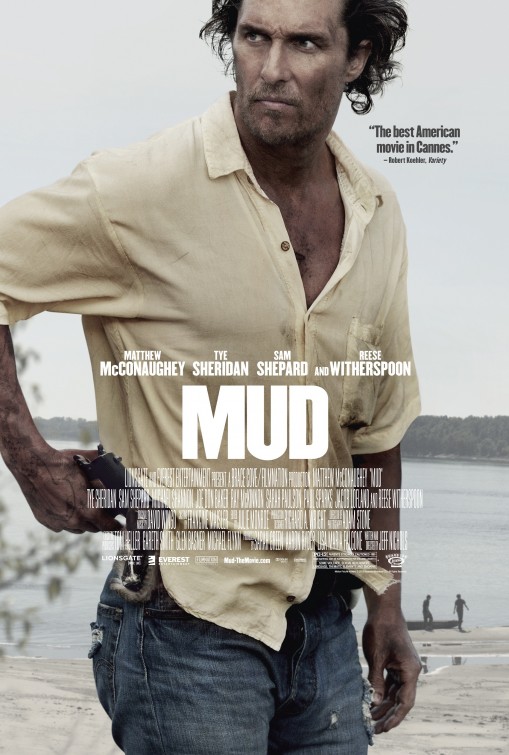 If you aren’t familiar with writer/director Jeff Nichols, do yourself a favor and get acquainted and fast because this guy is headed for indie stardom. Nichols’ last movie, the somber and unbearably tense thriller Take Shelter, was my top film of 2011. Mud, in contrast, is a harder sell, something akin to a modern-day Mark Twain fable about romantic outsiders, fugitives, friendship, and boys coming of age. Matthew McConaughey plays the titular character, a wanted man hiding out on a small island along the Mississippi River. He befriends two teens that help him rebuild a boat so that Mud can escape with his lady (Reese Witherspoon) and evade a team of dangerous bounty hunters seeking vengeance. Nichols is truly gifted at his ability to craft wholly believable characters regardless of circumstance. There is a great sense of setting here, without nary a judgment to the lower class moorings and difficulties, just as Nichols expertly showcased rural Midwestern life and day-to-day anxieties in Take Shelter. His new film is admittedly slow and takes a while to rev up, but the performances are just so good and richly delivered, from top to bottom, that you’re happy to go along with the somewhat loping ride. It’s such a pleasure to witness McConaughey fully engaged with a role, pushing him to utilize new and exciting acting muscles. Nichols also doesn’t soft-pedal the hardships of his characters. While it’s poignant and satisfying how the various plot threads come together for a thrilling conclusion, Mud also has the grace to leave several storylines absent tidy bows. There’s real heartbreak, real disappointment, and recognizable people of all walks trying to do good and find their place in this complicated world. If Mud is playing near you, it should shoot to the top of your must-see list.
Nate’s Grade: A-
Share this:

Oblivion (2013)
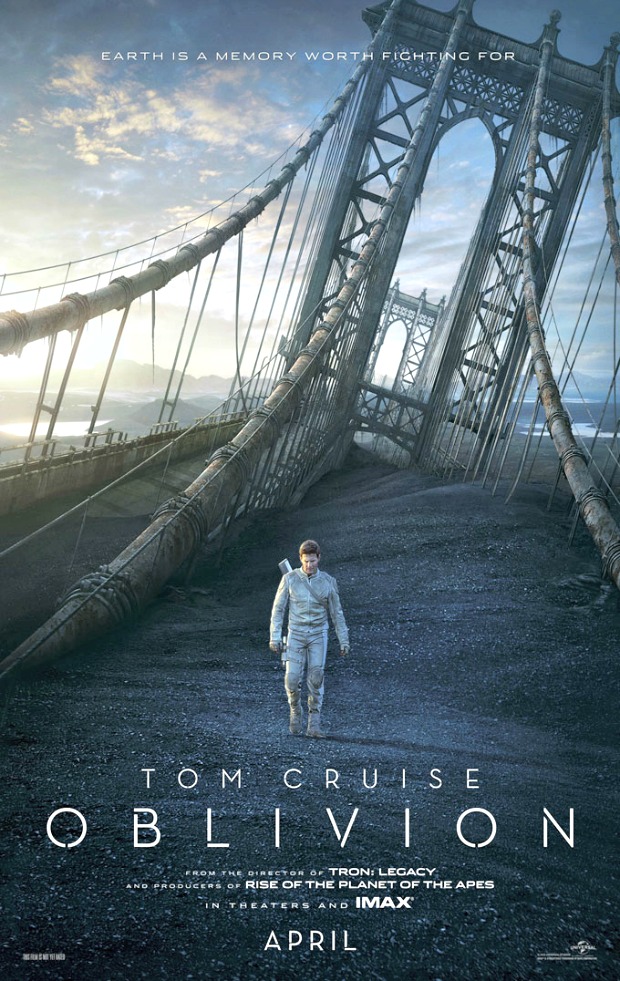 It’s late in the twenty-first century, decades after humanity battled an alien species in a war for the planet, and while humanity won the war Earth is desolate. The moon destroyed. The remaining members of humanity live on a starship around Saturn’s moon, Titan, and the oceans of Earth provide the energy resource. Jack (Tom Cruise) and Victoria (Andrea Riseborough) are the team stationed with repairing drones, the flying machines that protect the energy plants. There are still pockets of alien scavengers that need to be dealt with. Jack and Victoria make a great team, and dip into romantic companionship, until Jack meets a mysterious woman (Olga Kurylenko) professing to be his wife. Jack begins to doubt the purpose of his mission and wonder if the alien scavengers are the enemy.
If you’ve been keeping up with sci-fi cinema in the last couple decades, you’ll likely recognize more than a few elements with Oblivion. From its themes to its plot points to its revelations, there’s little here to designate as original. So the real question remains how derivative can we take? I think when the execution is nimble then it’s one of the easiest sins to remember. Especially in the realm of sci-fi cinema, it’s hard to put together a new story, let alone one set up as a Hollywood star vehicle, without borrowing from other established movies. This in itself is not an issue. Tarantino is a master borrower but he always recontextualizes his artistic influences into something new and different, and while we critics lament his less original career path of late, the man’s box-office profits have never been better in his career. I think when we feel like we’re getting a good story we don’t care when that story has been told before in other manners. Star Wars, after all, has many cultural fathers, but it was a rollicking good time with characters we cared about, so nobody seemed to mind. Likewise, Oblivion has many forbearers from Independence Day to I Am Legend to 2001 to an indie film from a few years ago I shall refrain from mentioning because even the very mention will spoil key plot points. Some will decry the film as a rip-off of superior, headier fare, but I never minded. I was having too good of a time and found the movie too satisfying to quibble.
 I won’t say the movie is smart per se but it’s far more measured than I would have expected. The advertising makes it look like Cruise fights a bunch of aliens and robots, and while there is that aspect, it’s almost an afterthought to a slow-burning mystery that patiently parcels out its revelations, even to the very end of the film. I’m trying to be cagey about certain plot points to avoid spoilers. It’s a film that has more on its mind than explosions, but when it goes into explosion mode, director Joseph Kosinski (TRON: Legacy) makes it count. The larger action elements are well staged and polished with some above average special effects. The sight of the moon dashed across the sky is definitely an evocative image. I love the overall look of the film, Kosinki’s clean, spare, bubbly Apple-esque aesthetics. The drones themselves manage to have personality even with a limited, streamlined design and some choice sound design. The man knows how to hold onto an image and when to keep pushing. The action is suitably thrilling and the drama suitably suspenseful. Actually, better than suitably. I enjoyed the details of this world. It’s probably the spiffiest post-apocalyptic landscape you’ll ever see. This is an entertaining movie that finds nice ways to satisfy, and given the particulars of its sci-fi plot, finds a way to have its cake and eat it too. As a result, Oblivion is a sci-fi flick that offers enough to engage the mind and audience demands for big effects and big thrills.
 I’ve never been a Cruise hater. I even thought the man tried his damndest to make a movie like Rock of Ages worth watching (a valiant effort but not enough). His character is pretty affable at first and we get to watch as everything he knows comes undone. It’s a role that would lead to overacting, but Cruise underplays the part, more alarmed naïf than flinty action hero. I’m not expecting Oscar-caliber performances in every role but Cruise does a fine job of anchoring the audience and selling his character’s journey. He also has good chemistry with not one but two ladies. Kurylenko (Seven Psychopaths, To the Wonder) is an actress of great beauty and questionable talent, but perhaps being paired up with a genuine star like Cruise brings out the best in her. They’re good together, though my preference was for Riseborough (W.E., Never Let Me Go), an actress who brings a tremulous vulnerability to an otherwise underwritten and confused character that’s more a plot device. Riseborough makes the character so much more than she is on the page. She’s still a relatively new actress so I look forward to her future performances. There are other familiar faces, like Morgan Freeman and an especially unsettling Melissa Leo, but it’s really a three-person acting exercise.
Oblivion is a visually alluring sci-fi thriller that also manages to have enough heart and smarts to leave a satisfying impression. The pacing is more deliberate but offers plenty rewards, doling out revelations up until the end, unpacking its mystery with finesse. The first twenty minutes or so, establishing the particulars of this world and the routine of our protagonists, is downright exceptional. The rest of the film doesn’t quite live up to that start but it continues to be an engaging and entertaining movie with some top-notch visuals. The musical score by electronic band M83 also provides a stirring counterpoint to the glossy, clean visuals (the band’s song “Outro” was also very effectively used in that lovely five-minute trailer for Cloud Atlas). You may figure things out as you watch, but you won’t mind, at least I didn’t. The more I step away the more I think back with renewed enthusiasm for the film. It’s smarter, slicker, and just a more satisfying film than we’re accustomed to with this kind of budget and from Hollywood.
Nate’s Grade: B
Share this:

Fist of the Reich (2012)
 It’s been too long since I’ve last had the pleasure of viewing a Uwe Boll movie. The man is downright prolific when it comes to spitting out multitudes of projects every year sometimes three or four. And yet there’s no guarantee I’ll have a speedy and easily accessible avenue to watch the man’s finished products. Take for instance his biopic on Max Schmeling, finished almost three years ago, and undergone a title change for American audiences to Fist of the Reich. Americans might not know who Max Schmeling was but by God do we know ourselves some Nazis. I can understand why this one was put on the shelf for as long as it was. There’s the fact that it’s entirely in German, Boll’s first completely foreign-language film since 1997. There’s also the fact that it’s still a pretty dull and uninvolving movie, and given the figure and subject matter, that may be enough to make Fist of the Reich the most disappointing film of Boll’s career.
 From 1930-1948, Max Schmeling (Henry Maske) was Germany’s most prolific athlete. He boxed overseas in America quite often, earning the world title in a controversial bout where his opponent was disqualified after a below the belt punch. Schmeling romances a movie star, Anny Ondra (Susanne Wuest), and proposes to her the day their courtship hits the gossip pages. Schmeling also has to fight the growing nationalistic influence of Hitler’s Nazi party, which looks at him as a powerful propaganda opportunity. After a high-profile loss to Joe Louis, in a rematch no less, Schmeling loses value to the Nazi machine and he’s drafted into the oncoming war.
When I say “most disappointing” I know that’s going to strike a chord given Boll’s oeuvre of craptacularcinema, but I really mean it. The biggest failing of the two-plus hours of Fist of the Reich is that it does not provide adequate evidence why Schmeling is a compelling figure of history. It’s a biopic that doesn’t have enough juice to justify why its central hero should even earn a biopic. I don’t think I’ve seen too many movies based upon real people where I left thinking, “Well that person didn’t deserve a movie.” And the ridiculous thing is that Schmeling of course deserves his own movie. The man was an international superstar, the pride of a nation during a tumultuous time, one of only three men to beat Joe Louis in his career, and then became a propaganda pawn for the Nazis. The man was even forced into service in the war and was one of only two survivors during a hellish battle. His manager was Jewish, his wife a Czech movie star, and they had to flee their country home to escape from the advancing Russians. That is some compelling stuff even before you get into the psychological depth at play with a man being pushed as a tool of Nazi propaganda and how that constrictive, humiliating, and infuriating chapter would have taken its toll on Schmeling’s soul. There is a wealth of material there to stage a rousing and engrossing biopic, and the fact that Boll and screenwriter Timo Berndt cannot is just inexcusable.
There’s very little depth given to Schmeling as a character; all the edges are sanded off and we’re left with a rather bland do-gooder that really just wants to box. He’s sort of this nondescript, milquetoast nice guy who trudges from scene to scene, doing bland but nice things. You won’t dislike the lug but you’ll find it hard to explain why he’s interesting. This shallowness just compounds as the movie continues, going further into the war as well as the downturns in Schmeling’s boxing career. His relationship with Anny is also pretty bland. They’re nice together and loving in appearance but also mundane. It’s like the movie is progressing scene-by-scene establishing facts and plot points rather than exploring the relationships of characters. Max gets married. Max gets a big bout. Max wants to give Joe Louis a rematch. The film seems so devoid of passion, bled dry by going through the checklist of what audiences desire in their biopics. The movie even attaches a weak framing device where Schmeling and a war prisoner are walking to a border and Schmeling recounts his life. Except this framing device ends with thirty minutes left to go. Can it be termed a framing device if it doesn’t frame a quarter of the movie? It’s not even necessary except to throw in a bit of war violence at the opening to hook an audience. It feels like nobody knows what to do with Schmeling so they’ll just breeze through his life’s big events, make him seem like a charitable fella, and then pray the audience understands the man’s historical significance.
Another reason for the stilted drama is quite possibly the noticeable acting limitations of our lead, Maske. The man is a former champion boxer in Germany who reportedly underwent eight months of acting training to prepare for this movie. Well, apparently eight was not enough (did I just backend into a pun?). He may be a great boxer but he is a very poor actor. His monotone, caveman-like warble reminds me of the speaking tones of early Arnold Schwarzenegger. I don’t think the guy has more than two sentences at a time. Again, I’d rather have my actors learn how to do something rather than teach a non-actor how to act. Actors can fake singing or boxing, plus there’s editing. Was it really substantial to have an actual boxer in the role? I know Schmeling himself actually wanted Maske to play him in a would-be movie, so there’s some passing approval, but there’s a reason that Maske hasn’t acted in a movie since this one. Maske’s pained acting, limited emotional range, and overall stiffness, combined with the thin characterization, makes for a void at the center of the movie.
 I also assumed given Boll’s own background in boxing (he famously boxed a group of critics several years ago in a publicity stunt) that the onscreen bouts would be thrilling to watch. The excitable German ringside announcer seems to be watching different fights than I am. The fighters just don’t have any fight in them, carefully going through the motions, but when they hit they do so like they’re timid, afraid to put any force behind it. The camerawork and editing also fail to mask this feeling. Boxing is such a ferocious sport and we need to feel the danger and ferocity within the ring, but all too often it just feels like another ho-hum occasion for Schmeling, one where he’s rarely put to the test. Even the boxing matches that go to 15 rounds show us two fighters without any blood on them or bruises or any sign, beyond a glistening coat of faux sweat, that these two men have spent over an hour beating the crap out of each other. This limited sense of realism handicaps the movie as well as drawing out the accomplishments of Schmeling.
Boll’s direction also seems rather remote on this movie, curiously so. He relies almost entirely on bobbling handheld camerawork that can get a bit tiresome when it feels like the camera rarely settles. The movie is almost entirely comprised of a series of medium shots, which further adds to the overall blandness of the movie. The cinematography by longtime collaborator Mathias Neumann is entirely lackluster and downright incompetent. The visual compositions are supremely lacking; I don’t think Boll and Neumann even stumble into one engaging visual shot. And we’re talking about a boxer’s career here. The colors of the movie feel so drab and restrained but not in any sort of elegant artistic manner. It just looks like a drab movie, which suits a drab script with a drab lead actor. I’m also fairly certain that Boll’s longtime musical collaborator Jessica de Rooij borrows liberally, if not outright lifts, the musical themes of John Williams’ score for Saving Private Ryan. Has anyone else caught this?
It may seem foolish of me to admit, especially after twenty movies reviewed, but I actually had some semblance of hope that Fist of the Reich was going to be Boll’s first actual good movie. As it stands, Tunnel Rats is still the best Boll film, relatively speaking. I really thought that Boll’s background and boxing experience would carry over and we’d get a handsomely made, reverent, and absorbing look into the life of Max Schmeling, but time after time, the movie settles for bland. There’s a lot of meat to this guy but it feels about as in depth as a child’s book report, skimming over the drama to cover the significant signposts of the man’s life. As a result, we get an overview of the guy’s life but lack the evidence why we even took the journey. Saying a guy’s a great boxer, or a great humanitarian is one thing, but we need to see this, we need to feel it, and that’s the saddest failure of Fist of the Reich, that it takes an important historical figure and squeezes out all the lingering resonance.
Nate’s Grade: C
Share this:

Trance (2013)
 Danny Boyle is a director that can make anything watchable. The man made an entire movie about a dude trapped under a rock and it was spellbinding. With that in mind, he does his very best to turn the trippy, Inception-like crime thriller Trance into a workable, watchable experience for the audience. The main issue is that the movie is so busy that once it slows down you realize there really isn’t anything going on. James McAvoy plays an art auctioneer who stashed a valuable painting during a heist. He undergoes hypnotherapy by Rosario Dawson so the crooks can determine where the loot resides. The premise allows for plenty of fake-outs, and you’ll be conditioned to doubt just about everything you see on screen. The film does a nice job of applying that doubt to the characters as well; the good guys may not be so good and the bad guys may not be so bad. With Boyle’s hyperkinetic visuals and some fast-paced editing, Trance is serviceable in the moment, but when the characters literally spell out everything you realize how shallow the movie is as well as these characters. The lone truly memorable moment is a scene where Dawson jets off to a bathroom, we hear an electronic buzzing, and she comes out fully nude, presenting herself as a shaven offering. The fact that this relates to an actual plot point is practically incidental. The movie isn’t as smart or as fun or as entertaining as it thinks it is, and I wish Boyle had taken advantage of dream/mind mechanics and gone crazier with his visuals. Still, if you’ve got a couple hours, some low expectations, it’s worth at least one watch.
Nate’s Grade: B-
Share this:

Evil Dead (2013)
 Upping the gore quotient considerably but having little else of merit, the remake of Evil Dead loses just about everything that made the original special. Gone is the sense of humor, unless you just count the quantity of gore to be the qualifier for “humor,” and gone is any real sense of a creative spark. It looks good thanks to director Fede Alvarez, and the practical gore effects can be memorable and truly disgusting in the best possible way, but it just doesn’t feel like an Evil Dead movie. It makes the same mistakes that your typical dumb horror movies do, from a lack of clarity to one-dimensional characters (I think Blonde Girlfriend had one line of dialogue for the first hour) to repeated rule breaking. There are a bunch of callbacks to the original Evil Dead but they serve little other purpose. The finale, after a series of fake-outs, involves a weak showdown with a Big Bad that’s anything but. I expect better from a remake sanctioned and produced by the original director, Sam Raimi, and star Bruce Campbell. Maybe they knew it was only a matter of time before their 1981 film, and its superior 1987 sequel, would be remade by a cannibalistic Hollywood, so they wanted to cash in while they could. Or maybe they just argued, if anyone was going to make a poor remake, it might as well be them. If you’re hungry for gore, then Evil Dead may suffice, otherwise it’s a horror movie that’s too familiar, too mediocre, and ultimately too disappointing to recommend.
Nate’s Grade: C+


 nathanzoebl
You must be logged in to post a comment.