The Host (2013)
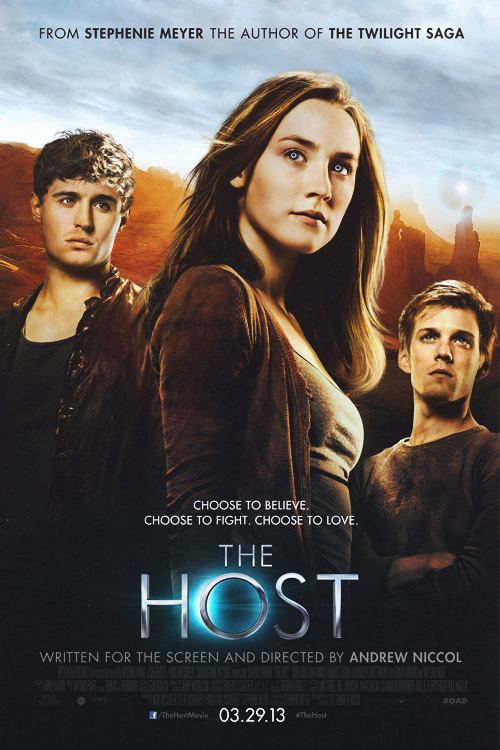 It’s impossible for me to ever separate The Host, a sci-fi would-be romance based upon the best-seller by dubious author Stephenie Meyer, and the demise of famous film critic, and personal influence, Roger Ebert. On April 4, 2013, America’s most prominent film critic, a man who with Gene Siskel changed the face of film criticism and the dialogue with movies, died after his cancer had returned. Upon hearing the news, I was overcome with grief and shed a few tears for the loss of a great writer and a great man who influenced a generation of online film critics like myself. Then I saw what was Ebert’s last published film review — The Host. Knowing his last review on this Earth is this awful movie, that it may be the last new release he ever saw, well it just feels ignoble. The man deserved better and so does anyone else who watches The Host, a movie I saw the very day of Ebert’s death.
Set on earth years after an invading alien race has already conquered, life isn’t too bad. There aren’t any wars or pollution or hunger. The aliens, looking like little glowworms, latch onto the spines of humans and use them as hosts. They control the bodies of the humans but some of us won’t go down willingly. Melanie (Saoirse Ronan) is an 18-year-old gal who fights as part of a resistance movement, led by her Uncle Jeb (William Hurt). The aliens abduct her and Melanie’s body gets a new owner – Wanderer, also referred to as Wanda. Good old Melanie is still in her head, feisty, and goading Wanda into finding Melanie’s family hiding out in the desert with Jeb. Also there is Melanie’s boyfriend, Jared (Max Irons), who is upset that his girlfriend has become “one of them.” Ian (Jake Abel), on the other hand, is adjusting well to the change, as he falls for Wanda and she him. In between these hormonal complications, Wanda is being chased by the appropriately named Seeker (Diane Kruger), who is deadest on bringing some human-style violence to Wanda/Melanie and the resistance fighters.
 The Host, like much of Meyer’s more popular Twilight saga, is a rather dramatically inert story that just seems to exist with little sense of momentum or direction or purpose, beyond providing another bloodless onscreen romance that ceaselessly finds unsettling messages to convey to young girls. Once again it all comes down to a stifling romantic triangle where none of the participants ever seems to work up the necessary passion to garner continual interest. There’s a bit more heavy petting going on but even when these people are having sex dreams, they imagine Melanie with her bra on (such a limited imagination). Please don’t confuse this as some implicit regret on my part that the movie didn’t sexualize its lead heroine (she’ll be turning 19 soon, so fear not pervs). At least the Twilight movies can be seen through the prism of pre-teen wish fulfillment. The Host, on the other hand, is just an Invasion of the Body Snatchers-style sci-fi movie where no one seems that preoccupied with anything too urgent. If the aliens are really that gung-ho to root out the resistance fighters, why aren’t they looking for heat signatures? Why aren’t they studying truck movements? The fighters aren’t very stealth-like in their comings and goings either. Hell, why don’t they even just keep a lookout for people wearing sunglasses, an obvious sign they have something to hide. It’s like the aliens and the humans are simply just going about their business without any danger. That’s because the ultimate fulcrum with which all the plot hinges upon is the romantic whims of a teen girl teaching an alien how to love. Sigh.
The least successful adaptation is likely including Melanie in the action through the use of bratty voiceover. She likes to chime in with snide remarks and pushes Wanda away when she starts getting feelings of her own for another boy. It is simply unbearable. You ever been stuck in the car with a really annoying brat? That’s what it felt like. Now I realize that having the dueling voices was an easier prospect on the printed page, but a similar challenge was tackled with 2003’s Dreamcatcher when an alien possessed Damien Lewis. We had a visual representation of Lewis taking refuge inside his own head. That was better than watching him, and it pains me even now to type it, engage in an argument with himself where the voice of the alien adopts a British accent. Maybe we could have had a better visual representation of Melanie inside Wanda, or maybe something with mirrors, that’s always a good go-to visual for characters of dueling minds. As developed, The Host feels like Melanie’s strapped in next to you, providing incessant and annoying commentary, and all you want to do is tell the kid to shut up.
Given the world-conquering plot elements, I can’t help but think Meyer found one of the least interesting stories to tell within this world. The invasion aspect seems far more compelling a story to tell than one girl stuck in a love triangle. I suppose it’s because Meyer is bringing a different perspective to science fiction, but I found most of this movie to be unbearably boring. And her premise, while flawed, could have been workable. Learning to live a symbiotic relationship with an alien that controls your physical being, there’s plenty of room there to tell an interesting and insightful story. The issues of identity and control could be richly explored. Instead, we get Melanie liking one boy and Wanda liking another, and so Melanie fights from inside to stop Wanda from acting out her exciting new feelings. Given the scope of everything going on, alien invaders and underground resistance organizations, it all feels so slight and myopic and overindulged melodrama. I suppose the whole thing could be a metaphor for puberty, a teen girl whose body is taken over by an alien presence, causing her to act irrationally and deal with swoons of affection she doesn’t know how to properly handle, causing her to act out and alter her perceptions of herself. Then again, I may just be giving Meyer and the movie more credit than they deserve.
The saddest part for me was that Andrew Niccol directed this movie as well as adapted the screenplay. He is responsible for these characters, these plot beats, these samples of dialogue. This is the man who gave us The Truman Show, Gattaca, and Lord of War. Granted, Niccol’s last movie, 2011’s In Time was a great idea in need of a far better script, but I always have high hopes with this man given his track record. From a visual standpoint, he takes a few pages from Gattaca where everything in the world is sleek and shiny and looking like an orgasmic car commercial. The shimmering cinematography by Roberto Schaefer (Marc Forster’s longtime DP) is crisp with plenty of cool colors to signify the mood of our pleasant overlords. There are plenty of nice things to look at, and female fans will likely extend that compliment to the young men duking it out for Melanie/Wanda’s affections. It’s just that everything moves so glacially, so stubbornly slow, that the movie feels like it’s run out of gas long before it’s over. At over two hours, there desperately needed to be some judicious chopping with this movie’s flabby midsection. If you’re not a fan of Meyer’s book, Niccol fails to give you any tangible reason why you should care or keep watching. I even thought about leaving at one point, and that’s an urge I can usually quell, so that’s how monotonous it truly got.
 It’s nice to see Ronan (Hanna) growing into the capable leading lady we all thought she could be, though this movie does her no favors (gone is the gangly awkwardness of The Lovely Bones). I understand that for the majority of the movie she’s playing Wanda, the alien controlling the body of Melanie. There are going to be certain limitations to this portrayal, but Ronan just sounds overly sedated for most of the movie. Then there’s her annoying voiceover, which dips into a Southern accent at several intervals. I guess when Mel gets mad it brings out her roots? Likewise with Meyer’s heroine du jour, Bella Swan, I just don’t see what all the fuss is about over this character. She’s a pretty plain heroine with courageous whims but it’s another example of a film where the supporting characters have to key us in on character traits we just aren’t picking up on our own.
I’m always puzzled when filmmakers decide to make their aliens so, well, alien. Independent evolution in a different star system is going to develop some funky designs, sure, but when you got magical glowworms as your sentient life, I find it hard to believe that they built all that super duper technology to achieve their world-domination. A glowworm made a spaceship? With its glowworm tentacles and its size of about three inches? At least the aliens on Star Trek looked like they knew there way around auto shop. For that matter, we’re in the future where everybody drives a crazy shiny vehicle no matter how off road it gets, but the stupid alien occupiers can’t master the tricky science of contact lenses? And this goes for the human rebels as well. The telltale sign you’re controlled by the aliens or not is the translucent blue ring around your iris, but why hasn’t either side just popped in some contacts to blend in? The aliens can master space travel but get squeamish about things touching their eyes?
The Host is another of Meyer’s poorly plotted, insipid melodrama that manages to be all about teen hormones except those hormones feels so hermetically sealed off. It’s another neutered romance, and this was supposed to be her so-called “adult book”? It’s the same themes and tropes from her non-adult Twilight series, just with a coating of sci-fi rather than supernatural. Even Niccol, admittedly in a bit of a slump, can’t save this picture, and ultimately the overly long, lightly plotted, and tremendously tedious affair lumbers to its predictable conclusion, replete with happy ending (let’s just say that Ian gets a hotness upgrade as far as his lover). The concept of an alien species stripping human beings of free will and living not just amongst us but within us, that’s a solid idea that could make for a compelling story. Meyer found the dumbest story to tell, her bread and butter, a love triangle where both guys have struck her at some point in the film (dwell on that). It pains me that The Host may have been Roger Ebert’s last movie. As far as I’m concerned, this movie murdered Ebert.
Nate’s Grade: D
Share this:

Spring Breakers (2013)
 Harmony Korine is the kind of filmmaker who I typically avoid. I haven’t liked a single one of the movies the man has written or directed. This list includes Kids, Julien Donkey-Boy, Trash Humpers, and the detestable 1997 film, Gummo, possibly one of my most hated films. The man has become an expert on depicting juvenile delinquents and the excesses of youthful folly, so I wasn’t surprised that his latest writing/directing effort, Spring Breakers, followed suit. I was surprised at the names he was able to attract to the film. Former Disney Channel starlets Selena Gomez and Vanessa Hudgens, as well as ABC Family’s Ashley Benson, join Rachel Korine as a foursome of gals who long for the pleasures of a spring break getaway. They scrimp and save for months, plus also rob a restaurant, and take their sojourn to the sunny beaches of Florida. The girls run afoul of the law and are bailed out by rapper and wannabe gangster Alien (James Franco). Living large, and with handy access to a plethora of weapons, the girls get involved in the crosshairs of a turf war, but they won’t let anything bring down their good times.
When you break it down to its trashy molecular core, Spring Breakers is like an exploitation film as directed by Terrence Malick. Allow me to explain, dear reader. Much like that hallowed art house filmmaker, the plot in Spring Breakers is really a wispy, abstract concept, and the film is prone to repetition and redundancy, a triptych for the senses. There’s plenty of overlapping dialogue that circles back and repeats itself, images that bleed into one another, and a plot that generally takes its cues from MC Skat Kat, namely moving two steps forward and then two steps back (is this reference too dated?). The rote dialogue, when not indifferently profane and nonsensical, is usually variations on, “Spring Break. Spring Break forever.” I’ve just given you about a fifth of the entire movie’s dialogue. It may have just been my theater’s sound system, but I found much of the dialogue hard to hear and decipher. Perhaps it was Korine admitting that the things his characters say weren’t worth straining to hear. As expected, this can get rather frustrating to sit through. It’s not so much a movie as an experience meant to wash over the audience. Hence the nonstop dubstep score, provided by Skrillex, and the crashing imagery of tawny exposed flesh, gyrating bodies, neon lighting, fellating gun barrels, and excessive inebriation, all meant to bring the spring break experience to the consumer, that is, if most people’s spring breaks involved lots of illegal activity. If Malick’s movies are meant to serve as religious experiences, then consider Spring Breakers to be the equivalent of ingesting GHB.
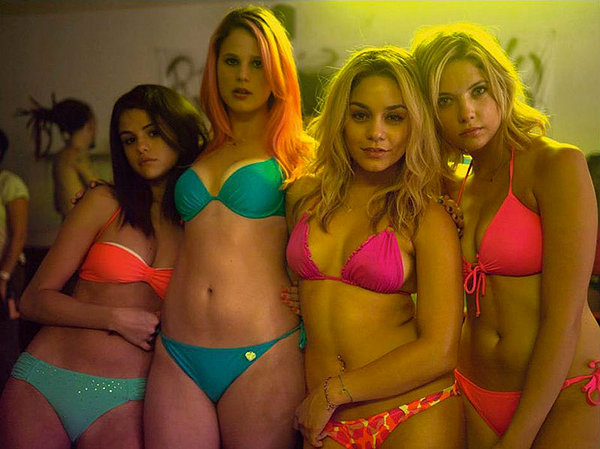 Let’s talk about that paucity of characterization. Besides Faith (Gomez), a name a bit too on-the-nose for this sort of enterprise, there is zero I can say about ANY of the other three girls. They are completely interchangeable. They have no defining characteristics beyond their simple geographic placement within the camera frame. That’s it. When Faith ditches the movie at the halfway mark, having the good sense to realize her supposed friends might not be the best influence, I wanted to go with her. I didn’t want to be left with these vacuous and annoying characters. It’s pretty clear the contempt that Korine has for his own female characters, constantly serving them up for ridicule. It makes the whole movie even less appealing. We’re not supposed to like our heroines but it gets uncomfortable when the director seems to be constantly shaming them, rubbing our faces in how awful they are as people. With an absence of characters you care about, and a plot that feels like it keeps circling back, there’s precious little to hold onto before you become anesthetized to Korine’s exploitative navel-gazing.
After Oz the Great and Powerful I didn’t think I would utter these words, but thank God for the presence of James Franco. The man is so fully committed to his gonzo portrayal of a white trash wannabe gangster that you are downright thankful when he takes over the movie halfway in. At least we don’t have to spend as much time with our empty-headed trio of ladies. Franco, perfecting an ominous drawl, is a cartoon of misplaced machismo, living the “gangsta” life he’s seen parroted in pop culture (he has Scarface running on a constant loop on his TVs). He provides a jolt of energy to the movie, a second wind, and thankfully pushes the girls into greater conflict than part-to-party binges. He brings a real sense of danger to the film, and the descent into a criminal path couldn’t have come soon enough for me. It’s such an enjoyably whacked-out performance that I wouldn’t be surprised if Franco may even be considered for some Best Supporting Actor nominations.
There’s something just so tiring and depressing about watching people trying to chase a hedonistic high rather than, you know, live their lives. In this warped sense of thinking, the all-encompassing term of “partying” is meant to be the divine state of being and anything else falls by the wayside of significance. I understand the movie is exposing a shallow and empty way of life but it can still be tiring to watch nonstop. You become numb to the onscreen antics. You become numb to the free-flowing spirits, profanity, and gratuitous nudity (there were literally six topless ladies onscreen before a word was spoken). Watching Spring Breakers, you have two options: give yourself over to the trance-like, self-destructive youthful fever-dream or sit solemnly, objectively observing how the outrageous become routine, and become dead inside.
As much as it pains me to admit, being a non-fan of Korine’s movies, there are a few moments in the movie that are actually surprisingly effective. The first is a hasty robbery of a small restaurant. We stay in the passenger seat of the slow-moving car as it spins around the building, and in the background we see the escalation of events, the girls smashing breakables and terrorizing the few patrons. It’s one of the few visual decisions that felt, and here’s a word you won’t find anywhere else in relation to this movie, artistically restrained. There’s also plenty of forced irony in the movie where a character’s positive words will be counterbalanced by a visual contrast. Faith phones her grandmother and talks about her great time, even promising next year that she wants to take dear old granny along with her. Meanwhile, as the words play out, which will happen again at several redundant points, we see the girls engaging in behavior that would most likely not be granny-approved. Even if forced, and often redundant, it’s still effective, as is Korine’s hypnotic visual sensibilities. If nothing else, Spring Breakers is a good-looking movie with many pleasing visuals.
 I think I understand why my critical peers have lavished as much praise upon Korine’s bacchanalia. They see a satire of this empty, nihilistic, party-all-the-time, damn-the-consequences lifestyle, the idiocy of youthful hedonism. The problem is that there’s only a handful of moments in Spring Breakers where I felt that Korine actually achieved satire, one of them being a montage of robberies set to a Britney Spears song (beforehand we saw girls holding guns by the barrel and dancing in a circle). Those moments that struck me as satire were few and far between, because what I mostly left with was just another exploitation film. If this were meant to be satirical, the girls would not get away with it all in the end. Korine may intend to stand back in some ironic judgment of his own movie, providing himself an excuse for the lackluster plotting and characters. Here’s the point: even if it was done intentionally, it still makes for a lackluster plot and characters. Saying, “I meant that all along,” is not an excuse when the rest of the film fails to live up to your stated satirical intents.
Allow me a moment to talk about the somewhat disconcerting treatment of, for lack of a better description, the sluttiest of our gals, Cotty, played by Rachel Korine. When I saw the last name of Korine I thought, “Is that the director’s daughter?” Harmony Korine has been in the film industry for almost 20 years, so it was a possibility, and oh what a disturbing thought that was. Some cursory research proved that Rachel Korine was in fact Harmony’s wife; there’s a thirteen-year age difference. It’s still uncomfortable that Korine would slot his own wife to portray one of the titular spring breakers, the only one from our posse who goes nude onscreen too (sorry skeevy Disney Channel and ABC Family fans). So when he’s slut shaming these girls, mocking them with contempt, directing their gratuitous exploitation, he’s also including his own wife in this distasteful characterization, making sure the camera has multiple opportunities to take in her exposed flesh. It’s like he’s serving up his own wife to the gods of spring break (a.k.a. young male ticket-buyers), and it just seems icky.
When Spring Breakers came to a merciful close, the college-aged guy behind me remarked, “That’s the weirdest movie I’ve ever seen.” I replied, “Then you haven’t seen a lot of movies, have you?” Korine’s abstract, aimless salute to self-indulgence is a depressing experience that celebrates the worst in human beings, but weird it is not. I’m just tired of Korine’s schtick. He presents trashy characters, prods us to ridicule them, and then gives them a lot of empty space to do dumb things for an hour and half, ultimately going nowhere and accomplishing little. It just so happens that Spring Breakers, his most commercial and accessible film, has attractive, nominally famous actresses partaking in the nastiness this time. I suppose there will be some appeal to a small swath of filmgoers to see former squeaky-clean Disney Channel gals cutting loose, behaving badly, and playing against (manufactured) type. For me, the very casting of these ladies was another sign of Korine’s artistically bare ambitions. If he wanted to hold up the entire escapist spring break pleasure-seeking lifestyle for satire, then he needed to push harder. What’s on the screen is rarely satire. Instead, it’s just another careless exploitation film, replete with moronic characters we don’t care about and a plot that would be charitably described as, well, a plot. Even Franco’s calculated weirdness cannot save this film. Spring Breakers is a trip best avoided.
Nate’s Grade: C-
Share this:

The Incredible Burt Wonderstone (2013)
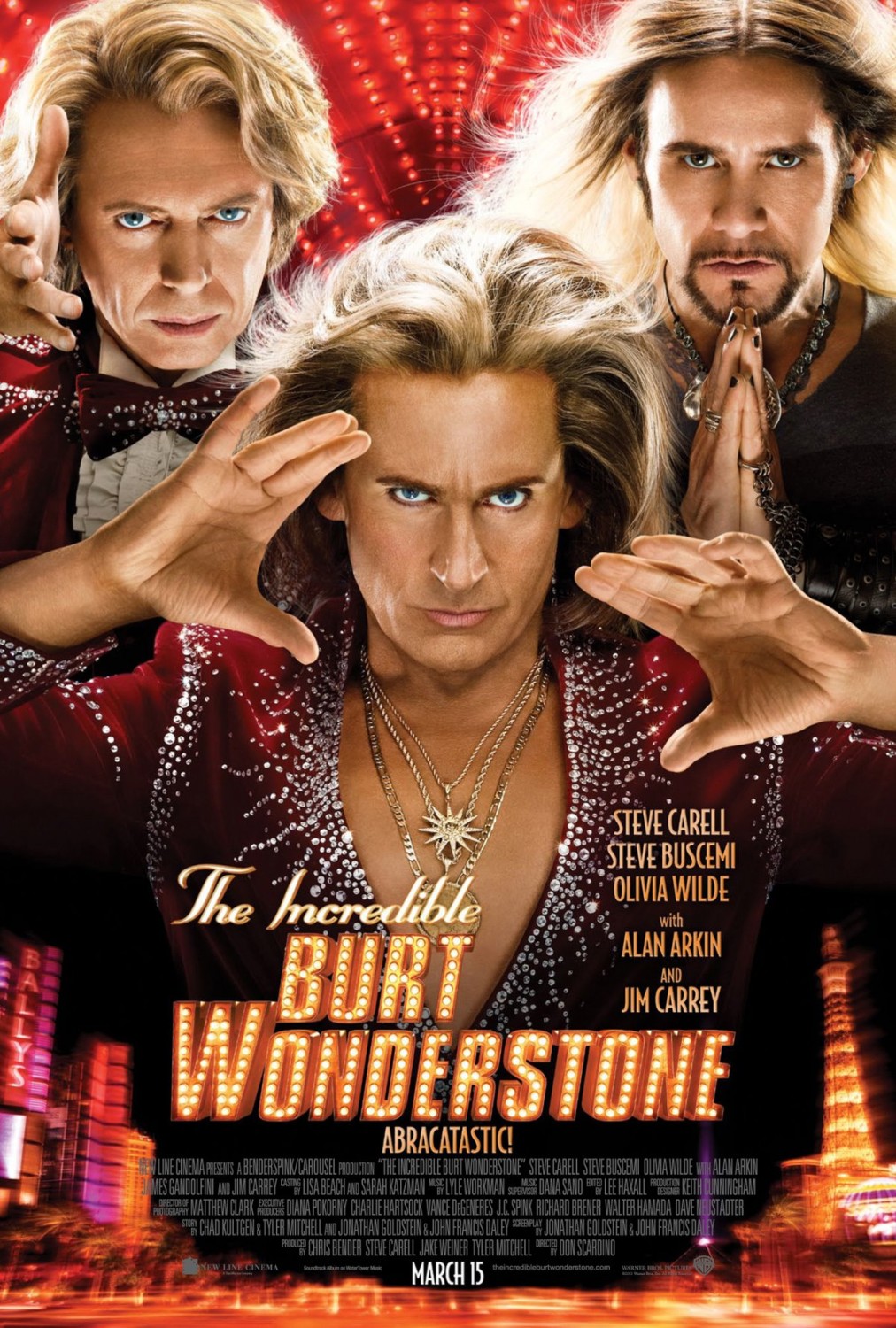 The Incredible Burt Wonderstone is a far better comedy than it has any right to be. It’s not perfect by any means, but it finds clever or darker angles to take that surprise, at least until it hits the next big marker on its jerk-learns-a-lesson plot playbook. The titular magician (Steve Carell) has a falling out with his longtime assistant and even longer-time (is this a word?) friend played by Steve Buscemi, who is disarmingly affable and warm. Their Vegas act is old hat in the face of younger, hipper, and more danger-seeking magicians, notably the Chris Angel-styled Steve Gray (Jim Carrey). While only a supporting character, Carrey’s bits onscreen are easily the best thing he’s done in a decade, comedy-wise. His physical comedy finds a perfect outlet. Gray’s schtick is more Jackass than David Copperfield, and the movie does well to explore this division and why people gravitate to magic in the first place. It’s ultimately a sweet film about the bonds of friendship, with Carell and Buscemi taking the bulk of the running time, and while it has plenty of silliness there’s also sincerity there. It all builds up to a great climax and a conclusion that left me laughing so hard I was in stitches. Make sure to stay through the credits. The Incredible Burt Wonderstone, from the writing team behind Horrible Bosses, is a charmingly broad comedy that has enough heart, committed comedic performances, takes enough clever turns to justify a viewing.
Nate’s Grade: B
Share this:

Magic Mike (2012)
 After all the hype and the derision from my friends, I finally saw Steven Soderbergh’s male stripper opus Magic Mike, and it does not pain me to say, as a red-blooded heterosexual male, that I found it mostly enjoyable. I understand the detractors, many of whom were let down by the relentless, frothing hype generating the film’s box-office success. The characters are fairly shallow, and almost all of the supporting players are one-dimensional; many of the male strippers only have their abs and a name to work with as far as characterization. There’s also the general absurd nature of the world of male stripping, where women are whipped into a frenzy and men almost comically gyrate atop them, or in some instances, literally pick them in the air to swing their junk into. The last act also rushes all sorts of storylines: the rookie’s fall from grace, Mike (Channing Tatum) coming to the realization to leave the business, a hastily thrown together romance. With all that said, I was always interested in just watching the ins and outs of this profession put on screen. And when the plot falters, there are always the impossible charms of Tatum to bring me back. Matthew McConaughey is also fascinating to watch as a mixture of showman, zen artist, and sexual being. I even found the dance/stripping sequences to be worthwhile as few insights into the various characters. While being less than magical, Magic Mike’s shortcomings don’t take away from what it has to offer. That may be the most unintended inuenduous statement I’ve ever written for a film review.
Nate’s Grade: B-
Share this:

Olympus Has Fallen (2013)
 Remember in the late 90s when studios seemed to develop similar projects every few months? In 1997, we had two volcano movies (Volcano, Dante’s Peak), and in 1998 we had two animated bug films (Antz, A Bug’s Life) and two asteroid action flicks (Deep Impact, Armageddon). With the wealth of unproduced screenplays, there’s definite merit to different writers coming up with similar concepts independent of one another. Now in 2013 we have two action movies that, boiled down, are essentially Die Hard in the White House. The first out of the gate, Olympus Has Fallen, is an entertaining action vehicle that reminds me of the 90s Jerry Bruckheimer era of big explosions, big body counts, and irony-free pleasures.
Mike Banning (Gerard Butler) is a top Secret Service agent still reeling from his inability to save the President (Aaron Eckhart)’s wife (Ashley Judd) in a freak accident. He now provides security at the nearby Treasury Department, the President afraid to see Mike’s face and be reminded of his loss. Then one sunny day, a cargo plane fires on D.C. citizens, armed terrorists assault the White House, and North Korean nationalist Yang (Rick Yune) has taken the President and his cabinet members hostage. The Speaker of the House, Trumbull (Morgan Freeman), has ascended to America’s Commander in Chief and he has to navigate tricky issues like how to save the president. Luckily, they have a man on the inside. During the firefight, Mike scrapped his way inside the White House. Now it’s one man versus a bevy of terrorists and nationalists.
 The overall execution reminds me of the heyday of mid 90s action cinema, with its mixture of the ridiculous played completely sincere. It doesn’t really matter that North Korean terrorists are able to take down the White House so easily. Sure we can nitpick the very prospect of a large foreign aircraft getting so close to D.C. before getting intercepted, and only with two fighters at that. But if you can tuck away that nagging voice reminding you of the implausible nature of everything, then Olympus Has Fallen is a serviceable action thriller. Every fifteen minutes or so our hero has a new mini-goal to accomplish. It keeps things fresh and holds your attention away from analyzing the sillier elements (Gatling guns atop the White House?). The debut script by screenwriters Creighton Rothenberger and Katrin Benedikt follows the Hollywood blockbuster blueprint down to the smallest detail. Of course there’s another blueprint it mirrors, namely that of Die Hard. Beyond the premise of one man left to his wits in a hostage standoff, there’s also the moment where the bad guy poses as a good guy to the ignorance of our hero, there’s the failed outside tactical use of force, and the bond forged between the man on the inside and the link outside, whom isn’t given the level of respect deserved. That’s not just an application of the Die Hard premise to a new setting (like Air Force One or Under Siege), but a sampling of the very plot beats from Die Hard. Then again if you’re going to steal then steal from the best.
There’s a certain throwback bravado vibe going on here that makes it all easier to swallow. It’s got big silly action sequences and some in-your-face jingoism (a character, when faced with the notion of execution, literally starts reciting the Pledge of Allegiance), enough that Michael Bay would be misty-eyed, but treating the subject matter with such thoughtless swagger makes the reality easier to accept. Having D.C. attacked, civilians mowed down, national monuments crumbled, and the White House in ashes, well you’d naturally think back to the very real horrors of 9/11, and you may shudder. By embracing the implausible nature of the action and achieving a tone that prioritizes popcorn thrills, Olympus Has Fallen dances around pitfalls of exploitation and simply becomes another big, dumb, but enjoyable action movie. I say this without a hint of derision or irony.
I haven’t been a fan of Antoine Fuqua as a director. He can compose a good looking movie, but Shooter, Tears of the Sun, and King Arthur were enough to convince me the man could not properly stage exciting action. I think perhaps the limitations of the setup brought out the best in him because there are some genuinely gripping action sequences on display here. Also, the man does a fine job of establishing the geography of his action and presenting a surprising variety. Fuqua, aided with the shifting script, makes sure that the audience never gets bored. Sure there are storylines that don’t exactly work, like Mike finding the First Son, a character never heard from again, but the movie keeps changing shape, getting bigger, and finding enough satisfying payoffs. This is an effective, serviceable “turn off your brain” action movie, and it does enough right that you don’t fret about turning that brain back on until the end credits. The R-rating also ups the ante, providing bloodier and brutal escalation to what should be life-and-death stakes. If you’re going to give me “Die Hard in a…” then you best make sure your movie doesn’t wuss out. You’ll recognize plenty of action movie tropes and clichés, but the action is worthwhile and the plot constantly moving that you simply don’t mind.
 It’s nice to see Butler (Playing for Keeps) find a role that plays to his, admittedly limited, strengths. His character is your standard tough guy with a tragic past, haunted by the life he couldn’t save, looking to make amends and forgive himself. It’s probably the fact that the role has so little to it that Butler is able to slide effortlessly into gruff action star mode, a preferential place (though I prefer the man to be bearded as well). The rest of the movie benefits from actors who are far better than the material: Freeman, Eckhart, Melissa Leo, Radha Mitchell, and Angela Bassett. They all provide better-than-average performances for this type of movie. Even Dylan McDermott (TV’s American Horror Story) gets room to shine. Rick Yune (Ninja Assassin, The Man with the Iron Fists) makes for a very sinister bad guy. The part is Generic Antagonist #301, but Yune finds fun ways to enjoy the menace, soak it up without hamming it up. He transforms a generic villain into a dude you want to see righteously toppled.
After last fall’s updated Red Dawn (scrubbed free of invading Chinese forces) and now this, I must ask if North Korea has become the go-to military enemy for American action movies. Olympus Has Fallen takes the added step of never having the government of North Korea involved or approve, like the terrorists are acting on their own. We wouldn’t want to upset the government of North Korea; that’s what Red Dawn is for. But does anyone really view North Korea as a credible military threat? They are seen as a rogue nation, yes, and they claim to have nuclear arms, so they should be taken seriously, but does anyone realistically think we’ll wake up tomorrow and be conquered by North Korea? I suppose this criticism lies more with Red Dawn than Olympus Has Fallen, a movie that only needs a handful of dedicated foot soldiers rather than an invading army. I also find it laughable that the only thing holding back North and South Korea from war, in this fictional scenario, is the presence of about 28,000 U.S. troops. Also, if these events played out as they do, who doesn’t think that the U.S. would respond with military action against North Korea? We started a war with Iraq and they weren’t even responsible for the actions of a handful of terrorists. I guess the North Koreans are the new Hollywood Boogeymen.
With a hook of a premise, some exciting action, and more than a few borrowed plot beats from Die Hard, it’s still a pleasant surprise at how entertaining Olympus Has Fallen works. It’s a movie that simply does enough right to justify watching. Its action is good enough, its plot is familiar enough but offers enough forward momentum, its actors are good enough, and it does enough right to quell potential boredom. I appreciated its throwback feel to the mid-90s action movie, a time of elevated popcorn thrills and powerful bravado, all without a hint of irony no matter how ridiculous things got. It lands on shakier ground when it tries to become a rah-rah kind of patriotic rally, but I’d be lying if I denied the certain pleasures of watching a Secret Service agent take out the bad guys on his turf. Time will tell how the second Die-Hard-in-the-White-House movie will fare, but if you’re looking for big and dumb but enjoyable, Olympus Has Fallen is like a summer popcorn film only in March.
Nate’s Grade: B
Share this:

Cosmopolis (2012)
 David Cronenberg is a director that’s full of surprises. The biggest surprise about Cosmopolis, his new film based on the Don DeLillo novella, is how shockingly terrible it is. This may be Cronenberg’s worst film. It’s certainly one of the worst films of 2012.
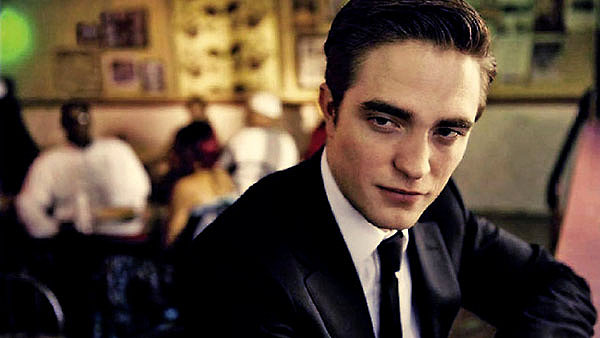
Eric Packer (Robert Pattinson) is a mega-millionaire currency trader. He’s got so much money he wants to outrightly buy a church just because. We travel with Eric over the course of one day as he travels through New York City in his stretch limo. Along the way, he hosts a colorful array of characters and fears that his high-stakes wagers will be adding up. He becomes more and more self-destructive and looks for new and exciting ways to waste money, talent, and time.
I hesitate to even use the term “film” with Cosmopolis because it’s truly more of an endurance test in didactic, pretentious art house masturbation. The script is really a collection of self-indulgent scenes with very little to connect anything together. Each new scene feels like the movie is starting over. Worse, the dialogue is painfully elliptical, stilted, and monotone, reeking of pseudo intellectual intent, lingering in ambiguity like it’s poetic. It’s not, it’s irritating and obtuse and characters talk in circles without ever really saying anything. It’s the kind of dialogue that reminds me of a pompous student play, something where the particulars involved think they’re making Artistically Daring Statements about Things That Matter. It’s such a mannered way of speaking, so labored in its affectations and superficially drawn to the mistaken belief that obtuse and redundant equals philosophical and thought provoking. The only thoughts I was thinking were of the murderous variety. I felt so pained that I had to check the time and only eleven minutes had passed. It felt like I had spent three times that. I stuck it out for you, dear reader, but otherwise I would have bailed. Here are a handful of dialogue samples to give you an idea:
 “Why do they call them airports?”
“I have an asymmetrical prostate. What does that mean?”
“Try putting a stick of gum in your mouth and not chew it.”
“Where do limos go to spend the night?”
I feel like I’m even doing a disservice to calling the people onscreen characters. They’re really more just talking heads, mouthpieces for cluttered ideology. The plot introduces new characters but they only last for a scene and then it’s time for someone new. This would be acceptable if it ever appeared that these interactions had any effect, positive or negative, on our protagonist. As it stands, it’s just a gloomy guy running into one meaningless encounter after another. Oh, and if that was the point of the whole exercise, then shoot me now. I literally cheered when the movie was over. Well, right after incredulously barking, “That’s it?”
Plot is another term, much like characters, that has next to no meaning for Cosmopolis. The plot is a wealthy guy who wants to get a haircut. Yes, that is the inciting incident. He stays in his limo as it slowly drifts down the bumper-to-bumper New York City traffic. He has encounters with people, sure, but mostly it’s the story of one man in his pursuit of a haircut. And you know what dear reader, spoilers be damned, but he gets that haircut too. The final half hour of the movie, almost a third of the whole running time, is spent with Paul Giamatti, an intense and angry man who wants to kill Eric. At least Giamatti’s performance kept me awake. The plot, much like the characters, is really a vehicle for the script’s ideas, so it becomes exasperating when the movie tries to pretend, at points, like now all of a sudden we should care about Eric and his journey. The ideas, as presented, are either on-the-nose or impenetrable. For every confusing conversation about death, you’ll get a leaden capitalism = rats metaphor.
 Pattinson (Breaking Dawn Part 2) seems like an apt choice as well as a craven marketing ploy for Cronenberg to get his weird arty movie greater exposure and financing. Pattinson gives a rather cold and detached performance, which I’m sure is also the point but it’s not exactly an outlet to showcase any potential range. I’m sure Pattinson leaped at the chance to work with Cronenberg, but he should have checked out his emotionally vacant character first. Oh I get it that Eric is a guy who seemingly has it all but now feels empty, and I get how it’s meant to be an analogue for the Wall Street set that’s hijacked our capitalism markets (rats!). I get it. It’s just lousy, and Pattinson could have been replaced with just about any young Hollywood hunk. The only enjoyable aspect of this whole movie, and this is simply a theoretical extension, is that plenty of diehard Twilight fans are going to watch this movie and be very very confused.
Cronenberg keeps us locked in that limo, at least for the first half of the film. We get to watch Eric host an array of guests. He gets serviced by a middle-aged woman (Juliette Binoche). He gets a prostate exam while conducting a meeting. He gets up-to-the-minute reports on the millions of dollars he’s hemorrhaging, and he doesn’t care. Money has lost all known value when everything is given to you. Look, I can make vague, self-important statements too. I’ll credit Cronenberg with finding creative ways to play around within the confined space of the limo, making the film less hermetic than it by all means should be. However, bad green screen effect work really proves distracting, so that you’re given another reason to check out when characters drone on as they do.
Strictly put, this was not a story that needed to be turned into a movie. I’m sure DeLillo’s novella has its own weight and power, but the big-screen adaptation of Cosmopolis is all flaccid pontification, empty verbal masturbation, and crushing dead weight. It was a Herculean effort for me to watch this meandering movie to the end and I know I can’t be alone in this regard. If only the characters were really characters, or the plot had any minute sense of momentum, or that the dialogue was less purposely obtuse, or if the movie felt like it was at least going somewhere or had some small recognizable shred of purpose. I won’t go as far to say that you should be worried if any of your friends gushes to you about how great this movie is, but you should probably keep an eye on them or see if they bumped their head. This movie is more like an insufferable lecture by the most boring people who confuse cerebral with impenetrable. If you’re not going to supply me any significant means of entry to engage with your art, then I’ll just go play with somebody else. Cosmopolis feels like the worst and most pretentious student film you’ll ever see. The rub is that a great director like Cronenberg made it.
Nate’s Grade: D
Share this:

West of Memphis (2012)
 The West Memphis Three murder case gained substantial notoriety thanks to an HBO documentary team, Joe Berlinger and Bruce Sinofsky, who were on hand in 1993 to document the trial in their film, Paradise Lost. Three eight-year-old boys (Michael Moore, Christopher Byers, Steven Branch) went missing one day in May in West Memphis, Arkansas. Their bodies were found the next day in a nearby creek. The boys had been hogtied and bore plenty of vicious marks, one of them having a severed penis. The horror shocked the small town and the blame landed on a trio of local teens (Jessie Miskelley, Jason Baldwin, Damien Echols). Miskelley had confessed under police interrogation and so was tried separately, but all three were found guilty. Miskelley and Baldwin were given life in jail and Echols, the supposed ringleader, a teen who disliked authority and read about magic and demons, was given the death penalty.
In the years that followed, thanks to the exposure of the Paradise Lost films (a second was released in 2000 and a third in 2011), advocates flocked to the cause, belied by the overwhelming belief that the three convicted had been unfairly railroaded. Celebrities spoke out and got involved, chief among them Lord of the Rings filmmakers Peter Jackson and Fran Walsh. They began communicating with Echols and his wife, Lori, and personally bankrolled a new team of forensic experts to amass new evidence that could allow for a potential appeal. Jackson even hired Oscar-nominated filmmaker Amy Berg (Deliver Us from Evil) to helm her own documentary, West of Memphis.
 Denied at most turns by the same flat-footed officials, the West Memphis Three struck a deal with the Arkansas attorney general in August 2011. The three would be granted freedom if they agreed to an Alford Plea, a rare legal circumstance where a defendant can plead guilty while still maintain their innocence. Eighteen years later the West Memphis Three are free but there are still many questions that need to be answered, mostly involving the conduct of officials involved in the case and the identity of the real killer.
As an ardent follower of the case, as well as the three previous documentaries by Berlinger and Sinofsky, I was concerned that West of Memphis would be more or less a rehash of what has already been covered in earlier, better movies, and to some degree it is. When you’re the fourth documentary to the table, there’s going to be some repetition. Berg’s film serves as a nice introduction to the case for newcomers and provides a diligent overview of the main facets of the murder case. There are a few finer points that Berg’s film spends more time illuminating that I think are worth mentioning. The first is extensively laying out why Miskelley’s confession was coerced. The teen, whose mental faculties are low, was locked away in police custody, without a parent or lawyer, for most of a day, with only a scant portion recorded. On these recordings, Berg clearly points out, with the assistance from some expert talking heads, how police officials guided Miskelley into the statement they wanted to hear. It’s pretty damming stuff to hear and a clear-cut case of a coerced confession.
What West of Memphis does best is narrow its focus to police and prosecutorial misconduct, picking apart the evidence that put two men away for life and one on death row. The fact that the prosecution used Damien’s own teenage poetry against him, evidence that might simultaneously doom and embarrass us all, should speak volumes. This was a case where the only thing tying the defendants to the crime scene was Miskelley’s false confession and the flimsy idea that the crime scene was a satanic ritual. Berg finds several of the prosecution witnesses who testified on the stand about how the three were involved in satanic practices, and in those new interviews each witness comes clean, admitting they were pressured by police or offered attractive deals to link the defendants to the satanic motive. Their recantations are satisfying to hear and, in journalistic lingo, a true get for Berg and her crew.
We expect our law enforcement officials to be just but mistakes will happen; however, in the event of those mistakes, we expect officials to try and correct them, to make things right. What West of Memphis shows is that the West Memphis officials dug down deeper in the face of compelling evidence, refusing to admit when they were so clearly wrong. In the years after the case and following the Berlinger and Sinofsky films, there have been renewed efforts to revisit the physical evidence of the case. To a fault, every professional profiler, including one guy who was there at the founding of the FBI, concluded that the crime had nothing to do with Satanism or the occult. They also concluded that most of the wounds, argued by prosecutors to be responsible by a serrated knife found in a lake behind Baldwin’s family mobile home (a knife the prosecution expressly knew Baldwin’s mother admitted to hurling in that lake a year prior to the case), were in fact made post-mortem by local scavenging animals, mainly large turtles with snapping jaws. There’s a reason that the wounds aren’t bloodier. It’s because the victims were already dead.
 But the most enlightening piece of evidence is what was found thanks to DNA, namely nothing. On not one single piece of evidence or anything relating to the victims was one scrap of DNA linked to Baldwin, Misskelley, or Echols. Seems rather open and shut, doesn’t it? Except Judge David Burnett, the same judge who presided over the original case, dismissed the reams of new physical evidence and rejected the motion for an appeal. It got to the point where, at the Arkansas Supreme Court, the state was arguing that the only new evidence that should be considered when granting appeals is evidence that points to guilt. The state argued, to the disbelief of the court justices, that new evidence that could overturn (wrongful) convictions should be disallowed. Fortunately, the Arkansas Supreme Court rejected this motion unanimously. It’s quite clear that law enforcement officials sought to save face rather than enact justice.
Another aspect that Berg’s film does better is illuminating another suspect the police have ignored for 18 years, Terry Hobbs, stepfather to Steven Branch. The movie devotes a solid 45 minutes on the subject, painting a convincing portrait of a suspect with long ties to abuse, anger, lies, and manipulation. A hair of Hobbs, matching his DNA exactly, was found tied into the knot of one of the bound boys. Weirdly enough, Terry Hobbs sued Dixie Chicks lead singer Natalie Maines for defamation, which fortuitously provided an opportunity to question Hobbs with the full penalty of the law behind them. Under oath, his story crumbles and his alibi at the time proves to have a sizable a gap, a period where the boys were killed according to medical reports.
Clearly Terry Hobbs is a compelling suspect though I wish the movie didn’t feel the need to resort to superficial assertions concerning how he “behaves guilty,” like his lack of emotion concerned the case. Questioning why he waited over two hours to tell his wife that their son was missing is a fair line of inquiry. Questioning his history of spousal abuse and violent run-ins is fair. Questioning why he isn’t more outwardly bereaved is not. It’s the same prejudicial judgments made against Damien when he was being tried, the idea that he just wasn’t acting like an innocent man (to be fair, Damien was also a moody teen at the time). Berlinger and Sinofsky are guilty of this as well, devoting a disproportionate amount of Paradise Lost 2 to pointing a suspicious eye toward John Mark Byers, stepfather of Christopher Byers, and a theatrical, larger-than-life figure. At least with Paradise Lost 3, the filmmakers make amends, and there’s a nice scene where Byers apologizes to Echols. This guilt-by-superficial-judgment is a dubious line of accusation that Berg and her film should rise above (just the facts, ma’am).
From there, though, I started feeling like West of Memphis is best served as a complimentary film to be paired with the altogether superior Paradise Lost documentaries. There is something to be said for Berlinger and Sinofsky being on the ground from the get-go, having unprecedented access to the victims’ families, the families of the accused, the attorneys on both sides, and the accused themselves. Naturally over three films you get a much stronger sense of the nuances of the case, but Berlinger and Sinofsky also gave you a much stronger sense of the community and the full context of the crimes. I was bothered at how often Berg’s film eschews direct on-camera interviews with Miskelley and Baldwin. Late in the film, as the movie explores Baldwin’s hesitancy to admit guilt for a chance at freedom, a friend recounts her phone conversations with Baldwin on the tricky subject. Why isn’t Baldwin himself on camera talking about this rather than a friend relaying her conversations with the man? Throughout the film, when it concerns the accused, the movie feels oddly removed from the source (Damien and his wife are credited as producers for the doc). It’s got plenty of talking heads and famous celebrities on camera but I’d rather hear from those directly involved. It’s just another reminder of the access and relationships that were formed through the Paradise Lost films. You’ll get a good overview of the fascinating and horrifying case with this movie, but to get a better understanding of the people involved, reference the meatier Berlinger and Sinofsky films.
 By the end, even after 18 years in prison, it’s remarkable and inspiring how free of bitterness the three men are. They still have to live with the guilty verdicts but they are free, and rather than dwell on what was taken from them, the men are thankful for their freedoms and thankful for the diligence of the people who believed in their innocence, who fought long and hard so the day would come when they three of them would be set free. Berg’s film even dedicates its last moments to those advocates and their efforts, saying that their involvement made all the difference. This is an example where a movie literally saved somebody’s life. Without the exposure of the Paradise Lost, it’s very likely Echols would have remained on death row and been executed. On a personal note, this was the final moment that got me to cry (there were a couple others that made me teary). It’s because of the shared happiness and accomplishments of helping, in whatever small way, three innocent men get their long overdue freedom. I won’t overstate my involvement, but I was there, writing letters, sending in donations, advocating, since 1999. I have never been happier to retire a T-shirt than with my “Free the West Memphis Three” shirt (I wore it one last time to watch this movie). The forward-thinking, gracious attitudes of Baldwin, Miskelley, and Echols are inspiring, and it even inspired me to seize the moment myself rather than remain passive in a personal relationship.
Coming in after a trilogy of other extensive documentaries, West of Memphis can’t help but feel a little late to the party. Its strengths lie in deconstructing the prosecution’s case and assembling new interviews where key witnesses have an opportunity to come clean and recant. Otherwise, it’s like listening to another singer perform a song you’re already familiar with. The case is so deeply troubling and morbidly fascinating that there’s definitely room for four movies on the topic and then some; Atom Egoyan has filmed a movie based upon journalist Mara Leveritt’s book on the case, Devil’s Knot (starring Reese Witherspoon and Colin Firth too). It’s easy to become immersed in this case; I know I have over the years. It all came down to a police force pressured to find a killer and three teens that were different in a small town. There are many tragedies tied to this case. The three boys who were gruesomely murdered. The three men who were wrongly convicted and lost 18 years of their lives. And since the West Memphis Three plead guilty, it means that the police can officially close the case, allowing the real killer to continue to walk free and unpunished. That should trouble every single person. West of Memphis is a gripping and thought-provoking documentary, though I think it’s best viewed as a supplement or introduction to the superior Berlinger and Sinofsky films.
Nate’s Grade: B+
Share this:

Emperor (2013)
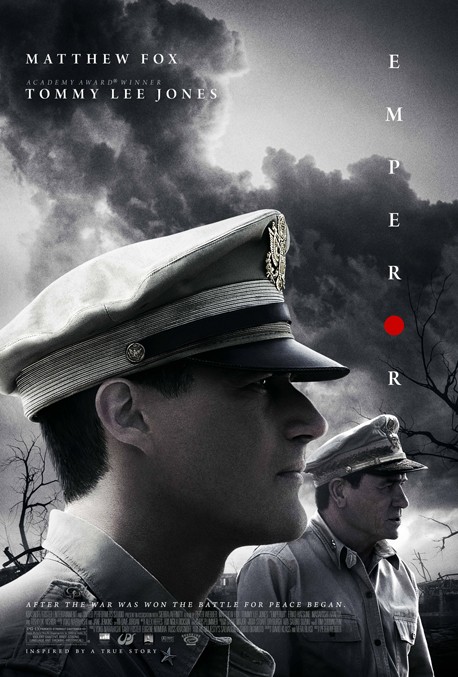 When you’re tasked with retelling an interesting part of history, a story that few are familiar with, it’s best to get out of the way. You don’t need to gussy it up if the history, itself, is interesting enough to warrant a movie. Such is the case with Emperor, a drama set in Japan weeks after their surrender to Allied forces in WWII. General Douglas MacArthur (a stodgy, scenery-chewing performance from Tommy Lee Jones) will rely upon the advice of one man (Matthew Fox) whether to try the Japanese emperor for war crimes for his possible involvement in the Pearl Harbor attack. The country is still recovering from the shock of nuclear bombs, its people could rebel against foreign occupiers, and the future of the country feels precariously on the brink. All of this makes for a good setting for a story, but Emperor doesn’t stick this out. It keeps falling back to a lame love story about Fox’s college days when he was smitten with a Japanese woman. So, now in Japan again, he desperately looks for her, having amber memories to times where he chased her around wooded areas (they must have done this a lot as a couple since it makes up the majority of his flashbacks). You keep thinking, isn’t there a bigger story at work here than one guy’s failed college romance? The rest of the movie is treated so cursory, with stiff-lip TV procedural attention, so that the details are all we get and the people get lost. Ultimately, Emperor is a movie that crushes us with the wrong history, misses out developing all the meaty stuff, and thinks what we truly want is Fox chasing after his lost love. It’s a shame the movie is so boring while the history is not.
Nate’s Grade: C
Share this:

Oz the Great and Powerful (2013)
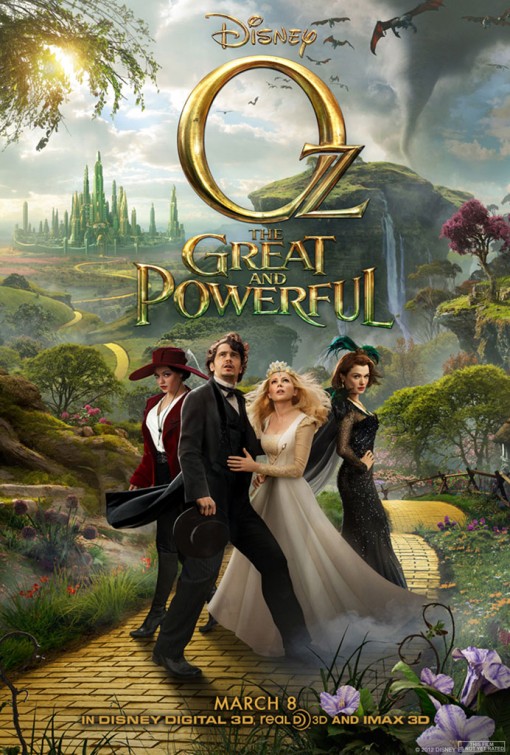 Usually when I’m watching a bad movie I have to stop and think where did things go so wrong, where did the wheels fall off, what choice lead to the disaster I am watching play out onscreen. In the case of Disney’s Oz the Great and Powerful, a Wizard of Oz prequel that pretty much hovers over the cusp of bad for its entire 130 minutes, I have to stop and think, “How could this movie ever have gone right?” I don’t think it could have, at least not with this script, this cast, and the edict from the Mouse House to keep things safe and homogenized, smothered in CGI gumbo and scrubbed clean of any real sense of venerable movie magic.
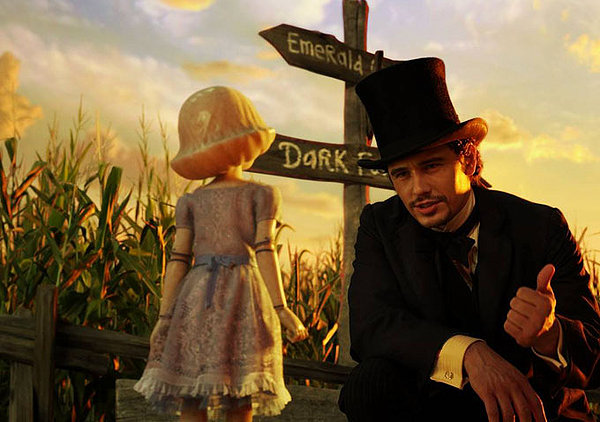
In 1905 Kansas, the magician Oz (James Franco) is used to bilking country folk out of their meager earnings. He’s a con man and runs afoul with a strong man in his own traveling circus. He makes a hasty escape in a hot air balloon and, thanks to a coincidental tornado, is whisked away to the Land of Oz. The people have long been told that a wizard would come and rescue them from the tyranny of the wicked witch. Theodora (Mila Kunis) and Evanora (Rachel Weisz), sisters controlling the Emerald City, task Oz with killing the other witch, Glinda (Michelle Williams). If he succeeds, Oz will become king and riches will be his. Along his journey he collects a band of cuddly sidekicks (flying monkey, China doll, munchkin) and learns that he may indeed be the hero that Oz needs to save the day.
 Oz the Great and Powerful is really just 2010’s Alice in Wonderland slapped together with a fresh coat of paint and some extra dwarves. I say this because, like Alice, this movie suffers from a plot that feebly sticks to the most generic of all fantasy storylines – the Great prophecy speaks about a Great savior who will save us from the Great evil. Naturally, the so-called chosen one has internal doubts about the burden they face, initially ducking out before finding that inner strength they had all long to prove they were indeed the one prophesized. It even got to the point where I was noticing some of the same plot beats between the two movies, like how last in the second act we spend time with a woman dressed all in white who we’ve been told is the villain but who is really the good guy. Then there’s the now-routine rounding up of magical creatures to combat the evil hordes in a big battle. Considering Alice was billion-dollar hit for Disney, it’s no surprise they would try and apply its formula to another magical universe hoping for the same results. Well I thought Alice was weak but Oz is even weaker. However, at least nobody absurdly starts breakdancing by the end. Small victories, people.
Beyond the formula that dictates the plot, the characters are poorly developed and broach some off-putting gender stereotypes. The character of Oz is portrayed as a scoundrel who eventually learns to be selfless, but I never really bought the major turning points for his character arc. Do all major characters need to be flawed men in need of redemption in magical worlds? I understand what they were doing with his character but I don’t think it ever worked, and certainly Franco’s performance is at fault as well (more on that later). The ladies of Oz, however, just about constitute every female stereotype we can expect in traditional movies. One of them is conniving but given no reason for why this is. One of them is pure and motherly. And then one of them gets lovesick so easily, falling head over heels for a boy in a matter of hours that she’s willing to throw her life away in spite. And all of these witches, who can actually perform magic unlike the charlatan Oz, sure seem like they don’t need a man to run the kingdom for them and tell them what to do. It’s sad that a conflict that involves feudal power grabs should devolve into a misconstrued love triangle. Then there’s the role of the little China Girl (voiced by Joey King) who adds absolutely nothing to the story except as another female in need of assistance and doting, except when she inexplicably behaves like a surly teenager in a tone-breaking head-turning moment. Oz keeps resting the very breakable doll on his shoulder, like a parrot. I suppose it’s better than tucking her in his pants.
The movie is also tonally all over the place. It wants to be scary but not too scary. Personally, I always found the talking trees to be spookier than the flying monkeys but that’s my own cross to bear. It wants to be funny but often stoops to lame slapstick and Zach Braff (Garden State) as a goofy flying monkey sidekick. It wants to be exciting but it never takes a step beyond initial menace. Its big climactic battle is more like a children’s version of something you’d see in the Lord of the Rings. The movie fails to satisfyingly congeal and so every set piece feels like it could be from a different movie.
 Some notable casting misfires also serve to doom the project. I like Franco (Rise of the Planet of the Apes) as an actor, I do, but he is grossly miscast here. He does not have the innate charm to pull off a huckster like Oz. Franco usually has an off kilter vibe to him, one that’s even present in this film, that gives him a certain mysterious draw, but he does not work as an overblown man of theatricality. Combined with lackluster character, it makes for one very bland performance that everyone keeps marveling over. It’s like all the supporting characters, in their fawning praise, are meant to subconsciously convince you that Franco is actually succeeding. Kunis (Friends with Benefits) is also a victim of bad casting. She can do the innocent ingénue stuff but when she (spoiler alert) turns mean and green it just does not work. When she goes bad she looks like Shrek’s daughter and she sounds like a pissy version of her character from Family Guy, which is ineffectual to begin with. Kunis cannot believably portray maniacal evil; sultry evil, a corrupting influence like in Black Swan, most definitely, but not this. There are lines where she screeches at the top of her lungs and it just made me snicker (“CUUUUUURSE YOOOOOOU!”).
I had faith that a director as imaginative as Sam Raimi (Spider-Man, Drag Me to Hell) would be a stolid shepherd for a fantasy-rich project such as Oz. I never got any sense of Raimi in this movie. It felt like he too was smothered completely by the overabundance of special effects. It’s a common complaint that modern movies are buried under an avalanche of soulless computer effects, but usually I find this bromide to be overstated. Having seen Oz, I can think of no more accurate description than “soulless computer effects overload.” At no point in the movie does any special effect come close to feeling real. At no point do you feel immersed in this world, awed by its unique landscapes and inhabitants (it feels often more like the land of Dr. Seuss than Oz). I chose to see the film in good ole standard 2D, though the 3D eye-popping elements are always quite noticeable. At no point do you feel any sense of magic, the most damming charge of all considering the legacy of Oz. The original Wizard of Oz holds a special place in many a heart. We recall feeling that sense of wonder and magic when we watched it as a child, the idea that movies could be limitless and transporting. While watching Raimi’s trip to Oz, I only felt an overwhelming sense of apathy that grew disquieting.
Then there’s the matter of the questionable messages that the movie posits. It celebrates the power of belief, which is admirable, but it’s belief in a lie. Oz is a fake, yet the movie wants to say that faith in false idols is something worth celebrating. Oz and his cohorts put together a deception to fool the denizens of the world into a false sense of security. Everyone believes in the Wizard of Oz so he has power but it’s all a sham. We’re supposed to feel good that these people have been fooled. Didn’t The Dark Knight Rises basically showcase what ultimately happens when a society’s safety is based around a lie and false idols? I understand that as a prequel one of its duties is to set up things for when Dorothy comes knocking, but do I have to be force-fed disingenuous moral messages?
Oz the Great and Powerful is a wannabe franchise-starter that feels like it never really gets started. There’s a generic hero’s journey, some underwritten characters, mixed messages, and poor casting choices, namely Franco and Kunis. The sense of movie magic is absent and replaced with special attention to marketing opportunities and merchandizing (get your own China Girl, kids). It feels more like the movie is following a pre-planned checklist of stops, cribbing from Alice in Wonderland playbook, and trying to exploit any nostalgia we have for this world and its characters. Except we love Dorothy, the Scarecrow, the Tin Man, the cowardly Lion, and Toto. I don’t think anyone really had any strong affection for Glinda or the Wizard. Just because we’re in the same land with familiar elements doesn’t mean our interest has been satiated. The Wizard of Oz backstory has already been done and quite well by the Broadway show Wicked, based upon the novels by Gregory Maguire. That show succeeded because it focused on the characters and their relationships (extra points for a complicated and positive female friendship dynamic). We cared. That’s the biggest fault in Raimi’s Oz, that amidst all the swirling special effects and fanciful imagination, you watch it without ever truly engaging with it. You may start to wonder if your childlike sense of wonder is dead. It’s not; it’s just that you’re old enough to see a bad movie for what it is.
Nate’s Grade: C
Share this:

Amour (2012)
 No other foreign film in 2012 racked up as many awards as Amour, a.k.a. Love, by Austrian writer/director Michael Haneke. It’s a love story but it shows the end of that love story, the part where the happily ever after meets the uncomfortable reality we must all eventually face. So, essentially, Haneke has crafted a horror film about getting old (this can happen to you, youngsters!). It’s a hard film to watch, though for me not just because of the subject matter but also because of the maddening ways that Haneke chooses to tell his art-house tales of woe.
Anne (Emannuelle Riva) and Georges (Jean-Louis Trintignant) are an 80-year-old married couple living in Paris. They are both retired musical teachers, they go about their days together, enjoying one another’s companionship. Then Anne suffers a stroke and starts slipping into senility. Her condition worsens and Georges tries to care for her increasing needs himself, buoyed by her fleeting moments where it seems like her normal self returns. But there’s only one way this story can end, and George must come to terms with letting go of his life’s love.
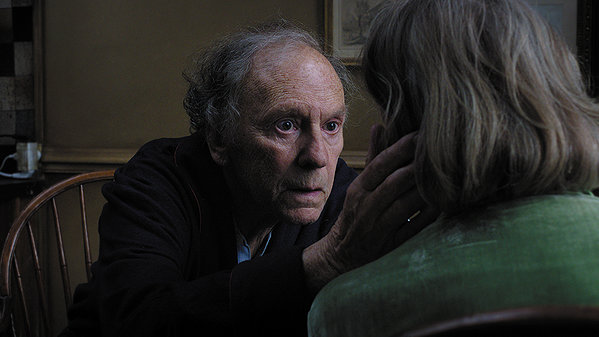 I will probably come across like a heartless bastard but that is the risk I’m willing to take; I found this movie to be rather boring and was, after an hour, just waiting for Anne to die so that the movie would likewise be at a merciful end. I’m just not a Haneke fan. I didn’t like Cache, I didn’t like (both) Funny Games, and I didn’t like The White Ribbon. In fact, while watching Amour I was reminded of all the reasons I dislike Haneke’s style. There was a sequence where a character leaves a room, but rather than follow that character or cut, the camera holds on the scene for an extended period of time, like 40 seconds, until the actor returns. I said, “Oh, I just remember he did the same thing in The White Ribbon, and I hated it then and I hate it now.” Want to watch an old man chase after a pigeon for five minutes? Oh, I get it, the pigeon is a metaphor, but did I need five minutes of it? I find Haneke’s sense of storytelling to be so glacial and, mostly, a spiral of kamikaze nihilism that’s usually distasteful. He’s such a cold filmmaker and the idea of him handling a “love story” seems dubious. It’s hard to watch a Haneke film and feel good about it. And that’s fine, the world needs downer filmmakers who will tackle serious subjects, but this guy is just not for me. With that said, take everything I recount in my review and analysis with a measure of consideration.
I know my power of empathy is alive and well, so I have to stop and run a diagnostic examination as to why I found it hard to really engage with this movie. I’m sure part of it is my relative youth in comparison to the onscreen couple. Death is still a mostly abstract concept I choose to be blissfully ignorant over. But that can’t be fully it. I went through a similar experience helping to care for my 91-year-old grandmother when she died (she lived with my parents for years before her eventual passing). It’s not the same as losing a spouse, naturally, but I do have a relatable entry point. Maybe it was the acting, which was free of any sort of showy actorly tricks we may expect from people reaching the big end. Death scenes have long been a staple of overacting, but underplaying it can also rob the movie of worthy emotional opportunities, and with an artist like Haneke, you may not get many more opportunities to soak up. While I had heard raves about Riva, and make no mistake she is quite good, I cannot help but think, “Yeah… but….” She’s quite convincing at showing the frailty of aging but she’s also practically comatose for half of the movie (I know I’m a Jennifer Lawrence homer, but glad she won the Oscar). And then Haneke tries to get clever with his ending, especially since he had been so straightforward for the previous two hours. The ending, a possible point of confusion, doesn’t feel like it fits the exacting, grounded reality I just barely stayed awake for.
 Amour is really less about Anne, the one slowly dying, as it is Georges coming to terms with his own selfishness, prolonging his love’s life after the point of dignity and mercy. It’s about how he comes to terms with the reality that he cannot care for his beloved, that she is too much of a burden, and that she ultimately wants to die and will fight her husband to achieve this wish. Again, this is an extremely dramatic storyline that could have developed some monstrously powerful examinations about end-of-life care. Sadly, I just didn’t, well, care too much. The relationship between Anne and Georges is very thinly realized onscreen. I’m sorry but I hate it when a character is afflicted so early in a story and that affliction becomes the stand-in for what should be proper characterization. All I know about Anne is her deteriorating condition. I don’t know about her life, her personality, her relationship with her husband before senility sets in. I’m just supposed to automatically feel for her because she’s old and suffered a stroke and her husband really cares a lot. Haneke’s storytelling has not done an adequate job to involve me. The actors, both quite good, can only do so much. There’s a reason that Hollywood has its heroines start the Cough That Symbolizes Terminal Illness when we hit the third act because by that time we’ve gotten to know them and care about their ultimate plight.
Now, Amour goes about its death business in a very sensitive but unsentimental way, which has and will likely emotionally devastate many a viewer. There are serious and hard discussions the movie gives adequate attention to, like how far can one spouse cope with care, when does holding on serve as a detriment, breaking the news to heartsick family members that your loved one isn’t getting any better, coming to terms with the inevitable, the tricky debate about what comes next as far as inheritances, and whether the person who is suffering should have a say in their care or lack thereof. It’s refreshing that serious decisions are given serious consideration, but like everything else, Haneke drags these out to great lengths that I stopped caring.
I find Haneke to be an outrageously overrated filmmaker of clinical coldness and occasional contempt. Just watch Funny Games to see what the man’s opinion is for most movie audiences lapping up your rote thrillers. Better yet, if you’re like me, don’t see Funny Games, and don’t see The White Ribbon, and don’t see Amour. I fully acknowledge I’m out on a critical limb here, cherishing my minority status, but I found this Oscar-winning film to be painfully ponderous and emotionally closed off. I’m happy people can watch Amour and see a great, tragic, affecting love story, because I don’t see it. The actors do fine jobs but the characterization is weak, relying upon circumstance and affliction in place of characterization. Maybe, and this is just a harebrained theory, but maybe Haneke dragged his movie out so long to symbolize Georges’ journey, so that we too, the audience, felt like when the end came it was a relief. I know for me, it did. Whatever Haneke does next, you can count me out. I’m done with the guy. After all, life’s too short to endure more plodding Haneke films.
Nate’s Grade: C+


 nathanzoebl
You must be logged in to post a comment.