Category Archives: 2012 Movies
The Impossible (2012)
 On December 26, 2004, an underwater earthquake triggered one of the deadliest tsunamis on record, devastating coastal cities along the Indian Ocean. Over 230,000 people are believed to have perished from the waves and resulting damage. The Impossible tells the harrowing and ultimately inspiring true-story of one family and their vacation from hell. We follow Marie (Naomi Watts) and Henry (Ewan McGregor) as well as their three sons, from oldest to youngest, Lucas (Tom Holland), Thomas (Samuel Joslin), and Simon (Oaklee Pendergast). They’re vacationing in Thailand for the holidays and then the tsunami hits, separating Marie and Lucas from the group. They are swept away by the punishing waves and Marie is badly hurt. Henry is desperately searching for his loved ones, Lucas is desperate to get his mother proper medical attention, and there are thousands just as desperate and just as in need.
It’s nigh impossible to watch this movie and be unmoved. It’s not very subtle when it comes to its themes and messages, but man is it ever effective. The family struggle could have easily descended into melodrama with a sappy, maudlin reunion, punctuated with swelling music to hit you over the head. It’s a fairly simple story with little to its plot. The family gets separated and then they desperately search for one another and, surprise, they reunite. It is after all based on a true story and they all lived, so there’s that. It’s the startling level of realism, the exceptional performances, and the poignant moments of human kindness and grace that suckered me in big time. I was an emotional wreck throughout this movie but in the best way possible. I cried at points, sure, but my tears and my emotions always felt genuinely earned. There’s no doubt that this is one manipulative movie. It knows what strings to pull, what buttons to push, and it does so with finesse. Last year I decried Extremely Loud & Incredibly Close for being overly manipulative and overdosing on false sentiment. However, with this movie, my investment was never in jeopardy. I was completely absorbed by the story and felt great empathy for the array of characters as they persevere. The horror of that 2004 tsunami is told in one small story, personalized, and giving an entry point for an audience to engage without feeling overwhelmed by the magnitude of destruction and death.
 Let me go into further detail about that wall of destruction, given astonishing, terrifying realism. The recreation of the tsunami ranks up there as one of the most frightening sequences I’ve ever seen in film. It’s a solid ten minutes of chaos, and you will feel the frenzy of that chaos. You’re put in the middle, floating along with mother and son as they helplessly try and cling to one another. The scope of the disaster will leave you gasping. I know they must have used sets and water tanks but I’m left stupefied how it all came together to look so seamless. It sounds macabre to compliment the marvelous recreation of mayhem, but director Juan Antonio Bayona (The Orphanage) and his team have turned disaster into world-class drama. It’s not just the powerful waves as well, there’s the field of debris just under the surface to contend with. When the first wave hits Maria, we experience her complete disorientation. The sights and sounds are blurs, the water oppressive, and the debris sudden, jolting, unforgiving. It’s the closest any person would ever truly want to get in the middle of a tsunami.
The majority of the film is about the family coming back together, and while their reunion is indeed a tearjerker, I found the film littered with many small moments that just soared emotionally. When a disaster of this magnitude hits, I’m always struck by the wealth of human kindness and cooperation that emerges in response. There’s something deeply moving about helping your fellow man in need, even if you cannot understand his or her language. Maria is aided by the Thai locals who do not treat her differently because she’s a white woman. She is just another person in need.
Whenever disaster strikes, we think of the people who plunge into the middle as heroes, but simple acts can be just as comforting and thoughtful. There are small moments of kindness, like lending a stranger your cell phone to call home, that speak volumes. In that one instance, Henry is so distraught, the weight of everything hitting him as he tries to put it into words, and his call is abrupt and somewhat incomprehensible thanks to his rising emotions. Henry is urged to call back, not to leave it at that, to leave his relatives dangling with such precious little and the alarm in his voice. So he’s given the phone again, and in a more measured demeanor, Henry is able to talk about the situation and promise to find his wife. It’s such an everyday gesture made invaluable to Henry. There’s a woman talking to Thomas about the stars in the sky, how we don’t know which are dead but they continue to live on, and the subtext is a bit obvious but it’s still heartfelt. Then there’s Lucas’ mission of organizing the triage center, scouring the grounds looking for missing family members. He takes it upon himself to make a difference rather than sitting idle. It’s that human connection in the face of adversity that proves most uplifting.
 Watts (J. Edgar) gives a performance of tremendous strength and fragility. The tenacity and resilience she has to keep pushing through is remarkable. She’s so strong but vulnerable at the same time, showing you the fine line she walks to stay above the fray for her child. She endures great physical trauma, a gnarly gash in her leg peeling off like tree bark. Then there’s the emotional burden of trying to be a mother to a child desperately in need of a sturdy parent. Watts could have readily played to the heights of the emotions, resorting to hysterics, but the quiet strength of her character makes her underplay the burdens she endures. She can’t simply just break down. You don’t get a true sense of the toll she has suffered until her life-and-death struggles at the very end.
The supporting team around Watts also deserves accolades. McGregor (Salmon Fishing in the Yemen) has several heartbreaking and heartwarming scenes, striving for hope. Lucas has to rise to maturity when his mother is wounded, protecting her, supporting her. Acting novice Holland rises to that challenge with great courage, though there are moments that still remind you he’s only a boy, like when he bashfully turns his back upon seeing his mother’s exposed breast. That awkward, indecisive moment where a young boy doesn’t know how to handle the sight, seeing his mother so exposed and vulnerable, is quite effective. The other actors who round out the family (Joslin and Pendergast) are quite superb as well. The family feels like a cohesive, loving unit, and every performance feels believable.
The Impossible is based upon the true experiences of a Spanish family, and yet the onscreen family we follow is white, so what gives? It’s not surprising for Hollywood to whitewash a story to appeal to a wider audience. Should we have any more sympathy for this family’s plight because they are white? Would we feel less if they were Spanish? I think the perils and victories would be the same regardless of language or ethnicity.
Watching the unflinching and stunning events in The Impossible, you will likely shed some tears, be they from horror, sadness, or happiness at the family’s reunion. While the ending is never in doubt, the movie has plenty of other potent and poignant small moments to keep your emotions safely stirred. It’s a visceral experience that will shock and exhilarate. There were moments where I felt like I had to cover my eyes. But The Impossible is not disaster porn, ogling over the suffering and endurance of the misfortunate. It’s as much about the response to tragedy as it is the wallop of that cruel tragedy in 2004. The perseverance, the open-hearted help of one’s fellow man, the strength of human connection, the long ripples of kindness, it all comes together to form one compelling, often moving, and quite memorable film experience. Add some formidable performances, top-notch direction, and tremendous technical achievement, and The Impossible is a rousing drama that speaks to the best of us even in the worst conditions (think of it as the antithesis of Ayn Rand’s philosophy). It may be manipulative, it may be somewhat straightforward, and it likely climaxes too soon, but when the results are this powerful and emotionally engaging, then I’m happy to have my buttons pushed.
Nate’s Grade: A-
Share this:

Atlas Shrugged: Part II (2012)
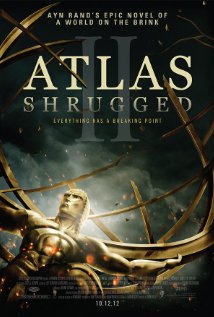 You’d think after the horrible and horribly boring Atlas Shrugged: Part One that a promised Part Two might just disappear into the ether. If only we could have been so fortunate. Ayn Rand’s cautionary opus about the evils of big government is given another creaky adaptation that fails to justify its existence. I feel like I could repeat verbatim my faults with the first film. Once again we don’t have characters but mouthpieces for ideology, an ideology that celebrates untamed greed. Once again the “best and brightest” (a.k.a. world’s richest) are disappearing and the world is grinding to a halt without their necessary genius. Does anyone really think if the world’s billionaires left in a huff that the world would cease to function? The assumption that financial wealth equates brilliance seems fatally flawed. Once again it’s in a modern setting where America has gone back in time to value railroads. Once again the main thrust of the inert drama is over inconsequential railway economics. Once again people just talk in circles in cheap locations. Once again the government agencies are a bunch of clucking stooges, eager to punish successful business. Once again Rand’s Objectivist worldview is treated as gospel and value is only ascribed to the amount of money one can produce. This time we have a slightly better budget, a better director, and some recognizable actors like Samantha Mathis, Esai Morales, Ray Wise, Richard T. Jones, and D.B. Sweeney as the mysterious John Gault. The story transitions to a ridiculous government mandate that include such incomprehensible edicts like making sure no one spends more money than another person. Can you imagine the paperwork involved? This woeful sequel will only appeal to Rand’s most faithful admirers, and you probably don’t want to hang out with those people anyway. There’s your clue: if you see someone carrying a copy of Atlas Shrugged: Part Two they either lack taste or are far too generous with movies. If there is indeed a concluding Part Three, it will be further proof that Rand’s market-based screeds are not accurate. The market has already rejected two of these dreadful movies.
Nate’s Grade: D
Share this:

Rust and Bone (2012)
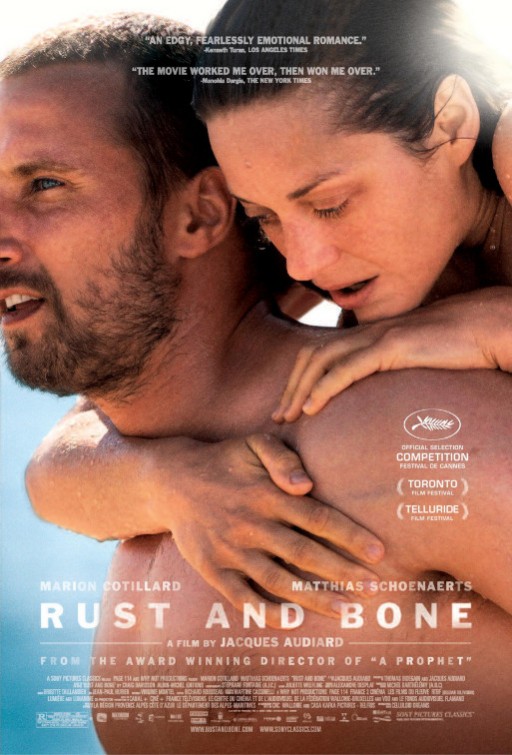 The French film Rust and Bone’s U.S. release seemed to hinge entirely on whether star Marion Cotillard would garner a coveted Oscar nomination. When that didn’t happen, it seemed like the studio just threw up its hands and said, “Well, that’s it.” Rust and Bone, co-written and directed by A Prophet’s Jaques Audiard, has been given a very ignoble release, an afterthought for an awards season that didn’t go Cotillard’s way. While I would have nominated Cotillard for her powerful performance, I certainly wouldn’t think much else about Rust and Bone, a frustrating film that doesn’t know whose story it’s telling or what movie it wishes to be.
Alain van Versch (Matthias Schoenaerts) is struggling to take care of him self and his young son, Sam. Alain’s ex-wife, and Sam’s mother, used the boy as part of her drug trades. Alain moves in with his sister and gets a job as a nightclub bouncer. It’s at the club where he meets Stephanie (Cotillard), a marine trainer. She’s also feisty and getting kicked out for starting a fight. Stephanie works at a Sea World-esque water park, and one horrific day one of the whales makes a wrong turn. It runs into the stage, knocking Stephanie unconscious into the water where, we learn, a whale has eaten her legs below her knee. She contacts Alain and the two form an unlikely friendship, one that turns physical as Stephanie worries what her sexual performance will be like under her new circumstances. Alain dreams of becoming a professional kick boxer/MMA fighter, and he performs in underground fights as another means of income. Stephanie tags along and helps motivate him win his fights. The two grow closer, but Alain struggles with what real feelings might mean.
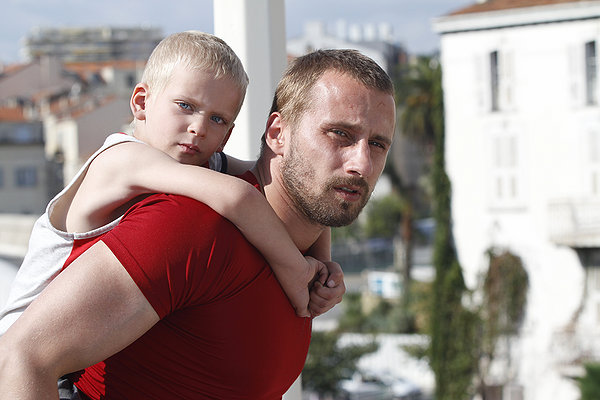 Rust and Bone has a serious case of multiple personality disorder. It looks like it’s going to be one movie, then all of a sudden it changes into another, and then when you think you’ve got a handle on that, it suddenly transforms into another. I’m perfectly fine with a movie switching gears suddenly, however, with Rust and Bone, I felt like I was getting three different half-hearted drafts rather than an actual movie. I went into the film knowing little other than the selling point, that Cotillard was playing a woman readjusting to life after a freak accident took her legs. For the first twenty minutes of the movie, I didn’t get a shred of this. I got a single father trying to scrape together what he could for himself and his son, often resorting to sneaky and illegal measures. Then shortly after Stephanie is introduced, the movie becomes all about her. We’re dealing with her recovery and her anger and her loss. Just when I think I’ve settled onto the narrative direction of the movie, it becomes Alain’s movie again. Now we’re following his budding career as an amateur kick boxer, with Stephanie as his cheerleader. Then she dissolves into the background of the movie yet again, and it’s all about him. I don’t think the movie knew which character it wanted to be its focal point, so we get a sloppy interspersing of storylines vying for dominance. Personally, I was much more invested and intrigued by Stephanie’s recovery than anything having to do with Alain trying to be a better father and failing. Then there’s other muddled storylines like hidden cameras in the workplace that only further distract. It’s just all too much and at the same time not enough.
Then there’s the matter of the romance between Stephanie and Alain. I suppose you could say they are both wounded people trying to gain a greater sense of independence, battling new concepts of self-identity, but I think I’m doing the film too many favors. The sad part is that these two people are extremely shallow and limited form a characterization standpoint. The only defining quality about Stephanie is her injury. Sure she’s feisty and can get into bar fights, and that fact that she’s attracted to Alain says something about her, but really, her only characterization is her new physical limitations and her adjustment to them. Her physical needs are given much more attention by the screenplay than her emotional resonance. It makes me sound like a hardhearted bastard but I’ve said it before, I need characters that have more depth to them other than that they suffer. Alain, on the other hand, is even worse. He’s a pretty flat character who’s actually a really terrible father. He loses his temper easily, chooses quick sex over picking up his kid at school, plus there’s the whole abandonment thing. It’s hard for me to believe that anything really sinks in with this lunkhead. His relationship with Stephanie, meant to open him up, instead reconfirms what a jerk he is. He uses women as sexual playthings, and treats Stephanie with this same careless abandon. He clearly doesn’t see her as anything but a comfortable fling, which he shows through his actions. If Alain’s romantic views have changed, the film doesn’t show any of this progression. I didn’t care about him and I certainly didn’t care about the two of them together.
Acting-wise, Cotillard (The Dark Knight Rises) is quite moving throughout as she tries to come to grips with everything that has been taken from her. Her more traditionally dramatic crying scenes are powerful, sure, but it’s the quiet moments that Cotillard nails. There’s a moment where she goes through her former routines hand motions, and in that moment, set to Katy Perry’s “Firework,” it becomes clear she is moving beyond her accident, accepting and getting stronger. It’s a subtle celebration of the human spirit’s ability to rebound, and Cotillard makes sure the moment is moving rather than cheesy. Also, there’s a very tender moment when she returns to the water park and reunites with the whale that took her legs. Through the glass, she goes through her training motions and the whale still resounds accordingly to her commands. It’s a wordless, touching moment that communicates so much, the nature of forgiveness, the culpability of an animal, but really about the connection between man and nature. Also, the fact that these two scenes are available on YouTube means somebody else must have seen them as standouts as well. She’s also naked frequently, if that matters to you.
 Schoenhaerts (Bullhead) is too opaque for his own good. He seems to settle for his brute physicality, and as such the movie does little to flesh him out further. He has a couple nice moments, especially at the film’s climax, but it’s too little to overturn the prevailing notion that his character is unworthy of co-lead status.
Probably the most impressive thing from Audiard’s film is the special effects to remove Cotillard’s legs. While the technology doesn’t seem like it has changed since Lt. Dan’s days in 1994, it’s still a striking image to process. I’m still wondering why exactly Stepheanie gets tattoos on her (remaining) thighs, reading “Right” and “Left.” Is she worried about going under the knife and the doctors taking more away from the wrong limb? That seems past the point of return. With the special effects technology, and the film’s quotient for sweaty sex scenes, this is the art house equivalent of erotica for those discerning few with amputation fetishes.
When it came time to determine which film would compete at the Academy Awards, France chose the feel-good buddy comedy The Intouchables over Rust and Bone. It’s easy to see why. Except for Cotillard’s fierce performance, and some spiffy special effects, there is nothing remarkable about this ultimately frustrating and shallow movie. The mismatched love story between Stephanie and Alain feels implausible and too focused on surface-level desires; not enough to justify some statement of personal growth on both their parts. There needed to be a complete restructuring of the screenplay. Too often it keeps switching focus, changing gears, mixing in other subplots until it all feels like one big mess lacking firm direction. I might have loved a movie that focused on Stephanie and her recovery, perhaps even one about Alain, though I doubt it. What Rust and Bone offers is a movie that’s persistently in doubt of its own identity, trying its hand at everything, forging necessary care to its lead characters. It’s a fine film that could have been a great one, if only it really knew what it wanted to be in the first place.
Nate’s Grade: C+
Share this:

Seeking a Friend for the End of the World (2012)
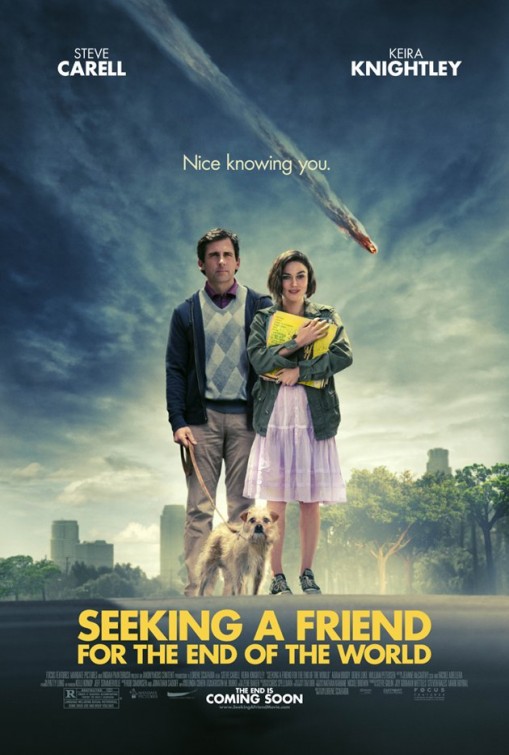 It’s the end of the world as we know it and I oddly felt fine… which is not a good sign for your apocalyptic movie. Seeking a Friend for the End of the World is a peculiar thing, all right. It takes place in the last three weeks of the human race. And lest you think the film wimps out on the promise of its title, think again. I was bemused for the first forty minutes, where writer/director Lorene Scafaria indulges in a series of one-scene vignettes of how humanity comes to terms with the certainty of annihilation. There’s an adult party where people joyfully try heroin, a hit man-for-hire service to bring back some of the mystery of death, and a restaurant where all the workers are spaced out on Ecstasy. I found each of these moments to be funny and a well though-out extension of the premise. But then the film’s diversions give way to the rom-com of our main characters, played by Steve Carell and Keira Knightley as your standard manic pixie girl. And the more time I spent with them the more I found myself not getting engaged. My emotional empathy was kept to a minimum; they’re nice people and all but I didn’t find them that interesting. The resulting movie feels like one of the weakest avenues given the premise. I credit Scafaria for not wimping out in the end, but as these characters faced oblivion together, I felt little emotional stirrings in my chest.
Nate’s Grade: C+
Share this:

The Odd Life of Timothy Green (2012)
 My friend and critical colleague Ben Bailey had warned me about The Odd Life of Timothy Green and he quite eloquently voiced his dumbfounded musings, which I will try my best not to knowingly replicate though I’m sure there will be some carryover. But whatever he wrote could not prepare me for what I ultimately got with The Odd Life of Timothy Green. Ladies and gentlemen, I think this movie broke my brain.
Cindy and Jim Green (Jennifer Garner and Joel Edgerton) are having trouble conceiving a child. One night they write a list of their hopes for a future child, place them in a box, and bury this chest of hopes in their garden. The next day they are shocked to discover a child covered in dirt claiming to be their son, Timothy (CJ Adams). He is the physical manifestation of all those buried hopes and wishes with some leaves attached to his ankles. The Greens take their magical parenthood in stride, trying their best to impart wisdom to their new son. They teach the kid how to play soccer, stand up to bullies, and interact with other human beings. Timothy has a secret he can’t bring himself to tell his new mom and dad, but if you have a hard time figuring out what his leaves falling off means, then there’s nothing I can do for you.
I feel like I just watched a movie where every person on Earth is depicted as being insane. Not goofy, not eccentric, not a little funny, no, we’re talking get the butterfly nets and padded cells. I feel partially insane just having watched the film, obviously still suffering from a contact buzz of insanity. I accept suspension of disbelief and that fantasy-based family films are going to have a whimsical nature to them. We cannot apply every rule of reality and logic to them, and I accept this. But The Odd Life of Timothy Green seems to exist in a fractured, cracked version of our own world, where the most bizarre and fantastical elements are just given a halfhearted shoulder shrug. People react to otherworldly events as if they were doing laundry. Where’s the awe? Or, more so, where is the skepticism? Seriously, if anybody told you they grew a child from a garden, would you accept this notion at face value? Their great piece of proof is that the kid has leaves attached to his ankles. Don’t you think, I don’t know, the parents could have taped those on? Beyond one guy, no one investigates this strange botanical phenomenon or even has the slightest inclination to. Where’s the intellectual curiosity, people? It’s like everyone in town has a lobotomy. Is there not one person in this small town that will dare stand and say, “You know, I think I’m going to require more empirical evidence to buy the story that this kid was formerly plant food.” And then they ran that one man out of town on a rail and salted his land.
 Timothy Green tries to gather a slew of messages and feel-good moments; it’s just that none of them feel coherent or truly earned. The parents don’t feel like responsible or even interesting adults. I understand we’re not going to dwell too much on the disappointments of a couple unsuccessful in conceiving a child (this is becoming an odd trend for Garner), but I expected more than one good cry and a bottle of wine. I want to empathize with these people but the movie makes it impossible time and again with their nonsensical behavior; it’s like they’re adults as envisioned by a child. On that note, I think the movie probably makes more sense from a fantasy point of view to flip the participants. It seems more likely that a child would try and grow new, ideal parents only to learn a lesson about the duds they’re stuck with. The Green family members all work one note, whether it’s the snide sister (Rosemarie DeWitt), the slaphappy grandpappy (M. Emmet Walsh), or the emotionally distant dad (David Morse), it’s all a tiny nub of characterization that gets whittled down to nothing. And then Timothy just seems to step into everyone’s lives and change them forever with little effort. He gets an older girl to fall in love with him, his father to stand up for himself and his family, and all the not nice people in town to be somewhat less not nice. He gets his mom to speak her mind to her bitchy boss (Dianne Wiest), which ends up getting her fired, so it’s a mixed message.
You want a prime example of this film’s collective shared insanity? Take this line from one of the board members from the town pencil factory: “If this boy can have leaves on his ankles, then we can make a pencil out of leaves.” What exactly does one have to do with the other, you may ask? I suppose it’s some claptrap about what is truly possible or whatever. My apologies to Ben Bailey for treading ground he has examined closely, but this cautionary line of dialogue glows with the intensity of 100 neon signs. It’s everything that is wrong and crazy about this movie, and the fact that it is spoken without a hint of irony or humor is all the more galling.
Here’s my problem with Timothy the life-changer: the kid is a dullard. He has no personality, he has no real insights or perceptions into life, he’s not funny, he’s not that interesting, and he eerily stays in the same modulated emotional presence. I found this kid far more unintentionally creepy than endearing. On paper, Timothy Green sounds like it should be a horror film and not the saccharine family slop that it is. Timothy just comes across like a rather bland kid with some weird tendencies, like his repeated inclination to soak up any sunny opportunity to photosynthesize (he gives Scott Stapp a run for his arms-wide-open pose throne). If a character is going to touch people’s lives and change their perspectives on life, then at least make that person fitting of praise. This kid just seems like a hazy mystic that’s playing it as he goes. Come to think of it, did anyone see him do anything superhuman? Cindy and Jim didn’t even find him in the garden, only inside their home covered in dirt. Who’s to say that young Timothy Green wasn’t a con artist this whole time?
 Then, likely as a defensive means to soothe my ailing brain, I started coming up with my own version of where Timothy Green should have gone. The ability to write down a bunch of general attributes and then grow a child seems too good to pass up. I desire more of this unique child cultivation process. For instance, Cindy and Jim want their kid to rock out as a musician, but they simply write “rocks” on their slip of paper before burying it. How is the magical entity that raises mutant plant kids going to be able to understand what the family intends with this vague entry? What if Timothy Green was born with rocks in his head? I wanted the film to simply turn into a comical version of The Monkey’s Paw, where every new version of Timothy Green would go horribly wrong. The first was born and then immediately suffocated because Cindy and Jim forgot to write “working lungs.” Then there would be the Timothy born with a “hunger for life” and become a cannibalistic plant zombie. Or the Timothy born with “his mother’s heart” and then upon his birth Cindy’s heart would go missing. What I wanted was a macabre trial and error game where the would-be parents had to refine exactly what they were asking for with the nondescript magical being in charge of answering hopeful parents. I want The Odd Lives and Deaths of Timothy Green and I want Cindy and Jim to have to bury all the malfunctioning prototypes in the same garden. Then, when they do perfect their perfect kid, the police find a yard littered with the corpses of children and haul them away.
The movie is told through the framing device of the Greens telling their story to the adoption agency, and why this adoption agency continues to listen after, “We grew a boy in our yard,” is beyond my guess. In a film breaking every boundary of believability known to mankind, this aspect to me seems the most incredulous. This is an adoption agency with standards and rules to follow, and to think they would allow a couple to drone on and on about their magical child that grew from a garden and changed people’s lives, instead of calling security and having them escorted from the premises, followed home, and then have their home exhumed for human remains of this child, is beyond me. And then, spoiler alert, they get a kid in the end. What adoption agency could reasonably and responsibly allow these two people, with no physical shred of evidence about their magical child other than some leaves and testimonies, to care for another human being?
Allow me to also question the sincerity of these two damaged people especially concerning their desire for a child. It sure seems like Cindy and Jim are planning on using their present and/or future child as means of settling some longstanding scores between relatives. When it looks like Timothy is finally going to do well in soccer, that’s when they pounce, airing out their resentments. Cindy brattily unloads against her sister: “I’ve had to listen to your perfect kids, well look at my kid! That’s my kid!” And then Jim finally let’s his distant father have a piece of his mind: “I could have been a good player too, dad. I had skills. If only you would have been more supportive.” Am I supposed to find any of this funny, because it comes across as far more sad. I feel like the reason that Cindy and Jim want a child is to desperately prove to their family that they are superior parents. It feels like one very crazy way of proving a point and one where the child will suffer, especially if he or she cannot live to a degree of excellence to provide mom and dad filial ammunition. Another example: both Cindy and Jim are oddly very jealous over the relationship their pseudo son forms with the slightly older gal, Joni (Odeya Rush). They try and talk him out of spending time with her, arguing there are so many fish in the sea for him to pay attention to. Are you really laying the argument that a 10-year-old should be playing the field? It also seems weirdly petty and controlling for two supposed adults to be jealous that their son chooses to spend part of his waking hours with another human being. So, does that sound like a loving and healthy family?
The Odd Life of Timothy Green is certainly odd but probably not for the reasons that Disney or the filmmakers had in mind. It feels like it exists in an alternative universe where everyone lacks any common sense, curiosity, or relatable human emotions. Nobody acts like a recognizable human being in this film, not for a single second. These people are all zombies, cowed into the cult of Timothy, the magical and, ultimately, messianic figure. But allow me to declare the emperor has no clothes. This Timothy is not worthy of the adulation he receives. He walks around like an ecological Forrest Gump, spitting sappy platitudes and changing lives with the insipid nature of all these easy messages. I wish I could say there was one genuine moment in this movie, but I cannot. It takes a magical premise and suffocates it with unearned solemnity. Why can’t a movie about growing a kid in your garden try and be, you know, fun? Well, I suppose embarrassing music recitals and kids getting hit in the head could be mistaken for fun, but I prefer a well developed story, characters I care about, and a genuine sense of enchantment to go with the supernatural. If we can make a movie about a kid with leaves on his ankles, then we can turn any sort of half-formed maudlin pap into family entertainment. Kids deserve better than The Odd Life of Timothy Green, and, for the record, so do plants.
Nate’s Grade: D
Share this:

Your Sister’s Sister (2012)
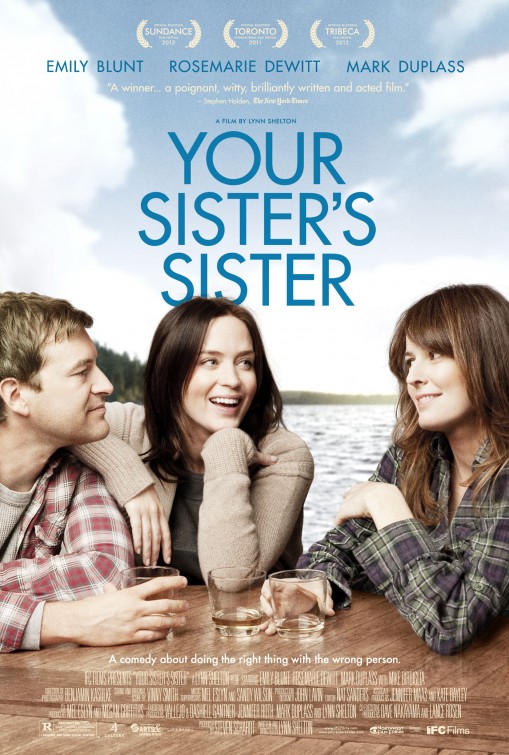 Lynn Shelton is quickly becoming one of my favorite indie film artists. Her writing and directorial offerings are somewhat relegated to the fly-on-the-wall hipster “mumblecore” category, but what separates Shelton is her narrative momentum, her laser-like focus with character, and her sense that a movie needs to build to something significant. With 2009’s Humpday, it was two dudes who might have sex as a test of their masculinity (you really need to see the movie for the full context). With Your Sister’s Sister, it’s the full ramifications of a bunch of delicious relationship secrets getting out there. Everyone in the film has something to hide and something to lose, and watching it all play out with humor and sweetness and honesty that is rare in movies.
Jack (Mark Duplass) is still coming to terms with the death of his older brother. His best friend, Iris (Emily Blunt), who was his brother’s girlfriend at the time of his passing, offers a suggestion. She arranges some alone time for the guy to clear his head. He bikes out to her family cabin but is surprised to find a guest already there, Hannah (Rosemarie DeWitt), Iris’ older sister. Hannah and Jack break the ice by bonding over their personal loss: his brother and her ending a seven-year relationship with her girlfriend. Over a long night of drinking, the two decide to impulsively have sex. The next morning is even more awkward when Iris shows up at the cabin, planning to finally reveal her own feelings for Jack. What follows may be one of the few character-based sitcom plots I’ve witnessed.
 Much like Shelton’s previous movie, the greatest strength of the film is how beautifully naturalistic it all feels while still telling an engaging story. The film has a relaxed vibe that washes over you, allowing you to immerse yourself in what feels like a real group of friends. There’s a tremendous naturalistic ease the film exudes, with the actors so familiar with one another that they truly feel like family. When I have well developed characters, and actors who seem so knowledgeable of their character’s tics and flaws and secrets and smallest details, I could honestly listen to them talk for hours. I don’t want to mistakenly give the impression that this movie is a dull yakfest where the participants are in love with the sound of their own exceptional voices. Each scene in this movie advances the plot further, twisting the screws, complicating matters, and brimming with delightful awkwardness and tension. With 2009’s Humpday, I wrote: “What I really appreciated about Humpday is that every moment feels genuine and every scene has a point. I was amazed that Shelton and her small unit of actors had made it so that every conversation had purpose; there is so little fat to this screenplay. Each scene reveals something new about a character or pushes the narrative forward toward its uncomfortable climax, and each moment never breaks the reality of the story.” And the same can be said for Your Sister’s Sister as well.
While the premise is a bit of a sitcom novelty with some farcical developments thrown in, the depth of the characters and the fantastic acting help to make sure that Your Sister’s Sister is nothing but graceful and beguiling. And the escalating conflicts, personal revelations and complicated feelings, always find a way to come across as organic to the story. That’s another amazing part of the film, that even with all the sexual hijinks that it still manages to feel grounded and surprisingly relatable. These are interesting, complicated, flawed, and spectacular characters, and watching them interact, profess their love through small actions and big declarations, seeing their heartfelt camaraderie, and watch them navigate their troubled lives to find some semblance of a happy ending is a joy to watch. This is a potent little movie, fully realized, poignant, funny, and genuine.
The film was shot over the course of 12 days and Shelton has said that much of the dialogue was improvised, working off her outline. Improvisation is a dangerous tact when dealing with a dialogue-driven film, such as this one. Just because it’s coming off the top of your head doesn’t mean it’s going to sound good. Not everyone is gifted with the ability to improv dialogue that is true to character, revealing, advances the story, as well as just being entertaining. Luckily, Your Sister’s Sister is the exception.
If Your Sister’s Sister does have a weakness, it’s the third act that seems to stall out without giving us much in development before tidying the broken relationships up again. The film’s comedic structure could feel, in lesser hands, like a generic sitcom. It is to Shelton and her actors’ credit that the twists and turns still manage to feel as believable as possible. The third act hits when all the secrets come out, pushing the characters away. Rather than (minor spoilers) ramping things up, we merely endure an extended wordless sequence of images of Jack biking around and the sisters burying the hatchet. Then it’s time for our big happy romantic declaration that tidies everything up, and we’re done. While satisfying on an emotional level given our empathy for the trio, the third act does seem very thin for an otherwise lean and well-structured story. It feels like perhaps Shelton only had enough plot for two acts.
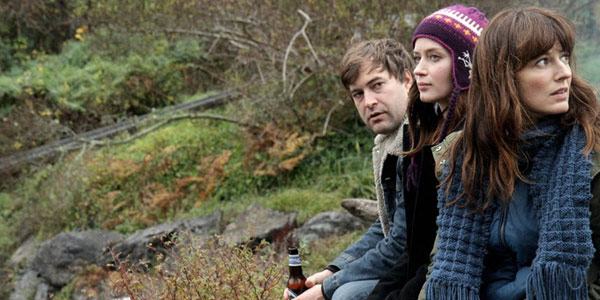 The main trio is a rather engaging ensemble that convincingly plays a besotted group of friends and family. Duplass (Safety Not Guaranteed) has gotten considerably more attention since starring in Shelton’s last movie; the man and his schlubby, smirky charm are ubiquitous. He has a way of being edgy without pushy and nonplussed and flummoxed without going overboard. Duplass has a natural fit for comedy but the man can really excel with the meatier drama bits as well, displaying the painful yearning of a man caught between his desire and the need to move on. He’s a winning and likeable presence that can still be endearing even when he’s flailing around or making others uncomfortable.
DeWitt (The Watch) was a late addition to the cast, replacing Rachel Weisv (The Bourne Legacy) when scheduling conflicts got the best of her. She deserves extra kudos for how good she is considering the miniscule prep time she had compared with her costars. DeWitt is amusing in how cagey and sardonic she can be, and her chemistry with Blunt (Looper) is outstanding. I greatly enjoyed the subtle nuances between them, the way their body language and gestures added extra layers to their relationship, the familiar communication and sisterly code, and just the smallest details that felt well thought out. The relationships in Your Sister’s Sister feel sweetly genuine, and with the benefit of great actors, it lays the groundwork for characters we care about.
Three people sharing time in a cabin might not seem like an exciting setup for a movie, unless, of course, there’s some supernatural presence murdering them in grisly fashion. However, when you lock away three great actors who know their characters inside out, a smart script that allows them the space to develop but pushes the movie forward scene-by-scene, and direction that feels seamless with the storytelling, then you have something special, and that something special is Your Sister’s Sister. While I think Shelton’s previous film had more at play concerning male relationships and sexual politics, this one, with a more straightforward, farcical plotline, is still plenty entertaining and with strong character work (the ending does leave one very large question unanswered). This is charming, sweet, unassuming little indie film that will provide a solid dose of smiles and laughs.
Nate’s Grade: B+
Share this:

Jack Reacher (2012)
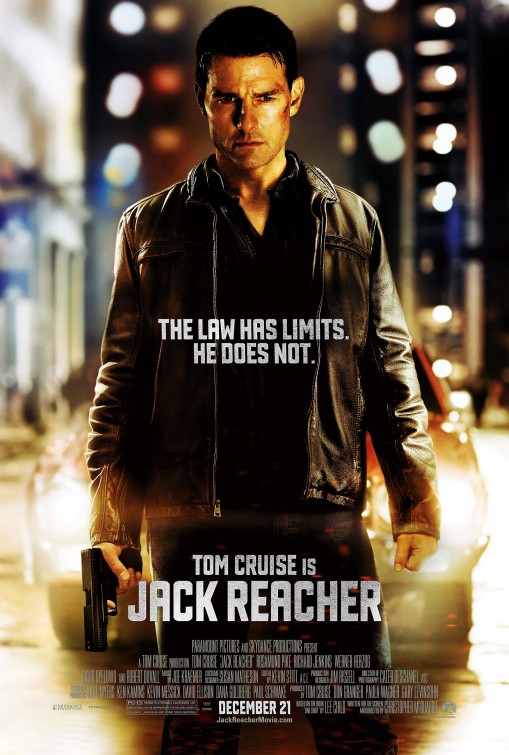 The Jack Reacher of the best-selling novels is a hulking, blonde haired, blue-eyed, 6’4” man of flinty justice. The Jack Reacher of the film of the same name is played by Tom Cruise, an actor who fits none of those descriptions. He is a movie star, however, and those are in short supply. The character is a former MP who operates like a drifter, leaving little trace, and inserting himself as needed to dispense his own sense of justice. The plot of the movie involves Reacher looking for a sniper responsible for a massacre, and hey is that German filmmaker Werner Herzog as the arch villain? Why yes it is. It’s a pretty standard mystery/investigation, complete with crooked cops and inept crooks. What elevates the movie is Cruise’s lone wolf intensity and writer/director Christopher McQuarie’s (The Way of the Gun) ingenuity with clichés. You’ve probably seen this sort of movie before, but McQuarie finds creative and clever ways to stand out, delivering a nifty car chase and a nifty escape as well. It’s just fun watching Cruise outfox his adversaries, via his wits or his fists. Where the movie becomes annoying is how it consistently has to remind you just how badass Jack Reacher is. At every turn, someone will say what kind of exceptional man he is, how he follows his own rules, etc. Reacher even gets the requisite “I’m not a hero so be afraid” speech. After a while, it just feels like the movie is overcompensating, trying to quell the irate fans of Lee Child’s novels who probably envisioned The Rock in Reacher’s shoes. Unlike Reacher the character, Jack Reacher the movie is not the best at what it does, but with a charismatic Cruise in control, it’s at least good enough to see once.
Nate’s Grade: B-
Share this:

Promised Land (2012)
 Actors Matt Damon and John Krasinski co-wrote Promised Land, which has been labeled as the anti-fracking movie. I wish. While it does take a suspicious view of the practice of extracting natural gas via high-powered underground water jets laced with chemicals, the movie feels too timid to really land home its points, settling on a familiar narrative of the redemption of one man working for The Man. The character development feels like it happens overnight rather than through a gradual process. Damon begins as a corporate raider, a guy selling false hope to the economic downtrodden, and ends up an altruistic environmental fighter. I mostly found him to be a pompous jerk. The scenes with Damon squaring off against Krasinski, an environmental activist, are easily the best, giving the movie a bristling energy it otherwise lacks. Krasinski provides a fine foil and some snappy competition until a late preposterous plot turn muddies everything up. I feel like the writers, as well as director Gus Van Sant, wanted to lure in wary moviegoers with something more broadly appealing (the evolution of one man) versus a more alarmist, message-heavy movie. That’s fine, but at least give me a better story. Promised Land even falls into the trap of having he Damon/Krasinski competition come down to a woman (Rosemarie DeWitt) they both fancy. Because otherwise it wouldn’t feel serious, right? It’s a solidly acted movie, with some nice turns by veterans like Frances McDormand and Titus Welliver (TV’s Lost), but the movie just doesn’t live up to the promise of its potential.
Nate’s Grade: B-
Share this:

Django Unchained (2012)
 It’s an understatement that no one makes films like Quentin Tarantino, though after Pulp Fiction it seemed like everyone was trying. The famous writer/director is an audacious filmic DJ, taking samples from all genres and mixing and matching them into a new and elevated form of art; he takes low-grade B-movie concepts and genres and turns them into highly literate A-class films. My only quibble is that, while I heartily enjoy the man’s unique efforts, I don’t know if we’re ever going to see a different Tarantino anymore. Since 1997’s Jackie Brown, he seems intent on re-imagining exploitation films and B-movies and putting his articulate spin on them. I have yet to dislike a Tarantino film (I rate Jackie Brown the lowest but that’s still an A-) and I’ll be first in line for anything the man attaches himself to as writer/director. Django Unchained is Tarantino’s ode to spaghetti Westerns, and it’s every bit as violent and tense and entertaining as you’d hope it to be.
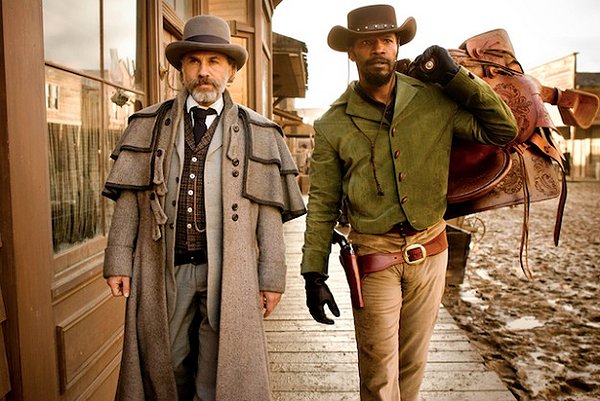
In 1858 Texas, an abolitionist bounty hunter, Dr. King Shultz (Christoph Waltz) frees a slave named Django (Jamie Foxx) and enlists his help in tracking down a team of outlaws. They strike up a mentorship, gunning down outlaws for money. “Kill white folk and they pay you for it? What’s not to like?” Django reasons. After a successful season nabbing bad guys and training Django in the ways of shooting, the men come to a crossroads. Django is looking for his wife Broomhilda (Kerry Washington). She was torn away from him and sold off to wealthy Mississippi plantation owner Calvin Candie (Leonardo DiCaprio). Schultz and Django cook up a scheme to rescue Broomhilda. Schultz will pose as a rich power player wanting to enter the “mandingo fighting” game (think savage gladiatorial combat). Django will play a black slaver, and expert when it comes to picking out prized fighters. With a generous offer, the two get invited to Candie’s family plantation, dubbed Candieland. Standing in the way of their plan is Stephen (Samuel L. Jackson), Candie’s head of the house. Stephen is deeply suspicious of their guests and ready to expose them for who they truly are.
 I’ve been dragging my feet writing a review of Django Unchained and I’m trying to determine why that is. Just after typing that sentence I spent 30 minutes checking my e-mail. I’m an avid Tarantino fan, so I’m left wondering what my hesitation is about. I certainly enjoyed the film, thoroughly, but perhaps my question is whether I should have enjoyed the film as much as I did given the historical reality of slavery. No movie will ever approach the true horrors of slavery; even the very act of owning another human is a detestable and crushing reality. Of course I’m coming at this movie from the perspective of a white male, so I feel like aspects of my commentary can only be minor. Is the backdrop of slavery too horrific for Tarantino to stage his spin on a revenge-filled Western? Spike Lee seems to think so via his critical public remarks. Tarantino has great glee in reveling in over-the-top movie violence, the kind that audiences (at least mine) cheer for. I guess the questionable angle is marrying the two realities and tones. You don’t want to take away from the brutality of slavery and at the same time you want to tell a compelling revenge-soaked thriller that satisfies with its buckets of blood. I’d say Django Unchained mostly finds the right balance to hit you in the gut one minute and the next have you clapping along.
It seems like the media is pressing every black celebrity for his or her personal thoughts on Django and especially Tarantino’s copious use of the N-word. Tarantino has gotten into hot water before with his penchant for the N-word, notably his own sequence in Pulp Fiction, but the N-word is entirely period appropriate for Django. Let’s face it, a majority of Americans, let alone Southerners, had really one word for slaves, and it wasn’t kind. This is the word that would have been uttered. However, after seeing the film a second time, I can see the complaints about the overwhelming use of the N-word. If you were to turn this into an awful and disrespectful drinking game, you’d probably pass out before DiCaprio even steps onscreen.
Like Inglourious Basterds, this movie is really a series of sit-downs that simmer with tension. The man has gotten so good with establishing the particulars of a scene, what the characters desire, and to push it to its breaking point when it comes to tension. While I don’t think anything approaches the highpoints of Basterds, this is still a movie that luxuriates in beautifully played tension and the danger lurking underneath Tarantino’s finely crafted words. And let’s talk about those wonderful words of Tarantino talk, the kind that seem so effortless to build sensationally interesting characters. The man sure enjoys writing his umpteenth variances on badasses engaging in verbal pissing contests (the literal kind are far less entertaining, at least for me). When you have character this sharply developed with such counter objectives, I could watch them duke it out all day. There are some pacing concerns with the movie, particularly once we get to Candieland, but when I’m engaged this much in a movie, I’d rather it go overboard than scrimp. Tarantino’s signature cool/funny/funny cool dialogue is alive and well. Every scene advances the plot, pushes it toward its bloody conclusion where bodies explode with sprays of red mist. It’s completely over-the-top in the Kill Bill vein, enough to draw snickers and laughter from a crowd, but Tarantino knows how to serve up a satisfying ending even with a body count to rival Hamlet.
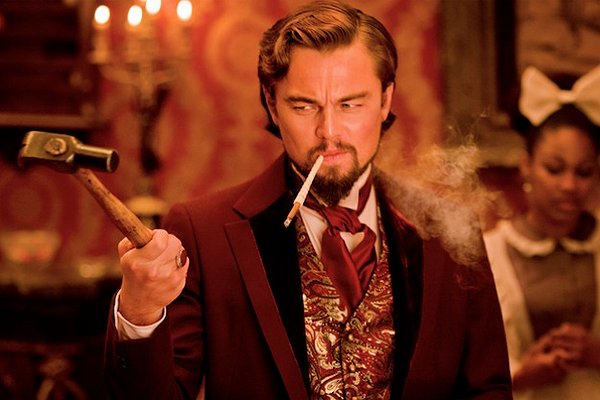 I don’t want to give the wrong impression that Django Unchained is deadly serious given the subject matter and historical context. I don’t think it disrespectfully sanitizes the horrors of slavery, but Tarantino’s brand of humor finds opportune moments to poke through. There’s a sequence with an early version of the KKK, a group of Southerners on horses arguing over whether they need to wear the ill-fitting bags on their head they prepared (plus Jonah Hill cameo). I was laughing so hard I thought people around me were going to shush me. It may well be the funniest thing Tarantino has ever written. There’s also natural humor to be had in the awkward handling of race relations, something that hasn’t exactly been perfectly ironed out to this day. A wealthy plantation owner (Don Johnson) struggles to explain how his slaves should treat Django, presented as a freeman by Schultz. “You want me to treat him like white people?” someone asks. This is followed promptly with a curt, “No.” There’s also plenty of gallows humor to be had with the over-the-top violence that pervades in the finale. It’s all key moments to blow off steam, so to speak, and make the film more bearable.
Django Unchained follows a traditional Western plot; in fact I’d say what we watch is essentially Tarantino’s whacked out spin on The Count of Monte Cristo (Alexander Dumas is even referenced in the film by name). Our lead character, Django, is in the Clint Eastwood mode of the strong and silent type. Schultz is the one who does all the talking while Django learns and glowers. They make a terrific buddy team and you almost wish that Tarantino had just diverged his story and allowed them to keep doing their bounty business. But Django’s wife needs some saving and that’s where the movie slows down. I wish Broomhilda had been given more character development. She’s pretty much the princess that needs saving, much like the German folk tale we learn is where Broomhilda gets her uncommon name. My sister described Django Unchained as a love story and I think that’s being a little generous (Tarantino did cut much of her torture, physical and sexual, from his script). We certainly feel Django’s desire to rescue her, and we worry about all the plot machinations and masks the characters must wear to accomplish this feat. With that said, the movie still has plenty of sucker punch surprises, much like Basterds, where violence erupts and despicable characters are given arias to illuminate the depths of their depraved worldviews.
I do wish that Tarantino had been a bit more judicious with his editing (the first without longtime editor Sally Menke who died in 2010) and curtailed all his self-indulgent meta film homage nods. We get stuff like Amber Tamblyn (The Sisterhood of the Traveling Pants) in one shot. Why you ask? See her father also stars in the movie in a small role, and he once played a character titled “Son of a Gunfighter.” So in his own credits, Tarantino lists him as “Son of a Gunfighter” and his daughter as, what else, “Daughter of a Son of a Gunfighter.” When all of that contorting is for an end credits gag and one shot in the whole movie, you feel like it was strictly masturbatory. Then there’s the original Django, Franco Nero, asking Foxx how to spell his name. Old Django asking new Django how to spell his name. I guess it’s supposed to be like a cinematic passing of the torch but it’s another moment that feels superfluous in a 165-minute movie. The movie can get a tad exhausting. The final 15 minutes, while still smartly written and boasting some terrific bloody comeuppance, feels like an add-on that wasn’t needed. It does manage to tie some elements back together but at this point the audience is ready for Django to ride off into the sunset, not have another obstacle to overcome in improbable yet badass fashion. At my first viewing, the kid behind me kept complaining to his parents that the movie had failed to end (“This is still going? It’s already been two hours!”). I also understand the fruitless and ironic nature of asking Tarantino to reign in his self-indulgences; that is, after all, what makes him who he is.
As expected from Westerns, the movie is a boy’s show. Foxx (Ray) has a steely screen presence that works very effectively for the character. The man’s quiet confidence and growing insolence play well, as he burrows into a role that boosts his confidence and assertiveness. Foxx’s journey from beleaguered and shell-shocked slave to mighty walking vengeance is definitely a full performance and one that Foxx delivers without any winks to the camera. Waltz (Carnage) will be dinged for playing a character similar to his Oscar-winning role in Basterds, but he’s still joyously entertaining, with that strange speech pattern of his that he plays like a musical instrument. He has a lot to say with plenty of theatrical flourishes, but that’s what makes him so entrancing. Simply put, Waltz and Tarantino are a match made in heaven.
 DiCaprio (Inception) doesn’t appear until over an hour into the film but he’s worth the wait. At my first screening, I thought DiCaprio was good but was unimpressed. Upon a second viewing, I must say my appreciation grew for the man’s performance. Calvin Candie is certainly a vile man and DiCaprio is able to give him such an intriguing brio; he’s not the magnetic source of evil that Waltz was in Basterds, a man able to stay two steps ahead of his prey. Candie is easily taken for a fool. He’s not the smartest guy in the room but he can work up a pretty sizable fury; DiCaprio actually cuts open his hand during a confrontation and remains in character, undeterred. But the best actor in the movie is Jackson (The Avengers). There are far more layers to his head house slave than meets the eyes. It sure seems like he’s really the fist behind the glove. He may put on an act for company, but the man is far more calculating and sinister than anyone else in the film. You know he’s a good villain when the audience cheers the loudest at his demise (don’t act surprised, spoiler-phobes). I wouldn’t be surprised if Waltz, DiCaprio, or even Jackson get nominated for supporting Oscars.
It seems like Tarantino has also stumbled into a hidden lucrative subgenre at the box-office, namely the historical revenge film. Who doesn’t want to see a group historically shafted get some sweet revenge, the bad guys punished, and all with sparkling dialogue? In 2009, Tarantino went on a Nazi scalping spree and got to shoot Hitler in the face. With Django, a brutalized slave becomes the hero of his own story and kills some vile slave owners and traders. It’s essentially a Nat Turner-style rebellion from history, albeit with some harebrained scams and colorful characters. Following this lucrative model, Tarantino could take other maligned minorities and give them cinematic justice. Sadly, there are too many examples to count where Tarantino can take inspiration.
Django Unchained is a bloody, rollicking, talky, messy, exciting, surprising, uncomfortable yet satisfying movie and probably one of the oddest crowd-pleasers in recent memory. I saw it on Christmas day and my theater was a sell out. They loved it, soaking up every minute, laughing at the funny parts and wincing at the gruesome violence. I couldn’t think of a better way to celebrate the birth of baby Jesus. It doesn’t whitewash the evils and viciousness of slavery, but at the same time Tarantino knows how to serve an audience and their demands for big characters, big set pieces, and big vengeance. Django is a sturdy Western/blaxploitation film, and whatever other genres Tarantino feels like tossing into his cinematic blender. Whatever you classify it as, Django Unchained is another Tarantino original specialty and his tremendous talent comes through loud and clear, even with a few false endings and self-indulgences at play. It looks great, has a great soundtrack, and presents great acting talent reciting Tarantino’s great words like they were prized possessions. It’s a bit long and a bit overdone, but when you’re enjoying yourself, who wants to leave the party early?
Nate’s Grade: A
Share this:

The Guilt Trip (2012)
 A funny thing happened after seeing The Guilt Trip. My father asked me what else Seth Rogen had been in that he had seen. And I was stumped (in retrospect, I could have said 50/50). I think that summarizes the mishmash of audiences for this mother/son road trip comedy. Rogen teams up with the ultimate Jewish mother, played by Barbara Streisand (Meet the Fockers), to travel the country. From that premise alone, it’s pretty much exactly everything you’d think it would be. The comedy is rather flat mostly because both characters feel mismatched from a comedy perspective; neither is given enough edge. I was surprised then when I found the warmhearted dramatic parts so much more skilled than the comedy (remember, sliding scale). The heart is better than the laughs. The deteriorating mother/son relationship is given some thoughtful consideration, and there are a few sweet emotional turns at the end to find a satisfying departure. It’s a rather nice movie, nothing too special or interesting, but nice can be perfectly fine under the right circumstances. I’m a Rogen fan and always enjoy his cocksure presence onscreen, and Streisand, at 70 years old, is still a natural movie star. The post-credits outtakes point to funnier material from their pairing, but director Anne Fletcher (The Proposal) sticks to the well-worn path of the road trip movie. It’s fairly inoffensive and safe, but The Guilt Trip has some light-hearted pleasures to offer its older audience, especially middle-aged parents and grandparents. Simply put: if you have to see one older-appealing movie with your family this holiday season, Parental Guidance or The Guilt Trip, take the trip.
Nate’s Grade: B-


You must be logged in to post a comment.