Author Archives: natezoebl
Gomorrah (2008)
 In the Bible, God promised not to obliterate the town of Gomorrah if Abraham could find a righteous man. That didn’t work out so well. This stirring Italian crime drama explores the long-reach of the Camorra crime syndicate stationed in Naples. The oldest Italian criminal organization is larger than the mafia, and the film’s four overlapping narrative threads showcase how the Camorra has a grip on every industry. The usual criminal enterprises are there, from drug trafficking to hired murders, but the organization is also deeply involved in the fashion industry as well as toxic dumping; in a perfect metaphor for the entire film, the Camorra is profiting by burying toxic death just below the surface. The objective docu-drama style lends disturbing reality to the ordeal, though the screenwriting too often feels like a pumped-up “true crime” novel – there’s far more emphasis on the minute details than the people. The movie makes empathy nearly impossible, not that this is necessarily a stinging detriment. The movie steers away from the excitement of violence and instead the death is merciless and swift and unexpected. Gomorrah strips away all the romantic notions involved with the gangster lifestyle; the two teenage gangster wannabes who quote Tony Montana are in for a rude awakening by the established toughs. The movie can be punishing and bleak but it’s always fascinating and told with factual backing that makes it spooky. It may not be as powerful or intense as 2002’s City of God but this is certainly one movie that can be punishing and bleak but it’s always fascinating.
Nate’s Grade: A-
Share this:

Duplicity (2009)
 This is the kind of slick, breezy fun that Hollywood seems to have forgotten how to make, or at least forgotten to make well. Writer/director Tony Gilroy has concocted an entertaining movie headlined by movie stars clearly having a blast. Gilroy’s narrative routinely folds back on itself with plot reversals, supplying new perspectives to the ongoing con/heist involving Clive Owen and Julia Roberts as ex-spies and current lovers. The movie itself is one long, pleasing con that manages to stay a step ahead of the audience without coming across as too confusing or dull. The tricky, twisty plot means that the audience must constantly reevaluate the movie, meaning that watching Duplicity can be described as less involving and more like an assignment. Gilroy is a sophisticated wordsmith and he has been knocking out crafty, intelligent adult movies, from the Bourne franchise to 2007’s Michael Clayton. The man probably spent too much effort trying to keep an audience on its toes. The audience becomes keenly aware of the plot structure, and we know it’s only a matter of time (usually 10-15 minutes) before another flashback reveals something else that will change the rules of the game. Still, the movie benefits from fantastic character interplay between Owen and Roberts and a superb supporting cast lead by Tom Wilkinson and Paul Giamatti as scheming corporate scoundrels (the opening credits slow-mo fight between the two men is delightful). Duplicity is an enjoyable romp with snappy dialogue, sizzling stars, and little re-watchability once all the plot machinations play out.
Nate’s Grade: B+
Share this:

I Love You, Man (2009)
 A thoroughly genial comedy, I Love You, Man is an easily enjoyable flick that has fun upending romantic comedy tropes. The movie follows Peter (Paul Rudd) and his search for a “bromance,” a heterosexual male friendship that follows similar dating patterns seen in typical romantic comedies. Peter finds his match with Sydney (Jason Segel), a semi-sophisticated slob. Rudd has been a superb smartass in so many movies, which makes it all the more surprising at how incredible awkward he plays Peter. This man seems embarrassed with every breath he takes. It becomes moderately endearing to see him break out due to his male bonding with Sydney; the nice guy comes of age by becoming impolite and vulgar. The plot takes some predictable turns, like when Peter’s fiancé (Rashida Jones) is upset that her man wants to spend more time with his new pal than with her. Rudd is the most charming actor on the planet, which makes it somewhat wasteful to stick him as a straight man in a comedy. Segel takes great advantage of his character’s boorish behavior and is consistently funny. The supporting actors lift their underwritten roles, especially Jon Favreau as an altogether asshole. I Love You, Man banks on plenty of pleasant vibes and amusing performances. It may never be a gut-buster when it comes to laughs and it may not be fully lovable but it’s certainly easy to like.
Nate’s Grade: B
Share this:

Fary Cry (2008)
 Say what you will about Uwe Boll as a writer and director; Lord knows I’ve written nearly a Master’s thesis on the notorious schlock filmmaker. However, this man would be an asset to have as a producer, at least initially. The German tax loophole was closed and yet the man still finds a way to make like three to four movies a year. He can pull together resources and organization as well as anybody in the business. So what if the final product happens to be substandard? This man knows how to produce. He’s just not as skilled at other positions. Far Cry, Boll’s latest video game adaptation, is a clunky action movie that treats genre clichés as virtues. It is not a bad movie but it’s not a good bad movie either. It’s just Boll’s version of disposable action.
Valerie (Emmanuelle Vaugier) is a Vancouver newspaper reporter who has got a great lead on a story. Turns out Dr. Krieger (Udo Kier), your classic mad scientist, is running experiments on a nearby island and he has an armored guard. Our spunky heroine is determined to investigate. Her uncle Max (Ralf Moeller) is actually working for the mad doctor and having misgivings, which is why he tries to send Valerie classified info on the experiments. Dr. Krieger is bankrolled by the (Canadian?) government to develop genetically modified super soldiers. They have a layer of armor under their skin and the only foolproof way to kill these super soldiers is to shoot them in the eye or mouth. My best guess why is because they both lead to the brain, but then why stop there? Why not shooting into ear and nose cavities? Anyway, the super soldiers won’t take orders so the mad doctor and his mercenaries capture Max and turn him into the newest test subject. Valerie has chartered a boat to meet up with her uncle. The boat captain, Jack (Til Schweiger, who sounds like his voice was dubbed by an actor that could not widen his mouth to enunciate), just happens to be an old Special Forces buddy of Max’s. This comes in handy when both Jack and Valerie are attacked once they reach the island. The duo must run for their lives and inflict much ass-kicking justice.
 Far Cry is a mediocre cliché-ridden action vehicle. You’ve got so many formula elements widely circulated in numerous other action flicks, and I’m not even talking about the standards like that the good guys are marksmen, the bad guys are terrible shots, and anyone can move unfazed if they get shot in the shoulder. We also have the fact that all evil hideouts, when not hewn into volcanic rock, must be located in giant warehouses with too many catwalks and chains and extraneous machinery that do little else but spit sparks when called upon. Jack also pulls the timeless tactic of stripping an enemy solider, putting on his uniform, and then infiltrating the enemy camp under a flawless disguise – a change in clothes. Let’s not also forget the tried-and-true method of throwing a rock in a different direction to cause a distraction. I think at this point only dogs fall for that. By the thirty-minute point, we’ve already seen two separate shots of Jack swimming underwater while an explosion rages above the surface. Though the word has likely lost all meaning to Boll, I would describe that as excessive.
Another major cliché of action movies is the forced coupling between Jack and Valerie. It doesn’t take long before their bickering leads to smooching. Shortly after just escaping mercenaries and a helicopter explosion in a lake, Jack and Valerie find a shack nearby and tend to their wounds. She changes out of wet clothes and makes sure that he doesn’t catch a peek (he does) and he dresses a flesh wound on his rippled abdomen. Eventually she crawls under the blankets on a bed to warm herself for the night. He does too, to stay warm of course. “I have to take off my wet pants, you know,” he reasons (oldest trick in the book). But after they’re in bed together they have to still talk about how cold they each are still, and then Jack suggests, “shared body heat,” you know, just to stay dry. After what seems like forever, these two just give up this charade and start kissing and have them some sex. Naturally, the introduction of an attractive female character in an action movie is designed so that she can snuggle and then be put in danger. Valerie does little else to the story. I want to know why either of these two is acting so casual moments after they escaped fiery death. They know that they’re still being hunted, and the shack is within walking distance from the crash site, which is being investigated by the mercenaries. For that matter, why do the bad guys call off each attack to search and confirm for kills? Are they that concerned with paperwork?
 Far Cry feels like every generic moment rises from the shadow of other generic action movies. The final conflict between Jack and Max the Super Solider boils down to an appeal to the man inside the monster, trying to tap the humanity buried beneath the killing machine. You’ve seen this in countless other movies. Dr. Krieger has a dominatrix-esque second-in-command that has some personality to her; it must be hard to be a female henchwoman, having to be even more evil than the henchmen to prove her self. The initial plot setup even reminds me of Ed Wood’s Bride of the Monster — girl reporter investigates mad scientist. The whole island-based setting, with the aquatic inclined stunts, led by a Central European action star, buddied up with a yammering idiot as a comic sidekick … it oddly reminds me of the entirely forgettable 1998 Jean Claude Van-Damme movie, Knock-Off, with also had the misfortune of co-starring Rob Schneider. A knock-off of Knock-Off? Well it is time for the tenth anniversary after all.
Boll stubbornly tries to make his mundane action movie into a comedy. The comic elements never fully gel with the rest of the film, and yet Boll keeps transforming the movie into this screwy action comedy. There’s the bickering between Jack and Valerie, which is expected territory for the genre, but then the movie fills its time with excessive wisecracks, strange digressions, and so much comic relief that it fails to be relief (or comic). Chris Coppola chews as much scenery as possible as Emilio, the irritating, hapless sidekick to Jack. He’s introduced at almost the hour mark and seems to be trying to make up for lost time in annoyance. He’ll offer to help Jack fight but then recoil and scamper off. This is the kind of movie that has the overweight Coppola lovingly caress a sandwich and coo, “I’ve been thinking about you all day.” Get it? He’s fat. Fat people love food.
But by far the funniest and weirdest aspect abut Far Cry is how unbelievably prepared Jack is for any situation. He hands Valerie a handcuff key from his pocket, which he always carried with him because, presumably, Jack lands in handcuffs often or cannot be trusted to remember his “safe word.” But then late in the movie, Jack is handcuffed and he literally regurgitates ANOTHER handcuff key. This means that Jack keeps a key in his pocket and swallows a spare. Does he eat these daily? What else is hidden among his body? The man could be a human Swiss army knife.
 No one ever seems to question what the chances are that a German former Special Forces agent will work at a Canadian lab, within reach of his Canadian niece ace reporter, who will charter a boat from another German former Special Forces agent who also happens to be within reach of this lab. I guess when you’ve got invincible super soldiers you don’t sweat the details.
Despite all its flaws and general laziness, Far Cry is a semi-decent action movie, especially one with a low budget. Boll manages to construct some passing action sequences with respectable camerawork, and the end battles between our heroes and the Super Soldiers is actually well-edited, with sharp cuts that help ratchet up the energy level, and has plenty of good stunt work. A chase through the nondescript warehouse between Jack and a super soldier actually makes use of some spiffy Parkour choreography, a welcomed addition. The forced comedy can actually succeed at times during the action, like when Valerie is hurling grenades with the pins still attached or when she accidentally lassos a helicopter with a harpoon gun (Dr Krieger scolds her, “You know, you owe me a helicopter.”).
In the pantheon of Boll movies, Far Cry lands more toward the top. It’s a middling action movie that tries too hard to constantly inject misguided humor into every freaking minute. The movie suffers from the same boneheaded flaws that plague the action movie genre, but by the end of its admittedly brief running time, Boll has pulled off a minor success. Far Cry is not a good movie and has too many derivative and unimaginative elements, but Boll seems to have cranked this one out. While Far Cry is not a particularly good action movie, it is relatively indecipherable from the thousands of other cheap mediocre action movies that pollute the direct-to-DVD market. He’s made an easily digestible product that isn’t even bad enough or weird enough to be memorable. To him that’s victory, but to me, an avid Boll expert, that’s just plain boring.
Nate’s Grade: C
Share this:

Knowing (2009)
 Knowing is a movie about the consequences of seeing the Eternal Plan. If you could know the exact day of your death, would you want to know? How would that impact your life? Would you feel motivated to live every other day to its fullest, or would it cast a pall over the rest of your time? One character in Knowing is told the day of her death and it destroys the rest of her life. I think this topic is interesting but perhaps I’m in the minority. Knowing has been savaged by film critics, and I can certainly see the validity of some of their complaints. It’s not a flawless movie by any means, but I found Knowing to be an effective and suspenseful B-movie.
In 1959, a Massachusetts school buried a time capsule with drawn predictions of what students though the world would be like in 2009 (lots of robots and rockets, how we’ve let them down). One girl, Lucinda Embry, wrote a series of numbers. Flash forward 50 years. MIT professor John Koestler (Nicolas Cage) is a widower raising his eight-year-old son, Caleb (Chandler Canterbury). When the school reopens the time capsule, the schoolteachers pass out the individual letters to students. Naturally Caleb is given the envelope with the number code. He brings it home to show his father, who becomes intrigued and looks for patterns. John reasons that the string of numbers is an eerie predictor for major disasters around the world. They predict the date, the number that die, and the location via longitude and latitude. All of the numbered disasters have already taken place (including the hotel fire that killed John’s wife), but there are three more numbered disasters that have yet to happen. It?s about this time that Caleb is visited by mysterious thin men in long black trench coats. John seeks out assistance from Lucinda’s daughter (Rose Byrne), whose daughter also hears the same voices that Caleb does about an impending doom.
 Count me genuinely surprised at how taut I found Knowing. This movie builds a good head of steam and I dreaded what was to follow (in the good sense). When John figures out the exact design of the numbers, pinpointing date and location of disasters, he feels compelled to try and prevent the loss of life. Would you do the same? I think if I had been given a secret celestial code that predicted cataclysmic disasters that I would make sure to steer clear from those locales, rather than running to them. Director Alex Proyas (Dark City, I, Robot) expertly stages the carnage, to the point that I was grimacing and wincing. The plane crash, all shown in one unending shot, is a realistic nightmare that gets more and more disturbing. John hops through the wreckage to attempt to save people and encounters one burning victims after another, all screaming in terror. There are subsequent explosions amongst the wreckage that engulf more people in flames. The scene is spellbinding and unflinchingly horrific. The same can be said about the second disaster sequence in New York City, indelicately evoking some 9/11 memories. After these sequences I was dreading every moment leading up to the next, yet I was also perversely interested to see what would happen next.
I?m glad that the screenwriters tackled the fallacy of numerology early. One of John’s MIT colleagues says that people see what they want to see in the numbers, and surprise then they find them. This was completely the case with the ridiculous 2007 thriller, The Number 23. Jim Carrey went crazy deducing everything to one number, but it was the human mind projecting what it desired to see. The same thing goes for psychics who express vague statements so that the poor saps paying can fill in the details and make it personally relevant (“I’m thinking of a grandfather who died… He was a man?”). I had less of a logic gap with the numbers in Knowing. Granted, I have no idea which set of numbers the code is going with. For example, it lists a set number of deaths for the 2004 tsunami that killed over 250,000 people. But with such a massive event, how do we calculate the dead? There could be loads of people missing and presumed killed by the tsunami. Do people that die as a result of injuries count as direct victims, or are they victims of infection? My point is either the number code is going by the reported estimate on the news or has the exact number, which would be different than what the estimate was in the press. Either way, it presents a mild discrepancy for John.
The movie paints itself into a corner and the astute viewer will realize that it?s only a matter of time before one of the two supernatural A-words gets dropped as the force behind the strange occurrences (or a hybrid of both options). While the movie gets somewhat silly toward the end with its apocalyptic resolution, Knowing refrains from getting stupid. Yes it’s weird that John somehow lives in a giant house decorated to look like some peeling haunted mansion. Yes it’s weird that some supernatural force could predict every man-made disaster yet decide not to intervene in the biggest one. Yes it’s weird when Cage screams, “We have to go where the numbers want us to go.” But here’s the thing, Knowing is packed with ideas, some of them derivative (the ending borrows liberally from Arthur C. Clarke’s novel, Childhood’s End), but there is an ongoing discussion over the nature of science, religion, destiny and free will, and this discussion does not pander. I would have expected a conventional movie to transform John back into a man of faith over the amazing course of events, but it never fully happens. The movie never deduces that religious faith is the right prescription for our ailing times, and it even questions the ideas of divine intervention, namely that we live in a universe of determination rather than randomness, though it won’t specify what that determination is. The movie adheres to its pessimistic viewpoint right down to the end, which result in some ballsy choices for a mainstream Hollywood thriller. The heavy-handed ending didn’t break the enjoyment of the movie for me, though I expect it will for many.
 Not that it was needed but Knowing offers some nice little moments of characterization. I really enjoyed John’s monologue about his wife’s passing. He laments what he was doing at the time of her death, mainly blowing leaves off the lawn. He thought you were supposed to know, to feel something when your loved ones are in peril. He was just tending to the leaves, unaware of his wife’s fiery death. I really appreciated this insight into John and also how realistic the scenario felt: the depressing realization that the universe let you down. This seems like a much more believable reason for John’s scientific atheism than anything Mel Gibson went through in Signs.
The acting is cranked up to an exaggerated level of screaming. Cage spends a good portion of the movie with his mouth agape. The rest of the time he’s frantically screaming, which could account for most of the acting. It alternates between catatonic and hysterical. Cage is rather decent as his life is consumed by mysteries. I must say though that the acting only made me raise my eyebrow a few times and never pulled me out of the movie. This is no Wicker Man embarrassment of monumental proportions.
[Knowing is a solid B-movie with some super special effects to go along with its haunting scenes of disaster. It?s a step above your average sci-fi flick thanks to a lack of pandering to easy answers. I’m somewhat amazed that a movie this fatalistic and bleak would be greenlighted and given the budget it has. Proyas make sure the movie doesn’t succumb to numerology hokum, though the movie does tilt a bit toward the silly by its conclusion. I went into Knowing knowing little beyond the fact that the movie was ripped apart by other critics. Perhaps my positive reaction is born completely out of low expectations, but I found Knowing to be a juicy bit of sci-fi escapism that diverted the time nicely
Nate’s Grade: B
Share this:

Watchmen (2009)
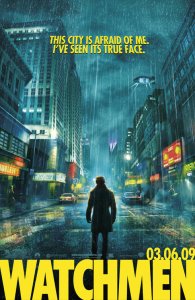 In the realm of comics, Watchmen is tantamount to the Bible. It consisted of 12 issues released between 1986-1987 but it arguable changed the medium forever afterward. TIME magazine listed the book, by author Alan Moore and artist Dave Gibbons, as one of the 100 greatest 20th century novels. Therefore, there has always been heavy trepidation within the geek community when Hollywood came courting the Watchmen property. Different directors have tried tackling the material, going back to the late 1980s when Terry Gilliam was hired to direct and producer Joel Silver was adamant about getting Arnold Schwarzenegger to portray Dr. Manhattan (back then, they totally just would have painted him blue — like they did when he was Mr. Freeze). The movie would seem like a tantalizing possibility and then the production would collapse, most recently in 2004 with director Paul Greengrass attached. Director Zack Snyder (300) understood all of the concerns from the notoriously vocal geek community and attempted to make the most faithful Watchmen film possible. He accomplished that goal. But was it the right goal?
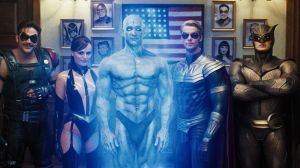
In this alternative account of history, masked crime fighters exist and were even bankrolled by the U.S. government. President Nixon is re-elected to a third term, thanks in part to superheroes winning the Vietnam War, and then he outlaws all masked vigilantes. Flash forward to 1985, and Nixon is on his fifth term and staring down Soviet aggression into Afghanistan. It appears that the world on is on the brink of nuclear annihilation by the dueling super powers engaged in a staring contest. Edward Blake, a.k.a. the Comedian (Jeffrey Dean Morgan), is thrown from his apartment window and killed. Blake used to belong to a second-generation superhero team in the 1970s called the Watchmen. The other members consisted of Dan Dreiberg, a.k.a. Night Owl (Patrick Wilson), Rorschach (Jackie Earle Haley), Adrian Veidt (Matthew Goode), a.k.a. Ozymandias, the glowing blue man Dr. Manhattan (Billy Crudup), who was transformed into a god-like figure of power after a laboratory accident, and then there’s Laurie Jupiter, a.k.a. The Silk Spectre (Malin Akerman), who was following in her mother’s (Carla Gugino) footsteps, the first Silk Spectre. The death of the Comedian brings the old team back together and rekindles some interest in putting on the super suits and fighting crime one more time. It seems someone out there is trying to knock off the retired superheroes, and Rorschach is convinced that a bigger conspiracy is unwinding.
 It’s difficult for me to formally express my feelings and reactions to the Watchmen film adaptation. Count me among the throng of fans that feels that Moore’s source material is a remarkably dense and witty deconstruction of the superhero mythos. Imagine a Superman that can’t be bothered to help out humanity because he feels life is overrated, or a group of super heroes that don’t necessarily do anything heroic; when they beat up the bad guys it’s because they get a sexual thrill from the rush of violence. My voice was among the cacophonous crowd screaming, “Don’t you dare butcher this great work! Keep it as close to the comic as possible!” And that’s pretty much what Snyder delivers. But now I’m left to wonder if a literal-minded interpretation is truly what I wanted all along. Watchmen is not like Sin City, a comic that was already a movie in panels. Frank Miller’s ode to film noir was ready and waiting to be a splashy action movie with style to spare. Watchmen is not a ready-made action vehicle, as it really only has about two extended pieces of action. Moore’s story examined what kind of people would become vigilante crime fighters if the government approved the practice. Surprise, it’s a bunch of sociopaths that are now getting checks from Uncle Sam! Watchmen is a nihilistic account of human behavior and far more cerebral than any superhero film that has ever graced the screen. Seriously, what other superhero movie opens with a fictitious episode of PBS’ political yak fest, The McLaughlin Group? So I suppose this paragraph is a sheepish way of admitting that perhaps Watchmen should have stayed place on the page unless, gulp, it was advantageously adapted for the medium of film.
It’s not that Snyder does a bad job or that the film itself is poor. While Snyder isn’t the best man to handle actors, he is certainly a skilled visual tactician and knows how to make some immensely pleasing imagery. He breathes great life into the images of the comic book and filled in the blanks nicely, and his one big artistic addition is one of the film’s best moments. In the opening credits we get a series of shots that perfectly establish this alternative universe, where JFK shakes Dr. Manhattan’s hand on the White House lawn only to be later gunned down by none other than the Comedian in Dallas. The segment is cleverly set to Bob Dylan’s “The Times They Are A Changin'” and is a terrific intro into a re-imagined America. I wanted to spend more time exploring the differences, like watching a giant Dr. Manhattan win the Vietnam War in one week’s time. In many ways, Watchmen is Snyder’s epic pop commentary on the history of the United States. Dr. Manhattan takes the first pictures of the astronauts on the moon. It is a female crime fighter that swoops a woman off her feet for that iconic celebratory kiss marking the end of World War II. The flick even has a period appropriate, synth-aided score, which is fine, though the use of period pop songs can be distracting. Watching Laurie and Dan make love to the raspy tunes of Leonard Cohen’s already overused tune “Hallelujah” is a deeply uncomfortable moment. Also, the aging makeup is horrendously bad. Gugino looks like she has a turkey waddle and the older Nixon looks like a freaking Halloween mask.
 At what cost did Watchmen make it to the screen? Wacthmen plays as an adaptation like the first two Harry Potter movies, like there was an assigned checklist rather than a fully developed script. I achieved a brief understanding with the characters and each central figure provides a glimpse of the trouble beneath the surface. Laurie is a girl with daddy issues who’s been pressured to follow her mother, a rape victim who still loves her rapist. Dan is a self-pitying putz who has never felt more alive than when he puts on a costume. Rorschach has the same pessimistic view of mankind that Travis Bickle did, viewing many people as vermin clogging the gutter. Yet Rorschach also is the most single-minded of all the characters and abides by an innate moral code and sense of duty, never mind the fact that he may have lost his mind. Dr. Manhattan has been turned into a supreme being and has lost his connection to humanity. The Comedian is a man of wanton desire who declares himself to be the epitome of the American dream: giving in completely to the id. Watchmen has been deemed as an unfilmable book, and perhaps they were right. It feels like Watchmen and looks like Watchmen, but the movie never seems to become anything grander than the sum of its parts. The Dr. Manhattan back-story, where we see him live life in the past, present, and future simultaneously may be one of the best moments in the movie, but it doesn’t add up to much more than an interesting aside. The trips to Mars and Antarctica provide nice visual landscapes but do little else. The other quandary is that everything Snyder cut from the comic (the side characters, the pirate comic, the alien squid) is something that ultimately was unimportant. All of the important and memorable moments from the comic are here, though abbreviated and truncated. Even a 2-hour and 40-minute movie feels like too much of a sprint through such rich material probably better suited to the more accommodating narrative confines of a glossy HBO miniseries. The movie ends up becoming a handsomely mounted and reverent homage to the source material, but I question if the movie serves any other purpose than as an advertisement to go read the book. Will people unfamiliar with the book enjoy a movie practically tailor-made to appeal to fans of the book? Who will watch the Watchmen?
Make no mistake, Watchmen is a hard R-rated movie and if any parent takes their child to this flick because it has men in capes, then that parent should have their child removed. Snyder has ramped up the book’s adult elements, which were originally a commentary on how comics flirt with sex and violence but never get their hands too dirty. Snyder has gotten his hands dirty all right. Instead of zapping others into poofs of smoke, Dr. Manhattan turns them into explosions of human goo that stick to the ceiling. Instead of the Comedian being thrown from the window, we see an extended fight sequence that seems to indicate that the Comedian’s apartment is full of nothing but breakable glass tables. When Dan and Laurie get into a street brawl where bones pop through skin. The sex scenes now involve an almost-agonizing level of thrusting. This is an adult tale in a very simple sense: there are boobs and blood. But the movie is also adult in the fact that it trades in complex political, psychological, and philosophic ideologies, asking hard questions that do not come with easy answers. Do the ends ever justify the means or is mankind destined to always destroy itself? Is humanity worth saving and at what cost? This is probably the most subversive studio-backed movie to come out of Hollywood since 1997’s pro-fascism melodrama, Starship Troopers.
 The three best performances in the movie all come from the three weirdest and most messed up characters. Haley (Little Children) fully inhabits the grisly character of Rorschach and growls his way through the movie. You can tell just by the man’s face how much he has weathered. Crudup (Big Fish) and his gentle voice make Dr. Manhattan an intriguing yet beleaguered super being. Morgan (TV’s Grey’s Anatomy) makes the Comedian one consummate bastard but a bastard that you cannot stop watching, nonetheless. The rest of the cast does suitable jobs and I don’t feel that Goode (The Lookout) or Akerman (27 Dresses) deserve the drubbings they’re getting through the critical community. I actually liked Goode’s portrayal of Ozmanydias, though he fails to express the heavy crown the smartest man in the world must bear. Gugino (Sin City) is terrific when she’s the young, spunky Silk Specter and the opposite of terrific when she’s the troubled, alcoholic older version on screen.
Snyder has served up the Watchmen that fans have been demanding for years, but is this really what everyone truly wanted? Snyder made an adaptation for the fans but what do the fans know except for lavish loyalty? The book utilized the medium of comic books to accentuated its story while commenting on the history of comics and superheroes, and when translated to the big screen as is Watchmen can feel like an artistic stillborn. I’m now more curious than ever to read the previous drafts out there, the ones that directors like Darren Aronofsky and Greengrass were going to film until the financing got pulled. One of the drafts transplants the world of Watchmen to modern day and replaces the nuclear brinksmanship with the Russians to the ongoing War on Terror. It may not be faithful to the fabulous source material, and it quite possibly would have made a terrible movie, but it would have been more interesting as a film project because it would have been an adaptation. Snyder’s Watchmen is reverent to a fault but I cannot complain too much. This is likely the most faithful recreation of a complex book that fans could hope for. I feel satisfied and yet unsatisfied with the finished product. It was everything I was looking for in a Watchmen movie and maybe, in the end, that was the problem. I think instead of buying the DVD I may just read the book again.
Editor’s Note: I have warmed up to this film much, much more on Blu-Ray, especially the 3-hour director’s cut. It’s Snyder’s best work to date.
Nate’s Grade: B
Share this:

Synecdoche, New York (2008)
 Nothing comes easy when dealing with acclaimed screenwriter Charlie Kaufman. The most exciting scribe in Hollywood does not tend to water down his stories. Kaufman’s latest head-trip, Synecdoche, New York, is a polarizing work that follows a nontraditional narrative and works on a secondary existential level. That’s enough for several critics to hurtle words like “incomprehensible” and “confusing” as weapons intended to marginalize Synecdoche, New York as self-indulgent prattle. I guess no one wants to go to the movies and think any more. Thinking causes headaches, after all.
Caden (Phillip Seymour Hoffman) is a struggling 40-year-old theater director trying to find meaning in his beleaguered life. His wife (Catherine Keener) has run off to Germany with his little daughter, Olive. He also manages to botch a potential romance with Hazel (Samantha Morton), a woman who works in the theater box-office who has an unusual crush on Caden. He’s also plagued by numerous mysterious health ailments that only seem to multiply. While his life seems to be in the pits, Caden is offered a theater grant of limitless money. He has big ambitions: he will restage every moment of his whole life to try and discover the hard truths about life and death. Caden must then cast actors to portray the various people in his life. Sammy (Tom Noonan) argues that no other actor could get closer to the truth of Caden; Sammy has been following and studying Caden for over 20 years (don’t bother asking why in a movie like this). Caden also casts his new wife, Claire (Michelle Williams), as herself. The theater production gets more and more complex, eventually requiring the “Caden” character to hire his own Caden actor. Caden hires Hazel to be his assistant and Sammy falls in love with her. Caden admonishes his actor, “That Hazel isn’t for you.” Caden then tries sleeping with “Hazel” (Emily Watson) to get even with the real Hazel. By producing a theatrical mechanism that almost seems self-sustaining, Caden wants to leave his mark on the world and potentially live forever.
 I heard plenty of blather about how mind-numbing Synecdoche, New York was and how Kaufman had really done it this time when he composed a script that involves characters playing characters playing characters. People told me that it was all too much to keep track of and that it made their brains hurt. The movie is complex, yes, and demands a viewer to be actively engaged, but the movie is far from confusing and any person or critic that just throws up their hands and says, “Nope, too much to think about,” is doing their brain a disservice. The movie is relatively easy to follow in a simple linear cause-effect manner; Kaufman only really goes as deep as two iterations from reality, meaning that Caden has his initial doppelganger and then eventually that doppelganger must get his own Caden doppelganger (it’s not nearly as confusing as it sounds if you see it). Now, where the movie might be tricky to understand is how deeply contemplative and metaphorical it can manage to be, especially at its somber close. That doesn’t mean that Synecdoche, New York is impossible to understand only that it requires some extra effort to appreciate. But this movie pays off in huge ways on repeat viewings, adding texture to Kaufman’s intricately plotted big picture, unfolding into a richer statement about the nature of life and death and love.
Theater has often been an easy metaphor for life. William Shakespeare said, “All the world’s a stage, and all the men and women merely players; they have their exits and their entrances; and one man in his time plays many parts.” Kaufman movies always dwell substantially with the nature of identity, and Synecdoche, New York views identity through the artifice of theater. Caden searches for something brutal and true via the stage, but of course eventually his search for truth becomes compromised with personal interests. Characters in Caden’s life are altered and in the end when Caden steps down, as himself, reality starts getting revised. The truth is often blurred through the process of interpretation. Caden ends up swapping identities with a bit player in the story of his life, potentially finding a greater sense of personal comfort as someone else. Don’t we all play characters in our lives? Don’t we all assume different identities for different purposes? Do we act differently at a job than at home, at church than at a bar? Caden remarks that there are no extras in life and that everyone is a lead in his or her own story.
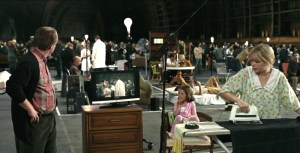 Kaufman’s movie is also funny, like really darkly funny and borderline absurdist to the point of being some strange lost work by Franz Kafka (Hazel even mentions she’s reading Kafka’s The Trial). You may be so caught up trying to render the complexities of the story to catch all of the humor. The movie exists in a surreal landscape, where the characters treat the fantastic practically as mundane. Hazel’s house is constantly on fire and yet none of the characters regard this as dangerous or out of the ordinary. It is just another factor of life. The entire subplot with Hope Davis as a hilariously incompetent therapist is deeply weird. Caden suffers some especially cruel Job-like exploits, particularly what befalls his estranged daughter, Olive. He’s obsessed with her hidden whereabouts and European upbringing, to the point that Caden cannot even remember the name of his other daughter he has with Claire. There is a deathbed scene between the two that is equally sad and twisted given the astounding behavior that Caden is forced to apologize for. There are running gags that eventually transform into metaphors, like Caden’s many different medical ailments and the unhelpful bureaucratic doctors who know nothing and refuse to divulge any info. Kaufman even has Emily Watson, an actress mistaken for Morton, play the character of “Hazel.”
This is Kaufman’s debut as a director and I think the movie ultimately benefits by giving its writer more control over the finished product. The movie is such a singular work of creativity that it helps by not having another director; there is no other artistic vision but Kaufman’s. While the film can feel slightly hermetic at times visually, Kaufman and cinematographer Frederick Elmes (The Ice Storm) pack the film with detail. Stylistically, the film is mannered but this is to make maximum impact for the vast amount of visual metaphors. Synecdoche, New York never feels as mannered as the recent Wes Anderson films, henpecked by a style that serves decoration rather than storytelling. The production design for the world-within-a-world is also alluring and imaginative, like a living, breathing dollhouse.
 The assorted actors do well with their quirky, flawed characters, but clearly Hoffman is the linchpin to the film. He plays a character from middle age to old age, and at every step Hoffman manages to infuse some level of empathy for a man routinely disappointed by his own life. The failed yet lingering and hopeful romance between Caden and Hazel provides an almost sweet undercurrent for a character obsessed with death. Hoffman is convincing at every moment, even as a hobbled 80-year-old man, and gives a performance steeped in sadness but with the occasional glimmer of hope, whether it be the ambition of his theater project or the dream of holding Hazel once more. Morton is also wonderfully kindhearted and endearing as the woman that just seems to keep slipping away from Caden.
There’s no other way to say it but Synecdoche, New York is a movie that you need to see multiple times to appreciate. The plot is so grandiose in scope and ambition that one sitting does not do it justice. Kaufman has forged a strikingly peculiar movie that manages to be surreal and bleakly comic while also being poignant and humane. This is a big movie with big statements that can be easily missed, but for those willing to dig into the wealth of metaphor and reflection, Synecdoche, New York is a rewarding film experience that sticks with you. By the end of this movie, Kaufman has earned the merging of metaphor and narrative. I have already seen the movie twice and still cannot get it out of my thoughts. This isn’t the kind of movie that you feel warm affection for, like Kaufman’s blissfully profound Eternal Sunshine of the Spotless Mind. This movie is less a confounding puzzle than an intellectually stimulating examination on art, the human experience, and, ultimately death. If people would rather kill brain cells watching whatever dreck Hollywood secretes every week (cough, Street Fighter: The Legend of Chun-Li, cough) then that’s their prerogative. Give me a Charlie Kaufman movie and a bottle of aspirin any day.
Nate’s Grade: A
Share this:

RocknRolla (2008)
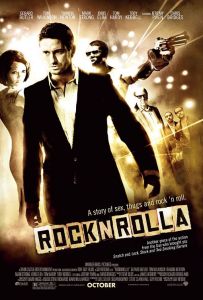 I’m a fan of Guy Ritchie’s convoluted cockney comedic crime capers (wow, check out that alliteration), but this movie is just plodding and dull. The trouble is that Ritchie works best when he has one foot in the fantastic, with comically over-the-top and menacing underworld personalities. A Ritchie movie usually involves a lot of crisscrossing characters, but this is his first film where I couldn’t keep the folks straight, I couldn’t understand much of the personal connections, I couldn’t understand the purpose of the various characters and their various interplay, and frankly, I never bothered to care. RocknRolla has maybe two colorful characters (all hail Tom Wilkinson as a sleazy real estate gangster), but the rest of the movie is overstuffed with bland and forgettable toughs. What the hell are Ludacris and Jeremy Piven doing here? You could eliminate half of the cast and the movie would barely be affected. This movie is just way too straight and square for its own good. Ritchie is still a top-notch visual stylist, and the movie has a terrific deep focus digital video cinematography, but there are very few moments or visual flourishes in this flick that prove to be remotely memorable. I hope Ritchie does not make good on his promise to continue telling more stories with these characters and in this style because this many needs to get back to what he does so well, and that is telling the darkly comic escapades of larger than life Dick Tracy-esque villains and scoundrels.
Nate’s Grade: C
Share this:

Confessions of a Shopaholic (2009)
 Releasing a romantic comedy about a woman plagued by credit woes in the middle of a global financial meltdown? Doesn’t sound like the best example of escapist entertainment, but Confessions of a Shopaholic is infectious fun, and it’s all thanks to the delightfully funny lead performance by Isla Fisher. She seems like she stepped out of one of the old Hollywood screwball comedies from the 1930s. There’s a terrific hunger in her eyes and the woman knows how to punctuate a joke. The movie itself isn’t too shabby either. As far as formulaic romantic comedies go, this is one of the better ones in recent years. It has a little dash of everything, from slapstick to farcical thriller to romance to even some mildly potent drama. Director P.J. Hogan (Muriel’s Wedding) keeps the movie light and fun and even spruces up the flick with some interesting visuals, like animated CGI mannequins that come alive to tempt Fisher. Even though the movie holds onto a sitcom level plot for too long (mistaken identity), Confessions of a Shopaholic is a far worthier piece of entertainment than typically found in the rom-com genre, and Fisher is a comedian to rival the best.
Nate’s Grade: B+
Share this:

Coraline (2009)
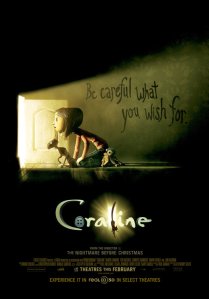 The beauty of stop-motion animation is that everything is painstakingly handcrafted so that it’s like watching a whole other world. Coraline is a wonder for the eyes and I loved just watching the movement of characters, their facial expressions, which were all done in great fluid motions. I loved that I could see Coraline thinking just through how her eyes were animated. The story, based upon the Neil Gaiman book, is about an alternative world where people have buttons for eyes provides enough eerie intrigue and some creepy imagery to spook younger kids. This is a fantasy film that doesn’t shy away from childhood scares. Coraline has an altogether pleasant feel with its spunky heroine and fine vocal cast (Dakota Fanning did not get on my nerves at all), but what’s most special is just watching the movie come alive; it’s enchanting to watch this world simply exist. There are some terrific displays of imagination in the alternative world, and it all looks even snazzier in 3-D where the world takes on further depth. Director Henry Selick (Nightmare Before Christmas) is the master of this peculiar art and thankfully Coraline follows its own visual style, never stooping to imitating Nightmare (like Corpse Bride). This is a visually stunning movie that may not leave much of an impression once it’s over (predictable story, thin plot, kind of slow ending). Coraline is a feast of artistic talent with something to discover in every awesome second.
Nate’s Grade: A-


You must be logged in to post a comment.