Blog Archives
Resident Evil (2026)
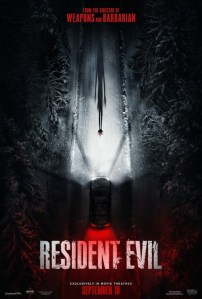 I’ve never played any of the popular Resident Evil video games but I have watched every movie, at least the ones starring Milla Jovovich, as I consider them the right kind of entertaining trash. In no way will I argue that any of the six movies from 2002 to 2017 are defensibly good by traditional standards (I’m purposely ignoring the 2021 failed reboot Welcome to Racoon City). I will, however, gladly sit and watch any of them if they are on TV because they are, at their best, gloriously ridiculous and silly spectacles. My interest dramatically increased in a new Resident Evil movie when writer/director Zack Cregger’s name was attached. The man behind twisty genre-benders Barbarian and Weapons helming a video game franchise best known for schlocky genre filmmakers like Paul W.S. Anderson? Weapons won an Oscar for a performance, a rarity for a horror movie, and now that same filmmaker wants to revive Resident Evil? My interest increased even further when Cregger confirmed it would be an original story and not really beholden to the established characters and plots of the many games (many fans did not agree with me). It felt like a fresh start with an exciting filmmaker on the rise, and having seen Resident Evil, I can declare it a gory blast, a brilliantly-calculated thrill ride to make you laugh and scream in good fun.
The entire 90-minute movie follows one character’s hellish night into the madness of the early signs of a deadly outbreak. We follow Bryan (Austin Abrams) as a medical courier delivering organs to hospitals. He’s ready to head home when he gets a special urgent delivery needed in Racoon City up in the snowy mountains. It will pay double and so he snatches the opportunity. It might be the allure of more money or it might be another chance to think about something other than the frightening reality that his girlfriend (Sara Paxton, off-screen) is pregnant. Along the dark and snowy drive up the mountains, a woman walks into his path and Bryan strikes her with his car. The rest of his night is about to get so much worse.
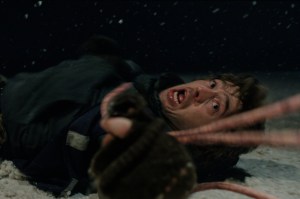 Considering its basis as a survival horror game, at least until it became a bombastic action-movie opera that better resembles the Jovovich screen spectacles, I think a streamlined approach by Cregger is smart. It narrows down the universe to this one guy’s very bad night, and it presents an immediately immersive experience, akin to playing a game and thinking through what is your best option out of a bunch of very bad options. From the very beginning, we are in Bryan’s frantic perspective. What he knows and experiences are what we know and experience. The clarity of focus provides a satisfying line of escalation as he gets into more and more danger. Cregger allows the audience to think through Bryan’s predicaments along with him, and there isn’t much he does that seems out of question, considering the extreme circumstances. I appreciated how once things really start going sideways that Bryan doesn’t miraculously transform into like an action movie hero. He’s just a normal guy relentlessly in over his head like any of us would be confronting monstrous horrors. I loved how bad he is with guns. Just because Bryan has some experience playing video games doesn’t mean he knows how to operate real firearms, and that doesn’t mean that the weapons of the real world perform like they do in games. There’s an ongoing joke about how he keeps trying to shoot off padlocks and failing that made me smirk every time. These little touches of realism in an elevated space made Resident Evil feel more engaging. It made it feel like even the little things mattered. This guy felt vulnerable, and sometimes his impulsive solutions only serve to get him into more trouble. The screenwriting plotting of A-to-B-to-C has a satisfying logic that manages to ground the mayhem on its own terms. He often has to think through an obstacle.
Cregger’s command of a scene is so enjoyable and assured, and he knows when he wants to make you squirm and when he wants to make you laugh. He can draw out a scene with excellent sound design for chills, like when a figure is quickly advancing on Bryan and clamoring up stairs while he desperately tries to reload a shotgun. The pacing of the moment is terrific. The resignation of desperation can also lead to many dread-fueled moments, like venturing into dark tunnels to sewers to blood-soaked halls. You don’t want to go down there, but you also kind of want to see. There’s also a heightened level that naturally draws mordant laughs, like when he’s being chased around a flipped-over police vehicle and sloppily shooting behind him. The movie wants you to laugh at the absurdity of trying to make sense of this nightmare scenario. It’s the release to get ready for more. Much of the humor is drawn from subverting our expectations of genre movies, like trying to ram open a locked gate, and particularly Bryan’s response to the madness. His panicked, befuddled reactions and clumsy physicality, accompanied with often high-pitched scream, serve as a reminder that he is a normal guy in unusual circumstances (I’d like to try and see you do any better). One of the biggest laughs for me was just a joke about stairs.
 This is also a great looking movie. Cregger has the enviable talent of cinematographer Dariusz Wolski, the man who photographed The Crow, the Pirates of the Caribbean trilogy, and nine (!) Ridley Scott movies since 2012. The man knows how to frame striking contrasts, so the whites of the snow-covered landscapes in the first half visually pop with the dark blacks of the silhouettes and the blood trails. The movements of the camera and compositions add such a charged sense of energy that reminded me of the best of Sam Raimi without feeling like a derivation in Cregger’s overall sense of style. The movie also doesn’t bend over backwards to bring to life the visual dynamic of the game, though there are more than a few passing gun barrel POV shots to sate the faithful.
This is also a very messy movie in the best/worst way. For gore-hounds, there is some impressively gnarly gore, which isn’t surprising considering the viral outbreak is turning residents into split-faced, multi-tentacled monsters. The body horror is gruesomely inventive. There’s one monster that reminded me of a different video game, 2004’s Katamari Damacy, a Japanese game where you start with a small sticky ball and roll it around, collecting more and more items and people, growing in size to the point that you attach the whole world. Imagine that but a snowman of men, and you can only see limbs moving at angles that limbs shouldn’t do. It’s quite unnerving to glimpse. I also found myself audibly wincing during a sequence where zombies are throwing themselves off the roofs of buildings while Bryan runs down an alley, bodies exploding all around him in eruptions of viscera. There’s another sequence of zombie rats that makes me shake my head in disbelief even now remembering it. Credit to Cregger, the man is unafraid to go places other horror movies fear to tread. Whether it’s animals or children, nobody is safe in this disturbing universe. There was one moment in a mutated maternity ward where I cautiously decided to shut my eyes to avoid poisoning my brain with fresh nightmare fuel to review when I came home and embraced my almost two-year-old son. There are some things I just don’t need to see presently.
 At a brisk 90 minutes, this is one of those rare movies I think would have benefited from another ten to fifteen minutes, especially with its abrupt ending. The final act loses some of the momentum accumulated beforehand, which isn’t a deal-breaker considering the film was moving like a runaway freight train up until that point. It also feels like a slightly different movie, both in approach and tone, going bigger and not exactly better. There’s also a question over what is gained from giving Bryan a characterization starting point. Over the course of the movie, he certainly re-examines his perspective on being a prospective father (and that’s before the mutated maternity ward). I thought this was going to climatically lead to a significant deliberation over making a selfish versus selfless decision, but Cregger doesn’t go there. The ending is kind of a cinematic middle finger to anyone expecting that character arc to come to something more meaningful, which is fine, but then why include the thread at all unless it’s just intended to be another deliberate rug-pull of your expectations? While the last ten minutes doesn’t quite live up to the amazing alacrity of the prior 80 minutes, it doesn’t ruin the good fun Cregger has earned in excess.
For many years, I thought it was impossible to make a good video game movie. This was because of the interactive nature of games versus the more passive medium of movies, but it was also a statement borne of the adaptations of the time, many of which had Uwe Boll’s name attached. I’m here to say times have changed but also so have the games. Over the last two decades, video games have reached new creative heights and that includes dramatic storytelling depth as well. Playing a game like Red Dead Redemption II is like burning through seven seasons of an epic and invigorating TV series. That’s not the intent of a movie like Cregger’s Resident Evil, a more streamlined and specifically designed contraption that is like riding a perfectly engineered ride. By the end credits, you might just have to catch your breath. While I have some minor quibbles about the ending and some dangling plot threads, Resident Evil is such a nasty, squishy, gruesomely entertaining movie, that I’m thankful for the privilege of watching Cregger operate at B-movie studio level (will Cury Barker be able to find similar results with his looming Texas Chainsaw Massacre reboot?). If we can give artists with a vision the berth to see it through, we might be able to turn around every moribund video game franchise. Look out for Ari Aster’s Doom next, and it will still be three hours and a metaphor for penises.
Nate’s Grade: B+
Share this:

Weapons (2025)

Zack Cregger began his career as one of the co-creators and co-stars of the sketch comedy troupe, The Whitest Kids U Know. This led to a poorly received sex comedy, 2009’s Miss March, which Cregger co-directed and starred as the lead. Then in 2022, Cregger made a name for himself in a very different genre, writing and directing Barbarian, a movie whose identity kept shifting with twists and world-building buried underneath its simple Air B&B gone awry setup. From there, Cregger joined the ranks of Jordan Peele, John Krasinski, and other horror-thriller upstarts best known for comedy. It became a question over what Cregger would do next, which sparked a bidding war for Weapons. It’s easy to see why with such a terrific premise: one day a classroom of kids all run out into the night at the same time, all except for one child, and nobody knows why. Weapons confirms Cregger’s genre transformation and the excitement that deservingly follows each new release. Each new Cregger horror movie is a game of shifting expectations and puzzles, though the game itself might be the only point.

The premise is immediately grabbing and Cregger’s clever structural gambits add to that intrigue. Right away in the opening narration from an unseen child, we’re given the state of events in this small town, already reckoning with an unknowable tragedy. The screenplay takes a page from Christopher Nolan or Quentin Tarantino, following different lead characters to learn about their personal perspectives. It continually allows the movie to re-frame itself, allowing us to pick up details or further context with each new person giving us a fuller sense of the big picture. Rather than resetting every twenty minutes or so, the movie offers an implicit promise of delivering something new at those junctures, usually leaving that previous lead character in some kind of dire cliffhanger. With each new portion, we can gain some further insight, but it also allows the story to ground its focus and try on different tones. With Justine (Julia Garner), we see a woman who is trying to figure out how to regain her life she feels has been unfairly stripped away, and many of her coping mechanisms are self-destructive old habits. With Archer (Josh Brolin), we see a father consumed by his sudden loss and the reflection it forces him into, while also obsessing over what possible investigative details he can put together to possibly provide a framework of an answer. Then with other characters, which I won’t spoil, we gain other perspectives less directly involved that approach a dark comedy of errors. At one point, you may even wonder when the movie is going to remember those missing kids again. I appreciated that Cregger resolves his mystery with enough time to really examine its implications. This isn’t just a last-minute twist or Scream-like unveiling of the villain coming to light. I also appreciated that it ends in such an enthusiastic climax that left me cackling and cheering. It’s a mystery with a relatively satisfying answer but a climax that is also cathartic and exhale-inducing after all the dread and build-up.

The technical elements are just as polished as its knotty screenplay. The movie is genuinely unnerving at many points. Even the image of kids Narutu-running off into the night is inherently creepy. There are a few cheap jump scares but most of the movie is built around a quiet sense of desperation and dread. Cregger prefers holding onto shots to build tension, like a door opening and waiting for something, anything to pop out of the darkness. There are moments that made me wince and moments that made me gasp, like suddenly being compelled to stab one’s face with a fork dozens of times. However, a significant drawback for me was the lighting levels of the cinematography. To be clear, the photography was eerie and very evocative. My problem is that this was a movie whose light levels were so low it made it excruciatingly hard to simply identify what was happening onscreen. I’m sure my theater’s dim projection was part of this, but this is also a trend with modern movie-making, the murky lighting, like everyone is trying to recreate those Barry Lyndon’s candle-lit tableaus. Sometimes I just want to see what’s happening in my movie.
Weapons is certainly a thought-provoking premise, but with some distance from the movie, I’m starting to wonder what more there may be under the surface. Now not every movie has to be designed for maximum layers and themes and metaphors; movies can have their own points of appeal before getting to subtext. I do think most viewers will find Weapons engaging and intriguing, and the slippery structure helps make the movie feel new every twenty minutes while also testing out different tones that might have been too obtrusive with different characters and their specific perspectives. However, once you straighten out that timeline and see things clearly, it begs the question what exactly Cregger is actually saying. The sudden and disturbing horror of a classroom of children all disappearing has to have obvious connections to school shootings and mass killings, right? The trauma image is too potent and specifically tied to schools to be accidental or casual. Taking that, what is the movie saying about our culture where one day, any day, a class full of young children can just go missing? Despite a literal floating assault rifle appearing in a dream, there doesn’t appear to be much on the movie’s mind about gun violence or even weapons in general. I’m reminded of my favorite movie of 2020, the criminally under-seen Spontaneous, which explored a world where one high school class of students lived under the threat that at any time they could explode. There was no explanation for this strange phenomenon, though scientists certainly tried, and the focus was instead on the unfair dread hanging over their day-to-day existence, that at any moment their life could be forfeited. The parallel was obvious and richly explored about the pressure and anxieties of a life where this very disturbing reality is considered your accepted new normal. That was a movie with ideas and messages linking them to its school-setting of metaphorical trauma. I can’t say the same with Weapons.

I’ve read some people analyze each one of the characters as one of the stages of alcoholism, and I’ve read other people argue that the movie is an exploration of a town come undone through unexplainable trauma, but I seriously doubt that last one. Don’t you think the mystery of the missing class would draw national and international media attention? Hangers-ons thinking they cracked the case? Intruders harassing the bigger names? People trying to exploit a tragedy for money or a sense of self-importance? Conspiracy theorists linking this mystery to their other data points for a larger conspiracy? It doesn’t feel like the impact of this unique mystery has escaped the county lines. Certainly there are characters searching for answers and treating this poor schoolteacher as a scapegoat for their collective fears and anger, but by turning the screenplay into a relay race where one character hands off to the next for time in the spotlight, it doesn’t expand our sense of the town and the broader effects of this bizarre tragedy. Instead, it pens in the characters we do have, which all seem to interact with those very same characters, making the bigger world feel actually smaller. Narrowing the lens of perspectives makes it more difficult to articulate commentary about community breakdown in the face of uncertainty. The creative choices square with the central mystery and the nesting-doll structure, playing a game with the audience to discover the source of this incident, but once you discover that source, and once we reach our ending, you too may appreciate Cregger’s narrative sleight-of-hand but eventually wonder, “Is that all there is?” Maybe so.
Weapons is an effective and engaging follow-up for Cregger and confirms that whatever stories he feels compelled to tell in horror are worthy of watching, preferably with as little prior information as possible. You definitely feel you’re in the confidant hands of a natural storyteller who enjoys throwing out surprises and shock value. I have some grumbles about ultimately what might all be behind that intriguing mystery and the lack of foundational commentary that would permit multiple viewings of close analysis. Then again not every movie is meant to be a repeat viewing. Some movies are one-and-dones but still enjoyable, and that might best sum up Weapons. It’s sharp and cleverly designed but maybe lacking a finer point.
Nate’s Grade: B


You must be logged in to post a comment.