Blog Archives
Bloodrayne: The Third Reich (2011)
 It took five years and three movies, but notorious film director Uwe Boll has finally gotten to the original time period of the Bloodrayne video game. The popular game concerns a lithe, redheaded half-vampiric lass killing nefarious Nazis in World War II. You would have thought that would make for a decent starting point. But Boll instead took his time, possibly always envisioning a trilogy to do the character and his storytelling ambition proper service. Or it was just a way to make more money. So after stops in 18th-century Romania and the Wild West, Rayne comes home, so to speak in Bloodrayne: The Third Reich. What if somebody was adapting the Grand Theft Auto franchise into a film and took Boll’s dawdling approach? The first film would probably start with horses and buggies.
Rayne (Natassia Malthe), our favorite dhampir, is back at slaying them dead. She teams up with Nathaniel (Brendan Fletcher) and his band of resistance fighters on the Eastern front. They rescue one train filled with prisoners and get into a shootout with Commandant Ekhart Brand (Michael Paré). But Rayne makes the unfortunate mistake of biting the Commandant before impaling the guy. She has unknowingly turned the Nazi officer into a vampire like her, one that can walk in daylight. You would think after 200 years of existence she would have a handle on this. The Commandant is educated in the ways of the vampire by a mad scientist, Dr. Mangler (Clint Howard), who enjoys torturing human and vampire alike for science. At one point the doc says, while slicing up a living body,” Vampires no longer have any bonds to the moral laws of man.” That seems like a pot/kettle situation to me. The Commandant assembles his own undead army of vampire soldiers. Rayne feels responsible for this ugly mess and vows to kill the Commandant again and to a satisfying degree of dead this time.
 For a while, Bloodrayne III looks like it might be the best in the trilogy, admittedly a dubious honor. Despite all my misgivings, Bloodrayne III almost works on its own lowered-expectation exploitation genre level. Almost. The campy combination of Nazis and vampires is a wild premise, though hardly original, and should reap some ripe and schlocky exploitation entertainment. The locations in Croatia are terrific and add just enough authenticity for a story about a vampire lady killing Nazis. In fact one sequence plays like Boll’s take on Tarantino’s Inglourious Basterds, involving a tavern showdown where people play a tense game of secret identities. There are moments that work, little bursts of promise, but they get reaped all too quickly. Boll’s action choreography is sadly limited in scope and editing. He sticks too close to his characters, never allowing for complicated tussles or expanding the scope of the action. There are a few serviceable explosions, some minor gore effects, but Boll does nobody any favor when the action is too brief and brittle. Everything feels pared down so most of the fights involve minimal players and the sequences themselves mostly give way to redundant posturing.
The failings of Bloodrayne III are roughly the same failings that dogged Bloodrayne II: Boll does not embrace his film’s inherent cheesiness. I wrote about 2007’s Bloodrayne: Deliverance: “Boll seems uneasy about embracing its supernaturally campy potential. Bloodrayne II has little blood, zero gore, no nudity, no sex, and a pitifully scant amount of action. In other words, it’s missing all of the exploitation elements that make a movie like Bloodrayne II worth watching.” While Boll has seen fit to correct the absence of certain genre elements, notably blood and boobs, he still cannot seize the pulpy premise into Grand Guignol. Nazi vampires, an immortal Hitler, a 200-year-old ass-kicking woman with signature arm-blades AND Clint Howard as a mad Nazi scientist and this is the best you can do? That’s unacceptable. The supernatural potential is wasted here. Rayne’s vampire side is barely utilized. She bites people, she jumps high once, but there’s nothing really vampiric about her beside one scene where she complains about having to drink pig’s blood. She might as well be anything else if you’re not going to take advantage of what makes a vampire a vampire. At one point, the Commandant turns his best tracker into a vampire for the purposes of finding Rayne (her secret hideout turns out to be a not very discreet large castle). That idea had great promise, all things considered, but like most of the other fights, it’s one-and-done. Rayne takes out the guy and we move along. Rayne is betrayed by one of the brothel girls who has her eyes set on running the business (“You’re a cocksucking entrepreneur,” someone declares, though I wouldn’t put that exact terminology on a resume). She gets turned into a vampire too. All right, she could work as a character that could get close to Rayne. But then she too is dispatched with mercurial swiftness. Why the hurry? Bloodrayne III runs a total 72 minutes before end credits. The film could have used a lot more fleshing out, and it could have benefited from being less serious with something so flatly ridiculous.
It wouldn’t be a Boll movie without the whiplash-inducing shifts in tone. One second we’re dwelling on the campy idea of Herr Hitler becoming a powerful vampire (there’s even a goofy dream sequence where Rayne is terrorized by Adolf with fangs) and the next minute the film descends into soft-core porn territory. Rayne visits a brothel to get an oiled massage, because apparently being a centuries-old undead slayer of evil can really cause some killer knots that only hookers are properly trained to knead away. Anyway, Rayne saves one of the brothel girls from an abusive Nazi john, and the women of the brothel wish to show their gratitude via some sex “on the house.” We’re then treated to a solid four minutes of heavy breathing and gauzy soft-focus shots of hands, nipples, and crevices. To Boll’s credit, it’s on par with most soft-core porn productions. When Rayne is beating the Nazi john she becomes a feminist mouthpiece: “I can’t punish you for the legions of women who have been brutalized by men, but I’ll give it my best shot.” If Sucker Punch proved anything, it’s hard to stand on a feminist soapbox when your characters are pure male fantasy figures. The onscreen lesbian tryst would fit the context of the film better if Boll kept a continuity of tawdry sensuality. I don’t recall any other lesbian leanings in previous entries but I suppose spontaneous lesbians/opportune bisexuality just goes with direct-to-DVD territory. The only other element of sexuality occurs late in Bloodrayne III, like ten minutes to credits. Rayne and Nathaniel decide it’s time to get it on. Oh, did I mention that they come to this decision while in the back of a German transport truck on the way to Berlin. Nonetheless, an awkward and deeply unerotic sex scene follows before their rescue. They appear to be making the most of their time, though curiously both participants leave their fingerless gloves on while they copulate. I call it “hobo lovemaking.
Boll doesn’t seem to understand what a truly juicy concept vampire Nazis are so we are treated to a lot of talking. But it’s not talking that really establishes character, setting, or plot; it’s mostly a jumble of self-aggrandizing, hyperbolic asides as heroes and villains are constantly reconfirming the stakes. Vampire Nazis. Trust us, we get it. But alas, the Commandant keeps gripping his fists and speaking about being “power incarnate” and how everyone shall bow to his power and how he’s “the prodigal son of the Third Reich,” which I don’t think is the proper analogy to apply. Dr. Mangler (too on-the-nose or an attempt to reference Dr. Mengele? You be the judge) will not let any situation to bray about the obvious go to waste, sometimes with peculiar anachronisms. Over the course of the film, this talkative evil scientist will reference Shakespeare, say “the world is your oyster,” and even, “The times they are a changin’, gyspy.” He even slams the father of penicillin, saying, “Alexander Fleming had his fungi. I have [Rayne].” But the worst offenders have to be Rayne and Nathaniel. At one point they bellow, “He’s not just a vampire! He’s a vampire with an entire German army behind him!” You know, in case you couldn’t grasp the subtleties of the narrative. Rayne is given to long passages of voice over where we get to listen to her wax poetic about man’s inhumanity to man, the cycle of violence, and other hilarious grasps at being mistaken as having, you know, depth or thoughts. This is the same character who ends the film saying, “Guten tach, mother fuckers!” Yeah, this one’s a regular Rodin.
 The film is populated entirely with Boll’s stock players, so you know the acting returns will be fairly diminished. Malthe (Elektra) returns for her second go-round as the titular half-vampire half-human heroine. For what reason, I could not say. Perhaps the former Maxim model had a large gas bill one winter. Malthe hasn’t advanced much as an actress in the layover between sequels. Malthe looks deathly pale in the film with alabaster skin. Apparently in the 60 years since the events of Bloodrayne II, she decided to keep the cleavage-accentuated fighting outfits but lose her skin tone and her heretofore signature red hair. But fear not video game aficionados because this Rayne has streaks of bright red amongst her otherwise jet black tresses. I suppose she found the one Hot Topic open on the Eastern front. Malthel looks the part, no matter what improbable form-fitting outfit she chooses to slay evil in, until she opens her mouth and destroys the illusion. To be fair, the Rayne character is mostly defined by costuming and weaponry. Don’t believe me? Read the user reviews by fanboys and see what they quibble over most.
It wouldn’t be a Boll film without his lucky charm, Paré (11 Boll film appearances!). The plainspoken actor was actually a fine fit in Bloodrayne II as a cowpoke. He’s not so well a good fit as an evil Nazi officer. Paré is never truly threatening in any capacity as a Nazi or a vampire. That’s pretty sad. He’s given tough guy things to say, and he bites people, but he never comes across as menacing. He’s letting the uniform do the acting for him. Likewise, Howard (first Boll appearance since 2003’s House of the Dead) gets lost in the broad generalization of his character. Howard always seems like he’s on the verge of breaking into third person. He seems lost in a daze too often. Howard comes across as more Igor than mad scientist. He’s definitely not going to be one the scientists other countries offer asylum for at war’s end.
Bloodrayne: The Third Reich could have been a ridiculously yet enjoyably campy B-movie that knew how to play to its strengths – vampire Nazis, attractive woman killing vampire Nazis. You would think that salaciously junky concept would write itself. The problem is that Boll seems to have made a movie that seemed like it would write itself. It’s not enough to just have a handful of genre elements (vampires, Hitler, lesbians!), you have to present those elements in an appealing manner. The premise is workable but the plot, characters, action, and tone are not given necessary attention. I never thought I would say this, but there’s just not enough holding together a movie about vampire Nazis. The dialogue is mostly characters talking in circles, rehashing what should be obvious, explaining why the bad guys should be threats when they fail to be credible onscreen. The film might be the best of the ongoing trilogy, but what exactly is that saying? Barely covering 75 minutes, with negligible action and an overall rushed pace, Bloodrayne III is a sterling example of disposable entertainment that hasn’t even been given the necessary components to be “entertainment.” Instead it’s just eminently disposable. The saddest part is knowing it’s only so long before this character gets resurrected for a fourth movie. Perhaps by then Boll will have figured out what to do with his vampire-killing lead. Fourth time’s the charm, right?
Nate’s Grade: C-
Share this:

Resident Evil: Afterlife (2010)
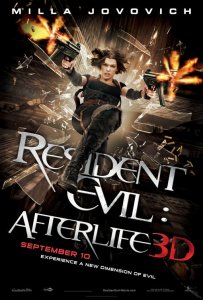 I won’t pretend these movies are anywhere close to good, but each one has provided some mild, mindless thrills. However, the fourth film in a franchise going nowhere is the first of the series that just says, “To hell with trying to be even remotely real.” This is a living video game, especially the opening sequence where it’s a nonstop barrage of self-conscious visual tricks, hails of bullets, gore, and a general kick in the balls to the laws of physics. I’m not asking for much, but I’d like my mindless violence to be of a quality where it doesn’t feel 100 percent gratuitous and, frankly, boring. If every single scene involves someone doing something fantastic, over-the-top, and absurd, then where can my interest go but down? Director Paul W.S. Anderson returns to the series he begat in 2002. Get ready for more zombies, more weird mutant creatures that will act however they damn well feel like, and more Milla Jovovich confusing toughness with cold stares. The action is ripped purely from a video game with no regards for geography, setup, tension, development, or anything that would matter. It’s just all flashes of violence one after the other. It’s a mostly depressing enterprise. But where do they go from here? The second movie was subtitled “Apocalypse” (little too hasty there), the third “Extinction,” and now this one is subtitled, “Afterlife.” Is the next one going to be, “Reincarnation”? And the certainty of a fifth movie only adds to my depression level.
Nate’s Grade: C-
Share this:

Scott Pilgrim vs. the World (2010)
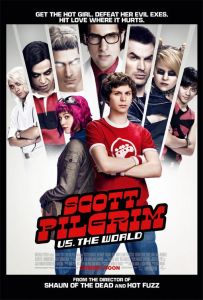 What happens when the millennial generation gets its own (attempted) seminal movie? It stays home and plays video games, letting the film, Scott Pilgrim vs. the World, languish at the box-office. I guess that’s what happens when you finance a movie whose target demographic will just as readily download the movie for free off the Internet.
Scott Pilgrim (Michael Cera) is a 22-year-old Toronto slacker. He?s the bass player for the band Sex Bob-Omb, along with lead singer Stephen Stills (Mark Webber) and acerbic drummer Kim (Alison Pill), a former ex-girlfriend of Scott’s from high school. The band’s biggest fan is 17-year-old Knives Chau (Ellen Wong), who also happens to be Scott?s new girlfriend. The world of Scott Pilgrim is abuzz with this scandal, especially Scott’s gay roommate Wallace (Kieran Culkin) and Scott?s younger sister (Anna Kendrick). Scott insists it’s all on the level and he has no ulterior motives for dating a high schooler. Then he sees the mysterious and alluring Ramona Flowers (Mary Elizabeth Winstead) who?s new to the area and American. Scott rabidly pursues her in what could best be described as stalking, eventually getting her to agree to date him. Trouble is, he hasn’t broken up with Knives just yet before starting this new venture. Scott is then confronted at the Battle of the Bands concert by a man who comes bursting out from the ceiling. He is the first of Ramona’s seven evil exes and Scott must defeat them all in order to earn the right to the violet-haired beauty. “Everybody has baggage,” Ramona says. “Yeah, but my baggage doesn’t try and kill me,” Scott wearily replies.
 Visually, this movie showcases director Edgar Wright (Hot Fuzz, Shaun of the Dead) using every crayon in the Crayola box. This is a visually resplendent film where every scene seems crammed with details to delight the eyes and light up the senses. It’s a rush to watch the kaleidoscope of colors and motions. The Scott Pilgrim universe clearly differs from our own. This is a realm that borrows heavily from old school video games, where people burst into coins when vanquished, where life-decisions are met with “leveling up,” where people have onscreen pee bars that will deplete after a trip to a urinal. Sound effects will routinely be verbalized on screen, everything from a “RIIIIIIIIIIING” of a telephone to the “Ding Dong” of a door. It’s amusing, though also easily overused. Jobs and stuff like that are for the real world, hence too square to be depicted. It’s this entire idiosyncratic comic book world treated like everyday reality.
The enormous display of style is impossible to ignore. Scott Pilgrim is a slick, flashy piece of entertainment that is riddled with nostalgic references for a select crowd. I appreciated how a nice walk was accompanied by the theme song from The Legend of Zelda, or that sound effects and onscreen graphics echoed the fights from Street Fighter II (don’t ask me which of the 800 versions). Scott Pilgrim is an excellent pop pastiche of a specific culture, namely a slacker, hipster, amiable, comics and gamer group. I myself was an avid Nintendo gamer back in my day, but I admit to waning interest when the games got too complicated and grisly (“Back in my day we had two buttons to push, one to jump and the other to shoot, and that’s how we liked it!”). The movie is an explosion of color, light, and (lo-fi garage rock) sound, which also might sound like the description of a seizure or a stroke to some. Like those ailments, Scott Pilgrim will be seen by some as an infliction. It’s hyperactivity and eagerness to please via nostalgic reference points will be what drives people to this film and what drives them away in equal measure.
The Scott Pilgrim graphic novels total six volumes and approximately 1200 pages, which means it?s not the easiest fit for a two-hour window. It also hurts that the Pilgrim books have a wide supporting cast of characters to tussle with, plus there?s the whole seven deadly exes thing which means the movie has to provide about a solid 20 minutes of set-up before finding enough time for seven antagonists (or boss battles, following gamer parlance) and a reasonable amount of resolution. Add on top of this the fact that Wright keeps the movie moving at an outrageous, ADD-addled pace, like the plot conveyor belt lever got broken and the scenes speed one after another. Everything about this movie feels fast and over caffeinated. The editing in particular has characters holding conversations where every line is in a new location, implying an added sense of movement. So you shouldn’t be too surprised when the Scott Pilgrim film feels like a whole lot of a little; it’s moving at the speed of light to entertain.
 Because of the plot mechanics and oversized cast of characters, Pilgrim can give off the impression of shallowness. It seems like all style and little substance and that’s because the movie attempts to cram an entire series of stories, back-stories, and conflict into two hours. The film version only has enough time to attempt to give Scott and Ramona characterization, though both come across as weak-willed, tentative, and less than charismatic, wondering if either party is worth the trouble. The movie tries to paint over these differences through distraction and force of will. The large cast of supporting players all elbows each other just to be mouthpieces for one-liners. Knives actually comes across as the most complete character, consumed by her infatuation, heartbreak, and then quest for misguided vengeance. She’s somewhat dismissed and yet she is the most developed person on screen thanks to Wong’s endearing and relatable performance. The entire experience of Scott Pilgrim vs. the World can be somewhat fatiguing when there’s little evidence presented for emotional investment. The books supplied the reasons for caring besides the whole underdog angle.
The movie aims to be a battle over love, but it’s not entirely convincing. Scott appreciates Knives because she’s simple, a relationship he doesn’t have to invest much within, something casual and enjoyable while it lasts or until it becomes too taxing. Then he goes ga-ga for Ramona and stalks her, wearing down her defenses. He’s purely smitten with her and willing to do whatever it takes to earn her affections, though he can?t explain why he feels this way. Here’s a note to screenwriters: when characters are asked why they love somebody, do not have them say, “I don’t know.” But for Ramona, Scott is her Knives. He’s something easy that won?t break her heart, an escape from the jerks she’s been dating before. He?s low maintenance. He’s something to pass the time. There’s an interesting dynamic here, made even more complicated by the fact that Scott’s time with Knives blended with his time with Ramona. There was not a clear end point. The movie takes a literal approach to the idea of love being a destructive force of nature. Scott is punished throughout because of his infatuation with Ramona, but he persists despite the bruises. And he doesn’t even really know much about her. There’s an interesting statement somewhere there about the punishment we endure, sometimes foolishly, over the affections of people we may love, or convince ourselves of, but not even like.
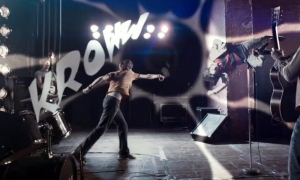 It may sound peculiar but I’m paying Michael Cera a compliment by saying his performance in Scott Pilgrim is the least Michael Cera the actor has ever been on screen. Gone is his gawky, awkward, ironic shtick that has fast become the Cera persona in films like Superbad and Year One. Scott is unjustifiably confident in his life’s pursuits, and Cera gets to act cocky and quippy, even if it?s done with a wink. He?s an unlikely kung-fu star but then again he?s also an unlikely leading man. Winstead (Live Free or Die Hard) is cute but plays her part a bit too toned down, like Ramona’s still searching for the right medication combination. Culkin and Pill are both scene-stealers of the first order, doing so with unabashed and flippant sarcasm. Every scene is made better by their presence. Among the evil exes, Brandon Routh (Superman Returns) has plenty of fun as a dim-witted super-powered Vegan bassist (“Vegans are just better than other people”), and Jason Schwartzman epitomizes hipster snark with such relish. The film is exceedingly well cast from top to bottom.
I’ve read some reviews positing that Scott Pilgrim vs. the World is an elaborate fantasy taking place in the mind of its titular hero, that he blends his knowledge of comics and video games to help make sense of the troubled waters of relationships and lingering hurt from the demise of love. I think that’s a nice explanation but perhaps trying too hard to frame this film as some form of psychoanalytical commentary on modern youth’s interpersonal relationships and the value of love. Scott Pilgrim vs. the World is really just a spastic, hip, clever wank that, as presented, gives little room or emotional investment. It?s a blurry, messy, prankish good time at the cinema that doesn’t translate into much more than the equivalent of sensory button mashing (video game reference). It’s fun while it lasts but it doesn’t have much beyond those astounding visuals to make it feel lasting, and I say this as a genuine fan of the graphic novels by Bryan Lee O’Malley. Alas, heavier discussions about the thorny, maddening issues of love are better left to more dramatic, and romantic, movies like Brokeback Mountain, Eternal Sunshine of the Spotless Mind, and even WALL-E. This movie is more preoccupied with spinning as fast as it can and then vomiting.
Nate’s Grade: B
Share this:

Prince of Persia: The Sands of Times (2010)
 This video game adaptation has the curious distinction of being both too simplistic and too complicated, sometimes in the very same breath. The harried screenplay could have used a lot more clarity concerning back-story, exposition, character roles, setting, rules of this Middle Eastern time period, supernatural rules, etc. At the same time, Prince of Persia is saddled with a pretty dopey story with weak characters. The plot is far too repetitious; somebody has the magic dagger that can turn back time, they lose it, they regain it, they lose it, repeat for over an hour. It feels like the story is never getting anywhere despite the fact that new, and still weak, characters are being introduced. The tone and look of the movie feels too beholden to its video game roots; the action is momentarily rousing but then seems overly coordinated to squeeze in all the game’s special signature moves. You’ll grow tired of all the wall flipping, wondering if a controller is stuck somewhere. For a movie dealing with a time-traveling dagger, give me more time travel. This fantastic plot device is used too sparingly in a ho-hum plot about an adopted son (Jake Gyllenhall, buff and with a sporting accent) of the king being accused of killing the king. Despite the Disney name, this feels less like a Pirates of the Caribbean knockoff and more cut from the same cloth that gave us the Mummy sequels. It’s loud, stuffed with empty special effects, and feels like junk food for your brain but it’s not even good junk food. Weirdest of all, the movie is one big metaphor for the U.S. invasion of Iraq (acting on false intelligence about some country aiding an enemy by manufacturing weapons). Seems Prince of Persia is Hollywood’s second attempt to rewrite our past political blunders in the Gulf and come up with a dubious happy ending.
Nate’s Grade: C
Share this:

Max Payne (2008)
 I have no idea whatsoever what the point of this movie was. Adapted from the popular video game, Max Payne follows a hardened police officer played hysterically super serious by a grumpy Mark Wahlberg. He scowls, he grumbles, he chews over laugh-out-loud “tough guy” dialogue as he searches for his wife’s killer. For whatever reason, this storyline dovetails with a super drug on the streets that makes people see hallucinations of winged demons/angels. The entire storyline has no merit except to squeeze in some semi-cool effects shots. But when you know they’re all just hallucinations, what does it matter? Can that really be scary? But then these creatures seem to interact with reality and pull people to their deaths, so what are the rules here? There’s not an ounce of fun to be had amidst this drabby neo-noir landscape. The plot is a formulaic revenge tale, where every turn is easily telegraphed and every character is a one-note stock role, complete with the video game favorite of doe-eyed pixie girl who carries huge guns (Mila Kunis, why?). Even the action sequences are dour and dull. Max Payne is a movie that was built to exist in moments and not as a whole. The most troublesome aspect of this whole sodden adventure is how much the film openly fetishizes guns. The end credits are like a reel of money shots, watching glistening CGI guns rattle off. What better way to end such a thoughtless exercise in pseudo entertainment.
Nate’s Grade: D
Share this:

Street Fighter: The Legend of Chun-Li (2009)
 It’s not every day that Jean Claude Van Damme gets some marginal level of redemption. The original 1994 Street Fighter film took the classic arcade fighting game and took it as seriously as possible, which meant it was incredibly silly. Van Damme was Colonel Guile and entrusted to rescue hostages from the evil dictator, Bison (Raul Julia). The big screen adaptation rewrote entire characters but managed to keep the stuff fans really care about, like catchphrases, costumes, and super moves. God forbid that audiences see Cammy (Kylie Minogue, yes that Kylie Minogue) make the wrong victory pose. It’s always the unimportant things that somehow matter the most to execs. Street Fighter is a campy blast. How could you despise a movie that has its villain say, “For you, the day Bison graced your village was the most important day of your life. But for me… it was Tuesday.” Though the movie does have the depressing distinction of being Julia’s last film before he died. Let this be a lesson to all actors looking to take a paycheck role. Years later, in the wake of a writer’s strike, the execs at Fox thought they could pump new blood into a Street Fighter franchise. Street Fighter: The Legend of Chun-Li purports to tell the back-story of one of its most popular fighters, the diminutive fireball-tossing lass with Princess Leia’s haircut. This movie proves that you don’t need a Van Damme to make a boring and mediocre action movie.
Chun-Li (Kristin Kreuk) is trained to be a master pianist and also a master martial arts warrior. You don’t realize the kinds of dangers classical pianists constantly run into. Her father is kidnapped by the crime lord Bison (Neal McDonough) for some reason or other. Three years later, a mysterious scroll falls into her possession. She travels to Bangkok to find her father. Bison has the ingenious plan of buying waterfront property, introduce high levels of crime, and then making money on lowered property values, which is simultaneously confusing and stupid. Bison has a few evil henchmen, notably the giant boxer Balrog (Michael Clarke Duncan) and the masked warrior Vega (Taboo from the Black Eye Peas), who help wipe out his criminal competition. In Bangkok, Chun-Li is mentored by Gen (Robin Shou, who played Liu Kang in two Mortal Kombat movies) and together they attempt to thwart Bison and his dastardly real estate scheme.
 For a movie about streets and fighting, well there’s a clear shortage of the latter. Much of the movie is structured around Chun-Li conducting her own private investigation and achieving some level of inner peace. She decides to try and make it on the streets of Bangkok. There are forgettable training exercises with forgettable platitudes disguised as wisdom (“You’re hurting me,” “No, you’re hurting yourself”). There are a handful of lackluster fights and chases, some of them through streets even, but the movie has a scarce amount of action until it revs up for a climactic showdown. The action is also poorly shot and poorly edited, distracting the senses and making it downright impossible to understand. The choreography is nothing special. When the movie suddenly introduces a supernatural element the other characters don’t even bat an eye. Screenwriting neophyte Justin Marks has too much revenge-seeking father drama and real estate scheming and not enough brawling. The Legend of Chun-Li has zero respect for the intelligence of its audience. It has flashbacks to flashbacks that just aired minutes earlier. How hard would it have been to just actually base a Street Fighter movie on a fighting tournament?
Director Andrzej Bartkowiak (Doom, Romeo Must Die) shoots the movie in such a dull manner that the fight sequences fail to even elicit any interest. There’s one scene in the middle of the film that serves as a testament to the lack of care put into this movie. Chun-Li has battled a Bison henchwoman in a women’s bathroom. The bathroom set design includes partition walls with portholes. Chun-Li is on one side and the henchwoman tries to punch her through the porthole. Chun-Li grabs the woman’s arm and squeezes. The camera angle is from the side of the actresses, so it would make the most sense to have the henchwoman’s right arm caught, that way her expression could be seen. Nope. Chun-Li is gripping the woman’s left arm, meaning that her raised arm and shoulder block any view of the woman’s face, and yet she talks through this scene. How difficult would it have been to just switch arms? Why purposely obscure an actor’s face, especially in a scene that doesn’t require a stunt double?
 Here’s a curious item. Chun-Li has always been a full-blooded Chinese woman in the history of the video game. When we see her as a child, baby Chun-Li and child Chun-Li are very obviously Chinese in features. Flash forward a few years and she’s transformed into looking like Kreuk, who is half-Chinese. Apparently, one of the less common side effects of trauma is becoming less Chinese looking as you age. Along these same strange ethnic lines, we’re told that Bison was the child of Irish missionaries and was left behind in Bangkok. And yet, the child grown up completely in Southeast Asia manages to sport an Irish accent. Anybody want to explain that particular linguistic loophole?
Kreuk (TV’s Smallville) is one of the film’s biggest handicaps. The script saddles her with great amounts of pointless voice over, to the point that half of her performance is listlessly explaining what is literally happening on screen. Kreuk is a dead-eyed robot in this movie; she displays some glimpses of human emotion, like sadness and rage, but they never feel remotely credible, like someone who only knows the definitions of emotions and not proper application. Her lesbian seduction dance is a small moment of absurdity. She thrashes on the dance floor and her “dancing” reminded me more of a bird’s mating dance without the excessive plumage displaying. Kreuk can run and flex well enough, which is also a nice benefit for a martial arts action flick.
The acting is terrible but there is one bright spot in a most unexpected location. Ladies and gentlemen, I present to you the best worst performance of the year, brought to you by Chris Klein (American Pie). Klein plays Interpol agent Charlie Nash who is conducting a parallel investigation into Bison’s Bangkok activities. He’s partnered up with a local gangland homicide detective (Moon Bloodgood) who takes extra care to showcase her cleavage thanks to work outfits with plunging necklines. Klein is awful to a powerful degree but here’s the thing — I’m fairly certain it’s one hundred percent intentional. Being a conosoire of trashy cinema, I feel that I’ve adopted the skill of being able to deduce when an actor is hopelessly serious or just goofing off. Klein comes across like a self-aware man; he knows this is a crummy movie with crummy dialogue, so he’s going to have as much fun as possible. His performance is all forced swagger, from the way he constantly swivels his head to the way he cannot purposely walk in a straight line. He overemphasizes lines, chewing over the faux hard boiled detective talk and spitting it out in a singsong delivery. He grimaces and furrows his brow, widens his eyes to comical levels, and when he crouches in a gunfight the man spreads his legs as far apart so that he looks like he could have effectively doubled as a backup dancer in an MC Hammer music video. It’s obvious that Klein has given a staggering performance, but the observant will note that this is not an inept performance. This man knows exactly the kind of movie he’s in. I always tabbed Klein as a wooden actor that came across like Diet Keanu Reeves, but I must credit him for making a bold acting choice to knowingly dig deeper when it comes to being bad.
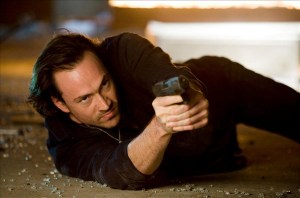
Hero of this movie, Chris Klein.
Readers know that I am skeptical and dismissive about the prospect of a good movie ever being born from a video game adaptation. Games call for interactivity and movies passivity. But if you’re going to make a movie called Street Fighter than stick to the script. This borefest wants to be a gangland drama with a tacked-on buddy cop side plot. Street Fighter: The Legend of Chun-Li is an awful work partially redeemed from the sheer amount of unintentional hilarity. Kreuk is extremely miscast as a warrior woman. The acting is bad, the direction is bad, the writing is bad, and Chris Klein tries to outdo them all in badness, and I admire the chap for trying something different in an admittedly abysmal movie. To be fair, I was never a big fan of the original video game. The special moves always seemed much more tricky to pull off. How many different incarnations of Street Fighter II were there before they eventually mastered basic math and released Street Fighter III? These are the things I was thinking about wistfully whenever Klein or Bloodgood wasn’t on screen.
Nate’s Grade: D
Share this:

Fary Cry (2008)
 Say what you will about Uwe Boll as a writer and director; Lord knows I’ve written nearly a Master’s thesis on the notorious schlock filmmaker. However, this man would be an asset to have as a producer, at least initially. The German tax loophole was closed and yet the man still finds a way to make like three to four movies a year. He can pull together resources and organization as well as anybody in the business. So what if the final product happens to be substandard? This man knows how to produce. He’s just not as skilled at other positions. Far Cry, Boll’s latest video game adaptation, is a clunky action movie that treats genre clichés as virtues. It is not a bad movie but it’s not a good bad movie either. It’s just Boll’s version of disposable action.
Valerie (Emmanuelle Vaugier) is a Vancouver newspaper reporter who has got a great lead on a story. Turns out Dr. Krieger (Udo Kier), your classic mad scientist, is running experiments on a nearby island and he has an armored guard. Our spunky heroine is determined to investigate. Her uncle Max (Ralf Moeller) is actually working for the mad doctor and having misgivings, which is why he tries to send Valerie classified info on the experiments. Dr. Krieger is bankrolled by the (Canadian?) government to develop genetically modified super soldiers. They have a layer of armor under their skin and the only foolproof way to kill these super soldiers is to shoot them in the eye or mouth. My best guess why is because they both lead to the brain, but then why stop there? Why not shooting into ear and nose cavities? Anyway, the super soldiers won’t take orders so the mad doctor and his mercenaries capture Max and turn him into the newest test subject. Valerie has chartered a boat to meet up with her uncle. The boat captain, Jack (Til Schweiger, who sounds like his voice was dubbed by an actor that could not widen his mouth to enunciate), just happens to be an old Special Forces buddy of Max’s. This comes in handy when both Jack and Valerie are attacked once they reach the island. The duo must run for their lives and inflict much ass-kicking justice.
 Far Cry is a mediocre cliché-ridden action vehicle. You’ve got so many formula elements widely circulated in numerous other action flicks, and I’m not even talking about the standards like that the good guys are marksmen, the bad guys are terrible shots, and anyone can move unfazed if they get shot in the shoulder. We also have the fact that all evil hideouts, when not hewn into volcanic rock, must be located in giant warehouses with too many catwalks and chains and extraneous machinery that do little else but spit sparks when called upon. Jack also pulls the timeless tactic of stripping an enemy solider, putting on his uniform, and then infiltrating the enemy camp under a flawless disguise – a change in clothes. Let’s not also forget the tried-and-true method of throwing a rock in a different direction to cause a distraction. I think at this point only dogs fall for that. By the thirty-minute point, we’ve already seen two separate shots of Jack swimming underwater while an explosion rages above the surface. Though the word has likely lost all meaning to Boll, I would describe that as excessive.
Another major cliché of action movies is the forced coupling between Jack and Valerie. It doesn’t take long before their bickering leads to smooching. Shortly after just escaping mercenaries and a helicopter explosion in a lake, Jack and Valerie find a shack nearby and tend to their wounds. She changes out of wet clothes and makes sure that he doesn’t catch a peek (he does) and he dresses a flesh wound on his rippled abdomen. Eventually she crawls under the blankets on a bed to warm herself for the night. He does too, to stay warm of course. “I have to take off my wet pants, you know,” he reasons (oldest trick in the book). But after they’re in bed together they have to still talk about how cold they each are still, and then Jack suggests, “shared body heat,” you know, just to stay dry. After what seems like forever, these two just give up this charade and start kissing and have them some sex. Naturally, the introduction of an attractive female character in an action movie is designed so that she can snuggle and then be put in danger. Valerie does little else to the story. I want to know why either of these two is acting so casual moments after they escaped fiery death. They know that they’re still being hunted, and the shack is within walking distance from the crash site, which is being investigated by the mercenaries. For that matter, why do the bad guys call off each attack to search and confirm for kills? Are they that concerned with paperwork?
 Far Cry feels like every generic moment rises from the shadow of other generic action movies. The final conflict between Jack and Max the Super Solider boils down to an appeal to the man inside the monster, trying to tap the humanity buried beneath the killing machine. You’ve seen this in countless other movies. Dr. Krieger has a dominatrix-esque second-in-command that has some personality to her; it must be hard to be a female henchwoman, having to be even more evil than the henchmen to prove her self. The initial plot setup even reminds me of Ed Wood’s Bride of the Monster — girl reporter investigates mad scientist. The whole island-based setting, with the aquatic inclined stunts, led by a Central European action star, buddied up with a yammering idiot as a comic sidekick … it oddly reminds me of the entirely forgettable 1998 Jean Claude Van-Damme movie, Knock-Off, with also had the misfortune of co-starring Rob Schneider. A knock-off of Knock-Off? Well it is time for the tenth anniversary after all.
Boll stubbornly tries to make his mundane action movie into a comedy. The comic elements never fully gel with the rest of the film, and yet Boll keeps transforming the movie into this screwy action comedy. There’s the bickering between Jack and Valerie, which is expected territory for the genre, but then the movie fills its time with excessive wisecracks, strange digressions, and so much comic relief that it fails to be relief (or comic). Chris Coppola chews as much scenery as possible as Emilio, the irritating, hapless sidekick to Jack. He’s introduced at almost the hour mark and seems to be trying to make up for lost time in annoyance. He’ll offer to help Jack fight but then recoil and scamper off. This is the kind of movie that has the overweight Coppola lovingly caress a sandwich and coo, “I’ve been thinking about you all day.” Get it? He’s fat. Fat people love food.
But by far the funniest and weirdest aspect abut Far Cry is how unbelievably prepared Jack is for any situation. He hands Valerie a handcuff key from his pocket, which he always carried with him because, presumably, Jack lands in handcuffs often or cannot be trusted to remember his “safe word.” But then late in the movie, Jack is handcuffed and he literally regurgitates ANOTHER handcuff key. This means that Jack keeps a key in his pocket and swallows a spare. Does he eat these daily? What else is hidden among his body? The man could be a human Swiss army knife.
 No one ever seems to question what the chances are that a German former Special Forces agent will work at a Canadian lab, within reach of his Canadian niece ace reporter, who will charter a boat from another German former Special Forces agent who also happens to be within reach of this lab. I guess when you’ve got invincible super soldiers you don’t sweat the details.
Despite all its flaws and general laziness, Far Cry is a semi-decent action movie, especially one with a low budget. Boll manages to construct some passing action sequences with respectable camerawork, and the end battles between our heroes and the Super Soldiers is actually well-edited, with sharp cuts that help ratchet up the energy level, and has plenty of good stunt work. A chase through the nondescript warehouse between Jack and a super soldier actually makes use of some spiffy Parkour choreography, a welcomed addition. The forced comedy can actually succeed at times during the action, like when Valerie is hurling grenades with the pins still attached or when she accidentally lassos a helicopter with a harpoon gun (Dr Krieger scolds her, “You know, you owe me a helicopter.”).
In the pantheon of Boll movies, Far Cry lands more toward the top. It’s a middling action movie that tries too hard to constantly inject misguided humor into every freaking minute. The movie suffers from the same boneheaded flaws that plague the action movie genre, but by the end of its admittedly brief running time, Boll has pulled off a minor success. Far Cry is not a good movie and has too many derivative and unimaginative elements, but Boll seems to have cranked this one out. While Far Cry is not a particularly good action movie, it is relatively indecipherable from the thousands of other cheap mediocre action movies that pollute the direct-to-DVD market. He’s made an easily digestible product that isn’t even bad enough or weird enough to be memorable. To him that’s victory, but to me, an avid Boll expert, that’s just plain boring.
Nate’s Grade: C
Share this:

In the Name of the King: A Dungeon Siege Tale (2008)
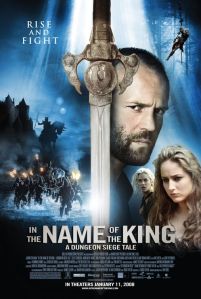 I have no idea how it happened but someone gave infamously reviled director Uwe Boll a bunch of money to adapt a fantasy video game called Dungeon Siege into a star-laden movie. In the Name of the King: A Dungeon Siege Tale seemed to be Boll’s stab at achieving mainstream credibility. He assembled his best cast yet with plenty of recognizable stars. At one point, I remember reading that Boll wanted to divide this film into two, Kill Bill-style, or release a 180-minute version. Until this movie, no Boll film had ever gone over barely an hour and a half. After seeing a slimmed down version that runs a little over two hours, I honestly have no idea what more Boll could have. In the Name of the King struggles to fill two hours worth with crap.
In a far off land, there lives a farmer named, coincidentally enough, Farmer (Jason Statham). His world is turned upside down when his family is killed by a band of creatures known as the Krug. He and his friend (Ron Perlman) must track down Farmer’s captured wife (Claire Forlani) and inflict some peasant vengeance of their own.
Evil wizard Gallian (Ray Liotta) was the cause of the attack. He has built up a whole army of Krug to challenge the King (Burt Reynolds) for the throne. Gallian also has two unwitting allies. The King’s nephew, the Duke (Matthew Lilard), wants to rule and is willing to plot with the evil wizard to achieve this goal. Muriella (Leelee Sobieski) is secretly sleeping with Gallian; he says he is teaching her how to use her blooming magical powers (remove your mind from the gutter) but he is really stealing her powers.
Farmer reluctantly becomes a leader to protect the kingdom. Gallian is stupefied that this simple farmer is somehow beyond the control of his magic. That’s because Farmer should probably change his name to Prince because he is the long-lost son of the King and some stable girl. Merick (John Rhys-Davies) serves as the King’s most trusted advisor but he is also the father of Muriella. He scolds her for being so foolish and being used by Gallian. She suits up like Joan of Arc and wants to fight, but her father won’t allow it.
Eventually this all leads to a large-scale battle between the forces of good and evil where Gallian uses his magic powers to create a cyclone of books to stop Farmer. There you have it.
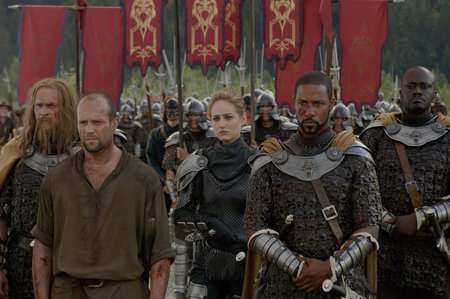 If I were Peter Jackson, I might consider a copyright infringement suit, because In the Name of the King is a sloppy Lord of the Rings rip-off through and through. The long-lost heir to the throne must accept his magisterial destiny … just like in Lord of the Rings. There is a 10-minute fight sequence that happens in a swath of woods … just like in Fellowship of the Ring. The villain relies on an army of stupid supernatural hordes … just like Lord of the Rings. There is a wizard-on-wizard duel … just like Lord of the Rings. A noble woman wishes to fight but her father does not approve, so she sneaks off in armor and does fight … just like in Return of the King. There is a shadowy “other” world that goes beyond our dimension … just like in Lord of the Rings. The eventual trek of our heroes leads to a volcano, but not just that, it’s also the villain’s lair … just like in Lord of the Rings. Bastian (William Sanderson, in his sixth Boll movie) serves no purpose other than to resemble Legolas. John Rhys-Davies you should know better; you freaking starred IN the Lord of the Rings trilogy.
So what does a $60 million budget get Boll? Lots and lots of crane shots. Boll relies on extended aerial photography and zooming, CGI landscapes that serve to remind you how much better Lord of the Rings was and that Vancouver is no New Zealand. There are some segments that lack a firm geographic bearing because Boll wants to jump from expansive crane shot to expansive crane shot. I get that he wants to showcase the depth of the battles, which do feature a fair amount of background action, but the repetition of any camera technique will always grow old if it doesn’t feel congruent to the onscreen drama. I’m happy that Boll wants to open up the scope, but when he relies on a multitude of high-angle crane shots in motion the effect becomes wearisome. The audience can never settle into the action because Boll is too forceful with wanting to demonstrate what he bought with his budget. The cinematography is a notable step up for Boll and longtime director of photography Mathias Neumann. Then again, if I had a $60 million budget I’m sure my movie would look good too, or at least better.
In the Name of the King is the biggest budget Boll has ever had, but it seems like proper costumes must have still been out of his price range. The marauding horde of Orcs, oh I’m sorry, the Krug look like cheesy low-rent Power Rangers villains in goofy rubber outfits. The camera never lets you get a good glimpse of these creatures because even Boll knows how crummy they look. You get another idea of how bad the creatures look when Farmer utilizes the familiar dress-in-other-guy’s-uniform-to-pretend-to-blend-in ploy that was perfected by the aging action stars of the 1980s. So Farmer knocks out a Krug creature, throws on its spongy armor, and is able to walk around the Krug camp.
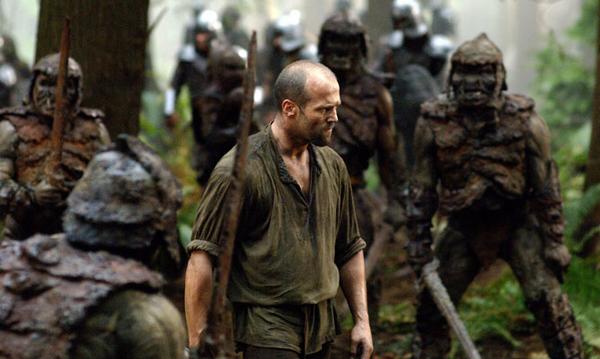 The special effects also seem to run the gamut. The green screen work is painfully ineffective and very transparent, like when Farmer is swinging down a rope across a gorge. When Boll tries to show large fields of soldiers it also exposes how fake the CGI work looks. The many battalions of soldiers look like a dated computer video game. The special effects for Alone in the Dark were better and that film had, reportedly, half the budget of this movie. Realizing all this, it’s no wonder that Boll tries to use as many real sets as he can.
And yet despite all of this, In the Name of the King is high-class camp. Boll achieves a workable level of derisive enjoyment that manages to keep the movie entertaining even while its spins into stupidity. The fight scenes are actually decent and Boll manages to compose a few shots here and there that look quite good, like when the camera scans over a field of dead bodies. During the action centerpiece, the 10-minute battle in the woods between man and Krug, Boll’s camera manages to frame some solid, if unspectacular, action with some good angles. It’s also cut to be mostly coherent. The fight choreography is credited to Siu-tung Ching who also did the choreography for Hero and House of the Flying Daggers. He must have procrastinated until the night before his choreography was due. It will pass but there’s little creativity there; however, Boll must have been flabbergasted. I think the true test for derisive viewer enjoyment will be when the ninjas come out of nowhere at the King’s disposal. All of a sudden in the middle of a medieval style fantasy fight there are flipping black-clad ninjas. I loved it for its sheer anachronistic absurdity. To me, it felt like Boll was trying to cram in everything that he thought was theoretically cool into one massive fight sequence. He just didn’t have the money to also include pirates and robots and hobos and vampires and bears and Batman.
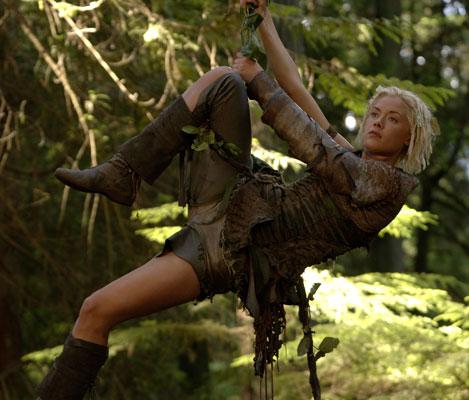
Fantasy is just not Boll’s preferred territory and it mostly shows. He really wants to make his own entry in the style of Lord of the Rings, but you can tell his mind is elsewhere. The plot is a mess but that isn’t indicative of Boll’s lack of interest with the film, it’s just indicative of a typical Boll movie. In the Name of the King feels like Boll is following a checklist of what is expected in a modern fantasy epic, except that Boll cannot provide the epic part. Here’s my proof: the vine-swinging tree nymphs led by Elora (Kristanna Loken). If Boll was really invested in this movie he would have paid more attention to these alluring vixens. These anti-war ladies have sworn off men (take that for what you will) and live their lives like Cirque du Soliel jungle performers. This stuff is right up Boll’s exploitation rich alley, and yet he and the film treat these women of the woods like afterthoughts. They show up and save the day when the film requires an inexplicable savior. I don’t know how helpful tree-dwelling women would be in a fight either unless it was fought in a well-forested area. Boll not capitalizing on these women warriors proves to me that his heart isn’t in this movie.
 Screenwriter Doug Taylor was clearly cobbling a story together by his fading memory of the Lord of the Rings trilogy, and yet this being a Boll movie, there are still plenty of head-scratching decisions that defy logic even for a would-be fantasy film. For instance, why does Farmer fight with a boomerang? How effective can a weapon be when it gets thrown and then needs to be picked up? The boomerangs that I know can hit people, sure, but usually hitting someone stops its path of movement. Then again, these could be magic boomerangs. How did Gallian raise such a massive monster army to rival that of the King’s without anyone noticing? I’m sure the excuse for that is also magic-related. The Duke takes out two legions of soldiers for his own purposes, and when one man asks where the commanding officers are the Duke, in front of everyone, stabs him. It seems like a lousy way to lead but I’m sure Joseph Stalin would approve. A telekinetic sword fight sounds cool on paper until you realize it is just actors standing passively while CGI swords clang around them. During the climactic battle it’s dark and raining (hey, like in Lord of the Rings) for the King’s army vs. the Krug, but then as Farmer and Elora race to the Volcano Lair it is light out. How many time zones does this kingdom have? Also during this climactic battle, the King’s army has the high ground thanks to a hill and the Krug race up the raised land. The archers atop the hill fire their flaming arrows at an angle pointing up, which would sail over the heads of all their targets. I suppose the King’s archery education program has been suffering some severe budget cutbacks.
The dialogue is pretty corny amidst all the sword-and-sorcery antics and induces its fair share of giggles. When Muriella asks Gallian if he always appears out of nowhere he responds, “No. I appear suddenly. Out of somewhere.” Thanks for clearing that semantic argument up. He also has a very icky conversation with his bedfellow Muriella dripping with double entendres: “I knew you would come,” “I told you I would,” “I felt it before you came,” “You told me I could come and go as I please.” I think my favorite moment is when the King is on his deathbed and addressing Farmer. He advises the man of agricultural means to try using seaweed to enrich his soil. “How do you know this?” asks Farmer. “Because I am king,” he replies.
The actors all feel like they are in separate movies on a collision course with one another. Boll has never had a firm command with actors. The big name actors feel their way around a scene with little guidance from Boll, which means they routinely experiment and play their roles like they were an exercise instead of a final performance. A fine example is a single line spoken at a family table; it’s just perfectly off enough to prick your ears to Boll’s tone-deaf direction. I think Boll either doesn’t care that much about performances or is easily cowed into submission by actors. Staham is recycling his glaring machismo that he’s turned into an action movie franchise, but he seems to me like a modern-day Steven Segal who dispatches foes in a monotone whisper. Luckily for Boll, Statham is adept at picking up fight choreography and so the movie benefits by watching the actor clearly in the middle of the fracas performing his own sword fights.
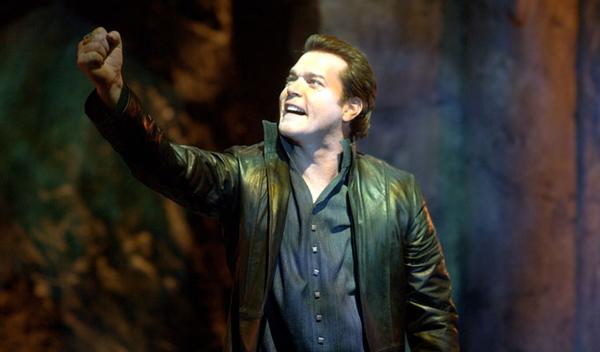 Most of the actors also seem to be falling back on past performances as inspiration for what to do under Boll’s laissez faire direction. Perlman plays his standard gruff tough with a deadpan delivery. Sobieski hasn’t acted in a movie for some time. She comes across as her usual inexpressively empty self, which is her thing, along with being a physical clone of Helen Hunt. Loken shows she can swing from a vine but not master a vague British accent. Forlani gets to cower and weep. Burt Reynolds is playing Burt Reynolds, and Rhys-Davies falls back on his trademark gravitas. Only Lillard seems to find enjoyment out of Boll’s vacuum of direction. His accent mirrors his wildly over the top style of acting that sometimes feels like a fish flopping around for air. His physical mannerisms are uncontrolled and he sneers through much of his lines, but I’ll give it to Lilard, he is much more fun to watch than any of the other slumming stars.
Special attention must be made to Liotta, who is on a different plane of terrible. It’s bad enough that he’s chewing the scenery in his typical manic, bug-eyed crazy yell-speak he refers to as acting, but the movie has to open on the discomfiting image of Liotta trying to suck Leelee Sobieski’s face inside out via kissing. Liotta’s character Gallian feels and looks out of place; he resembles a skuzzy Las Vegas magician with a pompadour and a long leather jacket and a button-down shirt. Where did this man come from? His performance is astonishing in how deeply the awful goes, and when he tells Farmer’s wife, “I feel him inside you,” try your best not to shudder.
After seeing eight of his films and writing 17,000 words on the man (including 2,600 for this review), I feel like I have a special connection to Uwe Boll. I just don’t sense that Boll’s heart was truly in this venture. In the Name of the King seems to be the last time I think we’ll see Boll flirt with mainstream Hollywood genre filmmaking. I think his time luring known actors has come to a merciful end. His next slew of films seem destined to all direct-to-DVD and feature no name casts that are mostly the same actors he has worked with before. In the Name of the King will stand as a ridiculous Lord of the Rings rip-off that has some workable action alongside its many laughably awful moments. It’s a lousy fantasy movie with too many extraneous characters and too familiar a plot outline. Even for a $60 million film, Boll finds new ways to prove that no matter what sized budget the man has he will always try to grasp something beyond his reach.
Nate’s Grade: D+
Share this:

Bloodrayne II: Deliverance (2007)
 It’s been some time since infamously derided director Uwe Boll reared his head and much has changed. 2006’s Bloodrayne was his last theatrically released movie but that movie was originally shot in 2004 and pushed back. In the meantime Germany revised its tax code closing the loophole that helped finance many of Boll’s cinematic duds thanks to German financiers being able to write off their debts. Boll has finished an additional three movies that are all scheduled for release in 2008, including the star-studded (for Boll) Lord of the Rings rip-off, In the Name of the King: A Dungeon Siege Tale opening this month. Boll may never get a chance to direct a theatrically released film again, which may explain his decision to helm a direct-to-DVD sequel to Bloodrayne.
The dusty town of Deliverance, Montana is under assault from the monstrous Billy the Kid (Zack Ward). Except Billy is no ordinary bandit but a powerful vampire intent on keeping his dastardly deeds nice and quiet until the railroad moves in with a nonstop supply of fresh meat and future members of the undead. Newspaper reporter Newton Pyles (Christopher Coppola, no relation to the famous family) has ventured to Deliverance in hopes of witnessing and writing exciting tales of the Wild West, and instead he’s become the man forced to write the cover-up of Billy’s actions. The vampires have kidnapped the town’s children with the idea of feasting off them while they wait. The town’s only hope is half-human, half-vampire Rayne (Natassia Malthe). Under the guidance of rustler Pat Garret (Michael Paré), the pair gather a team to combat Billy the Kid and free Deliverance from evil.
 Stylistically, Bloodrayne II: Deliverance is Boll’s desperate attempt to ape the look and feel of HBO’s popular Western series, Deadwood. It really is rather obvious to anyone that has ever seen the show. The costumes in Deliverance look similar, the sets are dressed similarly (though they still come across as too tourist attraction stagy), the gas-lamp lighting and use of darkness seems pretty similar, and the screenplay even manages to sprinkle in a few “cocksuckers,” which any Deadwood fan would know was the term of choice for historic cowpokes. Boll has the directing habit of borrowing liberally from his sources, so I expected nothing less for his attempt at a Western. The mundane cinematography goes to great lengths to declare how handheld the camerawork is. There is a noticeable difference between following the action as it develops for a docu-drama feel and simply shaking and bobbing the camera for a misguided attempt at artistic effect. After a while you feel like the cameraman must be balancing on a unicycle. There’s an over reliance on particular camera shots and close-ups are strictly reserved for the eyes and fingers during buildups to gunfights. The lavish mountain scenery of Canada (er, I mean Montana, yeah, Montana) is probably the visual highlight of a film.
The action is surprisingly decent. The climactic shootout between the forces of good and evil isn’t going to rival anything I saw in the updated 3:10 to Yuma, however, to Boll’s credit, the action is not ineptly constructed. He develops parallel lines of action and separates Rayne’s posse to deal with separate heroic last stands. Gunfights are naturally easier to stage than sword battles (shot 1: bad guy fires, shot 2: good guy ducks then fires, shot 3: bad guy gets hit) and that might explain why Rayne doesn’t break out her signature arm-blades until the very end of the climax. Rhetorical question time: who brings an arm-blade to a gunfight, anyway?
But it is structure that weighs down Bloodrayne II. Boll finally has a handle on crafting some workable action sequences and he just blows it. Bloodrayne II has exactly three action sequences and the first two are rather puny. There is a long drought in between action and in its place are a lot of dull conversations amidst increasingly dull characters. Vampires and the Wild West is a concept that can work; fun can be had with vampire cowboys and high noon (make that midnight) duels, and yet Boll seems uneasy about embracing its supernaturally campy potential. Bloodrayne II has little blood, zero gore, no nudity, no sex, and a pitifully scant amount of action. In other words, it’s missing all of the exploitation elements that make a movie like Bloodrayne II worth watching.
Screenwriters Christopher Donaldson and Neil Every throw in a lot of side characters into the stew but then quickly dispatch them as well, which at least keeps the audience on their guard and wary that anyone that assists Rayne is destined for a sudden end. Most egregiously, they speed through one of the best segments in all of movies: the getting-the-team-together sequence. Rayne and Garret are collecting a posse that includes a con man preacher (Michael Eklund) and a drunk affectionately known as Slime Bag Franson (Michael Teigen). Part of the enjoyment of the Western is following the unifying of a team and watching relationships form, and Bloodrayne II rushes through this process. It collects its gunfighters in brief introductions and then heads right for the finish.
 There seems to be little continuity between the two films even ignoring the change at lead vampire slaying lady. The vampires in this entry behave drastically different from the older European ones in the first film. Rayne seems to have lost her healing abilities, which were what the circus folk put on display when she was their money-earning star of their own little freak show (apparently during the 100-plus year gap between films Rayne got a little hammered during Spring Break and got a lower back tattoo). I bring up the healing issue because at one point Rayne is shot several times while escaping via swimming through a river. She’s struggling to regain her strength and confesses to Garret about her true nature and her need for blood. In one of the most curious moments for a movie that pairs vampires and cowboys, Garret slices open his arm and holds it over Rayne, dripping blood all over her face. The characters even seem to catch the weirdness as they both remark how much more useful a simple cup might have been.
It wouldn’t be a Boll movie without an abundance of the bizarre, the ludicrous, and the unintentionally funny. Rayne travels great distances on horseback to Deliverance with the intention of slaying some vampires she knows are responsible for murdering her friends. She finds the reflection-free accomplice (House of the Dead‘s Tyron Leitso) and holds a stool to his windpipe, choking the bastard. Instead of finishing him off Rayne relents and lets him live because, wait for it, he let her participate in his card game. Talk about a strange shift in motivation. During the climax, the townsfolk are stirred to rise up against Billy and his vampire clan thanks to the mayor and Pyles finally growing some spines. They set out to shoot them some vampires, but really what will they accomplish? Bloodrayne II established earlier that the vampires could take being plugged with bullets unless the ammunition is combined with garlic. I doubt the townspeople know they need that key ingredient to their firearms. How do the people in 1880s Montana manage to get a copy of the Chicago newspaper Pyles writes for? The railroad hasn’t made its way to Deliverance so I’m at a loss for the speedy spread of print journalism 1,000 miles away.
But the most unintentionally funny moment comes at the end when Billy has staged an elaborate system of pulleys so that when Rayne opens a door it drops a weight that will raise a series of nooses around the captured children’s necks. The kid on the furthest right is hung to death and the children seem to be arranged according to height, which seems a little OCD even for a vampire. The tallest kid on the far left of this makeshift gallows reacts very differently. While the rest of the child actors are crying, fretting, and acting like the ropes are cutting their breathing, this kid on the far left is just standing stone-faced and still.
The dialogue is expectantly awful, including clunkers like Pyles saying, “I have a question. I came looking for stories of the Wild West,” and then never actually asking a question (what kind of reporter doesn’t know what a question is?). The best/worst example of dialogue is literally the final line spoken and it blindsides the audience like a car crash. Garret says with a glint of wisdom, “Life is like a penis. When it’s hard you get screwed and when it’s soft it can’t be beat.” Wow. Someone alert the motivational poster industry because I have a gut feeling this will rival the perilous “Hang in there” kitty.
The first Rayne, Kristanna Loken, decided she’d rather stick with her Sci-Fi TV show, which has since been cancelled, than don the arm-blades once more for Boll. Malthe (Elektra, Skinwalkers) has the acting prowess you would expect from a former Maxim magazine model. It’s not like the role of Rayne involves much emotional complexity; mostly an actress has to be able to deliver some clunky dialogue and look attractive while swinging a sword. Malthe is certainly a fine looking woman but she is a non-starter when it comes to the world of acting. Whenever she speaks it’s in the same emotionless, dry tone even when she’s supposed to be angry. She comes across like an ineffectual dominatrix who’s studied acting by watching tapes of Shannon Doherty.
 Ward is hilariously miscast and completely unconvincing as an evil bloodsucker cowboy. Ward got his start in the classic A Christmas Story and I remember him best playing the goofy, dumb younger brother on comedian Christopher Titus’ hysterical TV show, Titus. Ward tacks on a lousy Eastern European accent that comes in sharp conflict with the setting and material of the film. Are vampires immune from having accents rub off on them, because Rayne seems to have assimilated well into frontier speech patterns? I challenge others not to crack up when he yells, “Now the slaughter begins.” In his defense, Ward isn’t given many scenes to play and the screenwriters have to fall back on the cheap “kids in danger” device to establish his villainy.
The other actors don’t fare much better. Coppola annoys within minutes of appearing onscreen. A helpful bartender (Chris Spencer) is astoundingly bad even for an Uwe Boll movie. He plays the part like Ted Lange in the Wild West. Boll go-to actor Paré actually seems at home with the Western material and his curt, monotone delivery fits well with the material. He’s a good fit for this genre but that doesn’t excuse his poor performances in four previous Boll flicks. The best actor in the movie is the original sheriff-turned-vampire (John Novak) who works an impressive snarl and a natural physically intimidating presence. He would have made for a serviceable lead villain over Ward.
Bloodrayne II: Deliverance is far less fun than the original while being better in some regards and worse in others. There isn’t much artistic growth shown. Boll was naturally meant to transition to the relegated realm of direct-to-DVD movies. It’s more his terrain what with the queasy production values, bad acting, and shoddy, repackaged scripts. In the world of direct-to-DVD a movie can live on into infinity thanks to assembly line sequels. Did anyone realize there are now, thanks to direct-to-DVD releases, seven Children of the Corns, four Bring it Ons, and a whopping 13 Land Before Times. It’s here where Boll’s quick production turnarounds will yield the most gain and where he may even thrive. He’s already planning to direct a Bloodrayne 3 and producing an Alone in the Dark 2 (regrettably there was a 2005 direct-to-DVD sequel to House of the Dead though it had no Boll involvement whatsoever). I think Uwe Boll is finally where he belongs.
Nate’s Grade: D
Share this:

The King of Kong: A Fistful of Quarters (2007)
 The King of Kong: A Fistful of Quarters is a short but sweet documentary that follows the lengths two men will go to set the records for the classic arcade game, Donkey Kong. We learn a whole lot about the many faces that populate the world of competitive video games, like Walter Day as official record-keeping referee, Steve Sanders as a fraudulent Donkey Kong champ in his youth who has now become a lawyer, Mr. Awesome, and the gaming world’s superstar, Billy Mitchell. He holds several world records including a score of 800,000 for Donkey Kong. Enter Washington science teacher Steve Wiebe who dutifully plays Donkey Kong in his garage. He challenges Billy’s score and videotapes himself passing 1,000,000 points; all the while you can hear his son in the background screaming to have his butt wiped.
What becomes very apparent is that the entire record-keeping system is tilted in Billy’s favor. It’s both sad and funny to watch a group of grown men who have all gravitated toward one man at video games. Billy’s claim to fame is he’s the best at video games, and he has a restaurant, a line of hot sauce, and other products that sell because he has that small sliver of fame. And this select circle of gamers essentially is a freaking tree house and they don’t like someone from the outside crashing their private party. This group of man-child sycophants is clinging to their small notoriety like a life preserver on a doomed ocean liner. It’s baffling how serious and self-involved they all come across; while on the phone with Billy, Steve Sanders, while dining, says in the most hyperbolic alertness that Steve has come into the restaurant “uninvitedly” like it’s some grave offense. It’s a restaurant! (Billy at one point literally says, “No matter what I say, it draws controversy. It’s sort of like the abortion issue.”) These few established gamers throw hurdles at Steve and even dismantle his Donkey Kong machine to snap pictures looking for some tenuous proof that his score was inflated somehow. When they find a small dew drop of glue in one corner of the control board, they claim that this, compiled with the fact that the board was given to Steve by a known enemy to Billy, is enough to disqualify Steve’s record-breaking million point score.
 They challenge him to break the record in public and that’s what Steve does, which is more than what Billy Mitchell is capable of. Steve travels to renowned New Hampshire arcade FunSpot and, under the glare of Billy lackeys, breaks 900,000 and gets to the heralded “kill screen,” where the old arcade game, because it has exhausted its memory, begins a stage simply to kill Mario within seconds. We’re told only two others have been ever known to reach a kill screen in public.
And then Brain Kuh pops in a videotape that Billy sent. The tape is a recorded game, presumably of Billy playing, where he passes 1,000,000 points on Donkey Kong and undermines Steve’s recent accomplishment. The sycophants are all abuzz, with Kuh on the phone with Billy relaying every moment in hilarious fawning detail. Apparently, it wasn’t kosher for Steve to submit a recorded video of his score but Billy doing the same thing is acceptable. This double-standard is even more dubious when you realize that Billy Mitchell is one of the deciding members on whether or not to credit Steve’s million-point tape; isn’t that a bit of a conflict of interest? Billy’s record-breaking tape has a mysterious blur that only appears on the side of the screen with the score, and the blur conveniently or coincidentally covers the score as it passes into seven digits. Surely that is more questionable than a dollop of glue on a control board, but oh well, the score stands.
The last part of the film involves the Guinness Book of World Records reaching out to Walter Day to setup a section on video game score records. The location for this showdown is even in Billy’s own backyard of Hollywood, Florida. Steve travels 3,000 miles to be there and challenge Billy head-to-head in public, but the many days go by and Billy refuses to put his skills to public scrutiny. Is he afraid to lose in public, or is there really something funny with that record-breaking tape he submitted to FunSpot?
King of Kong is pleasantly structured like a sports movie. Billy is portrayed as the villain, the establishment, and Steve is the underdog that just wants to succeed at something in a life that seems filled with disappointment. Even better, the filmmakers made a training montage set to “Eye of the Tiger.” The movie follows the expectations of a triumph-of-the-will tale, and King of Kong is all the better because of the silliness of the world of competitive old school arcade games. The sincerity and seriousness is so high that you cannot be faulted for asking whether or not this film is a mockumentary. It doesn’t seem to be real but that’s part of what makes it’s so fun to watch. Yes there’s some bias in the editing, but Billy Mitchell sure makes it easy to be characterized as a villain living high on his spoils of long ago. He openly connives and an old woman he’s helping reach a Q-Bert record even refers to him as “devious.” I think Billy even relishes the role of villain.
 King of Kong is filled with great personalities and Kuh may be one of the funniest and most pathetic real-life figures I’ve seen in recent documentaries. He’s a self-described “prodigy” of Billy’s, and he was one of the two people who ventured into Steve’s garage while he wasn’t home. He “retired” at age 30 and was one of the most vocal proponents of Steve proving his skills are valid in a public site. He says the true game player must perform in public, under pressure, with another gamer looking on, possibly playing mind games with you (he really does say this, I swear). Yet when Billy doesn’t follow suit, it’s legit. Steve was playing at the time the video was shown and asks to watch it. Kuh declines, saying it was a “one-play only show,” never mind the fact that Billy could have studied Steve’s own winning tape for hours. His hypocrisy and weasel nature aside, when he speaks directly to the camera to narrate Steve’s ongoing Donkey Kong game is where the true depth of how sad this guy is comes on display. He’s talking about how far Steve is advancing with thinly veiled envy and desperate hopes of a bad turn of events; he advises to be on alert for “wild barrels” and “aggressive fireballs.” It’s altogether pathetic. “For someone else to beat me to the kill screen would be a letdown,” he says, “but let’s see what happens, maybe he’ll crack under the pressure and maybe I’ll get my chance to do it first.”
King of Kong is a vastly entertaining documentary told with wit and visual flair. Debut filmmaker Seth Gordon has crafted a highly enjoyable little glimpse into the strange lives of competitive gaming. Following a sports movie model, it’s easy to root for the underdog and get swept up in the compelling, if bizarre, storyline. King of Kong is arresting and fascinating documentary on the agony of defeat and the thrill of competition.
Nate’s Grade: B+


 nathanzoebl
You must be logged in to post a comment.