Blog Archives
Not Cool (2014)/ Hollidaysburg (2014)
 Last year, Starz aired a reality TV series called The Chair. Produced by actor Zachary Quinto and Project Greenlight breakout Chris Moore, the aim was to give two different directors the same script, the same budget, the same shooting city, and the same access to resources to see what kind of movies they would create. The public would vote on a winner and the winning filmmaker would earn a $250,000 prize. Film is a director’s medium, and both of the chosen participants, Shane Dawson and Anna Martemucci, were allowed to rewrite the script, likely to the dismay of screenwriter Dan Schoffer. Dawson has built a following of millions making comedy shorts on his YouTube channel. Martemucci has written one other film and has professional ties to Quinto. Over the course of one winter in Pittsburgh, both Dawson and Martmeucci shot their films under the extra scrutiny of the reality show cameras. Whatever their TV portraits may have been, the work stands on its own. Dawson made the sex comedy Not Cool and Martemucci made the coming-of-age drama, Hollidaysburg. They are two quite different films, but are they any good and should The Chair be considered a success?
Scott (Dawson) is home for Thanksgiving break from his first year at college. In high school he was prom king and a big deal. Life since hasn’t been that easy. His girlfriend, Heather (Jorie Kosel), dumps him after a spontaneous hookup in a public bathroom. His father is closing the family’s record store. His sister, Janie (Michelle Veintimilla), might not graduate on time from high school. And then Tori (Cherami Leigh) accidentally hits him with her car. The two have history: Scott was responsible for Tori’s cruel nickname, “Tori the Whore-y.” Not having any of it, she lays in to him and unleashes years of anger, and then the two of them have sex. They try and pass it off as a one-time deal but they both can’t stop thinking of the other person. Tori’s pal Joel (Drew Monson) is determined to have sex with his high school crush, Janie. He agrees to help her with her schoolwork for a prime opportunity to make her fall in love with him. As Joel and Scott chase after their resistant love interests, they have to decide how far to go.
 I was completely unfamiliar with Dawson and his YouTube fame before seeing his film, and after watching Not Cool I wish I had remained in blissful ignorance. To call Not Cool unfunny is too kind. It is aggressively unfunny, going above and beyond to shock and appall. By no means am I a prude when it comes to crass comedy, but you have to put effort into it just like any other style of telling and developing jokes. You don’t just blurt out something vulgar repeatedly and confuse that for comedy construction. I knew I was in trouble when the movie resorted to projectile vomit within two minutes. Dawson’s direction consists of telling his actors to go as broad as possible; they feel like over-the-top cartoons engaging in shouting matches. A Thanksgiving dinner with Scott’s family feels like an insane asylum was evacuated. It’s fine that Not Cool doesn’t approach a relatable reality, but it needs to have some internal grounding that makes sense. It also needs to be funny. Much, much funnier. After ten minutes I had to stop the movie and gather pen and paper to start noting the unfunny and off-putting misogynist jokes on display. Let me make this clear: characters can be unlikeable and have non-P.C. POVs, but when the film itself seems to be adopting a tone and perspective that allies with ignorance and intolerance, that’s when a movie can become increasingly uncomfortable. Dawson’s interpretation of the script is rife with jokes that are homophobic, xenophobic, slut shaming and in general anti-women, and, I repeat, they just aren’t funny:
In response to dad’s new girlfriend (who is never mentioned again) being named Anastasia: “With that name she’s either a Disney princess or a stripper.” Fresh.
Janie relates how her sexist teacher is flunking her, which Joel responds with, “I’m surprised he didn’t give you an ‘A’ for those tit-ays.” Ugh. Just ugh.
“Tori the Whore-y? You look kinda good now. You know that nick-name might not be ironic anymore.” Because Scott is the arbitrator of what is acceptable attraction, therefore Tori should now have a sense of self-worth because he has deigned to find her of interest. This is later reiterated when Scott tells her, “You’re beautiful. You always were.” Thanks, now that you said it Scott it must actually be true.
Joel: “The only thing hotter than Leonardo DiCaprio is a retarded Leonardo DiCaprio in a sexy diaper.” What? I don’t think he ever wore a diaper in What’s Eating Gilbert Grape?. And Janie’s response is equally baffling: “That shit makes me so wet.” Huh? Watching an actor play a mentally handicapped child makes you sexually aroused?
To quickly wrap up this detour, let me highlight the most egregious stab at humor in the entire movie. During the film’s climax, his horny ex-girlfriend sexually assaults Scott. Tori sees this and, oh no, miscommunication. Scott explains he was raped and it was not consensual. The party’s host quietly walks over to a dry erase marker board that says, “Rapes at this Party.” He erases the zero and writes a “one” on the board, then goes back to partying. Let that sink in. The board was prepared for some sense of inevitable rape, and yet once it happens, the host carries on. That’s offensive on a number of issues.
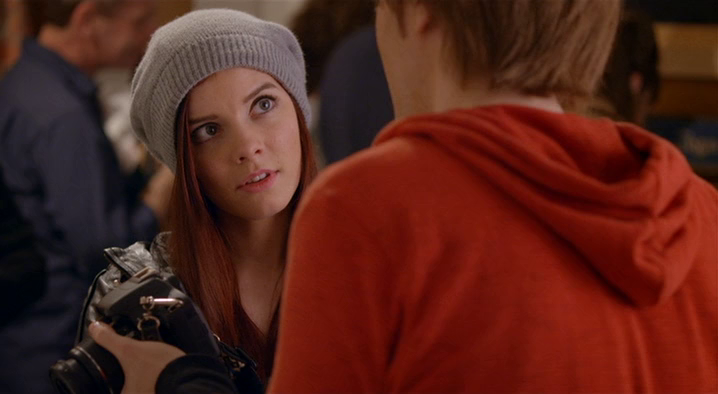 These scenes and lines are merely par for the course in what is ultimately a coarse and misguided comedy that is stocked with vile characters. Scott is served up as a figure that needs to get past his hubris, but the movie treats him more of a hero who the other characters just can’t help but love. It’s hard not to feel like the film is made to flatter Dawson as an actor. Within minutes of meeting Scott again, Tori says, “Would I have sex with you? Probably.” No one can resist his appeal, certainly not Tori’s family. Tori’s mother is practically begging to jump on top of him. When the character’s defining moment of humility and growth is cutting his Justin Beiber-like hair, it’s a failure. Tori is written in such an inconsistent fashion. She’s supposed to be all about negativity and hates everything in the world, but then she transforms into a Manic Pixie Dream Girl for Scott’s cutesy scavenger hunt. Leigh does a credible job with the character but she’s a half-formed assortment of quirks and messages meant to push Scott along. Dawson errs considerably by casting himself as the romantic lead. It further exacerbates Scott’s flattering portrayal, but really Dawson is just not a good enough actor to carry a film. But a lead role wasn’t enough, and Dawson appears as several female supporting characters in drag. The appearances stop the movie dead in its tracks. The characters are also just lame mouthpieces to blurt lazy inappropriate comments, especially a popular girl who just keeps calling people names at the top of her lungs. It is deeply unpleasant.
The worst character in the entire film is Joel. This guy is obsessed with having sex with his high school crush, who is still in high school while he’s in college, by the way. She has clearly and consistently stated that she does not have feelings for him, but what’s a woman stating her decisions going to matter to this guy? Joel’s pursuit of Janie is just insanely creepy. He mimes preforming cunnilingus on her. He stalks her online profiles to mine useful personal information. He enlargers and decreases a picture of her face on his phone and narrates the experience like she is giving him oral sex. At every point he treats her as a sex object. Even after a night out, where she wears a dress he picked out for her after trying it on himself and fondling himself in expectation (!), she tells him she doesn’t feel the same way, and he still forces the situation. It’s gross and at no point is Joel and his behavior held up to criticism. He’s rewarded for his “virtue” by having Janie pimp out all her promiscuous friends onto him. What makes the character even more repulsive is just how annoying Monson’s performance comes across; he’s going for faux bluster but it’s more like misplaced entitlement. If this storyline had ended with Joel murdering her while weeping and slow dancing with her corpse, you wouldn’t be that surprised.
 As the previous two paragraphs should indicate, there is certainly a point of view that emerges from the movie, one that trumps the heterosexual white male at the top and looks with derision on anybody that falls outside that definition. It feels like every joke is at someone’s expense. In the opening minute, an overweight woman tweets a picture of herself as a skinny model. I suppose it’s funny because she’s misrepresenting herself but it feels like the joke amounts to, “Ha, she’s ugly and fat.” But those who are conventionally attractive still don’t get off easy. Tori is slut shamed as a whore in high school, lead by Scott, and this is merely excused as the behavior of a loveable scamp. Janie’s friends are treated like idiotic sluts. Tori’s gay friend is defined by his flamboyance and obsession with sex. Disabled people are apparently hilarious just because they’re disabled and different. Tori’s older sister is blind and it’s funny because she accomplishes things… but she’s blind. I suppose the joke is that she shouldn’t have a successful life. There’s a woman at a party in a wheelchair (confession: I know this actress) and the joke is she’s doing normal activity. There’s one black character in the movie that is a homeless man who devours his own feces. At one point, his genitals are also used as a laugh. There’s also the characters’ flagrant and casual use of the word “retarded” to describe anything repulsive. The hoary stereotypes and unfunny portraits blend together, creating a mosaic of intolerance masked as comedy. Dawson’s sense of comedy is fairly puerile but it’s also offputtingly mean-spirited and denigrating.
Dawson makes too many fatal mistakes as a director for Not Cool to survive. Casting himself in the lead was a mistake. Appearing as female supporting characters was also a mistake. Excusing the bad behavior of his male characters, and rewarding them, was a mistake. Catering the humor to make fun of anyone that doesn’t classify as a heterosexual white male was a mistake. Relying solely on gross-out gags without better comic development was a mistake. Trying to earn a heart late into the film was also a mistake. After watching jerks behave like creeps with their inflated sense of entitlement, I don’t care if they maybe have feelings. Directing his actors to be heightened caricatures was a mistake. In short, Not Cool is a comedy graveyard of mistakes and bad decisions. I’m sure there will be people that find something to enjoy here, who laugh at the easy juvenile humor. I even laughed a couple times. There was a visual gag with a smuggled watermelon that was simply inspired. I think Dawson didn’t want to stray too far from his YouTube persona and the tone of his videos, lest he upset his fan base of millions, but what works as a three-minute YouTube short doesn’t translate to a feature film. Not Cool is proof enough that an overabundance of energy and cheap vulgarity does not compensate for a deficit in storytelling and execution. Not Cool is just not good.
 Going far in the other direction is Hollidaysburg, a modest coming-of-age drama that patterns itself after the mumblecore movement of indie cinema. Director Anna Martemucci definitely takes a more restrained approach to her interpretation of Dan Schoffer’s screenplay. She has some problems of her own but on a whole Hollidaysburg is the more promising and well-executed movie. It’s more sophisticated, better articulated, heartfelt, and comes far closer to achieving something worthwhile.
Right away you can tell a difference. We begin once more with Scott (Tobin Mitnick) and his girlfriend, Heather (Claire Chapelli), breaking up in the middle of sex, but they keep at it. It’s not exaggerated for extra laughs; the situation itself naturally draws them. The character isn’t made the butt of the joke either. It’s a much more encouraging opening than projectile vomit. Scott is also dumbstruck when he discovers his family home is days away from being emptied and sold. He reconnects with high school acquaintance Tori (Rachel Keller) and the two sleep together impulsively. As they’re trying to make sense of possible feelings, Heather is seeking out some company, anybody, and settles on her pot dealer, Petroff (Tristan Erwin), who happens to be buds with Scott. He’s wary of stepping over some kind of friend code, but in his efforts to get Heather out of her funk, Petroff starts to form a romantic interest he can’t help.
The focus is on our foursome of young, curious, and emotionally free-falling characters stumbling for some sense of personal identity. The theme of the film is about stasis versus change. Heather reasons that their long-distance relationship is not meant to be, and that it’s better to check out early. She’s also disillusioned by college, an experience that she had hoped would be remarkable at pointing her life in the right direction. Scott is quite literally saying goodbye to his childhood and his prior sense of who he was. His task for the holiday weekend is to pack the last of his childhood things in his old room so they can be sent to Florida. He won’t be returning to Pennsylvania likely, which is what Tori is also wrestling with. How far does she let herself get attached to something that could never happen? The two of them dance around their attraction and unconventional courtship. There’s real uncertainty about their possibility as a couple that’s palpable. Then there’s Heather’s sense of ennui that might just be a symptom of depression. She feels like she’s in a fog and that college is not the gateway others perceive it to be. Petroff is trying to juggle his role as friend and potential more-than-friend, and even though he has no real obligation to Scott on this one, he is trying to be deferential and sensitive. Before the breakup, he didn’t even consider Heather a friend. Now they’re getting to know one another on a much more personal level. The foursome is likeable, complicated, flawed, and pleasant to be around, enough to excuse some of the movie’s genial pacing.
 There are assorting supporting characters, notably siblings to Scott and Tori, but they are complimentary and better inform the story. Scott’s older brother spends the entire film trying to recreate his father’s recipe for pumpkin pie. It’s just the sort of concept that is slight enough to be fun but also lead into a dramatic character payoff. The dialogue feels attuned to the natural speech rhythms of human beings while still being entertaining. Scott and Tori’s initial reunion revolves around her keeping watch to make sure he doesn’t have a concussion after she hit him with her car. It’s a cute scenario that’s played with the right flirty tone that nicely sells the emergence of their romance. The humor isn’t as loud and underlined as Not Cool, and that’s to its benefit.
Your enjoyment of Hollidaysburg (named after a city in Pennsylvania) will depend mightily on your personal tolerance for the observational, delicate human comedies of the mumblecore genre. Sometimes derided as affluent navel-gazing, the often-DIY subgenre can have its own hardscrabble charm and touch upon relatable themes and conflicts that transcend their often self-indulgent characters. There’s also a stronger sense of realism in how fleshed out these worlds feel, and so I have enjoyed mumblecore primarily because of the combination of well-developed characters, emotional truths, and sincerity. I acknowledge a movie about a bunch of teenagers sitting around, mingling, smoking pot, and making life decisions is a harder sell than, say, sex comedy shenanigans. The difference is that you feel the care put in by Martemucci. She cares about these people and makes you start to care as well, or at least be interested. But if you’re not on the same wavelengths, one person’s observational is another person’s doddering.
While technically better on just about every level, Hollidaysburg has its own issues. The character arcs for Scott and Tori are rather nebulous. I’ll credit Dawson with this, in Not Cool the characters’ arcs were front and center and there was a progression. With Hollidaysburg, Scott is vaguely defined by his past but he doesn’t go into many details, failing to indicate how he’s undergoing some sort of high school hangover as he adjusts to a bigger pond. He’s uncomfortable with the discovery of how close Heather and Petroff have gotten, but this character turn doesn’t get developed enough to matter, instead coming across as a somewhat manufactured conflict break. Likewise Tori is looking to redefine herself in college but finding it harder than she anticipated. By the end of the film, her closing voice over quotes John Updike about being reborn every day, and how reassuring she finds this reflection. You could make the argument that through her romantic tryst with Scott, she’s better accepted the notion that she will define herself as she pleases, but I don’t even know if that approaches the conclusion. The two characters with the more clearly defined arcs are Heather and Petroff, and they’re on a relatively straightforward path where their biggest obstacle is hiding their emerging feelings from their mutual friend who would be hurt.
 I don’t necessarily know if I’d call The Chair a success. The fascinating premise has given birth to very different movies, but in the end one of them is an aggressively unfunny comedy and the other is an acceptable coming-of-age mumblecore entry. It’s hard to call either a rousing success. Not Cool is an abysmal comedy that is overly reliant on witless shock humor to substitute for storytelling basics. Dawson makes a slew of bad decisions, mostly playing to ego or his built-in audience, but I’ll say at least he goes for it. Martemucci certainly comes across as the more promising filmmaker; her film is better on a technical level and her handling of actors is far defter. At the same time, her aim is lower with her goals and her character arcs less defined. I suppose you could argue the hazy arcs tap into the characters trying to better find themselves but I won’t. Hollidaysburg is clearly the better film but Dawson’s legions of fans came to his service, and in the fall of 2014, Dawson was declared the victor by a majority of public voting. I purposely wanted to watch the finished movies before delving into the TV show so my feelings toward the filmmakers would not influence my reviews. Usually Project Greenlight was at its best when things were falling apart for its fledgling filmmakers, and I imagine the same level of entertainment will be had with The Chair. My foreknowledge will create a delicious dose of dramatic irony, as I know what all these efforts will lead toward. In my head I’ll likely be thinking, “Not worth it.”
I’ll add to this double-review after watching the series for any additional thoughts on Dawson and Martemucci as filmmakers and human beings.
Update: After having watched all ten episodes of The Chair, I can say neither director comes off terribly well. Martemucci is indecisive, poor with time management, and loses the big picture, but she’s far more open to collaboration and criticism. Dawson knows what he wants, is decisive, but is also quite thin-skinned and defensive and hard-headed to criticism. He seems incapable of thinking outside the bubble of his fanbase. He also has a far higher opinion of many elements of his film that I found awful, but that isn’t surprising. What’s surprising to me is that established producers could read Dawson’s script and watch the final movie and say, “Yeah, this is good.” Not everyone did though, as I discovered Quinto and another producer were so appalled by Not Cool that they elected to take their names off of it. They did not want to be associated with that material, which Dawson has trouble seeing as more ugly than standard “raunchy teen sex comedy” stuff (it is uglier, Shane). The funniest part for me was a tattoo parlor owner who discovers Dawson’s YouTube resume after she agreed to let him film in her parlor. She doesn’t want her shop’s name visible and associated with what she feels is racist, sexist, unfunny jokes. She even chastises Chris Moore about it. It’s like this one tattoo shop owner spoke as the prophet of me and all other home viewers and those who endured the awfulness of Not Cool. Congratulations for telling it like it is, Pittsburgh small business owner.
Nate’s Grades:
Not Cool: D
Hollidaysburg: B-
Share this:

The Equalizer (2014)
 If your idea of a fine time at the movies is watching Denzel Washington be a badass and murder people in grisly fashion for two hours, then The Equalizer is right up your alley. There’s not much to the plot of this loose remake of the 1980s TV show of the same name; Denzel plays a man with a mysterious past who works at a large Home Depot-esque hardware store. He sees injustice transpiring against his pals, and he fixes it in a violent fashion. The movie is two storylines that don’t converge until the final act, namely the Russian crime syndicate trying to ascertain who this vengeful badass just might be, and Denzel doing his episodic vigilante good deeds. The climactic act is a drawn out showdown where Denzel uses every part of the hardware store to deadly results. There’s definitely a pleasure in watching Denzel dispatch tough-talking baddies, and that’s what the film delivers, no more, no less. The confrontations are generally well written and ratchet tension nicely, especially when Denzel has some chilly conversations with his soon-to-be-victims before they inevitably make their bad decisions. The tense sit-downs were more entertaining for me than the bloody violence. Director Antoine Fuqua (Training Day, Olympus Has Fallen) goes about his business in a more than competent manner; the technical qualities are above average, though the film has moments where it seems too infatuated with its slick sense of style (slow-mo rain gun battles?). With a stream of bad guys to be toppled at a steady interval, The Equalizer can start to feel like an assembly line of cocksure carnage, a ready-made vehicle for audience blood lust. Still, watching Denzel be a badass and kill a whole lot of bad people is enough for a movie. Just don’t expect much more than that scenario and you may be satisfied if you’re not too squeamish when it comes to bloodshed.
Nate’s Grade: B
Share this:

22 Jump Street (2014)
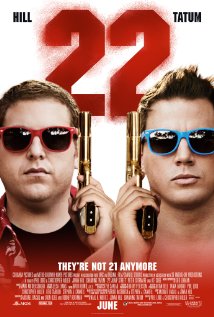 When 21 Jump Street was proposed as a movie, nobody thought it was a good idea. Even its stars and writers. They used that as an opportunity to craft one of the more charming, surprising, and hilarious films of 2012, a movie so good that it was also one of the best films of a relatively great year at the movies. Now that was something nobody expected with a 21 Jump Street movie. As often happens, Hollywood looks to keep the good times going, and 22 Jump Street is knocking at the door. In Hollywood tradition, sequels usually follow the “more of the same” format with a dash of “bigger is better,” a fact that 22 Jump Street takes to heart.
Having successfully busted a high school drug ring, Officers Schmidt (Jonah Hill) and Jenko (Channing Tatum) are the toast of their unit. That is until they let a dangerous criminal (Peter Stormare) get away with a shipment of drugs. It’s back to the Jump Street program, as their police chief (Nick Offerman) laments that everybody just needs to do the exact same thing that worked the last time. Captain Dickson (Ice Cube) has assigned Schmidt and Jenko to go undercover at the state university to sniff out where the student body is getting a powerful and deadly designer drug. Schmidt grows close to Maya (Amber Stevens), an art major who knew a girl who overdosed on the new drug. Likewise, Jenko is falling for team quarterback Zook (Wyatt Russell), or more accurately the bond they share as two athletes with a similar brain. The partnership of Schmidt and Jenko may be in trouble for the long haul if they can’t work together.
 This may be one of the most meta movies of all time, existing outside itself in tandem to always provide a winking dose of commentary about its own silliness, excess, and corporate mentality about replicating success through the least creative means possible. There’s even a character with a literal red herring tattooed on his bicep. There are plenty of in-jokes without breaking down the fourth wall, and the meta cleverness is an entertaining way to pave over the general same-ness that goes along with the limited undercover premise. While cracking wise for its full running time, 22 Jump Street really is “more of the same.” For most, myself included, that is completely acceptable since the first 21 Jump Street was an unexpectedly witty and comically brash outing. Seeing another adventure with this same team is more than justifiable, especially with the kind of comic kinship that Hill (The Wolf of Wall Street) and Tatum (White House Down) share. Once again the guys go undercover to bust a drug operation, and once again they each get close to a different set of students, and once again their relationship takes a personal hit. It’s the same plot beats but with different jokes (like the R-rated version of Anchorman 2). The entire “going undercover as a school student” concept is so dated to begin with, and neither Hill nor Tatum can credibly pass at this point, so the entire enterprise feels like they’re squeezing the most they can while they can, enjoying the good times, the good chemistry, being silly on the studio dime, and counting their luck.
The end credits for 22 Jump Street deserve special praise just for the appearance of burning down its franchise. Throughout the film the guys are mocking the very notion of a sequel. By the end, they mock, without abandon, the idea of a franchise. We flash through an absurd array of new assignments, new sequels, and new school-setting undercover gigs, and it’s almost like a flash-forward into the timeline of the movie, like the finale of Six Feet Under. There are some amusing cameos and business satire to mock with as well as the general ludicrous nature of repeating this plot/formula (Magician school?). The end credits leave the audience feeling buzzy and giggly, a perfect comic high, and it’s the best end credit high since the original Hangover.
The real enjoyment is watching Hill and Tatum continue to mine what has become one of film’s best onscreen bromances of all time. I never would have pictured these two fitting together so smoothly, or Tatum being such an unexpectedly natural comedic talent. Thank goodness for the 21 Jump Street movies for offering us these untold comic gifts and for knowing what the main attraction is and how to properly develop it. The relationship between friends/colleagues/bros Schmidt and Jenko is the most consistently interesting, surprisingly emotional, and comically ripe subject in the film. We have two great actors and watching them butt heads is just as fun as watching them get along. In the sequel, the guys go through what serves as an analogue for a separation, wanting to see other partners. We know in our hearts these two are meant to be together, and so much of the fun is watching just how this odd coupling now seems so indispensable to one another, with Tatum’s zigs blending ever so delightfully with Hill’s zags. I could watch another movie of just these guys doing paperwork.
In the first film, Jenko and Schmidt were set up to fall back into stereotypical roles before the movie found a better solution. Jenko was going to be the jock with sports classes, and Schmidt the nerd with AP classes and drama. Then a mix-up, and they have each other’s identities, and the movie is that much better, forcing each out of their comfort zone and finding the better comic scenario. With 22 Jump Street, the movie falls back to the old social order. Jenko hangs with the football jocks and the frat brothers and gets to be the super popular student-athlete, while Schmidt is left to investigate the art majors who knew the dead coed. It has them falling back into their high school roles (popular vs. outsider) and it’s not nearly as interesting, especially after seemingly growing beyond these moments. The side characters aren’t as interesting either, many lacking material to develop beyond one-note joke machines, like Zook. I was mildly intrigued by H. Jon Benjamin (TV’s Archer, Bob’s Burgers) as a football coach obsessed with protecting the goalpost, but I wanted more. Twin stoners who talk at the same time are not enough.
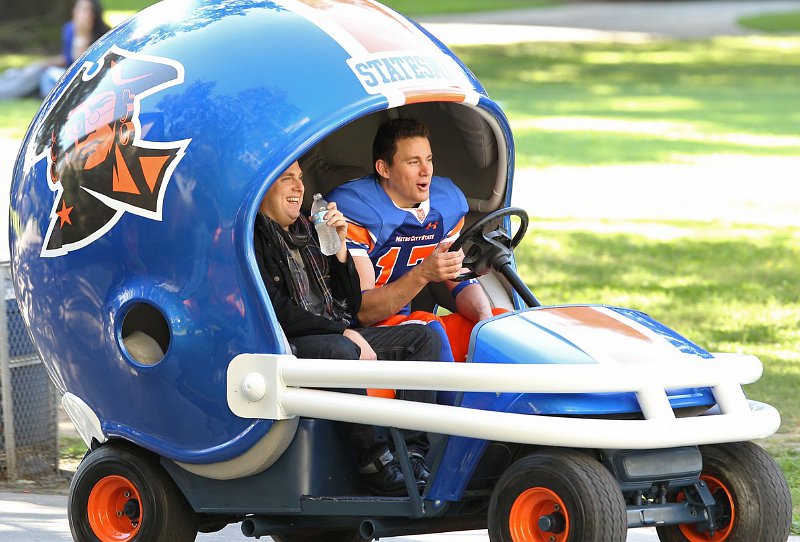 There is one supporting actor given enough material to shine and that is Workaholics’ actress Jillian Bell. She plays such a deadpan, biting, sarcastic, no-nonsense roommate who won’t entertain for one second that Schmidt is who he says he is, and she is wonderfully brutal with her insults. There’s a later scene where she keeps wrongly misinterpreting a fight with Schmidt into something else. It’s a highlight of the movie, a great example of her physical comedy skills and sense of timing, and it’s a plumb example of taking a topic that a situation that could be uncomfortable and finding the right balance to guide an audience along for the best laugh.
Like before, once the movie adapts to its action-filled climax, the jokes start taking a backseat to the action theatrics. Returning directors Phil Lord and Christopher Miller (The LEGO Movie) have kept their same brand of rambunctious spirited comedy alive and well, which keeps the movie’s pace brisk and always open to fresh weirdness. While some jokes don’t work as well the second time (Vietnamese Jesus, the drug freak-out fantasy sequence, though its use of Creed music almost makes up for that), this is still more sequel than retread. This is not an Austen Powers that repeats the exact same jokes with slightly different settings. Lord and Miller understand how to satiate an audience without overt pandering. They know how to build payoffs that are small and payoffs that are big, ones directly linked to character goals. There are strong comedic set pieces unrelated to any sort of meta commentary, Schmidt’s impromptu slam poem being one of them. It’s a manner of giving people what they want while still finding new ways to surprise, because otherwise comedy is dead without the subversion of expectations.
“More of the same” is the best and worst summary for 22 Jump Street, and despite 1500 words of film criticism, all you really need to ask yourself. Is more of the same good enough for you when it comes to another 21 Jump Street movie? Sure, we’d all wish for the same sort of unexpected cheeky revelation that was the first film, but then again no one had any expectations that a 21 Jump Street movie would be anything worth watching, let alone one of the best films of that year. 22 Jump Street is hilarious, witty, aggressive, irreverent, and even when it has to take on the role of action-comedy, it does so with a consistent wink, pointing toward all the sequel tropes and absurdity without rubbing your nose in every single reference and gag. The second time around Jump Street is, by definition, never going to be as fresh, but the company is still top-notch, the jokes are still layered and cracking, and the determination is high. It’s a sequel that delivers what it promises. I’m ready to take this franchise as far as it can conceivably go for two men well into their 30s-posing-as-high-schoolers. Magician school, here we come.
Nate’s Grade: B+
Share this:

Mr. Peabody & Sherman (2014)
 Surprisingly adroit, Mr. Peabody & Sherman might just be more fun for adults, especially fans of the original 1960s cartoon, than for little kids. It’s under the “family film” banner, a dubious one historically, but I was laughing consistently and good, snorting laughs, long chuckles; the whole gamut. With The LEGO Movie, the wide release of The Wind Rises, and now this, 2014 is shaping up to be a stellar year for animation aficionados. The movie between a genius dog and his adopted son is given the right amount of reverence before all the cheeky irreverence through history. The hops through time, notably the French Revolution, ancient Egypt, and the Trojan War, are fast-paced and clever without stooping to provide much context for the jokes; you either get them or you don’t. Even the necessary character building components between father and son are treated smartly, coming together for an ending that approaches poignancy. The plot can get a little complicated toward the end, what with opening a space-time paradox, but I respect the movie for being complex and tricky and scientific and trusting its audience to play along. The animation looks a little scruffy compared to other big screen efforts, but the script just flat-out works. The comedy, the drama, the relationships, but especially the comedy. If you’re on the fence, please, do yourself a favor, and go see Mr. Peabody & Sherman, especially if you appreciate history and those who love it. I saw it with my father and we both laughed ourselves silly. Needless to say, this blows 2000’s Adventures of Rocky and Bullwinkle out of the water.
Nate’s Grade: A-
Share this:

Veronica Mars (2014)
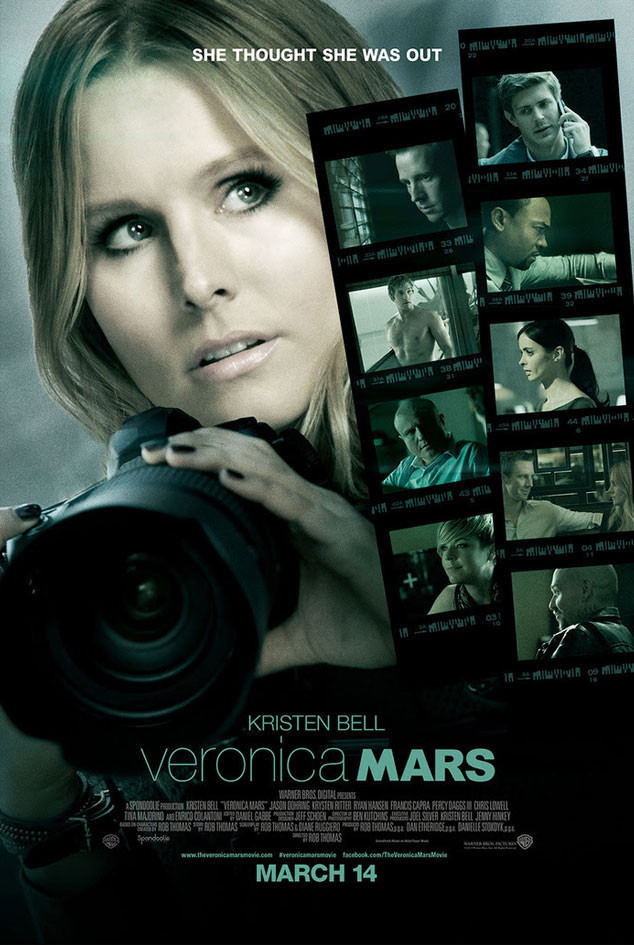 More people know the name Veronica Mars now than probably combined from its short-run on TV from 2004-2007, and that’s squarely because of its record-breaking haul brought in through the fundraising site, Kickstarter. Within hours, the project had already raised two million dollars, on its way to over five and a half million, enough for a long-awaited movie that fans have been teased with ever since the series cancellation. Creator Rob Thomas and his actors were beside themselves in gratitude to their fans (dubbed “marshmallows”). Fueled by the eager hopes of its fans, the movie went into production and is now available for digital download to many of its donors and in a handful of theaters.
Veronica Mars (Kristen Bell) has left behind her hometown of Neptune, California. She’s on the verge of signing with a major New York law firm, and an old friend comes calling. Veronica’s former flame, Logan (Jason Dohring), has recently lost his pop star girlfriend, also a Neptune graduate. He’s suspected of being the killer but he swears his innocence. With the promise of her assistance only lasting a few days, she flies back home and reunited with her old friends (Mac, Wallace, Weevil, Dick) and her father, private investigator Keith Mars (Enrico Colantoni). Veronica should go back to New York with her boyfriend Stosh “Piz” Piznarski (Chris Lowell), she should accept the job offer from the firm, but she can’t help herself fall back into old patterns. She misses the danger, the intrigue, and maybe enough, Logan himself.
 The curious case of Veronica Mars: The Movie is that it was truly made for the fans, those 90,000 people who contributed to their Kickstarter goal. It’s not made for the casual moviegoer who has no foundation with the television series. That’s not to say that Thomas doesn’t try and make the film more inclusive. The neophyte could reasonably follow along, and there is a fast-paced prologue to catch the audience up on the major developments of the series, though almost all from season one. A non-fan could watch this movie but I have no idea what they would get out of it because they would be missing all the connections and context that provide the depth. In a way, this situation reminds me of David Lynch’s Twin Peaks: Fire Walk with Me. Unless you were a fan of Lynch’s iconic thought short-lived TV series, there was no way you were going to follow along or be interesting in following along. It was a movie made for its fan base, and there’s nothing wrong with that though it always helps to provide enough entertainment to prove to the newbies why they should be fans in the first place. I don’t think the Veronica Mars film is able to achieve this. Sure, I enjoyed myself but that was because of my pre-existing fan club and my years-in-the-making desire to finally see proper closure to the characters I came to care about. I feel like someone without that devotion would watch the 105 minutes of Veronica Mars and question what all the fuss was about.
That’s because at feature-length, Veronica Mars is really more of an extended episode of the TV show, and not one of the top tier episodes. As a debut film director, Thomas does a serviceable job of recreating the series noir visuals. The mystery is sufficient if a little dull, lacking a strong sense of urgency throughout most since Logan is already walking around free of charges. The real anchor of the story is bringing Veronica back to Neptune and bringing her back into the family business. The class injustice was a hallmark of the TV series but it’s merely one more slightly malnourished storyline cluttering up the narrative. There are no real reasons to check in on so many characters beyond the fact that it provides resolution for fans. A ten-year high school reunion seems engineered just for this purpose, allowing the new old faces to all reappear again and catch us up. There are characters that appear in near-cameo form (though the surprise celebrity cameo is quite amusing). Even the romance feels mostly grafted onto the story because the core audience demands Veronica and Logan reunite, in all senses. It just becomes a matter of time waiting for the inevitable, as it is with all romantic comedies, except the romance is sidelined here until it isn’t. As a film, it doesn’t feel organically handled that Veronica would leap back into Logan’s arms, and so soon, unless, of course, you are one of those fans (I know MANY) who have been waiting seven years for that moment. Fan service is one thing but it shouldn’t detract from the internal logic of the featured story.
 What does still work are all the hallmarks of the TV show, even if they are less effectively showcased for first-timers. The plucky, sarcastic nature of Veronica still turns her into a heroine worth rooting for, a force of will that has her flaws as well. Bell (Frozen, TV’s House of Lies) can just about do it all, from goofy to heartfelt to ferocious. It’s clear how much she adores this character she helped bring to life ten years ago. The father/daughter relationship is warmly affectionate without dipping into sappy territory. The dialogue is still snappy, though having late twenty-somethings saying it rather than high schoolers has dulled some of the edge. There’s also the sleazy addition of older men hitting on Veronica now that she’s officially out of high school, so hooray. The season-long mysteries of the series, while satisfying and twisty, were secondary to the characters, and watching the overall jovial camaraderie of the cast, is a reminder at how much fans adore these people.
I can objectively critique the faults in the film, as I’ve tried to do for a couple paragraphs, but this is a movie where I set aside my critic hat and merge with the fans. I too contributed to the Kickstarter because I’ve been dying for a sense of closure for one of the best TV shows in the mid-aughts. The finale of season three left much of the show in doubt; Thomas was not counting on cancellation. While fan fiction can run rampant in these circumstances in order to cater to fan demands, it doesn’t compare to the creator being given a reprieve to tie up as many loose ends as possible. That’s the greatest accomplishment of the Veronica Mars movie is that it feels like a genuinely satisfying sense of closure for the fans. While not every storyline is wrapped up, like for instance Weevil’s path, it ends on a point where you can reasonably guess where the characters would continue from here onward if we were never to check in with them again. This is a good resting place. But given the runaway success of the Kickstarter campaign, maybe Warner Brothers could be convinced there are more stories to be told here. I’m cautiously optimistic but really Thomas has already given the fans just about everything they could want, unless they were the Veronica/”Piz” minority of shippers.
Whatever you think of the final product, Veronica Mars: The Movie has changed the way movies can get financed. Smaller boutique films with a passionate fanbase can now get the ball rolling, putting their money into a down payment on seeing their dream movie becomes a reality, convincing studio heads to roll the dice with less risk. I invite all newcomers to watch the series, since that is where it was best. As a film, it’s enjoyable enough and satisfying for the fervent fans, supplying needed closure. However, for people that don’t already have connections to these characters and this world, I don’t think there’s enough going on in the movie to attract a larger discipleship.
Nate’s Grade: B
Share this:

The Lone Ranger (2013)
 With the director, star, and writers from Disney’s original Pirates of the Caribbean trilogy, you’d likely expect The Lone Ranger simply to be Pirates in the West, and it pretty much is, for better and worse. The pieces don’t nearly come together as well, and the characters aren’t anywhere close either, but I was mostly pleased with the finished results after coming to terms with the flaws of the execution. This is a semi-supernatural reinvention of the Lone Ranger and Tonto, prankish and proudly peculiar.
In 1869 Texas, John Reid (Armie Hammer) is the new district attorney for a small outpost along the railway run by tycoon, Mr. Cole (Tom Wilkinson). John’s brother (James Badge Dale) is the sheriff and the more accepted hero. This all goes awry when the nefarious criminal Butch Cavendish (William Fichtner) kills the sheriff, his posse, and leaves John for dead. He’s brought back thanks to Tonto (Johnny Depp), a Native American with his own quirks. Together, the duo struggle with the idea of justice versus vengeance and taking responsibility.
Thanks to screenwriters Justin Haythe, Ted Elliot, and Terry Rossio, it still follows the summer movie blockbuster blueprint while maintaining its own sense of self. I enjoyed the 1933 framing device and the sense of commentary it added to the legend of Wild West tall tales. Many of these story elements will be painfully familiar, from the unrequited love interest that needs saving, her plucky son, to even the villainous railroad baron, but the film finds ways to keep all these formula figures at least integrated and satisfying, doling out payoffs to several storylines. More so, the film just has a wild sense of fun to it, enlivened by Verbinski’s exuberant feel for action. When he gets things going, the man has a touch for inventive action orchestration akin to Steven Spielberg. He is a director who knows how to add scale and scope to action and make it felt. The movie feels constantly alive and full of surprises, stepping outside itself for some non-linear asides, adding bizarre examples of nature undone (In the words of Nicolas Cage: do not touch the bunny), and a heavy dose of magic realism. It’s just too funky and weird not to be interesting even when it threatens to be boring. Disney put crazy money into something this crazy, folks, reportedly $200 million.
 There are serious problems here much as there were in the Pirates sequels, notably a lingering sense of bloat. At 149 minutes, there could have been a lot of cuts. The saggy middle seems to almost derail all momentum, as Reid and Tonto stumble about the desert, filling in a majority of Tonto’s tragic back-story. Most of the supporting characters are chiefly underwritten. I pity the great Ruth Wilson, so nerve-fryingly awesome on the BBC’s Luther as an enthralling sociopath, and here she’s basically Love Interest/Single Mom for Reid. At least she does a decent job with her Texas twang. There’s plenty of overindulgence all around, and I won’t even entertain the argument that its handling of Native American displacement, while not as clumsily racist as feared, was anything other than schlocky. There are also three villains of different stripes that need to be juggled. There are a lot of storylines and characters to keep active and the movie just cannot keep up. The tone can be somewhat jarring as it dances around dark comedy, earnest sentimentality, tragic drama, and cavalier heroism. It feels like the movie never settles down, which can keep an audience from being fully engaged, fully invested. It hurts even more when the characters are nowhere near as charismatic as Captain Jack Sparrow.
Perhaps I’m being overly generous after coming from Man of Steel, and perhaps, nefariously, Man of Steel is still going on, locking me forever in some sort of parallel mobius strip where I’ll never be able to leave, but I greatly enjoyed the action sequences in Lone Ranger. Verbinski is one of the most talented visual filmmakers working today but, more importantly, he knows how to orchestrate large-scale action sequences in a way that they matter. Yes, like most things in The Lone Ranger, they can go on a bit too long, but here the situations develop naturally with organic complications, the sequences move the plot forward, and they escalate in excitement. The concluding twenty minutes involves a sumptuous dual train chase that keeps shifting and changing, going from atop to parallel trains, to cars being dislodged, people jumping from one to the other, all racing toward a bridge triggered with explosives. It’s a thing of beauty, this final action sequence, and Verbinski’s shot compositions allow things to play out so artfully while the audience still maintains its sense of orientation. It’s a finale that feels exhilarating, and the playful whimsy and sense of danger that the movie had been flirting with before comes together, enough for you to wish the whole movie had tonally coalesced with the skill shown toward the end. As an action fan, I was lapping it up, and the playful non-linear jumps, as well as the satisfying ends to some satisfying villains (Fichtner is terrific), left me grinning and hopping with excitement. A strong finish went a long way toward improving my opinion on the film and minimizing my misgivings.
Who is this dark, weird, somewhat clunky movie really appealing to? The Lone Ranger had its cultural peak back in the 1950s and thus the people actually excited for a Lone Ranger movie must be slim. And those people are probably going to be turned off by something as jokey and unfaithful to the source material as this movie. It does utilize the Ranger’s theme song, the William Tell Overture, but saves it for the end. What about kids? The movie is released under the Disney imprimatur and has the stamp of “from the creators of Pirates of the Caribbean.” Everybody loved the first movie and the sequels were also huge global hits, but this movie is even darker and somewhat grisly. There’s a moment when Cavendish literally cuts open a dude’s chest and eats his heart (mostly off-screen and implied mine you, but still). I can already hear the parental uproar. And while it’s somewhat implied that Cavendish and his men are cannibals, this storyline is never really touched upon again. Did we need the heart-eating scene to fully communicate how nasty our villain is? The true audience for the big-screen Lone Ranger may very well only be the mega fans of 2011’s Rango, Vernibski’s Oscar-winning foray into animation. If you like a somewhat weird, somewhat anarchic, tonally uneven movie with personality and eye candy, then perhaps Lone Ranger is for you. Problem is that this potential audience is going to be meager, but it does include me.
 I know there are many people out there experiencing stage four Depp fatigue, and I can’t blame them. His penchant for peculiar character construction can get somewhat tiresome if the movie doesn’t have more going on. In something like Alice in Wonderland, a movie I didn’t even like, at least his weirdness fit with the weird world unlike, say, Dark Shadows, a movie best forgotten by everyone involved. Here his Tonto is as head scratching as he is humorous. And is there an inherent awkwardness having a white actor, in this day and age, playing a Native American? According to the Internet, Depp has said he “probably” has some Cherokee ancestors because he’s from Kentucky. The funny (awful?) thing is that Tonto is often in white face with his special face painting (red face in white face?). I just don’t think he can apply the same bug-eyed, swishy, eccentric sensibility to every character and call it a day. Just when you think he’s gotten away from starring in every movie with Helena Bonham Carter, surprise, here she is. And it’s not even a Tim Burton movie, people! Tonto is seen less as side kick and more of a co-lead if not the real star, and part of that is the bankability of Depp as a box-office draw, part of that is Depp as an executive producer on the project, and part of that is just because the kooky Tonto is just far more interesting than the straight-laced Reid. Hammer (Mirror, Mirror) has the jaw line, the look, and an engaging yet square appeal to him, and if anyone saw The Social Network you know the handsome lad can act. Too often he ends up being a minor foil to Tonto; it takes him far too much hemming and hawing before he accepts his masked outlaw status. As a result, he’s something of a bland fuss bucket.
Disney’s big-budget reworking of The Lone Ranger will probably be held up as the prime example, in a non-Michael Bay summer, of everything wrong with studio filmmaking, the punching bag for blockbusters. Some may even invoke a comparison to another costly Disney endeavor, last year’s flop, John Carter. There are plenty of faults the movie exhibits, namely an extended sense of bloat and an uneven tone, but I’d be lying if I said I was obsessed with the faults by its spectacular end. The movie does enough right, and enough semi-right with enough style and verve, that I left my screening feeling giddy and satisfied. It might be too dark, too glib, too weird, or too self-indulgent, but those are all reasons that made me like this movie even more. There’s a character with a wooden leg that doubles as a rifle, and not only that but one of our villains, a cavalryman, has a clear fetish for prosthetic legs. And this is a Disney film! I can’t help but love the spirit at large. Thanks to a fine supporting cast, Verbinski’s high wire visual stylings, and some strange sensibilities, not to mention a grand finish, The Lone Ranger is as entertaining in what it does right as with what it does wrong.
Nate’s Grade: B
Share this:

Dark Shadows (2012)
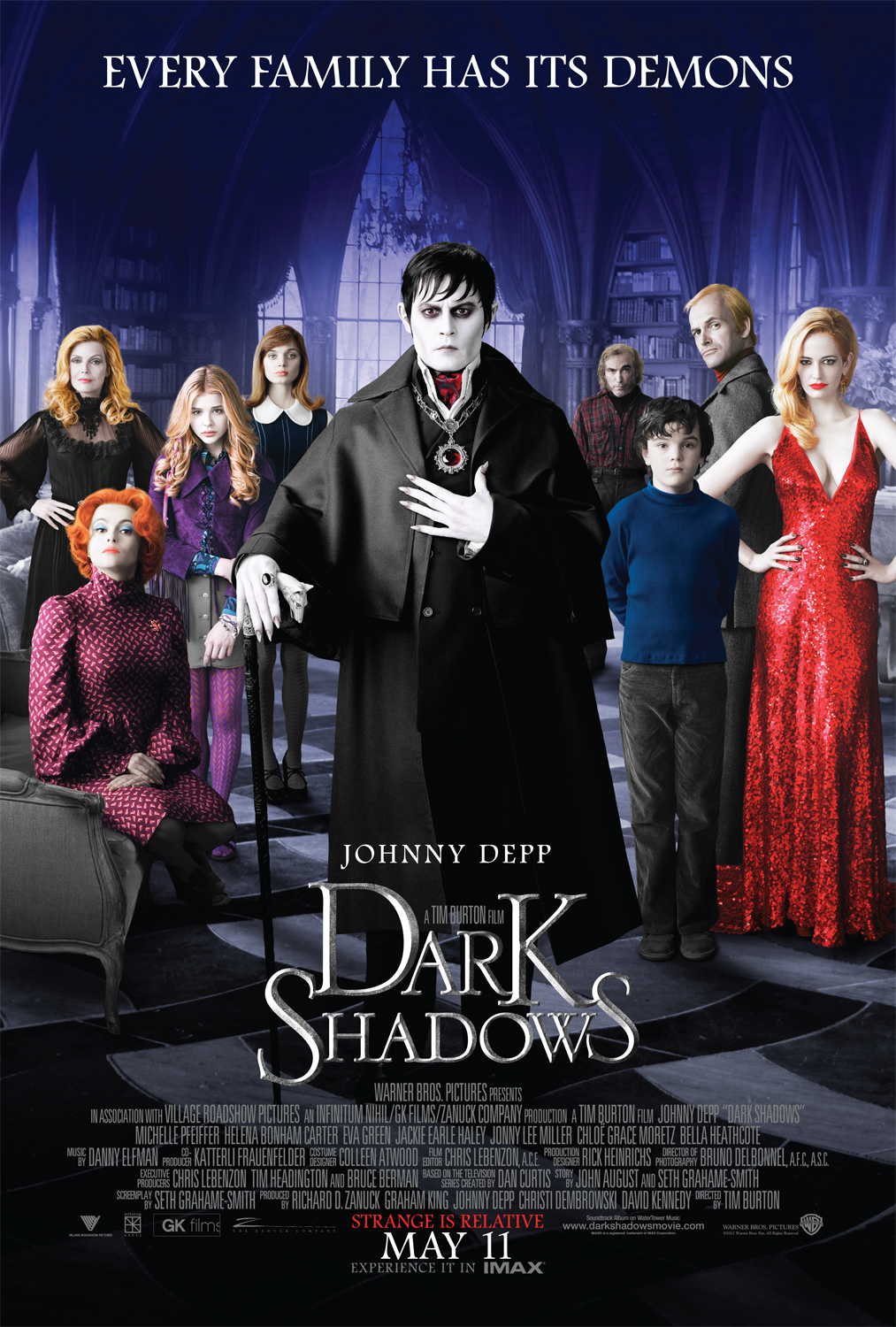 Dark Shadows was a daytime soap that aired for only a brief period of time as far as soaps are concerned, 1966-1971, but it was enough to make a lasting impression. The supernatural soap featured vampires, werewolves, and other creatures of the night, entangled in high-stakes drama and romantic excursions – it was the Twilight of its day. Director Tim Burton and his attached-at-the-hip collaborator, actor Johnny Depp, were fans as children and have kicked around a big-budget big screen version for years. Now that Dark Shadows hits theaters, you’ll be left wondering whether they really ever liked the original show or secretly despised it.
In the 1770s, Barnabus Collins (Depp) is the son of fishing and canning magnate in colonial Maine. He has a fling with Angelique (Eva Green), one of his family’s servant girls, and unfortunately for him, the gal is also a witch in her spare time. She curses the Collins family, killing Barnabus’ mother, father, and the woman he loves. She then turns him into a vampire, riles the villagers into mob mode, and Barnabus gets trapped in a coffin and buried for good.
Two hundred years later, a construction crew unearths an old coffin and out pops Barnabus from his prison. The world is a very different place. Elizabeth Collins Stoddard (Michelle Pfeiffer) is running the Collins family manor and canning company, which has fallen on hard times. A rival canning company is snapping up fisherman contracts, and this company is led by none other than the same ageless Angelique. Elizabeth tries to conceal her distant relative’s unique “condition” from the rest of her family, her brother Roger (Johnny Lee Miller), and his son David (Gulliver McGrath), grieving the loss of his mother, moody 15-year-old daughter Carolyn (Chloe Grace Moretz), and caretaker, Willie Loomis (Jackie Earle Haley). The Collins family also has a new hire, Victoria Winters (Bella Heathcote), who looks strikingly like Barnabus’ lost love from 200 years ago. He becomes smitten with the new lass, who may be the reincarnation of his lost love. That’s enough to rev up Angelique’s wild sense of jealousy, as she tries to get her long-desired man and destroy anyone that stands in her way.
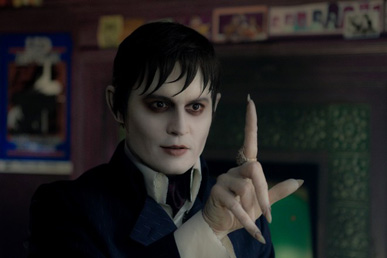 Is this ever one ghoulish mess of a movie. It never settles on a tone; is it supposed to be a larky tongue-in-cheek send-up, a Gothic melodrama, a dysfunctional oddball family comedy? What is this supposed to be, because whatever it is, it isn’t entertaining. Oh sure, it’s entertaining in a, “Where the hell is this going?” kind of way, but so is being kidnapped by a drifter. The movie feels like it has a box filled with ideas, and every so often it just shakes up that box, reaches inside, grabs one and says, “Let’s give this a try.” The screenplay, credited to author Seth Grahame-Smith (Abe Lincoln: Vampire Hunter), is awash with half-baked ideas and poorly developed characters. The live-in doctor, played by the second stalwart of the Burton Repertory Players, Helena Bonham Carter, is a hoot. Carter (The King’s Speech) has got an edge to her and an interesting dynamic with Barnabus, but sadly her storyline is tied up far too quickly. The character of Victoria is a rather interesting one, a girl who could communicate with her ghostly former relatives, who happen to look just like her. The gal was sent to a mental asylum by her parents and escaped, compelled to come to the Collins mansion. Why in the world wasn’t she the movie’s protagonist? That is a far more compelling perspective than a goofy vampire who speaks all old timey. Seriously, the Barnabus stuff is your basic fish-out-of-water comedy, lazily commenting on the times. There is no joke that is too obvious for this movie (Barnabus inquires why Carolyn has no husband; Barnabus is fascinated by a lava lamp; Barnabus thinks Alice Cooper is an ugly woman – sigh). A lot of the shapeless narrative would be forgivable if the movie was just funnier. Barnabus is just not that fun of a character. His anachronistic verbiage gets dull when you discover that seems to be the movie’s one joke. You may start tuning him out like I did.
The movie feels like a collection of subplots and no main storyline to gather traction. We’re told that the youngest Collins, little David, is enamored with Barnabus, though considering we’ve only seen the two together in like one previous scene, this seems like quite a leap. Unless David has gotten particularly skilled at hiding behind rocks, we haven’t seen any of this. The entire character of David and his sleazy father could be eliminated and they would only minimally affect the story. And then there’s the late revelation that one of our characters has a hidden secret identity, a revelation that fostered no setup. When the character looks into the camera to explain and ends with a curt, “Deal with it,” it’s like Grahame-Smith himself is speaking directly to the audience, mocking it for hoping that the movie would actually do a good job of setting up and paying off character development and relationships. Stupid audience. Why can’t you just be happy with all that neat Tim Burton set design?
 The final melee between the Collins family and Angelique keeps reminding you of the dashed promise of the flick. Angelique, in her witchy withiness, summons dark forces to make statues come alive. Well, sort of. They flail their arms a tad. And then she makes the walls bleed. Well, sort of. The dripping blood stops after just a few inches from where it began. If you’re going to make the house bleed, I want Shining-level torrents of the red stuff. The tonal inconsistency, matched with the muddled plot and scant character work, makes for a pretty frustrating bore of a movie.
You could usually count on Depp (Alice in Wonderland) for at least committing himself to another bravura weird performance, but the material fails him. He’s caked with alabaster makeup, given claw-like hands thanks to additional knuckles (why…?), and he’s trying his best to transform a list of peculiarities into a character, but like most things concerning the movie, it does not coalesce properly. I actually think the most entertaining actor in the movie is Green (Casino Royale). There’s not much to her role but at least she has fun with it, bringing an admirable level of energy while her peers remain laconic, content to submerge into the 70s scenery. She shows a nice flair for comedy heretofore unseen. Strangely, Green adopts a slightly raspy voice that sounded like an imitation of, none other than, Helena Bonham Carter. If Burton’s note to his film’s young, frisky, sexy antagonist was, “Sound more like my wife doing an American accent,” then I think we’ve butted into something personal best left between husband and wife.
Ultimately, I have no idea who this movie is going to appeal to. The fans of the original soap will surely not be pleased with the jokey, tongue-in-cheek manner that Dark Shadows treats its source material. Fans of Burton’s stylized, dreamy, Gothic fairy tale visuals will find the film tedious and a poor waste of the man’s talents. Even the casual Depp fan will probably find the movie mostly unfunny, weird, and boring. The tonal whiplash never settles down, and the plot is replete with half-developed characters, ideas, and plot points. It just seems to throw everything at the wall to see what sticks, but that’s not the best way to tell a story. Not even Burton’s visuals or Depp’s performance can save this movie. Dark Shadows is unquestionably amongst Burton’s worst films (2001’s Planet of the Apes debacle takes the crown), made all the more inexplicable by the fact that Burton and Depp are self-described fans of the TV show. Maybe we all have different definitions of “fan” that I am not privy to. This movie deserves a quick death.
Nate’s Grade: C
Share this:

21 Jump Street (2012)
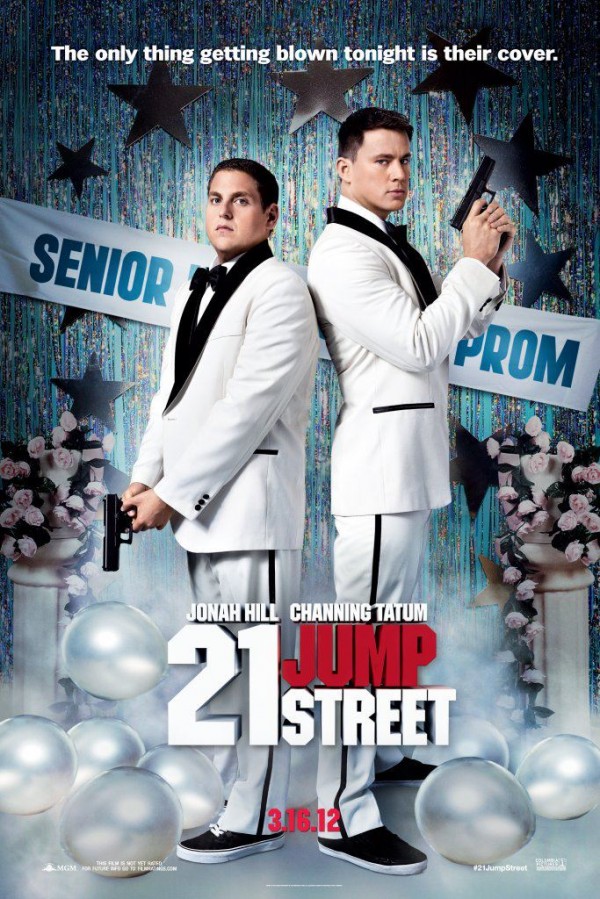 21 Jump Street ran on TV from 1987-1991 and is mainly known as serving as a launching pad for eventual mega movie star Johnny Depp… and Richard Greico too. Youthful looking police officers infiltrated high schools and tackled topical issues of the day (what snap bracelet goes best with my high-waisted jeans?). Why would anyone want to make this movie, let alone comic actor Jonah Hill? Surprising in just about every way, especially when it comes to overall quality, the 21 Jump Street movie is not just a great comedy but also a great movie. How the hell did this happen, Movie Gods?
Officer Schmidt (Hill) is smart but shrimpy (which is saying something considering how dangerous Hill’s weight has been before). Officer Jenko (Channing Tatum) is a stud but pretty dimwitted when it comes to tests. The two form a partnership and get assigned as bicycle cops, not exactly the position of command and authority they were expecting. After a few screw-ups, including failing to read a suspect his Miranda rights (“You… have the right… to be an attorney”), the duo gets bounced to an old undercover program at, you guessed it, 21 Jump Street. The pair is supposed to pose as high school students and find out who’s supplying teenagers a dangerous new club drug. Much has changed since Schmidt and Jenko were in high school together, and both of their profiles were accidentally swapped, meaning Jenko is given AP chemistry and the higher level classes, and Schmidt is given gym and acting courses, where he’s supposed to work his way into the popular circles. Molly (Brie Larson) is a gal in that popular inner circle and Schmidt struggles to accept that a pretty, smart, popular girl might actually “like like” him.
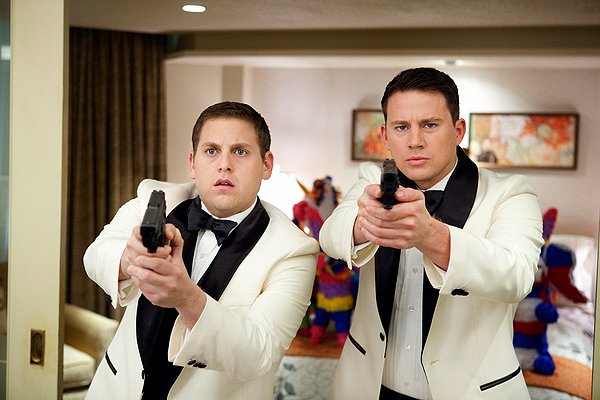 I knew I was in for something special when the movie itself lambastes the very idea of a 21 Jump Street movie, with the police chief (Parks and Recreation’s Nick Offerman) ridiculing the idea of unoriginal nitwits recycling something old that has name recognition and hoping the public will be too dumb to care. The movie beats the audience to the punch every time, mocking the absurdity of its own premise and plot points (many characters note how old Jenko appears). I should have expected more from screenwriter Michael Bacall (co-writer of the Scott Pilgrim movie adaptation) and especially from directors Phil Lord and Chris Hill, the same pair whose rambunctious comedic verve radiated from every frame of Cloudy with a Chance of Meatballs and their brilliant short-lived animated MTV show, Clone High. This movie had me laughing a lot and had me laughing hard, doubling over, with-tears-in-my-eyes laughter at points. Dickson spouts, “Some kid overdoses on drugs. And because he’s white, people actually give a shit,” showing that a movie with a mind-blowing number of male genitalia jokes can provide a few shrewd jabs of social commentary. There’s a great bit where on their first day back in school, Jenko points out the various school cliques. Then he gets to a group of students in skinny jeans, thrift store clothes, and floppy hats, and he looks puzzled. “I don’t know what those kids are?” Ha, because hipsters didn’t exist back in his (my) day.
21 Jump Street is cheeky, rowdy, quick-witted and playful in the best sense of an action comedy. It’s got fish-out-of-water moments as the duo struggle to fit in with a different high school setting. The one-liners and riffs can be gut-busters, but the film does an even better job layering oddball gags (Korean Jesus), loony slapstick, fun but telling character moments (Schmidt not knowing how to end a prayer: “The end, right? ‘The end’?”), strong setups that have stronger payoffs (using the reading of Miranda rights as a genuine emotional climax), and an overall raucous, anarchic spirit.
Here’s one sequence in particular that shows off the film’s clever comedic chops. The film finds a way to satirize the tropes of action movies, particularly buddy cop movies, with such nimble precision. Schmidt and Jenko are on the run but their car chase keeps butting heads with the fabricated reality of Hollywood movie chases. For one, they keep finding themselves getting stuck in traffic on the highway. This forces them to have to keep abandoning cars and finding a new set of wheels ahead of the gridlock. Then, as the bad guys chase them down on motorcycles, the chase causes all sorts of chaotic collateral damage, including oil trucks riddled with bullet holes and dripping the flammable substance all over the road. Then one of the motorcycles skids into the flammable muck, and our heroes wince in preparation of the expected explosion, and then nothing happens. “Huh. I really thought that was going to explode,” one of them remarks casually. And this setup is repeated again, denying us the explosive equation that action movies have pummeled into our brains (car + any tap of force = humungous fireball), and there is a payoff to this comedic tweak on the cliché, and it is silly and terrifically funny. Plus, I haven’t even mentioned that both Schmidt and Jenko are dressed in silly outfits and begin their car chase in a driver’s ed car. This sequence is just one example of the anarchic, robust, and self-aware comedic attitude that the movie flaunts.
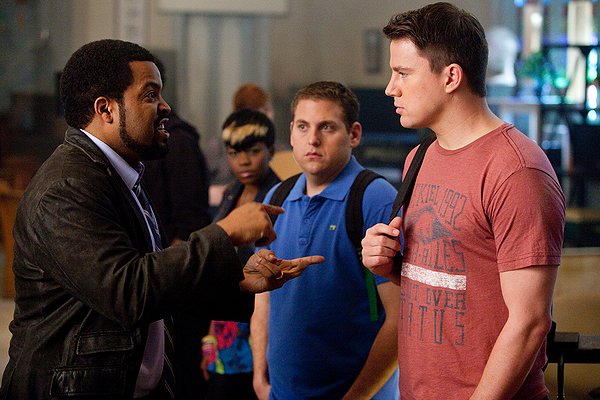 But more than being a hysterical action picture, 21 Jump Street works even better because at its core is a level of sweetness, a satisfying mixture of lewd and heart like the best Judd Apatow ventures. It’s a bromance of epic proportions even by buddy cop standards, the old school bromance vehicle of its day. The guys go back to high school and the movie’s bright switcheroo puts the characters in opposite social spheres, with Schmidt with the cool kids and Jenko struggling with the social misfits and bottom-dwellers, a.k.a. nerds. Of course the whole class assignment also shows the façade of being cool in high school. The movie could have mined this well-worn stereotypical class conflict with ease, but instead it decides to use its contrived scenario as a jumpstart for the guy’s emotional growth. The lessons may be simplistic (perils of ego, believe in yourself, teamwork, personal responsibility) but that doesn’t make them bad lessons, and the fact that the flick seriously uses covalent bonds as a metaphor, and does so in an almost poignant fashion, is worth applauding. The relationship between Schmidt and Jenko engages the audience, and we root for them even when they’re behaving like jerks. They’re misfits who are doubted and reprimanded, which make us hope for their eventual success even more. Refreshingly, the movie doesn’t put them in opposing camps in high school. Schmidt was a dweeb and Jenko was a dumb jock, but that doesn’t mean they needed to be adversarial. When they regroup in the police academy, they form a genuine partnership, realizing they can assist one another. They form an actual friendship and they’re both better cops, and better characters, together.
Hill and Tatum have preposterously good chemistry together as a comic duo. Hill, a co-writer himself, reportedly had to remain steadfast to convince Tatum to join forces, and thank god he stuck it out. Hill’s (Moneyball) already a comic pro at this point, though this role tones down his comical rancor and ups the spaz awkwardness. Tatum (The Vow) is the true revelation. Man does this guy have really great comedic skills; a sharp, instinctive sense of timing, a pliable physicality, and a genial charisma that doesn’t demand solo attention. He’s good at playing dumb without going overboard. He’s not just good, he’s flat-out terrific. Larson (Scott Pilgrim vs. the World) is an adorable and plucky love interest, sure of herself, down to earth, and accessibly quirky. The supporting cast shines in their small roles, notable Ice Cube (Lottery Ticket) as the typical brash and loud police captain, Ellie Kemper (Bridesmaids), in her randiest roll yet, as a chemistry teacher awkwardly flirting with the hunky Jenko, Dave Franco (Fright Night) as an eco-friendly drug dealer, Rob Riggle (The Other Guys) as an aggressive gym teacher, and a special cameo that’s worth leaving unspoiled.
21 Jump Street has some weaker points, namely when the action ramps up it’s pretty mundane when it’s not being funny, but the faults are minor. This is a silly, shrewd, salacious, and outright thrill of giddy entertainment, a comic blast. Hill and Tatum have a wonderful comedic dynamic and the clever screenplay gives them plenty to do with their talents. I didn’t think it was possible to adapt the cheesy TV show into a worthwhile studio comedy, but Hill and company have exceeded every expectation. 21 Jump Street isn’t the most nuanced or subtle comedy, though I will argue spiritedly that it has plenty of smarts in all the right places, but it’s an affectionate, witty, and rambunctious night out at the movies that will be hard to beat this spring.
Nate’s Grade: A-
Share this:

The Smurfs (2011)
 What a smurfin’ terrible movie. This big screen debut for the little blue commune dwellers is a painful experience, magically transporting the little creatures to New York City. They find themselves in the care of Patrick (Neill Patrick Harris), an ad man who’s pretty much a jerk, especially to his doting, pregnant wife. At one point, in his ad man frenzy, he yells, “ I never wanted any little people running around here!” Oh no, what a bizarre outburst that somehow cuts directly to his fears of being a father. The movie spends so much time with the human characters, who are shrill, exasperating, and dull form the get-go. The comedy is a mixture of slapstick and insufferable kiddie wordplay, replacing “Smurf” for just about any word in a sentence for a miserable attempt at humor. It’s like the screenplay was a Mad Libs page (Am I being too generous crediting a whole page to the script?). The Smurfs is clearly designed for a 3D audience, hence there is crap flying at the screen at every turn. Yeah, another stupid thing thrown at the screen. Hank Azaria plays the thankless role of Gargemel, the man who created Smurfette (voiced, not too badly actually, by pop singer Katy Perry) but schemes to capture Smurfs for their… smurfness. I don’t know. If this guy could create his own Smurf, why doesn’t he just keep doing this? Instead, Azaria runs around New York speaking in an arch manner, falling down a lot. I suppose the real question is whether this piece of blue excrement could entertain children, its target audience. Perhaps the youngest of tykes will be tickled by the Smurf adventures, but I think most kids will be puzzled and bored and weirded out by the movie, wondering what they had done wrong to deserve watching this dreck.
Nate’s Grade: D
Share this:

Mission: Impossible – Ghost Protocol (2011)
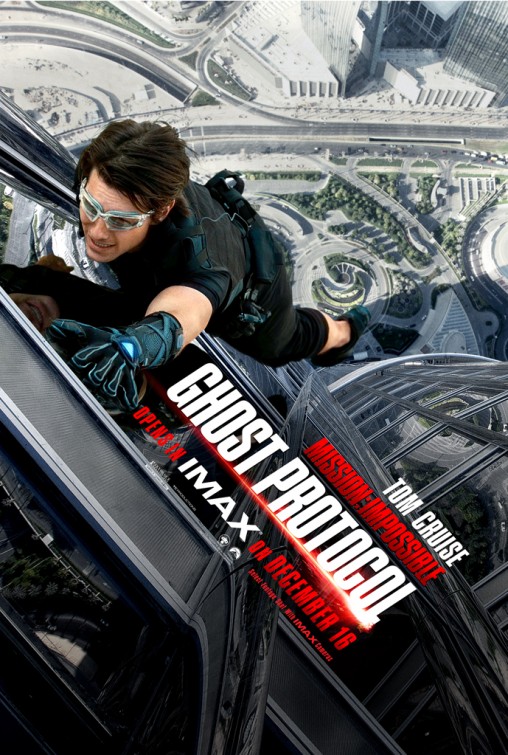 In the span of three months, two Pixar vets will be making their live-action filmmaking debuts. Andrew Stanton (WALL-E, Finding Nemo) is directing Disney’s big-budget John Carter of Mars adaptation, which will be released this March. But first is the awkwardly punctuated, colon-hoarding Mission: Impossible: Ghost Protocol (henceforth referred to as M:I 4), directed by Brad Bird. Any fan of The Incredibles (and who isn’t) knows that Bird is a terrific visual stylist who can compose remarkably exciting action without overlooking characterization. If anyone was ready for the leap into live-action, surely it was this man. Bird is the real star of the movie, and he aces his debut. I think he’s finally living up to the potential he showed with TV’s Family Dog (please note the tongue firmly planted in cheek here).
Ethan Hunt (Tom Cruise) and his IMF squad are on the run. They’ve been framed for an explosion that took out the Kremlin. The president has invoked “ghost protocol” meaning that the IMF no longer exists, and every member is cut loose. That means Ethan and his newest team, techno wizard Benji (Simon Pegg), feisty Jane (Paula Patton), and the mysterious Brandt (Jeremy Renner), have no backup. They are considered rogue agents and Russian’s own special police force is hunting them down as well. Hunt and his team must track down and stop an international terrorist, Hendricks (Micheal Nyqvist, the Swedish Girl with Dragon Tattoo series), who sees the global benefit of nuclear catastrophe (I suppose surviving would be the catch). Hendricks has gotten hold of Russian nuclear launch codes and now is looking to put the final pieces together to initiate a war between the United States and Russia, plunging the world into disaster. Hunt’s team travels around the globe to stop this bad man and his bad plan.
 Bird delivers in a major way in his live-action film debut. The man behind two of the best animated films of all time and Ratatouille, has shown that his keen skills of directing animation have easily translated to real people and real-ish explosions. Bird is a mad genius when it comes to staging elaborate action sequences; he teases out his action with organic consequences and his camera makes adept use of space and geography, and best of all you can easily follow what’s going on in the frame. So when we have an action sequence that takes place in the tallest skyscraper in the world, you know Bird is going to make fine use of this fact to accentuate his action. And the man does so in spades. The Dubai sequence is probably the how-did-they-do-that? standout that people will be most talking about. Hunt has to climb the outside of the aforementioned tallest building in the world using nothing but some special sticky gloves that don’t always work right. He has to climb several stories up, and then there’s the matter of going back down without them. But M:I 4 doesn’t rest on its laurels, because immediately after this sequence we have a feast of thrills. We segue right into a meeting between two parties where Hunt’s team has to pose as each member of this sit-down, orchestrating two separate simultaneous false meetings with the real bad guys. The two meetings dovetail one another as far their needs, making for a blissful parallel of escalating suspense. And then even after this, we get a foot chase into a sandstorm, which then becomes a dangerous car chase into a sand storm. And there are even more great stunts and spectacular action to come, notably a fight in a futuristic car park where the cars tumble from level to level.
Bird has such a firm command of his action, exercising his inspired imagination and all the tools in the special effects paint box. The screenwriters deserve recognition as well, Josh Applebaum and Andre Nemec, both of whom honed their writing chops on J.J. Abram’s sublime spy show, Alias. Their opening sequence, an escape from a Russian prison, sets the stage with Bird’s smart execution; setting up a problem and then letting the situation play out in surprising yet logical and clever ways. It may not have the epic scope of a Michael Bay flick, but Bird’s action is cool without having to be exhausting or noxious. The frenetic pacing rarely lets room for breathing. One of the film’s quiet moments ended in such a jarring fashion that it startled me and I kicked the patron sitting in front of me. I must also credit Applebaum and Nemec for producing the only Mission: Impossible movie that did not involve a turncoat. I was starting to think that IMF’s Human Resources department was in needing of a good housecleaning. Bird, and the screenwriters, has delivered a Mission: Impossible movie so good, with such kinetic and rewarding action sequences, logically utilized gadgets, sexy cars, sexy gals, and exotic locales. They’ve basically made the best Bond movie not to bear 007’s likeness.
Like the previous Mission: Impossible flick, this one emphasizes the team aspect, which makes a more fulfilling and interesting set of missions. M:I 2 became the “Ethan Hunt kicks people in the face for two hours movie,” which Chuck Norris might approve but otherwise was lacking. When J.J. Abrams got on board in 2006, the brand finally got back to its roots. And a team working together with individual strengths makes for a much more satisfying mission that also allows for multiple points of action. Simply out, if you have three people that need to do stuff in synchronicity, it plays out much better than watching Cruise kick people in the face. Choreography is always better when you have more dancing partners. Anyway, with M:I 4 we get some terrific teamwork that can be just as thrilling as the action sequences. Besides the breathless Dubai sequence, there’s a great sequence where the team has to infiltrate a sleazy Indian businessman’s (Anil Kapoor, the TV host from Slumdog Millionaire) cocktail party to get some special satellite codes. Jane is tasked with seducing the sleazy guy, Benji is left to operate a mechanical rover with a powerful magnet that will levitate Brandt, in a metal suit, across the system’s super hot inner mainframe, and Hunt is trying to lose his Russian pursuers. It’s a great sequence where all the pieces come together for maximum effect.
 Cruise has done plenty in the last five years to destroy audience good will, so it’ll be interesting to see if audiences warm back up to the man with the million-dollar smile. Cruise has always been an actor of ebullient energy and charisma, and this has always aided him in action settings and M:I 4 is no different. He’s still a credible action hero and a born movie star, whatever audiences think about his increasingly polarizing personal activities. Lessening Cruise’s load is a smart move, and Pegg (Paul) can provide needed comic relief while Patton (Precious) supplies the sizzle. My goodness can this woman fill out a dress in marvelous ways. Not to be completely sexist, she does a fair amount of ass-kicking too. Her fight with the French femme fatale agent (Lea Seydoux) was all kinds of awesome. Renner (The Town) seems groomed as a potential heir apparent for the franchise. His character is given a small amount of depth to work with, the guilt of a mission gone wrong that has a very personal connection to Hunt. At this point, Renner can do no wrong as an actor in my book. Although there’s only a nine year age difference between Cruise and Renner, so I don’t know how much more mileage that gives you as a franchise. Regardless, Renner is an actor of great conviction and intensity even when he’s silent.
In terms of the franchise, I’d say this fourth installment is just as good as Abrams’ M:I 3, though Abrams had a much better villain and the added emotional urgency of hunt’s wife in distress. Seriously, this is one really boring and completely interchangeable villain. For a movie about the world being on the brink of thermonuclear Armageddon, why do the stakes feel so low? It’s probably because the movie has deliciously orchestrated and eye-popping set pieces but very little urgency. World War III has never felt so ho-hum. Still, it’s hard to fault an action movie when it delivers such high amounts of adrenaline, perfectly packaged in well-developed action beats. This is a high-flying popcorn spectacle of the top order, a grandiose piece of Hollywood escapism. Mission: Impossible 4 is pretty much everything you’d want in a summer blockbuster, only shuttled to winter. I think Bird’s future is limitless, in animation and live-action, and I think the Broccoli family would do us all a favor by tapping Bird to direct a Bond movie. M:I 4 is a pretty good resume for the gig. That would be one mission to die for.
Nate’s Grade: A-


You must be logged in to post a comment.