Blog Archives
Nurse Betty (2000) [Review Re-View]
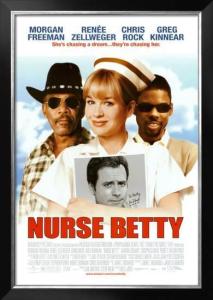 Released September 8, 2000:
Can a fairy tale have a dark undertone below all the bubbly whimsy? Hell, the Grimm tales were barbaric before they became homogenized, sanitized, and finally Disneytized. Nurse Betty presents a modern day fairy tale with the strike of reality always below it — the strike of darkness and disappointment. Fairy tales are an escape from this, but what if one creates her own fairy tale and chooses to believe in it over the drab reality she presides in?
Neil LaBute, the director of the incessantly dark In the Company of Men and Your Friends and Neighbors, collects together a whimsical modern day fable with a top-notch cast. Yes, to those fans of earlier LaBute offeriengs his name doesn’t seem synonymous with whimsical comedy – but in this flick LaBute cuts his teeth in the mainstream and earns his stripes if ever.
Baby-voiced and rosy-cheeked Renee Zellweger plays our heroine in diner worker and soap opera fanatic Betty. Betty finds solace from her life featuring a sleazy spouse, played with marvelous flair by Aaron Eckhart, in her favorite soap opera. When her louche of a hubby isn’t wiping his hands on the kitchen curtains or banging his secretary he tries proposing drug deals for shady characters. A recent drug peddling snafu sets him up to an ominous encounter with hitmen team Morgan Freeman and Chris Rock. Through a jarring scene of violence Betty’s husband is left brutally murdered and the only witness is Betty herself. The event causes Betty to slip into a fractured psychological state where she believes the world of her soap opera is alive and real with herself a vital character. She hops in one of her dead hubby’s used cars and drives off toward California to meet the doctor/soap star of her dreams in Greg Kinnear.
 Morgan Freeman and Chris Rock mistake Betty for a criminal mastermind and believe her to have taken the drugs and run. They embark on their own mad dash to capture her and finish the job they were paid to complete. Along the way Betty encounters many people that are at first confused but ultimately charmed by this delusional dame. Through a series of events she meets up with the eternally smarmy Kinnear and begins to learn what happens when a fantasy is corrupted by the disappointment of reality. Allison Janey has a small part as a network executive that shines strong, and Crispin “McFly” Glovin is just nice to see in a film again. He doesn’t seem to age though. Maybe he has that Dick Clark disease.
The flow of Betty is well paced and a smart mix between drama, whimsy, and dark humor. Overlooking some sudden bursts of violence bookend the film it comes across as a sweet yet intelligent satire and fable. Betty is looking for her Prince Charming but will later learn that she doesn’t need one, that she is the fairy tale happy ending inside her.
The acting of Nurse Betty is never in danger of flat-lining. Zelwegger is a lovable and good-natured heroine. Freeman is a strong and deceptively hilarious actor along side a caustic yet down-to-earth Rock. And I make an outgoing question if there is an actor alive out there that can do smarm better than Kinnear — I think not.
Nurse Betty is a wonderful surprise. Check into your local theater, take one showing, and call me in the morning. You’ll be glad you did.
Nate’s Grade: A-
——————————————————
WRITER REFLECTIONS 20 YEARS LATER
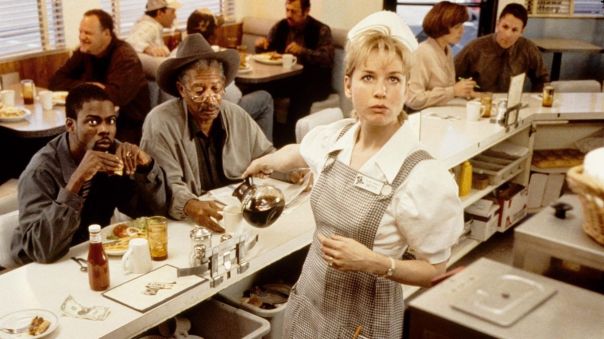
I was high on Nurse Betty in 2000 declaring it a modern-day fable with a darker undercurrent equivalent to that of the Grimms and their mixture of the everyday and extraordinary. In reality, Nurse Betty couldn’t feel more like a holdover of the 1990s indie scene where it might have been an unwritten rule that after Pulp Fiction every indie film had to have a subplot involving quippy hitmen (consider it the equivalent of every 1980s comedy having a mafia subplot for some unexplained reason). It feels engineered from a different era, and because of this, I’m sad to say that Nurse Betty hasn’t aged as well as I hoped. It’s not a bad movie but it feels more dated and peculiar, both in design and also unintentionally with its mishmashing tones that were more enticing twenty years ago.
The premise of Nurse Betty sounds like two movies smashed together. The movie is almost split evenly among its two storylines. We have Betty (Renee Zellweger) as the put-upon wife in Kansas dreaming of a better life, and maybe a better husband, who then has a mental breakdown and travels cross-country believing she’s in a real-life soap opera. Following suit is a pair of hitmen (Morgan Freeman, Chris Rock) who bicker and track her down, having their own cross-country road trip and getting on each other’s nerves. The problem with the screenplay by John C. Richards and James Flamberg is that these two competing stories could have existed on their own and probably would have been the better for it. It’s revealed late in the movie that Rock is the son of Freeman, and by that time of the reveal it doesn’t do much other than serve as a hasty attempt at a twist ending and to better push the fatalism of Freeman’s character, Charlie. However, if we knew from early on that this was a father-son hit team, think of the fun family squabbles and opportunities to present character development through these unique circumstances. It’s a father trying to train his son in his many years honed killing targets and not questioning why. You could tell a really quirky, compelling, and engaging family story through this dark comedy vehicle. Instead, the father-son hitmen are simply playing catch-up with Betty. Charlie becomes substantially less interesting the more obsessed with Betty he becomes because his character change is never really explained. Even he is unable to articulate why this one woman has entranced him. He stops being the scary, proud, and imposing figure who killed Betty’s husband and becomes a doddering, foolishly love-struck old man that loses his edge. Again, that arc could work but the screenplay essentially nullifies him as a threat and as a multi-dimensional character. If both of these dangerous men had driven off into their own movie, they and we would have better benefited.
 The Betty half is the more entertaining portion because it’s more unpredictable and because Betty is, at her heart, a sweet human being who is looking for her dream. It doesn’t take much to emotionally identify with her mistreated character who seeks an outlet for her life’s disappointments. Her mental break produces a sizeable degree of nervous laughter whenever she encounters someone new who is taking her at literal face value. Should we be laughing at her? Should we be pitying her? Should we be worrying about her having reality crush her hopes? The movie doesn’t seem to be holding up Betty for cheap mockery, which is a relief considering the quantity of her mental illness and trauma leading her into increasingly comical scenarios. The baffled misunderstandings can supply amusement but it’s more waiting to see how Betty responds to adversity and waiting for reality to hit with crushing force, eventually snapping her back. It’s waiting for the realization, but until then you can enjoy Betty’s blissful delusion like a sitcom character being hit over the head and thinking they’re somebody new. The movie takes on a new level of entertainment when she meets the man of her desires, Dr. David (Greg Kinnear), actually the actor George in real-life, and he doesn’t reject her but becomes fascinated with her. He’s impressed by her level of commitment to Method acting, so he assumes, and is curious how far she can keep things going. Betty also seems to bring back George’s passion for acting, which has waned over years of playing the same over-the-top plot machinations of daytime television. That’s such a better storytelling choice than having her dream man push her away immediately for being outwardly crazy.
The winning feature of Nurse Betty is the relentless positivity and daffy, perky performance of Zellweger as our dream-seeker. She always has a smile and go-get-‘em attitude that makes her compelling to watch and also easy to root for, whether or not she ever comes out of her mental break. Her sunny demeanor in the face of medical horror and confused authority figures is reliably charming. Zellweger never plays like the joke should be on Betty. Often it boomerangs, like when her L.A. roommate wants to dash Betty’s dream by introducing her to the real George, but instead of disaster they walk off to spend the rest of the fancy soiree together. Zellweger is the best reason to step into Nurse Betty and her portrayal of mental illness is not meant for ridicule. After Nurse Betty, Zellweger went on a tear, getting three Oscar nominations in three years, and a win for 2003’s Cold Mountain, before disappearing from Hollywood to re-emerge with a different face.
The jumbled tones proved more amusing to me twenty years ago but now they feel sloppy and poorly integrated, hence why it feels like two separate movies inelegantly melded together. The violence can be jarring and too serious for a movie that also attempts goofball whimsy. It feels like Nurse Betty was assembled with all the loose, leftover bits of irony from the 90s indie scene. It’s a bit of a hodgepodge movie that feels like it was green-lit based upon as many of its discordant elements all appearing under the name of one movie. Soap operas. Housewives. Mental illness! Road trips! Hitmen! Oh my! The soap opera jokes and industry satire feel pretty dated and must have been stale even by the time the film was released twenty years ago. There are points watching Nurse Betty where you feel like it went shopping for its quirk and bought it whole sale.
 Director Neil LaBute was a fascinating choice considering his prior work writing and directing very misanthropic small-scale ensemble dramas like 1997’s In the Company of Men where two toxic men set out to ruin an innocent deaf woman to punish the female gender they feel has done them wrong. This seemed like an odd fit but was a preview to LaBute’s attempts at being a journeyman mid-range director, helming the stunningly bad 2006’s Wicker Man remake as well as completely forgettable studio fare like Lakeview Terrace and the Death at a Funeral remake. LaBute has since found a home writing and directing in television, including writing 15 episodes of the SyFy Channel series, Van Helsing, which well and truly confounded me to learn. The man who was responsible for dark, David Mamet-esque plays about the searing depths of human depravity and toxic masculinity was writing low-budget vampire cable television. To be fair I haven’t watched a single episode so perhaps his prior writing experiences really added something to the tale of Vanessa Helsing kicking ass in a vampire-dominated future. Actually, I take it all back because that sounds like a fun show.
Nurse Betty is a dark comedy that surprises as often as it may frustrate, spinning two different stories on a collision course that would have benefited from a trial separation. It’s one of the first re-review films that has lost some of its magic for me. In 2000, this movie felt a lot more daring and hipper and I gave it credit for the inclusion of so many off-kilter elements. Nowadays, I need more from a movie than simply including unexpected elements. It has to make the most of them, incorporate them in meaningful and challenging ways, and justify their tonal integration. Reading over my original review twenty years ago, I cringe about how uncritical it proves to be. I clearly enjoyed the movie but couldn’t say much more than bad puns and obvious allusions (did you know fairy tales could be, get this, dark and unnerving?). This is not one of my finer film reviews and I won’t cut my 18-year-old self any slack because I’ve been impressed by the insights and writing style of my younger me before. I will hold my past self to higher standards, thank me.
Re-Review Grade: B-
Share this:

#Alive (2020)
 It’s a Korean zombie movie but the lean survival storytelling of #Alive could be universal. We follow one man during the outbreak of a zombie plague. He’s stuck in his apartment several floors above the ground and watches from on high, safe but trapped and on his own for food and other life-saving necessities. The movie is very easy to follow and is practically wordless for long stretches, relying upon clear and concise visual storytelling to be able to follow one man’s plight under the worst of circumstances. There is an easy pleasure about watching a character in a tough spot think their way through step-by-step. It worked with that beautiful middle hour of Cast Away and it works here with #Alive. Eventually, he befriends a woman across the courtyard and they rely upon one another from afar as partners in survival. The last third of the movie is much less interesting as characters make a big decision and it feels like a mundane episode of The Walking Dead, one of those middle of the season episodes. It’s not a bad sequence of events but it’s just not as interesting as the survival story beforehand. It becomes more like any other zombie movie. There isn’t anything terribly unique about #Alive except for its contained thriller perspective, so when the movie jettisons that, it can’t help but feel like it’s losing whatever helped make it compelling for so long. I went in thinking it was going to be more satirical, especially from its poster of our protagonist leaning off his balcony to hold a selfie stick, but any social satire is so slight too be fairly non-existent. If you’re a zombie fan or a fan of contained thrillers with high-concepts, then #Alive is a thrilling, enjoyable, and relatively satisfying 90 minutes. It may be derivative but that doesn’t mean that filmmakers with a specific vision and the creative ingenuity to see it through can’t make old stories worthwhile again.
Nate’s Grade: B
Share this:

Darkest Edge (2020)
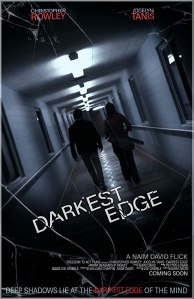 My pal Ben Bailey hates me reviewing Ohio-produced indie films. To be fair, he doesn’t have anything against the idea of providing critical and professional analysis to local filmmakers on their cinematic offerings. What he laments is how mediocre many of the finished projects end up being and how, in his view, it’s establishing a negative impression that Ohio movies suck. Truth be told, I haven’t found that one Ohio-made indie that has completely floored me. I’ve found several that I enjoyed and others that had elements to be proud about. The thriller Darkest Edge was filmed throughout Ohio and Kentucky and features Ohio talent in front and behind the camera. It’s the feature debut for director Naim David and screenwriter Joe Gribble. It’s a movie that aims beyond its own restricted reach but proves one of the less successful thrillers I’ve seen.
Mark (Christopher Rowley) is a Chicago journalist who is still reeling from his sister’s suicide. He’s on the verge of divorce and never seeing his daughter again, never mind his obsessive drinking. He’s given one final assignment, the closing of a notorious mental asylum in Dayton, Ohio, the very place that his departed sister spent time within. Ellen (Jocelyn Jae Tanis) is his assistant who insists upon being his camera operator. The two travel to Dayton and investigate the asylum, interview wary doctors, and Mark unlocks memories and secrets of his past.
Why is this thing in the middle of the screen?
Where this movie runs most adrift is with mood and execution. Look at that poster at the top of the review, check out the description of the plot setup, even judging by the spooky yet unmemorable title (I kept thinking “Dark Edge,” “Dark Corners,” “Darkest Corner” in my head). Even the tagline says, “Deep shadows lie at the darkest edge of the mind.” All of this is setting you, the viewer, to expect a creepy psychological thriller in a creepy asylum and for creepy things to happen. There have been horror movies that have been little more than watching wayward characters haplessly explore a haunted old locale, uncovering its secrets and perhaps its residents, living or dead. This simple plot setup can work as long as the filmmakers can execute their intended mood with aplomb. Unfortunately, Darkest Edge makes a critically fatal error in choosing its creepy locations. To put it simply, this soon-to-be-closing sanitarium is not scary looking in the slightest. The outside looks like a high school building from the 1960s. The inside looks very non-intimidating. There are doors labeled with pieces of paper and an accessible exit door literally within feet of “patient rooms.” While watching, my girlfriend pointed out this very problematic design flaw for a mental institution and I was aghast with that slip-up. The inside of this asylum is also practically abandoned. It’s supposed to be closing soon but there’s still supposed to be patients, evidenced by our characters randomly walking around the facility and finding doors obviously locked. This sense of emptiness will be a prolific problem with the movie (more on that later), but the asylum could have always been closed down and emptied already upon investigation. Another killer error is that almost the entire movie takes place during the day, which only further hampers the scare factor of this already ordinary looking building. It’s like watching people explore an office park and finding nothing. If Darkest Edge was going to hinge so much over a singular creepy location, oh is this place a big miss.
 With the location not exactly hitting the intended mood, I held hope that the central mystery tying to the protagonist’s memory, his occasional alcohol-induced blackouts, and hazy memories of this particular asylum could generate the intrigue that the setting was not. Mark is torn over the suicide of his sister, he’s been drinking so heavily he reeks at work, and this asylum might be the very same one that his sister was held at during both of their youths. Surely there has to be a dark secret afoot, or we’re being set up for some last-minute twist. I started guessing what the twist would be within ten minutes, because Darkest Edge seemed overwhelmingly like the kind of thriller that would roll out a last-minute twist. I thought maybe Mark’s daughter was really dead. My most outlandish, hacky guess was that Mark was really still in the asylum and that everything outside was a figment of his fevered imagination. Admittedly, that would have been an awful ending but it would have tapped into the psychological thriller context of its genre. There isn’t really any sort of mind-bending twist here. There is a revelation but, shockingly, the movie goes down a sentimental route that feels unearned and tonally ill-suited for the prior 75 minutes. It’s such a curious ending and goes against the very setup of this kind of movie. You’re expecting the story to end in a dark, desolate, traumatic place. If you want catharsis, you got to put in the work as a storyteller.
Unfortunately, a word I seem to find myself using often here, Darkest Edge doesn’t provide a compelling personal mystery for the audience. Mark is a boring character. He’s troubled and haunted in a general sense but the screenplay doesn’t give us anything too specific. Yes, his sister kills herself and he feels some guilt over this, but the entire movie doesn’t provide insight into the sister character or their relationship. If he’s so hard up over her death, you don’t feel why. He’s a sloppy drunk, and if you made a drinking game where you took a drink every time you saw Mark drinking, or holding a bottle, then you would black out just like Mark. It’s his lone defining characteristic and it is given again and again and again. Strangely, Mark will black out and find himself transported to distant locations, like thirty miles away from where he was (the movie, weirdly, makes sure we know the mile distances between specific Ohio cities). You would expect this would be a clue about some larger context, a deeper meaning for the torment plaguing our protagonist. Well your guess is as good as mine because ultimately those blackout long-distance travels don’t get clarified at all. For Mark to function as a character, he needs more specifics, especially when it comes to a trauma. He needs a specific fear or tragedy that haunts him and resurfaces with his trip to the asylum. We get what appear to be flashback snippets of a little boy exploring the interior of the asylum (apparently it was also just as easy to wander back then too). It’s all too vague and poorly explained, forcing the viewer to extrapolate connections and meaning. By providing a specific trigger and goal at the start, a viewer could watch Mark journey through his trauma rather than having to guess at it and its implications. I assume this was designed to make Mark’s personal history more enigmatic, but mystery only really works when you’re invested; otherwise it’s just obtuse, and that’s what we have here with Mark and Darkest Edge.
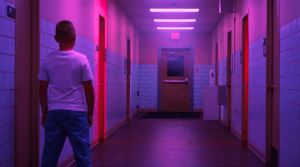 The reality of Darkest Edge is hard to take seriously, and part of this is affected by the limitations of the low budget and certain filmmaking choices that accentuate those. Just because a movie has a low budget doesn’t mean it can’t succeed or utilize a clever creative ingenuity to tell its story and entertain. If you want to tell a creepy story about exploring a creepy location, choose a genuinely creepy location, and shoot it during night time to build an effective atmosphere. Use shadows to your advantage and play up the worry of what may be around the corner next. Build that sense of compounding dread. Walking ordinary hallways during daylight hours is not making your movie scary unless people are encountering weird events or threatening folk, neither of which happens here. There are some doctors hiding extreme methods but these methods are questionably vindicated by the end. There needs to be a clear threat and for the far, far majority of Darkest Edge there isn’t and this results in the movie feeling meandering.
The technical elements can be distracting and disappointing. The fuzzy sound design is a noticeable shortcoming, often dampening from shot-to-shot. The extreme lack of background noise is unmistakable and makes the movie feel like it was filmed in a space capsule. This, coupled with the lack of background activity and extras, makes the movie feel borderline like a Twilight Zone episode where there are only five or six people left on Earth. The limits of the reported $7500 budget are also felt with the shot selections; frequently a scene will just bounce between two set shots, locked into a plodding shot-reverse shot rhythm. There are dramatic moments that are kept at a distance when a closer shot was begging to showcase the actor’s emotive powers. It leaves an impression that the production was pressed for time to get editorial coverage, and it feels like actors were often filmed at different times and cut together for conversations. There is very limited lighting overall and the photography quality is also a step removed, so why not make this entirely a found footage film? That would have allowed the limitations of the production to be an acceptable part of the presentation. The music is also far too loud at points, drowning out the dialogue, and far too generic without establishing a sense of foreboding. I kept scratching my head at the artistic choices, which routinely magnified the budget shortfalls rather than making decisions that would better compensate instead.
 The acting is mostly fine especially since the actors haven’t been given much to work with. The characters are boring and have one trait they get to rub down to its nub. Rowley (Primordial) has a beaten down, hangdog expression that works well. Most of the times he’s either playing hungover or short-tempered, and without a stronger personality, it’s easy to start mentally checking out with his character. Tanis (Lilith, Cinestudy) delivers a performance that manages to mingle ambition, naivete, and a barely concealed contempt for her colleague. She had so much more potential to explore and I wish we spent more time with Ellen rather than watching Mark get drunk for the twentieth time. Anthony Panzeca (Dodging the Bullet) plays an orderly at the asylum and makes a warm impression. His performance is the closest to unveiling charm in a cast regularly acting confounded or irritable. There’s a Dayton journalist that is such a confusing character for me. She buddies up with Mark by opening up her archives of news collections on the asylum. She then asks Mark what he’s found… in her own news archives? Shouldn’t she already be familiar with what she has?
Darkest Edge is not the movie the poster, tagline, or even setup proclaim it to be. It’s not really a thriller, let alone an accessible psychological thriller, and it’s not really a horror movie. It should be creepy given the setting and its supposedly sordid history, but too much of this movie is kept vague and obtuse, failing to give the audience a reason for watching. The characters aren’t that interesting or complex or compelling and their traumas are kept too unspecified to engage. If it was going to focus on the mental torment and troubled history of a troubled man, the script needed to make him more dimensional and his issues more central to the events unfurling. Tone-wise the movie doesn’t work or build a sense of momentum. It’s hard to make a scary thriller/horror movie when nobody looks like they’re scared, and that’s for good reason considering the settings are more mundane and plainer than skin-crawling and disturbing. I feel bad saying so but Darkest Edge is really a boring jaunt along empty hallways. Even if you’re an overly generous fan of this sub-genre, there is little to engage with during the padded 80 minutes. The most frightening aspect isn’t the haunted asylum but botching a go-to scary setting.
Nate’s Grade: D+
Share this:

I’m Thinking of Ending Things (2020)
 I expect strange from a Charlie Kaufman movie; that goes without saying. I also expect some high concept turned inward and, most importantly, a humane if bewildered anchor. His other movies have dealt with similar themes of depression (Anomalisa), relationship entropy (Eternal Sunshine), identity (Being John Malkovich), and regret from afar (Synecdoche, New York). However, no matter the head-spinning elements, the best Kaufman movies have always been the ones that embrace a human, if flawed, experience with sincerity rather than ironic detachment. There’s a reason that Eternal Sunshine is a masterpiece and that nobody seems to recall 2002’s Human Nature (ironic title for this reference). 2015’s Anomalisa was all about one man trying to break free from the fog of his mind, finding a woman as savior, and then slowly succumbing to the same trap. Even with its wilder aspects, it was all about human connection and disconnection. By contrast, I’m Thinking of Ending Things is all about a puzzle, and once you latch onto its predictable conclusion, it doesn’t provide much else in the way of understanding. It’s more a “so, that’s it?” kind of film, an exercise in trippy moments intended to add up to a whole, except it didn’t add up for me. I held out hope, waiting until the very end to be surprised at some hidden genius that had escaped me, for everything to come together into a more powerful whole, like Synecdoche, New York. It didn’t materialize for me and I was left wondering why I spent two hours with these dull people.
A Young Woman (Jessie Buckley) is traveling with her boyfriend Jake (Jessie Plemons) to meet his parents for the first time. It’s snowy Oklahoma, barren, dreary, and not encouraging. In the opening line we hear our heroine divulge the title in narration, which we think means their relationship but might prove to have multiple interpretations. It only gets more awkward as she meets Jake’s parents (David Thewlis, Toni Collette) and weird things continue happening. The basement door is chained with what look like claw marks. People rapidly age. The snow keeps coming down and the Young Woman is eager to leave for home but she might not be able to ever get home.
 The title is apt because I was thinking of ending things myself after an hour of this movie. Kaufman’s latest is so purposely uncomfortable that it made me cringe throughout, and not in a good squirmy way that Yorgos Lanthimos (The Lobster) has perfected. Kaufman wants to dwell and drag out the discomfort, starting with the relationship between Young Woman and Jake. She’s already questioning whether or not she should be meeting his parents and their inbound conversations in the car are long and punctuated by Jake steering them into proverbial dead ends. He’s a dolt. You clearly already don’t feel a connection between them, and this is then extended into the family meet and dinner, which takes up the first hour of the movie. I’m Thinking of Ending Things tips its hand early about not trusting our senses and that we are in the realm of an unreliable narrator. Characters will suddenly shift placement in the blink of an eye, like we blacked out, and character names, professions, histories, and even ages will constantly alter. The Young Woman is a theoretical physicist, then a gerontologist, then her “meet cute” with Jake borrows liberally from a rom-com directed by Robert Zeemckis in this universe (my one good laugh). Jake’s parents will go from old to young and young to old without comment. All the surreal flourishes keep your attention, at least for the first half, as we await our characters to be affected by their reality, but this never really happens. Our heroine feels less like our protagonist (yes, I know there’s a reason for this) because her responses to the bizarre are like everyone else. The entire movie feels like a collection of incidents that could have taken any order, many of which could also have been left behind considering the portentous 135-minute running time.
There are a lot of weird moments and overall this movie will live on in my memory only for its moments. We have a lengthy choreographed dance with doubles for Jake and the Young Woman, an animated commercial for ice cream, an acceptance speech directly cribbed from A Beautiful Mind that then leads directly into a performance from Oklahoma!, an entire resuscitation of poetry and a film review by Pauline Kael, talking ghosts, and more. It’s a movie of moments because every item is meant to be a reflection of one purpose, but I didn’t feel like that artistic accumulation gave me better clarity. There’s solving the plot puzzle of what is happening, the mixture of the surreal with the everyday, but its insight is limited and redundant. The film’s conclusion wants to reach for tragedy but it doesn’t put in the work to feel tragic. It’s bleak and lonely but I doubt that the characters will resonate any more than, say, an ordinary episode of The Twilight Zone. Everything is a means to an ends to the mysterious revelation, which also means every moment has the nagging feeling of being arbitrary and replaceable. The second half of this movie, once they leave the parents’ home, is a long slog that tested my endurance.
 Buckley (HBO’s Chernobyl) makes for a perfectly matched, disaffected, confused, and plucky protagonist for a Kaufman vehicle. She has a winsome matter of a person trying their best to cover over differences and awkwardness without the need to dominate attention. Her performance is one of sidelong glances and crooked smiles, enough to impart a wariness as she descends on this journey. Buckley has a natural quality to her, so when her character stammers, stumbling over her words and explanations, you feel her vulnerability on display. After Wild Rose and now this, I think big things are ahead for Buckley. The other actors do credible work with their more specifically daft and heightened roles, mostly in low-key deadpan with the exception of Collette (Hereditary), who is uncontrollably sharing and crying. It’s a performance that goes big as a means of creating alarm and discomfort and she succeeds in doing so.
I know there will be people that enjoy I’m Thinking of Ending Things and its surreal, sliding landscape of strange ideas and images. Kaufman is a creative mind like few others in the industry and I hope this is the start of an ongoing relationship with Netflix that affords more of his stories to make their way to our homes. This is only the second movie he’s written to be produced in the last decade, and that’s far too few Kaufman movies to my liking. At the same time, I’m a Kaufman fan and this one left me mystified, alienated, and simply bored. I imagine a second viewing would provide me more help finding parallels and thematic connections, but honestly, I don’t really want to watch this movie again. I recall 2017’s mother!, an unfairly derided movie that was also oft-putting and built around decoding its unsubtle allegory. That movie clicked for me once I attuned myself to its central conceit, and it kept surprising me and horrifying me. It didn’t bore me, and even its indulgences felt like they had purpose and vision. I guess I just don’t personally get that same feeling from I’m Thinking of Ending Things. It’s a movie that left me out cold.
Nate’s Grade: C
Share this:

The Tax Collector (2020)
 If you had told me that The Tax Collector was a parody of writer David Ayer’s hyper masculine, lurid, crime-ridden jaunts into the slums, police stations, and domestic lives of criminals, I would have completely believed you. We’ve been here before, with Ayer’s End of Watch, Street Kings, Harsh Times, Dark Blue, Training Day, even the fantasy-mingled Bright looked like an Ayer battleground of gangs, crooked cops, hypocritical politicians, and godly family men who someone can justify the heinous acts of violence they do. This time Ayer is following a pair of gangsters that make their monthly rounds to collect their dues from the other gangs. Their big boss, The Wizard, is rotting in jail, and a rival gangster, who also is literally a cannibalistic Satanist, takes the opportunity to make a violent power play. First off, this is nothing you haven’t seen before. It’s more bad men barking threats at those they feel are underneath their authority, then lots of driving banter meant to endear us to these bad men, and then professions of how much they love family or God. With the main villain being an avowed occultist, the battle-line takes on a biblical sense or good versus evil. The problem is that I didn’t care about a single character nor did I find them interesting. For a solid hour, we’re watching David (Bobby Sotto) and Creeper (Shia LaBeouf) go about their collections, argue about theology and diet, and reminisce. These guys are not interesting and more place setters for more compelling characters to be developed in later drafts that never took place. There’s a paucity of thrills and action and general tension to be had here. It’s shoddily paced. When things do pick up and The Tax Collector becomes a grisly revenge tale, the villains are so easily toppled, and in such unmemorable ways, that you understand why Ayer was putting all this off. During a bathroom brawl, the action stops for a pointless flashback to see Bobby in his martial arts class, but when he comes back he smashes a guy’s head with a toilet cover. That wasn’t a martial arts move he learned. It’s strange moments like that where The Tax Collector feels more like an old, incomplete screenplay Ayer had locked away in a drawer, a rough collection of his bombastic machismo crime thriller tropes that barely tops 80 minutes. The only passion on display is from LaBeouf, who reportedly got an entire chest tattoo for his character except his exposed chest is never clearly seen once on camera. I don’t even know why he wasn’t the main character. Bobby is boring as the humdrum hoodlum who wants out of the family business (Michael Corleone he is not). A late twist is meant to be revelatory but, beyond being predictable by the economy of characters, signifies little for Bobby. The Tax Collector is awash in the same grimy gangland stereotypes that have populated most of Ayer’s professional work, but rarely has his moral ambiguity, nihilism, and envelope-pushing “rawness” felt more like self-parody. This is a thriller bled dry.
Nate’s Grade: C-
Share this:

She Dies Tomorrow (2020)
 She Dies Tomorrow has unwittingly become a movie of the moment, tapping into the encroaching anxiety and paranoia of our COVID-19 times in a way where the horror of newspaper headlines and existential dread has been transformed into a memetic curse. The new indie thriller is an uncanny and unexpected reflection of our uncertain times and it makes She Dies Tomorrow even more resonant, even if writer/director Amy Seimetz (Upstream Color, 2019 Pet Sematary) doesn’t fully seem to articulate her story. We’ve dealt with curses in films before and we’ve dealt with foreboding omens of impending death, but how would you respond if you knew, with certainty, that you were going to die the next day? How would you respond if you knew that your existence was itself a vector for this mysterious contagion and that by telling others you are dooming them to the same deadly fate, as well as their loved ones, and so on? Sure sounds similar to a certain invisible enemy that relies upon communal consideration to be beaten back but maybe that’s just me.
Amy (Kate Lyn Sheil) is a recovering alcoholic who knows, with complete certainty, that she will die the next day. Her boyfriend killed himself after saying he was cursed to live one last day, and now she’s convinced the same fate awaits her. Her sister Jane (Jane Adams) is worried about her mental state and then becomes obsessed with her warning. Jane then believes she too will meet the same fate, and discusses this to her brother (Chris Messina) and his wife (Katie Aselton) and two of their dinner guests. Each comes to believe that this deadly declaration is true. They must decide how to spend their remaining hours and whether the curse spreads beyond them.
 It seems like with Color Out of Space and The Beach House, 2020 is the year of movies where characters slowly succumb to forces beyond their understanding and that they cannot overcome. Halfway through She Dies Tomorrow, we have a half dozen characters that have been infected, and we watch how each respond to the recognition of their impending doom. One man wants to take care of personal decisions he’s been postponing. Another decides to come clean about wanting to end their relationship. Another debates whether it’s more humane to allow their child to pass in her sleep rather than rouse her to expire aware and conscious. That’s the kind of stuff that is intensely interesting, allowing the viewer to question what their own decisions and thoughts might be under these unique circumstances. I also liked that Seimetz keeps some degree of ambiguity (though perhaps too much for her own good). The curse is never fully confirmed. Could it simply be people going crazy and giving into a mental delusion that their fate is decided beyond their governance? Could they all be hypochondriacs giving into their worst fears and finding paranoid community? Is there a relief is adopting self-defeating fatalism?
The slow, fatalistic approach of the storytelling and the spread of the curse channels the crushing feelings of depression and helplessness, an emotional state many can identify with right now. There’s a heaviness throughout the movie that feels like an oppressive existential weight. As soon as these characters recognize the truth of the “I’ll die tomorrow” creed, they don’t fight. They don’t run. They don’t even rage against the unfair nature of their imminent demise. There isn’t a cure or even a mechanism for delay. The rules of the curse are fairly vague but it seems to follow the specifics of once you’re been exposed to an infected individual, and they mention their own impending death, that this starts the clock for your end. The characters lament how they’ve spent their lives, what they might like to have done differently, and come to terms with some marginal level of acceptance. Amy wants her body to be turned into a leather coat after she’s gone. Another woman opines how much she’ll miss trees, something that she took for granted. Another character marvels at the beauty of the sunset, which will be his last, drinking in the natural splendor with a new appreciation that he never had before. One woman says she regrets spending so much of her days talking about dumb nonsense, and then her firend disagrees, saying he enjoyed her nonsense and it brought him laughter. Taking stock of a life, there will always be regrets that more wasn’t accomplished or appreciated, and many of these same characters are determining how to spend their last hours, whether they prefer a partner or going it alone. In that sense, She Dies Tomorrow reminds me of the mopey indie version of Seeking a Friend for the End of the World or the more palatable, less operatic version of Melancholia.
 At barely 90 minutes, this is also a very slow and meditative movie that will likely trigger frustration in many a viewer. I’ll admit that my mind wandered from time to time with some of the, shall we say, more leisurely paced segments or redundant moments. There is a heavy amount of ennui present throughout here, so watching a woman listen to the same classical record, or laying on the floor in a catatonic daze, or staring off uninterrupted into the middle distance adds up as far as the run time. There isn’t much in the way of story here to fill out those 90 minutes. Amy infects her sister, who infects her brother and his wife, and from there they all deal with their new reality. From a plot standpoint, that’s about all She Dies Tomorrow has to offer. It has flashes of interesting character moments, like the couple who talk about their long-delayed breakup, or the couple discussing the ethics of letting their child die in her sleep, but too often the movie relies on mood over story, letting a numbing futility wash over the characters and conversely the audience. I’m not saying that mood can’t be the priority. It feels like apocalyptic mumblecore but with a screenplay with too much internalization to really take off. It can seem like an overextended short film. I can’t help but feel that Seimetz is just scraping the surface of her story potential and that these characters could have been even more compelling if they were given more than resignation.
Sheil (Equals, House of Cards) gives a suitably withdrawn and shell-shocked performance. She reminded me of a cross between Katherine Waterston and Dakota Johnson. The other actors, including familiar faces like Josh Lucas and Michelle Rodriguez, all adjust their performances to fit the tone and mood of this world, which means much is dialed back. I wish I had more moments like when Aselton (The League) viciously unloads what she really thinks about her aloof sister-in-law. The cast as a whole feel overly anesthetized, a bunch of walking zombies bumbling around the furniture, and while it’s within Seimetz’s intended approach, it does drain some of the appeal from the film.
Given the overwhelming feeling of daily unease we live with during an ongoing pandemic, I can understand if watching a movie like She Dies Tomorrow doesn’t exactly seem desirable. It can prove engaging while also airy, navel-gazing, and adrift. It’s several big ideas spread thin with overextended melancholy and nihilism. In a way it reminds me of 2016’s A Ghost Story, another indie reaching for some big statements about the human condition and grief and our sense of self and legacy. But that movie didn’t quite have enough development to make those ideas hit. Instead, I’ll remember it always as the Rooney Mara Eats a Pie For Five Minutes movie. There’s nothing quite as memorable, good or bad, here with She Dies Tomorrow. It’s mildly affecting and generally interesting, though it can also try your patience and seems to be missing a whole act of development. If you only have one more day to live, I wouldn’t advise using your remaining hours on this movie but you could do worse.
Nate’s Grade: C+
Share this:

The Cell (2000) [Review Re-View]
 Released August 16, 2000:
Welcome to the not too distant future where the miracle of science (i.e. red bodysuits and washcloths over people’s faces) allow you to transport your mind into that of another individual. So what happens when a serial killer snags a catch only to be dropped into a coma with no way of discovering where his victim is before time runs out? Well we send Jennifer Lopez into his head — duh! The Latina songstress transports herself to learn the secrets of Mr. Madman before his next victim becomes just a number on a sheet. Sound contrived, like the movie was in production before they had a workable script? You’re not alone. One-named director Tarsem is from the land of music videos but for the life of me I can’t think of one he’s done.
Perhaps the excruciatingly long Nine Inch Nails promo would be less frustrating if the outpourings of creepy imagery meant something. Despite the desire to explain the inside cerebrum of a crazy man, 90% of the imagery is there for the simple sake that it looks cool. Lopez plays Alice to a lumbering wonderland of dark images and a mind-numbingly clattering musical score. Would someone please explain to me why a CGI vine grew on screen for five minutes then went away?
Lopez speaks in whispers, Vaughn speaks like he’s on Ritalin, and the movie speaks that if you had abuse as a kid it’s okay to trap women in self-filling aquarium cubes and bleach them into albino Barbies. Won’t see that in your typical after school special.
The Cell may present some things you’ve never seen before, like a jack-in-the-box theme to twirling intestines, but too often it presents things you have seen much too often in film — boredom.
Nate’s Grade: D
——————————————————
WRITER REFLECTIONS 20 YEARS LATER

I really thought The Cell might be better twenty years later but no. I was fairly critical back in 2000, referring to it as one of the worst movies of that year, and twenty years later it put me to sleep. Never a great sign for your entertainment. I had to re-watch the final act of this movie twice, and then I reviewed certain scenes a few more times just for good measure to make sure I wasn’t missing anything essential. The Cell doesn’t really play like a movie. It plays more like the film adaptation of a video game. The premise is promising, a psychologist (Jennifer Lopez) that has to venture into the twisted mind of a serial killer (Vincent D’Onofrio) in order to extract key info before time runs out finding his latest victim. We got something there. However, the actual movie becomes little more than an enterprise for director Tarsem Singh (Immortals) to get drunk on his lavish visual self-indulgences. As my 18-year-old self observed, it does feel like a 90-minute Nine Inch Nails music video.
I suppose The Cell could have been a harbinger of a sub-genre of movies that has multiplied in indie horror, namely the atmospheric movie where the atmosphere is the entire point. Forget story, forget characters, forget setups and payoffs, forget basic emotional investment; the film is simply constructed to deliver strange and memorable imagery and an overwhelming feeling of discomfort and/or transcendence. This isn’t a new sub-genre. David Lynch has been dabbling in this realm for decades, and Terrence Malick fully converted around the time of The Cell’s theatrical release (granted his atmospheric dawdles are considered more high-art). Dear reader, I’ll fully admit my own filmmaking tastes and biases and confess this sub-genre rarely does much for me. That’s because, in my personal experience, the atmosphere gets repetitious and predictable and without greater investment I just grow bored. I completely acknowledge that there is an audience that feels the opposite, that celebrates the immersive quality of giving one’s self into the visual decadence of a filmmaker creating a vivid dream to tempt and confuse your senses. I get it, but it’s not for me, and so I found The Cell to be overall empty and tedious.
 Credit where it’s rightfully due, the visuals on display are often striking and luscious, as are the amazing costumes that were shockingly not nominated for the Academy Award that year (The Cell did receive a nomination for Best Make-Up). The sequences are gorgeously composed starting with the opening of Lopez riding a black horse through the desert and then scaling the dunes, each shot so artfully composed that it could be mass produced as a postcard. Tarsem is a gifted visual artist and has been from his early days as an in-demand music video director in the 1990s (R.E.M.’s “Losing My Religion,” En Vogue’s “Hold On”). The mind of a serial killer allows the man to open up the bizarre and grotesque imagery we would expect from that slippery setting. There’s one scene where a series of glass partitions slice a horse into slimmer portions and then spread out the still-breathing remains. There are definite nods to classical baroque painting, like Caravaggio. The various incarnations of our serial killer’s demons gave me a reason to keep watching. There’s demon horn version, giant purple curtain caped version, Alice in Wonderland version, and a final incarnation that resembles a Star Trek alien crossed with Michael Keaton’s Birdman. There is a draw to exploring a brain built upon trauma and abuse and mental illness. It’s like the horror version of Inception. However, while commendable from a production and visceral standpoint, the plot diversions have the feel of visiting the most messed up museum, taking in display cases and then moving onto the next. There’s little here beyond the superficial and the imagery, while artful, is too disposable and ephemeral.
I’m slightly surprised Tarsem hasn’t had a bigger career in feature films. He delivers pretty much what you would ask a visually decadent director to do with this material. It took him many years to get his next film up and running, 2006’s The Fall, and from there it’s been a series of studio-friendly jobs, each further neutering his distinct visual style (watch 2015’s Self/less and tell me it’s the same director of The Cell). He seemed like the kind of artist who might follow Michel Gondry’s (Eternal Sunshine of the Spotless Mind) path but it didn’t seem to play out that way.
 Music videos in the 1990s became the fertile training ground for Hollywood to snatch up-and-coming talent for their projects, but looking back, very few of those directors had lasting feature film careers. Not everyone is going to be a David Fincher or a Spike Jonze or even a Francis Lawrence. Many of the most influential and prominent names, like Hype Williams (Belly), Samuel Bayer (A Nightmare on Elm Street 2009), Joseph Kahn (Torque), Mark Romanek (One Hour Photo), Floria Sigismondi (The Runaways), Jonathan Dayton and Valerie Faris (Little Miss Sunshine), Jonus Akerlund (Spun), and Dave Meyers (The Hitcher 2007) only got one or two movies to prove themselves as long-form filmmakers. You have your directors that were attached to action movies, like McG, Marc Webb, Marcus Nispel, Mark Pellington, and most successfully, Michael Bay (strange that they all start with “M”). I’m sure my general ignorance of contemporary music videos (beyond Billie Eilish it would seem) has kept me from citing more names that made the big leap. I guess this paragraph was just examining that most prominent music video directors don’t seem to last in the studio system unless they can prove themselves to be reliable purveyors of mainstream action.
The only real actor worth noting here is D’Onofrio (Men in Black). He gets to be gleefully weird, his favorite kind of acting. He looks like he’s having fun scaring Jennifer Lopez (Hustlers) and inhabiting the different demons of a very disturbed soul. Lopez is perfectly fine but almost entirely reactionary here, like she’s a video game avatar going from one dark corner to another as she clears stage after stage. Her biggest acting was simply putting on the weighty costumes. Vince Vaughn (Wedding Crashers) is completely wasted as a determined F.B.I. agent desperate to find the last victim before she drowns in one of those movie-world elaborate death traps. All of the scenes outside the killer’s psyche are a general waste and serve as monotonous running-time padding. That also includes a deleted scene, restored for the BluRay release, where the killer suspends himself from metallic piercings over a corpse and masturbates onto her body while watching another woman drown in his elaborate death trap. It’s so absurdly try-hard that it’s stunning. This scene offers no further insights into the character, only another gratuitous excuse to be transparently “edgy.”
Looking back at my original review at age 18, I’m struck by how much I agree with my younger self (good job, me). I didn’t have much to say beyond my general dissatisfaction with the boring narrative and the pretty yet vacant visuals. I would classify this review as one of my glibber entries, something I’ve noticed with bad movies and generally being a smart allecky teenager. I do think that perhaps I should raise my grade only slightly due to the level of visual flair. It’s certainly not a fun movie, or an interesting one, or even a good one, but The Cell is first-rate fetish wallpaper.
Re-View Grade: C-
Share this:

Greyhound (2020)
 I’m fairly certain I now know what my father’s favorite movie of 2020 will be. Greyhound is a World War II movie set in the cold, grey waters of the mid Atlantic and follows a cat-and-mouse game between an Allied convoy and a German submarine pack in 1942. Tom Hanks plays the beleaguered U.S. Navy captain of the Greyhound making his first voyage and the long, hard-fought campaign over five days without air cover. I wish I could have seen this in theaters with the added benefit of the immersive screen, the rumbling sound system, and my father as company. While often exciting and well rendered with visual effects, the movie isn’t so much a movie as it is a DLC video game campaign. Ostensibly this is a movie about heroic qualities like leadership and sacrifice and bravery, but it’s really all about tactics and historical realism. It reminds me of those Civil War movies in the 1990s that appealed to battle re-enactors. This feels like it’s made for the same crowd; not moviegoers looking for engaging characters and compelling drama but moviegoers looking for period jargon and historical accuracy, things incidental to storytelling. The climax comes at 75 minutes and the end credits at 81. The battle sequences can be thrilling and feel reverent to a fault, but what emotional engagement is this movie supposed to offer to someone who doesn’t fill their weekends watching streams of WWII documentaries? What characters am I to connect with? It’s not bad by any means but it also feels like it never even tries to be more than a visual manual for naval warfare. I kept thinking my own father would enjoy this movie. He happily watched the many, many hours of those Ted Turner-produced Civil War movies that paid fawning homage to the military tactics and realism (within reason, they were PG-13 after all) at the expense of character and story. The story is the battle, the characters are stuck as interchangeable faces, and the real star is the depth of historical fidelity. It almost feels like it should simply be the epic visual accompaniment to a series of talking heads for a WWII television documentary. Greyhound is an exciting experience, not much of an actual story, but it might be the most “dad movie” of 2020 if your father is anything like mind.
Nate’s Grade: B
Share this:

The Rental (2020)
 Dave Franco’s directorial debut showed me more promise than I’ve ever seen in big brother James Franco’s many, many directorial outings. The younger Franco also co-wrote The Rental with mumblecore/indie horror mainstay Joe Swanberg (Netflix’s Easy), and the movie is at its best when it feels like a really tense relationship drama with some creepy overtures for good measure. Two couples (Dan Stevens and Alison Brie, Sheila Vand and Jeremy Allen White) are renting a beautiful ocean-side cabin for the weekend. There’s a palpable tension early on as Vand’s character, a woman of Middle Eastern descent, challenges the homeowner why he chose to deny her bid over her white male co-worker. From there you quickly understand that she and Dan Steven’s character have a dangerous sexual attraction to one another and, after a drug-fueled night, circle each other hungrily and inevitably. I felt nervous simply waiting for them to cheat, and when they do, it sets the rest of the movie in motion because the evidence of their infidelity is what provides such an intriguing dimension of personal stakes. They discover a hidden camera in the shower head but it also means they are reluctant to go to the police because what if that proof is subsequently revealed? This delicious turn causes one half of our couples to conspire together and keep secrets from their significant others, and The Rental has a crafty and effective unease to it as the characters get more frantic, paranoid, and confrontational. There’s a solid hour of good material here with the relationship drama taking center stage in a creepy surveillance thriller setting. Franco also shows solid promise as a visual stylist. His ability to create an uncomfortable atmosphere of dread while maintaining pleasing, cleanly composed visuals is impressive. It reminded me at times of an Ari Aster A24 horror movie (Hereditary, Midsommar). Alas, it’s the last fifteen minutes that do The Rental in as it succumbs into being a boring slasher movie with a boring, and vague, killer. It fits with the parameters of the story being told but it’s the most boring and underwritten aspect, falling entirely on the mere iconography of slasher cinema to serve as external escalation. It’s a bit of a disappointment of an ending after such a promising and personal start. I definitely think Dave Franco shows promise as a filmmaker and a genre director who doesn’t sacrifice character for empty atmosphere, which is my most common complaint for much of atmospheric gonzo indie horror (see: Mandy, Neon Demon). At under 90 minutes, the movie doesn’t wear out its welcome and has enough juicy tension and drama to warrant at least one viewing. Hopefully, Dave Franco steps behind the camera again and hopefully he will write a better ending too.
Nate’s Grade: B
Share this:

Disclosure (2020)
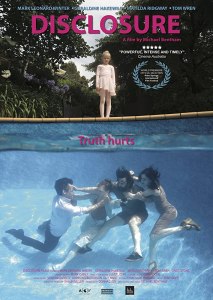 It starts with an accusation from a child during a playdate. Natasha, the four-year-old daughter of Emily (Matilda Ridgway) and Danny (Mark Leonard Winter), has a very serious accusation against the older nine-year-old son of Bek (Geraldine Hakewill) and Joel (Tom Wren). They’re neighbors, friends, and both sides are certain they can work things out like agreeable adults. Danny and Emily feel only right to be upfront about the accusation and ask to send the son to counseling. Joel and Bek are wary of this getting into the news (Joel is a local politician) and want the allegation withdrawn. Natasha says it happened. The boys say it did not. Over the course of one very long day, writer/director Michael Betham will push both couples to the brink.
Disclosure (not to be confused with another 2020 movie by the exact same name) plays out for 80 minutes like a play, locking us in one location with four characters growing increasingly hostile to one another. It’s an uncomfortable movie because it traps you in that squirming discomfort of hard conversations and high-pressure tactics to relent or capitulate on ethics. It’s important that we never really know the full truth of what actually happened between the children. We have what four-year-old Natasha has said happened, we have the denials from the older boys, who are older but still children themselves, and we have two sets of parents trying to make sense of some pretty startling behavior. Bek is convinced her own children could never commit something so heinous, and therefore Natasha must be confused or lying. She argues the children were too young to understand what her account alleges. Emily is convinced because of her daughter’s youth that she must be telling the truth, because why else would she concoct this harmful account? Each gets dug in from their perspective and only becomes more hardline. Bek reveals a startling secret of her own, being a victim of sexual grooming and manipulation in her youth, and this confounds Emily even more, asking why Bek doesn’t then believe the word of the victim here? These discussions begin in a civil manner that begins at surface-level neighborly pleasantries, but once the central conflict emerges and the opposing resolutions are debated, you start to wonder whether you are watching people at their extremes or whether you are watching the characters as they really are at heart.
 This is a patiently paced movie with every scene feeling like its own mini-movie or individual play, often a two-hander, and I was rapt with attention each time to see how the tension escalated. The couples think they can resolve matters, that they can convince the other side to the merits of their perspective and they can be persuaded to come over to their thinking. Naturally, this doesn’t happen. Given the seriousness of the alleged act, it brings out a ferocious defensive side, contemplating how far each member of each couple is willing to go to protect their children. It’s not like they get into a knife fight or anything that breaks the tonal reality of the scenario, but there is a clear moment where we have a divide between heroes and villains. That designation is a little flippant as nobody is portrayed in a strictly villainous manner; however, there are obvious moral missteps late in the movie that rely upon power plays and leverage. Bek and Joel have so much more immediate power between the couples and they’re not afraid to inflict it. They come over unannounced, catching Emily and Danny relaxing naked in their pool, vulnerable, embarrassed, and already discombobulated. Danny is eager to smooth things over and find a middle-ground because he loves his wife, and daughter naturally, but also because he doesn’t want to lose a prime career opportunity of working on a book with Joel. Eventually, the wealthier couple will use their wealth and influence to maximum pressure, even if they lament how much more they have to lose if the details of the allegation became public. For them, they have more at stake and Emily and Danny should be more reasonable and accommodating to their requests.
Eventually, there is a turning point where Disclosure goes from uncomfortably ambiguous to picking a side. A character clearly goes into the wrong, and at first you believe this transgression is to defend their child, but as it continues you begin to wonder whether or not it’s simply to “win” the argument and push aside a larger introspection over what this accusation personally means for this family. It made me loathe the character although it makes them more interesting and complicated. Ultimately, you will never know what happened with the children and the ending is somewhat unsatisfying because we end in a stalemate. I was genuinely hoping the movie would keep going for another 15-20 minutes to advance the plot and tensions further, but I understand the principle of Betham leaving on a point of disagreement and ruin and leaving the characters wanting. There are words and actions that will be highly unlikely to be taken back. They must deal with it all.
 Thankfully, the performances are universally strong to match the intensity of the story. It’s the women that make the biggest impact. Hakewill (The Pretend One) begins with the impression of Bek being an entitled rich wife who is used to getting what she wants, and over the course of those fractious 80 minutes, she proves how much this is merely an act. In fact, her own troubled marriage and past are in conflict with this veneer. Hakewill has several moments of barely-veiled rage that can be chilling but also heartbreaking. Ridgway (Book Week) is the face that many viewers will adopt as their own, meaning her perspective of treating her daughter’s accusation as credible and demanding response. She feels betrayed by her supposed friends, ambushed and wounded, and that she needs to remind her own husband to support their side of the argument. Ridgway is terrific as she tries to process her righteousness and disappointment over how everything spins out of control. The husbands are able in supporting positions, especially Wren (Winners & Losers) who uses a chummy sense of empathy as a shield he’ll drop at a moment’s notice. Winter (Escape from Pretoria) has the least to do simply of the players because his character attempts to be the most active peacemaker in the group.
Disclosure could have serviced as a stage play and the adaption wouldn’t have been too challenging but I’m glad Betham made this for the medium of film. I’m glad I got to see the subtle expressions of great actors trying to keep their cool, trying to stomach their resentment, and trying to force their opposition to retreat. It’s a pugilistic match where each side is convinced that they’re in the right or, in the wake of contrary evidence, that they have enough worth fighting for to be declared the winners. Characters keep saying they just want to think “about the children” and what’s best for them, but nobody seems to be on the same page about what that means. This isn’t an easy film to watch and given the thin line of sexual violence versus sexual exploration, as well as the question of how old a child can recognize their actions, it made me quite uncomfortable throughout, but I was always intrigued with where it would go next. Disclosure is a small Australian film that is available for streaming rentals and while it’s not going to be the most fun 80-some minutes of your day, it will definitely make you think.
Nate’s Grade: B+


You must be logged in to post a comment.