Blog Archives
Union Furnace (2015)
 As an Ohio-based film critic seeking out Ohio-based indies to provide professional reviews for, I had to be asked whether I knew Nicholas Bushman, and the name was completely foreign to me. Bushman was born in Columbus, dropped out of school at 16 to make movies, and has four features and counting to his name. His IMDB bio even declares, “Bushman has announced himself as one of the most promising voices outside of the Hollywood establishment.” Take that, anybody making movies in New York City. I kid but I was excited to discover a new Ohio filmmaker who has found a level of success on his own terms. I watched his 2015 thriller Union Furnace because it was filmed in southern Ohio, and parts of Columbus, and also because my girlfriend’s mother knew some people linked to the movie and had a DVD copy available. It’s a low-budget, scuzzy little thriller that forces the viewer to ask how far they would go for a buck.
Cody (Mike Dwyer, co-writer with Bushman) is a car thief whose life is spiraling out of control. He comes across a mysterious stranger (Seth Hammond as “Lion Mask”) with a tempting proposition that could solve his money woes. Cody agrees to enter into an underground series of betting games. He’s blindfolded, taken to a woodsy location, and finds himself competing with seven other strangers (this includes Keith Freaking David). They’re trapped, staring down a crowd of creepy mask-wearing gamblers, and the implied threat only one will survive.
 There are three clear paths to do a movie like Union Furnace: 1) deliver characters worth rooting for through these trials and tribulations or at least characters with secrets who might not be as they seem, 2) deliver really fiendish and degrading games and tests that a viewer can think alongside and imagine what they would do if given a terrible choice of terrible options, and 3) slowly unravel a mystery of who is responsible for the games and what their motivations are. It’s even further disappointing that Union Furnace doesn’t really do any of these. Let’s go path-by-path and analyze where the film’s storytelling shortcomings hamper its development.
It’s really hard to find any interesting character to emotionally engage with here. Perhaps they’re meant to be kept at a surface-level to adopt the perspective of our lead, Cody, as he too is trying to figure out who these people/competitors are over the course of one hellish night. If that’s the case, which I think is cop-out reasoning, then we need more careful attention given to Cody as our protagonist. He’s the main character of the film and the only person we follow before the fateful games, and it feels like he has material that could be utilized to make him a better formed character. He’s in debt, he’s stealing cars from church parking lots, he’s been in trouble before, and he might have a drug addiction. That’s a fine beginning for a desperate character, but what does it add to the overall narrative once the games actually begin? Sadly, too little. I was waiting for the games to have an ironic personal connection to the struggles of Cody, like maybe something relating to renewing an addiction that would make him question his limits. I suppose you could be overly generous and say Cody wanting the money for himself and then thinking of others is a character arc, but that’s too broad and unearned because of the lackluster supporting characters. Too many of these characters get whisked away too quickly to make much of an overall impression. Not having any character to really root for, or emotionally connect with, is a miscalculation considering the other miscalculations in narrative construction.
 We’ve seen low-budget thrillers and horror films with similar premises, like Would You Rather and Cheap Thrills and even Saw, that present the audience with a garish game to play along. It’s part of the appeal of these kinds of movies, envisioning yourself onscreen and what you’d do. Take the simple games of Would You Rather that involve harming yourself or harming another person, taking an awful punishment as-is or the potential mystery option that could be worse. Those kinds of scenarios allow for characters to open up for an audience, show us who is selfish, who is squeamish, what their personal morals and ethics can be when tested. The games need to be conversation-starters above all else, and that’s where Union Furnace misses. I looked at the running time and an entire HOUR passes before any of the seven games crosses into being something truly intriguing or stomach-churning. For the majority of the running time, the games are obtuse versions of what feel like childhood schoolyard games. The first game is literally playing a board game. There’s also a game of who cannot speak and even musical chairs. It’s not like these simple games have been given a sharper edge, like the chairs in musical chairs each have a knife propping out from the seat, so lunging and fighting for that coveted seat could turn very precarious (actually, maybe I will write that musical chairs horror film after all). There’s a level of obfuscation that also harms the sinister impact of the games. Some of them are unclear exactly what the contestants should even be aiming for. A late one seems to involve forced sexual contact, and it’s played in a restrained manner out of taste, but by leaving it so unclear it actually minimalizes the impact of its degradation. These games are fairly lame.
And lastly we have the revelations pertaining to our mask-wearing organizers and their betters, and I hope you’re also ready to be disappointed. The ringleader in the lion mask lacks a strong personality or menace to be truly memorable or to keep our attention as a nefarious emcee. Besides Cody, we spend the most time with Lion Mask but do we gain anything? The dialogue is obtuse and later conversations between Cody and Lion Mask feel like they’re holding two separate conversations, talking past one another than learning from the other. Take lines like, “You wandered wide the primrose path and found friends in Night Alley and Circus Surprise City” and, “You know, people are critical because they want to get something off their chest, because they want to put something in their heart.” Huh? There’s not exactly anything that forms into a specific point of view for this character that helps to drive his actions. He’s more or less just a performer revving up his crowd of gamblers. I was hoping we might get more of a history behind the organization and its rumors of traveling from economically distressed small-town to the next small-town, like a deranged carnival sideshow. There isn’t enough here to justify being this vague. The sense of discovering as it pertains to identity and mission are unimportant. I suppose there can be power in the idea of your neighbors possibly being behind dime store Halloween masks, ready and waiting to bet on your life if given the opportunity, but the dramatic potential is much higher if you actually do something with that rather than keep the organization vague.
 Being a low-budget thriller, Union Furnace does have technical merits worth bragging about. It’s a professional-looking movie and has some of the best sound I’ve heard from an indie production, which is usually a cumbersome handicap to many smaller movies. The filmmakers use their limitations to their advantage in artistic ways. I was expecting a limited location thriller but the grimy basement-esque dwelling adds a really effective discomfort for everything. The cinematography by Roy Rossovich (Evil Takes Root) makes smart use of lighting to make everything feel even more seemly, so exposed lights, high contrasts, and neon colors bathe the actors, making them feel like they’re in a 1990s music video (Fiona Apple’s “Criminal” came to mind) or a snuff film of the same wallpapered era. This is smart artistic collaboration and taking a potential negative, a lower budget, and finding creative ways to make it more a strength. As a director, Bushman is pretty solid all around. He has a fine command of visual compositions and building mood through select bizarre imagery. There’s a moment where a woman in a flesh-colored mask sings a rendition of the national anthem, and it’s so weird and off-putting that I wished Bushman gave us even more bizarre moments like this. Even just watching the trailers for his other films, I can tell Bushman is a natural director. I’d be curious to watch his other movies like his follow-up Stranger in the Dunes, filmed in North Carolina as a gift for his crew who braved the sub-freezing temps for Union Furnace.
The performances are decent but David (Cloud Atlas) is clearly the titan here. Even getting an actor of David’s caliber for something this low-budget in Ohio is an amazing accomplishment. Watching David command the screen is exciting in such a smaller role; I figured either he was going to die very quickly or go a long way, but I didn’t initially know which. He has a few strong angry outbursts where he feels he’s reached his limit and how much nonsense he’s willing to tolerate. He has an instant magnetism that the other actors simply don’t have (to be fair, he is Keith David). Dwyer (Future Lies), in only his second onscreen acting credit, does a serviceable job as the lead actor, especially at conveying the resignation of his character’s doomed thoughts suffocating him. Katie Keene (Clowntown) was another standout as a single-mother who gets some of the worst of the games. Her shell-shocked horror is some of the most quietly affecting moments.
 On the DVD extras, Bushman reveals that he and Dwyer only spent two weeks writing the screenplay for Union Furnace, and I honestly can say they needed more time. I kept waiting for something more, a turn, a twist, taking it to their oppressors, revealing some hidden personal depth that had been lying in plain sight, just something more than what felt so remorselessly rote. If the movie was going for straight nihilism, then the games needed to be fiercer and from the start. If we were meant to engage with the characters, then we needed more time seeing how these games are affecting them other than paranoia and bluster. If the movie was going for a mystery, then the wrong things were kept in secret, like understanding the expectations for the games. If you’re a fan of seedy, low-budget thrillers you may find enough enjoyment from Union Furnace and its technical merits, plus the presence of the great Keith David. I’ll be curious to investigate the other movies of Nicholas Bushman. As a director, I think he’s showcasing skill and potential. As a writer, I’m less sure of that. Still, the man is making his own movies on his own terms and he’s cranking them out every couple of years. He’s making this a career, and I hope that he can continue doing so, as well as hopefully re-evaluating what’s best for a story.
Nate’s Grade: C
Share this:

Da 5 Bloods (2020)
 Given the current political climate, there might not be a better filmmaker to seize the moment than Spike Lee. The controversial director has been making controversial, thought-provoking, inflammatory movies for over 30 years, and after the Oscar-winning success of 2018’s excellent BlackkKlansman, he’s on an artistic resurgence not seen since the early 2000s (please watch 2000’s Bamboozled, an underrated media satire that’s only gotten more relevant). In comes Netflix and their deep pockets and wide creative latitude for filmmakers and the result is Da 5 Bloods, a stirring movie that seems like a modern Kelly’s Heroes but becomes so much more.
“Da 5 Bloods” is the nickname for a group of Vietnam War vets, all African-American. Paul (Delroy Lindo), Otis (Clarke Peters), Eddie (Norm Lewis), and Melvin (Isiah Whitlock Jr.) venture back to Vietnam to discover a cache of gold bars they had hidden in 1971 as G.I.s. They’re also going to bring back the remains of their fallen leader, Stormin’ Norman (Chadwick Boseman), who died after they struck literal gold. The land has changed in the ensuing decades, with American culture finding its complacent commercial footing (a dance hall has an “Apocalypse Now” party presented by Budweiser), but then the men have also changed. Paul has brought along his adult son, David (Jonathan Majors, The Last Black Man in San Francisco), in an attempt to better understand one another and bridge their divide. When the multi-generational Bloods go for their buried treasure, it becomes a question over how far they will all go to get out of Vietnam rich.
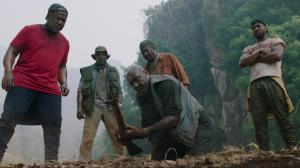 Lee’s commentary on art, war, and the commoditization of history happens early and with great deliberation. The most notable choice is how the flashbacks back to the group’s Vietnam experiences are portrayed. The aspect ratio squeezes to 4:3, akin to news footage or home movies over these memories, but Lee’s stylistic vision goes further. You’ll notice very early into the flashbacks that they take on a sort of heightened quality, coming across more like a movie version of the Vietnam War than the real experiences. The guys complain about the Rambo movies and then these flashbacks feel like their own Rambo rendition. The editing is quick, the shots are tight, and the boys are bursting with bravado, none more so than Stormin’ Norman, their celebrated friend who they believed was the best of them, and he’s played by a big-time movie star and a real black superhero of popular culture. The flashbacks take on an unreliable quality, exaggerated and fed by the bombastic war depictions of popular culture. This is later proven correct with a late personal reveal. The sequences feel more like preferential memories, and this is exemplified by the choice to have all the older actors play themselves in the flashbacks. It takes a little mental adjustment but I enjoyed the choice. It added to that surreal quality that made the scenes more worthy of analytical unpacking. It also gave our established characters more to do as they are slipping into their literal flashbacks coming back to Vietnam. Gratefully, Lee has also forgone any de-aging CGI spackle over his actors’ faces. Consider this the anti-Irishman, and it didn’t take me out of the movie at any point. I appreciated the choices.
The movie is about war and its representations in movies, as evidenced from those flashbacks, and then Da 5 Bloods becomes its own war movie. When the violence happens for real, it’s played differently than how it appears through the gung-hp flashbacks. It’s grislier, uglier, and hits you in the stomach. It’s not the rah-rah moments to celebrate in jingoistic fashion. As the Bloods get closer to their gold, the movie transforms into its own hybrid of Treasure of the Sierra Madre and pushes the characters to reconcile how far they will go to keep their secret. This pushes some characters to challenge others on a shifting plane of morality, and you never really get a sense of what might just happen next. When a French woman was talking about visiting Vietnam with the purpose of finding and detonating leftover landmines from the war, I knew it was only a matter of time before this scenario resurfaced with a vengeance. When the Bloods are exploring a hillside with a metal detector, I kept wincing, waiting for an eventual click and an explosion. There is a taut rescue sequence that also taps into a relationship showcase for two characters. That’s the greatness of what Lee has done here, because on top of mixing genres and tones and political commentary, he also makes sure that the action, the real action, actually means something.
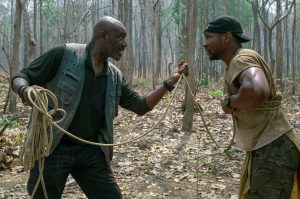 The last act of the movie is a big standoff with genuine stakes, and while it serves as a fun example of our older underdogs more than holding their own, it gets into the major theme of legacy. What will be these men’s legacy? What will the legacy be for a son who has never felt close to his father? What about a daughter who never knew her father? What will last beyond these men? The legacy of Stormin’ Norman informs and haunts the other Bloods; Paul practically breaks into tears confessing that he sees Norman’s ghost on a near daily basis. They all feel guilt over being unable to save Norman but also being unable to bring his remains home until now. Going back is not just about financial windfalls, it’s also about making good on a delayed promise. Talking about what the men will do with their shares of the loot allows each to fantasize about a more perfect life ahead, while at the same time coming to terms with their life’s regrets. This is where Eddie gets his most potent opportunity to stand out. The character too often just feels present rather than integrated in the narrative, but here he opens up about how his life might not be as perfect as his friends tease him about. Inherent in this ongoing discussion is the notion of what does sacrifice mean and for whom. Lee repeatedly threads historical footnotes of African-Americans being shortchanged after serving their country in wartime. Even though only making up ten percent of the U.S. population during Vietnam, black soldiers made up over 30% of the grunts on the ground. Paul says, “We fought in an immoral war that wasn’t ours for rights we didn’t have.” The Bloods view this gold as their long overdue reparations for being black in a racist country. However, it’s Eddie who won’t allow the Bloods to merely deal in grievance. He cites Stormin’ Norman and how they can improve the lives of the next generation even at their own expense. Even as the gunfire picks up and we have a misplaced mustache-twirling villain (Jean Reno), Da 5 Bloods is an action flick that has much more on its mind, looking to the past, present, and a better future.
 This is a compelling ensemble tale but Da 5 Bloods is clearly Lindo’s movie. Lindo has been a hard-working actor for decades, with roles in Get Shorty, The Core, Gone in 60 Seconds, The Good Fight, and a bevy of Lee’s films (er, “joints”) like Crooklyn, Clockers, and Malcolm X. But it’s the role of Paul that will serve as the actor’s finest career performance. There is so much pain and anger coursing under the surface with this character. Paul wears a red MAGA hat in proud defiance and to the jeers of his pals. Paul is a Trump voter who wanted to shake up the system, the same system that had let him down for his life. He’s haunted by his past, and even decades later, he can admit returning to the jungles is still affecting him. The gold represents something elemental, mythical to him, a lifetime-defining event that he needs to accomplish. As this zeal overtakes him, Lindo unleashes spellbinding monologues looking directly into Lee’s camera as he marches along, narrating his stormy inner thoughts, and trying to assess the contradictions of his life. Lindo doesn’t just play Paul as a hardass grumpy old man. He’s still reeling, from service, from fatherhood, from the decades having vanished, and from the setbacks to retrieve the gold. Paul’s odyssey takes on a religious passion play that builds him into a symbol of America’s unmet promises and fallibility. Even in uncertain COVID-19 times, I’d be shocked if Lindo isn’t nominated for an Oscar.
Netflix’s Da 5 Bloods is a great movie and invigorating reaffirmation that when Spike Lee really gives a damn he is one of our most essential filmmakers, even after 30-plus years in the director’s chair. The movie is packed with rich detail and character moments, little things to keep you thinking, and a blending of tones and texts that invites further analytical examination. At its core, it’s a story of friendship and legacy, and the actors are a great pleasure to watch grouse and weep and laugh together. Even at a taxing 154 minutes, I was happy to spend the extra minutes with these men and better understand them and their pain and their relationships. Even though the movie delves in loss and grievance, I found it to be ultimately hopeful and galvanizing. Something as simple as a hand-written letter can turn out to be more restorative than millions in gold bars.
Nate’s Grade: A-
Share this:

American Psycho (2000) [Review Re-View]
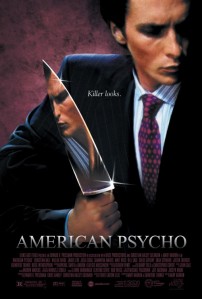 Originally released April 14, 2000:
American Psycho is based on the controversial 1991 best seller by Bret Easton Ellis though it got old fast. One can easily grasp how the lead connects with brand names on page one, but repeat it for 300 more and you’re tempted to add the book to your collection of firewood. Ellis’ novel was sadistically perverse, but director Mary Haron (I Shot Andy Warhol) has somehow managed to pull out an entertaining social satire from the pages of blood and name brands.
Christian Bale, mainly known as the boy-next-door in period piece films, plays Patrick Bateman with ferocious malevolence and vigorous life. Teen scream Leo was once considered for the part but after seeing Bale’s startling performance it should prove why he’s on screen and Leo’s swimming in The Beach. Bateman is an up-and-up Wall Street yuppie who glosses over appearance more than anything else. The only outlet it appears for our sinister shark from the soulless decade is by random acts of gruesome violence.
If Bateman blows off steam by blowing off companion’s heads than it only becomes more frustrating when no one believes his random confessions. Haron takes the grisly material of Ellis’ novel and mines it for pure 80s pulp. It only gets better the further it gets as you have so many points to discuss: Is Bateman acting out to prove his existence in a world that doesn’t humor him or others? Is he acting out deep-seeded rage from the actions of the decade on its people? Is he desensitized and so jaded that death does not even fracture him anymore? The questions are boundless.
The hit list of stars in Psycho includes Chloe Sevigny as a nailed home addition, Willem Dafoe as an investigative detective, Jared Leto as an axed co-worker, and sweet Reese Witherspoon as the apple of Bateman’s twisted eye. Everyone has fun in their tongue-in-cheek nostalgia romp through the absurd.
American Psychoshould not be confused with the successful teen sex farce American Pie. The only desserts in this film are just, and they’re usually left of the mayonnaise and behind the frozen head in the refrigerator. American Psycho is the thinking man’s slasher movie. A flick that slices, dices, and always entices. It only gets better after you’ve seen it. One of the best films of 2000 for now.
Nate’s Grade: A
——————————————————
WRITER REFLECTIONS 20 YEARS LATER

American Psycho was a literary sensation upon its initial publication in 1991 and was deemed shocking, grotesque, perverse, and all those splashy adjectives that made it guaranteed Hollywood would turn Bret Easton Ellis’ novel into a film. Every young actor in Hollywood in the 90s was rumored to play narcissistic serial killer Patrick Bateman. By the late 90s, director Mary Haron was attached with Christian Bale as the intended Bateman on the condition that other name actors could be brought on (Haron secured Willem Dafoe and Reese Witherspoon for supporting roles). The producers kept pushing for their number one target, Leonardo DiCaprio as Bateman, and Haron said she would walk if he was hired over Bale. The producers went ahead and DiCaprio was hired for several months, with the budget ballooning to over $40 million, half of which was slated just for DiCaprio’s payday. Months later, DiCaprio left to film Danny Boyle’s The Beach, and the producers went back to Haron and her top choice, Bale, who was so determined to play Bateman that he didn’t take any other acting gigs for nine months just in case (new total film budget: $7 million). Looking back again twenty years later, it’s difficult to imagine late 90s DiCaprio in the part that became the first of many star-making performances for Bale, one of the most chameleon-like actors of his generation. Haron’s tenacity and instincts proved correct and the film still stands tall as a dark comedy and a character study of a compulsive narcissist.
 The novel was set in the 1980s and intended to satirize the soulless suits of Regan’s America that made their ill-gotten gains on Wall Street, and the satire has only become more relevant after the 2008 financial meltdown and numerous white-collar scandals. The perception of Wall Street as predatory and vampiric and roiling with sociopathic greed has only become more pronounced, which makes the intended satirical targets even more worthy of their take-downs.
I initially wondered in my original review in 2000 whether, among other interpretations, Bateman was lashing out in a world that didn’t care about him in order to make himself feel heard, and that is exactly the opposite response. Bateman is acting out because he can and because he no longer cares about following rules. It may be a metaphorically simplistic application to make a Wall Street trader a serial killer but that doesn’t make it any less appropriate and resonating. The iconic business card scene still sends me howling, as Bateman and his colleagues (Justin Theroux, Josh Lucas, Matt Ross) compete for supremacy with who has the most accomplished little square of cardboard with their name on it. The hushed and awed voices, the detailed micro-analysis, the slow motion and beauty shots of the cards, it’s played to such wonderful heights of absurdity. When Bateman hires two call girls for a threesome, he spends more time flexing and admiring his own image in the mirror. He spends more time on his daily beauty care rituals than he does on introspection. For these hollow men, status and appearance is the only thing that matters in a world of imposters and transitory pleasures.
Bateman is meant to serve as a character study for a man who declares there isn’t anything there underneath him. It’s an expose of vanity in an era of venal excess and it’s also an indictment on privilege. As depicted on film, and later revealed why with an ambiguous conclusion, Bateman gets away with his wild and increasingly murderous antics because of his position. He’s a rich white Yuppie during 1980s New York City. He can get away with anything, which is why he can run around screaming, flailing a live chainsaw, wearing nothing but socks and blood, and nobody seems to be the wiser. It’s why he can go back to his own crime scenes to leave even more of his evidence, and DNA, around the premises. It’s why he can pose as Paul Allen (Jared Leto) even after he has hacked Allen into tiny little Yuppie pieces. It’s why he can hilariously wax on like a Rolling Stone essayist about musical artists like Phil Collins and Whitney Houston as he prepares to slice and dice his victims. As his actions become more and more blatant, the satire rises with Bateman to blanket his reckless impulses (these crooks can get away with anything, Haron seems to be whispering in your ear while elbowing you in the ribs). After two more decades of Wall Street scandal without consequence or credible jail time, as well as a president who is convinced rules do not apply to him, the satire has approached an even darker laugh-because-otherwise-you-might-cry territory than it was back in 2000 (“This confession has meant nothing.”).
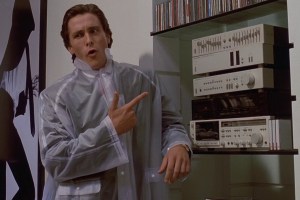 With no one able to tell him no, how far will Bateman go? Haron and her co-writer Guinevere Turner (who also appears in the film as Elizabeth, a drunk friend of Bateman’s who becomes another victim) smartly dialed into the themes they wanted to send up and dialed down the grisly gratuitous details. In the book, Bateman’s depravity is described in as much detail as he gives to his rampant consumerism. We don’t need pages upon pages of description to understand that Bateman is sick in the head, and we don’t need examples such as torturing a prostitute by trapping rats inside her vagina. The grisly overkill of the book is smartly pulled back to its essentials, and an oft-reviled work deemed misogynistic by many critics has been transformed from a deep dive into rape, dismemberment, and cruelty into a satire on the men who aspire to commit such awful acts. There’s a noticeable difference there that some will miss. One perspective focuses on the actions and the other focuses on the meaning. Bateman is a privileged, entitled, and alienated white man teeming with unprovoked rage, a figure we’ve seen more often in the news in the ensuing decades. The American Psycho movie takes aim at the fragile male egos of past and present. Haron would later go on to write and direct other indies (2006’s The Notorious Bettie Paige) but she never seemed to get that career boost after American Psycho. Ellis decried the movie adaptation and later said he felt female directors were unable to accurately translate the male gaze, which is dubious when the starting point for Hollywood filmmaking is preset at “male gaze.”
Bale is phenomenal in what proved to be his breakout role. It was only a few years later that he nabbed Batman for Christopher Nolan. According to interviews, Bale modeled his performance after what he saw during a Tom Cruise appearance on David Letterman’s talk show. Bale says he saw an “intense friendliness with nothing behind the eyes,” and he then knew how to play the part. It was also the beginning of Bale’s trademark method transformations, becoming the muscled figure of Bateman’s desire, the only thing that ever truly mattered to the man. Bale’s thinly veiled contempt for everyone and ironic detachment are constantly entertaining and provide great laughs (his go-to excuse for departing, “I have to return some video tapes,” made me laugh every time). There’s a late scene where Bateman calls his lawyer to confess to his litany of sins, feeling cornered, and it’s a spellbinding performance all in one take where he approaches mania as he finally unburdens himself (“Tonight I, uh, I just had to kill a LOT of people. And I’m not sure I’m gonna get away with it this time.”). It’s a tremendous moment in a tremendous performance. The movie is filled with familiar faces (Chloe Sevigny! Samantha Mathis! Reg E. Cathy!) that it becomes fun to realize just how many great actors and future stars contributed to the movie. For trivia buffs, it also features Batman (Bale) killing the Joker (Leto).
 My original review attempts many turns of phrase, like “blowing off steam by blowing off others’ heads,” but the core points are still viable: the satire improves from the book, Bale delivers an amazing performance, and there are many ways to interpret the film. The ending isn’t quite as ambiguous as perceived but it makes sense with the outlandish escalation of events, a point where even Bateman looks at his own power with befuddled curiosity. Back in 2000, I called American Psycho the “thinking man’s slasher movie” and I think that title still applies. It’s a vicious movie but the satire is just as vicious. Weirdly, there was a direct-to-DVD sequel that just went the “non-thinking man’s slasher” route by featuring Mila Kunis (Black Swan) as a criminal justice coed who embarks on her own bloodbath, including killing William Shatner as a professor. It’s like unintended satire on Hollywood itself; follow a cerebral and daring artistic work with run-of-the-mill slop under the same name, co-opting the appeal of a “brand” to make a buck. Much like Wall Street, Hollywood doesn’t know when to stop.
Re-View Grade: A
Share this:

Constraint (2019) [PART THREE]
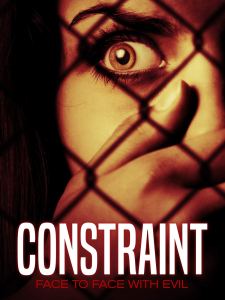 Please read PART ONE and PART TWO if you have yet to as I try and better articulate my questions over this Columbus, Ohio indie and its confounding creative decision-making. Dear reader, I am going to take you live through this very intellectual and artistic assessment as I continue to watch Constraint.
The main plot revolves around Oracabessa (Brooklyn Sabino Smith), a young cellist, who becomes entangled in a web of human traffickers, led by Tuco (Ralph Scott).
I’m now heading into Act Three with a half-hour left of movie to go with Constraint. Oracabessa mumbles the address from Tuco’s I.D. and wanders into the woods rather than call for help or use her moped or one of the cars at the scene of the accident. Magically, she finds the location. Her sense of direction must be superb while suffering from a concussion. Why would she think Tucco was holding the trafficking victims at his registered home address? I feel like the first step of human trafficking, after giving away one’s moral whole, is not to keep your victims at your home.
Dear reader, I am all about climaxes where our protagonist wreaks havoc among some very bad people who deserve some very bad justice dealt to them in hopefully poetic and painful ways. It’s a natural storytelling formula rife with catharsis and payoffs. But like other formulas, you need to still put in the work to reap the rewards. Just because our heroine is stumbling to a compound to free the victims and bring down their tormentors does not mean it works. It’s skipping to a climax the movie doesn’t really deserve because we spent so much precious time on side characters that didn’t matter and dawdled. Just in case if you mistook the good faith of the production, there’s also a gratuitous rape scene used as a setting device for one of the heretofore unknown bad men (at least she was clothed). One of the women from the beginning is found in the basement, she mistakes Oracabessa’s intentions, and runs to her to be saved, and she then gets gunned down in the back by the traffickers. She was let down twice by our heroine.
 Our leading lady wanders the compound and comes across two children, one white and one non-white, both of them trafficking victims, but she only addresses the white kid and says, “I’ve come to take you home.” They ask if she is the police, again a reminder that perhaps alerting the police to the whereabouts of this site might have been a higher priority than going alone. She is only here, it would seem, for these two children. Sorry the women she found in the confusingly oriented basement. I was already having a hard time liking this protagonist as is but this sealed it.
A lot of shots of running through the woods happen without much to connect a sense of spacing and geography, and then Oracabessa is saved when Derick drives up and they get inside his car and drive away to safety. The following then happens in our bulrush of a resolution:
1) Oracabessa is in a hospital bed. A nurse is asking her about medications.
2) Nicolas quickly rides a motorcycle to the hospital entrance outside.
3) The nurse says she “just got your blood tests back” (a certain The Room line echoed in my head) and then imparts, “Have you ever been pregnant before?” Why is this even being asked except to imply that she is currently pregnant or never had a son like she confessed before. We get no clear indication on either of these being true, so, again, why include it?
4) Cut to Nicolas running down the hospital corridor while SUDDEN electronica music begins blaring like we just dropped into an action set piece from Blade.
5) Nicolas comes into Oracabessa’s room and pulls up a blanket on her in a manner that seems less “tucking in” and more “pulling sheet over a corpse on a slab.”
6) We reveal in the same hospital is Oracabessa’s brother who was indeed the drug carrier that Tuco stabbed far earlier and has not been referenced since. The doctor says he lost a lung.
7) Nicolas thanks Derick for saving Oracabessa and they seem to part on good terms. In the same camera setup, with Derick in the same outfit, thus implying that same day, Oracabessa leaves on crutches, meaning she was discharged in hours. The ADR-ed line “Think you cracked the skull” occurs without Derick moving his mouth.
8) We jump to a new scene where Oracabessa has her hands around Derick’s face and she says, “I’m going to kiss you now, and it’s going to be the last time. I’ll never kiss you again.” It’s a repetitious line that screamed Neil Breen to me.
 9) We jump to a new scene where Oracabessa is hobbling to the ballet class teacher who shows no sympathy and literally tells her that her last performance “was an abortion.” Yikes! This is then immediately followed by Derick saying, “A woman has a right to choose” to Nicolas.
10) While talking to the creeper from before with the French accent who heads a music school, Oracabessa SUDDENLY remembers a time she saw him sitting in the passenger seat of Tuco’s car while it passed her on the street. Who else will she arbitrarily remember next? And how often did she see this one car drive around her entire town that she committed to memory? She, at long long LONG last, finally calls the police and has the human trafficker creeper arrested.
11) She then flies to Jamaica and visits her father, asking him about the little boy he ran over. Did this man serve jail time? Oracabessa blames herself for the kid’s death and now I feel like this should have been dealt with more if we’re going this route. It doesn’t feel like catharsis because it doesn’t feel like it was on her mind too often. Did I confuse the earlier scene of her talking about a son as this kid?
12) Nicolas surprises her in Jamaica. “Whatever happened to that Derick fellow?” asks dad at a dinner with the three of them. We’ve been told Nicolas was engaged to Oracabessa, so it seems peculiar that of the two men in his daughter’s life, this is the one he is unfamiliar with. Dad threatens Nicolas with great harm if he does anything to hurt his daughter. Is this comedy?
13) The voiceover overlaps and we jump to a wedding party dinner with the use of split screens. Why split screens? With how quickly we are rushing through plot content, I feel like this is the series finale of HBO’s Six Feet Under and I’ll see the next hundred years of these people’s lives.
14) The various characters mingle and dance in, what else, a wide angle that lasts an astounding FOUR MINUTES without cuts, as if the movie didn’t know it was over. It’s just lingering with no real purpose of why the audience needs to see any of this for four minutes. There is no dramatic change. Just people hugging. If the movie already wasn’t nearly two hours long, I would have accused the filmmakers of dragging this thing to a feature-length running time. Then the end credits just appear, which they could have done four minutes ago too.
 Finally, now I can derive my critical conclusions on this truly bizarre Ohio indie movie. Constraint feels overwhelmingly like Ohio’s own Neil Breen movie, plotted so loosely, so archaically, with characters behaving so randomly and nonsensically, and with a story that never seems to have traction, bouncing from one character to another and going on strange tangents and flashbacks, like it’s trying to pack in some half-formed Armistead Maupin ensemble piece. Constraint is just as much about a girl walking around town with her cello on her back (possibly one quarter of all shots) as it is about sex trafficking and finding the victims (when it’s not squeezing in some nudity from them). The pacing seems overstuffed and insufficient, with so many things happening but little connection to make those actions feel important even with life and death stakes. Perhaps having our main trafficker just wandering around town at all hours takes away from his mystery and danger. This is a movie where anything might happen at a moment’s notice because it doesn’t feel like much of what you’re watching builds off what came before. Being redundant at 110 minutes is just inexcusable. The scenes in a movie should matter, as should their placement, and the characters should learn, grow, progress, or at least present an interesting viewpoint for an audience to follow.
From a production standpoint, Constraint has some positive qualities but they are routinely hobbled by the exasperating creative choices of the man in charge, writer and director and editor and cinematographer Richard A. Nelson (The Endangered). The man likely should have only had one job on this project as director. He needed other creative supports that could better concentrate on seeing a vision through, a better writer to make a better story with fleshed-out characters, a better cinematographer to ensure more seamless camera arrangements for the edit, a better editor that wouldn’t sabotage the movie’s flow and literal comprehension with so many erratic edits. It’s not a bad looking movie despite some unfortunate edits and a heavy reliance on day-for-night filming. The acting is generally acceptable but I don’t hold the performances against the actors. The characters they are playing are very difficult to find a sustainable reality to inhabit. Smith (Indie Film School) has something about her that keeps you watching, which is good considering her cellist character doesn’t fulfill that same outcome. Scott (After) is dependably great. There are even moments, slivers, that give an idea of how good all these actors could be with better material, like the small scene between Alice and Tuco together. Constraint feels like a dozen movies that have been sloppily distilled together, with inorganic sections intruding upon one another. I don’t know if this approaches a so-bad-it’s-good quality but it’s flabbergasting to witness.
I cannot advise you to watch Constraint but I cannot not advise you to watch this. It’s Ohio’s own Neil Breen indie and I never thought I would discover something quite like that.
Nate’s Grade: D-
Share this:

Constraint (2019) [PART TWO]
Please read PART ONE if you have yet to as I try and better articulate my questions over this Columbus, Ohio indie and its confounding creative decision-making. Dear reader, I am going to take you live through this very intellectual and artistic assessment as I continue to watch Constraint.
The main plot revolves around Oracabessa (Brooklyn Sabino Smith), a young cellist, who becomes entangled in a web of human traffickers, led by Tuco (Ralph Scott).
I am now 45 minutes into the movie and screamed, “What?” to my screen. Oracabessa (Brooklyn Sabino Smith) is once again playing cello for a ballet class and the instructor doesn’t like the musical selection. She requests Wagner, and Oracabessa says she won’t. The instructor is animated and agitated and demands to know why she can’t play the composer. “I didn’t say I couldn’t play it. I won’t,” she replies. Why? Is this going to be like some character moment like in La La Land where Ryan Gosling gets fired for refusing to play the holiday music his boss asks for as dining accompaniment? I would think refusing to play what a client was requesting could cease in you getting more work from that client. And considering this one ballet class is the only thing we’ve watched her do for money, I wouldn’t be too pushy.
Oracabessa sees Tuco walking along the street again which begs the question of how protected does this guy think he is? She follows him but the ensuing tailing sequence goes through a blender of edits so it more implies the chase than allows it to establish. She then joins the college professor, and Derick, and others at a hookah bar to translate a French speaker. “What about having your own racial identity?” Why does this scene exist in a story about sex trafficking? Is the professor Oracabessa’s sister? Why was this never established earlier? There’s now a discussion over whether or not Jewish people should be defined by the Holocaust and its impact and it’s like a family dinner squabble, still with the omnipresent ADR dialogue, and I’m starting to lean into the arbitrary madness of Constraint as it further infects me.
 We transition back to the life of Tuco, our beleaguered sex trafficker. He kills a guy for being late to a drug deal and I cannot say but this might have been Oracabessa’s brother from the previous family dinner scene. Tuco has his kidnapped women line up in their underwear so they can be “inspected” by his superior. He warns them not to “embarrass him,” though I have no idea how that would be achieved. And then the women start stripping off their clothes and the camera angles are PURPOSELY AIMED to highlight their full-frontal nudity, even one side view that captures all three women’s breasts in a row while cutting off their heads. That’s when I stood out of my chair, cursed this movie out loud, and paced around the room in building anger.
Nudity in film by itself doesn’t have to be sexual or gratuitous, but this nudity is meant for titillation, framed for this purpose, and to squeeze this into the context of sex trafficking, a very depressing and all-too-real reality for many, I felt extremely grossed out. The scene doesn’t need visible nudity to feel the distress and vulnerability of the captured women. I love exploitation movies as entertainment, and have even supported a few financially, but story context and tone are key. The women of this moment are there to be objectified and the camera objectifies them too. You know how I know how these actresses felt about this scene? None of their last names can be found in the film’s credits, so I don’t think they were too happy to have their full names associated.
We now transition to another new perspective, this time Nicolas’ parents (Dino Tripodis and Kristina Kopf, The Street Where We Live). “He experimented with something exotic,” the father says, and I don’t know if this implies that dad is racist for thinking “black” equals “exotic.” This entire scene feels even more student film-esque than the rest, with the editing choices and the characters dancing around critiques of domesticity and parenting. The wide angles that suddenly cut to extreme close-ups of faces, the jump cuts, and ADR sound design, it’s all starting to make this feel like a foreign film that’s trying to be New Wave arty. “You didn’t even leave your son with the hopeful illusion that maybe his parents were in love at one time,” mom says. The dialogue in this movie feels like it was written by an A.I. at many points. Nicolas later confronts dad who is apparently out on a date with another woman, and he does so with his mom in tow. “My whole life, the one thing you’ve been good at, is making people cry,” Nicolas bemoans. The wide shots showcase a bar/restaurant with nobody else in attendance, again another mistake with revealing the limitations of filmmaking. Now the scene is suddenly in black and white, so is this an established flashback? If the whole thing was a flashback for Nicolas then why wasn’t it all coded in black and white? Wait, then Nicolas’ own voice over narration is coming in while dad is talking in the present. We then pull into a flashback of Nicolas telling the story of meeting his divorced father in the park to Oracabessa, so we witnessed a flashback-within-a-flashback for a side character. “What would you say is the most devastating thing to happen in your life?” he asks Oracabessa. Sheesh, if this is your pillow talk no wonder she dumped you, dude. There’s now a flashback 23 years to Jamaica with Oracabessa’s biological father. There’s an ongoing streak of whispered poetic voice over from Terrence Malick films. What movie am I watching now? I can’t keep up with the shifting perspectives and visual vocabulary that keeps being broken so flagrantly and randomly.
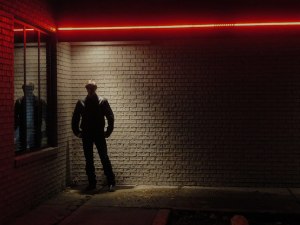 Folks, the erratic edits have not gotten any better and a conversation will randomly jump from four different camera positions from line to line to completely obliterate flow.
Derick and Nicolas are fighting over Oracabessa, who doesn’t want either of them, and then Oracabessa is playing at a big recital, and again I have to remind myself this is supposed to be a movie about sex trafficking but it’s playing like some small-town ensemble piece (why else do the same people keep running into each other in a city of over a million?) but like a Christopher Guest mockumentary (Waiting for Guffman) played straight. Why does Tuco even attend this recital?! Oracabessa follows him and the chase has several nice camera angles for a low-budget indie, and it’s also edited in a way that maintains the suspense and is readable for the audience, going from better selected angles to convey the progression of the chase and Oracabessa following closely. The music, however, is way too overwrought and we watch Tuco go into a restaurant, eat, and then leave with Oracabessa following again. Why did we need a pitstop? She didn’t even go inside.
Tuco finally ambushes Oracabessa and runs her over, which triggers a flashback of her son (?) she confessed she lost (in the flashback with Nicolas) being run over in the past. The way the scene plays doesn’t make it seem like she was witness to this event for recollection. Nope, it’s just a kid that Oracabessa’s father ran over while she was a child, which explains why she could recall this moment but also makes it too confusing for an audience to adjust to what is being thrown at us without context as it plays. It wasn’t even in black and white, which is the established code for flashback. A drunk driver then plows into Tuco’s car, which smashes into Tuco, finally killing him and setting Ralph Scott (Minus One) free from the earthly bonds of this movie. Oracabessa takes his I.D., gun, and sets off, presumably, on a path of righteous vengeance as she… wanders into the woods, but what do I know?
So this one woman had her father run over a child, abandon her, then she lost a child of her own, and has been stalked by human traffickers. This is getting into telenovela territory of melodrama. And so ends PART TWO of my real-time review of Constraint.
Share this:

Constraint (2019) [PART ONE]
A most unusual thing happened when I was watching the Ohio-made indie Constraint on Amazon Prime; I was so bewildered by the filmmaking choices that I had to stop and begin writing my thoughts immediately on the movie even as it continued playing. This is a rarity, a movie that causes such confusion that I feel compelled to articulate my thoughts in the moment rather than, as I normally do, assessing them upon completion. I wasn’t expecting any of this. Constraint has a very serious subject, sex trafficking, and filmed in my hometown of Columbus, Ohio, which has itself a very serious problem with sex trafficking networks. It starred familiar faces from my other Ohio indie viewings of recent. But then within only three minutes, I had to pause at several points, walk around my room muttering questions to myself, and couldn’t go much further in the movie without repeating this process. So, dear reader, I am going to take you live through this very intellectual and artistic assessment as I continue to watch Constraint.
The plot revolves around Oracabessa (Brooklyn Sabino Smith), a young cellist, who becomes entangled in a web of human traffickers, led by Tuco (Ralph Scott). Other characters will come and go into her orbit but Oracabessa is our guiding point.
Within minutes, I was already starting to question decisions, or practical limitations, exhibited by writer/director/editor/cinematogpraher Richard A. Nelson (The Endangered). Even the opening credits are strange with listing an assistant director before blocks of cast names and then zipping by in a blink as to render their inclusion seemingly moot. Then there was the realization that all of the dialogue sounded like it had been ADR, meaning recorded later and indoors. Not just outdoors scenes, which can be notorious for wind and auxiliary noise, but also indoor settings. Honestly, it made me immediately think of the notorious Mystery Science Theater 3000 high point/low point, Manos: The Hands of Fate, a movie from 1966 where every line of dialogue was recorded after filming and, what sounds like, in a bathroom, and sometimes with one actor providing both voices to a conversation of two characters. Immediately, my mind starts going into formulating some kind of explanation why this might be, what could have led to this, and I’ll fully admit to striking some of my criticisms if they vanish later in the film.
 The editing choices can be jarring and forced me to stop the movie at several points. An early scene, at the four-and-a-half-minute mark, has our lead Oracabessa visiting her boyfriend, Nicolas (Aaron Geib). The camera moves to a wide angle as they settle at a kitchen table. Within seconds there are two jump cuts but they eliminate mere seconds or fractions of seconds of footage. Then there’s a quick cut to an exterior of the apartment, presumably to “clear the edit” and allow a passage of time or at least a new camera angle. Nope, we come right back to the same shot. Why? Why not just start with the shot from after the exterior cut of her passing her drink to him? Why did the previous moments need to be seen? What then follows is a close-up of the food, fully prepared, and the boyfriend has his line entirely off screen. This is the stilted dialogue that follows:
Him: “It’s a peace offering? What are we, at war?”
Her: “Man and woman in any kind of relationship are always at war. It’s just a matter of what degree.”
She then passes by him and it jump cuts (same camera angle) to him responding, then it pans over to her at the other end of a doorway, and then after her line it literally cuts back to his position on the doorway (same camera angle) to walk over to her. What? Why not just pan both ways? She responds and then we have ANOTHER JUMP CUT (SAME CAMERA ANGLE) and then ANOTHER JUMP CUT (YOU GET IT) of her a step forward walking past him, and then ANOTHER JUMP CUT (YOU KNOW IT) of him looking off screen at her. The camera angle then changes, mercifully, to a medium shot (with her head cut off) of her pulling off her ring followed by a different medium shot (with her head now visible) of her placing it atop a bookshelf. We then cut back to the EXACT SAME previous shot of the guy still looking off screen in response. There’s a couple more cuts as she leaves and then the movie jumps into a bizarre montage of images as she’s riding on her moped with a fixed handlebar-POV shot, a closeup in slow motion, and black and white inserts of her presumably as a child.
Ladies and gentlemen, I have no idea what to tell you beyond watch the segment (5:30-6:30) for yourself and join in my mounting alarm and confusion. Even if the production was stuck with minimal camera setups, why jump so haphazardly from moment to moment with jump cuts? Why use pans so sparingly when they could keep an audience in the moment? If the point of the scene is to impart a distance, a lack of engagement in this couple’s relationship, the staging and editing could have better communicated this without resorting to off-putting decisions.
The next moment of curiosity occurs seconds later as Oracabessa attends a very sparsely populated college lecture (I literally counted 12 people in a hall that likely seats 200). Again, the noticeable ADR sound, again the annoying jump cuts, and again confusing choices about the staging of the scene. The professor is arguing over reparations and there’s a moment where it cuts to a black and white still image of the professor and then cuts back to her talking. Is this an Oliver Stone movie? A (white male) college student protests he shouldn’t have to pay for his ancestors’ bad deeds and gets into a fight with another student, but the majority of the crowd shots are taken from one very wide angle. When the students confront one another, the camera doesn’t move, doesn’t get us closer, and they just occupy a small portion of our screen, which then cuts to another exterior shot and back to the same interior angle again. I’ll accept that the professor, and the older man monitoring her teaching, were filmed at a separate time and cut to look together with the crowd of students. I get scheduling shortfalls, but why make it all the more apparent to your viewer? Why film in a way that highlights how empty the space of this lecture hall is? Why shoot with such static angles? And why again do we get so much weird edits that break up the flow of the scene? Reader, I am only eight minutes in.
I just counted six edits and three different camera angles just to capture Oracabessa copying a paper on a copy machine. It’s a twelve-second scene which raises the question why multiple camera angles were needed to simply convey she copies something and why we needed twelve seconds on this task. I am just completely bewildered by the editing choices of this.
Credit where its due, the investigation scene of Oracabessa looking through old microfilm at the library on missing person reports is the place where jump cuts and rapid edits are beneficial. The black and white flashback is confusing though whether it constitutes the events that actually happened, seeing a young woman and little boy somehow separately being stalked by an unseen driver in a car regardless of the fact that they’re walking in opposite directions, or whether it’s Oracabessa’s imagination playing out over what might have taken place.
The movie then seems to transition its protagonist, switching to Alice (Maya Sayre), the mother of the missing boy, who is identified via a subtitle at the bottom as if this was a documentary subject. She seems to be sitting in a coffee shop with a stack of missing fliers and… signing them? I don’t know. There are more quick cuts of things like a closeup of a teacup and then Alice sitting alone at a park. The trees all around her have missing posters of her son tacked on, which starts to beg the question of why put it on twelve trees in close vicinity to one another unless Alice has an endless supply of disposable money for unlimited copies or really hates trees. She is literally posting the same flier within mere feet of one another.
 Here, finally, is an example I can praise for its filmmaking choices. Alice is postering the neighborhood when the bad trafficker Tuco then pulls up to her in his car and says, “Oh, your son is missing?” As he asks about her circumstances, the camera hangs on Sayre (One Dollar) to deliver the moment with her performance and it works. It works because the camera allows us to stay in the scene and because of the trust in the actors. She’s heartbroken but still unable to fully articulate her grief, and it’s a beautifully acted moment of desperation. She even looks like Jessica Chastain in certain angles, especially profile. When Tuco walks up to her, the camera angle remains the same but to the benefit of the scene this time, as his size towers over her, dwarfing her, his head cut out of the frame, his arm thrown around her shoulder, providing potential comfort or potential constraint, and we already fear for her safety. She invites him into her home and they have a nice talk, with Alice lamenting how people are no longer kind. The irony seems to be building, and finally Constraint feels like a movie with purpose.
This is legitimately a good scene as Tuco vacillates over what to do with Alice. Her dubbing him a gentleman seems to dial up his sense of shame and he leaves for another room where we see him take out his gun and then put it back. Will his compromised sense of morality win out? Even the clipped framing helps this case by placing the emphasis on Scott’s hands and the gun. Their conversation lingers and the camera continues running, and that’s how to drive tension. Unfortunately, her horny desperation to get him to stay and the weird song that plays in the background as if they were trapped in an elevator undermine the scene’s suspense.
More bizarre editing choices as the scene of Tuco talking with a crony literally jumps from a super wide shot to a closer shot as they trade lines. It makes me think of the Sesame Street bit where Elmo demonstrates near and far. After several more erratic edits, the film leaps to a shot of Tuco waiting in his car, but it’s being filmed from an angle where a pole or pillar is obscuring his very face from being seen on camera. Why choose an obstructed view of this? Even more baffling, a minute later the movie indicates Oracabessa is observing Tuco kidnap another young woman and throw her in his car and drive off. And. Oracabessa. Does. Nothing. Not even call the police, try and yell back and create attention, even jot down a license plate number. Perhaps she wasn’t literally viewing this spectacle, but when you cut to her walking in what looks like the same setting as this is going down, then you’re going to convey this interpretation to your audience.
A stranger who has been hardcore eyeballing Oracabessa as she played cello for some little ballet dancers stops her on the street. He compliments her playing and then leans a hand out and says, “May I?” and then bizarrely strokes the side of her face. “Your face is flawless,” he says in an accent that invites imitation, all while gripping her face. “It is like glass. Like caramel-colored glass.” Why is she allowing this creeper to continue doing this? This is even before he says he’s a music school bigwig and think she has real talent. Does this woman have any sense of self-preservation? The characterization for her doesn’t make any sense from scene to scene.
 There’s another flashback where she recognizes Callie (Jennifer Ann Hickey), the female partner for Tuco, and that she had the missing boy beside her in the same car Tuco was driving. Again, is she imagining this and trying to connect mental dots (it’s played in a kind of black and white) or did this happen, which means that yet again she should have recognized Tuco as he was abducting a new girl in front of her. Then I laughed out loud when the camera does a sudden zoom into Tuco’s car followed by a close-up of Callie turning to face the camera and glaring. I thought Tarantino’s Kill Bill music was going to commence. Does Callie somehow recognize Oracabessa too? She starts running away, and again this is an opportunity for Oracabessa to call the police or write down Tuco’s license plate number, and she does nothing, eventually fleeing herself.
The editing proceeds as follows: Oracabessa is on the run. We hear a classical music piece to note the tension. We then see Tuco’s car trailing Oracabessa. Inside Tuco’s car, the same classical music piece is playing but noticeably softer, trying to imply the music is diagetic to the car radio? Then we cut to a hand on an acoustic guitar and a young woman singing at a party, which also seems kind of like an attention-grabbing thing to do unless the party is centered upon your performance. It’s only revealed later that Oracabessa is at this party. The same professor from earlier asks to dance with Oracabessa and literally holds her hands and barely sways, like a child’s idea of what slow dancing would be. This same professor then admits to inviting Oracabessa’s ex Nicolas and then says to dance with her. All of this is the same shot too. Nicolas then hovers over Oracabessa, butts into her dance, and then they awkwardly stand next to one another without saying a word for thirty seconds, and then the other dancee comes back. What?
The movie jumps perspective again, this time following the ex Nicolas, who goes home and sits on the bed he and Oracabessa used to occupy. There’s a post-coital flashback, which features Smith nude, and I felt protective of the actress, like she shouldn’t have to get naked for this. There’s even more stilted dialogue between the pair:
Him: “In every great love affair, you gotta have a nickname. Yeah, I gotta come up with a nickname for you.”
Her: “I detest nicknames. They’re arbitrary.”
Him: “Naw, your birth name is given before your personality has time to develop. A nickname is usually based on a personal trait.”Her: “It’s an intimate thing naming a person.”
Him: “Well… I think you’re a… ‘Saffron.’’Her: “Why Saffron?”
Him: “It’s got a malevolous ring to it. And you with your angular edges. I gotta name you something pleasant, right?”
Oh my God, people do not talk like this, at least the people of Earth. This scene could have been cute and a snapshot of their better times as a couple but now it just makes whatever they had feel even more bizarre. The dialogue is very unnatural throughout Constraint and reminiscent of something I would find in a Neil Breen movie, and it pains me to make that comparison.
 Another guy, Derrick (Kenyatta Foster), is also interested in Oracabessa and having a flashback of falling for her, and why am I seeing any of this? Her anecdote about “sympathetic vibrations” from a cello is actually a well written aside that she can explain her dating goals with, but it’s hobbled by the guy just leering over her: “I can give that to you baby, you just have to see.” He goes for the kiss and she consents, which makes me question whether she cheated on her now-ex-boyfriend or what the timeline was for this, or even whether this might just be in his head. I do like that it cuts from him kissing Oracabessa to him kissing the professor, and he’s clearly not into her. That’s an honest-to-God clever editing choice and better conveys the character’s response.
So many jump cuts, so much day-for-night shooting, so many confusing geographies, so many quick exterior shots after spending time indoors just to cut back to the same indoors, and now even more nudity from our lead actress with a gratuitous shower scene. This woman deserves better.
Tuco has somehow tracked her though we have no idea how and hidden in her closet. Instead of killing her when she was in the shower, to avoid the Psycho homage I suppose, he waits until she’s performing her cello. They fight and she beats him with her cello and uses the bow like a riding crop. Yet she doesn’t call the police after nearly being stabbed by an intruder, when the assailant’s weapon is still there, as well as his blood, for physical evidence. Tuco comes back but she has a few intimidating dudes standing around as a posse. Then we cut to ballet! Why? Is the threat over? Why does this guy even see Oracabessa as a threat considering she’s never reported him? How did he find out where she lived? Her apartment looks like the interior of a school. How is any of this adding up to the larger narrative? I am just so lost with the creative choices here.
I’m actually going to turn this review into a multi-part series to make it more digestible for you, dear reader, so thus concludes PART ONE. Read PART TWO.
Share this:

Extraction (2020)
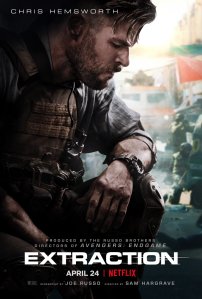 The new Netflix action movie Extraction is based on a graphic novel, co-authored by the Russo brothers, starring Thor himself Chris Hemsworth, and directed by longtime stunt choreographer Sam Hargrave. It has quite a pedigree, and after the wild success of the John Wick series, I’m genuinely excited to see what kind of action stuntmen-turned-directors can unleash. The best thing Extraction has going for it is its brutal, fluid, and immersive action sequences, including an extended sequence meant to convey a single take of relentless intensity. Unfortunately, that’s about the only thing this movie has going for it. The plot is very formulaic, with Hemsworth being brought in to retrieve a high-value target and then being betrayed, having to go on the run to protect the son of an imprisoned Indian mob boss. Hemsworth’s character is also haunted from personal tragedy and reluctant to get back into the fight, yet this final stand could allow him a late attempt at redemption for a lifetime of bloodshed. What I’ve just described could be a hundred other movies, minus the particulars of the Indian mob boss. The characters never really pop, even Hemsworth. The kid he’s tasked with saving never seems to get a moment to shine, to present a personality, or even a sense of growth or toughness. He might as well be a low-grade A.I. in a video game escort mission. The relationships don’t seem to matter. When it’s pumping, the action has an immediate appeal and Hemsworth acquits himself nicely with the more complicated fight choreography and stunts. As I kept watching, something didn’t quite feel right, and then it came to me. This movie doesn’t work from a tone standpoint. The John Wick-style action, glorifying in the fun and gory nature of slick violence done smoothly, conflicts with the setting and wider story of Extraction, namely the poverty-drenched streets of Bangladesh with child assassins thrown into duty by villainous gang leaders. It feels like you dropped John Wick into the searing reality of City of God, and the two styles of violence, and their larger social implications, do not really mix without uncomfortable consequences. It doesn’t help that so many of the characters just seem blank and replaceable. If you can ignore those misgivings, Extraction can offer some enticing thrills and above-average fight choreography.
Nate’s Grade: B-
Share this:

Among Them (2019)
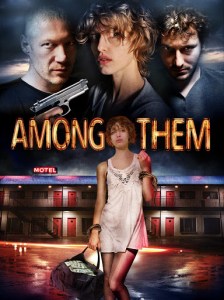
Among Them was described in its advertising as “Tarantino meets Bad Times at the El Royale,” and ignoring the fact that Bad Times is itself a colorful Tarantino-styled homage, what I was really reminded of was Waiting for Godot. For those unfamiliar with Samuel Beckett’s existential play, it follows two gentlemen who do nothing much more than waiting for a man named Godot who never shows up. They get involved in philosophical discussions, and many have intuited that Godot is a representation of God, to Beckett’s dismay, but it’s really a two-act play that involves a whole lot of waiting and the question over why. This is the extent of Among Them’s 90-minute total – a lot of waiting and a lot of questions over why bother.
Two bank robbers, Mick (Dan Liebman) and Harry (Jonathan Thomson), are hiding out in a motel room off the coast. Their bank heist has gone wrong and they’re awaiting the proper papers to escape overseas under new identities. They also discover a woman, bound and gagged, inside the trunk of their getaway car assigned to them from their bosses. Syd (Evalena Marie) could be a liability and they need to make sure she doesn’t get them caught.

The problem with the screenplay by director Kevin James Barry (Serena and the Ratts) and co-star Marie (Dark Haul) is that it has conflated being vague with the idea of being mysterious. There’s far too little going on in this story and far too little that makes much sense. Our criminal duo is following instructions to lie low at a motel. That’s it. They don’t really know who they’re working for, what those plans might include, and so they wait for some unknown source to finally give them their new passports to escape from the police. Being kept in the dark with your characters can be a benefit for storytelling because you are forced to think things through at the character’s level, which works nicely for paranoia thrillers and mysteries. However, when you don’t put in the necessary work, it just makes the story feel unfinished and pointlessly protracted.
I can clearly see the Tarantino elements that the filmmakers attach to Among Them, the bank robbers hiding after a job gone wrong, the kidnapped character becoming part of the team, the motel that might not be all that it appears to be, but these are just elements. What’s desperately missing from Among Them is the intricate plotting and superb characterization one comes to expect from a QT joint. If we’re going to be stuck with these characters in a confined setting, then we need either intriguing developments or engaging personalities that draw us in. Well, considering the story involves characters just waiting around a motel room and seeing weird ghostly visions, plot development isn’t going to be the winner. This is really where Among Them creates an artistic ceiling for itself with its bland characters who we’re stuck hanging around with. Neither Mick nor Harry are charismatic, interesting, or even that dangerous. There aren’t even that many differences between them. If you’re keeping characters cooped up, it would be smart to have some sort of interpersonal conflict that threatens to boil over and ruin things. Think about From Dusk ‘til Dawn and Tarantino’s character and his creepy fixation on an underage hostage, or the different agendas in Bad Times. Just because the characters are seemingly losing their minds doesn’t replace dynamic and necessary characterization.
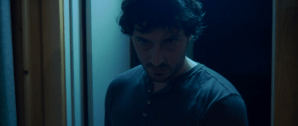
This brings me to the character of Syd, whom I do not understand at all. She’s discovered in the trunk of a car that was designated for our bank robbers. You would naturally think this woman either means something important enough to be captured or presents an intriguing enigma. This is another consequence of keeping everything so overwhelmingly vague. The characters don’t seem too bothered to learn more about her and why she was placed in the trunk of their car, which just seems like a criminal lack of curiosity on their part. Even worse, Syd doesn’t seem too interested herself why she ended up in somebody’s trunk. I figured she would want to run away at the first opportunity, but she doesn’t, and instead just hangs around with the guys, eagerly volunteering to help on their “spy missions.” If her perspective was going to be off kilter, then this could have opened up the character more, making her a wildcard who could take things too far, perhaps provide a dangerous threat to the characters achieving their goal, something. The fact that a bound stranger is gifted to them and they don’t have to thwart her from escaping feels bizarrely wasted. Why even bother with this scenario if nothing is to be done with it after twenty minutes?
Among Them fills its meandering runtime with unexplained supernatural imagery and dream sequences, which don’t so much convey the unique emotional trauma of the characters as it does serve up conventional spooky imagery and pad the running time. I held on waiting to see if there would be a viable explanation for everything, and I was left waiting unfulfilled, much like the main characters. I think the filmmakers were trying to get the audience to doubt what they watched, and show the characters are descending into madness, but it also doesn’t quite work. There isn’t an escalation for them. They don’t seem more unbound as things progress. These eerie visions don’t lead them to make drastic choices, though the movie comes close. Therefore, it just feels like a supernatural presence is messing around with people in a vague and unsatisfying manner because it, too, must be bored. It feels like weird things are happening to goose up a narrative that doesn’t have enough conflict or engaging characters.

From a production standpoint, Among Them looks relatively solid for a low-budget thriller. Having a limited location works for an indie production and the director seems to use every part of his space to keep things from getting visually dull. The acting is overall decent with the standout being Marie as a frightened victim who becomes the most interesting character among the three. Another actor worthy of note is Michael Reed (Chupacabra Territory) as the creepy motel clerk who is, from the get-go, clearly hiding something nefarious about his intentions.
Among Them is a fairly pedestrian thriller that had potential to be something more but is trapped by a stunning lack of imagination and intrigue. There are questions to be had and mysteries to be uncovered, but the subsequent supernatural twists and turns amount to distractions. The screenplay is absent memorable characters with complexity, conflict, and even colorful personalities to make spending all this free time with them something other than a chore. I never really knew what was happening and the characters didn’t seem too eager to find out either. Among Them is more a listless experience than a painful one, a tale that doesn’t ever seem to get started despite some surefire story elements just sitting there. If you’ve ever wanted to watch a disappointing 90s indie crime version of Waiting for Godot, then Among Them is chief among them.
Nate’s Grade: D+
Share this:

The Platform (2019)

What better time to Netflix and chill than when the state is demanding it? I recently watched The Platform, a Spanish sci-fi flick steeped in mystery and metaphor. Get ready for what could be dubbed “a vertical Snowpiercer.”
Goreng (Ivan Massague) wakes up in what looks like an endless stone tenement building. There are two people per floor and a large hole in the middle of the room. The food arrives via a descending platform that begins as a feast. Each floor has two minutes to eat, cannot hoard any food, and will have to subsist off what those above them left behind. Goreng’s floormate, Trimagasi (Zorion Eguileor) is one month away from being released from his time. He also might be losing his mind and definitely resorted to cannibalism before. Goreng has to decide what lines he’s willing to cross in order to survive and also to protect others.
The metaphors for The Platform are very heavy-handed and obvious but that doesn’t mean they aren’t effective in their blunt force. It’s a literal dystopian tower of human beings with the lower floors eating off the spoils of those residing above them. There’s only so much to go around but charity isn’t on the mind of too many of the residents. Better to feed when you get an opportunity than worry about who comes after you. Goreng asks about trying to talk to the neighbors above and below and this notion is scoffed at by his floormate. The people above will not talk to them because, simply, they are beneath them. The ones below Goreng and Trimagasi? Who cares, they’re beneath and thus inferior. Trimagasi takes a wine bottle and smashes it rather than let the men below him have it. Why perform this spiteful action? “It’s what’s been done to me,” he says without irony. I’m reminded of the reticence some have about easing student debt and other penalties; “I had to suffer, so why should these people not have to suffer the same?” The disregard seems to fluctuate depending upon how close one becomes to the prized top floor. Every month the inhabitants will randomly change floors, so someone who was closer to the top must now reconcile with being lower, and the food only goes so many floors before it’s picked clean. This perspective of being on the bottom doesn’t so much alter behavior as engenders a ravenous sense of “get what you can when able” to pervade. The people so many floors down will simply never even be granted the opportunity to eat unless those above change their consumption habits and sense of empathy. Nobody even knows how far down the floors go. 150? 250? More? Where is the proverbial bottom?
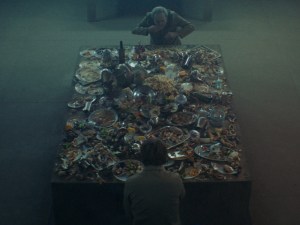
The story is kept in a vague explanation but that doesn’t stop the fun. We enter with Goreng and learn as he does what this place does to its people. He learns the rules of this new reality which is part dystopian prison, part game, part experiment. The stated utility of such a place is rather hard to fathom, so it’s best that screenwriters David Desola and Pedro Rivero keep the action confined to simply exploring the world within the vertical structure. There are a handful of flashbacks showing the interview process to enter the facility (Trimagasi is shocked to learn his floormate volunteered to enter such a place) but they are brief and could have been excised. This is one of those sci-fi conceits like Cube where the location is the story and simply learning more about how the day-to-day operates, its rules of functioning, its punishments, and the dangers is where the real draw of the story comes from. With the monthly reallocation, the movie keeps things interesting by dramatically changing Goreng’s standing. Just as it feels like he’s understanding his surroundings, they change, and force him into a new dilemma. When he’s stuck on a far lower floor one month, will he resort to cannibalism to survive? When he’s high above, will he use his fleeting power to enforce some social justice on the floors below, ensuring that lower floors get an opportunity to dine by rationing the food? Each new placement keeps things interesting and challenging for our protagonist, which is what good sci-fi should do.
Because of its general vague nature, The Platform relies more upon the strength of its ideas, metaphors, and discovery than on its structure for answers. There really isn’t an ending here. There is an end but it’s more symbolic and implicit than definitive, which makes sense considering that the preceding 94 minutes is running off metaphor and mystery primarily. The last act becomes either a foolish or brave attempt to make a difference despite the unique conditions of the location. The characters have theories and rumors, as well as a nagging suspicion that something has gone wrong from the original design, but they don’t know like the rest of the audience whether or not change is even possible from above. The ending is pretty open-ended and left to interpretation whether or not this attempt would even be recognized. Do the people who engineered this whole experiment/prison really care? It can spark discussion with friends but it’s also a development that might leave as many viewers unsatisfied by the lack of substantial answers or anything that can be viewed as definitive. Much like Cube, the space just carries on with more bodies and that invites sequel potential as well as a feeling of inertia that could also frustrate.

It’s a very limited space to work with but director Galder Gaztelu-Urrutia has style to spare. The general claustrophobic setting is played to fine effect but the bizarre touches are what makes the movie feel almost like it was ripped from the world of anime. The floating table, so affectionately adorned with fine foods and platters, is such a startling central image. The red-light late-nights conditioned me to be on edge because of the danger of the flying platform returning. The gore is sporadic but very effective at ratcheting up the suspense or horror. There’s also the subtle visual comedy of discovering as we travel from floor-to-floor the personal items each inhabitant has brought with them for their extended stay. I loved the absurd nature of some of them, like a surfboard or a child’s inflatable pool. Why would people bring these items?
I’m glad Netflix is able to bring small, strange, foreign movies like The Platform to, arguably, the biggest audience platform in the world. It’s an easy movie to plug into because there is much to unpack and learn. I was never bored throughout its brisk 94 minutes. Even as the movie’s metaphors are heavy-handed, the movie doesn’t become so in execution. It’s operating on a pure level of discovery and rejecting the status quo. There is plenty of room to score easy connections with its thematic interpretations but the movie still just works even as a collection of vignettes in a very strange setting. It’s not in the same level of ambition as Snowpiercer but I’d place it on par with the byzantine Cube series. The Platform is an enjoyable movie that may not be rich in much than its themes and mystery, but during our national time of need, 94 minutes of well-executed weird can be just enough to satisfy the soul.
Nate’s Grade: B
Share this:

Fantasy Island (2020)
 I wasn’t expecting to become a defender of Blumhouse’s much-reviled remake of 1970s TV staple, Fantasy Island (it currently has a 7% fresh rating on Rotten Tomatoes) but this year has been defined by surprises. I’m not going to say that this is a good movie but turning a cheesy TV drama into a horror thriller that might as well take place on the magical island from Lost, I have to admit that’s a daring approach and it almost works. Michael Pena is miscast as a villainous Mr. Roarke who invites a group of strangers to a beatific island resort to have their fantasies come true be they hedonistic (wild parties with sexy guys and gals) or vengeance (Lucy Hale getting even against a high school bully) or regret (Maggie Q saying yes to a proposal and starting a new life). At first the fantasies seem too good to be true and then the darker reality comes forward, forcing many characters on the run. I was very happy that the filmmakers, the same creative team behind the equally-reviled Truth or Dare, present the proceedings as being clearly supernatural and stick with it. I was expecting some hackneyed explanation of how it was all a show, or a simulation, or some kind of televised event for the rich to gamble upon, but the movie stays supernatural to the end as if it is the Lost island with its weird secrets. Because of that scenario, even when the rules of the island and the final scheme comes to light as to whose fantasy all of this pertains to, it’s a forgivable level of convolution. There were moments I even had fun, mostly just seeing how crazy and far away from the source material everything can get. It felt like if someone was ordered to remake The Love Boat and came up with Ghost Ship. It’s just fun how different it can go. I didn’t care for any of the characters outside of Maggie Q, who gets the best acting showcase as a woman with many regrets who is trying to ignore her misgivings. Hale seems to be playing a character ported from the Spring Breakers universe (what a dreadful thought). Michael Rooker (Guardians of the Galaxy) appears as a grizzled veteran of the island. Even when things aren’t working, like black-eyed zombies or much of the comedy, I wasn’t ever bored. How crazy would things get next? How would they tie this all together? Fantasy Island is not the horrible experience critics claimed earlier this year. It’s not a great movie but it works as silly escapism, and during a time of pandemic-initiated quarantine, a little silly escapism might just be what you need for a couple of hours.
Nate’s Grade: C+


You must be logged in to post a comment.