Blog Archives
Black Mamba (2019)
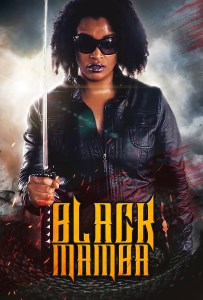
William X. Lee is an Ohio filmmaker who has found credible success on his own terms and over decades, a fact that deserves celebration. The writer/director knows the business of filmmaking as a genre specialist and has even become an adjunct professor of film at two different universities. With his many years on the fringes of the indie business, I expect Lee has a lot of wisdom about the particulars of the industry and finding a market that is welcoming to content that can be messier in execution. His latest movie in pre-production is called Bulletproof Jesus and, sight unseen, I legitimately love that title with my every fiber. His 2020 film, Black Wolf, literally involves a 58-year-old man having to track down and kill his high school bullies, all of whom miraculously grew up to become terrorists. That sounds hilarious. I believe Lee’s personal story is compelling and acknowledge that genre filmmaking could use more voices and visions from under served perspectives. However, the results on film show indifference or even disdain for accessible storytelling and entertainment value. Black Mamba is a 2019 supernatural action revenge available on Tubi, as many of Lee’s films currently are for free, and it’s indicative of the man’s sense of style and storytelling, both of which I have plenty to talk about in excrutiating detail.
Kyiera Stone (Angela D. Williams) was killed by local criminals. She’s brought back to life by angels who give her a second chance to exact revenge. Kyiera is pitted against an endless assembly line of villains that all want to return Kyiera to her state of decay.

I may sound like a scold, but it is near inexcusable that this movie is two hours long. Far be it from me to instruct a creative how much time they need to tell their story, but you have to think about an audience when you intend a platform for your efforts. What is going to keep someone glued to that screen and justify their investment in every one of your minutes? This is the kind of movie that can barely creak over the 80-minute feature-length finish line, and to push forward to two hours is excessive without an engaging story that needs that extra room to grow.
There is no real plot to speak of beyond our main character coming back to life to wreck vengeance. The movie is patterned after Quentin Tarantino’s Kill Bill, itself patterned over hundreds of genre movies, but it’s like Lee said, “Well, why stop with five bad guys to overcome when you can have 100!” Black Mamba (also the code name for the lead in Kill Bill) is stuffed to the breaking point with villainous characters and some of them are even being introduced with ten minutes left. The critical hit involves like a half dozen bad guys, and then there are more bad guys, and then hell is introducing its own bad guys, and then there’s like a fighting champion from hell, and witches, and I stopped caring because every scene played out exactly the same. The settings may vary, the person might be different, though with a cast list of rogues as long as this one good luck keeping them straight, but the scene plays out exactly the same. Some evil character gets the jump on Kyiera and within a minute she will kill them. That’s it. That’s all there ever is in these confrontations, many of which are hilariously short-lived. At no point will you fear or doubt Kyiera because she never seems to be in danger of losing. It makes the entire two hours extremely boring and repetitive. It also makes the majority of its two hours expendable. Rare is a two-hour movie where I could legitimately say that you could cut it down by 90 minutes, and yet that is the case with Black Mamba. It’s a movie of treading water.

Some of this could be mitigated by providing characters with big personalities, memorable flaws or quirks, or even interesting killing utensils, but Black Mamba feels more like a ramshackle improv fest where actors are entering scenes as “characters” with props or costumes they just assembled off-screen. I love genre movies and I love the way characters can be written for genre. Watch the TV series Justified because it is a masterclass in writing for character. Every character, even the bit-part villain of the week, is written with a distinct voice, an identifiable trait, an angle, something to make them stand out and feel more like a flesh-and-blood person in the stylized, hard-boiled universe of the show. The movie’s extended running time could have devoted scenes to showing why we should fear certain characters, their killing techniques that we would then anticipate seeing how they are applied to our heroine. Think of every movie you can with crazy killers and you see them apply their killer skills early because that’s how you get to fear them. Just being told, “so and so is deadly,” without seeing them in action is dull. In Black Mamba, often characters are over explaining things for the sake of the audience or seeming to narrate what is happening on screen. The dialogue is filled with profanity because it feels like nobody knew what else to say from scene to scene. There aren’t any tense exchanges and showdowns or clashes of viewpoints. It’s all just yelling, boasts, and non-clever insults.
The story doesn’t make much sense. There are angels that bring back Kyiera because it’s “not her time,” but then they want to use her in a celestial war? Was she lied to by the higher authorities in order to manipulate into an ongoing and endless war between heaven and hell? Is this a high-concept version of Munich and Kyiera is being used to perpetuate endless conflict regardless over culpability? No, well at least I doubt it. The larger workings beyond our heroine are left vague and seemingly shifting. The first thirty minutes could have been consolidated to ten to introduce the premise of Kyiera dying and being resurrected, but then there’s nary a section that couldn’t be consolidated, like the litany of interchangeable supporting characters.

Can you tell there are three people in this scene?
Halfway through the movie, we suddenly jump to hell and it doesn’t really alter the direction of the story but only provides more witnesses to commentate on the action. This is where Esmerelda comes in. She’s the queen of hell and played by Dawna Lee Heising, a 65-year-old actress who got her (un-credited) start as a stripper in Blade Runner and has a long list of campy T&A roles in low-budget genre fare. She feels like the production’s big “get” and so she gets a lot of unnecessary screen time. The character is annoying and the entire addition of hell as an environment feels tacked-on. I thought I knew who the big bad final boss was, and then hell is introduced with its own cadre of damned killers, and I didn’t know who the final boss should be. There’s no feeling of a direct line for Kyiera’s goals. Think again to Kill Bill as a prominent example. She had a small list, each name crossed off brought her closer to her biggest target, but each became harder to accomplish and more personally reverent as she climbed the ladder of revenge. There was a feeling of progression and payoff as The Bride worked through her bloody vengeance. With Black Mamba, she’s inundated with one face after another, but you never feel progression because the movie only feels like it’s stuck in a Sisyphean loop of disposable foes. The structure of this movie doesn’t have the groundwork to provide forward momentum.
The first thing you’ll notice about Black Mamba right away is the choice to up the contrast so high that it may hurt your eyes at time. There are times where the color contrast is so extreme that it obfuscates what is happening on screen. You’ll see faces disappear into shadow in a room, and not in a way that feels intentionally ominous, and every time a character is driving outside it looks like an atomic bomb is going off in the background. It’s chiefly a distraction and an ugly one and one that feels like it was done to make the footage look more like a grungy grindhouse movie of old. Going for a specific visual aesthetic is a fine marker, but when it harms the clarity of what is happening then maybe it’s worth revisiting. There are simple things that could have been done to better orient the viewer. The color contrasts and color palette could have better been paired with specific locations so that the audience knows exactly where they were or whose story they were following, much like in Steven Soderbergh’s Traffic. We even literally have the denizens of hell as one frequent setting, so why not crank the contrast high and more fiery in colors, favoring oranges and reds, and then go for a cooler color palette for action on Earth? Or even have a section that isn’t contrasted to death? It’s a stylistic choice that grates severely.
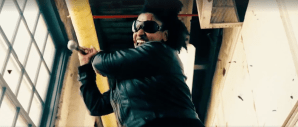
I would be forgiving of some of the obvious technical limitations for a low-budget indie aiming for the feel of other classic low-budget indies, except that, reportedly, Black Mamba had a budget of $250,000. When I read that I burst out in incredulous laughter. Maybe it was a decimal error, or maybe Lee was very generous and paid his sizeable cast and minimal crew handsomely, or maybe there are other reasons why a quarter of a million dollars does not, in the slightest, look to have been translated onto the finished product. Where did all that money actually go?
I’ve been watching enough micro-budget indies in my pursuit of reviewing homegrown cinema that I feel more adept at better gauging a potential budget. There are locations to consider, though Black Mamba seems to reuse a lot of empty warehouses, alleyways, and church parking lots, and there is action to consider, though Black Mamba uses a lot of plug-in special effects and limited fight choreography, and there are actors to consider, which Black Mamba has in excess, and there is the general professionalism of the look and sound of the movie, which Black Mamba is definitely lacking. There are persistent sound issues (the louder yelling is so screechy and high-pitched that I had to cover my ears) and there is a dearth of editing coverage. Apart from the fight scenes, it feels like every scene was designed with one shot in mind to connect directly to the next. This can make things awkward in conversations that would flow better with alternate angles rather than one person with their back to the camera or in extreme close-up. I geuss it just didn’t matter or they didn’t have the time, and yet with the budget being reportedly a quarter of a million dollars? This movie feels far more like a $10,000 budget indie than $250,000. To be blunt, I have watched movies with budgets under $15,000 look and sound much better than this quarter-million-dollar movie.
I thought about watching other Lee original movies available on Tubi but I only watched about 15 minutes each of 2017’s Six Feet Below Hell, 2016’s King Killer, and 2008’s Kill Every Last One. I don’t think I could take watching all of these movies even for objective review purposes, each of which appears to have the same faults and high contrast value as Black Mamba (one of those films is an astounding 133 minutes long!). While designed to be sold, these movies do not feel designed to actually be watched and enjoyed. There are no real characters to fall in love with, conflicts to draw intrigue, or well-developed plots to thrill and surprise. These movies feel like empty product to line an endless array of schlock DVD shelves.

This brings me to my final complaint registered at Black Mamba. More than halfway through the movie, yet another character is introduced, this time a formidable fighting champ from hell. Upon hearing the man’s name, the queen of hell falls onto the floor and begins gyrating in pleasure, moaning the man’s name and declaring him to be an amazing god among men. This character is played by none other than… the writer/director himself. I almost walked away from the movie at that point. It’s difficult to critique something like Black Mamba. The people involved don’t seem to have any aspirations that what they were making was serious, and yet maybe they should have taken it more seriously. Because of the punishing two-hour length, because of the repetitive and stretched thin plot, because of the over population of unmemorable and disposable characters, because of the technical flaws that still persist after a decade of filmmaking, because of the lack of accessibility for providing an engaging story and characters for an outside audience, and because of its reportedly sizeable budget, I regret to deliver my first failing grade for an Ohio-made indie. I wish Mr. Lee and his team well but this is assuredly a case where if you’ve seen one of the man’s movies, you’ve seen every one of the man’s movies, and unless you were in these movies, you shouldn’t watch them even for irony.
Nate’s Grade: F
Share this:

Luca (2021)
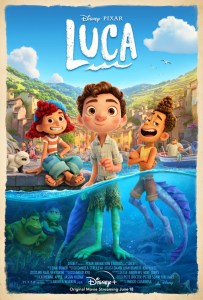 Pixar’s second straight direct-to-Disney-plus outing, Luca, is a decidedly lesser movie from the creative powerhouse. It’s more in keeping with the low stakes and minimal characterization of something like the Cars franchise or Monster’s University. It has its gentle charms and important themes about acceptance, accessibility, and identity, but Luca feels a bit too shallow and lacking in magic. Two sea monster boys want to feel the thrill and freedom of living on land, and it just so happens they transform into looking like humans as long as they don’t get wet. They must learn the ways of blending in, keep their secret, and win the local triathlon to achieve their dream of owning a Vespa scooter. Yes, ostensibly it’s about two kids, and a third once they become friends with a rambunctious redheaded girl in town, wanting to win a race to get a scooter, and you can see the larger theme about friendship and self-acceptance in the name of intolerance, but the movie feels like Ponyo meets The Little Mermaid with the setting of Call Me By Your Name (with maybe some of its coming-of-age queer coding?). The movie barely gets to 84 minutes long, pre-credits, and even that feels very lackadaisical and padded, stretching a thin storyline with minimal development. The animation is expectantly gorgeous and colorful, the lovely daubs of light are so soothing to watch, though I didn’t care for the Gravity Falls-style character designs. The stakes are low and personal but I didn’t really care about the broad characters. There are some fun farcical hijinks trying to hide their monster selves from being seen, and the conclusion has a sweet message without being overtly sentimental, but Luca is little more than a fitfully amusing yet slight seaside vacation for your hungry eyes.
Nate’s Grade: B-
Share this:

The Conjuring: The Devil Made Me Do It (2021)
 Three movies in, plus four spinoff films and more on the way, and The Conjuring franchise is losing some of its luster. The original director, James Wan, is still involved in an advisory capacity but his absence is felt in the director’s chair, not that The Devil Made Me Do It is poorly directed by Michael Chaves (Curse of La Llorona), but it’s starting to feel stale. The Warrens (Patrick Wilson, Vera Farmiga) are a husband-and-wife team of paranormal investigators traveling the country and solving 1970s/80s mysteries. This third entry feels the most like an expanded episode from a TV series, like X-Files, and maybe that’s because of its inherently procedural nature. The Warrens are defending a young man accused of murder but who says, as the subtitle describes, that he is not guilty by reason of demonic possession. From there, the Warrens are investigating to prove the demon exists and then trace its demonic history. The scares are low although the intensity feels cranked just as high; there are lots of scenes of gale force winds, shattered windows, characters yelling, and loud music. I miss the perfectly executed Old School horror sequences that were the hallmark of the earlier movies. It set up its rules, wound up the scene, and you just squirmed in anticipation. This franchise has never been revolutionary but more an expertly polished and honed tension machine. However, when the calibrations are off, then the franchise has even less going for it. There are some interesting ideas and elements, like Lorraine (Farmiga) being able to see from the eyes of the demonic killer, but the franchise feels more repetitive and stalled, with multiple exorcisms and Ed (Wilson)’s health being a motivating factor for his wife to prevent, again. The supporting characters are bland or broad and the mystery itself isn’t that interesting, nor is the ultimate villain. In the realm of Conjuring as weekly TV show formula, this feels like an acceptable middle episode with the expectations that they can improve the next week. The “based on true cases” selling point is also starting to grate in light of the reality that a man blamed his own actions on the devil and these controversial people sought to exonerate a murderer. The real-life version is morally abhorrent. The junky horror version can work as long as it doesn’t take itself too seriously. If the other Conjuring movies were gourmet entries, then this is more the fast food version. It may still satisfy fans but it’s definitely not as well made and with questionable ingredients.
Nate’s Grade: C+
Share this:

Wolfwalkers (2020)
 Beautifully animated with painterly water color visuals, Wolfwalkers is another treat from the acclaimed Irish studio that is single-handedly trying to bring back hand-drawn animation. The visuals are a delight and styled in a flat dimensional space reminiscent of Medieval tapestries (and Wes Anderson movies). The story brings to life 17th century Celtic mythology in a way that is still relevant today and concerns weighty themes about family identity, female independence, religious persecution, prejudice, colonial occupation and exploitation, and environmental conservation. It’s part Miyazaki and Brave and also reverent to its own cultural heritage, and it’s emotionally affecting and engrossing as well as being a treat for the eyes. We watch a young girl befriend a wild “wolfwalker,” a girl who can transform into a wolf when she sleeps. their bond will push each other to fight against forces trying to dominate the forest and morality. The filmmakers have carefully laid out the rules of their story and the implementation of the special powers so that everything happens through gradual circumstances where the plot feels as if it is following an entirely organic path. The voice acting is excellent and heartrending and perfectly paired for the exaggerated, wood-block-styled character designs. It’s a lovely and entertaining supernatural fable with enough thematic relevance, girl power, and visual grace to reaffirm just how magical traditional animation can still be.
Nate’s Grade: A-
Share this:

Mortal Kombat (2021)
 Mortal Kombat is video game royalty, and if you were a Millennial that grew up in the 90s, then you likely have your own personal connection to this bone-crunching franchise. Released in 1992, the halcyon decade of fighting games, the arcade game gained notoriety and parental infamy for its photo-realistic fighters and for the over-the-top violence. Players could finish off their opponents in brutal and bloody fashion, drawing the condemnation of parents and politicians and only making teenagers want to play the games even more. I can recall my disappointment over the Super Nintendo port of the first game lacking the blood and gore of the arcade, something my Sega Genesis friends could lord over me with their faithful port (there was a code where you could turn the copious amount of sweat red, but it wasn’t the same). This was corrected with the release of Mortal Kombat II, and I think I devoted two whole years of my teenage life to playing that game, memorizing every player’s special moves and deadly finishes. I never really kept up with the franchise after the third game, and from what I’ve seen with the newest versions, I can safely say they just aren’t for me anymore. The gore of the 90s games was campy and ridiculous and the gore of the current games is too medically graphic for me (I’m not alone; apparently the game developers also needed therapy as they suffered trauma from their research and detailed recreation of the intensely destructive violence upon human bodies).
 I can recall seeing the 1995 Mortal Kombat movie at the local drive-in with my friend and fellow fan of the franchise, and we lapped it up eager to see any live-action version of our video game obsession. We were so excited and ignored the faults of the film, and we weren’t alone. It gained the reputation as one of the “better video game movies,” which is a criminally low bar to clear. I never watched the 1997 sequel, Annihilation, but it’s widely regarded as a so-bad-it’s-good farce and definitely an insult to fans of the games. From there, fans have been savoring the day another Kombat film could find its way to the big screen, something to wash away the taste of the cheesy 90s movies that were both PG-13 and lacking the signature gore of the series. The new 2021 Mortal Kombat movie is firmly rated R and is chiefly made for the diehard fans. It’s a fun and bloody movie with some flaws, but I don’t know what more I should have expected from a franchise that, from its very beginning, has literally spelled “combat” with a K.
The plot is straightforward for a game centered around a super-powered inter-dimensional fighting tournament. The Outworld has won nine tournaments in a row and with one more victory they will gain control over Earthrealm. Sorcerer Shang Tsung (Chin Sun) is the ruler of the Outworld and has the bright idea that if he kills all of Earth’s chosen fighters ahead of time, it will make his next tournament victory that much easier. He sends powerful assassins to Earth to locate the Chosen One, an MMA fighter named Cole Young (Lewis Tan) who doesn’t know he’s the descendant of a destined family line of warriors. Cole is taken under protection by Sonya Blade (Jessica McNamee) and Lord Raiden (Tadanobu Asano), where he is trained to reach his true potential. He needs to unleash a hidden superpower to compete with the best of Outworld.
First off, if you’re looking for a Kombat movie that is faithful to the atmosphere of the games, then you should walk away happy. Nobody is going into this movie and expecting Oscar-level material. We’re here for the fights, the crazy characters, and the gasp-inducing gore effects, and to that end the third film incarnation of Mortal Kombat mostly delivers the goods. Compared to the 1995 movie, populated with majority white actors with varying degrees of martial arts skills, and “varying” might be charitable, this is a clear winner. These are actors here from The Raid, Wu Assassins, Into the Badlands, The Twilight Samurai, Mongol, and plenty other worthy martial arts spectacles, so the filmmakers clearly valued having actors who could credibly perform the complex fight choreography. It’s also worth noting that we have Asian actors playing Asian characters, so that’s a bonus for authenticity and reverence as well.
 The opening six minutes of the movie really sets up how serious and potentially great it can be. It’s the early 1600s, and we’re introduced to the quiet family man, Hanzo Hasashi (Hiroyuki Sanada), a member of a Japanese ninja clan that is being hunted by Bi-Han (Joe Taslim), a dangerous warrior from a rival Chinese ninja clan. The opening is patient, thoughtful, and eerie, and when the fighting breaks out it’s done in longer takes where we can watch the actors strut their physical stuff. The fighting makes specific use of each character’s skills and is a satisfying start. The movie never quite lives up to these artistic heights again, at least for a sustained duration, but this taste of a legitimately good Mortal Kombat movie is enough to make you believe we can return here again.
The rest of the movie is decidedly fun and clearly doesn’t take itself too seriously (they even make fun of the “combat” with a K spelling). It’s got characters that can shoot lasers from their eyes, invisible monsters, four-armed strongmen, metal arms, and just about every character introduction is another opportunity for the movie to shrug and just accept its inherent weirdness of its rogue’s gallery. There’s a lady with dinosaur wings and another guy with a really sharp hat. What you want is for the filmmakers to present a world where these characters work, something that didn’t succeed with the goofy 1990s movies. I think the script by Greg Russo and Dave Callahan (Wonder Woman 1984) accomplish this feat and presents a world that finds a credible middle ground between campy indulgence and self-serious blather. It’s serious enough to not break out into derisive laughter but it’s still not too serious that the filmmakers have forgotten what the audience has paid to see. The gore effects are sticky and impressive and gross without being offensively so. The creative process for this movie was likely crafting a list of all the red-strewn finishing moves from the games and figuring out how best to squeeze them into the royal rumble. Every character gets a signature move, along with plenty of clunky catchphrases also crammed in for fan approval. If you’re a fan of the games, they’ve designed this movie with your demands primarily in mind.
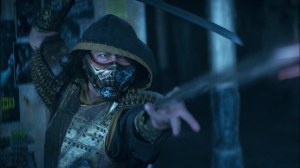 Where the movie falters are with decisions of pacing, structure, and some editing. Centering the story on a newcomer seems odd when any other established character could have sufficed, until you realize they’re setting up Cole Young to inherit the legacy of his ancestor and likely become the Scorpion we know so well from the games. Except that’s not quite what happens, which makes the decision to center him as an entry point perspective more confusing. It’s not like Cole is that interesting on his own. He’s a boring MMA fighter who wants to protect his family and that’s about it. He needs to summon his special power, and when he does, prepare to be underwhelmed. Another issue is that the second act is far too long and protracted. It’s mainly comprised of training exercises and people being told, “You’re not ready,” and vague force fields and teleportation powers that invite questions over whether they could have been used earlier. It’s too much training without the bloody reward of the gnarlier fights. This leaves the final act to be rushed and many of the climactic one-on-one fights are pushed into a measly montage. Finally, the editing of the fighting can become too choppy and jumbled to fully appreciate the onscreen action. The opening sequence is an example of where careful edits can highlight the choreography.
The new Mortal Kombat movie is fun, cool, bloody, and probably exactly what diehard fans would hope for from a big-screen rendition. It’s ridiculous but not tongue-in-cheek in tone. The visuals and special effects can often be weirdly beautiful especially with the crystalizing powers of Sub-Zero, the game’s popular ninja with the power to freeze and create deadly daggers of ice. There are some standout “wow” visual moments, like when Sub-Zero freezes a bullet firing from the blast of a rifle, or when he freezes his opponent’s spurting blood to form a knife. There were as many moments that brought a smile to my face as made me check the time. The dialogue is flat and the only actor who seems to really be enjoying himself is the proudly profane Josh Lawson as Kano. But when it comes to the fighting, the fatalities, and the franchise’s glorious selling point, it might not be a flawless victory but it’s still a victory nonetheless for fans.
Nate’s Grade: B-
Share this:

Thunder Force (2021)
 I feel like we were just here a matter of months ago, another aimless Melissa McCarthy comedy vehicle written and directed by her husband and chief enabler, Ben Falcone. With Thunder Force, McCarthy becomes an accidental superhero and that premise should be enough with this star to power a silly and amusing 90 minutes of entertainment. Once again it’s a dispiriting comedy that feels like it’s just sitting around and waiting for the performers to find something funny in their scenes and family-friendly improv ramblings. The energy of this movie is completely slack, and scenes feel adrift, lacking proper direction or purpose. The whole movie feels gassed and grasping. It takes 45 minutes for McCarthy to train to be a hero and sometimes there just aren’t jokes. Take one instance where McCarthy literally throws a bus, a point strangely referred to multiple times earlier as a setup for this long-desired moment, and then under Falcone’s uninspired direction we don’t even see the messy results. We don’t even see the bus crashing into, like, an orphanage or something that would provide an actual punchline. The comedy malpractice can be staggering. It’s the kind of movie that resorts to characterization where everything is clumsily reported to us, like, “You’ve always been this way since…” The chemistry between McCarthy and Octavia Spencer (The Witches) is lukewarm at best for these longtime friends. The buddy comedy doesn’t even seem like it was developed beyond its initial pitch. The shining light of this movie is easily Jason Bateman (Ozark), who plays a crab-armed mutant criminal that becomes an improbable romantic suitor for McCarthy’s character. If there is anything that made me laugh, it was related to this character (and an ordinary henchman named Andrew who may or may not be targeted as the next to get killed by his evil boss played by Bobby Cannavale). I even loved the simple image of Bateman crab walking off screen with his arms in the air. The sheer weirdness is enough to make you realize what potential could have been tapped with this super premise and with McCarthy, who can be so charming and disarming when she gives into her odd impulses. Just give me a full movie where a middle-aged superwoman tries to make a relationship with a crab-man super villain work. I wish that Thunder Force had more courage to chase its weird rather than settle, time and again, as an action comedy that is middling with its action and middling with its comedy. I think I had more fun with 2020’s Super Intelligence, another mediocre Falcone collaboration.
Nate’s Grade: C-
Share this:

Slaxx (2020)
 You would imagine a movie about a possessed pair of pants would be outrageously entertaining, and yet the Canadian horror comedy Slaxx is too stretched out and made from conflicting material. This movie needed to be more… something; more ridiculous, more exploitative, more gory and over-the-top, more satirical. It feels like a lost Tales From the Crypt episode that is over-extended and repeating the same points and carnage over and over. The haunted pants are unleashing a trail of vengeance against a department store’s employees one long night before a social media star makes an special live appearance. The kills are bloody without being very memorable or clever given the unique circumstances of the monster. Much of the gore is done off-screen as well, denying one more potential point of appeal for a movie that is supposed to be crazy. I found the movie and its social commentary to be rather tame and limited, which meant I was watching the same annoying, one-note joke supporting characters repeat the same abrasive activities and points. It got so redundant, and without really outrageous kills, that I just became bored as the movie dithered. The jeans are haunted by the victims of overseas child labor, and the serious points about labor exploitation are undercut by the goofy asides, like the pants dancing a Bollywood jig from unseen puppeteers (the highlight of the movie). By the time it concludes at the 70-minute mark, Slaxx feels like it’s been creatively gasping for some time. It’s not scary. It’s not really funny. It’s not gross. It’s not crazy enough. It’s just a killer jeans movie that could have been condensed down into an entertaining short film of fifteen minutes max. As a feature, Slaxx is slack.
Nate’s Grade: C
Share this:

Shadow in the Cloud (2020)
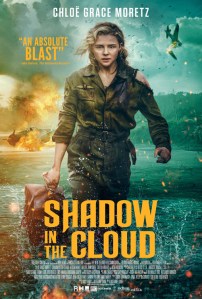 Shadow in the Cloud feels like a lot of movies smashed together with the slapdash glue of a SyFy Channel Original movie, combining crazy and crazier elements like a Jenga tower teetering on the brink of total disaster. Chloe Grace Moretz plays Maude, a female pilot during World War II and hitching a ride on a B-17 bomber plane leaving New Zealand. She says she has a secret mission to see through and a valuable package that cannot he opened. The men on the plane are skeptical and banish her to the lower turret on the plane. It’s there that she discovers they have another unwanted passenger, a furry, winged, blood-thirsty gremlin tearing apart the plane’s engines. Maude pleads for the men to listen to her warnings and ultimately takes matters into her own hands to ensure their safety and survival.
The first thing needed to be discussed is the wiry elephant in the room, namely the involvement of writer Max Landis. For those unaware, the successful Hollywood screenwriter of edgy, often glib genre fare (American Ultra, Bright, Chronicle) has faced a reckoning for his many years of abusive behavior with a litany of ex-girlfriends that accused him of gleefully manipulating them and bragging about giving them eating disorders. Landis’ script has since been rewritten by the director, Roseanne Liang, but it’s impossible to say what was on the page before and what was a new addition without reviewing multiple drafts. Suffice to say, Landis’ involvement may very well be a non-starter for many viewers, but it’s the first half that really makes things even more uncomfortable with his name attached. For about half of the movie, Maude is trapped and harassed by a bevy of off-screen men who joke about having their way with her and belittle her existence as a woman. I don’t believe that the movie is ever endorsing this misogynist and borderline rapey perspective of the men, but it is dwelling in this muck for quite some time, and to think that the famous screenwriter, who was credibly accused by multiple women of predatory and awful behavior, is writing these words, well it sure makes the entire protracted discomfort seem gratuitous and even risible. I’m sure women dealt with this sort of dismissive and harassing behavior while serving during wartime, obviously, but there’s a difference between reflecting realism and exploiting it for titillation. Was this aspect even worse before the director’s rewrites? Did she put her stamp on this harassment? It’s hard to say, but the lingering discomfort is a distraction to the overall entertainment value. It’s so heavy-handed that it becomes counterproductive to whatever message is attempted and becomes the lasting takeaway.
 With that being said, Shadow in the Cloud is a mess of a movie that feels rattled and tonally confused. I thought given the premise that this was going to be a mostly silly movie. We’re talking about a gremlin attacking an aircraft, which is pretty much a remake of that famous Twilight Zone episode “Nightmare at 20,000 Feet” starring William Shatner. There’s only so much you can do with, “There’s something on the wing” declarations and people not believing the crazy accusations. I wasn’t expecting fighting a literal furry, bat-like monster with the tension of whether or not the main character might be assaulted by a gang of men in the sky. If the filmmakers wanted to go with the grueling and uneasy tension of Maude being at the mercy of potentially lethal men, that would be fine, but don’t include a silly monster too. The moments simply don’t jibe. There’s a moment where Maude falls from the plane and a Japanese Zero plane above her explodes and the resulting explosion propels her back into her own plane. It’s like a cartoon. You could very easily eliminate any and all of the supernatural elements from this story and I think it would have been better served at that. There’s enough tension to be had with the Zero planes being out there and the crew not believing that Maude saw the enemy, let alone a monster. The musical score is all retro 80s synths and it feels jarringly discordant. I did not like it immediately. The tone veers so rapidly, at times from scene-to-scene, and while this can offer a sense of unpredictability, it can also hamper whatever had been working. The suspenseful time in the ball turret is mitigated with a finale that is so goofy that it exists in another universe. The movie ends on real-life footage of women serving in WWII and any sort of feminist inspiration is completely unearned from the crazy little contained thriller about mid-air monster battles and scrappy dames.
When the movie is locked in that ball turret, that’s when Shadow in the Cloud is at its best and presents an intriguing degree of potential before flaming out into self-parody. There are some genuinely well-wrought moments in that small space, and the natural tension of a woman on an all-male crew is enough to establish a dividing line of suspicion for the dismissive men. The director is also at her best during these sequences and finding resourceful use of her small space to still tell her story and reflect the dilemma of our protagonist. There’s a satisfying problem-solution plot formula to employ. There are a few mysteries to ponder, like why does Maude have a gun, what’s put her arm in a sling, what is her mission, and what is in that package she swears is more important than anything else? It’s enough to hold your intrigue while the men coalesce into a chorus of harassing voices interrogating her as their captive. She’s in such a vulnerable position and the movie can play up paranoia, vertigo, and claustrophobia all together to really ratchet up our fraying nerves. As the movie settled into this tight setting, I accepted that it might just be nothing more than a cost-effective contained thriller, and that excited me because it felt like the filmmakers were finding ways to make that idea work. I started getting visions of the last contained thriller that really knocked my proverbial socks off, 2010’s Buried. Alas, I was never taken with the silly gremlin aspect of the screenplay and how easily forgotten it becomes. This killer gremlin just sort of comes and goes whenever the story needs a convenient extra dash of blood. It’s likely what got the movie sold as a pitch but the first thing I wish had been removed.
 I have enjoyed Chloe Grace Moretz for years, all the way back in 2010’s Kick-Ass. While she’s now in her early twenties, she still comes across as so young, and the reveals relating to Maude and her motivation make it harder to accept Moretz in the role. I recognize that she is no longer a young girl and can elect to play adult women onscreen, but she never felt fully believable for me. She can do action and has proven herself to be tough and courageous, but something was lacking with the depiction of Maude. It felt too much like a kid playing war. Every other actor might as well be a vocal actor because the movie is pretty much a radio play with the exception of the first five minutes and the final ten minutes. The male voices tend to blend together and lack distinct personalities. When they’re all harassing and condescending then it makes it quite difficult to distinguish characters (“Oh, this is the OTHER gross guy with the higher pitch”). It’s excessive and another element exaggerated to the point that its aims become another self-sabotaging fault.
I’m sure there are more than a few that will have a blast with Shadow in the Cloud. They’ll celebrate the harshness of Maude’s harassment as a needed historical reality check. They’ll laugh up the goofiness of the gremlin attacks. They’ll shift nervously during the contained thriller centerpiece in the ball turret. They may even cheer during the big cheesy climactic brawl in the mud. However, I found the sum of its many parts to be too lacking. Shadow in the Cloud would have been better with a little more pruning, a little less Max Landis, and some tonal consistency. It might be crazy enough to entertain for its 80 minutes but it feels like its gasping for air by the ridiculous finish.
Nate’s Grade: C
Share this:

The Witches (2020)
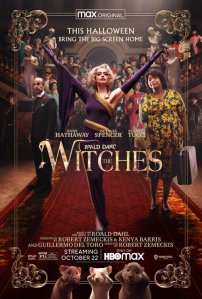 Rare is the Hollywood movie where the biggest question afterwards is simply, “What in the world were all these talented people thinking?” Why did Robert Zemeckis want to remake The Witches after a perfectly good and eerie 1990 movie starring Anjelica Huston? Why did the screenplay adjust the action to be set during a segregationist South without any added social commentary? What exactly is Anne Hathaway, as the lead witch, even doing with an accent that sounds like she’s blindly jumping from nationality to nationality? In one second she’s Hungarian, in another she’s Scottish, in another she’s Swedish. What was with this bizarre character design for the witches that gives them dinosaur talons and one-toed clog feet and, most off-putting, extended mouths visible with slits along the sides that they don’t even bother concealing? Why does the movie keep making fun of the chubby kid at every opportunity for being chubby? Why, even in life-and-death stakes, is the chubby kid unable to stop himself from losing all willpower around food? Why does Octavia Spencer’s grandmother character sound almost exactly like a rambling Grandpa Simpson when she’s just given enough room (“So I had an onion on my belt, as it was the style of the time…”)? How could a screenplay, that includes the likes of Oscar-winner Guilermo del Toro, include lines like, “That’s the thing about snow — it’s slippery”? I was groaning throughout this movie and just beside myself trying to make sense of the inexplicable creative decision-making on display. I also felt embarrassed for Hathaway, an actress I have enjoyed and find to be quite accomplished, who is just inhaling every piece of scenery that is not bolted down on set. It’s such a crazily misconceived performance of theatrical bombast that I felt like Zemeckis had done Hathaway wrong. This is a big hot mess of a movie and it’s so joyless.
Nate’s Grade: D+
Share this:

Wonder Woman 1984 (2020)
 Big, colorful, and brimming with optimism easy to scoff at, Wonder Woman 1984 (WW84) is finally here to save Christmas and maybe movie theaters and it’s an escapist treat. It won’t register among the best of superhero cinema but will likely keep a smile on your face.
In 1984, Diana (Gald Gadot) is working at the Smithsonian Museum in Washington D.C. and fighting crime as her costumed alter ego. She’s never quite moved on from the death of Steve Trevor (Chris Pine) back in WWI and she dearly needs some friends. Barbara (Kristen Wiig) is a mousy co-worker who comes across a mystical artifact, a rock that magically grants wishes. Barbara wishes to be strong like her boss/idol Diana and she gains new intoxicating power. Max Lord (Pedro Pascal) is a wannabe TV pitchman and an empty suit, fleecing investors and barely keeping ahead of his own Ponzi scheme. He learns of the magic rock and wishes himself to become the rock itself, turning him into a living genie. From there, Max’s wishes are spinning out of control, placing the world in greater crisis. Diana is torn because, before Max absconded with the wish rock, she wished for her heart’s desire, the return of Steve. Stopping Max and reversing the effect of the wishes means having to say goodbye to Steve all over again.
The original Wonder Woman was a break from the pallid doom and gloom motifs that Zack Snyder established, and the sequel goes even further with its candy-colored recreation of the 1980s. I was wondering if there would be a good reason to set the movie specifically during the 80s, and it’s mostly for the Cold War and Yuppies. I was pleasantly surprised that Jenkins and company don’t overdo the 80s nostalgia or the fish-out-of-water comedy for Steve Trevor. I thought this was going to be the entire reason for the throwback setting, and this time instead of Diana marveling at a modern world she did not understand it would be Steve. If you’ve watched the film’s trailer, then you’ve seen all of those jokes at Steve’s expense. That’s it. WW84 can manage to surprise you, mostly in a pleasant manner. Its sincerity is its biggest virtue. It’s a movie about plenty of goofy things but at its core it’s about relatable desires and struggle.
 WW84 is an improvement over the original in the action department. Returning director Patty Jenkins feels freed of emulating Snyder’s house style and brings a welcomed sense of levity and playfulness to the action. The fight choreography makes significant use of Diana’s lasso, opening up the playing field for her to swing around wildly, at times even literally riding the lightning. At points the lasso seems to have a mind of its own and able to divide into fragments. It’s something that helps separate WW84 from the glut of other superhero movies and it offers pleasing visual variance for the fights. There’s a car chase midway through the film where Diana has to leap from speeding truck to speeding truck, dodging goon gunfire. It’s an exciting and sustained action sequence, yet even across the Middle East, chase clichés will reappear, like dumb kids playing in the street ignorant to any emerging noise like a caravan of speeding vehicles. Jenkins seems even more adept behind the camera for the action, delivering big stunts and memorable spectacle ready to make a splash on a big screen. However, some of the CGI can be shockingly dodgy for a big-budget blockbuster and a final confrontation with a CGI-hybrid creature unfortunately reminded me of the lamentable Cats.
The magic wish rock setup shouldn’t be any harder to believe than, say, a secret island of immortal female warriors or just about anything in the absurd and absurdly entertaining 2018 Aquaman feature film. If I can accept a drumming octopus, I can accept a magic wish rock. WW84 hinges on the concept of the drawbacks of creating your own false reality where every wish comes with a cost and an increasing flood of alarming consequences. It it better to just accept the comfort of lies or accept hard truths? The characters even name-check the classic short story The Monkey’s Paw recognizing the ironic trap. That doesn’t stop characters from struggling with the pull of their burning desires, and it makes for an agreeable return for Steve Trevor. Ever since it was revealed that Pine’s character was returning, I was worried what the possible explanations could have been, pessimistic it would be satisfying. Is he going to be a clone? Reincarnation? The grandson who happens to look identical? The screenplay by Jenkins, Geoff Johns, and Dave Callaham finds a way to make it work by bringing him back through magic but with restrictions. In a very Source Code sort of style, Steve is operating in someone else’s body, but only Diana sees Steve. It’s a decision that frames the return in a personal way that also reminds us what is eating at her. It’s been 70 years and she hasn’t moved on from the man she loved, which can be viewed as sad, romantic, and unquestionably unhealthy. It’s a familiar character arc, having to move on from a loved one and accept grief, but it still works, and it humanizes this mighty Amazon warrior woman. It’s a worthwhile development that opens up these living gods into emotional, vulnerable beings.
 With the wish plot comes some gripes and lingering questions. I kept asking, “Is everyone simply not seeing what’s happening?” or, “Is everyone forgetting what has happened?” The scale of the wish consequences is substantial and very public but it never feels like the world is registering just how fantastic these supernatural shenanigans are. In 1984, Wonder Woman is fighting crime as a hobby but still not a named and identified hero. The world does not seem aware of the presence of super beings and amazing powers living among us. So as Max continues his wish-granting ways there are immediate consequences of huge staggering scale, but nobody seems to register how weird and not normal things are, like a giant 50-foot wall suddenly appearing in Egypt. People should be asking what is going on or what others are doing. Therein lies the lingering problem with setting this movie in the past. Much like the 80s-set X-Men: Apocalypse, the events presented generate questions to why future-set movies seem to be ignorant of these same events. If Wonder Woman comes forward and addresses the world, why is she still hiding her identity in 2016’s Batman vs. Superman? And if she learns more about her own super abilities, why does she not make use of these very helpful skills in 2017’s Justice League? These sound like quibbles, and they mostly are, but the movie would have benefited from being a little more judicious with its rules and applications because I started wondering if everyone was oblivious.
I was genuinely surprised how much screen time and consideration was afforded to the primary villain. No, I’m not talking about Barbara/Cheetah, who could have been completely cut from the film. I’m talking about Max Lord. He’s arguably in the film as much as Diana. He’s a con man trying to be a successful TV pitchman and oil tycoon but really he’s trying to be a “somebody” to make his son proud. The problem is that his goal always seems to be just out of reach no matter what is gained. This part confused me. After successful wishes with power and money, Max seems to desperately continue searching for more. I suppose it could just be a general “power-hungry corruption” explanation but I kept asking when enough was enough, and that’s likely the point. I don’t know if Max Lord is a character deserving of this much consideration, but the approach appeals to the film’s empathetic mentality that no one is beyond reach. Rather than the villain having to be physically defeated, WW84 rests on emotionally appealing to a broken man’s sense of self. It makes for a more intriguing conclusion in a superhero realm than merely out-punching the CGI antagonist, like the clunky, lumbering finale from the prior Wonder Woman movie.
The conclusion of WW84 rests upon millions having to make a personal sacrifice for the greater good, which is a lovely sentiment that we could all use at this point after a dispiriting 2020. However, this year has also proven for me that the conclusion of WW84 is pure escapist fantasy. Throughout a deadly pandemic, the United States has been beset by too many people refusing to endure inconveniences in the name of protecting others and saving lives from COVID-19. The cost-benefit doesn’t add up for many if they can’t see the results, never mind the harsh yet sterile reality of over 300,000 dead Americans and counting aided by this selfish obstinance.
 Gadot might not ever escape the long shadow of playing a famous superhero but she’s settled into the role nicely and even gets to flex some untapped acting muscles. I was skeptical of Gadot early when she was hired but became a believer in 2017. She definitely has an unmistakable presence onscreen. Gadot’s best moments aren’t even the punching and kicking, which she does with gusto, but the moments where she has to make grand appeals and hard decisions. There are a few emotional moments where Gadot’s familiarity with the character blends together and she and the filmmakers are not afraid to show strength in other ways other than brawn. Gadot still has a very enjoyable chemistry with Pine (Hell or High Water) that makes them a winning pair. One of the film’s highlights is a personal flight through fireworks that delivers sheer joy for Steve Trevor. His awe about the future and getting one more spin with life itself is heartwarming. Pascal (The Mandalorian) is going big and hammy with his performance that reminded me of the Richard Donner Superman movies. Wiig (Ghostbusters) is the big miss for me. She’s not convincing as a threatening foe and her early scenes as a klutzy, put-upon dweeb feel overdone and yet insufficient. We needed more establishment of Barbara’s life before her wish to better recognize why she would never want to go back. One reoccurring street harasser doesn’t cut it.
Wonder Woman 1984 is fun, splashy, and doesn’t lose sight of its characters and their emotional states even as it elevates the world-annihilation stakes. It’s a movie that seems more confident in its identity than the first film. It accepts that it can be silly, it can be sincere, it can be exciting, it can be smaller and more personal, it can be hokey, it can appeal to your best self. It’s overly long (the opening flashback of young Dianna in the Amazon Games could have been ditched entirely) and not everything works, but the problems are easier to digest and forgive with what does work. It might be the last blockbuster for some time given the uncertain theatrical landscape so I’ll take it. WW84 isn’t the swaggering solo venture the first film proved to be, but I would say it still makes for a mostly satisfying and fun experience that plays to the strength of the creative team.
Nate’s Grade: B-


 nathanzoebl
You must be logged in to post a comment.