Blog Archives
Bridget Jones’ Baby (2016)
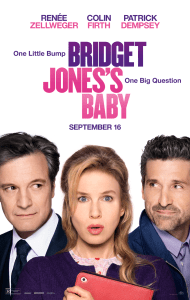 Coming 12 years after the last Bridget Jones outing, I was pleasantly surprised to discover how warm my feelings still were for this plucky, feisty heroine. Now in her mid/late 40s, Bridget is contemplating a life never becoming a mother when, surprise, she gets very pregnant and has two possible fathers: billionaire love guru Jack (Patrick Dempsey) or her newly available on-again off-again beau, Mark Darcy (Colin Firth). It’s a frothy plot contrivance but the screenwriters (including author Helen Fielding and co-star Emma Thompson) are able to produce fun comic scenarios that fully embrace the premise and its soapy conflicts. Bridget has two pretty appealing options, and when both men finally discover the possibility of the other, it becomes an entertaining game of one-upsmanship. The requisite romantic comedy elements don’t forget to be funny too, including an ending rush to the hospital that achieves some inspired slapstick. The film is swiftly paced and filled with zingers, and I just sat back for the two-plus hours and enjoyed the company of these silly yet realistic human beings. I enjoyed the adult humor and conversations that rarely get as much development in this genre. With all her self-sabotaging ways, you come to realize how much of a prize Miss Bridget is, and Zellweger slips right back into the role like no time has passed. However, plenty will grumble about Zellweger’s much-publicized plastic surgery, or the fact that she didn’t pack on the pounds for this picture, but I don’t see why any of that greatly matters in the interpretation of this character. The personality of Bridget is more than the alignment of her facial features. For fans of the series, Bridget Jones’ Baby is a welcomed return to form from 2004’s Edge of Reason and an extra dose of enjoyable fan service, tying up its tidy happy ending with a bow. Here’s something to chew over: my father had no prior knowledge of the Bridget Jones series, decided to see this movie, and enjoyed it thusly. Give Bridget Jones and her baby daddy drama a chance and you too may be surprised.
Nate’s Grade: B
Share this:

Blair Witch (2016)
 As is mandatory with all reviews, let us acknowledge the tremendous impact of the original Blair Witch Project, a full-borne cultural event that tapped into the zeitgeist. It was a rare indie movie that curated a must-see reputation and became a blockbuster. The found footage format was highly influential afterwards as were its low-fi thrills, community interactivity, viral marketing, and experimental construction. I remember having heated arguments with people about whether the movie was indeed real or a work of fiction. I pointed to the TV once and said, “Look, the actors are promoting it on MTV.” Naturally imitators followed suit and the studio looked to eagerly turn a curiosity into a franchise. 2000’s hasty sequel Book of Shadows was quickly rejected and just as quickly the Blair Witch phenomenon had slipped away. It remained dead until this summer. Director Adam Wingard (You’re Next, The Guest) and frequent screenwriting partner Simon Barrett had recently made a horror movie called The Woods, but at 2016’s Comicon the secrecy was finally dropped. It was a sequel to The Blair Witch Project, filmed in secret J.J. Abrams-style. It was a stunt that worked, and once again there was life in this franchise. This will only last until people see the new Blair Witch, a monotonous, confused jump-scare haven that’s too indebted to the original and discards anything interesting it stumbles onto.
Sixteen years after three backpackers went missing, footage has been posted that possibly shows one of these backpackers, Heather, still alive. James (James Allen McCune) is now an adult male and determined to find out if his sister is alive. Lisa (Callie Hernadez), a film student and maybe James girlfriend, tags along to record James’ hunt for the truth into her graduate thesis. Their friends (Corbin Reid, Brandan Scott) come along for the adventure into the woods, as well as a conspiracy couple (Wes Robinson, Valorie Curry) responsible for posting that new footage. The conspiracy couple leads them into the woods and it isn’t long before people get lost, tempers get heated, and strange disturbing noises materialize from the never-ending night.
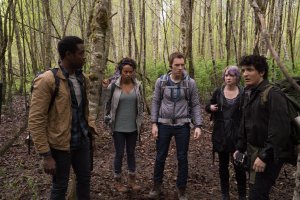 Much can be forgiven if a scary movie delivers the spine-tingling goods, and standing in the shadow of one of the biggest horror hits of all time is no easy proposition. It’s too bad then that Wingard’s Blair Witch is far more tedious than terrifying. I didn’t fall under the spell of the 1999 original but I could appreciate its slow-burn efforts and execution, which relied upon a lot of unsettling dread left to audience imagination. With the 2016 reboot, the filmmakers have upped the ante but don’t have patience. There are over six different jump scares, each punctuated by a loud, often shrill scream. At one point there are three in a row in a succession of mere minutes, enough so that a character provides a meta dose of commentary by saying in exasperation, “Why do people keep doing that?” Calling attention to the annoying trait doesn’t make it better. The sound design is also, in a word, amplified. It sounds like Bigfoot or a dinosaur is tearing through the woods and wrecking havoc. It was enough that I hoped the movie would just reveal the Blair Witch never existed and instead it was some other sizeable monster of legend. I’ll give Wingard credit for the found footage cinematography not being self-consciously overdone. The characters have an incredible stash of cameras, from GoPros to flying drone cameras, which makes the editing less choppy and the movie easier to watch.
There are exactly two scenes that unnerved me. One is the sheer numbers of an expected item upon waking up, the immense quantity and variation in size providing an eerie sight as it fills the screen. The other is a late sequence that involves squeezing in a tight space, which allows Wingard to employ some nice claustrophobic tension. Short of these two moments, and they are mere moments, the movie was boring me so profoundly that I considered just leaving, and I’ve never walked out on a movie before. It felt like it was going nowhere fast with characters I didn’t care about and without any relevant suspense. The found footage filming elements are even used to enhance the jump scares with sudden visual and sound glitches amplifying the tired attempts to constantly startle its audience. This is a movie more concerned with startling its audience than scaring it.
When the movie does start to tantalize your interest, it’s like a mirage that soon vanishes and you’re once again left in your dire predicament. Getting lost in the woods is not interesting minus interesting aspects. However, finding out that time is operating at a different level, now that’s interesting. The characters set their alarms for seven A.M. but it’s still dark out. The possibility of the Blair Witch manipulating time to trap hikers was the first moment in this entire movie that made me sit up in my chair. It took the movie in a different direction that demanded my attention, and it opened up the possibilities of what had been a rather lifeless enterprise up that point. Show me this movie. Alas, it’s an aspect that is quickly shoved aside and largely forgotten even with the timeline of events regarding the footage. There’s a scene where the stick figures directly communicate a powerful connective relationship, and yet this too is never touched upon again. There’s a new threat introduced that takes the movie in a body horror direction and raises questions about whether the woods themselves can become alive. It’s another intriguing moment that culminates in what promises to be a memorable gross-out image, and instead it too peters out and then unwisely abandons the body horror angle. It’s almost like the movie is so single-minded in its path that it ignores the intriguing and preferable detours.
Wingard and Barrett are trying to expand the Blair Witch mythology but their reboot operates on the assumption that there is even a base to work upon and that its audience is familiar with heretofore unspoken rules that appear arbitrarily and randomly. This reboot operates in a world that acknowledges the release of the first Blair Witch movie, yet nobody seems to be any different from this. Obviously James is different having to lie with the legacy of the movie, but why venture out into the woods on a whim of hope to find his long-lost sister who vanished 16 years ago? Does he think she’s just been living off squirrels and twigs in the ensuing time? Why doesn’t James try and question who edited the footage from his sister into a narrative? Why doesn’t he try suing the film production for profiting off his family pain? Why hasn’t Burkitsville, Maryland become a counter-culture tourist destination from taking ownership over its supernatural legend, much like Salem or Roswell? The town should be swamped with adventurous backpackers who want to live the experience. The much maligned Book of Shadows did far more to discuss the reality of the Blair Witch phenomenon and the tenuous hold on reality that the Internet age was ushering in. Wingard’s version eschews this world-building context for narrative immediacy. James wants to find his sister, he gets a clue that she might be out in those woods still, so they all go into the woods. Once the conspiracy theory couple insert themselves onto the trip it seems odd that we’ve ignored the larger context of the legend, instead rehashing how the Blair Witch died.
 As things begin to fall apart in the second half, the events start to feel arbitrary and poorly defined. There’s a sequence during the climax that I’ll try my best to describe with some discretion but be warned, folks (spoilers): the remaining characters eventually find that same shack in the middle of the woods, though the exact number of floors seems unclear. The witch looks to finally confront our characters, though why she/it waited until this moment is also unclear since she/it seems to be entirely overpowering. That’s when a character declares, with no prior guesswork to arrive at this conclusion, that they have to stand in corners and as long as they don’t turn around and look they will survive. And this works. It’s not explained why this Raiders of the Lost Ark closed-eyes routine is somehow the secret to supernatural survival (ignorance is bliss?). When the character unleashes this tidbit it’s treated like the audience knows the rules of the Blair Witch universe, and we sure don’t. At no point has a larger system been established, so when characters start spouting rules it feels like the movie is making it up as it goes. This don’t-look-back trick is played out almost to a comical effect, which culminates in the rising question of whether a character is going to backwards walk out of the whole stupid forest. The muddled world building (time dilation, voodoo sticks, tree monsters?) makes it feel like the doomed characters are ultimately trapped in a half-finished screenplay.
I was honestly expecting more from Wingard and Barrett after their previous genre collaborations. These guys know the underpinnings of enjoyable genre filmmaking and how and when t upend the conventions and expectations, zigging when others would zag. I felt these two would be able to take a studio gig like Blair Witch and find something new, something interesting, and certainly something scary with the property. I regret to say that this Blair Witch might be new but it sure fails to be interesting or scary. The characters are meaningless and interchangeable and boring. Their decisions are often illogical and stupid. The scares are stacked too high in favor of cheap jump scares, and the movie lacks the patience to develop its tension and horror. It can’t even properly establish rules for the audience to follow. It’s like the filmmakers are being upfront with their lack of faith in their final product. I think the key missing ingredient is, surprisingly, humor. Both You’re Next and The Guest balance along a delicate tonal line that can veer into macabre comedy any moment to lighten or heighten the tension. There are no (intentional) laughs to be had with this retread into the woods. I think the newest Blair Witch has done the unthinkable: it’s redeemed Book of Shadows.
Nate’s Grade: C-
Share this:

God’s Not Dead 2 (2016)
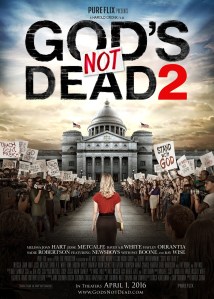 The creators behind God’s Not Dead 2 won’t admit it but their movie is pure science fiction; it exists in an entirely parallel universe that’s topsy-turvy where atheists want to stamp out the last signs of Christianity and will use their collusion of government and media power to marginalize and eliminate freedom in the name of “tolerance” and “diversity.” It’s another heavy-handed moral parable that feeds into the persecution complex of its target audience, the same people who made 2014’s God’s Not Dead a surprise hit. While the sequel isn’t nearly as mean-spirited and cruel (the godless characters don’t have to die or get stricken with cancer this time), it’s still speaking in code to stoke its audience’s unfounded fears of losing religious liberty. We follow an AP History teacher (Melissa Joan Hart) who gets into trouble from making a purely literary connection with the teachings of Jesus and non-violent revolutionaries Gandhi and MLK. The school board wants to “wash the blood off its hands” and she’s taken to court where her very faith is on trial and where her hunky lawyer has to prove Jesus historically existed. The entire premise is laughably preposterous given the context of her pedagogical reference. A student makes the Jesus connection and asks about it, and the teacher was not endorsing a religion but merely quoting a piece of literature as it pertains to those inspired from it. There’s no time for subtlety in this movie because we have a martyr that needs roasting, and in comes an ACLU lawyer played by Ray Wise (God bless this actor saying yes to everything) who may very well be the devil. Wise is the lone source of entertainment for me. There’s also a nasty TV pundit who says Christians are the real danger in this country (replace “Christian” with “Muslim” and the TV segments start to sound more familiar from our own world). Several characters from the first film pop back up but with very little to do. God’s Not Dead 2 is a pretty lackluster, laughable, and theologically simplistic morality tale but at least it isn’t as risible and offensively insincere as the original film. Like the first film, the credits close on a list of court cases the filmmakers say inspired the movie. Except, upon minimal research, not one of these cases echoes the movie I just watched. All of these cases involve intolerance against accepting gay marriage or fulfilling birth control and/or abortion services, all legal and protected aspects of our culture. I’m reminded of the quote “when you’re accustomed to privilege, equality feels like oppression.” I wonder if this kind of thinking would have lead an enterprising filmmaker telling the “brave story” of the segregationist standing up against government pressure to accept integrated schools. It’s not far off.
Nate’s Grade: C-
Share this:

Star Trek Beyond (2016)
 With J. J. Abrams’ departure from the franchise for the greener space pastures of Star Wars, there was a creative void to fill, and in stepped director Justin Lin (Fast and Furious series) and co-writer/star Simon Pegg, acclimating to the established new movie universe and providing a Trek movie that proves to be the most “recognizably Trek” in the series thus far. The crew of the Enterprise is stranded on an alien world after being attacked by a hive-like armada of ships. It’s a somewhat familiar formula, a distress call that ends up being a trap, from an unknown entity that is harboring vengeance against the Federation. This allows for several dispirit storylines to explore the surroundings but also the enjoyable character dynamics of the crew; the casting department hit the jackpot with this franchise, and it’s just satisfying to watch the actors deliver solid, satisfying character moments. The new character Jaylah (Kingmen’s blade-legged Sofia Boutella) is interesting, kickass, and a source of deadpan comedy conflicts with others. There’s a genuine sense of discovery that’s patiently paced, not so much the set-piece-every-ten-minutes of the Abrams films. Idris Elba (The Jungle Book) makes for an intimidating villain and I’m happy to report he doesn’t get lost under gobs of makeup. He becomes more Elba as it goes, and he’s given a credible motivation and back-story to explain his actions. The action is a bit less exciting than I was hoping for from Lin, whose special blend of crazy has been somewhat dampened as he adopts the house visual style of the franchise. Pegg and co-writer Doug Jung have steered the franchise into safer territory but also put the focus on the crew and their bonds, which is the secret weapon of Trek. You sense that Pegg and Jung are fans, and they even provide greater context and justification for the new Trek elements that drew earlier complaints, like the use of the Beastie Boys song which now becomes a fun moment of fist-pumping triumph. Star Trek Beyond (no colons necessary, apparently) doesn’t quite hit the same highs as the previous two films, but it’s a solid movie overall and might be the best movie for the most ardent fans of classic Trek. My last piece of advice: go into space construction in the future. The way they go through starships, you’ll always have a job.
Nate’s Grade: B
Share this:

Jason Bourne (2016)
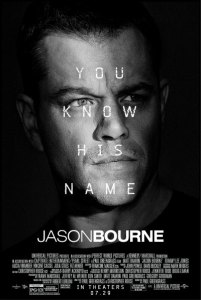 After the indifferent reception of its 2012 spin-off, original super spy Jason Bourne (Matt Damon) and director Paul Greengrass (Captain Phillips) are back and it feels like everyone is falling into familiar paces. The titular fourth film in the franchise (excluding Bourne Legacy) is easily the weakest (excluding Bourne Legacy) and the seams of the formula are starting to show. Once again an ally has intel to expose some sort of secret and illegal government conspiracy that ties into a revelation about Bourne’s past, and once again this ally is killed as the Act One break to spurn Bourne onward, and once again there’s a secondary assassin working for the morally murky government agency head, and once again there’s a signature car chase sequence, and once again there’s a final choice Bourne needs to make about what kind of person he wants to be given his new perspective on his old killin’ ways. The frantic Greengrass staple camerawork and editing can make just about anything bristle with some energy and suspense, but rarely was I fully feeling what was happening onscreen (except for the caveat of admiring how attractive Alicia Vikander’s face looks on the big screen). Short of the final car chase through Vegas with a SWAT truck barreling through traffic, the action sequences are pretty routine and unmemorable. The foot chases and fisticuffs, a hallmark of the franchise, feel slightly blasé in their development. The action isn’t bad but it feels more than a bit staid. The stakes aren’t as high and maybe that’s because it feels like there is little more to reveal about our hero’s hidden past. Is the next movie going to divulge the long lost secret that he never paid a parking ticket? Tommy Lee Jones makes an enjoyably crusty adversary. Vikander has just enough of an angle to provide more substance as a character than the typical agency analyst reciting exposition. The film ends with some promise of looking forward rather than back, and I hope that further adventures with Jason Bourne (excluding Bourne Legacy) stray a little more from the well-worn formula and provide better reasons for this spy to come out of his hiding.
Nate’s Grade: B-
Share this:

The Purge: Election Year (2016)
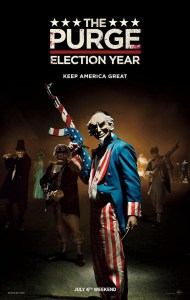 What once seemed like a premise fit for ridicule has become a franchise I actively look forward to now and swallow whole any incredulity. The Purge: Election Year is something of a lateral move from its predecessor, Anarchy, as it’s not an improvement but it’s still a fun and thrilling entry that provides just enough satisfying gonzo political commentary to temper its action. Finally with the second movie I got the Purge movie I wanted, experiencing the event itself outdoors, and Election Year continues this trend. We follow a small group of minority characters trying to survive the night, escaping from one location to another as they encounter a menagerie of weird, murderous citizens trying to make America great again. A presidential candidate (Elizabeth Mitchell) wants to do away with the barbarous Purge practice, and so this makes her a top target during that 12-hour free-for-all. Her head of security, and lone source of protection after an ambush, is played by Frank Grillio, returning from Anarchy and reminding you early and often just what a great action hero he can be. I enjoyed the ongoing shaping and texture of writer/director James DeMonaco’s kill crazy world, whether it was “murder tourists” coming over to America to experience consequences-free killing, the idea of a religious ceremony deifying purging, and even stuff I know is pure trailer candy, like an all-girl gang dressed in creepy masks, princess dresses, and chainsaws. There is some seriously unsettling imagery and moments, though the presence of a white supremacist hit squad dilutes some of the film’s tension simply by being a constant antagonist chasing down our heroes. There aren’t as many new set pieces to further illuminate the depravity of this world as there was with Anarchy. Still, there’s more than enough nasty bite in this franchise. How is this franchise not been turned into an open world survival video game yet? I wonder why everybody just automatically wants to murder during the Purge. I would just probably cheat on my taxes (don’t audit me IRS for this statement!).
Nate’s Grade: B
Share this:

The Conjuring 2 (2016)
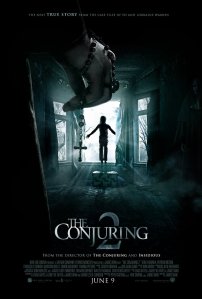 Horror is one genre where sequels rarely if ever satisfy. Usually the repetition is mind numbing and what was once scary has been eradicated. The true signs of great horror is the dread of what’s coming next, and to this end James Wan has shown tremendous skill at playing an audience and their fears. The Conjuring 2 isn’t quite the thrilling success that its predecessor was but it still upholds the best parts of what made the first movie frightening. We follow the Warrens once more, the husband and wife paranormal investigators, and this time to England where a malevolent spirit is haunting a family. One of the few miscues is delaying the meeting of the Warrens with the beleaguered family to almost an hour, pushing the running time to a needlessly overblown 133 minutes. The movie seems to be stretching out the ghost set pieces. Fortunately, Wan knows exactly how to build tension and let it simmer. The demon nun imagery is effectively unsettling, and there’s a brilliant sequence where Mrs. Warren (Vera Farmiga) has to slowly pull a light cord, all while the portrait of the demon nun hangs visibly in the dark. It’s a small scene that explains in full the clever construction of the whole. It sets up the parameters, develops them, and then lets the audience dread what it knows is coming. These are not cheap scares or lame jump scares but genuinely earned terror within a carefully constructed atmosphere. It might not be as good as the first one but The Conjuring 2 is still plenty good, which by default makes it possibly one of the greatest horror sequels of all time. Let’s hope the demon nun spinoff goes better than Anabelle.
Nate’s Grade: B+
Share this:

Independence Day: Resurgence (2016)
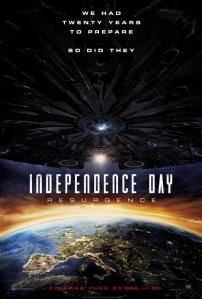 I can recall actively counting down the days until Independence Day was released in 1996, gobbling up every newspaper clipping and magazine article I could. I was a big fan of director Roland Emmerich’s Stargate, which is still a terrific movie, and I was eager to watch the end of the world, as we know it, in the privacy of my local theater. It was a blast, no pun intended, and one of the biggest box-office successes at the time. Surely there would be a sequel, especially after it helped launch Will Smith into another level of stardom. Flash forward twenty years, and here comes Independence Day: Resurgence, a sequel that misses what marked the original as escapist entertainment.
Twenty years later, human beings have been planning for the eventual return of their intergalactic invaders. Former president Whitmore (Bill Pullman) and CIA director David Levinson (Jeff Goldblum) have been trying to get the world prepared and studying our alien enemy. A psychic link is still formed from Whitmore’s brief bond in the first movie, and he keeps drawing mysterious symbols. Whitmore’s daughter, Patricia (Maika Munroe), is a former fighter pilot who works for the current president (Sela Ward). Patricia’s boyfriend and fellow fighter pilot, Jake Morrison (Liam Hemsworth), is stationed on the moon building a defense system. Then the aliens come back and pick up where they left off, annihilating Earth’s landmarks and population centers. It seems that their spaceship is going to suck out the Earth’s molten core, and by all accounts, that’s bad. Our ragtag group of characters must come together and overcome substantial odds once more to save the Earth from certain doom.
So where exactly did things go wrong? I’m not one to simply state that the filmmakers missed their window of making a quality sequel. While twenty years is a long time in between outings, it doesn’t mean that you will fail to come up with a compelling movie. Mad Max was 30 years between movies and this didn’t stop Fury Road from being a masterpiece. By most accounts, yes, there is certainly less of an appetite for an Independence Day sequel in 2016 than there would have been in 1998, but the first film is still fondly remembered and a worthy sequel would be welcomed regardless.
 I think one of the bigger causes to Resurgence not working is the fact that the rest of the moviegoing world has caught up when it comes to big screen spectacle, therefore spectacle by itself is not enough without a zeitgeist edge. In 1996, cutting-edge special effects-laden destruction on a global scale was reason enough to buy a ticket and the largest tub of popcorn. In the ensuring two decades, large-scale cataclysm has become commonplace on the big screen; just about every climax of a Marvel movie involves some world-devastating threat. What once quickened pulses has now become ho-hum. Emmerich himself has become a modern-day Irwin Allen since the first Independence Day, almost specifically focused on global disaster movies. I honestly don’t think there’s a better director working in Hollywood for that gig (his next movie is about the moon crashing into the Earth, so “familiar” territory). I think Emmerich’s skill and vision for big screen spectacle goes unheralded too often and he gets lumped in with empty visual stylists like Zack Snyder and Michael Bay. He’s better than that. However, the tide has turned, and audiences have become sated from empty spectacle. They need something more, or at least something compelling, and Resurgence struggles to achieve this. It feels like the aliens are back and they’re bigger, and that’s about it, folks.
Disaster movies are generally judged by their set pieces, and what is most surprising about Resurgence is that it really doesn’t have action set pieces as it does skirmishes. The movie is only two hours long, which seems like a rarity nowadays, but this is one of the few movies I think could have benefited from some extra breathing room. It feels too rushed, its internal logic often forcibly contrived, and this is evident most in its action sequences. A better term would be “skirmishes” because the sequences themselves are so curiously brief save for the climactic fight during the third act. We’ll get bursts of intensity or dread that comes to a head with violence, but then that’s it and the movie moves along. It’s usually mere moments of brief alien destruction. The action lacks proper development. One of the keys to great action sequences is naturally complicating and developing the events. Resurgence doesn’t even change gears. It provides exactly what you expect, and then it’s over, the surprise being how unsatisfying and short the unimaginative experience was for all parties. It’s a long wait until the third act where the alien queen comes outside to play. The movie shifts into a giant monster melee and it’s the one time where Resurgence feels most lively. It still follows a contrived logic (the Queen has a shield… now she doesn’t…) but I’ll credit the movie with at least saving the best for last and finally letting the action expand. I had enough fun with the final act of Resurgence that I was able to forgive some of its early transgressions.
The first Independence Day wasn’t by any means a cinematic milestone but it was fun and had a clean enough throughline. We spent the first hour in typical Emmerich fashion being introduced to the different characters and then watching the dispirit elements come together. The mystery of what was out there was intriguing and it became a step-by-step process of deducing how mankind should respond. When their hostile intent was revealed, it then became a learning experience as to how to fight back. Aerial dogfights won’t work. Nuclear weapons won’t work. It was a simplistic examination of the threat. While the solution of giving an alien operating system a virus is still a head-scratcher, at that point the movie had earned its ham-fisted solution because it had followed a logically satisfying path of discovery and response from the moment of first contact. Resurgence lacks any real internal logic. Things just sort of happen when the plot requires them and then don’t. If you’re establishing a science-fiction landscape, establishing the rules of what is possible and allowable is essential to the audience’s understanding and enjoyment. Otherwise it feels arbitrary, much like Judd Hirsch driving a school bus of children across the salt flats into danger. This literally happens in Resurgence.
Also fighting for time is a slew of new characters that are charisma-free and contribute little to nothing to the larger story. The biggest offender may be Dylan Hiller (Jessie T. Usher), the son of Will Smith’s character. What does Dylan offer as a character? His entire characterization is, and I kid you not, that he’s upset with Jake over a training accident. He punches Jake in the first act and then… he just sort of pilots ships and shoots things in the sky. That’s it. He doesn’t feel the burden of living up to his father’s reputation, or trying to make his own name for himself. He just has a quarrel to settle and does and then he still just sort of exists in the movie and the screenwriters were like, “Oh right, he’s still here. Well, have him fly something.” Jake and the rest of the young pilots don’t fare that much better as characters. Besides superficial distinguishing characteristics, they’re all variations on the same person. They’re a multi-ethnic collection of vacuous character placeholders; it’s like you took Randy Quaid’s kids from the first movie and made them on par with Smith and Goldblum. These bland characters inspire little love and are often boring with little investment. If the next movie started with them in a car and a giant pillar crushing it, I would not mourn their cinematic loss.
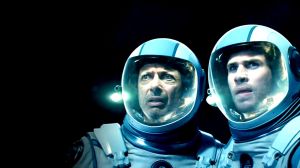 There are some familiar faces returning but none of them are able to compensate for the deficit of charisma and screen presence that is Will Smith. Goldblum is on autopilot and doing his stare off into the distance and talk deadly serious thing. Pullman shows up again as a warning of what was coming, though a superfluous one at that. The biggest screen presence from the first movie belongs to Brent Spiner (TV’s Star Trek) as the Area 51 scientist who conveniently has also been in a coma for twenty years. Some of his comic relief is rather labored and cheesy, but it’s at least something. Charlotte Gainsbourg (Nymphomaniac) collects a check as a psychiatrist who has little bearing other than to be Goldblum’s ex. The most interesting new character feels like he stepped out of a Street Fighter arcade game; he’s an African warlord (Deobia Oparei) who likes to use a pair of machetes to kill the aliens. “You have to get them from behind,” he keeps insisting, and I keep snickering. There’s also that Emmerich staple of an officious government weakling who comically grows a spine. It just so happens this part is played by one of the screenwriters of Resurgence, Nicolas Wright. He studied, apparently.
The best thing Resurgence has going for it is the expansive world building, one of the few aspects of the movie that shows actual thought and care. This is one of the few movies I can recall where people actually try and use the technology of their defeated invaders. Rather than just throwing all those dead spaceships on a junk pile, mankind has decided to backwards engineer technological advancements. As a result, the contemporary feels like a sci-fi hybrid of humanity and the alien technology. It’s interesting to see what advancements have been made and how these have been integrated into regular society. I do question why we only have one defensive weapon/colony on the moon when there’s also one as far as Saturn. I wanted a bit more of a sociological examination on what life post-War of 1996 means. Life would be so fundamentally altered by the realization we are not alone in the universe, and not only that but that we need to play catch up fast to survive. The assumption would be that they will be back. The threat of annihilation unifies the world but what are those consequences? What are the consequences of living in a permanent military state of readiness and anxiety, wondering is it all going to be enough?
If you have fond feelings for the original Independence Day, there may be enough good will with the sequel to appease your demands, though probably only barely. Resurgence suffers from CGI-heavy spectacle that has long lost its appeal without supplying helpful additions like characters to care about, exciting action sequences that develop and impact the plot, meaningful plot turns, and a story that follows some form of logic. It’s not a disaster in all senses of the word. In a summer that’s already building a reputation for its mediocrity, I think there may be enough that Independence Day: Resurgence has to offer that select moviegoers will walk away feeling momentary entertainment. It’s not that the first film was intellectually rigorous sci-fi, but it went about its destructive business with a satisfying precision. This movie all too often just feels like things happening, then not happening, and with characters that are there but without any compelling reason beyond survival. The end of the movie sets up an intended sequel and possible extended franchise of sequels with a larger galactic war against the alien invaders. It’s both hopeful and naïve, dangling the promise of another tantalizing humans vs. aliens throwdown. It’s also a bit aggravating because the premise of the hypothetical sequel (I’m going on record saying it won’t come to fruition for another 20 years) is much better than the “they came back again” sequel we get with Resurgence. Don’t make me pay my money and then tease me with a better movie down the road. Nothing should be taken for granted. Independence Day: Resurgence takes too much for granted, and that’s likely why this resurgence will stop with one entry.
Nate’s Grade: C
Share this:

Now You See Me 2 (2016)
 The first Now You See Me was a pleasant surprise that took a simple concept (magician heist) and injected enough sly fun, style, and humor and made a memorable action thriller. As success demands, a sequel was commanded, but I had hopes considering the blueprint of its success could be repeated because those core elements were strong. We all love heist movies, we all love to be fooled, we all love to watch a smart people befuddle those in power, and the reveals made it even more enjoyable. I wasn’t expecting Now You See Me 2 to drop much of what made the first film appealing and shamble through its set pieces with a disinterested sense of sequel duty. The magic is gone.
The Four Horsemen magic act (Jessie Eisenberg, Woody Harrelson, Dave Franco, Lizzy Caplan) has made quite a few enemies. They’re a group that attacks the fraud, exploitation, and greed of those rich and powerful who feel untouchable. This merry band of Robin Hoods is transported against their will to Macau, China by Walter Mabry (Daniel Radcliffe). Walter lost a lot of money from the Horsemen’s antics in the first film and demands they steal a super microchip that will allow him to erase his identity and stay private permanently. Meanwhile, the Horsemen’s handler, Agent Dylan Rhodes (Mark Ruffalo), is blackmailed by famous and currently incarcerated Thaddeus Bradley (Morgan Freeman). Bradley has a score to settle with the Horsemen and uses Rhodes to escape from prison. All forces are headed to Macau and much more will be learned of the Horsemen’s behind-the-scene organization, The Eye.
 It feels like the filmmakers aren’t even trying to keep one foot in reality this time. It’s not like the first Now You See Me was a deeply grounded movie but it took pains to at least offer varying explanations for how these illusions were accomplished. Some of the answers were clever and some were preposterous, but at least they tried to show you their work, which made the Horsemen even cleverer, in my book. Understanding the preparation for the illusions and the execution of them adds to their impressive aura. The characters in the sequel don’t even attempt to explain the far majority of their tricks, and it’s simply not as fun. The opening job is a fun refresher because we see the different characters working together but also because we can see how they’re getting away with their shenanigans. As the movie continues, those magic acts get bigger and bigger and more ludicrous and harder to explain and then the movie just stops trying to explain. At this point magic might as well be real and the Horsemen are wizards. There’s suspension of belief and then there’s simply obliterating all connections to reality. When Eisenberg can control the direction of rain itself without any explanation, it cheapens the thrill. Because if there isn’t some level of limitations, requiring the tricks to be based in reality, then the on screen efforts lose their appeal because it doesn’t matter. It’s like haphazardly just writing, “The Horsemen do some magic junk and get away.” It’s just not as satisfying when it feels like the trick is ultimately on the audience.
Another complaint I have is that the scattered script seems littered with missed opportunities. One of the bigger misses that comes to mind is Harrelson’s twin brother, an obvious Matthew McConaughey impression from his True Detective costar. The character isn’t nearly as funny as Harrelson or the producers believe. He isn’t particularly memorable or necessary to the plot at all, but that’s not even his biggest offense. In a movie about magicians playing sleight-of-hand trickery, how in the world do we not have a switcheroo with the twins? That would justify his existence for the plot. I was shocked this never happened because it seemed so obvious. Why is he a twin? What does being a brother to Harrelson have to do with anything related to the plot? The script also gets overcrowded with antagonists, introducing Radcliffe and then bringing back Michael Caine and Morgan Freeman. The characters don’t so much compete with one another as they operate in separate spheres until a “twist” reveals more about their connections. Their agendas are too opaque. Radcliffe wants them to steal a super microchip so he can fully be “off the grid.” A man of his means shouldn’t have a problem with this. It’s not like he’s hiding out from the law for some kind of corporate espionage. It’s a convoluted reason to bring the Horsemen to his hiding spot in Macau. It’s just one in a long line of ideas that never feel fully developed. Even the magic set pieces don’t feel as fun. Seriously, one of the climactic magic set pieces is a human game of three-card Monty.
 Director John M. Chu (G.I. Joe: Retaliation, Jem and the Holograms) has worked with action before and certainly knows his way around choreography, but he feels too hesitant this time. The action scenes are rare and the chase sequences are muted. Outside of the tricks, there isn’t a standout action scene in the whole movie. In the first film we had a pretty fun magic fight that was wild and surprising and loaded with small payoffs. In this movie we have a motorcycle chase that plays out as expected. We have a foot chase that plays out as expected. You have professional illusionists at your disposal; action set pieces should not play out as expected. The most fun sequence is fairly straightforward but easily the best developed, and that’s the Mission: Impossible-esque heist of the microchip that is outfitted onto a playing card. It’s also clearly the most visually inventive sequence as the Horsemen play a game of keep away and the camera literally at times tumbles into their clothes. I think what makes this easily the best sequence in the movie is because it’s moderately grounded, the stakes are explained, and the audience is in on the trick, enjoying all the flimflam obfuscation. It also means when there are complications to the plan the sequence generates suspense. When you don’t know what’s going on and don’t know when things are going wrong, or how they could go wrong, it’s hard to generate genuine suspense. Being involved in the action is much more fun.
The actors all seem on autopilot, falling back to the broader descriptions for their characters. Eisenberg is a smug and cocky. Harrelson is smooth and shrewd. Franco is awkward and insecure. Isla Fisher is replaced by the capable Lizzy Caplan (TV’s Masters of Sex) as the requisite Female Horsemen. She makes a good impression but part of it is that Capaln seems to be the only member allowed to be comedic. It feels like there are three straight guys to her comedy cut-up. She’s good but without variation it also starts to lose its appeal when only one character seems to be trying. Ruffalo (Spotlight) seems too often unrelated the Horsemen story as he discovers more info about his father. He’s the only character that actually has something of a storyline, though his playing of both sides and attempts to hide his role to the FBI is just another ludicrous element. I miss Melanie Laurent too.
Now You See Me 2 (how could this not be called Now You Don’t?) is a lackluster sequel that seems to have forgotten what made the first film the enjoyable caper that it was.
Nate’s Grade: C+
Share this:

Finding Dory (2016)
 Victims of their own meteorically raised expectations, there’s still never been such a thing as a “bad Pixar” movie, and yet that doesn’t stop a growing lower tier from emerging, mostly the non-Toy Story sequels. I was wary about their latest, Finding Dory, mostly because I wasn’t completely enamored with its predecessor and also because it felt like writer/director Andrew Stanton was resorting to safe territory after helming the high profile flop, John Carter. It’s an amusing, cute, and effortlessly beautiful movie to watch but the threadbare plot reminds me of those direct-to-DVD sequels that were born from many a Disney animated classic from the 1990s. This is simply a story that didn’t need telling, much like Monster’s University, Cars 2, and The Good Dinosaur. This narratively fishy fish tale is firmly in that lesser league of Pixar cinematic adventures. I laughed here and there and there are some emotionally resonant moments as Dory looks for her missing parents, but so much of the plot feels transparently utilitarian, moving pieces around, and without the imagination and wonder the original provided. Hank the octopus feels less like a fully defined character and more a merchandizing opportunity. The majority of the plot takes place at a marine park, which limits the discoveries. Where are the narrative payoffs and economical storytelling of Stanton’s masterpiece, WALL-E? There’s an emotional lesson during the third act that would have hit harder had the filmmakers had the courage to see it through. I was picking up a heavy parallel with Dory and raising children with special needs. I would imagine much like the brilliant Inside Out that parents might get more out of the film’s emotional relationships than children. Finding Dory is fun and difficult to dislike, what with its loveably optimistic lead character; however, it does too little thematically to separate itself from a sea of imitators.
Nate’s Grade: B


 nathanzoebl
You must be logged in to post a comment.