Blog Archives
Hellboy (2019)
 The new Hellboy reboot is utterly fascinating but in a way I doubt the filmmakers intended. The confluence of bizarre, arbitrary plotting, budget limitations, artistic self-indulgences, and tonal imbalances makes for a truly entertaining watch but for all the wrong reasons. A recent apt comparison would be the Wachowskis’ 2015 shining artifact-of-hubris Jupiter Ascending, an expensive and ambitious mess that left me dumbfounded how something like that could slip through the studio system. Right from the 500 A.D. opening prologue of Hellboy I was laughing under my breath, trying valiantly to make sense of what I was watching. It played like camp, ridiculous high-end camp, but I don’t think that was the intent of director Neil Marshall (The Descent) and company. I think they were going for a cocky, carefree sense of apathetic cool and wanted to have fun unleashing an adolescent fantasy of monsters, violence, and droll one-liners. Hellboy is an experience, all right.
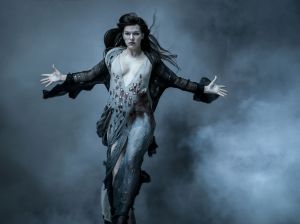
Hellboy (David Harbour), child of hell and intended tool for evil Nazi world domination, has been raised by his surrogate father, Professor Bloom (Ian Mcshane), as a valuable asset in the Bureau of Paranormal Research and Defense (BPRD), the fighters against the things that go bump in the night. An ancient evil witch, The Blood Queen (Milla Jovovich), is being resurrected one dismembered piece at a time. Hellboy and his associates, psychic smartass Alice Monaghan (Sasha Lane) and agent/were-jaguar Major Ben Daimio (Daniel Dae Kim), must track the whereabouts of the Blood Queen before she can fulfill her goal of unleashing hell on Earth.
 The storytelling for the 2019 Hellboy is its biggest hurdle that it cannot get over. I think ninety percent of this movie’s dialogue, and storytelling in general, is expositional, and the remaining ten percent are groan-worthy quips (after kissing a gross witch, Hellboy says, “Somebody get me a mint” — har har). Every moment is explaining the person in the scene, the stakes of the scene, the purpose of the scene, the setting of the scene, the other people in the scene, and then re-explaining one of these elements. Every single freaking scene. Every ten minutes a new character is thrown into the mix and the cycle starts anew; it feels like the screenplay is cramming for a test by the end credits. In addition to these expository present-day scenes, there are five separate flashback sequences to explain superfluous back-stories. Do we need a flashback to explain the motivation behind the pig man, who is pretty much a standard henchman? Would the audience not believe he has a grudge against Hellboy if we lacked a key flashback to set up the history between our protagonist and this unimportant side villain? Does Daimio need a flashback to showcase his military team being attacked by something vaguely mysterious? Or can he just say he was attacked and we reveal later the full extent of his… were-jaguar powers? Did we need an entire segment where Hellboy travels to another dimension to tussle with the imprisoned witch Baba Yaga to find out a location? Did we need an entire Arthurian legend to set up a super special weapon that will kill our villain, or could it have been anything else? Then there are prophecies and counter-prophecies and I was exhausted by the end of these relentless two hours. It feels less like a coherent two-hour movie and more like an aborted television pilot intending to set up weekly wacky adventures and preview a larger realm of potential storytelling avenues. We even get the extended set-up for a hopeful sequel that will all most certainly never materialize.
 The bonkers narrative inconsistency and runaway pacing make it feel like anything can happen at any moment, but not in a good way. It makes it feel like very little onscreen legitimately matters because the next second a character could just say, “Hey, here’s that thing,” or, “Here’s a new person that cancels out that previous thing.” It feels like the internal rules of the storytelling are completely ephemeral. I kept shaking my head and shrugging my shoulders, just like the breathless inconsistency of Jupiter Ascending. I was not a fan of the original 2004 Hellboy (if I recall I cited it as one of the worst films of that year) and one major reason was just the sheer number of goofy elements that felt overwhelming to any sense of a baseline of believability for me to gravitate toward. I feel like if I were to revisit the original Hellboy I might be more charitable (I enjoyed the second film), but this 2019 edition is an even bigger culprit because it feels like nothing in any previous ten minutes matters. The screenplay is structured like one disposable video game fetch-quest after another.
You can almost see the movie that Marshall and his team were aiming for, a weird hard-R action/sci-fi film with strange creatures and smarmy attitude. There are moments where you can tell a lot of fun was had designing certain ghouls and monsters, like the hell beasts unleashed that include a spike-legged monstrosity that ka-bobs people as it stomps. It’s moments like that where you see the zeal of crazy creativity that must have attracted Marshall and others to this project. It’s too bad there aren’t enough of them. There’s a sequence where Hellboy takes on a trio of giants that’s filmed in a style meant to evoke one long tracking shot. It doesn’t quite get there thanks to the limits of the budget’s special effects to conceal the seams. This is an issue throughout the movie. The special effects can get surprisingly shoddy, especially a spirit late in the film that shockingly resembled something akin to an early 2000s PS2 game. If the budget could not adequately handle these sequences then maybe there should have been less new characters and excursions and we could have concentrated on what we had and done it better.
 I pity Harbour (Stranger Things) for stepping into the oversized shoes of fan favorite Ron Perlman. It’s quite a challenge to follow up the guy who seemed born to play this part, but Harbour does a good job with what he’s been given. The character is a bit more sulky and surly than we’ve seen in the previous incarnations. It makes Hellboy feel like a giant moody teenager chaffing under his dad’s house rules and saying nobody understands him. The practical makeup is great and still allows Harbour the ability to emote comfortably though he always appears to be grimacing. MacShane (TV’s American Gods) is a more ornery father figure than John Hurt, and he seems in a hurry to get through his lines and get out of here. Jovovich (Resident Evil… everything) is an enjoyably hammy villain with her withering sneers and overly dramatic intonations, but she knows what she’s doing here. The same can be said for what might be the most pointless character in the whole movie, a Nazi hunter known as “Lobster Johnson,” played by Thomas Haden Church (Easy A), who plays it like he’s in one of those heightened propaganda inserts from 1997’s Starship Troopers. The actual side characters for Hellboy are the weakest because the film doesn’t know what to do with them. Lane (American Honey) and Kim (TV’s Lost) are both good actors but the movie doesn’t understand that a character foil is more than a bickering, doubtful sidekick.
I would almost recommend watching the new Hellboy reboot for the same reasons I would Jupiter Ascending. It’s rare to see a big screen stumble where it feels like the movie is just being made up as it transpires before your eyes, where the mishmash of tones, intent, and mishandled execution is confusing, disconcerting, and even a little bit thrilling. This might not be a good film for various reasons but it can be a good watch. If that sounds like your own version of heaven, give the newest Hellboy a passing chance.
Nate’s Grade: C
Share this:

Serenity (2019)
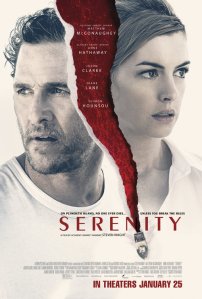 Serenity might have the most bizarre plot twist of any film this year, or maybe even the last few years. For the sake of you, dear reader, I’ll not spoil it, but it’s hard to talk about this neo-noir crime thriller without revealing its larger grand design. I have no real idea what writer/director Steven Knight, a talented wordsmith who has written Eastern Promises, Locke, and Peaky Blinders, was going for with this murky genre mishmash. Matthew McConaughey plays Dill, a local fisherman who for the first 18 minutes of the movie is obsessed with a hard-to-catch tuna like it’s Moby Dick. Literally, this is the key plot for 18 minutes. Then his old flame (Anne Hathaway) comes to town and looking for Dill to help her kill her abusive husband, Frank (Jason Clarke). Now we’re on fertile noir ground, and then one hour in the film throws a curve ball that nobody will see coming, and it spends another 45 minutes dealing with those repercussions. Some of this added knowledge leads to creepy exchanges where Dill is peeling back the veneer of his sleepy island town residents, but really it’s a confusing and unnecessary twist that leads to strange thematic implications and tonal oddities that may lead to unintentional laughter. The sentimental ending conclusion, born out of murder both real and imaginary, feels like it was ripped out of Field of Dreams and forcibly grafted on. So much of the drama is about following what is expected of us, and there are more than a few passing, though intriguing, Truman Show-esque moments that reward further examination, but these are put on hold to slay the abusive husband/step dad through the power of an elusive fish. I don’t know what to make out of Serenity. The acting is fairly solid, the photography is stylish, and Knight knows how to spin a mystery, but to what end exactly? It feels like a passionate albeit misguided student film trying to say New Things about old tropes. In the end, it’s a fish tale that is better off being thrown back. See, I can do fish things too.
Nate’s Grade: C
Share this:

Us (2019)
 I think it’s important to state that Us is not Get Out and that’s perfectly okay. Not every movie can be a Get Out, an experience that was so refreshing, socially relevant, wickedly fun and dynamic that I immediately wanted to see it again and tell everyone I know to join in. Writer/director Jordan Peele shed his funnyman past and flexed his impressive genre know-how to make a knockout of a movie with an amazingly structured story, allowing all of the pieces to snap together with clever precision. It was my own second favorite film of 2017 and I was highly looking forward to Peele’s follow-up in the realm of what goes bump in the night. Don’t go into Us expecting Get Out. It’s not quite the sum of its parts and has some storytelling shortcomings that limit the impact of its visceral thrills. It’s an engaging horror movie, but it’s far more allegorical and far less tidy and satisfying.
The Wilson family is spending their summer vacation at a rental home in Santa Cruz, California. Adelaide (Lupita Nyong’o) and her husband Gabe (Winston Duke) are trying to enjoy a getaway with their children, teenage daughter Zora (Shahadi Wright Joseph) and young son Jason (Evan Alex), when strange coincidences keep occurring. This is the same beach town where many years ago Adelaide had a traumatic childhood experience getting lost from her bickering parents. Then one night Jason informs his family that there’s another family standing in their driveway. The Wilson family is hounded by mysterious doppelgangers, each a cracked mirror version of themselves. This new family wants what the Wilsons have and will use any bloody means to see that they get it.
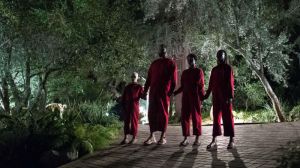 Us is more a straight horror film and has plenty of excellent, terrifying, and smartly directed scenes to make an audience squirm in their seat. Peele has established in two movies a strong instinct for horror and how to expertly stage a scene. His camera is judicious in what it does and does not show the audience, holding onto moments to escalate tension and providing no escape for an eager audience. The majority of the second act is a home invasion thriller and these scenes and subsequent chases and escapes can be nerve-wracking. Each character has their own opponent and each has their own method of trying to outsmart or out maneuver their downtrodden doppelganger. I was getting plenty of Funny Games vibes, a movie I downright despise, but what it could have been if the creator actually cared about the inhabitants. The family and their bonding is a strong empathetic anchor for the audience, so we watch each member of the family battle a literal incarnation of their inner demons. Peele also assembles an effective collection of spooky imagery, from caged rabbits, to the slice of golden scissors, to a carnival funhouse, to even the nature of that 80s social event, Hands Across America. You can sense Peele’s love of horror and the entertainment value horror movies afford. There’s a strong central mystery to guide the narrative and the sense of discovery from Act Two onward keeps things fresh as we learn more and more about these doubles.
From a technical craft standpoint, Us has the upper hand over Get Out. This is a movie that wants to scare you and Peele has devoted great consideration into his artistic elements to achieve that key principle. Peele knows exactly how to craft a particular mood and what genre elements to pepper in and to what amount for the right response. The photography by Mike Gioulakis (It Follows) is evocative and makes great use of limited light to capture an eerie and unsettling feeling. The musical score by Michael Abels is also exceptional, making the most of each heightened scene and doing wonders with a dark, operatic version of the chill 90s song “I Got 5 On It” by Luniz. It makes for a fun, frightening, and favorable film experience in the moment-to-moment sequences of build and release.
The performances are another strength, with each member of the family getting extra range thanks to their dual roles. Nyong’o (Black Panther, 12 Years a Slave) is the standout and emotional center of the movie. Her double is the leader of her clan and the only one that has the ability to speak, except speaking isn’t quite the right word. It’s more like the words escape her throat, raspy and without intonation. It’s a remarkable commitment on her part and she tries a lot of weird character tics, most of them work, from her herky-jerky to robotically possessed physical movements, unblinking eyes, and then there’s that startling voice. Duke (Black Panther) finds his footing as a comedic foil, starting as a corny but loving dad and thrust into a family defender that gets more and more tired of the horror movie nonsense he endures. The kids all do solid, effective work with what they’re given, seizing their moments. Elizabeth Moss (The Handmaid’s Tale) plays a bourgeoisie friend and has a fantastic moment with lip gloss that made me horrified and entranced all at once.
 This is where the merits of the film start running into conflict with Peele’s muddled intentions and messy execution toward the finish. As I said, it’s far more allegorical in approach; meaning for the longest time it seems to be a film outside the bounds of literal interpretation. That’s fine since many horror films rely upon a heaping helping of metaphor for larger implications. I was prepared for Us to stay in this creative territory. Except Peele makes a late decision to squeeze his movie into a bizarre and distracting middle ground, where it feels like the metaphor is the real message, if you can decode it. Once you stand back and assess the full Us, it doesn’t hold together in allegory or explanation.
Even hours after seeing the movie, I cannot say whatsoever what the intended theme is for Us, and this really befuddles me since Get Out was laser-focused in this regard. Peele isn’t just cranking out fun, throwaway genre movies, he’s trying to make statements through horror and elevating the genre in artistic ways. Get Out postulated how being a black man in America was like living in a horror movie and a Stepford Wives-meets-Being John Malkovich commentary on the usurpation of minority agency and the commodification of black bodies. It’s not every day that a horror movie wins an Oscar for Best Original Screenplay, let alone deserves it, and Peele’s treatise on race relations was perfectly structured, each piece snapping together and better informing the whole, with setups and payoffs galore, and at its heart was its relevant message. With Us, I don’t really know what Peele is trying to say here. There’s a simple duality theme but that seems pretty weak and underdeveloped. There may be a have/have not inequality discussion but this gets into trouble in the final act (more on that below). I don’t think race even factors into the overall message, as a late turn reveals that the doppelgangers extend beyond our central African-American family. What is Peele trying to say with Us? I’m at a real loss and I’m trying to process that confusion and my own expectations.
This might have worked better had Peele not elected to supply a hasty sci-fi explanation for why things are the way they are, and in the process he strands his film in a contentious middle zone that tries to find a logical context to plant his allegory. I won’t get into what exactly the details of this explanation are but suffice to say it doesn’t really hold together and invites far more questions, each one picking apart the reality of the film, which disintegrates at an ever-increasing speed. How far-reaching is this conspiracy? What is the ultimate goal? How do these people think they will win? Why now? There’s also a big twist ending that should be obvious for anyone paying attention, but what makes this decision worse is not that it’s predictable but that it hardly sheds any new dimension to what came before. It doesn’t really change our reading of certain people because of the time it happened and so the big meaning is its existence as a twist. It doesn’t redefine the narrative in the way that great twists should. It might play into a larger thematic point except, as described above, that area is hard to ascertain. The last third of Us gives a sense of scope and rationale but the movie also loses its form, trading in dream logic and then trying to provide a new real world context that cannot hold.
 Friends have already asked me whether Us is a good movie, and I’ve found myself saying, “Yes, but…” Peele’s follow-up left me with more questions than answers and a nagging sense of dissatisfaction that began to eat away at my otherwise good time in the theater. Us has some fantastic moments and tense scares but I cannot say what its muddled theme is, the hazy explanation doesn’t really work, and the overall intent left me perplexed. It’s an evocative horror movie with solid to great performances from a very game cast of characters. Given its more free-floating plot, it feels like the kind of movie that would hold together by a strong thematic core. I think most people will leave Us somewhat scratching their heads and wondering what it was all about, but not as an accessible puzzle to decode. It’s more a puzzle that doesn’t resemble the picture on the box and is frustratingly missing a few too many pieces to come together.
Nate’s Grade: B
Share this:

Captive State (2019)
 The fraught world of Captive State is interesting, a political landscape ten years into an alien occupation. We follow a small band of human resistance fighters working to get past a security stopgap to strike back at the alien overlords who resemble human-sized pine trees. John Goodman plays a police security chief trying to unravel the insurgent conspiracy while working with the collaborative government. It has a slight cat-and-mouse feel of a good conspiracy thriller and there are asides that broaden the world, giving an interesting peak at the realities of this strange new world. The problem is that it feels like a whole mini-series stripped into a two-hour movie. The characters feel less like people and more like impressions of people, and the story is plowing through so many incidents that there isn’t much time to flesh them out except for the occasional trope. As a result, the movie feels like it has a lot of things happening but my interest level flagged because I felt little for the characters. The limitations of the budget are felt here and there as far as the sense of scale. Director/co-writer Rupert Wyatt (Rise of the Planet of the Apes) takes a docu-drama approach and favors nighttime chases and sneaking, which also conceals special effects restrictions. The visual grittiness adds a visceral level of realism but can lend itself to additional logic questions. I kept waiting for the world to feel more lived-in and offer important slivers to add layers of context to this conspiracy. Captive State is frustrating with how much it leaves unspoken and unclear. It’s ten years in to this occupation and what exactly have the aliens offered the world? What has changed? Why are these freedom fighters fighting back? What are the goals of the aliens? I can handle ambiguity and nuance but with too much the world building can feel unsatisfying and incomplete. It comes together well but by the climactic end I felt the universe it established was more intriguing with potential than the story it delivered.
Nate’s Grade: C+
Share this:

Alita: Battle Angel (2019)
 James Cameron has been dreaming about making Alita: Battle Angel for decades. He bought the rights to the 90s manga and has been sitting on the property, having to continuously push it back because of technological demands and the demands of, at last count, a thousand Avatar sequels. Cameron co-wrote the screenplay and handed the directorial duties over to Robert Rodriguez (Sin City), a talented visual stylist who has been struggling of late. The marriage looks good and the final 122-minute feature is the closest a live-action film has ever gotten into replicating the look and feel of an anime, for better and worse.
Hundreds of years after the fall of civilization, a lonely scrapper and doctor, Dr. Ido (Christoph Waltz) discovers the remains of a cyborg with a still beating heart. He puts her back together with a new body and names her Alita (Rosa Salazar). She’s special and learning about the big new world, trying to unlock her memories of the past, and we’re talking way way back into the past. She’s old technology, something that’s quite valuable for the street gangs that strip amputees for parts and for the global corporation whose emissary (Mahershala Ali) needs to reclaim the powerful tech. Alita falls in love, learns about her sense of humanity, and fights lots and lots of robotic villains.
This visual decadence of Battle Angel is the greatest reason to see it, especially on the big screen if able. The future setting is immediately visually engaging, with people walking around with mechanical limbs that look like they were literally cobbled together with whatever junk was lying around. There is a have/have not dichotomy between the huddled masses trying to eek out a living in a garbage city and the floating metropolis above that regularly dumps its trash onto the people below. It’s easy to see the influences of Battle Angel in other media, like Elysium, as well as its own cyberpunk influences, from the likes of Blade Runner to recycling the chief sport of Rollerball. The character design is to die for in this movie, with exceptionally assembled figures that stand out in memorable, dangerous, sometimes junky ways. There are a number of different robotic killers with colorful and unique weapons and personalities, and the larger world invites further scrutiny. There is a bustling post-apocalyptic life here and it’s plastered on a splashy, broad visual canvas with some spectacular special effects. Not all of the effects are at the highest level, from some compositing issues with faces to the big anime eyes (more on that later), but Battle Angel is an expensive movie that puts it all onscreen. The world is fun to watch and the action sequences feel ripped directly from the manga, with larger-than-life creatures fighting in vicious and frenetic ways. Even when the movie feels like it’s losing its momentum there’s always the visuals to enjoy.
 The central idea of this post-apocalyptic junk town being populated with deadly bounty hunters who work for a mysterious conspiracy is a great starting point. There is a bevy of killers with different allegiances and different codes, and then you throw in a powerful new addition who doesn’t remember her hidden past and you’ve got a recipe for drama and conflict with some crazy characters. There are even little dark touches that I would have thought would have been clipped in the adaptation process. Battle Angel has so much going for it that it can get a little frustrating when it feels like it’s spending so long to stay in the same place. The plot revelations are fairly predictable but still effective, but the long delays between them are filled with numerous action set pieces that diminish a sense of progression. I liked the Alita character and her relationship with her surrogate human father, but I didn’t think enough of any other relationship she had in the film. I wasn’t that invested in uncovering her past, which was still a bit too vague for me as a non-reader of the source material. At the end of the story, Rodriguez has set up his audience for a continuing saga of strife that feels too incomplete. Alita has learned more about herself (though I’m still confused) and has a goal of vengeance (against a force that is left too vague) and a renewed sense of purpose (built upon a relationship that doesn’t feel that affecting). It’s a curious end point and a questionable decision for a movie this expensive to assume it would secure demand for a presumptive sequel.
Where Battle Angel began losing me was because its title character, Alita, became too overpowered for her own good, eliminating a sense of stakes early on. The battle calculus skewed far too quickly. After the first act, actually from her first fight onward, there is never any doubt whether Alita will triumph. She doesn’t undergo any training or any real learning curve when it comes to her superhuman defense. Right from the get-go she’s doing amazing acts of fight choreography and making it all look easy. She even defeats an enemy when she’s only a one-armed torso. That’s admittedly impressive but another indicator that there is no real threat that can be posed against her. No matter how huge the cyborg, or how many pointy appendages at their disposal, it’s only a matter of time before our little pint-sized warrior is eventually triumphant. There is really only one fight where she’s presented with any slight disadvantage, the aforementioned one-armed torso sequence, but this too is shortly rectified. She goes from having a nigh-invincible body to an even more nigh-invincible body, making her, you guessed it, even more powerful. This reality takes something away from the numerous cyborg-on-cyborg battles, and without greater variance on the scene-to-scene needs, the fights become somewhat stale. Visually they are still impressive with a sense of fun watching the manga pages come to startling life, but without stakes and variance, it’s all the same punches with less power.
 Now Battle Angel isn’t the only story to deal with an overwhelmingly powerful protagonist (see: Neo, Superman, just about every character on Dragonball). The solution is usually a specifically applied weakness or, most often, the vulnerability of those closest to the hero. It’s the regular people that can be gotten to, that can be endangered, that approximate the “weakness” for the overpowered protagonist. However, for this to work, you need an emotional connection to the characters in order to feel their potential loss. This cannot work if the characters are stuck in archetypal mode and add little help. That’s the problem with Battle Angel; I didn’t really care about any of the other characters. They had points of interest, a tragic shared back-story, a dream to escape their earthbound poverty, some secrets they don’t want getting out, but it’s never enough to make them feel that much more refined than the secondary background players. The film doesn’t even go the route of really threatening the more vulnerable people in Alita’s life, which is a strange miscalculation. What we’re left with is a very kickass robot woman doing her thing and taking down the big bad cyborgs. It’s entertaining and there’s enough of an interest in bullies being beaten by the underdog, but Alita isn’t really the underdog and so the many action sequences become a tad tedious.
Salazar (The Maze Runner: The Death Cure) gives an expressive performance and enables her superhuman cyborg to find a semblance of her humanity. Because of the character design the degree of performance capture relies much on the micro expressions of Salazar, so if she overdoes it then Alita can lose that tenuous sense of reality. She finds a balance that makes her feel real, at least real enough to exist in this world. Waltz (Downsizing) is enjoyably paternal with a few dark secrets of his own. His rocket-powered pickax thingy falls under my category of something that’s futuristic but not exactly practical. This wouldn’t present much of a problem except his character is an expert at using the parts he can scrounge up to get the job done. Skrein (Deadpool) has found a real career for being sneering villains with oh-so punchable faces, and he succeeds yet again. Ali (Green Book) and Jennifer Connelly (Only the Brave) deliver enough with so little that you wish the screenplay asked more of them than the occasional in-shadows skulking. It’s interesting to look at this cast, which has four Oscars to their names (possibly another one for Ali), and an additional nominee with Jackie Earl Haley.
 Let’s talk about those eyes. The film is based upon a popular manga and anime and James Cameron was determined, from the earliest point, to recreate that stylized big-eyed look famous to Japanese art. It’s one thing on the page and another brought into real life, and the response has been all over the place. Some cite the uncanny valley and cringe while others argue it makes Alita more vulnerable, the eyes being the window to the soul and all. It does set her apart from the crowd, which is supposed to befit her character and where she came from, so to that end it works. It’s not as distracting as I feared and you do grow accustomed to them. However, was any of it necessary? Would we feel any different for Alita if she had more human-sized eyes? I doubt it. The costly effect of a very costly movie ($200 million reported) made me think of a similar quirk with the 2011 Green Lantern film where Ryan Reynolds’ suit was a CGI effect. Rather than simply wearing a costume the filmmakers spent millions applying one in post-production, and in the end what of value did it offer to the experience?
It’s hard for me to watch Alita: Battle Angel and understand why this was a property that James Cameron set aside for almost two decades. What about this makes it special or at least separates it from the pack of imitators? It’s a world with points of interest and characters that could be interesting, though many stop short at the design phase. The live-action version is entertaining and visually sumptuous, but I was finding myself grow tired of the film’s loose stakes, predictable plotting, simplistic themes, and archetypal characterization. The action can be pretty fun but even as Alita lines up more obstacles and more enemies we never feel threatened or concerned. Without a larger sense of danger and plot development the many fights start to grow monotonous. The special effects are wild but they service a story that seems ordinary genre. Alita: Battle Angel ought to please fans of the source material but it short-circuited for my attention.
Nate’s Grade: C+
Share this:

Happy Death Day 2U (2019)
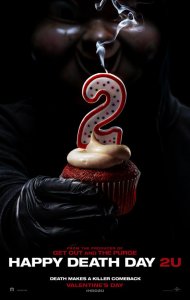 On one hand I can admire the “who gives a damn?” ethic behind the sequel to Happy Death Day, a fun time loop of slasher cinema tropes. The original had some darkly comic edges but mostly played its premise straight in the realm of horror. The sequel doesn’t play anything straight. It’s completely bonkers and looking to turn anything into a joke. This provides a charming carefree sense of bravado; however, if you were a fan of the first film, it also might rub you the wrong way and seem overly flippant and messy. We get a science fiction explanation involving parallel universes as to why the time loops are happening, and now our heroine Tree (Jessica Rothe) is stuck in a parallel version of her looped day. The film sidesteps a Back to the Future 2 sense of repetition but doesn’t stray too far from the outlines of the original Happy Death Day, just with a few new surprises. The big question is whether Tree will return to her home dimension or stay as a tourist in this new dimension, a world where her mother is still alive but her boyfriend is with somebody else. As should be obvious, this hard choice isn’t really that hard considering that she could always still get with the would-be boyfriend again. There are some comedic sequences that borderline on farcical sitcom, like a montage of suicide set to Paramore’s “Hard Times” and a woman faking being a bumbling blind student, and too many of the plot complications feel artificial and random, especially the delays to return to the home dimension. The world can often feel constrained as well, like this bustling campus only comprises the same eight faces (and their bushy eyebrows). My biggest gripe is that the first act is completely superfluous and it presented a more compelling mystery, a student from a future trying to kill their past self to avert a crisis. That’s way more interesting than another dopey killer in the baby mask. Still, the movie never pretends to be anything other than a fun couple of hours with sprightly visual comedy and a terrific anchor in Rothe, a comic stalwart. Happy Death Day 2U gets more ridiculous as it goes and I hope it just keeps digging further, never finding its bottom.
Nate’s Grade: B-
Share this:

The Lego Movie 2: The Second Part (2019)
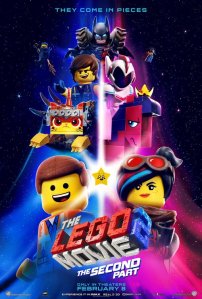 Everything might not be awesome but it’s still pretty great for this creative, heartfelt, and hyperactive family franchise that is better than it has any right to be thanks in part to returning writers Phil Lord and Chris Miller. It’s not quite as fresh and clever as the first go-round but it manages to better its predecessor in some key ways. Now that we know the colorful and zany antics of the animated Lego characters are also simultaneously the imaginative play of a real-world family, it provides a deeper thematic subtext with the unseen nature of siblings in conflict. I remember my own younger sister wanting to play with me and my toys, and me rebuffing her, and the film struck home some key emotional points about the inclusion of cooperative play. The different styles of play are on display as our characters are abducted by a shape-shifting space queen (voiced by Tiffany Haddish) who is determined to marry Batman and possibly rule the universe. A fantastic running joke is how transparently malevolent the queen is, which leads to an even better payoff. There are more songs and each is pretty well constructed, relevant to the story, and assuredly catchy, like “Catchy Song” used to brainwash people through pop, and a mournful version of “Everything’s Not Awesome” that becomes genuinely inspirational and uplifting by its climax. The life lessons are easily digestible and the sense of breezy fun is still alive and well. I was laughing throughout, sometimes quite hard, and the brother/sister subtext had me wondering if I owed my younger sister a decades-late apology for my behavior (sorry, Natalie). Lego Movie 2 is a worthy sequel that finds new and interesting ways to build off the irreverent original’s model. Bring on the Toy Story 3-style ending where our grown-up owner says goodbye to his childhood toys and friends. At this point, Lord and Miller can do anything and imbue it with wild wit, whimsy, and unparalleled mass entertainment (except Star Wars, I suppose).
Nate’s Grade: B+
Share this:

Bird Box (2018)
 As a film critic, I feel compelled to write about Bird Box because, apparently, one third of the entire Internet is currently talking about this Netflix sci-fi horror movie. It’s about killer monsters that cause people to violently kill themselves upon sight. Netflix has reported that over 40 million customers have watched Bird Box in its first week of its streaming release, which basically means 35 million people likely fell asleep to Netflix and it started playing the new high-profile movie on auto play. I know people that love this movie. I know people that hate this movie. I know people who hate this movie with a passion and go into apoplexy trying to describe their disgust. Bird Box isn’t a movie worth strong feelings, both good and bad. It’s a fittingly entertaining movie with too many structural flaws, underdeveloped ideas, and diminished tension and stakes.
Malorie (Sandra Bullock) is trying to navigate the post-apocalyptic world of monsters. She’s traveling down river with her two children, all blindfolded. Meanwhile, she flashes back to the first few days of the monster outbreak when she found security in a stranger’s home until things went from bad to worse to murderous.
Part of the problem with Bird Box is that the monsters never feel that threatening because the hazy rules manage to defang them. Given the unknowable nature of monsters, I’m not expecting a textbook but some level of consistency that won’t rip me out of the film. The monsters are only a threat when you look at them, which is fine, except they cannot or choose to refrain from physically interacting with their human targets. I don’t know if this is a natural limitation, a choice, or simply anecdotal evidence that will be disproved. Just because the monsters haven’t done something yet doesn’t mean they might not be able to. Just because the monsters don’t attack anyone wearing a blue sweatshirt with a googly-eyed reindeer doesn’t mean this is standard. We see at one point the collateral movement of a monster chasing after Sandy and the kids, shoving trees and other forest vegetation aside. They do physically interact with the world; they just do not interact with our characters. This takes away much of the danger of these creatures. There’s one scene where a character is struggling to get indoors and, oh no, the garage door is opening. Look out; all he has to do is… continue not looking at the monsters as he was doing without effort. It makes me think of The Simpsons Halloween episode where the key to defeating killer mutant advertisements was not to look (it had Paul Anka’s guarantee).
 The monsters also adopt the voices of loved ones, so survivors would start to learn from these experiences and begin to carry a deep skepticism about suddenly prevalent loved ones begging for blindfolds to be removed. Does this mean the monsters can psychically read the thoughts of human beings to know what voices to tap into? It made me think of The Bye Bye Man and its Bye Bye Man-induced hallucinations (“Is this cop’s face really oozing black blood through empty eye sockets, or is that you Bye Bye Man, you scamp?”). This is an interesting aspect that never feels fully developed, the mistrusting nature of the calls for help. Instead of adopting the voice of dead loved ones, I wish the monsters had chosen more judiciously. You could feature a sequence with someone genuinely calling for help and being left behind by Sandy because, in their blindfolded state, they cannot tell the difference in the authenticity of the speaker’s claims.
But what I kept coming back to is why can’t the monsters go indoors? This was a hurdle I could never fully get over because it cheapened the threat for me. As with any apocalyptic or viral outbreak, there is danger in having to leave the sanctuary, and there will be a need to gather supplies, but once you have a home base the monsters can’t enter, it loses a level of stakes. It makes me think of M. Night Shyamalan’s Signs where space aliens can travel the stars but cannot open a pantry door. Having limitations on your monsters is essential or else the threat will feel too overwhelming, but these limitations need to make consistent sense. The monsters in A Quiet Place had superior hearing but were essentially blind. The monsters in Bird Box are deadly to look at, will tempt you with auditory siren songs, but as long as one remains indoors and stays away from windows, you can live a happy and healthy albeit sheltered life of repose.
 This is one reason why the story has to find a new threat that is allowed to venture into the safe spaces. There are certain people who seem immune to the suicidal impulses of the monsters. The screenplay by Eric Heisserer (Arrival) implies people who were crazy beforehand are unaffected, though what degree of crazy or mental instability is up to interpretation. These people worship the monsters and actively try to force others to look at them, to also be enlightened. This could have been an interesting addition to the world of Bird Box but it plays it too straight. These cultist people are just another obstacle, a group of standard movie crazy killers. I was hoping that the screenplay was playing coy with this subject and biding its time only to introduce this group in a more meaningful and manipulative fashion later. It never happens. They’re just crazy killers meant to enter buildings and pose a new indoors threat. Now you can’t trust anyone!
The structure of Bird Box constrains the overall impact of its story. The movie is divided almost equally between two different timelines, one shortly after the start of the monster attacks and one five years later. I was waiting for these two different storylines to inform one another, and they do in essentially superficial ways. We know in the future story that it’s only Sandy and the kids, so it’s only a matter of time before everyone in this house will end up dead. It also hurts that this segment is best described as “dime store Stephen King.” We’re stuck with a group of strangers who have all been given one note to play, therefore the extra time feels tedious because we don’t care about them or what happens to them next (sorry John Malkovich, Jacki Weaver, BD Wong, and others). Winnowing these extended flashbacks and sticking with the current day storyline would have improved the movie. There’s a more immediate threat and it presents a more intriguing scenario of being on the run and learning as we go about the monsters and the accrued survival tactics. I think learning on the run would be more exciting rather than conveniently finding refuge with a guy who explains everything because he was doing a book report on the supernatural and somehow knows the rules. This would also better hone the theme because the “before” of our before-and-after dynamic doesn’t establish Sandy enough as a disinterested mother.
Much of this could be forgiven or mitigated if the suspense sequences were engaging and smartly developed. I can forgive any nagging plot quibble with A Quiet Place (Why don’t they live closer to the waterfall? Why don’t they have a sound system to draw away monsters?) because the suspense sequences were brilliantly executed and highly unnerving. This just isn’t the case with Bird Box. There is one clever sequence that seems to capitalize on the possibilities of its sight-challenged premise. During the house half, the gang climbs into a car and uses its motion sensors and GPS to navigate a trip to the local grocery store for a supply run. It’s fun and decently staged. The inclusion of caged birds being a monster alarm is interesting until it starts to become more ridiculous. People never seem to listen to these birds and pay the price. The initial outbreak in the opening, with cars flipping and people flipping out, has a nice escalation into madness and chaos. The movie never quite recovers that same tense feeling. Watching people wander with blindfolds doesn’t make for great visual tension unless we see what they do not and dread what’s to come. Bird Box settles into a generic paranoia thriller about who can be trusted, and that’s even before the crazy cultists come knocking. Outside in the woods, the final act involves running to sanctuary, but without the killer cultists, it’s only running away from a thing that can’t touch them. It makes for a curiously inept climax and a sentimental resolution that feels unearned.
 The arc of the movie is about Sandra Bullock’s character accepting motherhood and attachment to others but this theme is murky. She named her children “Girl” and “Boy” because she didn’t want to think of them as her own. This is the kind of thing that seems more symbolic and meaningful in theory than practice. She tells the children that in order to survive in this brave new world that they must be ready to cut another person loose at any moment. Attachments to others will get you killed, or so Sandy argues but not in deed. Because this storyline covers half of the film, the relationship she has with the kids feels underdeveloped but not by Sandy’s choice, by the filmmakers. If Sandy’s character arc was going to end at the destination of her realizing love is not a detriment even in a horrible, terrifying world, then we needed more time spent on this emotional journey, which is another reason why we could have used more time in the present-day storyline. A degree of self-sacrifice feels missing to better signify the theme of attachment and the emotional stakes.
I reiterate that Bird Box is not worth the strong feelings of love or hate. It’s got a wobbly structure where either half fails to better inform the other, the limitations of the monsters guts too much of the tension and stakes, and the actors deserve better. Bullock delivers a strong central performance and serves as our entertainment anchor. She makes the movie more watchable and does her best with some less-than-stellar expository dialogue. It’s enough to make you wish this movie was better and better realized with its spooky premise.
Nate’s Grade: C
Share this:

Bumblebee (2018)
 Why haven’t they been making these kind of Transformers movies from the beginning? Bumblebee is a scaled-down, character-driven family film where the bigger moments re about fitting in, finding your sense of self, and keeping your new alien robot friend hidden from your parents. Set in the late 80s, Hailee Steinfeld (Edge of Seventeen) plays a high school senior dreaming of a life beyond her neighborhood and family. The ticket out is a new car, which just happens to be an Autobot from another planet disguised as a VW beetle. Because Bumblbee had his memory wiped from a fight years earlier, he’s very childlike and endearing, and the interaction between the big robot and Steinfeld will rekindle more than a few memories for The Iron Giant, E.T., and other classic “boy and his dog” tales. There’s a real attention to the characters, big and small, that makes this the best Transformers movie. Not everything has to be about the next world-destroying cataclysm. There’s plenty of formidable drama in watching a teen girl navigate the world with an unconventional new friend. Director Travis Knight (Kubo and the Two Strings) graduates to the world of live-action with a terrific feel for the visual parameters and material. It helps that Knight gives his film a sense of scale without sacrificing coherency. The camera prefers wider shots and longer takes so the audience can follow the action. The movie also has a sly sense of humor it knows when it call upon, like a highly enjoyable John Cena who is baffled at his government’s open door policy to evil robot aliens: “They have Decepticon in their name. Is that not a red flag to anyone else?” This is a well-paced, sweetly heartfelt movie with good humor, good characters, and good action. If this is what happens when you strip Michael Bay from the franchise, then lock him up.
Nate’s Grade B+
Share this:

Aquaman (2018)

It’s hard not to talk about the fledgling DCU without grading on a curve. Wonder Woman was a great success and a definite step in the right direction but it still had clear Act Three problems. However, when your previous movies are the abysmal Suicide Squad and Batman vs. Superman, anything in the right direction is seen as enlightenment. There are currently no planned Superman films, no planned Batman films, and it looks like the teetering DCU is banking its future on the success of Wonder Woman and Aquaman. If you had told me that the future of an interconnected series of franchises would rest upon the shoulders of a man who talks to fish, I would have laughed. Enter director James Wan, best known for the Conjuring franchise and plugging into Furious 7 without missing a beat. Warner Bros. desperately wanted Wan’s stewardship to get a notoriously difficult comics property to float in the modern market. The early marketing was not encouraging but I held out a slim degree of hope that Wan would make it work. While Aquaman as a whole has its share of problems, Wan has done it. He’s made a big screen Aquaman movie that is fun, visually immersive, weird, and packed with great action. I was just as surprised as you, dear reader, but the smile on my face was evident.
Arthur Curry (Jason Momoa) is heir to the undersea throne of Atlantis. His mother (Nicole Kidman) fled her arranged marriage and had a son with a human lighthouse keeper. She retreated back into the ocean to prevent further harm to her shore side family. Arthur is approached by princess Meera (Amber Heard) to return to Atlantis and claim his birthright to the throne, currently occupied by Arthur’s half-brother, King Orm (Patrick Wilson). The reigning king is planning to unite the seven sea kingdoms to launch an attack against the surface-dwellers. Arthur must go back to the people who reportedly killed his mother and challenge his half-brother for supremacy. Along the way he’ll have to venture across the globe with Meera for a series of adventures to reclaim lost artifacts, while also dodging Black Manta (Yahya Abdul-Mateen II), a pirate gifted with underwater technology who swears vengeance against Arthur for letting his father die.

Make no mistake, there is definitely a ceiling capped for Aquaman. The characterization is pretty standard stuff with little added nuance. It’s a dash of Chosen One destined to bridge communities, a dash of Prodigal Son outcast trying to make amends and duty, and there’s the general pledged vengeance that reappears again and again for motivation. The plot is reminiscent of a video game, structured so that Arthur and Meera have to travel from one stage to another, finding an important artifact and then going to the next stage. Sometimes there are mini-bosses at these various video game stages. The antagonists are acceptable but without much in the way of depth or charisma. You might even find yourself agreeing with King Orm as far as his pre-emptive strike over mankind (the latent racism of “half-breeds” maybe not as much). The leads are also given little. Momoa (Justice League) is a naturally charismatic actor but his range is limited; he basically has two modes, off and on. This might have been one reason why the screenplay resolves to merely push him toward his “call to action,” which I thought was his Justice League arc. Still he’s an affable and handsome presence even with lesser material. Heard (London Fields) is struggling to find her character’s place in the story. She’s a romantic interest, quest cohort, and there are attempts to push through more feminist agency but it’s too murky. It feels like she’s trapped by her character and her giant Halloween store red wig. If you cannot get over these deficits, it’s going to feel like a relentless 143-minute video game.
And yet the movie works thanks to the talents of Wan and the overall abundant sense of exuberant fun. Wan has become a first-class chameleon, able to adapt his skill set to whatever genre he attaches himself to, be it high-octane car chase thriller, slow burn horror to grisly torture porn, or now splashy superhero blockbuster. Early on, I knew we were in good hands when Wan showcases a destructive fight scene between Kidman and a group of aqua storm troopers in long takes and wide angles, letting the choreography speak for itself and allowing the audience to fully take in every smash and crash. The action is consistently interesting and filmed in ways to highlight its best points. An underwater brotherly battle takes the movement within water into account, adapting fight choreography to add this new dimension. That’s what good action movies should be doing, applying their unique settings into the action development. There isn’t a boring action moment in the film. Even when we get to the big CGI armies duking it out, Wan instinctively knows to pull back to avoid overkill. Even the otherwise normal hand-to-hand combat is clever and consistently entertaining. The highlight of the movie is actually on land, an extended chase through the villas of Tuscany. Arthur and Meera are battling Black Manta but they’re also divided, and Wan’s camera will zoom back and forth between the two, connecting each on their parallel tracks. They jump from tiled roof to tiled roof, escaping danger. There’s one super aqua storm trooper who takes a more direct approach and just runs through room after room, and the camera follows him on this direct line of destruction. There’s even a payoff where Meera uses her powers in a wine shop to her great advantage. It’s moments like this where Wan is clearly having fun and demonstrating that he and his team have put good thought into their action.

The visuals are wildly immersive and amplify the sense of fun the film has to offer. There are plenty of cinematic reference points of influence here, from George Lucas to James Cameron, but Wan and his team do an excellent job of making this universe feel full. We visit many different undersea realms and people, including seahorse people, crab people, and just taking ownership of the weirdness without irony is refreshing. With the exception of Momoa’s need to undercut moments with quips, the film feels genuine and proud of its old-fashioned mentality, taking the ridiculousness and treating it with sincerity. That doesn’t mean there aren’t campy and absurd moments that are enjoyable precisely because of their camp and absurdity. There are people riding great white sharks and battling crab people to the death. How can that not be silly? There’s one group of creatures that feel plucked from Pitch Black, a band of feral monsters vulnerable to fire. There’s a fun and effective sequence where Arthur and Meera must dive to escape with their lit flare and we see the full totality of their situation, a literal sea of these monsters breaking apart just so as they dive. It’s a creepy moment made even better by Wan’s visual choices, which always seem to correspond to what’s best for the experience. The special effects are uniformly great and the attention to the undersea worlds is pristine.
Ultimately your view of Aquaman will come down to what you’re willing to forgive in the name of fun spectacle. Its best Marvel Cinematic Universe (MCU) equivalent are the pre-Ragnarok Thor films. There are definite deficits with the minimal characterization and the familiar hero’s journey plot arc, but the execution level and the sheer energetic entertainment are enough to rise above. The action sequences are routinely thrilling, eye-catching, and wonderfully alive and clever thanks to Wan. They’ve found a way to make Aquaman cool and fun, which is what rules the day when it comes to the film version. Aquaman is another step in the right direction for the notoriously gloomy DCU. If Wan was attached for a sequel, I’d genuinely be interested. This is nothing you haven’t seen before in any number of movies (just now underwater), it’s not exactly intellectually stimulating or emotionally involving, and yet the sheer success of the visuals, action orchestration, and the sense of fun override the rest of the detractions for me. It reminds me of the Fast and Furious franchise. I don’t care a lick for any non-Rock/Statham characters; I’m just there for the physics-defying stunts and set pieces. It provides the goods when it comes to action spectacle, and so does this movie. If you’re looking for a 90s throwback to big, fun action movies, then take the dive with Aquaman.
Nate’s Grade: B


You must be logged in to post a comment.