Blog Archives
Kissing Jessica Stein (2002)
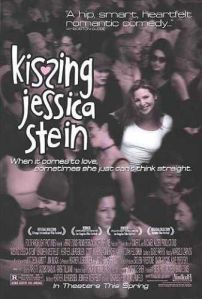 Kissing Jessica Stein stars Jennifer Westfeldt as the perfectionist title heroine searching for true love in the Big Apple. She answers a personal ad sent by Helen (Heather Juergensen), an art gallery manager trying her hand at women for the first time. What begins in comedic awkwardness turns to the fires of passion. Which leads to much more awkwardness as Jessica attempts to keep her secrets and the true identity of her “friend” from her mother.
Juergensen and Westfeldt wrote the script based on characters they have nurtured for several years, and their comfort level with the material shows. Each gives a wry and charismatic performance, with Westfeldt proving herself an acting revelation. It must be nice for her to have something else to her résumé than being one of the “girls” in Two Guys, A Girl and a Pizza Place.
Kissing Jessica Stein tiptoes a fine line with some characters possibly becoming gay or Jewish stereotypes; however, they never do fall into the abyss of Caricature Land. Tovah Feldshuh, playing Jessica’s mother, might make you wince at the thought that she’d be mired as a Mike Myers “Coffee Talk” portrait. But she has scenes where she shows real tenderness that is very affective.
At times the movie feels a bit too wrapped up in its own precocious-ness. There’s even a standard montage of bad dates that becomes annoying much sooner than it ends. Those looking for deep lesbian issues needn’t apply here. Kissing Jessica Stein hits its targets on a surface level, which can be deemed appropriate for an innocuous romantic comedy. The downer closing 10 minutes seems to come from nowhere and betray the feel of the movie.
The film plays by conventional rules for the most part but these don’t diminish the healthy humor in the least. Kissing Jessica Stein is a charming and fun experience and would serve as a good date movie for prospective couples.
Nate’s Grade: B
Share this:

Monster’s Ball (2001)
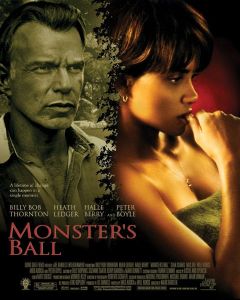 Monster’s Ball has already garnered two Oscar nominations, including one for the lovely Halle Berry for Best Actress, and received numerous end of the year accolades. Is Monster’s Ball the startling ruminations on race that you’re being told? Well
yes and no.
Set in the South, Hank Grotowski (Billy Bob Thornton) and his son Sonny (Heath Ledger) are prison guards at the state penitentiary and preparing for an execution. The man to die is Lawrence Musgrove (Sean Combs) who will be leaving behind an overweight young son and making a widow out of Leticia (Halle Berry). The tension in the Grotowski home escalates especially as Hank has chosen to care for his own ailing father (Peter Boyle), who still finds the time to spout out racist rhetoric through an oxygen mask. One last confrontation leaves a permanent mark of emptiness on the family.
 Leticia is struggling to just make ends meet and fight an impending eviction. Her car keeps breaking down on her, she’s been let go from her job as a waitress and she has to raise a son by herself all the while trying to encourage him to lose weight. Leticia is breaking down and her world around her is crumbling. One night Leticia gets into an accident walking home along the roadside and needs assistance badly. The one who pulls the car aside to help is actually Hank. As time goes by he helps Leticia however he can whether its giving her a ride home from the diner or just staying with her so she won’t be alone.
Hank and Leticia come together out of mutual need and grief. They are two people entirely wrong for each other that kindle a passion that seems to transcend race. Leticia needs someone to take care of her, after having a husband on death row and fighting to stay above the poverty line. Hank needs someone to take care of, out of a mixture of compounded loneliness and grief.
Thornton reprises the repressed protagonist of The Man Who Wasn’t There with his portrayal of Hank. His lips are pursed, looking a tad like Mr. Limpet, and he expresses more with a furrowed brow and stare than words could manage. Thornton’s performance is good, and the audience does really end up rooting for Hank, but the performance doesn’t resonate, possibly because of the writing for the character. I guess one could say Monster’s Ball is Halle Berry’s legitimization as an actress. Berry gives the performance of her career and has moments where she’s on the verge of ripping your heart out.
Monster’s Ball is not exactly the scorching portrait of race relations that it has been hyped to be. It’s really more of a story about two characters with race being underscored except for a convenient occasion where it can become the catalyst to a fight.
The film also takes some of its metaphors rather simply. The connection between father and son includes Hank and Sonny using the same prostitute. Hank eats every night in the same diner and always orders a bowl of chocolate ice cream (get it?) and black coffee (get it?).
 All the ballyhoo over the explicit sex scene (thank you so much news-fluff) is undeserving. The sex scene is no different than a hundred seen before and many on Showtime during the late hours. The scene serves its purpose thematically in the story for its characters but it really isn’t “hot and steamy” as it’s been dubbed to be. Move along, folks.
Besides the acting Monster’s Ball has some other accomplishments up its sleeve. The cinematography is gorgeous and uses lights and darks to an incredibly effective degree. There are many scenes where you might be paying more attention to how the scene looks than the scene itself. The music is also commendable for the simple task of not becoming intrusive and actually enhancing the story. This is what scores are intended to do.
Monster’s Ball may be the biggest suck-in-air-uncomfortably movie to come out in a long time. I found myself enacting this measure every time someone did something horrible, said something racists or surprisingly died. This may be because I had the entire theater to myself for my own amusement. Monster’s Ball is certainly a well-written and well-acted film. It’s just not up to snuff when it comes to Best Picture speculation.
Nate’s Grade: B
Reviewed 20 years later as part of the “Reviews Re-View: 2001” article.
Share this:

Vanilla Sky (2001)
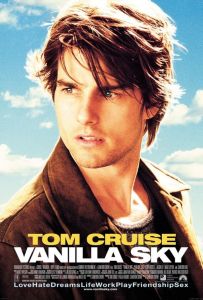 Talk about a film’s back story. Tom Cruise signed on to do a remake of the 1997 Spanish film Abre Los Ojos (Open Your Eyes) which was directed by Alejandro Amenabar. During the filming the romance between Cruise and Penelope Cruz (no relation) got a little hotter than expected onscreen and broke up his long-standing marriage to Nicole Kidman. At the time she was finishing filming The Others which is the second film by Amenabar. This, by the way, is much more interesting than Vanilla Sky unfortunately.
Cameron Crowe’s remake starts off promising enough with Tom Cruise running around an empty Times Square like a Twilight Zone episode. Afterwards the film begins to create a story that collapses under its own weight. David (Cruise) is a rich boy in control of a publishing empire inherited through his dear old deceased dad. He has the time to throw huge parties where even Spielberg hugs him, and even have crazy sex with crazy Cameron Diaz, whom he tells his best friend (Jason Lee) is his “f*** buddy.” David begins to see a softer side of life with the entrance of bouncy and lively Sophia (Cruz) and contemplates that he might be really falling in love for the first time. But this happiness doesn’t last long as jealous Diaz picks up David in her car then speeds it off a bridge killing her. Then things get sticky including David’s disfiguration, his attempts to regain that one night of budding love and a supposed murder that he committed.
 Crowe is in over his head with this territory. His knack for wonderful exchanges of dialogue and the perfect song to place over a scene are intact, but cannot help him with this mess. Vanilla Sky is an awkward mish-mash of science fiction. The film’s protagonist is standoffish for an audience and many of the story’s so-called resolutions toward the end are more perfunctory than functional. The ending as a whole is dissatisfying and unimaginative. By the time the wonderful Tilda Swinton shows up you’ll likely either be asleep or ready to press the eject button yelling “cop out!”
Seeing Vanilla Sky has made me want to hunt for Amenabar’s Abre Los Ojos and see what all the hype was about, because if it is anything like its glossy American counterpart then I have no idea why world audiences went wild for it.
Nate’s Grade: C
Reviewed 20 years later as part of the “Reviews Re-View: 2001” article.
Share this:

Not Another Teen Movie (2001)
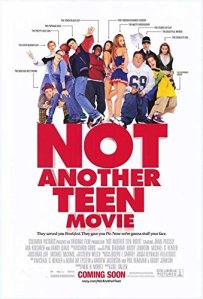 Spoofing is often believed the cheapest and lamest form of comedy. One runs jab after jab, and gag after gag relentlessly hoping that some hit but content that if they don’t more will follow with the potential to. But many of the jokes in a spoof aren’t textured; there’s nothing below their surface. Spoofs can be done well or they can be embarrassing and wretched to sit through. Count Not Another Teen Movie in the latter category.
At John Hughes High School (can you feel the parody, can you?) it’s life as we know it for stereotypes and clichés. The Bitchy Cheerleader has just dumped the Popular Jock and the Cocky Blonde Guy has initiated a bet that PJ cannot turn anyone into prom material. The men size up their choices, including an albino girl singing about her lost pigmentation (one of the few funny gags), and decide on the Pretty Ugly girl who is beyond all hope with her glasses and ponytail. Meanwhile, the Cruelest Girl is trying to find a way to seduce her brother, the Popular Jock, a trio of Virgins try and, what else, lose their virginity, and the Best Friend with Hopeless Crush tries to work his klutzy charm.
 In a genre full of Freddie Prinze Jr.’s greatest hits (or misses, however you want to look at it) a parody wouldn’t be too difficult to prescribe. All too often the film has no edge and falls back on scatological humor as its savior once too often. An exploding toilet and a flying vibrator can only do so much. There has to be things behind it. Alas, there is nothing. For every one part funny (a character tries to find the right moment to start a slow and building applause) there are three parts inane, satirically flaccid, crudely useless, or bordering on exploitative (the foreign exchange student who drapes around completely nude the entire film). The jokes arrive many times cold and require a good deal of familiarity with the subject material it’s spoofing. NATM seems to not think too greatly of the audience for it. The film continually seems to explain jokes after they happen or reacquaint the audience with the source for spoofery. The worst example may be that the movie has to SHOW a character watching a scene from ‘Pretty in Pink’ mere seconds before it spoofs that very scene.
The movie, as a whole, has about six good gags and bits but the rest is watch-checking time. Some comedic threads don’t even get the proper treatment to become good jokes. The Token Black Guy’s introduction is rather funny, but then all he does in the film is repeat the words he said he could only say. Now, if the other characters had begun to question this law of teen movies, and asked him questions then this idea could have been ripely handled. As it stands it’s another joke in a line of jokes that go nowhere but we keep going back to repeatedly.
 The flick was directed by Joel Gallen, marking his film debut after years as an MTV producer. Gallen shows no finesse when it comes to comedy as everything is rammed into the ground. His film is a spoof with nothing to do, much like the bad but better Scary Movie 2 earlier this year. Jokes come and go but they serve no purpose in moving things along or setting up greater jokes. This is comedy lost in the woods.
NATM is an attempt to satirize the teen genre, which should have been a rather easy job to do but instead just becomes another sad addition to it. And a rather poor and limp addition at that. NATM doesn’t know that the audience isn’t laughing with it but at it.
Nate’s Grade: C-
Share this:

Ghost World (2001)
 Thora Birch. Mmmhmm. I mean, an excellent showcase for the outsider in all of us, brilliantly tweaking our society and culture while fostering surprisingly poignant, deeply funny characters and situations as they interact with a world they barely understand and don’t wish to. And it’s got Thora Birch.
Nate’s Grade: A
Share this:

Hedwig and the Angry Inch (2001)
 John Cameron Mitchell directed, adapted from his stage play and stars as the sexually confused rock mega-star Hedwig. Hedwig was a boy trying to escape from the constraints of soviet occupied East Germany. His lucky ticket came in with a GI who agreed to marry Hedwig and take him out of the country with him, but Hedwig had to go under the knife and become a proper lady before their escape was to ensue. When the sex change operation is botched it leaves Hedwig with a single nub-like inch left causing gender confusion (“Six inches forward, five inches back”). Dumped by his GI Hedwig turns to song and befriends a lonely and confused boy Tommy Gnosis (Michael Pitt). Their courtship seems to be going fine until Gnosis steals all of Hedwig’s songs and uses them for his own superstardom on MTV. Hedwig’s defense is to pack up a traveling band and to perform at various salad bars and trucker diners in the same town Gnosis travels to. It’s during these performances that Hedwig dishes about her unusual life.
Unlike most plays turned into films, Hedwig has been adapted for the medium of cinema. Animations, clever camera tricks and sing-alongs follow our story, making it an exhilarating film going experience. Hedwig is excitingly original and spilling over with passionate energy that can’t help but transfer to the audience. Mitchell proves himself a born filmmaker, but also a rock star. Many of the songs of Hedwig are quite listenable and could be found on some music channels. Hedwig is a trans hero for all of us and Mitchell delivers a fresh and resoundingly funny, sad, and technical achievement of a movie.
Nate’s Grade: A
Share this:

Serendipity (2001)
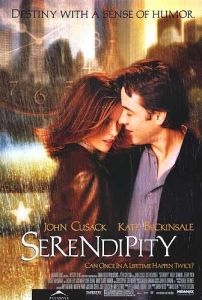 There’s a universe somewhere populated entirely with down-on-their-luck lovable sweethearts and good-hearted friendly buffoons operated under the physics of romantic comedies. In this universe there is no such thing as chance, even if one leaves it up to it, and in this place what would seem like frustratingly idiotic behavior seems romantic. So is Serendipity revolving in this universe. Kate Beckinsale is a gal that leaves everything to fate, possibly even her taxes, and John Cusack is the smitten man running all over the place trying to find this mad woman. In our world Beckinsale would seem foolish or even mean-spirited, but because the two will definitely end up in each other’s arms before the credits roll we allow her to continue her ridiculous behavior. She puts Cusack in a seemingly cruel obstacle course of chance to win her heart. These people operate outside of our known world. Eugene Levy has a brief and funny part in the movie but otherwise Serendipity takes itself as being much cuter and smarter than it is.
Nate’s Grade: C
Share this:

Captain Corelli’s Mandolin (2001)
 We open on an island on the offshoot of Greece in the start of the 1940s. The waters are blue, the sand is white, the people are happily ethnic, and it’s basically a postcard. The island is overpopulated with idyllic beauties and friendly people and then evil evil war had to come and steal the innocence. Cruz plays a woman who has a first name that I have no clue of or remotely how to pronounce it, but I am certain it began with a P. Cruz is studying to be a doctor under the tutelage of her wise old customed father (John Hurt). She’s engaged to be wed to hunky fisherman Mandras (Christian Bale) until the war threatens their peaceful isolated world. Mandras feels the patriotic urge to go to war and thwart the advancing Italians and Cruz pines for his safe return writing letter after letter with no answer to only fear the worst.
 As the war continues the Italians do advance further and take occupation of the Greek island. Captain Antonio Corelli (Nicolas Cage) is amongst the divisions assembled to this Mediterranean isle. He is agreed to stay in Cruz’s home and, as always, begins to develop feelings for Cruz. She feels some as well but is torn on what her actions should be. Corelli, it turns out, is far more a singer than a fighter. He has a battalion of men he dubs his “opera” and they break into frequent song and an overall zeal for life. They run around drinking and singing on the beaches complete with topless women making this Italian occupation seem like summer camp.
The good times don’t last of course and the war rages closer and closer. Soon the Italian army surrenders and then the Germans come in to retake occupation of the Greek island. Corelli must decide to go home or help fight amongst the guerrillas and native people to keep their beautiful land away from Nazi hands.
Penelope Cruz seems to be heavily pushed on me by Hollywood. She is too mute at times and the emotions that we should see tearing her up are simply dampened by her staring downcast or biting her lip.
Cage is an Italian-American and yet his Italian accent is atrociously comical. His performance is like the Joker doing an Italian accent. He also kisses like he is trying to swallow poor Penelope’s tiny head. Somehow beyond my reasoning the talented Christian Bale got in this movie. He’s about as convincing as a Greek as Laurence Olivier was as a Moor. The rest of the cast is filled with Greek people portraying Greek people.
The love story of Captain Corelli’s Mandolin is a mishmash of un-involving war violence and a cloying romance that never gets into the proper gear. There are elements of guilt and affection, but they aren’t transcendent of any reality. The first time Corelli tells Cruz he loves her they have sex in a field that very moment. There is not enough groundwork laid to produce a decent romance. So the supposed “smolder” between Cruz and Cage is thematically unbelievable, and kind of a bit creepy.
 Corelli suffers from A.I. syndrome in that it desperately needed to end twenty minutes earlier than it did. The fact that Cage survives a machine gun execution because a SINGLE PERSON stood in front of him is bad, but it gets even worse for the inhabitants of the Greek island. Some get hung by their own people, some get shot in the face from Germans, and then everyone must suffer after the war by having an earthquake level half of their town. This stretch of film goes from pointless to comically absurd. It’s like John Madden fell asleep in his director’s chair and someone thought, “Well, let’s model the last act of the film after a Universal tram ride. Hey, can we have Jaws pop out of the water at some point?” Corelli has failed as a romance and during its end stretch it completely fails as any kind of cogent drama.
The direction is adequate by Madden but the script just doesn’t cut the mustard. In the end they rely on the old Hollywood principal of Nazis being pure evil, so much so they might as well have mustaches to twirl. I thought at one moment they were going to tie Cruz to a railroad track and would have preferred it if they had. This is a film caught between romance and war, and it does a disservice to both. The war is a naive afterthought and the romance lacks any credibility. The scenery sure looks nice though. In the end, Captain Corelli’s Mandolin is a film desperately out of tune.
Nate’s Grade: C-
Share this:

American Pie 2 (2001)
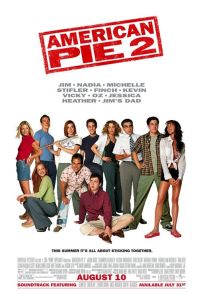 First and foremost I disliked the first American Pie movie. It just rang very transparent for me and I didn’t laugh once – a capitol crime with a comedy in my book. So I wasn’t exactly looking forward to another addition with the American Pie family, but ventured out with friends and found myself enjoying this second helping of raunch. And this time I genuinely laughed at several points and found it overall less insipid.
To American Pie 2‘s benefit all the characters have been introduced prior and are familiar to the audience, therefore no time is wasted on pointless set-up. The movie jumps right out to the familiar faces and decides to further the AP2 universe. Jim (Jason Biggs) and friends are returning back home after their first year of college. Jim has not had a sexual experience since his prom night with Michelle the band geek (Alyson Hannigan) and he is completely in doubt of his abilities in the bedroom. Complicating matters is the news that the Czech student of his fantasies Nadia (Shannon Elizabeth) is on her way back and is eagerly anticipating another tryst with Jim. Kevin (Thomas Ian Nicholas) is still hung up on his ex Vicky (Tara Reid) and worrying that his friends will grow apart and college will change everything. Oz (Chris Klein) seems to be doing fine with his monogamous relationship to Heather (Mena Suvari), despite the taunting of Stifler (Sean William Scott) that he needs to spread out. Finally Finch (Eddie Kaye Thomas) is still chasing after the only woman that ever caught his heart, Stifler’s mom.
 After the boys return back to their roots the police bust a party at Stifler’s pad, and they are without a place to party for the summer. Kevin brings to their attention the idea of renting a cabin on the beach for the summer. The place serves as a spot for the boys to enjoy their sunshine-y days away from school and stay together as friends, as well as attempt to get an abundance of tail. Hi-jinks ensue.
AP2 almost seems to follow the formula of the first one to the letter. The opening scene has Jim’s dad (the always hilarious Eugene Levy) walking in on an embarrassing moment for Jim (you think he’d learn that doors have locks at this point). Jim encounters a horrific sexual accident that he must discuss with his father afterwards. Stifler gets a not-so-nice encounter with a bodily fluid in the beginning party. And it all ends with a big party to end all parties with everyone hooking up with a partner for some post-coital spooning. The script was written by the same writer of the first yet he seems to be playing connect the dots with his own formula.
What American Pie 2 does to separate itself as more enjoyable than the first is give the interesting characters the majority of the time and leave the least interesting sputtering for air. The interesting ones follow: Jim is a nice guy full of the same insecurities that plague a teenager and intimacy, and Biggs plays him as an everyman who somehow always seems to come into sadistic moments of embarrassment. With Jim’s wish to be more sexually adept he visits the infamous band camp and finds Michelle once again who agrees to coach him on techniques and pointers. Hanigan is given an incredible amount more of screen time and she’s glowing in every second of it.
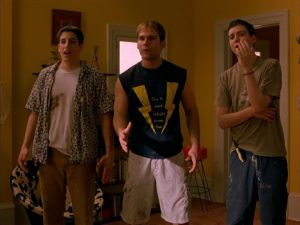 Also the man-you-love-to-hate Stifler has a larger role leading his group of lakeside roommates into encounters with lesbians and other sexual calamities. Scott may be playing Stifler as a jerk but he’s entertaining and genuinely funny, and at one point you can’t help but root for the crass frat boy. Finch has learned that Stifler’s mom will be paying a visit to their cabin at the end of the summer and spends his time studying up on Tantra and Zen to fully explore his inner sexual prowess.
The entire cast from the first American Pie romp does return, though not everyone has equal time. Mena Suvari (still looking so young) leaves in the beginning of the film and then comes back at the very end. The insatiably annoying Reid (who has eyes that I can’t tell where her whites end and irises begin) thankfully is only in the film for two short scenes which leads me to question was she even necessary in the first place? Natasha Lyonne is only in scenes alongside Reid, so her stint in the sequel is equally as brief. Elizabeth’s role might be central to Jim’s quest for sexual fulfillment, but she only pops up in the last eight minutes of the film – and doesn’t show her breasts this time. Now that I think about it Klein and Nicholas really weren’t in the film too much either except for standing in the background while another character talked.
The soundtrack is a collection of every pop “punk” band that’s been playing on MTV since May of that year. It’s like the producers just watched the channel for a week and would point to the ones they wanted.
The film still is a mishmash of gross out sexual humor and sentimentality, but for some reason it’s a lot easier to swallow the second time around. For all its bodily fluids and crudeness, American Pie 2 has a stickily sweet secretly conservative old-fashioned heart. Though the makers would never tell you so. In a summer almost bankrupt on entertainment value I’ll leisurely take a slice of American Pie 2.
Nate’s Grade: B-
Share this:

Pearl Harbor (2001)
 It turns out we went to war in 1941 not because of Japanese aggression, Hitler’s dominance in Europe, or the protection of freedom and democracy. Sorry kids. The real reason we went to war was to complicate and then clear up Kate Beckinsale’s love life. At least that’s what director Michael Bay and screenwriter Randall Wallace would tell you with their indulgent epic Pearl Harbor.
We open in Tennessee in the 20s with two boys who dream of being pilots. Rafe (Ben Affleck) and Danny (Josh Hartnett) grow into strapping young lads who flash their hot dog flyin’ skills at basic training, which brings them chagrin from superiors but admiration from peers. Rafe falls in love with a young nurse named Evelyn (Kate Beckinsale), who goes against ARMY rule and passes Rafe in his eye exam portion when he has a slight case of dyslexia. But he’s just so cuuuute. The romance builds but Rafe feels like he’s grounded when all he wants to do is fly, and volunteers to fight in the RAF over in Europe. He promises he’ll be back to see his lovely Evelyn. Of course he gets into an accident and everyone assumes that poor dyslexic Rafe is fertilizing a lawn somewhere with his remains. Hence Danny slowly but surely develops something for Evelyn in their periods of mourning, and the two consummate their puppy love with a tango in parachute sheets.
All seems well until Rafe returns back from the dead throwing a wrench into Evelyn’s second date parachute plans. Thus the Hollywood favorite of the love triangle endures until the end when the two fly boys enlist in the Doolittle attack against Japan, months after the ferocious attack on Pearl Harbor. The real purpose of the Doolittle attack was not militarily, but merely for morale. The real purpose it serves in the movie is to shave off an end on our love triangle.
 Pearl Harbor allows us to follow a group of youthful and innocent starry-eyed kids from training to combat. Each seems pretty much exactly the same to each other. It’s near impossible to distinguish which character is which. It’s like the screenwriter didn’t even have the gall to resort to cliche supporting character roles, and he just made one character and duplicated it. The only one who was noticeable for me was the character of Red (Ewen Bremner, julien donkey boy himself), but that was simply because the man had a speech impediment. We also have our handful of young nurses alongside Beckinsale, and I had an easier time distinguishing between them; everyone had different hair colors.
]If you look in the pic, or the credits, you’ll see that two of the nurses would turn out to be Jennifer Garner (Alias) and Sara Rue (Less than Perfect), both stars of ABC shows, and ABC is owned by, yep, Disney. Coincidence? Probably. When they ran this on TV they actually advertised Jennifer Garner above Kate Beckinsale. That reminded me of when Seven ran on TV shortly after Kevin Spacey had won his well-deserved 1999 Best Actor Oscar for American Beauty, and they gave him second-billing in the advertisement over Morgan Freeman, the movie’s true main character.
Affleck has a hayseed Southern twang, but seems to mysteriously disappear for long stretches. Hartnett seems to talk with a deep creak, like a door desperately trying to be pushed open. Beckinsale manages to do okay with her material, but more magnificently manages to never smear a drop of that lipstick of hers during the entire war. We could learn a lot from her smear-defying efforts. Gooding Jr. is pretty much given nothing to work with. I’m just eternally grateful he didn’t go into a usual Cuba frenzy when he shot down a Zero.
Michael Bay has brought us the ADD screenings that are the past, loud hits of The Rock and Armageddon. Teamed up with his overactive man-child producer Jerry Bruckheimer once more, Pearl Harbor is less Bay restrained to work on narrative film as it is Bay free-wheeling. His camera is loose and zig-zagging once more to a thousand edits and explosions. Bay is a child at heart that just loves to see things explode. When he should show patience and restraint he decides to just go for the gusto and make everything as pretty or explosive as possible. This is not a mature filmmaker.
Despite the sledge hammer of bad reviews, Pearl Harbor is not as bad as it has been made out to be. The love story is inept and the acting is sleep-inducing, unless when it’s just funny. It doesn’t start off too badly, but twenty minutes in the movie begins sinking. The centerpiece of the film is the actual Pearl Harbor bombing that clocks in after ninety minutes of the movie. The forty-minute attack sequence is something to behold. The pacing is good and the action is exciting with some fantastic special effects. The movie is bloated with a running time a small bit over three hours total. Maybe, if they left the first twenty minutes in, then gave us the forty minute attack sequence, followed by a subsequent five minute ending to clear up our love triangle’s loose ends… why we’d have an 80 minute blockbuster!
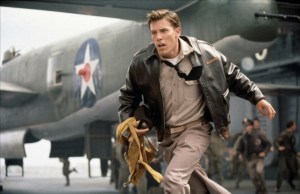 Pearl Harbor doesn’t demonize the Japanese, but it feels rather false with their open-minded attempts to show both sides as fair minded. It gets to the point where they keep pushing the Japanese further into less of a bad light that it feels incredibly manipulative and just insulting. It seems like the producers really didn’t want to offend any potential Pacific ticket buyers so the picture bends backwards to not be insulting. The only people who could be offended by Pearl Harbor are those who enjoy good stories. Oh yeah, and war veterans too.
The cast of Pearl Harbor almost reads like another Hollywood 40s war movie where all the big stars had small roles throughout, kind of like The Longest Day for the Pepsi generation. Alec Baldwin plays General Doolittle and is given the worst lines in the film to say. Tom Sizemore shows up as a sergeant ready to train the men entering Pearl Harbor. He has five minutes of screen time but does manage to kill people in that short window. Dan Akroyd is in this for some reason or other, likely because Blues Brothers 3000 has yet to be green lighted. John Voight is easily the most entertaining actor to watch in the entire film. He gives a very authentic portrayal of President Roosevelt. I still find trouble believing it was Voight under the makeup.
The blueprint for Pearl Harbor is so transparent. They took the Titanic formula of setting a fictional romance against a disaster, with the first half establishing characters and our love story, and then relegating the second half to dealing with the aftermath of the disaster. It worked in Titanic (yes, I liked the film for the most part), but it doesn’t work here. Pearl Harbor is a passable film, but the mediocre acting, inept romance, square writing, and slack pacing stop it from being anything more. Fans of war epics might find more to enjoy, especially if they don’t regularly have quibbles over things like “characters” and “plot.” To paraphrase that know-it-all Shakespeare: “Pearl Harbor is a tale told by an idiot. It is full of sound and fury, signifying nothing.
Nate’s Grade: C
Reviewed 20 years later as part of the “Reviews Re-View: 2001” article.


You must be logged in to post a comment.