Blog Archives
Jersey Girl (2004)
 Writer/director Kevin Smith (Dogma) takes a stab at family friendly territory with the story of Ollie Trinke (Ben Affleck), a music publicist who must give up the glamour of the big city to realize the realities of single fatherhood. Despite brief J. Lo involvement, Jersey Girl is by no means Gigli 2: Electric Boogaloo. Alternating between edgy humor and sweet family melodrama, Smith shows a growing sense of maturity. Liv Tyler stars as Maya, a liberated video store clerk and Ollie’s real love interest. Tyler and Affleck have terrific chemistry and their scenes together are a playful highlight. The real star of Jersey Girl is nine-year-old Raquel Castro, who plays Ollie’s daughter. Castro is delightful and her cherubic smile can light up the screen. Smith deals heavily with familiar clichés (how many films recently end with some parent rushing to their child’s theatrical production?), but at least they seem to be clichés and elements that Smith feels are worth something. Much cute kiddie stuff can be expected, but the strength of Jersey Girl is the earnest appeal of the characters. Some sequences are laugh-out-loud funny (like Affleck discovering his daughter and a neighbor boy engaging in the time-honored game of “doctor”), but there are just as many small character beats that could have you feeling some emotion. A late exchange between Ollie and his father (George Carlin) is heartwarming, as is the final image of the movie, a father and daughter embracing and swaying to music. Jersey Girl proves to be a sweetly enjoyable date movie from one of the most unlikely sources.
Nates Grade: B
Share this:

Eternal Sunshine of the Spotless Mind (2004)
 No other movie this year captured the possibility of film like Michel Gondry and Charlie Kaufman’s enigmatic collaboration. Eternal Sunshine was a mind-bending philosophical excursion that also ended up being one of the most nakedly realistic romances of all time. Joel (Jim Carrey restrained) embarks on having his memories erased involving the painful breakup of Clemintine (Kate Winslet, wonderful), an impulsive woman whose vibrant hair changes as much as her moods. As Joel revisits his memories, they fade and die. He starts to fall in love with her all over again and tries to have the process stop. This labyrinth of a movie gets so many details right, from the weird physics of dreams to the small, tender moments of love and relationships. I see something new and marvelous every time I watch Eternal Sunshine, and the fact that it’s caught on with audiences (it was nominated for Favorite Movie by the People’s friggin’ Choice Awards) reaffirms its insights into memory and love. I never would have thought we’d get the perfect romance for the new millennium from Kaufman. This is a beautiful, dizzingly complex, elegant romance caked in visual grandeur, and it will be just as special in 5 years as it will be in 50, that is if monkeys don’t evolve and take over by then (it will happen).
Nate’s Grade: A
Share this:

Intolerable Cruelty (2003)
 Miles Massey (George Clooney) is the preeminent divorce attorney in Los Angeles. But after years of bankrupting homes after people have broken them (this allusion may be too tricky), hes grown tired of the same old same old. Enter Marilyn Roxroth (Catherine Zeta-Jones), a conniving gold digger who has been ruined by Massey defending her dimwitted hubby (Edward Herrmann). Now shes out for revenge, which could be in the form of romancing Massey while bringing him down.
Intolerable Cruelty is something of a strange breed. It’s the Coens most striving foray into mainstream success, with the weight of the world on Clooney and Zeta-Jones exchanging sparks and verbal repartee. For the most part, things work: the leads do have a winning chemistry; Zeta-Jones is positively glowing in Roger Deakins’ beautifully milky cinematography (she found out she pregnant late in the shoot, which could explain the glow).
 The stumbling block for Intolerable Cruelty and its central romance is that neither of the leads, though at times charming, isn’t exactly likable or able to root for. An integral part of any romantic comedy is empathy for the leads so much that we want them to get together, possibly with swirling crescendos. But in Intolerable Cruelty, both leads make a living off deceiving and taking advantage of others. So while their War of the Roses-esque pursuit to out-scam the other can provide some entertaining twists (and some forced and out of place), the whole duplicitous one-upsmanship doesn’t blossom credible love between the leads or the audience.
I have a strong feeling that Intolerable Cruelty was a story the Coens hopped on late, did some rewrites and invited old Coen friends to join in the jubilee. This is the first time the Coens have worked with other writers (the people who brought us such duds as (Big Trouble and Life), and certain storylines or subplots that glaringly feel disjointed from the screwball-comedy tone of the film. An asthmatic hit man named Wheezy Joe (who got the biggest laugh with his demise) is funny but in the wrong Coen film. When Clooney and Zeta-Jones both hire the services of Wheezy Joe to off the other, you know the story took a fantastical wrong turn. A creepy decrepit owner of Clooney’s law firm also feels like a leftover from a different film. This movie also has the most ripping up of legal documents I’ve ever seen in a movie.
Clooney is quite funny as a chattering legal eagle with a Cary Grant edge. Hes ready and willing to play against his movie star image, which works wonders for comedy, though the running gag where he must look at his teeth in any reflective surface never takes off. It took me until Intolerable Cruelty to realize how much of a beautiful woman Zeta-Jones is. Her warm smile could light up an auditorium. The supporting characters are all underused but very memorable. The opening with Geoffrey Rush’s TV exec walking in on his canoodling wife is very funny, and he plays the long-haired arrogant type well. Cedric the Entertainer is hilarious as a private eye determined to ”nail yo ass” that I started privately wishing the film would spin to follow his life and not Clooney’s.
Intolerable Cruelty is a nice diversion for the Coens, with some good laughs here and there (my favorite being the courtroom scene where Clooney and Zeta-Jones go head-to-head for the first time), but one would hope that the Coens will get back to doing hat they do best, which is quirky yet beautiful independent films. In the end, it seems that the Coens have created an oddity for themselves — a normal movie. We expect more Joel and Ethan.
Nate’s Grade: B-
Share this:

Lost in Translation (2003)
 Sophia Coppola probably has had one of the most infamous beginnings in showbiz. Her father, Francis Ford, is one of the most famous directors of our times. He was getting ready to film Godfather Part III when Winona Ryder dropped out weeks before filming. Sophia Coppola, just at the age of 18, stepped into the role of Michael Corleone’s daughter. The level of scathing reviews Coppolas acting received is something perhaps only Tom Green and Britney Spears can relate to. Coppola never really acted again. Instead she married Spike Jonze (Being John Malkovich) and adapted and directed the acclaimed indie flick, The Virgin Suicides. So now Coppola is back again with Lost in Translation, and if this is the kind of rewards reaped by bad reviews early in your career, then I’m circling the 2008 Oscar date for Britney.
Bob Harris (Bill Murray) is a washed up actor visiting Tokyo to film some well-paying whiskey commercials. Bob’s long marriage is fading and he feels the pains of loneliness dig its claws into his soul. Bob finds a kindred spirit in Charlotte (Scarlet Johansson), a young newlywed who has followed her photographer husband (Giovanni Ribisi) to Japan and is second-guessing herself and her marriage. The two strike up a friendship of resistance as strangers in a strange land. They run around the big city and share enough adventures to leave an indelible impression on each other’s life.
 Lost in Translation is, simply put, a marvelously beautiful film. The emphasis for Coppola is less on a rigidly structured story and more on a consistently lovely mood of melancholy. There are many scenes of potent visual power, nuance of absence, that the viewer is left aching like the moments after a long, cleansing cry. There are certain images (like Johansson or Murray staring out at the impersonal glittering Tokyo) and certain scenes (like the final, tearful hug between the leads) that I will never forget. Its one thing when a film opens on the quiet image of a womans derriere in pink panties and just holds onto it. It’s quite another thing to do it and not draw laughs from an audience.
Murray is outstanding and heartbreaking. Had he not finally gotten the recognition he deserved with last year’s Oscar nomination I would have raged for a recounting of hanging chads. Murray has long been one of our most gifted funnymen, but later in his career he has been turning in soulful and stirring performances playing lonely men. When Murray sings Roxy Music’s “More Than This” to Johansson during a wild night out at a karaoke bar, the words penetrate you and symbolize the leads’ evolving relationship.
Johansson (Ghost World) herself is proving to be an acting revelation. It is the understatement of her words, the presence of a mature intelligence, and the totality of her wistful staring that nail the emotion of Charlotte. Never does the character falter into a Lolita-esque vibe. Shes a lonely soul and finds a beautiful match in Murray.
 Lost in Translation is an epic exploration of connection, and the quintessential film that perfectly frames those inescapable moments of life where we come into contact with people who shape our lives by their short stays. This is a reserved love story where the most tender of actions are moments like Murray carrying a sleeping Johansson to her room, tucking her in, then locking the door behind. The comedy of disconnect is delightful, like when Murray receives incomprehensible direction at a photo shoot. The score by Jean-Benoît Dunckel, front man of the French duo Air, is ambient and wraps around you like a warm blanket. The cinematography is also an amazing experience to behold, especially the many shots of the vast glittering life of Tokyo and, equally, its strange emptiness.
Everything works so well in Lost in Translation, from the bravura acting, to the stirring story, to the confident direction, that the viewer will be caught up in its lovely swirl. The film ends up becoming a humanistic love letter to what brings us together and what shapes how we are as people. Coppola’s film is bursting with such sharply insightful, quietly touching moments, that the viewer is overwhelmed at seeing such a remarkably mature and honest movie. The enjoyment of Lost in Translation lies in the understanding the audience can feel with the characters and their plight for connection and human warmth. A work of art like this sure doesn’t come around every day.
Writer/director Sophia Coppola’s come a long way from being Winona Ryder’s last-second replacement, and if Lost in Translation, arguably the best film of 2003, is any indication, hopefully well see even more brilliance yet to come. This is not going to be a film for everyone. A common argument from detractors is that Lost in Translation is a film lost without a plot. I’ve had just as many friends call this movie “boring and pointless” as I’ve had friends call it “brilliant and touching.” The right audience to enjoy Lost in Translation would be people who have some patience and are willing to immerse themselves in the nuances of character and silence.
Nate’s Grade: A
Share this:

Gigli (2003)
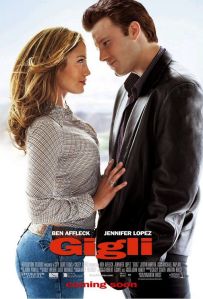 It’s the feel-good movie of the year revolving around a lunkhead mobster (Ben Affleck) and his mentally challenged kipnapee and their attempts to covert a lesbian hitman (Jennifer Lopez) in between her yoga/horrific monologues concerning the superiority of female genitalia. Believe the hype people; Gigli is indeed as bad as they have told you. It’s not even entertainingly bad, like Bulletproof Monk, no folks; Gigli is just mundane and awful. During the entire two hour stretch, which feels much much longer, I kept saying one thing aloud: “How could anyone making this think they were making a goodmovie?” Did they think audiences would find it funny that Affleck’s mother (the mother from My Big Fat Greek Wedding) shows us her big fat Greek behind? Did they really think that a mentally retarded kid (who has an affinity for gangster rap and wishes to travel to the mythical “Baywatch”) would come off as endearing? Well instead it comes across as insulting. And what else is insulting is the laugh-out-loud dialogue Lopez is forced to spit out concerning her attraction for women. I can’t think of any actress that could say the line, “I love my pussy” convincingly. And I’m sure a lot of actresses out there have true affection for it. The writing is just atrocious. And so much else fails as well. The score is a perplexing mix of upbeat jazz and inappropriate string orchestra. I don’t understand what emotions they were going for during scenes in Gigli but a full string orchestra playing music better suited for a real drama does not fit. Maybe it was for a tragedy. In that case, then it’s right on the money. You won’t see a more sloppily executed, horribly acted, painfully written, lazily directed, inept film this year. And what the hell did Christopher Walken walking in have anything to do with anything?
Nate’s Grade: F
Share this:

How to Lose a Guy in 10 Days (2003)

Andie Anderson (Kate Hudson) is a fashion magazine writer with the juiciest column of her up and coming career. She will catch herself a man then torture him for ten days by subjecting him to mistakes women make in relationships (calling too much, tampons in the medicine cabinet, asking if you look fat). Benjamin Barry (Mathew McConaughey) is a hotshot ad exec convinced he can make any girl fall in love with him. His confidant colleagues put him to the test and select a girl he has ten days to fall in love with him. Any guesses which lucky lady gets picked?
Hudson and McConaughey have a weirdly effective chemistry that seems to grow on you as the film continues. The over animated and cutesy antics of Hudson gel nicely with McConaughey’s sly charm and syrupy drawl. Their battle of the sexes doesn’t really reach the simmer and zip of classic screwball comedies but the journey along the way to the predictable coupling is rife with healthy gender-crossing doses of humor.
How to Lose a Guy in 10 Days plays its proceedings very close to the chest, following the well-worn path of romantic comedies that have come before. I guess it’s what to be expected when the source material is a picture book. Seriously, look into it. The movie even ends with the Man running against time to stop the Woman leaving on some vehicle set to a moderately upbeat, Top 40 pop song. Yes, How to Lose a Guy in 10 Days has its formula down: initial clashing and trashing leads to lip mashing that’s just smashing. This is the kind of film where they hold the leads apart as long as they can and then let ’em at each other.
How to Lose a Guy in 10 Days is a decent date for you and your honey, especially if romantic comedies are really your bag. For me, the lack of surprises gave me much time to think and three things kept circulating in my brain: 1) Aren’t too many romantic comedies today built upon some premise of deceit? Isn’t this a bad idea to start a relationship?, and, 2) Does Mathew McConaughey always act this stoned?
Nate’s Grade: C+
Share this:

Punch-Drunk Love (2002)
 So what do you get when you cross clown prince Adam Sandler and the writer/director of the lengthy epics Magnolia and Boogie Nights? Well you get the most unique romantic comedy ever, that’s what.
Barry Egan (Sandler) is a self-employed supplier of novelty toilet plungers. His seven older sisters have made it their job to torment him ever since he was young. In moments of confession of his unhappiness Barry usually prefaces by pleading with people not to tell his sisters. Barry is a timid introverted wallflower yet full of volatile rage fit to senselessly trash a restaurant bathroom. Lena Leonard (Emily Watson) pursues Barry after being introduced through one of his sisters. Lena latches onto the oddball and he finds the maternal comfort and acceptance he has missed his entire life. Somehow these two souls have crossed paths and become exactly what the other has always needed.
But Barry has trouble ahead of him. One night he called a phone sex line and innocently gave out all of his personal information over the phone. Now a sleazy Provo mattress store owner (Phillip Seymour Hoffman) is extorting money from Barry and using four blond Mormon brothers as his muscle. When Barry confronts the thugs, whom have now begun to endanger Lena as well, he boldly states, ”I have a love in my life and that gives me more strength than you will ever know.” You cant help but believe it and genuinely feel for the resurgence of this character’s dignity.
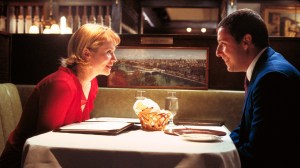 Writer/director Paul Thomas Anderson spins an engrossing character study deconstructing the angry goofball Sandler has been so accustomed to playing in all his slapstick comedies. He plays the same character archetype but is now given new dimensions to play with and depth. The true revelation of Punch-Drunk Love is that Sandler can really act. No, really, I’m dead serious.
The direction and writing are much more restrained than with Andersons previous films. The world of Punch-Drunk Love is full of stark colors, slow camera movements and vast amounts of spatial emptiness. The scope is much narrower, focusing on a small set of characters and just allowing them to tell the story without outside interference — like a frog shower. Due to the attention paid to Barry, everyone else becomes underwritten including the stoic love interest. After being convinced of Barry’s instabilities the audience is left to assume sheer blind faith at what Lena sees in Barry.
Punch-Drunk Love gleefully ignores and plays with romantic comedy conventions. The running time is under 90 minutes, (which is still only HALF of Magnolia) but the pacing is precise. John Brions percussion heavy musical score wonderfully displays the boiling anger behind Barrys placid exterior during key moments.
The storytelling of Punch-Drunk Love is full of uneasily accessible quirks and will likely be reacted to with hostility by mainstream America. What Anderson has crafted is an arty Adam Sandler movie that few thought even possible. Next thing you’ll tell me is that David Lynch will do a G-rated Disney Film. What’s that now?
Nate’s Grade: B+
Share this:

Sex and Lucia (2002)
 “Put lots of sex in it. Thats always good,” says a character in Sex and Lucia, the steamy Spanish import now playing. And Sex and Lucia is true to its very title. There are many scenes with Lucia, our heroine, and there’s also oodles of sex. This is the type of movie where if people can walk around without a stitch on, they will. This is the type of movie where a babysitter will masturbate to her mother’s porno. This is the type of movie where shower heads are not used for their intended purpose. No wonder this movie went unrated.
Sex and Lucia is a genuinely erotic movie. And when it comes to eroticism in cinema, the Europeans make us look like sickly amateurs. After exploring whatever late-night stimuli is offered on Showtime or Cinemax youll get an idea of how poor American eroticism is. Usually they involve an adventurous couple, or a sex therapist, or a Jacuzzi/swimming pool, or a lonely stewardess/waitress/secretary and usually Shannon Tweed stars. What disarray the state of our erotic union is in. But for all its shocking and stimulating moments, Sex and Lucia is an intriguing tale of loss, love and sexuality, of course, even if it’s told rather obtusely.
Lucia (Paz Vega) is a waitress in Madrid. She enters into a fiery relationship with a writer named Lorenzo (Tristian Ulloa). Their passion seems to burn as fast as the many cigarettes in the film. Their relationship is full of joyous sex, impromptu strip teases, and blindfolded foreplay. But Lorenzo has a secret he hides from Lucia. Six years ago he fathered a daughter he has never seen when he had a tryst on the beach of a Mediterranean isle. The mother has sent their daughter, Luna (named after the full moon on her conception), into the care of a former porn star and Belen, her randy teenage daughter, in Madrid. Its here that Lorenzo first meets his daughter and then Belen starts coming onto him.
 After learning some disconcerting news about her boyfriend, Lucia leaves to take some refuge on the same sunny Mediterranean island where Luna’s mother lives. Lucia actually takes refuge with her and looks back upon her stormy relationship with Lorenzo. The island has many deceiving holes that fall into caverns all along its beach, directly echoing the rabbit hole for Alice.
This, believe it or not, is the most easily understandable part of the movie. I’ve told you what took place but after seeing it even I dont know what happened. The story has several moments, even entire subplots, that could be the truth, fantasy, sections of Lorenzo’s story, an exaggerated dream, or maybe all of them combined. Your guess is as good as mine, reader.
Writer/director Julio Medem utilizes about every narrative trick in the book to create an alluring puzzle. He washes out the colors of the film (also seen in Three Kings) and seems to correspond to the surreal quality of many story lines. The cinematography is a gorgeous delight. Vega has a smolder and can act circles around her Spanish competition. She gives a brave performance, partially for being as nude as often as she is, and also for displaying the fragile emotions of Lucia so well.
Sex and Lucia is indeed quite sexy but it’s more than just art house porn. The film’s story is an intimate tangle that just might stimulate the largest organ: the brain.
Nate’s Grade: B
Share this:

Secretary (2002)
 Secretary is a new romantic comedy with a few kinks to it. Its actually the most romantic S&M movie ever. It’s the first S&M romantic comedy since maybe Garry Marshall’s disastrous 1994 Exit to Eden. Im still trying to get the image of Rosie O’Donnell in a bondage mask out of my ongoing nightmares.
Lee Halloway (Maggie Gyllenhaal) is fresh from a stop at a mental institution for her hazardous habit of cutting herself to feel relief. Her overbearing mother stashes the entire kitchen cutlery in a locked cabinet. The sheltered Lee resorts back to a kiddy make-up box stashed under her home bed. Instead of colorful brushes and arrays of lipstick, she has a selection of sharp objects. Lee goes job hunting to step back from her habit, and is hired as a secretary to E. Edward Gray (James Spader). He is a rigid taskmaster who delights in pointing out typographical errors with his red marker, his weapon of choice. Gray enjoys his dominance and Lee complies, even if its routing through garbage. He ticks away Lee’s flaws like a checklist of annoyance but also appears to have genuine concern for her. When he notices her wounds Gray confronts her and convinces Lee to stop cutting herself.
The turning point arrives when Gray orders Lee into his office one afternoon. He commands her to bend over his desk and then delivers a sound spanking. Lee stares at her purple rump with fascination, like something has been awakened inside her. Soon enough Lee purposely makes typos so she can re-assume her spanking position.
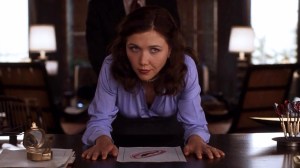 Maggie Gyllenhaal is a cinematic find with a fearless and breathtaking performance that is at once delicate, nervous, self-controlled, seductive and delightful. Gyllenhaal, with her heart-like face and pert lips, radiates star quality. She allows the audience into Lee’s head and we quickly fall in love with this peculiar yet charming heroine. If there is any justice in this world Gyllenhaal should at least get an Oscar nomination (she didn’t). Spader can do this left-of-center creepy character stuff in his sleep.
Secretary on the surface may seem like a fetish flick but it’s no different than boy (sadist) meets girl (masochist) and falls in love. Director Steven Shainberg treads carefully around serious subject matter, like Lee’s self-mutilation, to focus on these two very special characters. Secretary isn’t making any loud statements on sadomasochism or post-feminism, it’s just showing us that S&M is the route these two people take to find true love. It doesn’t judge them for their unconventional tastes and neither should we. This is one of the finest romances in recent memory and it seems to come from one of the most unlikely places.
Sadomasochism has been predominantly shown involving pain or some leather-masked madman evoking torture. Secretary may be the film that shows there can be pleasures with pain. Some people regard what Lee and Edward do as sick, perverted, or downright wrong. Secretary is a foot in the door to get people to understand what willing sadomasochism really is about. We all have fetishes and interests, and S&M is the number one fetish truth be told. This isn’t your everyday romance.
Obviously, this is a movie that will not appeal to everyone. The relationship between our leads is surprisingly complex but gentle and even sweet (if thats the proper word for an S&M romantic comedy). Secretary shows that it truly takes different strokes and, despite an overly silly ending, is the most pleasing romance of the year. Youll never look at red felt pens the same.
Nate’s Grade: A
Share this:

My Big Fat Greek Wedding (2002)
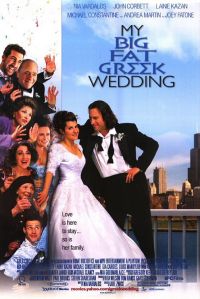 Toula Portokalos (Nia Vardalos) opens by telling us that as a Greek woman she has three responsibilities, “1) Marry a Greek boy. 2) Have lots of Greek children. 3) Make lots of food.” Toula works in her family’s restaurant letting life pass her by, while her father pleads with her to get married even though she is already “old” at 30. It doesn’t seem like that day will ever come for Toula, nor is she looking forward to it, until a handsome stranger (John Corbett, Aidan from Sex and the City) catches her eye in the restaurant. Through more encounters the two seem to have sparks flying off from the heat they generate. He pops the question and Toula happily says yes. There’s only one slight problem – he’s not Greek.
My Big Fat Greek Wedding isn’t anything provocative or innovative but it does have its charming moments and engaging humor. These “ethnic family comedies” are really a double edged sword to work with. You see, they will exaggerate the cultural eccentric-ness of the characters to the point of gross parody but then rely on them to become endearing lovable characters who the audience appreciates for the very same reasons it’s laughing at them. And while Greek Wedding can be found guilty of this notion as well it really does take someone from the inside to come up with this stuff, so there must be some love there to start with.
Vardalos, who also wrote the script, is a perfect casting choice exactly because of her everyday looks. This isn’t someone like Jennifer Aniston trying to pull off being poor and un-pretty; this is a normal looking gal pulling off normal. It works exceptionally and Vardalos certainly knows how to hit a joke. The supporting cast of goofy yet lovable Greeks is played with admirable gusto by the many assembled players. A favorite of mine is the elderly grandmother who continues to try and escape from their home. And yes, an N’SYNC member is in this movie. Why I will never know. Is he even Greek? Is “Fatone” a Greek name?
My Big Fat Greek Wedding is a big helping of family comedy and easy to see why it’s become as crowd pleasing as it is. It’s nothing new or extravagant, but hey, I’d easily go see this again than ever venture close to a theater showing XXX or Blue Crush or Pluto Nash or The Master of Disguise or…
Nate’s Grade: B


You must be logged in to post a comment.