Blog Archives
Sorry, Baby (2025)
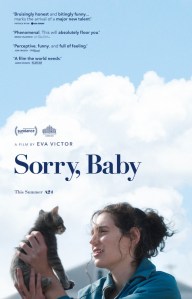
Sundance favorite Sorry, Baby takes several serious subjects and provides its own little bittersweet treatise through a character study of one woman navigating her complex feelings after being assaulted by her college professor. Written, directed, and starring Eva Victor, the movie feels like a combination of one of those small-town slice-of-life hangouts and something a little more arch and peculiar, but it still coasts on its vision and authorial voice. Victor’s portrait rings with honesty and empathy as her character, Agnes, wants to live a “normal life” but doesn’t quite understand what that might be. Her best friend is pregnant from a sperm donor, she’s adjusting to her workload as a literary professor at her alma mater (in an ironic twist, she occupies the same office as her former mentor and attacker), she’s flirting with the possibility of a romance with a nice neighbor (Lucas Hedges), and she just adopted a stray cat. The present, suffused in indecision and depression, is juxtaposed with flashbacks to her before, immediately after the assault, and the infuriating aftermath. This is where some of Victor’s darker sense of humor arises, like when Agnes is consoled by university officials who tell her there’s nothing they can do because her attacker has resigned but, hey, they’re also women, so, you know, they get it. Sorry, Baby walks a fine line between making you wince and making you want to laugh. It’s an impressive debut for Victor on many fronts, though I wish I felt like it amounted to something more emphatic or emblematic. It can feel more like a lot of self-contained scenes than a full movie, like Agnes going through jury selection before being excused when she has to confess her own history and her conflicted view of her attacker. I really enjoyed the concluding monologue Agnes gives to a newborn, explaining that the world she’s just entered will probably eventually hurt her but that there’s still good people and goodness that can be found. It’s heartfelt but in-character and feels completely on her own terms. Sorry, Baby is a little slow and a little closed-off, but it also deals with trauma and perseverance in a manner that doesn’t feel trite, condescending, or misery-prone.
Nate’s Grade: B
Share this:

Mickey 17 (2025)
 Bong Joon Ho is one of those filmmakers that has earned the right to make any movie he wants. Hollywood might not feel the same, but the filmmaker behind Snowpiercer, The Host, and the triumphant Oscar-winning Parasite, the first time an international movie won Best Picture, is an amazingly versatile storyteller who seamlessly blends different genres and tones into unique and mesmerizing film experiences. If he’s interested in telling a story, then that guarantees I’m interested in watching it. This is especially true if he steps into the realm of science fiction. After the worldwide success of Parasite, Bong Joon Ho was given $100 million dollars and final cut from a big studio to make whatever he wanted, and he chose an adaptation of Edward Ashton’s novel, Mickey 7, telling the story of the world’s most/least fortunate expendable in a fledgling space colony. I read the book last year and it was quite good, so my anticipation was even higher for the feature film Mickey 17, especially after Warner Brothers delayed the movie an entire year. Now, after the long wait, we can all finally enjoy Bong Joon Ho with peak artistic freedom, a position that will likely not be repeated. It’s a grand movie with big ideas, vision, satire, and also enough underutilized ideas and distracting characters and performances to quibble over “what if’s.”
In the distant future, Earth is overrun in population and low on natural resources, so the next space race is to find habitable colony worlds. Mickey (Robert Pattinson) gets in over his head to shady loan sharks and looks for any possible way off of the planet. The only position he can sign up for is that of an expendable, a person who can be cloned from a biological printing machine. These expendables are put in dangerous jobs and different science tests because, well, if they die, you can start over. It’s a terrible job, one that involves dying repeatedly, and Mickey agrees to be the human crash test dummy. He’s on a multiyear colony ship traveling across space to find a habitable world. The planet they land on is bitterly cold, impossible to farm, and crawling with its own crawly wildlife. Mickey 17 is left for dead after falling down a chasm but he survives, trudges back home, only to discover another Mickey in his bed. They’ve assumed Mickey 17 died and already printed out his replacement. There’s a rule about there not being multiples and, if discovered, both expendables would be killed. They have to hide their secret and work together while still vying for dominance over one another and staying out of the crosshairs of buffoonish yet powerful political leaders Kenneth Marshall (Mark Ruffalo) and his wife, Yifa (Toni Collette).
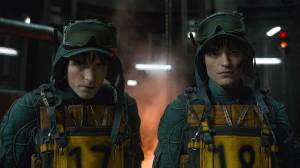 Mickey 17 is a smart, weird, and consistently fun and thoughtful movie. It doesn’t waste any time getting started, literally with Mickey 17 on the cusp of dying with his looming interaction with the aliens. Bong Joon Ho adapted the screenplay and has a nimble way of dealing with the conflicts and setting. I appreciated that he doesn’t prolong different storylines beyond their point of interest. He’s always got another development or joke or set piece to provide. There’s a fun sense of discovery with the movie as well as satisfaction to watch how he slides all the pieces into place. I appreciated how he imbues character notes so easily with supporting characters, giving this universe a larger personality that resonates. I love the setting and the reality it presents of a long-voyage space colony fighting for resources and struggling to keep the lights on. The sets and photography are gorgeous to behold but also filled with details to help make the world feel lived-in. I loved that even in the far-flung future, technology can still work in fits and starts, like watching Mickey slide out of the printer conveyor belt only to lurch backwards before going forward again, like the printers of the 1980s. I love the alien creature design that resembles an armadillo crossed with the subterranean worms from Tremors. I loved how they were able to defend their queen/mamma in Act Three. I love the goofy comic flourishes too, like the fact that there’s a guy just walking around in like a pigeon mascot costume that is never really explained. This is also the same movie where characters constantly ask Mickey what it’s like to die and you realize that every version of Mickey doesn’t know because he’s never experienced it personally, only born from the aftermath. The way this movie is capable of marrying big ideas with silly visual jokes and slapstick and explosions is impressive and a reminder that certain artists will prosper on big stages when given ultimate freedom. Come for the star power and slapstick, stay for the existential dread.
Pattinson presents another wildly weird performance that reminds me how exciting he is as an actor. He’s got these movie star good looks but he really wants to play all the weirdos he can with the most eclectic filmmakers, and I love it. His Mickey 17 and Mickey 18 may be constructed from the same DNA but they come across as vastly different iterations of our hero. This provides a more assertive version of Mickey to try and shape up our more passive Mickey into standing up for himself, taking chances, and taking charge when the situation calls for it. He’s like a mentor. Mickey 18 isn’t featured that often in the story, and truthfully he wasn’t featured that often in the book as well. It’s mostly the story of the hapless and whiny-voiced Mickey 17 and his journey of self. It’s a familiar yet enticing formula to watch a character gain agency and go from pushover to defender of the vulnerable. Pattinson finds little sparks to grab onto with the character, little pieces of weirdness that really help crystalize our understanding of Mickey. Of course the human lab rat would have the fight bred out of him through resignation, and it’s still gratifying to see him stay who he is while also rising to the challenge of the moment. In interviews, Pattinson has said that he modeled his two Mickey performances after the cartoon characters Ren and Stimpy. This actor is perfect for the wacky, tone-blending worlds of Bong Joon Ho. He’s game for everything.
 It’s not hard to see the entire enterprise as a crafty critique of capitalism, not exactly a new point in the Bong Joon Ho movie universe. Mickey’s value to his mission is the literal exploitation of his body. He’s callously tested upon for vaccines and weapons and whatever the scientists may cook up. Because they know they can download another Mickey, it changes how they view the current iteration: he’s not a person, he’s only whatever they want him to be at whatever moment. His value is what he can offer to them as a test subject, as a pile of flesh to be experimented upon. Therefore, the casual cruelty in the name of science and “progress” is yet another example of how we can easily dehumanize our fellow man in a system that profits from their labor and exploitation. Bong Joon Ho also provides a more compassionate view of the downtrodden Other, in particular the indigenous alien species on the colony world (to be fair, as is pointed out by another character, the humans are the actual aliens in this scenario). The creatures are viewed as unworthy of co-existence, in the way of man’s intergalactic manifest destiny, and so they must be wiped out for greater conquest. It’s not a huge surprise that the aliens might not be the stupid and scary creatures that they’ve been projected to be, and this is revealed very early when a collective herd saves the wounded Mickey 17. He views this as an insult, that he’s not even seen as worth eating, but the reading should be obvious to everyone in the audience. Thus we spend the rest of the movie for the other characters to realize the reality of these strange creatures. I did appreciate that the end of the movie coincides with a battle for primacy versus cooperation and compassion, which centers some of the major themes and ties the movie’s character arcs and significant messages together. Plus there’s also explosions.
And yet, there are ideas that could have been explored for even more depth and contemplation. There’s a very intriguing question concerning the different personalities of Mickey 17 and Mickey 18, which begs the follow-up question whether or not they are indeed one hundred percent replicas. Their personalities are such wild swings away from one another, with one being much more the laconic pushover and the other being the aggressive and assertive ideal Mickey. The next Mickey is built upon the recorded memories of the previous memories, so in theory there wouldn’t be many significant differences. However, the big personality differences are not explored or even questioned. This is a missed opportunity that could have gotten to something deeper philosophically and with the revelations of its world-building tech. Perhaps the cloning device doesn’t actually work as advertised and each new Mickey is a close proximity but there are minute yet distinct differences, meaning each new Mickey is his own person deserving of identity. This could then also further connect with the religious objection to cloning that one body should only have one soul. This could lead to Mickey 17, and even 18, debating whether or not they have souls of their own and their conception of life and sacrifice, being more than just the living equivalent of a punching bag. It could also bring into a spiritual element about possibly having a celestial reward after their extra-solar toils, at least the hopeful belief. There were real thematic qualities to explore and provide meaningful texture to the whole movie, and yet they’re disappointingly ignored.
 The Trump buffoonery avatar stuff is a little harder to take in early 2025 with the fallout of a second Trump presidency still having its far-reaching, chaotic, despotic consequences. The character and his wife are invented entirely for the movie by Bong Joon Ho, and clearly he had some things he wanted to say about the former and now-current president (there are even followers wearing those signature red caps). I just don’t know if there’s anything of real substance to this portrayal. He’s a cartoonish idiot villain overcome with vanity, ego, overconfidence, and craven manipulation, but there’s not much that is gained from his multiple appearances. Ruffalo is doing fine work jutting out his jaw and making sure to show those upper teeth as often as possible. It’s just that the character is an exaggerated all-purpose blowhard villain, and it makes for a character you desperately want to see brought lower, to be exposed as a fraud, to get their cosmic comeuppance. The problem is that the appearances are all hammering away at the exact same point that I began to tune Marshall out. In our current political landscape, with the intended target taking up every iota of oxygen in the public sphere, it just becomes another reflection point of the exhaustion felt from the Trump administration. One character verbally lambastes the political bully as a world-class idiot and says, “That’s why you lost the elections.” Plural. It’s then I recalled Mickey 17 was delayed a year, and this would have played differently for me in early 2024 than 2025.
There’s also a very late sequence I would like to analyze why it doesn’t quite work as conceived, but this will enter into some spoilers, so skip to the next question if you’d like to remain pure, dear reader. During the epilogue or coda, Mickey is seemingly remembering something from his past until it’s revealed to be a nightmare and thus having little consequence beyond insight into Mickey’s subconscious anxiety. In this nightmare, Mickey stumbles upon Yifa in the midst of her printing out a new version of her husband through the cloning machine. We’d been previously told that after her husband’s death that Yifa had been locked away and supposedly slit her own wrists. This raises the question whether the Yifa that we see at the machine is her or a clone, and that tantalizing possibility unlocks a new world of story for the movie that seems completely natural and essential. It’s the kind of twist hiding in plain sight that could have worked, that there were two Yifas at the same time there had been two Mickeys or long predating. This is because once you start thinking of this possibility it’s too obvious that it would happen. Of course the rich and famous blowhards who regard themselves as more important than others would see the expendable process as a means of living forever, or at least having a back-up plan. Of course the Marshalls would be hypocrites about their moral righteousness against cloning being an affront to God and creation. Of course these people would use whatever means they could to extend their power and their lives. Just like that, the very end of the movie has an extra layer to it that also provides more purpose for Yifa as a character. Then, just like that, it’s revealed as a nightmare, and all that intriguing possibility is wiped out, and I was left wondering why even produce this moment after the duplicating machine has been destroyed?
 Mickey 17 is an engaging, funny, enraging, and silly example of what science fiction can do. It can explore existential and essential questions about what it means to be human while also employing cartoonish slapstick, as well as cartoonish political satire. Not everything comes together smoothly; it’s a true jumble of tones and ideas, a Bong Joon Ho staple, but he’s typically so skilled at hiding the transitions and seams so you don’t even notice the genre movement until it’s already happened. There are intriguing directions and ideas I wish the movie had explored more, and the climax is a little conveniently tidy but suitably fitting as an invention for a showdown. As a reader of the novel, I can say that it’s an entertaining and fitting adaptation but also one that works on its own while I can still encourage people to read the novel. Mickey 17 is ambitious and messy and also very human, finding grace inside the darkness and absurdity. It’s not perfect but it is worth celebrating, just like each of the put-upon Mickeys.
Nate’s Grade: B+
Share this:

Blink Twice (2024)
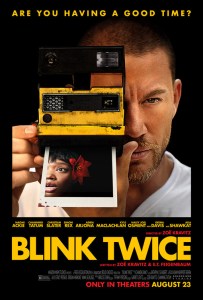 Zoe Kravitz’s directorial debut Blink Twice has stayed with me for weeks after I watched it, and with further harrowing revelations coming from the fallout of P. Diddy’s empire of exploitation, it has even more relevance. Think of it as a feminist revenge thriller set on Jeffrey Epstein’s island or a Diddy party. Channing Tatum plays a successful tech bro who hosts lavish getaways for the Wall Street and Silicon Valley elite, where the week is an orgy of food, drink, drugs, and of course sex. We follow Frida (Naomi Ackie), a waitress yearning for the finer things in life, so when Tatum’s rich and famous CEO invites her and her friend to his private island, she’s ecstatic. But everything is not what it seems, and Frida and the other women begin to notice weird clues, that is, when they can remember as time frequently seems to be lost for them. Blink Twice is a twisty, eerie mystery and Kravitz shows real skill at developing tension and suspense, with sequences that had me girding great waves of anxiety. There’s also an eye for style and mood here that makes me feel Kravitz has a real career as a genre director. I don’t think it’s spoilers to say that eventually the surviving women team up together to fight back against their oppressors, and it’s gloriously entertaining, bloody, and table-turning satisfying. The ending is designed to spark debate and controversy, and I enjoy that Kravitz and co-writer E.T. Feigenbaum do not want to make things too tidy, even with their protagonists. The themes here are broad but the execution is exact. There are several moments that stand out to me, from unexpected moments of levity to bold artistic choices that are mesmerizing, like an “I’m sorry” apology that goes through every level. If you’re looking for slickly executed genre thrills with great comeuppance, don’t blink when it comes to with Blink Twice.
Nate’s Grade: B+
Share this:

Star Wars: The Rise of Skywalker (2019)
 In 2017, there was a great disturbance in the Force when Star Wars Episode 9 director Colin Trevorrow (Jurassic World) was unceremoniously jettisoned. He had spent over a year developing a script for the concluding film in this new Star Wars trilogy (he’s still listed in the credits for story) and I guess the producers must have had some strong feelings. Trevorrow was out and J.J. Abrams returned to close out the saga he had kicked off with 2015’s The Force Awakens. It felt like a safe choice, the return of an artist best known for dabbling in other people’s established worlds. 2017’s The Last Jedi, written and directed by Rian Johnson (Knives Out), was, to say the least, divisive with the fanbase. It made sense to jump back in with Abrams who had delivered a fun, lively kickstart that made box-office records. Surely Abrams and his army of magicians would steer the franchise into safe territory and provide a satisfying ending to the character he created?
Note: I promise to keep this review free of significant spoilers beyond some minor plot points. If you want to avoid reading anything further until after having seen the film, I understand.
The Emperor (Ian McDiarmid) is alive and well and offering a fleet of planet-destroying starships if Kylo Ren (Adam Driver) will kill Rey (Daisy Ridley). She’s trying to uncover hidden clues about her parentage and still believes she can reform Kylo from the dark side. Finn (John Boyega) and Poe (Oscar Isaac) are chasing after a series of artifacts to find the secret location for the Emperor’s secret planet and rebuild the fledgling resistance. Kylo and Rey are headed for a final confrontation to determine whether they turn to the light side or the dark side.
 It is with a heavy heart that I feel like I have to admit that there wasn’t a single storytelling choice that I enjoyed in The Rise of Skywalker. It feels like Abrams and company were in a mad panic after the divisiveness of The Last Jedi and retreated to the safety of nostalgia and fan expectations. This feels like the producers made a list of fan demands and then acceded to them. It certainly feels like an overblown course correction, let alone discarding major changes and characters from Episode 8. Now fan service in itself is not a negative; there is such a thing as good fan service and bad service. The difference is that bad fan service relies heavily on pandering and reference points, leaving an audience unchallenged, and that certainly feels like Episode 9, a movie ever beholden to its calcifying past. My anecdotal evidence already tells me that many fans will love this movie, more than likely the same contingent that found such stinging fault in Episode 8, and I don’t wish them ill. I’m happy for them. For me, Episode 9 is a mess of bad plotting, rushed pacing, truncated character arcs, useless cameos, and a reheated Return of the Jedi climax that was as boring as it was exhausting and dispiriting. It’s supposed to be an end to this new trilogy, and a trilogy of trilogies, but the backwards-looking franchise will never be done paying homage to its cherished past while it eats its own tail until it vomits. This movie is so eager to please as many fans as possible that it feels like an anxious hostage.
I think it was a major mistake for The Emperor to come back into play this late. The very reappearance already cheapens the sacrifice Darth Vader made in Return of the Jedi, and it begs the question what has this evil old man been doing for three decades? Has he just been hanging around his completely empty rock planet sitting on his uncomfortable rock throne? Abrams throws some haphazard lip service that Palpatine was really behind everything, we just never knew it, but that feels cheap. It’s like in 2015’s Spectre when Christoph Waltz emerges and says, “Hey James Bond, while you’ve never met me until this moment, I’m responsible for every bad thing that happened in your life, not those other bad guys, and I just didn’t feel like saying anything.” It wasn’t a satisfying plot development then and it isn’t now. The “boss’ boss” manipulating in the shadows is simply an aggravating shell game. If Palpatine lived even after the second Death Star exploded, then what’s to say if he can ever be defeated? Even if he is toppled in Episode 9, what’s stopping him from being resurrected in Episode 12 to serve as another quick excuse for a major villain? This decision to bring him back to life also taps into a further reverence for bloodlines that The Last Jedi was valiantly fighting against. Star Wars may take place in a different galaxy but it frustratingly feels like only three families populate it. The Last Jedi proposed that you didn’t have to come from select magic bloodlines to be somebody important, that your past was irrelevant, and now Abrams and company sharply reverse course, hugging the concept of the Chosen One until it bursts. It feels creatively starved.
 Too much of the movie’s 142-minute run time was devoted to hasty, convoluted plotting that served little else than to fill time. By the concluding movie in a trilogy, there should be no moments left to fill time, nor should we really be introducing new worthless side characters rather than using the people we’ve already established. The first 90 minutes of this movie could be condensed to “get a thing to get a thing.” It’s one superfluous obstacle after another, one item to gain another, that reminded me of video game fetch quests. Even worse, none of it felt like setbacks or difficulties because the movie was rushing through every sequence. If we have to rush through to cover four abbreviated action set pieces, why can’t we consolidate to two really good and developed action set pieces instead? A great way to make your movie forgettable is to cram it full of disposable plotting and short action sequences that never take off. I kind of liked one lightsaber battle along the surf of the ruins of a Death Star (of course there has to be another Death Star!) but that was it for the action. There wasn’t anything onscreen that even came close to replicating the thrills or suspense from Episodes 7 and 8. I felt more suspense in The Last Jedi for Rose’s doomed sister than I did for anyone in Rise of Skywalker. There was space where Abrams and company could have expanded and developed important themes and given characters room to grow, but the pacing feels so breathless in order to distract from the hasty plot retreats.
Characters feel like they zapped to the end of their character arcs because that was what was expected, but why they reached these milestones feels arbitrary from a plotting standpoint. It reminded me of, I’m heartbroken to even say, the final season of Game of Thrones; fans didn’t object on their face to character destinations but the journey to reach these points felt like it was missing key moments to serve as connection. Why redemption now? Why tempted by the dark side now? It plays more like Abrams said, “Well, we ran out of time folks, so let’s skip to the end.” Looking back on the trilogy, it was clearly Rey and Kylo’s story first and foremost, but the supporting characters ultimately feel abandoned and wasted. Finn had a great perspective, a Stormtrooper who defects, but that unique position is cast aside by introducing a new side character that serves no purpose other than to remind you that Abrams must have really not liked Rose (Kelly Marie-Tran). Seriously, Rose is sidelined to study monitors. Abrams tapped an old Lost alum, Dominic Monaghan, for this thankless duty, so why can’t Rose at least be the sidekick? We don’t need another new sidekick this late. Poe is another wasted character. He learns greater responsibility and teamwork in Last Jedi, but he’s really just a Han Solo stand-in, the rakish rogue quick with a quip. Episode 9 gives him an old flame but not much in the way of additional characterization. He feels the same from his first scene in Episode 7. Oh, and all the forced cameos Episode 9 makes time for feels almost like a Star Wars reunion special. That’s including the awkward use of existing General Leia footage to cobble together something for her. I’m wishing more and more that it was Leia that went badass kamikaze in Episode 8 as her exit.
 At every point, the movie seemed determined to undercut itself when it came to themes, when it came to character growth, and when it especially came to sacrifices and stakes. There are four fake outs when it comes to deaths. What’s the point of sacrifices when it can just be reversed with little explanation? What’s the point of learning when the Force can just serve as a magic hand-wave solution for anything you need? There are some pretty remarkable leaps in what exactly the Force can do in Episode 9. The Rise of Skywalker even resets some pretty inane things, like Kylo Ren gluing his smashed helmet back together or a certain character getting a long-overdue medal for valor. The themes Abrams works with are extremely broad and lack the questioning of the inerrancy of the Jedi order from Episode 8. It’s also confusing when the theme is that your destiny is not written by your station when the movie repeatedly elevates the mythic at the expense of the nuance and human. It’s like saying your past doesn’t dictate your future while slavishly venerating the past at the expense of the present story.
Given the budget, talent involved, and Abrams’ natural pedigree for blockbuster filmmaking, Rise of Skywalker still has moments of grand spectacle and fun. The actors are still enjoyable to watch and Adam Driver (Marriage Story) is the definite MVP of this new trilogy. His character is, by far, the most interesting and the one that goes on the biggest emotional roller coaster. Abrams slides in some rather pleasing visual compositions. The score by John Williams serves as kind of a greatest hit collection of his many themes over the course of the 40-year saga. The denouement feels right, even if I quibble with the final line spoken. There are things to like, plenty, and I know many fans will find even more, but the good is trounced by the mistakes and miscalculations which just happen to be the really big stuff (plot, resolutions, characterization, action development, structure, payoffs, etc). Abrams himself has joked that he’s really good at starting stories and not so great at finishing them, so maybe choosing to have Episode 9 function as a conclusion not just to three movies but to three times three was overburdening.
 I’ve seen it twice now and given some time to think it over, and I think I’ll declare Star Wars: The Rise of Skywalker as my least favorite of the nine core movies. I know these are inflammatory words, and for an easily-inflamed fanbase, but my level of disappointment is immense. I’ve enjoyed both of the previous Star Wars saga installments but I wasn’t quite expecting this. I groaned throughout the movie more than I laughed. Even the much-derided Phantom Menace had less at stake, and that’s why I hold the disappointment of Rise of Skywalker as the more grievous of the two. It had much to accomplish and much to payoff and its missteps cast a shadow over the previous movies. It also reconfirms for me my worry that there will only be a small world for Star Wars, a set of pre-approved parameters that creatives must adhere within, taking the same pieces and delivering variations of the same story. There are definite ideas that could work here with Episode 9, but the rushed pacing, inconsequential plot filler and side characters, and its use of nostalgia as a heat shield (look at that cameo please!) doom its execution. As much as Abrams wants to reject destiny, his Star Wars are still driven by a devotion to destiny. We won’t be getting another Star Wars for several years until 2022 and I think that’s a good thing (also without the Thrones writing team now too). The producers need some distance to determine where to go next. I just hope they understand they have an awfully big universe of untapped stories at their disposal and a wealth of eager storytellers with fresh ideas. Star Wars will always be Star Wars but it can also be much more if it wanted to be.
Nate’s Grade: C
Share this:

Lady Macbeth (2017)
 Cool, calculating, impassioned, and razor-sharp in its shrewd storytelling, the period film Lady Macbeth is worthy of the title of Shakespeare’s manipulative anti-heroine. Katherine (newcomer Florence Pugh) is recently married and expected to fulfill her wifely duties. Except her husband demands she stay inside and he also wants nothing to do with her physically. While away, she strikes up an affair with Sebastian (Cosmo Jarvis), one of the servants hired to tend the estate. She finally feels desired but also free, able to do what she wants and without the stifling control of patriarchal forces. There are three impediments to Katherine continuing to enjoy her status and relationship, and each one requires another step into moral turpitude. Lady Macbeth does a very effective job of developing taut tension born out of its premise. Every plot point naturally leads to another, creating more frisson and conflict. It pushes an audience into an uncomfortable position of deciding how far their sympathies will align with our put-upon protagonist. The ending is fitting but will likely produce a lot of heavy sighs and foot shuffling out of the theater. Pugh delivers a star-making performance in a role we’ve seen often in nineteenth century literature, the oppressed woman yearning for autonomy of body and mind. However, this isn’t an unrequited romance of furtive glances and pearl clutching, this is a meaty psychological thriller seeped in murder. Pugh expertly portrays a fascinating figure, a woman capable of cruelty to stake her claim in a cruel world. She commands the screen. A great reoccurring image is Katherine sitting on a settee and going through breathing exercises, as if to get into character for what she must do. Lady Macbeth (based upon the Russian novel Lady Macbeth of Mtsensk) is a tightly wound psychological thriller that brings a darker, absorbing carnality to the bonnet drama.
Nate’s Grade: B+


You must be logged in to post a comment.