Blog Archives
Homeroom: Heart of America (2003)
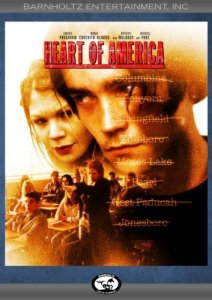
The film spans one morning of a “normal” high school in Oregon (it looks like the school is a three-story motel). It’s the last day of school and everyone is ready to jump into the real world. The storylines are rife with every high school cliché that can be found. Drum roll please, and they are:
1) Good Virgin (Stefanie MacGillivray) is dumped by Jerky Jock (Will Sanderson) because she refuses to put out. The majority of this storyline takes place in the guy’s car where he sadistically tells her all the details of the many other girls he was “forced” to sleep with (“The whole school f*cks. Everybody except you.”). One of these girls is the transient High Girl (Elisabeth Rosen), who has fallen in love with Jerky Jock over the course of him using her for sex.
2) High Girl has no parental involvement and lots of free time. She thusly gets high a lot and trips out for most of the movie. Dealer Dude spends all day implausibly hanging around the high school with sacks of drugs to sell. He’s stopped by Idealist Guidance Counselor (Maria Conchita Alonso) who wants to make a difference.
3) Good Student apparently wasn’t good at contraceptive planning because she’s pregnant. She wants an abortion and her life back. She’s also upset with her Boyfriend who wants to keep the baby and support her but is also willing to support whatever decision she makes.
4) Mean Creative Writing Teacher (Michael Paré) gets a good talking-to by the school principal (Jurgen Prochnow). The teacher is struggling with his own writing and taking out his frustrations by being overly critical of his students’ works. His grades appear to be unfair and unprofessional. One of his students is High Girl.
5) A team of bullies regularly beat up and humiliates Barry (Michael Belyea) and Daniel, who masterminds a plot for revenge. Daniel (Kett Turton) is tormented by his abusive father (Clint Howard) who just laughs when he sees bruises and black eyes on his son. The bullies are lead by King Bully (Brendan Fletcher) who is visited by his older brother, Former King Bully (Steve Byers), who reminisces about the good ole days of beating people up because they were different. These storylines mix and match until our inevitable shoot-em-up conclusion.
 Heart of America is based on a story by Boll and written by Robert Dean Klein (Blackwoods). The plot structure is competent and the film is mildly entertaining, which was a great surprise for me. The cinematography is above average for its budget and the score is quiet and reflective. Heart of America, with all its shortcomings, is still a better movie than Gus van Sant’s school shooter opus, Elephant (I dread to see this statement on the front of a re-released DVD).
Despite all of its simplicity, Heart of America makes some boneheaded decisions. It closes with lengthy text detailing other school shooters in the previous years. The text takes away from the drama and has no significant purpose other than to say, “You’ve just watched kids shoot up their school. Here’s how some other kids did it. If you’d like to learn more, visit your local library.” Heart of America also lacks subtlety; every item that is meant to carry a message of significance is hit so hard you’ll wonder if a gong is rattling. Then again, Boll isn’t well known for subtlety. This should explain Heart of America’s aches and pains with revealing its twists and revelations.
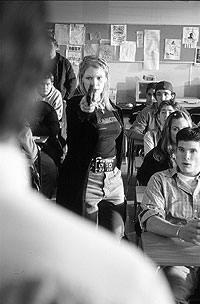
For two acts we’re led to believe that Daniel and Barry are the ones who are going to shoot up their school. Daniel IM’s his co-conspirator and reminds them not to “punk out on him.” Then minutes before the bloodbath it’s revealed that his co-conspirator is . . . another person! It’s High Girl, who takes a gun and gladly goes about killing classmates. Heart of America intentionally teases the viewer whether Barry will not follow through and this twist is intended to be something of a surprise. Trouble is someone should have told that to the DVD manufacturing folks. On the Heart of America DVD cover (as you can see for yourselves above) are the faces of Daniel and High Girl side-by-side. Superimposed over them is a list of school shooting locations that have been crossed out (it’s little wonder that Boll held back from the final one saying, “Anytown, U.S.A.”). Below all of these images is another picture of High Girl, this time standing in class and pointing an accusatory finger at some unforeseen figure. Any person intending to watch Heart of America will instantly associate High Girl with Daniel and already be thinking they’re Bonnie and Clyde. You can’t have a twist when you’re advertising it on the front cover of your DVD. Would The Sixth Sense have been as effective if the poster had Bruce Willis walking through walls like Ghost Dad (no respect to Ghost Dad intended)?
The most disturbing moment in Heart of America doesn’t even take place around the school. It involves a story Big Brother tells his bully clan about his greatest accomplishments. One of these is inviting a mentally challenged girl into his basement, getting her drunk, and then assaulting her. At first I thought it was rather unwarranted and unethical to have flashbacks of Big Bro’s story so that we can actually see the assult. Then it hit a slightly interesting juxtaposition, as Big Bro’s positive recount of his victim’s experience doesn’ match what we see happening. So I was willing to let it slide for a while until the film hit a deplorable low – a gratuitous nude scene of the mentally challenged girl (dubbed “Slow White”). You can tell it’s gratuitous too because most of the scene isn’t even shot at angles that expose her. It’s disturbing on the level that Boll was knowingly trying to shoehorn in some nudity and elicit titillation. The decision actually detracts from the power of the scene because it feels so tackily gratuitous.
 Once the end credits start to roll, the casual viewer will think two things: 1) What is that awful, tonally inappropriate pop song playing that actually has the lyrics, “The roads you made are the ones you pave,” and 2) what the hell was the message of Heart of America? In the first ten minutes or so we see teens on drugs, teens on medication, teens with no parental involvement, teens with parental abuse, and teens bullying to feel better about themselves. Do any of these things cause school violence, or is it some kind of magic combination? I never expected Heart of America to fashion a thesis on why kids grab guns and shoot up their schools but the ending feels ridiculously, artlessly devoid of meaning.
To further get into this point of discussion I will be spoiling all of the major plot lines of the movie, so in the rare instance anyone is remotely interested in watching Heart of America, scroll down. You won’t be missing much, trust me.
As expected, Daniel and High Girl get revenge primarily upon their tormentors. What I don’t get is that before High Girl sweeps into her classroom for her vengeance, she tells Dealer Dude, “I couldn’t have done it without you.” Huh? Does she mean she wouldn’t have gone to these lengths had she not be high? Or is this statement farther reaching, like blaming Dealer Dude for being apart of a system that has turned her into a degenerate drug user? I have no idea, but High Girl struts into class and kills Creative Writing Teacher, who had made fun of her and forced her to read her poetry aloud. Got it. But then she aims her pistol at Jerky Jock, whispers “I love you,” and then shoots Good Virgin to death. Apparently High Girl did not catch the news that Jerky Jock had dumped her minutes earlier. So what is the point of Good Virgin’s storyline? The only thing I can surmise is that if you don’t have sex you will be killed. If Good Virgin had given up her goodly virginity then Jerky Jock wouldn’t have been on the prowl, and he wouldn’t have used High Girl for throwaway sex, and then she wouldn’t have shot Good Virgin in jealousy. You see how this works? It’s the exact opposite of a horror movie. Daniel also shoots and kills Good Student’s boyfriend/father of her baby. What is that saying? Why couldn’t any of the shooters have clipped Patrick Muldoon’s nails-on-the-chalkboard horndog sex ed teacher? It seems Boll has a soapbox but he has nothing understandable to say.
Heart of America makes the audience not only side with the school shooters but also practically roots for them. Daniel and Barry undergo constant bullying from the get-go. The film, in its simplistic approach, plays the bullies as irredeemable assholes and Daniel and Barry are the hapless victims. Heart of America practically justifies its characters resorting to violence. Sure some innocent people get caught in the fray, but then aren’t they all to blame somehow? Again, I have no idea what Boll is trying to say.
Despite Boll having no command with actors (Muldoon is a constant reminder of this), the younger actors in Heart of America give pretty good performances. Turton (Saved!, Walking Tall) really festers with anger and discontent but also gives insights into a fragile kid just wanting to live. Belyea really works his nervous indecision to a nub, going so far as to hide his mother’s car keys so she won’t chance going to his school. Fletcher (Freddy vs. Jason) is a grinning monster as a bully but, in the film’s lone turn at character depth, also shows how uncomfortable he is being a bully. It seems that he too is just doing it to fit in. Fletcher’s pained and awkward reactions are a welcome sign of humanity, though it seems to be too little too late when we the climax hits. Rosen seems decidedly disconnected and dead-eyed scary.
 It’s puzzling that the top listed actors in Heart of America’s credits are as follows; Jurgen Prochnow, Michael Paré, Patrick Muldoon, and Maria Conchita Alonso. All four of those actors amount to about ten minutes of total screen time; Muldoon essentially has a grating cameo. Why are the kids not credited as the rightful stars of the show? The adults all give terrible performances (seriously, I cannot overstate how awful and creepy Muldoon is) but the kids are all right. The most shocking fact about the cast is that somewhere in this mix is Emmy-nominated Mad Men actress Elisabeth Moss. Look for her in here somewhere as “Robin Walters.”
Heart of America works with paint-by-numbers characters and Boll only doles out one color. The jock is a jerk. The virgin is good. The bullies are mean. The stoners are high. Very seldom does the film delve any deeper than these cursory characterizations. Because of this simplicity Heart of America strains credibility during its more unrealistic moments. At one point, King Bully and his posse force Daniel and Barry to eat dog poop and the moment is played as a defining point of drama. Does this stuff really happen? If it does then it certainly doesn’t happen often enough to be included in Boll’s depiction of a “normal” school. Then again, Boll’s idea of a normal American educational environment also involves raping mentally challenged girls. The name of the movie itself indicates how typical everything is supposed to seem.
This is a thought-provoking film, with the main thought being “What the hell is the movie trying to say?” Heart of America wades in a kiddy pool of high school clichés. The characters are paint-by-numbers and lack definition beyond their social title (Virgin, Jock, Bully, etc.). This film is awash in unresolved statements and stacks the deck so the audience will practically root for the school shooters. With no help from Uwe Boll, the younger actors are the movie’s stars and give good performances despite the limited range of their characters. You won’t know anything deeper after watching Heart of America. It’s Boll’s Big Statement Film but your guess is as good as mine as to whatever that is. Violence breeds violence? Parents need to spend more time with their kids? Don’t force kids to eat poo if they’re not ready? Heart of America is unrealistic, strained, unfocused, shallow and clumsy, and it’s also Boll’s best work to date.
Nate’s Grade: C
Share this:

Match Point (2005)
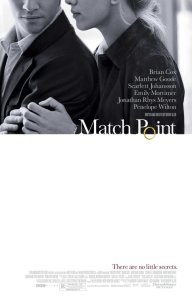 This is an excellent return to form for Woody Allen and his best film since 1987’s Crimes and Misdemeanors. The first half is deliberately slow, yes, but it is justified by the second half which more than makes up for it. The first half needed to be as slow as it is to set up the incredible minutia of this rich, elite world that former tennis pro Chris (Jonathon Rhys-Myers) has been adopted into. We need to see how comfortable this life is to understand why he doesn’t want to give it up and why he goes through the machinations he does in the second half. The characters and dialogue are spot-on and Allen has transported his world of the upper crust New York elite so well over to London, and the change of scenery has reawakened his writing. Allen knows the privileged world very well and their disconnected view point. However, he rightly centers his film not on the neurotic upper crust but on his social climbers Chris and Nola (Scarlett Johansson), a beauty engaged to Chris’ prospective brother-in-law. It is the second half of Match Point that makes it great. Allen tightens the screws on his social climbers and the tension is superbly taut. The dark turns and in the final act are greatly entertaining, as Allen delves further into his look at a universe built around chance and disorder. The returning imagery of the ball hitting the tennis net elicited gasps from my audience, and I was one of them. I love that Allen lets his story continue to unfold after the dark twists. The film’s biggest flaw is anchoring the entire point of view on Rhys-Myers, a somewhat limited actor that reminded me of Jude Law’s character in Closer. Johansson is an excellent noir femme fatale, her husky voice perfectly suited. Frankly, if ever there was a Scarlett Johansson nude scene, this movie was crying out for it. She has her tawdry affair with Chris and there’s even a sequence where we see her laying on her stomach nude while he applies baby oil to her. Their sex is supposed to be so impassioned and carnal, in contrast to his boring but stable relationship with Chloe (Emily Mortimer). And yet no nudity? Woody Allen, you’ve let me down. Your film, on the other hand, is intelligent, sharp, dark, taut, and wonderfully entertaining.
Nate’s Grade: A
Share this:

The Matador (2005)
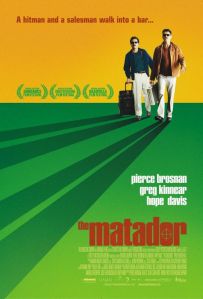 This is an adequate movie that doesn’t really resonate because at its heart it feels like a lot of interesting ideas and characters that are languished with a sitcom plot. I never thought Pierce Brosnan’s performance as the aging hit man was as funny as the film thought it was. The Matador is actually a more interesting movie than funny or amusing. The movie doesn’t go deep enough; the story isn’t as refined as it could be, and there are so few set pieces that this flick could have worked as a play. The end feels a bit too tidy and asks Greg Kinnear’s ordinary husband character to act out of character. There?s an extended talk in The Matador between Kinnear and his wife and Brosnan upon his unexpected visit, and it feels like a sitcom like the wacky neighbor next door has come over and hatched a hilarious scheme. I enjoyed the characters but they really just sit and stew in a really weak story. The characters are richly drawn but have nowhere to go.
Nate’s Grade: B-
Share this:

Mr. and Mrs. Smith (2005)
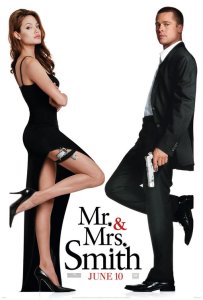 The new action comedy Mr. and Mrs. Smith sure seems to be in the headlines a lot. Most from tabloids trying to connect Angelina Jolie as the catalyst for why Brad Pitt and Jennifer Aniston have filed for divorce. You can’t walk past a checkout counter without being screamed at by 15 magazine covers. Too bad the actual movie seems to be forgotten in the process. That’s a shame because Mr. and Mrs. Smith is one terrifically fun summer ride that you don’t want to get off of (kind of like Jolie and/or Pitt, depending upon which way you swing).
Things aren’t so peachy for the Smiths (Jolie and Pitt). They met and married in Columbia amid a flurry of action but now it seems like their lives have become quite mundane as husband and wife. Life at work, though, is quite the opposite. Mr. and Mrs. Smith are hiding a whopper of a secret — that they’re hired assassins. They’ve both been hired to take out the same mark (Adam Brody) and accidentally discover each other’s true identity. Of course both spies are now compromised so they’re assigned to bump off their spouse. And you thought your marriage was murder. Mr. and Mrs. Smith combat their real feelings and put the spark back into their marriage by trying to kill each other, the little taught alternative in marriage counseling courses.
Mr. and Mrs. Smith has a vibrant sex appeal to it. Pitt and Jolie are extraordinarily beautiful people, no question, but they also have sizzling chemistry. The looks they give could ignite the screen. Even when they’re at each other’s throats you like them and hope for the best. The stars’ sex appeal and the film’s off kilter tone collides in fun ways. A knockout, drag-out fight between husband and wife turns into foreplay that literally brings the house down. The most unbelievable aspect of the movie is the idea that these gorgeous people would grow sexually tired with one another.
 The leads are terrific and terrific together. Jolie has finally found the right role for her. She’s the perfect balance between tough and sexy. She could very easily kick my ass and look good doing it. Originally Nicole Kidman was going to play Mrs. Smith before scheduling conflicts put the kibosh on that. I can not see Kidman working. I’m not afraid of Kidman, but with Jolie I’d do whatever she says. Jolie has a real kick in Mr. and Mrs. Smith and the audience can feel it too. It also helps that she looks absolutely magnificent. Finally, her beauty and wildness are put to excellent use. I’ve always thought Pitt got a bad rap as an actor for being pretty. Sure, he’s built like a Greek God (and played one in Troy) but this man can act. People seem to forget he was nominated for an Oscar for Twelve Monkeys. Pitt exudes a natural calm and always seems a smirk away from getting out of anything. These traits serve him well as a smooth criminal. Even when he’s whacking people with a golf club he seems easygoing.
The tone needs to be very specific for Mr. and Mrs. Smith to work. I mean, one false step and husband and wife revitalizing their marriage by trying to kill each other turns from funny to horrifying. Mrs. and Mrs. Smith walks that delicate line but nails the jaunty, tongue-in-cheek tone needed to make this movie soar. When you boil it down, Mr. and Mrs. Smith is essentially a modern day screwball romance. Instead of sparring with witticisms they spar with heavy-duty weaponry (I can only imagine what Spencer Tracy and Katherine Hepburn could have done with knives and bazookas).
After Mr. and Mrs. Smith find out the true identities of their spouses, they both know it’s kill-or-be-killed. Both tread very carefully and are highly suspicious that any little thing, like a glass of wine, a trip to the bathroom, could be the trigger to their demise. Now, if the tone weren’t exactly perfect, this sequence would seem overly silly or overly cruel. Instead, the sequence comes across as being very funny. Pitt and Jolie nail the casual awkwardness as they test one another. Even the ending of Mr. and Mrs. Smith is laugh-out-loud perfect with the film’s vibe. I will go so far to say it’s the greatest ending line for a film since 1959’s Some Like it Hot.
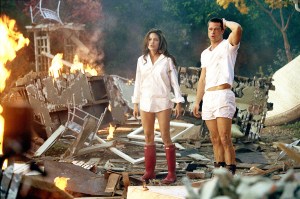 It seems that if you want your action done right, you call Doug Liman to be director. Liman, as he did with 2002’s stellar The Bourne Identity, can craft highly imaginative, stylish, and playful action sequences that are low on pesky CGI and high on thrills. He makes sure the audience can witness every balletic move of his orchestration. He’s likes his fireballs big, though not Michael Bay the-sun-is-exploding big. If you want an inventive use of ordinary objects, Liman’s your man. There’s a fabulous car chase that utilizes a mini-van in surprising and gleeful ways. While dodging bullets and bad guys, Mr. Smith slides the vehicle’s doors open on both sides. When a bad guy jumps into the car, he grabs the baddie and swings him out the other side in one continuous motion.
This isn’t a movie to take too seriously. Yes, the plot is pretty goofy at turns and the Smiths seem nigh invincible. Yes, the bad guys are all terrible shots. Yes, it would be unlikely for the Smiths to take out 100 or so armed men surrounding them. Yes, it seems like the resolution would be cloudy because they’d still be wanted as husband and wife assassins. Yes, Brody is wearing a Fight Club T-shirt. None of this matters. Of course a world of super spies and gadgets is going to be goofy, but Mr. and Mrs. Smith never winks at the camera. This is one romantic comedy with a macabre edge and a devilish sense of humor. I was thoroughly entertained from start to finish.
Mr. and Mrs. Smith is the big blast of fun I’ve been waiting Hollywood to deliver all year. The action sequences are inventive, exciting, and quite sexy. Seeing the two hottest people on the planet (Thora Birch excluded, obviously) kiss, fight, shoot each other, and blow stuff up is entertainment in itself, but the chemistry between Jolie and Pitt is in the five-alarm area. This will not be a movie for everyone. Mr. and Mrs. Smith is about married assassins who do kill people and get off on trying to kill each other. But for people who like their summer ventures to have a little malevolent glee, Mr. and Mrs. Smith will hit the right note. I can only hope for the eventual sequel – Mr. and Mrs. Smith Go to Washington. Imagine that potential filibuster sequence and try not to smile. You can’t!
Nate’s Grade: A-
Share this:

One Hour Photo (2002)
 Do we regularly invite strangers to view the picturesque and personal moments of our life like marriages, celebrations, and maybe even a handful of hastily conceived topless photos? Well we all do every time we drop off a roll of film for development.
Robin Williams continues his 2002 Tour of the Dark Side (Death to Smoochy, Insomnia) as way of Sy, your friendly photo guy working at your local Sav-mart superstore. Sy takes an intense artistic pride in the quality of prints he gives. He knows customers by name and can recite addresses verbatim. One family in particular Sy has become fond of is the Yorkins, mother Nina (Connie Nielsen), father Will (Michael Vartan) and nine-year-old Jake. The Yorkins have been coming to Sav-mart and Sy for over 11 years to have their photos developed. He tells Nina that he almost feels like Uncle Sy to the family. For Sy, the Yorkins are the ideal postcard family with perennially smiling faces and the happiest of birthdays. He fantasizes about sharing holidays with them and even going to the bathroom in their posh home.
 Sy is an emotionally suppressed and deeply lonely man caught in his delusions. In one of the eerier moments of the film we see that Sy has an entire wall made up of hundreds of the Yorkin’s personal pictures. When Sy attempts to become closer to the objects of his infatuation that’s when things begin to unravel at a serious pace. The more Sy learns that the Yorkins are not the perfect family he yearns for the more he tries to correct it and at any cost.
One Hour Photo is an impressive film debut by music video maven Mark Romanek (best known for the NIN “Closer” video). Romanek also wrote the darkly unrepentant story as well. One Hour Photo is a delicate voyage into the workings of Sy’s instability with lushly colorful metaphors. Romanek’s color scheme is a lovely treat, with vibrant colors popping out and Sy’s life being dominated by cold, sterilized whites. His direction is chillingly effective.
This may be the first time we can truly say Robin Williams has not merely played a version of Robin Williams in a movie. Sy’s thick glasses and thinning peroxide-like hair coupled with an array of facial pocks allow us to truly forget that the man behind the mask is Mork. His performance is unnerving and engrossing. The supporting cast all work well. Nielsen (Gladiator) is a sympathetic wife even if her hair looks like it was cut with her eyes closed. Vartan (Vaughn on ABC’s wonderful Alias) plays understandably wary of Sy’s friendliness. The great Gary Cole has a small role as Sav-mart’s manager who grows tired of Sy’s outbursts and peculiarities.
 One Hour Photo is rife with nervous moments and titters. Williams almost has an uneasy predatory feel to him when left alone with Jake. The greatest achievement the film has is that is depicts the scariest person youll ever see, sans hockey mask, and by the end of the film you actually feel degrees of warmth for this odd duck.
Not everything clicks in Romanek’s dark opus. A late out-of-left-field revelation by Sy feels forced and needlessly tacked on. The Yorkin family photos all appear to be taken by a third party, since the majority of them involve all three of them in frame. The climax to One Hour Photo also feels anything but climactic.
A compellingly creepy outing, One Hour Photo is fine entertainment with beautiful visuals and a haunting score. And maybe, in the end, it really does take an obsessive knife-wielding stalker to make us realize the importance of family.
Nate’s Grade: B
Share this:

Panic (2000)
 The story behind Panic goes something like this. The film was dropped by Artisan because they got test screening results back and apparently it wasn’t what they wanted. After this set-back it was going to be dumped to the wasteland of direct-to-cable like so many other troublesome pictures studios feel would not earn a buck if they were bleeding on the side of the road. After some fighting, particularly from critic Roger Ebert, a production house decided to distribute Panic in a very limited release. So what does this cinematic game of musical chairs mean? It means if you have a chance see this film.
Panic is a story about characters first and foremost. William H. Macy plays the son end of a father-son team of hitmen, with Donald Sutherland as the oppressive patriarch. Macy is a man who is never truly happy, almost like it is an impossibility for him at this point in his life. His wife (Tracey Ullman) is flaky and gives into her paranoia of her hubby having an affair with a younger chickadee. Macy meets an attractive and mysterious ingenue (Neve Campbell) while waiting for therapy. He begins on an obsession he can’t explain and fantasizes about her as the escape and ticket to happiness that is outside his reach.
 The acting is as rich as the characters. Macy plays low-key but suits the subservient ghost that his character has become. Sutherland is haunting as the controlling father figure and the flashbacks between him and young Macy are disturbing as he plants his seed of control. Even at age six Macy’s character is referring to his father with “sir” tagged to the end of every sentence.
Neve’s character is the most in depth she’s ever been dealt, though her runner-up is a girl constantly chased by men in black robes with knives. Ullman is a nice presence and the audience really can sympathize with her. The child who plays the son of Macy and Ullman is one of the most adorable child actors I have ever seen. He lights up the screen every time he is present.
The story is brisk at a mere hour and a half. It is written and directed by a former writer of ‘Northern Exposure’ and ‘Homicide’ and the attention to characters shows. The film moves not through plot occurrences but through characters acting. When Macy discovers that the final hit he has to do is on his own therapist (John Ritter) his journey is one involving everyone around him in his life. The strains and pulls on this man are encompassing to watch.
Panic is a glimpse at a quiet movie told about the life of a man caught in his father’s grasp. Macy is a man conditioned to saying “he’s sorry” even if it is not deserved. His character is rich and Panic is a strongly acted gem if you can locate it.
Nate’s Grade: B+
Share this:

Hannibal (2001)
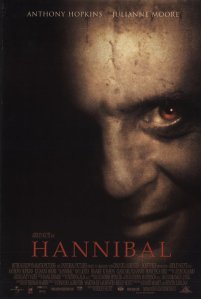 Trying to sequelize Silence of the Lambs is surely harder than trying to sequelize The Blair Witch Project. The novel Hannibal by Thomas Harris I don’t think will be confused as a necessary burst of creative ambition, and more of a chance to cash in on the love of Hannibal Lector. Though I’ve not read a line from the book from what I’m told the movie is faithful until the much hated ending. Starting a film off a so-so book isn’t a good way to begin, especially when you lose four of the components that made it shine Oscar gold.
 The element that Silence of the Lambs carried with it was stealthily gripping psychological horror. It hung with you in every closed breath you would take, surrounding you and blanketing your mind. I mean, there aren’t many serial killer movies that win a slew of Oscars. Lambs excelled at psychological horror, but with Hannibal the horror turns into a slasher film more or less. What Lambs held back and left us terrified Hannibal joyfully bathes in excess and gore.
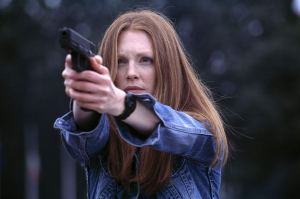
Julianne Moore, a competent actress, takes over from the ditching Jodie Foster to fill the shoes of FBI agent Clarice Starling. Throughout the picture you know she’s trying her damndest to get that Foster backwoods drawl she used on the original down. The problem for poor Moore though is that her character spends half of the film in the FBI basement being oogled by higher-up Ray Liotta. She doesn’t even meet Hannibal Lector until 3/4 through. Then again, the title of the film isn’t Starling.
Anthony Hopkins returns back to the devil in the flesh and seems to have a grand old time de-boweling everyone. Lector worked in Lambs because he was caged up, like a wild animal not meant for four glass walls, and you never knew what would happen. He’d get in your head and he would know what to do with your grey matter – not that he doesn’t have a culinary degree in that department in this film. Lector on the loose is no better than a man with a chainsaw and a hockey mask, though he has a better knowledge of Dante and Florentine romantic literature. Lector worked bottled up, staring at you with dead unblinking calm. He doesn’t work saying goofy “goody-goody” lines and popping out of the shadows.
 Since the director, screenwriter, and female lead didn’t show up for the Lambs rehash, it feels a tad chilled with Ridley Scott’s fluid and smooth direction. The cinematography is lush and very warm.
Gary Oldman steals the show as the horribly disfigured former client of Lector’s seeking out revenge. His make-up is utterly magnificent and the best part of the film, he is made to look like a human peeled grape. Oldman instills a Texan drawl into the character yet making him the Meryl Streep of villainy.
Hannibal is no where near the landmark in excellence that Silence of the Lambs was but it’s not too bad. It might even be good if it wasn’t the sequel to a great film. As it is, it stands as it stands.
Nate’s Grade: B-
Reviewed 20 years later as part of the “Reviews Re-View: 2001” article.
Share this:

Series 7: The Contenders (2000)
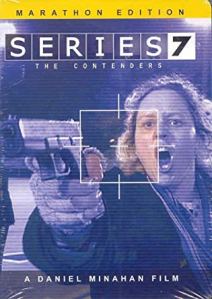 A scathing satire of our media and bloodthirsty society wanting something always pushing the boundaries. Writer-director Daniel Minahan has created a future where the most popular TV show is called “The Contenders” and selects five strangers at random in the same town as contestants. The problem is that these five people, including the winner of the previous season, are now on a manhunt in a kill-or-be-killed situation where the only prize of this game show is one’s own life. Series 7 is skillfully made to be indistinguishable from other reality TV shows except for the bursts of language and violence. If you were playing this and a friend walked into the room they would be convinced it was a TV show. The film gets a little soap operish toward the end with its characters dealing with haunted love but the film is a fast and entertaining warning piece that might provoke as many thoughts as cries for blood.
Nate’s Grade: B
Share this:

Way of the Gun (2000)
 Way of the Gun is screenwriter Christopher McQuarrie’s follow-up to the twisty smash who-dunnit The Usual Suspects. This time he takes the reigns of directing himself and establishes that he is a born man behind the camera and in the chair.
Gun unfolds its tale through the center of two antisocial hoodlums “Parker” (Ryan Phillippe) and “Longbaugh” (Benicio Del Toro), two men brought to the point of selling plasma and sperm to pay the bills. One afternoon they overhear a conversation in the doctor’s office about a wealthy couple paying a woman (Juliet Lewis) to act as the surrogate mother for their child. It seems the real mother just doesn’t want to be burdened with a child hanging on her for nine months. The two men use this information to plot what should be their big break and their big score. After a scheduled doctor’s visit they get into a heated shoot out with the bodyguards (Nicky Katt and Taye Diggs) protecting her for their wealthy employer. Parker and Longbaugh kidnap their impregnated prize and hold her to squeeze a fat ransom.
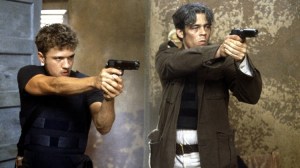 The story-telling Way of the Gun plays is a mix of older mature films where they would have room to breathe as well as Quentin Tarantino flicks. This is a story of characters and their devious multiple back stabbings, crosses, secret affiliations, and ultimate intentions. ‘Gun’ moves methodically with an armada of gaunt twists and turns keeping the audience alive and awake.
James Caan comes in mid-way to play a conniving intermediary in the exchange. His character is the wisest of the bunch and knows more then he’s always telling. It’s also quite a perplexing site to see Caan’s nipples through his shirt in an interrogation scene. Up to this point I never thought about James Caan having nipples.
The action in the flick is pulse-pounding. The shootouts are probably the best on film in a long while. You see and hear every effect a bullet has. The final climax which involves a drawn out gun battle in an empty Mexican brothel is a scene of sheer excitement and relentless entertainment that it may well be my favorite 10-15 minutes of film all year.
There can be a word to describe Way of the Gun and that word could be “ugly.” This is not a film for everyone. The violence and its after-effects can be gruesome at times, as I heard just as much groans and shrieks in my theater than anything else. There’s scenes of picking shards of glass from one’s own arm, performing stitches on one’s eyebrow, and even an impromptu hand done C-section. This will not be something to take grandma to.
Way of the Gun pacing is also a problem. There are moments of drag as we wait and wait. The languid pacing works for the story and the characters but the double-edge sword creates dry spells of interest. The score uses tympani to full extent, sometimes beyond that which it reasonably should.
McQuarrie has sold me with his re-spinning of tired cliches and familiar elements into gold. Way of the Gun is a flick I’ll see with my friends time and again.
Nate’s Grade: A-
Share this:

American Psycho (2000)
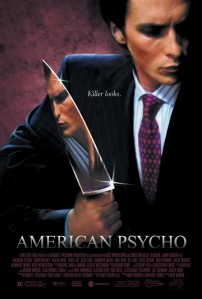 American Psycho is based on the controversial 1991 best seller by Bret Ellis though it got old fast. One can easily grasp how the lead connects with brand names on page one, but repeat it for 300 more and you’re tempted to add the book to your collection of firewood. Ellis’ novel was sadistically perverse, but director Mary Haron (I Shot Andy Warhol) has somehow managed to pull out an entertaining social satire from the pages of blood and name brands.
Christian Bale, mainly known as the boy-next-door in period piece films, plays Patrick Bateman with ferocious malevolence and vigorous life. Teen scream Leo was once considered for the part but after seeing Bale’s startling performance it should prove why he’s on screen and Leo’s swimming in The Beach. Bateman is an up-and-up Wall Street yuppie who glosses over appearance more than anything else. The only outlet it appears for our sinister shark from the soulless decade is by random acts of gruesome violence.
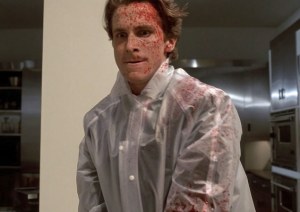 If Bateman blows off steam by blowing off companion’s heads than it only becomes more frustrating when no one believes his random confessions. Haron takes the grisly material of Ellis’ novel and mines it for pure 80s pulp. It only gets better the further it gets as you have so many points to discuss: Is Bateman acting out to prove his existence in a world that doesn’t humor him or others? Is he acting out deep-seeded rage from the actions of the decade on its people? Is he desensitized and so jaded that death does not even fracture him anymore? The questions are boundless.
The hit list of stars in Psycho includes Chloe Sevigny as a nailed home addition, Willem Dafoe as an investigative detective, Jared Leto as an axed co-worker, and sweet Reese Witherspoon as the apple of Bateman’s twisted eye. Everyone has fun in their tongue-in-cheek nostalgia romp through the absurd.
American Psycho should not be confused with the successful teen sex farce American Pie. The only desserts in this film are just, and they’re usually left of the mayonnaise and behind the frozen head in the refrigerator. American Psycho is the thinking man’s slasher movie. A flick that slices, dices, and always entices. It only gets better after you’ve seen it. One of the best films of 2000 for now.
Nate’s Grade: A
Reviewed 20 years later as part of the “Reviews Re-View: 2000” article.


You must be logged in to post a comment.