Blog Archives
The Accountant 2 (2025)
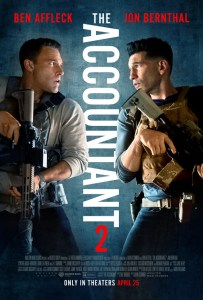 I’m going to start this review by doing what everyone loves to read, the author patting themself on the back. Back in 2016, I found The Accountant to be an enjoyable thriller with a compelling main character that answered the question, “What if Jason Bourne was actually interesting as a character?” I concluded my original review with this observation: “It’s rare that a movie leaves me wanting more, and it’s even more rare when a movie leaves me wanting to watch a weekly variation of Christian Wolff living as whiz kid accountant by day and enforcer of justice by night.” Over the years, The Accountant became one of the most popular streaming movies, a real word-of-mouth sensation that gave it life long after its theatrical release. It was enough that another studio, Amazon MGM, wanted to buy the rights to pay Ben Affleck to produce a sequel that hit theaters and now is available on streaming, thus ready to be the next great movie that dads fall asleep to. It took longer than expected but The Accountant 2 does fulfill my request, showcasing what a regular series could be, for better and worse.
Christian (Affleck) is like Batman if Batman had Autism and did his own taxes. He has a multi-million-dollar foundation that looks for wrongs to right, and this time he’s called back into the action by the sudden death of Ray King (J.K.Simmons), the retired agency head who was tracking the elusive accountant for years. Ray was obsessed with a family lost to human trafficking and hoped to find the missing child. Christian takes up the case and invites his once-again estranged brother Braxton (Jon Bernthal) to help.
 The positives from the original Accountant still shine through, namely the entertainment value of Christian as an outsider character trying to fit into the larger world. He’s an unexpected and often funny person but also a man with his own code of justice, and it’s a treat to watch him bomb through a marathon of speed dating one moment and punch guys in the throat the next moment. Affleck is still enjoyably dry as the lead, and the movie is at its best in the moments where Christian and Braxton are butting heads. It takes a longer than it should to reintroduce Braxton and bring him back into Christian’s orbit, but once the brothers are together, the movie coasts on a chummy buddy comedy dynamic that can reliably work no matter the setting. That’s one of the features that led me to apply the movie into a TV adaptation; the characters are what make ordinary encounters that much more entertaining, and TV is the premiere realm for characters. We tune in on a weekly basis because we want to discover what the characters we love will do next. While The Accountant 2 is certainly a few steps behind its predecessor, the core dynamic that made it enjoyable for so many should still prove appealing to those same legions of fans.
The movie also demonstrates some creaky choices and execution that manages to make it feel less like a full and vital sequel and more like an iffy showcase for turning the franchise into that weekly TV series. The central mystery feels lifted from any generic crime procedural about discovering a human trafficking network. The particulars aren’t that interesting or complicated or even that surprising given the general public’s understanding of human trafficking nowadays. I was waiting for this storyline to give us a little insight into the people most affected, the vulnerable families being exploited as they risk everything to search for a better life or more stable employment. I was waiting for something extra that felt like this storyline would be anything more than a ripped-from-the-headlines rescue mission, and it just doesn’t materialize. Much like 2023’s Sound of Freedom, the complex issue of human trafficking gets boiled down to whether or not our characters can save one unfortunate child. Hilariously, during the climax, the movie keeps cross-cutting between the brothers riding to liberate the kids from their imprisonment and an excavator digging a hole intended to be the kids’ mass grave. One inclusion is enough for us to understand the stakes, but the movie keeps cutting back repeatedly, as if anxiously asking, “Oh no, will the bad guys get the grave completely finished in time for the kids to be dumped inside?”
Already it feels like we’re sanding things down in order to fit a formula. Another indication is the relationship between the brothers. Apparently the brothers have not seen nor spoken with one another since the events from the first movie eight years ago. This is odd considering much of that movie’s story was divided with the Braxton character in parallel and finally recognizing his long-lost brother. After all their years apart it feels more likely that they would have stayed in touch or better. By not going that route, the sequel gets redundant reuniting the brothers again, but this time they’ll actually stick it out because they’ve gone line dancing together and killed even more dudes, the two most brotherly-bonding activities possible. It feels like setting up the team for more fun adventures.
 Although redundancy is part of what holds back the movie. Take for instance back-to-back introduction scenes for Braxton. Our first scene is him trying to psych himself up, and we may think it’s for a date or to talk to a woman he likes, but it’s actually to ask whether or not he can adopt his selected puppy even earlier. Funny, sure, and gets to his loneliness. The next scene he’s trying to have a conversation with a woman who is clearly not as interested and this perturbs him, and upon him leaving we see the trail of bodies he has left behind in the aftermath of some job. Both of these scenes are accomplishing the same thing: Braxton has difficulty connecting with others and is lonely. Why did we need the first scene when the second conveys the same information plus his formidable nature? Braxton even brings up his desire to get a dog later and Christian considers his brother more a “cat person” because he lacks the stable job and responsibility to care for a canine. This moment could have been the first time the film introduced Braxton’s desire for a pet. We don’t gain much from knowing this already. This may seem slight but it’s indicative of a movie that is filling time (hence the mass grave cutaways). For a movie over two hours, there is a surprising amount of fat that could’ve been reduced for narrative redundancy and pacing.
The most obvious sequel idea for a special-skilled accountant would be to meet his match, and The Accountant 2 does and doesn’t do this (some spoilers to follow in this paragraph). Much of the movie is about locating two people, the child stuck in human trafficking and a mysterious woman (Danielle Pineda) who the bad guys are after. She is linked to the missing child but she’s also a highly-skilled killer who is seeking vengeance of her own. It turns out this woman, who I won’t identify, had a traumatic experience and has now become a savant action superhero. This revelation is meant to explain how an ordinary woman could become this badass killing machine, but it awkwardly feels like a ret-con to try and apply Christian’s condition to anyone under unique circumstances (you too could transform, kids). Except the first Accountant made it abundantly clear that Christian was as skilled and methodical as he is because of being on the Autism spectrum, allowing him a unique dedication and attention to detail. Obviously, Autism is not some shortcut to super powers. If it were, RFK Jr. would actually try and read something relevant about medicine. But it was established that the same skills that Christian uses to be such an exacting accountant are the ones he taps into to become a crushing crusader. As someone who has worked with many on the Autism spectrum, I didn’t see this portrayal as insulting or insensitive, especially since much of the movie is about humanizing people with differences and showing how their capabilities can rise above the preconceived perception of others. It wasn’t saying Christian was like all people with Autism, but this is, again, only my nuer typical perspective. I don’t know if in the ensuing eight years that returning screenwriter Bill Dubuque (Ozark) decided that it was less problematic to have the secret formula be the brain’s response to trauma rather than being on the spectrum. It opens up the movie to other highly-powered super spy assassins, but it also takes away something from the premise.
 The actual bad guys are a rather uninspired gathering of goons and shadowy business types. At no point will you feel like our characters are genuinely under threat, and at no point will you remember anything about these villains except for their rote application in the plot. The main trafficker is an evil Boston crime boss (Robert Morgan) that could have been ported over from any other generic crime thriller. His one quirk is that he whistles “Pop Goes the Weasel,” even when he’s murdering migrants in the desert. So there’s that. His main muscle is just… some guy. Literally there is no even cursory attempt to provide any point of characterization for this guy, and he’s supposed to be one of our biggest threats? They could have given this guy, bare minimum, like an eye-patch or an affinity for pop songs, anything. As a result, we have two sets of antagonists, one of which is revealed as an avenging antihero while the others are so disposable to be laughable. At least the first Accountant film gave us a real opponent who, granted, ended up being the younger brother to our main character, but there was a real question what could happen when their paths crossed. Would they use their skills to eliminate the other?
The Accountant 2 might not add up to the same degree of entertainment and thrills that its first outing offered, and there are several missteps and redundancies that take away the edge and uniqueness of that original, but as long as Christian is still determined to help others, I’ll always find this possible franchise worth watching. Now look out for that eventual Amazon TV series to be scheduled right after Reacher.
Nate’s Grade: C+
Share this:

Juror #2 (2024)
 Clint Eastwood’s possible last movie as a director (the man is 94 years old, people) was buried at the theater through a limited release by its studio, which is a shame because Juror #2 is a fairly solid adult drama with some grueling tension built right in. I was wondering how screenwriter Jonathan Abrams was going to make this premise work, where a recovering alcoholic and expectant father, Justin Kemp (Nicholas Hoult), is impaneled on a jury for a murder case and discovers, over the presentation of evidence, that he might actually be the culprit. That same night, at the same location of where the supposed murder took place, is where Justin thought he hit a deer. What follows is a soul-searching account of one man being torn apart as far as what he should do. Does he let this other man take the blame so Justin can live out his life with his new baby and wife? Or does he come forward and admit his own firsthand knowledge of the events would present a very reasonable doubt for this trial? The movie becomes an extended balancing act of how long Justin can keep this secret and what angles he will work, trying to push the jury one direction or another through persuasive appeals. It’s familiar dramatic territory to anyone who grew up on 12 Angry Men, though with an extra high-concept twist. It’s a fairly straightforward drama that allows the story to take center stage and puts the focus on one man’s personal crisis. The acting is strong all around with Hoult (Nosferatu) being the predicted standout, showing the heavy weight of his guilt wirh every pained expeession. I think the ending does a disservice to the kind of movie that came before it, namely that it should be more definitive in its conclusion and provide a fitting resolution. This isn’t exactly the kind of movie that benefits from prolonged ambiguity, so the abrupt ending feels like a miscalculation and hampers a bit of the ending’s impact. However, Juror #2 is a good squirm session.
Nate’s Grade: B
Share this:

Spider-Man (2002) [Review Re-View]
 Originally released May 3, 2002:
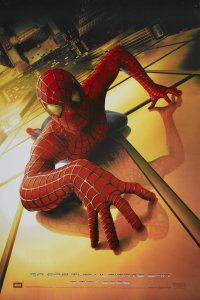
Hollywood take note, Spider-Man is the prototype for a summer popcorn movie. It has all the necessary elements. It has exciting action, great effects used effectively, characters an audience can care for, a well toned story that gives shades of humanity to those onscreen, fine acting and proper and expert direction. I recommend movie execs take several note pads and go see Spider-Man (if they can get in one of the many sold out shows). What summer needs are more movies in the same vein as Spider-Man, and less Tomb Raider’s and Planet of the Apes.
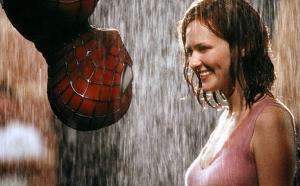
Peter Parker (Tobey Maguire) is a dweebish photographer for his school yearbook clinging to the lowest rung of the popularity ladder. He lives with his loving Aunt and Uncle who treat him like a son. Peter has been smitten with girl-next-door Mary Jane Watson (Kirsten Dunst) ever since he can remember, but he’s been too timid to say anything.
At a field trip to the genetically altered spider place (there’s one in every town) Peter is snapping pictures when he is bitten by one of the eight-legged creatures. He thinks nothing of it and awakes the next day to a startling change. He has no need for his rimmed glasses anymore and has a physique that diet ads would kill for. He also discovers he can cling to surfaces, jump tall building in a single bound and shoot a sticky rope-like substance from his wrists. Hairs on his palms and shooting a sticky substance from his body? Hello puberty allusion! Peter tries to use his new abilities to win the girl and when that doesn’t work out he turns to profiting from them. He enters a wrestling contest in a homemade costume and proceeds to whup Randy Savage. Following the fight Peter’s Uncle Ben is dying after being involved in a car jacking Peter inadvertently let happen. Haunted by grief Peter becomes Spider-Man and swings from building to building as an amazing arachnid crime stopper.
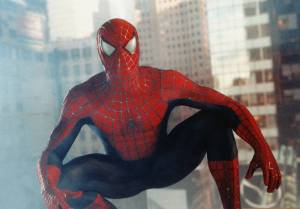 But every hero needs a villain, and that is personified in the Norman Osborn (Willem Dafoe), scientist and businessman. Osborn is experimenting with an aerial rocket glider and a dangerous growth serum. When the military threatens to cut his funding and shop elsewhere Osborn haphazardly undergoes the serum himself. What it creates is a duality of personalities; one is Norman, the other is a sinister and pragmatic one. The evil alter ego dons the glider and an exoskeleton suit and calls himself the Green Goblin. The Goblin destroys all that are in his way, and has his yellow eyes set on the pesky Spider-Man.
The casting of mopey-eyed indie actor Tobey Maguire over more commercial names like a DiCaprio or a Prinze Jr. (I shudder to think of a Freddie Prinze Jr. Spider-Man) left some people scratching their heads. Of course the casting of Mr. Mom to portray the Dark Knight likely got the same reaction in the 80s. Maguire plays the nerdish and nervous Peter Parker to a perfected awkwardness with his sensitive passivity. When he explores his new powers with exuberant abandon then begins crime fighting, we as an audience are with him every step of the way pulling for Peter.
Kirsten Dunst was also a surprising casting choice but works out very well. She allows the audience to fall for her along with Peter. Her chemistry with Maguire is great and could be a major reason why rumors have surfaced about the two leads taking the onscreen romance off screen.
Willem Dafoe is one of the creepiest actors in the business (though he made an effective creepy-free Jesus) and delves deliciously headfirst into the cackling menace of Spider-Man’s nemesis. Dafoe, with a face that looks like hardened silly putty and jutting rows of teeth, relishes every maniacal glare and endless evil grin. But instead of being one-note he adds certain amounts of sympathy and understanding as Norman Obsorn. No one could have done this role better than Dafoe.
 Director Sam Raimi was most known for his cult splatter house Evil Dead series, but he’s got a new resume topper now. Raimi was chosen over a field of directors because of his passion for the character and story. Raimi brings along integrity but with a joyous gluttony of spectacular action sequences. He expertly handles the action and daring-do all the while smoothly transitioning to the sweet love story. He has created the movie Spidey fans have been dreaming of for 40 years.
Spider-Man swings because of the respect the source material has been given, much like 2000’s X-Men. The story follows the exploits of the comic fairly well but has some stable legs of its own. The multitudes of characters are filled with life and roundness to them, as well as definite elements of humanity. You can feel the sweet romance budding between the two young stars, the tension and affection between Osborn and son, but also the struggle with Norman and his new sinister alter ego.We all know villains are the coolest part anyway. Isn’t that the only reason the last two Batman films were made?
There’s the occasional cheesy dialogue piece but there is that one standard groaner line. In X-Men it was Halle Berry’s query about what happens when lightening hits a toad. In Spider-Manit was the response to the Green Goblin’s offer to join him, to which he asked “Are you in or are you out?” (Obviously channeling George Clooney). The dreaded response: “You’re the one who’s out Goblin. Out of his mind!” Sigh. Maybe a well placed “freaking” before “mind” would have made the line better.
Spider-Man is the best kind of popcorn film: one that leaves me anxiously anticipating the sequel (which will come out two years to the day the first one was released).
Nate’s Grade: A-
——————————————————
WRITER REFLECTIONS 20 YEARS LATER
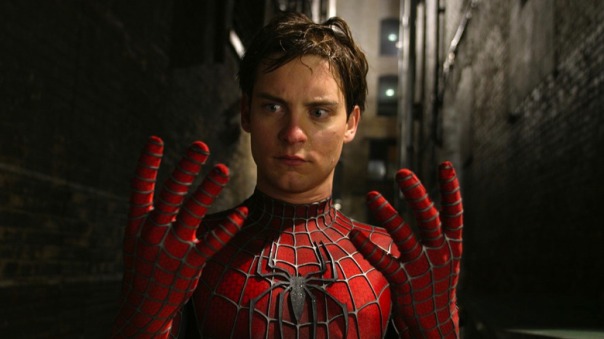
Twenty years ago, 2002’s Spider-Man changed the landscape of studio blockbusters. Since swinging into theaters twenty years ago, we’ve gone through three different actors playing three different Spider-Men in three different franchises, plus an Oscar-winning animated movie, and oodles of toys. If X-Men’s success in 2000 made Spider-Man possible, then Spider-Man’s record-breaking success, the first film to earn more than $100 million in a weekend, made the Marvel Cinematic Universe, the defining chain of blockbusters for our age, possible. X-Men provided a template and Spider-Man was the confirmation for those curious bean counters in studio offices. From there, it was a gold rush to secure their own superhero franchise. Universal launched Hulk. Fox launched Daredevil and the Fantastic Four. Warner Brothers started trying to reboot Batman and Superman again. It was an IP scramble and not every property proved worthy (see: 2004’s Catwoman, or better yet don’t see it). For better or worse, 2002’s Spider-Man ushered in the modern era of superhero mega blockbusters. Now with twenty years of hindsight and influence, it’s interesting to go back to the OG Spider-Man, especially after the nostalgic revisit with 2021’s Spider-Man: No Way Home, and see why this movie was so successful.
Created in 1962 by Steve Ditko and Stan Lee, the friendly neighborhood Spider-Man took a circuitous path toward big screen stardom. He had a popular cartoon in the 1970s, a cheesy U.S. tv show, and Lee even licensed the character into a 1978 television series in Japan that is well and truly insane. The main character is a racer injected with alien blood, from planet Spider no less, who leaps into a giant robot to fight giant monsters (it’s basically Power Rangers before Power Rangers). Legendary genre house Cannon Films bought the film rights and then sold them to Carolco, the studio killed by Cutthroat Island’s bombing in 1995. Carolco reached out to reported king of the (blockbuster) world James Cameron to rewrite an existing draft with Peter in college. He envisioned Edward Furlong as Perter Parker and Arnold Schwarzenegger as Doctor Octopus. Later, his new Spider-Man script was reset in high school, brought back in a previously absent Mary Jane, and involved Electro and Sandman as the primary villains, and apparently was going for an R-rating with language and an intended sex scene between Peter and Mary Jane on the Brooklyn Bridge, which brings into further question his organic web-shooting inclusion.
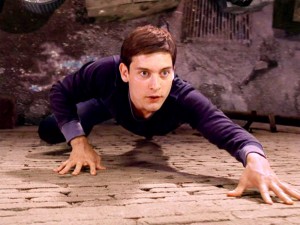 It all fell apart when it was revealed Carolco didn’t actually own the full rights to Spider-Man. After Carolco’s bankruptcy and the ensuing legal wrangling, Sony eventually ended up with the rights for a deal that is absolutely brutal in retrospect: a mere $7 million plus five percent of film grosses and half of merchandising. That’s it. For a character that earns over a literal billion dollars a year in merchandise even when there are no movies being released. As of this writing, No Way Home has made almost two billion dollars world-wide at the box-office.
Sam Raimi was picked as director because he was so passionate for the project, owning over 20,000 comic books and knowing the character and his universe inside and out. It’s not like Raimi was some schlub that Sony just drafted from the street in a contest either. The man was a genre visionary from the beginning with the chaotically kinetic Evil Dead movies. When the studios were unsure about tapping him for comic book movies, Raimi decided to make his own with 1991’s Darkman, a gloriously fun, weird, and gory Phantom of the Opera-esque action movie with Liam Neeson and Frances McDormand. After that, Raimi expanded his style by directing four very different movies in different genres (The Quick and the Dead, A Simple Plan, For Love of the Game, The Gift), and by that time the studios had come around to embracing Raimi as their trusted shepherd of coveted comic book IP. Director Chris Columbus also turned down the job first, instead opting for the Harry Potter cinematic universe. I don’t know if Spider-Man would have been as successful with anyone else at the helm. Let’s not pretend that the movie would have been a commercial failure with some other director attached (I’m sure, prior to Cutthroat Island, there was a very real chance of “Renny Harlan’s Spider-Man” – that’s right, the hits just keep on coming, Cutthroat Island). But Sam Raimi perfectly encapsulates the combination that has worked so well for other later superhero directors: passion and peculiarity.
Raimi is a first-rate visual stylist with the comedy of The Three Stooges, and I don’t mean this as a negative. He has a rare, instinctive sense, much like Cameron and Steven Spielberg, about what will play best on the big screen with a packed crowd, those kinds of blockbuster moments. The one thing you can say about any Raimi feature is that they are exploding with verve and energy. The man nailed a camera to a plank of wood and chased after Bruce Campbell in 1980, and he’s been running wild ever since. That gleeful, childlike sense of entertainment exists in a Raimi picture. His horror instincts and influences are readily apparent in his editing, tone, and setup, across all pictures and genres. Horror is such a precise genre, and Raimi knows the ins and outs of developing scares, tension, and payoffs, and he also knows that editing can make everything sing. A Raimi film might be more self-conscious with its antic camera angles, movements, and editing, but this man is a natural conductor of the chaos of moviemaking. He is a natural for big stages and has only made one movie for less than a hundred million in the last twenty years (2009’s throwback, Drag Me to Hell). It’s also a little disappointing that Raimi has only directed one movie in the last 13 years (2013’s failed franchise-starter, Oz: The Great and Powerful).
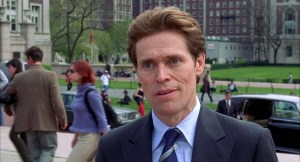 Raimi’s movies also have a deep sense of humor, twisted and loony, not afraid to get gross or goofy. When I watched Drag Me to Hell, his first film after leaving Peter Parker’s orbit, I was busting a gut as often as my stomach was churning. Raimi’s Spider-Man 2 sequence where Doctor Octopus (Alfred Molina) awakens and his cybernetic arms slaughter the doctors has been repeatedly re-evaluated in social media circles as a nigh perfect sequence. Raimi isn’t afraid to veer to the edges of what is considered conventional; he’s not afraid to be goofy just as he’s not afraid to be sincere. This is a director who embraces his peculiarities but also has a reverence for visual storytelling and blockbusters. With the exception of Oz, I cannot recall a Raimi film that just felt like a slapdash work-for-hire job. The man has a signature style. It was what Marvel insisted they wanted when they hired him to direct the Doctor Strange sequel (now in theaters!). Finding auteurs with peculiar sensibilities, zany humor, and new ideas for studio projects is what has allowed directors such as Joss Whedon (Avengers), James Gunn (Guardians of the Galaxy), Taika Waititi (Thor: Ragnarok), and Jon Watts (the Tom Holland Spidey films) to flourish.
Revisiting OG Spider-Man, we have two more versions of this universe to compare with, three if you count the animated escapades of 2018’s Into the Spider-Verse, so some things just seem a little more quaint, like an old story from your childhood. Part of this is because the character and his lore have become as familiar in popular culture as Batman or Superman. That’s why the Holland version skipped the origin part of how Peter Parker got his super powers and lost his dear old dead Uncle Ben (just like we don’t need to ever see Batman’s parents die onscreen again). The first two Spider-Man films still hold up; I re-watched Spider-Man 2 shortly after 2017’s Homecoming to see which was the overall best Spider-Man film, and it was still very good. They’re earnest and cheesy but easily transporting and you feel the passion for those involved. Raimi clearly loves this character and wants you to love him as well, and we do. There are a few moments that just speak to the dated nature of culture from twenty years hence, like Peter Parker cracking an unfortunate homophobic joke about his wrestling opponent. The special effects are still strong throughout and benefit from Spider-Man’s costume lacking exposed skin. The action sequences are a bit tame and especially lacking compared to even later Spider-Man films.
Maguire might even be regarded as the least favorite Spider-Man actor at this time after the successful revamping of Andrew Garfield’s version from No Way Home. He stands out from Garfield and forever boyish Holland. He was 26 when he began playing Peter the high schooler. His prior indie film roles would make him seem more likely to be cast as a moody school shooter than as a clean-cut superhero (I guess it worked for Ezra Miller), and the fact that he pulled it off is a credit to both Maguire and Raimi. Maguire hasn’t been able to escape the long shadow of Spider-Man and he seems to be fine with that, having only appeared in one movie since 2014. The conniving celebrity poker player that Michael Cera played in Molly’s Game is believed to be Maguire in real life. Dunst was maligned throughout the original trilogy and you can clearly see her disinterest in the character. To her credit, this iteration of Mary Jane is fairly one-dimensional. She’s little more than the object of Peter’s desires and a damsel to be saved. Dunst has become a much more interesting actress after shedding the Spider-Man universe with Melancholia, season 2 of Fargo, and The Power of the Dog, earning her first Oscar nomination.
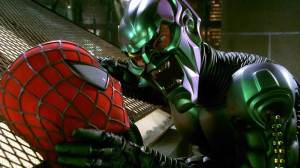 Dafoe had to beat out many actors for the role that seems perfected by him. Raimi intended for Billy Crudup (Almost Famous) to be his Norman Osbourn but the producers worried Crudup was too young to portray a middle-aged scientist. Dafoe’s normal face already resembles the Goblin mask. He demanded to do as many of his stunts as possible, and apparently he was a natural learner with the Green Goblin’s winged glider. Dafoe loved the part so much he begged Raimi to find ways to include him again even after his character died. I grew to love him even more after No Way Home reminded everyone of the mental anguish of Norman, a man torn apart by his demons. Dafoe is so maniacal and vulnerable and indispensable in this role. It’s no wonder they even bent space and time to have him generously visit us once more.
I was worried that my older review from 2002 was going to be overly flattering, gushing about what the filmmakers had gotten right and a little too pleased with results that haven’t aged as well with so many others running with what Raimi and company established. It’s still a solidly enjoyable movie that moves along at a steady pace and still finds time to have important character moments so that the quiet still matters paired with the spectacle. We’ve had a generation grow up with the Maguire Spider-Man trilogy and for many of us these early superhero films have a special place in our hearts. There’s a nostalgic factor. The first Spider-Man was more successful in creating an exciting kickoff than X-Men, though that film had bigger hurdles in adaptation, and it still has a lasting appeal at its core because of the skill and passion of the filmmakers involved. I’m very curious about revisiting 2007’s Spider-Man 3, where it all fell apart and seeing if it’s due some begrudging respect, though I doubt it (I know what I’ll be watching in 2027). Spider-Man is a little dated but still swings mighty high.
Re-View Grade: B+
Share this:

Spider-Man: No Way Home (2021)
 This is going to be a difficult review to write. It’s the third Spider-Man movie in the Tom Holland era, though his sixth Marvel Cinematic Universe (MCU) appearance as the character, that much can be said. The MCU has been teasing a universe of parallel universes for a while now, even famously in 2019’s Far From Home, the previous Spider-Man film, and which No Way Home opens seconds later to deal with its immediate aftermath. The scuttlebutt with this new Spider-Man movie is that it is the most Spider-Man in all senses, bringing past iterations from the original Tobey Maguire run (2002-2007) and the maligned Andrew Garfield reboot (2012-2014). We know villains from each non-MCU Spider-Man film are making special appearances, and there are expectations for plenty more special appearances, so by that notion, writing a film review about a movie built upon surprise inclusions and secret revelations can be daunting to even be readable without giving too much away. I’ll do my best, dear reader. Spider-Man: No Way Home is not the best Spider-Man movie, in the MCU or prior, but it’s a rollicking adventure that will play like catnip for fans of the series, all iterations, and has some of the strongest moments of any web-slinging blockbuster.
In the wake of Mysterio framing Spider-Man (Holland) and revealing Peter Parker’s real identity, life has not been kind to your friendly neighborhood Spidey. The public has turned on him and even his best friends are suffering the consequences of their personal relationship. It’s enough that Peter seeks out his old pal, the wizard Doctor Strange (Benedict Cumberbatch), to cast a spell to erase the world’s memory of who Spider-Man really is. The magic spell, naturally, goes wrong, and villains of Spider-Man from other universes begin to appear. These larger-than-life characters are dangerous but also confused; this isn’t their universe, and this isn’t their Peter Parker. Doctor Strange is happy to send them all back to their primary universes, to correct the loose ends of the spell, but Peter doesn’t want to send them all to their fated deaths. He wonders if maybe they can be cured or reformed and if it’s too late to still do the right thing.
 First things first, you need to know that this movie is going to play much, much better if you are familiar with, and especially if you’re a fan of, the previous Spider-Man movies. No Way Home almost feels like it was written by a fan who has been nurturing a desire to do right by all past Spider-Man films. This feels like someone who had assembled a list of unresolved issues from different Spider-Man movies for over twenty years and said, “Hey, could I write these characters another ending that can redeem them and provide better closure in a way that is meaningful?” Because of that, each new character that comes through has a definite jolt of fan excitement like an all-star reunion, especially for characters you never thought you would see again. Certainly, some characters have more meaning than others, but I was pleasantly surprised how well integrated and written so many of the villains come across. Returning screenwriters Erik Sommers and Chris McKenna have ret-conned and redeemed the various Spider-Man missteps of old and have given characters more attention and fitting resolution, which makes this a surprisingly emotionally deep Spider-Man in ways you weren’t expecting. There are character reunions and resolutions that I didn’t know I needed, and I was smiling and even battling back tears of my own at various points. If you’re a fan of the recent Holland run, then the movie will still play well, but if you’ve been with Spider-Man from his cinematic beginning (if you really want to feel old, the original Spider-Man teaser involved the World Trade Center) then this movie will feel like a nostalgic blanket to warm you all over.
I think it’s safe to discuss some of the villains that have been prominent in the advertisement and later trailers, but if you wish to skip any character details, then skip to the next paragraph. It shouldn’t be much of a surprise that the two biggest villains are the ones with the biggest screen time and most allowance at redemption. Willem Dafoe as Norman Osborne (Green Goblin) and Alfred Molina as Doctor Octavius (Doc Ock) are treasures. It’s so good to see them again in these roles and each actor is just as good as you recall from their time 15-plus years ago. I was worried that bringing Doc Ock back could spoil the redemptive turn he has at the end of 2004’s Spider-Man 2, sacrificing himself to save the day from his own dangerous experiment. Little did I know that the entire movie was going to seek redemptive arcs for a veritable Sinister Six-worth of Spider-Man villains. It becomes the backbone of the movie, and I was skeptical at first but the movie found ways to win me over with just about every character’s inclusion. Norman and Octavius are similar in that they are battling other sinister personas in their heads, and when the real versions of each man break through, it’s often in heartbreaking moments of existential confusion and sadness. This is a movie that has time to fit in Spider-Man memes as well as question the moral culpability. It’s fascinating that a huge Marvel movie is so concerned with providing glimpses of humanity and compassion to bad guys from movies that the general public didn’t even generally like.
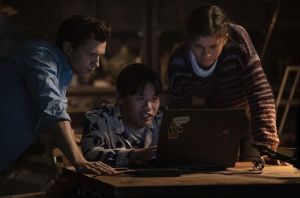 This is the best acting of Holland’s Spider-Man run. He really gets put through the wringer about the consequences of trying to make the moral choice, both good and bad. His most emotional moments got me each time because of the investment in his character growth over six movies as well as the added investment in the supporting characters too. This is the most integrated and important both Ned (Jacob Batalon) and MJ (Zendaya) have been to the plot, and they have a platonic hug at the end that sent me into a tailspin of emotions for what it meant. The humor and natural camaraderie of the actors is still there, a hallmark of the MCU Spider-Man series. I laughed plenty, especially with certain characters deconstructing their parallels and connections (“Gotta watch where you fall,” a villainous understatement). However, this is the most emotional Spider-Man likely ever, and the actors all perform ably. I want to single out Marissa Tomei as Aunt May because she’s been undervalued in these movies until now. This is the biggest role Aunt May has played and she serves as the voice of morality to push Peter to do what he knows is right even in the face of outlandish adversity and personal cost.
No Way Home works better thematically than as a well-constructed plot. The solutions to the villain redemption are laughably convenient, and while it’s not as expressly magic as Doctor Strange’s spells, it’s pretty much the equivalent of technological magic. That’s fine, because it’s less the struggle of invention and more the choice that matters for each character. The mechanics of the ending also feel overly convenient and tidy (you could have just done this the whole time?). When Doctor Strange is chastising characters for hasty decision-making, it’s the movie calling attention to its own cheats. The movie splits so much of its time across multiple villains and drafting off of your old feelings. There are other narrative shortcuts taken and abbreviated, especially Strange’s involvement. He’s left out of much of the movie for the same reason Captain Marvel was left out of much of the final battle with Thanos in 2019’s Avengers: Endgame: he’s too powerful to have on the board. I’m not saying the screenwriters made the wrong choices on what to emphasize. The emotional beats of this movie hit strongly, and if they have to rely on a few cheats and nit-picky hand-waves to get there, then so be it.
 From an action standpoint, I think this might rank last for me in the series. Returning director John Watts has never wowed me as an action director. He’s not bad at staging the big moments but he seems more present in zippy tone than in style on a big stage. The added wow factor of seeing the various characters assembled on screen will compensate for much of the action feeling contained to dank sound stages. I think this was done as a cautionary measure to keep the secrets from being leaked, but it also shortchanges the action possibility. There’s nothing in this movie, from a pure action standpoint, that rivals the Venice or London sequences in Far From Home. The movie utilizes portals, and it got my hopes up for clever action inventions, but it serves as more plot device than action complication. There have been some artistic sacrifices, narratively and visually, to accommodate the Spider-Man Movie All-Stars approach, and while I think the filmmakers have emphasized the correct parts, it does still feel like there are some nagging shortcomings to an overall experience that plays exuberantly.
Finding a comfortable medium between fan service and creative constriction, Spider-Man: No Way Home is not the best Spider-Man movie but at the same time it just might be. It serves as a salve to the rest of the franchise, five iterations across two different runs, and because of that level of attention and compassion, the past movies get a little bit better, with more added resolution, more character moments, and second chances to correct miscues and blunders. Who among us wouldn’t want another opportunity to correct our mistakes? While ostensibly setting up the troubles ahead for the MCU (the trailer for 2022’s Doctor Strange: The Madness of the Multiverse is the final post-credit scene), the movie feels entirely backward-looking, rewarding fans of the character and resolving to do better where other films had gone awry. Maybe (Disney)Fox could do something like this for the bad X-Men movies? I don’t know if the same punitive charges of being slavishly nostalgic will hit No Way Home like they’ve done for the new Ghostbusters and Star Wars. It’s definitely still accessible for newer fans but plays best to the people with the longest investment, but isn’t that every continuing movie series? No Way Home is a rewarding cinematic experience of many highs and fun surprises and cameos as well as a humane redemption for the sins of Spider-Man’s past. It’s not the best superhero movie but it might be the most joyous one yet.
Nate’s Grade: B+
Share this:

Being the Ricardos (2021)
 Have you ever wondered what a week in the production of the I Love Lucy show would be like? Have you ever wondered about Lucille Ball and Desi Arnaz’s marriage? Have you ever wondered if Ball was secretly a communist? Well worry no longer, because Being the Ricardos is writer/director Aaron Sorkin’s ode to early television, the creative process, and recapturing something he was trying to articulate in his failed TV series, Studio 60 on the Sunset Strip. Yes, this feels like an especially long edition of that old show, with too many plotlines vying for attention like B-stories and C-stories for an episode of television, and several of them have curious conclusions. The storyline given such outward significance, whether or not Ball will be shunned as a possible communist in her youth, is wrapped up so anticlimactically and easily, and the storyline given such minimal coverage, Desi’s possible infidelity, is then given an ending that doesn’t feel nearly as setup to have its proper impact. The acting is another issue. Everyone is mostly good, but Kidman is no Lucille Ball, and while she doesn’t attempt a direct impression it’s still not a favorable comparison. Bardem is better as Arnaz but you can’t help but feel both actors are miscast. The supporting players, like J.K. Simmons as William Frawley, Nina Arianda as Vivian Vance, and Tony Hale as show creator Jess Oppenheimer, offer the more entertaining and insightful positions from the wings. Being the Ricardos feels like Sorkin trying to work his signature rat-a-tat snappy dialogue but missing a few rhythms, and part of that might be Sorkin serving as his own director for the third time. Director Sorkin plays everything too stately and serious, so even when the script is telling us these comedy writers are making a comedy show, the flow is off and everything is a little too self-important and reaching for culture war symbolic terms, reminiscent of, you guessed it, Studio 60 on the Sunset Strip. I guess my disappointment was not really getting to know more about Ball besides her perfectionism and underrated comedy savvy. This movie is just too busy with narrative devices; there are documentary-esque interviews with aged crew members in the future, a present-day storyline about workshopping one episode through a week’s schedule, and intermittent flashbacks to Lucy and Desi that can be confusing when past and present swap. Then there’s the black and white interludes of the show which are Lucy’s imagination of what may be? It’s a cluttered mess with pacing issues. You also get to watch Lucy and Desi have sex, which is like walking in on your parents. Being the Ricardos feels like an overly serious TV movie that’s too busy and scattered to remind itself that funny people can also be fun people.
Nate’s Grade: B-
Share this:

Ghostbusters: Afterlife (2021)
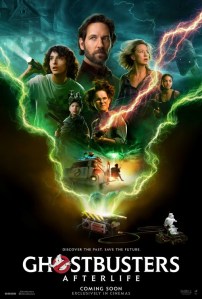
As I stated in my review for the 2016 Ghostbusters, allow me to wax nostalgic and explain my own private history with the franchise: “Growing up in the 80s, other kids had Transformers, or G.I. Joe, or He-Man, but I was a Ghostbusters kid. I fell in love with the 1984 original movie, slept below the poster for most of my childhood, and obsessively collected all of the action figures and toys, watched with glee the animated TV series, and hold the world and its characters in a special personal place.” This franchise means something to me. I think about the hours I spent playing in this world and my imagination and my own stories illustrated with marker and crayon, and it makes me extremely happy as well as reminds me how I fell in love with weird storytelling and macabre, ironic humor. I’ve been waiting for more Ghostbusters movies for my adult life. The 2016 movie was fine, I wasn’t enraged by it in the slightest, but it didn’t scratch that itch. While replicating some of the same plot beats, the 2016 movie was not reverent to its source material. Now the 2021 Ghostbusters, delayed over a year and a half from COVID, goes completely in the other direction. Ghostbusters: Afterlife is reverent to a fault, and while it has been met with mixed reviews and complaints of overdosing on slavish fan nostalgia, I found it to be a charming and fun family adventure that left me laughing, cheering, and even crying.
Egon Spangler (Harold Ramis, R.I.P.), original Ghostbuster, is dead, killed by a malevolent spirit. His estranged adult daughter, Callie (Carrie Coon), and her two teen children, Trevor (Finn Wolfhard) and Phoebe (Mackenna Grace), are shocked to learn of his death and their unexpected inheritance: a dirt farm in small-town nowheresville Oklahoma. They don’t know much about their grandfather and the kids are not exactly excited about relocating to a secluded mining town. Phoebe starts discovering weird pieces of technology hidden in the old house of her grandfather’s. A presence seems to be reaching out and trying to get the family to understand their real legacy. It appears that Gozer the Gozerian was not fully defeated on top of that New York City skyscraper in 1984, and Phoebe and her family must learn about the past in order to make sure we all have a future.
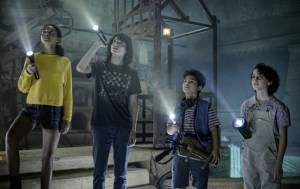
I can understand the charges of Afterlife being too nostalgic, but I don’t understand the charges of it being so enamored with its past that it poses a disservice to the movie standing on its own. This movie is intended at its very DNA to live within the shadow of the original films. The director and co-writer, Jason Reitman, is the son of the original films’ director, Ivan. It’s going to be reverent but that’s not an automatic bad thing. Whereas the 2016 reboot shrugged at past convention and went completely comedic, this edition takes the opposite approach, hugging onto the lore and past of Ghostbusters with heartfelt affection. If you’re a fan of the franchise, this adoring approach will likely be more favorable, not that the 2016 film is wrong for eschewing the established canon of the franchise and trying something new. If Afterlife had been a completely original story set in a Ghostbusters universe, I would have happily accepted that. However, just because something is outwardly nostalgic, or taps into fan service, does not mean it is destined to be an exclusive retread that only satisfies the hardcore base. I didn’t need the gratuitous Easter eggs of passing shots of a twinkie or Crunch bar, but they’re blink-and-you’ll-miss-them moments that don’t really relate to anything of consequence, so I can excuse them. Afterlife is similar to The Force Awakens in that it uses familiar plot beats to mirror events of its predecessors to ease back fans and new members to the fanclub, most especially in Act Three where Gozer’s demonic pooches are unleashed. I can understand many chaffing at this, but I feel that Afterlife does enough to justify its own creative existence even in facsimile rather than as some insular, facile, fan-stroking cash-grab.
This is, by far, the most dramatic of the Ghostbusters movies, a series that has existed in the realm of comedy. The prior movies were never spooky on adult terms, but they reached back into a primal, childlike curiosity and anxiousness over the unknown that made them creepy when they wanted to be. I don’t understand the umbrage some have expressed over Afterlife being more of a drama. First, the comedy is present throughout the movie with the characters making specific and wry observations that feel fitting for their situation. The humor is not as forced as the loping line-a-rama improv jazz riffs of Paul Feig’s 2016 film. I think this universe can sustain different kinds of stories being told, and I think that drama is perfectly acceptable as long as it’s earned, just like the comedy or horror elements. The central premise involves an estranged family coming to know the secret life of an absentee relative who abandoned them, so the more they learn about his Ghostbusting past and responsibilities, the closer they come to uncovering a clearer picture of who this man really was as well as their connections to him. Reitman and co-screenwriter Gil Kenan (Monster House) have smartly connected the investigation of the past into the development of personal relationships. We in the audience know the significance of the Ecto One and the ghost traps, but the new characters do not. We await them to understand the knowledge we already attain, but the movie doesn’t play this as characters dawdling. Each discovery unlocks new potential for the characters to shape who they choose to be, and each one gets them closer to their grandfather and reshaping their conception of the man who they wrongfully believed abandoned them for folly.
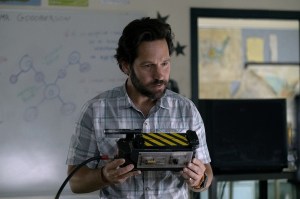
This all leads to a climax that had me genuinely in tears. I won’t exactly spoil it but Afterlife’s conclusion is less concerned with beating the Big Bad Gozer yet again and saving the universe. Reitman and company have smartly placed the real climax as an emotional catharsis; it’s more in keeping with Field of Dreams than some huge Marvel apocalyptic showdown. The ending is personal, emotional, and reaches into our universal desire for closure, for having that one last moment with a beloved who we no longer have any moments left to share, Reitman is clearly missing Ramis, a close family friend and inspiration who died in 2014, and this is his own way of processing his personal grief, offering an emotional output for the fans to share in, and allowing a grieving character/surrogate to find that needed release. It serves as a fitting conclusion and a special end note for any Ghostbusters fan who has held this franchise close to their heart for several decades, especially if shared with a paternal figure who may be gone.
The film also successfully channels a childhood perspective of awkward and awesome. It’s hard to create a story where a group of precocious adolescents discover strange things cooking in their sleepy small town without suggesting Stephen King and Stranger Things, but this isn’t necessarily a total negative. The earlier movies were always from a more cynical adult perspective. Yes, there were characters like Ray (Dan Ackroyd) and Egon who were true believers, but they were often set up for easy laughs. The tone of the series was mostly tied to the irony of the character of Peter Venkman (Bill Murray) that looked at the supernatural with droll detachment. This is the first Ghostbusters entry where the primary perspective is from children, and there’s something hopeful and heartfelt about a younger point of view with the supernatural material. These kids are excited and eager to learn more about the somethings strange in their neighborhood. It becomes endearing to ride along with them as they get to jump into the action. I loved the concept of a sidecar gunner seat for the Ecto One and how it felt like a childhood dream coming true. But it’s more than fan service because it serves as a point of progression for Phoebe’s sense of self, of embracing her scientific interests and roots, and taking charge in the face of unknown danger. It’s a coming out of sorts. When the kids are driving through (the always empty?) town and chasing a runaway ghost, wrecking storefronts from the boom of the proton pack, it’s a blast for them and us.

This is Reitman’s most commercial and mainstream film of his Oscar-nominated career. It’s interesting to me that this indie darling, who was on such a hot streak in the late 2000s, hit some speed bumps with the critical misfires of 2013’s Labor Day, 2014’s Men, Women, and Children, and 2018’s The Front Runner, so the next movie is a retreat to a big-budget franchise film. Reitman doesn’t necessarily have the best feel for large-scale spectacle, but he knows intimate character dramas and guides his actors well. Grace (Gifted, Haunting of Hill House) is wonderful as our plucky lead. Unfortunately for Wolfhard (It, Stranger Things), his dull character has nothing to do but pine for a local girl, scoff at his family, and then fix up the old ghostbustin’ mobile. Paul Rudd (Ant-Man) is as charming as ever as the school science teacher, especially as he nerds out over interacting with the Ghostbusters paraphernalia like an excitable fanboy living out his childhood dream. I wish Coon (The Leftovers) had more to do, but that’s my primary complaint in any movie where Carrie Coon is a supporting actress. Her chemistry with Rudd is strong and they could have done so much more together as adults trying to make sense of madness. They could have eliminated Wolfhard’s mopey older brother character entirely and given us more time with the goofy adults too. One feels like there is some secret contract where anything relating to 80s nostalgia requires the hiring of Wolfhard on hand.
Ghostbusters: Afterlife will not be the best movie of 2021. There are areas that could have been improved and streamlined and better developed. However, Ghostbusters: Afterlife will most assuredly be my favorite film experience of 2021. It’s a heart-warming continuation for fans with enough wit and whimsy to charm while owning its obvious and intended connections to the original. I may not be the most objective source on this particular matter, but I know what I like, and this movie had moments of pure happiness that just shot right through to my dopamine center. We’ll see if this movie can restart the dormant franchise, and strike more on its own, but even if this lone 2021 entry is all that we eventually get, I’m happy I got to experience this magic once again. I can’t wait to see it again with my dad.
Nate’s Grade: B+
Share this:

The Tomorrow War (2021)
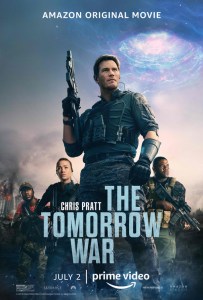 Amazon’s new movie, The Tomorrow War, is the costliest original blockbuster of the summer, and it’s skipping theaters entirely. The $200 million-dollar sci-fi movie was originally slated for theatrical release in December 2020, then pushed to summer 2021, then sold to Amazon streaming for the cost of its production budget. It’s easy to grasp the excitement of its premise and how it could translate into engrossing escapism. At the 2022 World Cup, a flash of light transports a team of future soldiers who need enlistments. In a matter of months, the world will be facing a war between alien monsters, and by 2050 we will be on the verge of losing for good. Dan Forrester (Chris Pratt) is a science teacher/ex-veteran who is conscripted into the future war, along with some other unlikely soldiers, and thrown into the future. His tour will last one week and then he’ll be sent back to 2022, if he survives, and only twenty percent come back.
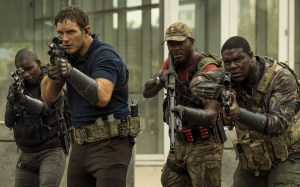 Perhaps it was the allusions or homages to Starship Troopers, but I found the first act and the action before the action to be the most interesting part of The Tomorrow War. I was hoping with its time travel premise of a future war fought by the past that there would be some attention paid to the world building and implications of its premise, at least before it became hunting down monsters and shooting in corridors, and thankfully the movie actually takes some sweet time to lay its foundations before being conscripted itself into action movie spectacle. Much like Starship Troopers, we have people unprepared for a war against an alien species and essentially being tossed into basic training as cannon fodder for the military industrial complex. I enjoyed that the screenplay by Zach Dean (Deadfall) actually plays out some of the larger effects that its future confirmation would stir. Effectively, humanity knows that in thirty years it’s all over. There is a definitive end date. Knowing that thirty years is all civilization has remaining would cause all sorts of global, social, and psychological upheavals. Why bother going to school if it’s all over in thirty years? Why try and start that business if it’s all over in thirty years? Why start a family if your children will be doomed in thirty years or less? Society would be irrevocably changed, and sectors and populations would refuse to go back to the way things were, and instability would flare up with generations sore over their lack of Earthly inheritance.
That’s just one factor that gets attention during this first 45-minute section. The nature of the future conscripting people of the past to fight their war has plenty of political commentary about generational conflict, proxy wars, and how the poor are disproportionately affected with less choice. The soldiers being taken from the past are older and an unorthodox pool of candidates that wouldn’t meet contemporary military recruitment standards. This is because the people being sent to fight are already dead by the time 2050 rolls around to avoid any time paradox concerns. There are interesting implications here. It’s like their own governments are saying, “Well, you’ll be dead anyway, so you might as well die now rather than much later and maybe you’ll provide a more immediate need other than taxes. Thank you for your service, now die.” Again, the psychology and ripples of that can be fascinating. I’m skeptical why more 2022 Americans are not disputing why they should fight 2050’s war with their own flesh and blood. I suppose I wanted this intriguing premise to be played out more in the span of an ongoing TV series, something along the lines of the elegant existential bummer of HBO’s The Leftovers. As a feature, The Tomorrow War gets beaten into blockbuster shape to become another noisy sci-fi spectacle, but the potential of its premise and the bombshells of its world-building deserved even more deliberate consideration.
 When the action picks up, The Tomorrow War follows a predictable path of alien invasion military thrillers. Dan’s unit must go into enemy territory and retrieve an important thing before the aliens overrun the facility as well as before the Army firebombs the block. There are many ticking clocks built into the plot mechanisms, from Dan’s week-long sojourn into the future ticking clock, the overall “humanity’s last stand” ticking clock, the ticking clock of getting needed lab components before destruction, the ticking clock of synthesizing a magic alien cure, and there’s likely others I haven’t even noticed. That cluttering of urgency extends also to its personal exploration of two sets of frayed familial relationships, father/daughter and father/son across three generations. It’s simply too much and detracts from more time and attention being given to the elements that demand the most development. The father/daughter relationship has the most meaningful drama considering it covers multiple periods of time and pushes Dan into thinking more critically about sacrifice and legacy. The broken father/son relationship between Dan and his absentee dad (a buff J.K. Simmons) is unnecessary and put on hold for too long and then hastily tied together. The Tomorrow War is an unlikely candidate of having too many conflict elements and points of urgency that they can dilute one another.
This also gets into an extended third act that feels entirely tacked on. After a critical climax, I grabbed my remote to pause the movie with the belief that things were wrapping up shortly. I was shocked to see I still had another 30 minutes left to go. The mountain-set final action set piece feels like a late studio addition rather than an outgrowth of what was established in the screenplay. Strangely, the characters don’t seem to be acknowledging the reality of cancelling out the alien-invasion nightmare future with their actions. If Dan has the magic elixir to thwart aliens, and goes back to 2022, then he can prevent the billions of eventual deaths. I suppose that does nothing for those in 2022 that got zapped into 2050 and died in the line of duty, but it spares everyone else from 2023 onward. I started yelling at the screen that preventing the terrible future meant good things.
 As far as the quality of action, it’s a cut above thanks to director Chris McKay (The Lego Batman Movie), making his live-action film debut. I’ve noticed with other directors who primarily got their start in the realm of animation that they have such a great command of filling up the screen. Brad Bird, Travis Knight, Phil Lord and Christopher Miller, and Tim Burton, all of them have an extra artistic sense of how to use the space of the frame to immerse the viewer. I greatly appreciated that many of the sequences where the soldiers fight the alien monsters use long takes and clear editing. There’s one scene where soldiers are trying to wrangle a monster as a hostage and all the fighting and buckling is impressively presented with sufficient distance so we can see the soldiers react and go flying. The introduction of the alien monsters is drawn out of the shadows, but from that moment onward the movie presents the monsters clearly, and I enjoyed the squid-meets-feline creature design enough that I welcomed more closeups. There’s also a horrifying and darkly comic tech mishap where the future accidentally zaps its new recruits into 2050, but instead of re-materializing five feet above the ground it’s 100-plus feet high, so we watch people hurtle to their awful deaths. McKay can replicate standard studio action movie grist seen in plenty of other big-budget blowouts (there are multiple examples of characters slow-motion jumping out of the way of explosions), but more often McKay has a natural eye for visual compositions and how to bring out more with his sci-fi spectacle.
One of the bigger miscues of the movie was the hiring and prominence of Pratt (Jurassic World) as the lead. He’s got the presence and build to be convincingly ex-military, but he’s not a good fit for an everyman, let alone a family man everyman scientist. He’s a high school science teacher going through personal malaise because he feels like he’s meant for something bigger (what’s bigger than saving humanity, guy?) and this ordinary life just ain’t cutting it. Except Pratt can do charming and affable, he can even do heroic, but this part does not play to the actor’s strengths, so Dan often comes across as plain and bland. He’s stuck as the square-jawed straight man for the movie and is boring once he goes into action or thinking mode.
 I wished the movie had been retold from the point of view of Charlie, played by reliable comic Sam Richardson (Veep, Werewolves Within). He’s a welcomed voice of panic and reason among the avalanche of sci-fi, science, and military jargon. He’s a widower, losing his wife on her own tour of duty, and he feels greatly out of place. The actor is so amusing and the character so unexpectedly entertaining that I wish Pratt’s hero had bit the dust early as a meta head-fake (think of Seagal getting killed off early in 1996’s Executive Decision) and we were left to follow Charlie as humanity’s unexpected savior. Along the conversation of waste, Betty Gilpin (The Hunt) is shortchanged as Dan’s wife in 2022 world. They introduce a plot point that family members can be conscripted in place, and then there’s the transport glitch that kills all but a few, so I assumed that an actress of Gilpin’s kick-ass capability would find herself in the future fighting too. Alas, dear reader, Gilpin is just here to be the concerned wife at home waiting for her man to return.
The Tomorrow War is an original story though it’s built from older, recognizable parts, a little Independence Day here, a little Alien there, and a dash of Edge of Tomorrow. It’s derivative but it still has its own points of interest, chief for me is the world building and premise. The action is solid and filmed well. The scope of the special effects fits comfortably in the blockbuster studio range. It’s a good-looking movie with plenty of action and enough time travel quirks, though your attention may also flag as the movie lurches to a protracted close with its extended third act. It does more right than wrong as blockbuster spectacle. I think it had offshoots of better potential that could have been tapped, but as a big screen entertainment ported to your smaller home screen, The Tomorrow War is destined to win fans with lowered expectations and 140 minutes of free time.
Nate’s Grade: B-
Share this:

Alternate Opinion: Zack Snyder’s Justice League Guest Essay
My friend and writing partner Ben Bailey asked me to host an extensive essay he was compelled to write after watching the four-hour Snyder cut of Justice League. I’ve never featured anyone else’s words or opinions on this review blog before, but it’s been so long since he really devoted himself to an artistic analysis, and with such detail, that I felt compelled to publish it on my personal review platform. Behold, a guest essay on the nature of Art, Ayn Rand’s Objectivist theory, super heroes and their appeal, Zack Snyder as a filmmaker and philosopher, and capitalism.
____________________________________________________________
“Zack Snyder’s Justice League and The Virtue of Shallowness: An Essay In Search of a Point” By Ben Bailey
All Art is self-indulgent, but not all self-indulgence is Art.
Back in 2010, legendary film critic Roger Ebert famously groused that video games could never be Art. His reasoning was largely an attempt to grasp at the essential definition of what Art is, and how it can and cannot be applied to various artistic mediums in order to claim supremacy for his preferred medium, cinema, over one he pompously scorned. At the time, as a 25-year-old man-baby gamer, I objected strenuously to his argument but not in a way that I could articulate with the same thoughtful presentation with which he made his case. I just instinctively rebelled against the notion that a thing I loved in the same way Ebert loved movies could not be Art like movies clearly are because smart people like Ebert said so. I was still struggling with what Ebert struggled with in his piece, as I hadn’t yet developed a working definition of what Art actually was. Unlike Ebert, who never settles on a definition and just decides to declare himself right, I have since found one that at least works for me, and now in the cold hard light of 2021, I’m forced to conclude that Ebert was sort of correct but not for the reason he thought he was. The vast majority of video games are not Art, just like the vast majority of movies, TV shows, and books are not Art, because Art is something special and pretty hard to achieve in a capitalist society designed to stifle creativity at the altar of marketability.
For me at least, Art has a practical and a poetic definition. The practical one can best be distilled as, “Deliberate creative expression done for its own sake.” Artistic Intent is everything. It has to be something done on purpose, not something retroactively defined as Art by someone experiencing it separate from the Artist. It has to be a creative expression, which is to say something done to reflect the internal life or point of view of the Artist as opposed to something a craftsmen might build to be functional but not intellectually or emotionally inspired (All Art is craft, but not all craft is Art). And most importantly, it has to be done for its own sake, free of any creative compromise. For something to be Art, the Artist has to do it because it is something they simply must do, because it is born inside of them and must be birthed through the process of creative expression so that it isn’t left stillborn inside their soul to rot and kill its host. If it is done for any other motive, for profit or to cater to the whims of a prospective audience, it ceases to be Art and becomes Commerce, a commodity that belongs to the world and no longer to the Artist.
 The poetic definition is a bit looser as you might expect: “Art is the process of making your dreams come true.” It is how we physically manifest our imagination into literal reality, recreating what is inside of us to bare our souls to the world, not because it matters what the world might think of them or who might want to buy or sell the product of their representation, but simply because the soul of an Artist burns bright and the fire has to go somewhere. Many things are mistaken for Art because they are created with the same tools through the same mediums. A really entertaining movie you love might seem like Art to you, but chances are, just given the realities of how movies are made in the studio system, it wasn’t created by an Artist or group of Artists collaborating to bring something beautiful into the world from their own minds. It may have started out that way, or that may have been the hope at the outset, but inevitably to get the thing made, money people began to influence what it should be, and test audiences and marketing algorithms ultimately dictated its form. A spatula might be used to make pancakes or spank your lover, but that doesn’t make your breakfast foreplay.
You might have noticed by now that my conception of Art is marked by an almost Platonic ideal of the Artist as Rugged Individualist, perhaps an expansive application of Auteur Theory that would mean almost nothing could be Art if it involves any kind of collaboration. That’s not entirely untrue, as I am trying to say that Art is a very rare and exclusive thing, at least when it comes to the kind of creative works we are typically exposed to in a society built on commercial industry. But to clarify, multiple Artists working together on a shared vision like a film or video game, while always more difficult to coalesce than one person articulating a singular vision like a painting or novel, can still be Art as long as the intent remains pure, or if the idea of purity sounds a bit fishy to you, at least free of external influences from non-Artists. Still, it’s just easier to conceptualize the Auteur as Artist for the purposes of discussing artistic intent, eschewing the messiness of multiple Artists trying to figure out the workable common denominator of their unique perspectives. If Art is a person making their dreams come true, the fact that it is their dream and no one else’s would seem to be the pertinent factor in assessing whether it is true to what it is. You might call it the Virtue of Selfishness. And that is where Zack Snyder comes in.
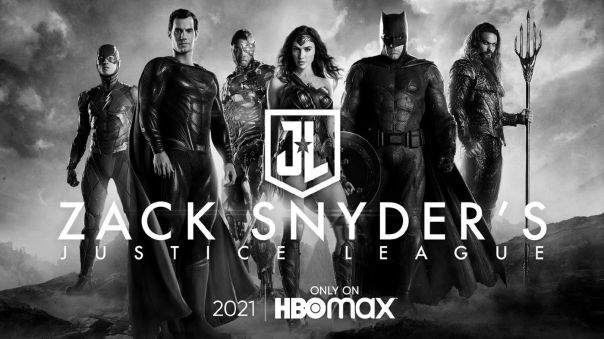
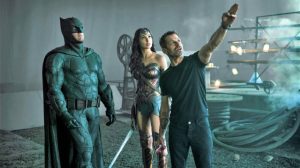
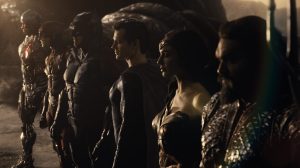 At this point, I don’t think I need to provide too much on the history surrounding the supposed epic tragedy of behind-the-scenes studio machinations that was the 2017 Justice League film. Suffice it to say if you don’t know, the theatrically released version of the movie was a sort of Frankenstein’s monster of two competing visions, one the culmination of original director Zack Snyder’s bleak, realistic take on DC superheroes introduced in two previous films, and the other a studio-mandated effort to re-shape the project to dilute Snyder’s influence and better ape the success of the Marvel Cinematic Universe (MCU) through the inclusion of re-shoots, re-edits, and post production work provided by the MCU’s most notable director at the time, famed garbage person Joss Whedon. The result was widely regarded as mediocre at best, a mishmash of clashing ideas and tones representing diametrically opposing perspectives on what a superhero movie should be. It was assumed at the time that the relative critical and commercial failure of the film meant that it and the cinematic universe it spearheaded was, much like Snyder’s conception of the DC Universe, completely hopeless. And then some weird stuff happened.
A strange confluence of circumstances involving the changing nature of our engagement with modern media, the increasing ubiquity of streaming platforms challenging and possibly supplanting the theatrical model of film distribution, and also a freaking pandemic, led to Snyder getting an incredibly rare second bite at the apple in the form of the Snyder cut. A long fabled, often dismissed as mythical truer version of Snyder’s masterpiece, the Snyder cut had been cruelly torn from him and mutilated beyond recognition by shortsighted naysayers who just didn’t understand the deep and profound things the director of Sucker Punch was trying to say in the movie where Lex Luthor apparently pees in a jar to make a point to a senator before killing her. Or I don’t know, maybe he got his assistant to do it before sending her to die in the explosion he didn’t tell her about? Okay, that’s not the point, but Batman V. Superman is still really stupid. The point is, fans demanded it, and Warner Bros.’ long history of poor decision-making led them to provide a whopping 70 million dollars, roughly the budget of an entire year’s worth of quality Blumhouse movies, to complete a thing that was supposedly already basically done. And now it’s here.

Author Ayn Rand
If you didn’t pick up on my reference earlier to the Virtue of Selfishness, consider yourself lucky to have never been exposed to any kind of deep dive into the nonsense of Objectivist “philosopher” Ayn (rhymes with “whine”) Rand. I use “philosopher” in quotes because Rand famously rejected all philosophers post-Aristotle other than herself, most likely because all of modern philosophy might as well be collected with the subtitle: “Why Ayn Rand Is An Idiot,” so her rejection of them was likely a preemptive strike done with the same degree of defensive self-awareness that led her to rail against government hand-outs her whole life only to accept Social Security and Medicare in her autumn years. The Virtue of Selfishness refers specifically to a collection of essays encapsulating Rand’s ethical vacuousness better than I could with any description, so I would say you should just read it, though you really shouldn’t. You could also check out her much more popular and well known novels, the CEO’s on strike fantasy Atlas Shrugged, or The Fountainhead, about a self-described brilliant artist who would rather see his greatest work destroyed than allow it to be altered by the people with the moral temerity to think they had the right to dictate what it should be just because they paid for it. Coincidentally, Zack Snyder has been trying to make that book into a film for years.
Snyder is, by his own admission, a devotee of Ayn Rand and a committed Objectivist, and despite my already established aversion to this worldview, I want to state clearly here that I don’t bring this up to say that Zack Snyder believes in something I find ridiculous and is therefore a ridiculous person. I might think that if I got to know him, but that isn’t the point I’m making here. I have no reason to think that Snyder isn’t a perfectly nice, intelligent person as an individual, at least by the standards that we might judge those things in the abstract. I don’t know the man personally, so I don’t know for a fact that his love of a philosopher who said we owe nothing to each other means he believes the same thing wholeheartedly, and I have no way of knowing how he might translate his conception of Objectivism into his daily interactions with other people. He may be a sweetheart or a total bastard for all I know. As a filmmaker, however, I feel like I can say with some degree of certainty that his Randian worldview is at the forefront of his creative vision. If his movies are any indication of his artistic intent (as one assumes they should be), the Artist’s fire that burns in his soul is one that seeks to burn down the liberal social order predicated on the notion that our success as a civilization requires that we care about each other.
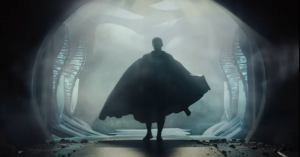 I would submit that the reason Zack Snyder’s approach to superhero movies feels so strange and off putting to so many people, whether or not they can articulate why, is because it lacks empathy. That isn’t to say that a movie or even a work of Art requires empathy, but its absence always feels wrong because art is the language of the soul, and having no interest in appealing to our shared humanity is the spiritual equivalent of gibberish. It feels especially wrong in superhero fiction because empathy is the basis for all superheroes on a fundamental conceptual level. The thing that makes them heroes is that they care about other people and, because of that, dedicate their lives to helping others. The people with similar powers who only use them for personal gain or to hurt other people, because they don’t believe we owe anything to one another, are the bad guys. So when Snyder, a filmmaker who views the world and the worlds he creates through the literal and figurative lens of Randian self-interest, tries to realize the characters of Superman, Batman, or Wonder Woman, it does not occur to him that anyone like them would ever sublimate their own selfish interests for the good of humanity. He has no frame of reference for altruism, so he can’t relate to characters designed to be the personification of it.
Snyder’s Superman spends almost the entirely of Man Of Steel rejecting the idea that he should use his amazing powers to help anyone, and only begrudgingly takes on the threat of General Zod when he is personally threatened and it is in his interest to fight, famously failing to even try to save Metropolis from the destruction wrought by his battle because civilian casualties were immaterial to him. In the sequel Batman vs Superman: Dawn Of Justice, the idea that all of this superheroic carnage has any real toll on real people that we should care about is addressed almost as a petty response to the backlash Man Of Steel faced for its callous depiction of the character, with Batman representing the side that at least cares enough to seek revenge, only to be revealed as short sighted in his zeal to defend humanity from this all-powerful alien god after a few common enemies and a coincidence involving their mothers’ names causes him to see the monster as a misunderstood hero. In between this convoluted arc, we have a montage of Superman saving lives that is one of the most morose series of images ever put to film, suggesting its the last thing he wants to spend his time doing. We see Wonder Woman coming out of hiding after decades of refusing to use her powers for the good of anyone, and we also find out that Batman, the billionaire who spent his life and vast wealth defending the innocent from evil, has since broken his oath never to kill and seemingly delights in sending criminals to prison branded with a symbol that almost assuredly marks them as targets for rape and murder.
 Back in 2019, Snyder directly addressed the criticism of his dark, “realistic” approach to superheroes, and specifically the idea that Batman would kill, by saying “It’s a cool point of view to be like, ‘My heroes are still innocent. My heroes didn’t fucking lie to America. My heroes didn’t embezzle money from their corporations. My heroes didn’t commit any atrocities.’ That’s cool. But you’re living in a fucking dream world.” And you know what, he’s absolutely right. It’s a dream world called comic books. You could say the same thing about something like Star Trek, the idea that we could all give up on greed and completely restructure society around the idea of helping each other is pretty naive and will probably never happen, but that’s not the point. The point is to imagine a world where it could happen, compare that imaginary world to our own, and think about what we might need to do to bridge the gap between them. Fantasies aren’t supposed to be realistic, they are supposed to be inspirational and aspirational. Most billionaires do probably embezzle money, and most people given the powers of a god would probably be corrupted by that power and commit atrocities. But what if they didn’t? What if those people were innocent do-gooders who helped other people instead? That would be super, and pretty heroic at that.
Of course, Snyder is in no way obligated to like or care about what superheroes are traditionally meant to represent in order to make movies about them, but it begs the question of why he would want to spend so much of his time and effort crafting an entire series of superhero movies if he doesn’t. A cynical approach to answering that question might start with the dumptruck of money Warner Bros presumably wheeled to his home, and might even posit a sort of trollish pleasure in taking down something he clearly detested through creative deconstruction a la Rian Johnson’s The Last Jedi. Or perhaps his motives were even more insidious. Perhaps he hates the very idea of altruistic superheroes and altruism in general so much that he dedicated an entire film franchise to subverting our love of superheroism so that we would lose hope in the empathetic message they are meant to inspire, and with nothing else left to cling to, fully embrace our Randian dark sides. For the record, I don’t think it’s any of those things, but any one of them would be more interesting that what I think the actually answer is, which gets me to my biggest problem with Snyder’s work overall, and especially his latest magnum opus, the Justice League Snyder cut.
 Every single movie Snyder has ever made has been at its core a parable extolling the virtue of selfishness, but none of them were intended to be that because they were never intended to be anything. If Snyder were a political or philosophical polemicist for Objectivism or any ideology, I would at least respect the intellectual exercise even if I couldn’t appreciate the end result, but that’s not what Snyder does. While his visual style is marked by hyper-realism, all slow-motion grandiosity, his storytelling is focused on reflecting the real world as he sees it, and his point of view just happens to be skewed the way it is. Remember, he doesn’t want to live in a dream world of his own making, he wants everything to be like the real world, which he just happens to see as one where nobody cares about or likes each other. Beyond that, there’s no inherent meaning in anything he does, which is insane considering how skilled he is at creating visuals meant to evoke the feeling of deeper meaning. When Aquaman stands on that pier with waves crashing over him and “There Is A King” playing in the background, it certainly feels like its saying something, but what? He’s sad? Angry? Symbolic of… anything? When Superman poses like Jesus, he’s clearly not meant to represent any form of Christ narrative I’ve ever read, but the image is iconic and memorable and just feels important somehow, and that’s all that matters.
Snyder’s shallowness is not in and of itself a problem, even if given his talents it represents a crushing waste of potential. The problem is that when your movie is four hours long and serves as a once-in-a-lifetime opportunity to rectify the injustice of studio meddling as a battle cry for every artist who ever had their work stolen from them, not having anything of importance to say and adding literally nothing of substance to the two-hour studio cut everyone hated is maybe the most disappointing thing you could have done. Obviously, the tragic circumstances surrounding his leaving the project in 2017 and the seemingly shady way Whedon was brought onto the project do not make Warner Bros look good, but if I’m supposed to believe this narrative that Snyder was betrayed and his dream project was bastardized by philistines, I shouldn’t be coming away from his original vision with so much more respect for the mediocre hatchet job. I know the prevailing critical consensus coming out of this is that whatever you may think of Snyder’s version, it’s at least better than the Joss Whedon version, but these people are just wrong.
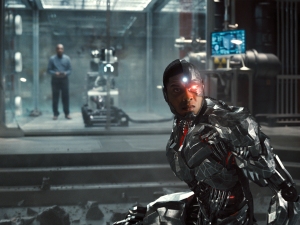 Comparing the two cuts is apples and oranges. One of them is a movie, created under the auspices of a studio director’s responsibilities to their contract, and the other is a vanity project with no such restrictions. Whedon completed a film that was palatable to a wide audience and within a reasonable running time to be shown in theaters, which is presumably what the studio thought Snyder was going to do too. If we are to believe that what we have now is Snyder’s true, uncompromised vision for it, then what was he going to do when they told him you can’t put a four-hour movie in theaters? What would he have cut to get it to two hours? If I had to guess, I’d say probably almost everything Whedon did, since the stories are so similar that its clear the content Snyder put back in was largely superfluous to the narrative. Most of what Whedon cut was unnecessary slow-mo, call backs to movies we wanted to forget, and setups for movies nobody wanted, and redundant moments already covered elsewhere. All the action scenes are present between the two cuts, except for the completely pointless Flash sequence, but in the Snyder cut they’re all twice as long. Same beats, same information conveyed to get the point across, just longer and less well paced than in the theatrical version.
Is Steppenwolf a more interesting villain now that we know he serves Darkseid because of some past mistake we don’t know about, rather than just assuming he does it because he’s from Darkseid’s totalitarian world where everyone serves him? Does Darksied’s comical incompetence as a despot make him a more enticing prospect for a sequel, somehow forgetting that the thing he devoted his life to searching for was on the one planet he failed to conquer, which just so happens to be the one planet where they left behind all those doomsday devices waiting centuries to be easily activated? We’re told it’s such a shame that we missed out on the great character of Cyborg, and now we finally get to see what could have been, but to quote the black clad Superman at the end of the Snyder cut, I’m not impressed. What more did we learn to deepen his story? Daddy never came to his football games but he still misses him when he’s dead? Riveting! Did we need a six-minute excursion into his mind palace with a voice over explaining all of his powers like we’re children when the original just demonstrated all of them by showing them to us? And what does it all amount to? In the end, he gets to ascend to his rightful place as the least interesting mopey superhero who hates being a superhero with all the other mopey self-hating superheroes. Hooray?
 Naturally, you’re probably thinking, it wasn’t all just cuts, what about all that stuff Whedon added in? “What about brunch?” you say. Sure, I’m not going to defend everything Whedon did to make his version work. You’re mileage may vary; I would say about half of his new additions worked for me and half were cringe worthy, but the good half seems even more vital now than it did when we didn’t know the alternative. The brighter color palette alone is a welcome change from the dreary, washed out look of the Snyder cut, and for every bit where Flash wedges his face in Wonder Woman’s cleavage, we get one like Cyborg laughing about his injuries after stopping the mother box, the only moment in either version where he resembles the fun, lighthearted character from the comics and TV shows. The Flash never gets his hot dog-strewn first meeting with Iris West, but he gets a heart-to-heart with Batman about how being a real hero means saving people one at a time that speaks to the greatness of both characters in a way nothing in the Snyder cut does. When Superman smiles in Joss’ version, it’s because he’s saving lives and he’s happy when he gets to do that. When he smiles in the Snyder cut, it’s a menacing sneer because he’s about to lay the smack down on a weaker opponent to show him who’s boss. And then we get that delightful Russian family.
Yeah, I know, you hate the Russian family, and I get it. I hated the Russian family when I first saw the 2017 cut. Why would they waste time showing these characters who don’t seem to have any bearing on the story? The thing is, we only thought that because we were treating this superhero movie like a superhero movie, where we don’t necessarily need to be reminded that superheroes save lives as long as that’s a base-level assumption. But in Snyder’s world, it isn’t. In his cut, there’s no family to save because who cares about saving families? The stakes in the Whedon cut are clear and personal, real people will be hurt if they fail. We are them and they are us. It’s not subtle but neither is anything Snyder has ever done in his life. In the Snyder cut, we know that the Earth is doomed, but it’s all theoretical, our entire planet reduced to the same collateral damage that Metropolis became in Man Of Steel, where the people are there, we assume, but they don’t matter enough to be our focus. And in the end (of the Whedon cut anyway) the villain is defeated by his own fear, because the fear he represents cannot stand up against what the heroes represent in opposition to him: love, for each other and for the world they fight for. In the Snyder cut, they just savagely whale on him, stab him, and cut his head off with terrifying glee in their eyes, and then we cut to a flash-forward into a future world seemingly based on the Injustice video game series where we find out they failed to save the planet anyway.
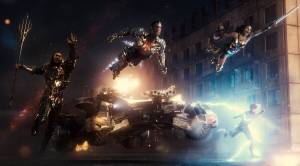 Again, I would like to stress that I am not making a one-to-one connection between filmmaking style and personal character. I’m not saying that Zack Snyder the person doesn’t care about people, and I know Joss Whedon doesn’t. I assume that before he shot those Russian family scenes, he made sure to make some of his female employees feel like dirt because making women cry is the only thing that gives Whedon an erection. But the real-life context matters. You might be asking why I keep bringing up the Ayn Rand stuff even though I don’t even think he’s intentionally injecting it into his movies. It’s because when I saw the original 2017 cut, I was disappointed but I didn’t hate it. When I saw this new cut, I was incensed, and I couldn’t quite figure out why until that side of it clicked for me. I went through something similar with Quentin Tarantino’s Once Upon a Time… In Hollywood. Everybody was loving it but I couldn’t explain quite why I didn’t until it dawned on me that it wasn’t anything about the filmmaking but the larger context, a director who made millions working with Harvey Weinstien, making a love letter to old Hollywood in the wake of the Me Too movement centered around the exploitation of an actress and making the story about two clueless men. It just felt wrong, and I’m finally to the same point with Snyder’s movies.
The 2017 cut of Justice League came out shortly after the election of our fascist, white supremacist, and eventually traitorous former president Donald Trump, a man so comically evil that he literally served as one of the inspirations for Lex Luthor when he was transformed from a mad scientist into an 80’s-style corporate tyrant. His rise to power, or rather the lie he tells people about being a self-made man and not a trustfund baby, is basically a Randian Horatio Alger story, and not just because both men were fabulists rumored to be pedophiles. You might even call him a Randian Superman, and the line from Randian Self-Interest to CEO worshiping Social Darwinism to Trumpian fascist strongman politics is undeniable. This new Justice League, where Zack Snyder tries to turn all my favorites superheroes into fascist action figures, comes out only a few months after a bunch of traitorous right-wing scumbags tried to raid our nation’s Capitol to usurp our democracy at the whims of a would-be king. One technically doesn’t have anything to do with the other, but the images are iconic and the connection just feels like there’s something meaningful there, even if it’s unintentional. I just can’t treat Snyder’s bad politics as just some interesting facet of his directing style anymore. I don’t want it in my polity, I don’t want it in my entertainment, and I sure as hell don’t want it in my superheroes.
So what was the point of any of this? Why start with that long boring excursion into the definition of Art? And what’s more, if Art is the one place where the Virtue of Selfishness makes sense, where does any audience or any would-be critic like myself have any place to question an Artist like Zack Snyder? Why write 20-plus long paragraphs, the Snyder cut of Snyder cut hot take think pieces, if an Artist should never care about what anyone thinks of what they create? That’s where I’ve been the last few days. As you might guess, I find the whole notion of Art criticism to be utterly worthless and without merit. The entitlement that audiences have surrounding the Art they consume is equally abhorrent to me, as if what they think of something should have any bearing on the form it should take. So where does that leave me? Feeling like a hypocritical piece of garbage.
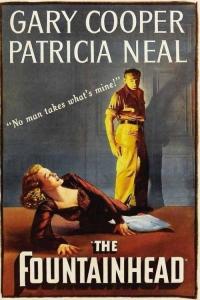 I keep coming back to The Fountainhead (as a metaphor, not the actual book, because I read it once in college and that was enough). The protagonist Roark was hired to design a building and insisted he could blow the thing up if they didn’t let him build it the way he wanted, and when he does, he goes to trial, and makes a passionate plea in defense of his own rights over his creation that wins over all the doubters who couldn’t force him to conform to tradition. I keep wanting to force this narrative where Snyder is Roark and the saga of the Snyder cut is his quest to finally build that eyesore upon the skyline the way he always wanted, but it just doesn’t work for me. Art is deliberate creative expression for its own sake. The Snyder cut is certainly deliberate, and while it was made at the behest of the studio for a profit and an audience, I’m even willing to give Snyder the benefit of the doubt that he didn’t care about either of those things and really did set out to make it for its own sake. But then there’s that middle part, creative expression, something that reflects the internal life or point of the view of the artist. What if there’s nothing interesting about the internal life to reflect, and any apparent point of view is accidental and despicable at that? Is Zack Snyder the architect Frank Gehry, building beautiful sculptures people just happen to live and work in, or is that just who he thinks he is and who we want him to be, and really he’s just a very skilled craftsmen with nothing to say? How boring and uninspired can a work of Art get before it ceases to be Art at all from the sheer weight of its pointlessness?
Roger Ebert tried to say that video games could not be Art, but really he just didn’t understand them or like them, and for years, similar charges have been leveled at comic books and comic book movies. Whatever I might feel about Snyder or his work, he has been instrumental in lending a degree of legitimacy to comic book storytelling in the minds of a lot of people who otherwise dismissed it. Maybe not as much as the MCU has, but he’s still a part of it, and as a lifelong comic book fan, I can’t ignore that. I feel like I should be right there with everyone else, if not loving the Snyder cut, then at least loving what it represents, that for once the little guy won over the big guy, even if the little guy is usually on the side of the big guy unless he’s the one getting screwed, and he didn’t really win so much as reveal his limitations and give me a reason to say “I have more respect for Joss Whedon as an artist” which is something I never wanted to say again. But I’m not there, and I don’t think that’s what this represents, and really, I just wish that someone else, or really anyone else could have gotten the opportunity that Snyder did. Maybe this release makes that more likely in the future, but I don’t have much hope for that. I don’t have much hope for anything left in me anymore because I just watched a four-hour Zack Snyder movie and I’m pretty sure our future is going to be a Randian dystopian Knightmare. Release the David Ayer cut! Release the Gareth Edwards cut! Release the Lord and Miller cut! Release the Michael Cimino cut! Release all the cuts!
Just try to keep them under two hours, please.
Share this:

Zack Snyder’s Justice League (2021)
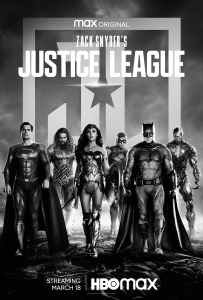
Zack Snyder had a unique situation that many filmmakers would never get close to fulfilling. He departed the 2017 Justice League movie in the wake of a family tragedy, Joss Whedon was hired to direct and rewrite extensive reshoots that totaled an estimated additional $30 million dollars, and the world was given the strange amalgamation of two different filmmakers, along with the nightmare-inducing CGI baby lip to replace actor Henry Cavill’s mustache. The 2017 theatrical release of Justice League was meant to be a significant milestone for the DCU, launching an all-star assembly of superheroes and setting up future solo adventures and franchises. It was meant to be a major kickoff and it was simply a major shrug. The general public was indifferent to the 2017 League, and it seems like the DC brass is positioning for a cinematic universe do-over, retaining the elements they liked (Jason Momoa, Gal Gadot) and jettisoning the other pieces to start anew. In the ensuing years, fans have been petitioning for the fabled “Snyder Cut,” a theoretical version of Justice League that was closer to Snyder’s original artistic vision before the studio intervention and interloping of Whedon. It became a joke on social media and then one day it became real. Warner executives, seeing opportunity with the rabid fanbase, decided to give Snyder an additional $70 million to finish his version of Justice League. It would be an exclusive to their new streaming platform, HBO MAX, and Snyder could complete his version without artistic compromise. The resulting four-hour version, titled Zack Snyder’s Justice League, is less a movie than a mini-series, and a rare chance for a director to complete the story they wanted to tell without artistic compromise. After having watched the full four hours, along with re-watching the 2017 version again for comparison, The Snyder Cut just feels like the original version only longer. I would actually advise people that if they haven’t watched either Justice League to simply catch the 2017 version. At least its mediocrity is half your time investment.
Once again, months (?) after the death of Superman (Cavill), Bruce Wayne (Ben Affleck) is traveling the world and recruiting a very specific group of job candidates. He needs serious help to combat an oncoming alien adversary, Steppenwolf (voiced by Cirian Hinds). The cosmic Big Bad is looking for three special boxes, a.k.a. mother boxes, to destroy the world and make way for his master, Darkseid. Wonder Woman (Gal Gadot) helps Batman convince the half-man/half-machine hybrid Cyborg (Ray Fisher), underwater dweller Aquaman (Jason Momoa), and hyperactive speedster Flash (Ezra Miller) to form a league of sorts to thwart Steppenwolf.
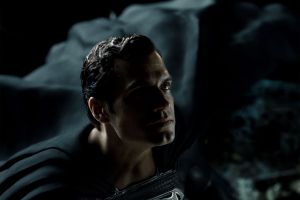
I think it’s unfair to judge the 2017 film to the Snyder Cut as a movie simply because this version never would have been released in theaters. No studio would have released a four-hour version. The two edicts that Whedon was given by the studio when coming aboard the project was that it could not be over two hours and to lighten it up. Imagine what the 2021 Snyder Cut would look like if Snyder was then tasked to cut it down to a more manageable two-hour running length. I predict many of the same scenes being eliminated or dramatically trimmed down. That’s the main takeaway from the Snyder Cut, that there is more room for everything, and quite often too much room. I swear a full hour of this movie might be ponderous slow-motion sequences. Plot-wise, Zack Snyder’s Justice League is pretty close to what was released in theaters in 2017. The action sequences are extended longer (Steppenwolf’s attack on the Amazons has increased from six minutes to a whopping twelve minutes) but I don’t know if they’re dramatically improved. Instead of two punches there’s four; instead of one chase, there’s two. It’s that kind of stuff, filling out the sequences but not really elaborating on them in an exciting fashion that reorients the moment. I liked some additions, like the inclusion of blood during the underwater Atlantis fight because it added a neat visual flair, but the added action is often obscured by visual decisions that dis-empower the experience (more on that later). I found myself growing restless with the movie. All that added time allows some sequences and plot beats to breathe better, but it also allows Snyder to meander to his greater indulgence (more on that later as well, notably on the multiple epilogues). The four hours feel like Snyder’s kitchen sink approach, and with the benefit of years of hindsight from the critical and fan reception of the 2017 version, he’s able to spend tens of millions to correct mistakes and improve a flawed film.
I hate how this movie looks for multiple reasons. The most obvious difference is that the aspect ratio has been altered to a 4:3 ratio more reminiscent of pre-widescreen television. Why is this the case? Snyder has said he cropped his movie to this boxy format so that it could be played on IMAX screens. That’s fine, but why crop your movie now months if not possible years before it will ever play on IMAX screens? When it comes time to adjust for the IMAX screen, adjust then. Why must every viewer see this limited version now on their widescreen televisions at home? It’s just so bizarre to me. It would be like if Quentin Tarantino reasoned that his movies will eventually play on airplanes, so he better get ready and cut back his widescreen into a flat, pan-and-scan mode, and he might as well include alternate takes and scenes to cover for those that would be deemed too profane or intense for the all-ages captive audience of an airplane, and then that version was the one he released to all audiences and we were stuck with it. Snyder had millions of dollars to reshoot his epic and he lopped off the edges, meaning you’re getting more movie but also less (at least the footage predating the new reshoots) in every second because of the framing. The grandeur of the superhero saga is also extremely hampered by the drab color palette. Snyder has always preferred muted colors to his movies but his Justice League drains all life and vibrancy. Everything is literal shades of grey. Color is not allowed to exist in this universe. A sunset is almost comical. Apparently, there’s going to be an official black-and-white version but we’re already practically there. Some could argue the oppressive grey is meant to evoke the grief and heaviness of the picture, and I’ll give you some leeway with that, but the drab colors also nullify the visuals. It’s simply harder to see everything that’s happening even during the daytime, and then you tack on the ugly CGI that makes everything look like a fuzzy video game. For a movie that has cost potentially over $350 million dollars combined, Justice League looks so phony. Maybe that’s part of Snyder’s overall stylized look, he’s never really been one to visually ground his operatic action spectacles, but I feel like the aspect ratio and color palate just make it worse. For those four hours, this is often a very visually unappealing movie to watch.
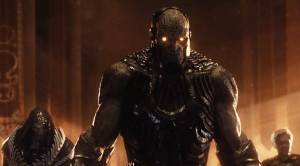
With the added time, there are definite benefits and characters that are lifted by the extra attention. Chief among them is Cyborg, a character that felt like a Swiss army knife in the original who was just there to perform whatever techno jazz the movie required at a moment’s notice. With the Snyder Cut, the character becomes more engaging and given a fuller arc relating to the relationship between father and son. The father’s placement in the story actually matters and Cyborg has more of a personal journey coming to terms with his new abilities. There is a back-story with his frayed relationship with his father, his accident that caused him to become the creature he is, and a reoccurring theme of a son blaming his father and the father trying to reconnect with the son he refused to part with. I still think Cyborg ranks low on the list of superheroes, but the additional scenes give the character more weight, more tragedy, and more intrigue. Another added benefit is that Steppenwolf’s motivation is improved as well as his look. He’s now outfitted with a herring-bone armor that twitches over his body. It’s a more intimidating look than what he had going on in 2017. I also appreciated that he now has more motivation other than “conquer the universe” because now it’s “conquer the universe to get back in the good graces of the boss.” Steppenwolf is trying to repay a debt and make amends, and that makes him slightly more interesting than his generic motivation in the original theatrical cut.
However, not all the new editions are as smooth or as helpful. The added time with the rest of the Justice League doesn’t seem to have added anything to their characters. Each one’s arc is more or less the same from the 2017 version, except now we have even more scenes of Wonder Woman wondering whether she needs to get off the sidelines and be more involved (the events of WW84 conflict with this timeline) and Aquaman rejecting his call to adventure from the Atlanians. Neither is a richer portrayal and the scenes are redundant. Take Wonder Woman finding out about Steppenwolf’s attack. In the 2017 version, her mother lights an arrow and it sails into Greek ruins, signaling her daughter, who knows what this means. In the Snyder cut, the arrow still lights the Greek ruins, but now Wonder Woman visits the ruins, she gathers a stick, she wraps a cloth around it, she dips it in kerosene, she lights it on fire, she enters a secret room because of the arrow, she jumps down a cliff, she finds a hidden temple with hieroglyphics warning about Steppenwolf and the mother boxes and Darkseid. Even if you really wanted the end where she sees those hieroglyphic warnings, why did we need these many steps to get there? The opening hostage/bank heist scene is given far more attention, with multiple scenes of hostages being terrorized, and then Wonder Woman literally vaporizes the chief terrorist. A little girl looks at her, likely traumatized for life by the whole experience, and says wistfully, “I want to be like you when I grow up.” She wants to be a murderer? In Snyder’s universe, Superman kills people, Batman kills people, so why not Wonder Woman too?
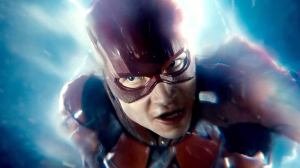
The revised introduction of Barry Allen is also regrettable. He’s applying for a dog walking job and a car accident occurs and he saves the day, but not before slowing down time in a frustrating manner. This is because he seems to be dawdling while the rest of the world is frozen, which makes the event seem less special. His movements seem less urgent than Quicksilver in the X-Men films when he would perform the same memorable slow-mo set pieces. I disliked that the Flash’s big involvement in the final showdown was literally running around in a circle, a repeat of what he had done prior. Also making the slow-mo save introduction less special is the fact that the Flash picks up a hotdog floating in midair for silly reasons. It’s drawn out with interminable slow-motion and the song choice is baffling, a common theme throughout Snyder’s movies. I think he’s been smarting ever since he painfully paired Leonard Cohen’s “Hallelujah” with a sex scene in 2009’s Watchmen, and now we must al endure similar awkward auditory pairings. Every song inclusion just feels wrong here. As Aquaman is drinking and walking along a pier, in slow motion, we hear “There is a Kingdom” by Nick Cave, and it just doesn’t pair right, especially in contrast with the hard-rocking guitar riffs from The White Stripes in the 2017 version. For good measure, Snyder even includes another “Hallelujah” cover by the end for good measure, as if he’s still fighting this same battle over musical taste.
And then there’s the barrage of epilogues, each the start of a story never to be continued, and it approaches the realm of self-parody (spoilers to follow). We get three endings, the first an extension of the post-credit scene from the 2017 version where Lex Luthor (Jessie Eisenberg) suggests the formation of a Legion of Doom for villains. He even shares with Deathstroke (Joe Manganiello) that Bruce Wayne is Batman. Well, that could be an interesting next step, but we know it’s not to be so it becomes just a teasing preview. The next ending cuts forward in time to the dusty, apocalyptic vision that Batman had in Batman vs. Superman, and he’s got a crew including an older Flash, Meera (Amber Heard, why does she have a British accent now?), and even Jared Leto’s Joker. They’re facing off against a villainous Superman who has been driven mad by the death of Lois Lane (Amy Adams), which is pretty much the plot of the Injustice games. The Joker is antagonizing Batman with some references to killing someone close to the Dark Knight, and this whole sequence amounts to Snyder basically saying, “Hey, here’s where I wanted to go with things but you’ll never see it.” Then there’s a third ending, because the second is revealed to be another dream/vision for Batman, where he meets Martian Manhunter, a character that, other than diehard comic aficionados, no one cares about and has been given any reason to care about. The guy just introduces himself and Batman is like, “Oh, cool,” and that’s the ending Snyder decides to close his four hours with. There is a literal half-hour of epilogues and false endings to finish with and I was exhausted. I owe Peter Jackson an apology.
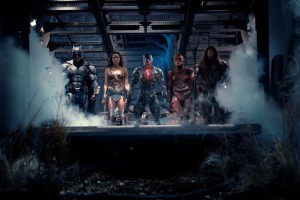
In my original review of the 2017 Justice League, I wrote, “I think I might have actually preferred Joss Whedon not being involved and simply releasing the full Zack Snyder cut. It would have been stylistically more coherent. Much of the Whedon reshoots do not feel like they are for the better. To be fair, he came in late and this franchise behemoth had already gone too far to fully alter its fate. There are small moments that work but the big moments are what fail. This movie is missing setups, payoffs, and character arcs. It’s missing pathos and emotion. It’s missing memorable action sequences that are exciting and varied. It’s missing basic internal logic. It’s missing a greater relevance.” Some of those issues are resolved with the four-hour Snyder cut and too many others still remain. At the end of the day, this is still just a longer, bloodier version of a mediocre superhero movie, except now we get stuff like Batman saying the F-word, so I guess that’s cool. I have more of an artistic appreciation for what Whedon had to pull off to even wrangle this beast into two hours. I’m happy Snyder was able to fulfill his complete vision and that HBO MAX offered a platform that would provide such a rare opportunity of expensive art unencumbered by studio meddling. I can’t say it’s worth your four hours, nor can I say it’s dramatically better than the 2017 version because whatever benefits it offers are weighed down by the extraneous, the redundancies, and the length. As it stands, I feel I have no choice but to grade Zack Snyder’s Justice League the same as the 2017 Justice League.
Nate’s Grade: C
Share this:

21 Bridges (2019)

21 Bridges would have been a more interesting movie if it had simply been a conversation between the police detective, Andre David (Chadwick Boseman), and the mayor of New York City as he proposes shuttling all twenty-one bridges leading out of Manhattan to catch a pair of cop killers. My pal Ben Bailey surmised it should go with the mayor flatly refusing and telling them they should use actual police investigative work to catch the criminals, like all casework, instead. It’s not like Manhattan houses millions of people with deep subway networks and somebody could remain unseen for some time, or the fact that there are more ways off an island than bridges. This concept doesn’t even factor into the story in a meaningful way; the police could have just as easily used the bridges as checkpoints for the difference it makes. This eliminates the ticking clock factor. Another miscalculation was splitting so much of the narrative between the two sides, Andre and the cops doing the hunting, and the criminals trying to run away. I’m not emotionally invested in these guys escaping, and it doesn’t ratchet tension as the cops get closer. If anything it alleviates tension as I know we’re closer to them being captured. The shootouts, foot chases, car chases, and machismo barking are all serviceable from director Brian Kirk, a veteran of television. It’s fine if this is a genre you enjoy but there isn’t anything new in 21 Bridges, or anything new that works, to open up that entertainment for anyone else. It’s entirely predictable every step of the way, enough that I was correctly guessing the real villains before the movie even started. The actors all do respectable work. It’s all competent from top to bottom, but it’s in service for a forgettable by-the-numbers cop thriller. I have to believe the original script for this was something more daring, perhaps opening up Andre’s character and his reputation as a “cop killer killer” and what effects that has had on him. He really shouldn’t be the hero. He should be the guy who comes to learn his culpability in being part of a corrupt system of justice, pushing him toward an anti-hero reclamation arc. What we get isn’t even close to that level of character exploration, so I must believe 21 Bridges was noted to death by studio exec mismanagement. Otherwise what did the star of Black Panther and the directors of Avengers: Endgame see in this story that urgently had to be told on the big screen? It feels like some relic from the 90s that would have starred Wesley Snipes and absent any modern commentary on the role of a police state in urban communities. Alas, you get what you get with 21 Bridges, which could have been 18 Bridges, but some exec must have said, “No, that’s not enough bridges. But 30 is too many. Gentlemen, were gonna stay up all night if we have to in order to solve this number-of-bridges conundrum.” If you have a soft spot for this kind of thriller, you might find some fleeting moments of entertainment. Everyone else can look away.
Nate’s Grade: C+


 nathanzoebl
You must be logged in to post a comment.