Blog Archives
Saw 7 (2010)
 The story behind Saw 7 (or as presented in theaters, Saw 3D) is more intriguing than anything you’ll find in this lackluster chum bucket of guts. The director of Saw 6, series editor Kevin Greutert, was all prepared to go off and direct the sequel to the surprise smash, Paranormal Activity. The folks at Paramount even penciled in a Halloween release date, long the fertile ground for the annual Saw sequels. It seemed like Paramount was rubbing in the fact that they now had the more exciting, buzz-worthy franchise and they would tap dance on the grave of Saw. Well the studio suits didn’t take too kindly to this broadside, so they activated a clause in Greuter’s contract. The man was legally required to leave the Paranormal Activity 2 project so that he could direct a seventh Saw film. Because nothing says “work of art” like forcing your director to make a movie by threat of legal action.
Saw 7 is billed as the “Final Chapter” but it doesn’t feel like a satisfying conclusion, more like an overdue mercy killing. It’s no secret that the Saw franchise has been flailing and sputtering for quite some time, with the bizarre exception of Saw 6 (my friend Eric proudly deems it the “Godfather II of the Saw franchise”). It was because of Saw 6, a fascinating return-to-form by tackling the topical issue of health care reform, that got my hopes slightly renewed for the franchise’s finale. Having health insurance employees as the victims gave the franchise some much-needed populist anger, a renewed morbid fascination that was surprisingly enjoyable. Imagine Saw 7 taking on the extension of the Bush tax cuts? Alas, my fledgling hope was for naught.
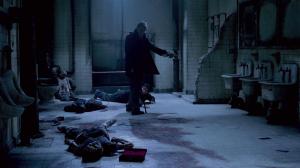 Part Seven follows a self-help guru Bobby Dragan (Sean Patrick Flanery) who talks about surviving a Jigsaw death trap as a spiritual awakening. Except that he’s a fake; he’s devised this phony survival tale as a scheme to get rich. Naturally Jigsaw (Tobin Bell, as always, in flashback) doesn’t take too kindly to this misrepresentation. Dragan would seem like a prime candidate for the haunted warehouse of horrors that Jigsaw usually specializes with, except that Jigsaw has been dead for four films now. His second apprentice, Hoffman (Costas Mandylor), is wanted by the police and FBI and even Jigsaw’s own widow (Betsy Russell), who unsuccessfully tried killing Hoffman with one of the series’ infamous bear traps masks. So let’s stop and think this out. Hoffman, who is on the run and established as a serial murdering fiend, still takes time out to set up a warehouse full of death traps for Dragan to fulfill his late employer’s wishes. If it’s not obvious now let me make it pointedly clear – in whatever city these murders, take place, it has the most incompetent police force in the history of the universe. Did they literally hire the Police Academy crew? That would make for an entertaining diversion that might reboot two franchises.
As always, the sinister death traps are the real draw of the franchise, and these convoluted killing devices have been getting less inspired from each shallow sequel. These contrived contraptions always bothered me in their uniform intricacy. The franchise began with some pretty simple scenarios: crawl through barbed wire to reach an exit, while covered in kerosene hold a candle to see a written combination, saw off your feet if you want to escape a filthy bathroom of doom. Then in order to top the previous film, the death traps got more contrived and involved a lot more engineering muscle. The more complex they got the less interesting they became. Now with Part Seven, some traps include a three-headed saw with each member of a love triangle in its aim. Two guys, the boyfriend and the “other man,” have to overpower a saw or they can relax and let the woman that’s come betwixt them lower onto a saw blade. This opening trap is the start of some dubious misogyny even for a genre as female punishing as horror. There’s a gauntlet of grisly horror in store for a bevy of female characters, usually involving something sharp penetrating them. But for the lone man who falls into a Jigsaw trap he meets his death by… hanging. Yes, a simple almost merciful hanging compared to the gruesome fates the women encounter. I’m not seeking feminist sensibilities from a genre that profits from their half-naked terror, but Saw 7 is even sicklier because of the undercurrents of misogyny. The traps in number seven aren’t memorable, interesting, and they feel like they’ve been done before in some earlier incarnation (a woman being “smoked” in a mechanical pig does seem to be different).
 The biggest problem with Saw 7 is that it doesn’t feel like anybody gives a damn anymore, including the filmmakers and actors. The production values seem like a world away from other movies in the series. The entire affair reeks of “direct to video” even though it was shopped as a 3-D theatrical experience. As you can imagine, because of the gimmicky 3-D, the movie is filled with plenty of pointy objects pointed at the screen. When watching in traditional 2-D, it gets fairly tiresome. Also because of the 3-D presentation, the filmmakers had to compensate for how dark the 3-D glasses make the movie. That means that the spurts of blood are in a rather unrealistic pink lemonade shade, like the retro blood from 1970s exploitation flicks. Without the glasses, as most will view the film at home, it further cements the overall cheap atmosphere. The production design, cinematography, and editing all feel like the Lionsgate intern team performed them. Every technical aspect feels more than sub par, it feels like no effort was exerted whatsoever. Sure it got finished, but finished and complete are different.
The Saw franchise has always been built around the craft death traps and a last-second twist ending accompanied by a barrage of scenes given new context. This formula has been repeated with each installment, so I expected nothing more and “nothing more” is what I received. Saw 7 thinks its audience demands to know its convoluted back-story, which gives way to all sorts of behind-the-scenes flashbacks that are always retroactively changing and channeling the timeline of events and participants. I think it’s all frightfully boring. I don’t care who screwed what bolt into what. I’m not watching Saw for realism (hence why the police NEVER think about tracking what vacant warehouses are sucking down gads of electricity). But at this point, with the thrill of the death traps long beaten into a bloody submissive pulp, I don’t even know what I would watch this series for. The appeal seems to have died along with its boogeyman, Jigsaw, four films back. The subtitle “The Final Chapter” seems like a promise destined to be broken. In the annuls of horror, any successful franchise will live on forever with cheap made-for-DVD sequels. Saw 7 just feels like the first made-for-DVD sequel, except it got a theatrical release as one final gasp at cash. Just wait twenty years and the whole thing will be rebooted as some sort of prestige picture that speaks to man’s inhumanity to man circa 2030.
Nate’s Grade: D
Share this:

Kick-Ass (2010)
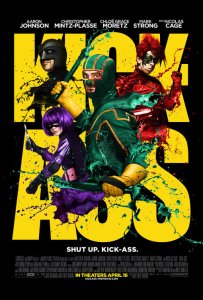 Based on Mark Millar and John Romita Jr.’s popular eight-issue comic, Kick-Ass takes the world of superheroes and makes it one step closer to reality. Granted, it’s still a heightened reality with flexible rules erratically administered, but it’s almost recognizable. Nobody in Hollywood wanted to touch this movie, so it was produced entirely outside the studio system. That hesitation may be because Kick-Ass begins as a goofy teen comedy and morphs into a bloody action caper with off-the-wall violence. But it’s also preposterously entertaining.
Dave Lizewski (Aaron Johnson) is just a typical kid who reads comics and wonders what else could be out there for him. He’s pretty much a nobody at school who routinely gets beat up. His life’s biggest tragedy is the loss of his mother, but she was not taken by some dastardly villain but by an aneurysm. Dave questions why nobody ever tried to be a real super hero. Tired of being a nonentity, Dave orders a wet suit and fashions a costume for a superhero alter ego, Kick-Ass. His first few encounters don’t go so well, landing Dave in the hospital, but in short time his exploits become a YouTube sensation. His MySpace page becomes full of admirers all seeking super hero help. He inspires others to don cape and cowl, like Damon “Big Daddy” Macready (Nicolas Cage) and his daughter, Mindy “Hit Girl” Macready (Chloe Grace Moretz). But they have their own reasons for cleaning up the streets. Big Daddy worked as a cop but was wrongly imprisoned when he went against mob kingpin Frank D’Amico (Mark Strong). Damon has been plotting his vengeance and training Mindy to be an efficient killing machine. Unfortunately, their mob hits are being blamed on the hapless Kick-Ass. Frank D’Amico enlists his wannabe gangster son, Chris (Christopher Mintz-Plasse), to pose as a superhero and lure Kick-Ass out into the open. It’s like The Departed but with more eyeliner.
 Kick-Ass is a fairly subversive work, notably in the relationship between Hit Girl and Big Daddy. He has been training her (or brainwashing) to become a tool of vengeance, but he’s also making sure that his little girl will be tough enough to handle the evil the world may throw at her. A father/daughter outing includes dad firing live ammunition into his daughter’s bulletproof wearing chest. He’s doing this so that she won’t be afraid when, not if, she gets shot. She will know what it feels like. He then promises that they’ll go out for ice cream later. This demented sense of parenting, as presented, actually becomes strangely endearing. They become the heart of the movie, and I was surprised that during some major scenes how emotionally involved I was. We have a beguiling sense of protection for Hit Girl, much like her father who even in moments of great agony screams helpful tactical suggestions to his little girl (to answer any concerns, Moretz and the character are not sexualized even with a Catholic schoolgirl outfit). Unlike Kick-Ass, they have something very concrete to fight for, which is why we feel for them and hope for their success.
The tone of this movie, as you might be able to tell, is wildly uneven. Kick-Ass exists in a reality closer to our own, and Hit Girl and Big Daddy exist in a different fantastic reality where they can perform Matrix style maneuvers at a moment’s notice. But I actually believe that these two different tones and approaches compliment one another. Kick-Ass is a realistic portrayal of what would happen if somebody with no training and nothing but complete naivety would don a costume to fight crime for the greater good. In Kick-Ass’s first confrontation with the criminal element ends with him getting stabbed. His superhero wish fulfillment is brought back to a stinging reality thanks to that blade in his side reminding him that violence is real and painful. His first successful encounter with criminals is not because suddenly he has developed super martial arts skills or any sort of power, it’s simply because he has a stronger will power to continue fighting, even as he staggers back and forth likely to pass out from exhaustion. He wins through sheer will power and little else. He’s got heart but not the ability, thus we watch him receive many pummelings throughout the film. And throughout the movie, Kick-Ass keeps to this edict. He doesn’t succeed through any sort of cunning; his only “special ability” is his above-average tolerance for pain. On the flip side, Hit Girl is the ultra stylized fantasy version of a superhero that we’re more familiar with. She has an amazing talent for death and deception, and even her back story feels ripped from the comic pages — raised to avenge the death of her mother by the hands of gangsters. She is much more in line with our anticipated pop culture sensibility of what makes a super hero. So she and Big Daddy exist as the contrast, an exaggeration that heightens the vast difference between the fantasy super hero and the harsh reality of the ordinary (Dave). It’s a satire that indulges in its targets. While the movie toggles back and forth between the two tones, I never felt chaffed by the alternating styles.
 And while we’re on the subject, while the film may be called Kick-Ass but he’s the least interesting aspect of it, perhaps because he is a mirror to the audience. He’s weak, wimpy, and is delusional as far as where his lack of abilities can take him. Which sets the stage for the film to be completely stolen by Hit Girl, played to foul-mouthed, steely perfection by breakout star Moretz. She is a one-woman wrecking crew and dispatches bad guys with stylish, wall-flipping ease. The incongruity of watching an 11-year-old child turn into a killing machine both serves as commentary on the preposterous nature of the comic book world, and it also makes for some seriously wicked fun. Who wouldn’t enjoy a pint-sized little crime fighter with a profane vocabulary? Parental activist groups, I suppose, who have complained about the movie’s portrayal of young Moretz, going so far as to argue that any child should not be made to say the off-color language that she does in Kick-Ass (have they listened to school yards this century?). But here’s the point: it’s supposed to be shocking exactly because she’s a child and that battery of behavior is not expected. She lures opponents into a false sense of security because, after all, she’s “just a little kid.” But Hit Girl is anything but. She’s one tough chick and Moretz gives a performance full of swagger. Film fans, get ready for her lead role in the Let the Right One In remake this fall. It should prove to be another launching pad for Moretz.
Director Matthew Vaughn started as a producer for Guy Ritchie’s films, but with every new film under his belt it looks like Ritchie might become an asterisk for the mighty career of Vaughn. After the tense gangster thriller Layer Cake, the whimsical fantasy Stardust, it seems like Vaughn is getting to be a better director whereas Ritchie appears to be getting worse from film to film. But I am here to praise Vaughn and not bury Ritchie. The movie has splashy visuals and some grand action, especially during an all-out assault on D’Amico’s lair as finale. Pretty much like Hot Fuzz, in the last act the movie degenerates into what it was parodying earlier. But by this time I’m already hooked. Let the fireworks commence and I’ll keep munching my popcorn. It’s a rousing, action-packed finish that manages to acknowledge the irreverent ludicrousness of the whole film while still being, well, kick-ass. Vaughn makes excellent use of music, nicely pairing muscular pieces of epic instrumental rock like “In the House — In A Heartbeat” by John Murphy from 28 Days Later. There are some smart additions like having Joan Jett’s “Bad Reputation” play at a fiery moment of anger, and a kitschy kid song playing during our first introduction to Hit Girl, magnifying the absurdity.
Vaughn also coaxes a good performance from Cage, meaning the actor has strung two good performances in a row (please see Bad Lieutenant: Port of Call New Orleans). Cage has an eerie sense of determination but he plays his character in an “aw, shucks” Mr. Rogers style, even borrowing the speech patterns of Adam West when he dons his costume.
 The movie does have some issues. It’s stuffed with too many subplots that go into more detail than they have to. The gangster goons have way too much screen time and are, at best, bad caricatures. The subplot with Dave’s love interest, cute girl Katie (Lyndsy Fonseca), thinking Dave is gay goes on for too long just to offer some third-rate Three’s Company misunderstanding gags. The plot is also completely self-referential without stooping to explanation. As stated earlier, the tonality shifts will not play out the same for everyone, and the plot pretty much switches protagonists halfway through, becoming the Hit Girl show. Then again some might argue that the film would be better off without Kick-Ass.
Kick-Ass plays like a juvenile romp, nothing to be taken seriously. This is not The Dark Knight by any account. I was not feeling the same sense of moral unease that I felt during the depraved, consequences-free killing-as-personal-self-actualization film Wanted, also based on a Millar comic book series. Kick-Ass is never really mean-spirited or cruel or casual with human life, despite the central themes of vigilantism and vengeance. In fact, the movie posits that more people need to make a difference and stand up to injustice, granted he movie ignores the justice system in lieu of fisticuffs. The movie doesn’t deconstruct the world of superheroes like Watchmen, but at the same time it holds it all up for ridicule, saying, “Isn’t this all ridiculous?” and offering escapist thrills. Kick-Ass is a visceral, absurd satire of the realm of superheroes that also manages to mine that same realm for polished genre thrills. Vaughn keeps the movie from feeling disjointed, even as it swaps tones from comic to dramatic, from (moderately) realistic to geek fantasy wish fulfillment. It won’t be for everybody, but consider me apart of the throng that cheered when an 11-year-old managed to make a guy shoot himself in the head with his own gun. There’s probably something wrong with me.
Nate’s Grade: B+
Share this:

Ninja Assassin (2009)
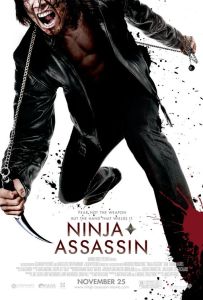 I never would have fathomed that a movie with both “ninja” and “assassin” in its title would barely hold my interest. This is a movie I got up and did the dishes through. Over-the-top never felt so boring, and perhaps it comes down to the flimsiest of stories strung together to connect the various ninja fights. It really does the bare minimum narrative-wise to get to the next opportunity for bloodletting, and oh what bloodletting! This is an extremely bloody movie but its power is undone because the violence is too stylized. Blood sprays like geysers and every slash of the flesh unleashes a balletic dance of painterly, soupy blood. The movie might work as disposable trash if only the action sequences were exciting. This isn’t a ninja movie but some half-assed video game. These aren’t Bruce Lee Ninjas, these ninjas can literally vanish into thin air before your eyes and they blend into the shadows. They are supernatural creatures that defy our traditional notions of what defines a ninja. This ain’t it. The characters all take such brutal beatings, and they spill tanker truckloads of blood, that it’s a wonder they can even stand let alone fight. There are a fee snazzy fight sequences but only thanks to choice in geography. The choppy editing only makes matters worse. I expected much more from the director of V for Vendetta. Ninja Assassin is just an un-engaging, hyper violent cartoon with a dimwitted story and little reason to care. The action isn’t even that good because the editing and lighting conspire to make sure you won’t be able to comprehend what’s going on. The best part of this entire damn stupid movie is the animated segment at the start of the closing credits. So have fun washing dishes until then, folks.
Nate’s Grade: C-
Share this:

Repo Men (2010)
 It’s not unheard of for different writers to independently create similar projects. Remember back in 1998 when there were two animated bug movies and two apocalyptic asteroid flicks? Granted, those were big budget studio movies and the final films had little in common other than concept or premise. Repo Men takes place in a world where people open contracts on new organ transplants, but if the buyer is late on the payment then a repo man will come and take back the merchandise. This gory premise might sound familiar for fans of the Goth opera, Repo: the Genetic Opera, which was released a whole 18 months earlier. The makers of Repo Men and Repo have engaged in a he-said/she-said argument over who originated the idea. Repo Men‘s screenwriters claim they came up with the concept in 2003, though the book the film is based was only released in 2009. The Repo team point out that their funky little musical began as a theatrical show that was first performed in 2002. The songwriters behind Repo say that the idea itself goes back to 1999 and began as a 10-minute opera experiment. I suppose we’ll never know who really had the idea first, though I’m inclined to side with the Repo musical fellas because they can back up their claims with evidence. It seems like a whole lot of squabbling over so little, but hey, that’s Hollywood for you.
In the not-too-distant future, one corporation, The Union, seems to hold sway in the world of organ transplants. Remy (Jude Law) is an expert repossessions officer who will slice open anybody 90 days late on his or her payment. His wife wants him to transfer to sales; it’s less messy. Remy’s partner (Forest Whitaker) is an old childhood friend and doesn’t want to lose his butcher buddy. One night, Remy is sidelined by some malfunctioning equipment that fires his heart. He has no choice but to get his own organ transplant. Following the operation, Remy finds that he no longer has the stomach for his old line of work. Remy’s newfound moral compass comes at a cost. He quickly falls behind in his payments and his old bosses plead for Remy to refinance. Reluctantly, they sic the repo men, including Whitaker, on Remy to retrieve company property.
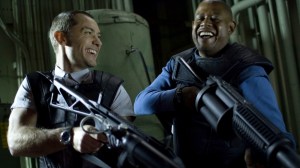 Repo Men takes some nice commentary on predatory lending, pushing the hard sell knowing that the customer can never stay ahead of the mounting fees and payments. The allegory has some sharp moments. However, the movie would have benefited from being pushed further in pretty much every regard. The side characters are horribly shallow. I’m fairly certain that Carice van Houten (electrifying in Black Book), as Remy’s beleaguered wife, could have been replaced with a cardboard cutout boasting a disapproving look. She gets to glare and complain and talk about family issues and then she’s gone, replaced entirely by Beth, a mysterious organ replacement junkie. Beth could have an intriguing back story, and the concept of surgery addiction could dwell upon the human cost of beauty and “upgrading,” but alas, her real purpose is to become an oddly implacable love interest for Remy. She gets to hold his hand while they run. That’s her main contribution (except for one key scene detailed below).
The entire concept of a future world held hostage by a greedy health care corporation could use more contemplation. What is happening with society? No epidemic is ever mentioned, so why do people start contracts on million dollar organs? Do the heavy debts pass on to the next of kin? What is the legality of organ repossession? What level of competition is there out there in the market? What does the government have to say about all this? Does this mighty company supersede the U.S. government? How come Remy can’t even get an employee discount on the merchandise? Has anybody had enough surgeries to become the six million dollar man? There is a wealth of questions born from this premise, but the movie only scratches the intellectual surface and sets its standard change-of-perspective morality storyline into gear. I actually would have found the life of an organ salesman to be more dramatically appealing. What kind of ethical rationalizations take place in the mind of a man who makes his living signing saps into modern indentured servitude? I find that story direction to be more compelling than following the guys who bring back the company merchandise.
But then something weird happens. The movie gallops to a satisfying close, and then it somehow gets even better in its closing moments. I was certain that I was going to write off Repo Men but then 4 things happened to make me sit up straight in my chair (I’ll refrain from any large spoilers):
1) In a film relentlessly aping the visuals of other, superior dystopian films, there’s not much new to look at. You’ve seen this future society thing before, just with more flying cars or jet packs. I came to terms with this; it’s not every movie that reinvents how we interpret the future short of some calamity. Then when Remy breaks into the Company HQ, which is awfully easy by the way, he stumbles into the genetic organ hatchery, if you will. Rows and rows and rows of scientists tinker with organ replacements. The entire environment is a strikingly sterile white, including the scientists wrapped in bulky white biohazard suits. Then Remy and Beth make a run for it, and they are covered head to toe in black. It’s a fabulous visual image, watching the color contrasts. It’s debut director Miguel Sapochnik’s high point.
2) Once Remy and Beth move beyond this laboratory, they get caught in a hallway, and Remy proceeds to take out a mob of employees. The fight sequence is several minutes long and a clear nod to the memorable extended hallway fight in Oldboy (Remy takes out a hammer as his final weapon). Weirdly, Remy’s opponents are suit types, middlemen, office employees, numbers crunchers, but they all leap into battle to take out the corporate intruder. The fight sequence is bloody and stylish enough to please the senses, like when Remy swings a hacksaw and we get Swinging Hacksaw POV as characters duck out of the way lest their jugulars get sliced.
 3) Following this, Remmy and Beth must deposit their corporate-licensed organ replacements. This involves cutting each other open, taking a bar code scanner (think a grocery check-out), and digging inside each other to get those subcutaneous scans. What’s amusing is that the scene is blatantly juxtaposed as a sex scene; Remmy and Beth intimately penetrate each other, the editing cuts to close-ups of moaning, and the other tries to soothe the pain with physical assurances, and it’s all set to a slow jam. It’s something of a bizarre sequence, especially upon further review (how effective can scanning for bar codes be inside the gook-filled human body?), but man is it interesting.
4) Just as I had come to terms with the movie settling for a conventional conclusion, the movie pulls the rug out from under you. It offers up a last-minute ending that upends the conventional framework, and, actually, presents the easy coast to a conventional stop in a new light. This is one of those rare instances where a last-minute ending twist actually improved the film. More often than not, a last-second twist is forced and the nail in the coffin of lasting entertainment.
Repo Men is a competently looking, competently entertaining sci-fi thriller that miraculously stumbles into a final act that not only works, it elevates the rest of the movie. My mild boredom vanished and I started wondering why they made me wait so long for the good stuff. Repo Men is a mixed marriage of overall tone. One second it will be darkly humorous, the next it will be satirical, the next it will pine for serious drama, and occasionally it goes for Guy Richie-styled slapstick. A sequence where Remy describes the three occasions he’s been knocked out, with visual interludes, feels like a deleted scene from an entirely different movie. The movie never really settles, touching upon a lot of areas but mostly poorly. The script desperately needed to be fleshed out to make any lasting impact. Now that I’m living in a two-Repo world, I’ll probably stick with the campy musical fun of Repo: the Genetic Opera. At least that movie left you humming.
Nate’s Grade: C+
Share this:

Saw VI (2009)
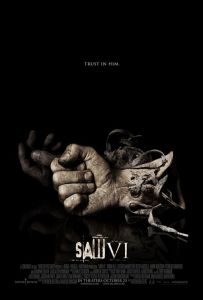 I checked out on Saw 4 and Saw 5 feeling like this horror series had grown stagnant, plus its central villain was killed off by the conclusion of the third movie. I thought the series wouldn’t go on for much longer, and oh how wrong I was. Jigsaw (Tobin Bell) has a second apprentice now fulfilling his departed master’s bidding, capturing even more people and trapping them into the franchise-favorite death traps. This means that there are yet even MORE recorded messages and vast, abandoned warehouses out there. FBI Agent Hoffman (Contas Mandyor, an amazingly horrible actor) has taken up the contrived contraption mantle. Of course it’s all preposterous and overly gory, but that never stopped the series before. Saw 6 boasts the franchise’s fourth director (the editor of all the previous movies just graduated to the big leagues). But this is mainly a franchise built around the hardened desires of its fans, indoctrinated in the gospel of gore. As I said before with Saw 3: “Just like the collapse of the Final Destination franchise, these movies started big but then bottomed out when their audiences had the rules memorized. At that point the only thing left is curiosity in what fiendishly outlandish ways people will get horribly killed.” This pretty much still holds true.
The real interesting draw for the sixth entry, and the only reason I drifted back in curiosity, is because Saw 6 is the weirdest participant yet in the current health care debate. The victims in this installment are health insurance employees. The people in charge of deciding who live and who dies are now put through morally challenging, queasy challenges. It’s a lot harder to kill somebody deliberately rather than by omission, by denying coverage or finding a loophole to get out of paying for a perfectly reasonable, and much needed, procedure. There’s a macabre enjoyment in watching health insurance officials put through Jigsaw’s battery of tests, though some of his victims seem pitiable — one guy is thrown in just because he’s a smoker (I suppose Jigsaw didn’t consider giving the guy a nicotine patch first). The main character going through the funhouse of horrors is an insurance company CEO (Peter Outerbridge) who has his mathematical equation about who earns coverage put to the test. Jigsaw is exacting vengeance after the CEO denied him coverage on an experimental treatment for cancer. It’s easy to see what side of the issue Jigsaw is on; he says that insurance companies put profits over human lives and get in the way between doctors and patients. This is a Saw movie even Michael Moore could cheer. I wish at the recent health care summit on Capitol Hill that the president had said, “Gentlemen, we’ve heard what the Democrats had to say about health care, we’ve heard what the Republicans had to say. I’d now like us all to see what Saw 6 has to say on the matter.”
 The story again is cut into two halves: the health insurance CEO going from death trap to death trap, and Agent Hoffman trying to stay ahead of the FBI investigation into the new Jigsaw killer. Guess which is more interesting? The FBI agents in this movie are those classical trained bumbling FBI goons that always come in late, take things over, and properly muck everything up. These people are lousy detectives and even worse at hiding their suspicions about Hoffman. It’s no surprise then that he manages to outsmart these idiots when Hoffman is, in fact, a dolt. This is not a smart man. Case in point, he’s using the severed thumb of a dead agent (Scott Patterson, apparently on Hoffman’s trail for the previous two films) to mark up bodies and frame the guy. Problem is that he’s framing a dead man, which means Hoffman has a really small window of plausible time to make this frame credible. It’s not going to work months later when the FBI wonders how a dead agent keeps kidnapping new people and putting them through hell. Then again, given the intelligence level of these onscreen agents, I’d assume that the FBI would blame zombies.
The apprentice aspect has always been the worst part of this series. I do not care whatsoever about the ins and outs of how Jigsaw set up his traps and who helped build the damn things. This isn’t some Discovery Channel series. I don’t need to watch the behind-the-scenes look at the grisly garage of doom. Just like the third Saw film, this is another entry that wants to play around with the bigger Saw picture. Scenes are introduced that retroactively alter the Saw timeline of events, causing characters to grow different motivations. I swear, the Saw movies all start to feel like they’ve been built from the rotting leftovers from each previous and less effective movie.
The only thing of note as far as acting goes is that the opening player (Tanedra Howard) won a VH1 reality show competition for a spot in this movie. Ladies and gentlemen, we now live in an age where people will compete for the luxury of being the first to cut open their insides in the SIXTH movie of a flagging horror franchise. You don’t want to know what they’re willing to do for a spot in the next flick.
 The draw of this franchise are its clever yet queasy death traps where the audience can place itself in the victim’s position and wonder what they would do given the life-and-death circumstances. How far would we all go to live? Well, in Saw 6 the traps aren’t that fiendish or memorable. The best one involves a group of six insurance actuaries (experts at finding loopholes to deny and cancel coverage) tied to a carousel with a shotgun pointed at them. One by one they swing by the kill zone, making it the most proverbially deadly game of musical chairs ever. Even better is the fact that the CEO is given the opportunity to “save” two on the carousel from the shotgun blast, so they each start screaming little arguments why they are worthy and their peers are not. It’s a neat little pressure-cooker of a scene, especially when one guy on the carousel realizes he’s the last to die. The thing slowly reels back around as he uses his final seconds to demand that the CEO look at him (“You look at me when you kill me!”). That defiant little moment manages to pierce through the ponderous personal growth edict the series has foolishly heralded as its purpose. The rest of the death traps are just cruel and labored and not nearly as interesting. You ca only watch people singe their skin on hot burners so many times before the body begins to involuntarily yawn.
Saw 6 is certainly no better than the other movies but neither is it worse. It’s the topical subject matter that makes this the only Saw movie worth a dubious look after the first flick. It taps into a populist rage against insurance companies that makes it vicariously satisfying and truly bizarre. It would be questionable to say that the franchise has recaptured any sort of creative juice, but I wouldn’t mind catching a future Saw film take on other big issues plaguing our country. Imagine Saw tackling predatory lending and the negligible banking industry resisting reform tooth and nail. Wait until the heads of Goldman Sachs and AIG get a load of Jigsaw.
Nate’s Grade: C
Share this:

The Wolfman (2010)
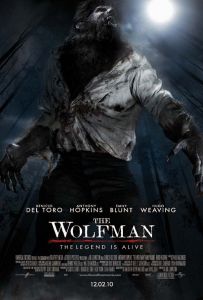 After re-shoots, reedits, a second director late in the process, and delayed release dates, it’s no surprise that The Wolfman is a bit of a shaggy mess.
In 1880, Lawrence Talbot (Benicio Del Toro) is an actor who returns home to England when he learns that his brother has been killed. Gwen (Emily Blunt), the fiancé to Talbot’s dead bro, writes that the departed brother was mauled, which points toward some kind of vicious creature roaming the woods. Inspector Aberline (Hugo Weaving) has been called in to clear the matter. Talbot’s father, Sir John (Anthony Hopkins), welcomes his prodigal son back but warns him of the dangers lurking in the countryside. The villagers are ready to blame the gypsy caravan and their chained bear when the feral creature strikes again, thus exonerating the bear. Talbot is bitten by the beast but survives only to transform into the cursed werewolf once every full moon.
Structurally, this movie feels like it’s all Act 1 and Act 3 with about ten minutes in between. By that I mean it’s all protracted setup and climax and little to connect the two. The beginning takes so long, with characters walking around like zombies who have no sense of wonder or fear given the extravagant circumstances. This is a movie that confuses set changes with plot advancement. Dour characters enter half-lit rooms and say little that isn’t cryptic or terse about the unusual happenings. This is what you have to look forward to for about an hour. The central mystery of who is the initial Wolfman is pretty easy to figure out when you play the economy of characters, which only compounds the movie’s sluggish pacing problems. You’re going to have definite pacing issues when your monster can only appear once a month, so say hello to massive time-lapse montages with the moon. It makes it hard to keep track of how much time is actually elapsing.
 There is little cogent explanation for why anything happens and the movie does an extremely poor job of maintaining a credible suspension of disbelief. What exactly are the rules here? What are the limitations for the Wolfmen? How far back does this whole thing go? The movie traces it back to an Indian kid, who looks like Gollum, in a cave, but where did he get it from? What is the history of this lycanthropy illness? When you turn into the monster, do you have any control? Are you a slave to your animal impulses? Are you culpable for what happens? Is it more like having multiple personalities except one of them is harrier? Nothing is really made clear and the movie just plows along while the unanswered questions continue to pile up, never to be addressed.
The Wolfman does a fine job of establishing an ambiance that feels ripped right from the old Hammer horror films, but fog and shadows and art direction can only take you so far. Every room looks like it’d be a prize-winning example of how to build a haunted house, though the lighting tends to be overly murky. Danny Elfman also provides a darkly lush score that mingles well with the onscreen atmosphere. But the refined sets only tease a better movie. An attack at the gypsy camp can get interesting. The beast flaring up at an insane asylum calls for something wickedly entertaining and scary, but everything is over before it really gets going, and we’ve moved on to the next scene of character sitting glumly in the dark. There’s nothing to startle beyond some overused jump scares. The movie lacks good scares because the film fundamentally can’t sustain a mood because the plot is never elaborated.
The character work is exceedingly shallow. Talbot is the main character but what do we learn about him? He’s an actor, he left town, he gets bit by a wolf, he skips stone’s with his dead brother’s girl, and that’s about it, folks. There’s an entire back story about Talbot spending time in a mental ward, which could prove to be fascinating but it’s just another set piece and nothing more. Talbot is pretty much a placeholder for a character; he’s the dude that has to get bit for there to be a story. He’s more catalyst than character, and you can feel that painful realization in how Del Toro (Traffic, Che) plays his non-character. Del Toro is a truly capable actor but he sleepwalks through the entire movie and mumbles most of his lines. Despite being a dead ringer for Lon Chaney Jr., he brings no energy to his role, nor does he ever seem truly concerned with his beastly transformation. You got more reaction and contemplation from Michael J. Fox in Teen Wolf.
The rest of the actors try and make good with the parts they’ve been tossed. Blunt (Sunshine Cleaning) can be a very good actress but she’s playing the thankless task of the underwritten love-interest-to-monster part. She’s no more fleshed out than the blonde damsel that screams and faints in the old classic monster movies. Blunt has the annoying habit of her voice turning into this simpering whine when she’s distressed. Hopkins (Fracture) pretty much gives the plot away with his maniacal cackling and incessant ear-to-ear grinning. You can pretty much faithfully assume where his character is going from the first malevolent twinkle in his eye. The screenplay exerts no effort to disguise its easily telegraphed character reveals. The person who comes out best is Weaving as the inspector, but that may be directly linked to the fact that he has the least amount of screen time of any of the main characters.
The special effects are fairly good and the practical makeup effects by screen legend Rick Baker are even better. The actual Wolfman is a snarling, spooky creature, but I wonder why we don’t get more shots allowing us to fully view the makeup work. Director Joe Johnston (Jurassic Park 3, Jumanji) seems to be more of a proponent of CGI, which means that we get scenes of Wolfie jumping from ye olde rooftop to rooftop like he’s any sort of wily creature. There’s nothing in the movie that really makes use of the specifics of being a Wolfman. We get a few POV shots of the Wolfman running extremely fast, but little else takes advantage of what makes the Wolfman a creature to be reckoned with. We only get a slew of decapitations and sliced innards that display the ferociousness of those wolf claws. Johnston isn’t afraid of gore but he doesn’t help his case when he fails to create any feeling of dread. It’s hard to dread what you can barely understand and with people you don’t really care about. Consider me stubborn, but when I got to a movie called The Wolfman I want some attention paid to the title animal.
 As I was watching The Wolfman I began to disassemble it in my head and piece together my own version of the film, an infinitely better version. For the sake or argument, I’ll explain my version and you can tell me which seems like the superior product. In my imaginary version, I completely eliminated Blunt, Hopkins, and most of the other side characters. I focused on Talbot and the Inspector and their relationship. Talbot has known about his lycanthropy for some time but he’s been able to control it for the most part, until recently. It haunts him, his inability to stop the sinister urges inside him that take over. The inspector is called in after the mysterious murders have picked up and they resemble some equally gruesome murders from 20 years prior (when Talbot first grappled with his hairy alter ego). The bent of the plot would then be on the relationship forged between the two men, how it turns into mutual affection and admiration all the while Talbot is trying to stay one step ahead of the investigation. Then my Act 2 break would be the Inspector finally realizing who is responsible for the murders (his friend!) and struggling with his own moral obligation to meet justice. Maybe this sounds too much like a crime thriller, but to me that sounds like a better film than watching two CGI werewolves claw at each other and spit.
The Wolfman is yet another misguided remake in a genre being gutted by horror remakes. The old monster movies of old were more than creature features and deserve better treatment than this bloody mess. I suppose few films can survive given the retooling process this one went through. This super serious monster movie has terrific production design, some alluring atmosphere, and a whopping void where a story should be. Characters will bumble about and the plot hums along with no explanation or elaboration given, meaning that setup often immediately crashes into climax. That’s not a satisfying recipe for a moviegoer. The Wolfman is mostly suspense-free and the actors are phoning it in; Hopkins is a kook, Blunt trembles her lower lip, and Del Toro seems to be drugged. This is mostly a costume drama with a little gore splashes in for good measure. It’s boring and half-baked and the best attribute is the scenery. If I wanted to watch scenery I’d flip through a Home and Gardens magazine. I was expecting entertainment here but instead it’s just another reminder to stick with the original.
Nate’s Grade: C
Share this:

Legion (2010)
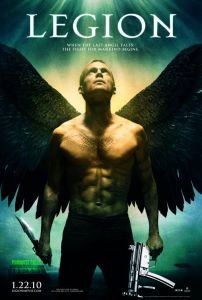 Just to be upfront, I am a big fan of action movies making use of Christian mythology (sorry if the use of the word “mythology” offends some). You tell me a tale about angels, demons, in a contemporary setting no less, and I’m hooked. You give those two sides weapons and have them fight over the fate of mankind, and I’m already revving my engines. So please know that no matter what the artistic achievements of Legion may be, I was predisposed to enjoying a movie that features the angel Michael (Paul Bettany) on the poster with a sword in one hand and an automatic weapon in the other. The premise of Legion is that God has finally had it with mankind and is making good on his threat to “turn this thing around right now.” He’s sending a host of heavenly angels to … eliminate humanity. Michael rebelled, believing man was still capable of making good on its promise. So he fights alongside a handful of characters shacked up in Dennis Quaid’s greasy spoon diner in the middle of nowhere. The action isn’t really involving but the movies does have some cool moments, like when Michael goes mano-a-seraphim with Gabriel (a marble-mouthed Kevin Durand). Legion deals with an antagonist (God) that is so powerful that there have got to be arbitrary limits placed on that power. So the attacking angels don’t overwhelm the tiny diner with their superior numbers, nor does the Almighty just blink the troublemakers out of existence. The end doesn’t really give much in the way of clarity but I got what I wanted from a movie like Legion. Though, in retrospect, I really didn’t want sizzling acid popping from boils.
Nate’s Grade: C+
Share this:

Daybreakers (2010)
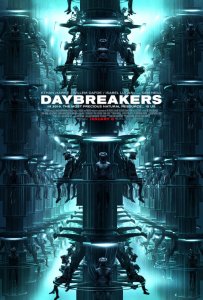 Taking a cue from zombie cinema, Daybreakers takes the idea of vampire-as-virus to an apocalyptic crescendo. The world is populated almost exclusively by vampires now. Human beings are farmed for blood but they are in such limited supplies. You see there is an extreme blood shortage because the vampires have lived beyond their means. That’s right, it’s a consumer consumption/environmental metaphor. The limited resources are dire because if vampires go without human blood they begin to devolve into senseless, winged mutating monsters known as “subsiders.” The poor cannot afford the skyrocketing blood prices so they are most fated to doom, while the rich argue that the blood supplies need to go to families first and not be wasted on the lesser dregs. The U.S. vampiric military, when not hunting humans, shackles the subsiders and marches them into the sunlight to be executed. Daybreakers has a lot more on its mind than most vampire movies, and it’s plainly fascinating to explore the realities of a world run by vampires (cars that drive during the day, the Subwalk, blood in your coffee). For most of its running length, Daybreakers is an intriguing setup that makes room for cool visceral action and social commentary. Then in the final act it sort of devolves itself into one big, dumb action movie. Ethan Hawke is a blood scientist trying to work on a synthetic substitute for a super vampire corporation that, of course, is evil. He stumbles upon an outlandish “cure” for vampirism and wants to resurrect humanity. This leads to a climax where Hawke and his human warriors wage battle inside the corporate HQ. For a promising concept, it’s depressing that Daybreakers had to end in such a typical manner. At least the vampires explode in the sun instead of sparkling.
Nate’s Grade: B-
Share this:

Final Destination 4 (2009)
 I felt that this franchise was creatively exhausted after the third film in 2006, and I see no reason to change that opinion. The fourth film has the added feature of being in 3-D, which means you get the luxury of having entrails exploding in your face. I watched the movie in the limits of two dimensions, which may be why I wasn’t thrilled having every other visual thrown at the screen. Regardless, the cruelly elaborate deaths are the draw. This is a horror movie built from the inside out, finding the thinnest of tissue to connect all the gory gross-out moments. A documentary set in writer’s room for a Final Destination movie would be more interesting than the finished product. It seems like the producers aren’t even trying any more; the one-note characters exist in a world bereft of adults, cops, media, and anybody with a brain. The film doesn’t waste any time on characters because they’re all just meat for the grinder. The film does, literally, the bare minimum just to move the plot along to the next fiendish death trap (this flick has a franchise record 11 death sequences). At one point, a character says, “Don’t make fun, but we Google-ed ‘premonitions,'” and then they explain the rules of the series like somebody handed them a manual. Later, the teens celebrate because they think they broke death’s chain, and I’m yelling at the screen, “That hasn’t worked for three movies, you stupid kids!” They’re all running through the same worn-out patterns that the audience already knows by heart. The big question is whether the gruesome death sequences deliver the goods. Flaming escalators and killer car washes? Clever or desperate, you be the judge. For me, the fun of this franchise was killed long ago when it gave over to the cynical bloodlust of its target audience. Since Final Destination 4 made the most money out of any of the previous films, expect more entrails in glorious 3-D.
Nate’s Grade: C-
Share this:

Watchmen (2009)
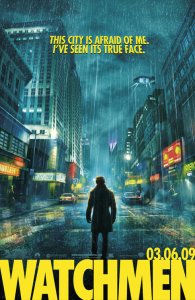 In the realm of comics, Watchmen is tantamount to the Bible. It consisted of 12 issues released between 1986-1987 but it arguable changed the medium forever afterward. TIME magazine listed the book, by author Alan Moore and artist Dave Gibbons, as one of the 100 greatest 20th century novels. Therefore, there has always been heavy trepidation within the geek community when Hollywood came courting the Watchmen property. Different directors have tried tackling the material, going back to the late 1980s when Terry Gilliam was hired to direct and producer Joel Silver was adamant about getting Arnold Schwarzenegger to portray Dr. Manhattan (back then, they totally just would have painted him blue — like they did when he was Mr. Freeze). The movie would seem like a tantalizing possibility and then the production would collapse, most recently in 2004 with director Paul Greengrass attached. Director Zack Snyder (300) understood all of the concerns from the notoriously vocal geek community and attempted to make the most faithful Watchmen film possible. He accomplished that goal. But was it the right goal?
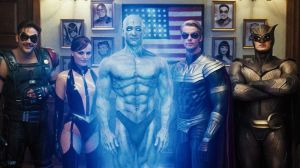
In this alternative account of history, masked crime fighters exist and were even bankrolled by the U.S. government. President Nixon is re-elected to a third term, thanks in part to superheroes winning the Vietnam War, and then he outlaws all masked vigilantes. Flash forward to 1985, and Nixon is on his fifth term and staring down Soviet aggression into Afghanistan. It appears that the world on is on the brink of nuclear annihilation by the dueling super powers engaged in a staring contest. Edward Blake, a.k.a. the Comedian (Jeffrey Dean Morgan), is thrown from his apartment window and killed. Blake used to belong to a second-generation superhero team in the 1970s called the Watchmen. The other members consisted of Dan Dreiberg, a.k.a. Night Owl (Patrick Wilson), Rorschach (Jackie Earle Haley), Adrian Veidt (Matthew Goode), a.k.a. Ozymandias, the glowing blue man Dr. Manhattan (Billy Crudup), who was transformed into a god-like figure of power after a laboratory accident, and then there’s Laurie Jupiter, a.k.a. The Silk Spectre (Malin Akerman), who was following in her mother’s (Carla Gugino) footsteps, the first Silk Spectre. The death of the Comedian brings the old team back together and rekindles some interest in putting on the super suits and fighting crime one more time. It seems someone out there is trying to knock off the retired superheroes, and Rorschach is convinced that a bigger conspiracy is unwinding.
 It’s difficult for me to formally express my feelings and reactions to the Watchmen film adaptation. Count me among the throng of fans that feels that Moore’s source material is a remarkably dense and witty deconstruction of the superhero mythos. Imagine a Superman that can’t be bothered to help out humanity because he feels life is overrated, or a group of super heroes that don’t necessarily do anything heroic; when they beat up the bad guys it’s because they get a sexual thrill from the rush of violence. My voice was among the cacophonous crowd screaming, “Don’t you dare butcher this great work! Keep it as close to the comic as possible!” And that’s pretty much what Snyder delivers. But now I’m left to wonder if a literal-minded interpretation is truly what I wanted all along. Watchmen is not like Sin City, a comic that was already a movie in panels. Frank Miller’s ode to film noir was ready and waiting to be a splashy action movie with style to spare. Watchmen is not a ready-made action vehicle, as it really only has about two extended pieces of action. Moore’s story examined what kind of people would become vigilante crime fighters if the government approved the practice. Surprise, it’s a bunch of sociopaths that are now getting checks from Uncle Sam! Watchmen is a nihilistic account of human behavior and far more cerebral than any superhero film that has ever graced the screen. Seriously, what other superhero movie opens with a fictitious episode of PBS’ political yak fest, The McLaughlin Group? So I suppose this paragraph is a sheepish way of admitting that perhaps Watchmen should have stayed place on the page unless, gulp, it was advantageously adapted for the medium of film.
It’s not that Snyder does a bad job or that the film itself is poor. While Snyder isn’t the best man to handle actors, he is certainly a skilled visual tactician and knows how to make some immensely pleasing imagery. He breathes great life into the images of the comic book and filled in the blanks nicely, and his one big artistic addition is one of the film’s best moments. In the opening credits we get a series of shots that perfectly establish this alternative universe, where JFK shakes Dr. Manhattan’s hand on the White House lawn only to be later gunned down by none other than the Comedian in Dallas. The segment is cleverly set to Bob Dylan’s “The Times They Are A Changin'” and is a terrific intro into a re-imagined America. I wanted to spend more time exploring the differences, like watching a giant Dr. Manhattan win the Vietnam War in one week’s time. In many ways, Watchmen is Snyder’s epic pop commentary on the history of the United States. Dr. Manhattan takes the first pictures of the astronauts on the moon. It is a female crime fighter that swoops a woman off her feet for that iconic celebratory kiss marking the end of World War II. The flick even has a period appropriate, synth-aided score, which is fine, though the use of period pop songs can be distracting. Watching Laurie and Dan make love to the raspy tunes of Leonard Cohen’s already overused tune “Hallelujah” is a deeply uncomfortable moment. Also, the aging makeup is horrendously bad. Gugino looks like she has a turkey waddle and the older Nixon looks like a freaking Halloween mask.
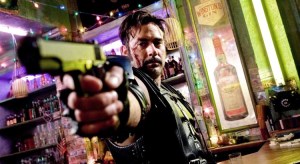 At what cost did Watchmen make it to the screen? Wacthmen plays as an adaptation like the first two Harry Potter movies, like there was an assigned checklist rather than a fully developed script. I achieved a brief understanding with the characters and each central figure provides a glimpse of the trouble beneath the surface. Laurie is a girl with daddy issues who’s been pressured to follow her mother, a rape victim who still loves her rapist. Dan is a self-pitying putz who has never felt more alive than when he puts on a costume. Rorschach has the same pessimistic view of mankind that Travis Bickle did, viewing many people as vermin clogging the gutter. Yet Rorschach also is the most single-minded of all the characters and abides by an innate moral code and sense of duty, never mind the fact that he may have lost his mind. Dr. Manhattan has been turned into a supreme being and has lost his connection to humanity. The Comedian is a man of wanton desire who declares himself to be the epitome of the American dream: giving in completely to the id. Watchmen has been deemed as an unfilmable book, and perhaps they were right. It feels like Watchmen and looks like Watchmen, but the movie never seems to become anything grander than the sum of its parts. The Dr. Manhattan back-story, where we see him live life in the past, present, and future simultaneously may be one of the best moments in the movie, but it doesn’t add up to much more than an interesting aside. The trips to Mars and Antarctica provide nice visual landscapes but do little else. The other quandary is that everything Snyder cut from the comic (the side characters, the pirate comic, the alien squid) is something that ultimately was unimportant. All of the important and memorable moments from the comic are here, though abbreviated and truncated. Even a 2-hour and 40-minute movie feels like too much of a sprint through such rich material probably better suited to the more accommodating narrative confines of a glossy HBO miniseries. The movie ends up becoming a handsomely mounted and reverent homage to the source material, but I question if the movie serves any other purpose than as an advertisement to go read the book. Will people unfamiliar with the book enjoy a movie practically tailor-made to appeal to fans of the book? Who will watch the Watchmen?
Make no mistake, Watchmen is a hard R-rated movie and if any parent takes their child to this flick because it has men in capes, then that parent should have their child removed. Snyder has ramped up the book’s adult elements, which were originally a commentary on how comics flirt with sex and violence but never get their hands too dirty. Snyder has gotten his hands dirty all right. Instead of zapping others into poofs of smoke, Dr. Manhattan turns them into explosions of human goo that stick to the ceiling. Instead of the Comedian being thrown from the window, we see an extended fight sequence that seems to indicate that the Comedian’s apartment is full of nothing but breakable glass tables. When Dan and Laurie get into a street brawl where bones pop through skin. The sex scenes now involve an almost-agonizing level of thrusting. This is an adult tale in a very simple sense: there are boobs and blood. But the movie is also adult in the fact that it trades in complex political, psychological, and philosophic ideologies, asking hard questions that do not come with easy answers. Do the ends ever justify the means or is mankind destined to always destroy itself? Is humanity worth saving and at what cost? This is probably the most subversive studio-backed movie to come out of Hollywood since 1997’s pro-fascism melodrama, Starship Troopers.
 The three best performances in the movie all come from the three weirdest and most messed up characters. Haley (Little Children) fully inhabits the grisly character of Rorschach and growls his way through the movie. You can tell just by the man’s face how much he has weathered. Crudup (Big Fish) and his gentle voice make Dr. Manhattan an intriguing yet beleaguered super being. Morgan (TV’s Grey’s Anatomy) makes the Comedian one consummate bastard but a bastard that you cannot stop watching, nonetheless. The rest of the cast does suitable jobs and I don’t feel that Goode (The Lookout) or Akerman (27 Dresses) deserve the drubbings they’re getting through the critical community. I actually liked Goode’s portrayal of Ozmanydias, though he fails to express the heavy crown the smartest man in the world must bear. Gugino (Sin City) is terrific when she’s the young, spunky Silk Specter and the opposite of terrific when she’s the troubled, alcoholic older version on screen.
Snyder has served up the Watchmen that fans have been demanding for years, but is this really what everyone truly wanted? Snyder made an adaptation for the fans but what do the fans know except for lavish loyalty? The book utilized the medium of comic books to accentuated its story while commenting on the history of comics and superheroes, and when translated to the big screen as is Watchmen can feel like an artistic stillborn. I’m now more curious than ever to read the previous drafts out there, the ones that directors like Darren Aronofsky and Greengrass were going to film until the financing got pulled. One of the drafts transplants the world of Watchmen to modern day and replaces the nuclear brinksmanship with the Russians to the ongoing War on Terror. It may not be faithful to the fabulous source material, and it quite possibly would have made a terrible movie, but it would have been more interesting as a film project because it would have been an adaptation. Snyder’s Watchmen is reverent to a fault but I cannot complain too much. This is likely the most faithful recreation of a complex book that fans could hope for. I feel satisfied and yet unsatisfied with the finished product. It was everything I was looking for in a Watchmen movie and maybe, in the end, that was the problem. I think instead of buying the DVD I may just read the book again.
Editor’s Note: I have warmed up to this film much, much more on Blu-Ray, especially the 3-hour director’s cut. It’s Snyder’s best work to date.
Nate’s Grade: B


You must be logged in to post a comment.