Blog Archives
Cinderella (2021)
 Do we need another rendition of good ole’ Cinderella, especially only a few years after the Disney live-action version? The new Cinderella starring pop star Camila Cabello is a surprise jukebox musical, and it’s irreverent where it should be and progressive where social critiques are warranted with the source and historical context. In short, it’s a fleeting but fun experience that’s a winning 100 minutes for families with young children and adults who enjoy a peppy, self-referential musical. Written and directed by Kay Cannon (Pitch Perfect), this movie is packed with singing and dancing to the point that the talking only makes up perhaps twenty percent of the movie. This choice proves to be a durable source of energy and keeps the pacing running smooth. It’s also convenient because we don’t need extra time explaining the setup and character dynamics that we’re all so familiar with at this point thanks to the umpteenth renditions. The mash-up of popular songs kept me amused and guessing what would appear next, and the original songs contributed by Cabello have a nice soaring uplift to them as well as memorable hooks. There’s a “What a Man”/”Seven Nation Army” mashup at a ball that gave me strong Moulin Rouge vibes, especially with all that chaotic sashaying petticoat editing. The movie is also funnier than I expected, with consistent wise-cracking and one-liners that had me laughing and critiques about the patriarchal system from a progressive, feminist perspective. The evil stepmother, played by Idina Menzel (Frozen), is even given her own song detailing her tragic history of being a musical prodigy who had to give it all up in a society that only valued her as marriage material. Even she gets consideration and empathy. The winking feminist criticisms won’t be new to anyone over the age of twelve, but it’s still welcomed even as the film skates over the discordant plot elements to keep things light. The film delivers some bon mots of political thought to go along with its sugary sweetness of a contemporary sing-a-long musical that is easy to digest. Cabello has a natural charisma to her and is surprisingly adept with comedy, able to turn on a dime and deliver a hilarious self-effacing remark. She’s far better at acting than you might believe. If you have no interest in another version of Cinderella, I understand the fatigue with the property. However, this Cinderella understands your fatigue, provides something light and airy, with actors who seem to be legitimately having fun, and it’s got a consistent feminist perspective that chides the prevalent problems with the source material. It works as a family film and even as a diverting jukebox musical for adults whose tastes run a little sweet and a little tart.
Nate’s Grade: B
Share this:

The Green Knight (2021)

The Green Knight is an indie drama heavy on atmosphere and mood and a little lax on pacing, falling into yet another A24 discrepancy between critics and audiences. Much like the contentious differences of opinion over It Comes at Night and Hereditary, it seems like general audiences are a little more indifferent to hostile for this arty release than the critics. Maybe they were expecting something more conventional, which is a mistake considering it’s written and directed by David Lowery, who has dabbled in a studio sphere (Pete’s Dragon, the upcoming Disney Peter Pan remake) but seems more at home with introspective, quiet, occasionally overly obtuse art-house pictures, the kind like 2016’s A Ghost Story where Rooney Mara eats a pie for ten minutes (I will never forget this puzzling movie moment). It’s not surprising then that The Green Knight would be a polarizing film of differing expectations. It’s got good graces, an artistic vision, and a preponderance on atmosphere that can feel a little strained at points.
Gawain (Dev Patel) is the nephew to the King of England (Sean Harris). He longs to be accepted as a respected knight but he has no adventures to his name. Then one Christmas, a Green Knight (Ralph Ineson) enters the kingdom and challenges any daring knight to a game. That knight can inflict whatever blow or mark upon him, but then the Green Knight will return the exact favor in one year’s time. Full of bravado, Gawain takes mighty Excalibur and decapitates the Green Knight. Turns out the knight is not dead. He only picks up his fallen head and promises that in one year, he’ll deliver the same to Gawain. The months pass and Gawain is drinking and sleeping away his last remaining time before finally accepting to meet his fate. He rides out of Camelot in search of the Green Knight and perhaps a solution out of his predicament.
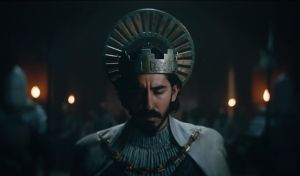
Where The Green Knight excels is with the distillation of mood and myth-making while not losing sight on its own sense of humanity. This is an Arthurian legend that is potentially a thousand years old, and when it comes to big screen adventures steeped in the mythology of cultures, it’s easy to get swept up in the fantasy spectacle of monsters and heroism. The vulnerability of the heroes is often cast aside to provide further attention to the grandiosity of the experience and entertainment. Lowery positions his movie from the perspective of an eager naïf yearning for a proper adventure to bring him respect and legacy, but he’s also a scared young man who is dreading the worst possible outcome that could be his only outcome. As Gawain sets off on his quest, he sets off proud, striding along his horse, not looking back at his home as he rides off to face his destiny, and then he’s immediately beset by treachery that removes the pristine shine off the tales of old. He’s taken advantage of by highway robbers and placed at an even greater risk of failure. As the movie progresses, Gawain becomes more and more anxious about the potential of getting himself out of his predicament. It truly seems like he’s marching off to meet his executioner, and that realization forces him to quickly adapt into the heroic mold he’s been aspiring for, the legendary knight, bold and brave and meeting death square in the eye. That sounds good in theory but it’s a lot harder to realize in real life. If any one of us, dear reader, knew that our lives were coming to an end with certainty, summoning the courage to meet that would be a herculean effort, and many of us would crumble under the pressure. It all doesn’t seem like enough time. This is what I appreciated throughout The Green Knight. It has its weird, atmospheric mythology and fantasy elements, but it also grounds the drama in relatable and nervous human emotions.
Where the movie goes astray, at least for me, is the time it devotes to achieving its poetic atmosphere. This is a two hour-plus movie that feels every bit of it, even if you’re enraptured by all the pretty style and ponderous pontificating. That’s because the movie is very episodic by nature, which at least breaks it up into manageable chunks each with something new to draw our attention, but it also makes it feel like less is being earned or amassed. In one segment, Gawain rescues the head of a ghostly woman (Erin Kellyman). In another segment, this one quite awkward to experience, he is tempted by both the lord (Joel Edgerton) and lady (Alicia Vikander) of a household, keeping his vow while something most distracting is taking place simultaneously. Another segment has Gawain interacting with giants, including one breastfeeding a little giant. There’s also a fox who occasionally talks and tries to plead with Gawain to turn away from meeting the Green Knight. I suppose if you’re being charitable you could surmise each of these stops is like a test of his skills of knighthood, from compassion to chastity to dedication, but it feels less like an accumulation and more like Lowery is simply finding time to explore other weird offshoots of this crazy fantasy medieval world.

A term I first used describing the films of Nicolas Winding Refn (Neon Demon), a filmmaker I’m not particularly fond of, is the use of empty space, where the narrative feels stretched out and the audience is intended to provide that extra level of meaning for the dead air. To me, it’s narrative forfeiture. The Green Knight could have been trimmed down, it could have been reordered, it could have been given more specific meaning, but that would potentially detract from its tone poem qualities. If that cinematic sensation works for you, and you fall under the film’s sway, then congrats. If you’re looking for more or at least more meaning in the plot and chain of events, then you’re going to be left grasping for more significance. Sometimes things just feel put into the movie because, beyond all else, it’s simply cool. That’s fine, though I found too many of the asides to be lacking once the initial obstacle was established. Lowery has a larger thesis under the surface about environmental awareness considering the Green Knight is literally made of wood and plants, he goes out to the forest to live on his throne amongst the wilderness, and there’s even an extended fiery monologue by Vikander about the enduring power of “green” and how it will outlive us all and grow over our corpses (if you were being pedantic, you could argue that all color will outlive us as I doubt there will be a nightmare future without, say, the color orange). The larger thesis, however, doesn’t feel supported by the asides and episodes of Gawain. I guess it’s about thinking of the consequences of our actions and, in a way, proportionality or response. Maybe more people would reconsider their carbon footprint if nature was going to cut off their heads as a consequence of using too many plastic straws. Maybe.
Where Lowery’s plot and ambition do come together, thankfully, is with his conclusion, which I will spoil in the following two paragraphs. In the original Medieval legend, Gawain meets the Green Knight who proves to be the lord of the manor in disguise. The man playfully chides Gawain for flinching and wearing a sash he felt would spare him of harm. He then says Gawain is “the most blameless knight in all the land,” which makes little sense, and then Gawain joins the other knights, and they all have a big laugh about the jape played on Gawain. That’s not exactly a satisfying ending and takes away any personal growth Gawain might have earned. In the movie, the Green Knight is for real. Gawain initially lowers his head, trying to summon the courage to meet his death, but he flees and apologizes, escaping the Knight’s retribution.

In a nearly wordless epilogue, we watch Gawain’s life over the course of decades, inheriting the throne, siring an heir, abandoning the mother, leading his people to war, losing his son, and eventually being such a disliked leader that his own people revolt including his own family members. All the while he wears that magical sash to thwart his own demise. This epilogue is revealed to be a flash forward for Gawain, who returns to the moment of consequence with the Green Knight. Rather than flee his fate, he now chooses to accept it, to avoid this future where Gawain goes down a path of corruption and neglect. Better to die now than become a cruel despot that will harm others. He even removes the sash. It is here where the Green Knight finally acknowledges Gawain with respect. It’s this ending that really hits home the themes and the character arc for Gawain. He’s become a knight worthy of legend but has no audience, and is choosing to have no audience, to die alone rather than live in infamy. He’s found his sense of bravery at long last because of his fear of what avoiding his fate will cost. It’s an ending that feels earned and when the Green Knight is giving him an “atta boy” you want to join in.
The Green Knight is going to be a different experience for each viewer depending upon your patience for ambiguity and pacing. I found myself at points marveling over the mood and visual style of Lowery’s vision, and at other points I found myself getting restless with the episodic side quests and the stalled character development. It all comes together by the end with a finale that really cements Lowery’s big ideas and drives homes the personal journey of Gawain. It’s all a mixture of bold and beautiful and a little bit boring.
Nate’s Grade: B
Share this:

Nine Days (2021)
 Oddly enough, over the course of less than a year, we now have two movies about young souls competing to find their sense of self before being born. Will (Winston Duke) lives in a small cottage in the middle of the desert. Or so it would appear. He’s a former human who now serves as a spirit who watches over the lives of a select group of others on Earth through P.O.V. monitors. After a car accident, one of his people is killed, leaving a new opening. It’s Will’s job to interview a group of candidates and determine who is best equipped to handle being born. Will takes the process very seriously but he is also more emotionally affected by the loss of life under his guidance than he admits. Where did he go wrong, or is right and wrong even the right markers for assessment? Will must choose wisely over nine days of deliberation and insight into what it means to be human and what it means to live.
 Nine Days is a tender and thoughtful movie that has much under the surface given its metaphysical context and probing questions about spirituality, identity, and existence, but it doesn’t simply rely upon the artistic weight of ambiguity. There’s a genuinely involving emotional drama here that’s accessible while offering greater depth to be unpacked by the viewer who enjoys metaphor and implication and debate. At its essence, the movie is about a series of job interviews but for a position that we don’t fully understand what the requirements are and if even meeting the requirements is enough for the hire. It’s a primarily dialogue-driven procedure but it’s also character-focused as the entire process examines what animates Will, what haunts him, and why he does what he does. Early on, the surreal nature of what should be an ordinary event, job candidates interviewing with a boss, gives the movie an air of mystery and offbeat humor. The candidates are showing up, going through a series of questions and role play scenarios, and with each session, the candidates evolve into the personas that will define them. There’s something mildly profound about watching the development of an identity before it’s even been born. As the movie progresses, Will turns down candidates and the news is truly devastating. Not only will these spirits/souls miss out on being born on Earth, they will cease to ever exist and fade away. That is some heavy stuff. Watching each one come to terms with that sort of death can be heartrending. Just imagining having to accept the end before life ever even began.
Rather than simply fade away into the blank of nothingness, Will chooses to help these souls get one last moment of peace before their ultimate end. He becomes a celestial one-man Make-A-Wish spiritual service. It’s unknown whether these “positive memories” are from the souls’ own development or their observation of the souls that have been placed on Earth. Regardless, each rejected candidate gets a moment that Will studiously recreates as an act of kindness. This section can be rather moving as each soul gets a personal sendoff and, in those final moments to savor, we watch them become affected with the generosity and the fleeting moment of life that will be tragically denied to them. One candidate climbs aboard a stationary bicycle, and Will positions one screen after another, each with projection from that angle of the street. When taken together, it creates the illusion of a nice bicycle ride through a town square. The homemade production, even sprinkling cherry blossoms and a swinging light to illustrate a traveling through a tunnel, provide small moments of affectionate conviction. I found each of these moments to be emotionally rich and beautifully rendered on screen. The care and craft Will puts into these acts is wonderful and a tremendous insight into who he is as a character and what he values in others.
 Will is haunted by the idea that he may have been oblivious to the pain of one of his pupils, and this indecision is coloring his interview process for a replacement soul. It’s unclear what exactly Will is, or his boss, or his duties, but he vaguely amounts to a guardian angel. He has a bank of old TVs that he monitors and obsessively documents the lives of a few. He takes particular pride in one soul on Earth and listens to her virtuoso violin playing as a means of personal relaxation. Her sudden death rocks him, and when it’s revealed that she was depressed, he tries to make sense of being able to see and hear everything these souls do but not fully knowing them. Did he get something wrong in his clerical assessment? Did his understanding of her have its limits? Could she have been hiding something so all-consuming without his suspicion? It all upends Will and fosters self-doubt. He’s trying to make sense of something that may not ever make sense. That is how inscrutable human beings can be and how tragically fleeting life can become in an instant.
The other change agent for Will is the presence of Emma (Zazie Beetz), a candidate who shows up late, questions the nature of the questions she is given, and is empathetic to a fault. The other candidates are playing within the rules of Will’s questions but she’s pushing back, and it only makes Will think more and more about her and her aims. I don’t consider it too much of a spoiler that Emma will be one of two final candidates for the open spot for life. Her character causes Will to reassess his own biases, his own way of doing things as they have, and his own conception of himself and what life can be about including his own time spent on Earth, which he likes to remind the others like it’s bragging rights. I suppose one could argue that, yet again, we have a quirky female character in service of teaching the male hero about the importance of embracing life to the fullest, but I think the general makeup of the characters is superfluous to the impact of the story. We’re dealing with spirits taking a physical form here. Their appearance is immaterial to their identity at this point, at least in an otherworldly realm that (hopefully) knows no sexism and racism.
 Nine Days is the film debut from commercial director Edson Oda and the movie is utterly gorgeous from a technical standpoint. The photography favors gleaming sunsets and pristine vistas to communicate the exquisiteness and otherworldly plane of existence. The desert landscape is beautifully filmed, and the interiors are also pleasing with their visual arrangements and the mingling of natural and artificial light. Oda won a screenwriting award at the 2020 Sundance Film Festival and for good measure. This isn’t just a good-looking indie, which it assuredly is, but there is deep melancholy and beauty and transcendence to be had with the very humane and compassionate storytelling trying to get at larger truths about our limited time. The storytelling has plenty of ambiguity and nuance and metaphor, but there’s an accessible core that I believe most viewers can align with and then, if they choose, can discover further meaning. There is a slightly basic “stop and smell the roses” moral, but I found there to be more lyrical beauty at different points that affected me deeper than any condensed message. The conclusion hinges on a recitation of Walt Whitman’s “Song of Myself” and it conveys not just Whitman’s celebratory humanism but also taps into Will’s own character arc. The poetic performance itself is an expression with multiple levels, celebrating life in multiple ways, and serving as a heartfelt and personal goodbye. It’s a lovely ending for a lovely little movie.
Nine Days is packed with recognizable acting faces (Tony Hale, Bill Skarsgaard), several of whom have graced Marvel superhero movies (Duke, Beetz, Benedict Wong), and there must have been something compelling for them to all accept this low-budget, contemplative indie about the human condition. It’s a little movie with a lot on its mind but it doesn’t feel the need to explain everything. There’s a sturdy foundation to begin with but enough ambiguous room for discussion and debate. It reminds me of 2003’s beguiling, divisive, and highly metaphorical indie Northfork. Both movies are poetic, understated, and deeply involved in human connection and spiritual meaning while providing room for interpretation. There’s plenty here to unpack but even on a literal level the movie works as an emotional experience. I found myself under the gentle sway of Nine Days and its mighty beating heart of humanism that extends even beyond the realm of flesh and blood.
Nate’s Grade: A-
Share this:

Jungle Cruise (2021)
 Disney turned a theme park ride that mostly involved sitting into a billion-dollar supernatural adventure franchise, so why not try another swing at reshaping its existing park properties into would-be blockbuster tentpoles? Jungle Cruise owes a lot to the Pirates of the Caribbean franchise, and actually owes a little too much for its own good. For the first half of the movie, it coasts on the charms of stars Dwayne Johnson and Emily Blunt and some light-footed visual misadventures. Then the second half turn involves a significant personal revelation, and that’s where the movie felt like it was being folded and crushed into form to closely resemble the Pirates franchise. It gets quite convoluted and littered with lackluster villains, too many and too stock to ever establish as intriguing or memorable (one of them is a man made of honey, so that’s a thing). I found myself also pulling away in the second half because of the inevitable romance. Their screwball combative banter between Johnson and Blunt gave me some smiles and entertainment and then, as they warm to one another, it sadly dissipated, as did my interest. The comedy is really labored at points. Johnson keeps referring to Blunt as “Pants” because she’s a woman and she wears pants in the twentieth century. It was not funny the first time and it’s not funny or endearing after the 80th rendition. The supernatural elements and curses feel extraneous and tacked on. With the Pirates films, at least the good ones, there are a lot of plot elements they need to keep in the air and you assume they’re be able to land them as needed. The competing character goals were so well established and developed in those movies and served as an anchor even amid the chaos of plot complications and double and triple crosses. With Jungle Cruise, it feels like a lot of effort but also a lot of dropped or mishandled story and thematic elements. This feels more creatively by committee and the heavily green screen action is harder to fully immerse with. As a wacky adventure serial, there may be enough to keep a viewer casually entertained, but Jungle Cruise feels too beholden to the Pirates formula without bringing anything exciting or fresh on its own imagination merits.
Nate’s Grade: C
Share this:

Space Jam: A New Legacy (2021)
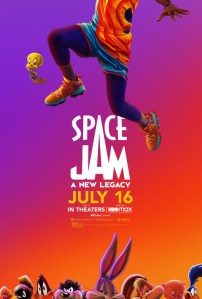 For a generation of millennials, those of us who came of age in the 1990s, Space Jam has miraculously accrued a nostalgic fixation. Michael Jordan starred alongside cartoon favorites and we all learned valuable lessons about teamwork. The soundtrack also, as the kids say, slapped, with that titular banger welcoming us to the jam and the R. Kelly eponymous ballad, “I Believe I Can Fly.” Flash forward 25 years, and a new basketball superstar is looking to relaunch the franchise and reinvigorate the Looney Tunes pals for a new generation. Lebron James plays a fictionalized version of himself struggling to connect with one of his sons. He wants the boy to take basketball seriously but worries about his commitment and thinks video games, the child’s true passion, are a distraction for him. He and his son get sucked into the “server-verse” of Warner Bros. studios thanks to an angry A.I. (Don Cheadle) who just wants respect. The scornful A.I. challenges Lebron to a basketball game while tempting Lebron’s son to the dark side. Lebron teams up with Bugs Bunny to reunite the classic Tunes to put together a winning team.
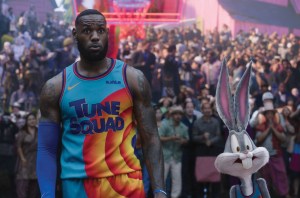 This movie is clearly not intended for adults but at the same time it feels engineered from their references. Are children going to understand William Shatner impressions? Parodies of The Matrix, or Mad Max: Fury Road, or Casablanca? To that end, I question if we’ve come to a point in popular entertainment where the Looney Tunes characters have been eclipsed. When I grew up, cable television, let alone channels devoted to entertaining children, were just beginning in the 1980s, so I did grow up with classic cartoons from decades prior. I knew about Bugs and Daffy and Tom and Jerry and Hannah Barbara and the old guard. Modern American children have grown up with a generation of original cartoons and programming and I would argue they have more nostalgic reverence for shows like The Fairly Odd Parents, Gumball, and other popular Cartoon Network originals. I strongly doubt that the majority of the movie’s stated target audience, children, have any emotional investment or recognition for the old Looney Tunes characters. Perhaps the entire Space Jam sequel is designed to reignite interest in a certain younger demographic, and this wouldn’t surprise me as its real source for existence. To be fair, the original 1996 Space Jam was created to sell sneakers, so it’s not like this is out of step for the franchise’s integrity.
The conception of this movie is less about Lebron James interacting with the classic Looney Tunes characters than Lebron James being the spokesman for a catalogue of Warner Bros. intellectual property (IP). What children are sitting around saying, “I can’t wait to interact with all my favorite Warner properties?” Children do not think like this, they don’t segregate into tribes for different corporate masters. They like what they like and don’t think about whether its corporate parentage is with Disney or Viacom or whatever. Space Jam: A New Legacy feels less like a story or even a movie and more like a catalogue launch for the Warner Bros. gift shop (get your Grandma Matrix sweaters just in time for the fourth movie coming out these holidays!).
 The intermingling of different worlds and properties can be done, see The Lego Movie, but more needs to be done other than transporting characters into a world they do not belong. Watching Granny perform moves from The Matrix isn’t funny because what is even being set up for comedy? It’s not a tweaking or commentary on the original, nor is there any recognizable comedy angle; it’s what Family Guy typically does – repeating the scenarios but with different faces. There is a key difference between reference and parody (a point I have discussed at EXTENSIVE LENGTH in my reviews of the very bad Friedberg and Seltzer spoofs). Nobody cares that much about these characters that just seeing them in a different environment is enough. Watching Wile E. Cayote as one of the War Boys in Fury Road is not enough, and I absolutely adore that movie and consider it an instant classic, but if I wanted to just watch Fury Road, I would gladly just watch Fury Road (they do not even call it “Furry Road,” come on!).
By far, the most confounding part of this new Space Jam is the decision-making process over what IP should be included and what should be excluded. I would be fascinated to watch a documentary series just on the creative clashes with studio execs. There are some bizarre choices selected to attend the culminating basketball game as rowdy spectators. I can understand memorable figures like King Kong, Dorothy from the Wizard of Oz, the Iron Giant, and the Scooby Doo van. Those are immediately recognizable for modern-day children. However, why is Jim Carey’s Mask character there? Why is the grotesque Danny DeVito version of the Penguin there? Why is the Night King from Game of Thrones there? Why is Pennywise the Clown, a vicious and frightening character, there? Why are the droogs from A Clockwork Orange there? Who is that supposed to appeal to? Why would anyone in their right mind include a gang best known for wanton violence and rape to be faces in the crowd to cheer on a basketball game? It would be akin to taking the hillbillies who rape Ned Beatty in Deliverance and placing them side-by-side with cartoons for a movie intended for children. If the droogs and Pennywise made the cut, what inappropriate characters from the vaults of Warner Bros. were denied? This fascinates me.
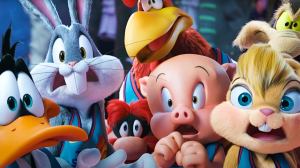 I also have problems when Bugs and the other Tunes step into the third dimension. Characters that were intended for two-dimensions always look awkward when transported into a three-dimensional realm. It was a smart move keeping the cartoons as their standard hand-drawn selves in the original Space Jam. When the big basketball game commences, the Tunes and James are pulled into three dimensions and the characters do not look good. The circumference of their heads and how it relates to their mouths moving looks all wrong. Bugs looks like a Mylar birthday balloon that has somehow gained sentience. This extra step is likely meant to appeal to modern-day audiences who have turned their noses on more traditional hand-drawn animation in feature films (Tangled and Frozen began as 2-D animated films before going to 3-D). It’s another curious case meant to modernize the Looney Tunes and appeal to a younger demo, and yet it runs counter to so much more of the programming choices and contradictory decision-making.
Is Space Jam: A New Legacy a good movie? Quite simply, no, but then by objective standards neither was the original Space Jam. Lebron James may still be trailing his Airness in a few more NBA records but King James has more natural charisma and acting ability than Jordan who settled as straight man/pitch man. There is an occasional joke that earned a laugh from me, the best being the bait-and-switch reveal of Michael Jordan returning to the Tune Squad, which also seems to imply that Sylvester the cat is kind of racist. I liked Lil’ Rel. Congrats also to the filmmakers for bringing back Lola Bunny, having her voiced by Zendaya, and realizing she can just be a lady bunny good at playing basketball. The original Lola Bunny was hyper sexualized and I’ve already read too many comments from dregs on the Internet upset this new rabbit doesn’t make them feel funny in their pants (“IF I CANNOT OBJECTIFY THIS CARTOON RABBIT, THEN WHY AM I EVEN WATCHING A MOVIE INTENDED FOR CHILDREN?”). The moral or message is pretty simple about accepting others for who they are and not how you demand, which is weirdly exemplified in a cross-generational conflict where Lebron will not allow his son to play video games because his coach growing up thought they were a waste of time. As if he’s only allowed to play basketball with every waking and sleeping second of his existence. Lebron grew up in the late 90s when video games were mainstream and great. His son is an obvious game design prodigy, but it will take him the whole movie to see.
 Feeling like the unholy IP orgies that were Ready Player One and The Emoji Movie, the Space Jam sequel (or reboot) feels more like a catalogue launch or a streaming channel opening its vast archives for ready-made consumer consumption. There are several moments where I just shrugged and said to myself, “Well, that happened,” like Granny doing her fancy Matrix moves or Porky Pig battle rapping. I think the idea of Lebron helping the classic Looney Tunes characters in another wacky edition of basketball would have made for a suitable children’s movie. The original only focuses on the Looney Tunes and gets by. For whatever reason, the studio execs insisted to the six credited screenwriters (pity them all, and the sixty un-credited) that this serve not as a franchise relaunch but as a corporate portfolio branding showcase. The movie gets lost in the shuffle from all the haphazard and contradictory impulses to see this through, turning from the game of basketball into decades-past-their-prime Austin Powers jokes. Regardless, Space Jam: A New Legacy is less new and more everything Warner Bros. owns the rights to in the past that they would like to remind you about. Watch it all now on HBO MAX, folks!
Nate’s Grade: C-
Share this:

Luca (2021)
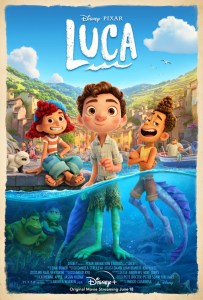 Pixar’s second straight direct-to-Disney-plus outing, Luca, is a decidedly lesser movie from the creative powerhouse. It’s more in keeping with the low stakes and minimal characterization of something like the Cars franchise or Monster’s University. It has its gentle charms and important themes about acceptance, accessibility, and identity, but Luca feels a bit too shallow and lacking in magic. Two sea monster boys want to feel the thrill and freedom of living on land, and it just so happens they transform into looking like humans as long as they don’t get wet. They must learn the ways of blending in, keep their secret, and win the local triathlon to achieve their dream of owning a Vespa scooter. Yes, ostensibly it’s about two kids, and a third once they become friends with a rambunctious redheaded girl in town, wanting to win a race to get a scooter, and you can see the larger theme about friendship and self-acceptance in the name of intolerance, but the movie feels like Ponyo meets The Little Mermaid with the setting of Call Me By Your Name (with maybe some of its coming-of-age queer coding?). The movie barely gets to 84 minutes long, pre-credits, and even that feels very lackadaisical and padded, stretching a thin storyline with minimal development. The animation is expectantly gorgeous and colorful, the lovely daubs of light are so soothing to watch, though I didn’t care for the Gravity Falls-style character designs. The stakes are low and personal but I didn’t really care about the broad characters. There are some fun farcical hijinks trying to hide their monster selves from being seen, and the conclusion has a sweet message without being overtly sentimental, but Luca is little more than a fitfully amusing yet slight seaside vacation for your hungry eyes.
Nate’s Grade: B-
Share this:

Wolfwalkers (2020)
 Beautifully animated with painterly water color visuals, Wolfwalkers is another treat from the acclaimed Irish studio that is single-handedly trying to bring back hand-drawn animation. The visuals are a delight and styled in a flat dimensional space reminiscent of Medieval tapestries (and Wes Anderson movies). The story brings to life 17th century Celtic mythology in a way that is still relevant today and concerns weighty themes about family identity, female independence, religious persecution, prejudice, colonial occupation and exploitation, and environmental conservation. It’s part Miyazaki and Brave and also reverent to its own cultural heritage, and it’s emotionally affecting and engrossing as well as being a treat for the eyes. We watch a young girl befriend a wild “wolfwalker,” a girl who can transform into a wolf when she sleeps. their bond will push each other to fight against forces trying to dominate the forest and morality. The filmmakers have carefully laid out the rules of their story and the implementation of the special powers so that everything happens through gradual circumstances where the plot feels as if it is following an entirely organic path. The voice acting is excellent and heartrending and perfectly paired for the exaggerated, wood-block-styled character designs. It’s a lovely and entertaining supernatural fable with enough thematic relevance, girl power, and visual grace to reaffirm just how magical traditional animation can still be.
Nate’s Grade: A-
Share this:

Raya and the Last Dragon (2021)
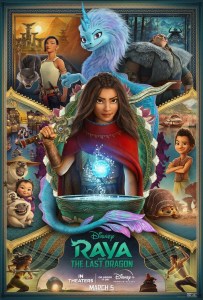
Disney’s new animated feature, Raya and the Last Dragon, is coming at an opportune time and in some ways it’s a movie of the moment. It’s all about a divided nation learning to heal and learning to trust one another despite bitter disputes. I can only hope the ensuring months and years of political dispute in this country can end as fortunately as Disney’s fantasy fable.
We follow Raya (voiced by Kelly Marie Tran) as she embarks on a quest to save her people and the divided lands of Kumandra from a mythical evil that has returned to the land. Dragons gave their lives to fight this monstrous force known as the Druun that turns life into stone. The world has been divided into separate nations surrounding a dragon-shaped body of water. There is Tail, Claw, Heart, Fang, and Spine, Raya ventures to uncover the last dragon, Sisu (Awkwafina), the dragon that originally thwarted the Druun, except Sisu says she’s not exactly the best at magic and dragon stuff. Together, Sisu and Raya are chased by Raya’s childhood nemesis Namaari (Gemma Chan), the next-in line with Fang, the nation blamed for the new outbreak of the Druun. Raya must find a broken piece of Sisu’s dragon stone from each nation to level up her powers and banish the Druun once and for all and return everyone who has turned to stone, including her father.

In many ways, Raya feels like Disney trying to do its own fantasy universe akin to the Last Airbender series. The world building is tantalizing and feels lived-in, the lands distinct and with personalities and different cultures, and those cultures are respective of their environments. I was pleased to continue with the movie and discover more well laid details that built out this world and its inhabitants, the relationships to the dragons, and the veneration of magic. The stone statues each represent a person succumbed to the evil, itself a byproduct of the inability of the splintered nations to unify and trust one another (more on theme later). I appreciated the respect and reverence given to the fallen and to the dragon statues as well. There’s a scene where Namaari and her crew are walking through a field of overgrown dragon statues and they treat it with such reverence like it was a war memorial. For Namaari personally and for Fang especially, the sacrifice of these creatures is one that humanity has been struggling to live up to. I also appreciated that the magic and lore is presented as we need it, so that the audience is overloaded early with an onslaught of new information needed to orient this make-believe world. The filmmakers do a fine job of building from previous established information and expanding naturally to complicate their world and the larger conflict. The plot through line is left pretty simple, collect the pieces of the magic rock, but because of the accessible formula it also builds anticipation we can attune to. It gets me to wonder what new power Sisu will inherit, how that new nation has dealt in the ensuing time with the power and influence of the magic shard, and what new fun character we’ll pick up along the way.
Raya is also an exciting edition to the Disney animated collection. I’ve watched the movie twice, and would watch again, but I really honed in on the action during my second viewing. The fight choreography is impressive and not simple standard kicks, punches, and sword slashes. There are specific moves and countermoves here, and the long takes with the action allow the audience to appreciate the complexity of the brawls as if we were watching The Raid. There were some moments that genuinely gave me goosebumps. I also appreciated that the action isn’t gratuitous; each scene has an emotional connection to a character and their conflict, even the many run-ins between Raya and Namaari trying to prove themselves against one another. This is also a movie where we are replete with strong female characters, diversity, and women in positions of power, and nobody makes a big deal out of it. It’s accepted as the norm and I think that’s smart. It’s nice to add another kick-ass Disney “princess” and for there to be not a single mention of romance throughout the movie. There are bigger issues and the ladies aren’t fighting over a boy’s attention but over their personal rivalry and anger. For a briskly paced 100-minute movie, Raya and the Last Dragon has enough action and awe to provide satisfying thrills for all ages.

Where Raya admirably succeeds is with its adherence and execution of theme. The characterization can be limited at times for anyone beyond our protagonist, but that doesn’t mean that the supporting players are without charm and resonance and importance. They contribute nicely, just in other ways. The screenplay does an excellent job of supporting the theme of trust and unity, a topic that is in short supply today in a turbulent time of social and political upheaval. The different clans of this fantasy land have resentment, animosity, and decades of score-settling to make it even harder to trust, especially anyone from the Fang nation, the people blamed for the current epidemic. It’s much easier to project anger on an outward force rather to blame than look at our own culpability, and it’s even harder to take that first step to repair the damage done from broken trust and manipulation. Still, the entire journey of Raya, both film and character, is on the importance of taking that step regardless of whether or not it works. Each character from a different nation represents another factor in dealing with grief, and each has reasons not to trust the others, to only think about themselves and their interests, to perpetuate a failing cycle.
The movie articulates the dangers of holding onto grudges and distrust with every moment, so when the climax happens it’s a small yet very meaningful payoff, where the characters don’t make grand final stands and showcase amazing powers against an overwhelming force. No, instead it’s about demonstrating faith in the possible goodness of another person and taking a leap. Sisu suggests offering a friendly gift to make amends and it becomes a running joke but it’s also indicative of her character and personal experiences, how she differs from the contemporary and more nihilistic world, and the larger theme. The movie mentions several points how empowering trust can be, to be valued and believed in, regardless of mistakes and misgivings, and Raya embodies this with every decision, meaning even the small moments and silly side characters have a larger purpose and contribution to the overall message of this tale.
There are some elements that hold Raya and the Last Dragon back from true greatness, joining the ranks of Disney’s recent epic 2010s run of Wreck-It Ralph, Zootopia, Moana, and yes, Frozen (sorry haters, it’s still great). As I said before, the supporting characters are kept more at the idea level than multi-dimensional. They each represent a facet of loss, but I would have liked a little more attention given to them to have more tiny character moments and maybe even some realized arcs. As it stands, they support Raya on her arc and they become subsumed by her arc, and it works, but there was an opportunity to deepen these cute supporting players into more meaningful members. There are some elements that feel like holdovers or clues about earlier drafts, little remnants of scrubbed storylines. Repeatedly Sisu will remind us what an excellent swimmer she is as her special dragon power and we witness this once to use in a minor escape. With the build-up given, you’d expect the movie would make more with this in a climactic manner.

Raya and the Last Dragon is a worthy and exciting entry into the Disney animated canon and presents a fantasy world of its own making with detail, ingenuity, and care, supporting a central theme with every primary creative decision, even if some of them hinder what could have expanded the film into an ever bigger and more diverse ensemble. As it is, it’s all about Raya, who is an engaging and compelling figure trying to prove herself and atone for her own guilt. Her rival is given consideration as well from the pressure she’s under to serve her people. However, this is the Raya show (her name is in the title after all) and that’s plenty for 100-plus minutes of entertainment. Raya and the Last Dragon is a good-to-great animated fantasy film and one I think could support further exploration. This could be the start of Disney’s own Airbender world if they wanted. The animation is fluid and colorful and gorgeous and the character designs are easy to distinguish without placing undue emphasis on exaggerated features to characterize this as a Chinese fable. The vocal acting is great, and by the end of the movie, as its theme comes full circle, I don’t mind admitting I was even tearing up a bit. It’s a well-designed and well-developed fantasy with a secure emotional foundation to build upon.
Nate’s Grade: B+
Share this:

Soul (2020)
 I needed to watch Soul twice before I fully processed how I felt about it. Pixar’s latest animated wonder follows a New York City music teacher named Joe (voiced by Jamie Foxx) who goes into a coma right before his big break playing for a jazz legend. He’s transformed into a cuddly little blue tuft of cloud creature and informed his soul is ready for The Great Beyond. In a nod to Heaven Can Wait, Joe indignantly fights his way back to Earth to reclaim a life he felt was just now getting on track. His ticket back to Earth is through mentoring a surly, pessimistic young soul 22 (Tina Fey) that nobody seems able to reach, even Mother Theresa. Early on, there are two very clear realizations. First, Soul is beautiful to look at and very weird and art deco with its character designs in its spiritual realms. Second, the world building and rules of this special world are quite convoluted. Unlike Inside Out where you were dropped into a new world and all the parts added up with a sense of logic, the spirit world and especially the process of how baby souls become what they are seems hazy and arbitrary and not fully articulated. This confusing world building also includes the idea of people “being in the zone,” lost souls wandering the land as lumbering monsters, and a traveling group of mystics that can meditate their way into this higher plane of existence. That’s even before a second act trip back to Earth that reminded me of Brave and leaned into slapstick and comical misunderstandings. There is a soul guardian on the hunt for Joe to keep things back in order, though the consequences of a soul count being out of whack are never explained. I thought this antagonist character was going to amount to much more but is mostly forgotten. Where Soul succeeds is with its heart about people trying to find their spark, that special something that lifts their spirits and makes them who they are, and I think it’s an important lesson that it’s not the same as a purpose. The comedy banter between Foxx and Fey is solid and there are some funny sequences and a few gags that impressed for going the extra mile. I was interested from the opening moments but I cannot say I was terribly emotionally invested. Part of this is because the movie swiftly runs through so much world building and rule-setting in 90 minutes, partly because the character of Joe is a bit close-minded in how he designates success, and partly because the young character of 22 feels more like a sidekick than a developed supporting role. The musical score by Atticus Ross and Trent Reznor is highly original and evocative. It was providing an emotional resonance and wonder I found missing at other points in the film. It feels very ethereal and propulsive and just new and exciting. The climactic track “Earthbound” feels so stirring and emotional and light. It’s my favorite film score of the year. Soul is a fun and imaginative movie that has some wrinkles with its world building, characterization, and delayed emotional investment, but even a second-tier Pixar movie means it’s still one of the better movies you’ll see for 2020.
Nate’s Grade: B
Share this:

Dancer in the Dark (2000) [Review Re-View]
 Originally released October 6, 2000:
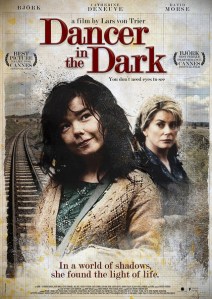
Lars von Trier’s latest shaky video opus is likely the most unique movie going experience you’ll have all year. Dancer in the Dark is a clever, heartfelt, and achingly beautiful tale of sorrow and redemption. Dancer stars Iceland’s version of Madonna in the elfin Bjork. She plays Selma, quite possibly the nicest but also most stubborn person in the world. She’s an immigrant in 1960s America working long and odd hours to ensure that she can raise enough money for her son. You see Selma is slowly going blind but continuing to work so she can make sure her son will not have to suffer the same inherited illness. So she works late on heavy industrial machinery causing accidents as her condition worsens all to stop her son’s genetic curse she will give to him. Selma’s escape has always been musicals. In life she hears music in unusual places and visualizes life stopping to burst out into a vibrant fully choreographed musical number. Selma’s life continues to degenerate along with her vision as events pile on worse and worse until they all come crashing together.
Dancer in the Dark is no picnic in the park. The movie is haunting but incredibly depressing. Lars von Trier’s previous film (Breaking the Waves) was another wrenching drama with good people going through rough times with no fraction of light at any end of a tunnel. His jerky handheld video work is back capturing the life of Selma and seemingly framing it in a more realistic sense. The video images are edited to look like a documentary and the whole feel is one of raw power. You aren’t merely watching a film, it’s like you are in it witnessing the actions from the sidelines. The escapist musical numbers are shot in glorious still film to contrast the drab realism of video. The colors are bright, the faces are happy, and the cinematography is a wonder to envision.
 Bjork soars and delivers what should be an Oscar-caliber performance. I never knew the queen of alt-rock had such emotive powers. Selma’s innocence is keenly expressed in Bjork and her glassy eyes. Her love for her son is no more evident then all the suffering and tragedy she goes through. All of the suffering and tragedy could be avoided – except her son would not be helped.
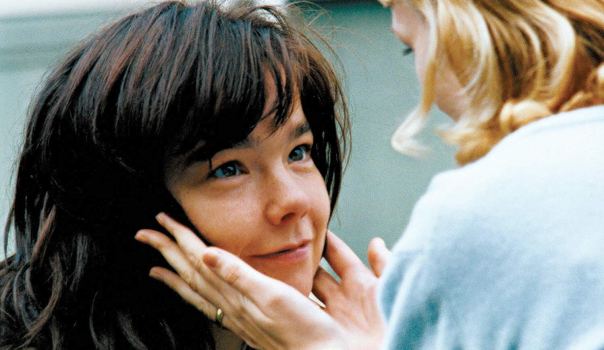
The ensemble around Bjork work fantastic magic as well. Peter Stormare is a sad figure trying to just get a glimpse of Selma’s attention. David Morse is a down-and-out policeman who is Selma’s landlord and in need of some cash. He’s afraid to tell his bourgeois wife they’ve run empty with money. Catherine Deneuve turns in the brightest supporting performance as Selma’s co-worker and friend Kathy. She’s torn between trying to stop Selma from continuing on her acts that could cause her harm and helping her along her determination. A great scene as example of her care for Selma is when the two of them are in a theater watching an old Hollywood musical. At this point Selma is completely blind and can’t see what’s going on, so Kathy takes Selma’s palm and dances her fingers in correlation with the actions on screen to Selma’s delight. A simple scene yet so elegant and beautiful.
Dancer in the Dark is a wonderful piece of original film making that gives us the escape of hope and the crush of despair. Selma’s love of musicals and their role in life is perfect symbolism for discussion. Dancer will leave you with a distinct feeling by the end credits. Whether it’s sorrow or bewilderment Dancer in the Dark is a film not to miss.
Nate’s Grade: A
——————————————————
WRITER REFLECTIONS 20 YEARS LATER
I knew going back to my first Lars von Trier film was not going to be a pleasant experience, and oh what an understatement that turned out to be. von Trier has compared himself to a Nazi, his intense methods have driven his actors to the brink, including Dancer in the Dark’s Bjork who swore off the entire profession of acting after her experiences working with him. I am not surprised by this response because his movies have famously followed a formula of a woman being tortured by men, by society, by forces outsider her control, and then she suffers for two hours and dies, a victim of the cruelty of the universe. Repeat. It’s a formula that I’ve since grown weary of and after 2018’s The House That Jack Built I contemplated not watching another von Trier movie again. He just can’t help himself and his nihilistic, heavy-handed impulses handicap his genuine artistic abilities and the merits of his storytelling. Back in 2000, it all felt relatively new. von Trier was the biggest name of the Dogme 95 movement, a Danish collective of filmmakers who swore to adhere to digital video and other aesthetic rules to better replicate reality as it was, ripping away the glossy artifice of Hollywood fantasy. von Trier was subversive, provocative, and exciting, and since then I’ve broken free from the von Trier spell. I was questioning whether I would share Requiem for a Dream or Dancer in the Dark with my girlfriend, who had seen neither, and in hindsight I’m glad I picked Requiem instead (think about that, yikes).
Dancer in the Dark is a powerful experience and one that is unfortunately smothered by von Trier’s heavy hand. It’s easy to root for Selma (Bjork), a Czech transplant in small-town 1960s America (the movie was filmed in Sweden because von Trier is afraid to fly). She already has so much going against her: 1) she’s a woman, 2) she’s an immigrant, 3) she’s poor, 4) she’s suffering from a degenerative disease that will rob her of her sight. Even worse, her son will suffer the same fate unless Selma raises enough money for an operation. She takes on extra work at her factory, even if she’s not exactly qualified, and she’s a hopeful yet stubborn woman who says what she means, earning friends who will champion her. She’s also a lover of old-fashioned Hollywood musicals, as they presented an escape to her as a little girl growing up in poverty. America was the land of opportunity, where everyone dances all the time, sings their hearts out, and gets the girl or the guy by the conclusion of the finale. That dichotomy, between reality and fantasy, and all the cultural and psychological commentary within, is the strongest aspect of the film and a peak of ambition that von Trier never really got close to again with his later punishing dramaturgy. The first musical number doesn’t come until 45 minutes into the movie, and by that time we have had our heroine, her plight, and the first markers of a looming tragedy efficiently established.
 Jeff (Peter Stormare), a lovesick co-worker who shows up every day to maybe drive Selma home, cannot understand musicals, saying people just burst out into song and how unrealistic this is, and Selma agrees, but for her it’s wonderful. She hears music in the world around her and it gives her life, especially as her vision deteriorates. As injustice after injustice falls upon her, Selma uses extravagant musicals as an escape, where everyone is a friend waiting to jump into the number and work together. A common refrain she sings is “there’s always someone to catch me,” referencing the choreography of musicals where the dancers frolic together but it’s also her request to the universe for a little help, for someone to catch her when she stumbles and provide that level support a woman of her means and background lacked in this landscape. The musical numbers staged by von Trier have a chaotic energy to them, assembled from dozens and dozens of sporadically placed cameras. They feel like a burst of imagination while keeping an improvisational feel; less drilled than managed. The first musical number “Cvalda” is a delirious daydream where Selma imagines the various sounds of the work machines creating a percussive symphony and she’s a Mary Poppins conductor. After Bill (David Morse) dies, she retreats to “Scatterheart” to make sense of her actions, with her son telling her she only did what she had to do and Bill rising from the dead to beg her forgiveness. When she’s in solitary confinement and can’t hear any sound, Selma goes into despair. She shouts the lyrics to selections from The Sound of Music to bring music back into her isolated world. Even on her march to execution, Selma copes by turning the “107 Steps” to the noose into a song. Her last words are her singing her final goodbyes to her off-screen son, so until the end musicals were how this woman chose to compensate for the rotten luck of her life. And oh boy was it ever rotten.
There’s one scene in the second half begging for symbolic unpacking where Selma is in the middle of her trial and the prosecution calls a famous Czech film actor and dancer to the stage. It’s none other than Oscar-winning theater legend Joel Grey (Cabaret) and his character doesn’t know who Selma is, even though she told the court she had been sending money to him (she listed her son’s account for his operation under a pseudonym to not risk it being derailed). This famous actor starred in movies in her native Czechoslovakia and crossed over to American cinema. He was an idol for young Selma and another figure to encapsulate the promise of America. Then as he’s testifying on the stand is when Selma drifts back into another rendition of “In the Musicals” and Grey joins her in tapping, and he confesses, “I didn’t mind it at all / That you were having a ball / at my musicals / And I was always there to catch you.” He understands and empathizes. This scene alone is just packed with so many layers of metaphor and projection and symbolic subtext and commentary and you could probably write an entire Master’s thesis on its myriad meanings. At its best, that’s Dancer in the Dark, when von Trier is using the language of musicals to subvert their form, to lay commentary on the un-reality is a rejection of the cruelty of real life, of finding order in disorder, finding community amid a nest of selfish vipers competing for dominance. It’s when von Trier uses our understanding of musicals to really make us think about the associations and contradictions that makes this movie a stirring and sometimes sensational experience.
 Alas, the artistry is seriously wounded by von Trier’s heavy-handed approach to all drama. This has become even more pronounced after where von Trier has obliterated the entire world (2011’s Melancholia) and ruined a four-hour movie with a last-second dumb joke of an ending (2014’s two-part Nymphomaniac). Subtlety is not one of the tools von Trier prefers to dabble with. It’s a shame because he’s a natural storyteller when it comes to establishing vulnerable characters in fraught scenarios and slowly raising the temperature, organically transforming allies into enemies and friends into abusers. This is done very well in 2004’s Dogville as well, a movie I would argue both plays into and succeeds his tortured-woman formula of drama and political allegory. I would say Dogville is his second-best film precisely because I was expecting another unrelentingly unjust ending for another anguished woman. However, where a lighter touch could accomplish his points, von Trier instead brings out a bazooka. Selma’s deadly encounter with Bill happens at the halfway point in the film. From there there’s still another 65 minutes of her suffering to drag out to preposterous proportions. We go through the trial, her cross-examination, her willfully keeping secrets that will only make her look guilty to maintain a promise to a dead man, and then there’s her visitations in jail, her appeal, her rejection of her appeal because the costs will empty the fund’s for her son’s operation, the realization of her impending execution, the march to the execution, her being bound to a board because she cannot stand straight because she’s so scared, her rejection of the hood, her last song while she waits for the governor’s call, and then her abrupt death. There were several points where I was just pleading, “Enough already,” because it was so thoroughly exhausting.
Selma is served to be a martyr of an unjust system that looked suspiciously on immigrants, and Selma elects to accept her fate because anything less would endanger losing what she has set up for her son’s well-being. This woman takes all this punishment and that’s the story, America. That’s the story of America, America. That’s what von Trier is getting at, but the 140-minute movie is so overdone and so drawn out to obsess over the wrongs inflicted on this poor woman that it unintentionally blunts the message. The second half becomes a passion play where we watch our poor Selma elect to accept tragedy and self-sacrifice and endure all the injustices. It’s harrowing and upsetting but would still be so if we didn’t spend half of the movie dwelling on a litany of examples of her fated misery. I’m sure others will argue the crushing nature of the injustice is meant to convey for the viewer the feeling of aggravation and outrage. I would agree that outrage is sought, but when von Trier doesn’t let up, it tilts into overwrought self-parody.
 Dancer in the Dark resonates as strongly as it does because Bjork gives every ounce of herself in this performance. She was originally just going to write songs but von Trier chased her for a year to convince her to also star as the lead. There are moments of awkwardness where it feels like maybe she’s confused in the scene with what her lines are supposed to be, but then her lack of polish is revealed for its true strength. It’s a deeply, deeply felt performance, stunning in how raw and empathetic she gets, subsuming herself into the character and her tribulations. You don’t see the craft so much here as you do sheer, undiluted passion and ferocious naturalism. She doesn’t hold anything back and gives the best performance in any von Trier movie. In my mind, she had been nominated for a Best Actress Oscar that year but this was not the case; she was only nominated for Best Original Song (“I’ve Seen It All”) where she wore her famous swan dress that became a go-to punchline. She was, and continues to be, an eclectic artist and a really weird person, but man could she be a tremendous actress given the right circumstances. It’s a shame that von Trier’s sadistic directing style lead her to quit the entire profession.
Looking back on my original review, I remember seeing Dancer in the Dark with my freshman pal Kat Lewis, who was just the biggest Bjork fan you could find in all of Ohio in 2000. We were both floored by the movie, and Bjork, and cited it as uniformly brilliant. With twenty years of distance, I can say some of the ironic commentary of undercutting musical escapism feels too easy now, seeking credit for daring to ask, “Hey, what if musicals weren’t so happy, huh?” It’s still a worthwhile subversion to explore but simply presenting it as a subversion isn’t enough for a satisfying thematic focus. It’s funny that the moments that stood out to me as an 18-year-old, like Catherine Deneuve dancing her fingers on Selma’s palm to communicate the onscreen dance routine she can no longer see, are the same ones that stood out to me as a 38-year-old. Good writing will still make itself known and felt. There’s plenty to admire and, paradoxically, enjoy about such a depressing movie, but von Trier’s inability to self-edit and hold back his condemnation of humanity is what truly oppresses his movie.
Re-View Grade: B


You must be logged in to post a comment.