Blog Archives
Percy Jackson & the Olympians: The Lightning Thief (2010)
 If you’re looking for a pristine example of mediocrity, then let Percy Jackson serve as the new definition. From the acting to the special effects to the story, this movie barely registers anything other than a disinterested shrug. Based on a series of young adult books, clearly the producers were eyeing a potential lucrative franchise, which may explain why they hire Chris Columbus as director. The modern-day scions of ancient Greek gods is an intriguing starting point, until you realize that the film is just going to become one big, dumb retread through Greek mythology without a hint of wit. It’s Greek mythology turned into a kid’s book report who never read deeply into the source material. The film’s best asset is its collection of adult actors (Pierce Brosnan, Uma Thurman, Steve Coogan, Catherine Keener, Rosario Dawson), which take your mind off the fairly bland teen actors in the lead. Percy Jackson would be a more forgivable drag if it presented any moments of wonder that didn’t feel trite. The plot has the maddening habit of making characters stupid for plot reasons (hey Lightning Thief who wants to start a God-on-God war, when you have Zeus’s lightning bolt, thus sealing an impending war, don’t stop and monologue!). Yet the film has enough going on that you can follow it with ease and a minimal commitment. Consider putting on Percy Jackson when you need to do some household chores; it deserves that kind of attention.
Nate’s Grade: C
Share this:

Harry Potter and the Deathly Hallows Part 1 (2010)
 When author J. K. Rowling dropped off her last 700-page tome in the Harry Potter series, the world went into a state of mourning, right after ravishing every page of The Deathly Hallows. There would be no more literary adventures. You can expect that same sense of longing for the studio suits over at Warner Brothers considering the Harry Potter franchise has grossed over five billion worldwide. The bounty was about to be over, especially with one last book to adapt into an eventual overly long movie. Then the suits came across a genius strategy: split the last book into two separate movies. Filmed simultaneously over a year, Harry Potter and the Deathly Hallows will be released in two parts eight months apart. I understand that it’s hard to say goodbye to the boy wizard that charmed millions, and tow movies almost guarantee that nothing will be left out in the adaptation process. It also ensures that Warner Brothers will have two movies that make giant piles of money instead of one. Deathly Hallows: Part One plays its part setting up the finale, but judging from what we’re given, this series conclusion could have effortlessly been condensed to one overly long film instead of two.
Picking up shortly after the events of Half-Blood Prince, Harry (Daniel Radcliffe) and his best pals, Ron (Rupert Grint) and Hermione (Emma Watson), are on the run. Lord Voldermort (Ralph Fiennes) is determined to be the one to slay the boy wizard. Voldermort and his influence have taken over many facets of the magic world’s infrastructure, and they are all after Harry. Harry learned that his snake-faced nemesis has broken his soul into pieces and hidden them inside magical items known as horcruxes. Unless these horucruxes are destroyed, Voldermort will never be able to truly die. Harry and company has to hunt down those accursed horcruxes while being hounded by evil forces determined to kill them all.
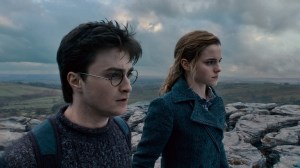 For a solid hour I felt like I was watching the second best Harry Potter film; Alfonso Cuaran’s Prisoner of Azkaban still stands as the artistic highpoint. Watching the characters on the run and constantly in peril spurs your protective feelings. We’ve seen them grow up, vanquish evil and hormones, and now they seem to be in serious danger and you feel real tension. I stopped to realize how much I actually cared for these characters and how concerned I was. There is a somber sense of finality, and I enjoyed characters and events colliding back together for one big finish. It truly feels like everything is coming to a titanic close, and the film manages to be the most emotionally satisfying of the series. That’s likely because it’s building off six films of character growth and goodwill. But it’s also due to the fact that Deathly Hallows spends the most time examining the characters of Harry, Ron, and Hermione. The series has followed a very lockstep plot formula and now it’s been stripped away. The kids are removed from the school setting so we get to spend plenty of time alone with the trio. In fact, it’s a bit too much time. We spend an interminable amount of time with these kids lost in the woods, waiting for something important to happen. While we wait we have the trio address fears, anxieties, and emotional hang-ups, which turns Part One into the most insular, reflective movie in the entire series. While this makes the movie rich with feeling before we come to the finish line, it also makes the film somewhat boring because these kids aren’t that deep.
Luckily, Deathly Hallows Part One presents some of the more exciting action sequences and tense mood yet for a franchise mostly built upon investigation and Hardy Boys stuff (with extra magic!). The Harry Potter world has always been more interesting to me the darker it got, and now the series has now firmly converted to the dark side (as far as PG-13 fantasies go). The opening shows each of the three kids being left alone, including Hermione protecting her Muggle parents by wiping away their memory of their daughter. Tough stuff. Then we transition to a floating Hogwarts teacher held prisoner by Voldermort and his legion of Death Eater followers. She’s struck dead and we see a tear roll down her bloodied face right before Voldy’s pet snake eats her. Parents be warned, this is no longer kid’s stuff. Death comes to several supporting characters and there’s plenty of spooky stuff that adds up to a gloomy atmosphere. The infiltration of the Ministry of Magic is a thrilling sequence. Harry and pals disguise themselves as Ministry workers to locate a horcrux from Dolores Umbridge (I cheered at the sight of Imelda Staunton back in pink). The scene is tense and lays out the stakes and important characters to fear. It also produces some potent drama as Ron is disguised as a Ministry member whose innocent wife is being interrogated. The moment culminates in a genuinely exciting chase sequence that got me excited for what was ahead. What I failed to realize is that there was not much more ahead.
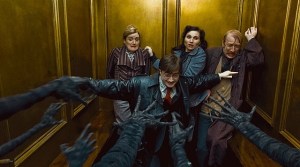 With all that extra attention spent on character, I can also say that Part One has some definite issues with its stagnating narrative. Having never read the books (get over it, Potter nation), I go in blind every time short for the mega-spoilers that I can’t help but learn thanks to all the Potter readers inhabiting my circle of friends and family. I can tell you if something doesn’t make sense because I don’t have the background knowledge of the books to fill me in. There was plenty in Deathly Hallows that made little sense. The adaptation introduces the titular deathly hallows, which ends up being another three super special magic items. There’s a nicely Gothic animated sequence to try and explain the three hallowed items, but it all adds up to a fairy tale that makes little traction. The narrative has already shaped up into a portentous scavenger hunt. Harry and friends are after the remaining horcruxes containing the soul of Mr. Snarly Face. The entire 145 minutes of Part One is spent destroying a single horcrux, leaving 3 or 4 remaining. Now they add three more magic items to find and it all compounds my feelings of fatigue. Did I mention they also have to find a magic sword? How many magical items are these kids going to be responsible to find and how many am I expected to care about?
I left the theater with many questions about what the hell the deathly hallows were, why they mattered, and all sorts of other storylines too. I could not follow all the new characters they threw so late into the game, especially some old wand maker and his connection to wand thievery. And when the hell did everyone gain the ability to teleport at will? Why don’t they teleport all the time then, especially out of danger or when they’re chased through the woods? My friend (an avid Potter reader) had to deal with a litany of stupid questions, likely treating me as a parent would a child asking about where the sun goes when it becomes night.
Also, the film is intended to be a prelude for an epic finale but it mishandles its own sense of climax at several turns. I’ll refrain from heavy spoilers, but one of the most interesting characters, played by an actor I adore, is killed off screen. Off freaking screen! Some other character comes back and says, “Oh yeah, he’s gone,” and then everyone looks glum and goes about their business. It happened so matter-of-factly and anticlimactically that I never made the connection. So later in the film when it’s confirmed that this character is in fact dead, I felt pretty thick. The last chapter of Harry Potter is destined to be a combined 5 hours, and you’re telling me they couldn’t fit in a fight scene that lets this character go out with style? I suppose somebody thought it was more dramatic to just mention a character death offhand. Following this logic, I can’t wait for the grandiose finale where Harry Potter just walks back into a room and says, “Oh, by the way, I just killed Voldermort. So who wants to get a bite to eat?” The emotional climax of the film involves the death of a supporting character I have yet to see onscreen for 8 years. How am I supposed to feel for a character that hasn’t been seen for so long? The ending is sad, sure, but it would have been more effective if: a) I knew what significance the character had in the narrative, and b) it didn’t look like Harry was clutching a rubber doll to his chest. We spend too much time with new characters that end up having minor worth or come across as one-offs. The movie would have benefited from some of the deathly exposition that clogged the first two film’s storylines. As the movie comes to a close it should be clearing things up instead of polluting the narrative with more names and faces.
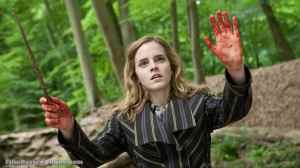 Director David Yates has been captain of the Potter helm since 2007’s Order of the Phoenix, and he seems to have found a unifying visual balance for the series. The film’s tone has gotten heavier and having a singular director take the series to an end looks to be a godsend. Despite a lengthy slog in the middle, Yates keeps the pacing fairly tight and tense. The visuals and special effects are just as luminous as ever. The true treat for me is watching all these splendid British actors assembled: Alan Rickman, Ralph Fiennes, Imelda Staunton, Helena Bonham Carter, Timothy Spall, Jason Isaacs on Team Evil, and Brendan Gleeson, David Thewlis, Rhys Ifans, Julie Waters, Robbie Coltrane, Michael Gambon on Team Good. Then there are new additions like glass-jawed David O’Hara (Wanted) and the great Peter Mullan (Young Adam) making strong yet short appearances. I don’t really care why all these talented thespians are together but I’ll enjoy them all the same.
Harry Potter and the Deathly Hallows: Part One is the beginning of the end, literally a prelude for the finale coming to theaters in summer 2011. The film manages to be exciting and dramatic and equally boring and confusing, especially for someone who has willfully refused to read the books. Spending more time with the teen actors has its pluses and minuses, chief minus being that while they wait for stuff to happen so do we. The manufactured end point for the movie feels far from satisfying, but the film manages to effectively whet the appetite for the follow-up. As the Harry Potter series comes to a close it’s hard not to get nostalgic and apologetic, but I resist this urge. Looking back, many of the Potter films have been fine pieces of entertainment but also too long, misshapen, and too slavish to making a book on tape. Part One of Deathly Hallows still falls victim to some of these faults, but the accumulated goodwill of the series and actors makes a 145-minute prologue easily bearable.
Nate’s Grade: B
Share this:

The Last Airbender (2010)
 Let The Last Airbender be a shining example of how NOT to adapt a children’s fantasy series into a standalone 90-minute movie. M. Night Shyamalan was hired to write and direct the popular Nickelodeon cartoon into a major movie with a major budget. It’s astounding how poorly made on every front this movie is. Seriously, people should be taking notes because Shyamalan has given a blueprint of blunders to avoid. The first blunder, and perhaps the source of all the others: hiring Shyamalan to begin with.
The film takes place in a fantasy realm where human beings are divided into four different nations based on the natural elements: earth, fire, wind, and water. Each nation has a special select group of people that can control that element. These people are known as benders. The one figure who can control all four elements is referred to as the Avatar, and this figure is reincarnated into a different nation each generation. In the absence of the last Avatar, the fie nation has invaded the other nations. Prince Zuko (Dev Patel) has dishonored his father, leader of the fire nation, and been banished. He seeks redemption by attacking the water nation, where siblings Katara (Nicola Peltz) and Sokka (Jackson Rathbone) live. They discover hidden among the ice a small bald child named Aang (Noah Ringer). This kid is the last of the airbenders and is believed to be the last reincarnation of the Avatar. For obvious reasons, Prince Zuko is after the Avatar to regain his father’s acceptance.
 At one point christened with the moniker of “the next Spielberg,” the writer/director has been slipping and sliding down into the pits of his self-deluded grandeur and stubbornness. After Lady in the Water and The Happening, who in their right minds would give this guy $150 million to direct a special effects-driven summer action movie AND let him adapt the show too? Even if you somehow managed to convince yourself that Shyamalan sitting in the director’s chair was a feasible solution, why on Earth would you let this man near the screenplay? I must repeat: did people see Lady in the Water and The Happening (this is a rhetorical question, because nobody wants to remember seeing them)? The Airbender series is a very well regarded television show that has appealed to audiences of all ages, including those old enough to buy their own beer, thank you very much. What purpose does it serve to ditch the show’s creators and longtime show runners in place of giving the responsibilities for coming up with plot, characterization, and God help us, dialogue, to the man that last gave the world The Happening? The Happening, people! What did you think was going to happen? Even with the lowest of expectations, The Last Airbender will still confound with its dead-on-arrival acting, zero character development, and overly serious spiritual mumbo jumbo. Who at the studio read Shyamaln’s adaptation and thought it was ready to move forward?
The Last Airbender begins with an opening scrawl informing the audience of the four different nations and the significance of the Avatar. Then it sprints forward without ever establishing context. Spending time to explain the rule and makeup of a new world is essential to the fantasy genre; we need to be able to know the rules of this universe and the dramatic stakes. Shyamalan establishes his villains via a lame text crawl. How hard would it have been to open the movie by showcasing the Fire Nation being big and bad? Most films open by establishing the bad guys in true villainous form. This movie would have started out so much better by establishing the villains, their mission, why they’re so bad, and introducing the general audience to the family of bad guys. That way our first introduction to them isn’t so perfunctory. In the film as it is, Shyamalan just sort of slides his characters into the plot in the most bumbling, awkward fashion. We don’t even learn about Prince Zuko’s banishment firsthand. In grand Shyamalan style, characters explain to the audience at every opportunity. Because why would you rather watch Zuko try to impress his father, fail and become scared, and have his father banish him from his nationality, promising to return and win back his father’s approval… when you could just listen to a character recite what took place? Isn’t that way better than watching something in a visual medium? There are a terrible amount of moments that feel clumsily strung together, like several important scenes were taken out at the last minute.
 This is emblematic of the entire movie because unless you’re well versed in the Airbender story, you will be as clueless as I was. I had no idea what was going on for most of the movie. Suddenly characters appear. Suddenly they can do some magical ability. Suddenly they can’t. Suddenly they’re gone. Suddenly we’re somewhere new. Suddenly this character’s dead/ Suddenly the Earthbenders are all kept together in a prison that lies atop plenty of bendable earth. Where’s the correctional planning on that one? I couldn’t explain why anything was all of a sudden happening, or what the exact rules were that helped or hindered characters, and I was left grasping for any sort of workable motivation among all the ridiculous and reflexive New Age spiritualism. Shyamalan and the film’s producers do not set up a damn thing. The film operates on a false assumption that the audience is already familiar with the source material, so it never stoops to setup plot or explain characters and events. That would be a waste of time when they have more substandard water effects to show. Because why would you want to spend $150 million on a movie that appeals to people outside a narrow margin of fans? And when you try and try and cannot understand what’s happening on screen, it’s only natural to lose interest. When the film is as dopey as The Last Airbender it only speeds up the process. I was deeply apathetic all the way through this ungainly mess.
I don’t think there’s anything that irritates me more in a fantasy film than when characters treat everything with such general indifference: “Ho hum, we just found a bald kid and his flying buffalo in a block of ice. Ho hum, he can master all the elements. Whatever. What’s on TV?” If the characters can’t be bothered to care then why should I?
I don’t know what this movie spent on special effects but whatever it was it clearly wasn’t enough. Last Airbender has some of the worst special effects I’ve ever seen in a major Hollywood summer release. Did the ILM gurus pass along their effects work to their interns? The green screen work, featured early with Katara and Sokka in some Icelandic realm, is ridiculously shoddy. People look like they have halos as they stand out against the all-too fake backdrops. The special effects in general are missing a polish and resonance that helps to disguise the illusion. I have to admit that it gets pretty boring watching one character hurl blue water orbs while another hurls red fire orbs. You would hope that a movie where people can control natural elements for combat they could do something more imaginative than fling different colored blobby orbs at each other. You have the power to control fire, the power to command the oceans or the wind, why must you low-ball it? I saw infinitely better choreographed elemental fighting on old episodes of Captain Planet and the Planeteers.
 Once again Shyamalan completely betrays the trust of his actors (don’t think Zooey Deschanel can give an awful performance? See The Happening). He gets lost in the whirlwind of special effects and fantasy worlds, so his actors get short shrift when it comes to direction. Ringer look the part and can perform the tricky martial arts moves with ease, but is that the best reason to hire an actor? Can’t makeup take care of perfecting a look? Can’t a stunt double fill in for the more challenging physical stunts? I’d rather have somebody who can act rather than just look like the human form of an animated character. Ringer is an annoying messianic figure to have at the center of your franchise. His counterparts don’t fare much better. Peltz (Deck the Halls) is impassive and routinely hits the wrong note for a scene, and Rathbone (Eclipse, New Moon) is fairly wooden and plays too many scenes like he was given one note (“bigger eyes”). Patel (Slumdog Millionaire) gets to glower and his voice kicks up in volume at weird intervals. It’s another example of unmoored actors struggling for direction. But the worst offender in the film is Aasif Mandvi, though through no real fault of his own. He is dreadfully miscast as the movie’s chief villain, and wickedness is not in Mandvi’s repertoire. He’s a cutup on TV’s The Daily Show but here Mandvi couldn’t seriously menace anyone. His tone, demeanor, and even very look lack intimidation. He has a glint of mischief that you can’t take seriously. I’m usually not one to point and shout “racism,” but the fact that Shyamlan and the producers have whitewashed the film’s casting is troublesome. Caucasian actors have filled in for the series’ predominantly Asian characters, and all the villains happen to be transformed into dark-skinned figures played by Indian actors.
I can’t explain most of M. Night Shyamalan’s thinking when it comes to the finished product. The Last Airbender seems intended solely for fans given how forgetful it is when it comes to plot setup and explanations and back-stories. Why should an audience be able to follow along? Comprehension is overrated (David Lynch being a lone exception). At the same time, Shyamalan gives nothing back to those fans who have looked forward to a big-budget realization of the popular TV fantasy series. Shyamalan even seems downright disdainful, again falling victim to his own ever-swelling hubris. Why shouldn’t he write the script? Why would the creators have any clue about how to condense their mythological dense show into a satisfying two-hour taste? If you’ve never watched the TV show, you’ll leave the theater wondering why the hell anybody would give a crap about all this junk. The movie presumptuously sets itself up for a series of sequels that I doubt we’ll ever see, certainly not with Shyamalan’s involvement at the least. Shyamlan once again defies his critics and lives on to make yet another artistic disaster. If three straight duds couldn’t detract somebody from throwing $150 million and artistic license his way, then I don’t know if this man and his ego will ever be humbled or tamed.
Nate’s Grade: D
Share this:

Scott Pilgrim vs. the World (2010)
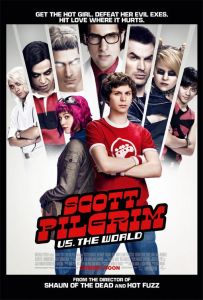 What happens when the millennial generation gets its own (attempted) seminal movie? It stays home and plays video games, letting the film, Scott Pilgrim vs. the World, languish at the box-office. I guess that’s what happens when you finance a movie whose target demographic will just as readily download the movie for free off the Internet.
Scott Pilgrim (Michael Cera) is a 22-year-old Toronto slacker. He?s the bass player for the band Sex Bob-Omb, along with lead singer Stephen Stills (Mark Webber) and acerbic drummer Kim (Alison Pill), a former ex-girlfriend of Scott’s from high school. The band’s biggest fan is 17-year-old Knives Chau (Ellen Wong), who also happens to be Scott?s new girlfriend. The world of Scott Pilgrim is abuzz with this scandal, especially Scott’s gay roommate Wallace (Kieran Culkin) and Scott?s younger sister (Anna Kendrick). Scott insists it’s all on the level and he has no ulterior motives for dating a high schooler. Then he sees the mysterious and alluring Ramona Flowers (Mary Elizabeth Winstead) who?s new to the area and American. Scott rabidly pursues her in what could best be described as stalking, eventually getting her to agree to date him. Trouble is, he hasn’t broken up with Knives just yet before starting this new venture. Scott is then confronted at the Battle of the Bands concert by a man who comes bursting out from the ceiling. He is the first of Ramona’s seven evil exes and Scott must defeat them all in order to earn the right to the violet-haired beauty. “Everybody has baggage,” Ramona says. “Yeah, but my baggage doesn’t try and kill me,” Scott wearily replies.
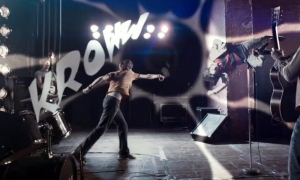
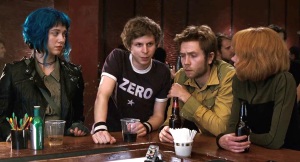 Visually, this movie showcases director Edgar Wright (Hot Fuzz, Shaun of the Dead) using every crayon in the Crayola box. This is a visually resplendent film where every scene seems crammed with details to delight the eyes and light up the senses. It’s a rush to watch the kaleidoscope of colors and motions. The Scott Pilgrim universe clearly differs from our own. This is a realm that borrows heavily from old school video games, where people burst into coins when vanquished, where life-decisions are met with “leveling up,” where people have onscreen pee bars that will deplete after a trip to a urinal. Sound effects will routinely be verbalized on screen, everything from a “RIIIIIIIIIIING” of a telephone to the “Ding Dong” of a door. It’s amusing, though also easily overused. Jobs and stuff like that are for the real world, hence too square to be depicted. It’s this entire idiosyncratic comic book world treated like everyday reality.
The enormous display of style is impossible to ignore. Scott Pilgrim is a slick, flashy piece of entertainment that is riddled with nostalgic references for a select crowd. I appreciated how a nice walk was accompanied by the theme song from The Legend of Zelda, or that sound effects and onscreen graphics echoed the fights from Street Fighter II (don’t ask me which of the 800 versions). Scott Pilgrim is an excellent pop pastiche of a specific culture, namely a slacker, hipster, amiable, comics and gamer group. I myself was an avid Nintendo gamer back in my day, but I admit to waning interest when the games got too complicated and grisly (“Back in my day we had two buttons to push, one to jump and the other to shoot, and that’s how we liked it!”). The movie is an explosion of color, light, and (lo-fi garage rock) sound, which also might sound like the description of a seizure or a stroke to some. Like those ailments, Scott Pilgrim will be seen by some as an infliction. It’s hyperactivity and eagerness to please via nostalgic reference points will be what drives people to this film and what drives them away in equal measure.
The Scott Pilgrim graphic novels total six volumes and approximately 1200 pages, which means it?s not the easiest fit for a two-hour window. It also hurts that the Pilgrim books have a wide supporting cast of characters to tussle with, plus there?s the whole seven deadly exes thing which means the movie has to provide about a solid 20 minutes of set-up before finding enough time for seven antagonists (or boss battles, following gamer parlance) and a reasonable amount of resolution. Add on top of this the fact that Wright keeps the movie moving at an outrageous, ADD-addled pace, like the plot conveyor belt lever got broken and the scenes speed one after another. Everything about this movie feels fast and over caffeinated. The editing in particular has characters holding conversations where every line is in a new location, implying an added sense of movement. So you shouldn’t be too surprised when the Scott Pilgrim film feels like a whole lot of a little; it’s moving at the speed of light to entertain.
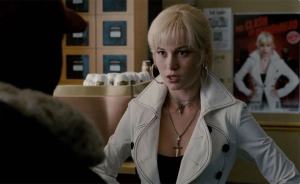 Because of the plot mechanics and oversized cast of characters, Pilgrim can give off the impression of shallowness. It seems like all style and little substance and that’s because the movie attempts to cram an entire series of stories, back-stories, and conflict into two hours. The film version only has enough time to attempt to give Scott and Ramona characterization, though both come across as weak-willed, tentative, and less than charismatic, wondering if either party is worth the trouble. The movie tries to paint over these differences through distraction and force of will. The large cast of supporting players all elbows each other just to be mouthpieces for one-liners. Knives actually comes across as the most complete character, consumed by her infatuation, heartbreak, and then quest for misguided vengeance. She’s somewhat dismissed and yet she is the most developed person on screen thanks to Wong’s endearing and relatable performance. The entire experience of Scott Pilgrim vs. the World can be somewhat fatiguing when there’s little evidence presented for emotional investment. The books supplied the reasons for caring besides the whole underdog angle.
The movie aims to be a battle over love, but it’s not entirely convincing. Scott appreciates Knives because she’s simple, a relationship he doesn’t have to invest much within, something casual and enjoyable while it lasts or until it becomes too taxing. Then he goes ga-ga for Ramona and stalks her, wearing down her defenses. He’s purely smitten with her and willing to do whatever it takes to earn her affections, though he can?t explain why he feels this way. Here’s a note to screenwriters: when characters are asked why they love somebody, do not have them say, “I don’t know.” But for Ramona, Scott is her Knives. He’s something easy that won?t break her heart, an escape from the jerks she’s been dating before. He?s low maintenance. He’s something to pass the time. There’s an interesting dynamic here, made even more complicated by the fact that Scott’s time with Knives blended with his time with Ramona. There was not a clear end point. The movie takes a literal approach to the idea of love being a destructive force of nature. Scott is punished throughout because of his infatuation with Ramona, but he persists despite the bruises. And he doesn’t even really know much about her. There’s an interesting statement somewhere there about the punishment we endure, sometimes foolishly, over the affections of people we may love, or convince ourselves of, but not even like.
 It may sound peculiar but I’m paying Michael Cera a compliment by saying his performance in Scott Pilgrim is the least Michael Cera the actor has ever been on screen. Gone is his gawky, awkward, ironic shtick that has fast become the Cera persona in films like Superbad and Year One. Scott is unjustifiably confident in his life’s pursuits, and Cera gets to act cocky and quippy, even if it?s done with a wink. He?s an unlikely kung-fu star but then again he?s also an unlikely leading man. Winstead (Live Free or Die Hard) is cute but plays her part a bit too toned down, like Ramona’s still searching for the right medication combination. Culkin and Pill are both scene-stealers of the first order, doing so with unabashed and flippant sarcasm. Every scene is made better by their presence. Among the evil exes, Brandon Routh (Superman Returns) has plenty of fun as a dim-witted super-powered Vegan bassist (“Vegans are just better than other people”), and Jason Schwartzman epitomizes hipster snark with such relish. The film is exceedingly well cast from top to bottom.
I’ve read some reviews positing that Scott Pilgrim vs. the World is an elaborate fantasy taking place in the mind of its titular hero, that he blends his knowledge of comics and video games to help make sense of the troubled waters of relationships and lingering hurt from the demise of love. I think that’s a nice explanation but perhaps trying too hard to frame this film as some form of psychoanalytical commentary on modern youth’s interpersonal relationships and the value of love. Scott Pilgrim vs. the World is really just a spastic, hip, clever wank that, as presented, gives little room or emotional investment. It?s a blurry, messy, prankish good time at the cinema that doesn’t translate into much more than the equivalent of sensory button mashing (video game reference). It’s fun while it lasts but it doesn’t have much beyond those astounding visuals to make it feel lasting, and I say this as a genuine fan of the graphic novels by Bryan Lee O’Malley. Alas, heavier discussions about the thorny, maddening issues of love are better left to more dramatic, and romantic, movies like Brokeback Mountain, Eternal Sunshine of the Spotless Mind, and even WALL-E. This movie is more preoccupied with spinning as fast as it can and then vomiting.
Nate’s Grade: B
Share this:

Toy Story 3 (2010)
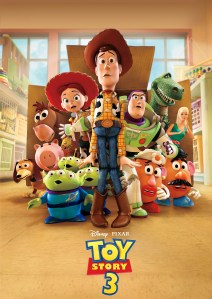 I was completely unprepared for how emotionally involving Toy Story 3 would be. Sure, Pixar has managed to break and melt your heart through ten previous movies, but I suppose I foolishly felt that I was beyond caring for toys. But even in the opening minutes, a tremendous make-believe fantasy, I felt punches of emotion as each character was reintroduced. It felt like I was reconnecting with old friends and it was such a pleasant reunion. It’s okay, guys, to cry over toys.
Cowboy sheriff Woody (voiced by Tom Hanks), the leader of Andy’s toys, is trying to keep hope alive. Andy is now 17 years old and on the verge of leaving for college. His favorite childhood toys have long since been relegated to a chest as Andy has matured. Joining Woody are spaceman Buzz Lightyear (Tim Allen), Jessie the cowgirl (Joan Cusack), Mr. and Mrs. Potato Head (Don Rickles and Estelle Harris), Slinky Dog (Blake Clark), the timid Rex (Wallace Shawn), and the piggy bank, Hamm (John Ratzenberger). They are all the toys in their gang that remain. As Andy leaves their main goal seems to have been accomplished. They were there for their owner and now he no longer needs them like he once did. The toys have a few options left: stuffed into the attic, sort of like a retirement home, until perhaps Andy digs them out for his own kids, or being thrown out with the trash. Woody assures them that Andy would never just throw them all out, though even he has his doubts about their current purpose. They all feel the loss.
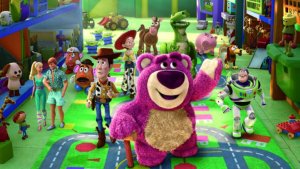 After a mix-up, the toys decide to take matters into heir own adjustable hands. They will sneak away inside a donation box for Sunnyside Day Care. The center seems too good to be true. The courtly Lotso Hugs Bear (Ned Beatty), who seems to lead the center, promises that all toys will never be forgotten again. When the children grow too old then a new batch moves in to play. It’s a toy’s dream, that is, until Buzz and the gang discover that they’re canon fodder for hyperactive, maniacally destructive toddlers. They can’t keep up with the daily abuse. Sunnyside Day Care is less a haven than a prison. New toys have to pay their dues and earn a place in the vaulted Butterfly Room, where young children lovingly interact with their toys. It’s a toy class system. Lotso refuses to cotton to rule-breakers, and toys are locked away nightly so they cannot escape. Woody must try to save his friends by breaking them out and getting back to Andy before he departs for college.
Given that the movie tackles major issues like moving on, growing up, and mortality, I knew I was in for some heavy moments, but absolutely nothing prepared for some of the emotions that clobbered me. You do realize through the course of this third film as the toys try and find a suitable place to retire, if you will, how attached you are to these characters. Late in the movie the toys are in some dire circumstances. There’s a horrifying junkyard sequence that even manages to evoke Holocaust imagery, which means parents are going to have to calm some spooked tykes come bedtime. There’s a silent moment, where the toys all seem to accept their fate, and all they want to do is join hands and face it together, as a united family one last time … and my God, I could not control myself. My face was dripping with tears (even thinking back right now is causing my eyes to well up a bit). Toy Story 3 isn’t the strongest of the trilogy in terms of character or plot (in some respects, the plot is a reworking of The Brave Little Toaster), but you better believe that it delivers emotional resonance in spades. Major credit goes to screenwriter Michael Arndt who won an Oscar for Little Miss Sunshine.
 But fear not, Toy Story 3 is not all sturm und drang, it also provides plenty of laughs and plenty of visual wonder and excitement. The toy’s point of view has always allowed for plenty of amusing insights and satirical riffs. The personality clashes makes for the most jokes, and the new characters pull their own weight, particularly Ken (Michael Keaton), an effeminate clothing-conscious doll who finds his true love with the arrival of Barbie. The use of Big Baby as a malevolent goon is also refreshing and quite creepy. The Spanish Buzz reboot personality seems superfluous but cute. The jokes come by at a steady pace and while they all may not work as well (Ken in a trying-on-clothing montage set to “Le Freak”?) there are still moments of great creative ingenuity. The detailed escape from Sunnyside feels like a terrific parody of prison movies, and they way it utilizes all the different characters as key components is satisfying and fun. But the best moment of the break-out, by far, is when Mr. Potato Head is trapped, hurls his pieces out of an opening, and reassembles thanks to a tortilla body. It’s a weird visual, like something out of Salvador Dali, and yet I could not stop giggling from watching his floppy movements. It’s comedic while at the same time a genius move in drawing out an action sequence — it makes keen use of the players and their skills. From an action standpoint, G-rated Toy Story 3 manages to have more thrills and spills than any other 2010 movie so far.
Director Lee Unkrich (co-director for three previous Pixar flicks) makes quite a debut for himself. The complexity of the action, while still maintaining an internal logic, is hugely rewarding. The Pixar wizards truly know how to craft inventive action sequences and stay true to character. Unkrich’s command of visuals is impressive. The action is well paced, but it’s the man’s use of composition, camera movement, and editing make Toy Story 3 a visual treat. Unkrich fully knows how to best utilize and fill up the screen. The world of Toy Story is popping with color and visual whimsy, as well as plenty of sight gags and subtle movie references for adults. Ten years of advancements in computer effects has also allowed the toys to get a bit of a facelift. The 3-D process enhances the overall experience without calling attention to itself. There aren’t any standard 3-D moments where big and pointy things keep flying out at the audience. The 3-D provides a greater field of depth without distracting you from the pivotal moments of story.
The voice acting is just about perfect from top to bottom. Allen and Hanks are a welcomed pair, Cusack provides plenty of spunk, Rickles brings his usual dish of joyful disdain, and new characters like Timothy Dalton as a stuck-up thespian porcupine and Kristen Schaal (TV’s Flight of the Conchords) as a bubbly triceratops toy are fun additions that don’t overstay their welcome. Blake Clark takes over the voice of Slinky Dog from the late Jim Varney who died in 2000, and he does a fine job without sounding like a direct imitation. I was really delighted by Beatty. He has such a Southern gentlemanly demeanor that underscores the hardened heart of his villainous character. And yet, Lotso gets his own rich back-story of abandonment and bitterness similar to Jesse the cowgirl. Even when he’s dastardly we can see where the big purple Teddy bear who smells like strawberries is coming from. Ned Beatty has finally appeared in another breakthrough cultural film to redefine his identity. Perhaps now he won’t be best remembered as the guy who gets raped in Deliverance. He probably still will be.
A lot has changed in the 15 years since Pixar revolutionized the world of animation and family films with their first feature, Toy Story. Kids at the time are now teenagers; some embarking on college this summer themselves much like Andy. They too have to put away former childish things and move forward. Toy Story 3 is magic confluence of heart, wit, visual whimsy, cleverness, and drama. Not quite as sharp as the first two installments, or as artful as Pixar’s high-water mark, WALL-E, the third Toy Story is still a mighty entertaining piece of work. The last 30 minutes of this movie is harrowing and then deeply satisfying and moving, finding a fitting sendoff for characters that we’ve come to love. It’s all about moving forward, saying goodbye, and reflecting about times shared. I wouldn’t be surprised if Toy Story 3 inspires kids, and adults alike, to go home and play with their old toys, giving them renewed life and purpose.
Nate’s Grade: A
Share this:

The Princess and the Frog (2009)
 It’s taken this long to get an African-American leading lady/princess in a Disney animated film, and she gets to spend the majority of the flick as a slimy frog? This return to traditional 2-D animation for Disney is less than a triumph due to a pretty dull storyline. All the familiar elements are there, but the characters just fill voids rather than tell a story. There’s the downtrodden heroine with her dream, the arrogant prince who learns to value others, the comical talking animal sidekicks, and get ready for a slew of songs you will instantly forget despite the added gumbo flavor. Set in 1920s New Orleans, the film has plenty of ravishing visuals to get you through the formulaic plot. It’s a nice return to Disney’s bread and butter before the 3-D animation craze took off, and I pray that there will be plenty more traditional 2-D animation on the horizon from the Mouse House, but this isn’t the best film to reestablish the glory of traditional animation, racial politics aside.
Nate’s Grade: B-
Share this:

Prince of Persia: The Sands of Times (2010)
 This video game adaptation has the curious distinction of being both too simplistic and too complicated, sometimes in the very same breath. The harried screenplay could have used a lot more clarity concerning back-story, exposition, character roles, setting, rules of this Middle Eastern time period, supernatural rules, etc. At the same time, Prince of Persia is saddled with a pretty dopey story with weak characters. The plot is far too repetitious; somebody has the magic dagger that can turn back time, they lose it, they regain it, they lose it, repeat for over an hour. It feels like the story is never getting anywhere despite the fact that new, and still weak, characters are being introduced. The tone and look of the movie feels too beholden to its video game roots; the action is momentarily rousing but then seems overly coordinated to squeeze in all the game’s special signature moves. You’ll grow tired of all the wall flipping, wondering if a controller is stuck somewhere. For a movie dealing with a time-traveling dagger, give me more time travel. This fantastic plot device is used too sparingly in a ho-hum plot about an adopted son (Jake Gyllenhall, buff and with a sporting accent) of the king being accused of killing the king. Despite the Disney name, this feels less like a Pirates of the Caribbean knockoff and more cut from the same cloth that gave us the Mummy sequels. It’s loud, stuffed with empty special effects, and feels like junk food for your brain but it’s not even good junk food. Weirdest of all, the movie is one big metaphor for the U.S. invasion of Iraq (acting on false intelligence about some country aiding an enemy by manufacturing weapons). Seems Prince of Persia is Hollywood’s second attempt to rewrite our past political blunders in the Gulf and come up with a dubious happy ending.
Nate’s Grade: C
Share this:

Ponyo (2009)
 It was hard for me to watch the initial trailers and advertisement for this movie because the animation just looked so … simple. I was forlorn that legendary director Hayao Miyazaki was taking a step backwards. He was stepping away from the complexity of his recent works. While his take on Han Christian Anderson’s Little Mermaid tale is intended for young children, I was relieved when I finally saw the finished animation. I got what he was going for: a painterly aesthetic that is seductively simple. The boy meets fish-turned-girl tale is resoundingly cute with a delightful sense of wonder; however, it really just sort of comes to an abrupt stop. The character relationships are established, the conflict of a sea princess being on land is developed, and then all the magical creatures team up and chat with the humans, and then we’re pretty much done. It’s a curiously hasty conclusion and it makes the movie feel less formalized and finished; Miyazaki is still one of the most imaginative filmmakers alive, in any medium, but Ponyo, while visually appealing and mostly adorable, suffer from shrift storytelling that ultimately makes this a cute if passing diversion.
Nate’s Grade: B
Share this:

Alice in Wonderland (2010)
 Director Tim Burton seems like the perfect candidate to take on the imagery of author Lewis Carroll. I would argue that, short of Dickens’ Christmas Carol, Alice in Wonderland is the most reproduced piece of literature in modern history. It’s going to take a keen vision to make these old characters interesting (the macabre American McGee video game sure felt like it could have been born from the mind of Tim Burton). Unfortunately, Burton and some 3-D wizardry are not enough to compensate for a story that only works in one dimension.
Alice (Mia Wasikoswki) is now a teenager girl who can barely remember her jaunt to Wonderland in her youth. She’s assigned to marry a simpering lord because in Victorian England that’s how women took care of their futures. Alice is more interested in taking over her dead father’s trading company. So when the time comes for her lord to ask for her hand in marriage, Alice stammers, says she needs some air, and chases after what looks like a rabbit with a pocket watch. She falls down a rabbit hole and winds up back in Wonderland, however it’s really known as Underland. It’s been 13 years since Alice visited this magical world, and in the meantime the Red Queen (Helena Bonham Carter) has ruled as a tyrant quite fond of removing the bond between head and neck. Her sister, the White Queen (Anne Hathaway), was deposed and lives in exile. The (W)underland residents live in hope that an Alice will return and free them as an old prophecy foretells. She’ll have to rely on old friends, like the Cheshire Cat (Stephen Fry) and the Mad Hatter (Johnny Depp) to fulfill her destiny, and, why not, slay the Red Queen’s fearsome dragon, the Jabberwocky.
 You would think that the combination of Burton, Depp, Lewis Carroll, and 3-D would produce an irrefutable masterpiece, at least from a visual and entertainment standpoint. I’m compelled to argue that the finished results are pretty much a mixed bag. The world of (W)underland seems fairly drab. Sure it was some big stuff and some weird stuff but from a color standpoint everything comes across as washed out, like Burton took one look and said, “Bright colors equate happiness. We can’t have that.” I understand the world wanting to convey a dispirited mood, but this isn’t any regular Burton film, this is Alice in Wonderland and we need a sense of, wait for it, wonder. Instead, we get an overwhelming feeling of drabness. Now, full disclosure, I didn’t catch the 3-D version of this movie for two reasons: 1) my then partner’s head was hurting and she couldn’t take 90 minutes wearing nose-pinching, eye-hurting glasses that play with her depth of field, and 2) the 3-D shows were all sold out. I could tell which elements where intended to pop in a 3-D environment, namely the Hare always throwing objects as a calling card and the materialization of the Cheshire Cat. The tone isn’t too dark to scare the Disney families but at the same time there’s a bit more menace to the proceedings. The Red Queen’s bulbous, disproportionate head makes for an eye-catching visual that doesn’t get stale. (W)underland is a more hostile world but at the same time it’s not too threatening. Pretty much all the villains have some moment of redemption that makes them less threatening. The weirdest motif in the movie is eye gouging, which happens twice thanks to the same diminutive character.
Having said that, this is a visual decision that I could live with if the story engaged my senses more. Alice is now an older 19-year-old girl that has to defend (W)underland by fighting a dragon and suiting up in armor. She has to accept her destiny and be THE Alice and save the kingdom. The mystery of whether Alice is the one true Alice, look no further than the title, folks. He doesn’t remember anything from her first encounter in (W)underland and yet she has no sense of awe or curiosity. Also, why now do the residents of (W)unerland seek out Alice to rescue them? They never thought about reaching out in the 13 years the Red Queen has been ruling?
 The plot is a fairly pedestrian “hero’s quest” that ends in a fairly pedestrian battle sequence where the armies of good and evil clash in CGI combat. The problem is that the original Alice in Wonderland source material really didn’t have much of a plot to it; it was really more a satire of the times, which featured Alice essentially going from one oddball to the other. The appeal was more the language than the story. It’s not the easiest piece of literature to adapt, to find a through line for a plot, so I guess making it about a hero’s destiny seems like the easiest, laziest path. The screenplay by Linda Woolverton (Beauty and the Beast) assembles all the memorable characters but gives them little else to do, other than act mad. You may start to feel Alice’s sense of frustration after a while. Because of the threadbare story, you know exactly where the movie is going to be headed (wow, unintentional pun). In some ways this movie functions as a sequel and in some ways this movie functions as a remake, meaning that the plot is pretty much stuck trying to decide where to go next in a standard fantasy narrative device.
And then there’s the dance scene. Oh, the dance scene. How do I approach this gingerly? The climax that’s established is not Alice slaying the dragon, accepting her destiny, and (W)underland triumphing over the Red Queen’s tyranny. The climax is Depp break-dancing. You read that right, though the residents refer to his crazy legs movement as “futterwackin,” which sounds suspiciously naughty. It’s a moment so goofy, so tonally inappropriate that it shatters the entire notion of suspension of disbelief. It rips you out of the movie and all for a cheap laugh. It’s bizarre. I acknowledge that, given the fantasy framework, that the ending ought to stay in touch with the fantastical setting. But break-dancing? Would The Wizard of Oz have ended better if the Tin Man and the Scarecrow started break-dancing? At least the Tin Man could effectively perform the Robot. It’s a real-world artifact that has no place in the world of fantasy.
 Depp is usually such a valued performer, digging deep into his character and reveling in their eccentricities. He’s the strangest and most exciting character actor that has become a box-office star. But that doesn’t mean he’s immune from giving a rare bad performance. While nowhere near as off-putting as his Willy Wonka, Depp’s Hatter is more distraction than anything. He comes across like a figure grappling with post-traumatic stress, causing him to mutter incomprehensibly in a Scottish brogue. He’s tiresome after a while. Carter (Sweeny Todd) can be pretty shrill, playing the same overwrought note time and again, but she still manages to give the best performance in the movie. Hathaway just sort of acts flighty and raises her arms, waltzing around like she’s trying to imitate Depp’s Jack Sparrow. She’s entirely wasted. Stephen Fry (V for Vendetta) is a delight as the voice of the Cheshire Cat, and our heroine, Wasikowska (HBO’s In Treatment) has a striking Grecian presence, even if her performance is more dour than it needs to be given the fanciful environment.
Tim Burton and Johnny Depp usually make for an unbeatable creative team, but I think Disney was the key figure in this arrangement. Alice in Wonderland wants to thrill without getting too scary, wants to delight without getting too original, and wants to dazzle without getting too weird. Burton’s visual inventiveness manages to make the movie entrancing at times and bewildering when the rest of the movie fails to live up to those fleeting moments. Truth be told, I actually enjoyed the real-world Victorian scenes more than many of the ones in (W)udnerland. The film is just too disjointed and uneven to fully embrace, regardless of the 3-D upgrade. There are moments that I adored and moments that I could have lived without — like the break-dancing finale. The finished product isn’t a terrible night out at the movies, and there are plenty of enjoyable elements to savor. However, Alice plays like a familiar fantasy that takes Lewis Carroll’s creatures and rearranged them into a watered-down Lord of the Rings hybrid.
Nate’s Grade: C+
Share this:

Legion (2010)
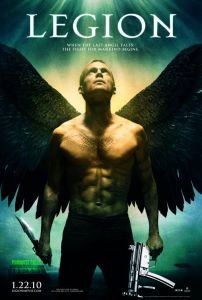 Just to be upfront, I am a big fan of action movies making use of Christian mythology (sorry if the use of the word “mythology” offends some). You tell me a tale about angels, demons, in a contemporary setting no less, and I’m hooked. You give those two sides weapons and have them fight over the fate of mankind, and I’m already revving my engines. So please know that no matter what the artistic achievements of Legion may be, I was predisposed to enjoying a movie that features the angel Michael (Paul Bettany) on the poster with a sword in one hand and an automatic weapon in the other. The premise of Legion is that God has finally had it with mankind and is making good on his threat to “turn this thing around right now.” He’s sending a host of heavenly angels to … eliminate humanity. Michael rebelled, believing man was still capable of making good on its promise. So he fights alongside a handful of characters shacked up in Dennis Quaid’s greasy spoon diner in the middle of nowhere. The action isn’t really involving but the movies does have some cool moments, like when Michael goes mano-a-seraphim with Gabriel (a marble-mouthed Kevin Durand). Legion deals with an antagonist (God) that is so powerful that there have got to be arbitrary limits placed on that power. So the attacking angels don’t overwhelm the tiny diner with their superior numbers, nor does the Almighty just blink the troublemakers out of existence. The end doesn’t really give much in the way of clarity but I got what I wanted from a movie like Legion. Though, in retrospect, I really didn’t want sizzling acid popping from boils.
Nate’s Grade: C+


 nathanzoebl
You must be logged in to post a comment.