Blog Archives
Labor Day (2013)
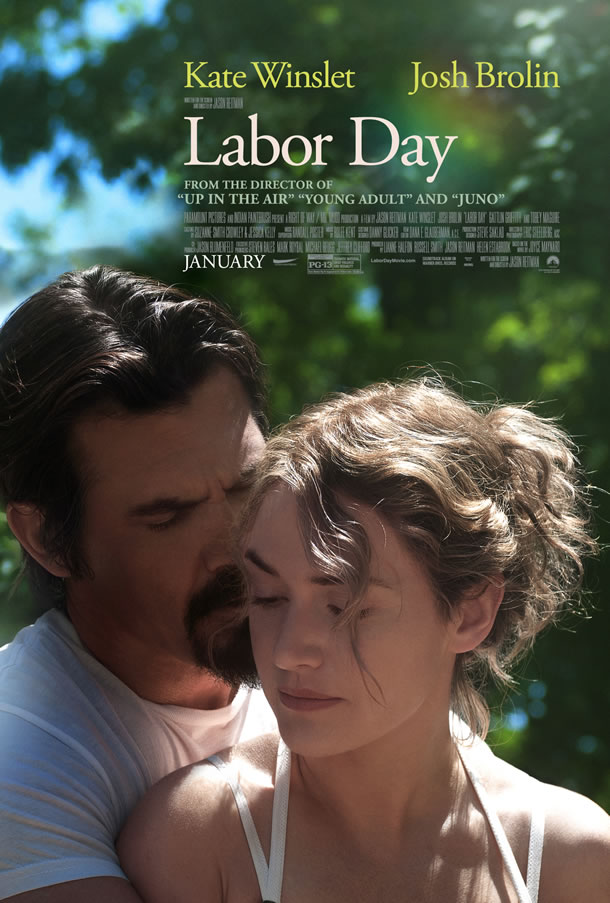 Labor Day, based upon the novel by Joyce Maynard, is the kind of sappy material that you never would have expected director Jason Reitman to attach his name to. Reitman has been accumulating an enviable career of top-shelf dark comedies (Thank You for Smoking, Up in the Air, Young Adult), yet his touch with characters and actors, as well as his delicacy with tone, reminded several of a young Billy Wilder. The stuff of Labor Day felt more like a Lifetime channel original movie. This is just one artistic miscalculation from the start and it doesn’t get better as it goes.
Back over Labor Day weekend in 1987, young Henry (Gattlin Griffith) is living with his grieving mother Adele (Kate Winslet) and performing many of the duties of a husband (don’t get gross). It’s been some time since Henry’s parents divorced but Adele has become a shell-shocked recluse who can barely talk or look others in the eye. While visiting a grocery store, Henry runs into a dangerous man named Frank (Josh Brolin). He’s bleeding from the abdomen and intimidates Adele to give him a ride. Frank is an escaped prisoner and he takes to hiding at Adele’s home. After the initial hostage period, Frank allows Henry and Adele to walk around freely, as long as they don’t tell anyone where he is. As the days pass, Frank helps out around the house, helps Adele get out of her funk, and becomes a surrogate father figure for Henry. The unconventional family must evade the police and skeptical townsfolk to make a run for it.
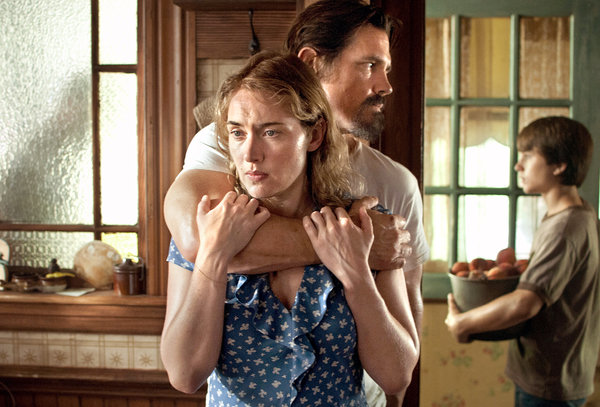 The very premise and its tone are just not a good fit for Reitman. First off, the movie plays out far more like a hostage thriller than any sort of romance. If you were to look deep inside, the romance can be explained as one very emotionally needy woman and her child going through Stockholm syndrome. The entire movie takes place over the titular Labor Day holiday, which means that all these changing feelings have to morph over the time period of three days. I don’t know if I’d call that love, even in Movie Land. Hey, Frank didn’t kill everyone and he helps around the house, isn’t he great? These people should be far more afraid for far longer. It is almost comical how saintly Frank becomes and how many surrogate father activities he squeezes into the abbreviated window of time. He performs handyman jobs all around the house, teaches young Henry how to change a tire, tosses a baseball with the kid, teaches everyone the finer points on pie making, and other such helpful activities. I understand that these two lonely people finally see a replacement man; for Henry a father, for Adele a lover. Again, the three-day time window makes everything appear like the manifestation of Stockholm syndrome. How many of those abducted have uttered, “He’s not that bad. You just don’t know him like I do”? Frank’s back-story is tragic but he is a wanted felon and he has no problem threatening both of these people’s lives in the beginning. Yeah he doesn’t resort to violence or yell in their faces, but why would he against an adolescent boy and his easily cajoled mother? No matter how long Reitman spends showing us the softer side of Frank, especially while preparing delectable dishes of food, he’s no more developed than the common Misunderstood Bad Boy.
Then there are the dawdling coming-of-age moments clinging to young Henry, a boy growing up quickly in a tumultuous holiday weekend. It strikes me as tonally odd to already take a tricky balancing act with the film’s plot and then tossing on a coming-of-age addition. The story is told from Henry’s perspective, and that’s a major problem as well. He’s the least interesting person in this dramatic setup. Being confined to his viewpoint often keeps us distant from the deeper drama going on. I’d rather spend time with Adele and Frank bonding so that the romance can find some traction, but no. Al we hear are the thumps from the other side of the wall and the gentle whisperings between them in stolen glances. It’s a frustrating perspective because quite frankly nobody really cares about this kid’s sexual awakening and his daydreams about the cute girl’s bra. His dad (Clark Gregg) wants to talk to him about the birds and the bees. His mom talks about the same. It’s a somewhat uncomfortable position for the audience with both parents wanting to cover the sex talk. There’s a wanted man hiding in his home! Henry’s personal growing up drama has no equivalency to this. Of the three main characters, doesn’t Henry seem like the worst participant to tell the story? It doesn’t help that Tobey Maguire narrates as older Henry. Have we not learned from The Great Gatsby: Maguire’s voice does not suit narration.
It’s the film’s more tense moments where you get glimpses of the real movie here, the thriller that’s been gussied up and disguised as some strange romance. Whenever someone gets close to discovering what’s really going on in that house, the movie picks up and grabs your interest once more, albeit fleeting. The fear of getting caught is potent but it should have been more omnipresent. The film, through Henry’s perspective, is treated like this nostalgic chestnut of that one summer a convicted killer held us hostage. The police are canvassing for an escaped prisoner but the neighborhood doesn’t seem to be that alarmed, still going about their business bringing desserts and fresh produce to one another’s doorstep. Too much of the film implies the threat, like with a short glimpse of a police checkpoint, but places it on the back-burner so that the romance can take shape. Again, this is a byproduct of being stuck in Henry’s perspective whereas the kid might not have the best understanding of how serious everything is (he’s worried his mom will abandon him and run off with Frank). But in those brief moments of dread and tension, this is where Labor Day works, and Reitman does a great job of turning the screws and building that suspense. It makes you wish the whole thing were a thriller.
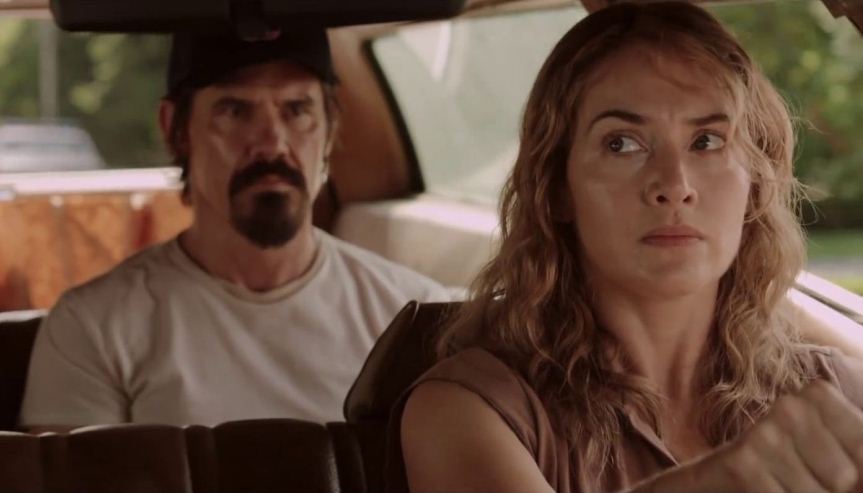 No one is going to question that Winslet (Divergent) and Brolin (Gangster Squad) are great actors, but boy do these characters underachieve. There is one very effective and moving monologue Winslet has about her pregnancy problems that have turned her away from the world, but it’s not enough. For much of the movie, she plays such an anxious and internalized character, so it’s hard to really follow her emotional development. That monologue does the most heavy lifting but it’s pretty wan before and after. Winslet is too good an actress to play essentially a catatonic woman that’s fairly mute. Brolin can play a soulful brute in his sleep. There’s so little to challenge him and so he seems on autopilot. It also hurts that both Frank and Adele have very limited conversations. It’s a romance told in gestures and handclasps (and the rhythmic thumping of walls at night). It’s not their fault that their characters are underwritten and unsatisfying. Griffith (Green Lantern) is a nice young actor but he too is forced to communicate much with little and comes up short. James Van Der Beek (TV’s Dawson’s Creek) is a local cop who appears for one scene, and afterwards you wish he would stick around longer. Look for Reitman good luck charm J.K. Simmons (Dark Skies) as a helpful neighbor.
Reitman is such a talented director that he can almost pull off sequences in Labor Day despite all of its inherent structural, tonal, and perspective flaws. From a technical standpoint, the movie is a gauzy, amber-accented tale with plenty of strong alluring visuals to set you at ease. There are these trembling moments where you almost see what attracted Reitman to the film, but the finished product is just a mushy misfire. It’s earnest without having earned our emotions, and the thriller elements and the romance elements are in constant conflict. We all remember our grandparents telling us that magical moment they knew they had met the one when he tied her up and held her hostage. Much of the drama that comes from the premise is handicapped from the mistake of having Henry as the chief storyteller and point of view. His limited involvement means we’re kept at the peripheral for too many important moments. I have no doubt Reitman will rebound and quickly (he’s already filming his next movie and has optioned a book for his next next movie). Get ready to have Labor Day play every subsequent Labor Day weekend on the Lifetime channel, its true home.
Nate’s Grade: C
Share this:

Devil’s Knot (2014)
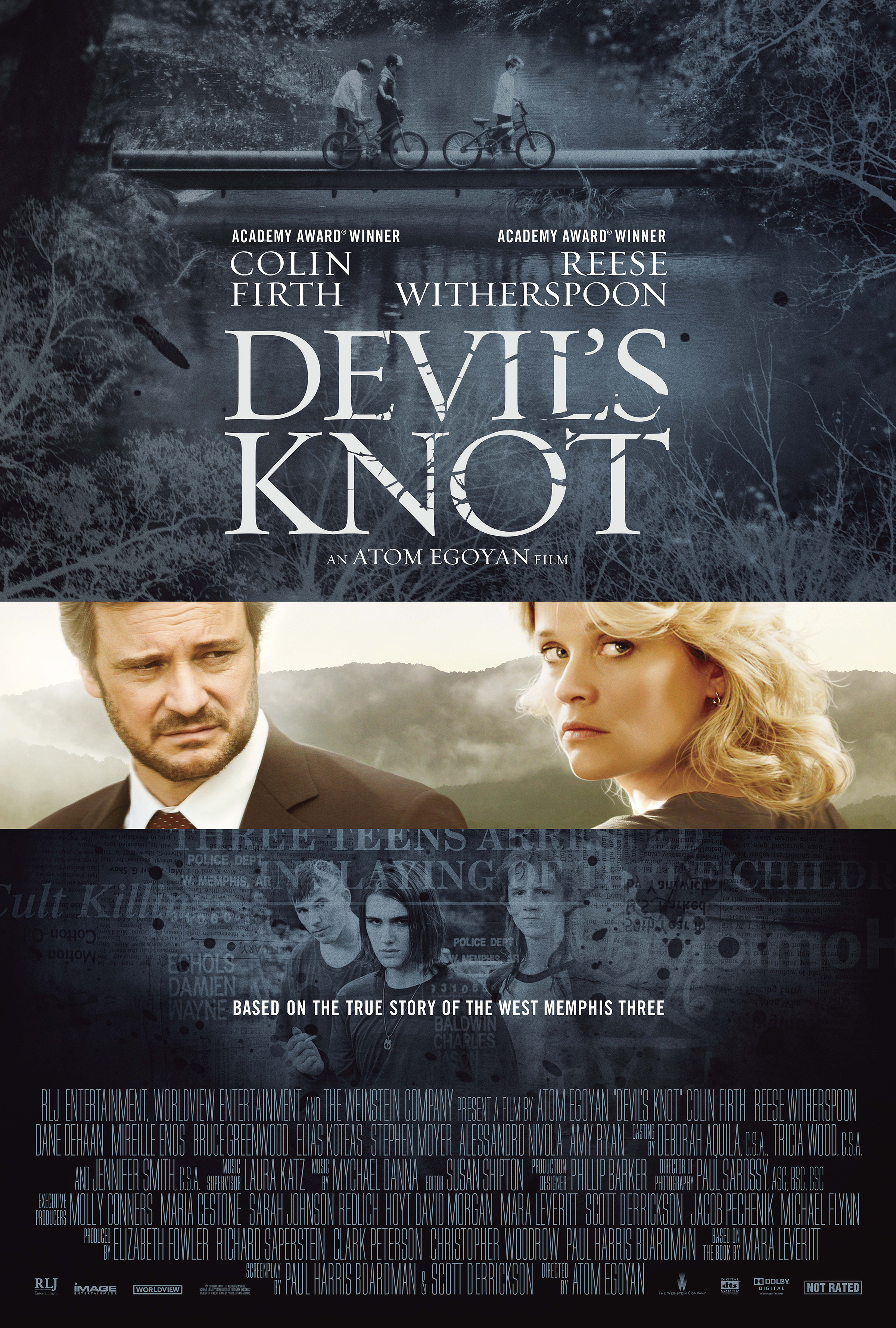 In 1993 in West Memphis, Arkansas, three eight-year-old boys went out late one night to ride their bikes. They were never seen alive again. The ensuing media circus that erupted lead to the conviction of three teenagers (The West Memphis Three) who many believed were innocent of these heinous crimes. Stop me if you’ve heard this story before. It was the basis of three stirring, powerful, galvanizing documentaries by Joe Berlinger and Bruce Sinofsky, two men credited with saving the West Memphis Three. Now after their release from prison, here comes Devil’s Knot, the first fictional film about the notorious case, Hollywood’s first crack at well-tread material. Is there anything new to be found?
Director Atom Egoyan (The Sweet Hereafter, Chloe) and his screenwriters do a credible job of distilling the complicated case against the West Memphis Three to its basics, relying on a modulated tone that shies away from the sensationalism that dominated the case back in 1993. With the benefit of time and hindsight, it’s easy for the movie to point out the erroneous thinking of the prosecution, the jump to conclusions, and the Satanic panic engulfing the community of Arkansas. We’re told by a police officer that they knew this “Satanic cult stuff” would hit town; they’ve just been waiting for the day. To its credit, the movie does a fine job of calmly and objectively pointing out the deficiencies in the police and prosecution’s case against the West Memphis Three. We’re told that from the twelve hours of interrogation with Jessie Misskelley, only 40-some minutes was recorded. The obvious mistakes in his confession, as well as the police coaching and coaxing him to their desired response, is made readily apparent. There’s “witness” Vicki Hutchernson (Mireille Enos of the oft-canceled The Killing) who says she say chief suspect Damien in a Satanic ritual, but the film cuts back from the imaginary to Vicki watching a movie on TV, the real source of her descriptive flourishes. Egoyan’s direction has a calm, objective overview that is reverent and respectful of the dead and the bereaved. It’s rarely boring and the facts of this case are such that any retelling would be somewhat compelling.
 So that brings me to the ultimate question: why even make a fictional movie about this subject? Four lengthy documentaries have covered the intricacies of the legal story, the breakdown in justice, and the personal toll on all sides of the crime. The only thing a fictional movie provides is: 1) the fun/distracting game of seeing relatively famous actors play the real-life people we’ve previously seen, and, 2) as an option for people who hate documentaries. If you’re one of those people who dislikes documentaries and doesn’t view them as “real movies,” then Devil’s Knot is for you, you dismissive filmgoer. Otherwise, literally everything was handled better in the Paradise Lost films. With the West Memphis Three thankfully out of prison, the omnipresent sense of urgency from the documentaries is now absent, replaced with a Monday morning quarterback sensibility pointing out all the obvious bias, judicial hypocrisy, and flaws of the case. And as anyone who has plowed through the powerful and addicting documentaries knows, there are plenty of flaws to point out for harsh scrutiny and incredulity. Movies have a long history of showing us an example of judicial injustice, and this is a prime example. However, Egoyan has put the emphasis of his movie on two outsiders rather than people in the center of this case. The West Memphis Three themselves are barely supporting actors in their own movie. I suppose the filmmakers may have wanted to present a different angle to the case since the Paradise Lost films showed the accused up close and personal. The construction of this plot just doesn’t work under the perspectives of Pam (Reese Witherspoon) and Ron (Colin Firth).
Ron serves as a pro-bono adviser to the defense, but that doesn’t mean he has the same access inside and outside the court. He can gather evidence on his own but really this guy is meant to be a fly-on-the-wall for the planning and frustration of all the legal roadblocks thrown at the defense. Is an added body in the room necessary? Could not one of the defense attorneys have provided the same purpose? Instead, he gets to grumble in the court and out about all the legal shenanigans going on to railroad innocent boys. He is essentially spelling it out to an audience. Pam has even less narrative purpose in the film. Her perspective makes sense early on as the mother of one of the murdered young children. Her panic, her worst nightmare come to life, it all makes for the stuff of major drama, which is why you’d imagine Witherspoon was drawn to the part. But once the case against the West Memphis Three gets going, Pam transforms into our Chief Reaction Shot Provider. Whenever a curious moment happens in court, we cut back to Pam and Witherspoon cocking her head in dawning curiosity and uncertainty. It’s as if she is meant to symbolically represent the entire community that was so fervent in their beliefs that these boys were guilty… until they heard the shaky case and the questionable experts put on the stand. So Pam and Ron end up becoming signals to the audience on how to feel and what to think. The movie doesn’t have enough faith in its audience to keep up with the minutia of the trail, or even the lawyers’ arguments, reducing a complex legal trial down to two nonessential characters nodding or shaking their heads.
 I’ll admit that I had some interest watching the actors inhabit the roles, and there are scads of people involved in this story. Bruce Greenwood (Star Trek) does a valiant job showcasing the head-scratching decisions of the trail judge, David Burnett, and his slimy dismissive nature. Stephen Moyer (TV’s True Blood) is particularly infuriating as John Fogleman, chief prosecuting attorney. Seth Meriwether (Trouble with the Curve) looks eerily like his character, the young and accused Jason Baldwin, and he nails his moral convictions and gentle nature. Dane DeHaan (The Amazing Spider-Man 2) gets to do his troubled youth thing he does so well. Kevin Durand is an actor I normally enjoy but even he can’t do justice to John Mark Byers, step-father to one of the slain boys, and easily the most memorable figure in the Paradise Lost films; the man is so theatrical and larger-than-life, and yet Devil’s Knot treats him like a featured extra, with many of his speaking scenes off camera. There isn’t a bad actor in the extremely large cast, though Firth’s Southern accent isn’t the most refined. If the movie lacks much reason for existing, at least the bevy of good actors respectfully bringing new life to these people, good, bad, and many somewhere in between, is the one credible quality to this movie.
What to make of Devil’s Knot, an example of a decent, modulated, and well acted movie that ultimately has no reason to exist in the wake of three excellent documentaries (Paradise Lost) and one other pretty good one (West of Memphis). The ground has been covered. However, that doesn’t mean that a well-told story can’t be told again, with a different angle, with a different approach, but Devil’s Knot hinges on two characters serving as metaphorical barometers to teach the audience what to think and how to feel. Then there’s the matter that the trail covers the entire 114-minute running time. There’s so much more that happens after the initial trial, so much that the last two minutes of this movie are almost a nonstop barrage of text updating the audience on many of the post-trial developments, including the West Memphis Three being released from prison in 2011. The movie feels too limited; there is so much more depth here, to the details of the case, to the personalities and human drama, to the story after the trial. Egoyan and his cast and crew have made a respectful fictional version of these sensational events, but the problem is that they don’t do enough to justify their own film’s existence. Unless you have an irrational hatred for documentaries, just watch those instead.
Nate’s Grade: C+
Share this:

Heaven is For Real (2014)
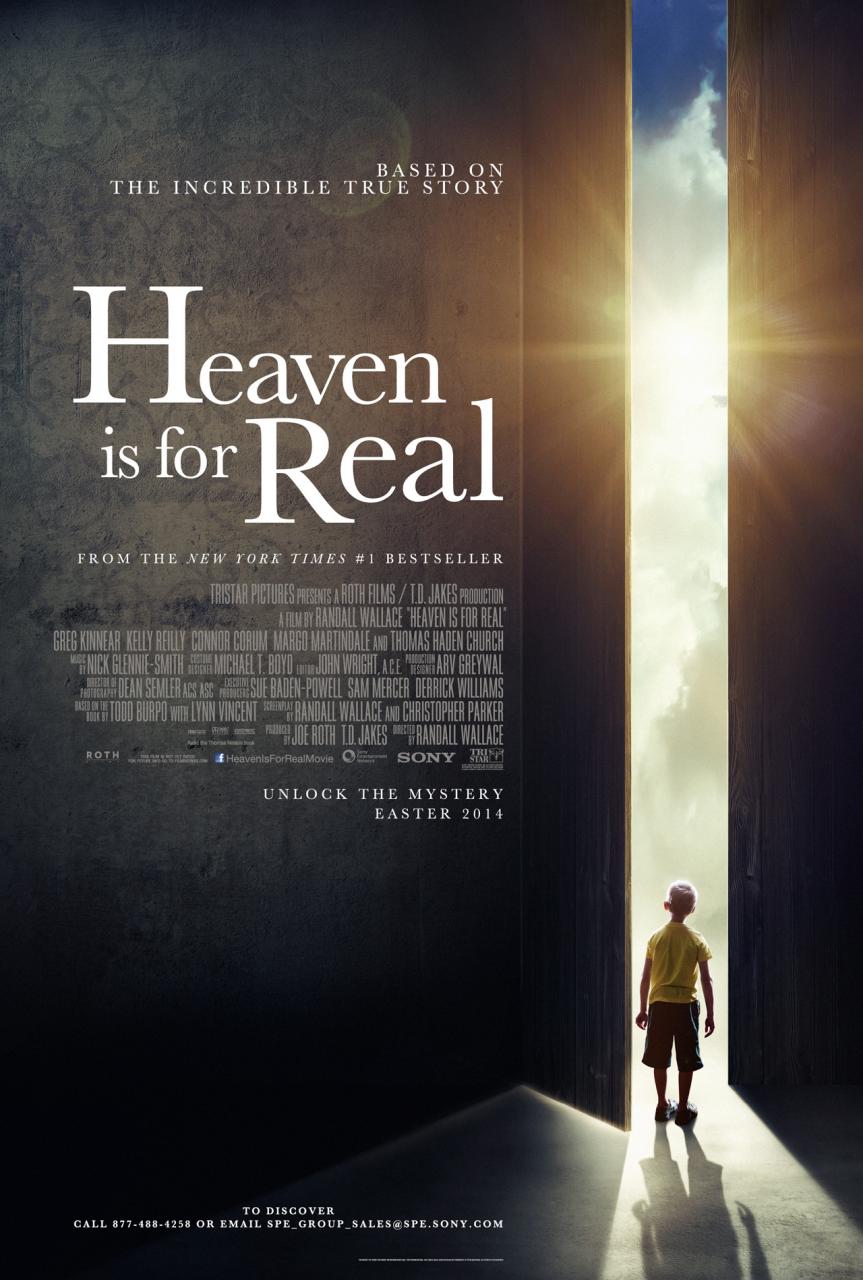 Christian movies have been lighting up the U.S. box-office this year. First there was Son of God, which opened at over $30 million dollars for what is essentially a retread of what people could see for free on TV. Then there was Noah, the Biblical epic given a new life with modern special effects magic. Then the little indie that could, God’s Not Dead, which continues to hang around the box-office, collecting astonishing sums. Now in time for Easter is Heaven is For Real based upon the best-selling book of the same name. Adapted and directed by Randall Wallace (Secretariat, Braveheart), the film manages to be emotional, earnest, and efficient, even despite not really having the elements needed to be called a film.
Todd Burpo (Greg Kinnear) is the pastor for a small town in rural Nebraska. He and his wife Sonja (Kelly Reilly) are struggling to pay the bills and care for their two children, Cassie (Lane Styles) and Colton (Connor Corum). One fateful day, Colton is rushed to the hospital with a burst appendix. He makes it through the operation. Afterwards, he tells his family the amazing news that while unconscious he visited heaven. The Burpos are ready to dismiss their son’s experience as a response common to those who went through near-death experiences, except little Colton never died on the operating table. Todd is unsure what to do with his son’s information, including key knowledge that he has no Earthly way of knowing. The members of Todd’s church worry about trusting the child’s account, and are wary of the media circus, and may just hire a new pastor for all the trouble caused by Colton’s confession.
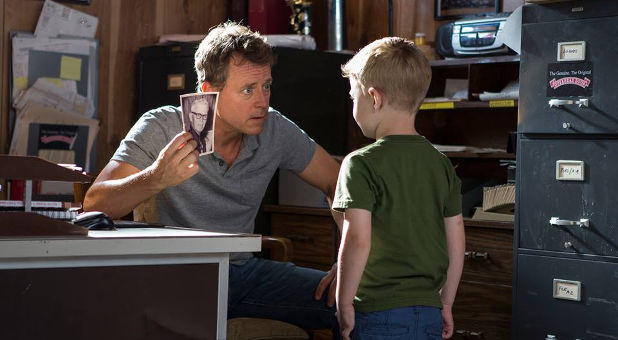 Kinder and gentler, here is a movie that has an inclusive, positive message executed with earnest conviction. The drama isn’t subtle but it can be effective. The music rises, the actors crinkle their faces and get tears in their eyes, and you’re left feeling like there’s something in your own eye. It may be manipulative in some sense but it’s so well executed, and without any hint of pretension or agenda, that I really didn’t mind. It’s a heartfelt movie that could fervently inspire the masses that pack the theater. I’d much rather have any Christian consumers, or the curious, check out this well-meaning movie than the mean-spirited and spurious God’s Not Dead. This movie actually allows its characters to feel like regular people who exist in our world. Todd and Sonja have a sex life, and the Burpo family doesn’t just sing famous Christian tunes in the car, they’ll shout Queen at the top of their lungs. In other words, they’re a fairly normal Midwestern family, and I appreciated that the movie didn’t feel the need to sanctify them. The supporting characters also have dollops of depth to them, at least in the hands of actors like Thomas Haden Church (so wonderfully deadpan) and Margo Martindale (her sorrow fermenting into bitterness). Heaven is for Real is anchored by two strong performances by Kinnear (The Last Song) and Reilly (Flight) as the parents. Both of these actors get a wealth of emotions to play, a few crying scenes, one angry outburst, and they sell it all, never overplaying the emotions of the scene, gently grounding the film with compassion.
I suppose in some capacity this film could be the more religious version of The Sixth Sense. It’s about a gifted child who sees things others cannot and who battles with being taken seriously by the scolding adults. We know that he’s going to say something he should not know, the adults would gasp and say, “How did you know that? There’s no possible way,” and then we’ll repeat this process. It reminded me of when young Haley Joel Osment finally gets through to his mother when he tells her that grandma saw her dance and is proud of her. Just add a dash of non-denominational Christianity.
The problem is that there really isn’t a movie here. Heaven is For Real is comforting and earnest, but there just isn’t a story here that translates into the structure and form of a film, and it shows. First off, there really isn’t much in the way of authentic conflict here. After Colton is saved, the only real conflict is whether to believe what he experienced. This setup could work in the scheme of a movie if his parents were not believers; thus their arc is one that goes from disbelief to belief. However, the movie already begins with the Burpos as good Christian folk. Todd is the town’s pastor for crying out loud, so you’d think he wouldn’t be troubled with his own set of doubts. These are also rather good people. In the opening scenes, despite being behind on bills, Todd refuses to charge someone for his garage-repair services and accepts free carpet instead. In the end, when Todd is preaching and talking about his own journey and how prideful he was back at the start, I’m left wondering what he’s talking about. I suppose he didn’t have to try and run to third base in that church softball game, but is that really all we have to go on? Would staying on second symbolize his lack of faith? What I’m saying is that the Burpos don’t really travel on a character arc, so their squabbles over their son feel forced. More so, the struggles with Todd’s church feel the most inauthentic. I just don’t get it. The pastor’s kid says he went to heaven, and the congregation has members that are mad, but mad at what? Should the pastor, who preaches about heaven for a living, dispute his son, especially when the boy possesses extraordinary knowledge? I don’t understand what the conflict is here and neither does the movie, which doesn’t really adhere to a three-act structure, and just sort of ends without much preparation. People just believe. End. Why did it take this long? It’s not like these people are stone-cold atheists.
 It’s that lacking sense of urgency, let alone goals or a central through line, which makes me question how Heaven is For Real spends its time. Why does the movie choose to spend as much time on scenes that don’t seem to matter? The first act is spent with such dramatic moments as… Todd playing softball and breaking his leg (the one thing that pushes the film into PG material). And from that… a completely unrelated kidney stone infection. Then from there… the family takes a trip to the Denver zoo. I was getting restless myself that this kid was never going to get to heaven. I kept waiting for these moments to have consequence, like how the Burpo kids fall ill after visiting the zoo. Aha, it must be connected to the zoo (monkey pox!). Nope, it’s his appendix rupturing. Very little of the pre-heavenly visit looks to have any bearing on the overall plot, instead providing texture to the family life. I suppose Todd passing the kidney stones was meant to be a comedic excursion (Church says the average is passing 15 stones – that is too insane for me to believe at face value). Why kind of hours does Todd have for his family when he’s a minister, a full-time job, repairs garage doors as a second job, then volunteers as a firefighter AND coaches a high school wrestling team? He’s got way too much on his plate but objects to the idea of his wife getting a job. What purpose does Todd seeing a psychiatrist on short notice serve other than allowing an externalization of his internal doubts? I’ll let that one slide, but they never come back to the psychiatrist. Too much of the movie feels like padding and stalling until the non-conflict reaches its end.
Wallace also shows a lack of faith in his own audience. By choosing to visualize the heavenly sequences, though brief they are, the movie risks being goofy, as whatever man can derive will never be comparable. If the whole movie is about whether or not to accept Colton’s story on faith, why do we have to have dramatizations of his story? Isn’t that cheating? The heavenly sequences don’t really add much oomph to the story any way. Colton goes to church, watches vaguely humanoid angels bathed in light hover and sing. He asks them to play “We Will Rock You.” The angels laugh but they don’t play the classic Queen rock song/universal sports anthem. Is it a matter of taste, angels? Who doesn’t like Queen? Then Jesus shows up and walks Colton outside. Other than a visual glimpse of Colton hugging his dead sister, that’s it. The other issue with depicting heaven onscreen, or something close to it, is that we can start picking it apart. Just ask Peter Jackson and his miscalculated Lovely Bones. If everyone is young in heaven, as Colton observes, then do we get a say in what our prime age is? I personally think George Clooney is a more handsome man as he ages than back in his E.R. days. And why does Jesus have to dress in the standard robes and sandals of 2000 years ago? Couldn’t he wear something more casual? Just imagine: Jesus relaxing in the pajama jeans. Then there’s Colton coming across his departed sister, who died at eight months, but is represented by a 6-8-year-old girl. Does this mean she’s going to be like that for eternity? Does she not get to choose to be an adult? See what I mean about picking it apart?
Its heart is in the right place, its message is inclusive and positive, and ultimately Heaven is For Real preaches about making life on Earth just as significant as the one after, and so I can say that the film is a relatively inoffensive and effective drama. It isn’t enough to say heaven is for real; the movie challenges the audience to do more. It doesn’t go overboard into maudlin territory, though it comes close enough with some of the wistful child acting. There really isn’t much of a movie here, and some of the choices seem to backfire, but it’s saved by its sense of earnestness, compassion, and some above average acting. Amidst the glut of evangelical movies this spring, I’d recommend Heaven is For Real above the rest (I’m excluding Noah from this list). It’s a thoroughly nice movie, and a film that should inspire its core audience, but in a good way, unlike God’s Not Dead. I can’t exactly say that this is a movie that needed to be made, especially from the cut-and-dry source material, but there’s a level of skepticism and reality imposed on what could easily be transformed into a blunt outreach piece. Even though the outcome is never in doubt, there’s an intelligence to the craft here that is much appreciated. Heaven is For Real may not be a great movie, but it works well enough as a movie when it shouldn’t, and that’s enough of a success in my book.
Nate’s Grade: B-
Share this:

Nymphomaniac volumes I & II (2014)
 When Danish film director Lars von Trier said he wanted his next movie to be “porn” he wasn’t kidding. The controversial filmmaker wanted to explore the world of a woman addicted to sex, following her history of varied experiences over the course of two movies/volumes. Actors lined up for the notoriously demanding filmmaker. During the sex scenes, computer effects magic married the actors’ faces and upper bodies with the lower parts of porn stars. Upper half, Charlotte Gainsbourg, lower half, some pornographic double, all spliced together into one onscreen human being. Think about that little special effects ground-breaker, putting Hollywood faces into hardcore sex scenes. Knowing von Trier’s pessimistic tendencies, and his penchant for heaping abuse upon his female leads to the point of uncomfortable exploitation, you may rightly cringe about the prospect of a von Trier “erotic” movie. That’s the funny thing about Nymphomaniac; it’s all about sex, sometimes graphically so, but it’s never erotic. It’s an intriguing, sometimes maddening look at human sexuality and our inhibitions and frailties, until a horrible ending spoils it. In the end, von Trier just couldn’t help himself.
The story boils down to this: Joe (Gainsbourg as an adult, Stacy Martin as the younger version) is found beaten and unconscious in an alley. The kindly, monk-like Seligman (Stellan Skarsgard) finds her, brings her back to his home, and tends to her wounds. Joe says she brought all of her pain upon herself. Seligman finds this hard to believe. She uncorks a lengthy series of tales about her sexual awakening and desires.
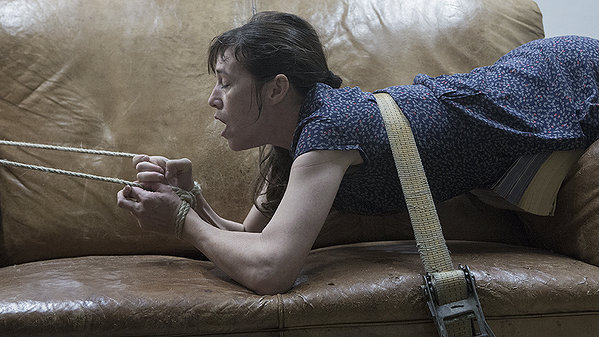 In many ways, Lars von Trier is the best and worst candidate to present a four-hour opus on the life and times of an avowed nymphomaniac. The man approaches the idea of sex addiction in practically the most clinical way possible while still being cinematic. You can practically envision Seligman as a stand-in for von Trier, countering Joe’s sense of shame with a broader, scientific perspective. Really, this is the tale of a woman spilling her guts about all her dirty little secrets and a man nodding along, asking questions, and dismissing her self-loathing with his reason and empathy. It’s sort of like being inside a therapist’s office. I can’t say whether or not I find all the analogous asides to be interesting or simply insufferable pretension. While Joe is detailing her behavior, Seligman will stop her and provide further context, often bringing in such subjects as fly fishing, the mating habits of fish, the Fibonacci sequence, Eastern Orthodoxy, and classical music. It’s almost absurd how encouraging Seligman is, dismissing every action of Joe’s sordid past through an example. After a while, it almost becomes a humorous game all its own, as we know Seligman will use every story as a stepping off point to some weird outside connection. Every item in Seligman’s bare bedroom inspires a story from Joe, which leads to a suspicion that she is something of a salacious Keyser Soze, piecing together her story on the spot; some of the coincidences with Jerome (Shia LaBeouf) seems just a bit too much. Seligman’s enlightened and intellectual asides force the audience to consider deeper meaning with Joe’s actions. Is she irredeemable, does she have control over what she’s doing, is she doing anything even bad? Over the four hours of psychological examination, the doctor is out. Nymphomaniac, especially in Volume Two, is the best film yet on sex addiction. It doesn’t demonize the behavior, it doesn’t treat it as sensationalistic, and it doesn’t overtly judge its lead characters and the choices they make, nor does it spare them the devastating consequences.
The graphic nature of the film is getting all the headlines but Nymphomaniac treats its heroine as an addict trying to get a hold of herself. We begin with young Joe innocently discovering her sexuality, especially discovering the pull she can have over an almost endless parade of weak-willed men who will follow her every whim. If that was the only plot, then there would be little separating von Trier’s film from any late-night cable erotic series (“Oh, let me tell you the time I met this man and we did this…” –Repeat). Over the two movies, we get a stronger sense of how utterly trapped she is by her urges, by her addiction. When she’s dealing with the undignified death of her father, Joe finds whatever solace she can with a willing bedmate. She places herself in precarious situations chasing after that orgiastic high, which disappears at the conclusion of Volume One. The cliffhanger separating the two volumes is that Joe loses her ability to feel sexual pleasure, which is rather problematic for a nymphomaniac. And so in Volume Two, Joe desperately searches for a means to get her groove back, at one point abandoning her own child so that she can pursue her kink. Joe goes to counseling, joins a sex addict group (she bristles at the term and prefers “nymphomaniac”), and tries to detox, at one point removing everything vaguely sexual from her apartment, including anything knob-shaped.
 The film is structured as a series of vignettes and anecdotes, broken up with von Trier’s tried-and-true onscreen chapter system. As expected for a film based around anecdotes, some stories are more interesting or revealing or simply entertaining than others. The stories are a little more whimsical in Volume One but by the time we get to Volume Two, they become more punishing and sad. It’s one thing to bet your promiscuous gal pal who will have sex with the most people on one train ride home, or on a prank to stick a restaurants dining utensil up your vagina, but it’s another when an adult woman, night after night, leaves her toddler at home so she MAY have the opportunity to have her behind whipped. The young Joe stories are easier to shake off as youthful experimentation and thrill seeking, which Seligman rationalizes as well. However, they set up just exactly the path that the adult Joe was destined for. The tales in Volume Two have to ratchet up the stakes, given Joe’s absent mojo, so what was once titillating can become downright disturbing. von Trier’s four hours offer plenty of feel-bad feel-good opportunities along the human sexuality sphere. Adult Joe thinks introducing a language barrier could be enticing, so she asks an African immigrant if he’ll have sex with her. He agrees, but brings his brother along. The two men bicker in a different language, while Joe sits there, head slumped against her hand, comically waiting for these two naked men, their penises wagging in the foreground of the camera, to get to business. It’s quite a funny and ludicrous turn of events.
One story in Volume One stands out for its raw emotional power. Joe has a whole schedule of lovers visiting her door. Well one such older man wanted to have Joe all to himself but her price was high: he had to leave his wife, “Mrs. H.” Surprise, he does, and Joe is already uncertain if this new arrangement is what she wanted; her offer was better in the theoretical sense that he would never cross that line. Well the misses (played with chomping disgust by Uma Thurman) comes for a visit and she brings her kids along. She wants her children to see what their daddy traded them away for. At first, the wife acts civil with some stinging passive-aggression, but the uncomfortable incident is dragged out, and the emotions reach a fever pitch, with crying all around. It’s so uncomfortable, so potent, and so memorable, forcing Joe, and the audience, to think of the ripples of consequences from simple sexual dalliances. While Joe is having her fun, unbeknownst to her, there are far-ranging consequences that she, and by extension the audience, choose to ignore because all those pesky details would get in the way of our fun.
The most troublesome storyline is also one of the longest, with Joe having her backside swatted by a no-nonsense sadist played by Jamie Bell (Man on a Ledge). This guy insists there will be no penetration and his rules are to be followed strictly. It starts out intriguing to get a sense of who this guy is and what his practices will be. Joe has to sit with other women between the hours of 2-4 AM, and maybe she’ll get picked. Night after night, she goes through this setup, so desperate to feel the spark of desire again. This situation feels like it goes on forever. There is no easy climax. Rather it sets up the darker turn for Joe’s character, as she gives up being a mother and a wife. To make ends meet she becomes a debt collector, using her knowledge of men, particularly heir weaknesses, to coax them back into paying. There’s one disarming moment when she takes great pity on a pedophile that will surprise you, and it’s the only incident that causes Seligman to disapprove. Her boss (Willem Dafoe) advises her to think of an eventual replacement she can groom, and his method is singling out a young girl with no support, becoming her world, and slowly manipulating her to do your every wish. In a von Trier film, that is what a retirement 401k package looks like. This whole storyline, including her young mark (Mia Goth) romantically falling for her would-be maternal figure, just feels misplaced, like von Trier doesn’t know how to bring his four-hour opus to a close.
 That’s because he doesn’t! This paragraph is going to delve into the conclusion of Nymphomaniac, so be warned that there will be major spoilers being discussed. If you wish to remain pure, skip to the next paragraph. During Volume One, I had the unmistakable feeling that all of this had to be leading somewhere. It wasn’t just going to be one woman distilling her life stories over the course of one night. I also figured there had to be a reason for why Seligman would rationalize every one of Joe’s actions, shifting blame away from herself. And there’s truth to what he says, namely that the world judges Joe far more harshly for her actions because she happens to be a woman committing them. If a man was performing the same stunts, or left his family, he would not be seen as damningly. Then early on in Volume Two, Seligman reveals himself as asexual, a man born without any sexual desire. He argues he’s the perfect person to hear out Joe’s tales of woe, as he can objectively analyze them free from lust and desire and titillation. Then, by the end of volume Two, Joe as decided to change her ways. She wants to be someone different, someone better. She’s turned the corner. What, a glimmer of well earned hope emerging at the end of a von Trier film? That’s impossible. This natural ending is destroyed thanks to von Trier’s nihilistic perspective; he just can’t help himself. And so, though it makes no narrative sense and seems completely out of character, Seligman comes back to Joe, tries to rape her, and is then shot dead. That’s the end. Every man is a deviant. It just completely undoes Seligman’s entire perspective, as von Trier abandons whatever gains he’s made over four hours for what amounts to a groan-worthy joke. It is without question one of the worst, most misguided endings I’ve seen in a film. It makes the previous four hours feel like a lousy setup for a lousier joke.
It’s a shame because Gainsbourg gives a terrific performance as the older Joe. The actress is no stranger to von Trier and his sadomasochist ways, having also starred in Antichrist and Melancholia. You get a sense of her character’s desperation, the thrills of her youth now gone. She’s also grappling with her own fallibility, the anger that comes from that, her antipathy with others, and the regrets and jealousy that penetrate her hard exterior (no pun intended). She’s trying to act above society, an operator who plays by a different set of rules, but it’s fascinating when the emotions reveal themselves from the sensations. And Gainsbourg puts all of herself into this role, submitting to her character’s many mental and physical tortures. Even if she has a body double pasted in, it’s still representational of her and Joe. Gainsbourg manages to draw us in, not wanting our sympathy but eventually earning it. Martin, as young Joe, gets just as much screen time as Gainsbourg, but there’s a vacancy there to her acting, a certain passivity that makes young Joe feel more like a spectator than a participant in her life. Skarsgard (Thor: the Dark World) is an appealing foil for Joe, almost comical in how accepting he is and how excited he can get with his digressive connections. The only other actor of note in the large ensemble is LaBeouf (Transformers) who affects a strange accent but sticks with it. We’ll see if his self-imposed exile from Hollywood and acting sticks as well.
 I’ve spent this entire review talking about everything else rather than detailing the nature of the graphic sex, the point that earned Nymphomaniac much of its curiosity with the general public. That’s because the explicit nature of the sex is inconsequential. I understand that that may sound odd for a movie literally called Nymphomaniac, but that’s because von Trier’s movie is less interested in the salacious and tawdry acts and more about deconstructing a life lived and the increasingly fraught rationale for her choices. Much like Blue is the Warmest Color, the graphic sex is the headliner, and it is occasionally graphic and unsimulated, with more than a few vaginal close-ups. The sex is incidental, a symptom of the human condition, and von Trier’s less-than-sensational look at such a sensational topic grounds the movie intellectually. With Nymphomaniac, von Trier is posing questions, pushing his audience to question our own views on sexuality and concepts of normalcy and what is and isn’t in good taste. We’re prurient creatures lapping up all the dirty details and copious amounts of nudity, but the introspection is what sticks, and it’s an incisive character study that opens up in many beguiling, illuminating, and surprisingly relatable ways…. Until the end. There’s no way to account for Nymphomaniac and just forget the ending. Four hours and for what? I cannot fathom what von Trier was going for rather than a return to his M.O. of humanity resorting to casual cruelty. If you can bear it, Nymphomaniac is a fitfully entertaining film, provocative to the end, and then it all slips away thanks to cinema’s worst practical joker.
Volume 1: B-
Volume 2: C+
The Ending: F
Nate’s Grade Overall: B
Share this:

Draft Day (2014)
 Let there be no question, while baseball may still cling to the title of “America’s sport,” the real king in the realm of sports is football. The NFL has grown by leaps and bounds and dominated American culture, to the point that the NFL Draft is an event that millions more watch than actual games in other sports. In some way the Draft is the most optimistic day in football, where every professional team thinks they’ve found the missing pieces to make that championship run, that their draft picks will all pan out. It’s a rare day where even the Cleveland Browns can be optimistic. There’s also been a shift with the fans. Decades ago, most people would fantasize about being an NFL head coach; nowadays, in the age of number-crunching and fantasy football, most people would prefer being an NFL general manager (GM), assembling their dream team. The landscape is ready for a film like Draft Day, but will the fans turn out for a fictional outing?
Sony Weaver Jr. (Kevin Costner) is the GM for the Cleveland Browns and he’s put the team’s future all on the line. He’s traded draft picks with the Seattle Seahawks, jumping from number seven to number one. Everyone assume that Wisconsin quarterback Bo Callahan (Josh Pence) is the consensus number one. Sonny has traded his team’s first round draft picks for the next three years in order to make this move. Now, with less than twelve hours remaining before the start of the NFL Draft, he has to make sure Bo Callahan is the kind of player he wants on his team. Highly regarded Ohio State linebacker Vontae Mack (Chadwick Boseman) has sparked doubt in Sonny. Despite what the experts think, is there something amiss with Bo? Sonny has no shortage of people with opinions on what he should do: the owner (Frank Langella) demands Bo so they can sell tickets, the coach (Denis Leary) wants a prized running back rather than having to struggle with a rookie QB, and Sonny’s coworker, Ali (Jennifer Garner), wants Sonny to come clean about their secret relationship and her impending pregnancy.
 Less cerebral than Moneyball but still mightily entertaining, Draft Day is a pressure-packed crowd-pleaser skillfully made to deliver big payoffs, regardless of whether you watch football or not. Like the Oscar-nominated Moneyball, the focus is less on the game than the micromanaging of the game behind the scenes with the key personalities of an organization. The movie is knowledgeable, swift, and stuffed with characters that each have their own demands, always crashing into Sonny and pulling him in a new direction. It’s easy to see why this script was the number one screenplay on the Black List in 2013; it just moves, so effortlessly, cognizant of the ticking clock at every moment and the impending stakes for our hero. It’s a man with one mission: the future of the Browns, but with infinite ways to do it, each side pushing a favorable case for themselves. There are so many permutations to putting together a team, let alone having the number one pick. And if Sonny doesn’t make a splash, he knows he’ll be out of a job at the end of the season. It’s a position rife with conflict and dramatic payoffs. There’s the pressure of the fanbase, hungering for a winner to finally root for, the pressure of the owner, salivating over the ticket sales a splashy QB can provide, and there’s the pressure of Sonny’s own father, a man who recently passed that forces Sonny to reflect on what will be his own legacy with the Cleveland Browns. As a sports fan, it’s fascinating for me to listen to experts talk about the nuts and bolts of putting a team together. As a movie fan, it’s easy to get into the film with its underdog protagonist, a man trying to get out of a hole of his own doing, which means his moments of triumph are even more resonant.
The film smartly presents itself as a combination of an investigative mystery and a high-stakes con game. Sonny has the number one pick and yet his gut is telling him something is amiss with the surefire can’t miss quarterback prospect. With the Draft that very day, Sonny is under tremendous pressure to conduct a speedy background check into Bo Callahan. Each minute that passes the more significant it becomes to know who Bo is and follow the leads on questionable evidence; Sonny can’t assign the future of the franchise to a player that will leave it in ruins (or in the case of the Browns, more ruins). Sonny has mortgaged his team’s future and the pick better be worth it. The Freakonomics guys estimated that a bad franchise QB (think the Raiders with JaMarcus Russell in 2007) could set back a team on average five years. Likewise, the film balances this ongoing mystery with a con game. Every team is trying to fleece the gullible and needy, and Sonny fields offers for his top pick, some laughable and some tempting. Once the Draft kicks off, and Sonny steers his team in the direction he desires, that’s when the film gets even more exciting. We watch the man spin and deal and conspire, flexing muscle against other teams and regaining a position of strength. It’s tremendous fun for football fans and non-fans alike just to watch a professional in their element con his way to victory.
With as much conflict that comes naturally from the setup, I wish Draft Day didn’t feel so sitcom-y at times, shoehorning in trite additional conflicts and storylines. Let’s just assess the day for Sonny: he’s the GM with the number one pick, his future and the team’s future hangs in the balance, but his father also just died, his mother insists upon an ashes scattering burial that day, he has to perform a deep background check on his would-be franchise QB, he’s been harboring a secret relationship with an assistant who wants to go public, and he’s just been informed he’s going to be a father. That’s a lot of conflict for one man in a period of one day, and the confluence of all this drama in such a short window of time is far too unbelievable. You might wager that at the end of Draft Day Sonny puts a pistol in his mouth. The romance with Ali, and his impending fatherhood, never really works, serving up Sonny an opportunity to reflect and squeeze in some exposition, a life outside of football. The romance subplot feels tacked on and malnourished. Likewise, there are characters and moments that feel like they were slapped together as apart of some broad marketing package. Ali has a hapless intern who always comically happens to be in the wrong place at the wrong time. Well, it’s supposed to be funny, but it just feels forced. There’s a scene where the Browns’ coach sets a draft analysis on fire, dropping it onto Sonny’s desk, only to have Ali douse it with a fire extinguisher. Football is a theatrical game to begin with, attracting colorful characters with oversized egos, but actions like this just feel strangely silly and false.
 Director Ivan Reitman hasn’t made many films since 2001’s underrated Evolution, and one of those was the horrendously unfunny, misogynistic My Super Ex-Girlfriend, so the prospect of “an Ivan Reitman film” doesn’t have the same draw as it once did. His touch with actors is still kicking. Costner (3 Days to Kill) is great in a role suited to his talents. Even with a thankless role, Garner (Dallas Buyers Club) can be a winning big screen presence. The film is packed with great actors filling out even the smallest of roles (hooray Sam Elliott, Chi McBride, Terry Crews, Timothy Simons, and Kevin Dunn). Boseman impressed me more with a handful of scenes here than in the entirety of 42 as Jackie Robinson. The best decision Reitman makes as a director is to present the movie as the breezy two hour-entertainment it is, keeping the pacing to the floor. However, Reitman gets drunk on his use of split-screens. It begins on an interesting note, with one side transitioning beyond the division of the split-screen. Then it happens again and again, sometimes repeatedly in one scene. It was a neat visual device that Reitman just can’t let go of, which might actually get some people queasy with the sliding scenes.
Time for a personal disclosure: as a diehard fan of the Ohio State Buckeyes and a relative fan of the ever-suffering Cleveland Browns, this movie was tailor-made for my own sports fandom. The people of Cleveland will especially enjoy this movie. During my preview screening, when the Seahawks brass asked, “Who would be that desperate?” and the scene cut to a skyline of Cleveland, my audience cheered. That’s us, they all agreed. The world of Draft Day also exists in a slightly parallel plane where the Dallas Cowboys have won “a lot” including recent championships. Enjoy that fiction, Dallas fans. In the original draft by writers by Scott Rothman and Rajiv Joseph, Sonny was the GM of the Buffalo Bills, but cosmically it just feels correct that it’s the Browns, a team defined by its long history of letdowns, epic collapses, draft busts, and comical mismanagement. It’s eerie that the Browns themselves are faced with a similar situation for the 2014 Draft. Many pundits predict the Browns will select a new franchise QB with their number four pick, but are any of these young men up to snuff? Are there character concerns for Johnny Football? Should the Browns give their own promising quarterback another chance after a season-ending injury before starting over at the position? Eerie.
Draft Day isn’t exactly the football equivalent of Moneyball, but it’s close, though more mainstream in appeal and execution. As a football fan, I’ve been looking for an intelligent and analytical look behind the scenes of the most physical of American sports. In 1999, Oliver Stone came close with the noisy and expansive Any Given Sunday. With this movie, we have a mixture of genres (mystery, con, existential drama) that turn the sports movie into something greater. It’s fun, often humorous, breezy, charming, and agreeably entertaining even when it takes one too many forced detours amidst all the conflict. You don’t have to be a football fan to have a good time with Draft Day, though it helps. This movie very well may be the highpoint of the Cleveland Browns’ season this year.
Nate’s Grade: B+
Share this:

God’s Not Dead (2014)
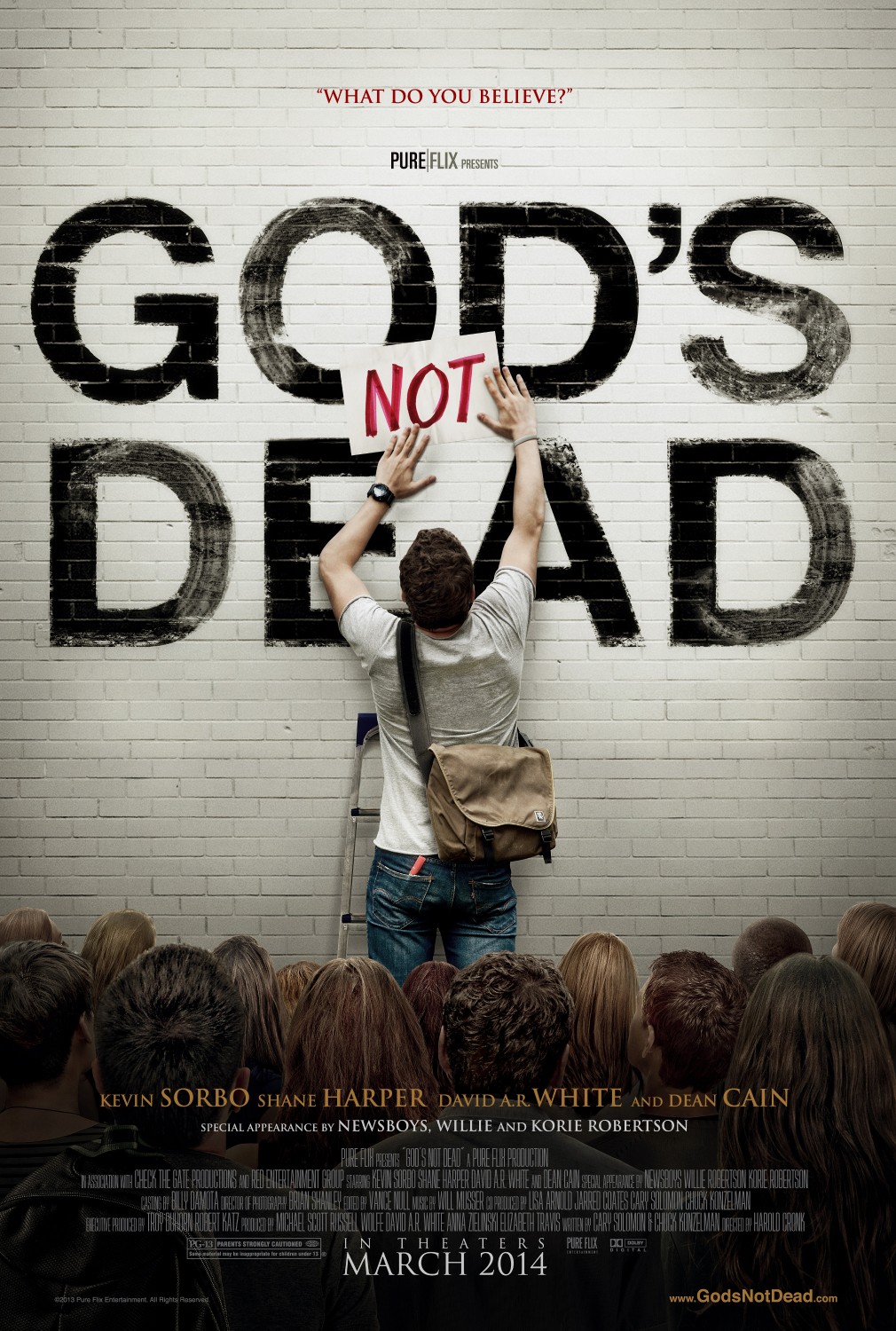 Before I dive deep into the unfortunate indie film, God’s Not Dead, allow me to disclose my own leanings. While I can objectively deconstruct and analyze a film, as I intend to with this one, allow me to state that I consider myself a Christian. I also happen to have several friends of different faiths including some who are atheists. We can civilly discuss our differences without having to demonize one another, finding merit in the different tracks people take to add value to their time on this Earth. Well somebody should have let God’s Not Dead know that the world isn’t so didactic, and the best way to reach people is not to loudly declare your own sense of superiority. This is such an angry little movie disguised with a misleading happy face.
Josh (Shane Harper) is a freshman assigned to Professor Radisson’s (Kevin Sorbo) introductory philosophy class. He’s been warned early on that the prof has a target for Christians in his class. Sure enough, on day one, Radisson offers his class a tempting offer: if they will turn in a slip admitting God is dead, then they will automatically get a good grade and the class will move on to other thinkers. Josh can’t do that, so Radisson challenges the coed to prove the existence of God over the course of three classes. Josh’s peers will serve as the jury of this theological trial.
 It should go without saying that God’s Not Dead feels like it exists in a world that doesn’t come close to resembling reality. That’s fine, movies don’t have to be a perfect reflection of our world, but when a film purports to be the reaction to the persecuted, it has to bend over backward to create its illusion of persecution. One of the big giveaways early on was the fact that all but one person in a full class would acquiesce to admitting, “God is dead” for a better grade, especially a school in the South (the film was filmed in Louisiana). The next giveaway was when Josh’s girlfriend threatens to break up with him if he goes through with challenging Radisson. Her thinking: if Josh gets a poor grade in one class his freshman year, he’ll never be able to go to law school, and their future plans will be kaput. Who thinks this way? Another giveaway was the representation of academia, namely the professors at the university, all of whom come across as snobby, self-satisfied, smug, and mean-spirited even to the point that they’re mocking their own colleague’s girlfriend to her face. People don’t behave like this. Then again this is more of a parable than a story, and more of a conversion exercise than a movie.
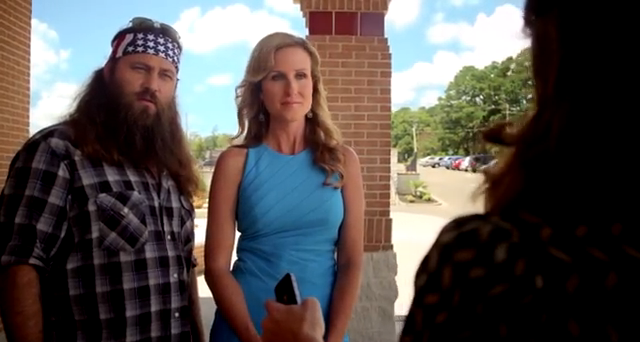
The genesis of this movie feels like it was spawned from a collection of e-mail forward bogeymen, in particular the notion of Christian persecution. For starters, a far majority of this country identifies as Christian, as do the politicians making and enforcing the laws. This is very much a Christian country, so why do certain people feel they are under attack? Even accepting the premise, the movie is rife with creaky subplots that don’t add weight to the film, only padding. There’s the Chinese student who wants to gravitate toward Christianity, whose father warns him to go with the flow lest they upset the Chinese government (COMMUNISM!). There’s the Muslim student forced to wear a headscarf and who secretly listens to Billy’s Graham’s son on her iPod, afraid of what her traditional father would do if he found out (MUSLIMS!). There’s a blogger that writes for “The New Left” who wants to ambush good Christian celebrities like the Newsboys and one of the bearded gents from Duck Dynasty (he looks eerily like my critical colleague, Ben Bailey) with her position of outrage (LIBERAL MEDIA!). In light of the controversy over the Duck Dynasty patriarch saying gays are on par with terrorists and black people were more cheerful in the Jim Crow days, it’s even more unusual. These additional storylines are grafted on with such witless care, belaboring the running time.
Radisson is the prime bogeyman, the smug, self-satisfied atheist intellectual (LIBERAL! COLLEGE! ATHEIST!). No college professor is EVER going to force his or her students to declare God dead in class. They would be disciplined severely and booted. Radisson can spout out a few famous names, but really the man resorts to bullying and intimidation, including physical threats against Josh. There’s no way a dean would allow this to stand. The classroom, and higher education in general, is meant to provoke discussion, especially for a philosophy class. The notion that a philosophy professor would think only in reductive right/wrong terms is idiotic. The entire idea of college as this liberal brain-washing ground that infringes upon the freedoms of Christians, a feeling cataloged in the end credits with reported legal cases, falls apart when you understand that college is about the exchanging of ideas. A Christian viewpoint is but one viewpoint, and within that group the variances are many. Simply being exposed to differing views, texts, and people is not cause for alarm, unless, of course, the person is too insecure in their own faith. The anti-intellectualism argument seems to believe that the more knowledge one is exposed to, the more choices they have, the less trustworthy they can be with making up their own mind.
 Then there’s just the overall poor nature of Josh’s debates. If you’re going to put God on trial, then devote the majority of the movie to this exercise. Cut the many subplots just floating around gunking up the narrative. Josh is in charge of presenting a compelling case for the existence of God. He opens with the notion that man cannot prove God exists but they also cannot disprove God. Huh? Josh, you’re tasked with proving the Almighty and you start with this rhetorical nonsense? Let’s apply this logic elsewhere: I can’t NOT prove that eating ice cream spares me from getting struck by lightning. An intelligent case can be made for a Creator, but that’s not what happens here. Instead, Josh relies on circular logic while blasting others for circular logic. He cites Genesis as the accurate scientific account for the Big Bang, saying science had it wrong, forgetting that science is, pardon the term, an ongoing evolution building off the previous ideas and breakthroughs. He also grossly misrepresents the theory of evolution, the timeframe of developing life, provides a ham-fisted rationalization for the existence of evil, and finally resorts to pressuring Radisson to admit he is a lapsed Christian who has never forgiven God for the death of his mother. Because, you see, an atheist can’t simply come to their beliefs logically. The final head-scratcher is when the class unanimously votes with Josh “I am Spartacus” style, not a single soul, in a philosophy class no less, quibbling over the flawed presentation (Hey, he made animated PowerPoint slides! That’s all we need). I also doubt that any modern-day college class would be filled to capacity especially a class as potentially boring and esoteric as a philosophy class for eighteen-year-olds.
Let’s focus on the really nasty core of God’s Not Dead, which states explicitly and implicitly that anybody who is not a Christian is without morals and judgment. Josh, in his concluding argument, cites Dostoevsky (though it’s really a character in his book) saying, “If God does not exist then everything is permitted.” His argument boils down to the concept that those who do not believe in God are without moral clarity. That’s generally insulting and downright hostile, presupposing that the only reason people treat other human beings with kindness and respect is because of religious faith and not, you know, an innate personal sense of right and wrong. Newsflash: no one religious group has a monopoly on moral values. Hammurabi didn’t need Christianity to come up with a system of moral laws to live by in 1700 BC. I don’t kill my neighbor merely because I fear cosmic retribution. Likewise I don’t help a person in need because I want my brownie points; I do it because I know it’s right. The entire movie exists in such a black and white terms, and to keep up with this edict every non-Christian is presented as a terrible, often mean-spirited human being. The Muslim father believes in God, but not the Christian God, and so he must beat and threaten his daughter for her clandestine conversion. The superficial businessman (Dean Cain) has riches but at what price? The liberal blogger has her career but in her time of need nobody close to comfort her. The film posits that atheists or non-Christians are without morals and cannot be truly happy in life. It’s this gnawing and unnecessary sense of superiority that infuses the film, leaving an unsettling aftertaste of smugness for a movie purporting to castigate others for their own smugness.
Let’s talk about the liberal blogger and Radisson for a moment. It’s not enough that we can’t allow intelligent people to have differing perspectives and beliefs, and respect those differences; no every person with a different view on God must be punished. The liberal blogger finds out she’s dying from cancer. Big spoilers ahead: Radisson is fatally hit by a car. Our kindly reverend character has just enough time to get Radisson to profess his love for Jesus on his deathbed before stepping off into the light. And so, our voices of dissent are unceremoniously killed off. Literally we jump from the death of a man outside to an extended Newsboys concert that asks people to text bomb their pals, a text which just happens to be the name of the movie and the Newsboys’ 2011 album. It’s a little unseemly from a dramatic standpoint but from an ethical standpoint more so.
 I’ve expended a lot of words examining the content of God’s Not Dead, so allow me to judge it as a film. For starters, there are way too many subplots that eat up valuable time, mostly people on the periphery meant to provide validation to Josh for his actions. Tonally, several of these segments clash, especially the kindly minister and his wacky misadventures trying to drive to Disney World. The time in the classroom is the hook of the film but it gives us about equal time with the liberal blogger or the Muslim daughter or any other distracting side character. Also, the filmmakers have the annoying habit of cutting to another scene and then back while their first scene continues to play out. I assume they’re forcing parallels but in reality it’s just shoddy editing that disorients an audience. Then there’s the sequence where the Muslim girl’s younger brother is entering her bedroom, going to discover what she’s listening to on her iPod, and it’s played hilariously like a horror movie with the lurking shadows. There are directing choices that take away from the potential drama of scenes. From a technical standpoint, God’s Not Dead looks slightly better than other Christian widespread releases, but the filmmakers are worse storytellers than the Kendrick brothers (Courageous).
The acting is inoffensively bland with one notable exception. Despite what you may think, Sorbo (TV’s Hercules) is actually pretty good as the raging atheist. He digs into his character’s pool of anger and arrogance and produces a performance that weirdly feels moderately grounded, even for a character that is not. I don’t really know why the Duck Dynasty cameo was necessary but I suppose the filmmakers felt they needed additional star power to lure their target audience.
God’s Not Dead is a surprisingly mean little film that hides its purpose under the auspices of evangelism. I expected a pro-Christian message and it has every right to put forward its own viewpoint, but the film isn’t so much pro-Christian as anti-everyone not already following the same limited interpretation of Scripture. This is not an inclusive film that will reach out to those lost sheep. Putting aside the poor filmmaking and plotting, the misplaced persecution complex, and the straw man arguments, the most disappointing aspect of God’s Not Dead is the illusion of intellectual rigor. The merits of Josh’s less-than-stellar arguments are not the point, though any person skilled in critical thinking should be able to poke holes in his faulty rationale. The point of the film is to feed into an unjustified sense of being wronged, that even though Christians are a clear majority in our country, that somehow they are under attack simply because others are allowed equal opportunity to share their own valid views and beliefs. In the black and white universe of God’s Not Dead, there is only one way to be happy, to be moral, and if you’re not on this team than there’s no way to achieve anything of substance in your life. Do you see the difference? It’s not that my side is good, it’s the notion that my side is better, that your side is worse. It’s a distinction that adds a decidedly sour note. This is a movie after all where the purveyors of atheism have to be struck down with death. God’s Not Dead is likewise striking ‘em dead at the box-office, but you should hold the movie to a higher standard.
Last note: the very title is a misuse of Nietzsche’s quote. The full quote is, “God is dead and man has killed him,” which implied man no longer needed religion to serve as its lone basis of moral authority.
Nate’s Grade: D
Share this:

Captain America: The Winter Soldier (2014)
 A welcome addition to the Marvel Cinematic Universe, the second Captain America film brings the square superhero to our modern-day and presents a complicated national setting where the enemy is the U.S government. The challenge with a Captain America (played by Chris Evans) movie is just how outdated his whole sensibility seems, an irony-free nationalistic hero. Smartly, the filmmakers have pushed his loyalties to the test, and the movie transforms into something along the lines of a Jason Bourne thriller, where the government is hunting down a rogue fugitive. It’s certainly the most timely superhero film since 2008’s The Dark Knight, and the political commentary on the NSA spying and drones is a welcome big screen subversion. But the action is still what people come for and in that the Winter Soldier is quite an entertaining movie. Directed by the Russo brothers, known mostly for their comedy work in TV like Community, the movie packs quite a punch with a variety of action/thriller sequences, each well staged and well developed. My favorite might be Nick Fury under assault and desperate to escape in his car from overwhelming enemy forces. An opening sequence rescuing hostages on a boat serves as a great reminder why Captain America is indeed so super. The movie does have some issues but nothing so large as to derail the enjoyment. First off the villain is way too obvious, but also the movie lets the U.S. government off the hook, falling back on a select evil group that has been undercover perverting the government. Secondly, the Winter Soldier of the title is one plotline that doesn’t feel needed or well integrated. It’s another super soldier for Cap to combat and this guy has a mysterious link to our hero. It feels like one plotline too many, a story that deserves better attention on its own. Still, Captain America: The Winter Soldier is an engaging, thrilling, intelligent, and altogether entertaining addition into Marvel’s sprawling cinematic canvas.
Nate’s Grade: B+
Share this:

Noah (2014)
 Meticulous director Darren Aronofsky gained a lot of creative cache after Black Swan raked in over $200 million worldwide, a Best Actress Oscar, and heaps of critical acclaim, including from myself (not to imply I was a deciding factor). The man had what all artists dream of, a perfect moment to seize whatever creative project his heart desired. And what he chose was to remake the biblical story of Noah for the masses, with an artistic fury and idiosyncrasy the likes of which audiences have never witnessed. The decision left many scratching their heads, wondering why Aronofsky would waste his time with a story already well told, in an outdated genre (Biblical epic), that would likely turn off evangelical ticket-buyers with any deviations and turn off mainstream audiences with any devotion. It looked like a big budget folly with no way of winning. The box-office is still unwritten, though I suspect the effects will net a pretty penny in overseas grosses, but as far as a creative statement, Noah is far more triumph than folly.
Noah (Russell Crowe) is living his life in isolation from the communities of king Tubal-cain (Ray Winstone). Noah and his wife Naameh (Jennifer Connelly), their two older sons Shem (Douglas Booth) and Ham (Logan Lerman), youngest son Japheth (Leo Mchugh Carroll), and adopted daughter Ila (Emma Watson), are living on the outskirts of civilization, aided by a group of fallen angels. Then Noah is given apocalyptic visions of an oncoming flood and the mission to save the world’s animals. After speaking with his 900-year-old grandfather Methusselah (Anthony Hopkins), Noah is convinced what he must do, and it involves a lot of intensive manual labor.
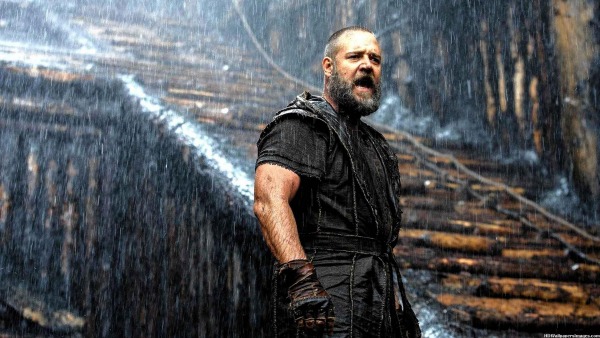 Aronofsky treats Noah and the beginnings like Greek mythology mixed with a Lord of the Rings-style fantasy epic, and it’s madly entertaining. The visuals are stirring, large-scale, and sumptuously memorable (the Earth covered in spiral weather patterns is a standout, along with Noah’s visions and a Tree of Life-style triptych narrating the birth of life). The film has come under fire from conservative critics for its creative deviations from the Bible, but sidestepping a larger conversation, why should a movie be punished because it wants to entertain a wider berth of people than the faithful? Does it truly matter that the people refer to the Big Guy as “The Creator” rather than “God”? Would these people even use the word “God”? This just seems like a petty battle of semantics. It seems like certain critics are looking for any nit to pick. Sure giant rock monsters that were fallen angels might make people snicker, but why should this aspect of the story be any more preposterous than a man and his family gathering two of every biological creature on the planet? I loved the rock creatures, I loved how Aronofsky introduces them, I love how they walk, I love that Aronofsky even finds a way to give them a redemptive storyline, offering an emotional payoff. Seriously, why should these be any harder to swallow for narrative stability?
There were fears that Aronofsky would be less than reverent to the source material with his additions and subtractions bringing it to the big screen; Noah is a Biblical epic for our modern age but also one fervently reverent to the lessons of the tale. First off, a literal version of the Genesis tale would be boring and short. There is going to be some additions and they should be welcomed. What Aronofsky and his co-writer Ari Handel (The Fountain) have done is taken a story filled with casual larger-than-life events and given it a smaller human perspective that is thought provoking. When Noah’s sons ask about wives, it’s personal planning but also a necessary part of, you know, repopulating the planet. They’re being anxious teen males but the small, relatable plot line also finds a way to relate to the larger picture, a tactic Aronofsky frequents. There’s a focus on family, fathers and sons, jealousy, but it really comes down to a personal level, differing perspectives about the overall purpose of man. The human-scale provides a richer context for the Biblical tale’s better-known aspects, like Noah turning to the bottle. As a result, we get the special effects spectacle without sacrificing the potent human drama at work. While the movie may never refer to “God” by name, it’s respectful and reverent.
 Another aspect about what makes Noah so daringly visionary is that it doesn’t blink when it comes to the darkness of the story. Over the years popular culture has neutered the tale of Noah into a cutesy tale about a guy on a boat with a bunch of happy animals. I think we’ve purposely ignored the lager picture, namely how truly horrifying the entire story is. It’s an apocalypse, humanity is wiped out; children and babies are drowning. Everybody dies. The later brilliance of Noah is that it doesn’t mitigate this horror. Once Noah and his family are inside, the floods having arrived, they painfully listen to the anguished wails of those struggling for life in the waters. The movie forces the characters, and the audience, to deal with the reality of a world-destroying cataclysm. Noah’s visions of the ensuing apocalypse are beautifully disturbing. The film takes place eight or nine generations removed from Adam, and God is already willing to take his ball and go home. After watching mankind’s wickedness, you might sympathize with The Creator. Aronofsky’s film has an unmistakable environmentalist stance (how does one tell this story without being pro-nature?), but he also shows you the brutality of mankind. The citizens of Tubal-cain have no respect for life, at one point kidnapping crying young girls and literally trading them for meat to eat. Resources are dwindling and people are pushed to the brink. There’s some sudden and bloody violence, as death is not treated in the abstract or with kid gloves. This is no cutesy story for the little ones. No stuffed animal tie-ins.
Of course once the flood occurs, the story seems like it’s at an end, Noah and his family having only to patiently wait out before starting over. It’s during this second half where the movie becomes even more personal, challenging, and philosophical. Noah believes that his family was spared to save all of those creatures born on Days 1-5, not so much Day 6 (a.k.a. mankind). He accepts this burden with solemn duty, declaring that his family will be the last of mankind to ever walk the Earth. However, spoilers, his own family pushes him to the test of this declaration. His adopted daughter is pregnant. There is hope that mankind can continue if the child is a girl. Noah sticks to his guns, saying that the child will live if a boy but killed if a girl. Now we’ve got a ticking clock, so to speak, while in the ark, and it manages to be a personal test of Noah’s own faith. How far will he go to enact what he believes to be God’s plan? He’s single-minded in this regard but he’s no zealot, more a flawed and troubled man of virtue trying to make sense of an improbably difficult conundrum. That’s the stuff of great drama, finding a foothold in a debate over the nature of man, whether man is inherently evil and shall lead, once again, to the ruination of God’s paradise. Can Noah place the personal above his burden? This looming conflict tears apart Noah and his family, forcing them into hard choices. Even assuming the film wouldn’t end with Noah butchering his grandchildren, I was riveted.
There’s an intellectual heft to go along with all the weird, vibrant spectacle. The film doesn’t exactly break new ground with its fundamental arguments and spiritual questions, but when was the last time you saw a Biblical movie even broach hard topics without zealous certainty? Definitely not Son of God. There’s an ambiguity here to be admired. Noah isn’t a spotless hero. The villain, Tubal-cain, actually makes some good points, though we all know they will be fleeting. Tubal-cain is actually given more texture as an antagonist than I anticipated. He’s a man who interprets man’s mission on Earth differently. Whereas Noah views man’s role as being stewards of the Earth, Tubal-cain views man as having been given dominion. They were meant to reap the pleasures of the Earth. Before marching off to take the ark, Tubal-cain pleads for The Creator to speak through him; he longs for a connection that he feels is missing, and so, perhaps a bit spiteful, he declares to act as the Creator would, laying waste to life. That’s far more interesting than just a slovenly king who wants to live to see another day.
 Aronofsky also benefits from a great cast that sells the drama, large and small. It’s been a long while since Crowe (Les Miserables, Man of Steel) gave a genuinely great performance; goodness it might have been since 2007’s 3:10 to Yuma remake. The man can do quiet strength in his sleep, but with Noah he gets to burrow into his obsession, which just so happens to be sticking to the edict that man does not deserve to spoil the Earth. It’s a decision that challenges him throughout, forcing his will, and Crowe achieves the full multidimensional force of his character. He can be scary, he can be heartbreaking, but he’s always rooted in an understandable perspective. Connelly (Winter’s Tale) overdoes her mannerisms and enunciation at times, like she’s practicing an acting warm-up, but the strength of her performance and its emotions win out. Watson (The Bling Ring) is winsome without overdoing it, Hopkins (R.E.D. 2) provides some comic relief without overdoing it, and Lerman (Percy Jackson) gets to thrive on angst without overdoing it. In short, you’ll want these people to live. Winstone (Snow White & the Huntsman) is always a fabulous choice for a dastardly villain.
Darren Aronofsky’s Noah is a labor of love that maintains its artistic integrity amidst special effects, threats of infanticide, and giant rock creatures. Aronofsky has forged a Biblical epic that reaches beyond the pew, providing added surprise and depth and suspense. The man takes the modern fantasy epic template and provides new life to one of mankind’s oldest tales, staying reverent while opening it up for broader meditation. It’s a weird movie, but the silliness is given a wider context and grounded by the emphasis on the human perspective. It’s a dark movie, but the darkness is tempered with powerful feelings and a sense of hope that feels justified by the end. It’s also a philosophical movie, but the questions are integral, the stakes relatable, and the answers hardly ever easy to decipher. This is a rare movie, let alone an example of a Biblical film, that succeeds by being all things to all people. It’s reverent, rousing, thought provoking, exciting, moving, and a glorious visual spectacle of cinema. Aronofsky’s epic is a passionate and thoughtful movie that deserves flocks of witnesses.
Nate’s Grade: A-
Share this:

Divergent (2014)
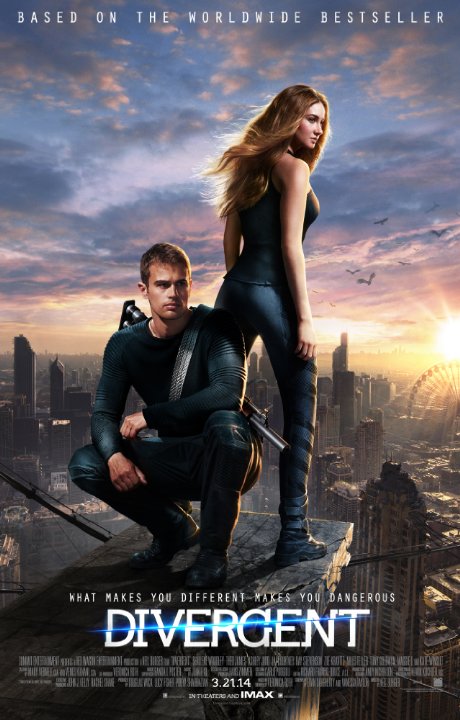 High school for many was a personal version of hell, with its class system and pressure to conform. Divergent built a whole future dystopia around this relatable concept. The problem with the movie is that the source material doesn’t think that much further.
In the future, 100 years after a great war that scarred the world, the survivors have holed up in the remains of Chicago with a large fence as their protection. The government decided to split off into five different factions, each with their important purpose. The five factions (Abnegation, Candor, Erudite, Amity, and Dauntless) work in harmony. Tris (Shailene Woodley) comes from a family of Abnegation, the selfless ones who run the government, though Jeanine (Kate Winslet), the head of Erudite, would like her faction to be on top. At the choosing ceremony, a candidate can select which faction they wish to live within. However, if rejected, that person will be factionless and on the outskirts of society. Rather than choose the comfort of her boring life, Tris decides to join Dauntless, the faction in charge of the security of the city. Before she can say goodbye to her family, she’s off joining a new one, but Dauntless has many tests to weed out the weak. Paramount in her mind is the fact that Tris is told she’s a divergent, one who doesn’t fit neatly into any one of the factions. Divergents are being singled out and executed because they are feared; they can’t be so easily controlled. Tris has to prove herself against tough competition in Dauntless while hiding her true divergent nature.
 Having not read the best-selling Young Adult books, I went into Divergent and walked away entertained enough though questioning the larger appeal. My movie partner told me that the adaptation hews closely to the book, fitting in all the major plot beats; she even said it was a better adaptation than the first Hunger Games, so fans should be relieved. What the movie came down to was one long plot about Tris getting through the Dauntless tests. It’s like a post-apocalyptic Full Metal Jacket, just minus the war half. With this tight focus, the film actually plays better and is easier to digest. The stakes are made clear and the hurdles are easy to understand. In a way it reminded me of the Ender’s Game film where we watch a recruit move up the ranks of their sci-fi training, though Ender’s was better at establishing dimension to its world. I did like the small touch that the Abnegation people won’t allow themselves to see their reflection because they see it as vain. I could have used more touches like that.
There are simple pleasures watching Tris, the plucky underdog, rising to the challenge and besting her snobby peers. The games get more intense and Tris learns from trial to trial, eventually learning how to hide her divergent nature by blending in against her nature. There’s also an intensity to this world that’s appreciated; people will die if they can’t keep up (there is one shocking sequence where a batch of jealous recruits literally try and kill Tris). The physical trials are fun but the mental ones are even more entertaining because they function around the candidate’s fears. It’s a tad lazy to simply broadcast a character’s fear for them to confront in a dream, but it provides some creepy imagery and new wrinkle for Tris to master. Even the requisite romance that every YA property has to have is handled respectfully without overdoing it. The mentor/teacher relationship with Tris and Four is a natural conduit for their budding romantic feelings, though James (Underworld: Awakening) looks way older than Woodley (The Descendants). In reality, he’s 30 and she’s 22, though she’s supposed to be… 17? 18 years old? I don’t know but it just didn’t sit right.
 Where the movie gets into problems is the larger world outside those Dauntless camps. It feels too ill defined and purposely vague. What’s on the other side of the giant electrified fence (hopefully dinosaurs)? I suppose that’s what sequels are for (they’re already filming the second Divergent for March 2015). The world just feels too small even for one city, and the history doesn’t feel integrated into the cultivations of this society. In a sense, the movie doesn’t give you enough to go on with its world building and spends far too much time dragging out its story. At a hefty 142 minutes, a time frame becoming de rigueur with YA adaptations, the film feels laboriously padded. I kept thinking the movie was going to check out at any moment, robbing me of some semblance of a complete ending. Fear not, there is an ending, though one that feels far too definite to continue a franchise. The bad guys are so obviously guilty, that even while still being at large, it’s hard to fathom a scenario that doesn’t unite everyone against the common threat. Does every YA post-apocalyptic mold eventually lead to unlikely heroes becoming the focal points of revolutions? I’m being facetious, but also highlighting just how derivative this movie is. Divergent borrows from its larger influences liberally, having enough story sense to know how to construct a satisfying tale of heroes and villains. It’s a well-polished film thanks to director Neil Burger (Limitless) but it’s also lacking necessary elements to distinguish it from the glut of dystopian imitators and predecessors.
I just can’t wrap my head around the world of Divergent. It lacks the clean clarity of, say, The Hunger Games, where the game is kill-or-be-killed and it’s very much a class warfare allegory. In Veronica Roth’s novel, the post-apocalyptic Chicago is divided into five factions but this isn’t a caste system. The different factions are looked at as equals, meant to cooperate harmoniously. So there goes any sort of class conflict when the factions are presented more as lifelong clubs. The design is that branching people off into five groups will somehow prevent the strife that lead to the unnamed war of the past. This doesn’t really make a lot of sense to me. Why would limiting people’s options for careers and lifestyles eliminate conflict? I understand the not so subtle message about conformity and the strength in controlling others, but it still doesn’t hold. Then there’s the notion that a divergent is a dangerous rogue, but it’s not like the divergent are mutants or genetically different. These are just people who don’t fit neatly into one of the five faction options. If you eliminate the conformity obsession, who cares? It’s only an aptitude test in the end, like what you take in middle school that say, “Hey, you like drawing, maybe you’d like to be a police sketch artist” (true personal anecdote of mine). It’s not something that looks deep into the souls of boys and girls and presages their future. It’s an aptitude test for crying out loud. The world of Divergent also feels strangely unfulfilled, with too many lingering questions about the logistics of how this future Chicago is able to function. There’s a confusing aura around this world and it doesn’t get explained because we spend so much time in Dauntless boot camp.
There was a weird motif I kept noticing throughout the film and that’s the future’s unsafe disregard for medical safety. The Dauntless kids are all about the running, jumping, punching each other in the face, but it all begins at their choosing ceremony. The candidates walk to the front of an auditorium, slice their palm with a ceremonial knife, and then squeeze blood into a bowl representing the faction they select. Of course they reiterate “faction before blood” so it’s a little strange that the ritual involves their blood. Anyway, what I picked up was that every candidate was using the same knife, only with he most perfunctory of wiping the blade. That is just unclean and a way for blood-based disease to spread. Then later during the mental round of testing, Four injects Tris and himself with the same needle. Clearly these post-apocalyptic people have forgotten all about AIDS and other deadly diseases. Why else would Jeanine be so calm as her hand is covered in someone else’s blood? I’m surprised she just didn’t lick it for effect.
 The actors are all well cast for their parts, with Woodley again proving herself as one of the best young actresses today in Hollywood. Her part isn’t anywhere as complex or demanding as her terrific turn in The Spectacular Now, but she’s able to slide in emotion where possible, expressing much through the power of her eyes. She’s a heroine you want to root for, and when she goes into badass mode it feels earned. James is suitably hunky while still being mysterious and broody. Interestingly enough, Miles Teller, Woodley’s onscreen beau in Spectacular Now, is here as a bully and Ansel Elgort, who plays Tris’ older brother, will soon play Woodley’s onscreen beau in The Fault in Our Stars. It’s like this weird cross-section of Woodley’s film history of boyfriends. The adults do fine jobs with their limited time, with Winslet (Labor Day) being a better realized version of what Jodie Foster was possibly going for in Elysium. My favorite adult actor was Jai Courtney (A Good Day to Die Hard, Jack Reacher) who hasn’t found the right fit for his talents, until now (he was great on Starz’s Spartacus TV show). As a no-nonsense Dauntless captain, he’s imposing in many respects and also intriguingly devious. He’s a grade-A heavy and adds a jolt to the scenes he’s in.
Poised to be the next YA breakout franchise, Divergent will likely be a hit with its target audience and reap the rewards at the box-office, though I think its flaws will hold it back from being embraced by a wider audience with no affiliation with the books. It’s an entertaining story with good actors and enough well constructed payoffs, but it’s also confusing, vague, and lacking enough urgency, class conflict, and developments to parlay into a more interesting story once Tris graduates from the Dauntless ranks. As a standalone film, Divergent works enough and duly entertains, thanks again to Burger’s visual sensibilities and the strength of Woodley. I’m just not invested at all in this world or its larger characters to compel myself to find out what happens next. I ravenously tore through the Hunger Games books, but to each their own. As a big screen sci-fi film, it’s strange that Divergent would work best in its smaller moments and settings. It’s too bad the movie doesn’t diverge enough from the pack of YA-modeled adventures. Well there is one thing to look forward to: I’ll see if I get my wish for dinosaurs in March 2015.
Nate’s Grade: B-
Share this:

Son of God (2014)
 Safe to the point of unyielding boredom, Son of God is a film that is too fearful to be anything but bland. It’s a resuscitation of the life and times of Jesus Christ, but it’s so static because it’s a collection of the Jesus Greatest Hits checklist. This is more a jumble of scenes than a movie, with little room given to flesh out the man who asked others to eat of his flesh. If anything, the one takeaway it presents is a more rounded and surprisingly empathetic perspective on why the leaders of the time felt threatened by Jesus. There is nothing here that stands out, that separates it from the glut of Biblical dramas of the past, beyond a penchant for reaction shots of an anguished Mary (Roma Downey, a producer as well). Son of God is shot and acted with the limited vision of a TV movie, and it’s easy to see why. The movie is actually partially culled from footage of The Bible miniseries that aired on the History Channel in record numbers. With that context, it’s easy to see the movie as a crass brand extension. I almost fell asleep at several points chiefly because I knew exactly what was coming and had little engagement with those onscreen. Just because you got Jesus up there doesn’t mean to get to slack when it comes to characterization. Even Mel Gibson’s Passion of the Christ brought the cinematic spectacle. This is just a bland movie that only preaches to the converted.
Nate’s Grade: C


You must be logged in to post a comment.