Blog Archives
Veronica Mars (2014)
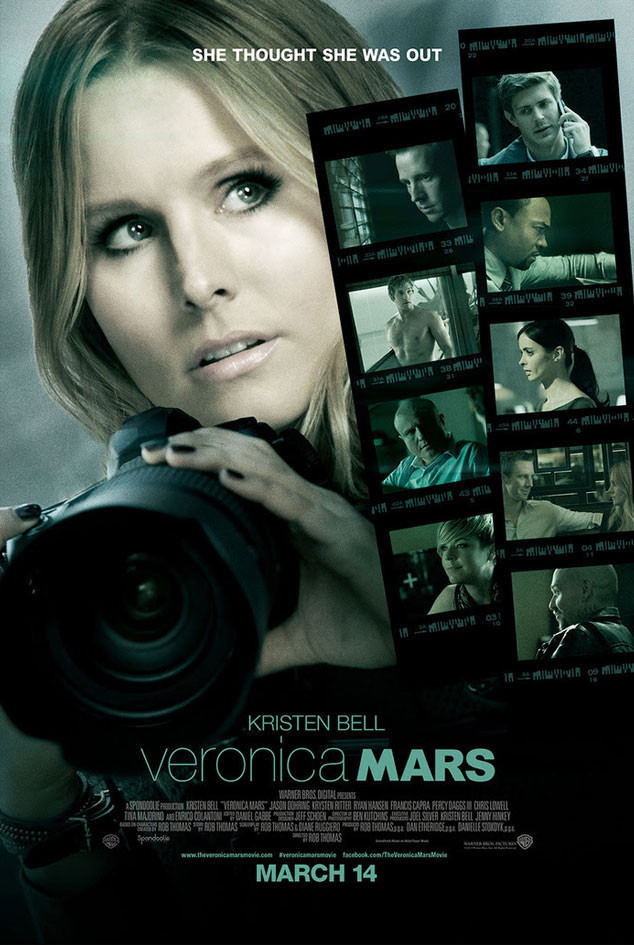 More people know the name Veronica Mars now than probably combined from its short-run on TV from 2004-2007, and that’s squarely because of its record-breaking haul brought in through the fundraising site, Kickstarter. Within hours, the project had already raised two million dollars, on its way to over five and a half million, enough for a long-awaited movie that fans have been teased with ever since the series cancellation. Creator Rob Thomas and his actors were beside themselves in gratitude to their fans (dubbed “marshmallows”). Fueled by the eager hopes of its fans, the movie went into production and is now available for digital download to many of its donors and in a handful of theaters.
Veronica Mars (Kristen Bell) has left behind her hometown of Neptune, California. She’s on the verge of signing with a major New York law firm, and an old friend comes calling. Veronica’s former flame, Logan (Jason Dohring), has recently lost his pop star girlfriend, also a Neptune graduate. He’s suspected of being the killer but he swears his innocence. With the promise of her assistance only lasting a few days, she flies back home and reunited with her old friends (Mac, Wallace, Weevil, Dick) and her father, private investigator Keith Mars (Enrico Colantoni). Veronica should go back to New York with her boyfriend Stosh “Piz” Piznarski (Chris Lowell), she should accept the job offer from the firm, but she can’t help herself fall back into old patterns. She misses the danger, the intrigue, and maybe enough, Logan himself.
 The curious case of Veronica Mars: The Movie is that it was truly made for the fans, those 90,000 people who contributed to their Kickstarter goal. It’s not made for the casual moviegoer who has no foundation with the television series. That’s not to say that Thomas doesn’t try and make the film more inclusive. The neophyte could reasonably follow along, and there is a fast-paced prologue to catch the audience up on the major developments of the series, though almost all from season one. A non-fan could watch this movie but I have no idea what they would get out of it because they would be missing all the connections and context that provide the depth. In a way, this situation reminds me of David Lynch’s Twin Peaks: Fire Walk with Me. Unless you were a fan of Lynch’s iconic thought short-lived TV series, there was no way you were going to follow along or be interesting in following along. It was a movie made for its fan base, and there’s nothing wrong with that though it always helps to provide enough entertainment to prove to the newbies why they should be fans in the first place. I don’t think the Veronica Mars film is able to achieve this. Sure, I enjoyed myself but that was because of my pre-existing fan club and my years-in-the-making desire to finally see proper closure to the characters I came to care about. I feel like someone without that devotion would watch the 105 minutes of Veronica Mars and question what all the fuss was about.
That’s because at feature-length, Veronica Mars is really more of an extended episode of the TV show, and not one of the top tier episodes. As a debut film director, Thomas does a serviceable job of recreating the series noir visuals. The mystery is sufficient if a little dull, lacking a strong sense of urgency throughout most since Logan is already walking around free of charges. The real anchor of the story is bringing Veronica back to Neptune and bringing her back into the family business. The class injustice was a hallmark of the TV series but it’s merely one more slightly malnourished storyline cluttering up the narrative. There are no real reasons to check in on so many characters beyond the fact that it provides resolution for fans. A ten-year high school reunion seems engineered just for this purpose, allowing the new old faces to all reappear again and catch us up. There are characters that appear in near-cameo form (though the surprise celebrity cameo is quite amusing). Even the romance feels mostly grafted onto the story because the core audience demands Veronica and Logan reunite, in all senses. It just becomes a matter of time waiting for the inevitable, as it is with all romantic comedies, except the romance is sidelined here until it isn’t. As a film, it doesn’t feel organically handled that Veronica would leap back into Logan’s arms, and so soon, unless, of course, you are one of those fans (I know MANY) who have been waiting seven years for that moment. Fan service is one thing but it shouldn’t detract from the internal logic of the featured story.
 What does still work are all the hallmarks of the TV show, even if they are less effectively showcased for first-timers. The plucky, sarcastic nature of Veronica still turns her into a heroine worth rooting for, a force of will that has her flaws as well. Bell (Frozen, TV’s House of Lies) can just about do it all, from goofy to heartfelt to ferocious. It’s clear how much she adores this character she helped bring to life ten years ago. The father/daughter relationship is warmly affectionate without dipping into sappy territory. The dialogue is still snappy, though having late twenty-somethings saying it rather than high schoolers has dulled some of the edge. There’s also the sleazy addition of older men hitting on Veronica now that she’s officially out of high school, so hooray. The season-long mysteries of the series, while satisfying and twisty, were secondary to the characters, and watching the overall jovial camaraderie of the cast, is a reminder at how much fans adore these people.
I can objectively critique the faults in the film, as I’ve tried to do for a couple paragraphs, but this is a movie where I set aside my critic hat and merge with the fans. I too contributed to the Kickstarter because I’ve been dying for a sense of closure for one of the best TV shows in the mid-aughts. The finale of season three left much of the show in doubt; Thomas was not counting on cancellation. While fan fiction can run rampant in these circumstances in order to cater to fan demands, it doesn’t compare to the creator being given a reprieve to tie up as many loose ends as possible. That’s the greatest accomplishment of the Veronica Mars movie is that it feels like a genuinely satisfying sense of closure for the fans. While not every storyline is wrapped up, like for instance Weevil’s path, it ends on a point where you can reasonably guess where the characters would continue from here onward if we were never to check in with them again. This is a good resting place. But given the runaway success of the Kickstarter campaign, maybe Warner Brothers could be convinced there are more stories to be told here. I’m cautiously optimistic but really Thomas has already given the fans just about everything they could want, unless they were the Veronica/”Piz” minority of shippers.
Whatever you think of the final product, Veronica Mars: The Movie has changed the way movies can get financed. Smaller boutique films with a passionate fanbase can now get the ball rolling, putting their money into a down payment on seeing their dream movie becomes a reality, convincing studio heads to roll the dice with less risk. I invite all newcomers to watch the series, since that is where it was best. As a film, it’s enjoyable enough and satisfying for the fervent fans, supplying needed closure. However, for people that don’t already have connections to these characters and this world, I don’t think there’s enough going on in the movie to attract a larger discipleship.
Nate’s Grade: B
Share this:

Nebraska (2013)
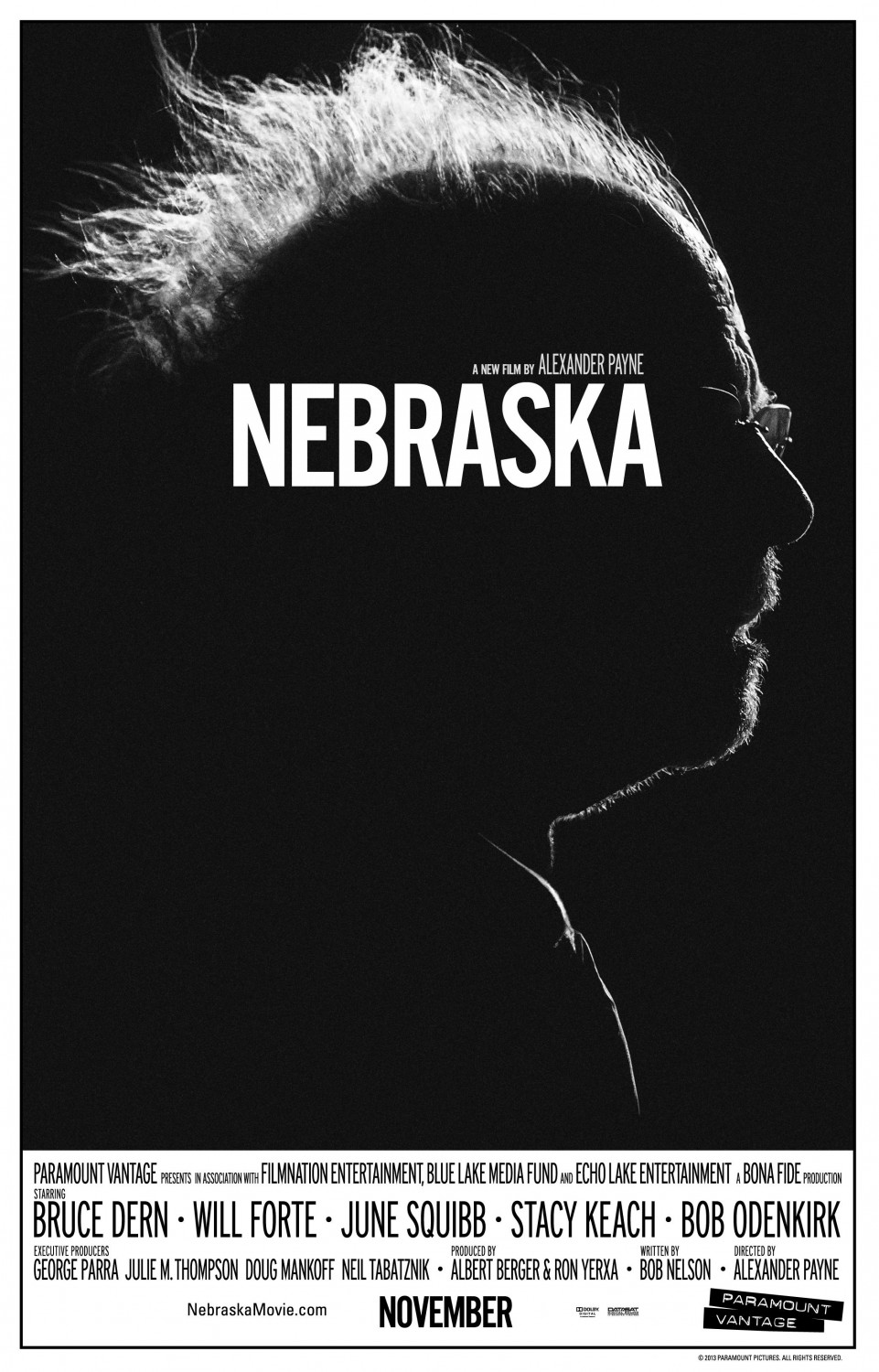 Nebraska is a slow burn, wryly-funny character study of understated proportions, highlighting Midwestern culture rarely given its big screen due. So, in essence, it’s an Alexander Payne movie.
Woody Grant (Bruce Dern) is an elderly man convinced he has won a million dollars and all he needs to do is travel to Lincoln, Nebraska to claim his loot. It’s one of those mass mailings really meant to get people to buy magazine subscriptions, but Woody will not be stopped, sneaking out to walk all the way to Nebraska from his home in Billings, Montana. David (Will Forte) is in a rut himself. He’s recently been dumped, his job is going nowhere, and his father refuses to accept his million dollars isn’t real. There’s a question of how lucid Woody is, and so to placate his old man, David decides to drive his father to pick up his winnings, to humor him before his mind may be gone for good.
 Despite the overtly sitcom machinations of the inciting incident, which even the characters dismiss, the film is really a drama about the relationship between a father and son and the culmination of our life choices. Woody and David are not close by any conventional means but over the course of their road trip, David begins to see his father in a different light; the old wounds are not forgotten, but David is learning about who his father is through others. He’s been so mad at his father for so long that it was the only identity he had for the man. Now in his deteriorating mental state and physical fragility, his father has a sense of vulnerability that brings about decidedly mixed emotions. In his fragile state, is he the same man or at least the same man David remembers? Then there are all the family revelations springing out from the situation. With a genuine millionaire in their midst, the family is coming out of the woodwork clamoring for their own pieces for all the unpaid assistance they’ve given Woody over the years. Initially, it makes Woody look like he’s been stuck trying to find his footing his whole life, as we learn about the lingering post-traumatic stress effects from his war service. Was he lazy, undiagnosed PTSD, or, as another character surmises, too ashamed to say no when others asked for help, and so he was taken advantage of in the guise of assistance from unscrupulous friends and family. The question remains who is Woody?
This is one of those observational slice-of-life films, and your enjoyment of it will depend on your threshold for the taciturn types. These are the strong silent types who keep most of their feelings to themselves. There’s a very funny sequence where Woody and his aged brothers have gathered around a TV, and to listen to the dry mostly car-related conversation bounce back and forth like a dead, floating wiffle ball, is a great comic moment but also a nice insight into an older generation and their communication. Given the perspective of the film, it’s hard to deduce whether the plainspoken people are being satirized or whether it’s a loving send-up of a specific culture. With Payne’s involvement, I lean more on the affectionate tweaking rather than a mean-spirited ridiculing of small town folk and their small town ways. There are funny situations, like David and Ross teaming up for some misplaced justice, and there are characters more broadly drawn for laughs, particularly Woody’s wife (June Squibb), but the overall interaction of the characters, their speaking vernacular, and how they viewed themselves, that is what made me laugh the most and appreciate the script. You feel like you’re dropping in on these people’s lives; every character feels like they could be a real person, not a stereotype. And boy does money really bring out the worst in people.
With Woody and his son visiting his old haunts, the movie inevitably becomes a reflection of a man taking stock of his life, regarding the choices he made and did not make. The pit stop in town opens up the character and David learns far more about his father, with old girlfriends, old business partners, and old rivals. What I appreciated further is that Nebraska doesn’t try and soften Woody; he’s not going to be some old curmudgeon who over the course of 90 minutes has his icy heart thaw and comes to realize the errors of his ways. Nope. Our views on the old man may soften when we get a fuller picture of who he is ad the life he’s lead, but the man himself is the same. He’s readily belittled, insulted, looked down upon, even by his own family members, especially his sassy wife. It’s easy for him to retreat into alcohol and wonder what if. As the family picture broadens and becomes more clear, the film approaches simply yet touching revelations about the family and the nature of legacy. There’s a father/son examination, but there’s also the discussion of what to do when your parents become too ill to take care of themselves. It’s not exactly The Savages, but there’s a circling sense of burdensome decision-making that provides an extra level of pathos to the sitcom setup. By the end, Nebraska squeezes out some earned sentiment without losing its edge or sense of identity. There’s a lot more going on then just some send-up of rubes.
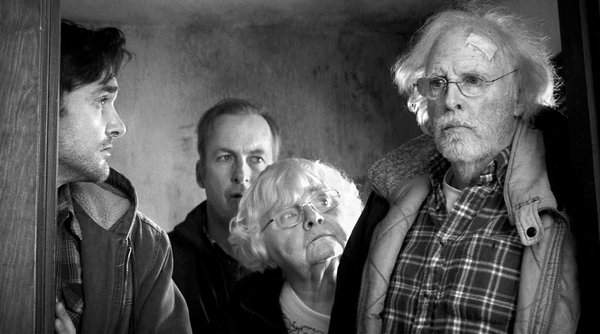 People have been raving about Dern (TV’s Big Love, Django Unchained) ever since the film’s Cannes premier, where the man earned top acting honors. The man deserves every positive words penned. He’s simply fantastic. The character vacillates between outward hostility, spacing out, and general Midwestern emotional reserve, and Dern is able to sell you on every emotional beat without breaking character. He’s unrepentant and demands to be taken for who he is, and his matter-of-fact bluntness has a certain charm to it, like when he admits to David that he never had any plans for kids. He just liked to “screw” and their mother was a Catholic (“You do the math”). I even appreciate that Woody would use the term “screw,” which seems more appropriate. As a two-man show, it’s a shame that Forte (TV’s 30 Rock, The LEGO Movie) doesn’t exhibit the dramatic chops to keep up with his onscreen pop. It’s nice to see him attempt something so different but his limitations are too evident; it’s just another gear that’s not present. At no point would I call Forte’s performance bad but he’s just unable to keep up. Squibb (About Schmidt, Meet Joe Black) is a hoot though the character seems to be permanently stuck in “wacky” mode. She’ll crack you up with her unrestrained commentary, but you may wonder if there’s any more to this character than saying outrageous, curt comments.
This was the last Best Picture nominee I’d failed to catch up with, and while it’s entertaining, funny, and unexpectedly touching thanks to terrific acting and a sharp script, but it also might be the weakest Alexander Payne film yet. This is the first film that the Oscar-winning director hasn’t written himself. Bob Nelson’s screenplay may never have even been glanced over by Payne had it not been for the state of its title (Payne’s films general take place in Omaha). It’s got Payne’s stamp, as would any film he directs, but it also feels like it’s missing something ephemeral, not to get too pretentious. This is a quality study of a cracked group of characters that, upon further review, aren’t as cracked as we may think. They’re just flawed people trying to get along as best they can. Even amidst the snide and antagonistic conversations, there’s gentleness here about the value of family that resonates above the din of the shouting. By film’s end, what started as a cockeyed sitcom transforms into a film that has more meaning and emotion, never betraying its guarded sense of self. When I say the weakest Payne film, this is not an insult but merely an observation. Even the weakest Alexander Payne film is going to be so much better than just about everything out there.
Nate’s Grade: A-
Share this:

The Great Beauty (2013)
 In the Eternal City, a.k.a. Rome, Jep Gambardella (Toni Servillo) has served as its unofficial emcee for years. The literary magazine writer has been coasting for years, living off the prestige and fame from an international hit novel he wrote in his twenties. Now at the age of 65, Jep has come to the conclusion that his life has been lacking the beauty he has sought. All the parties, the late nights, and the fast living have caught up with him. Jep explores the city and its peculiar inhabitants to examine his own life.
It’s impossible to watch The Great Beauty without conjuring images of the great director Fellini. It certainly brings to mind a modern La Dolce Vita. There’s a heightened sense of reality mingling with the surreal, the lives of the rich socialites stepping into the reaches of irony-free satire. At a small party, one rich lady compliments the jazz playing, and another lady says, “The only jazz scene worth listening to today is Ethiopian jazz.” I burst out laughing harder than I have all year. These are people living privileged lives that have lost their tenuous grasp on reality, unaware that they have become caricatures. Their silly ennui has consumed their perspectives. Like Fellini, the movie explores a cloistered world of the Roman elite and their tragicomic absurdities with a touch of the surreal and meditative. I can’t so much pinpoint a clear plot or structure that guides the film, but there are numerous moments, images, scenes that standout in my memory. A private Botox party is played as a zany spiritual gathering where applicants take waiting numbers and a doctor whisper about the great journey they are on together, and then injects botulism into your face. Nuns are everywhere, which shouldn’t be a surprise, but the sight of nuns just randomly populating scenes lends to the surreal nature. Then there’s the 104-year-old nun positioned to be a saint. She looks like a mummy, prefers to sleep on a floor of cardboard, and her mind is still capable of great insight. The ancient nun manages to thematically sum up the film’s interests in beauty, culture, religion, remembrance, and death.
 The relaxed nature of the film and the abstract plot, with little sense of linear trajectory, will certainly test the patience of several moviegoers. At my theater, after twenty minutes several middle-aged couples walked out, muttering, “This is one of the worst movies I’ve ever seen.” I don’t know what these people were expecting when they walked into a 140-minute Italian film, but there declaration is flat-out wrong. I mean, these people probably haven’t even seen InAPPropriate Comedy (cheap shot, achieved). The opening involves the death of a Japanese tourist, and then it switches over to a raucous rooftop party that rivals what we saw in last summer’s Great Gatsby. This is a slow movie but it is slow with purpose, if that makes sense. Jep’s life for so long has been about the party scene, the dulling of the senses, the rush of adrenaline and alcohol. After his sixty-fifth birthday, he’s decided he has no more time to chase after momentary thrills. The journey that follows is mostly a collection of anecdotes and ideas, but many of them have strong staying power. The most notable story is a budding romance he forms with Ramona (Sabrina Ferilli), a 40-year-old stripper with no illusions about who she is. Their relationship is sweet and it ends abruptly, far too soon than a viewer would wish. I know if Hollywood ever remade an English version of this film, they’d structure the whole movie around this relationship. I suppose another benefit of a free-floating, stream of consciousness style plot is that few storylines overstay their welcome.
Jep has come to a turning point, a stark realization that his life is empty. A nice reminder of this notion, as well as a haunting “what could have been” review, is when the husband to an old girlfriend seeks him out. She has recently died and inside her diary, she writes passionately about Jep from their romance way back when they were teenagers. She only has a passing remark for her husband of 30-some years, and it rips the poor man apart. She was always hung up on Jep, always thinking about what might have been, the path not taken, and this defined her intimately. For the first time since he was young, Jep is looking at the world with different eyes and a hunger that exceeds Earthly pleasures. His friends all suffer from the doubt that they’ve wasted their time, that they were never good enough, and they accept their defeat and leave Rome one by one. One man, so humbled, doesn’t even want to bring any furniture with him, so he leaves it all behind. The only thing he’s taking with him is the years of regret, apparently. There’s a nice moment when he’s reiterating the story of his first kiss to Ramona, which also involves this now deceased woman. He can’t remember what she said to draw him, and the look of disappointment at his failing memory, at being unable to relive a moment that meant so much to him so long ago, it crushes him. Who knows how long Jep had held onto that memory as a source of respite. Jep is examining his life’s disappointments and misanthropy but it may already be too late.
There are plenty of messages and points of contemplation throughout the film, but the major theme seems to be as simple as, “Stop and smell the roses,” And yet, that doesn’t make the film less engaging and responsive. Jep is asked why he never wrote another book after his great success. There look to be a number of reasons, but he confesses he was waiting to be inspired again by the titular Great Beauty. Naturally, by this point, we and Jep have come to realize that waiting for beauty is foolish when it is all around us at any moment (especially in Rome). Most of Jep’s adult life has been consumed with social frivolities and passing pleasures, but only now does he seem to stop and fully appreciate his surroundings and his company, naturally, when his friends are departing. It’s a universal theme and one that hasn’t gotten old and the film’s handling is anything but sop-headed sentimentalism. It even ties back to the opening, where the Japanese tourist keels over dead. The man is so busy trying to document his vacation rather than experience it, and in the end, it’s all for what?
 Like Jep, we too will fall in love with Rome as he strolls around it. Gloriously photographed, it’s a treat to experience the major works of art in Rome, so much so that it may stir your passions to see them in person. Even as the plot becomes lugubrious, you don’t mind because of how lovely Rome and its facilities look. Characters doing little and ruminating in Kansas may get boring, but characters doing little and ruminating in Rome, well at least that’s scenery worth watching.
I’ve read many differing interpretations of the film and its messages, the impact of different scenes and which hit hardest, and it reminds me what good art is meant to do; it’s meant to inspire us, entreat us, but also stir us to engage with it, and The Great Beauty does just that. It’s a bawdy, beautiful, and entertaining film but one that also takes its time, luxuriates in atmosphere, and asks the audience to ponder as Jep does about regret, lost opportunities, and the contradictions of happiness. The surreal touches can provide plenty of laughs, but it’s the smaller appreciation of side characters, ideas, and the contrasts that provide more intellectual payoffs. The film is far more free-floating and meditative than American audiences are used to, but unlike, say the works of Terrence Malick, I felt like I could celebrate the absurdities and joys of life along with the people onscreen. It’s existential without being laboriously pretentious, and the comedy and stylish flourishes help anchor the entertainment. The Great Beauty is a beguiling movie that admittedly could have been chopped down from its 140-minute running time. If you’re a fan of Fellini, or art history, then this is a must-see. For others, I’d advise giving this a try, though don’t be surprised if it takes a while to grow on you with its ponderous nature.
Nate’s Grade: A-
Share this:

Philomena (2013)
 A more family-friendly alternative to the wrenching The Magdalene Sisters, the drama Philomena is ostensibly a good movie, but woe unto thee if you thought you were in store for a crackling comedy. Philomena Lee (Judi Dench) was forced to work in a Catholic workhouse in Ireland when she became pregnant as an unwed teenager. Her child was placed into adoption into America and now, 50 years later, she wants to find her long-lost son and learn about him and his life. Helping her in her quest is Martin Sixsmith (Steve Coogan, co-writer as well), a recently unemployed journalist. Their odd couple pairing should inspire comedic repartee, as so the ads would also have you believe. The film is funny, in spurts, but it’s much more effective as an illuminating drama on the abuses of the church-run workhouses that guilted poor girls into, sometimes lifelong, slave labor. At the thirty-minute mark, when Martin comes across a makeshift graveyard of dead teen mothers, who were forced to give birth on the workhouse premises as punishment for their sins, you can pretty much abandon any hope of a ribald road trip comedy. Once your expectations are realigned, you can enjoy the film for what is has to offer: an intriguing mystery, solid characterizations, a terrific Dench performance, and an ending that doesn’t pull punches. Be warned, you will walk away from this movie wanting to punch nuns in the face. Coogan’s role is one of anger and outrage, and there’s plenty to go around with church corruption, scandals, and cover-ups uncovered. But it’s Philomena herself who is the life lesson for us all; her church fails her but her forgiveness is the model we should all strive for. It’s a moving film with as much compassion as it has criticism. Just don’t watch it in the company of a nun.
Nate’s Grade: B+
Share this:

Winter’s Tale (2014)
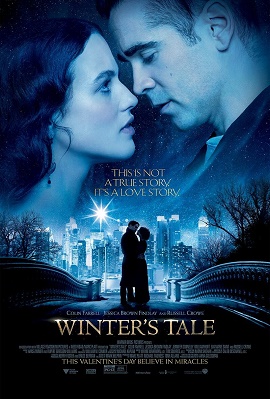 Every now and then you get to witness a special movie that doesn’t so much offend as it inspires, and what it inspires is a question you grapple with during the entirety of its run time, mainly – How did this get made? At any point, did the producers or actors or anyone stop, take a moment to reflect on the movie they were participating in, and think, “Wait, what is going on here?” Bad movies made by hacks are easy to shrug off because, well, hacks don’t know any better but bad movies (see: InAPPropriate Comedy, or better yet, bleach your eyeballs first). With Winter’s Tale, there are people who should know better, people that have been awarded Oscars. These people should resolutely know a terrible movie while they’re making it. Maybe they did. Look deep into their eyes.
In 1918, Frank Lake (Colin Farrell) is an orphan long abandoned by his family so he could have a better life in America. He hasn’t taken this message to heart. Frank worked as an expert safecracker under the employ of local crime boss Pearly (Russell Crowe), and Pearly hasn’t taken kindly to Frank leaving. Frank is able to escape Pearly’s goons and finds love with Beverly Penn (Jessica Brown Findlay), a wealthy heiress afflicted with consumption. Pearly doesn’t want Frank to get away because Pearly is really a demon in the employ of the Devil (Will Smith, yes you read that right). In the battle of good versus evil, Frank and Beverly appear to be at the focal point.
 I have to give writer/director Akiva Goldsman some credit for making an unabashedly earnest movie in an era of irony and ready-made snark. His goopy romantic fantasy longs to exist in a simpler era, but even then Winter’s Tale would fall apart on many levels. Its sheer unbending corniness is both a blessing and a curse. Magic realism is one thing (check out 2001’s Amelie as a how-to guide), but what Goldsman seems to be going for is a modern fairy tale (our maiden locked away in her tower, true love’s kiss, etc.). The film wants the audience to fall under its spell but instead will likely elicit numerous unintentionally hilarious moments; I was laughing to myself throughout, trying to comprehend all of the hokum and poor decision-making (Will Smith as the devil?).
Let’s begin with the fact that the movie is an obtuse fantasy that feels like it makes up its plot and its rules as it goes along. Bleeding fantasy and fantastical creatures into the everyday world is a marvelous conceit but it needs finesse and careful rule building. Otherwise it doesn’t so much feel like a story with a sense of internal logic as it does a bedtime story that can always just create a new shortcut or extension. The very first few minutes of the film will already push your credulity to the test. We see an adult Peter on the run from Pearly and his goons and all of a sudden he runs into… a white horse. Ah, but this is no ordinary horse, this is a magic flying horse, and Peter flies away to live another day. Yep, within minutes, we’re given a magic flying horse. No groundwork. Worse, the horse just randomly appears when the plot demands, and I think the horse is supposed to represent the side of God in this cosmic battle between good and evil. Whatever, there is a magic flying horse. From there the film gets even cornier. It’s the type of movie that posits the stars are really human beings, and so, in the end, rather than having our hero ride off into the sunset he (spoilers be damned) flies off into space on his magic flying horse and he BECOMES a new star, resting beside the star meaning to represent his beloved (never mind that these stars would be millions of light years apart). If you can read that sentence without rolling your eyes then congratulations are due.
Another problem is this massive time leap that creates far more plot holes. After Beverly succumbs to her illness, which I might add happens literally SECONDS after she’s done having sex for the first time (Colin Farrell killed her with his penis), the film leaps forward to present-day. However, Peter was given immortality through Beverly’s miracle. I suppose you could view miracles as a byproduct of sex. At first glance, this almost seems like a cruel gift; your love is dead and now you have to live forever without her. For no discernible reason, Peter also suffers amnesia, because, really, why not? All he does day after day, presumably for… 90 years, is sketch the same image of a redheaded girl in public places. In the intertwining years, why hasn’t evil Pearly picked up on the fact that Peter is still alive? He’s only been sketching the exact same image. Also, how does Peter even support himself? How does he feed himself? Who are his friends? These are the questions that arise when you take this foolish route with the plot. It could have been avoided with a simply Rip Van Winkle-style hibernation or time jump. Another problem is that Peter grew up with the 90 years of history, meaning he should know what things like the Internet and library cards are. He’s not a man out of time. The solution to Peter being confirmed is to seek out the still-living Willa (Eva Marie Saint, nice to see you again). The problem with this is that Willa should at least be over a hundred years old if you do the math. If the purpose of the leap forward was to just save another character we hadn’t seen previously, why does it have to be 2014? Why couldn’t it just have been 1940 or any other earlier period?
And the central romance between Frank and Beverly is just so boring you wish Frank would move on to someone new. Presumably they fell in love at first sight, which just so happened to be when he was in the process of robbing her home. Ah, but you see, her love redeems him because that’s really the whole role of the sick love interest in movies, to make the other figure a better person through this shared experience of grief. So in this regard it’s no surprise that Beverly lacks defining characteristics outside of her ailment. She plays the piano and falls fast for Farrell’s bushy eyebrows, but that’s all we got here. The entire second act of the film follows their abbreviated courtship, but there’s no real moment where you buy into their romance. Like most of the film’s storytelling, we’re told something is and expected to buy into it 100 percent without flinching. They’re in love, what more do you need? Well, some interesting characters would be a start.
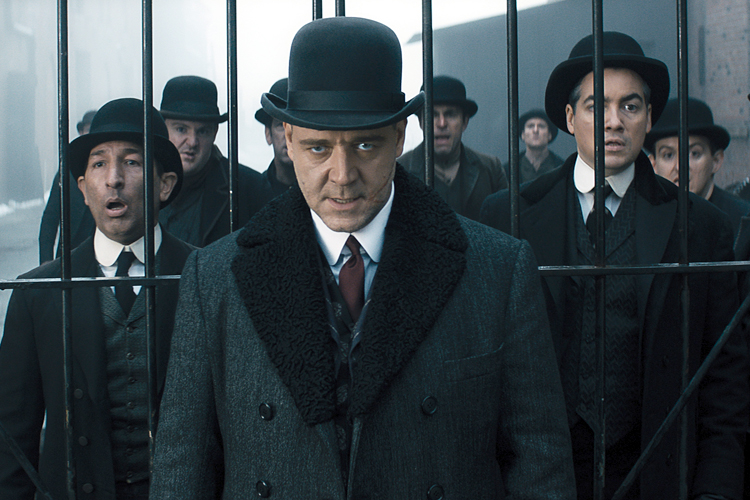 I’m fairly certain that all of these actors were doing Goldman a favor by appearing in this nonsense, but only Farrell (Saving Mr. Banks) walks away favorably. He is the best person onscreen who burrows into their character, ignoring the absurdity of every moment, yearning so hard that you almost want to give in. You won’t. Many will best remember Findlay as the Lady Sybill on TV’s Downton Abbey (she was also the reoccurring ghost on the BBC’s Misfits). Here she gets little else to do but smile and give those knowing looks that all afflicted characters give, as if their illness has opened up the secrets to the universe for them. Crowe’s performance will likely draw up comparisons to his maligned work in Les Miserables, a performance that wasn’t as bad as advertised theater snobs. This performance, however, is as bad, as his Irish brogue seems to overtake him and he comes across like a hotheaded big bad wolf. Jennifer Connelly’s appearance isn’t even worth mentioning as it is that slight beyond the fact that she’s the mother of a terminally ill child (you really thought the movie had any sense of restraint?). The film has numerous well known actors for flashes, like Kevin Corrigan, Kevin Durand, Graham Green, Matt Bomer as Frank’s immigrant father. One suspects their brief time was either a sign that the screenplay evolved as production went or that they were repaying a debt.
I will say the only saving grace in this entire blunder is the cinematography by Caleb Deschanel (The Passion of the Christ). Even when the cheesy special effects take flight, Deschanel makes sure the images are worth watching, having a special skill with the cool hues of the wintry color palette. I wanted to at least credit one redeeming aspect.
The inconsistent plotting and rules, the corny and overly wistful characterization, the overwhelming silliness of every single moment, Winter’s Tale will spark far more guffaws and derision than plaudits. It’s a movie that bludgeons you with its unrelenting maudlin nature disguised as romantic fantasy. The source material is beloved by some but it all comes across as nonsensical twaddle onscreen. Goldsman’s screenwriting credits run the gamut from award winning (A Beautiful Mind, Cinderella Man), to big budget to notorious stinkers (Batman & Robin, Lost in Space). It’s hard to judge the man’s talents with such a wide range of quality. However, I can question the finished results of Winter’s Tale and openly wonder what in the world convinced Goldsman to cash in all his Hollywood cache to direct this dreck. I’m almost tempted to encourage people to watch Winter’s Tale just to try and make sense of it themselves, to try and take in 118 minutes of earnest bad decisions. Whether it’s the magic flying horse, the 100-year-old news writer, or the fact that we’re dealing with a bad guy named Pearly, or Will Smith as Lucifer, but sometimes Hollywood unleashes a disaster that begs to be seen.
Nate’s Grade: D
Share this:

The Monuments Men (2014)
 An all-star cast, a true-life tale that incorporates a treasure hunt, a race against time, Nazis, and fish-out-of-water tropes as non-soldiers are placed in harm’s way, plus the skills of George Clooney behind the camera; in short, how could this go wrong? With that plot makeup and this cast it would take more effort to tell a boring big screen adventure of the real-life Monuments Men (and women). And yet, the movie found a way. It’s by no means a bad film and its heart is in the right place, but allow me to explain why The Monuments Men sadly fails to live up to its mission.
It’s 1944 and Adolf Hitler doesn’t just have his sights on constructing a permanent empire, he wants all the world’s art treasures as well. The Nazis have been plundering famous works of art, and while the war is coming to a close with the Allied invasion, the fate of these priceless works of art may be in jeopardy. Frank Stokes (Clooney) is tasked with putting together a team to save Europe’s art from the Nazis. He puts together an unconventional group of soldiers (Matt Damon, John Goodman, Bill Murray, Bob Balaban, Jean Dujardin, Hugh Bonneville) and search for the hidden loot.
 The film looks like it’s going to be a high-concept heist film when it reality it’s a series of vignettes that do not add up to a solid whole. Early on, the Monuments Men team is scattered to the wind, divided into pairs, and so we have four or five competing storylines that don’t develop as desired. To be fair, there are some very good scenes, well executed and written by Clooney and Grant Heslov (The Men Who Stare at Goats) where the conflict is turned up, but the film cannot escape the fact that it feels more like a series of scenes than a cohesive story. Not all of the stories are equal in their interest as well. The Cate Blanchett (Blue Jasmine) and Damon storyline in France amounts to little else than her stalling for as long as the plot necessitates, then handing over the Very Important Info, then she’s swept aside. The comical asides, notably with Murray and Balaban, feel like scene fillers when there could be stronger material. Once they’re reunited as a group, you wonder why we even needed the time apart. Perhaps it’s an attempt to showcase a wider sampling of stories and perspectives on a complicated war, which is fine, but the characters don’t get the same complicated examination. Despite physical descriptors, these guys are fairly one-note and stay that way, which is a real shame especially when we start losing Monuments Men. The attention is split amongst a bunch of characters lacking proper development. If I felt like we knew these guys on any substantive level, I would feel more at their untimely passing.
Another issue that exacerbates the directionless feeling pervading the film is that it lacks a clear and concise goal. I understand they’re saving and rescuing art, but that’s kept vague until the very end of the film when it becomes more concrete. Until then, the guys are just traveling from place to place, retrieving this piece or that, having comic misadventures, and the movie just feels like it needs a stronger guiding force to corral all these stories, a concise goal that each scene builds onto and where the urgency increases. Late in the film, I got a glimpse of exactly what kind of movie Monuments Men could have been. Once the war is over, the Germans are replaced as antagonists by the Russians (two-for-two with classic American movie villains) and it becomes a race against time to get to the art before the Russians confiscate it. There was always a ticking clock in the film, as Hitler was assembling his art and his command would destroy them in spite of returning them. However, in the very end of the film, the urgency is cranked up, made real, and for once the film emerges with a sense of suspense. I think it would have been a more engaging film experience if the scope of the film were narrowed simply to the material covered in the climax, namely beating the Russians to the art reserves. It practically has a Raiders of the Lost Ark feel with two parties trying to outrace the other to the next precious treasure. How cool would that movie have been?
 Another problem is the film’s seesaw tone never really gels together in a satisfying manner. The film awkwardly switches gears from drama to comedy to action without smooth transitions. Clooney wants his film to be a comical buddy comedy but also a poignant remembrance of the lives lost so that we can enjoy our great treasures. Clashing tones take away from the effectiveness, making us feel that Clooney didn’t feel confidant with either direction to make a movie. Alexander Desplat’s overbearing musical score instructs the audience what they should be feeling at any given moment. It vacillates without similar transitions informing you with little transparency that you should feel whimsical, now sad, and now heroic, now go back to whimsical. The entire film, from a story standpoint to a technical standpoint, cried out for a greater sense of unity.
Then there’s the question of whether art is worth people giving up their lives, and this is a valid question that deserves consideration. I was never in doubt what Clooney and company would say to this ethical query, but it’s as if Clooney has little faith in his own audience. He gives three separate speeches about the significance of art and culture and why it is worth dying for. I expected one hefty speech, but three? It’s like Clooney is afraid his audience will waver when blood starts to be shed, and so we need to be reminded by the professor why art is significant to mankind’s value. The point has been made; it doesn’t need to be belabored. The film even ends on recycling this debate, with Clooney putting one final stamp of judgment before the credits roll.
One gets the sense while watching The Monuments Men that it would make a better documentary than a fictional feature film, at least this incarnation of a fictional film. Hearing from the men who lived it will be far more interesting than watching the comic squabbles of Clooney’s crew through Europe. I was instantly reminded of an engrossing documentary from a few years ago called The Rape of Europa, which looked at the subject of saving the arts from Hitler, not specifically the Monuments Men. That documentary was filled with so many different fascinating stories, I remember thinking that any one of them could have made a stellar movie. Monuments Men is further proof that a sharper, more contained focus would be best rather than trying to tell as many war stories involved on the topic. Clooney has proven himself an excellent director and despite his film’s faults it’s still an entertaining film in spurts. I just think we all expected better given the pedigree of talent involved and the can’t-miss quality of the history.
Nate’s Grade: B-
Share this:

Paradise (2013)
 You’re courting irony when you name your movie Paradise, as well as pained movie critic puns, but I had faith that Diablo Cody, stepping into the director’s chair for the first time, would entertain, especially after her best screenplay yet, 2011’s Young Adult. The problem with Paradise is that it goes just about nowhere and it’s shockingly bland, a criticism I never thought I’d have for a Cody-penned work. The premise starts off strong, with Lamb (Julianne Hough) as a devout Christian living a sheltered existence until the day she becomes the sole survivor of a plane crash. Her body covered in burns, her faith shaken to its core, she embarks on journey to Las Vegas to sin it up big time. It’s snarky and satirical, and then she gets to Vegas, she meets some nice new pals (Russel Brand, Octavia Spencer), and they hang out and… that’s about it. The Lamb character is meant to be a naïve but ultimately nice person, but she’s portrayed as vaguely racist thanks to Cody’s simple skewering of fundamentalism. Where are the sharp characters and incisive wit of Cody’s past efforts? The comedy almost dissolves as it goes and you realize that intriguing premise is never going to be realized. And then the third act happens and it feels like the film just gives up, unearned sentimentality takes control, and the characters all find unsatisfying conclusions. The characters aren’t given enough material, often left adrift in a plot-free environment of self-discovery. A misguided scene where Lamb pours her heart out to a former prostitute could work as a summary of what tonally doesn’t work with this movie. There are some funny moments, even some affecting ones, but Paradise doesn’t feel like it has a sophisticated voice and clear direction. Coming from Cody, I wouldn’t have expected those two chief complaints.
Nate’s Grade: C
Share this:

Saving Mr. Banks (2013)
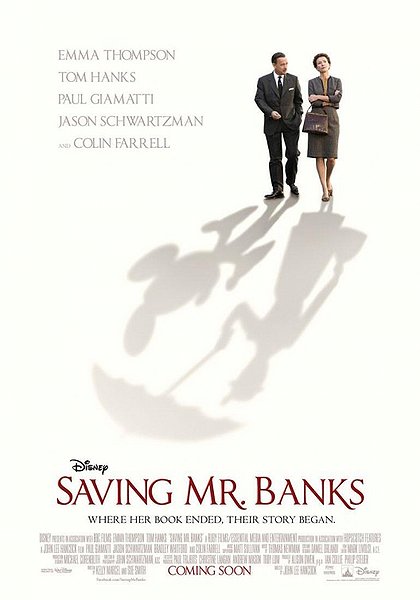 Seemingly sure-fire Oscar bait, Saving Mr. Banks left enough Academy voters cold and it’s easy to see why. First off, the behind-the-scenes sparring to adapt Mary Poppins is the movie we want to see, watching crotchety author P.L. Travers (Emma Thompson) butt heads with head honcho Walt Disney (Tom Hanks). The movie is at its best when these two share the screen, with Walt’s genial strong-arming finding little traction with Travers stern refusals (no Dick van Dyke, no animation, no mustaches). What I wasn’t expecting was a parallel storyline detailing Travers childhood in Australia dealing with an unstable home life thanks to a drunken father (Colin Farrell). It literally takes up half the movie, and while there are a few interesting juxtapositions, the screenplay just trades off scenes; one in 1961, then one in 1906, then back again, etc. The issue is that the flashbacks are never very revelatory and have no business dominating the running time. All of the information gleaned from these flashbacks could have been corralled into one late flashback, or even mentioned in a speech. Saving Mr. Banks gives you two movies running parallel, but most people will only be interested in the one. It’s a pleasant film, benefiting from strong performances by Thompson and Hanks (perfectly cast), but one can’t shake the feeling of Disney P.R. pervading the film’s retelling. It comes from the perspective that Disney is always right and that Travers was always wrong, having to work through her personal issues before relenting, even tearing up at the final product. In real life, Travers never forgave Disney and never allowed another of her Poppins books to be adapted into a film, though not for want of trying by the studios. It feels unfair to portray an author’s artistic integrity as an obstacle that needs to be defeated, but there it is, and Disney’s Mary Poppins, while beloved, resembles much of what Travers feared. Who defends the cranky authors of the world when they have a point? Saving Mr. Banks is an entertaining film, charming and likeable, until you begin to look beyond the fairy dust and realize the revisionism before your eyes.
Nate’s Grade: B-
Share this:

Fateful Findings (2013)
 Ever since the ascent of Tommy Wiseau’s The Room atop the dung heap mountain of midnight movie fare, the world has been avidly searching for the next so-bad-it’s-amazing film. There have been several contenders over the years, most of which were amusing, such as Troll 2 or the original Birdemic, but some of which made you consider the value of life itself, such as 2009’s After Last Season. Oh, that one still makes me wince. Don’t even see that one. But as a lifelong lover of all things cinematically terrible, thanks in part to growing up on a healthy appetite of Mystery Science Theater 3000, I am compelled to seek out the worst of the worst. The Room is one of my favorite movies of all time; my love for it knows no heavenly bounds. I have to sniff out anything that comes remotely close to replicating that wonderful experience.
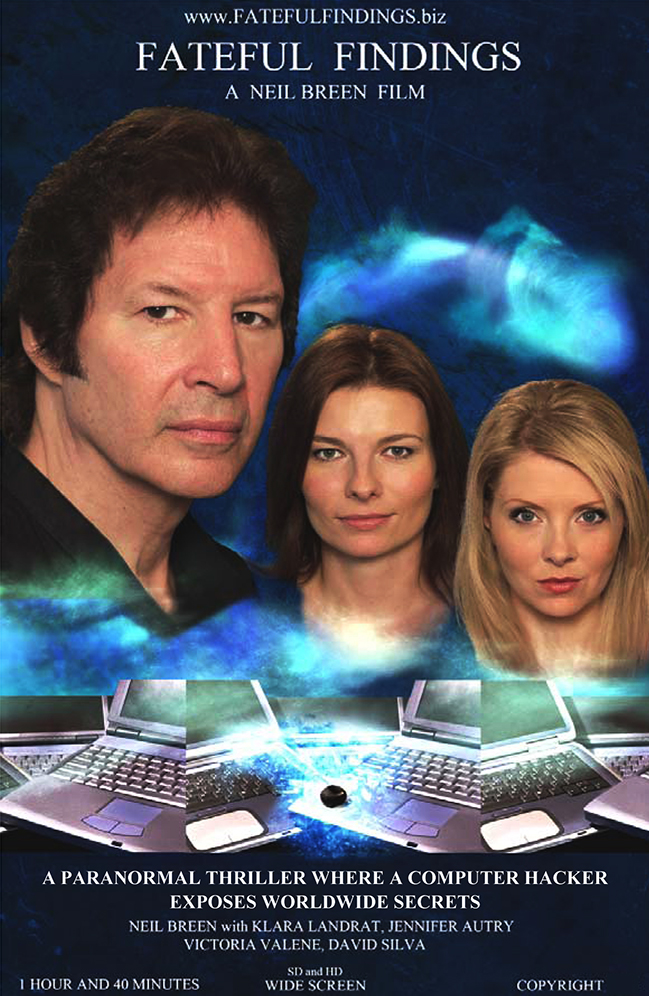
Enter Las Vegas realtor and architect Neil Breen. According to a Deadline Hollywood report from October 2013, Breen wrote/directed/produced/starred/edited/and just about everything else a little bundle of love called Fateful Findings. He sent it out blindly to distributors looking for any takers. It just so happens one bit, and now Fateful Findings is gearing up for a nationwide release specifically targeted at the midnight movie crowd that made The Room the sizeable cultural hit it is. Like Wiseau’s accidental masterpiece of cinematic miscalculation, Breen’s film is awash with bizarre directing choices, curious line readings, painful acting, subplots that come and go as they please, a lack of resolution, characters that behave more like aliens than human beings, odd camera framing and compositions, and, naturally, an ending that must be seen to be believed. For fans of woefully bad cinema, there’s a lot to dig in and I’ve got my knife and fork. First, I want to describe four of my favorite things about Fateful Findings and Breen.
 1) “It’s a magical day!”
The film opens with an eight-year-old boy and girl waking through the woods, coming across a magic mushroom (not that kind). The mushroom disappears, revealing a jewelry box, and inside is a black rock. “It must mean something,” young Dylan lets the audience know. Young Leah then says, twice, “It’s a magical day!” Oh, but if that wasn’t made abundantly clear, she also writes it in a notebook and shows it to the audience. But this opening scene isn’t done with its magic. We flash forward many years to an adult Dylan (Breen), who looks at least ten years older than the adult version of Leah (Jennifer Autry). Prepare for the sudden time jump shock. Anyway, Dylan and Leah never saw each other again after that magical summer that is… until she’s invited to a family barbeque. Why is this stranger, and her then fiancé, invited to a limited family engagement? Anyway, the way that these two people reconnect is that adult Leah bumps into adult Dylan and drops, what for it, the SAME notebook. It falls magically open to the SAME page, revealing the SAME message: “It’s a magical day!” Apparently she still carries that notebook around everywhere she goes and has never written in it since that fateful day. Who doesn’t bring a 30-year-old notebook with them to a barbeque?
2) “It was the Rolls Royce that hit ‘em. I saw it. I’m a witness.”
Also in the first ten minutes, we watch adult Dylan get creamed by a Rolls Royce. The speeded-up sequence itself is just hilarious to watch, especially since the car appears to be going rather slowly in the previous shot. Anyway, Dylan recovers in a hospital thanks to the black rock reviving him (make note when the EMTs arrive and their lagging sense of urgency). The collection of rubberneckers gathers at the accident scene, including one gentleman who, God bless him, foolishly attempts a British accent out of the blue, reciting the above line. I’m sure it would have been in question since the one car resting right next to the injured man is covered in his blood (how much did that cost to rent and splatter a car like that?). It’s at the hospital where Dylan unknowingly meets the adult Leah for the first time. She’s a doctor and pronounces Dylan “semi-comatose.” How is that a thing; can you be semi-pregnant? After his miraculous revival, Dylan leaves the hospital and re-enters his home, taking a shower. His wife, Emily (Klara Landrat, a former model), steps into the shower with him and happily embraces her man. Except beforehand we see a shot of his feet in the shower and blood is profusely streaming down his leg. Remember, all this is from a head wound, so how much does his head have to be bleeding to get down his leg? The shower is filled with blood, Dylan’s bandages are blotted red, and she steps inside. Gross. What kicks this entire sequence even higher in hilarity is that Dylan’s facial bandages actually cover his ENTIRE mouth and nose with no indentations for him to breathe out. When he detaches the oxygen mask, you’ll see there’s nowhere for him to actually breathe. Damn you, Obamacare!
 3) “No more books!”
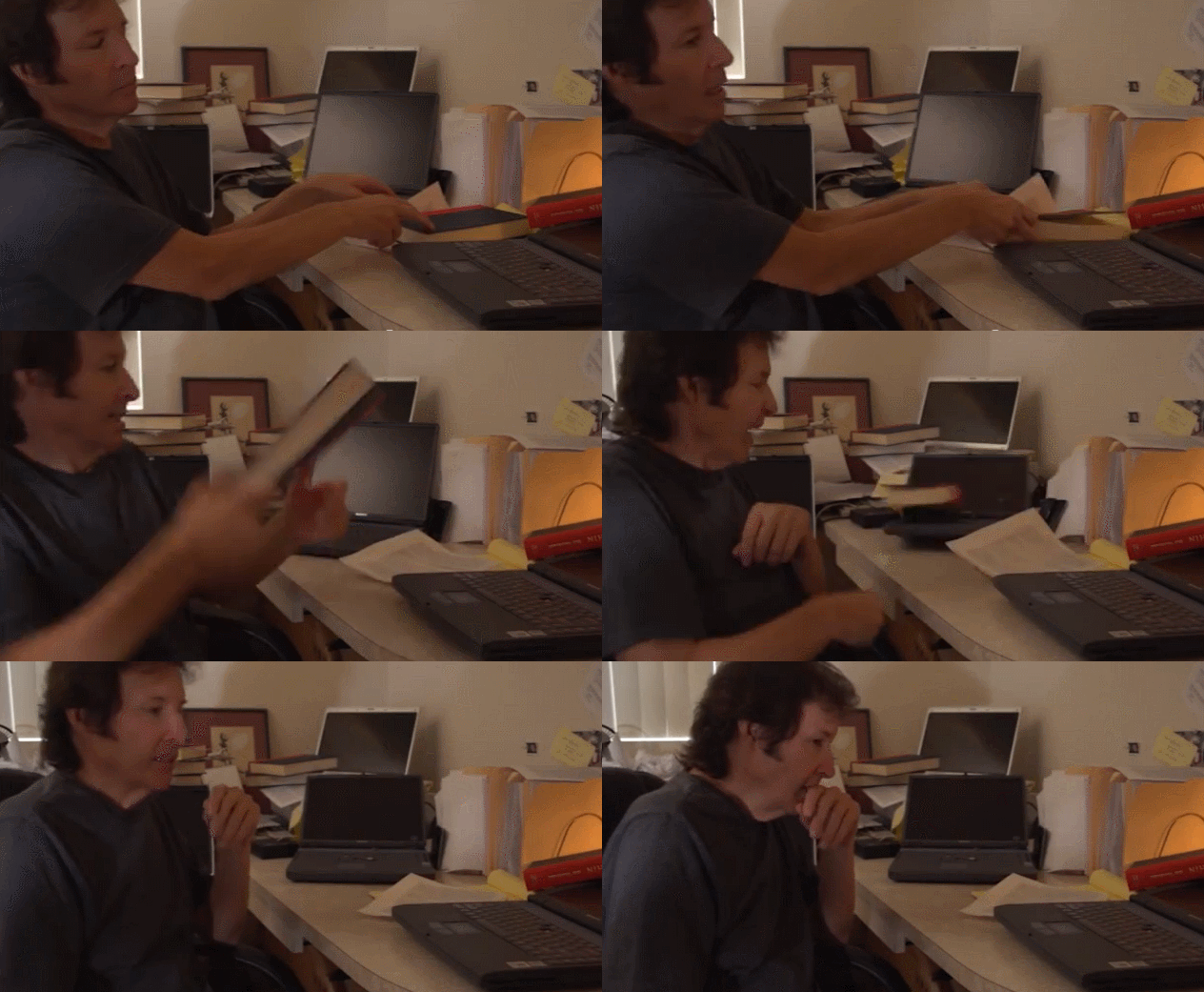
Once home, we learn that Dylan has a Master’s degree in computer science but became a successful novelist, a fact he seems almost disdainful about. This dichotomy is illustrated by the fact that Dylan has four laptops out at all times, none of which are ever really turned on. Why four? Why not? He pounds away, literally, trying to complete his next book, but when his temper arises, he almost always takes it out on the poor laptops. This is a very abusive film when it comes to laptops. My favorite moment is when Dylan is holding a cup of coffee and it looks like he’s going to spill it on that laptop. It’s a ten-second sequence that leaves you on the edge of your seat, finally ending in an even greater comic punchline. At another point, Dylan throws two books into two laptops before holding back his incalculable rage onto a third laptop. The only way people communicate is by throwing things in this film. You could turn Dylan’s tortured mistreatment of laptops into a drinking game.
4) “I can’t believe you killed yourself. I cannot believe you killed yourself. I can’t help you out of this one.”
I won’t go into detail about the context of this quote, to spare some spoilers, but it illustrates the habit of actors repeating lines of dialogue ad nasuem. The dialogue itself is rather plain, so it’s weird that Breen and company feel the need to keep repeating themselves, as if we’re missing some deeper hidden meaning. We’re not.
Breen has described his film in interviews as a genre-bending psychological thriller, and while some of those elements may be present in the faintest, most diluted distillation, the man’s movie is really the long story of two marriages coming apart. Dylan’s marriage with Emily hits the skids when she gets addicted to his pain medication, but neither person seems to treat this as the serious development it is; what makes this worse is that Dylan enables her addiction. He keeps getting her the meds when he clearly no longer needs them. It seems once his childhood sweetheart re-enters his life, Dylan just forgets he has a wife. The other marriage consists of Dylan’s bickering neighbors, Amy (Victoria Valene) and Jim (David Silva), and they really have no impact on the greater plot whatsoever, and yet Breen’s film wastes so much time on their story. They’re unhappy. He wants sex. She doesn’t. Eventually in the heat of the moment Amy does something impulsive and very criminal, and the movie treats it like any nominal plot moment. A vital witness to this crime doesn’t bother speaking up until fifteen minutes later in the film, as if they just had some nagging chores to do before alerting others about a serious crime. Perhaps Jim and Amy are, in some twisted perspective, Breen’s idea of comic relief (Jim’s exaggerated “drunk” movement, throwing drinks on one another, etc.), but for a movie that is nonstop comic blunders, what difference does it make?
 And then there’s the supernatural story that permeates the edges of the film, popping in from time to time to remind you during the marital discord that, oh yeah, there’s a mysterious ghost or something or other. The supernatural stuff begins muddled and unexplained and never really clarifies. It’s thanks to the black rock, which Dylan refers to as a cube, that he’s able to survive being hit by the car. If that’s the case, then I don’t think I’d ever let that sucker out of my pocket. I’d glue it to my hand. Inexplicably, the rock also gives Dylan the ability to transport himself through walls, though he only does this once and never explains how he knew. The way we know something “magical” is happening is when a little puff of grey vapor appears onscreen. Is it a spirit, a malevolent force? Does it have anything to do with this stupid book that keeps haunting Dylan? I feel like Breen is patterning himself after the work of David Lynch, except that Lynch’s films, which can consist of weirdness for weird’s sake, have cohesion, a vision. Fateful Findings has the occasional supernatural entity, but it’s rarely examined, and then we’re off to the next subplot as if spinning a board game wheel. Then the supernatural angle, which is only barely toyed with, and with such peculiar indifference, is abandoned and the movie wholly chases after another storyline.
The movie’s final focus is on Dylan’s super secret hacking uncovering all sorts of vague secrets and corruption from governments and corporations (“As president of… The Bank…”). Throughout the film, Dylan keeps mentioning this but it never seems terribly significant, at least judging by the characters’ actions. It isn’t until the very end where Breen spends more than a passing interest in this subplot, because we have more important storylines to feature, like Ally (Danielle Andrade), his neighbor’s teen daughter, inexplicably trying to seduce him. It comes out of nowhere and is just as quickly pushed aside (I also wonder how old Ally is supposed to be). Allow me to thread an analytical narrative to make sense of these dispirit storylines. Assessing the film, it sure comes across like Breen’s attempt to bolster his sense of self. In every scenario, people treat him as a treasured human being, he’s at the center of a diabolical conspiracy, he’s gifted with magic powers that separate him from normal men, all women want to seduce him, and then in the end he’s the one who makes the world a better place by exposing corruption. It sounds like a hero complex to me. Even acts that deserve harsh scrutiny, like his enabling of his wife’s addiction or his blasé attitude about carrying on an affair, are ignored. In this universe, Dylan is always right, always desired, always respected, and always special.
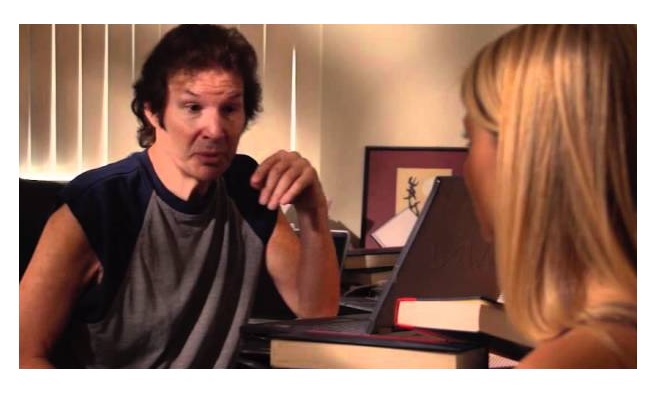
 The production has a hard time hiding its obvious shortcomings, sometimes hilariously so. It becomes clear very early that most of the film was likely shot in Breen’s home, which is fine except it also unsuccessfully doubles as other locations (the blinds are the big giveaway). The worst is the hospital room, which mostly consists of a bed and three oxygen canisters. What hospital room is going to have carpet? So much of the movie takes place in Dylan’s home office, with that plethora of laptops, that you’ll start to memorize the home layout. In the opening, with Dylan and Leah as kids, we’re shown modern-day vehicles and then flash forward at least 35 years. Could Breen not have shot the scene with some older vehicles? Then there are Dylan’s two therapist’s offices. The first one is the guy who keeps prescribing pain meds. Perhaps to communicate his overall incompetence as a doctor, Breen stages all of the therapy scenes in a conference room with both men sitting as far apart, at either end of the long conference table. What better way to foster patient intimacy? He also magically switches jackets in the middle of one session. The second therapist operates in what looks like a closet, and the only thing we see are two folding chairs. She may not really exist, or was in on the unexplained supernatural conspiracy, so perhaps the old lady therapist didn’t feel like putting that much effort into decoration.
The technical abilities of the Fateful Findings crew are, to be expected, less than stellar. The editing is another clumsy detraction, namely that Breen and his TWO other editors let their scenes meander several seconds longer than where they should have cut, giving the film a loping feeling. It’s like each person is counting mentally when to respond to the dialogue, and when one person finishes the film holds, counts as well, and then cuts. There are slow pans that add nothing to the film but space in between lines of dialogue. I don’t need rapid-fire cuts for what is essentially a domestic drama, but why the hesitant editing? Is it just a sneaky way of inflating the film’s running time? Even Breen’s staging of the camera can often be confounding. For whatever reason, the film often features camera shots of people’s feet or people very carefully cut off at the head, meaning their heads are not visible. It happens enough and for such nonessential scenes that I started to wonder if Breen found himself an Ed Wood-esque solution for not having his same actors for the scenes he needed them for. Beyond a Tarantino-size foot fetish, I don’t know why there are so many shots of feet. At least Breen is not as inept in his visual staging as the makers of After Last Season, a movie so bad it’s just bad beyond measure. Breen knows enough to adequately stage his scenes, which makes his choices all the more curious.
The acting is generally terrible across the board, occasionally breathtakingly bad. Let’s start with Breen himself, who is fairly listless and deadpan throughout. He raises his voice but rarely does he change how he’s responding. He’s aloof and strikingly self-serious at the same time. Breen’s command of his actors is limited to directing them to just ham it up. Most of the actors will exaggerate facial expressions and physical movements, providing more drama. Landrat is trapped by her storyline too early, and so she succumbs to the screaming wife with an Eastern European accent. Autry does no better, looking uncomfortable in every moment onscreen. The worst actor in the movie, easily, is Valene, who squawks in the same pained sing-songy manner with every line with nasally incredulity. The best performance in the film may belong to the mysterious old lady therapist who may not really exist. And yet, she’s the most grounded.
 Making the film seem even more alien is Breen’s chaste sense of human sensuality. One of the adjectives on the poster describing the film is “passionate,” but you have to wonder if Breen was just too uncomfortable, or perhaps his female actresses were, to make the onscreen passion a bit more palpable. The very way people kiss in this movie is so chaste. They lean in, pecking each other slightly on the lips, as if one was kissing their grandmother goodbye rather than engaging in uncontrollable passions. They were doing hotter fake kissing in 1940s Hayes code era Hollywood (check out Hitchcock’s Notorious and tell me that Cary Grant-Ingrid Bergman kiss still isn’t hot today). Breen’s passions are so modest and contained. Take for instance a scene of passion directly following a spat between Dylan and Emily, one where she threatens to leave him. Apparently that revved up their engines because they start tearing apart one another’s clothes and doing their chicken peck kissing. Breen, as is his usually fashion by this point, knocks over several laptops and throws papers into the air for what feels like a solid minute. Whenever disrobing one of the actresses, be it tearing of clothes or the more gentlemanly “unbuttoning” method, he always stops above his ladies bosoms, allowing a hint more cleavage but nothing beyond. It happens enough that it starts to become a noticeable artistic choice, as is his consistent framing of topless women sleeping face down on their beds. It gives just enough of a glimpse of partial nudity without revealing more (all four main actresses will go partially nude at some point in the film). This puzzled me because I was certain the only reason these actresses were selected is because they likely accepted a part where they would eventually display their physical assets. They’re not here because they can act, that’s for sure.
In fact, the only nudity in the entire movie belongs to Breen himself as he bares his behind while stumbling out of his carpeted hospital room. If you dare look closer, you’ll see the end of his gown catches the end of the hospital bed just so, allowing the flap to stretch and display Breen’s posterior. Either this was a one-time thing and Breen said, “why not?” or, and I think, given the nature of hero complex evidenced, this is more likely, that they kept shooting the scene until the flap caught and proudly displayed Breen’s rump. I suppose in the Garbage Bag Room (a reoccurring dream/nightmare in a space literally lined with garbage bags), there is a nude woman accompanying him, but she’s tastefully composed and likely a body double for Autry. For a man who looks visibly uncomfortable even kissing women, let alone disrobing them, it defies logic that Breen would acquiesce to his own nudity in his own film.
But the question that must be asked of all craptacular movies is whether it is the right kind of bad, the kind made with sincerity in equal measure with its incompetence. It’s one thing to make a bad movie and another to make it purposefully, chasing after the ever-hungry midnight movie crowd, looking to cash in with some canny filmmaking ineptitude (Birdemic 2, people). From everything I’ve gathered via Breen’s interviews, he’s legit. He even has previous movies to his name and I can only hope those will see a wider release. Breen’s film hits that so-bad-it’s-good sweet spot of derisive entertainment enjoyment. I was laughing just as many times as I was shaking my head. However, as a connoisseur of crap cinema, I must say that The Room maintains its throne. Breen’s film is a bit too lackadaisical in its nonsensical plotting and starts to feel redundant, and I’m not just talking about the oft-repeated dialogue. There is a finite level of bad to this film whereas The Room is a thousand brushstrokes of terrible. Breen’s film marvels but it may also test your patience at turns, unless you’ve been drinking heavily.
 Fateful Findings is awash in terrible decision-making, to the world’s benefit. Breen and his team have put together a movie that is baffling, ridiculous, and greatly entertaining. From the dropped subplots, repeated laptop abuse, inauthentic human behavior, hazy plotting, laughable special effects, chaste human interaction, strange feet-heavy framing, and that ending, oh the ending is just comedy gold; there’s a little something here for every discerning ironic viewer of bad movies, though the film does lag and repeat its offenses enough that it feels stretched and redundant. I’d say, amongst the spectrum of recent bad midnight movie fare, it’s probably just below Birdemic. I don’t know what the repeat value will be for Breen’s film, or whether it will catch on with audiences like Wiseau’s unexpected success. I can’t even say whether I really want to watch it again, but I will, and with a gathering of friends, and likely with the added benefit of some adult beverages. If Fateful Findings is playing at a theater near you, by means see it and bring your pals along for the fateful experience. It will make you think. Mostly about laptops.
Nate’s Grade: F
Entertainment value: A
Share this:

The Secret Life of Walter Mitty (2013)
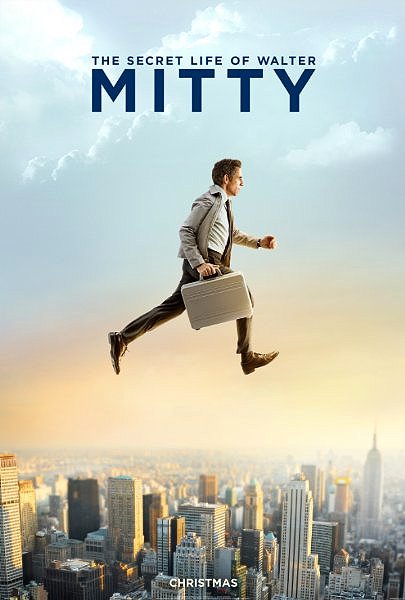 The Secret Life of Walter Mitty, based on James Thurber’s short story, is a property that has long beguiled Hollywood. The idea of escaping one’s ordinary life with fantasy, where we’re the hero. It was turned into a 1947 film starring Danny Kaye, which is rather entertaining, but has yet to be remade in all that time. It’s the kind of attractive project that has attached big name talent at different stages of development, including Steven Spielberg and Jim Carrey. It was never able to get off the ground, that is, until Ben Stiller stepped in, not just as director but also as the lead actor. Given Stiller’s directorial track record, there was suitable reason to anticipate what he could accomplish with Mitty, but the film too often feels like Stiller hamstrung, ably trying to marry a sincere indie sensibility to a mainstream sentimental holiday-released excursion for families. Stiller’s Walter Mitty never quite takes off.
Walter Mitty (Ben Stiller) is a man who has trouble filling out an online profile. He doesn’t have too many experiences or places traveled. It may be why he frequently “zones out,” as his family terms it, escaping into fantastical daydreams. In real life he works as a photography assistant for LIFE magazine, a publication that is transitioning to a digital-only existence. The enigmatic photographer Sean (Sean Penn) has sent a collection of film negatives to Walter, making special note of how Negative #25 is his life’s masterpiece. However, Walter cannot find it and is having trouble getting in contact with Sean, who is overseas on assignment. Without that much-hyped negative/picture, Walter will surely be fired, and then he’ll never have a chance to ask out his co-worker, Cheryl (Kristen Wiig). Walter sets out to Iceland and beyond to find the negative, stop daydreaming and finally live his life.
 The very tone of the movie feels like a miscalculation. It’s the story of a daydreamer, a man who retreats into his head and lives out preferable fantasies that are whimsical and far-fetched. We all knew this going into the film. It’s the same as Thurber’s story. The problem is that when Walter gets the courage to embrace life, his life is full of whimsical and far-fetched moments. He jumps out of a helicopter in shark-infested waters, where the sharks are ravenously active. He also hops into a car and has to outrun an oncoming ash cloud from an exploding volcano. And then in the third act, he travels across a mountain range all by himself and manages to miraculously find one guy. I don’t think this approach works if his real-life adventures are on par with his whimsical fantasies. I suppose one could argue that this serves a point to make real life seem just as appealing as his mental retreats, but I think it harms the very execution of the movie. First, if there’s a parallel, it means that his fantasy sequences aren’t going to be too fantastic, squashing the potential of Walter’s imagination. The only fantasy I enjoyed was a Man of Steel-esque brawl with a bearded Adam Scott (TV’s Parks and Recreation). Secondly, it means that the serious “go get ‘em” message of the movie is occurring within a medium that ordinary citizens have little connection with. Make no mistake, Walter Mitty is clearly meant as a mainstream feature meant to inspire the masses with its sentimental stripes, but is the story of a superhero doing super deeds any more relatable to the common man?
Another problem plaguing Mitty is the illusion of depth. Beyond the simplistic platitude of “get out and live your life,” there really isn’t much more of an idea explored here. It’s not like this idea hasn’t been explored in, oh, hundreds of other stories. Regardless, the film often just becomes a two-step process of Old Walter feeling timid, and then, what’s this, the hip soundtrack with the likes of Arcade Fire and Of Monsters and Men starts pulsating, and Mitty boldly shifts into New Walter, the go-getter, the guy who’s going to take charge of his own life. It’s a strong soundtrack in all senses. This process is repeated throughout the second act of the script where most of Mitty’s overseas journeys take place. Also, it may sound petty, but let’s focus for a moment on the applicability of the movie’s message compared to the practicality of what is onscreen. Live your life, but how many of us can afford to go globetrotting on a whim? I understand the larger canvas meant to evoke Mitty’s growing sense of discovery, so I’ll let it slide. The theme of Walter Mitty isn’t so much developed as it is repeated. There’s not enough substance here. In the end, the movie feels like 100 minutes of a soundtrack and a message in search of a better movie.
Allow me illustrate one of those “go out and live, Walt” moments in the film. Walter is in Greenland (though filmed in Iceland) and needs to get to a fishing vessel. The man next to him is a helicopter pilot. Great. But he’s also drunk, so Walter understandably refuses to fly with the man. This seems like a very rationale decision, but then he fantasizes Cheryl coming through, urging him on through song (through song!), and the soundtrack starts pumping, and Walter runs out and literally jumps inside the ascending helicopter. It’s meant to be portrayed as a triumphant moment of embracing the uncertainty of life’s adventure, but in reality the movie just pressured its title character into getting into a flying vehicle with a drunken pilot. What? That’s irresponsible.
And then there’s just the lackluster characters and plotting. Walter Mitty is a nice enough guy but too milquetoast to be that appealing, relying upon the comic graces of Stiller to provide the filling. The character of Walter is basically a hodgepodge of other Stiller characters in previous movies, but the character feels too restrained for an actor of Stiller’s talent. I understand that the arc has to travel from passive to active, but it feels like the funny Stiller we’re all accustomed to is being held in check thanks to the film’s broad appeal feel-good sentimentality. There’s one brief moment of the anarchic, silly Stiller that we loved so much in Tropic Thunder, and it involves a weird fantasy where Walter suffers the reverse-aging Benjamin Button disorder. It doesn’t fit at all with the tone of the film, and that’s why it stands out. Walter is a nice guy but rather boring. He pins his journey of self-discovery on getting the girl, and then when presented with one minor obstacle at the start of Act Three, rather than speak with her, he assumes the worst and just gives up. The narrative requires one of those eleventh-hour misunderstandings to keep the guy and girl apart, but it’s a frustrating decision that makes me like Walter less.
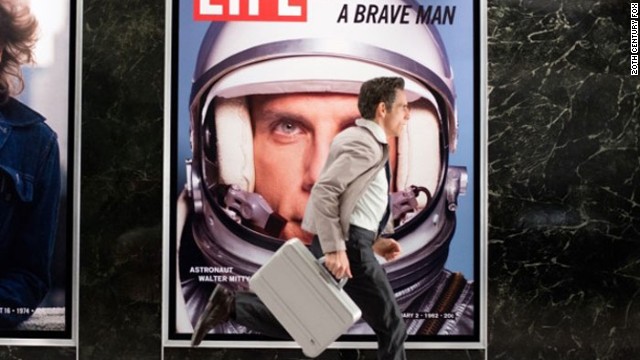 The Secret Life of Walter Mitty is also filled with blunt product placement and some strange plot elements that don’t blend together. I’m not generally offended by product placement in movies when they make it oblivious; hey, a character has to drink something so why not a (insert product here)? But the fact that the Walter Mitty team actually makes Water’s teenage stint at Papa John’s a reveal about his character, and that the very store is meant to stand in as a reminder of his own deceased father, is just wrong. Then there’s the fact that Walter works as a negative corrector (analog job) at a magazine (troubled industry), and that magazine happens to be LIFE (which shuttered in 2000). Why all the analog contexts? Is it meant to convey Walter’s reluctance to change or adapt? The whole notion of the magazine downsizing gives the film a real-life aspect that just doesn’t feel appropriate for the movie. The fact that Walter’s journey is propelled by a quest for a single missing negative feels a tad too facile for the man’s transformation, but it’s made worse when the answer to the location of the negative is so transparently obvious from the get-go. It was so obvious I almost talked myself out of it. Most of the supporting characters in the film serve little effect on any of the events. They’re there just to provide minor details about Walter and that’s it.
The movie is so earnest and you can tell Stiller is trying hard, but The Secret Life of Walter Mitty ends up being a disappointing feel-good message lacking substance and much entertainment. The filmmakers have conviction, I’ll give them that, but it’s misplaced, and the film’s tone has too many distracting elements. The fact that real life mirrors Walter’s fantasy visions seems like a miscalculation from the start. Thurber’s short story didn’t have that much to it to begin with but we need more than this, an office schlub learning to live his life through improbable adventures meant to inspire the rest of us common folk. As a slice of escapist entertainment, it’s not fanciful enough, not creative enough, and not funny enough. As a motivational, heart-tugging ode to living one’s life, it falls into too many traps to feel applicable, insightful, or engaging. It looks beautiful and the people behind the film obviously mean well, but good intentions and nice camerawork are not the same as an effective movie built from the ground up, namely the lackluster story and characters. The Secret Life of Walter Mitty feels like it has as much depth as a glossy, idealistic commercial, and perhaps for some this will suffice, but I found this Walter Mitty’s secret life not worth investigating.
Nate’s Grade: C+


You must be logged in to post a comment.