Blog Archives
50 Shades Freed (2018)
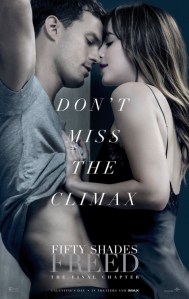 I think Fifty Shades Freed as a title works well not just for the audience but also the actors, as everyone is celebrating putting one of Hollywood’s least engaging film franchises well behind them. E. L. James’ best-selling erotic novels have made for pretty lifeless big screen entries. Director James Foley (Glengarry Glen Ross) is free from having to bring this silly thing to straight-laced life. The actors are free at last from the mechanical sex scenes that populate these films, free at last from their terrible chemistry with which they cannot conceal, free at last from having to say stilted dialogue for stilted characters, and free at last from the six hours of boredom and overstated kink. This is a franchise that wants to go out in a toe-curling climax but goes out with a whimper. If you’re like me you’ll scratch your head and wonder, “Was that it?”
Anastasia Steele (Dakota Johnson) and Christian Grey (Jamie Dornan) are now Mr. and Mrs. Grey. While honeymooning in France, Christian still can’t help his domineering ways and instructs Ana not to sunbathe topless. She finds ways to assert her independence and defiance. Meanwhile, the happy couple is challenged by two foes: a vengeful Jack Hyde (Eric Johnson) and the prospect of children.
 It’s hard to say which in this trilogy is the worst film but I still venture that the second, Fifty Shades Darker, is the winner in that regard. It’s hilariously bad and incompetent, whereas Fifty Shades Freed is slightly better simply because there’s less of everything, which also includes less of a reason to exist. If you thought the previous film was struggling to stretch enough story to fill a feature-length runtime, then just wait until you watch the new movie where we have such scintillating plotlines like whether Christian’s brother might be cheating on his girlfriend or Christian being mad because Ana hasn’t changed her work email to her new married name. That last item also serves as another blaring waning sign about the scary control freak that is this franchise’s supposed brooding, Byronic hero, but we’ll get more into that later. The characters introduced in the last film don’t really matter. There just isn’t a credible story here, which may be why this is the first Fifty Shades to clock in short of two hours (and it has a montage that cycles through highlights of the trilogy). The problem is that the last film mostly completed the journey of Christian Grey from bad boyfriend material to slightly less bad marriage material, as he got down on one knee and proposed to Ana. He learned to settle down, open up about his past behavior, and start the process of compromise. With Fifty Shades Freed, we start off with them getting married and their frolicking honeymoon, and the movie seems to exist in that post-“happily ever after” phase of romances that we rarely see because nobody wants to know what happens after the couple gets their Big Closing Kiss. Does anybody want to check in with Cinderella and Prince Charming arguing over who has to do the dishes (trick question: it’s the servants)?
Conflicts are once again introduced and hastily taken care of, much like the laugh-out-loud helicopter crash from that last film that was resolved in the very next scene. They’ve carried over a lackluster villain from the second film, Ana’s unfortunately named old boss Jack Hyde who tried to sexually assault her. This man worked as a fiction editor in the world of publishing and now suddenly he’s an expert on kidnapping, breaking and entering, and stalking. It’s a ridiculous threat meant to provide some level of dread and danger, except he’s easily dispatched by the end of Act One. There’s a hilarious courtroom scene where his lawyer is trying to argue that Jack was simply trying to work things out after exhausting all his communication resources. Ignore the fact he held a knife to Ana’s throat. He goes away for the second act only to, surprise, come back in another stupidly preposterous way to re-establish his menacing threat… only to once again be easily dispatched in an anticlimactic manner. This guy sucks. The screenplay tries to hastily add some duality to Jack, saying he despises Christian Grey for denying him the life he deserved. Apparently (spoiler alert but do you actually care anymore?) Jack and Christian were in the same Detroit foster care system together and I guess Jack assumes without Christian he would have been adopted by wealthy elites instead? Jack seemed to make a name for himself even without that cushy starting point. Mostly this is another Fifty Shades movie that feels like it has time to fill and time to kill.
 That’s where you’d expect the steamy sex scenes to provide a jolt. Isn’t the whole purpose of this franchise watching pretty people get naked and do sexy things? For all its whips and chains and BDSM banter, the Fifty Shades sex has been tepidly tame. As I wrote previously of this franchise: “I cannot overstate just how dull and lazily staged the sex scenes are in the film, extinguishing any kind of titillation and strangely demurring once things get passionate. The nubile bodies are on display, Johnson’s in semi-permanent arched back, though Dornan is often coquettishly obscured (sorry ladies). The word that seems most appropriate for the sex scenes is ‘anticlimactic.’ Ana jokes that she’s a vanilla girl and trapping Christian into a plain relationship, and their big screen sex life typifies this (anyone remember Ana’s question about what a butt plug was?). It’s a world of kink where nipple clamps are giggle-worthy accessories to the participants and the go-to sexual position is missionary. This movie is not the daring dip into untapped sensuality it’s been made out to be. It’s much more conservative at heart.”
The lusty thrills are of the soft-core porn variety with close-ups of erect nipples and heavy breathing. The sex scenes in the second film were most strange because they all followed a routine that was cut short once actually sex began, cruelly teasing the target audience. By my count, there are three actual sex scenes in Fifty Shades Freed and two or so aborted efforts. The strongest sex scene is the one that feels inspired from 9 1/2 Weeks, where Ana takes control and dabbles melted dollops of ice cream over Christian’s shirtless torso only to lovingly lap up every morsel. It’s the only scene that feels like it has some spontaneity and sexiness. Maybe it’s because it breaks free from their Red Room routines or maybe it’s because it has Ana in charge, or maybe it’s just residual good will from memories of 9 ½ Weeks (side note: I re-watched it a year ago as “research” for a short script, and it is not as sexy as you’ve been told. There’s an extended sex scene on the scuzziest and grimiest fire escape stairs in the rain). Another disappointment for its intended audience must be the lack of full-frontal male nudity, something each film has curiously shied away from. There is plenty of Jamie Dornan’s pubic hair, which I guess was dangled as a concession to the fans. If you came to watch erotic sex scenes you’d be better off getting off from late night cable.
 With bad sex, bad storytelling, and bad pacing, what we’re left with is the closing realization that these two people really shouldn’t be together. Much of the second half of this movie revolves around a core difference over their views on children: Ana wants them and Christian is less than enthusiastic. This is a conversation that should have taken place before they got hitched. It’s another example of Christian not wanting to share Ana with anyone (he literally says this in response to being a potential father). You can bring the man to sing a dopey love song on the piano but you still can’t remove all the scary, controlling elements of his character. I think ultimately Christian’s love of bondage is because he is portrayed as being damaged, abused, and this informs his sexuality. While that may be the case for various people, transforming moments of trauma into uncontrollable and subconscious desires or titillation, it presents a pretty distorted picture of the consenting adults who frequently enjoy participating in BDSM. These people are simply not that interesting. Anastasia Steele (and it pains me every time to type that out) is a mousy audience surrogate meant to be whisked away into a hidden world of luxury, where the hunky man is obsessed with having her, and only the power of her love can make him whole again. That doesn’t exactly sound like the makings of a healthy relationship, and the fact that it’s spun into being a smutty fairy tale is even more disconcerting. The Twilight fan fiction origins become clearer with every film.
Struggling to justify its whole existence for 105 lugubrious minutes, Fifty Shades Freed is the flaccid finale to a boring and underwhelming trilogy. I have no problems with movies whose sole purpose is to turn on their audience. Erotic movies certainly have their place in the landscape. They can even be specifically designed for very specific audiences that do not include me, and the Fifty Shades series is definitely not my kind of smut. I’m not the target audience but I’m open to interesting stories and visceral sexuality. With how redundant and tedious the film franchise is, I think I’ll recycle yet again an observation I wrote of the original film: “Surprisingly boring and rather tepid, Fifty Shades of Grey feels too callow to be the provocative film experience it wants to be. It needs more of just about everything; more characterization, more organic coupling, more story, more romance, more kink. It is lacking in too many areas, though the production values are sleek, like it’s the most technically accomplished episode of Red Shoe Diaries.” Skip the Red Room, these insipid characters, and the high-camp tawdry attempts at sensuality. The final Fifty Shades is a fitting end for a franchise that could never get its mojo going.
Nate’s Grade: C-
Share this:

Phantom Thread (2017)

When the 2017 Oscar nominees were announced, one of the bigger surprises was the amount of love the Academy dished out for writer/director Paul Thomas Anderson’s Phantom Thread. In hindsight, maybe this should have been more obvious considering the Oscar-friendly pedigree (Anderson a.k.a. PTA), the acting phenom (Daniel Day-Lewis), the setting (1950s), and the subject matter (obsessive artists). I had no real desire to see Phantom Thread after enduring PTA’s last two movies. I strongly disliked Inherent Vice and The Master, to the point that when I read about the love for either I can only stare at my feet, shake my head, and hope one day these defenders of rambling, plotless, pointless navel-gazing will come to their better senses. While not nearly ascending to the heights of his early, propulsive, deeply felt works, Phantom Thread is for me a marked improvement as a PTA film experience and an intriguing study in toxic desire.
In 1950s post-war London, fashion designer Reynolds Woodcock (Day-Lewis) is famous for dressing movie stars, princesses, and the rich elite of the world. His sister, Cyril (Leslie Manville), acts as his business manager and personal manager, including kicking out the old muses who have overstayed their welcome. After a day out in the country, Reynolds becomes instantly smitten with Alma (Vicky Krieps), a foreign waitress. He pulls Alma into his highly secluded world. She lives in the Woodcock offices and he summons her at all hours, caught up in the madness of inspiration. Alma is overjoyed by the attention and adoration from such a famous and brilliant artist. It’s the kind of feeling she doesn’t want to end, and when Reynolds begins to lose interest with her, Alma will fight however she can to stay longer in this new and exciting world.
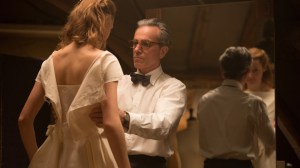
While this doesn’t have nearly the same amount of plot in comparison to early PTA, Phantom Thread at least held my interest and felt like what I was watching mattered. The character dynamics were compelling. Reynolds is a puzzle and we’re side-by-side with Alma trying to figure him out, suss his moods, and analyze why he is the way he is and how best to compensate. It becomes something like a portrait of a Great Artist who doesn’t operate on the same social and interpersonal levels as the rest of us, leaving Alma fumbling for stability. A breakfast in silence can become a battle of wills on the sound design team (you’ll never notice the sound of bread scraping like ever before). It’s not quite the thorough character study that There Will Be Blood purported to be, but Day-Lewis is as reliable an anchor for a movie as you’ll get in cinema. I was especially fascinated by the role of his sister, Cyril. She’s the gatekeeper to a very private world and knows the precise routines and preferences of her very fussy brother. She doesn’t necessarily approve of his actions but she sees them out, though occasionally she has to be more of the responsible one of the pair. Cyril is his lifeline, enabler, and enforcer. She treats Alma as a visitor into their home, further magnifying her worry about eventually being replaced by another muse for Reynolds. This insecurity is what drives much of the film’s second half as Alma tries everything she knows to assert power and influence so that she will not be unceremoniously carved out of this new special life for herself.
At its core Phantom Thread is an exploration of the stubborn artistic process and the toxic relationship of chasing those mercurial, waning affections. It’s very easy to feel for Alma, a relative nobody plucked form obscurity and whisked away to a glamorous world of the London’s fashion scene where she is the chief muse of a brilliant man. When he lays the full force of his attentions on her, it’s like feeling the warmth of the sun, and her world revolves around feeling that intensity. When his attention is elsewhere, Alma can feel lost and discarded, desperate to seek that warmth and fulfillment once more, though running into barriers because of Reynolds’ peculiar personal habits and demands. She plans a surprise romantic dinner that Reynolds resents, and he congratulates himself on the “gallantry” of eating his asparagus with butter instead of the salt he normally likes. Reynolds is a powerful figure who casts a powerful shadow. You feel for Alma as she tries again and again to find the exact formula for pleasing and comforting this obsessive man given to routines. She’s tying to crack the code back into Reynolds good graces. He’s an inscrutable force and one Alma is willing to genuflect to for his affections. Because of this dynamic, much of Phantom Thread is watching Alma try and fail to impress or win back the attentions of Reynolds, which is part fascinating and part humiliating. The film explores Reynolds’ history of burning through his shiny new muses, relying upon the iron-hearted determination of his sister to finally push out the discarded lovers/muses. For Reynolds, his muses follow the cyclical pattern of a love affair, the excitement and discovery of something new, the possibilities giving way to artistic breakthroughs, and then what once seemed en vogue is now yesterday’s old fashion.

Because of this tight narrative focus, the film does become repetitious in its second half, finding more ways to expound upon the same ideas already presented. Reynolds is a jerk. His process is of utmost importance and must not be altered. Alma is struggling to make herself more essential and less expendable in his orbit. She doesn’t want to end up like all the other prim women who have been elbowed out of the spotlight. She’s feisty and pushy and will challenge Reynolds, and this doesn’t usually work out well. While the strength of the acting never wavers, the plot does feel like it reaches a ceiling, which makes the film feel like it’s coasting for far too long (and it’s also far too long). It feels like Alma is fighting an unwinnable battle and after all her efforts she’ll just be another muse in a history of muses. That’s probably why Anderson gooses his third act with a thriller turn and with a specific plot device I’ve weirdly seen a lot in 2017. It feels like this plot turn is going to disrupt the cycle of Reynolds affections, and then as things begin reverting back to the old Reynolds, it all feels so hopelessly Sisyphean. And then, dear reader, the literal last few minutes almost save this entire movie’s lethargic second half. It’s a new turn that made me go, “Ohhhhh,” in interest, and it redefined the relationship and power dynamic between Alma and Reynolds in an intriguing way. It says a little something about the relationship between self-sacrifice and self-sabotage and how the power of giving can approach perverse levels of distorted self-fulfillment.
The biggest selling point of any movie with Daniel Day-Lewis is the man himself. He’s literally only been in four movies over the last decade, and in two of them he’s won Best Actor Oscars and was just nominated for another with Phantom Thread (Gary Oldman has that thing in the bag this year, though). The excellence of Day-Lewis is beyond dispute, and yet I would argue that Day-Lewis is pushed aside by the acting power of Krieg (A Most Wanted Man). This woman commands your attention enough that she can go toe-to-toe with Day-Lewis and win. She’s the worst at holding back her emotions and playing games, which makes her the most affecting to watch. When her romantic dinner goes badly, you can feel her reaching for reason, thinking out loud, her eyes glassy with uncertainty. When she’s speaking in an interview about her relationship with Reynolds, the warmth in Krieg radiates out from her. The other standout is Manville (Harlots) who does an incredible amount with mere looks. She can be withering. It’s a performance as controlled as Alma is uncontrolled, relying on the facade of calm to operate through a manufactured space of rules and expectations. And yes Day-Lewis is terrific. It’s also the first time he’s used his natural speaking voice in decades on screen.

Paul Thomas Anderson’s newest movie is about the world of fashion but it’s really about three characters jostling for understanding, attention, and control. We follow the tumultuous power dynamics of an artist-muse-lover relationship and the toxic implications it has on Alma as she struggles to maintain her position. The second half can get a bit repetitious and feel rudderless, but the eventual ending and wealth of great acting makes it an arguably justified journey. I lamented that Anderson was no longer making movies for me with the lurch he had taken with The Master and Inherent Vice in particular. He doesn’t have to make movies for me at all, but it was this sad realization that made me feel like I was undergoing a breakup with an eclectic artist I had loved tremendously in my younger days (Boogie Nights remains one of my favorites). Phantom Thread doesn’t exactly return things back to the way they used to be but it at least rights the ship, offering a mild course correction with a movie that is accessible and substantive. If this is indeed Day-Lewis’ last movie, at least it was better than Nine.
Nate’s Grade: B
Share this:

Hostiles (2017)
 A slow-paced Western with A-list actors, Scott Cooper’s Hostiles is a ponderous Western that feels too lost in its own expansive landscapes. It’s about an Army captain (Christian Bale) reluctantly taking the lead to escort a Cheyenne chief to die on his native soil. As you could expect from that premise, Hostiles is reverent and meditative to the point of boredom. It deals with Major Themes about man’s place in the world, connection to nature and the land, and our treatment of Native Americans, but it feels like it believe it’s saying a lot more than it accomplishes. The final film is over two hours but I kept waiting for the movie to feel more substantial, for the real story to start. The premise is workable and there are some interesting side characters, notably Rosamund Pike as the sole survivor of her family’s Native American attack, but it all feels underdeveloped to serve the central figure. It’s a story of one man having to come to terms and forgive himself for the cruel things he’s done in the past in the name of glory, honor, and patriotism. There are too many moments where characters reach out to remind him that he is, in fact, a Good Man. It gets to be too much. The talented supporting cast is generally wasted. Bale (The Big Short) is very internal, almost far too insular as a man speaking with looks and eyebrow arches, as he feels the weight of his soul over the course of this journey. I just grew restless with the movie and kept waiting for it to change gears or get better. Hostiles is not a poorly made movie, nor without some artistic merit, but it’s too languid and lacking.
Nate’s Grade: C+
Share this:

After (2018)
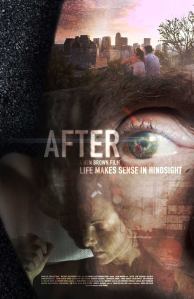 Filmed throughout central and southern Ohio, After is the passion project of special effects wizard Ben Brown who wrote and directed it (and, yes, did the special effects). Many brilliant people lent their time and talents behind and in front of the camera, and I once again must confess to personally knowing several of them. I’m trying to keep my biases at bay through this review but acknowledge that may be impossible. Still, After is a pretty, heartfelt movie about Big Things that has some structural miscues and plot padding that left me from fully dubbing this an unqualified indie success.
Charles Galloway (Lee Slewman) lies dying in an alley having being fatally stabbed by a mugger. He reflects back on his life as a younger man (Dan Nye) and the people who shaped his experiences, notably Marie Granger (Tifani Ahren Davis), a free-spirited artist who captured his heart and then left it in tatters. Also, Clare (Carolyn Schultz) is an EMT worker who is having a hard time living with the rigors of her job. She’s haunted by the people she could not save and turned to drinking to self-medicate. She tries to get her life back on track by putting herself out there and discovering more of who she is.
 After is a movie I would not be primed to enjoy that much based upon my own artistic tastes, namely a very earnest ode to the deeply felt, prosaic works of Terrence Malick (The Tree of Life). With that in mind, if you are a lover of Malick’s divisive films (I’m not a fan) then I think you’ll find a recognizable artistic ambition worth celebrating in After. Being loosely plotted means much is meant to be felt through the experience, the combination of the images building off the next, a tone poem of contemplation. It follows a dream logic and either you can immerse yourself in the overall experience or you’ll be left waiting. The very Malick-styled cinematography by Gil Whitney (The Street Where We Live) makes the colors look lush, the outdoors inviting, and the spaces around characters cavernous to communicate distances and isolation. The special effect sequences present arresting visuals exploring Charles’ mind fraying. There was one shot where Clare woke up from post-sex activities and her hair is magnificently arranged. It’s a little detail but it did not go unnoticed, and that kind of doting care is evident in many of the shot compositions and dreamy visual aesthetics. There’s a gorgeous shot over a cityscape of Cincinnati that evokes a romantic mood worthy of cinema. This is a nice looking movie and the actors are putting in strong uniform efforts. It’s a man’s life uncovered as if it were a jigsaw puzzle, and putting the pieces together is part of the fun. Adult Charles has to learn about responsibilities, what it means to be a man, and the consequences of letting others in, of allowing yourself to be vulnerable and having your heart broken. If I had to surmise a theme I would say it’s about the unexpected detours and unintended consequences of life, the longer effects of our choices bringing opportunity even in our many failures on this Earth.
After is so sincere and radiating with big emotions that I felt rotten for not being moved more. It’s a pleasant film that wears its mighty heart on its sleeve, has strong visuals and technical attributes, and skilled actors, so why was I thwarted from being more engaged? After some time and searching, I think it has to do with the underdeveloped plot structure and with a character that is given undue attention.
 I started questioning whose movie this was with the divided focus, and Clare was not justifying her presence and the time spent with her. It’s almost like they’re co-leads that the film keeps cutting back and forth with; however, you keep waiting for her larger relevance to make itself known. Because why would the life of the EMT on the scene after the death of the supposed protagonist be worth this much attention? So we keep waiting for something more to be revealed but the character is unfortunately too underdeveloped, formed from customary cues of people suffering from Heavy Life Things (alcoholism, depression, poor social interaction, haunted by the ones she cannot save). She’s established early as being something of a zombie sleepwalking through life but this characterization is more stopping point than starting point. Even when she starts an awkward romance with a police officer we’re waiting for movement, change, some new insight into the character, and when that doesn’t arrive the question becomes even more pertinent over why exactly this character is absorbing so much precious screen time.
The non-linear narrative structure has some elegant visual symbolism but also feels somewhat underutilized. The framing device is Charles lying mortally wounded in a dirty alley, his life flashing before his eyes, reviewing the Big Moments. This is also mixed in with Clare, who conflicts with the framing device until the very end of the film reveals how these specific pieces snap together. I think if this story had been told chronologically it would be more obvious how the eventual purpose of our depressed and haunted EMT was mostly for the impact of the eventual reveal. It’s masking the reality that she’s more a plot device than a person, a lesson to be learned. If a character is given the second most screen time and is mostly here as a reflection or foil to the lead then it’s hard for them to stand on their own. Because of all of this, whenever the film kept coming back to Clare and her life I felt like it was intruding on more interesting plotlines.
 I was hoping the film would take the bones of its story and put them to more use. A dash of something a little high-concept could have juiced the appeal and mystery, like a simple time travel element that provides even more stakes for an out-of-time man looking back over his confusing life. That opens more narrative possibilities for the ages of the Charles character at various points in his life, plus it would also naturally start to bleed memories into one another, allowing the repetition to provide more intriguing insight. Speaking of bleeding memories, I thought what if the framing device remains and it’s almost an Eternal Sunshine-style internal recount of one man’s life. Charles could literally be retreating into the safe confines of his old memories, chased by the hooded mugger who represents Death. Finally, rather than running away, he confronts the mugger and accepts his fate, accepts passing away, and cherishes the life he’s had. Or if you wanted something more conventional, then explore the unexpected relationship with the young fan (Tisha Michele Hanley) who is the only person to appear at Charles’ latest book signing, an unexpected older/younger friendship that could inform both of them. After is a concept with possibility but it feels more a corralling of various story elements than a fully formed story.
The acting is relatively strong throughout the production, able to sell those big feelings pulsating out like ripples. The three Charles Jr.’s all perform ably. The youngest, Trevor Bush, only has one scene but makes his character felt. It’s inaccurate to say all Sleeman (Those Who Kill) does is spend half the movie lying on his back. Much of his performance is inherently nonverbal through alternating awed and fearful expressions, and Sleeman communicates the years of regret and joy with aplomb. He has a wry sense of hard-won wisdom to him. Nye (Harvest Lake) shows quite a bit of range as the adult version of Charles, going big during key dramatic moments and very insular during the fallout. Nye’s at his best when he’s with his best scene partner, Bridgette Kreuz (Perennial) as his “little sister” Colleen. The two have a very easy chemistry to them that sells their sibling bond. Kreuz reminded me of Portia Doubleday from Mr. Robot, a strong woman peeking out behind a deceptively gentle exterior. Kreuz can communicate so much through her tremulous eyes. The older “little sister” (big little sister? Old little sister?) played by Heather Caldwell (The Turn Out) is given much of the exposition being a therapist tying together the two main characters. She covers the exposition hurdles with grace. The two biggest female roles are enhanced from the talents of the actresses imbuing what is absent from the page. Schultz (Prism) is suitably harried and unsure of herself as Clare, and Davis (Clever Girl) is suitably charming without slipping into full Manic Pixie Dream Girl mode as Marie Granger. The movie rightfully treats Davis as an ethereal spirit worth remembering for the rest of one’s life on this Earth.
 I want to single out a few supporting actors who do incredible feats with less. Ralph Scott (Stitches) is a blessing. The man is capable of communicating such emotion with subtlety, which is why his few scenes registered so much for me. He’s coaching his son, Charles Jr., on a very mournful day. His son asks why his father isn’t sad, and in the subtleties of facial glimpses, Scott shows you the sadness he’s keeping at bay, the pained recognition, and then the character must move onward, for his sake and his son’s. It’s the performance that does the most with the smallest amount in the movie. Also of striking note is Hanley (Bong of the Living Dead) as the awkward and adoring fan at the bookshop. Her performance is so natural, stripped of any overt actorly artifices, and the character seems pleasant and hopeful, that I wanted more scenes with her and her character. Hanley left such an impression that I was rewriting the story in my head to get her more involved.
After is a movie that wants to make people think and feel, and for many it will have this desired effect. It’s powerfully earnest and well-intended, a loving recreation of the Terrence Malick spiritual aesthetic of art and reality, and a movie with important things to say. The underdeveloped story occasionally gets sucked up into the power of the visuals, though I believe much is meant to be communicated from the poetic imagery. It’s a conscious choice that I don’t think helps the greater story and characters but that’s also because Terrence Malick’s ponderous poetic interludes are not my kind of movies. While I don’t feel like the finished film is the best version of its own story, the completed movie showcases the hard work and sincerity of many artists. After is an tribute to the burgeoning film scene in Columbus, Ohio and its many talents. Look for it with festivals in the future.
Nate’s Grade: B-
Share this:

The Greatest Showman (2017)
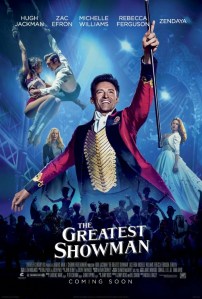 It’s rare to see an original musical given this sort of stage and attention. We usually reserve this space for tried-and-tested properties from Broadway or whatever animated film Disney has deigned to remake for an extra billion dollars in goodies. Another question is whether the movie will make the use of its big screen potential, as we’ve been inundated with smaller-scale musicals that are satisfying but lacking in an awe-inspiring sense of scale. The Greatest Showman is a big, splashy, 80s-styled Broadway musical that deals with big moments, big characters, and big emotions. It wears its mighty sincerity on its sleeve and challenges you not to get swept away with all of its charming pomp and circumstance, and for the most part I did just that.
P.T. Barnum (Hugh Jackman) is an unemployed salesman trying to provide a life of luxury and imagination to his wife Charity (Michelle Williams) and two daughters. He opens a theater in New York City and hires folks with unique appeal, a bearded woman (Keala Settle), a little person dressed as Napoleon, other so-called “freaks” and several trapeze artists. The show garners some controversy but still attracts a crowd. He reaches out to a rich playboy Phillip Carlyle (Zac Efron) to better shore up the finances. Phillip is reluctant but eager to step away from the pull of his parents, which includes falling in love with Anne (Zendaya), a trapeze performer. Barnum achieves enough success to force his way into the moneyed world of New York high society but he doesn’t feel they accept him, so he reaches out to renowned opera singer Jenny Lind (Rebecca Ferguson) and convinces her to come to America. Barnum plans a cross-country tour for his newest star and plans on going with, soaking up every standing ovation from the upper class. With his focus distracted, Barnum is in danger of losing those closets to him.
 This is a loving throwback to those old Broadway days and it succeeds admirably on the big screen, taking its circus setting and opening up the space. There’s a rooftop dance among hanging sheets that reminded me of classic Rogers/Hammerstein. I was particularly fond of the choreography of two duets, both with Efron. The first, “The Other Side,” he is being wooed by Barnum in a bar and the two men circle each other in negotiations, eventually jumping on tables, the bar top, and pounding and sliding shot glasses to naturally match with the percussive elements of the catchy song. The “Rewrite the Stars” lovers’ duet is playful and romantic as envisioned in its location, the center ring of the theater . Zendaya swings along ropes, rings, and weights, making their “will they won’t they” song a literal flirtatious dance, their orbits getting closer to one another, and the staging makes the emotions of the song feel even larger and more resonant. If you’re a fan of the unabashed, big audacious musicals of old with a sincerity that could approach mawkish, then you’ll definitely be in for a treat with what The Greatest Showman offers.
Reading that the Oscar-winning musical team behind the listless tunes from La La Land was the ones cooking up the original Showman songs did not inspire me with confidence. Well, apparently what they really needed was people who could sing and a canvas that allowed for a wider array of musical instrumentation. The songs mimic the movie in its presentation of exploding emotions and earnestness, and the big group numbers have a habit of feeling very kitchen sink in their melisma. It’s all the notes, all at you, with a thundering backbeat, and it can be a little overpowering at first to process, but eventually you adjust to its ecstatic rhythms. The opening number “The Greatest Show” threw me for a loop, with quick audience foot stomps cut with a millennial whoop and then laid over a dozen other musical tracks. It hits you hard but serves as a fine introduction, teasing you about the world to come and Barnum’s showcase. The song is also emblematic of my biggest quibble with what is otherwise rousing musical numbers insofar that it’s overproduced. There are solid melodies with each song and its reprise; however, it feels like the arrangements cannot settle on when to stop adding stuff. The songs can feel cluttered, weighed down by the added production. Barring that, it’s 39 minutes of original music that puts the Oscar-winning La La Land to shame.
 With any musical, different numbers will strike people differently, so I’ll highlight some of my favorites. The aforementioned “The Other Side” has a playful jaunty beat that builds and builds, nicely lending itself to showoff moments for Jackman and Efron as they try and outsmart and eventually out dance (the musical equivalent of persuasive speaking?) one another. the lyrics are also sharp (“I live among the swells/ We don’t pick up peanut shells”). It’s also a nice change of pace from the anthems and ballads that populate much of the soundtrack. Speaking of ballads, “Never Enough” might come from the least important character in the overall story but my goodness does Voice alum Loren Allred, providing vocals for Ferguson to lip synch, give it such a wallop. The emotion in the singing is crystal clear and made me wince because it’s so good. I’m one of those crazy people who care more about the performances in my big screen musicals than hitting all of the correct notes (see: Les Miserables), but it’s nice when a performer can grant you both. There’s no shame in lip-synching, La La Land. “Tightrope” is Williams lamenting her martial changes but the real revelation is her singing. She takes a fine song and makes it better. The song getting the most awards attention is the anthemic “This is Me” about accepting one’s self like a “Let it Go.” Keala Settle takes complete ownership with her booming vocals and passionate intonation. It’s a calling for all outcasts and delivers the inspirational groundswell into a millennial whoop pinnacle. There wasn’t a song that didn’t engage me at some level, either musically, performance-wise, or even presentation, and that’s one of the most important aspects for a musical.
Jackman (Logan) might just be blessed with more charisma than anyone on the planet, and so when he has that twinkle in his eye, you’re willing to go on whatever journey with the man. This has been a passion project of his for years and Jackman and he puts his all into being a captivating conman who can get high on his own hokum. He’s leaping off the screen to entertain and his dexterity and natural showmanship parlay well into bringing great, bustling life to his character. Efron (Baywatch) is an appealing actor who can so easily pull you in with his adeptness at comedy, acting, dinging, and dancing. It’s been a while since Efron hoofed it up on the screen and he hasn’t missed a step. Zendaya (Spider-Man: Homecoming) is a born star. She has a moment late in the film where her hoarse voice repeats the chorus of “Rewrite the Stars” and she pushes it from being cheesy into being touching. Williams (All the Money in the World) is better than her underwritten material affords and brings warmth to her understanding, doting wife. For fans of the excellent Netflix series GLOW, which is also all about showmanship, that’s Sheila the She-Wolf as a young Queen Victoria (Gayle Rankin) greeting Barnum.
 Now, the direct sincerity of the entire production is somewhat called into question by its very sanitized approach to P.T. Barnum. One way of looking at his “freak show” was that he was empowering the less fortunate and providing a safe space for them to call a community and earn a wage in a discriminatory job market. Barnum gave them a sense of dignity. Another way of looking at it is that Barnum was exploiting people who had no other options and selling tickets for the public to indulge its morbid curiosities. Barnum is a fascinating figure before he even conjures up the idea for his circus. He was an abolitionist who dropped out of school at fifteen, owned and operated a newspaper by age 21, was jailed for libel, exposed a credit scheme to gain his theater, four in the Civil War, and was a purveyor of any ridiculous and ghastly theatrical stunt, including an enslaved African woman’s autopsy to prove she was really 160 years old. Barnum is a complicated historical figure with a wealth of anecdotes that would make great storytelling potential.
The movie invents a Barnum for an invented tale, which isn’t necessarily a problem except that what we get is absurdly simplistic in comparison to the complex source. Barnum becomes a poor kid with great aspirations, most of which seems to be either joining the rich elites or sticking it to them and their snooty sensibilities. Likewise, being a champion of the “freaks” is naively unsophisticated for a man as craven for publicity as Barnum. The simplicity also extends into the supporting characters that have meager morsels to work with considering the considerable attention Barnum draws. An interracial romance between Phillip and Anne has tremors of importance but falls back on easy signifiers lacking greater examination, like Phillip’s agog family response to him being interested in “the help.” It’s a shame because Efron and Zendaya are terrific together and a simple gesture like reaching out to hold hands can have such power. Charity is the put upon wife we see all-too often in the stories of Great Men, and her domesticity represents the source of Barnum’s true happiness. You see, dear reader, Barnum’s character arc is that he wants to stick ti to the rich elites, than he wants to be accepted by them, and then he learns the errors of his ways and goes back to appreciating his family and life’s smaller pleasures, those pleasures are still living comfortably. It’s a strange stop-and-smell-the-roses sort of lesson, and it’s even weirder when Barnum seems to lose interest in his community of performers he’s gathered. The subplot where Barnum abandons his theater to tour with Jenny Lind feels both obvious and unnecessary. The only tension is whether or not there will be an affair, and the impact of Jenny Lind seems overall fleeting, forcing conflict in contrived fashions. For a man whose life story was writ large and fascinating, The Greatest Showman conjures a sedate replacement.
 As I was watching and smiling to the soaring emotions and tunes, I kept thinking how 17-year-old me would have likely tore this movie to shreds, lambasting its earnestness as a mawkish attempt to wring out a feel-good story from a questionable source. 17-year-old me would have snickered about how gloriously unhip The Greatest Showman is. Mid-30s me has a much easier time not just accepting sincerity but also appreciating it. The performances are charming, the performers able, and the songs slyly catchy. The story of P.T. Barnum is sanitized with mixed results but the ebullient feeling coursing through this film is undeniable and worked its magic over me. If you’ve been missing the big Broadway musicals of old, The Greatest Showman will be a three-ring treat.
Nate’s Grade: B
Share this:

Boo 2! A Madea Halloween (2017)
 I don’t automatically hate Tyler Perry’s alter ego/monstrous matriarch, Madea. I didn’t even hate the first Boo film, but its sequel is exactly everything Perry’s critics have accused his films of being. This is the movie everyone thinks the Madea films are. This feels like 90 minutes of vamping, where there clearly wasn’t a script and Perry hoped each new scene would somehow stumble into hilarity. The premise could have worked, placing Madea in a Friday the 13th scenario, but they play it as a lesson to teach the youth about their fool ways. It’s so listless and repeats itself often, stretching to fill out the running time of a feature film. It’s poorly developed, poorly planned, and none of the characters matter as they sometimes change abruptly by the moment. There was clearly no plans to do a sequel for the first Madea Halloween movie, until it became the second highest-grossing film of his career. Everything about this movie smells of desperation. Everybody is just dancing around on screen, speaking in circuitous improv jags that go nowhere, and there’s even an extended sequence of twerking from a famous dancer. This is a punishing movie that plays to Perry’s worst instincts. Let the Boo franchise die.
Nate’s Grade: D
Share this:

Molly’s Game (2017)/ Call Me By Your Name (2017)
 Two new awards-caliber film releases couldn’t be more different. One of hyper-literate in a high-stakes world of drama, gambling, and crime, and another is somber, lackadaisical, and personal, chronicling a summer love that changed lives. One movie has scads of plotting it zooms through with high-powered visuals and voice over, and another luxuriates in the moment, a placidity on the surface interrupted by rising passions. One of these movies I found captivating and the other I found perfectly nice but unremarkable.
Molly’s Game is Aaron Sorkin’s directorial debut, clearly having studied at the altar of David Fincher, and he packs a lot into his 140 minutes chronicling the rise and fall of Molly Bloom (Jessica Chastain), a former Olympic hopeful who found herself running an expensive, private series of poker games. She’s drawn into an unfamiliar world and through her tenacious grit, preparation, and fortitude, she is able to become a fixture amongst the rich. Then the FBI comes knocking and wants to charge her in conjunction with being part of a Russian money laundering operation. Driven by a fierce performance from Chastain, Molly’s Game is a gloriously entertaining movie that glides by. It burns through so much plot so quickly, so much information, that you feel like you might have downloaded Bloom’s book while watching. The musical Sorkin dialogue has never sounded better than through the chagrined, take-no-prisoners Chastain. The snappy dialogue pops, the characters are richly realized, and even during its more outlandish moments, like a surprise paternal reunion therapy session, Sorkin packs multiple movies of entertainment in one brisk, excellently manicured production.
 In contrast, Call Me By Your Name is a slower peak into the discovery of romantic feelings between 17-year-old Elio (Timothee Chalamet) and grad student Oliver (Armie Hammer). Set amid the sunny countryside of northern Italy, the film takes it sweet time establishing the lazy world of its characters and their closely intersecting orbits. I became anxious because the characters kept me at arm’s length, leaving their burgeoning romance to feel distant and tame. I understand the hesitation of both parties and the age difference complicating matters. I understand caution. But it feels like the film is cautious to a fault, to the point that one of them laments later why they wasted so much time. The acting is pleasant if undistinguished. The best scene is a terrific monologue by Michael Stuhlbarg as the world’s most lovably accepting father. For an earth-shattering romance, I too often felt unmoved and restless. If we’re going to spend this much time hanging out with these people we should get to know them more intimately, and not just in the physical sense. I missed the compelling artistic charge of something like a Moonlight. I’m a bit stupefied at all the praise heaped upon Call Me By Your Name, a fine indie drama that, for me, too infrequently delves below its pretty surface into something more substantial.
I don’t know if this recent comparison sheds light on any personal insight, but perhaps I just love big, showy, obvious plot that calls attention to itself, with characters that fill a room, rather than an airy romance that moves at the speed of its own breeze. Anyway you have it, one of these movies makes my Best Of list and the other just makes me shrug.
Nate’s Grades:
Molly’s Game: A-
Call Me By Your Name: B-
Share this:

All the Money in the World (2017)
 All the Money is the World used to star Kevin Spacey as the prolific oil billionaire John Paul Getty, that is until director Ridley Scott elected to reshoot the part, replacing Spacey with Christopher Plummer after Spacey’s unsavory history of sexual assault came to light. In only ten days, Scott changed his movie with only a month to spare before its release. It’s an amazing feat, especially when you consider Plummer is in the film for at least a solid half hour. He’s also the best part as the mercurial, cruel, penny-pinching magnate who refuses to pay his grandson’s ransom even though he’s the richest man who ever lived. In 1973, John Getty III (Charlie Plummer, no relation) was kidnapped by Italian criminals. With the miserly grandfather offering no help, Gail (Michelle Williams) tries to negotiate with the criminals and her father-in-law to secure the release of her son. I didn’t know anything coming into this film, but afterwards I felt like it focused on the wrong characters. The mother stuck in the middle is not the most interesting protagonist here and seems like a go-between for the two more immediate and intriguing stories, the elder Getty and the youngest Getty. Williams (Manchester by the Sea) is acceptable as the strong-willed, put-upon mother, though her mid Atlantic accent made me think I was watching Katherine Hepburn. Mark Wahlberg (Daddy’s Home 2) is completely miscast as a former CIA agent that helps Gail. He succeeds in converting oxygen to carbon dioxide and that’s about it. The central story is interesting enough, though there are points that scream being fictional invented additions, like a last act chase and a kindly mobster who undergoes reverse Stockholm syndrome. John Paul Getty is an interesting character, and Plummer is terrific, though I am quite curious what Spacey’s performance would have been like under octogenarian makeup (Plummer already happens to be in his 80s). All the Money in the World is an interesting enough story with decent acting but I can’t help but entertain my nagging sense that it should have been better even minus Spacey.
Nate’s Grade: B-
Share this:

The Post (2017)
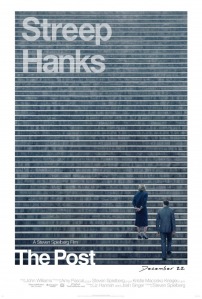 Even with the added timely benefit of championing a free press in the era of Trump, Steven Spielberg’s The Post is a movie held together by big speeches and Meryl Streep. It’s the story of the Pentagon Papers but it’s told from the wrong perspective. It’s told through the reference of whether the owner of the Washington Post (Streep) will or will not publish and how this endangers her family’s financial control over the newspaper. Plenty of dismissive men doubt her because she’s a woman. It’s simply one of the least interesting versions of an important story. Streep is her standard excellent self and has a few standout moments where you can actively see her character thinking. I just don’t understand why all these talented people put so much effort into telling this version of this story. I missed the active investigation of Spotlight, how one piece lead to another and the bigger picture emerged. There was an urgency there that is strangely lacking with The Post. The question of whether she will publish is already answered. It feels like the screenplay is designed for Big Important Speeches from Important People. Tom Hanks plays the gruff editor of the newspaper and Streep’s chief scene partner. They’re enjoyable to watch, as is the large collection of great supporting actors (Bradley Whitford, Carrie Coon, Sarah Paulson, Tracy Letts, Matthew Rhys, Jesse Plemons, Bruce Greenwood, and a Mr. Show reunion with David Cross and Bob Odenkirk). This is a movie that is easier to admire than like, but I don’t even know if I admire it that much. The film has to call attention to Streep’s big decision and the stakes involved by underlining just what she has to lose and reminding you how brave she’s being. When Streep leaves the U.S. Supreme Court, there’s a bevy of supportive women lined up to bask in her accomplishment. It’s a bit much and another reminder that The Post doesn’t think you’ll understand its major themes. It’s a perfectly acceptable Oscar-bait drama but it sells its subject short and its audience.
Nate’s Grade: B
Share this:

Downsizing (2017)
 Alexander Payne is not exactly the first name you would think of when it comes to science fiction. The man has a history of road trip comedies, average Midwestern men, mid-life crises, and the colorful miscreants of society. The fact that the director of Sideways and The Descendants is tackling The Incredible Shrinking Man is a bold move. Payne is outside his comfort zone with Downsizing, and it shows at points. While never quite satisfying the possibilities of its premise, Downsizing is still worth watching for its memorable moments and for the sheer brilliance of one outstanding performance.
In the not-too-distant future, science has developed the technology to shrink human beings to five inches tall, approximately 1/100th of their size. A middle-income couple can live like the top one percent because their money goes further. Paul Safranek (Matt Damon) is a schlubby, regular guy suffering from the ennui of a job he hates and a life that feels unfulfilled. He and his wife, Audrey (Kristen Wiig), decide to undergo the downsizing procedure, which is irreversible. Paul’s wife backs out at the last minute but he doesn’t find out until after he’s gone small. Now with a McMansion all to himself, Paul has to readjust to what he thought his new life would be like. He moves into a condo and shirks the offers to join the parties of his hedonist neighbor, Dusan (Christoph Waltz). Paul finally decides to live life and embraces new experiences, the biggest befriending Ngoc Lan Tran (Hong Chau), a one-legged Vietnamese cleaning lady who was downsized against her will for being an overseas political activist. Paul feels drawn to this woman and she opens his eyes to the larger world around him.
 The strangest part of Payne’s movie is that the main thrust of the story could have been told without all of the science fiction dross. This is very much a romantic comedy/drama that follows the formula of a man jilted at the altar who has to get his life back together, finds someone new who changes his perspective on life, and then they get together by the end. You could have plucked this story and set it in an ordinary world and it still would have worked, which begs the question whether the world of Downsizing is properly applied. The consumer commentary seems muddled, with the rationale for downsizing being helping the planet, reducing the population so to speak, but really it’s an escape into a fantasy of wealth. People are downsizing so they can live in luxury and leisure. This should set up Payne for his incisive brand of satire as he skewers the selfish and self-righteous foibles of mankind, except that doesn’t really happen. Sure, eventually in the second half the movie opens up its tiny world a little wider, revealing the not-so-hidden subculture of immigrant labor toiling away to keep everything stable and pretty. It’s obvious social commentary and rarely does it go a step further than just recognition. And so the film becomes another in a long line of movies about a man who must be shaken from his malaise and enjoy the possibilities of life he never knew existed. Downsizing eventually ignores its sci-fi conceit to tell a relatively ordinary tale of self-actualization.
Payne’s premise would have best been explored through the more open parameters of a television series. Downsizing is an interesting concept that leads to other natural questions over how this tiny world operates and also how it interacts with the larger community. There’s a small scene where a drunk overhears Paul’s plan to shrink and argues that little people shouldn’t be granted the same voting rights as “normal-sized” citizens. The normies contribute more to society and should be given more credit, he argues, before being shooed away. This political division could have made for an interesting topic of reflection itself, but like many of Payne’s pit stops, it comes and goes after whetting your appetite for further examination. What about a story where downsizing is a punishment to do away with the “undesirables” of a nation? A TV series would have allowed more room to explore, with finer nuance, the details and possibilities of this fanciful world. Payne allows his movie to breathe, taking extended jaunts on different ideas but rarely enough to satisfy your sense of curiosity. The last act takes place at the original downsized colony in Norway, though at their diminutive size I wonder if it took them months to travel in Dusan’s yacht. It’s meant to think about what will come after humankind has passed the point of no return when it comes to climate change. Paul has to rethink what he wants his legacy to be and what meaning his life will have, which then pushes him into a rather simplistic choice of go with the girl or the cause. Given the rest of the movie’s focus, you shouldn’t be surprised what decision he ultimately makes.
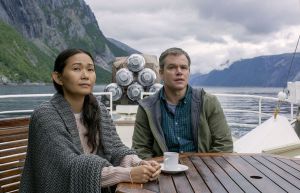 However, the real reason you should legitimately see Downsizing is for the astounding, star-making, can’t-take-your-eyes-off-her performance by Hong Chau (Inherent Vice, Big Little Lies). I cannot recall another movie where a character comes in at the halfway mark and just takes over completely, single-handedly lifting the movie up. Every moment she is onscreen is made better. You’ve never seen a character in a mainstream movie quite like Ngoc Lan Tran. She’s a political dissident, amputee, and lower-class cleaning woman who teaches Paul about the class divides. Tran is tragic, comic, caustic, lovable, and Chau is an acting revelation. I’ve read several reviews that found her to be a cringe-worthy, borderline racist depiction of an Asian woman meant to be laughed at, and I strongly disagree. At no point was I laughing at Tran because of her status, her ethnicity, or her broken English cadences. I was laughing because she was a force of nature that blew away the pretensions of others, that cut to the chase, and spoke her mind in a carefree and honest manner. Her matter-of-fact affectations are so perfectly delivered in accordance with the character’s personality. There are moments where her character is being set up for one thing and Tran goes entirely in another direction, and whereas you might have laughed at the start she surprisingly earns other emotions. Take for instance a scene where Dusan tries to ditch her by making an excuse about a sudden travel commitment. Tran takes this moment and turns it into a genuinely poignant monologue about the unexpected nature of fate. By the end she’s crying out of sheer elation, and those tears are not meant for ridicule. Downsizing realizes what an asset it has and makes her the deserved focal point of the second half. You’ll fall in love with her too. Chau doesn’t just deserve an Oscar nomination; she deserves to win everything.
Downsizing is an episodic high-concept comedy where the shrinking is irrelevant to the main storyline that evolves over two plus hours. This is an adult movie that explores some mature topics with surprising time and scrutiny, and then it can also be a simplistic rom-com that misses the mark on larger, Swiftian social satire. It’s another story in a long line of disaffected, middle-aged men finding their groove again, except then it becomes the story of a Vietnamese activist and her unique persona. Hong Chau is the reason you should see Downsizing above all. She doesn’t so much steal her scenes as just take full ownership over the back half of the movie. Her performance is so uniformly excellent that you wish the rest of Payne’s uneven movie could meet her commitment. There are a lot of ideas here that seem to get brushed aside for the conventional formula of a romantic union, even if the pairing is rather unconventional. Downsizing is an entertaining movie that doesn’t quite amount to more than the sum of its little parts.
Nate’s Grade: B


You must be logged in to post a comment.