Blog Archives
Among Them (2019)
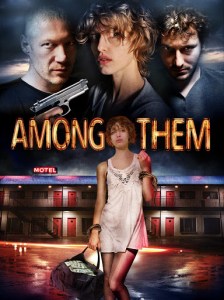
Among Them was described in its advertising as “Tarantino meets Bad Times at the El Royale,” and ignoring the fact that Bad Times is itself a colorful Tarantino-styled homage, what I was really reminded of was Waiting for Godot. For those unfamiliar with Samuel Beckett’s existential play, it follows two gentlemen who do nothing much more than waiting for a man named Godot who never shows up. They get involved in philosophical discussions, and many have intuited that Godot is a representation of God, to Beckett’s dismay, but it’s really a two-act play that involves a whole lot of waiting and the question over why. This is the extent of Among Them’s 90-minute total – a lot of waiting and a lot of questions over why bother.
Two bank robbers, Mick (Dan Liebman) and Harry (Jonathan Thomson), are hiding out in a motel room off the coast. Their bank heist has gone wrong and they’re awaiting the proper papers to escape overseas under new identities. They also discover a woman, bound and gagged, inside the trunk of their getaway car assigned to them from their bosses. Syd (Evalena Marie) could be a liability and they need to make sure she doesn’t get them caught.

The problem with the screenplay by director Kevin James Barry (Serena and the Ratts) and co-star Marie (Dark Haul) is that it has conflated being vague with the idea of being mysterious. There’s far too little going on in this story and far too little that makes much sense. Our criminal duo is following instructions to lie low at a motel. That’s it. They don’t really know who they’re working for, what those plans might include, and so they wait for some unknown source to finally give them their new passports to escape from the police. Being kept in the dark with your characters can be a benefit for storytelling because you are forced to think things through at the character’s level, which works nicely for paranoia thrillers and mysteries. However, when you don’t put in the necessary work, it just makes the story feel unfinished and pointlessly protracted.
I can clearly see the Tarantino elements that the filmmakers attach to Among Them, the bank robbers hiding after a job gone wrong, the kidnapped character becoming part of the team, the motel that might not be all that it appears to be, but these are just elements. What’s desperately missing from Among Them is the intricate plotting and superb characterization one comes to expect from a QT joint. If we’re going to be stuck with these characters in a confined setting, then we need either intriguing developments or engaging personalities that draw us in. Well, considering the story involves characters just waiting around a motel room and seeing weird ghostly visions, plot development isn’t going to be the winner. This is really where Among Them creates an artistic ceiling for itself with its bland characters who we’re stuck hanging around with. Neither Mick nor Harry are charismatic, interesting, or even that dangerous. There aren’t even that many differences between them. If you’re keeping characters cooped up, it would be smart to have some sort of interpersonal conflict that threatens to boil over and ruin things. Think about From Dusk ‘til Dawn and Tarantino’s character and his creepy fixation on an underage hostage, or the different agendas in Bad Times. Just because the characters are seemingly losing their minds doesn’t replace dynamic and necessary characterization.
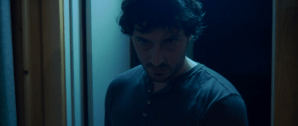
This brings me to the character of Syd, whom I do not understand at all. She’s discovered in the trunk of a car that was designated for our bank robbers. You would naturally think this woman either means something important enough to be captured or presents an intriguing enigma. This is another consequence of keeping everything so overwhelmingly vague. The characters don’t seem too bothered to learn more about her and why she was placed in the trunk of their car, which just seems like a criminal lack of curiosity on their part. Even worse, Syd doesn’t seem too interested herself why she ended up in somebody’s trunk. I figured she would want to run away at the first opportunity, but she doesn’t, and instead just hangs around with the guys, eagerly volunteering to help on their “spy missions.” If her perspective was going to be off kilter, then this could have opened up the character more, making her a wildcard who could take things too far, perhaps provide a dangerous threat to the characters achieving their goal, something. The fact that a bound stranger is gifted to them and they don’t have to thwart her from escaping feels bizarrely wasted. Why even bother with this scenario if nothing is to be done with it after twenty minutes?
Among Them fills its meandering runtime with unexplained supernatural imagery and dream sequences, which don’t so much convey the unique emotional trauma of the characters as it does serve up conventional spooky imagery and pad the running time. I held on waiting to see if there would be a viable explanation for everything, and I was left waiting unfulfilled, much like the main characters. I think the filmmakers were trying to get the audience to doubt what they watched, and show the characters are descending into madness, but it also doesn’t quite work. There isn’t an escalation for them. They don’t seem more unbound as things progress. These eerie visions don’t lead them to make drastic choices, though the movie comes close. Therefore, it just feels like a supernatural presence is messing around with people in a vague and unsatisfying manner because it, too, must be bored. It feels like weird things are happening to goose up a narrative that doesn’t have enough conflict or engaging characters.

From a production standpoint, Among Them looks relatively solid for a low-budget thriller. Having a limited location works for an indie production and the director seems to use every part of his space to keep things from getting visually dull. The acting is overall decent with the standout being Marie as a frightened victim who becomes the most interesting character among the three. Another actor worthy of note is Michael Reed (Chupacabra Territory) as the creepy motel clerk who is, from the get-go, clearly hiding something nefarious about his intentions.
Among Them is a fairly pedestrian thriller that had potential to be something more but is trapped by a stunning lack of imagination and intrigue. There are questions to be had and mysteries to be uncovered, but the subsequent supernatural twists and turns amount to distractions. The screenplay is absent memorable characters with complexity, conflict, and even colorful personalities to make spending all this free time with them something other than a chore. I never really knew what was happening and the characters didn’t seem too eager to find out either. Among Them is more a listless experience than a painful one, a tale that doesn’t ever seem to get started despite some surefire story elements just sitting there. If you’ve ever wanted to watch a disappointing 90s indie crime version of Waiting for Godot, then Among Them is chief among them.
Nate’s Grade: D+
Share this:

Another Version of You (2019)
 As for my Ohio indies round-up, Another Version of You (available on Amazon Prime) was recommended to me, and even though it was filmed in Tennessee I want to contort to consider it an Ohio-related project. One of the producers, Ryan Hartsock, seems to hail from Ohio. One of the supporting actresses, Brittany Belland, grew up in Cincinnati and attended Ohio State. It even features a cameo from famous Ohio State Heisman Trophy-winning running back Eddie George. For these reasons, I’m considering Another Version of You (formerly titled Other Versions of You) as Ohio-adjacent. I want to consider it Ohio-related because it’s very entertaining and well made. Another Version of You is a delightful and imaginative little gem of a movie that is proof positive how concept and the right people are how you make a standout lower-budget indie.
Diggsy Ellston (Kristopher Wente) is heartbroken. His longtime friend and secret crush, Suzette (Sara Antonio), has just gotten married to another man. Daphne (Belland) tries her best to remind her brother that there are more fish in the proverbial sea. Then at the bar a mysterious stranger (George) takes pity on him and gifts Diggsy a magic key that fits any lock and opens doors to parallel worlds. Diggsy is skeptical but curious. He uses the key and steps out into a brave new universe, and he decides to keep going until he can find a Suzette for him.
 I’m a sucker for time travel and parallel universe stories because they involve so many playful possibilities and imagination and don’t need huge special effects or expansive sets. You can tell a fascinating time travel/parallel world tale with a single apartment building. It’s all dependent upon the ingenuity of the storyteller and I’ve always loved the sheer open possibility inherent (I’ve written my own time travel and parallel world screenplays). I had a lot of hope with Another Version of You simply based upon the premise, and after the first fifteen minutes, I was finding myself smitten. There were several segments in the first hour where I was urging the movie to take a new turn, to follow through on an advantageous dramatic development, and then it dived right in and I pumped my fist and celebrated. Writer/director Motke Dapp (The Many Monsters of Sadness) must have been secretly plugged into my brain, waiting for my anticipation, and then ready to reap my mental high-fives. The twists and turns kept me glued to the movie and then something began to rise inside me I haven’t experienced during my viewing of most local movies, and that was, to paraphrase the dearly missed President Obama, the audacity of hope. I felt like I had something special blooming before me on my TV. While it doesn’t quite nail the ending (more on that later), I was highly entertained throughout this swoon-worthy concoction of romance, destiny, science fiction, and dramatic left turns.
Naturally, having an unlimited access to parallel worlds invites plenty of questions about rules, so it’s understandable that the different realms we hop between aren’t all that different. It’s not like a Rick and Morty episode where in one world the Nazis won World War II (why is this always to go-to for parallel worlds/alternative timelines?) or in another world dinosaurs never died out and evolved into humanoids. It’s okay to be limited, so every time Diggsy moves from one universe to another, he inevitably runs into the same faces from his familiar life even if he’s overseas in Iceland. Given the breezy rom-com tone, I thought this was a smart move, like that no matter the world the characters are anchored to one another. I will say there was room for further comedy and exploration with the differences in universes (Will Smith not passing on The Matrix), but since it’s about core character relationships, focusing on the people and less the new worlds guarantees the best audience investment. The different worlds themselves are almost inconsequential. It’s about who the people are in these spaces and how that reflects on Diggsy.
 That doesn’t mean that Another Version of You lacks a strong sense of the implications of its rules. From the get-go, there is no set number of universes, which means the chances of Diggsy returning to his own universe seem near impossible. I thought about his sister at home being distraught that her brother was lost to her. While the movie doesn’t dwell on this reality, it doesn’t remove it. There are some real unsettling consequences to this power. There are people that Diggsy runs into that get trapped in other parallel worlds, absent the ability to escape. Again, sometimes it’s played for laughs but other times it’s played for tragedy. What happens when you’re a refugee from another world and there’s already one of you occupying your spot? I wondered if Another Version of You would go into even darker territory, reminiscent of the final season of the brilliant TV series Mr. Robot, where the transplanted Diggsy accidentally, or intentionally, murders the native Diggsy so there is only one version present. I thought about him trying to pay for anything in these worlds. Would his prime universe credit card even work? Otherwise he seemed destined to run out of on-hand cash soon. This perspective isn’t ever really explored in great detail, and that’s fine, but my mind kept bouncing to intriguing implications and dangers from the premise.
One of the hardest hitting moments relates to the best part of the movie, and that’s the magnetic and talented actress Brittany Belland (The Sleeper, Clowntergeist). Early on she’s a winning and warm presence, but then her reappearance once the universe-hopping occurs complicates things. This universe Daphne has lost her brother and she’s overwhelmed to see him magically back. When he talks about leaving, she fights to keep him, breaking down and arguing the pain of losing Diggsy and then having this amazing opportunity to have him back in her life, to tell him all that she never had the chance to say to her departed brother. It’s a moment of stunningly felt acting from Belland who doesn’t go over-the-top with her performance. I was thrilled when her character stayed in the story longer and found her own version of a happy ending; the movie got better once Diggsy had an out-of-state partner. After having seen this Daphne at an emotionally distraught low point, it was very pleasing to watch her have fun, get flirty, and beam that incandescent smile. Belland can do heavy scenes. She could do light-hearted fizzy scenes. She could do it all. Belland reminded me at turns of Lake Bell or Carrie Coon; she felt like a real discovery, like I was watching someone excitingly new who had the versatility to make it big. I felt like I had found a future star. Then I saw the movie dedicated to Belland, and I was confused. I looked it up and quite sadly learned that Belland passed away in late 2018. I never knew this woman and I legit felt like I was in some degree of mourning. A pall came over me. I’m making a point of watching as many of her available performances as I can. She was so good, dear reader. I mean it.
 The other actresses are also notable highlights, particularly Antonio (The Reason, Christmas at Graceland) who gets the most versatility in the cast. She’s the object of Diggsy’s desire so just about every pit stop in every universe involves some version of Suzette appearing. Antonio demonstrates real impressive range; this whole movie could be her acting reel for any future part. She gets to play the manic pixie dream girl on crack cartoon version of Suzette, a sultry and aggressive version of Suzette, a sunny and domestic version, a terminally ill and wizened version of Suzette, and the romantic drama version, the one who would top-line a movie, a slightly awkward, vulnerable but undeniably appealing version. She’s great. Another surprise is C.J. Perry (Pitch Perfect) as a cafe worker named Gwyneth who comes into Diggsy’s orbit. Perry is best known to WWE fans as “Lana,” a world I’m generally ignorant of. She has a natural charisma and presence and, in another world, I could have seen her finding her footing in a world of features than a ring.
This is also one of the best looking lower-budget indies I’ve ever watched. The cinematography by Micah Simms is chock full of vibrant color and visual arrangements that feel ready-made for postcard replication. Even the opening segment caught my attention, as we go from a bride and groom being whisked away in their car only to reveal Diggsy drinking away his disappointment as the car drives out of the frame. That is sharp and direct and impactful visual storytelling. I knew I was in good hands already. I can see why Dapp works in commercials. He has a dynamic feel for putting together pleasing visual arrangements that don’t become self-consciously arty. The compositions with foreground and background can be blessed. The interior sets are impeccably designed and dressed to provide personality and, later, contrasts. For a movie mostly told from a series of rooms, Simms and Dapp choose different locales prudently to avoid redundancy. The footage from Iceland and its unique landscapes is refreshing. It’s not like there’s a glut of overly stylized camera movements. The film’s sense of style is not a creative trap that dooms many indie productions, boxing them in. It’s twee without being overbearingly so. I don’t recall even much in the way of camera movements. Dapp knows how to frame, light, and color a scene and doesn’t need to rub it in your face. I was impressed from the opening wedding march to the last shot. I will completely be in this man’s camp for his next film project and, if there’s a crowdfunding campaign, I would gladly contribute. Dapp has a clear understanding of how to tell a story visually and how to get the best from his skilled actors.
 The story keeps moving forward with such intrigue and playfulness, cleverly tapping into its potential for exploration and complication, that I was worried whether or not the ending could keep up. The last act isn’t disappointing by any means but it lacks that same heightened level of promise the first hour exuded. It’s a central reason why Another Version of You is so tantalizingly close to total greatness: the character of Diggsy just isn’t terribly interesting. Early on, our introduction is that he’s lovesick over his crush getting married. When we cut to the requisite flashback of his regret, the moment he could have opened up to her about how he really feels, I felt very little for Suzette and Diggsy being together. They didn’t feel like a couple that I would root for. They didn’t even feel like close friends in that flashback. It was a misfire for the character as far as making me board his mission. He literally leaves his friends and family to chase after a universe where he can get his ideal version of his girl. Even forgetting that, there are several universes he discovers where he and Suzette are even together romantically but there are factors Diggsy doesn’t want. In one universe, Suzette has a child, in another she’s pregnant, with the indication it’s Diggsy’s baby, and the guy skedaddles hastily out the door (“I didn’t sign up for kids.”). I thought maybe the film would relay a commentary about Diggsy’s sense of possession of a Suzette like in 2012’s Ruby Sparks, an underrated and disturbing movie about the negative lengths of trying to manufacture and own/entrap one’s idealized mate. Nope.
The compound effect of the first act makes Diggsy seem overly selfish and a bit of a douche. I was never sold on wanting to see him get this girl, and as a result I wasn’t really interested in any of his relationships. Diggsy, as a character, is very opaque, his identity caught up in chasing after his dream of a woman. He’s even told, from one of those versions of that woman, that his idea of her may not even exist. That’s a good lesson but Diggsy seems stubbornly slow to learn. Kristopher Wente (Legal Action, Hour of Lead) does fine work in the role but Diggsy is too often more a reactive vehicle for the audience’s otherworldly exploration.
 Whimsical, exceedingly cute, heartfelt without being cloying, and surprisingly dark at points, Another Version of You is close to everything I could want from its clever, budget-friendly premise. I don’t want to make it seem like this movie is cheap. It’s a sunny and could measure up with any general Hollywood indie in technical accomplishments. This is an easy movie to get sucked into and it doesn’t take long to get running. It reminded me of The Adjustment Bureau (a personal fave, and an inspiration for my own time travel script too) and About Time. The storytelling here just flat-out works, more so with the supporting characters and the intricate and playful possibilities, best demonstrated with the character of Daphne and the excellent Belland. I was getting really excited as the movie kept going, following through with its fun potential. Clearly Dapp has thought through his film, but I honestly could have even used another 20-30 minutes to maximize the emotional investment in the lead character and his lovesick cause. This is one of the best indies I’ve had the pleasure of watching as I started my critical Ohio indie odyssey (even though it was filmed in Tennessee). I advise lovers of brainy rom-coms and human-scale sci-fi to check out Another Version of You. It’s a true keeper.
Nate’s Grade: B+
Share this:

Mock & Roll (2019)
 As far as Ohio indies go, Mock & Roll might have one of the smartest creative approaches. It’s a mockumentary following the mishaps of a Columbus, Ohio band trying to make it big. Director/co-writer/editor Ben Bacharach-White (Jimmie Van Zant’s American DeTour) and his cast and crew make good use of limited resources, blessed casting, but the movie could have been even more had it devoted more attention to its comedy writing and doc tricks.
We follow the band Liberty Mean, with lead singer Robin (Aditi Molly Bhanja), guitarist Rick (Chris Wolfe), bass player Tom (Pakob Jarernpone), and drummer Bun (Andrew Yackel). They are a parody band that sticks to only one source, parodying the songs from the rock band The Black Owls. Their mission is to put together an album, gather enough fans, and take the South by Southwest Festival by storm. Robin’s brother, Sully (William Scarborough), is documenting the band and their wacky hijinks as they play punk bars, try crowdfunding, undergo drug trials, stumble into the underground world of art dealing, and land in jail.
 Mock & Roll is an amiable experience and one comparison became so fundamentally clear to me that afterwards it’s all I could envision. This movie feels exactly like a Nickelodeon or Disney Channel live-action tween series. I know that may sound like a complaint but it’s not intended as one. The comparison just became so obvious to me that I was amused throughout to see the finished film hold to this creative endeavor, whether intentional or unintentional (I’m guessing unintentional). The exuberant energy level of the performers, the comedy scene writing that has specific beginnings and ends, the episodic nature of plot, the “let’s put on a show with our friends” mentality, the wacky hijinks, the direct communication with the camera, it felt like an extended collection of episodes for iCarly or Wizards of Waverly Place or Hannah Montana. Again, I do not intend this as a criticism, but the style and delivery of storytelling, as well as the genial likability of its cast, made me draw this comparison.
The best thing this mockumentary has going for it is its spirited cast who go beyond their limited characters. The difference maker in mockumentaries is characterization. The Christopher Guest mock docs (Best in Show, Waiting for Guffman) don’t have revolutionary storytelling but rely upon seasoned actors to really dig in deep with their unique characters, so that no matter the situation, something will spring out of the interaction and response to conflict. The characters in Mock & Roll are scant. The one with the most outward personality is Rick, puffing his chest out with bravado and swagger. The other two male characters, Tom and Bun, are working on the same note, basically deadpan absurdity. They’ll wax philosophical or bizarre at any moment. Robin, unfortunately, seems to be the straight-man role to center the rest of the group.
While these roles limit what comedy styles are available in the different vignettes, the performers go above and beyond and make the movie enjoyable. Wolfe (Where Are You, Bobby Browning?) is a standout as Rick and his voice reminded me of T.J. Miller. He has a natural charisma but also can easily channel a grinning doofus, which gives him the widest comedy berth. I would happily watch Wolfe in other movies and think he has a bright future in comedy. I would hire him. Yackle (False Flag) appears to be the best improviser on the set, able to pull wonderfully bizarre details from thin air and deliver them with understated care. His riff about Beethoven being deaf, and also blind, and having wooden hands, and that’s what made him great got a solid laugh from me. Jarernpone (Dark Iris) has a similar acting technique except it’s unloading deep philosophy without breaking a sweat, also performed at an understated rate, where the comedy best resides. Bhanja is a welcomed presence among the boys and I wish she had been given more to do. She shows promise and an engaging personality even in limited form. There are two supporting players of note, Scarborough (The Incredible Jake Parker) as Robin’s mostly unseen documentarian brother Sully, and Ohio superstar KateLynn Newberry (Dark Iris, Widow’s Point) as Rick’s girlfriend tasked with building a crowdfunding campaign for the band. Both are enjoyable to the point I wish they had been onscreen more often. Newberry has such a great nonplussed frustration with the band’s self-deluded antics.
 The episodic nature works for Mock & Roll until it simply doesn’t. At 77 minutes long pre-end credits, the movie feels far more like a collection of scenes than as a film narrative with a recognizable three-act structure. The vignettes don’t last longer than maybe eight minutes, which is another reason why they feel like anecdotal segments of a 22-minute TV episode. There is an advantage where if I’m not engaged in one scenario, and many are hit-or-miss, I know that another is coming up (after these commercial breaks). A disadvantage, however, is that nothing feels like it builds off the previous actions of the story. You could rearrange any of the first hour and would only impact the overall plot minimally (a reference to a crowdfunding campaign here and there). The episodic nature robs the movie from feeling like its plotting matters or builds to needed payoffs and running gags that make it more satisfying to watch than, say, a collection of unrelated skits.
Then in the last quarter of the film it becomes a prolonged segment that transforms into a baffling Boogie Nights homage. The gang get involved in art theft transportation (a miss), and then it happens again with a criminal art smuggler Dante (Brian Bowman, Dark Iris). This entire segment feels like the Wonderland/Rahad Jackson sequence late in Boogie Nights. Bowman is meant to be Alfred Molina in an open bathrobe, wavering between inebriated and dangerous. The plot beats follow the sequence and even some of the dialogue exchanges are similar. So the question arises, naturally, why even bother? The segment isn’t funny and doesn’t seem designed to be funny. Throwing the characters into an increasingly uncomfortable scenario that presents more and more danger could produce some great cringe-worthy moments of awkward comedy. This doesn’t happen. It just keeps going and it’s the only segment that actually builds off the events of previous segments, and I wanted it all to just go away. It’s too long, too turgid, and doesn’t have nearly enough construction in its comedy to justify the jaunt into criminality. The ending is also so flippant that it feels like it could all have been removed for the impact it has. If you’re going to break the formula established for an hour, it better be worth the excursion.
This transitions into some of Mock & Roll’s design flaws that keep it from being a stronger movie. The fact that the central band is a parody band of The Black Owls will mean next to nothing to an audience, the far majority who do not know whether The Black Owls are a real band or not. They are real but a quick check on Spotify shows they haven’t exactly crossed a listening threshold, so when the Liberty Mean band members talk about the band’s real songs, we won’t know the reference points. We don’t know the reference so we can’t appreciate the parodies, and the performances of Liberty Mean are fleeting, and many don’t even allow us to hear the parody songs themselves. If this was the given reality, Mock & Roll would have been better to just have them parody a silly fake band, or a band that everyone in the audience would be familiar with, rather than settling on a local rock band that allowed their music to be given featured placement. The idea of Liberty Mean as a parody band, and the nature of parody, also feels sadly underutilized. I was hoping the movie would go into a direction where one of the band members splits off, forms their own band, but it’s a parody band of Liberty Mean, so a warped parody of a parody.
 There are many fun possibilities for comedy with a parody band (a rival band nemesis, per se) but the comic shenanigans that Liberty Mean encounters are lackluster. The comedy segments are one-idea concepts that fail to develop and surprise as they go. The band plays at a punk bar and everyone seems to make a big deal out of this like it’s a grave offense, but the audience doesn’t understand why this would be any different. We’re not graced with any unsavory “punk bar patrons,” or specifics beyond that the acoustics might not be as precise. The band agrees to take part in an experimental drug experiment and the results are boring. They get high, they see hallucinations, but it’s nothing terribly interesting or different than you would expect. I’m starting to loathe drug tripping sequences in comedy because too many assume characters acting stoned is funny enough. There is also a lack of editing used for comedy potential with Mock & Roll. Watch The Office, or any other faux doc series, and an added benefit is that edits are part of its intention, so a quick cut or an inserted interview line allows a dense layering of jokes. Or at least the opportunity. Strangely, none of the band members are ever filmed individually for their takes. There are many comic and storytelling options through mockumentary that aren’t used.
Mock & Roll is a smartly modest film that coasts on the good will of its exuberant cast. Crafting a mockumentary approach for a fictional band is a clever way to make an indie film that can stand out with limited resources. The technical attributes are solid, especially the sound, though there are occasional questions like whether what we’re seeing is meant to be doc footage or simply reality, because when Sully is the only cameraman, who else is filming when he’s in the shot? The good nature of the movie is enough to warrant the time spent with an agreeable cast that seem to be having a good deal of fun. The episodic pacing works to keep things moving; however, it also makes the events interchangeable and lacking stakes. The comedy writing is often underdeveloped and reliant upon the performers to do most of the heavy lifting. It is breezy, genial, and fun, thanks to a cast that has great chemistry. I could see further adventures for Liberty Mean but would prefer a new creative approach. Mock & Roll could have been weirder, wilder, or simply better written and make better use of its documentary format.
Nate’s Grade: C+
Share this:

I Still Believe (2020)
 I Still Believe was one of the last wide releases before theaters shuttled thanks to COVID-19. It was a low-budget Christian indie by the Erwin brothers, Andrew and Jon (I Can Only Imagine, October Baby). My expectations were already low and the final film is equal parts earnest and goofy, but where it goes wrong is with its stretched-out passion play built on suffering.
Jeremy Camp (K.J. Apa) heads to college and falls instantly in love with art student, Melissa (Britt Robertson). He’s a budding Christian musician and gets his big break from fellow “student” and successful musician, Jean Luc (Nathan Parsons). Jeremy and Melissa’s relationship is tested when she is given a cancer diagnosis, but he’s unwavering in his support. They pray for help and struggle for meaning, with Jeremy turning to music for answers.
As with many Christian indies, I’ve discovered that the elements of filmmaking and storytelling are generally secondary to whatever the message is the film wishes to confirm for its built-in audience. So the details don’t really matter as much as the bigger picture, which in this case I assume is to inspire in its audience that even when they are suffering that God has a plan for them. I can see how people can find that topic comforting because one of the nagging questions in theology is over why a loving God would allow terrible things to happen to good people. The best the film can surmise is that there is a “greater good” sort of response we cannot know, and that the death of one person could have ripple effects and inspire many millions more. That’s what I Still Believe is proposing with its true story, namely that the tale of Jeremy Camp’s deceased first wife happened to inspire millions and bring them closer to God through Camp’s music and storytelling over his loss. Either you find that comforting and an answer enough or you don’t, but if you question that logic, then the movie demonstrating this resembles a cruel passion play.
 Even before I started this movie, I knew that Melissa was going to die, and I knew her ultimate purpose was going to be to push the man along on his own spiritual and artistic journey. She dies so that you can become a better guitarist, Jeremy. I don’t mean to sound crass considering these are based on real people, and the real Melissa really died, and her friends and family felt real grief. My critical aims are with how the movie handles this and not her real tragic loss. I think many can be irritated when a movie says a character’s ultimate suffering was all to prop up another character; I’m reminded of numerous Hollywood stories about African-American suffering where it props up a white savior character to learn or achieve Important Things. This nagging feeling would have been lessened had Jeremy come across as a more compelling character in the movie and, even, a more compelling artist. He’s a pretty bland white dude and his music is fairly vanilla acoustic guitar soft rock. The music is earnest, it’s pleasant enough, but there’s nothing that really stands out, but that assessment is personal, I admit. I struggle with movies that try to convince me of someone’s artistic ascendance but don’t feel like they back it up with the evidence for that fame. The character of Jeremy onscreen is a nice guy, well-meaning, but he’s more interesting when he’s in the goofy love triangle with Jean Luc. Once Melissa gets her cancer diagnosis, his characterization just gets put on hold. He becomes a loving caretaker and then, once she inevitably passes, he becomes a loving and bereaved husband.
This is where I rankle because that cancer diagnosis comes so early and that is all the movie becomes afterwards, and when we all know where I Still Believe is ultimately heading, it becomes very tedious and arguably garish. The cancer diagnosis happens with an entire hour left to go, which means we’re left to watch Melissa get sick, everyone worry and cry, and when her remission happens with a half hour left to the movie, you know we’re just biding time until it comes back again because what else are we going to do with all this extra time? It’s not like Melissa, fresh from beating cancer, says to her man, “Let’s pull off a heist.” We all know where this is going, so this momentary reprieve and the movie treating it like, “Hooray, look at what prayer has done,” feels downright cruel because we know it’s not going to last. We know the rest of the road ahead is going to be watching her returned suffering, which is the entire movie. It is a passion play where we watch a young woman suffer and die so that we will ultimately get some songs written about her memory and experience. For those outside the target audience, this can become borderline offensive, and from a storytelling standpoint so much is left simply broad.
 The most enjoyable parts of I Still Believe for me are how goofy it can be especially with its fuzzy details. This is a movie without any sense of humor and yet it can inspire laughter. Jeremy seems to be attending a school where he never has to do any work. This school is also I guess a regular stop for Jean Luc, an alum who has already become famous and has a backing band, so why does he just keep showing up to perform on this campus? Doesn’t he tour outside the school? Also, Jeremy is almost immediately successful. He’s thrown onstage in what amounts to the film’s Star is Born moment when Jean Luc invites Jeremy to share his special song to a live audience. From there, Jeremy is recording, performing regular to packed crowds, to the point that I questioned when he has a sit-down with his college dean about quitting school to tend to the ailing Melissa, I was shocked he was still attending school at all. Isn’t he just a successful musician now? My opening impression of Jeremy as he goes off to college is positive, as he calms down his impaired little brother who is bereft with the departure. Then over the opening credits he’s playing his acoustic guitar on a charter bus and I thought how rude that would be. But by far the most amusing part of the movie is the love triangle between Jeremy, Melissa, and Jean Luc. First off, every time a character says the name “Jean Luc” with such seriousness I giggled. The actor seems so much older than everyone else, though he’s only two years older than Robertson (who is 7 years older than Apa). The love triangle is enough to keep Melissa from being public about dating Jeremy, and when he presses her on it, she pushes back that he should return the jacket that Jean Luc gave him, as if these are equivalent. And then she keeps bringing it up. Jean Luc isn’t even a character so much as a platform of opportunity for Jeremy and then a contrived obstacle for their blooming romance.
The acting overall falls into that earnest yet occasionally goofy territory of many Christian indies. It’s not quite camp but there are moments where characters are so serious that things feel a tad off, like we’re just seconds away from everyone breaking into laughter. Apa (Riverdale) is blandly appealing but feels very much like Zac Efron lite. He does all his own singing and guitar playing which is more technically impressive than the character he has been given. Robertson showed such promise with 2015’s Tomorrowland and seems to be given little to do here. She’s slated in that dewy role as the Wise Woman Fated For Tragedy, which is kind of like the more somber terminal illness equivalent of the Manic Pixie Dream Girl. Even in her last moments, she seems to have a radiance of knowledge. I wish I could say there was strong chemistry between the leads but Apa has better chemistry with his guitar. Then there are Jeremy’s parents played by Gary Sinise and, surprise surprise, recording star Shania Twain. This is only her third film appearance and she is given so little to do that, frankly, it didn’t impress me much. The best performance in the film happens late when Jeremy meets a fan (Abigail Cowen) who monologues what Jeremy’s songs and experiences have met to her and how they’ve changed her life. It’s a moment that feels emotionally affecting even if you know it’s here to literally remind the audience of the theme. That same woman would then go on to become Jeremy’s wife, so good for them.
 I Still Believe isn’t offensively bad, campy, or even theologically misguided in its view of morality like a hokey Kirk Cameron vehicle. It feels like a glossy made-for-TV movie that just happens to be made for a majority-Christian audience. The message is paramount, and all else serves the message, which means the characters are uninteresting, the story is redundant to the point of piling on cruelty, and the overall earnest tone can approach unintentional goofiness. It feels like much of the film is padding the running time with lengthy musical performances like a concert movie. It’s also a movie without enough story to cover its near two-hour length. Either you connect with the overall message that there can be meaning in suffering or you see past it and take umbrage with the movie presenting a woman’s suffering as character development for a soon-to-be popular musician. This is like a Christian weepie version of The Fault in Our Stars, which was another movie we knew where it would be headed, but it lacks the effort level. The Erwin brothers shoot everything either with annoyingly distracting handheld camerawork or swooping drone footage. The film has technical merit but filmed like it’s a collection of B-roll for some prescription drug ad (all those smiling, warmly lit faces on the beach having fun). I Still Believe is a blandly dull movie built upon extended suffering and extended musical performances. Maybe it knows its audience too well but I doubt anyone outside the flock will find inspiration here.
Nate’s Grade: C
Share this:

Minus One (2010)
 As I’ve been looking into more Ohio independent films to highlight and review, I had several in local filmmaking circles recommend me the 2010 drama Minus One (currently available on Amazon Prime). It’s a war drama filmed entirely in Columbus, Ohio. It’s an example of what can be done when indie filmmaking accentuates the most important parts of storytelling, ones that do not require Hollywood budgets. It’s a heartfelt drama and one that is easy to plug right into.
A trio of National Reserve soldiers have been given the call that they are to report for duty. In three days, they will be transported overseas and onto a base in Iraq. David (Jon Osbeck) is a career veteran and in charge of rounding up the other guys in town. James (Roger Bailey) is a 30-something veteran still trying to build a family. Robert (Remy Brommer) is a young student whose days were about playing video games with his pals and sneaking time in with his girlfriend. The three men try and put their lives in order before they leave and face the possibility of not returning.
 Minus One is the kind of meaty drama that can be done on a shoestring budget, which makes it a smart play for indie filmmakers because the drama and characters are what sustain it. There’s something immediate and engaging about a group of men spending their last few days before shipping out. It’s a situation that feels like grieving, the uncertainty and anxiety hanging on everyone’s faces. Will this person ever return home to me? Will things ever be the same? It’s a premise that forces confrontations and that naturally leads to drama and catharsis. The trio of characters all have personal relationships that will need to be touched upon before their departures, although James really gets the short end dramatically. He’s scared about going back for another tour but his wife is supportive and loving and they’ll see it through. James seems to serve more as a contrasting data point in between the character chart, the middle ground between the novice (Robert) and the strong-but-silent veteran (David). The situation demands introspection, reflection, and the conflict of action versus inaction. Will you make amends while able? Will you continue to drift away from those who were at one time so crucial? Will you take ownership over your own faults and the pain you may have caused others? By starting at this point, each scene becomes a learning opportunity for the viewer, trying to deduce connections between established characters and new supporting faces, as well as getting a fuller sense of their daily lives through habits and breaks from routine. Not every scene does this, and there are some scenes that just restate the same learned info, but as a whole Minus One is a well-constructed drama that puts the emphasis on character and conflict and patience. It takes its time to fill in the blanks.
Each character is taking stock of their life and what this moment means, but they’re also taking stock of how it affects the people around them in their lives. Robert being called into service effectively ends his relationship with his girlfriend, and the both of them know it during a party. His mind is preoccupied and she gets up to leave, remarking she has an exam in the morning. You can tell Robert is a little hurt by this reality, wanting to soak up the time they have remaining before he’s gone, and then accepts that reality, that he’s already gone. She says goodbye, hugs him, and they hold onto one another, and what’s unsaid seems to be understood by both parties. This is more than a nightly goodbye. They both know it’s the end and must move on. David is also trying to make right with his ex-wife and little daughter, trying to fix one small thing, one achievable act of kindness, one point that can be fondly remembered, by fixing the broken front porch swing. As his ex-wife relays, David has been a family man in name more than deed, failing to fulfill promises and being present for his loved ones. The duties of the job took their toll. This is a small town and losing three of its own to the war effort will have repercussions. Especially during trying times, it’s clear that our lives and actions can extend far beyond us.
 Osbeck (Dark Waters, The Public) has the most challenging role given that he is the most hardened to the call of duty. He delivers a finely textured and weathered performance with enough glints to hint at reserved pools of emotion, from regret with his ex-wife and a lingering ember of hope, to resigned acceptance and gratitude to the many familiar faces in town. Watch the guy talk to his daughter and try not to get a sense of how good Osbeck is at bringing this character to life. His isn’t a showy performance and often underplays the scenes, which feels more appropriate for the role. Bailey and Brommer (Speak) do fine jobs especially when they’re pitted against each other. Both men are fearful but dealing with it in different manners, which puts them at odds. Robert is ignoring the certainty and changes, trying to parrot the Army’s slogans and racist terminology for the enemy overseas as a means of covering up for his gnawing fear. He’s gung-ho for war, and this greatly irritates James, who knows better than to blithely celebrate war as if it was glamorous. I wish their blowup could have gone on longer and cracked both characters open even further.
Other acting standouts include Jennifer Schaaf (Heather’s Painting) as David’s ex-wife who is trying to navigate her complicated feelings of sympathy and personal boundaries, Jane Mowder (The Street Where We Live) as Robert’s mom, especially during the scene where she has to process the news her son is shipping out, Misti Patrella (Classholes) as the grieving widow who has turned to the bottle and has a shared history with David, and the irreplaceable Ralph Scott (Bong of the Living Dead) as the small-town police chief who provides a much-needed wry sense of levity. He has such a natural way of inhabiting a character. Scott is so prevalent in Ohio-produced indie filmmaking that I assume if he’s not in the film he must have been holding the camera somewhere.
There is one significant misstep for the movie and it literally comes in the closing minute. I’ll dance around spoilers to keep things kosher. The film ends as you would expect with our trio being driven out of town and heading to the airport for their international travel (this should not be a spoiler). We’re then treated to post-script text informing us what happened to the three soldiers once they reached Iraq. Firstly, it’s not necessary to give resolution when so much of the story exists in the uncertainty of what will happen next. It feels like ending 12 Angry Men with a post-script that said, “Oh, the kid was really guilty the whole time.” It goes against the thematic emphasis of the preceding story. We don’t need a resolution because these men are representative of the United States soldier as a whole, so it’s better left open-ended. The other drawback is that this post-script covers some pretty major dramatic changes, and to do so in a handful of words in the close is inherently anticlimactic and unsatisfying and a bit clunky. If this was going to be the conclusion to certain characters, then learning about it this manner was not the right choice. Better to have kept things ambiguous and open-ended than serve up developments this way.
 This impulse also surfaces during one of the movie’s most dramatic points, a nearly six-minute monologue by David about his time overseas and a checkpoint that went badly. We begin the moment on Osbeck’s face recounting the painful memory, and then the movie haphazardly cuts back into flashback of the event as narrated. This decision seems like a reasonable one, visualizing the traumatic experience, but it takes away from the moment. It interrupts the focus on Osbeck’s performance where the viewer is studying him for the slightest changes. It’s a strong monologue and the emphasis should be on Osbeck’s face alone. Another reason why this choice doesn’t work is the reality of doubling the Middle East in Columbus, Ohio. This requires a stylistic choice that amounts to “ghost trails” in editing software (think “drunk vision”). It’s being used to signify the past but it’s also being used to cover up the environmental differences. Even with this effect, the forest of the checkpoint still stands out as incongruous. I do think a flashback could have strengthened this moment but it needed to be very judicious. The point of the monologue isn’t how he and his friend got into trouble, it’s about his friend’s sacrifice he blames himself over, which means the emphasis needs to be on his friend. David describes seeing his expression in that final moment, an understanding of his inevitable demise, and that is exactly what should have been the flashback focus. All you needed was a closeup of the man’s face, fixed, emoting every damn thing he can before a flash wipes away the memory. That way the emphasis is on the performance and gets rid of production replication shortfalls.
Minus One is a fairly simple story told in a straight-forward manner. The emphasis is on the relatable characters, the simmering conflicts and the personal revelations of each coming to terms with how their lives will be changing, and the uncertainty that they must come to terms with. This is a story that has been told before, both in film and simply a lived experience of millions, and it will continue to be told afterwards because, at its core, it’s a universal story. It’s saying goodbye to a loved one and coming to terms with responsibility and sacrifice. Yet, Osbeck, serving as writer and co-director with Marc Wiskemann (Holding Patterns), doesn’t rest on making these men symbols (admittedly some of the three have more depth than others). It does no disservice to say Minus One feels like a competent made-for-TV movie; from a technical standpoint, the visual compositions and shots are very standard, placing the focus on the actors and giving them space, and material, to deliver, and they generally do. It’s a small movie about big things and I enjoyed the little touches that better rounded out the world, like David revealing, with a delightful smirk, the secret to how he always gets the daily trivia question correct at his local coffee shop. It’s those small touches that give Minus One a personality. I disagree with the very ending and how it impacts the overall resonance of the movie but it doesn’t sabotage the whole experience. Minus One is a somber, reflective, and touching little homespun drama with plenty of sincerity and heart to spare.
Nate’s Grade: B-
Share this:

Emma. (2020)
 If you’re going to see a Jane Austen movie, chances are you already know what you’re signing up for. This new edition of Emma. (with extra punctuation at no charge) feels like a slightly more arch version, given a dose of the stilted whimsy of Wes Anderson. It’s only a dash but it’s definitely enough to set the movie apart from its more austere brethren, which will either make it a fresh and reinvigorating take on the material for an audience or a quirky misfire not playing to the strengths of its source material. I fall somewhere in the middle, as I’m not the biggest fan of Austen’s comedic voice but appreciate her point of view and the way she can drop you into these very specific, very rarefied world of class, privilege, and ignorance. The movie’s pacing is quite slack and the scene-to-scene urgency can seem a bit in doubt, which works with the more arch portrayal but also makes the movie feel very long and borderline tedious at parts. The technical asides of Emma. are impressive, with the glorious costuming and art direction transporting an audience back to that early pastoral 19th century time period. Ana Taylor-Joy (Glass) is a sprightly choice as the titular matchmaker and her best moments are when she embraces the extremes, whether it’s being haughty, awkward, contentious, or the occasional dose of slapstick. She navigates the complicated minefield of others affections, trying to stay above it, while finding herself drawn to the free-spirited Mr. Knightly (Johnny Flynn), who is the only reason this movie is rated PG thanks to a brief flash of rear nudity. Mia Goth (Suspiria) is winning as a demure women feeling the highs and lows of love thanks to Emma’s friendly intervention. It is such an amusing change of pace for Goth, often performing as a sexpot. The real standout are the comic actors doing the most with their supporting turns. Bill Nighy (Detective Pikachu) is highly amusing as the fussy hypochondriac father and Miranda Hart (Spy) is a welcomed presence as the oblivious, constantly nattering Miss Bates. It’s Emma’s show, though, and Taylor-Joy is an enjoyable lead surrounded by an exquisitely manufactured world of old. If you’re an Austen fan, Emma. is worth a watch. If you’re not, this won’t exactly be the movie that brings you over into the fanbase.
Nate’s Grade: B
Share this:

The Way Back (2020)
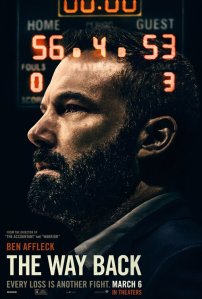 Not to be confused with 2013’s The Way Way Back, or 2010’s The Way Back about Gulag survivors, this movie entitled The Way Back is about Ben Affleck as an alcoholic basketball coach, and it’s thoroughly fine. We follow Jack (Affleck) as he tries to get his life back on track following the death of a child and the end of his marriage. His alma mater needs a new coach and the former high school basketball star might have found a job that could lead him to be a better version of himself. There’s nothing inherently bad in director Gavin O’Connor’s drama. The acting is pretty good, the docu-drama style gives it a credible sense of realism, and the movie doesn’t downplay the destructive pull of addiction. The problem is that it never feels like it goes deep enough in any aspect. I feel like I just watched a by-the-numbers sports drama attached to a by-the-numbers addiction drama. I kept waiting for more insights with the characters, but the story kept falling back on “dead child” as the explanation for everything. I kept waiting for the characters to distinguish themselves with personalities, but the team to the assistant coaches to Jack’s own ex-wife (Janina Gavankar) are left underdeveloped and more as stand-ins for approving or disapproving figures. There’s plenty of dramatic potential here and it feels like The Way Back doesn’t have the courage or nuance to keep going. I was thinking back to McFarland U.S.A. and how great that movie opened up its world, its community, its culture, getting to know the different characters and their needs, pressures, and hopes. I was absorbed by that movie and with The Way Back I was left mostly unmoved. Affleck (Justice League) is delivering a good performance that touches upon his own challenges with alcohol. He’s the reason to see the movie, but there isn’t much else to warrant your attention. It’s competently made and refrains from getting mawkish, which is something considering how easy it could given the susceptible subject matter. I was just left relatively unmoved because I was kept from emotionally connecting with these people and getting to know and care about their lives from this story. It’s no The Accountant.
Nate’s Grade: C+
Share this:

The Street Where We Live (2019)
 I was fortunate enough to actually hear co-writer/director John Whitney and co-writer/star Dino Tripodis discuss their hardscrabble indie drama, The Street Where We Live. It’s an Ohio indie that was filmed over the course of several weekends from the fall of 2015 to the summer of 2016, had its festival run throughout 2017-2018, and became available for the general public to watch via Amazon Prime in 2019. I was lucky to hear both men talk about their experiences making this movie on a small budget under a constrained time frame, as well as their hopes for it, paying homage in particular to the hard-working mothers that both men credit for their upbringing.
We follow Mary (Kristina Kopf), a recently unemployed factory worker, struggling to stop her family’s descent into greater financial ruin. Her children, Jamie (Katie Stottlemire) and Thomas (Dylan Koski), are trying to hide the shame of their living conditions, though it’s getting harder. Things go from bad to worse as this family tries to regain their stability.
 The film does a very good job of communicating the vulnerability and struggle of poverty as well as how susceptible a majority of people living on the fringes are. As has been said, many Americans are simply two paychecks away from disaster; in a survey, a majority of Americans would be unable to pay for a sudden expense of $400, meaning most Americans lack even that amount when it comes to personal savings. That day-to-day anxiety of simply getting by, of persevering and not prospering, is best expressed by the layers of sad, quiet resignation that hang on lead actress Kopf’s face. Hers is a performance steeped in quiet suffering (more on that later) and her fight for dignity and opportunity. This isn’t a very dialogue-driven movie and instead is more like one long sigh slowly eliminating all breath. One calamity leads to another in a succession of setbacks, and it’s clear to understand just how difficult it is to reset your life when that chasm seems more insurmountable by the day. You don’t have enough money to pay electricity leads to not enough money to pay for rent, leads to living in your car and washing in the bathrooms of gas stations, leads to having your car towed, leads to an impound that expects even more money if it cannot be immediately paid, and all the while that deficit grows and grows. The Street Where We Live is at its best when it’s opening up about the slippery slope of poverty and how it’s not some choice, not the result of trenchant laziness, but just bad timing, bad luck, and limited opportunities. In that way, the film works extremely well as an empathy project to convey the toll of poverty on the human condition and one’s hope.
Much like the mumblecore sub-genre of indie dramas, the observational little details and natural give-and-take are what help give the movie its sense of authenticity. This feels like a world where Whitney and his crew are well versed and can supply exacting insights. There are a few devastating moments in the movie, one of them being how out-of-touch a person can feel in a quickly changing marketplace. Mary has held her factory job for years and is applying for, what she has been told, is a simple secretarial position in an office, something she feels she can at least keep up with even if her typing skills are mediocre. Instead, she’s pummeled with questions of technical insurance jargon, and each one further shatter the idea that a “simple secretarial” job is within reach for Mary. Her sinking realization that this job is closed to her is such a hard moment to watch and Kopf, once again, plays it tragically and beautifully. It’s a small sucker punch of a moment, and from here she’s fighting even to get underpaid dish washing gigs. There are some aspects that are stretched a bit in order to maintain the family’s tragic desperation (one would think Mary wouldn’t have to venture all the way out of the state to contend for a paying job). It’s excusable because we’re meant to feel the crushing uncertainty of a character struggling with what is the best of her limited bad options. The only aspect of The Street Where We Live that didn’t feel realistic was the seconds before the factory workforce was about to find out their jobs were all gone, because I have to think everyone was suspecting the worst and wouldn’t be so amped for noisy chit-chat prior to the news.
The acting is another component that helps compliment the movie’s valued sense of reality. The Street Where We Live and its success hinges on two fulcrums: 1) its everyday realism, and 2) Kopf. The characters feel very recognizable and the performances rely on subtlety more than histrionics. More is gained by watching the pained expressions of ordinary people than listening to a character explode in a well-polished monologue about the hardships of living in poverty. There are a few emotional outbursts but they’re saved for the end, and even these moments are crafted to better maintain that well-earned sense of cinema verité.
 Much of the film’s impact is reliant upon Kopf (Constraint, Axe Giant) and the micro-expressions that cross her face. Hers is a role about suffering in silence, her weathered gaze its own shattering scream, and you study her to see how she’s coping with each new added indignity. A terrific moment is when Mary is trying to square a very personal, moral-crossing decision she made for the greater good of her family only to have a cruel man use his small amount of power to further wound. You feel how powerless this woman is and while you want her to punch the creep, there will be no release. You want the “movie moment” where she can upstage her tormentor but it won’t happen. Kopf has long been a staple of Ohio indies and there’s a very good reason why. Tripodis (Bottom Feeders) has an immediate well-worn charm that’s heartwarming. One of the best scenes in the movie is his character Ben and Mary sharing a small moment of compassion after hours of hunting for recyclables to turn in for meager money. This moment is so naturally written, with their interplay feeling relaxed, natural, and organic, that I instantly wanted more. Stottlemire (Tragedy Girls, My Friend Dahmer) has begun to branch out into bigger movies and her burgeoning talent is clear to witness. She follows Kopf’s lead and works in underplayed tones to great effect. Koski gets the least to do as Thomas, like him strumming his father’s guitar is all that is needed to communicate his longing to connect to his past. There are also small roles and cameos from other central Ohio indie faces like Ralph Scott (After), Daniel Alan Kiely (Bong of the Living Dead), Heather Caldwell (After), and Richard Napoli (After), and several others.
If there is one thing holding back the film from achieving a greater level of success and viewer engagement, it’s that the characters are defined entirely by their ongoing suffering. I call it the Lars von Trier School of Storytelling (not that it’s only associated to the Danish sadist) where you establish a character that takes the slings and arrows of their society, but this props up a protagonist as more of a symbol/metaphor/martyr than a human being. This approach can still work when given a major theme that is complex enough to take on the extra brunt of attention. However, this approach can also make the protagonist feel less active, more reactionary, and also less complex. If you were deconstructing Mary as a character, I know very little about her as a person. I know she had a job for many years. I know she lost her husband. I know she doesn’t feel comfortable asking others for help. I know she’s willing to make sacrifices for her children. Internally, I don’t know much about her, nor do I know much about her personality, interests, flaws, quirks, the things that make people more fleshed out, nuanced, and appealing. Mary certainly serves a purpose and she voices this in the film’s very last scene as Whitney unleashes his thesis statement about how our society should be better with its inherent social promises. For some, this will be a minor quibble and for others it will be, in essence, a cap for their empathy levels.
 The Street Where We Live is an affecting and honest little movie about the everyday hardships many people face when their lives are suddenly in free fall. It’s a potent drama packed with small, telling details that better create a world that feels lived-in, compassionate, and authentic. The acting is mostly sharp and anchored by a standout performance from Kristina Kopf. The technical details are pretty solid overall for a movie made for less than $13,000 and under the start-stop circumstances that the filmmakers had available. The cinematography and editing can feel like there wasn’t much in the way of additional options, but the look of the movie, muted greys and rusty browns, adds to the overall dreary tone. It’s a sparse film in execution but that’s because it doesn’t need bells and whistles and fancy camera setups to make its story felt. It’s a deeply empathetic movie that could open some hearts about the struggles of others. It’s so easy to fall down and much harder to get back up without a support system. The movie might be hitting repeated points without enhanced characterization but it still hits its marks. The Street Where We Live is the kind of movie where its small budget can actually be a plus, not just in forcing creative ingenuity from the filmmakers but also in lending a blue-collar validity. It’s a story that resonates because of its universal themes and lessons in empathy, and it’s worth watching to see what a group of well-meaning artists can do when inspired to do good.
Nate’s Grade: B
Share this:

The Photograph (2020)
 The Photograph is a romantic drama that is unfortunately tethered to three very uninteresting lead characters. They all have potential; a journalist (Lakeith Stanfield) getting closer to a story than he anticipated, a woman (Issa Rae) learning more about her artistic, ambitious, and self-involved mother (Chante Adams) after her death. The problem is that these characters all feel trapped in boxes, confined, and the personal growth onscreen is minimal. Sure, we still get the boy-meets-girl and boy-loses-girl paces expected but there’s precious little depth given to these people. It feels like writer/director Stella Meghie (Everything Everything) should be mining more insights and revelations from this mother/daughter re-examination, but by the end we haven’t learned anything we didn’t already know in the first thirty minutes. It’s a strange experience because even as things are, on paper, moving forward, the movie feels stagnant. This is also a byproduct of the nascent chemistry between Stanfield and Rae, two genial, good-looking people that just don’t have that spark or urgency when they’re comfortably close. It’s a movie that seems to stay in the same languid gear throughout the movie, even as the couple is progressively getting closer. It’s a competently made movie with good actors but my mind kept wandering and wondering what a full movie following the mother chasing her dreams might resemble, or a full movie following Lil Rel Howery (Get Out) and his adorable family, the character who entertained me the most. The story elements are here for an engaging and potent romantic drama but the mix feels undercooked and stale.
Nate’s Grade: C+
Share this:

The Assistant (2020)
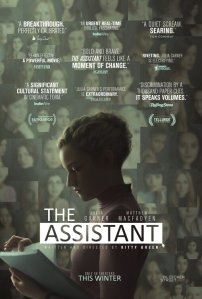 Jane (Julia Garner) is a young woman serving as an assistant to a high-profile film and TV producer, the kind of man with plenty of pull within the industry. She’s the first one into the production office and the last one out at night. Little by little, a larger picture forms of her temperamental, vindictive, and lecherous boss, especially as young women seeking to get ahead in the entertainment world as carted before him like sacrificial offerings. What will she do when the offending evidence becomes too much to ignore?
Where The Assistant lost me was in its lack or urgency with its storytelling. This is the slowest of slow burns, and it’s understandable, to a point, why this approach is the more realistic path. We’re watching the decades of inertia that make anyone standing up to harassment and abuse very difficult to find any traction or credibility. It’s much easier to just shrug it off, say “that’s just the way this awful man is,” laugh it off like some of his peers, ignore it like others, or compartmentalize, justifying your complicity as symptomatic of just how the industry works. I was waiting for the slow reveals to finally form a picture for our protagonist and push her into action, a desire to do something or say something about what she can no longer ignore or assist. The movie gets us to this point and, in its best scene, smacks her down for even seeking out this oversight. From there, the movie just becomes another repeat of what happened before, with more clues about the bad behavior of Jane’s boss, but it’s more of the same and then it just ends. I think writer/director Kitty Green (Casting JonBenet) was going for ongoing ambiguity whether or not Jane ultimately decides to leave her entry-level position or swallows her moral turpitude. However, there is a frustrating difference between an ending that is openly ambiguous and one that feels incomplete and lacking. After everything I went through, a little more definition by the end could have made the slog of work details more palatable.
 This subject is bursting with pertinent urgency and social commentary and I feel like this movie is just missing so many important things to say and do in the name of misplaced indie understatement. Understatement can be fitting as an approach to real-life dilemmas but The Assistant is understated to its unfortunate detriment, traversing from subtlety into somnolence. More time is spent establishing the mundane details of Jane’s office duties than the harassment and protection afforded to her boss. I was expecting to collect little telling details, like the male assistants’ patterned ease of composing “apology e-mails” for whatever indignation the boss feels, but we’re absent a certain momentum throughout. The first thirty minutes is packed with moments like Jane making coffee, Jane tidying an office, Jane getting food, Jane answering phones, Jane microwaving a cheap dinner. We never see her at home from the moment she leaves in the opening of the film. It’s like the movie is saying she lives at the office or must if she is to get ahead in a broken system of people using people. The people passing through are superficial to us, never more than pretty faces, or important names coming and going on the peripheral. I was feeling crushed by the obsessive details of this work routine. I expected to establish a pattern, establish a baseline, and then move from there, forcing change or at least reflection. The mundane details are meant to convey the soul-crushing nature of Jane’s job, being on the bottom of an industry she’s desperate to break into, and how un-glamorous the life of the little people can be. But she’s also a gatekeeper of sorts for the line of future victims encountering her bad boss. There’s a degree of culpability there, and it’s never fully explored because of how underplayed every moment and every scene comes across, choosing mundanity over drama. I would not begrudge any viewer if they tuned out The Assistant after the first half hour of work.
There is a noticeable feeling of dread and discomfort in the movie, but without variation or escalation it feels almost like a horror movie where we’re stuck with the person on the other wall of the action just briefly overhearing things. Imagine Rosemary’s Baby but if you were one of the neighbors just wondering what was going on. There’s an important message here and the point of view of an up-and-coming young woman as the assistant to a Harvey Weisntein-esque monster and her moral quandary of how far to ignore and how much she is willing to suffer is great. That’s a terrific, dramatically urgent starting point, and yet The Assistant is too muted and padded. There’s a remarkably thin amount of drama during these 85 minutes, with the more intriguing and disturbing action kept in the realm of innuendo and suspicion. It makes the final movie feel like the real movie is on the fringes of what we’re seeing and we just need to nudge back to the drama.
 There is one fantastic scene in The Assistant and it happens at the end of Act Two, and that’s when Jane finally seeks out the HR rep, Wilcock (Matthew Macfadyen). You sense just how much she wants to say but how much she feels the need to still be guarded, so minute by minute she tries a few more scant details, all that’s needed to limit her vulnerability and exposure. Wilcock seems like he might just take her words seriously, and then he interrupts to answer a phone call, and it’s an obnoxiously unimportant call and his behavior merges into just “one of the guys.” From there, he turns the heat on Jane, laying out her circumstantial claims and questioning what her future plans are and if this is the best course of action to see those plans through. It’s the company line sort of pressure and you feel Jane retreat within herself as soon as this potential ally becomes just another cog in a system to enable abusers. Garner (Ozark) is never better than in this scene, where the understated nature of the film, and her performance, really hits the hardest. It’s the quiet resignation and heartbreaking realization that the system is designed to protect itself. I wish the concluding twenty minutes had more of the drama that this scene points to as its direction.
The Assistant had a lot of things going for it as a queasy indie drama and it’s still well acted with searing details and a strong sense of authenticity. I feel like that authenticity, however, gets in the way of telling a more compelling and affecting story. I’m here to see the pressure, torment, and decision-making of a young woman put in an unenviable position, and what I was given was an hour of office tasks and eavesdropping. It’s got its moments but it left me wanting more.
Nate’s Grade: B-


 nathanzoebl
You must be logged in to post a comment.