Blog Archives
Big Fish (2003)
 Big Fish (2003)
Premise: Estranged son Will (Billy Crudup) travels back home in an effort to know his ailing father Edward Bloom (Albert Finney; Ewan McGregor as the younger version). Will hopes to learn the truth behind a man who spent a lifetime spinning extravagant tall tales.
Results: Despite a shaky first half, Big Fish becomes a surprisingly elegant romance matched by director Tim Burtion’s visual whimsy. McGregor’s shining big-grinned optimism is charming. Not to be confused with the similar but too mawkish Forrest Gump, Burton’s father-son meditation will have you quite choked up at its moving climax. Fair warning to those with father issues, you may want to steer clear from Big Fish. You know who you are.
Nate’s Grade: B+
Share this:

Pieces of April (2003)
 The set-up for Pieces of April, a low-budget film starring Katie Holmes, is a pastiche of familiar independent film elements so much so that it could across as parody. Holmes plays April Burns, a beleaguered teen living on her own in a grungy New York apartment. Today is Thanksgiving and her family will be stopping by for a grand Thanksgiving meal prepared by April. Her cantankerous mother (Patricia Clarkson) is ailing from breast cancer, and when she tries to think of one good memory shes had with April, she can only conjure memories belonging to younger daughter Beth (Alison Pill). She also will be introducing her family to her new boyfriend, Bobby (Derek Luke of Antoine Fisher). April has 24 hours to cook a memorable meal for her family and it could be the last Thanksgiving they spend together.
In the world of independent film, it seems like theres a whole sub-genre of movies that revolve around chaotic Thanksgiving dinners and dysfunctional families. The holiday setting, her mothers cancer, April’s spirited attempts at autonomy in the big city, interracial dating and an apartment complex full of cute oddballs all seem like tried-and-true staples of indie film.
Pieces of April was written and directed by Peter Hedges, writer of What’s Eating Gilbert Grape? and co-writer of About a Boy. His pedigree would certainly state that he knows something about family drama, and Pieces of April is a nice continuation of his observational humor. Hedges has a skilled confidence in his writing. The characters feel real and we gravitate to their vulnerability and hope. We see every sincere detail of Aprils plight to make her family proud. The choice to shoot Pieces of April on digital video adds an extra element of intimacy, like were trapped inside a home video.
Holmes gives her best performance to date. April, with patches of bright orange hair and arms enclosed with bracelets, is a sweetly vibrant character. When a neighbor asks about her relationship with her mother, April describes herself as the first pancake. She’s the one you’re supposed to throw out, another neighbor explains. Holmes’ performance is like a slow simmer of frustration, optimism and determination that wins your heart. Her more dramatic moments of helplessness and disappointment are quite affecting.
The supporting cast for Pieces of April is top-notch. Clarkson gets some weighty moments as the ailing mother, like when she runs out of the car in tears because she cant afford one more bad memory with April. She gets the showy part but enlivens every moment. Oliver Platt further feeds my theory of his quest to be in every movie ever. In Pieces of April he plays the put-upon father who frets his wife could pass any moment. Pill shines as the hyperactively cheerful and overachieving Beth. Her cherubic cheeks and glowing smile leave an indelible impression, and makes me question if her face ever got sore from excessive smiling.
Pieces of April is a pleasurable little comedy thats borderline touching. It’s not much more than a small slice of family drama, but with excellent writing and strong acting, Pieces of April distinguishes itself as more than a collection of familiar staples, and as a warm and quietly charming homespun comedy with an extra helping of heart.
Nate’s Grade: B+
Share this:

The Human Stain (2003)
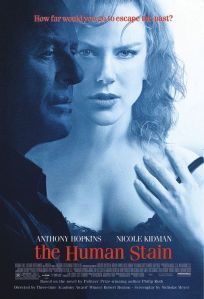 Anthony Hopkins as a black man? Nicole Kidman as a white trash janitor? And the two are LOVERS? This is a movie that is sunk by some lamebrain casting decisions. It’s one of those art pieces that yearns to be something more but just gasps for air.
Nate’s Grade: C
Share this:

Mystic River (2003)
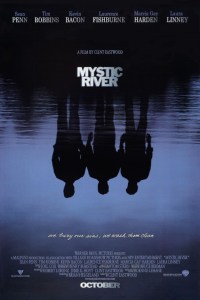 The acting is phenomenal. The story is twisting and layered with incredible amounts of depth. The direction is calm and focused. This is a great Greek tragedy and a great crime story and human drama. Eastwood scores again.
Nate’s Grade: A
Share this:

Kill Bill Vol. 1 (2003)
 Breathtaking and stylistically amazing. That’s all there is to it. Can’t wait for part two.
Nate’s Grade: A
Share this:

School of Rock (2003)
 School is now in session. Jack Black has long been a Hollywood oddity. He’s a whirlwind of manic energy but it can be accurately placed (his breakthrough in High Fidelity), or misused on hollow roles (Saving Silverman). Black is also a credited musician with his band, Tenacious D. Writer and sometime actor Mike White is a friend of Black’s and said he wrote the lead in School of Rock specifically for him. Will Black measure up with his first lead role, or will he be held back?
Jack Black plays Dewey Finn, a thirty-something lead guitarist who takes rambling guitar solos and crowd surfs even when theres no one to catch him. His band mates fire Dewey from the group for his outlandish behavior. Dewey’s roommate (Mike White), and especially his harpy girlfriend (Sarah Silverman, generally wasted here) urge him to find a job and start pulling his weight. A call comes in for Dewey’s roommate to substitute teach at a prep school. Dewey poses as his pal and enters the ranks of academia. When he finds out that his class plays instruments he organizes them into a band as a class project. When someone questions what they’re learning, Dewey shouts that they’re learning rock ‘n roll, which he says, ”Will test your head, and your mind, and your brain too.”
 Black has showed scene-stealing ability in other films, but School of Rock gives Black the role he was born to play. His character isn’t some high-minded jerk that learns the errors of his ways by having his rough exterior melted by the compassion of children. Heck no. Black’s character remains rocks willing soldier from beginning to end, but School of Rock gives him the chance to share his passion and instill it in the youth. Black’s circus of eye bulging, energetic gyrations, and infectious excitement make a vibrant lead that can make us laugh at a moment’s notice. It’s a marvelous performance full of rock bliss.
Non-professional actors play the prep school kids that populate School of Rock. They smartly decided to have the kids played by real musical prodigies, so when they get jamming thats real ten-year-olds and eleven-year-olds putting people to shame with their musical ability.
The film isn’t anything new exactly. Its story is somewhat familiar, but it’s got an attitude all its own. School of Rock uses familiar elements and comforts the viewer, but its madcap energy, touching moments of heart, and ambitious belief that music can change lives will leave the viewer smiling from beginning to end. There wasn’t a second I wasn’t smiling or laughing while watching School of Rock.
School of Rock is a joyous movie that excels with sweetness. Lets just get down to it and say the flick is monstrously funny, heartwarming, inspired, charming, entertaining and certifiably rockin’ enough to blow you and your neighbors socks off. Dont be fooled by the PG-13 label (which I’m still scratching my head over), because School of Rock is the perfect film for families of all ages. Its got a genuine tenderness most comedies lack, and it also has a consistently cheery sense of humor that never resorts to inane gross-out gags like so many current comedies. This is one to take the kids and grandma too.
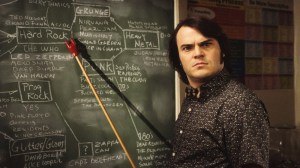 In lesser hands this film could have been a disaster. The kids would come off as cloying, Blacks character would come off as a crude loaf, Joan Cusack’s (a wonderful performance, by the way) principal character would just be an uptight bitch, and the familiar story would seem syrupy, like a Dead Poets Society with guitars instead of suicide. Under the smooth direction of Richard Linklater (Dazed and Confused, Waking Life), one of the stalwarts of the 90s independent film renaissance, School of Rock strikes the right balance between warmth and Blacks uncaged craziness. Linklater has taken his indie sensibilities and assuredly given the film a heart that beats to the rhythm of rock n roll, that also never falters into sticky sentimentality.
School of Rock is an exuberant comedy, sharply written, with confident direction, cute kids, and the dynamic performance of Black. The movie will appeal to families, fans of Black, and people tired of feel-good formula films or those looking for a feel-good film. School of Rock will lift up your spirits and make you want to dance in your seat. I raise my goblet of rock and salute you, makers of School of Rock, for the greatest 108 minutes of fun I’ve had this year.
Nate’s Grade: A
Share this:

The Magdalene Sisters (2003)
 There’s a certain genre of films as well-defined as say, the Western, Film Noir, or even Romantic Comedies. The genre Im speaking of is I-can’t-believe-that-happened cinema. This is a genre made up of little-known true stories where people with power abuse those below them. These include films like Rosewood, Rabbit Proof Fence, Matewan, Mississippi Burning, and just about every movie with a Holocaust setting. These films are intended to antagonize the audience and to get them to ask, How could something like this happen? The Magdalene Sisters is a film that an audience will walk away with very much wondering how something so cruel, amoral, and heartless could carry on in our modern world.
In 1960s Ireland, the Catholic Church was life. The Magdalene Sisters sheds light on the little known work asylums, which were institutions set up to help girls who had transgressed against God. The girls admitted to the asylum, a kind of extreme reform school, are there to work away their sins and reach forgiveness, thus saving their immortal souls. Rose (Dorothy Duffy) had a child out of wedlock. Bernadette (Nora-Jane Noone) was caught by school officials for being too pretty and tempting teen boys. But perhaps the most startling admission is Margaret (Anne-Marie Duff), admitted to the asylum by her own father for the grievous sin of being raped by a cousin. The Magdalene Sisterhood asylum is run by Sister Bridget (Geraldine McEwan), an old nun who subscribes to the cruel to be kind theory in spades. The girls at the asylum toil tirelessly in sweatshop conditions, are physically abused by the nuns, sexually abused by the asylums priest and are left hopeless of escaping. Girls who run away are turned back in by their parents or cooperative police. Some of the women at Magdalene have been there for their entire lives. It seems the only ways out are death or joining the convent. Get thee to a nunnery indeed.
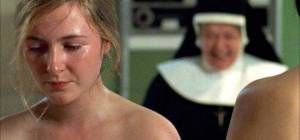
 The Magdalene Sisters is full of sadistic moments that will shock an audience. One of the most disturbing scenes transpires late into the film. The girls of the asylum line up completely nude, shivering and crying. Two nuns, with a nauseating smugness, chortle and play a game seeing who has the largest breasts and the smallest nipples, among other things. When the winner of this sick experiment stands forward and clenches her teeth from crying so hard, one of the nuns asks, ”What are you crying for? It’s just a game.”
The young ladies at the films core deliver magnificent performances tinged with honest emotional devastation. Noone is the standout as Bernadette. She utilizes steely rebellious gazes that speak volumes about her characters resourcefulness. Noone can convey more poignant emotion in the raising of an eyebrow or the biting of her thumb than most starlets can ever hope to express.
McEwan is terrifying as the head nun and head source of torment. Her grandmotherly voice, tinted with an Irish brogue, is enough to send shivers down your spine. She is surely 2003’s greatest movie villain, next to Johnny Depp in Once Upon a Time in Mexico.
Writer/director Peter Mullan keeps the suffering at an almost unbearable level but allows the spark of human resistance to keep us going. His film is one brimming with anger and disbelief; ensuring the audience will experience that same burning anger before the credits roll. Mullan’s passionate story can be deemed one-sided, but then again, what exactly is the other side going to say about the abuse of innocent girls for life-long slave labor? Not much I suspect.
 The Magdalene Sisters is a somber, unflinching look at the abuses of the church as well as the upward battle for equality women faced. This film is tough to sit through. It might be too much for some, especially if they don’t have a strong relationship with the Catholic church to begin with. The decades of abuse The Magdalene Sisters sheds light on is incredible, but it’s also a beginning for healing. Before we can overcome atrocities we must acknowledge them, and this is something I’m sure Mullan is arguing that the Church is failing to do. In fact, the Catholic church has denounced The Magdalene Sisters for its portrayal of church abuses. Something tells me Mullan is not surprised.
Not only is The Magdalene Sisters an eye-opener, it’s also great cinema. The characters, pacing, realistic sharp-eyed direction, and superb acting render it more than just a snuff film. This film is more than watching people mistreated and suffer; this is a film about perseverance and resolve. It’s about the enduring human spirit. I’ll gladly (well, not gladly) watch sequences of misery in order to see human triumph. This isn’t just a sad story, it’s exceptionally well told and acted and it bathes you in the pain of its characters. You feel their heartbreak and tragedy, but you also feel their victory.
The Magdalene Sisters is, without a doubt, the must-see feel-bad movie of this year. Now, there will be plenty out there saying, Why should I pay to see a movie that will make me feel bad? This is my defense: because the movie is so good at having its fears, tortures, and ultimate triumphs resonate that it makes you authentically feel something. And isn’t this the purpose of art, to feel something? The Magdalene Sisters is unflinching, passionately powerful and unforgettable. Just one more item to get your blood boiling: the last of these Sisterhood work asylum closed in 1996.
Nate’s Grade: A
Share this:

Secondhand Lions (2003)
 Walter (Haley Joel Osment) is being shipped off by his absent-minded mother (Kyra Sedgwick) to spend the summer with his two great uncles (Michael Caine and Robert Duvall). His mother is secretly hoping that Walter will cozy up to his eccentric relatives because of rumors that they have stockpiled millions of dollars. She sends Walter off with a mission to find the location of that money. Walter is a weenie, and Caine and Duvall are mans men that can still show them cocksure youngins a thing or two. The summer passes and Walter learns more than he could have ever known about his uncles and their supposedly amazing lives.
Caine and Duvall, two of the best actors we have, are wasted with material that pushes them into grizzled ole curmudgeons that inevitably soften up. Duvall plays the same rough and tumble character he plays in so many better movies, and Caine just seems like hes bored. Osment loses some cuteness as he hits puberty. He still has the face of a teddy bear (really look sometime) but Im sure hell rebound and it’ll only be a matter of time before he’s dating one of the Olsen twins. Wow, this is weird for me to write about.
The film feels like its in the hands of a novice with no confidence. The director (whose only other experience was a film called, [Dancer,Texas Pop. 81) doesn’t seem to know of anything reaching subtlety. The storyline with Osment’s flighty mother is just painful to watch. She’s an embarrassment of a character. Scenes are awkwardly framed and there are way too many fun montages of Caine and Duvall shooting things endlessly. I don’t know about your movie lore, but when I see old men firing at people from their porch, this doesn’t register as crazy yet lovable old timer but only as crazy. The entire lion subplot is just silly. The film even gets worse as it spins into a fantastical epilogue that stretches the bounds of reality. You’ll know it when the helicopter touches down.
 Some elements of Secondhand Lions work despite themselves. Theres an ongoing subplot where Caine spins a great yarn about him and Duvall’s adventures as young men in the French Foreign Legion. We cut to some B-movie inserts that provide some fun, despite a preponderance of sword swinging violence that may question the family label people are too freely applying to Secondhand Lions. Watching this tall tale was far more entertaining than the reality Secondhand Lions[ was trying to dish. I kept wanting the film to somehow invert, and then this film would be the B-movie adventures where some person is telling a story about a whiny kid who gets an old lion and learns a thing or two about life and being a man from his two crazy uncles. Do you see what Im getting at.
Secondhand Lions is an overly sentimental Hallmark card of a movie. I dont think I’ve yawned this much during a movie in a long time. Secondhand Lions is an uninspired trick pony trying to appear like a wise coming of age nostalgic tale. Instead, the entire film feels secondhand. Beware, contents may have shifted upon delivery. Mark this box return to sender. Okay, I’m done with the postal puns.
Nate’s Grade: C
Share this:

Luther (2003)
 Certain things can pass under my radar. Previously it’s been items like female flirtation and the due dates of papers. So imagine my befuddled surprise when last weekend my father, himself a Lutheran minister, said the family was going to hop on over to the movie theater and catch a historic bio-flick about Martin Luther, plainly titled Luther. I had no idea this movie existed. And after seeing it, it left no strong memory that it did.
Luther (Joseph Fiennes, Shakespeare in Love) is a 16th century German monk with some quibbles with the Catholic Church. Seems Luther doesn’t like how the Church is preying upon people’s faith for money, most notably its chief indulgence seller Johann Tetzel (Alfred Molina, with a criminally scant appearance). He makes up a list of 95 grievances, nails them to the doors of a church, and thus Protestantism is born. Luther’s ideas catch on wit the lower classes through rampant publication, thanks to the newfound printing press. The princes of the German states also like what this monk is cooking, and they decide to hold him in safety. The Catholic Church, however, is none too pleased. They threaten excommunication and eventually death, and keep pushing for Luther to recant. But Luther feels he must stand strong in his convictions.
The acting is fine, and the direction is passable, but the pacing of Luther is like tracking the movement of a glacier. Some representative decisions are also fairly stupid. To try and communicate Luthers internal struggle he hits his head and yells like at voices. The first time it’s funny. The next five times, it’s dumb. There’s also a dirty peasant child who’s crippled but still a big fan of the Luther Man. Her gaping tooth smile has more screen time than some characters. Later in the film the peasant revolts ravage through the country with thousands massacred. Luther visits the ruins and comes across the little girl’s broken crutch and breaks down and cries. If you were in my theater you probably heard me hitting my forehead repeatedly (no voices though).
The film is an admirable effort, but Luther ultimately fails because of the measures of film. To try and tell the story of Luther would be more appropriate for the confines of a miniseries, not a two-hour movie. The Reformation and its players lose its impact in such a shrift retelling. What the audience gets is a pared Cliff notes version that misses the richness, and gives lip service to the historical importance. What were left with are endless scenes where people dress up and talk and talk and talk. Without a sense of weight for character or story, the countless talky moments blur into tedium. If I had a sleeping bag with me I would have curled up into it.
Another problem is the lack of makeup. The film spans thirty-some years and yet Fiennes doesn’t age a day. My mother proposed that maybe he didn’t want to look old and decrepit in the film. I responded by saying, He let them shave his head but he didn’t want anybody to splash some gray in his hair?
I guess if you judge movies on costumes or production values, Luther would be competent. But does anyone go to a film saying, ”Man, I sure hope those costumes and sets are incredible! Fingers crossed!?” Luther is a well-meaning bore that only historical enthusiasts and Lutherans might enjoy.
Nate’s Grade: C
Share this:

Lost in Translation (2003)
 Sophia Coppola probably has had one of the most infamous beginnings in showbiz. Her father, Francis Ford, is one of the most famous directors of our times. He was getting ready to film Godfather Part III when Winona Ryder dropped out weeks before filming. Sophia Coppola, just at the age of 18, stepped into the role of Michael Corleone’s daughter. The level of scathing reviews Coppolas acting received is something perhaps only Tom Green and Britney Spears can relate to. Coppola never really acted again. Instead she married Spike Jonze (Being John Malkovich) and adapted and directed the acclaimed indie flick, The Virgin Suicides. So now Coppola is back again with Lost in Translation, and if this is the kind of rewards reaped by bad reviews early in your career, then I’m circling the 2008 Oscar date for Britney.
Bob Harris (Bill Murray) is a washed up actor visiting Tokyo to film some well-paying whiskey commercials. Bob’s long marriage is fading and he feels the pains of loneliness dig its claws into his soul. Bob finds a kindred spirit in Charlotte (Scarlet Johansson), a young newlywed who has followed her photographer husband (Giovanni Ribisi) to Japan and is second-guessing herself and her marriage. The two strike up a friendship of resistance as strangers in a strange land. They run around the big city and share enough adventures to leave an indelible impression on each other’s life.
 Lost in Translation is, simply put, a marvelously beautiful film. The emphasis for Coppola is less on a rigidly structured story and more on a consistently lovely mood of melancholy. There are many scenes of potent visual power, nuance of absence, that the viewer is left aching like the moments after a long, cleansing cry. There are certain images (like Johansson or Murray staring out at the impersonal glittering Tokyo) and certain scenes (like the final, tearful hug between the leads) that I will never forget. Its one thing when a film opens on the quiet image of a womans derriere in pink panties and just holds onto it. It’s quite another thing to do it and not draw laughs from an audience.
Murray is outstanding and heartbreaking. Had he not finally gotten the recognition he deserved with last year’s Oscar nomination I would have raged for a recounting of hanging chads. Murray has long been one of our most gifted funnymen, but later in his career he has been turning in soulful and stirring performances playing lonely men. When Murray sings Roxy Music’s “More Than This” to Johansson during a wild night out at a karaoke bar, the words penetrate you and symbolize the leads’ evolving relationship.
Johansson (Ghost World) herself is proving to be an acting revelation. It is the understatement of her words, the presence of a mature intelligence, and the totality of her wistful staring that nail the emotion of Charlotte. Never does the character falter into a Lolita-esque vibe. Shes a lonely soul and finds a beautiful match in Murray.
 Lost in Translation is an epic exploration of connection, and the quintessential film that perfectly frames those inescapable moments of life where we come into contact with people who shape our lives by their short stays. This is a reserved love story where the most tender of actions are moments like Murray carrying a sleeping Johansson to her room, tucking her in, then locking the door behind. The comedy of disconnect is delightful, like when Murray receives incomprehensible direction at a photo shoot. The score by Jean-Benoît Dunckel, front man of the French duo Air, is ambient and wraps around you like a warm blanket. The cinematography is also an amazing experience to behold, especially the many shots of the vast glittering life of Tokyo and, equally, its strange emptiness.
Everything works so well in Lost in Translation, from the bravura acting, to the stirring story, to the confident direction, that the viewer will be caught up in its lovely swirl. The film ends up becoming a humanistic love letter to what brings us together and what shapes how we are as people. Coppola’s film is bursting with such sharply insightful, quietly touching moments, that the viewer is overwhelmed at seeing such a remarkably mature and honest movie. The enjoyment of Lost in Translation lies in the understanding the audience can feel with the characters and their plight for connection and human warmth. A work of art like this sure doesn’t come around every day.
Writer/director Sophia Coppola’s come a long way from being Winona Ryder’s last-second replacement, and if Lost in Translation, arguably the best film of 2003, is any indication, hopefully well see even more brilliance yet to come. This is not going to be a film for everyone. A common argument from detractors is that Lost in Translation is a film lost without a plot. I’ve had just as many friends call this movie “boring and pointless” as I’ve had friends call it “brilliant and touching.” The right audience to enjoy Lost in Translation would be people who have some patience and are willing to immerse themselves in the nuances of character and silence.
Nate’s Grade: A


You must be logged in to post a comment.