Blog Archives
Taking Lives (2004)
 While viewing Taking Lives my mind wandered quite a bit. There was one point where I actually gave credence to a theory that Taking Lives was so intensely bland that is was parodying the glut of serial killer films. Then I just concluded that the movie was dumb. Angelina Jolie plays one of those hard-as-nails criminal investigators who just happen to be drop dead gorgeous. She’s on the hunt for a Canadian serial killer who murders then assumes the lives of his victims. He’s been doing this for over 20 years. My main question is … how? Taking someones identity has so many variables to it. What if any family member found you? Theyd know for sure you wouldn’t be their loved one. Oh yes, and the killer masks the identity of his victims by cutting off their hands and smashing their faces in. Would that even work? All you have to do is draw some blood and do a DNA test. Taking Lives is so by-the-book that it even dares to have a scene where the serial killer calls Jolie and claims that he and her are exactly alike. The ending veers so far off track into the land of implausibility that its almost entertaining. Almost. The only reason to even poke your head in a theater to see this is for a gratuitous nude scene involving Jolie, and even that you’ve seen before in better movies.
Nate’s Grade: C-
Share this:

Hidalgo (2004)
 It is important to talk about Hidalgo being marketed as a “true story.” As a general rule, it’s good to be wary of movies that are heavily pushed as being “true stories” or “based on true events.” You have to pay close attention to the wording. Last fall, The Texas Chainsaw Massacre remake was heavily marketed as a film “inspired by true events.” Which means it’s about as real as your dreams are. With this said, Hidalgo is based on the real Frank Hopkins and his stories about his life. Oh yeah, it just so happens that Hopkins is also a pathological liar and none of this is real. So, what the marketing of Hidalgo should really say is something like “based on the true story of what we heard from a pathological liar.” Something like that.
In fact, if you do some minor research, you’ll discover that the only thing true is that there was a guy named Frank Hopkins. He wasn’t part Native American, a Pony Express employee, a member of Wild Bill’s Circus, and he never had a horse named Hidalgo AND there has never been any 3,000-mile race in the Arabian desert. Yet Disneys marketing department still goes with “based on a true story.” I’ll remember that next time I have a dream involving little people and ice cream.
 Hidalgo is the “story” of Frank Hopkins (Viggo Mortensen), a former Pony Express employee who’s turned to the bottle to try to forget the slaughtering of Native Americans (exactly like Tom Cruise in Last Samurai). Hopkins enters a legendary 3,000-mile race across the Arabian desert to regain his spirit. The race, across the “Ocean of Fire,” is dangerous, the elements are brutal, and the other riders will stop at nothing to win. Can the American cowboy who no one believes in triumph in the end?
Taking a hard look at Hidalgo, roughly 50 percent of the finished movie is watching Hopkins travel from Point A (usually on the left) to Point B (usually on the right). So, yes, half of this movie is watching someone walk one direction. I can’t imagine what the editing process was like. How do you know exactly where one shot of Hopkins walking should go? Sure, Lawrence of Arabia had a lot of walking in the desert from left to right, but it was also 4 hours long! Both films do star Omar Sharif, though.
25 percent of what is left involves people sitting around talking about all kinds of clichés, like pining for acceptance, independence, equality, etc. These sequences tend to bog down Hidalgo‘s narrative and bring the action to a halt. I realize that these “sit down” scenes are meant to be breathers and expand the characters. However, the characters don’t deepen because they are amidst a patchwork of clichés instead of a story. The actors are also saddled with some laughably awful dialogue, like, “There is a tempest in my tent,” or the greatest groaner of them all, “Even a blind man could see you’re beautiful.”
So, continuing numbers crunching, an audience is left with 25 percent of a movie, and what is that 25 percent? In short, the rest. Hidalgo does have some lively action sequences and exciting horse races but these bursts of fun are much too far apart. When getting down to it, Hidalgo is 25 percent an interesting movie. Now, whether 25 percent of entertainment is enough for someone depends on how hard-fought they are for amusement.
The thing Hidalgo has going for it is Viggo’s star power. He is a handsome guy and has a smoldering presence but he whispers more lines than any actor I know. Maybe he threw out his voice after three of years of yelling with The Lord of the Rings.
 There are just some wondrously odd moments in Hidalgo. When Hopkins gets to the Arabian desert he notices a group of chained black people walking beside him. “Never seen slaves before?” a rider asks Hopkins. Then we cut away. What was that? The movie gives a shoulder shrug to slavery and then moves on. Later the slave kid becomes part of Hopkins’ pit crew, which also includes a wily old goat farmer. What? I have no idea how this kid became like Hopkins’ servant, and I have no idea why he’d be so happy about it. This part of the movie leaves me stumped, especially for a film where a character is so forward thinking about tolerating other races (as the protagonists always are in movies now). By the time you get to a laugh-out-loud sequence where Hopkins is on his knees chanting Native American chants, and the wavy ghosts of his brethren encircle him, you may have already checked out of the building.
Some of the blame must be heaped upon director Joe Johnston (Jumanji). His pacing is quite slack (136 minutes) and yet he stuffs more subplots and minor characters than the narrative seems able to handle. A very long subplot involving a kidnapped princess is a nice diversion, but entirely inorganic and almost to a distracting level of fantasy. Johnston also employs some hatchet CGI work that seems like it was left over from The Mummy movies. It does not speak well to the quality of a film when it’s been on the shelf for close to a year. The surprise antagonist who kidnaps, kills, and does whatever to win the race has no repercussions at the end. They lose. That’s it. Hopkins doesn’t even find out the person is a villain. What’s up with that? There’s no comeuppance
Hidalgo is not a bad film, but it’s not exactly a good film either. It’s cliché-ridden, clumsily plotted, and full of bad dialogue and stiff characters. The movie looks good, and the horses are beautiful, but this is one tale to put out to pasture. Those hungry for a grand adventure with a hunky lead may be partially pleased, but that’s only if they can put up with 25 percent of an entertaining movie.
Nate’s Grade: C+
Share this:

The Passion of the Christ (2004)
 The Passion of the Christ is a retelling of the last 12 hours of Jesus Christ’s life (perhaps you’ve heard of him?). In these final hours we witness his betrayal at the hands of Judas, his trial by Jewish leaders, his sentencing by Pontius Pilate, his subsequent whippings and torture and finally his crucifixion. Throughout the film Jesus is tempted by Satan, who is pictured as a pasty figure in a black hood (kind of resembling Jeremy Irons from The Time Machine if anyone can remember). The Passion spares no expense to stage the most authentic portrayal of what Jesus of Nazareth endured in his final 12 hours of life.
For all the hullabaloo about being the most controversial film in years (and forgive me for even using the term “hullabaloo”), I can’t help but feel a smidgen of disappointment about the final product. The Passion is aptly passionate and full of striking images, beautiful photography and production values, and stirring performances all set to a rousing score. But what makes The Passion disappointing to me is the characters. You see, Mel Gibson’s epic does not devote any time to fleshing out the central characters. They are merely ciphers and the audience is expected to plug their feelings and opinions into these walking, bleeding symbols to give them life. Now, you could argue this is what religion is all about, but as far as a movie’s story goes it is weak. The Passion turns into a well-meaning and slick spectacle where character is not an issue. And as a spectacle The Passion is first-rate; the production is amazing and the violence is graphic and gasp-inducing. Do I think the majority of people will leave the theater moved and satisfied? Yes I do. But I can’t stop this nagging concern that The Passion was devoid of character and tried covering it up with enough violence to possibly twist its message into a Sunday school snuff film.
 For my money, the best Biblical film is Martin Scorsese’s 1987 The Last Temptation of Christ (also a film mired in controversy). Last Temptation, unlike Gibson’s spectacle, was all about Jesus as a character and not simply as a physical martyr. Scorsese’s film dealt with a Christ consumed by doubt and fear and the frailties of being human. But the best part is the final 20 minutes when Jesus is tempted, by Satan, to step down from the cross and live out a normal life. Jesus walks away from the cross, marries Mary Magdalene, fathers children (this is where the controversy stemmed from but they were married) and dies at an old age. Jesus is then confronted by his aging apostles who chastise him for not living up to what he was supposed to do to save mankind. Jesus wakes up from the illusion and fulfills his mission and dies on the cross. Now, with the story of Last Temptation an audience has a greater appreciation for the sacrifice of Jesus because they witness his fears and they witness the normal life he forgoes to die for man’s sins. There is a sense of gravity about what Jesus is sacrificing.
With The Passion Gibson figures if he can build a sense of grand sacrifice by gruesomely portraying the tortures Jesus endured. Even if it is Jesus, and this may sound blasphemous, torturing a character to create sympathy and likeability is the weakest writing trick you can do. Yes Jesus suffered a lot, yes we should all be horrified and grateful, and yes people will likely be moved at the unrelenting violence he endured, but in regards to telling a story, I cannot feel as much for characters whose only characterization is their suffering. Sure, The Passion flashes back to some happier moments of Jesus’ life, which I like to call the Jesus Greatest Hits collection, but the movie does not show us who Jesus was, what he felt (beyond agonizing pain) or the turmoil he went through in finally deciding to give up his own life for people that despised him. The Passion is not about character but about spectacle.
So let’s talk about the violence now, shall we? Gibson’s camera lovingly lingers on the gut-churning, harrowing, merciless level of violence. But this is his only message. It’s like Gibson is standing behind the camera and saying to the audience, “You see what Jesus suffered? Do you feel bad now? FLAY HIM MORE! How about now?” What was only three sentences of description in the Gospels takes up ten minutes of flogging screen time. Mad Mel has the urge to scourge. After an insane amount of time spent watching Jesus get flayed and beaten the violence starts to not just kill whatever spiritual message Gibson may have had in mind, but the violence becomes the message. The Passion does give an audience a fair understanding of the physical torture Jesus was subjected to, but the movie does not display Christ as fully human, enjoying life and love, or fully divine. The only thing The Passion shows us about Jesus is that the son of God sure knew how to take a whuppin’. For Gibson, the violence is the message and the point is to witness what Jesus endured. Some would call that sadistic.
 The actors all do a fine job and it’s impressive that everyones’ lines is in two dead languages (Latin and Aramaic, though for the life of me I can’t tell them apart). But the acting is limited because of the nature of the film. Had there been more moments of character the acting would come across better. As it stands, the acting in The Passion is relegated to looks of aguish or looks of horror, interspersed with weeping. Monica Bellucci (The Matrix sequels) really has nothing to do as Mary Magdalene but run around in the background a lot. Jim Caviezel (Frequency, Angel Eyes) gives everything he has in the mighty big shoes he tries to fill. It’s too bad that his Jesus spends most of the screen time being beaten, which kind of hampers his acting range.
Now let’s address the anti-Semitic concerns. Let’s face facts; you are not going to have a film about the crucifixion of Jesus and have some Jews coming off in a good light. Just as you would not have a film about the Holocaust and have some Germans coming off in a good light. It is unavoidable. The Passion does portray a handful of Jewish religious leaders as instigators for Jesus’ eventual crucifixion, but there are also Jewish leaders who denounce their actions and just as many people bemoaning the torture of Jesus as there are calling for it. Who really comes off looking bad are the Romans. Excluding the efforts to make Pilate look apprehensive, the Roman soldiers are always seen kicking, punching, whipping, spitting on Jesus and laughing manically with their yellow teeth. How anyone could watch The Passion and come away anti-Semitic and not anti-Italian is beyond me.
And like I said before, most people will be extremely satisfied with the film because it’s hard to find a person who doesn’t have an opinion on Jesus. Gibson is counting on audiences to walk in and fill in the holes of the character so that The Passion is more affecting. Gibson’s film is worthy spectacle, and despite the vacuum of character I did get choked up four separate times, mostly involving Jesus and his mother. The Passion is a well-made and well-intentioned film that will hit the right notes for many. I just wish there were more to it than spectacle. I really do.
Nate’s Grade: C
Share this:

The Butterfly Effect (2004)
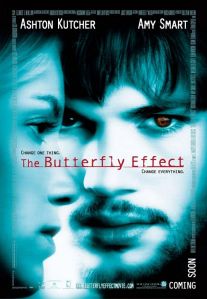 Notice: I found Ashton Kutcher, star of The Butterfly Effect, on a trip to buy dog food, and cordially asked him to write a review. This is what he sent me. It’s totally him. I wouldn’t make this stuff up. That would be dumb.
“So, like, this Nate guy asked me to do a review of my new awesomest movie, The Butterfly Effect. Dude, like anyone needs a review for the most awesomest movie ever. I mean, like, the term awesomest movie ever should say, like, everything. The only thing possibly more awesome than The Butterfly Effect would be trucker hats … or two chicks totally making out. And I only said possibly more awesome, which doesn’t mean it is more awesome, because, dude, like I said before, The Butterfly Effect is the most awesomest thing ever. You cant dispute that. Dont even try. Im awesome!
Like, the story goes like this, man. I play this guy, like I know big stretch there, but he’s not the most awesome guy ever, which is what you’d be thinking since its the most awesomest movie ever. But no, he’s like this kid who blacks out and has this wickedly twisted childhood where he stars in his neighbors kiddie porn, has his dog set on fire, and, like, his dad is all crazy, or, like I like to say, insane in the ole membrane. Ha, I totally made that up right now. I’m awesome!
So, you’re like saying, ’Dude, that movie sounds less than awesome. Yes, sir, I am having definite doubts about the awesomeness of this movie. Like, do I need to go to the movies to, like, feel bad? I got my parents to do that for me. That and school.’ Hey man, I’m there, I know what you feel. Cause right when you are like, “‘Dude, when is Demi gonna show up playing his mom?’ I find these old journals of mine and, dude, use them to travel back in time. I know, the awesomeness has returned. And I use the journals to go back and try and punk time, man. I try and make things better and change the future but I like totally just make it worse. I know, double punkd, man! I try and fix the life of this hot girl in the movie (she showed her boobs in that Road Trip movie, did you see that? That part where she shows her boobs, oh man … It is awesome) but things don’t work out. Like she becomes a crack ho at one point. Dude, total punkd. I’m awesome!
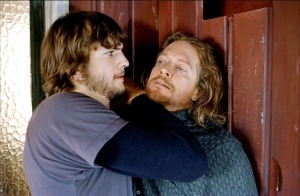 I should be taken as a serious actor. I didn’t hit my head on something and I grew a beard, what more do people need to know I got the goods? I mean, I don’t want to keep saying it but …
beard. C’mon! When actors want to be taken seriously they, like, grow beards. That’s why all those people in movies before 1970 (I know, it surprised me too that there were older movies) got awards and stuff. Beards, dude. Beards. When Billy Dee Shakespeare, like, invented acting, he totally imagined dudes, and chicks too, with beards. Thats why girls cant be taken as serious actors, cause they cant grow beards. But dude, don’t tell that to Demi, because she totally has one wicked ferocious beard, if you know what I mean. Ha. I’m awesome!
I should be taken as a serious actor. I didn’t hit my head on something and I grew a beard, what more do people need to know I got the goods? I mean, I don’t want to keep saying it but …
beard. C’mon! When actors want to be taken seriously they, like, grow beards. That’s why all those people in movies before 1970 (I know, it surprised me too that there were older movies) got awards and stuff. Beards, dude. Beards. When Billy Dee Shakespeare, like, invented acting, he totally imagined dudes, and chicks too, with beards. Thats why girls cant be taken as serious actors, cause they cant grow beards. But dude, don’t tell that to Demi, because she totally has one wicked ferocious beard, if you know what I mean. Ha. I’m awesome!
So, like, if you ever wondered what it would be like to see me, Ashton Kutcher, the most awesome man alive who ever lived, no the most awesome human being -the most awesome thing - ever, as a frat boy, or like, some poor dude with no arms, then you should see my new movie, The Butterfly Effect. After all, it is the most awesomest thing ever. That’s awesome. So, like, you people reading (is that what school is for?) should go see my movie. Ill tell you why in two words: beard.”
Nate’s Grade: C+
Share this:

Monster (2003)
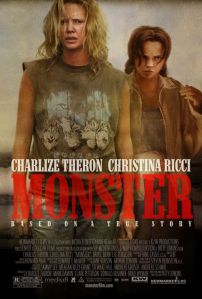 Monster follows the life of Aileen Wuornos (Charlize Theron, now nominated for a Best Actress Oscar), Americas only known female serial killer. In the late 1980s, Wueros was a roadside prostitute flexing her muscles with Florida motorists. She describes hookin’ as the only things shes ever been good at. One day Wuornos has the full intention of taking her own life, but she meets 18-year-old Selby (Christina Ricci) at a lesbian bar and finds a companion. Driven by a growing hatred of men from sexual abuse, Wuorno’s starts killing her johns to try and establish a comfortable life for her and Selby.
Let’s not mince words; Theron gives one of the best performances I have ever seen in my life. Yes, that’s right. One of. The. Best. Performances. Ever. This is no exaggeration. I’m not just throwing out niceties. Theron is completely unrecognizable under a mass of facial prosthetics, 30 extra pounds, fake teeth and a total lack of eyebrows. But this is more than a hollow ploy to attract serious attention to the acting of a pretty face. Theron does more than simple imitation; she fully inhabits the skin of Aileen Wuornos. The closest comparison I can think of is Val Kilmer playing Jim Morrison in The Doors.
Theron is commanding, brave, distressing, ferocious, terrifying, brutal, stirring, mesmerizing and always captivating. It may be a cliché, but you really cannot take your eyes off of her. Her performance is that amazing. To say that Theron in Monster is an acting revelation is perhaps the understatement of the year.
With previous acting roles in Reindeer Games and The Cider House Rules, Theron is usually delegated to pretty girlfriend roles (who occasionally shows her breasts). Who in the world thought she had this kind of acting capability? I certainly did not. If Nicole Kidman can win an Oscar for putting on a fake nose and a so-so performance, surely Theron should win an Oscar for her absolute transformation of character and giving the performance of a lifetime.
With this being said, and most likely over said, Monster is by no means a perfect film. Minus the terrific central performance, Monster is more of an everyday profile of a grotesque personality. The film weakly tries to portray Wuornos more as a victim, but by the end of the film, and six murdered men later, sympathy is eradicated as Wuornos transforms into the titular monster. Some supporting characters, like Ricci’s narrow-minded Christian up bringers, are flat characters bordering on parody. The supporting characters are generally underwritten, especially the male roles that serve as mere cameos in a film dominated by Sapphic love.
Monster is proof positive that human beings will never be phased out by advancing machinery when it comes to acting. Monster boasts one of the greatest acting achievements in recent cinematic history, but it also coasts on sharp cinematography and a moody and ambient score by BT (Go). Monster is a haunting film that you wont want to blink for fear of taking your eyes off of Theron. She gives an unforgettable tour de force performance that will become legendary.
Nate’s Grade: B
Share this:

Cold Mountain (2003)

Cold Mountain (2003)
Premise: At the end of the Civil War, Inman (Jude Law, scruffy) deserts the Confederate lines to journey back home to Ada (Nicole Kidman), the love of his life he’s spent a combined 10 minutes with.
Results: Terribly uneven, Cold Mountain‘s drama is shackled by a love story that doesn’t register the faintest of heartbeats. Kidman is wildly miscast, as she was in The Human Stain, and her beauty betrays her character. She also can’t really do a Southern accent to save her life (I’m starting to believe the only accent she can do is faux British). Law’s ever-changing beard is even more interesting than her prissy character. Renee Zellweger, as a no-nonsense Ma Clampett get-your-hands-dirty type, is a breath of fresh air in an overly stuffy film; however, her acting is quite transparent in an, “Aw sucks, give me one ‘dem Oscars, ya”ll'” way.
Nate’’s Grade: C
Share this:

The Last Samurai (2003)
 The Last Samurai (2003)
Premise: Alcoholic Civil War vet (Tom Cruise) is hired by the Japanese emperor to modernize his army. After being captured by samurai, he finds solace and fights alongside his former enemy against the emperors modernized army.
Results: A miscast Cruise is not turning Japanese, no matter if he really thinks so. The Last Samurai is a conservative by-the-book epic the limply transports the framework of Dances with Wolves and effectively creates Dances with Japanese People. Dont believe me? Lets go to the videotape. Civil War vet (check) haunted by massacre of Native Americans (check), finds peace with a foreign culture (check), falls in love with one of the foreign women (check), and must battle the invading former culture that threatens his new happiness (check). The film does have lovely cinematography and production design, if that means something to you.
Nate’s Grade: C+
Share this:

Lord of the Rings: Return of the King (2003)
 To all those hairy-footed Tolkien geeks that chewed me out for having the audacity to call 2002’s Two Towers, of all things, boring, let me say this: while I still find the second entry of The Lord of the Rings to be disappointing and pretty flawed, the final chapter, Return of the King, is a glorious and satisfying conclusion. Instead of doing a usual review (plot synopsis, strengths/weaknesses, etc.), I’m going to bring back the charges I had against Two Towers and explain why Return of the King does not suffer from these ills. Will the defendant please rise as I read aloud the charges.
Charge Number One: Two Towers has nothing going on for its majority except hyping an oncoming battle.
And I still feel this way. Short of the great Helms Deep battle, there was oh so little going on in Two Towers that they could have easily trimmed an hour away from it. And don’t give me this crap about the whole kingdom of man subplot or Aragorn (Viggo Mortensen) realizing his eventual responsibilities. Whatever. Now, in Return of the King, there is so much going on and the pacing is so tight, that despite being the longest film by far (3 hours and 20 minutes), this is the FIRST Lord of the Rings films that has not put me to sleep in the theaters. The nearly hour-long battle involving the 200,000 Orc army with its huge elephant creatures is mesmerizing and visually stunning. But even after the battle and before, unlike Two Towers, there is plenty going on that actually matters, not just three characters running around endlessly.
 Charge Number Two: Despite nothing going on except waiting for a battle, Two Towers has little characterization of any of its characters.
So even though little is going on, Two Towers still doesn’t use all this free space to deepen characters. But in Return of the King, the characters come through and shine. The hobbits are back to the front burner and the film is better for it. Sam (Sean Astin, in the finest performance of the film) and Frodos journey becomes increasingly important and the strain and deception of Gollum puts a wedge between their friendship. When Frodo (Elijah Wood) looks scornfully at Sam and dismisses him from their journey, it’s heartbreaking. Why? Because after two years we as an audience have come attached to these characters and do feel for their struggle. When Sam, toward the climax, says, “I may not be able to carry the ring, Mr. Frodo, but I can carry you!” I dare anyone to try not choking up. We also get deeper moments of character with peripheral characters, like Faramir realizing he can only satisfy his father by a suicidal mission. Even the smaller characters from the second film, like Eowyn (Miranda Otto) and her kingly father Theoden (Bernard Hill), have wonderful moments where the emphasis is on characterization. Return of the King is filled with rich character moments that remind us how much we enjoy and feel for these people … uh, and hobbits.
Charge Number Three: Most of the characters from Fellowship of the Ring have scant appearances in Two Towers.
This still holds true. Gandalf (Ian McKellen, brilliant) returned from the dead but had about three minutes of screen time. The elves (Liv Tyler, Hugo Weaving, Cate Blanchett) were given the amount of screen time most people would consider cameos. And then the hobbits were left alone for the overlong subplot involving Theoden and his clan. What Two Towers really was was the dwarf, elf, and Aragorn movie. And I like each of those characters but this story is not theirs its the hobbits. So the disproportionate amount of time spent with Gimli (John Rhys-Davies), Legolas (Orlando Bloom) and Aragorn felt like what would happen if, in Star Wars, C-3PO and R2D2 had their own film. It wasn’t as interesting and it wasn’t right. But with Return of the King, the attention is back to the hobbits, and all of the characters in the entire film have at least one stirring moment of quality time. Gandalf is back in a big way and its welcomed. What else is welcomed is the increasing attention Merry (Dominic Monaghan) and Pippin (Billy Boyd) have. They started as merrymakers, but by this trilogys end they are desperate to join the ranks and fight. The shared moments between Merry and Eowyn in battle are great. The moments between Pippin and Gandalf are even better. And even though the elves still get the short end of the stick, they make lengthier appearances that are more satisfying. It appears, though, that Cate Blanchett’s longest amount of time in this whole trilogy was narrating the opening prologue.
 Charge Number Four: Excessive dwarf jokes.
Even if you disagree with me on the previous three charges, you must agree with me that Two Towers had about a million dwarf jokes too many. Return of the King, to my knowledge, doesn’t even have ONE dwarf joke. Fabulous. This is not to say I want less Gimli. The subplot involving the Two Towers trio seeking an army of the dead (a tad deus ex machine) is intriguing, and his competitive banter with Legolas is still ripe (Bah! That still counts as one!).
Return of the King is an amazing experience and one that is a fully satisfying conclusion, unlike say, I don’t know, maybe the last two Matrix films. The danger feels more abundant now that the end is near and the tension mounts. The payoffs are rewarding and the climax is fittingly climactic. However, the 20-minute resolution is a bit drawn out. It seems director Peter Jackson can give us three hours of fast-paced action but cant speed through a medley of hugs. You think its over…. and then theres more, then you think its over…. then there’s more. This is a small quibble for such an epic trilogy, and Return of the King proves that it’s really one large triumphant film, with a bit of a sag in the middle. What? Did you think I’d get through all this Lord of the Rings love-fest and not take one last jab at Two Towers? Though I still prefer Fellowship of the Ring out of the three, Return of the King cements the trilogys cinematic greatness in our time. Oh yeah, and the cinematography, special effects, production design, makeup, and score are magnificent too.
The defendant is cleared of all charges.
Nate’s Grade: A
Share this:

21 Grams (2003)
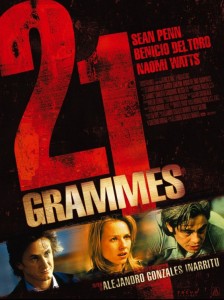 21 Grams (2003)
Premise: A mathematician (Sean Penn) in need of a heart transplant, a recovering addict (Naomi Watts) mourning the loss of her husband and children, and an ex-con (Benicio Del Toro) whos found redemption in Jesus, are all linked by a horrific car accident. The aftermath will bring them together out of grief, guilt, and revenge.
Results: The greatest asset 21 Grams has, bar none, is the trio of breathtaking performances. De Toro gives a powerful performance as a man consumed by grief and seeking answers in the unknown. Watts gives the definition of a raw performance. What isn’t cool is the structure, told out of order like the directors first film, the brilliant Amorres Perros, translated: Loves a Bitch. But the mixed-up structure of 21 Grams is needlessly complicated d frustrating, plus it pulls you out of the movie. Im sure theres a rationale reason for it, but the surprises and expectations it produces are minimal. The whole thing would have been better plunked in an old-fashioned linear structure. The sensational performances and intelligent story will stay with you long after the film ends.
Nate’s Grade: B+
Share this:

House of Sand and Fog (2003)
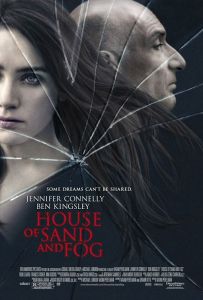 House of Sand and Fog (2003)
Premise: Kathy (Jennifer Connelly) has lost her family home due to a bureaucratic error, and a former Iranian colonel (Ben Kingsley) and his family move in for a rock-bottom price. Neither is willing to budge, and their turf tussle soon becomes a tragedy.
Results: Perhaps the first real estate thriller, House of Sand and Fog is a smartly written, emotionally harrowing film with phenomenal acting. Kingsley is superb and deserves a Best Actor nomination. Shohreh Aghdashloo is heartbreaking as Kingsley’s wife, who doesn’t know a lot of English but loses sleep over the word ”deportation.” The drama is meant to convey that both sides have a convincing claim to the house, but who are audiences going to side with, an American screw-up who could have avoided the whole mess by mailing in a letter, or a hard-working family ere the son is willing to take a second paper route to help out? The final act is a bit overly bleak, and the cop boyfriend character is an easy go-to for plot turns. House of Sand and Fog is one of the more compelling films of the year. What more could you want in a prestige picture?
Nate’s Grade: B+


You must be logged in to post a comment.