Blog Archives
The Station Agent (2003)
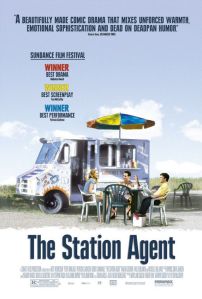 This is the most charming film of 2003, and Im not just saying this because I had an interview with one of its stars, Michelle Williams (Dawson’s Creek). Fin McBride (Peter Dinklage) is a man with dwarfism. With every step he takes every look he gives, you witness the years of torture hes been through with glares and comments. Hes shut himself away from people and travels to an isolated train station to live. There he meets two other oddballs, a live-wire hot dog vendor (Bobby Cannavale) and a divorced mother (Patricia Clarkson). Together the three find a wonderful companionship and deep friendship. The moments showing the evolution of the relationship between the three are the films highlights. Its a film driven by characters but well-rounded and remarkable characters. Dinklage gives perhaps one of the coolest performances ever as the unforgettable Fin. Cannavale is hilarious as the loudmouth best friend that wants a human connection. Clarkson is equally impressive as yet another fragile mother (a similar role in the equally good Pieces of April). The writing and acting of The Station Agent are superb. Its an unforgettable slice of Americana brought together by three oddballs and their real friendship. Youll leave The Station Agent abuzz in good feelings. This is a film you tell your friends about afterwards. Theres likely no shot for a dwarf to be nominated for an Oscar in our prejudiced times but Dinklage is deserving. The Station Agent is everything you could want in an excellent independent movie. It tells a tale that would normally not get told. And this is one beauty of a tale.
Nate’s Grade: A
Share this:

The Battle of Shaker Heights (2003)
 Ben Affleck and Matt Damon, being the egalitarian champions we all know celebrities to be, started a contest called Project Greenlight that allowed aspiring screenwriters to enter for a chance to have the winning script made into a movie by Miramax and the process documented for a behind the scenes reality show to run on HBO. Project Greenlight‘s first winner was the hapless Pete Jones. His winning screenplay gave birth to Stolen Summer, a maudlin coming-of-age story about a Catholic boy trying to get his ailing Jewish friend into heaven. You can feel the grating precociousness already. While Stolen Summer was an artistic yawn the HBO series was a hit as we the viewers saw every stupid mistake, naïve decision, and screaming matches during the production. Pete Jones’ pain was our gain.
Unlike the first contest, this one had a separate entry for directors and the tag-team of Efram Potelle and Kyle Rankin were picked to direct the winning screenplay The Battle of Shaker Heights, by Columbus, Ohio (represent) grad student Erica Beeny. Project Greenlight on HBO showcased the tension created by these butting heads. Beeny seemed ready to meltdown at a moments notice, probably because she let her good nature be taken advantage of by the egotistical, passive-aggressive, non-communicative, hilariously self-absorbed directors. This raises the question; did Affleck and Damon pick the best people or the people most likely to create the best television?
 Once again, the winning screenplay involved a coming-of-age story, this time revolving around the life of Kelly (Shia LeBeouf), a glib teenage war re-enactor. Kelly befriends Bart (Elden Henson) during a battle reenactment. Bart is from a wealthy Wasp-y household where his college is already predetermined. Kelly, on the other hand, must sullenly deal with his father (William Sadler), a former junkie who wasted away his college fund, and his flighty mother (Kathleen Quinlan). Bart and Kelly scheme to teach a schoolyard bully a lesson, and in the process Kelly starts falling for Bart’s attractive older sister Tabby (Amy Smart).
The character of Kelly doesn”t seem to have any deep reflections of life or anything of substance, just wicked one-liners. The fact that Kelly comes off as a sympathetic hero goes fully to the charming LeBeouf, who displays a laid back sense of humor and allure that is reminiscent of a young John Cusack. LeBeouf gives a star-making performance that keeps the audience engaged, even if the story is turning them off.
One of several problems Shaker Heights suffers from is that the finished product is a one-man show. Kelly is such a dominating character, a whirlwind of misplaced rage that everyone that gets in his path suffers. His relationship with Tabby seems like nothing more than unrequited puppy love that doesn’t need so much screen time being spent on a tired will they or wont they diversion. Kelly’s parents come off like theyre invisible. If you blink you may miss their entire time on screen. The father is more an absent force to drive Kellys angst, while his mother doesn’t seem to have any purpose or influence whatsoever.
 Shaker Heights feels like a film made by committee because as Project Greenlight astutely documented it was made by a committee. Miramax executives decided they could sell the film better as a pure comedy so they removed most of the winning screenplays drama. So now, with this new incarnation of Shaker Heights, the comedy never really emerges from more than a handful of superficially cute lines, and whenever a bit of drama does emerge it seems alien and disorienting. The heavy-handed direction by Potelle and Rankin paints in broad strokes, so the dramatic efforts come off as forced and overblown when they sneak up on an audience.
This incarnation of the movie may be entertaining to some, but with these cuts and directorial choices Shaker Heights seems horribly ordinary. Kelly is a disaffected teen with smart-ass comments; he lusts after the older girl who, of course, is with a supposed loser; his parents just don’t know what to do with him. The story is dulled down and all the edges seem polished off, and what an audience is left with is scenes, characters, and a story we’re already well familiar with. Does Project Greenlight seem to have a desire to select coming-of-age stories and then water them down to the point of distilling any original voice? The only interesting diversion in Shaker Heights is the war reenactment section, which is tragically too short.
The Battle of Shaker Heights is another theatrical dud from the Project Greenlight crew. Fans of teen melodrama might get some moderate enjoyment from it, but realistically, the only people who are going to pay any sort of money to see Shaker Heights are the people who avidly followed the Project Greenlight TV series. And in the end, one cant shake the feeling that The Battle of Shaker Heights ultimately feels like a disappointing season finale to Project Greenlight.
Nate’s Grade: C+
Share this:

Thirteen (2003)
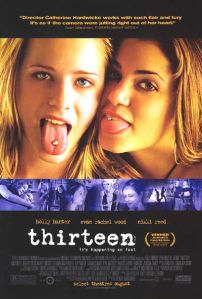 No one said being a 13-year-old was easy. Tracy (Evan Rachel Wood, a dead ringer for a young Jennifer Garner) is a straight-A student living with her mother Melanie (Holly Hunter, nominated for an Oscar). Her family fights to get by with Melanies at-home hair salon. People, usually accompanied by wee kids, stroll in and out of their house like it was a bed and breakfast. Melanie’s previous boyfriend Brady (Jeremy Sisto) has sobered up and settled back into her life, despite Tracy’s wishes.
Evie (Nikki Reed, who co-wrote the film with the director) is that cool girl at Portola Middle School. Tracy desperately wishes to join Evies inner sanctum of friends, enough that shell steal the pocketbook of a stranger to impress Evie. Tracy is taken under Evies wing and learns how to flirt, dress, dance, kiss, and terrify her mother. Melanies concern is a slow simmer, but she cant ignore all the signs of what is happening momma’s little girl. The girls revel in bared midriffs, body piercing, and gallons of shiny make-up. Evie lives with her guardian Brooke (Deborah Kara Unger), herself a sad woman ravaged by booze and pills. When she tells Melanie that Brooke beats her, the maternal instincts overpower her concern. She invites Evie to stay with her family. Evie even calls Melanie mom. More disintegration of Tracy follows.
 Thirteen does exhibit a rare maturity in the displaying of teenage emotions, namely the pull to belong. It also pays incisive attention to our consumer society marketing teen sexuality and the implicit effects. Thirteen creates a more realistic teenager by showing the vulnerability that’s inherent in growing up.
Wood gives a strong performance as her character descends from goodie-good to teen vamp. Her square jaw and lanky frame are physically perfect at displaying a natural young awkwardness. She looks like a teenager I’d see on my block, not what Hollywood is trying to tell me. Wood gets a tad drunk on her characters emotions, like a scene where she tries to scare her mother by lurching forward and cooing, “No bra. No panties.”
Hunter’s depiction of Tracy’s mother is out to lunch about her daughter. This makes the character seem earnest yet stupidly naïve, and after the 200th request of we need to talk is met once again with a closed door, the audience begins to think that Melanie has some deep-seated issues herself.
The direction by first timer Catherine Harwicke starts off as annoying with self-gratifying camerawork. The handheld camera swoops in and out attempting to establish a fluid realism. She also utilizes muted or exaggerated colors to express Tracys highs and lows. What started as self-congratulatory direction actually warmed me over, and I began to take notice of how lovingly Hardwicke stuffs her frame and utilizes lighting. It seems like she could have a career ahead of her as a director.
Though the acting is strong and the direction grows on you, Thirteen never really rises above its ilk of cautionary tale. It’s your basic story set-up of good girl meets bad influence, gets bad, distances family and old friends, experiences highs and then crashing lows, usually capped off with some kind of lesson learned. This is Thirteen in a nutshell. Tracys change from good girl to pubescent trash occurs at an unbelievably fast speed.
 You could make an argument that the film is trying to be daring and shocking, but this whole ”what’s wrong with kids today” routine has been done better in lesser films, like Larry Clark’s Kids. Even though Clark has a fixation for lingering on nubile bodies, his film portrays wayward teenagers and their hedonistic behavior without the constraints of trying to frame sympathetic characters. Thirteen hedges its resources; it cant be fully shocking if it keeps trying to make us like the characters, thus giving glimpses of remorse and doubt. In today’s world, I dont think its shocking anymore to see 13-year-olds engaged in drugs and sex, especially after witnessing kids killing kids in the brilliant City of God earlier last year.
Thirteen is a noble effort but fails in any attempt in functioning as preemptive wake-up call. The acting is quite capable (Wood appears to be headed for junior star status) but the film is ultimately unimpressive. Perhaps the only way to be shocked by this movie is if you’re a negligent parent with a disposable income. It would be worth a rental, but there’s nothing overpowering enough in the film to justify full movie ticket price. While I was watching Thirteen I kept recalling a piece of dialogue the grandfather in Fargo said: You let him go to McDonalds at this hour? They do more than drink milkshakes, I guarantee you that. In the end the message of Thirteen is simply this: one bad apple can spoil the bunch.
Nate’s Grade: C+
Share this:

Hulk (2003)
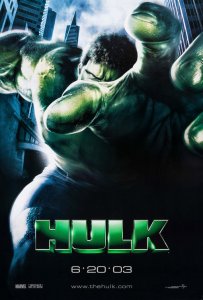 Comic book movies are all the rage these days. The X-Men films, Spider-Man, even Daredevil all managed some level of success because they were, at their heart, entertaining pulp and treated the source material with some sense of reverence. Now Ang Lee’s monstrous film Hulk lumbers into theaters and one could best describe it as being too serious for its own good.
Bruce Banner (Eric Bana) is the quiet guy, the one who bottles everything inside. His lab partner Betty Ross (Jennifer Connelly) has recently broken off their relationship due to his emotionally shut-off demeanor. Well Bruce gets hit with a lethal dose of gamma rays and it kicks up something inside him. You see, Bruces long-absent father (Nick Nolte, looking frightfully like his drunken mug shot photo) experimented some kind of regeneration serum on himself. When he fathered Bruce he passed on whatever genetic alteration. So now when Bruce gets mad he turns into a 15-foot raging Jolly Green Giant (the CGI in this movie is not good). He starts enjoying the freedom letting go can bring. Nothing gets him more mad than some yuppie (Josh Lucas, badly miscast) trying to buy out his lab and then kill him to sell his DNA to the military. Along the way, Betty’s father (Sam Elliott) tries to hunt Bruce and his greener-on-the-other-side alter ego for the good of us all.
 Director Ang Lee has injected most of his films with a sense of depression and repression, from the biting and darkly astute The Ice Storm to the stoic Gary Cooper-like silence of the aerobatic samurai in Crouching Tiger, Hidden Dragon. He’s a master filmmaker without question. Lee bites off more than he can chew with Hulk much like the gifted Cameron Crowe did with the sci-fi Vanilla Sky. Lee is so damn ambitious that Hulk tries to be everything and it ends up fulfilling nothing. His film is the most ambitious and the most tedious super hero/comic book movie of all time. What does it say when the super green Hulk has more personality than the bland Bruce Banner?
The acting is a non-issue here. Connelly remains one of the most beautiful women in all of movies and has incredibly expressive eyes and brows. She has this strand of hair thats always in the right side of her face. It’s so awkward. Bana gets the least fun part as the mentally scarred kid afraid of his own anger. He doesn’t do much but then he isn’t given much. Elliott overacts with impressive gusto whereas Nolte overacts like every line was his last breath.
After about an hour or so of beleaguered talking and flat characters, I started to become restless. I wanted to see Hulk smash, Hulk smash good. Instead what you get is endless scenes of cheesy speeches, sci-fi babble speech, phony philosophy, and mind-numbingly awful pacing. Seriously, Hulk has worse pacing than glaciers. You’ll see the Mona Lisa yellow faster than this movie will be over. And in some weird paradox, I think it will never be over.
 Lee attempts to make the film a living comic book. You’ve never seen this many wipes short of a Brady Bunch marathon on TV Land. Lee splits his screen into multiple panels and slides them around much like the layout of a comic book. However, this visual cue is overused and calls attention to itself in a how arty are we kind of pretentious way. If Hulk was attempting to be a comic book movie, then where the hell did all the action go? This movie could have been subtitled The Hulk Goes to Therapy because everything excluding an over-the-top final act revolves around people working out childhood issues. Man, there’s nothing I like to see more during the summer than a $150 million dollar movie about people working out childhood issues. Oh yeah!
Hulk is an overlong and ambitiously meandering film thats incredibly serious, incredibly labored, and incredibly boring. Someone needs to tell the creators of this film to lighten up. The big-screen adaptation of the big green id may have heavy doses of Freudian psychoanalysis (try and tie THAT with the merchandizing onslaught) but the film is barren when it comes to fun. Even comic book fans should be disappointed. I heard a story of a kid who saw Hulk and asked his mom when the movie was going to start, and she replied, “90 minutes ago.” Should you see Hulk in the theater at full price? No. Instead, give your money to me. It will have more resonance and action than anything this bloated, joyless, self-important vacuum of entertainment could offer.
Hulk mad? Audience mad! Audience leave theater. See other better movies instead. Hulk sad. No Hulk 2. Audience happy.
Nate’s Grade: D+
Share this:

The Man on the Train (2003)
 A dark stranger gets off a train in France. He has piercing blue eyes and a weathered face with a machine-like expression. This man is Milan (Johnny Hallyday) and he’s stopping by this small French town for a new job. Oh, Milan’s business is robbing banks. In this small village he befriends a garrulous retired poetry teacher, Monsieur Manesquie (Jean Rochefort). The two men spend their time wishing they had the life of the other. Milan openly seeks a comfortable life surrounded by books. Manesquie is a huge fan of Clint Eastwood movies and longs for some action in his life. He secretly dreams of one day robbing a bank just for the fun of it.
So, an interesting start for a film, right? Sure. But this IS the movie. The Man on the Train is a middling character experiment. The two men rub off each other, with Milan teaching a young boy the wonders of poetry, and Monsieur Manesquie learning how to properly fire a gun. The scenes are nice and both actors are splendid (especially French rocker Hallyday) but the film is one long muddled and meandering trip until our inevitable climax. The ending feels needlessly open-ended and a tad clumsy. There’s also a subplot featuring a young mistress for Monsieur Manesquie that sticks out like a sore thumb.
The Man on the Train is well shot and well acted but it only feels like the first half of a movie. I’m sure plenty of people out there will appreciate the character nuances and small moments, but this is a film completely driven by small moments that never adds up to anything larger. Maybe The Man on the Train just isn’t for me. Or maybe I need to just wait for the second half, if it ever gets made.
Nate’s Grade: C+
Share this:

X2: X-Men United (2003)
 Rollicking entertainment until they reach the dam and things get really bogged down. However, still the action film to beat this year. I heart Bryan Cox. X-Men 2 shows the promise of the X-Men world after the somewhat dull first film. Thank God we got the jumping point out of the way because now we can have fun with these characters and their world. And X-Men 2 is great fun. This is how sequels should be.
Nate’s Grade: B+
Share this:

The Core (2003)
 I knew about 15 minutes in that The Core was not going to take its science too seriously. Aaron Eckhart, as a hunky science professor, is addressing military generals and essentially says, “We broke the Earth.” He tells them that because the Earth no longer spins (don’t think about it, you’ll only hurt yourself) the electromagnetic shield will dissipate and the sun will cook our planet. And just to make sure people understand the term “cook” he sets a peach on fire as an example. At this point I knew The Core was going to be a ridiculous disaster flick with its tongue firmly planted in its cheek.
Earth’s core has stopped spinning and horrific disasters are starting to be unleashed with anything from drunken bird attacks to lightening strikes in Rome. I always love how in disaster films Mother Nature always instinctively goes after the monuments, the landmarks, the things of cultural importance. The United States government hires a ragtag group of scientists and NASA pilots to journey to the center of the Earth and jump-start our planet. Of course everything that can go wrong on this fantastic journey will eventually go wrong.
The Core is so improbable, so silly, that it ends up being guilty fun. If you let go, ignore the incredible amounts of birth imagery (the sperm-like ship tunneling through to get to the egg-like core), then the very game cast will take you for a fun ride.
There’s a scene where the government approaches kooky scientist Delroy Lindo to build the super-ship that will take them to said core. When asked how much he thinks it’ll cost Lindo laughs and says, ”Try fifty billion dollars.” The government responds, ”Can you take a check?” I was pleasantly reminded of an episode of Futurama where the space-time continuum is disrupted and time keeps skipping forward. The old scientist and a Harlem Globetrotter (it was a very funny episode) theorize that to create a machine to stop this problem they would need all the money on the Earth. Flash immediately to the two of them being handed a check that says, “All the money of the Earth.” Richard Nixons head, in its glass jar, then says, “Get going, you know we cant spend All the Money on the Earth every day.”
 The assembled cast is quite nice. Hilary Swank assumes a leadership role quite nicely. Eckhart is suitably hunky and dashing. Stanley Tucci is very funny as an arrogant science snob. Tcheky Karyo (the poor mans Jean Reno) is … uh, French. I don’t think anyone would believe that these people were the best in their fields (only in movies are scientists not old white men but hunky and sexy fun-lovin folk).
Director Jon Amiel (Entrapment) seems to know the preposterous nature of his films proceedings and amps up the campy thrills. An impromptu landing of the space shuttle in an LA reservoir is a fantastic action set piece, yet is likely the reason the film was delayed after the Columbia crash. The cornball science and steady pacing make The Core an enjoyable, if goofy ride. The film does run out of steam and goes on for 20 minutes longer than it should.
The Core is pure escapist entertainment without a thought in its head. And in dire times of war and harsh realism blaring at us every evening, there’s nothing wrong with a little juicy escapist fair. Buy a big tub of popcorn and enjoy. Does anyone else wonder if we broke the Earth just after its 5 billion year warranty was up?
Nate’s Grade: C+
Share this:

Dreamcatcher (2003)
 Stephen King movie adaptations are usually a mixed bag. For every Carrie there’s a Sleep Walkers or a Sometimes They Come Back. Let’s not even discuss how many straight-to-video Children of the Corn releases there are (the answer, of course, is far too many). So what can we expect from a novel that featured butt weasels?
Dreamcatcher centers on four friends and their annual hunting trip in the woods recounting an earlier time when they befriended a mentally retarded child who would later give each of them psychic gifts. At the same time it appears an alien invasion is nearby, the military are to quarantine the area, and the lost hunter has expelled a bloody serpentine-like creature from his bowels. What does it add up to? The craziest spring break ever man!
There are several moments in Dreamcatcher where you think to yourself, ”Well, it can’t possibly get more stupid,” and yet the movie routinely will find a way. It doesn’t know when to stop. Just when you think the bottom of the Stupid Hole has been hit, here comes an alien possession where the alien uses a freaking British accent (and actually says the word ”guvna,” proving to be the most dangerous interstellar chimney sweep). The only reason I knew what was going on was because I read the book over the summer.
The story is a mixture of different King staples: schmaltzy coming-of-age buddy stuff (It), alien invasions (Tommyknockers), gory monsters (take your pick). Dreamcatcher feels like a Stephen King greatest hits tape. The different narrative elements have great trouble gelling, as you can only segue from mentally challenged boy with mystical powers to crazy Morgan Freeman shootin’ up slimy aliens so often. The story does not work and has too many leftover bits it doesn’t know what to do with. Dreamcatcher is a proverbial square peg being jammed into a round hole.
 The movie shows some promise in its opening, displaying the camaraderie of actors Thomas Jane, Jason Lee, Damien Lewis and Timothy Olyphant (a younger looking Bill Paxton if I ever saw one). The notion of the memory warehouse is a fun idea that is used for nice comic touches.
Director/co-writer Lawrence Kasdan has written some of the most exciting films of the past 25 years, and screenwriter William Goldman is an old hand at adapting King (having done the masterful Misery and the mawkish Hearts in Atlantis). So what in the world went so horrendously wrong? For starters, the book is a whopping 620 pages and would be more suited in the frame of mini-series. Condensed into a messy two-hour movie, Dreamcatcher is sloppy with its pacing and scope. The movie drags for an eternity and then makes a mad dash at a finish (I wont spoil its unbelievable awfulness but will say it veers SHARPLY from the novel).
The most interesting part of the novel, for me, was the second half that involved the alien (Mr. Gray) taking over the body of Jonesy (Lewis). What kept me reading was Mr. Gray finding a liking to human temptations like bacon and, later, murder. Seeing Mr. Gray become intoxicated with humanity and perplexed by it at the same time was interesting. Sadly, all you get in the movie is the British accent and some goofy faces as Lewis holds two conversations in one person.
Few movies come along that are as incredibly stupid as Dreamcatcher. I cant exactly recommend it for this quality. They are playing that Matrix cartoon after it (my theater showed it before the film started). It looks like a video game and features a woman doing flips and sword fighting in a thong, because, quite simply, that’s what women do in these things. It’s not really that good either.
Nate’s Grade: D
Share this:

City of God (2003)
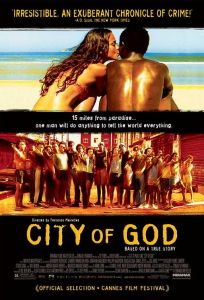 Looking for a film that really packs a genuine wallop? Take the visual panache of a pre-Madonna Guy Ritchie (Snatch) film, the juvenile delinquency and debauchery of a Larry Clark (Kids) film, the propulsive narration and bloody violence of a Martin Scorsese (Raging Bull) film and mix it with a cast of about 40 characters. What you get is City of God, a brilliant and vibrant film that pulsates with exhilarating action, thoughtful commentary and devastating power.
In the 1960s, the Brazilian government transported its impoverished citizens outside of Rio de Janeiro, a glamorous tourist magnet. This new place of residency was a distant housing project of shabby slums, ironically titled City of God. In this begotten neighborhood the police rarely emerge (except to occasionally pick dead people’s pockets) and crime has become rampant. A mixture of poverty and an overabundance of guns and testosterone have bred a culture of criminals where teenagers populate ruthless gangs.
 Our story focuses on Rocket (Alexandre Rodrigues) narrating the rise, and many falls, of all the flashy thugs of the City of God and the ripples they create in the community. Hes a young boy who is too scrawny to be a hoodlum like his older brother Goose. His brother belongs to a gang known as the Tender Trio, who are used to hijacking propane tanks for small gain. They get the idea to knock off a brothel at the urging of Lil Dice, a younger kid with ambition and a heart like a stone. After the successful robbery Lil Dice cleans up after the Trio, sifting through the brothel killing everyone inside and laughing insidiously.
The murder spree has long lasting effects, with each member of the Tender Trio finding an untimely end. Lil Dice grows from calculating child into a big-time burgeoning cruel gangster, who now calls himself Lil Ze (Leandro Firmino De Hora Phellipe). Ze has climbed to the level of kingpin the most pragmatic way possible: systematically eliminating all of the competition. Ze attains reign over the city. He instructs others not to do anything to arouse the outside police (the locals are paid off), and thus has made the City of God a safe place for rich tourists to drive in and purchase their drugs. It seems that Ze ruling by fear has brought newfound safety and prosperity.
Rocket’s path is quite different. As he matures into a teenager he discovers a love of photography. His attempts at a life of crime are short-lived; he simply likes his victims too much to rob them. Ze has Rocket take pictures of his gang strutting their machismo that eventually gets published onto the front page of a newspaper. Rockets reaction is that he thinks his death certificate has been signed. Ze’s reaction is delight. Lil Ze’s great weakness is his self-believed sexual inadequacy. When turned down by a girl he seeks out her good-looking boyfriend, Knockout Ned (Seu Jorge), and humiliates him. He terrorizes Ned, raping his girlfriend in front of him and inspiring him to long bloodthirsty battles of vengeance against Ze that will engulf the City of God.
 A complaint that could be levied against City of God is the numbing effect of its violence. The gangsters in this film aren’t the mustache-twirling types of Gangs of New York, but merely kids. This isn’t any kind of glamorized Hollywood gun battle. When these kids get hit their bodies go limp; they drop to the ground in weeping masses. The films message of the hereditary nature of barbarism is clear. One of the amazing parts of the film is that it was mainly filmed in the actual City of God and uses a cast almost entirely of non-actors.
City of God is a loud announcement to the world of the arrival of a fresh, invigorating and monumental talent with director Fernando Meirelles. The visual flair he utilizes to advance his storyline is amazing yet never falters into the land of gimmickry. The narrative folds in on itself time-wise (much like Tarantino films) yet rhythmically connects the numerous lives and history of the City of God in one lustrous and captivating tapestry of urban decay. A fantastic example is a scene that chronicles the entire history of one apartment and the origins of the entrance of drugs in one un-moving shot. Imagine the Natalie Imbruglia “Torn” video but with drugs and guns.
 There is one sequence of crushing emotional power that has been burned into my memory. The sequence involves a bawling child, no older than seven, being forced to decide where he would rather be shot, in his foot or his tiny trembling hand as punishment for his mischief. The reality of City of God is a harrowing one. As you can clearly see, City of God is not for the weak. The movie has its definite squirm-worthy moments of discomfort and will not be a good choice if you and your date are looking for that perfect weekend movie. This is a difficult movie to sit through at times, and the reality can be grim and uncompromising, but City of God is rewarding in respect to the amazing narrative and visual accomplishments. This is an unforgettable film.
The film piles on the body count while at the same time advancing a pacifist message between the bursts of adrenaline and bullets. Meirelles’ film will leave your jaw dropped to the floor by its sprawling complexity. This is what great filmmaking is all about. City of God is one of those movies that once you’ve left the theater you excitedly claim, “Now thats why I see movies.” City of God is simply a cinematic masterpiece and not only the best film I’d seen in 2003 but also one of the best movies I’ve seen in my life.
Nate’s Grade: A+
Share this:

Tears of the Sun (2003)
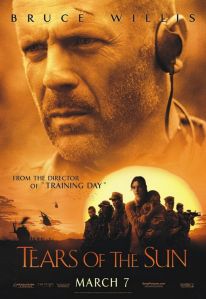 Bruce Willis is an ARMY squad leader called in to rescue a doctor (the sultry Monica Belucci) at a missionary in Nigeria. The country is in great turmoil after very very evil rebels have assassinated the entire royal family. Oh, but the good and very hot doctor refuses to leave without Willis’ squad taking the refugees out of the missionary with them. He begrudgingly accepts and they as a group travel through the countryside of Nigeria, all the while the very rebels are not far behind.
The film takes a tonal shift when Willis’ men come to the choice of staying with the refugees and trying to save them all, or following their mission protocol and getting the hot doctor onto an ARMY helicopter and shipped out ASAP, with no regards to the refugees. The shift in morality isn’t as smooth as Three Kings but now the film tries to place an emphasis on the human scale of genocide (even though ALL of these refugees who have lived in squalor have sterling white teeth, go fig). The weight of the topic easily alludes what is little more than a by-the-numbers action film.
With action films there will always be gaps of logic. However, there was one monumentally glaring miscalculation of forward thinking that prevented me from getting into the film again (*Spoilers ahead, big angry spoilers*).
 Okay, so African Rebels are chasing Willis and his team and the refugees. Got it. But then we find out later that one of the refugees is actually the, wait for it, heir to the throne of the country! All right, sounds hokey and more than a little culturally pretentious but I can follow. Hold on a second then. This heir to the country, who is obviously so important that people would risk their lives and safety for his own, why did these people not put him on the ARMY helicopters earlier that flew a handful of refugees out and to the safety of a U.S. air craft carrier. It makes no freaking sense whatsoever to have this golden opportunity that would 100% ensure the safety and longevity of THE HEIR TO THE KINGDOM and say, “Nah, you know what? Well catch the next ARMY helicopter guaranteeing safety to the man who would be king. Well sweat it out and have the rebels chase us, we could use the exercise anyway.” What has just happened to this movie?! After this, it was never the same for me; not that it was anything special to begin with.
Tears of the Sun is an action movie that attempts to be an action flick with a heart and a social conscious. There is a segment of the film where Willis and his cadre stumble onto ANOTHER batch of DIFFERENT but still very EVIL rebels assaulting a town, you know, rape and pillage and the like. Willis and company essentially save these people from the rebel tyranny but at this point the films core message has been well lodged into your gray matter: Africa needs the white man’s saving. More than a little arrogant and a tad racist, don’t you think? I mean not every country can wait patiently for Willis to liberate them.
Tears of the Sun does have some lovely examples of cinematography and some competent pieces of action here and there. In the end the film is an overblown and culturally insulting entry into the genre of people shooting and people falling down.
Nate’s Grade: C


You must be logged in to post a comment.