Blog Archives
Daredevil (2003)
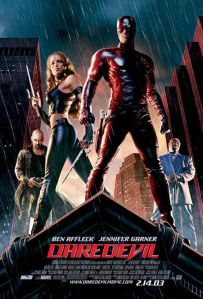 Not as bad as it could have been. That’s the best way to sum up Ben Affleck in tights.
Nate’s Grade: B-
Share this:

Better Luck Tomorrow (2002)
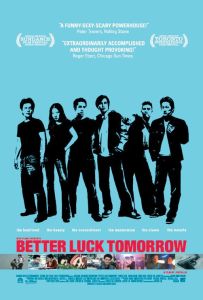 This film shows a fascinating side to the underbelly to suburban malaise. The story centers on a group of Asian-American friends that are social delinquents and petty criminals that can get away with it because theyre star students. Its an interesting dichotomy in Justin Lin’s directorial debut. The cast is strong and the pacing is brisk. The opening five minutes yanks you into this world and places you in the hands of a confidant voice. Familiar elements abound like unrequited love, jealousy, crashing lows, but Better Luck Tomorrow gives them a mildly fresh spin. The films familiar territory gets the better of it in a languid final act, but the ride is still an enjoyable and entertaining one at that.
Nate’s Grade: B
Share this:

About Schmidt (2002)
January at the theaters is a tale of two kinds of films. One type are the studio bombs (take Just Married and Darkness Falls, please take them far away). The other type are the prestige pictures expanding their releases in hopes of garnering some of that Oscar magic. A lot of prestige films were released around the holidays and though not every one could be a winner, they were all better than Kangaroo Jack. Well, except for The Hours.
 About Schmidt (2002)
Premise: Retired and recently widowed, Warren Schmidt (Jack Nicholson) must learn to live his own life for the first time. Warren travels across the country to rediscover himself and stop his resentful daughter from marrying a man-child with a mullet.
Results: Nicholson downplays his usual shark grin to deliver one of his best performances in a funny, tragic, savage yet warm-hearted film. About Schmidt, from the creators of Election and Citizen Ruth, is one of the best films of 2002.
Nate’s Grade: A
Share this:

The Hours (2002)
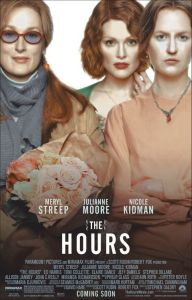 Okay, after watching the Golden Globes award show and seeing The Hours crowned with the highest prize, and hearing incessantly about Nicole Kidman’s fake prosthetic nose in the movie, it was time to venture into that darkened theater and see how good the awards-friendly The Hours was. Little did I fully realize what I was getting myself into.
Nicole Kidman plays Virginia Woolf, who is in the midst of writing her novel Mrs. Dalloway, where she proposes to display a womans entire life through the events of a single day. Julianne Moore plays Laura Brown, a housewife in 1951 having difficulty adjusting to a domestic life that she feels ill equipped for. Meryl Streep plays Clarissa Vaughan, a gay copy-editor in 2001 planning a party for a poet and former lover (an emaciated Ed Harris), who is suffering from the late stages of AIDS. These three storylines will be juggled as the film progresses, with each womans life deeply changing before the end of the day.
The Hours is a meandering mess where the jigsaw pieces can be easily identified. The attempt at a resolution for an ending, tying the three storylines together, is handled very clumsily. The film spins on and on that you start to believe the title may be more appropriate than intended. What this movie needed was a rappin kangaroo, post haste! The film is wrought with victimization and screams ”Give me an award already!” Before you know it youre being bludgeoned to death with what is profoundly the most over serious Lifetime network movie ever assembled. And there’s nothing fundamentally wrong with Lifetime movies but The Hours does not share the sensibilities of its TV brethren.
 Kidman, nose and all, gives a strong performance displaying the torture and frailty of a writer trapped within her own mind but too often relies on wistful staring or icy glares. Moore is effectively demoralized but cannot resonate with such a shallow character. Streep is the least effective of the three and fizzles among an over-stuffed assembly of characters.
The supporting cast is unjustly left for dead. The characters are seen as parody (Toni Collette as Moore’s un-liberated homemaker neighbor), extraneous (Claire Danes as Streep’s daughter, Allison Janney as Streep’s lover, Jeff Daniels as Harris ex-lover, you know what, almost anyone in the Streep storyline), one-note (the workmanlike John C. Reilly who plays yet another doting and demystified husband) or merely obnoxious (Moore’s brat child that refuses to separate from her). It appears The Hours is the three lead actress game, and everyone else is not invited to play along.
Stephen Daldry’s direction shows surprising stability and instinct after his art-house pandering Billy Elliot showed little. The technical aspects of The Hours are quite competent, especially the sharp editing and musical score, which just points out further how slickly hollow and manufactured the film is.
The Hours is an over-glossed, morose film that is too self-important for its own good. It sucks the life out of everything. And for all its doom and gloom and tsunami of tears, the only insightful thing The Hours is trying to pass off onto the public is that women are more depressed than you think.
Nate’s Grade: C
Share this:

Narc (2002)
 Stop me if you’ve heard this before. A hard-nosed and diligent cop (Jason Patrick) gets taken off the force after in accident while serving in the field. The bureau brings him back in the help of solving a case collecting cobwebs, the death of an officer undercover. This cop gets teamed up with a hothead (Ray Liotta) who doesn’t play by all the rules who becomes increasingly more suspicious that said hothead breaks more rules than enforces. Oh, and diligent cops neglected wife and child incessantly worry over his well being as he becomes consumed by the work. Whats that, you want me to stop? Well okay then.
So what do we get with Narc? Well, Ray Liotta yells. A lot. He’ll huff and puff until smoke blows out his ears and veins jump from his neck. Liotta eats scenery uncontrollably like Marlon Brando left alone at the Cheesecake Factory.
Narc attempts to tell a gritty police drama in the same manner of The French Connection but, instead, turns into every other gritty cop movie. The twists (I use this word lightly because every turn is easily telegraphed) do nothing to liven up this rote rogue copper flick. Let’s face it, every cop drama is plot driven, even the classics like L.A. Confidential and The French Connection. So if you don’t have a good story then theres no gas in this car. And Narc barely runs on fumes.
Writer/director Joe Carnahan tries to play window dressing with some superfluous camera tricks in an attempt to jazz up the proceedings. The opening handheld chase scene could give the makers of The Blair Witch Project motion sickness. The editing can at times simulate an annoying fly buzzing around your ear. The result of these tricks is like covering a turd with chocolate and selling it to the masses.
Narc won’t quicken any pulses or knock any socks out of their vicinity. So what will you get? Well Ray Liotta yelling at you, which, surprisingly, could lead to audience narc-olepsy. Even that horrible pun is better than watching the film. I think that says it all.
Nate’s Grade: C
Share this:

Talk to Her (2002)
 Before one can assess Talk to Her, the new Spanish import from famed writer/director Pedro Almodovar, one must come to grips with what they have seen. It’s not every film you see that has a giant vagina. Yes, you read correctly dear reader, a gigantic yet scalable recreation of the most sensitive part of the female anatomy. Was there also a giant penis you might reasonably ask? No, but there was an incredible shrinking man that burrowed into the enormous vagina and lived the rest of his days with the labia and clitoris as his next-door neighbors. And what may be even more surreal is that all of this, thematically and metaphorically upon retrospect, makes absolute sense.
So maybe this opening salacious salvo was a bit hyperbolic, but describing Almodovar’s unusual meditation on life, love and death can prove quite ponderous. To explain the story of Talk to Her is to miss its complexity and richness. This is a film destined to spark conversation afterwards.
Almodovar’s colorful melodrama centers on two sets of relationships. Benigno (Javier Camara) is the most attentive boyfriend a woman could have. He talks to former ballerina Alicia (Leonor Watling), washes her hair and makes sure she gets plenty of exercise and attention. Oh yeah, Alicia has also been in a coma for four years. Benigno carries on like he was involved in a normal relationship, except the woman of his heart cannot return a single glance.
 Marco (Dario Grandinetti) is recovering from a former relationship when he falls completely in love with Lydia (Rosario Flores), a female bullfighter. She is having trouble competing in a very male dominated “sport” (I don’t really consider stabbing animals a sport per se). At the start of a bullfight Lydia is horribly gored and dragged around the arena like a rag doll. The results leave Lydia lying in a coma with no hope of ever waking up. It is at the hospital where Marco meets Benigno, who is one of the most helpful nurses. He helps Marco overcome his grief over his fallen love. Benigno shows that unresponsiveness and death cannot deter a man’s love. The two men bond and become very close; however, dark clouds are on the horizon, as Benigno’s fantasy cannot last much longer.
Almodovar has routinely enjoyed tweaking the establishment, especially gender roles and religion (there’s a few tacky priest molestation jokes), but with Talk to Her he attempts to forge serious drama through odd circumstances (ballerinas, bullfighters, giant vaginas, oh my!) and all without the use of irony. The result is a quietly affecting film that burrows its way inside you, much like the shrinking man burrows into … well, you remember.
The movie is darkly comic in its portrayal of Benigno’s delusional relationship, and yet Talk to Her is also a celebration of love and friendship. The affection that is shown is perplexing but also transfixing with the ability to love someone who is mentally not even there. The film questions the compensations we make for love. Some people pretend that their mate is a different person and glaze over character flaws. Could it not be possible then that someone would compensate for an entire person?
Almodovar has created a very female-centric film despite our female leads spending the majority of their screen time lying perfectly still. Talk to Her is an engrossing and intriguing character-driven story. It may start out like a sick joke but the layers of humanity Almodovar effortlessly injects into his story create the most bizarrely touching movie of 2002.
Nate’s Grade: A
Share this:

Solaris (2002)
 A most amazing thing occurred when I sat down in my theater to watch Steven Soderbergh’s sci-fi remake, Solaris. The majority of the theater was women, no small part Im sure to George Clooney and the promise to see his posterior not once but twice. As the film progressed I kept hearing the rattling of seats and the exit doors. When the lights came back on more than half my theater had walked out on Solaris. I have never seen this many walk outs for any film before, and if one has to hold this title Solaris certainly does not deserve this dubious honor.
Clooney plays Chris Kelvin, super future psychologist who is struggling to overcome the grief over the suicide of his wife, Rheya (Natascha McElhone). Clooney is dispatched to a space station orbiting the mysterious glowing planet Solaris. Seems strange goings on, are, well, going on. When he arrives he finds that the station head has taken his own life and the two remaining crew members on board could use more than a few hugs. Clooney goes to sleep (in a bed resembling bubble-wrap) and is startled awake when his dead wife is suddenly lying right beside him. But is it his wife? Is it merely his memories being recounted? Is it Solaris messing with his gray matter? Does Rheya have consciousness of the past or of her self? What are her thoughts on her new materialization? Good luck Steven Soderbergh, existentialist party of one.
It’s not that Solaris is necessarily a bad film, it’s just that it’s plodding, mechanical and overly ambitious. There are long periods of staring, followed by brief exposition, then more staring, sometimes earnestly but mostly slack-jawed. Solaris is attempting to be an existential meditation on identity and self, but what really occurs is a lot of nothingness. For a movie that was over three hours in its original 1971 Russian conception, and a mere 93 minutes in its slimmer Soderbergh size, I could likely get this movie done in 6 minutes. It could be argued that its arduous pacing amplifies its methodical subject matter but whatever.
 Clooney has said in interviews how Solaris was the most challenging role of his career. To this I make a collective noise of disagreement. Clooney turns from grief-stricken to confusion, then back to grief-stricken with nary a line of dialogue. The effect is more dampening than emotional. Clooney’s conscious gets even worse when he banishes New Rheya into the cold vacuum of space then Another Rheya appears the next night. He just can’t escape this dead woman.
I’m very pleased to see the glassy-eyed, apple-cheeked beauty McElhone in movies again. She seemed to be on the cusp of mainstream acceptance after prominent roles in 1998’s Truman Show and Ronin, yet she just disappeared. McElhone is a wonderfully expressive actress and deserves to be a leading lady.
Soderbergh’s take on existential dread could be described as a noble failure. Solaris is the type of overreaching, underachieving film only really talented people could make. And for anyone wanting to leave after the double dose of Clooney’s derriere, they both happen in the first 30 minutes. You can go after that if you so choose.
Nate’s Grade: C+
Share this:

Harry Potter and the Chamber of Secrets (2002)
 So is Harry Potter and the Chamber of Secrets better than the first film? Well, mostly yes. The story of Harry Potter is a long and complicated one, full of numerous funny names as well. Harry (Daniel Radcliffe) is still living with his abusive relatives and barred in his room. Hes warned by Doddy, a self-abusive CGI house elf, not to return to Hogwarts School of Magic because he will be in grave danger. Fat lot of luck this does. Before you can say Jar Jar Binks, Harry’s timid friend Ron Weasley (Rupert Grint) and his flying love bug rescue Harry. They meet up with old friend Hermione Granger (Emma Watson) and begin their second year of magical education. But danger surfaces as students with Muggle (a non-magically inclined family member) blood are turning into petrified statues. Lots of other stuff is crammed in (like broomstick rugby, Nancy Drew-like detection, and spiders oh my!) but lets all be honest here, its not like a plot synopsis is going to push you into seeing this movie.
 Much of the acting responsibilities falls on the shoulders of our three young leads, and all I can say is what a world of good puberty has done them all. Radcliffe, stiff and overly subdued in the first film, has grown a deeper voice. He seems to have settled into the part nicely. Grint, playing a noble coward, goes from squeal to grimace in 3.5 seconds. Watson has a winning smile and bounces with enthusiasm but sadly sits the last half of the film out.
Some notable additions to the Harry Potter family include Kenneth Branagh as the narcissistic new professor of the Defense Against the Dark Arts. Can anyone do ham better than Branagh? I dont think so. Jason Isaacs is malevolently delicious as the aristocratic father of Harrys school rival, Draco Malfoy. You could start shivering from the icy glare this man casts.
Chamber of Secrets is better than the earlier Sorcerer’s Stone in many ways. The story has less exposition and contains darker elements that suit the story surprisingly well. The special effects are vastly improved from the first film. The child acting, as previously mentioned, is much better.
Despite lacking prolonged setup, Chamber of Secrets clocks in around 2 hours and 40 minutes — 9 minutes longer than the first! You could watch your life go by sitting through a Potter movie marathon. This might seem like an eternity to small children if they weren’t so overly obsessed with the book series.
 So remember when I said Chamber of Secrets was “mostly” better than the first film? Well that “mostly” is because the amazing adult cast is hardly seen. Gentle giant Robbie Coltrane and Maggie Smith are mere background noise to the story. Headmaster Dumbledore (played by the late Richard Harris) has a weathered feel. What Chamber of Secrets needs are more scenes with the brilliant Alan Rickman, as moody professor Severus Snape. Rickman (Dogma) is perfect and a thrill to watch. I got a fever and only more Rickman can cure it.
Chris Columbus (Home Alone) is a director with no remarkable visual flair or distinct vision. Everything that is occurring is so faithful to the book that it has no individual flavor or distance. It’s directing with your hands tied. It should be Rowling’s name for the director’s credit because she’s the one with the vision being translated.
Harry Potter is a worldwide phenomenon that is already breaking box-office records and parents’ bank accounts. Chamber of Secrets plays toward audience expectations, but all of the components involved seem to be settling in their roles. Chances are whatever you felt about the first film youll relive during the second.
Nate’s Grade: B
Share this:

Punch-Drunk Love (2002)
 So what do you get when you cross clown prince Adam Sandler and the writer/director of the lengthy epics Magnolia and Boogie Nights? Well you get the most unique romantic comedy ever, that’s what.
Barry Egan (Sandler) is a self-employed supplier of novelty toilet plungers. His seven older sisters have made it their job to torment him ever since he was young. In moments of confession of his unhappiness Barry usually prefaces by pleading with people not to tell his sisters. Barry is a timid introverted wallflower yet full of volatile rage fit to senselessly trash a restaurant bathroom. Lena Leonard (Emily Watson) pursues Barry after being introduced through one of his sisters. Lena latches onto the oddball and he finds the maternal comfort and acceptance he has missed his entire life. Somehow these two souls have crossed paths and become exactly what the other has always needed.
But Barry has trouble ahead of him. One night he called a phone sex line and innocently gave out all of his personal information over the phone. Now a sleazy Provo mattress store owner (Phillip Seymour Hoffman) is extorting money from Barry and using four blond Mormon brothers as his muscle. When Barry confronts the thugs, whom have now begun to endanger Lena as well, he boldly states, ”I have a love in my life and that gives me more strength than you will ever know.” You cant help but believe it and genuinely feel for the resurgence of this character’s dignity.
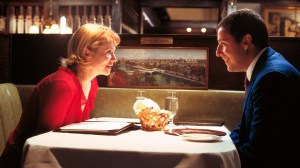 Writer/director Paul Thomas Anderson spins an engrossing character study deconstructing the angry goofball Sandler has been so accustomed to playing in all his slapstick comedies. He plays the same character archetype but is now given new dimensions to play with and depth. The true revelation of Punch-Drunk Love is that Sandler can really act. No, really, I’m dead serious.
The direction and writing are much more restrained than with Andersons previous films. The world of Punch-Drunk Love is full of stark colors, slow camera movements and vast amounts of spatial emptiness. The scope is much narrower, focusing on a small set of characters and just allowing them to tell the story without outside interference — like a frog shower. Due to the attention paid to Barry, everyone else becomes underwritten including the stoic love interest. After being convinced of Barry’s instabilities the audience is left to assume sheer blind faith at what Lena sees in Barry.
Punch-Drunk Love gleefully ignores and plays with romantic comedy conventions. The running time is under 90 minutes, (which is still only HALF of Magnolia) but the pacing is precise. John Brions percussion heavy musical score wonderfully displays the boiling anger behind Barrys placid exterior during key moments.
The storytelling of Punch-Drunk Love is full of uneasily accessible quirks and will likely be reacted to with hostility by mainstream America. What Anderson has crafted is an arty Adam Sandler movie that few thought even possible. Next thing you’ll tell me is that David Lynch will do a G-rated Disney Film. What’s that now?
Nate’s Grade: B+
Share this:

The Ring (2002)
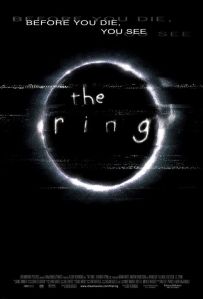 So have you heard the one about the videotape where you die seven days after you watch it? No it isn’t a new late fee ploy by Blockbuster. It’s the great premise for the entertaining new horror movie The Ring. After you watch this eerie video your phone rings. A raspy voice on the other end tells you that you have seven days, then, one week later to the minute, you die. How cool is that?
Seattle reporter Rachel Keller (Naomi Watts) learns of this urban legend at the funeral of her teenage niece, who died suddenly and mysteriously. Through research she observes that her niece’s three friends all died at the same hour on the same day, though through different circumstances. She recovers pictures of the four of them at a campsite, where they had watched the video, except their faces are blurred in pictures taken after they had watched the tape.
The Ring has its shares of creepy scares but midway in it makes an unexpected turn. Rachel, being the good journalist she is, goes to the camp and pops in the dreaded videotape. She watches it and makes us watch it too! Afterwards, working against the death clock here, she tries piecing together clues left on in the tape’s grisly and stark images to solve the mystery of who is behind it. It’s at this moment that The Ring turns into an extended beyond-the-grave episode of Law & Order.
As with most mysteries, the intrigue and questions are more interesting than the eventual answers. As Rachel’s investigation picks up steam we start to lose interest. Of course it wouldn’t be a supernatural thriller these days without a Sixth Sense-like twerpy kid. This one features Rachel’s son (who looks like the lost Culkin child) who has premonitions of death.
 Watts, who wowed critics with her breakout role as the good girl/bad girl in Mullholland Drive, is luminescent as a leading lady. Watts can deliver parts passion, fright, curiosity and concern without blinking an eyelash. She is an exciting actress to see develop.
The Ring is directed with a vibrant sense of foreboding by Gore Verbinski (The Mexican). He delivers some definite cover-your-eyes moments but also creates a wonderful atmosphere of fear throughout with illuminating visuals. There is an absence of gore and any real violence, just an emphasis on intense atmosphere like what the classic horror films would achieve.
The scares that The Ring can conjure are genuine and the film has a nightmarish undertone to it. This Hollywood remake of the Japanese cult classic can stand on its own legs with confidence, even with an overextended ending that you may require initiating another person to explain to you. So, anyone want to watch a killer movie?
Nate’s Grade: B


You must be logged in to post a comment.