Blog Archives
Man on Fire (2004)
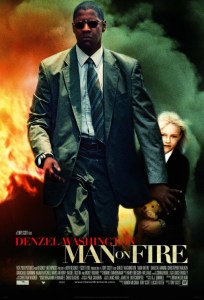 By far, the most entertaining moment of Man on Fire occurs shortly after the movie ends. A message comes on screen more or less saying, Mexico City is a very special place and we thank them. Now, after having watched a lengthy 2 hour and 25 minute film that shows Mexico City as a chaotic equal to the Middle East, a city that experiences four kidnappings a day we are told, these ending sentiments feel like a mea culpa. To say a place is great after showing it to be a corrupt war-zone is hilarious. I doubt Mexico City will be using Man on Fire to lure tourism, just like I doubt Germany uses Hogan’s Heroes for its tourism.
The man on fire is Creasy (Denzel Washington), a former soldier with a drinking problem. Hes hired dirt cheap to be the bodyguard for Pita (Dakota Fanning), the daughter of a wealthy Mexican politician (Marc Anthony). Creasy is pragmatic about his job and shirks Pitas attempts at friendship. Eventually, the precocious tyke gets the better of him and Creasy forgoes his self-loathing for coaching Pita on how to swim better. Creasy has found his recovery in the form of Pita’s love, but his world is ripped apart when Pita is kidnapped and Creasy is left for dead. When he recovers, he vows merciless vengeance on anyone involved in Pita’s kidnapping.
 Denzel Washington is competent in his role, but there aren’t many films that wouldn’t be better by having a Denzel Washington performance in it. Fanning has a robotic nature to her delivery. The wacky Christopher Walken is in this movie somewhere, but you would be hard-pressed to find him in the last hour or so. It’s kind of nutty that Walken of all people plays the voice of reason in a revenge movie.
Director Tony Scott (Crimson Tide, Top Gun) has flat-out forgotten or lost interest in telling stories. His direction of Man on Fire is erratic and heavy on stop-the-action-dead visual flourishes. Scott is a slave to visuals, but so many of them are jarringly miscalculated that the audience can never fully immerse themselves in the film. It’s like a kid fiddling with a new camcorder and wanting to try all the super cool special features (Whoa, I can make things slower … now grittier stock … now sepia … now I can make a mirror of things … etc.).
It takes over an hour to get to the key kidnapping plot point. Until then the audience is relegated to watching scenes of Creasy find redemption through the eyes of a child. Denzel and Fanning have a nice mentor camaraderie, but after an hour the audience is impatiently waiting for the inevitable kidnapping that the movies foreshadowing has been tripping all over.
 When Man on Fire does hit the kidnapping, the ensuing movie gets very messy, and boy does it get ugly. Creasy goes on a grisly killing spree that turns him from a sympathetic loner into a one-man wrecking crew. Vengeance is an easy emotion for an audience to get behind a character, but Man on Fire goes way beyond audience empathy. Are we to cheer when Creasy goes about ruthlessly killing unarmed people and threatening families, pregnant women, and kids? I didn’t cheer. I was somewhat appalled that the filmmakers expected us to revel in this violence as if it was more than justified. It’s just ugly, plain and simple. It is also sickeningly sadistic.
The most bizarre thing about Man on Fire is the subtitles. When I think back on this film in the future, that is the one thing that will stand out for me. These arent your ordinary stay-at-the-bottom-and-do-as-you’re-told subtitles. Oh no. These subtitles dance, jump around, float, fade, expand and shrink in size, and do about everything but make balloon animals (or, I should say, subtitle animals). It’s like a living comic book; however, this is yet another visual trick that draws the audience out of the film. The unusual subtitles call too much attention to themselves, especially when they just pop up for a single word, spoken in English, as if to clue in the audience that this point of information will be vital somehow.
Man on Fire is a sadistic action film that is too full of itself for amusement. By the time that mea culpa comes onscreen its almost a relief to laugh again. The hard-driving ugliness of Man on Fire might make you forget how to. Fans of revenge films may find some redeemable qualities, but Man on Fire is one gruesome 145 minutes to squirm through.
Nate’s Grade: C-
Share this:

Mystic River (2003)
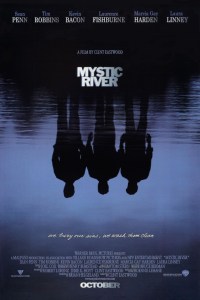 The acting is phenomenal. The story is twisting and layered with incredible amounts of depth. The direction is calm and focused. This is a great Greek tragedy and a great crime story and human drama. Eastwood scores again.
Nate’s Grade: A
Share this:

Kill Bill Vol. 1 (2003)
 Breathtaking and stylistically amazing. That’s all there is to it. Can’t wait for part two.
Nate’s Grade: A
Share this:

City of God (2003)
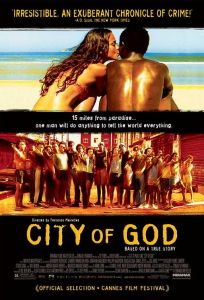 Looking for a film that really packs a genuine wallop? Take the visual panache of a pre-Madonna Guy Ritchie (Snatch) film, the juvenile delinquency and debauchery of a Larry Clark (Kids) film, the propulsive narration and bloody violence of a Martin Scorsese (Raging Bull) film and mix it with a cast of about 40 characters. What you get is City of God, a brilliant and vibrant film that pulsates with exhilarating action, thoughtful commentary and devastating power.
In the 1960s, the Brazilian government transported its impoverished citizens outside of Rio de Janeiro, a glamorous tourist magnet. This new place of residency was a distant housing project of shabby slums, ironically titled City of God. In this begotten neighborhood the police rarely emerge (except to occasionally pick dead people’s pockets) and crime has become rampant. A mixture of poverty and an overabundance of guns and testosterone have bred a culture of criminals where teenagers populate ruthless gangs.
 Our story focuses on Rocket (Alexandre Rodrigues) narrating the rise, and many falls, of all the flashy thugs of the City of God and the ripples they create in the community. Hes a young boy who is too scrawny to be a hoodlum like his older brother Goose. His brother belongs to a gang known as the Tender Trio, who are used to hijacking propane tanks for small gain. They get the idea to knock off a brothel at the urging of Lil Dice, a younger kid with ambition and a heart like a stone. After the successful robbery Lil Dice cleans up after the Trio, sifting through the brothel killing everyone inside and laughing insidiously.
The murder spree has long lasting effects, with each member of the Tender Trio finding an untimely end. Lil Dice grows from calculating child into a big-time burgeoning cruel gangster, who now calls himself Lil Ze (Leandro Firmino De Hora Phellipe). Ze has climbed to the level of kingpin the most pragmatic way possible: systematically eliminating all of the competition. Ze attains reign over the city. He instructs others not to do anything to arouse the outside police (the locals are paid off), and thus has made the City of God a safe place for rich tourists to drive in and purchase their drugs. It seems that Ze ruling by fear has brought newfound safety and prosperity.
Rocket’s path is quite different. As he matures into a teenager he discovers a love of photography. His attempts at a life of crime are short-lived; he simply likes his victims too much to rob them. Ze has Rocket take pictures of his gang strutting their machismo that eventually gets published onto the front page of a newspaper. Rockets reaction is that he thinks his death certificate has been signed. Ze’s reaction is delight. Lil Ze’s great weakness is his self-believed sexual inadequacy. When turned down by a girl he seeks out her good-looking boyfriend, Knockout Ned (Seu Jorge), and humiliates him. He terrorizes Ned, raping his girlfriend in front of him and inspiring him to long bloodthirsty battles of vengeance against Ze that will engulf the City of God.
 A complaint that could be levied against City of God is the numbing effect of its violence. The gangsters in this film aren’t the mustache-twirling types of Gangs of New York, but merely kids. This isn’t any kind of glamorized Hollywood gun battle. When these kids get hit their bodies go limp; they drop to the ground in weeping masses. The films message of the hereditary nature of barbarism is clear. One of the amazing parts of the film is that it was mainly filmed in the actual City of God and uses a cast almost entirely of non-actors.
City of God is a loud announcement to the world of the arrival of a fresh, invigorating and monumental talent with director Fernando Meirelles. The visual flair he utilizes to advance his storyline is amazing yet never falters into the land of gimmickry. The narrative folds in on itself time-wise (much like Tarantino films) yet rhythmically connects the numerous lives and history of the City of God in one lustrous and captivating tapestry of urban decay. A fantastic example is a scene that chronicles the entire history of one apartment and the origins of the entrance of drugs in one un-moving shot. Imagine the Natalie Imbruglia “Torn” video but with drugs and guns.
 There is one sequence of crushing emotional power that has been burned into my memory. The sequence involves a bawling child, no older than seven, being forced to decide where he would rather be shot, in his foot or his tiny trembling hand as punishment for his mischief. The reality of City of God is a harrowing one. As you can clearly see, City of God is not for the weak. The movie has its definite squirm-worthy moments of discomfort and will not be a good choice if you and your date are looking for that perfect weekend movie. This is a difficult movie to sit through at times, and the reality can be grim and uncompromising, but City of God is rewarding in respect to the amazing narrative and visual accomplishments. This is an unforgettable film.
The film piles on the body count while at the same time advancing a pacifist message between the bursts of adrenaline and bullets. Meirelles’ film will leave your jaw dropped to the floor by its sprawling complexity. This is what great filmmaking is all about. City of God is one of those movies that once you’ve left the theater you excitedly claim, “Now thats why I see movies.” City of God is simply a cinematic masterpiece and not only the best film I’d seen in 2003 but also one of the best movies I’ve seen in my life.
Nate’s Grade: A+
Share this:

Better Luck Tomorrow (2002)
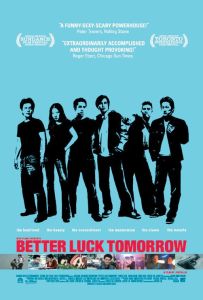 This film shows a fascinating side to the underbelly to suburban malaise. The story centers on a group of Asian-American friends that are social delinquents and petty criminals that can get away with it because theyre star students. Its an interesting dichotomy in Justin Lin’s directorial debut. The cast is strong and the pacing is brisk. The opening five minutes yanks you into this world and places you in the hands of a confidant voice. Familiar elements abound like unrequited love, jealousy, crashing lows, but Better Luck Tomorrow gives them a mildly fresh spin. The films familiar territory gets the better of it in a languid final act, but the ride is still an enjoyable and entertaining one at that.
Nate’s Grade: B
Share this:

Catch Me If You Can (2002)
January at the theaters is a tale of two kinds of films. One type are the studio bombs (take Just Married and Darkness Falls, please take them far away). The other type are the prestige pictures expanding their releases in hopes of garnering some of that Oscar magic. A lot of prestige films were released around the holidays and though not every one could be a winner, they were all better than Kangaroo Jack. Well, except for The Hours.
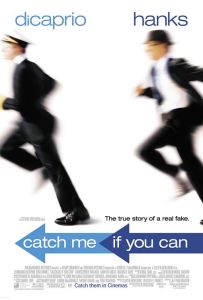 Catch Me If You Can (2002)
Premise: Successful true-life con artist Frank Abagnale Jr. (Leo DiCaprio) zips across the world posing as a pilot, doctor and lawyer all before the age of 18. A mousy Tom Hanks provides the chasing.
Results: Breezy and light-hearted, Catch is an entertaining and fun romp that works with a charming Leo (unlike in Gangs), a jazzy score and a skillful recreation of the 1960s life and mood. Spielberg hasn’t made a film under two hours since 1989, so Catch is a tad long.
Nate’s Grade: B
Share this:

Chicago (2002)
January at the theaters is a tale of two kinds of films. One type are the studio bombs (take Just Married and Darkness Falls, please take them far away). The other type are the prestige pictures expanding their releases in hopes of garnering some of that Oscar magic. A lot of prestige films were released around the holidays and though not every one could be a winner, they were all better than Kangaroo Jack. Well, except for The Hours.
 Chicago (2002)
Premise: Roxie Hart (Renee Zellweger), hungry for fame, finally grasps it when she kills her lover and is put on trial. Silver-tongue lawyer Billy Flynn (Richard Gere) stirs up the media in her defense, as well as for another starlet killer, Velma Kelly (Catherine Zeta-Jones).
Results: A song-and-dance picture thats quite toe-tappin with imaginative numbers, even if I can only remember like two songs. A surprisingly steady Zeta-Jones really shines and Gere can cut a rug. Chicago is just lively fun. Blink and youll miss Lucy Liu in it.
Nate’s Grade: B
Share this:

Narc (2002)
 Stop me if you’ve heard this before. A hard-nosed and diligent cop (Jason Patrick) gets taken off the force after in accident while serving in the field. The bureau brings him back in the help of solving a case collecting cobwebs, the death of an officer undercover. This cop gets teamed up with a hothead (Ray Liotta) who doesn’t play by all the rules who becomes increasingly more suspicious that said hothead breaks more rules than enforces. Oh, and diligent cops neglected wife and child incessantly worry over his well being as he becomes consumed by the work. Whats that, you want me to stop? Well okay then.
So what do we get with Narc? Well, Ray Liotta yells. A lot. He’ll huff and puff until smoke blows out his ears and veins jump from his neck. Liotta eats scenery uncontrollably like Marlon Brando left alone at the Cheesecake Factory.
Narc attempts to tell a gritty police drama in the same manner of The French Connection but, instead, turns into every other gritty cop movie. The twists (I use this word lightly because every turn is easily telegraphed) do nothing to liven up this rote rogue copper flick. Let’s face it, every cop drama is plot driven, even the classics like L.A. Confidential and The French Connection. So if you don’t have a good story then theres no gas in this car. And Narc barely runs on fumes.
Writer/director Joe Carnahan tries to play window dressing with some superfluous camera tricks in an attempt to jazz up the proceedings. The opening handheld chase scene could give the makers of The Blair Witch Project motion sickness. The editing can at times simulate an annoying fly buzzing around your ear. The result of these tricks is like covering a turd with chocolate and selling it to the masses.
Narc won’t quicken any pulses or knock any socks out of their vicinity. So what will you get? Well Ray Liotta yelling at you, which, surprisingly, could lead to audience narc-olepsy. Even that horrible pun is better than watching the film. I think that says it all.
Nate’s Grade: C
Share this:

The Rules of Attraction (2002)
 The Rules of Attraction is based on Bret Easton Ellis’ hedonistic 80s novel about boozing coked-out, aloof teenagers and their rampant debauchery. Roger Avary was Quentin Tarantino’s writing partner for years, with an Oscar sitting at home for co-writing Pulp Fiction. As a director Avary lays the visual gloss on thick utilizing camera tricks like split-screens and having entire sequences run backwards. While Ellis’ source material is rather empty, echoing the collegiate friendships bonded over substances or social lubricants, Avary does his best to represent the dazed world of college.
 We open with Lauren (Shannyn Sossamon) getting raped by some drunk “townie” while the film buff she had her eyes on videotapes it. She’s just broken up with the bisexual and apathetic Paul (Ian Somerhalder), and both are interested in the sociopath Sean Bateman (James Van Der Beek), a self-described emotional vampire. Lauren keeps a picture book of venereal diseases to ward her from her wayward sexual urges. Her roommate Lara (Jessica Biel) needs no such book. Our introduction of Lara has her dancing down a hall, liquor bottle in each fist, bedding an entire sports team. Some attractions connect, many don’t, but the fun is watching the characters interact in their own seedy yet often hilarious ways.
The best thing that The Rules of Attraction has going for it is its about-face, against-type casting. The film is populated with the WB’s lineup of clear-skinned goody-two-shoes getting a chance to cut loose. Van Der Beek broods like a predatory hawk and bursts with spontaneous rage. Biel sexes it up as a cocaine-addicted harlot who asks if she’s “anorexic skinny” or “bulimic skinny.” Even Fred-Wonder-Years-Savage shows up briefly to shoot up between his toes! The adults of this world are no better than the kids. Eric Stoltz has an extended cameo of a duplicitous professor offering a higher GPA if any coeds are willing to go down on their morals. Swoosie Kurtz and Faye Dunaway show us that pill-popping ditherheads may likely breed drug-addled teenagers.
 Attraction may have the most disturbing suicide I’ve ever witnessed in film. After having her advances rejected a woman slips into the bathtub, razor in hand. The scene is as unsettling as it is because the camera hangs on the poor woman’s face every second and we gradually see the life spill out of her as the music becomes distorted, not letting us escape the discomfort.
Some of Avary’s surface artifice works perfectly, like Victor’s whirlwind account of an entire semester in Europe. Some of the visual fireworks are distractions to the three-person narrative but the film is always alive with energy, even when it’s depressing you. What The Rules of Attraction does get right is the irrational nature of attraction. Each character is trying to fill an inaccessible void with what they think is love but will often settle for sex, drugs, or both. The Rules of Attraction is made up of unlikable, miserable characters that effectively do nothing but find new ways to be miserable. It constantly straddles the line of exploitation and excess but maintains its footing. The movie is entirely vapid but it is indeed an indulgently fun yet depraved ride. If you’re looking for degeneracy instead of life-affirmation, then The Rules of Attraction is your ticket.
Nate’s Grade: B
Share this:

Training Day (2001)
 Denzel Washington won an Oscar for this? Instead of Malcolm X? For THIS?! Yes he gets to huff and puff as he plays against type as a dirty cop, but is this reason alone to give an Academy Award to such a forgettable and collectively implausible film? Ethan Hawk, his co-star, is actually better in the film. All I can say is right actor, wrong movie. It’s like rewarding Kevin Spacey for Pay It Forward over the other screamingly better movies. It doesn’t make sense. There are plenty of hip-hop stars making cameos or small roles (Dr. Dre, Snoop, Macy Gray) but most of the time Training Day feels like tired and dead air especially as the contrivances begin to pile onto one another the longer this day goes. And Denzel is huffing and puffing but the house still stands. Man, the voters must really have not wanted Russell Crowe to win.
Nate’s Grade: C-


You must be logged in to post a comment.