Blog Archives
17 Again (2009)
 My introduction to tween sensation Zac Efron came last fall. After hearing about the dominance of the High School Musical franchise I decided to finally watch the first made-for-Disney Channel film and see why exactly tween girls were screaming themselves hoarse. And after watching the musical I felt, well, how can I put this diplomatically? It sucked. Hard. First off, the plot only covered auditioning for a musical, not the actual show. What the heck is up with that? How does a movie musical climax around callbacks? Amidst the bland vanilla pop tunes, goofy hoofing, and painfully simplistic life lessons about class-consciousness, there was the overall dreadful acting by the cast. Efron wasn’t the worst actor of the lot but he seemed to go on autopilot, beaming dreamily and leaving his mouth agape long enough to stockpile flies for a long winter. I could not understand why young girls and the media were making such a fuss over Efron. I am clearly not in Efron’s core flock of fawning fans, but after catching his fairly nimble work in 17 Again I think perhaps this guy might be able to break out from the clutches of Disney and grow into his own, unlike Miss Miley Cyrus, who I believe has an ankle bracelet that will detonate if she travels further than 100 feet from the Disney execs. They don’t want another Hilary Duff getting away and sticking a scorpion down her shorts (see: War, Inc.).
Mike O’Donnell (Matthew Perry) hates his life. He’s 37, just been passed over for a promotion at his job, is getting divorced from his wife Scarlett (Leslie Mann), and his two teenage children (Sterling Knight, Michelle Trachtenberg) think dear old dad is a doofus. Apparently, everything was better 20 years ago, in 1989 when Mike was a 17-year-old basketball phenom who had his whole life ahead of him, until he walked out on a climactic game to tend to Scarlett, who just revealed that she was pregnant. Mike wishes he had one last shot to be 17 and have his whole life ahead of him again. Thanks to a magic janitor (I believe it’s really the magic hobo from The Polar Express, except now he’s gone through a work program and become a respectable community custodian), Mike transforms into the visage of his 17-year-old self (Efron). Mike seeks help from his childhood pal Ned Gold (Thomas Lennon), who poses as Mike’s father and enrolls him in the same high school his children attend. This leads to many awkward family encounters.
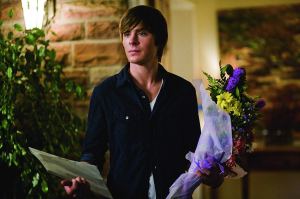 The body swap genre can be counted on for some decent fish-out-of-water laughs and some earned wisdom. Usually transporting young people into older bodies allows for more comedy because it leads to more socially awkward moments and the exaggerations of trying to be old before your time. 17 Again is consistently amusing enough and I was pleased that it found fun plot developments to explore from its body swap angle. So Mike is young once more but that doesn’t stop him from having, on the surface, inappropriate feelings for Scarlett. On top of that, teen Mike must beware the romantic advances of his own teenage daughter. Yes, the movie simultaneously explores robbing-the-cradle romance while dodging incestuous pratfalls al la Back to the Future. There is uncomfortable father-daughter sexual tension without getting too perverse. These two wrinkles nicely take advantage of the older person body swap premise and add some spice to an otherwise safe and sunny movie. Besides that, if you’ve seen any body swap movie from the past (and the 1980s were littered with body swap movies) then you’ll know exactly how everything will turn out with 17 Again. The movie is mostly silly, mostly the fun kind, but it doesn’t dip into being outrightly dumb. It’s derivative but it’s not fluff. I mean the essential premise revolves around a man regretting supporting his pregnant teen girlfriend/eventual wife. You won’t find that in the Hannah Montana Movie no matter how hard you try, perverts.
17 Again isn’t great art but it works as a showcase for its appealing star, the dewy-eyed, shaggy-coifed Efron. The filmmakers clearly know their target audience because Efron is shirtless and sweaty by minute one, displaying killer abs. By minute four, he’s dancing before his big basketball game (does this kid have a clause in his contract that he must play basketball in all his movies?). 17 Again asks little of Efron and he easily delivers on that mandate with a convincing performance that easily charms. He’s also adept at comic timing, particularly when he’s sparring with Lennon. Efron has a fabulous toothy grin and he’s a good-looking pup, but the jury’s still out on whether or not this kid can go the distance. He’s improved considerably since the first High School Musical launched his mug onto thousands of household products. He probably doesn’t have an Oscar in his future but he certainly will be headlining movies for years to come. He’s more movie star than actor, but let’s not mince words, the kid is a star (fun fact: Efron’s first acting credit is for an episode of Joss Whedon’s Firefly).
The supporting cast surrounding Efron greatly add to the film’s surprise enjoyment. The subplot involving adult dweeb Ned romancing the principal (Melora Hardin) is an amusing diversion that manages to make me like all of the characters more. Lennon (Reno 911!) steals every moment he’s onscreen and develops a kooky chemistry with Hardin (TV’s The Office). The more these two actors interacted the more I wanted the movie to ditch everyone else. Mann gets the thankless job as “upset wife” but brings a spark to the character without coming across as grating. Trachtenberg (Euro Trip, TV’s Gossip Girl) is actually 23 years old but her youthful looks seem to lock her into teenage girl roles. Look out for cameos by comedians like Jim Gaffigan and Margaret Cho. Perry must have enjoyed working for about a week and cashing his check. Also, Perry looks absolutely nothing like Efron and appears to be over a foot taller than his younger, more genetically blessed doppelganger.
 I feel sympathy for the editor of 17 Again, because clearly script supervisor Steve Gehrke must have been asleep for the entire film shoot. There are continuity gaps galore in this movie. Now, normally I don’t care so much about mild continuity errors in a movie because that’s just part of moviemaking. So if a character sits up in bed and the sheets are a few inches lower, or in a different ruffled state, well who cares? But when errors compile wildly and become flagrant distractions, then the movie has a problem and the script supervisor, the person in charge of catching those errors in progress, failed miserably. When teen Mike eats a hamburger in the school cafeteria it goes from being in his hands, out of his hands, having a bite out of it, and then magically reformed. Even worse is a moment when teen Mike is nursing a battle wound and his wedding ring keeps changing hands. Why would anyone even bother switching hands for a ring to begin with? That sounds like an easily avoidable hassle. To be fair, there are several factual errors that are not Gehrke’s total fault, though I’m dumfounded why no one else caught these. In 1989, the coach yells at Mike to quite dancing and refers to him as “Vanilla Ice,” but Vanilla Ice didn’t release his debut album until 1990 (apparently the coach knows his underground white hip-hop). What’s even more puzzling is that this pop culture reference is destined to sail over the heads of Efron’s target tween audience. All of this is easily verifiable. I won’t even get into Mike referring to “hippogriffs” 10 years before Harry Potter was published.
17 Again is a pleasant enough confection that is undemanding and yields some laughs and enough heart. The movie manages to be more mature than expected thanks to some kinky-for-PG-13 sexual tension and yet the movie is a harmless good time at the movies. Efron carries the movie ably but he’s got a great supporting cast to help carry the comedy load. Body swap movies are all invariably the same, and truly 17 Again must have been born with the sentence, “It’s reverse-Big.” It’s playful and light and cheery and pretty much an adept project for its star. It’s a small step in the right direction for Efron, and perhaps his fan base will start including more than squealing teenager girls primed to swoon at a moment’s notice. Swooning: it’s not just for the youngsters any more.
Nate’s Grade: B
Share this:

I Love You, Man (2009)
 A thoroughly genial comedy, I Love You, Man is an easily enjoyable flick that has fun upending romantic comedy tropes. The movie follows Peter (Paul Rudd) and his search for a “bromance,” a heterosexual male friendship that follows similar dating patterns seen in typical romantic comedies. Peter finds his match with Sydney (Jason Segel), a semi-sophisticated slob. Rudd has been a superb smartass in so many movies, which makes it all the more surprising at how incredible awkward he plays Peter. This man seems embarrassed with every breath he takes. It becomes moderately endearing to see him break out due to his male bonding with Sydney; the nice guy comes of age by becoming impolite and vulgar. The plot takes some predictable turns, like when Peter’s fiancé (Rashida Jones) is upset that her man wants to spend more time with his new pal than with her. Rudd is the most charming actor on the planet, which makes it somewhat wasteful to stick him as a straight man in a comedy. Segel takes great advantage of his character’s boorish behavior and is consistently funny. The supporting actors lift their underwritten roles, especially Jon Favreau as an altogether asshole. I Love You, Man banks on plenty of pleasant vibes and amusing performances. It may never be a gut-buster when it comes to laughs and it may not be fully lovable but it’s certainly easy to like.
Nate’s Grade: B
Share this:

RocknRolla (2008)
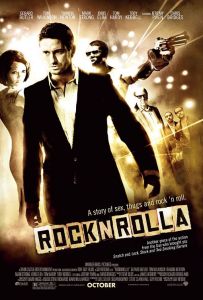 I’m a fan of Guy Ritchie’s convoluted cockney comedic crime capers (wow, check out that alliteration), but this movie is just plodding and dull. The trouble is that Ritchie works best when he has one foot in the fantastic, with comically over-the-top and menacing underworld personalities. A Ritchie movie usually involves a lot of crisscrossing characters, but this is his first film where I couldn’t keep the folks straight, I couldn’t understand much of the personal connections, I couldn’t understand the purpose of the various characters and their various interplay, and frankly, I never bothered to care. RocknRolla has maybe two colorful characters (all hail Tom Wilkinson as a sleazy real estate gangster), but the rest of the movie is overstuffed with bland and forgettable toughs. What the hell are Ludacris and Jeremy Piven doing here? You could eliminate half of the cast and the movie would barely be affected. This movie is just way too straight and square for its own good. Ritchie is still a top-notch visual stylist, and the movie has a terrific deep focus digital video cinematography, but there are very few moments or visual flourishes in this flick that prove to be remotely memorable. I hope Ritchie does not make good on his promise to continue telling more stories with these characters and in this style because this many needs to get back to what he does so well, and that is telling the darkly comic escapades of larger than life Dick Tracy-esque villains and scoundrels.
Nate’s Grade: C
Share this:

Confessions of a Shopaholic (2009)
 Releasing a romantic comedy about a woman plagued by credit woes in the middle of a global financial meltdown? Doesn’t sound like the best example of escapist entertainment, but Confessions of a Shopaholic is infectious fun, and it’s all thanks to the delightfully funny lead performance by Isla Fisher. She seems like she stepped out of one of the old Hollywood screwball comedies from the 1930s. There’s a terrific hunger in her eyes and the woman knows how to punctuate a joke. The movie itself isn’t too shabby either. As far as formulaic romantic comedies go, this is one of the better ones in recent years. It has a little dash of everything, from slapstick to farcical thriller to romance to even some mildly potent drama. Director P.J. Hogan (Muriel’s Wedding) keeps the movie light and fun and even spruces up the flick with some interesting visuals, like animated CGI mannequins that come alive to tempt Fisher. Even though the movie holds onto a sitcom level plot for too long (mistaken identity), Confessions of a Shopaholic is a far worthier piece of entertainment than typically found in the rom-com genre, and Fisher is a comedian to rival the best.
Nate’s Grade: B+
Share this:

Bride Wars (2009)
 In early 2007, it seemed like Eddie Murphy was destined to win a Best Supporting Actor Oscar for Dreamgirls. The funnyman was racking up honors for his fiery portrayal of a fallen Motown singer. Then came ads for the atrocious Norbit where Murphy played three roles, including a grotesquely overweight woman and a racist portrayal of an old Asian man. Was it much of a surprise then when Murphy lost out to Alan Arkin (Little Miss Sunshine) whose character died halfway into the film? I suppose Academy voters took long looks at those appalling Norbit ads and said, “Academy Award-winning star of Norbit? I don’t think so.” Earlier in 2008, Anne Hathaway starred in Rachel Getting Married and became a surefire Oscar contender with her bitterly funny portrayal of an ex-druggie released for her big sis’ wedding. Hopefully the Academy will ignore the awful comedy Bride Wars or Hathaway will be doomed to follow Murphy’s lead (personally I think this is Kate Winslet’s year).
Liv (Kate Hudson) and Emma (Hathaway) have been dreaming of getting married since they were little girls. Both girls were at New York City’s Plaza Hotel and witnessed a wedding reception. They both swore that day to get hitched at the luxurious hotel. The girls grow up and Liv works as a hotshot attorney and Emma is a schoolteacher. Both get proposed at the same time and the high-pitched squealing ensues. Emma wants Liv to be her maid of honor and vice versa. The ladies seek the services of Marion St. Claire (Candice Bergen), the greatest wedding planner in the city. She delights the duo by booking them for two June wedding dates at the illustrious Plaza Hotel. Then comes the bad news. The booking dates got mixed up and the weddings are booked on the same day. The next open date at the Plaza is in three years time. Both women refuse to budge. Then a bridal arms race begins. Each would-be bride tries to sabotage the other’s wedding preparations.
 Bride Wars is indulgent and tiring and occasionally obnoxious, much like the main characters. These characters are one-note and the movie drills that one note repeatedly; Liv is domineering and Emma is a pushover. I don’t care about these characters, and when the movie ramps up the sentiment in the final 20 minutes it doesn’t work because I feel no emotional attachment, and waning interest, in these people. Hudson’s Liv serves as the real antagonist for like half the movie’s running time. She comes across as brash, pushy, unlikable, narcissistic, and overbearing, and her unflagging desire to win is what pushes the conflict. Emma and Liv view their husbands-to-be more as accessories to their collective Big Days, and the movie seems to treat them the same way. The three bland male leads (Bryan Greenberg, Chris Pratt, Steve Howey) even look vaguely the same, and Bride Wars just allows them to slowly fade away. Like the Sex and the City movie, the women come across as deeply shallow and petty, people more worried about ceremony than every day after that fairy tale wedding. The film’s comedic focus is on uninspired slapstick and the pranks that the ladies play. Bride Wars practically excuses the bridezilla bedlam because it eventually makes Emma a stronger person who can stand up for her self after long last.
The initial conflict seems trite and readily negotiable. So the girls have their weddings scheduled on the same day, and they can’t work this out? Why such drama if they’re both lifelong best friends? They couldn’t just have a double wedding? Here’s what I don’t understand. Marion tells our ladies that the Plaza has three June openings, two on the 6th and one at the end of the month. Liv gets one date and Emma gets the other date, and then a third woman (co-writer and Saturday Night Live actress Casey Wilson) grabs the final June 6th slot. So when Marion announces that her assistant switched the dates, why wouldn’t the third woman want to swap back? She’s been planning for her wedding to be on June 6, so why wouldn’t she want to keep the date she already agreed upon? Likely this woman has begun to plan around the specific date and it would make much more sense to maintain continuity. And it is this contrived conflict that sets Bride Wars loose.
The script is lazy and the PG-rating all but neuters the bitch fest. This setup was begging for the claws to be unleashed but the filmmakers play it safe. It can’t get too messy because everything must be made nice and tidy by the conclusion. The acts of sabotage never get too out of hand. This is less a war and more of a scuffle. Bride Wars trades in nothing but stereotypes and stock characters (including the late addition of Liv’s brother who obviously has a decade-long crush on Emma), and I expect that from chick flick fluff, but the movie just misses so many obvious comedic opportunities. The girls have a group of friends that offer no commentary on the situation. One of their friends is unhappily newly married and could offer plenty of sarcastic quips. Liv has her hair dyed blue at a salon and nobody in the movie makes a single joke about the wedding staple of wearing something blue? How is this even possible for a movie about weddings? That’s just a glaring oversight.
 Hudson and Hathaway are far better than this material, though Hudson is credited as a producer. Perhaps she can explain why she chose a haircut that makes her head look humongous. Seriously, her head looks gigantic, especially when she stands beside the coltish Hathaway who has quite a cylindrical noggin. Hathaway comes across the better of the two. Hudson has proven adept at goofy comedy but she just comes across as a bully. Kristen Johnston (TV’s Third Rock from the Sun) looks alarmingly thin. Somebody should check up on her.
To dismiss Bride Wars as a chick flick is to miss the point. Women deserve better than this mediocre comedy that showcases women as harpies worshiping marital materialism. The characters are annoying and vapid, the conflict is boneheaded and contrived, the comedy is watered down, and the lead actresses are wasted. Because something is a chick flick does not excuse it for being poorly manufactured. Bride Wars does not reflect well upon anyone involved, from the actors, to the director, to the writers, to the people that got people coffee. The movie isn’t monstrously bad but it is a banal piece of entertainment. Women, men, and all people deserve better no matter the genre classification.
Nate’s Grade: C
Share this:

An American Carol (2008)
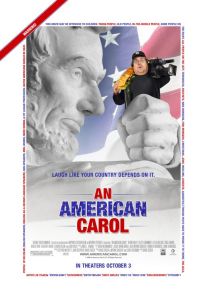 Being a conservative in Hollywood is like being a gay Republican – tough business. Director David Zucker has a notable history with comedy, having helmed Airplane!, the Naked Gun series, and the back half of the Scary Movies. He says that he converted to conservatism in the wake of 9/11, and Zucker actually wrote and directed a short for the 2004 Republican National Convention that was deemed too edgy for the Grand Old Party. Conservatives have also garnered the reputation for not having the best sense of humor, and Zucker’s An American Carol will do little to change this belief.
Michael Malone (Kevin Farley) is an egotistical, fat, liberal documentary filmmaker whose latest work is titled, “Die You American Pigs.” Catchy, ain’t it? Malone wants to abolish the Fourth of July (would we just skip to July 5th?) and plans to protest a Trace Adkins concert for the troops. A batch of inept Islamic terrorists want to bomb the concert and decide into tricking Malone into assisting their goal. He will score them media passes to get onstage at the concert venue. Following the Charles Dickens’ playbook, Malone is first visited by the spirit of his idol, John F. Kennedy (Chriss Anglin), who horrifies Malone by saying war is sometimes necessary (really, conservatives are trying to reclaim Kennedy?). Three spirits will visit him although he spends almost all of his time with the ghost of General Patton (Kelsey Grammer). The ghostly general takes Malone on a trip to see what the alternative versions of U.S. history had the country avoided war at all costs. Malone stays defiant until he meets up with the Angel of Death (also Trace Adkins, because?) and sees the error of his “America-hating” ways. I don’t want to spoil things too much but the movie ends with an expanded Trace Adkins concert saluting the brave men and women in the armed forces.
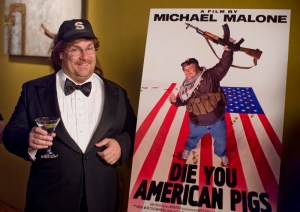 Some from the opposing political viewpoints will find An American Carol to be infuriating. To those angry few I say get over it, because this movie is simply too lazy to get angry over. It barely reaches 77 minutes before the credits roll. Zucker and company tend to stretch their canvas too broadly, to the point that they aren’t exaggerating to lampoon but setting up cheap jokes. Michael Malone is fat. Michael Malone smells. Michael Malone falls down. Liberals hate America and want the terrorists to win. It’s so easy to write this material because there’s nothing topical or nuanced or even socially relevant. The movie beats reliable figures of conservative agita. When the movie tries to slam college professors as being dippy hippies brainwashing teens about the insurmountable ills of America, it just gets dumb (those people spend 10-15 years studying in a specialized academic field). There is no teeth to any of this satire because it’s all just recycled caricatures with the wit ground down. There isn’t anything of true satirical substance here. I don’t even get some of the satire, like the ACLU is depicted as a cluster of zombies with briefcases. What does that mean? Needless to say, the skewering of Arabs is mostly cartoonish and offensive. The flick constantly makes fun of the documentary art form, saying they are inferior to “real movies.” Because Michael Moore has an Oscar does that mean that the history of documentary film has to be slandered as being nothing more than transparent propaganda (at an awards ceremony, the top documentary is honored with the “Leni Riefenstahl Award”)? Marginalizing an entire art form seems rash, especially considering that Moore’s Fahrenheit 9/11 grossed over $220 million worldwide. As of this writing, An American Carol, a “real movie,” has grossed seven million and counting.
The film deals in distasteful absolutes. Every idea is presented crudely in black and white. By the film’s standards, being anti-war and anti-troops are inseparably linked. In my mind, and this might be crazy, but it seems to me that the most pro-troops one could be would be hoping for them all to return home alive and healthy. An American Carol attempts to justify the ongoing War in Iraq, though it conveniently only ever flashes to combat in Afghanistan, the war that a majority of the public agrees with. It makes a case that war is sometimes necessary, though it has to flash back to Hitler and World War II to find a morally justified military engagement that everyone can feel god about. I agree that war is sometimes a reasonable option, but the movie paints all pacifists as wimpy appeasers. George Washington (Jon Voight) even steps in at one point to argue for the necessity of war in reference to the War on Terror. Did the filmmakers forget that Washington spent great expense to keep the nation out of foreign wars in his two terms? Isn’t it also condescending and objectionable to have Washington say freedom of speech is misused when it goes against the government? I think the Founding Fathers would realize the importance of freedom of speech, including offensive speech. Isn’t it also somewhat ironic to use slave-owners as mouthpieces for the merits of freedom? An American Carol says that disagreement is the same as dissent; so refusing to support one’s government blindly during a time of war is traitorous. Criticism is not anti-American. It’s insulting to all rationale human beings. Zucker and crew make their case look just as myopic and dismissive as those they choose to ridicule.
The acting neither hinders nor helps the material. Farley is a game comedian but he cannot do much with such lightweight material. There are several celebrity cameos including James Woods, Dennis Hopper, Bill O’Reilly, Mary Hart, David Alan Grier, Gary Coleman, Leslie Nielsen, Zachary Levi, Kevin Sorbo, and Paris Hilton. When Zucker is calling favors into the likes of Paris Hilton, you know things cannot be solid.
 Here’s the problem. It’s harder to satirize from a conservative point of view. Conservatism believes that the status quo is best or that things were better back in the day. Liberalism believes that society can always improve, so a liberal point of view would tweak the present situation in order to call attention to remaining improvements. A conservative point of view would make fun of that possible change. This is the same reason why documentaries, like it or not, typically have a more progressive bent, and it’s because the filmmakers are presenting a case for change or outrage. Why would anyone devote himself or herself for years to create a film that says the world is peachy? Now I’m not saying that conservatism and humor are conflicting concepts, but it just makes it harder to be smarter. Making fun of Good Night, and Good Luck is not trying hard enough. How dare George Clooney make a film about the media cowering and failing to question our elected leaders and have it be applicable to today’s world.
The Zucker gag-a-minute spoof style doesn’t necessarily translate well to political satire. I wasn’t expecting much with An American Carol. When they exploit 9/11, taking Malone to the wreckage of the World Trade Center to make its case, well the movie stops being a satire and just implodes. It hits its tired targets with a sledgehammer. The satire is extremely lazy, the slapstick is dumb, and the movie specializes in being obnoxious, coloring the world in two extremes. This isn’t satire. This is just cheap and petty. Seriously, making fun of Michael Moore is like four years too late. Moore is a figure worthy of satire but the best that the movie can come up with is he’s fat and hates America? That he’s angry because he couldn’t get girls when he was younger and all those studly military recruits did? That’s not satire, that’s just excessive name-calling. An American Carol presents a new low for Zucker and I think even he knows it. On the DVD commentary track, Zucker, co-writer Lewis Friedman (BASEketball), and actor Kevin Farley basically lambaste the final product, often criticizing their own movie. The derisive commentary track is more enjoyable than the film itself.
Nate’s Grade: C-
Share this:

Miss Pettigrew Lives for a Day (2008)
 The movie seems to float on the effervescent air of 1930s screwball comedies, and in truth it does possess some of that snappy allure. Francis McDormand travels into the inner circle of the upper social classes in London and befriends a bubbly lounge singer, played by bubbly actress Amy Adams. The film moves at a ridiculously fast pace, sometimes too fast as it tries to pile on complications and setbacks. This day-in-the-life confection is sweet and well natured but rather too digestible. Once the movie is over I do not see myself ever dwelling upon it once again. It’s a pleasant and entertaining experience even if it dances right out of your memory.
Nate’s Grade: B
Share this:

Then She Found Me (2008)
 Actress Helen Hunt’s directorial debut is an altogether pleasant film experience without achieving anything memorable or truly accomplished. It’s a simple story of a 40-something grade school teacher (Hunt) torn between her man-boy husband (Matthew Broderick) and a student’s hot father (Colin Firth, who seems to be a middle-aged woman’s dream come true). The extra plotline where Hunt discovers the identity of her biological mother (Bette Midler) never truly seems to coalesce with the romantic foibles. Then She Found Me has a noticeably wry tone, like that of a world-weary adult that’s been-there-done-that. That specific and welcomed tone helps keep the viewer alert and mostly satisfied from beginning to end. It isn’t a warm or sappy movie despite some sitcom-level plot complications. The acting is fairly amusing, though somewhat one-note (the foursome of actors rarely break from the one-sentence descriptions of their characters). The most shocking aspect of the flick is how weathered and gaunt Hunt looks, which is a refreshing and realistic turn for the actress. Hunt is competent behind the camera but doesn’t prove much else when it comes to directorial skills. Then She Found Me is a mildly affecting movie that passes the time well. Stick around to catch acclaimed author Salman Rushdie as Hunt’s OB-GYN.
Nate’s Grade: B
Share this:

Drillbit Taylor (2008)
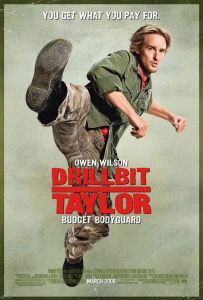 This is a case where a movie feels stuck between two different aims. The premise of a group of geeks hiring a bodyguard to protect them from high school bullies feels dramatically dated, like an idea that John Hughes could have cranked out over a weekend in the 1980s. Owen Wilson stars as a homeless Army vet that agrees to be the bodyguard but he intends to fleece the kids of their money. Eventually the film culminates in the geek trio violently fighting the bully, which is kind of a weird climax to a mainstream teen-centered film. The main bully is actually psychotically dangerous and the movie exists in a realm where every adult character is a cretin or a moron. Don’t even think about security in the school. The jokes aren’t as lively or clever as the movie would like to think, but special credit must be awarded for collecting a group of teen actors that look authentically geeky. Drillbit Taylor is a safe vehicle for Wilson because he’s played a variation of this zen-cool character in many movies. I’m honestly surprised that Seth Rogen is a co-writer and that Judd Apatow produced this flick. This is noticeable below their standards. This movie isn’t anything special and it’s tonally all over the place, but then it does have some funny situations, some amusing character interplay, and some dependable slapstick. Think of it as a sanitized PG version of Superbad combined with an 80s movie.
Nate’s Grade: C+
Share this:

Role Models (2008)
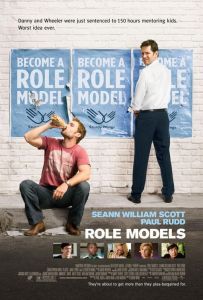 Is there an actor alive more charming than Paul Rudd? The always-affable actor has a terrific sarcastic yet lovable presence that never dips into being glib. Role Models is a great showcase for his sly comedic talents. The plot of irresponsible adults (Rudd, Sean William Scott) learning to be responsible by being big brothers to problem kids (Christopher Mintz-Plasse, Bobb’e J. Thompson) is mostly conventional, but it’s the character camaraderie that makes the movie special. Watching the cast interact is a great pleasure, and they constantly add sustained laughs that seem organic to the plot and the characters. I found myself laughing out loud steadily, and although the ending is a bit formulaic I was amused that film didn’t break character once. It goes for gusto when it comes to embracing the geekery and cheesiness of a climactic medieval battle. There are witty running gags, rewarding payoffs, and the film even packs some heart, though it never gets sentimental. Combine a wicked comedic turn by the daffy Jane Lynch and some added Elizabeth Banks sparkle, and it all adds up into what might be the most satisfying mainstream comedy in a non-Judd Apatow-directed year.
Nate’s Grade: B+


You must be logged in to post a comment.