Blog Archives
Jay and Silent Bob Reboot (2019)
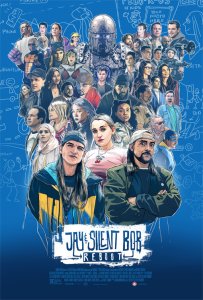 Jay and Silent Bob Reboot is strictly made for writer/director Kevin Smith’s fanbase, so does trying to play outside this cultivated audience even matter? Honestly, there’s no way this is going to be anyone’s first Smith movie, so it’s already running on an assumed sense of familiarity with the characters and stories of old, which is often a perquisite to enjoying many of the jokes (more on this later). It’s been 25 years since Clerks originally debuted and showcased Smith’s ribald and shrewd sense of dialogue-driven, pop-culture-drenched humor. He’s created his own little sphere with a fervent fanbase, so does he need to strive for a larger audience with any forthcoming movies or does he simply exclusively serve the existing crowd?
Jay (Jason Mewes) and his hetero life-mate Silent Bob (Smith) are out for vengeance once again. Hollywood is rebooting the old Bluntman and Chronic superhero movie from 2001, this time in a dark and edgy direction, and since Jay and Silent Bob are the inspirations for those characters, even their likenesses and names now belong to the studio. The stoner duo, older and not so much wiser, chart a cross-country trip to California to attend ChronicCon and thwart the filming of the new movie, directed by none other than Kevin Smith (himself). Along the way, Jay and Bob discover that Jay’s old flame, Justice (Shannon Elizabeth), had a daughter, Millennium “Milly” Falcon (Harley Quinn Smith) and Jay is the father. Milly forces Jay and Bob to escort her and her group of friends to ChronicCon and Jay struggles with holding back his real connection to her.
 One of my major complaints with 2016’s Yoga Hosers (still the worst film of his career) was that it felt like it was made for his daughter, her friends, and there was no point of access for anyone else. It felt like a higher-budget home movie that just happened to get a theatrical release. Jay and Silent Bob Reboot feels somewhat similar, reaching back to the 2001 comedy that itself was reaching back on a half-decade of inter-connected Smithian characters. There is a certain degree of frantic self-cannibalism here but if the fans are happy then does Smith need to branch out? This is a question that every fan will have to answer personally. At this point, do they want new stories in the same style of the old or do they just want new moments with the aging characters of old to provide an ever-extending coda to their fictional lives?
I certainly enjoyed myself but I could not escape the fact at how eager and stale much of the comedy felt. Smith has never been one to hinge on set pieces and more on character interactions, usually profane conversations with the occasional slapstick element. This is one reason why the original Jay and Silent Bob Strikes Back suffers in comparison to his more character-driven comedies. Alas, the intended comedy set pieces in Reboot come across very flat. A lustful fantasy sequence never seems to take off into outrageousness. A drug trip sequence begins in a promising and specific angle and then stalls. The final act has a surprise villain that comes from nowhere, feels incredibly dated, and delivers few jokes beyond a badly over-the-top accent and its sheer bizarre randomness. There’s a scene where the characters stumble across a KKK rally. The escape is too juvenile and arbitrary. A courtroom scene has promise when Justin Long appears as a litigation attorney for both sides but the joke doesn’t go further, capping out merely at the revelation of the idea. This is indicative of much of Reboot where the jokes appear but are routinely easy to digest and surface-level, seldom deepening or expanding. There’s a character played by Fred Armison who makes a second appearance, leading you to believe he will become a running gag that will get even more desperate and unhinged with each new appearance as he seeks vengeance. He’s never seen again after that second time. There are other moments that feel like setups for larger comedic payoffs but they never arrive. The actual clip of the Bluntman and Chronic film, modeled after Zack Snyder’s Batman v. Superman, is almost absent any jokes or satire. There are fourth-wall breaks that are too obvious to be funny as they rest on recognition alone. There’s a running joke where Silent Bob furiously taps away at a smart phone to then turn around and showcase a single emoji. It’s cute the first time, but then this happens like six more times. Strangely it feels like Smith’s sense of humor has been turned off for painfully long durations on this trip down memory lane. The structure is so heavily reminiscent of Jay and Silent Bob Strike Back that there are moments that repeat step-for-step joke patterns but without new context, meaning the joke is practically the repetition itself.
 The problem with comedy is that familiarity can breed boredom, and during the funny stretches, I found myself growing restless with Reboot as we transitioned from stop to stop among the familiar faces. I enjoyed seeing the different characters again but many of them had no reason to be involved except in a general “we’re bringing the band back together” camaraderie. It’s nice to see Jason Lee again but if he doesn’t have any strong jokes, why use him in this way? Let me dig further with Lee to illustrate the problem at heart with Reboot. Jay and Silent Bob visit Brodie (Lee) at his comic book shop, which happens to be at the mall now. He complains that nobody comes to the mall any longer and he has to worry about the “mallrats,” and then he clarifies, he’s talking about actual rodents invading the space, and he throws a shoe off screen. I challenge anyone to find that joke amusing beyond a so-bad-it’s-fun dad joke reclamation. I kept waiting for Smith to rip open some satirical jabs on pop culture since 2006’s Clerks II. In the ensuing years, Star Wars and Marvel have taken over and geek culture and comic books rule the roost. Surely a man who made his name on these topics would have something to say about this moment of over saturation, let alone Hollywood’s narrow insistence on cash-grab remakes. I kept waiting for the Smith of old to have some biting remarks or trenchant commentary. Milly’s diverse group of friends (including a Muslim woman named “Jihad”) is referred to like it’s a satirical swipe at reboots, but there isn’t a joke there unless the joke is, “Ha ha, everyone has to be woke these days,” which is clunky and doesn’t feel like Smith’s point of view. There are several moments where I felt like the humor was trying too hard or not hard enough. As a result, I chuckled with a sense of familiarity but the new material failed to gain much traction.
I do want to single out one new addition that I found to be hysterical, and that is Chris Hemsworth as a hologram version of himself at a convention. The Thor actor has opened up an exciting career path in comedy as highlighted by 2017’s Ragnarok, but just watching his natural self-effacing charm as he riffs about the dos and don’ts of acceptable behavior with his hologram is yet another reminder that this man is so skilled at hitting all the jokes given to him.
 Where the movie succeeds best is as an unexpected and heartfelt father/daughter vehicle, with Jay getting a long-delayed chance to mature. It’s weird to say that a movie with Jay and Silent Bob in starring roles would succeed on its dramatic elements, but that’s because it feels like this is the territory that Smith genuinely has the most interest in exploring. The concept of Jay circling fatherhood and its responsibilities is a momentous turn for a character that has previously been regarded as a cartoon. His growing relationship with Milly is the source of the movie’s best scenes and the two actors have an enjoyable and combative chemistry, surely aided by the fact that Mewes has known Harley Quinn Smith her entire existence. This change agent leads to some unexpected bursts of paternal guidance from Jay, which presents an amusing contrast. There’s a clever through line of the difference between a reboot and a remake, and Smith takes this concept and brilliantly repackages it into a poignant metaphor about parenthood in a concluding monologue. Smith’s position as a father has softened him up a bit but it’s also informed his worldview and he’s become very unabashedly sentimental, and when he puts in the right amount of attention, it works. There’s an end credit clip with the late Stan Lee where Smith is playing a potential Reboot scene with Stan the Man, and it’s so sweet to watch the genuine affection both men have for one another. I’m raising the entire grade for this movie simply for a wonderful extended return of Ben Affleck’s Holden McNeil character, the creator of Bluntman and Chronic. We get a new ending for 1997’s Chasing Amy that touches upon all the major characters and allows them to be wise and compassionate. It’s a well-written epilogue that allows the characters to open up on weightier topics beyond the standard “dick and fart” jokes that are expected from a Smith comedy vehicle. It’s during this sequence where the movie is allowed to settle and say something, and it hits big time.
The highly verbose filmmaker has been a favorite of mine since I discovered a VHS copy of Clerks in the late 90s. I will always have a special place reserved for the man and see any of his movies, even if I’m discovering that maybe some of the appeal is starting to fade. I don’t know if we’re ever going to get a Kevin Smith movie that is intended for wide appeal again. Up next is Clerks 3, which the released plot synopsis reveals is essentially the characters of Clerks making Clerks in the convenience store, which just sounds overpoweringly meta-textual. He’s working within the confines of a narrow band and he seems content with that reality. I had the great fortune to attend the traveling road show for this film and saw Smith and Mewes in person where they introduced Reboot and answered several questions afterwards. Even though it was after midnight (on a school night!) I was happy I stayed because it was easy to once again get caught up in just how effortlessly Smith can be as a storyteller, as he spins his engaging personal yarns that you don’t want to end. As a storyteller, I’ll always be front and center for this gregarious and generous man. As a filmmaker, I’ll always be thankful for his impact he had on my fledgling ideas of indie cinema and comedy, even if that means an inevitable parting of ways as he charts a well-trod familiar path. Jay and Silent Bob Reboot is made strictly for the fans, and if you count yourself among that throng, you’ll likely find enough to justify a viewing, though it may also be one of diminished returns.
Nate’s Grade: C+
Share this:

Dolemite is My Name (2019)
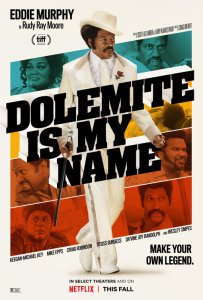 I’m a sucker for behind-the-scenes movies on scrappy genre indies, following a band of creatives come together, build camaraderie, and serve as the underdogs we root for as they put on their fun show, so Dolemite is My Name is right up my alley. It’s a biopic on Rudy Ray Moore (Eddie Murphy), who by the 1970s rebranded himself in his 40s when he began performing as an outrageous, rhyming pimp character named Dolemite. He recorded crude comedy albums, sold them out of the back of his trunk, and reached a new level of fame, but he sought a blaxploitation movie to get him to even further heights. This movie is akin to The Disaster Artist where we watch a lot of artists pull off a bad movie with little money, as well as 2004’s Baadasssss!, where Mario Van Peebles recreated the making of his father’s 1971 blaxploitation hit, Sweet Sweetback’s Baadasssss Song. Chances are, if you enjoyed either of those two movies, or the hilarious blaxploitation spoof Black Dynamite, you will be smiling aplenty with this new Netflix movie (given a short theatrical run and soon to be widely available via streaming). The movie belongs to Murphy, who hasn’t had a part in three years, and he comes roaring to life as Moore, a man who won’t let anything stand in the way of his dreams. Murphy is fully captivating in every scene as he turns the Dolemite persona on and off, sharing moments of personal insight and fear, like when he’s nervous over his physique with an upcoming sex scene for his movie. He’s a determined hustler and it’s hard not to fall for his grinning charm. The Dolemite movie has a special appeal because it was intended as a comedy, so the shoestring, scrappy nature of it works nicely with the good intentions of simply making a big, silly, kung-fu-filled action comedy with what audiences want. I’ll confess I never found any of Moore’s standup to be funny as the audiences at the time. However, the filmmakers have already answered this, as Moore and pals go see The Front Page, a movie dubbed by critics as a laugh-out-loud comedy, and the men sit stone-faced and confused throughout the pithy, erudite comedy that seems to be amusing the largely white, WASP-y crowd. Humor is subjective, but not only that it’s the kind of entertainment with the shortest shelf life. It’s naturally going to expire quickly. Comedy routines we found hilarious decades ago might not still be funny today, and that’s okay. Dolemite came out at the right time and influenced other artists and filmmakers. A behind-the-scenes film is destined to be a movie with a definite ceiling. Moore is an interesting success story but there’s only so much to be gleaned from this underdog tale. Thanks to writers Larry Karaszewski and Scott Alexander (Ed Wood, The People vs. O.J. Simpson) and the energy of Murphy, Dolemite is My Name is a fun two hours with a bunch of cut-ups.
Nate’s Grade: B
Share this:

The Peanut Butter Falcon (2019)
 It’s a beguiling little buddy movie about a wrestling fan with Down syndrome (Zack Gottsagen) escaping his care facility, joining forces with a runaway screw-up (Shia LaBeouf) in over his head, and the nursing home assistant (Dakota Fanning) looking to find her charge so they can all sail down the river and meet an old wrestling coach (Thomas Haden Church) who may or may not exist. It’s an episodic journey that hearkens to Mark Twain and 90s indie cinema with its unorthodox family dynamics. The real pleasure of the movie is watching LaBeouf and newcomer Gottsagen bond, whether it be building a raft, channeling larger-than-life wrestling personas, running away from a vengeful criminal (John Hawkes), getting baptized by a blind man, and simply finding time to become friends. It’s one of those “journey, not the destination” films because by the end The Peanut Butter Falcon is nice but rather unremarkable. It’s amusing and sweet but the advertising was filled with heightened exclamations such as, “The sweetest damn film of the decade.” As I sat in my theater, I was wondering if there was something wrong with my ticker; it wasn’t exactly feeling too full from the onscreen proceedings. It felt like there were core elements here that could have been further built upon, further developed, to turn The Peanut Butter Falcon from a relatively good movie into a great one. It’s well acted and the photography of the South can be gorgeous. LaBeouf (American Honey) is genuinely terrific and carries the movie on his back as a beleaguered soul still wounded from personal tragedy. The way he becomes the biggest supporter and advocate for his new friend is heartening without feeling overly trite or saccharine. However, by the end, I didn’t feel too uplifted or moved by the accumulative adventures. I enjoyed myself, but much like a Twain story, it’s more the teller than the tale, and by its winding conclusion I felt like there was too much left behind unexplored.
Nate’s Grade: B-
Share this:

Where Did You Go, Bernadette? (2019)
 I have no idea who Where Did You Go, Bernadette? is for. It’s based upon a best-selling book, directed and adapted by Richard Linklater (Boyhood), and starring great actors, chief among them Cate Blanchett in the title role. After a half hour, I kept wondering why I wasn’t engaged with what was happening, why everything felt so directionless, and I’m still looking for answers. I felt like the movie was gaslighting me because so many characters devote so much time to preach that Bernadette is the worst. She’s no rabble-rousing outsider setting fire to the world; she’s just a quirky out-of-work architect with some undiagnosed mental illness. Yet the other people want to convince me that she’s anti-social, that she’s mean, that she’s ruinous, and I just never saw much evidence on screen. This is symptomatic of the movie’s problem of characters talking in declarative statements, telling the audience things we need to know, but rarely do we see these events. It felt like I was watching a movie where everyone else had seen some prequel and was relying on that information, leaving me out of the loop to catch up. It felt like I was being talked at. The movie feels like it’s lacking a spark and a workable tone. It feels like it’s presenting quirk but without whimsy, so things are recognized as offbeat and just left there alone. Thank God for Blanchett, who delivers a sturdy and great performance as a woman losing her sense of self and trying to follow her passions. She’s funny, defiant, vulnerable, and has the dramatic potential to be even more involving. An extended third act in Antarctica feels like the movie is just biding its time for a reunion, something that already feels low stakes given that everyone is on the same page and would eventually find one another anyway. The pacing of the movie and its slipshod structure contribute to its sluggish sense of direction and a whopping 130 minutes in length. Where Did You Go, Bernadette? wants us to believe that Bernadette is self-absorbed, or everyone else is self-absorbed, or that passions are worth chasing even to the opposite ends of the Earth. I don’t know. It’s a mildly amusing comedy with some dramatic moments but I wouldn’t be surprised if this quickly vanishes from theaters and few if any will be asking where exactly it went.
Nate’s Grade: C
Share this:

The Lion King (2019)
 Ever since the run-up of Disney’s live-action remakes, I’ve been predicting what would happen with the newer films, and it all seems to be coming true. The problem with Disney remaking hit animated movies from the 80s and 90s is that there hasn’t been enough distance. The immediate audience is going to demand their nostalgia exactly as they remember it, and they will not be happy with anything less. It’s not like a scenario where the original movies could be improved upon, like 2016’s beautifully tender Pete’s Dragon. What these live-action remakes offer is an uglier, inferior version of an animated classic. There’s no reason for most of them to exist. They won’t be different; they won’t be interesting. It’s a sludgy, auto-tuned cash grab that shows no end in sight. Before this year, I did not expect Tim Burton’s Dumbo to be the best of the three 2019 Disney live-action remakes, but here we are. I guess the concept of Disney eating its own tail with these live-action remakes is symbolic of the studio “circle of life,” and the perfect segue way to The Lion King, a remake missing the wonder and magic of the 1994 original.
King Mufasa (voiced by James Earl Jones again) rules over an African prairie and preparing his young son Simba (JD Mcrary and Donald Glover as an adult) for his eventual rule. Mufasa’s scornful brother Scar (Chiwetel Ejiofor) conspires to have Mufasa killed and Simba banished. Blaming himself for his father’s death, Simba runs away and finds kinship with a meerkat named Timon (Billy Eichner) and a warthog named Pumba (Seth Rogen). They preach a carefree life of “no worries.” This new life is interrupted when Nala (Beyoncé Knowles), Simba’s childhood friend, returns seeking help to remove Scar from the throne. Simba must confront his fate and treacherous uncle and bring balance back to his ailing homeland.
 The biggest appeal of director Jon Favreau’s Lion King remake is the stunning special effects. It’s been ten years since James Cameron brought to life a photo realistic alien world that dazzled audiences, and the advances have only made the professional fakery more startling. This movie was completely “filmed” inside a computer. Every single shot, every blade of grass, every pebble, every photo realistic morsel onscreen is the result of digital wizards. In 2016’s The Jungle Book, there were still some physical elements filmed, chief among them the human boy, but now it’s all done away. The remake looks like an HD nature documentary. One could question the use of the technology, $250 million to recreate what ordinary cameras on location could achieve, but I’ll choose to congratulate Disney and Favreau on the remarkable technical achievement. The Jungle Book was a big leap forward and The Lion King is that next step. However, the special effects are ultimately the only selling point. Come see how real it all looks, kids. The rest of the remake left me feeling unmoved and occasionally perplexed.
This is an almost exact shot-for-shot recreation of the original movie. It made me think of Gus van Sant’s 1998 Psycho remake and why anyone would go to this much trouble to make a copy. You’ll feel a tingle of recognition with different shots and scenes and then that feeling will transition to disappointment and lastly resignation. It’s the same, just not as good.
So what exactly is different with the live-action Lion King of 2019? Very very little. Despite totaling a half hour more movie, it really only has one added incidental Beyoncé song, a small character beat where Timon and Pumba explain their philosophy on more fatalistic terms, an explanation how Nala left the pride lands, and more poop and fart jokes. The filmmakers have added realism in appearance but also added more scatological humor, which seems like an odd combination. There is a literal plot point attached to giraffe poop. Instead of a whispery feather, petal, whatever finding its way to the baboon Rafiki to let him know Simba is still alive, now we watch the life of a tuft of fur as it travels from creature to creature, at one point being consumed on a leaf by a giraffe. The next image is a ball of poop being rolled by a beetle with our tell-tale tuft of lion fur. I guess it’s more emblematic of the whole “circle of life” theme, but I didn’t think Disney was going to literalize the poop aspect. The new Beyoncé song is fairly bland and unmemorable. That’s it, dear reader. Lion King 2019 is 95 percent identical to Lion King 1994 in plot, and yet the original writers do not earn a screenwriting credit thanks to arcane animation writing guild rules, and that is madness. It’s their story, it’s their characters, and it’s almost entirely their dialogue, and to not have their names rightfully credited where they belong is wrong.
 There are some definite drawbacks to that photo realism as well. When lions and other animals are photo realistic, they have facial structures that don’t exactly emote, so it looks like all the animals often just have their jaws wired shut. You’ll listen to the vocal actors go through a range of emotions and watch these plain, unmoved faces that you start to wonder if maybe all of the dialogue should have just been voice over. As soon as I saw Mufasa speaking, I was immediately shaken by the image and longed for the expression of the animation. I never got over it and it made me feel removed from the film, even more so. This is the trade off of realism; animals don’t actually speak, you know. Another trade off is that the film becomes much more intense especially for younger kids. I would not recommend parents take the littlelest ones to this movie because now, instead of watching a traditionally animated band of characters brawl, you’re watching realistic lions and hyenas scrape, claw, and hurl one another to their deaths. If kids were traumatized by parts of the original movie, I can only imagine the nightmares that await. Strangely, the photo realism also mitigates the film’s sense of scope and impact. The stampede sequence feels far less dangerous because the camera doesn’t pull back that far, showing a massive herd from a distance. Subsequently the sequence loses some of its urgency. Then there’s also simply identifying who may be who when those fights come, because you’re trying to pick out realistic animals instead of distinct creatures with specific character designs.
The aspects you enjoyed with the 1994 Lion King will still be enjoyable, even if they suffer in direct comparison. Hans Zimmer’s score is still magnificent. The songs are still catchy, though some of the arrangements are a bit under-cooked, like the speak-sung “Be Prepared.” The song “Can You Feel the Love Tonight?” occurs absurdly early in the Simbla/Nala reunion and takes place in the sunny afternoon. So much for “tonight” (the famous Nala “bedroom eyes” moment is also quite diminished from a real lion’s face). The jokes are still funny because they were funny the first time. The things that worked the first time will still work to some degree, even if the presentation leaves something to desire. Several of the vocal artists just sound flat, especially Ejiofor (12 Years a Slave) who comes across so blasé. I missed the casual menace of Jeremy Irons. The best vocal performances belong to Eichner (Difficult People) and Rogen (Long Shot), maybe because they’re already broad personalities, or maybe because they felt the most comfortable to occasionally steer away from the original script, finding small room to roam. Florence Kasumba (Black Panther) also delivers a snarling and effective performance as one of the hyena leaders, Shenzi. They’re the only vocal performances that fare well in competition.
 I need to defend the art of animated films. There is nothing wrong with animated films simply because they are animated. A live-action version is not better simply because it’s more “real.” I hear this same argument when it comes to making a live-action anime. Animation is a wonderful medium and has a magic all its own that often live-action cannot emulate. The animated Lion King is beautiful with bold colors, strong visual compositions, and emotive characters with specific designs. The live-action Lion King is missing much of that, at least when it’s not recreating exact shots from its predecessor. I don’t know who this movie is going to appeal to. Parents will be better off just playing the original for their children at home. Die-hard fans of The Lion King might enjoy seeing their favorite story told with plenty of cutting-edge special effects magic. I would have been happier had the filmmakers attempted something like Julie Taymor’s transformative and ground-breaking Broadway show. I would have been happier had they just recorded the Broadway show. The new Lion King is a lesser version of the 1994 movie, plain and simple, and if that’s enough for you, then have at it. For me, these Disney live-action remakes are making me feel as dead in the eyes as a photo realistic lion.
Nate’s Grade: C
Share this:

Sword of Trust (2019)
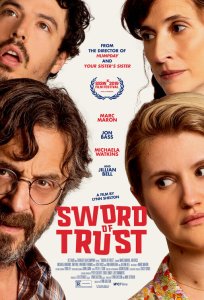 Writer/director Lynn Shelton is a filmmaker that has a habit of flying under the radar with her wonderful entries in the fly-on-the-wall hipster mumblecore sub-genre of indie dramas. The hilariously awkward Humpday punctuated insecure masculinity and was on my Top Ten list for 2009, and 2012’s Your Sister’s Sister was another laser-like focus on characters trying to deal with a lifetime of relationship secrets coming out. Both of those movies have been remade as French films too, with Humpday becoming 2012’s Do Not Disturb and Your Sister’s Sister becoming 2015’s Half Sister, Full Love (which sounds more like a porn title to my ears). Sword of Trust is one part mumblecore drama, one part screwball comedy, and a bit of a lovely, shambly mess.
Mel (Marc Maron) owns and operates a pawn shop in a small Alabama town. He’s used to losers and lowlifes and junkies coming through and giving their sad stories. Enter Cynthia (Jullian Bell) and Mary (Michaela Watkins), a gay couple looking to make the most of a strange inheritance. Cynthia’s grandfather gave her a Union sword and a story that says this sword is proof that the South did not lose the Civil War after all… somehow. The trio, along with Mel’s dimwitted shop employee Nathaniel (John Bass), hatch a scheme to try and con an underground Confederate memorabilia group for all its worth.
 The real draw of Sword of Trust is the low-key comic sensibilities of the cast. As I wrote previously in my review for Your Sister’s Sister: “There’s a tremendous naturalistic ease the film exudes, with the actors so familiar with one another that they truly feel like family. When I have well developed characters, and actors who seem so knowledgeable of their character’s tics and flaws and secrets and smallest details, I could honestly listen to them talk for hours.” Sword of Trust (written by Shelton and Michael Patrick O’Brien) probably ranks a distant third in the three Shelton-directed movies I’ve seen, but her skills and care are still evident in characterization and empathy.
Maron has matured into an impressive dramatic actor thanks to Netflix’s wonderful wrestling series GLOW. He has a natural sad sack aura to him, as well as a brittle fuse that’s in danger of being set off at any moment. The character of Mel seems tailor-made for him, and I wouldn’t put it past Shelton that it was (she directed several episodes of GLOW as well as Maron’s 2017 comedy special). He’s the biggest mystery of the movie and we get hints early on in a disarmingly dramatic moment when his ex-girlfriend Deidre (Shelton herself) tries getting collateral so she can secure a job. She professes that he knows “she’s good for it,” and that this time will be different, and the way the two of them seem to circle a larger conversation, one filled with hurt and heartache, is a masterful example in writing subtlety and subtext. We’ll have their personal connections revealed later in the movie, but this scene serves as a tantalizing clue that there’s more to this movie than a group of oddballs in a pawn shop. It’s the first stab at drama and it’s quite effective, and Shelton can be one hell of an actress too. She leaves an impression as a character you want to get back to, and sadly the movie keeps her at a distance as we learn more.
 The rest of the movie doesn’t quite tap into this vein (more on that below) but the agreeable camaraderie of the characters is a major selling point. Mumblecore movies are typically character-driven and small observational movies that lean on broken people navigating their way through the world, pushing forward onto greater emotional growth by the closing credits. If you’re not a fan of these kinds of movies, then Sword of Trust might still prove appealing based upon the broader comedy elements and the wackiness that can come at a moment’s notice, like when a man at gunpoint instructs each hostage to dance in a different bizarre style. Otherwise, Sword of Trust is a movie that ambles along on its own gentle wavelengths, buoyed by the performances and interactions of its core cast. There’s an uneasy alliance between the foursome. Primarily this is with Maron and Bell’s characters, the two most significant players. Bell (22 Jump Street) is enjoyably sunny and awkward as a woman trying to make the best of a bad inheritance. It’s the most dramatic and restrained I’ve ever seen Bell, best known for loud-mouthed, course comic supporting roles. Watkins (Casual) is more a force to push her girlfriend into further action, and Bass (Baywatch) is kept as the goofball meant for easy ridicule as a symbol of preferential ignorance. He’s never more than a quick punchline, especially as he tries explaining his scientifically strained flat Earth beliefs.
They’re an enjoyable group and watching them bicker, jostle for leverage, and ultimately work as a team for common cause it sweetly entertaining. Everyone is trying to make the best of an unexpected situation, with each playing their part to try and capitalize on this strange money-making scheme. A lengthy conversation in the back of a truck bounces from character to character, each revealing further layers they feel comfortable now sharing. It’s the kind of enjoyable character beats that the mumblecore genre is known for, crafting relatable, interesting, flawed characters and watching them play off one another. There’s also plenty of comedy because of how the characters are drawn, like when Mel insists that an attacker stole his own screwdriver to use as a threatening weapon. This small comedic beat grows and grows as it almost consumes Mel so that even when that harried situation clears up he has to know whether or not it really was his own screwdriver. That’s a sly comedy beat connected to character. Shetlon’s film has an improvised feel but honed to a script that provides a necessary degree of discipline.
 Despite the amiability of the cast and the comedic potential of the premise, Sword of Trust doesn’t really rise above being a pleasant if minor hang-out picture. I feel like if it was ultimately about the characters then we needed a few more scenes where they can grow, be challenged, or simply share their conflicts and histories. If it’s going to be more a wacky send-up of willfully ignorant conspiracy theorists and anti-intellectuals, then I feel like the final act needed more complications and examination. Shelton’s movie settles into a middle ground trying to have the wacky sitcom shenanigans and the heartfelt, modest mumblecore character beats. It doesn’t feel like either side is fully utilized and explored to its best version. I enjoyed the characters and found the movie getting better as they opened up, especially Maron’s curmudgeonly lead with a guarded past. I also laughed some big laughs at the wacky hijinks of a dysfunctional gang working together to con a group of Confederate revisionists. There are moments that point toward the more studio-friendly, concept-driven version of this movie, like when the gang creates a cover story of them being romantic couples. In Shelton’s film this is a momentary gag and then it’s left behind, also because it occurs so late into the movie. You can see where the escalation of misunderstandings and trouble could make the film a broader comedy. You can also see the avenues where the characters eschew the broad comedy for more intimate, revealing conversations. The resulting film is enjoyable and solid, but I think it would have been better if it had chosen its preferred tone.
Sword of Trust (my fingers keep wanting to type Sword of Truth) is definitely a lesser but still enjoyable film for Shelton and her ensemble. It’s stuck in a pleasant but diverting hangout zone when it could have been more observational or broader and wackier. I was hoping for more of a send-up of the fringes who cling to rumors and disbelief in the face of overwhelming evidence to the contrary, whether it’s that the South legitimately lost the war or that the Earth is indeed round. Sword of Trust benefits from a group of actors who can smartly handle improv scenarios while still keeping things true to character. It’s an enjoyable 90 minutes just hanging out with these people, even if the film feels like it’s losing some of its momentum as it veers into its third act. While not as polished, there’s still enough to enjoy and recommend with Shelton’s latest, and she’s a storyteller that deserves an adoring audience.
Nate’s Grade: B
Share this:

Stuber (2019)
 The problem with the alchemy of action comedies is that once the action starts too often they forget to be comedies. Stuber (a portmanteau of our title character and “Uber”) follows the exploits of Stu (Kumail Nanjiani) as a passive, awkward, insecure retail employee and Uber driver and his newest fare, Vic (Dave Bautista), an aggressive police officer who just had Lasik eye surgery. The opposites-attract setup is a comedy staple and Nanjiani (The Big Sick) and Bautista (Guardians of the Galaxy) are well chosen for their roles. The problem with the movie is that only one of them gets to do or say anything funny. Nanjiani is entrusted with all the film’s humor, relegated to his riffing while under duress or sardonic detachment. I laughed here and there but Stuber is missing inspired set pieces and larger payoffs. Too many of the jokes seem obvious or lazy. There’s one genuine gut-busting gag involving a can of propane in a high-speed chase, but this seems like the only application of tweaking action movie cliches. There are some disposable storylines about finding a mole in the police department, tracking down a Very Bad Guy (one of The Raid actors, curiously kept from doing martial arts after the opening segment), Stu telling his unrequited love how he feels, and Vic making it on time to appear to his adult daughter’s art gallery show. It doesn’t matter. What matters is the enjoyable oil-water chemistry between the two male leads. The majority of the jokes occur just from their frantic interactions, enough so that I wish the exterior storylines had been shaved away. The film’s tone is too uneven, and when in doubt it falls upon action beats over comedy beats, and some times the violence is just a bit too harsh for the material. It can kill the good vibes quickly. This is more Pineapple Express to me than 21 Jump Street, and while I don’t regret having watched Stuber, it’s a movie that is hardly deserving of a five-star rating. Three stars, at best.
Nate’s Grade: C+
Share this:

Spider-Man: Far From Home (2019)
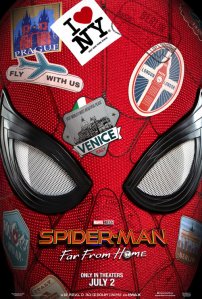 Spider-Man: Far From Home arrives as the tasty dessert to the epic five-course meal that was Avengers: Endgame. It picks up weeks after the events of the climactic chapter, starting right away with the consequences in a clever, albeit light manner. Peter Parker (Tom Holland) is excited to go on a class trip to Europe and has big plans to confess his true feelings to his crush, MJ (Zendaya). He’s pulled into hero work by a testy Nick Fury (Samuel L. Jackson) who needs Spider-Man to stop a group of inter-dimensional elemental monsters. Quentin Beck (Jake Gyllenhaal), dubbed “Mysterio” by the Italian media, is the last survivor of that other dimension and looking for assistance to thwart them and save this Earth. Peter tries to live a “normal life” and balance his superhero duties, but his secret life is increasingly intruding upon his actual life, especially as the world looks for the next superhero to step up in the absence of Tony Stark. Far From Home is an enjoyable road trip movie that feels like Junior Spy Hijinks for the first half. It’s funny but I definitely felt like the filmmakers weren’t fully engaged in telling that story, so I was left a tad disengaged. There’s a big reason for this and it’s a turn that comes halfway through, and from there out the movie is mostly great. The action sequences are directed with flair and even better visual acuity by returning director John Watts (Cop Car), there are some vivid nightmarish hallucinations that are glorious and disorientating. Gyllenhaal (Nightcralwer) becomes much more interesting in the second half and makes better use of the actor’s comic and dramatic range. It almost feels like some of the staid back-story from the first half is a satirical point of the second half, but you have to get through it all first. This bait-and-switch storytelling structure leads to certain pluses and minuses, and had it gone on much longer it would have more negatively affected the overall enjoyment factor. The first post-credit scene is definitely a game-changer in the world of Spider-Man and has a fantastic character debut that made me cheer and will be big especially for fans of the recent hit PS4 game. Far From Home doesn’t have the polish and brilliant structure of 2017’s Spider-Man: Homecoming but it’s a Spidey sequel that doesn’t lose track of the characters, presents an interesting villain as something we haven’t quite seen before, and has a good sense of humor while still being able to thrill and chill. The MCU is in a different world now after Endgame and with Holland and company leading the way, I could use more of this Spider-Man pronto.
Nate’s Grade: B
Share this:

Yesterday (2019)
 What if you were the only human who knew The Beatles ever existed? That’s the high-concept premise of Yesterday from director Danny Boyle (Slumdog Millionaire) and famed writer Richard Curtis (Love Actually, Notting Hill). We follow Jack Malik (Himesh Patel), and to say he is a struggling musician is an understatement. His best friend and manager Ellie (Lily James) is a constant source of encouragement and unrequited affection. He’s ready to quit when suddenly a world blackout results in him getting hit by a bus. He wakes up in a hospital badly bruised and apparently the world has never heard of The Beatles songs. Jack uses his unique knowledge and launches his musical career by passing on their material as his own. Suddenly he’s a superstar with a craven new manager (Kate McKinnon) and opening for Ed Sheeran. As he catapults to a new level of fame, he starts reconsidering his feelings for Ellie and fame in general.
Yesterday is a fantasy fitting of The Twilight Zone but cheerful and whimsical that it could fit well into the pantheon of Curtis’ other famous romantic comedies. It’s a relatable wishful scenario where you have the inside track to take advantage of pre-established works and zooming ahead to fame and fortune. It’s like a direct passage to the goal of creative acclaim. The movie is generally fun as it works on dramatic irony for laughs, as Jack introduces person after person to the songwriting of the Beatles. It’s a fun magic trick that doesn’t lose its charm. Even the musical score adopts several familiar melodies from The Beatles and Boyle highlights certain landmarks and their connections to the history of the tunes. I enjoyed Jack trying to remember the lyrics for “Eleanor Rigby” and coming up with various alternatives. There’s an amusing running joke about what else is missing from this parallel universe, including Coca-Cola and Harry Potter (there’s a great joke missed having Jack try and spectacularly fail to write Harry Potter). It’s a regular source of silliness and Boyle visually trains the film to automatically do a Google search for the missing item and what is found instead. There’s no rhyme or reason for what is missing; I doubt Curtis is trying to speculate that without Coke we wouldn’t have the Beatles and so on. The movie has an easy charm and affection that makes even its looser moments more agreeable. I was hoping for more moments of subversion, like when Jack is trying to play “Let It Be” for his parents for the first time and they keep absentmindedly interrupting. What if certain Beatles songs didn’t break through as popular today as they did in the 1960s? Does “I Want to Hold Your Hand” seem to quaint for modern listeners? There aren’t many surprises in store with Curtis’ script, which uses the fantasy gimmick as a vehicle to tell a pretty ordinary love story.
 The problem with the gimmick is that there really is no downside for Jack. He zooms to international stardom. There is a small idea that he feels like a fraud by getting famous from the creativity of others but this is barely toyed with. Here’s one instance that could have better highlighted that inner turmoil: while on tour with Ed Sheeran, the musician challenges Jack to an impromptu songwriting contest, to go off to their respective corners and in ten minutes come up with a brand-new song. As presented, Jack comes back and plays “The Long and Winding Road” and everyone is spellbound. He wins. The scene could have played out with Jack trying his own material on the piano, either a tune we saw him working on before his accident or something truly original from the moment, and he could watch the crowd looking indifferent. His panic would flash in and he would cave, resorting to a Beatles song to win them over again. That moment could have showcased his internal dilemma of feeling like a fraud but his need to impress and win easy adulation. There is real downside for his passing off the Beatles songs as his own (spoilers to follow for the paragraph). At the very end, on the world’s stage, he announces the truth and that he didn’t write one of his hit songs, instead giving credit to John, Paul, George, and Ringo. Except even after this declaration, he doesn’t suffer any consequences. He maintains his fame, fortune, happiness, and gets the girl. Surely the media would seek out these cited songwriters and they would not know what he was talking about at all. Then what? Apparently nothing, as the world must have just accepted Jack as possibly being mentally ill.
Since so much of the film hinges on the romance between Jack and Ellie, it makes the obstacles keeping them apart feel foolishly arbitrary and annoying. It feels like there should be no stopping these two crazy kids from getting together but the movie manufactures questionable reasons. Firstly, Ellie is practically throwing herself at her friend in every scene for the first half, obviously hinting at her desire to be seen as something more than a friend and manager. At one point she even point-blank asks him why he doesn’t seem to view her as a romantic option (it’s not like Jack is being mobbed by other women), and the man doesn’t even articulate a reason. He just stares dumbfounded at her, as if he too is realizing a plausible reason hasn’t been conveyed. He doesn’t say, “I never knew,” because of course he knows, and he doesn’t say, “I didn’t want it to ruin our friendship,” or anything else along those lines. There isn’t even a protest. Then when he is famous, he starts thinking about becoming romantically involved, and Ellie says she doesn’t know if she can manage his new lifestyle. He’ll be in L.A. and she’ll be in her English small town, and he must choose one life over the other. This is a false choice. He’s rich and famous. He can live wherever the hell he wants, including a small English town with her. This is even glimpsed during the end credit epilogue, meaning it was completely an available option. The reasons both of these characters reject one another are just unreasonable. Lily James is playing a charming woman and should not have this much trouble having a man want to be with her.
 Because of this forced and arbitrary conflict, keeping the lovers apart until finally letting them at each other, Yesterday is ultimately capped with its enjoyment level. It’s pretty much a gimmick that is meant to serve a more traditional rom-com, which Curtis knows how to do easily. Why then has he seemed to put so little effort in why these two should be kept apart? The yearning you need to feel in every rom-com feels one-sided and then switches over, making the chase feel like running in place for the sake of stretching out this conflict. It doesn’t make sense. There were realistic obstacles available with this premise, from Jack’s ego taking over thanks to everyone projecting the Beatles acclaim onto him, and he could just have become a shallower person that Ellie stops seeing as a desirable mate. That’s the easiest thing and Yesterday doesn’t even do that. Other women aren’t ever an option too. When Jack hits the big time, he isn’t fending off groupies and other industry sorts that want a piece of him. At no point does Ellie have any competition for his heart or any other part of him. They’re good together too, cute, and seem obvious that they should be together, so this foolish keep-away game feels grating.
Here’s a closing question: if the Beatles songs were released in a contemporary market, would they be the era-defying hits that they were? I’m somewhat doubtful. For an experiment, show Yesterday (or even 2007’s Across the Universe) to teenagers generally unaware about the Beatles catalogue. Do they instantly take notice? Do they ravishingly consume the songs and seek more? I’m sure some will; just because music is old doesn’t mean it can’t connect with a new, appreciative audience. However, would these songs be global hits instantly launching the songwriter to stardom? The Beatles are an indelible part of our culture and have influenced generations of artists. It’s hard to overstate their artistic influence but partly because of the time and place of that influence. Would Beethoven be as influential if he had gone unknown by history until the twenty-first century? Anyway, Yesterday is a cute but rather slight movie that reminds you about the power of music and the annoyance of contrivances withholding a happy ending until the final say-so.
Nate’s Grade: B-
Share this:

Toy Story 4 (2019)
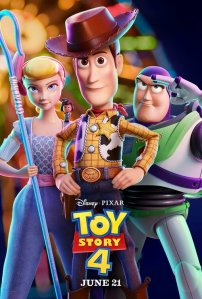 The Toy Story franchise has been the gold standard for Pixar with three excellent movies, the last of which was released back in 2010. When the Pixar bigwigs announced they were making a fourth entry, I felt some degree of concern. The hidden world of toys still felt like an interesting world with more stories to be told, but did we need to revisit Woody and Buzz and the gang? Everything ended so beautifully and perfectly with the third movie, with the toys getting their sendoff from their original owner and a new life in the possession of a new child, little Bonnie. I’ve been more wary about this movie than just about any other Pixar film because the audience had something that could be lost, namely closure. If they harmed that perfect ending in the crass desire to extend the franchise for an extra buck, it would have been aggravating and depressing to disturb something that felt so complete. It’s like when Michael Jordan came out of retirement (the second time) to be a shadow of himself for the Washington Wizards in order to sell tickets for the team he was part owner of. Nobody wanted that. I’m happy to report that Toy Story 4 is a treat of a movie and a worthy addition to the franchise.
Bonnie is gearing up for kindergarten and nervous about the change. She isn’t allowed to take toys with her to school, though that doesn’t stop Woody (voiced by Tom Hanks) from tagging along. In her desire for a friend, and with a little assist from a certain cowboy, Bonnie creates a fork-figure named Forky (Tony Hale), and amazingly it comes to life. Woody tries valiantly to convince Forky that being a toy to a child is the greatest gift but he’s also really reminding himself now that he sees his influence waning with Bonnie as he’s selected for play time less and less. During a family road trip, Forky escapes and Woody leaps to find him, both of them coming into the clutches of Gabby Gabby (Christina Hendricks), an antique doll missing a functional voice box who has her sights set on Woody’s voice box. It’s at this small-town pit stop for a carnival that Woody discovers Bo Peep (Annie Potts), an old flame he never thought he would see again. She’s assured, happy, and preaching a life of being independent from a kid. Woody has defined himself for so long by one identity, and now he must decide which to follow.
 In many ways, Toy Story 4 takes themes and questions from the third movie and improves upon them, making what could have been a retread feel like a do-over you didn’t know you desired. It’s been many years since I saw the third film but I recall the major themes being the fear of change, reconciling one’s self-identity, and the courage of letting go and starting over. The toys had to recognize that their owner was growing up and their old place wasn’t going to be the same. This same issue finds new life in Toy Story 4 primarily through the lens of Woody, who finds himself on the decline with his kid’s interest. He’s not offended or upset by this but is still trying to provide what assistance he can as a beloved toy, even if that relationship becomes more and more one-sided. His identity is in selfless sacrifice for another, but with the re-emergence of Bo, he is now contemplating a life on his own, a life without a kid. This alternate path never seemed a possibility until his former flame stepped back into his life. It challenged Woody in a way that feels more personal and more relevant than it did with 3, especially with the removal of a larger external threat to occupy the attention of our main characters. This places a renewed focus on Woody’s internal dilemma beyond his role as leader and protector.
Toy Story 4 might also be the weirdest movie of the franchise, which really elevates the comedy into another realm. I thought the characters played by Jordan Peele (Us) and Keegan Michael-Key (Predator) were going to quickly wear out their welcome; they seemed to be a heavy part of pre-release teaser trailers. The filmmakers don’t overdo them and use them in clever ways, which is a compliment that can be applied to every new character in this sequel. The plushies by Key and Peele have a hilarious running gag of their increasingly absurd plans to attack a woman, and one instance deliciously prolongs the eventual punchline, becoming more bizarre and macabre to the point that I lost control from laughter. Keanu Reeves (John Wick 3) is fun as a very Canadian Evel Knievel motorcycle driver, and the weird references to the Canada-ness of it are played completely straight, making it even funnier (his laments with the French-Canadian boy’s name made me snicker every time). There’s a trio of action figures, Combat Carls, and one of the three is always left hanging for high-fives and he just leaves his arm up waiting, silently pleading, and then lowers it in defeat, and it’s hysterical even just as a background gag. The ventriloquist dummies are routinely played for creepy laughs and physical humor. There’s a running joke where Buttercup, the unicorn voiced by Jeff Garlin, is always suggesting getting Bonnie’s father sent to jail no matter the circumstances. It’s these touches of weirdness that make the movie stand out that much more from the three others.
 The villain of Toy Story 4 is given a surprising sense of poignancy, enough that I genuinely sympathized with her plight. She’s a damaged doll used to being behind glass, isolated and separated from the children she wishes to be part of. She views her salvation in fixing in her damaged voice box, her perceived disability. She’s after what Woody has physically, the voice box, but it’s a means to an ends to have what Woody has had emotionally, the love of a child in need, the connection she yearns for. I won’t spoil what happens with her but even when there are setbacks the film and the characters don’t give up on Gabby Gabby. Her perspective and desires are still seen as valued, and the eventual resolution of her character put a lump in my throat. She wasn’t really the villain after all. She was just another toy in pain looking for acceptance and having to adjust her identity. I feel like there is a conscious disability empowerment message implanted in Toy Story 4, namely that those who are disfigured, disabled, or seen as “broken” can continue to be valuable and that their lives don’t end.
If this serves as the finale of the franchise, it will end on a fitting and resonant high-point. As much as Toy Story 3 was about change and acceptance, this sequel does a very respectable effort of personalizing that message even more to one central character’s dramatic arc. It also works wonderfully playing off of our collective investment in the character over the course of four movies and twenty-four years. There are some drawbacks to this approach. It makes the majority of the other toy characters feel like they have little to do on the sidelines, other than fret about retrieving Woody and Forky. Buzz is given a cute joke about listening to his inner voice but it doesn’t amount to much more than a cute joke. The inclusion of Forky feels like an exciting and even daring addition, tackling some existential questions and how and when toys are “made” and brought into being, and he presents these for a while. Once we get to our carnival setting and Forky is captured, he seems to be forgotten about. He’s more a motivation point for Woody than overtly anything else. I suppose you could make the analysis that Forky represents how Bonnie is moving on even with invented toys at the expense of Woody. However, these are minor quibbles considering the quality and emotional involvement of what Pixar has produced.
It goes without saying that the animation is beautiful but what amazed me is how expressive the faces of the characters could be, even when they were relatively inflexible toys. The relationship between Woody and Bo actually has a surprising amount of nonverbal dramatic acting to communicate nuance. As the years go by, I continue to be further and further amazed at the Pixar animators and their abilities.
 As protective I was over Toy Story 3’s perfect ending, I am happy to say that Toy Story 4 more than justifies its own existence in this hallowed franchise and even improves from the third film. The themes are something of a repeat but the filmmakers have elected to focus almost entirely on Woody and his personal journey, and it makes the loss and possibility more robustly felt. In many ways the film is an exploration on relationships and the need to redefine ourselves, to move onward when the time is right, and to try something new even if things get scary. Between Woody and Gabby Gabby, ostensibly the hero and villain of the piece, they’re looking for meaningful connections where they can. They may be secondhand, they may be disabled, but that doesn’t mean they aren’t worthy of affection. This is a joyous movie that finds time to be wonderfully weird and often funny. It might not have the set pieces or ensemble showmanship of the prior Toy Story tales, but what it does have is a character-based emphasis on the most complex figure in this universe of toys. The conclusion is moving and satisfying and I don’t mind admitting that tears were shed. I even teared up at different other earlier points. Toy Story 4 could have gone a lot of different ways but I’m relieved and appreciative with this new sendoff we’ve been granted.
Nate’s Grade: A


 nathanzoebl

You must be logged in to post a comment.