Blog Archives
Charlie’s Angels (2000) [Review Re-View]
 Originally released November 3, 2000:
These angels aren’t exactly what your father was enjoying when your mother was away fulfilling errands. These angels aren’t delegated as mere sex objects running around providing the jiggle entertainment that is (or was) supplied by today’s Baywatch. The 90s is a different decade after our minority movements and today’s woman is just as apt to do a flying kung-fu face plant into a baddie as any man. The angels of the film are action heroes for an armada of small girls needing some female empowerment when their only other choices consist of a barely clothed Britney or a barely covered Christina. These angels aren’t just the sex objects that the classic assortment of angelic 70s stars were; these angels are also tough-as-nails, resourceful, and not afraid to tussle or tango. Now that this exposition is out I can concentrate on the scattershot film Charlie’s Angels.
The film has been rumored to have at a minimum of 17 writers who tried shaping a story for Cameron Diaz, Drew Barrymore, and Lucy Lui. The story is pretty much shelved toward the back so the forefront is our trio of ladies kicking ass then shaking it with zig-zaggy and wild camera movements from debut filmmaker and video director McG.
Charlie’s Angels is whiz-bang dumb fun. The overall feel of the film is something more difficult to get a grasp on. At times it shows itself as tongue-in-cheek and satirical but then at other times it seems overly serious or overly dumb. The characters are non-existent and basically only discernible by hair color. The characters are very wooden and I actually found more enjoyment watching the villains and seeing more of them; call it the Austin Powers dilemma. Diaz makes the only notable attempt as her goofy and light-hearted angel connects with the audience best. Lui plays a techno-babe dominatrix but is easy to see that she was the last angel chosen and doesn’t exactly gel with the others as much as she could have.
 Charlie’s Angels is best when the action is pumping. The scenes are cut together in a jam-packing sequential way adding distinct flavor and style. McG is a true surprise in the effectiveness he can orchestrate his action motifs even if the Matrix effects and moves make absolutely no sense in the real world.
Crispin Glover shows himself as a silent assassin nicknamed “the thin creepy man.” Glover is so suave and slick in his role of the non-verbal Oddjob henchman role that he exhilarated me with every presence he made on screen. Goodness, he was too cool in this film and everyone gets brownie points for allowing him. He has such energy and charisma that I wanted the film to veer off into him and desert our angels. Seeing our ageless McFly perform action scenes and choreographed fights is something I will be pleased with until my grave. seeing Crispin in the excellent Nurse Betty and now huge exposure in this is a true joy. And man… he smokes a cigarette way too cool every time he’s in this film. Some people can smoke cool some of the time but Crispin does it all of the time. His mere presence almost cancels out the annoyance of Barrymore.
The line is drawn with Charlie’s Angels in that it’s sex-kitten jiggle and an acrobatic arrangement of (light) feminism and humor. These gals know they’re sex objects and they’ll use it to their advantage delighting in every second of it. Therefore, you could argue successfully that Angels is exploitation hiding as meaningful but hell… why think about this stuff? The movie rolls along at a fast pace where you don’t keep track of these issues. It’s just an easy sit down.
The gigantic success of Charlie’s Angels makes sequels and a possible franchise all but certain. I’d be happy for McG to hop back in his directorial chair but have a unique idea for Angels 2: Bigger, Longer, and Uncut… it involves Glover kicking a lot of ass really cool like.
Nate’s Grade: B-
——————————————————
WRITER REFLECTIONS 20 YEARS LATER

The 2000 Charlie’s Angels seems to understand that nobody should take this seriously. It even opens with an in-joke of T.J. Hooker: The Movie being inflight entertainment and an undercover character lamenting how bankrupt Hollywood is when it comes to recycling old TV shows. From there, our undercover angel literally exits with her target in the middle of the air and plummets to the water below, safely landing via parachute with a team meeting via helicopter aerial hook-up and a speedboat below. Why any of this? What sense does any of it make? It doesn’t matter in the slightest, and from the opening scene onward the movie lives by this credo, doing its best to be silly and have fun and just not care about the rest, and it shows. Twenty years ago, I think Charlie’s Angels benefited from low expectations as I recall mostly enjoying it. Now, having re-watched the movie for the first time in ages, I will say the fizzy appeal seems to be diluted. It’s still got energy to spare, though it feels a little too antic, a little too episodic and slipshod, and a little too proudly shallow, and that’s before you re-examine its depiction of the angels.
It took 17 writers and considering every under-30 actress in Hollywood to put together Charlie’s Angels. Drew Barrymore had bought the remake rights and wanted to make a big screen splash with a trio of kick-ass heroines that could better relate to the culture of the new century. I understand that Barrymore and her team wanted the angels to be sexy, yes, but also smart and funny and goofy and fearsome and all the things that little girls should believe possible. That’s commendable from a positive representation, but then so much emphasis is placed on their bodies and their off-the-charts sex appeal to bamboozle men that the goal becomes eclipsed. One could argue that Barrymore, Cameron Diaz, and Lucy Lui are embracing their sexuality, and that taking control of this is empowering, and if you feel empowered by Charlie’s Angels, by all right enjoy that and bless you. However, twenty years later, this feels less like the girls are in charge are more like they’re just being exploited in a manner we’re being sold as new feminism.
 There are so many examples where the angels are in skimpy clothing or objectified. There was an entire clip of Diaz dancing in her underwear that I remember Harry Knowles of the early 2000s mainstay Ain’t It Cool News devoted a gross drooling essay to his obsession (“But to sum up, Cameron Diaz’s Swirling Ass is one of the greatest images and objects in the whole of human existence.”). Barrymore’s character is constantly getting undressed and using her body to disarm men. Again, duping men through their hormones can be a key asset as a spy, but it’s happening in every scene and at her disservice as well. She tumbles down a ravine naked in a last-second escape, and the movie treats it as cheeky comedy (no pun intended). Lui adopts a series of disguises that routinely sexualize her, from a masseuse to the most overt, a domineering corporate boss that resembles a dominatrix. They’re straight fetish roles. I’m surprised a Catholic schoolgirl outfit wasn’t adopted as a disguise. The movie’s depiction of its female stars and the emphasis on their bodies feels retrograde for its ideals. I know they wanted to improve upon the portrayals from the 1970s but we still got problems. McG’s stylish direction prioritizes the angels’ sexuality. They can be smart and kick ass but also in a sexy way, the movie is telling you. Thandie Newton was supposed to be an angel but schedule overruns from Mission: Impossible II got in the way, and later she admitted she had strong misgivings because her character was going to be introduced with a closeup of her denim-clad butt. No one is arguing that women should be barred from taking ownership of their sensuality, but the lens Charlie’s Angels utilizes is strictly a male gaze, and these women are repeatedly objectified.
As a result, the movie has a new sheen of discomfort during all the silly, sudsy spy missions and wardrobe changes. Before you might think, “Oh look, they’re dressing up as Japanese geisha girls, what fun,” and now you’re like, “Oh, somebody at the studio was getting off on this.” Before you might think, “Oh look, they’re dressing up as Middle Eastern belly dancers, what fun,” and now you’re like, “Oh, somebody at the studio was getting off on this.” There are a lot of ethnic disguises that would likely get axed today as cultural appropriation. The carefree, frivolous attitude of the movie is meant to be charming and low stakes, but when it’s applied to the exploitative nature of how the women are depicted, it all becomes a bit dodgier to accept.
 This was the first real blockbuster after The Matrix reshaped action cinema and the stylish choices can run the gamut between exciting and cool to dated and shallow. Twenty years later, it’s just not as impressive that they used wires to swing their actors around for stunt choreography, or that they replicated key Matrix touches like bullet time. The fighting sequences are often choppy in editing and some of the moves meant to demonstrate the power of the angels just feel silly, like a moment where Diaz went full Lui Kang with her flying kicking feet. It’s moments like that where the style gets away from McG. The tonal trick is finding a balance between goofy and cool, exciting and cheesy, and I don’t think the movie achieves this with its action. The set pieces feel built around “cool moments” rather than using geography, organic complications, and escalation. It means that Charlie’s Angels has its share of cool moments but then they are fleeting and ultimately meaningless because they don’t better connect to character, story, or even simply their own satisfying action compositions. It’s like immediately disintegrating cotton candy. The dozens and dozens and dozens of needle-drop music cues feel like another potent example of this charge as well as some anticipated attempt to distract from its shallow and diverting design.
I was dreading revisiting my original review as an 18-year-old because I was convinced my younger self was going to conflate the portrayal of the women as taking ownership. I just knew this would be something I had bought into in 2000, and yet it wasn’t quite so: “The line is drawn with Charlie’s Angels in that it’s sex-kitten jiggle and an acrobatic arrangement of (light) feminism and humor. These gals know they’re sex objects and they’ll use it to their advantage delighting in every second of it. Therefore, you could argue successfully that Angels is exploitation hiding as meaningful but hell… why think about this stuff? The movie rolls along at a fast pace where you don’t keep track of these issues. It’s just an easy sit down.” Hooray for my younger self seeing through this movie’s sheen of empowerment. At the time, it bothered me less because the movie was dumb fun, and now it just seems less fun and also dumber. I was so taken with Crispin Glover (Back to the Future) and his creepy cool style, much of which was Glover’s doing. His character was supposed to have dialogue except he hated the lines and asked to be silent. That’s one way out of memorizing, and it worked because he was a breakout and appeared in the 2003 sequel. Sam Rockwell (Three Billboards) was also a fun discovery though he only gets good once he’s revealed as a baddie. He would reuse those dancing moves for Iron Man 2.
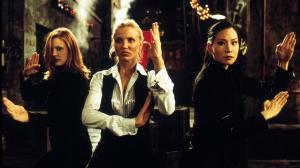 By the time 2003’s sequel Full Throttle rolled out, the appeal was gone. In my own brief review, I summarized, “It all seems so ho-hum and excessive at the same time. Quite an accomplishment. No more please.” I feel like the 2000 film also falls into this summary. It’s clearly not intending to be anything more than a goofy action movie, and I suppose the right person could still likely turn off the necessary parts of their brain to enjoy the rush of sights, sounds, and cleavage. There shouldn’t be a “wrong kind of feminism” so if this works for you, great. Many years later I felt that the male gaze was more ogling the women in the name of celebrating them. And yet Sony still felt there was material to be mined when they tried again with a failed 2019 reboot. The original Charlie’s Angels film is a cocktail of style with a creeping hangover right behind.
Re-Veiw Grade: C
Share this:

Love and Monsters (2020)
 Imaginative, quirky, and monstrously fun, Love and Monsters is a winning sci-fi monster movie and more evidence to the unique amusements provided in full from a Brian Duffield (Spontaneous, The Babysitter) story. In the near future, after blowing up a world-threatening asteroid, the ensuing chemical debris causes many lizards and insects to grow to world-threatening sizes, killing a majority of the population, and forcing the survivors to live underground in vaults. Our hero is Joel (Dylan O’Brien), a very Jessie Eisenberg-esque guy who isn’t so good at survival skills in this new world. His group looks at him like he’s a helpless kid who can’t defend himself. Joel discovers that his teenage crush, the girl he’s been writing letters to, is alive and he pledges to make the 80-mile trip on the surface to reunite with her. The resulting journey can be episodic but each section is impactful, each monster encounter is different and contributes to a fuller understanding to the world, and the character arc finds ways to surprise you, like when it acknowledges that Joel’s foolhardy romantic gesture is exactly that, him not fully accepting how the world has changed both he and the object of his desire. That sparkling creative voice of Duffield’s is alive and well throughout. His worlds feel well thought out, lived in, crazy but with purpose, and his characters are often teenagers with pointed attitude but they feel like characters rather than mouthpieces for overt stylized dialogue and pithy banter. O’Brien (The Maze Runner) is an interesting choice and gets to be far more neurotic and physically comedic than I’ve ever seen him. He’s an underdog that’s easy to root for. There are moments of wonder, moments of unexpected empathy, moments of suspense and terror, and plenty of moments of comic bemusement in the face of this crazy world. Joel befriends a very Woody Harreslon-esque father (Michael Rooker) with an adopted daughter in tow (the Zombieland character dynamics are pretty apparent but not a major detraction) and they form an enjoyable fractured family to help Joel become a better survivalist. I loved a small moment with a beaten down robot helper that manages to be sentimental as well as subverting sentimentality. The conclusion feels like a Walking Dead episode but it brings together many of the dangling storylines and proves satisfying for the character’s arc, a better understanding of the creatures in this world, and for Joel’s sense of self and community. The special effects are amazing for a movie that shockingly only had a tiny $28 million budget. Love and Monsters is a movie that makes the most of its time and money to tell a bigger story but one with enough wit, heart, and personality to draw you in and leave you happy for more post-apocalyptic monster adventures. All hail Duffield, king of spry and accessible quirk within the Hollywood system.
Nate’s Grade: B+
Share this:

Vampires vs. The Bronx (2020)
 Take Attack the Block and mix with The Lost Boys and you get a perfectly enjoyable B- kind of fun B-movie about a group of Bronx tweens combating blood-suckers gentrifying their neighborhood, and vampires too. It’s a pleasant experience that hankers back to enjoyable 80s ensembles and it maintains a sweetness without being sappy and an edge that feels appropriate for its age-range without getting too heavy or too simplistic. We follow our core characters as they investigate the would-be vampires, uncover their real estate schemes for the neighborhood, and then plan how best to thwart them. It’s a reliable formula but it works. I enjoyed Shea Whigham (Kong: Skull Island) as the vampire middleman, and I enjoyed how his own character arc as a subservient villain is tied into another teen’s arc about not following in the steps of his criminal older brother and rejecting people who only want to use you. That’s smart writing, finding room to draw parallels and connect the personal to the thematic. The lead kids all have their own personalities and problems and I enjoyed spending time with them as they bonded, bickered, and bandied together as a team. Their chemistry made them feel like real friends. The horror doesn’t really ever approach being scary or intense; when the vampires are in full teeth-baring mode, they seem more like the goofy, cheesy, cloaked figures from the TV soap Dark Shadows. It also feels like the movie runs a bit out of steam as it carries on into its final attack/assault on the vampire’s nest. Still, Vampires vs. The Bronx is a funny and light-hearted 90 minutes with likeable characters and an enjoyably relaxed supernatural caper. It’s not going to be too deep but you can tell the filmmakers care about these characters, the film’s genre influences, and telling an accessible adventure to kids.
Nate’s Grade: B-
Share this:

Bill and Ted Face the Music (2020)
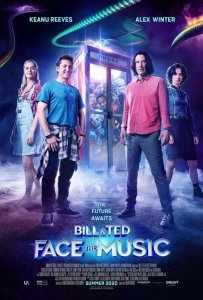 Bill and Ted might be one of the most inexplicable franchises in Hollywood. It began as a riff on 80s high school movies by writers Ed Solomon and Chris Matheson, taking the California surfer/stoner goofball supporting character staple and saying, “What if people deeply uninformed about history traveled through time?” 1989’s Bill and Ted’s Excellent Adventure movie was a comic delight, and Bill and Ted became unexpected icons, action figures, and even a Saturday morning cartoon. The 1991 sequel could have easily repackaged another escapade through time but instead it went a completely different, darker, and weirder direction. Bill and Ted’s Bogus Journey followed its characters through death, hell, heaven, and back again. It’s been almost thirty years since Bill and Ted left the pop-culture spotlight behind. What more challenges could you present? Bill and Ted Face the Music is a sweet sequel that explores the, dare I even utter the word, legacy of these cheery doofuses, and while it’s not at the same level as its clever predecessors, I was more than happy to take one last trip with these gents. Most excellent.
It’s been decades since Bill S. Preston Esquire (Alex Winter) and Ted Theodore Logan (Keanu Reeves) hit the big time with their band Wyld Stallyns but life hasn’t quite worked out how they imagined. They had been told their music would bring peace to the world, but they’re in their 50s now, fame now behind them, and they have yet to live up to those heavy expectations. Bill and Ted are struggling to still write that perfect, magical song, the one they were destined for, but both men have growing doubts over whether or not they can make it happen. Their adult daughters (Samara Weaving, Brigette Lundy-Paine) want to help and take the ole phone booth time machine for a spin, collecting famous great musicians throughout time to help collaborate with their dear old dude dads before all of reality unravels if that fabled song cannot be written.
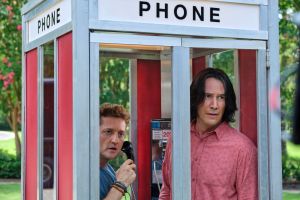 Just as Bogus Journey rejected being a lazy reprise, Face the Music inclines to chart its own path as a sequel rather than replicating the hits of old while also staying reverent to why people loved the originals. This is more a time travel movie, and the daughters even go on their own Excellent Adventure rounding up famous musicians through history as a B-story, but the main story is squarely on Bill and Ted facing off against themselves and their collective insecurities. When challenged, the Bill and Ted of present-day figure that they can skip ahead to the future and simply take the world-saving song from their future selves, who obviously would have written it by then. It’s a move the franchise has used before, relying upon future actions to take care of present problems, so it’s fitting for the characters but this is the first film to explore this as a negative. Bill and Ted are desperate and looking for an easy solution and skipping to the end will do that. However, their future selves are pathetic has-beens who have yet to write the ultimate song, and they resent their past selves for setting them up for failure. There are many face-to-face meetings between present and further future versions of Bill and Ted and their interactions become an adversarial tit-for-tat. I looked forward to each new pit stop with future Bill and Ted to see how their lives were and if they were still trying to set up the past Bill and Ted for a long-simmering retribution. The fact that this storyline has a genuinely sweet and even poignant reconciliation is a joyous addition.
Thankfully, Bill and Ted are still the same lovable, affable, and relentlessly positive dudes we’ve known and loved since the 1980s. I appreciate over three movies how much these guys legitimately appreciate and love each other. That’s one reason why it’s so enjoyable to hang out with these guys regardless of what their adventures entail. It would be easy for Bill and Ted to have become jaded in their old age, cynical from not fulfilling their hallowed destiny. They could have some animosity between the two of them that need to be buried in order to work together, rekindle that old magic, and save the world. But the screenwriters know who these characters are. Even when things aren’t going their way, they stay who they are, hopeful and supportive. I also appreciated how this translates to their relationships with their daughters, who clearly love their fathers and want to follow in their footsteps. They even refer to them as “dads” rather than “dad.” The conclusion rests on the daughters and fathers working together, and the positivity that radiates through their relationships allows the ending to reach a surprisingly emotional high for a family of good-natured goofballs.
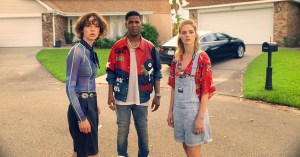 Face the Music is a bit overstuffed with subplots and characters, and I do wish there could have been some careful pruning to allow more room for the daughters. Bill and Ted’s wives, the princesses from Medieval England, have been recast again (Erinn Hayes, Jayma Mayes), and once again they are barely featured. There is an early conflict between the wives and husbands, and the prospect of losing them motivates Bill and Ted to save their marriages, but this conflict is entirely sidelined after the “end of the world” dilemma overtakes the plot. The wives are in their own subplot and also traveling through time or to parallel dimensions, though we never spend any time with them. There must be entirely cut scenes with them. Their perspectives could have been a whole other movie but they’re only an afterthought, as these characters have always been. Kristen Schaal (My Spy) appears as the daughter to Rufus (the late George Carlin), and we’re introduced to her mother, a deadly robot (Barry’s Anthony Carrigan) set to kill Bill and Ted for questionable reasons, the return of the Grim Reaper (William Sadler), plus all the assembled historical figures with the daughters. Also, just about every supporting family character makes an appearance too. It feels like too much, like the movie is constantly racing forward, juggling people and stories, when we didn’t need it all.
The daughters are more reflections of their fathers than independent characters. Each character, Thea and Billie, is a younger impression of their father and little else. They like the same music their dads like. They have the same goals their dads have. They have the same personalities their dads have. Both actresses are fun and Brigette Lundy-Paine (Netflix’s Atypical) does a wicked impression of a young Reeves, including adopting his sway-heavy gait, but I wish they had more to chew over. It seems cliché to make the central conflict of a third Bill and Ted movie an inter-generational one, where the fathers cannot relate to their daughters, and the four of them go on a fantastic journey that helps to bridge their differences and allow each side to better understand and relate. It might sound cliché but it could also have been compelling as well, and it would have elevated the daughters and their relationship into a primal position, rather than using the relationship with the near non-existent wives as the throwaway motivation for their call to action.
 It’s been quite a while since Winter and Reeves have played these parts, and while they both have clear affection for their characters, it’s not quite a seamless relaunch. Reeves (John Wick) has been playing hardass action heroes for so long that it feels like he can’t easily recapture goofball energy. His line deliveries can feel far more stilted and low-energy. Winter hasn’t acted onscreen since 2013 and has transitioned into being a documentary director. He delivers a more spirited performance and hits the comedy notes more effortlessly than Reeves, but the time apart from acting shows. Watching both men imitate their younger selves and going through the same shtick can have a different impact on the viewer. Hearing the same catch-phrases but with deeper, gravely voices isn’t quite the same thing and serves as a warning of the enterprise living in its own shadow. My pal Ben Bailey found an old Bill and Ted to be rather sad. I think that’s part of what Face the Music leans into (including its knowing title). They haven’t succeeded like they wanted. That weighs on them. Neither character is about to contemplate suicide but there is a sense of disappointment about how their careers turned out that they’re barely staying ahead of, which adds a melancholy dimension to these characters still falling back on what they know because it’s all that they know how to do. It’s not overpowering but it’s an acknowledgement of the loss of time.
Bill and Ted Face the Music is a charming, likable, and sweet-natured sequel that wraps up the franchise well, reminding fans why the Bill and Ted characters were so enjoyable from the start. In our COVID times, I’m finding it easier to shrug away some of the movie’s flaws, like its low-budget being noticeable, chintzy CGI special effects, and too many supporting characters on top of not integrating the daughters into the main action in a more significant fashion. It’s 90 minutes of laid back, light-hearted fun with actors and filmmakers who clearly love this franchise, and the screenwriters could have merely coasted and did no such thing. We didn’t need a third Bill and Ted big screen adventure but I’m happy that it still feels, even thirty years later, remarkably like Bill and Ted.
Nate’s Grade: B
Share this:

An American Pickle (2020)
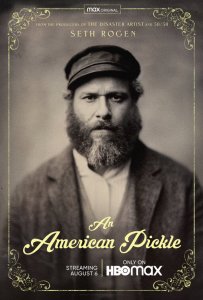 Delightfully droll and surprisingly poignant, An American Pickle is a light-hearted fable elevated by a terrific dual performance from Seth Rogen. He plays Herschel Greenbaum (Rogen), an immigrant from Easter Europe seeking a new life with his pregnant wife Sarah (Sarah Snook). Due to an accident at the pickle factory, Herschel is locked in a vat and kept in stasis for 100 years, brined for the future. His only living relative is a great-grandson, Ben (Rogen), a struggling app developer who is equal parts fascinated and annoyed by his long-lost family member. Right away I knew this was a movie with its sense of tone locked firmly in place. The opening few minutes establish the heightened, comically depressing life in the Old Country (“Her parents murdered by Cossacks. My parents murdered by Cossacks!”) and courtship where Sarah dreams of being rich enough to own her own gravestone. Then after Herschel is resurrected and the news media is obviously doubtful, a doctor explains and the narration goes, “A doctor explains. It is good. Everyone accepts,” and the same doubtful reporters now nod in approval. The movie knows its ridiculous but asking you to simply go along. By then I knew this was the movie for me. The first half of this relatively brisk comedy is where it’s at its best. Rogen does an exceptional job portraying Herschel, a man out of time trying to reconcile the life and loved ones lost. There are genuinely emotional moments that affected me, and Rogen doesn’t even try to undercut them with a wink or a nod. Beyond the technical ingenuity of playing identical roles in the same space, Rogen imbues each Greenbaum as a distinct character. Herschel is easily the more compelling character and Ben can be quite annoying, especially in the latter half as he tries to sabotage his great-grandfather through a series of petty recriminations. The last half hour can become a bit too episodic, repeating the escalating family feud without feeling like we’re getting much further narratively. It feels like a series of shorts more than a sustained storyline, like the first half. Yet I laughed repeatedly from writer Simon Rich’s (Miracle Workers) clever and aloof storytelling voice. This is a first-caliber chuckler of a movie, with a few hearty guffaws here and there. Top it off with a surprising veneer of emotional reflection and a fabulous performance from Rogen in comedy and drama, and I would cite An American Pickle as one of the more charming, diverting, and enjoyable comedies of the year. In a pandemic-ravaged year of anxiety, we need a little sweetness with a dash of tart, and that’s what Pickle packs.
Nate’s Grade: B+
Share this:

Chicken Run (2000) [Review Re-View]
 Released June 23, 2000:
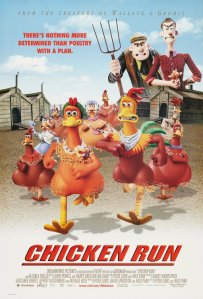
I strongly urge everyone out there if ever given the opportunity to see this movie. Do not confuse Chicken Run as a “kids only” affair while you yourself sneak into something “better.” This movie is easily the best movie of this lackluster summer of commercial perpetual bile, and possibly one of the better if not best films of the year. It’s no secret I have an affinity for animation and the claymation choices of directors Nick Park and Peter Lord, of Wallace and Gromit fame, give the characters real emotion. I can just look at one of the chickens in the eye and feel emotion that I couldn’t get seeing many Hollywood films. The cinematography and animation is lush, vibrant, and breathtakingly beautiful. The story is fresh, wonderfully hilarious, and even touching. The voice artists are terrific, with Miranda Richardson pulling out as my favorite for her delightfully vile Mrs. Tweedy. Treat yourself to one of the very few decent movies this summer and see the incredible fun of Chicken Run, and if you still feel conflicted it has Mel Gibson in it. And if you still feel bad you can say you got lost on your way to the restroom.
Nate’s Grade: A
——————————————————
WRITER REFLECTIONS 20 YEARS LATER
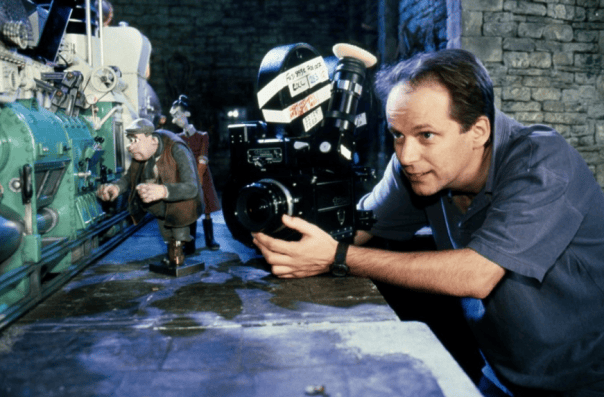
I’ve been a fan of animation since I was young, and stop-motion animation has its own unique and impressive charms. While it has been smoothed out with recent high-profile Laika entries (ParaNorman, Kubo and the Two Strings), there’s a distinct un-reality to stop-motion animation, a stutter-stop to the movements and its physical details that can place it in a beguiling middle-ground between fantasy and reality. I know thousands of hands toil many thousands of hours with every hand-drawn and CGI animated film, but seeing a literal canvas of three-dimensional physical proportions and knowing, with every second, that a person individually moved this figure bit by infinitesimal bit to provide movement, it gives me awe. It’s one of the reasons why 1993’s The Nightmare Before Christmas is one of my all-time favorite movies, plus its top-shelf soundtrack by Danny Elfman at the peak of his talents (I wore out my cassette tape listening to the soundtrack so often). The Aardman production team became famous from the success of their Creature Comforts and Wallace and Gromit shorts, but it wasn’t until 2000 that they tackled their first feature film. I saw Chicken Run in theaters three times that summer. I was so taken with the imagination, humor, storytelling, and efficiency of it, that I kept returning for more. Checking back in twenty years after that initial release, it’s still an effortlessly enjoyable comic caper.
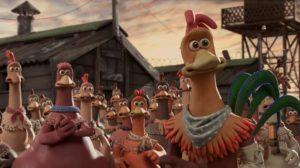 This is an all-ages comedy that asks what if you remade The Great Escape but from the perspective of poultry. It’s a prison break movie that takes its stakes seriously but can still find room for goofy humor and a little romance. The screenplay by Karey Kirkpatrick, working off the story by directors Peter Lord and Nick Park, is minus any fat. Everything in the script sets up the characters, their distinct personalities, goals, stakes, and complications, especially once our main characters of Ginger (voiced by Julia Sawalha) and Rocky (Mel Gibson) are at cross-purposes; he only wants to think of himself and she can only think about saving everyone. He’s hiding the secret of his limitations; she sees him as the answer to their plight, and they’re both growing closer to one another as their time to escape dwindles. Every character is responsive to the action of the others, so the repercussions of the escape attempts lead to the villains escalating their plans. Instead of seeing the chickens as egg providers and meat when they can no longer produce eggs, now they are all expendable and meat is the top Tweedy Farm meal ticket. There’s a clear connection between all the plot beats that is deeply satisfying. Chicken Run is only 85 minutes long and it doesn’t waste a moment to make you smile and tell a good story.
I laughed several times, especially with the daffy Babs (“Are we going on holiday?”), and also the ingenuity of the slapstick. There’s a sequence going inside the machinations of a pie-making machine that is wonderfully developed with great obstacles leading to great slapstick. There’s one stretch where Ginger and Rocky find themselves inside a giant lit oven and they have to race out by leaping from pie to pie. Ginger is fleet and gets ahead, but Rocky tumbles into one pie after another, which is already good slapstick paired with an exciting scenario. Then it cuts to an overhead shot and you see that Rocky has somehow managed to trip and fall in every pie in the oven. It’s small comic touches like that where the Aardman team excel with their funny.
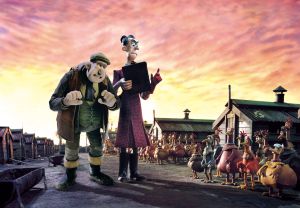 This is also a deceptively visually impressive movie. The Aardman design, the big eyes and buck teeth, seems underdeveloped to a layman but Chicken Run is a beautifully made movie. The stop-motion animation is professional and fluid, but it’s the degree of camera movement and visual enhancement that wowed me. There are long camera pans between human-sized characters and chicken-sized characters. There are visual gags that pop, especially during its thrilling finale when the chickens build their own flying contraption to escape. Mrs. Tweedy (an amazingly wicked Miranda Richardson) is hanging by a cord of lights, smashes through a billboard advertising her pies, and her face is replaced with the smiling billboard version a second before she rips it apart to reveal her frenzied homicidal expression. The use of montage in the opening to establish the many failed escape attempts by Ginger and her solitary confinement punishment is fantastic. Even just keeping the scale between the humans and dogs and chickens is an impressive feat as a physical production. The color palette can be, understandably, a bit muddy, but the imagination on display on a micro and macro level is thoroughly entertaining.
The vocal cast perform excellently. In my original review, I cited the inclusion of Gibson as a reason to encourage animation-wary moviegoers to see Chicken Run. In the ensuing twenty years, Gibson is definitely not seen in the same light thanks to his anti-Semitic and misogynist rantings. I can understand not wanting to watch this gem of a movie simply because you don’t want to listen to the man’s voice. I get it, but if you can overlook the man’s failings, his performance is lively, brash, and all the character requires. Sawalha (TV’s Absolutely Fabulous) is a plucky and expressive lead and gives a real heart to the movie. Ginger could easily escape but she’s determined to save all her peers even if they don’t appreciate her help. In 2020, Netflix announced they were producing a sequel to Chicken Run, and they also announced they are replacing Sawalha as the voice of Ginger. This deeply hurt her and the stated reason was that she sounded too old now. Sawalha recorded herself reading the same lines from twenty years ago, and she sounds identical to her 2000-circa self (listen for yourself), at least to my ears. Ginger just won’t be the same without her.
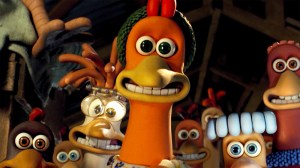 This was also one year before the Academy created the Best Animated Film Award, which would go onto 2001’s Shrek. I’m convinced if this award had been established one year earlier that Chicken Run would have been its very worthy inaugural recipient. Other animated films released in 2000 that might have contended: The Emperor’s New Groove, The Road to El Dorado, Titan A.E., Sinbad, and France’s Princes and Princesses. It seems bizarre today but there wasn’t a single wide-release CGI animated movie from Pixar, Disney, DreamWorks, or Nickelodeon. This was the last-year it was predominantly hand-drawn animation, which I do miss dearly.
Looking back on my brief review in 2000, I cannot recall why I had such antipathy for the major studio releases that summer. Gladiator was a success, though Mission: Impossible 2, Gone in 60 Seconds, Shaft, Titan A.E., Me, Myself & Irene, and The Perfect Storm disappointed me. Plus, there was the cataclysmic misfire Battlefield Earth. Whatever the case, Chicken Run was a breath of fresh air for my 18-year-old self that summer season. My younger self felt more compelled to argue that animation was not merely a medium for children, a stigma I believe has been significantly chipped away over the decades, especially with the publicity of Pixar. The Academy Award also gave the field a long-overdue honor and boost to the public. Aardman has released several movies after Chicken Run, including the absolutely delightful 2012 Pirates: Band of Misfits, which I highly recommend for all ages. I love animation and filmmakers that take advantage of the overwhelming possibilities the medium affords. My A grade stands. Chicken Run is just as enjoyable today. It might not be an all-timer of animation but it’s 85 minutes wonderfully spent.
Re-View Grade: A
Share this:

Killer Raccoons 2: Dark Christmas in the Dark (2020)
 Dear reader, I already know what your first question is regarding the title of this low-budget, schlocky comedy, and yes, there actually was a first Killer Raccoons movie. Back in 2005, writer/director Travis Irvine and his pals made Coons! Night of the Bandits of the Night for only $5,000 and their slasher killer was a team of trash-eating, nocturnal mammals with a bad rap. It got a small DVD release from Troma Studios and would be considered a success by any modest standards of genre filmmaking. For whatever reason, Irvine decided he had more raccoon-related mayhem to indulge and got his friends back together to make a sequel 15 years later. Filmed throughout Ohio in 2018, the end result is Killer Raccoons 2: Dark Christmas in the Dark (it seems in the ensuring decade, somebody wised up about not having “coons” as a title). As with other Ohio-based indies, I do happen to know several people involved in this local production but I will be doing my best to write an objective, bias-free review of… a killer raccoons movie. That might be one of the most absurd sentences I’ve ever written in my years as a film critic.
Ty Smallwood (Yang Miller) has just gotten out of prison after the events of the first film. He’s looking to start a new life, prefers to go by Casey, and has plenty of people unable to recognize him (it’s a different actor from the first film). Casey is meeting Darlene (Evelyn Troutman), the little sister of one of the women killed at that fateful campsite 15 years ago. They’ll better get to know one another over one long train ride home for the holidays. Ranger Rick Danger (Mitch Rose, also a different actor) has other plans. He and the other surviving members of the summer camp have hijacked the train with help from raccoons wielding automatic weapons. Ranger Danger plans on holding the nation’s government hostage (the mayor of their small town is now the Secretary of Defense) with a super phallic death laser satellite operated in space by trained raccoons (why? Who cares?). Casey teams up with a steward, Double A (Ervin Ross), and they go car-to-car trying to rescue passengers, evade armed raccoons, and thwart Danger’s evil catastrophic plans.
 Somebody actually went and made a schlocky beat-for-beat parody of 1995’s Under Siege 2: Dark Territory, and I have yet to process whether this is a commendable act of unusual comedy obsession or simply a folly with no real appeal but to the smallest of fringe audiences. The Under Siege sequel was another Die–Hard-in-a-place setup happening miraculously again (this time on a train!) with Steven Seagal as its leaden lead, so devoting the plot structure to reminding people about the existence of this movie and its many low-points seems, in some sense, like the kind of hyper-specific meta ironic comedy you’d find in an Adult Swim special. In my own comedy writing, I rekindled an old TV series from the 90s that was unceremoniously cancelled after eight episodes (The 100 Lives of Captain Black Jack Savage), leaving its 100-countdown mission unfinished and dangling in my mind until I wrote my own conclusion. Re-examining some forgotten relic of personal pop-culture, especially something built around silly and stupid, is a fine starting point for a comedy riff. However, the expectation is that more will be done than serving as a reminder of that inspiration. If you’re simply re-creating the beats of the source to completion then what exactly is the point? Nobody needs a crummier version of an already crummy movie. That’s where Killer Raccoons 2 goes awry. It’s so committed to recreating Under Siege 2, including exact character roles, names, and many dialogue repetitions, that you could have removed the killer raccoons completely. I even started watching Under Siege 2 again for this review simply to determine if the pixelated spy camera nudity used in the opening to demonstrate the satellite’s telephoto prowess was exactly the same stock footage used in the actual movie (they are separate people; you’re welcome, world). Killer Raccoons 2 is more an inexplicably fixated parody than a goofy killer animal comedy, and that is a major letdown of imagination.
Let me give you an example of the disappointing complacency of too much of the comedy. The hijackers (all sporting an eye-patch, a stylish motif I did enjoy) are trying to find Darlene among the passengers since they now know she has value with her relationship to Casey. Darlene says she’ll adopt a disguise and she literally arranges a strand of hair to lay across her face like a fake mustache. Now this is a silly, obviously transparent disguise but it shouldn’t be the end of the joke. A better extension would be since we expect it to be so flimsy that it somehow works and the hijackers cannot tell the difference. Then the hair strand could drop and the hijacker would express immediate confusion and alarm, only for Darlene to place it back in place, and the hijacker’s worry replaced yet again (“There was another woman just here.”). It’s one idea but it’s an idea, building off subverting expectations and then developing the setup to build into something more. The problem with Killer Raccoons 2 is that there aren’t any real comic set pieces, no really well-structured scenarios that can make you smile from their very inception about what will transpire. The closest is an improvised fight with whatever household kitchen items are available, at one point pitting waffle maker against waffle maker. Much of the humor is so obvious that the obvious nature is itself the joke, like the chintzy special effects, bad wigs, and copious amount of penis jokes (the deadly satellite is named the “PEN-15”). However, there’s a fine line between an obvious joke being funny and the filmmakers pointing it out. There are too many times where characters literally explain jokes or point out the absurdities.
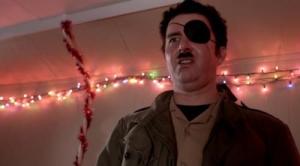 This is a 96-minute comedy when, in all honesty, it could have even been pared down to 80 minutes. The pacing can feel slack and many confrontations can stretch on, circling the same obvious joke. Even moments that work, like the improvised fight, go on too long and without sustained energy. There are way too many plot beats from Under Siege 2 distilled here (the Seagal movie is only a couple minutes longer). There are too many characters involved in the action too. I’m shocked how much effort Irvine has gone to in order to bring characters and story points from the original into this unexpected sequel. It’s been 15 years so I can’t imagine there was much demand for fidelity to not just Killer Raccoons 1 but also Under Siege 2. The most useless character is a painfully protracted cameo by the likes of aging porn star Ron Jeremy. I understand the appeal from a marketing standpoint of having a celebrity “name,” but the movie would have been better served with Jeremy making his contractual appearance and then hastily departing. The movie’s humor dies a tragic death every strained second he is regrettably onscreen.
As a hit-or-miss comedy, there are moments that had me genuinely laughing, mostly because of the exuberance of its go-for-broke cast. There were repetitions that would occasionally make me giggle, like referring to Darlene’s “dead sister he lost his virginity to,” or the emphasis on “for real dead for real” with characters always surviving insane mishaps through two movies. There are the occasional moments were a sudden escalation in violence against the raccoons got me to laugh. When the film is being silly, it has a charm where the goofiness and cheap budget enhance the entertainment value (“While this spoon appears to be harmless, it’s actually really super-hot”). Take for instance Ranger Danger furiously typing in the air but with no keyboard present. The sight itself is good enough to earn a quick goofy smile, but if the movie were to comment upon it, then the joke would just seem ruined. It’s that character that, by far, brought me the most laughter. The character of Ranger Danger is a twangy hoot chiefly because of the comic timing and impressive gusto of debut actor Mitch Rose. He takes okay jokes and adds such professional polish that got me to laugh out loud (“A gazillion dollars?” “I just… look, I made up a number”). Several of his line deliveries are pure wonders (everything about the golden VHS tape he so reveres), and he’s the kind of capable comic actor that could be the anchor of a bigger vehicle. Somebody get this man more work in the funny industry, pronto. Yang Miller (Huckleberry) is also deserving of praise by playing his self-serious loner hero so serious that he’s oblivious to his own ineptitude.
 I don’t have to over-complicate this. By its overly verbose title alone, you’ll know if you have any interest in Killer Raccoons 2: Dark Christmas in the Dark. It’s a goofy comedy that’s proudly low-budget, lowbrow, and low on ambition. It’s a sequel to a movie nobody likely saw, religiously parodying an action movie that hardly anyone remembers, and it’s filled with little raccoon puppets that could have easily been ditched for what they add to the overall comedy. I’m a little shocked there aren’t more tasteless exploitation elements present, like gratuitous nudity, over-the-top gore, and more envelope-pushing crude humor. Killers Raccoons 2 feels decidedly juvenile but not quite transgressive. It’s not going to be a great experience but the hits might outnumber the misses, especially if your sense of humor is attuned to the likes of schlocky Troma movies, Conan O’Brien, and late-night Adult Swim. It’s that combination of trash and irony that can prove blithely appealing, though I wish Irvine had put more effort into his comedy compositions. It feels weird to lament what could have been with a title like Killer Raccoons 2, but this just could have been funnier. A strange side note is that Irvine ran as the libertarian candidate for governor in Ohio in 2018. There’s a lazy joke to be had about him running the government the way he makes his movies, but I’m not going to stoop to that level. That’s for Killer Raccoons 3.
Nate’s Grade: C
Share this:

Palm Springs (2020)
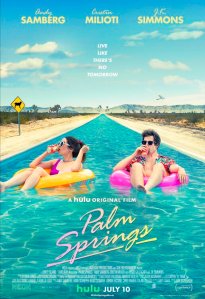
I am a sucker for a clever time travel tale, or parallel universes, a sci-fi story where the creative ingenuity is front and center, and Palm Springs is a delightful new rom-com bursting with imagination. By this rate, most audiences should be familiar with the time loop formula, from comedy classic Groundhog Day to Source Code to Edge of Tomorrow to Netflix’s audacious series, Russian Doll. It’s a creative conceit that rests on building patterns and subverting expectations, allowing a writer an unparalleled opportunity to retell a story, pulling at the edges and getting to answer an assembly of “But what if?” questions. It builds out its world and makes it feel richer and more intricate, all the little stories and characters that might have been missed had there only been a single avenue. It requires a creative storyteller with a big imagination for details, but when done correctly, the time loop movie can be a wealth of satisfying payoffs and intriguing detours. Palm Springs deserves to be added to that list of hallowed time loop movies.
It’s the day of the wedding for Sarah’s (Cristin Milioti) sister. There’s one wedding guest that seems to stand out. Nyles (Andy Samberg) seems prescient on the dance floor, has a prepared speech that earns tears, and strolls through the reception like he owns it. Sarah becomes smitten with him and, against her better judgment, follows him into a mysterious glowing cave. She wakes up in her bed and relives the wedding day again, learning she too is now trapped in that 24-hour loop with Nyles. He laments that she followed him, having once encouraged another person to join him in the world of no tomorrows (a rueful Roy, played by J.K. Simmons). But with a partner, the many days have a new relevance, and Nyles and Sarah depend on each other, but is there a chance that they can escape or are they doomed to perform the Electric Slide forever?

Right away, you can tell that writer Andy Siara (TV’s Lodge 49) has given his story tremendous thought, and the fun of it is watching our main characters go through the process of discovery while learning more about each. The rules of the universe are straightforward; whether death or sleep, they will wake up back that fateful wedding morning. Nyles has felt trapped for so long and the prospect of another companion going through his same purgatory fills him with guilt, but he cannot help feeling a new purpose when he finds a partner for this weird world. Initially she’s looking for an escape, but then she opens up to the possibility to a life permanently on pause, without consequences, and how freeing this can be. Then the appeal dampens as we come to understand why this day is a personally painful one for Sarah and why she would be desperate to live another day, any other day. When she drops out for a solid stretch in the second half, you miss her just as much as Nyles and better realize what a great team they made. Palm Springs has plenty of fun with the possibilities (Nyles requests a quick death over a long drive to “beat the traffic”) but it doesn’t lose sight over why we should care about these people. It doesn’t really matter how the time loop began or whatever theory will end the loop. It’s the central relationship that will ultimately provide the emotional anchor, and it’s because of that attention that by the conclusion of Palm Springs I felt uplifted, buoyant, and happy (a mid-credits scene thankfully answers the one lose thread, providing an even more welcomed conclusion).
Make no mistake, this is a funny movie and I laughed often. Samberg (TV’s Brooklyn 99) and Milioti (Black Mirror) are terrific together and genuinely seem to enjoy one another. They have a combustible spark to them that reminded me of older screwball comedies. Having a willing partner allows Nyles to cater to different impulses but also pushes him to re-examine his perspective when he has someone new who sees the excitement in their unique position. However, except for Roy and his long drive from Irvine, they are hopelessly alone, unable to move forward, and the question arises can there be anything of significance without consequences? The screenplay has a natural dark streak with its humor, so even when things get heavy with existential quandaries, it doesn’t stop the movie from being smart and enjoyable. There are so many wonderful little payoffs, little running gags, and larger payoffs to be had with the time loop formula. It also hooks an audience by watching a character fail, and fail, and fail, only to succeed. Palm Springs is a romantic comedy that can be funny, romantic, and make me care.

Debut director Max Barbakow keeps the pacing swift and has fun playing with bold primary colors across the desert setting. The tone of the movie is delicate as it can go into silly revelry, like a surprise coordinated dance routine and a wedding outburst involving a bomb, into yearning romance, into heartfelt pathos, and then even the occasional stomach punch. For as rightfully beloved as Groundhog Day is, there’s nothing that comes close to feeling like an emotional gut punch. With Palm Springs, the time loop is given its sci-fi examination, the comedy is given is full exploration, but it’s the characters that matter most, and Barbakow prioritizes the right feelings at the right times. By the end, you feel sweetly fulfilled by these 90 charming minutes.
At first, I wondered why the Roy character was included except as a cautionary tale why Nyles would not want to rope someone else into his purgatory. But then as we visited with the older man, I realized, as he does, that he’s meant to symbolize the change in perspective (mild spoilers to follow). The family that he couldn’t stand before his loop-life has now become his personal oasis. He’s grown in appreciation and love of his family bonds. He is the example for Nyles about how one can personally grow and change when given dedication and enough time to see it through. It’s a nice moment, and while Simmons (Whiplash) is always wildly entertaining when he’s bulldozing over others, giving Roy a poignant sendoff made me feel like he was a much more integral character and his earned wisdom was its own special reward.
Palm Springs is a great detox of movie, with enough sunny comedy and winning romance to make you smile and enough tortured existential drama to provide substance. Everyone involved, from the writer to the director to the cast, is having a blast and it’s fun to join in the good times. When it comes to time loop cinema, Palm Springs is a respite of entertainment and smartly developed and richly realized execution. Find it on Hulu and kick back.
Nate’s Grade: A
Share this:

Irresistible (2020)
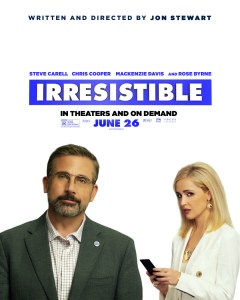 Jon Stewart was a chief part of keeping me sane during his storied 16-year tenure on The Daily Show, and every night he helped deconstruct politics and media bias with reassuring clarity and soothing wit. I was expecting far more bite from his first writing/directing effort since leaving his show in 2015 but Irresistible feels anything but and especially toothless when it comes to political savvy. Steve Carell (Vice) stars as a Democratic strategist still reeling over 2016 and who sees a bright shining star in a local Wisconsin farmer (Chris Cooper) who could help rebrand what a Democrat looks like. Carell agrees to help the man get elected mayor, which leads to a fish-out-of-water comedy where the big city elite tries to fit in with the salt-of-the-earth folk of small-town middle America. Rose Byrne (Like a Boss) plays a shameless Republican strategist who coordinate with the opposing candidate and lives to torture Carell, and she’s easily the best part of the movie. Some of the satirical jabs land (a CNN screen divided among 24 talking heads all talking at once) but many more feel strangely outdated, like a political satire from ten or fifteen years ago and not reflective of a the seismic post-Trump landscape. The satire doesn’t feel hard hitting enough and the comedy doesn’t feel especially well constructed beyond simple quips, so Irresistible lands in a disappointing middle ground of meh. It’s not a bad movie or even one bereft of certain entertainment, but coming from Stewart, it feels too safe and too self-satisfied. There’s a late twist that re-configures the entire context of the movie and I can’t decide whether it’s clever or ridiculous. There is a potential romance being leaned upon with Mackenzie Davis (Terminator: Dark Fate) that has the best and most knowing punchline when it comes to Hollywood’s depictions of romance. That was a joke that hits its mark with force. Too often the film seems content to nibble at the edges of larger political malfeasance. Ultimately, it becomes a lesson about the dangers of big money in the escalating arms race of politics, which is definitely a worthy issue, but in the exhausting era of Donald Trump, it almost feels quaint as the biggest target. Irresistible is a middling political satire for today and one that sadly made me worry whether Jon Stewart might have lost his touch.
Nate’s Grade: C
Share this:

The King of Staten Island (2020)
 The King of Staten Island is a semi-autobiographical vehicle for its star and co-writer, Pete Davidson. He plays Scott, a shiftless young twenty-something bumming through life and trying to find his sense of self as a wannabe tattoo artist. His father was a fireman who died on 9/11 and his mother (Marissa Tomei) has just started dating a new man (Bill Burr), also a fireman, and that triggers Scott, who fights to sabotage his mother’s new relationship. I’ve never been impressed with Davidson from his fleeting appearances on Saturday Night Live, but I genuinely enjoyed him here and, yes, the character is a natural fit with his awkward, sarcastic, deadpan sensibilities. It’s another in director Judd Apatow’s style of loping big screen comedy, so we have many scenes of hanging out with friends and reprobates, with Scott trying different things to get a better concept of what he wants to do with his life. It’s a movie that coasts on the good feelings with the characters and their easy camaraderie. However, from a plotting standpoint, The King of Staten Island could have used more at the end and less in the middle. It’s only the last 40 minutes or so where Scott moves into the firehouse, which seemed like a more central focus from the advertising. The abrupt conclusion left me on a note of, “Oh? Okay.” The movie is already an unwieldy 137 minutes long, so there was plenty of hanging out moments that could have been trimmed to better position the actual personal triumphs and character resolutions. Some of the payoffs don’t exactly feel earned either. Scott’s wants to keep things casual with a woman he sleeps with (Bel Powley) and uses his mental illness as the excuse, and she says she deserves better, but then they just end up together and it doesn’t feel earned or like Scott has learned how to be a better boyfriend. It’s like Apatow is saying, “Oh, yeah, and he got the girl. The end?” I would put this on par with 2015’s Trainwreck, though that film has a more clearly defined character arc, but both serve as fitting vehicles that play to the strengths of their individual comedians. I enjoyed the overall mood, I laughed, I enjoyed the various vignettes of the fun supporting characters. I wish there was a bit more shaping with the plot and a more fitting conclusion, but The King of Staten Island allowed me to enjoy Davidson as a performer. That’s a triumph for a guy I didn’t care much for prior to this moment.
Nate’s Grade: B


You must be logged in to post a comment.