Blog Archives
J. Edgar (2011)
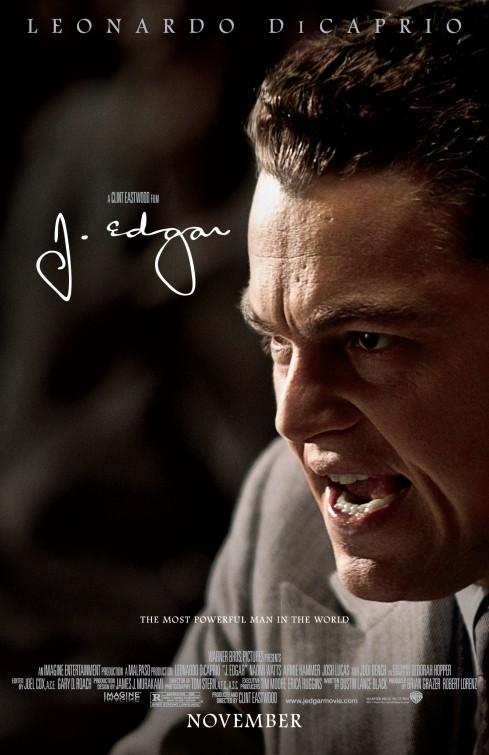 J. Edgar has all the qualities you’d want in a high profile, awards-friendly movie. It charts the life of legendary FBI head J. Edgar Hoover, it stars Leonardo DiCaprio in its title role, and it has Oscar-winner attached as screenwriter (Dustin Lance Black) and director (Clint Eastwood). The only way this movie could be bigger awards bait was if Hoover personally challenged Adolf Hitler to a duel. At a running time of 137 minutes, J. Edgar misses out on explaining why this complex man was who he was, a difficult prospect but I would have at least appreciated some effort.
J. Edgar Hoover (DiCaprio) was, at his height, said to be the second most powerful man in the United States. The first director of the Federal Bureau of Investigations served under eight presidents and for over 50 years. The man rose to power fighting against radicals and Bolshevik terrorists in 1919. Hoover successfully arranged for America to deport foreigners with “suspected radical leanings.” He was appointed to head the, then, Bureau of Investigations, where Hoover remade the agency in the image he desired. His agents were going to be clean-cut, college-educated, physically fit, and God help you if you had facial hair. Hoover also fought to bring modern forensic science into investigations and trials, proposing a centralized catalogue of fingerprints, which at the time was dismissed by many as a “speculative science.” Hoover also amassed an extensive system of confidential files on thousands of American citizens he felt were potential threats or if he just didn’t like them. Hoover wasn’t afraid to bully presidents with this secret catalogue. On a personal level, Hoover was admittedly without any friends or interests outside the agency he felt responsible for. His life was defined by three close personal relationships: his mother (Judi Dench), whom Hoover lived with until the day she died; Helen Gandy (Naomi Watts), his loyal secretary and confidant of 40 years; and Clyde Tolson (The Social Network’s Armie Hammer), an FBI agent that Hoover shared a decades-long unrequited romance with. Upon Hoover’s death in 1972, Tolson was given Hoover’s burial flag, and Tolson’s own grave is a mere couple plots away from J. Edgar’s.
 The movie feels trapped in a closet alongside Hoover. The guy was rather enigmatic and hard to nail down, but I would have appreciated Eastwood and Black at least trying to figure the guy out. They treat the subject with such fragility, such sympathetic stateliness about his more salient personality points. It feels like Eastwood doesn’t want to get his hands too dirty, so the provocative material, like the gay stuff, is kept to very period appropriate acts of discretion. A handholding in the backseat of a car is practically scandalous given the treatment on the gay material. The oft rumored cross-dressing aspect is hinted at but explained, in context of the scene, as Hoover’s way of mourning the loss of his mother. With Hoover, there was only his public persona of a moral crusader, a face that he never removed even in his private moments. The guy could never embrace happiness, only duty. It feels like Eastwood couldn’t decide on what stance to take, and thus the film settles on a bloodless examination that won’t upset any of the, presumably, delicate sensibilities of the older audience members. A towering figure of moral certainty, extreme paranoia, righteous conviction, a vindictive streak against his mounting collection of enemies, and a shaky hold on the truth, all in the name of protection against America’s many real and imagined enemies – I feel like the blueprint has been established for the eventual Dick Cheney biopic. It’ll just be slightly less gay.
Let’s talk more about the gay factor. It feels like this area is where Eastwood definitely could have pushed much further, but the old school director seems to be of the opinion that a biopic need not pry nor speculate. Excuse me, but you’re telling me about a man’s life, the least you could do is dig deeper. A domineering mother, who said she’d rather have a dead son than one of those “daffodils,” and the moral restraints of the time, are easy enough to identify why Hoover was a repressed homosexual. That doesn’t separate him from probably a far majority of homosexual men in the first half of the twenty-first century. What makes Hoover, a repressed homosexual, tick? This is no Brokeback Mountain style whirlwind of untamable emotion. Eastwood keeps things chaste, choosing to view Hoover as a celibate man. Hoover and Clyde becomes inseparable “companions,” eating every dinner together, going away on trips, and enjoying the pleasure of one another’s company – the life of the lifelong “bachelor.” But that’s as far as the movie is willing to go (remember the scandalous handholding?). There are hints about how socially awkward Hoover can be, a guy who seems downright asexual at times. He proposed to Helen on a first date where his attempts to charm included showing off his card catalogue system at the Library of Congress (“I bet you show this to all the girls…”). You get the impression he’s not comfortable with this necessary area of human biology. That’s fine room to start, but J. Edgar doesn’t do anything but start its characterization ideas. It gives you ideas to toy with and then moves along. The relationship with Clyde hits a breaking point when Hoover discusses, during one of their weekend getaways, the prospect of finally choosing a “Mrs. Hoover.” Naturally Clyde does not react well to this development, and the two engage in a brawl that ends in a shared bloody kiss. This is about as passionate as Eastwood’s movie ever dares to get.
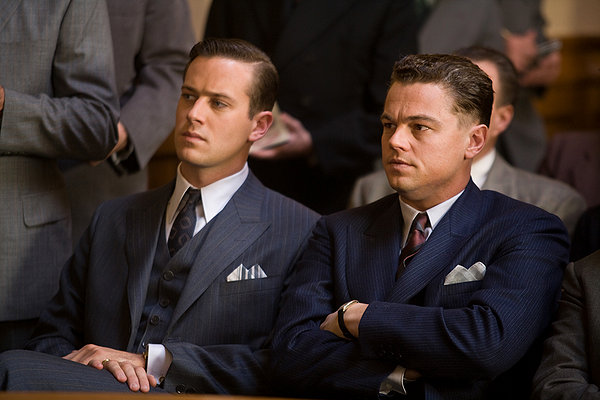 I expected more from the Oscar-winning writer of Milk. Black’s lumpy script can often be confusing, lacking a direct narrative through line. Some leaps in time can just be confusing, like when J. Edgar is asking his junior agent typist what figure was most important in the 20th century thus far. The agent answers, “Joe McCarthy,” and then we have a new agent sitting there, and Hoover asks again. Finally we have another agent who responds with Hoover’s desired answer, “Charles Lindbergh.” I suppose we’re left to assume that Hoover fired his typists until he found one who mirrored his own thoughts. There is also far too much time spent over the Lindbergh baby case. I understand it’s the so-called Crime of the Century and, as Black sets up, a situation for Hoover to prove his bureau’s value when it comes to modern criminal science. It just goes on for so long and rarely offers insight into Hoover. Sans Clyde, the majority of the supporting characters offer little insight as well. Hoover’s mother never goes beyond the domineering matrimonial figure. Helen seems like a cipher, rarely giving any explanation for her decades of loyalty despite clear objections to certain choices. She’s too often just a “secretary” there to move the plot along by introducing more characters of minimal impact. With Hoover being such an enigmatic and closeted figure, the supporting characters could have been the areas we found the most insight into the man. Nope.
The entire plot structure feels like a mistake. Hoover is dictating his memoirs so we primarily flash from the 1930s, when Hoover was making a name for himself, to the 1960s, when Hoover is fighting a secret war against, of all things, the Civil Rights movement and Martin Luther King Jr. (he was convinced King was tied to communists). The back-and-forth nature of the story can lead to some confusion over facts and timelines, but the concept of Hoover dictating his memoirs means that the movie becomes a greatest hits compilation, a showcase of Hoover’s finest hours in an attempt to win public support back. He can explain his obsessions and justify his overreaches. That’s why Hoover’s entire catalogue of secret files on thousands of American citizens, including presidents, is given such short shrift. Why would he want to discuss his own subversive tactics hunting subversive elements? The only time the screenplay discusses this secret catalogue is when Hoover and Clyde want to have a good laugh over Eleanor Roosevelt’s lesbian paramour (irony?). Richard Nixon covets these files, so Helen swears that upon the death of her boss that she will shred every page before Tricky Dick can get his hands on them (J. Edgar is rated R for “brief strong language,” and they are all provided by potty-mouthed Nixon). Black attempts something of an Atonement-styled ending with an unreliable narrator, but the effects are slight and only superficial and too late.
 At this point it’s probably going to be rare for DiCaprio (Inception, Revolutionary Road) to give a dud performance. The actor isn’t the first name you’d think of for a Hoover biography. Regardless, the guy does a great job especially with the emotional handicaps given to him by Black’s script and Eastwood’s direction. Given all the emotional reserve, it’s amazing that DiCaprio is able to make his character resonate as much as he can, finding small nuances to work with. Hoover’s clipped speaking style, likely the most readily recognizable feature of the man, is here but DiCaprio does not stoop to impression. He’s coated in what looks like 800 pounds of makeup to portray Hoover in the 1960s. The old age makeup looks good on DiCaprio, though the same cannot be said for his inner circle. Older Clyde looks like he is suffocating behind a gummy Halloween mask; the man looks like he is mummified in his own liver-spotted skin. Older Helen just looks like they powdered her face and added some gray to her hair.
The movie seems to take its emotional cues from its subject; far too much of J. Edgar is reserved, hands-off, and afraid to assert judgment on what was a highly judgmental man of history. What makes Hoover compelling is his array of contradictions. He’s defined by three personal relationships (mother, Clyde, Helen), all of whom he could never have. That’s got to mean something. Instead of exploring these contradictions in any meaningful psychological depth, Eastwood seems to take his hand off the wheel and the film just casually drifts along, steered by the self-aggrandizing of Hoover himself, given so much room to explain detestable behavior in the name of protecting America. J. Edgar is a handsomely mounted biopic with some strong acting, but from Eastwood’s impassive direction (his piano-trinkle score isn’t too good either) and Black’s lumpy script, the finished work feels too closed off and arid for such a controversial subject worthy of closer inspection.
Nate’s Grade: B-
Share this:

The Social Network (2010)
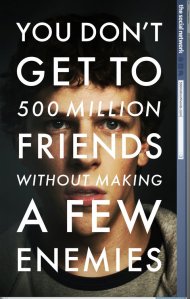 Dismissively branded as “the Facebook movie,” the whip smart and hypnotic, yet poorly titled, The Social Network is much more than a rote TV-movie on the start of a popular website (coming out next year: Twitter: The Musical in 144 Characters). Yes, the film chronicles the people responsible for the Internet’s most ubiquitous time waster and their very varying accounts of who was responsible and who was unscrupulous. But the backdrop could be just as much any start-up business. Truth be told, the “Facebook movie” bares a striking resemblance to Citizen Kane. It is the story of one man who may be a genius in some regards but can?t help but push everybody he cares about away. It’s about powerful men who don’t know what to do with power. It’s about ambitious men who dedicate their lives to that ambition. It’s not about terabytes and html coding, this is a movie about people, betrayal, ego, greed, jealousy, and the great irony that Mark Zuckerberg created the world’s most dominant social network and yet he himself cannot hold onto a single legitimate friend.
In 2003, Zuckerberg (Jesse Eisenberg) is a Harvard student obsessed with getting into the prestigious clubs and fraternities on campus. But he’s not well connected or athletic or close to being rich. So after being dumped on night, he goes home and hacks into various Harvard sorority websites and steals pictures of coeds. He then creates the crude website Facemash (while also drunk, mind you) where Harvard undergrads rank their fellow classmates side-by-side two at a time. It’s an immediate hit and crashes the Harvard server. Zuckerberg is then approached by Cameron and Tyler Winklevoss (Armie Hammer and Josh Pence), handsome blue-blooded WASP twins who have an idea. They want to create their own social website just for Harvard students to communicate with each other. They are impressed with Zuckerberg’s tech skills and want to hire him to build the site. Zuckerberg takes the idea to his roommate and best friend Eduardo Saverin (Andrew Garfield), proposing to make their own site with Saverin’s limited means.
From there is where the different parties diverge on their versions of truth. Zuckerberg secretly works on his own side project while stalling and dodging the Winklevoss twins. He offers to have Saverin be CFO of the company and split the stakes. Then as success mounts, the Facebook website gets the attention of Sean Parker (Justin Timberlake), notorious for co-founding Napster at age 19. Parker immediately has the ear of Zuckerberg, and it isn’t long before Saverin starts feeling on the outskirts of his own company, and then eventually shut out completely. The Winklevoss twins and Saverin each file multi-million dollar lawsuits accusing Zuckerberg of intellectual theft and underhanded business tactics.
 Watching The Social Network feels like you?re downloading an entire semester?s worth of information directly to your brain. Adapted by uber wordsmith Aaron Sorkin (TV’s West Wing, Charlie Wilson’s War), this is a story that gallops at full speed and leaves you spinning. The dialogue flies by so blazingly quick that it?s easy to get left behind. I would not advise eating any concession snack with this movie or else you might miss reams of dialogue. Sorkin smartly weaves together a murky and litigious tale of alternate truths, showing different sides when it comes to the creation of Facebook. Was it really stealing or did the Winklevoss twins merely inspire Zuckerberg? Is he truly indebted to them? “Does a guy who makes a chair have to pay a fee to every person who ever made a chair before in history,” Zuckerberg snaps. How deep did Saverin?s involvement go, and was he naïve or just thinking too small in scope? How much is a friendship worth in dollars and cents? Sorkin gives a definite impression to these answers, and it should surprise nobody that Saverin comes across as angelic and the obviously wronged party here. But the script as a whole is meticulous with detail, characters, and dates. It almost feels like the content of a miniseries has been squeezed into a brisk two-hour time frame. The characters are just as layered as the plot. The opening scene where Mark is dumped by his girlfriend (Rooney Mara, soon to be Lisbeth Salander in Fincher’s remake of The Girl with the Dragon Tattoo) sets the tone of the movie. The dialogue feels like an assault and it is unrelenting. You openly wonder how Eisenberg can breathe reciting his verbose lines with such lightning speed. Mara is aghast at her hyper-literate yet bitter boyfriend spewing bile at the elite and yet unashamedly pining for that life. He’s brilliant and cutting but socially awkward and unable to understand the feelings he’s hurting. Mara has had enough and dumps him right there, spurring Zuckerberg into a drunken night of revenge that will set the stage for Facebook. Sorkin can pretty much start clearing shelf space for his Best Adapted Screenplay Oscar right now.
Many will find Zuckerberg to be unlikable from the get-go, but I never could bring myself to actively dislike or loathe the man. He’s really more of a figure of Greek tragedy. Zuckerberg is a blissful conundrum of a character, a walking contradiction. He can be sullen and wounded one minute and the next casually cruel. He seethes at deposition hearings; unable to control the contempt he has for others. Zuckerberg’s anger boils over, and his beady-eyed glares communicate an incredulous, “You are worlds below me.” He can?t stand people who have easy breaks, the select and privileged, and yet he nakedly longs to be apart of that group and meet their approval. He can be childish and narcissistic, insular and insecure, and then he can be charitable. Zuckerberg created a music application that Microsoft was willing to purchase. “Why didn’t you sell?” asks one of the Winklevoss twins. Zuckerberg just shrugs his shoulders. He doesn’t want to sell ad space on Facebook and get rich quick because it would ruin the site experience. He is a champion of the democracy of the World Wide Web; a modern-day Thomas Paine? Probably not, but Zuckerberg’s hard-driven ambition and crooked tactics make him a modern-day robber baron, a titan of industry. Rockefeller and Carnegie and J.P. Morgan are all men that don’t seem any different in practice than Zuckerberg, though they probably had more family money as a starting point. That’s not an excuse for Zuckerberg’s behavior, but I want to add some perspective before the world tars and feathers the guy. Zuckerberg is the Internet’s first self-made billionaire, but what are the costs? By sacrificing all, and burning personal relationships, Zuckerberg may have advanced Facebook to unparalleled heights. But whom does he get to share his success with? It’s a little simplistic to boil such a complex film to the greeting card-esque moral “It’s people that matter most?” but the film always circles back to the question of cost. It’s also rather simplistic to chalk up the creation of Facebook as a means of impressing a girl, but then operas have been written, art has been sculpted, and wars have been fought over the need to impress a woman. Zuckerberg is a fascinating creature and brilliantly played by Eisenberg. This is a character Ayn Rand would love.
 It seems that Zuckerberg’s instincts about human obsession with being apart of something exclusive were right on the mark. What separated Zuckerberg’s site from the likes of MySpace and Friendster is that you needed a college-based web address to get inside. It was a closed community, which made it cool and desirable. It started as a restricted club that all the cool kids wanted to belong to, then everyone joined, and now it’s damn near impossible to resist. First it was college kids, then college kids from other countries, then high school kids, then adults, now everybody on the planet has a Facebook page making sure the world doesn’t miss a single detail about their personal lives. I resisted as long as I could but broke down and got a Facebook account earlier this year. The Social Network is not concerned with the business angle of success unless it related directly to how it impacts the characters. You’re not going to find many insights into why Facebook took off or became entrenched in our navel-gazing society, which is a pity. The film also doesn’t concern itself with outright social commentary. Sure by exploring the micro personal struggles and betrayals of Mark and Eduardo the film marginally comments on the macro idea of generational self-absorption and ego, but so much more could be said about society as a whole. The film’s one clear moment of social satire is when Eduardo’s girlfriend berates him about his Facebook relationship status remaining single. She’s incensed and wants to know what he truly means by this outrageous declaration. He says he’s embarrassed but he doesn’t know how to change it, plus he’s hardly ever on the site. She responds to this by setting his gift on fire. Ah, petulant and jealous and self-absorbed concerning what a few scraps of digital bits say rather than direct, personal, face-to-face communication. It’s a brief, albeit nice slam on the myopic self-absorption of millennials, who came out of the womb with something electronic attached to their fingertips. The film doesn’t even touch the idea of millennials’ free sense of privacy and over sharing. This is not a generation -defining movie, folks.
This is all strange ground for director David Fincher (Seven, Zodiac), a visual stylist with few peers. Nerds creating a website doesn’t exactly strike anybody as fertile ground for a visually exciting drama, and yet Fincher proves once again that he is a masterful artist. The film looks beautifully sleek from beginning to end with Fincher’s typical green tinted, deep focus cinematography. Fincher also makes the best use of special effects I’ve seen this year. The Winklevoss twins were not played by actual twins. Hammer had his face digitally placed onto a stand-in’s (Pence) body. The digital cut-and-paste was remarkable in Fincher’s Benjamin Button but it also called attention to itself. Nobody would walk in believing Brad Pitt’s face somehow was on the body of a three-foot tall old man. However, in The Social Network, you would never once doubt that there are two twin actors on screen the whole time. Hammer manages to make each twin distinct and frustrated without coming across as jerky or entitled. The rest of the actors do fantastic work as well, and special notice to Timberlake who plays his mercurial role with glee.
 So what does the real Mark Zuckerberg think about all this attention? Well, in a surprise to people who do not have a firm understanding of the word, Facebook has declined all advertising for The Social Network and is staying mum on the film, hoping to ride out the critical storm. I don’t think anyone is going to be using Facebook less now that they have learned the ethically murky beginnings of the website. But Zuckerberg and his Facebook crew might want to think of formulating some response strategy because this movie, and talk of this movie, isn’t going away any time soon (Zuckerberg recently donated $100 million to Newark city schools on Oprah coincidentally the same week Social Network was opening). It’s rare to find a studio film that is as polished across the bard as this film. The writing is sharp, the direction is sleek, the acting is top-notch, the film rollicks with intrigue and suspense and juicy drama, and the film can’t help but be relevant in our modern society. You do not have to know a lick about coding and websites and whatever to get absorbed in this high-stakes drama. It may not be the generation defining experience some critics are wetting themselves over in hype, but The Social Network is easily one of the best films of 2010. Perhaps the Academy will give it the ultimate “friend request” come this winter. In the meantime, log off and get yourself into a theater to see this great American movie.
Nate’s Grade: A


You must be logged in to post a comment.