Blog Archives
Rise of the Planet of the Apes (2011)
 I owe the makers behind Rise of the Planet of the Apes a huge apology. I have been vocally dismissive of a new Apes film from the first moments I heard about the project. I just thought rehashing this material was a stupid move. Then I heard James Franco (127 Hours) was going to be the lead, and I sighed. Then I saw the trailers and verbally impugned them in my theaters. Upon the conclusion of the trailer I yelled, “You can still shoot them!” and my criticism drew applause from those around me. The concept that we suddenly made apes smarter and they could now enter the Bronze Age, brandishing spears, didn’t overwhelm me. Just because the apes suddenly had tools didn’t seem like enough to topple mankind from the top of the evolutionary ladder. So in the months and weeks ahead I sneer, jeered, and overall dismissed Rise of the Planet of the Apes. And then the reviews came out and they weren’t just good, they were ecstatic. I went begrudgingly into the theater, waiting to hurl my own feces at the screen (figuratively, of course). Then I was completely taken aback by how much I unabashedly loved it.
Will Rodman (Franco) is a young scientists working hard at create a miracle cure for Alzheimer’s. His corporate company has been testing their drugs on chimps to mixed results. One day a promising ape, made smarter by a dose of ALZ 112, goes bananas and is put down by security. The lady ape left behind a baby ape that has taken on traits from the ALZ 112. Will takes the little chimp home to care for the “company property.” But then he ends up adopting the chimp, which his ailing father (John Lithgow) names Caesar. Due to the super drug, Caesar shows remarkable intelligence and looks to be getting even stronger. It looks like Will might have found his cure, and his boss (David Oyelowo) will make billions. But then complications ensue, as they always do, and Caesar is taken to an animal preserve facility run by a crooked father/son team (Brian Cox and Harry Potter’s Tom Felton). Caesar is mistreated and distraught to adjust to a life in pens. He makes plans to escape but then decides to rally his fellow imprisoned apes to a greater cause with the help of some of the ALZ 112.
Even through Franco is the headliner he’s really nothing more than a supporting character, a catalyst. The real star of the movie is undoubtedly Caesar the chimp. After about he 45-minute mark, Franco is reduced to making frowny faces while he scowls, trying to ascertain where his favorite monkey is. His dialogue is mostly reduced to different iterations of yelling Caesar’s name in different locations (the guy even manages to smirk in his sleep in one scene). But the major surprise is that Caesar is not only a compelling leading character but also a well-developed one at that. This is a living, breathing character brought to life thanks to top-notch computer wizardry and the talents of Andy Serkis, the leading authority for soulful motion-capture performances. Caesar may be the greatest single special effect of all time, not because of its life-like quality (it’s close, but again the creature’s features seem too waxy). But the reason Caesar is so impressive is because of the depth of emotion that can be read onscreen. This is a textured performance where you can read varying emotions through the looks of eyes, the twitching of facial muscles, the biting of lips. The emotions are genuinely recognizable; he flashes guilt, anger, frustration, heartache, disbelief, betrayal, fear, shame, just about everything in the book. From a DNA standpoint, chimps and humans share 96 percent of the same genes, so it’s understandable that we can relate to the plight of our distant relatives. Serkis is responsible for providing the groundwork for CGI creations like Gollum and King Kong, so he’s the world’s go-to guy when it comes to providing a framework for animators (Robert Zemeckis, why have you never called this guy?). It’s an amazing special effect accomplishment and works side-by-side with the storytelling to make Caesar a complicated, interesting, and deeply empathetic hero. He’s a terrific center for the movie and a figure that you root for, even with the tacit understanding that cheering on the apes’ escape is also tantamount to cheering the decline of the human race. But by God, during the apes-run-amok climactic sequences you are cheering for mankind’s downfall hardcore.
The Planet of the Apes saga (six films) is, let’s be honest here, rather abysmal. Everybody loves the first movie but the quality sharply drops from there, with four sequels in four years each managing to answer the depressing question, “Can this thing really get any worse?” The 2001 Tim Burton “re-imagining” was just embarrassing and filled with loopy logic (how can the apes take over Earth’s past when Marky Mark crashes on a DIFFERENT planet in the FUTURE?). Given that, the filmmakers behind Rise of the Planet of the Apes did not have to achieve much to separate themselves from the monkey-stank of the sci-fi franchise. The film serves as a prequel to the series but it’s easily the best film since the original. Easily. For one, the storytelling is not overwhelmed by the allegory of sci-fi packaging. The world is decidedly our own and the problems the characters grapple with are fairly relatable. Will may be responsible for the annihilation of the human race but his motivation is pure – he wants to save his ailing father. That’s a believable motivating force that would push the character to action over caution, testing his special serum without fully examining all the side effects. You know what they say about the road to Hell (my friend Eric Muller always suspected Franco would be linked to the end of civilization)? But in a Planet of the Apes movie there is a wealth of thoughtful human drama. Animal rights are one of the more obvious messages the movie deals with, but the film takes a character-driven approach following the animal himself. You care about these characters and when one CGI ape was cradling a dying CGI ape, I swear I was getting choked up over those computer pixels. That’s how emotionally involving this new Apes film can be. It’s refreshing to have a Hollywood action film that has more on its mind than blowing stuff up all good like.
 But when the action shapes up, mostly during a stirring man vs. apes climax, the film easily delivers. The nimble screenplay by Rick Jaffa and Amanda Silver (their first film since 1997’s Relic!) is a terrific example of economical big-budget pacing. Every scene moves the story forward and doesn’t waste a frame. The final running time is only 105 brisk minutes but it squeezes in so much entertainment and emotion. Director Rupert Wyatt keeps the thrills coming on a human-scale, never letting the enormity of the events getting too out of hand. Sure suddenly there are like 500 apes all of a sudden and all of them are super smart, but I can roll with that. The stakes are always clear and the action is easy to follow and easier to get swept up in. There are a few shout-outs to the original film’s iconic lines, which will either come across as fun or ham-handed. And thankfully a plausible scenario is put forth to explain why the humans would be overtaken by the apes. That’s not to say that everything is smartly woven into the narrative. Several of the side characters are but crude renderings. Frieda Pinto’s (Slumdog Millionaire) underdeveloped love interest could be completely taken out with minimal effect on the plot. Likewise the Evil Business Head seems to have nothing but speeches that remind you his sole interest is making lots of moolah.
Rise of the Planet of the Apes is a Hollywood movie with a soul. Finally late in the summer a major studio movie emerges that has the right balance of brains, brawn, and thrills. It’s an exciting action movie, a poignant drama from an animal’s point of view, a tour de force of special effects that manage to make the film more emotionally involving, and a sci-fi prequel that’s actually worthy of its name. Serkis’ gifts for physical performance are invaluable to the emotional core of the movie. By going back to its DNA, Rise of the Planet of the Apes has given new life to a franchise whose best days were 40 years ago. I don’t see where the series can go from here. A prequel to the prequel seems superfluous. A sequel would only really showcase the waning days of humanity and also seem superfluous. Then again, until the moment I was watching Rise of the Planet of the Apes I would have said this very movie was superfluous too. Instead this is the finest summer spectacle of the year and destined to make my top ten list for the year. If you can’t beat them, join them, damn dirty apes and all.
Nate’s Grade: A
Share this:

Captain America: The First Avenger (2011)
 In the summer of superheroes, you’ll be excused for feeling some fatigue when it comes to men in tights. Captain America: The First Avenger is a surprisingly enjoyable sepia-tinted action film that flexes enough might to pleasantly hark back to the days of 1940s adventure serials. Taking place almost entirely in the era of World War II, the film, and its hero, and unabashedly square and earnest. Steve Rogers (Chris Evans) begins as a 90-pound weakling determined to fight for his country and gets transformed into a behemoth of beefcake by the Army. Captain America is devoid of the dark brooding that has come to encapsulate modern superhero movies, but it’s also playing its B-movie silliness straight. The flick has more in common with Raiders of the Lost Ark and Sky Captain than most other superhero product. Better yet, the movie finesses the in-your-face patriotism of the title character. I mean the guy is called Captain America. Yet the film finds a way to resonate a sincere nationalistic pride without falling back into Michael Bay-level jingoism. And who’s going to make for better villains than Nazis? Director Joe Johnston (The Rocketeer, Jurassic Park 3) turns out to have been the perfect choice to helm this rah-rah retro enterprise. The pacing is swift, the acting is engaging, the special effects are terrific particularly Evans’ transformation into a weakling, and the film is unexpectedly emotional at points. This is a comic book movie that would appeal to an older generation not normally interested in superheroes, namely people like my dad.
Nate’s Grade: B
Share this:

Cars 2 (2011)
 Universally regarded as the least involving and nuanced film in Pixar’s illustrious catalog, Cars was the last film I thought would get the sequel treatment. Was it a creative tale that yearned to be told on the big screen, or is this just a business decision motivated by the sound of merchandizing coffers? Those talking cars seemed pretty content by the end of the 2006 original film. It doesn’t take long to realize that Cars 2 was done strictly for the cash. A sequel to the least involving Pixar film, with an even less involving storyline and elevating the most annoying character (Mater the tow truck) to lead status provides little in the realm of adult entertainment. The storyline, a mistaken identity spy thriller, seems like a rejected plot for a lesser direct-to-DVD sequel. While the visuals are still outstanding, the humor is stuck in neutral, overloaded with motor vehicle puns and groan-worthy visual gags. The message about accepting your uncouth friends no matter what their bad behavior might be seems rather misguided. That’s the message? Congrats Pixar, for providing cover for irresponsibility and incivility. The environmental message and its connection to a Big Oil conspiracy feels tacked on as an afterthought to try and crowbar in something more meaningful than a mediocre spy farce. I think cars are rather limited in their anthropomorphic expressions. There’s only so much they can do. And a world populated completely by living, breathing, gas-guzzling (can they get drunk on ethanol?) vehicles begs for an examination on how this world operates without any opposable thumbs. After a magical slate of films that dealt with serious mature themes and danced with storytelling finesse, it’s a shame that daring run comes to an end with such a rudimentary roadblock. Little kids will be entertained by all the bright colors and simplistic storytelling, but I cannot foresee too many fans of Cars even justifying the sequel’s existence. It’s not out rightly bad it’s just so pitifully pedestrian. Cars 2 has so little going on under its hood, you’ll swear it came from a different maker.
Nate’s Grade: C+
Share this:

Transformers: Dark of the Moon (2011)

After the obnoxious, oafish mess that was 2009’s Transformers: Revenge of the Fallen, a sequel that took everything good from the first flick and undermined it and took everything awful and magnified it, I wasn’t expecting much. True, low expectations have benefited this franchise built upon merchandizing, product placement, and giant freaking robots that fight. I still remain a fan of the first film back in 2007, and I do feel like director Michael Bay (Bad Boys, Armegeddon) is a natural fit for this material. But after another overlong, overblown, and overloaded Transformers film, I’m starting to think that the franchise’s best days left with Megan Fox and her cut-off jean shorts.
Sam Witwicky (Shia LaBeouf) has graduated from college and is now perusing a job in Washington D.C.’s vast center of government contracts. He’s living with his new girlfriend, Carly (Rose Huntington-Whiteley), the assistant to a rich billionaire (Patrick Dempsey) and his fleet of collector cars. Sam gets a job with at a military private contractor run by a angry loon (John Malkovich). But Sam’s post-collegiate journey once again runs afoul with killer alien robots. The villainous Decepticons are plotting to steal a spaceship that crash-landed on the dark side of Earth’s moon. Inside that spaceship are teleporter orbs and a sleeping robotic giant known as Sentinel Prime (voiced by Leonard Nimoy, hooray). Optimus Prime, leader of the noble Autobots, revives his predecessor. Together, the group attempts to thwart the Decepicons, lead once again by Megatron (voiced by Hugo Weaving).
The Transformers films have been getting larger and larger in scope and destructive power; the first film messed up some L.A. streets, the awful second film trashed Egyptian pyramids (only Six Wonders of the World left in your punch card, Bay), and now the third film pretty much obliterates downtown Chicago in stunning and overblown fashion. The climactic Windy City beatdown lasts a solid 50 minutes and may just be the greatest thing Bay has ever put onscreen, which admittedly might be faint praise to many. Perhaps the city of Chicago thought this would make for good tourism: ”Hey kids, come see the buildings that were turned to rubble in your favorite summer movie!” The impressive special effects are uniformly terrific, and the integration of reality and fantasy seems seamless. That goes without saying. I must credit Bay for creating sustainable action that is, here it goes, actually coherent. I know that “Bay” and “coherency” rarely go together, so I’m as shocked as everyone. No longer does geography become a hindrance to understanding. During this climactic Chicago onslaught, the locations are established, the objectives are clear, and the audience has a crisp understanding of the different teams, their paths, and their organic roadblocks and setbacks.
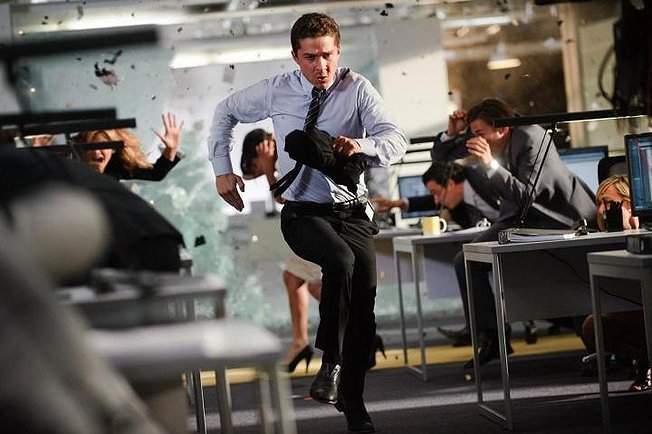 There’s a strong set piece within this 50-minute assault where Sam and company enter into a crumbling skyscraper that then teeters on its side. The organic complications allow for some nifty, almost ingenious, split-decisions utilizing a specific location, the hallmark of good action sequences. One moment they’re climbing up the floors, the next moment they’re tumbling through the floors, then sliding down the sheer glass wall, then firing at the glass to fall back inside and tumble some more. All the while a giant worm-like robot is churning through the foundation of this collapsing building. The scale of the sequence is quite thrilling for the time being. And yes, the 9/11 imagery is undeniable and relatively unearned without even a nod to solemnity or anything less than brainless summer spectacle. Sure the “cool-ness” of the individual parts never really materializes into something greater, and yeah maybe the action would have more impact if you actually felt for the characters, or knew who some of them even were, but you take what you can get in Michael Bay world. The extended climax for Transformers: Dark of the Moon is relentless and will beat you into submission, admiring the intrinsic beauty unique to Bay’s epic, albeit mind-numbing, demolition of the senses.
But Dark of the Moon is also the most visually coherent of Bay’s troika of Transformers flicks because the man has finally settled down when it comes to editing. Now no one will confuse this movie for Rope or Russian Ark (look it up, Transformers geeks), but the edit/panic button is given a slight reprieve. The shots last longer; the editing is far less frenetic and chaotically ADD-addled, and no longer does a Transformers action sequence look like jumbled, mechanical scrambled porn. Image A and Image B make a logical connection, at long last. You can tell which robot is which, for the most part. Perhaps this editing epiphany was a result of Bay’s corporate betters insisting that the film be shot in 3D (I chose to see the film in good old boring 2D, feeling that 150-minutes of Michael Bay with headache-inducing glasses was not worth the extra dough). Perhaps Bay had to consciously think about his audience’s well being so his shot selections lasted longer than his usual whirlwind of cuts. Perhaps the secret was loading Bay with cameras that weigh the same as couches. Maybe a little extra weight was all the man needed to formulate lucid action sequences.
And yet Dark of the Moon is just as stupid, outlandish, and tonally disjointed as the other movies, particularly the abysmal Revenge of the Fallen. The comedy remains at a puerile, sophomoric level. Bay’s sensibilities have always somewhat mirrored that of a snickering 14-year-old boy; the love of destruction, the fascination with things that go “boom,” the ogling of lithe feminine bodies. No joke, the first image seen directly after the film’s title is a close-up of Huntington-Whiteley’s ass ascending a staircase. I imagine there were plenty of men spasming in their 3D glasses trying to reach out and grab the circumference of a Victoria Secret model’s talents. I wrote about the second film: “Women don’t seem to exist in the Michael Bay world, only parts and pieces of women.” Huntington-Whiteley’s character certainly leaves much to be desired, outside aesthetics. At least Megan Fox’s character had, you know, some character traits. I also wrote: “Amazingly enough, [Fox] manages to lose more clothes the more she runs in slow-mo, allowing the male audience members to follow the nuance of her bouncing breasts. She’s clearly not the next Meryl Streep but this girl deserves more than being wordless arm candy.” Seems apt to me. Carly is as bland as she is blank-eyed beautiful, just the way Bay likes ‘em.
The first 90 minutes of the film is spent with the humans and it’s like being trapped inside a bad comedy. There has always been a strong comedic bent to the franchise ever since the first film in 2007; however, the latter films have taken to grotesque caricature. In Dark of the Moon, the comedy is so deeply unfunny but so consistently antic, trying to overwhelm you with its bad taste. There’s a scene where Ken Jeong (yes, you read that right) corners Sam in a bathroom stall to distribute his crackpot manifesto. Then Sam’s boss walks in and, oh boy, he overhears and thinks they’re having a homosexual liaison in the men’s stall. What a hoot. Then Sam’s mother gives him dating advice, stating there’s no earthly way her son is going to nab a third “hottie” unless her boy has a giant…. and trials off (wouldn’t a mother kind of have an idea about that subject?). And then there’s the little Autobots, the size of remote control cars (perfect presents for Christmas mom and dad), who wheel around spitting smart-alecky backtalk. The entire Malkovich portion could have easily been cut from the film without damaging a soul. The Ken Jeong stuff should have been eliminated first. There’s something to be said when John Turturro’s returning Agent Simmons is the least annoying comic sidekick in this movie. But hey, at least there aren’t any overt racist depictions and jokes about robot scrotums. Nope, there’s only infantile humor and nonchalant misogyny. The comedic pit stops and non-sequitors never allow the movie’s tone to gel.
 Before the movie descends into an all-out series of explosions and shrapnel, the setup actually has some genuine interest. Then it just all goes nuts at warp speed. The fact that the space race to the moon had a sinister ulterior motive, investigating alien technology, is an intriguing start. Bay even shoots the 1960s sequences like he’s ripping off Oliver Stone, swapping film stocks and black and white film to showcase his historical reinactors (three presidents get represented, including Obama). Apparently after this film and X-Men: First Class, the breakout star this summer is archived footage of JFK (man did he have a full plate, mutants and robots, and the man still found time to bang Marilyn Monroe). There’s even a cameo by the real Buzz Aldrin, which served to make me remember his better cameo on TV’s 30 Rock (“Would you like to yell at the moon with me?” he politely asked Tina Fey). The space race was a pretense for getting our human hands on some alien technology. Of course we were warned years ahead of time via Pink Floyd but nobody could put the pieces together. But there’s more alternative history to be had. Turns out that the disastrous nuclear accident at Chernobyl was caused by the Russians trying to operate alien/Transformer technology. I’m sure modern-day Ukrainians will adore having their deadly tragedy turned into a plot point in a stupid movie about fighting robots. The Decepticons wicked plan is to open a teleportation portal and bring their dead planet, Cybertron, to Earth. Then they will use Earth’s human population as slave labor to bring their dead planet back to life. My question is this: when you’re a huge robot the size of a building, wouldn’t puny little humans make for a terrible labor force with their stunted little legs and feeble muscles? I know there’s billions of them, but there’s a reason human beings have never turned on ants and forced them to become a labor force for our construction projects. How many more deadly things from Cybertron are secretly going to be hidden on Earth? And yet none of this is even one-tenth as stupid as Transformers’ heaven in Revenge of the Fallen.
Transformers: Dark of the Moon is likely everything fans would want from a franchise. There’s wanton destruction, a plethora of noisy explosions, and plenty of eye candy both in special effects wizardry and pouty, full-lipped women. But at a colossal 150-minute running time, this is a Transformers film that punishes as much as it entertains. There’s really no reason a movie about brawling robots should be this long. There’s no reason it should have to resort to so much dumb comedy. There’s no reason that the women should be fetishized as if they were another sleek line of sexy cars. There’s no reason why something labeled a “popcorn movie” can’t deliver escapist thrills and have a brain too. Dark of the Moon is saved by its long Chicago-set climax, which gives way to some staggering action set pieces. The newest Transformers movie is just as stupid as the rest (what the hell is up with the weird Igor robots tending to Megatron that just seem to grumble and grunt?) but, unlike the previous installment, it’s not offensively stupid. Dark of the Moon is an exhaustive experience whose thrilling high points even feel mechanical and pre-programmed. Is this the future of Hollywood? Bay and his army of robotics and excessive spectacle have taken over the world. When it comes to big-time summer entertainment, the machines of Hollywood are going nowhere fast and even louder.
Nate’s Grade: C+
Share this:

Green Hornet (2011)
 Unassuming, impetuous, and with a lowbrow sense of duty, The Green Hornet gets by on its self-aware, campy, chummy tone thanks to co-writer/star Seth Rogen. The slimmed-down comedian plays a news media playboy who tries to right his life by becoming a super hero with his deceased father’s assistant, the kung-fu connoisseur Kato (Jay Chou, making a very poor English acting debut). Where the movie works best is when it upends formula convention, like making every character insecure about their personal standing, including the villain (Oscar-winner Christoph Waltz), who is aggravated that the “Green Hornet” is dazzling criminals with his digital age marketing. When the film thumbs its nose at convention, it plays like a mischievous prank on super hero/crime fighting tales. Green Hornet is a movie that at times is too busy, too childish, bordering on a bromance between Rogen and Chou. But with director Michel Gondry (Eternal Sunshine of the Spotless Mind) at the helm, there are enough quirky visuals to keep things interesting to the noisy climax. Rogen and his film can never be accused of being too serious, and given the material that’s a blessing.
Nate’s Grade: B-
Share this:

Green Lantern (2011)
 To quote that sage Kermit the Frog and his words of wisdom concerning Green Lantern: “It ain’t easy being green.”
Hal Jordan (Ryan Reynolds) is a cocky pilot working for his ex-girlfriend, Carol Ferris (Blake Lively). Hal never takes anything too seriously and seems to freeze up in moments, recalling his own father’s crash. Then one day a purple alien crash-lands on Earth and seeks a replacement. This alien belongs to the Lantern Corps, a group of intergalactic policemen for the universe. He was mortally wounded by Parallax, a creature that grows stronger on fear but looks like a big rain cloud. The alien’s ring chooses Jordan as the replacement. Next thing you know, the guy is training on the alien world Oa and meeting lantern officers from all over the universe led by Sinestro (Mark Strong). Jordan is unsure of his heroic destiny, though we are reminded many times “the ring does not make mistakes.” In the meantime, Hector Hammond (Peter Sarsgaard) is dissecting the dead purple alien and gets infected with the fear cloud/Parallax. He lashes out at his father (Tim Robbins), at Jordan, and signals to the giant evil rain cloud that Earth is an all-you-can-eat fear buffet ready for the binging.
For starters, he power is a bit silly and hard to explain. I fall in with the majority of the public when I say, “Green Lantern who?” So the guy’s super duper power is to channel his imagination into green-tinted reality? It’s a bit vague and hard to quantify. So when a helicopter is falling to earth, instead of, say, picking it up or steadying it, Jordan creates a green Hot Wheels racetrack for it to zoom around to a stop. When the evil rain cloud fires its energy projectile, Jordan conjures a catapult to catch the projectile and fire it back. And of course at some point he materializes a green gun to use in combat. I’m sorry but for me this just seems silly. It’s one thing to say, “His strength is the power of his imagination,” and I can see where young kids would gravitate to this stuff, but when it’s realized on the big screen is seems infantile. What are the rules here exactly? It just seems dumb. I can better accept a magic ring that allows Jordan to fly or shoot sparkly lasers. If a healthy imagination is key, then the rings should be choosing some of the world’s greatest living authors and artists. Can you imagine Charlie Kaufman (Being John Malkovich) with a lantern ring, or Neil Gaiman (Sandman)? Surely those guys would come up with something more interesting than catapults and racetracks. But you see, the rings, and the lantern world itself, runs on the power of will. Will power is their energy resource (talk about going green). The enemy, the cosmic rain cloud, runs on the power of fear, which is represented by yellow energy. What are the other colors of the rainbow? Is the power of love red? Is the power of envy a darker green? Is orange the color of hunger? Is brown the color of painful bowel movements? Is the power of apathy… forget it.
The biggest misstep is all the time the screenplay squanders on boring old Earth. Just like Thor, the alien worlds are the best part of the movie. But in Green Lantern, we see the training home world (Oa) and the thousands of weird, fun-looking aliens staffed to police the universe. We get a taste of the lantern life and the heavy responsibilities. We get a sense of the powers. And… then… Hal… quits. He up and quits. He says, after about five minutes of training, “You got the wrong guy,” and we head back to Earth. What the hell? We then get to spend the majority of Act II with this guy moping over whether he should or shouldn’t be a superhero. Memo to Hollywood: no one spends this kind of money on a movie where the main character can’t be bothered to accept being a hero with amazing super powers. I can’t be bothered with a hero who can’t be bothered. The screenplay structure should have been: Act I spent on Earth, Act II spent on Oa and in space, Act III return to Earth to save the day. Instead we get about ten minutes spent on Oa. And while I’m on the subject, whenever we see this alien planet it’s like a non-stop Green Lantern convention (does Oa host other conventions? Is next week the semi-annual gathering of amateur ornithologists?), so who is left policing the universe? I understand that a majority of the universe is empty space, but if the lanterns keep getting together for pep rallies on Oa, what’s to stop a universe full of criminals from stealing everybody’s car stereos? Also, lanterns intervene in the universe when evil is afoot, but nobody seemed to give a damn about planet Earth until we got lantern representation with Hal Jordan.
So the bad guy here is a semi-formless rain cloud with a head that sucks people’s fear. It feeds on fear. That is its energy source (get a job in the media, son). Like much else in the film, the rules concerning the villain are never fully explained. At times, this rain cloud thing seems invincible. Most of the time it’s never explained what exactly this thing could do. See, if you explain things then you box in your characters. So if you don’t establish rules for your villain, your heroes, their respective powers, the history of the universe, etc., then they are limitless. It also means that everything onscreen lacks any sort of logic, internal or otherwise. So the villain is really just a fuzzy concept of fear. Hal Jordan and the lanterns have nothing to fear but fear itself. That means that the screenplay falls prey to a plethora of hackneyed messages that feel ripped out of some Saturday morning cartoon series. Everyone feels fear. Accept your fear. Courage means rising above. It’s the same patter that’s been rehashed for hundreds of episodes of people in tights teaching schoolchildren it’s okay (take a drink every time a character utters the word “afraid” or “fear”). The simplistic moralizing on fear and courage made me yearn for a ring so that I could imagine a better villain. Lastly, there’s a scene where our dastardly cosmic rain cloud descends to Earth and starts sucking away people’s fear/energy/souls. There’s a shot of a school bus screeching to a halt and children dashing away. I imagine children’s fears are more heightened since their healthy imaginations and lack of world experience would exaggerate scary things that adults would try and simply deny. Their fear has to be like a delicacy. I guess what I’m getting at is, if I were a giant space cloud that fed on people’s fears, I’d go for the children first.
Director Martin Campbell has crafted some truly spellbinding, breathless action sequences in movies like Goldeneye and Casino Royale, but you can tell that he seems to be straining against the onslaught of computer effects. Campbell is more at home with the open world of practical effects and the tangible. Being confined to the realm of green screen and CGI seems like a shackle for this guy’s own imagination. He constructs solid action sequences, admittedly, but nothing worth bearing the name of Campbell. It’s a special effects bonanza without a hint of realism, like a computer start vomiting onto the screen. It feels weightless and formless, like a giant evil rain cloud. The film reportedly cost over $200 million, which is a high figure for a movie that spends so much freaking time on Earth! Here’s an example of a costly filmmaking expenditure – the suit. Hal Jordan has a skin-tight green suit that is complete a computer effect. That means that every second Reynolds is seen onscreen in his signature outfit, it’s another effect that people labored over for months. Why? I’m pretty sure that in this day and age we have the technology for clothing. Campbell succumbs to the limitations of the material and Green Lantern ends up feeling more like a TV pilot with a runaway budget than the beginning of an epic franchise for its parent company.
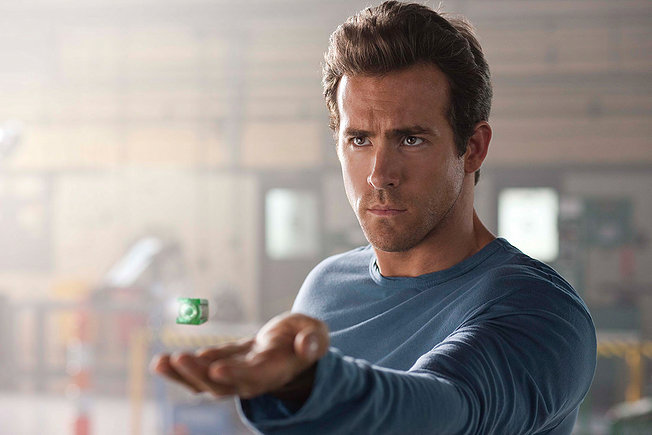 Reynolds (The Proposal) is an extremely likable actor whose biggest drawback is that he rarely seems serious, last year’s Buried a notable exception. He’s got this carefree attitude, practically bobbing his head and winking to the audience, and you like the guy even when he’s being a cad or a wimp. His character’s arc is supposed to be the guy who accepts responsibility, learns to accept and move beyond his fears, and it’s a character track that has been long journeyed and will continue to be. It makes for a simplistic hero’s journey storyline that seems to do the least work necessary to move things along. The movie did not fail on Reynolds’ shoulders; you can blame the four screenwriters and a ballooning budget for that one. Lively showed that she really could act in The Town. She shows no proof of this ability in Green Lantern. She speaks every line in a flat, monotone delivery, so much so you start to think she has like an inner-ear infection and can’t hear her own modulation. Her character is the weak love interest/damsel in distress role that regularly peoples these kinds of movies. Her monotone delivery does nothing for the lukewarm chemistry between her and Reynolds. Only Sarsgaard (An Education, Orphan) comes away mostly unscathed. His underwritten villainous character undergoes a monstrous transformation that would elicit sympathy from the Elephant Man.
Green Lantern is a movie that will thrill twelve-year-old boys and few others. It’s full of special effects, noise, and little clarity or wit. It’s not even a particularly fun movie. It repeatedly tells the audience things it should be showing, and it can’t help showing the audience character points (like Hal’s dead dad) that could have been handled with smoother nuance. The movie never feels like it can trust its audience for anything subtle. This is the kind of movie that needs to spell out everything. Green Lantern is muddled, tonally disjointed, the rules are not established, the villain is abstract, the messages are simplistic, the powers are ill-defined and also silly, the action is lackluster and overly dependent on often needless CGI, and the hero can’t even be bothered to accept his super powers. Apparently Green Lantern has about 60 years of comic history and a rich sci-fi universe, and this is the best four screenwriters could come up with? This is the best stuff they pulled from? Green Lantern is a movie that feels dimmed from start to finish.
Nate’s Grade: C
Share this:

Drive Angry (2011)
 Without a hint of self-awareness, and not nearly enough tawdry camp, this exploitation throwback manages to be completely serious with a ridiculous plot and a celebration of muscle cars, gory violence, and women in hot pants. And yet for a film about Nicolas Cage literally escaping from Hell to save his baby granddaughter at the hands of a Satanic cult leader (Billy Burke), it’s awfully complicated. The plot is hard to nail down, rarely does it spell things out, which means the audience is left trying to piece together the scraps of logic in between fetishizing cars and violence. Amber Heard (The Informers) and her cut-off high-waisted jeans becomes Cage’s sidekick and she gets to hold her own. The 3-D elements are mostly distractions flying at the screen, the violence is extreme but with a distasteful nihilistic edge, and the tone lacks any traces of irony or appreciation of genre. There’s more potential here that never feels tapped, like Cage’s special “God-killer” gun that spooks even the Grim Reaper/Angel of Death (William Fichtner, having a blast). At one point, Cage is locked in coitus with an overly animated waitress, and he kills an onslaught of goons while still engaging in sex. While Shoot ’em Up did it too, it’s a sequence that hints at what the film could have been had it given in to more crazy impulses. Instead, Drive Angry isn’t nearly passionate enough to register as anything but a mundane retro, country-fried rehash of 1970s action movies.
Nate’s Grade: C
Share this:

Pirates of the Caribbean: On Stranger Tides (2011)
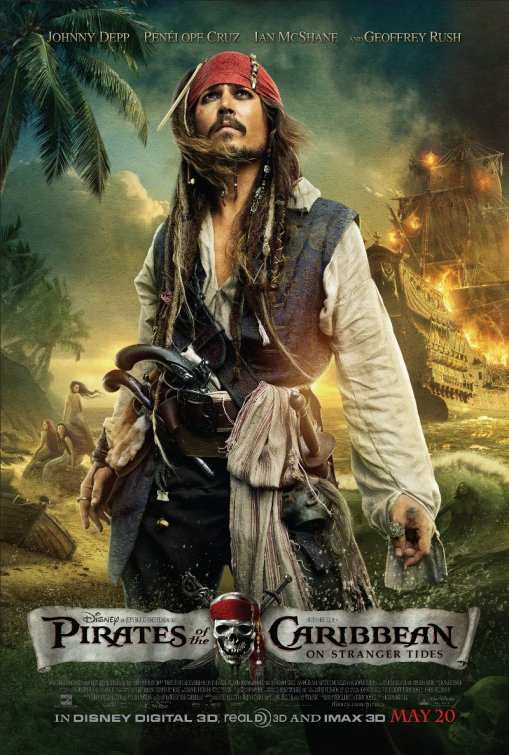 The public reaction to the two previous Pirates of the Caribbean sequels, 2006’s Dead Man’s Chest and 2007’s At World’s End, were decidedly mixed, though that didn’t stop them each from earning a bazillion dollars. Fans didn’t care for the darker tone, the confusing interlocking of the story, and especially the bloated running times. It feels like Disney’s uber-producer Jerry Bruckheimer must have taken notes from the sequel backlash and they amounted to: “Less of everything.” Welcome to less plot, less character, less involvement, and far less entertainment. Welcome to Pirates of the Caribbean: On Stranger Tides.
It’s been a few years since the non-world-ending events of At World’s End, and Jack Sparrow (Johnny Depp) has been in London putting a new crew together. Except, it’s a Sparrow imposter. Turns out it’s Angelica (Penelope Cruz), a former lover of Jack’s who woud still like to settle some scores. She and her father, the feared pirate captain Blackbeard (Ian McShane), force Sparrow to lead them to the Fountain of Youth. Apparently, Jack at one point had the map. King George II (a delightfully hammy Richard Griffiths in one of the film’s best scenes) is in a race against the Spanish crown. The English monarch hires Barbossa (Geoffrey Rush), Sparrow’s occasional enemy and ally, to find the fountain as well. It’s a race to see who can benefit from eternal youth first because, apparently, no one can share a source of water. Second grade teachers nationwide are very disappointed, Disney.
The entire enterprise just lies there on the screen, devoid of all energy or danger. The entire picture is just so shockingly inert, lazy, phoned in from every angle, missing any resonance of magic. Rob Marshall was the wrong man to be tapped as the new director of this series. Marshall has a fine eye for visuals, but the man couldn’t stage an action sequence to save his life. The Oscar-nominated director of musicals like Chicago and Nine stages his action sequences like dance sequences, which on paper don’t sound too far off. That’s until you realize action needs to incorporate story, location, build in tension, create organic obstacles, and be easy to follow. The action sequences in On Stranger Tides aren’t outlandish enough. It’s all so dull, a sword fight here a sword fight there. Short of a mermaid attack sequence, there’s no excitement to be found onscreen. That is disastrous for a franchise that has built a reputation for its anarchic, wild action and storylines. Marshall’s action angles and editing don’t communicate urgency. There’s no mood to these set pieces. The editing feels like it’s always catching up, always too late, needing a myriad of trims. Action cinema has been lambasted when it’s hyper edited and the audience cannot see what is happening; On Stranger Tides is not edited enough. One of the reasons these half-baked action sequences can never get going is because they always seem to be starting and stopping with the lackadaisical editing, always a step behind. The shots linger when they shouldn’t. The ingredients are there for a tasty meal but the chef (Marshall, screenwriters) doesn’t know what to do. The musical score by Hans Zimmer tries very hard to compensate and rattle the audience, compelling them to think what is transpiring on screen is exhilarating. It is not, and the music is just loud and annoying.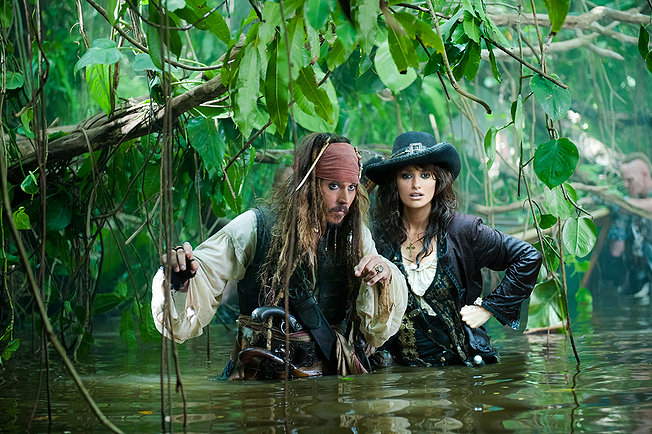
One of the chief criticisms of the two Pirates sequels were that they were overstuffed with storylines, characters, setups, and were just far too convoluted and confusing for their own good. So with On Stranger Tides we get a simplified, pared down one-off movie. Much of the film is just characters walking in circles and, likewise, talking in circles. Motivations are flimsy. The dialogue is stilted; Sparrow’s malapropisms and one-liners feeling sloppy (“I agree with the missionary’s position,” he quips. Groan). The entire premise is to get to the Fountain of Youth, and then they get there and, well, very little happens. The characters will talk about little, walk a few feet, talk about little more, and this process repeats. Barbossa should be an interesting foil, going from fop to pirate by film’s end, and yet his every appearance in the movie feels like when the next-door neighbor appears on a TV sitcom. It’s an intrusion meant to remind you that you, the audience, like this character, even if they don’t serve any point in the story. The plot lacks any twists and turns, ultimately having every competing force converge on the Fountain of Youth at exactly the same time for a slapdash climax that involves more lackluster sword fighting, just like all the other sequences. On Stranger Tides is a full half-hour shorter than the third movie, and yet it still feels like an eternity at two hours and seventeen minutes because it spends so much time doing so little.
At least the other three Pirates movies found clever ways to mingle their sci-fi mythology into an old-fashioned Errol Flynn swashbuckling adventure. With On Stranger Tides, the sci-fi fantasy elements are just as underdeveloped as the characters. The Fountain of Youth is another of those magic do-hickeys that involve gathering magic tokens and blah blah blah, mermaid tears, silver chalices. Hey, if you wanted to drink up some mermaid tears, have them watch 2009’s Oscar-winning best documentary, The Cove. That ought to do it (a scene driving the mermaids into nets oddly reminded me of The Cove). Blackbeard and Angelica have a Jack Sparrow voodoo doll, which is highly effective, and yet this plot device is nearly forgotten for the entire film. There is no clever application of this unique device. Blackbeard has a magic sword that makes ships come alive. Why? How? It’s just another magical Macguffin, like Jack’s compass. Man-eating mermaid temptresses is an interesting idea, and a great way to squeeze in a lot of obfuscated nudity in a Disney film for teen boys who have not discovered the Internet. Too bad the mermaids are confined to one scene, albeit the highpoint of an otherwise bad film. Their feeding frenzy is the only moment in the film that channels that high-flying sense of verve that made the original so memorable. Don’t even get me started on the fishy romance presented between the captive mermaid (played with all the acting capability of a French perfume model) and a missionary (Sam Claflin). The whole experience feels like a shambled, draggy, inarticulate rip-off of Last Crusade, complete with a climactic drink from a magic chalice. I appreciate Marshall’s emphasis on practical special effects but if these are the results then bring back the previous sequels’ CGI vomitorium. This franchise feels like every ounce of energy and danger has been squeezed out of it.
So does that means that this Pirates venture is more character-based now that it has jettisoned side characters and complex plots? Fat chance. The problem is that Jack Sparrow is not a good lead protagonist. He’s not meant to be a classic good guy. He’s a libertine, somebody who makes selfish choices but will revert to do something proper when his conscience nags him enough. Sparrow is more of the dashing rogue at best. Does anyone remember how he was going to trick doomed men into signing their souls to Davy Jones? He also needs a foil, a striaghtman to bounce off of. I almost miss the wooden performance of Orlando Bloom. Without a do-gooding striaghtman, Jack Sparrow plays like a man adrift, searching for his groove. Unfortunately, Sparrow never finds it in this vehicle, which just asks him to go through motions and mannerisms. Blackbeard makes for one very bland villain. McShane (TV’s Deadwood) can glower and chew scenery with the best of them, but his baddie never seems too menacing. He burns one guy alive and threatens to kill his own daughter in order to keep Jack in line. I’m sorry, but that doesn’t even compare after the previous films included a monstrous ship captain who would readily slice prisoners’ throats and a British bureaucrat who hanged an eight-year-old before the freaking opening credits. Blackbeard, in contrast, just comes off like a crusty old man in need of a shave.
 The film’s biggest addition was bringing in Jack’s former flame Angelica, a woman he robbed of her virtue and personally betrayed. But is there any tension? No, because Jack and Angelica don’t have any old feelings for one another they rehash (oh how I was even pleading for a trope like that), and the characters don’t really feel any antagonism either. Sure they will parry and threaten one another, but it’s so devoid of danger or tension or interest. This is no screwball romance. They feel like a couple that can’t be bothered working up any notable feelings toward one another. Therefore, all their shared scenes, and there are many, sink the film’s flow. Their bickering should bring some sparks. She should be exciting; she’s the daughter of a notorious pirate, she was going to be a nun until Jack Sparrow came sailing into her life. She should be sore. She should be angry. She should be a lot of things that ultimately the character is not. Cruz (Nine, Vicky Cristina Barcelona) doesn’t come across as an equal or love interest, she just feels like an annoying sidekick, harping on “Yack.” At one point, Jack tells her, “If you had a sister and a dog, I would take the dog.” When she’s got a personality like this, I’d agree.
Depp (Alice in Wonderland, Sweeney Todd) is obviously a comic gift and his Sparrow character will go down in the ages as one of the most universally beloved figures in cinema history. Everyone adores this character, a loveable scoundrel. But that doesn’t mean the screenwriters can just strand him in a crummy story with nothing to do. Depp will always be enjoyable when he puts on his Captain Jack eye liner and does that funky, swishy walk of his, but even he feels like he’s phoning this one in. He realizes that his character is trapped in a sodden adventure that offers little to do as a character and an actor.
I never thought I would say this, but On Stranger Tides makes me positively reevaluate the other Pirates sequels (I admit to being one of the few critics who liked Dead Man’s Chest a good deal). If this is what a simplified Pirates of the Caribbean film gets you, bring me back the messy, maddening plots of the previous films. Bring me back the scope, the danger, the clever mingling of genre elements, the adventure, the sizzle, the anarchy, and bring me back director Gore Verbinsky. Marshall has no feel for this material or how best to serve story. I never expected a movie with this kind of budget to be so lifeless. It all just sits there on screen, expecting the pieces to come together through ardent wishful thinking. On Stranger Tides suffers not because it strips away some of the excess and convolution that plagued the other films, it suffers because it gives no reason for its existence. It does not enrich the characters, the Pirates universe, or provide a rip-roaring story. Obviously, the film exists to line the coffers of Disney. It may earn plenty of booty this summer, but this is no way to rejuvenate a sinking franchise.
Nate’s Grade: C
Share this:

Thor (2011)
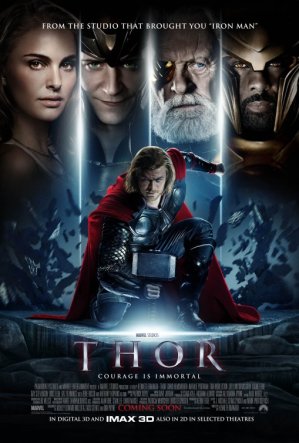 I had strong misgivings going into Thor. How was a powerful Norse god going to seem remotely relatable? How was the most improbable member of Marvel’s Avengers ensemble going to be explained in a way that didn’t feel like a ton of cheese richly slathered in hokum? I was expecting this movie to be a silly, trippy, LSD-enhanced flashback (rainbow bridges! Pass the bong!) that could barely strain any sense of believability. It’s one thing to have stories about super heroes who have gotten their powers via genetic defect, scientific accident, or act of God. But what about when your character happens to be a god? It just seemed too goofy for it all to be pulled off with any conviction. A Thor movie seemed destined for some Xanadu-level of camp. Get a load of the blonde with the big hammer, boys. Not every super hero flick has to be as brooding and dark as The Dark Knight. Marvel’s own Iron Man was a great example of a briskly entertaining movie. Now that I’ve prefaced my experience, let me publicly admit that Thor is indeed a somewhat silly but mostly fun entry in the mighty realm of summer blockbusters.
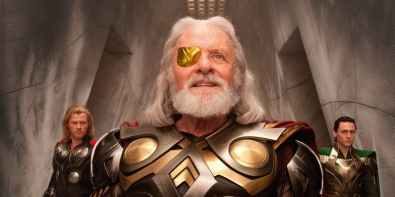
Thor (Chris Hemsworth) is the god of thunder on Asgard, a distant planet populated by the Norse mythical figures (apparently, they visited Earth and the Scandinavian amongst us worshipped these… space aliens?). Thor waits to inherit the throne from his father, Odin (Anthony Hopkins), a wise king who has kept a tenuous truce with the fierce Frost Giants, inhabitants of another planet. But Thor is not ready to assume the responsibilities of leadership. He’s quick to action and temper, arrogant, and defies his own father’s orders by trying to start some intergalactic conflict with the Frost Giants on their home turf. Thor is robbed of his powers, his mighty hammer, and banished to Earth to walk amongst the smelly Earthlings. He crashes in the New Mexico desert and is retrieved by a team of scientists (Kat Dennings, Stellan Skarsgard) led by Jane Foster (Natalie Portman). The group wants to learn where exactly this man from the sky came from. So does the government, led by the S.H.I.E.L.D. agency who takes possession of Thor’s hammer. Thor thinks if he can reunite with his beloved hammer, then he can go home. But for a thunder god, he’s got a lot of lessons to learn. While Thor is out of the picture, his younger brother, Loki (Tom Hiddelston), plots to take what he feels he is owed – the kingdom of Asgard.
 The biggest surprise for me was that the Asgard sequences are the best part of the movie; thankfully the majority of the running time is spent in this fantastic realm. I credit Kenneth Branagh’s direction, which neither hides the silliness of the material nor fully acknowledges it. By the time Thor hurtles to Earth, I was completely engaged in the operatic tale of fathers and sons, gods, jealousy, hubris, intergalactic conspiracies, you know, the stuff of juicy drama. It jus so happened that these characters wear funnier costumes. The family dynamic between Thor and Loki, the infighting and the scheming, intrigued me. Some critics have thrown around the word “Shakespearean” to describe the movie’s outsized family conflict, but I think that’s just the critical community getting lazy. Would they even approach that term is Branagh was not the director? This opening section of Thor effectively explains the history of Asgard as well as its place with the other eight worlds, the shaky relationship with the Frost Giants, the family responsibilities at play as Odin must decide the future of his ABBA-infused nation, as well as the various mechanics of how this different world operates, like Idris Elba (The Wire, Luther) stationed at the end of the rainbow as a gatekeeper to the other worlds. I liked discovering how all the pieces of this world fit together. If analyzed out of context, any part of the Asgard section just seems stupid. But taken in the film, Thor‘s crazier, more fantastic elements come together and spark genuine interest. I wanted to spend more time in this magical realm. The more ridiculous and fantastical that Thor got the more interesting it became.
But unfortunately Thor was sent tumbling to our ordinary planet. It is the Earth section that seriously deflates the movie’s vibe. It’s a relief that the fish-out-of-water comic relief is kept to a minimum, because the character of Thor isn’t an idiot, just an arrogant brat. But it’s the period on Earth where the God of Thunder learns his Really Important Lessons and finally understands what it means to be a good leader. It’s all very expected and the execution is less than inspired. The trio of scientists that Thor encounters (Portman, Skarsgaard, Dennings) could easily have been consolidated into one character. Their contributions to the story are weak. Skarsgard is mostly there for fatherly advice and the occasional expository ejaculation. As a gawky little sister scientist, I don’t even know why Dennings is in this film other than to make my eyes happy. I anticipated that Portman would assume the “love interest” spot in comic book movies that we now reserve for Oscar-winning actresses, and I assumed that role would be underwritten. But I never expected Portman’s part to be this underwritten. She’s practically nonexistent except for that winning smile of hers. Over the course of… two days, she falls in love with our banished brute. But to be fair, it’s not every day that a guy looking like Hemsworth falls out of the sky. New Mexico isn’t exactly looking like a great singles mingles hotspot. Anyway, their relationship is supposed to be the trigger that makes Thor realize he’s been a selfish and reckless fool. But their scenes lack any tension, any charm, anything of interest. They feel like two actors sitting in chairs telling stories. You don’t feel any romance between them. The drabby Earth sequences only serve as a losing contrast to the crazy Asgard territory. You can’t compete with rainbow bridges (imagine the tolls on those suckers).
 Branagh has never directed anything of this magnitude in size before, and it shows at parts. While none of the action sequences are particularly bring, none of them are particularly thrilling. The beginning battle between Thor and his pals on the Frost Giant planet (Jotunheim) is so poorly lit that the darkness forces you to squint to focus on what’s happening. Why spend $150 million on a super hero flick and shoot a dankly lit action scene? What’s the point in that? The choppy editing can also be too hectic to follow with all the quick-cuts that fail to orient the action geography. Really, there are only three serious action sequences in Thor, but then again I remember Iron Man having a light load when it came to on screen action. That film was devoted to character and performance. This film, under Branagh’s watch, is devoted to just making the entire universe of Thor credible. It’s a lot to take in, and Branagh’s biggest accomplishment is producing a sense of grandeur to the film that saves it from falling into the sticky clutches of camp. The world of Asgard feels convincing in production design and infrastructure; the cities look like pipe organs. Branagh’s film expands the Marvel universe significantly, broadening the scope for future installments. Mercifully Thor does not hard sell the upcoming Avengers movie as appallingly as Iron Man 2.
The acting in Thor is as splashy as the Asgard scenery. Hemsworth gave a notable performance as the doomed father of James Kirk in 2009’s Star Trek. He as only in the film for that ten-minute prologue, and yet the actor found a way to do much with what he was given. You got to see his character hurdle through a gauntlet of emotions: fear, duty, relief, desperation, and acceptance. His sacrifice still can make me tear up, and Hemsowrth deserves some of that credit. However, Thor is a different matter entirely. Obviously it’s going to be a more challenging role to play a buff cocky god with a magic hammer. Buff he does quite well. Cocky he does fairly well, but this is not a great starring vehicle for the actor. Hemsworth looks too self-satisfied, like he’s playing his character as an intergalactic hotel heiress. In sharp contrast, Hiddelston (Wallander) commands your attention. Those penetrating eyes, the cold yet calculated demeanor, this is an actor who feels like he walked off a Shakespeare production and just changed his headgear. You want to spend more time with Loki than watch Blondie futz around on Earth. Loki has much more depth to him than Thor; he feels betrayed by his family and an outcast to his society. I’m glad that we’ll be seeing more from this trickster in future Marvel movies (have I said too much?). Hopkins knows how to sell silliness like few other actors. And for those who have been wondering where Renee Russo has been for the last six years, well here she is, as Thor and Loki’s mother, a role that’s best suited to confirm that she is still alive.
 I was expecting far worse judging upon the scraps I had seen from the Thor advertising campaign. So I suppose that beating my low-flying expectations might not necessarily be something to champion. Thor is an inherently goofy, yet mildly satisfying and credible action film. It doesn’t have the style or panache of other heroes, but the fact that Branagh could make a two-hour Thor film that didn’t cause me to laugh derisively from start to finish is an accomplishment. Again, that sounds rather dismissive. I’m just very surprised that this movie works. Because if you take it apart, it doesn’t seem like it should. The acting ranges wildly in quality, with Hiddelston outshining everyone else. Thor is a solid if inconsistent start to the summer season of blockbusters. If you must turn your brain off for some movie, you’d do far worse than Thor. It has pretty colors.
Nate’s Grade: B
Share this:

Skyline (2010)
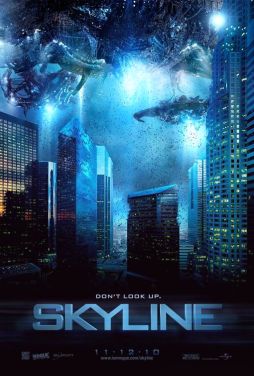 This movie is out-of-this-world terrible. Who wouldn’t want to spend an alien invasion stuck in some L.A. condo with a load of insufferable Los Angelinos? From a storytelling standpoint, watching characters I don’t care about talk about amazing and horrible things happening off camera is not the best use of anyone’s time. Skyline is a movie that keeps surprising you with the depths of its stupidity; just when you think it couldn’t plumb any deeper, the aliens have invaded to eat our brains. Yes, they’re after our brains. So that explains why gigantic monsters will claw away at a building, scrounging for the tiniest morsel of human (that still doesn’t explain it, really). That does not explain why they targeted L.A. if they’re after brains. The special effects are notable for a $10 million dollar movie, but due to the budget restraints, that’s probably why most of this alien invasion is spent indoors and behind trusty sets of Venetian blinds. The pacing is as shoddy as the character work. I kept waiting for these nitwits to step into the light and be vacuumed up into the alien mothership. The end almost looks like it might redeem part of this monstrosity, with our survivors accepting a doomed fate together. But then… I can’t even put into words how shocking, dreadful, and groan-inducing the true ending is for this junk. Suffice to say, it ends with zero resolution, a jagged plot left turn, and setup for a sequel that I’m absolutely positive not one person will be demanding.
Nate’s Grade: D


You must be logged in to post a comment.