Blog Archives
The Jungle Book (2016)
 It seemed like only a matter of time before those in the Mouse House started looking through the back catalogue of hits for inspiration. The Jungle Book is a live-action remake of the 1967 Disney animated film, but it’s only the first of many such translations to come. A live-action Beauty and the Beast is being filmed currently and plans are underway for a possible live-action Aladdin as well, though I pity the actor with the unenviable task of replacing the beloved Robin Williams. I was wary of director Jon Favreau’s (Iron Man) version just because it seemed, on the surface, like a quick attempt to fleece the public of their hard-earned money with a repackaged movie. What I got instead was a brilliantly executed adventure story with a beating heart, amazing special effects, and ultimately an improvement on the original. Imagine that.
Mowgli (Neel Sethi) is a boy raised by a pack of wolves. He tries to fit in with his pack but he grows a bit too slow and he can’t help himself with “tricks,” making tools. During a drought that signals a jungle wide peace between predator and prey, the feared tiger Shere Kahn (Idris Elba) lets the rest of the animals know his demands. The “man cub” is to leave or Kahn will hunt him down. The mother wolf, Raksha (Lupita Nyong’o), refuses to part with her child but Mowgli volunteers to leave to keep his pack safe. Kahn chases him deeper onto the outskirts of the jungle where Mowgli teams up with Baloo (Bill Murray), a lackadaisical bear who makes use of his partner’s affinity for tools and building contraptions. Mowgli’s new life is interrupted when he learns Kahn has attacked the wolf pack with the desire for Mowgli to return and face his wrath. Mowgli must team up with the friends of the jungle and use all his bravery and skills to defeat the ferocious Shere Kahn who has been lusting for vengeance for years.
 Favreau’s version of The Jungle Book is a thrilling and thrillingly immersive visual experience that opens up the big screen as an exciting canvas. The visual wizards have made an entire ecosystem look photo realistic to the point that if somebody said offhand that Jungle Book was shot on location in India, I wouldn’t think twice. The environments are entirely CGI and they are brilliantly brought to life in a seamless recreation I haven’t seen so effective since 2009’s Avatar. It’s stunning what can be accomplished with modern special effects, and then there’s Favreau’s smart decision not to radically anthropomorphize his animal cast. These are not some hybrid human-animal combination but rather flesh-and-blood wild creatures that just happen to speak English when they open their mouths (depending upon your territory). The animals don’t fall into that pesky uncanny valley where your brain is telling you what you’re watching is fake and unsettling to the senses (see: The Polar Express). The animals and behave like the real deal and further cement the exceptional level of realism of the movie. From a purely visual experience, The Jungle Book is a feast for the eyes that helps raise the bar just a little bit higher for the special effects industry and its proper application.
The movie would only succeed so far if it weren’t also for its engaging story. Let’s be honest about the 1967 Disney animated film: it’s not really a good movie. It’s fun and has some memorable songs (more on that below), but as a story it’s pretty redundant and flimsy. Mowgli bounces around one potential animal group to another trying to find a home only to move on to the next prospective foster situation. I never made the connection before but in a way the movie North is this plot, minus the talking animals and general entertainment value. There are long segments of the original Disney film that coast just on the charisma of the vocal actors and the animation. Certainly the Beatles parody characters haven’t aged well. There was plenty that could have been added to this story and screenwriter Justin Marks does just that, making the characters far more emotionally engaging. I felt a swell of sadness as Mowgli is separated from his wolf family, his mother declaring that no matter what he still is her son. Marks also personalizes the stakes between Mowgli and Shere Kahn. Each side has a grudge to settle when it comes to vengeance rather than Kahn rejecting the “man cub” out of general fear. This Mowgli is also a much more interesting protagonist; he’s plucky and uses his “man cub” other-ness as an asset when it comes to problem-solving. We have a better hero, a better villain, wonderfully brought to life through the velvety roar of Elba, and a small band of supporting characters that are more emotionally grounded. The wolf pack feels like a genuine family, a community. The relationship between Mowgli and Baloo becomes the backbone of the second half of a briskly paced movie, and the predictable narrative steps feel earned, from Baloo’s con job to caring for his lil’ buddy. The attention to the characters and their relationships provides a healthy sense of heart.
The vocal cast is expertly matched with their jungle creatures, notably Elba (Beasts of No Nation) and Murray (St Vincent). Murray has an innate way to make his lazy character endearing. Nyong’o (12 Years a Slave) gives a much better motion capture performance as a wolf than whatever the hell she was in The Force Awakens. Scarlet Johansson (The Avengers) is a nice addition as Ka the serpent, and as fans of Her can attest, her breathy voice can indeed be quite hypnotizing. Even the small comic relief animals are well done including the brilliant Gary Shandling in his last film role. Motion capture for non-primates seems like an iffy proposition considering that you’re either forcing the human actors to physically walk on all fours and pretend to be animals, which can be silly, or just copying the direct movements of animal models, which seems redundant then with the technological advances. I don’t know how they did it but it seems like The Jungle Book found a working middle ground that still showcases actor performances.
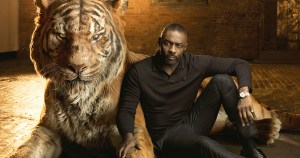
I think this picture cures infertility.
With a movie that works so well on so many levels, the few faulty areas tend to stand out, and I feel like somewhat of a cad to say that one of the biggest problems is the acting from its child star. I’ll give Sethi some leeway here considering he was never interacting with much more than a giant warehouse of blue screens, which I think we’ve shown doesn’t exactly lend itself toward the best live-acting performances (see: Star Wars prequels). When Sethi is in more action-oriented scenes, like running and jumping and generally being physically mobile, his performance improves. However, when he has to shift to portraying emotions beyond fight-or-flight that is where Sethi has trouble. When he’s playing “happy-go-lucky” early on with his wolf brethren, he’s way too animated in that way that unrestrained child actors can be without a proper anchor to moor their performance. There were moments that made me wince. I see no reason why an actor under ten should be immune to criticism when warranted. We live in an age of amazing child acting performances, notably evidenced by the incredible Jacob Tremblay in Room. We should expect better from our smaller actors. Unfortunately for Sethi, the visual spectacle is so luscious that the one human element sticks out more when he is also delivering a mediocre to poor lead performance.
The other minor detraction for Jungle Book is the inclusion of the two songs that really anyone recalls from the original Disney version, “I Want to Be Like You” and “The Bear Necessities.” I’ll even charitably give “Bear Necessities” a pass as it involves a moment of levity and bonding between Mowgli and Baloo and they’re simply singing to themselves as they relax down the river. It’s also the most famous song and if you think about it the “Hakuna Matata” of its day. “I Want to Be Like You” does not deserve the same consideration. It comes at an awkward time and undercuts the build-up of tension and does nothing short of rip you out of the world of the movie. At this point, we’ve been introduced to the hulking presence of King Louie voiced by Christopher Walken. The giant ape is portrayed like a mafia don and his sit-down with Mowgli has a real menace to it as he wants to provide “protection” for the man club at a price. It’s a moody moment and then this big orangutan starts singing and dancing. The illusion and reality of the movie is broken. At no other point does The Jungle Book come close to breaking its reality and it’s all for such an extraneous moment. There’s nothing conveyed in this song that couldn’t have simply been communicated through speech. Instead, the live-action movie makes a tortured homage to the older Disney source material, and it’s the one major misstep in its approach.
The Jungle Book is a magical movie that actually improves upon its cinematic source material. It’s a visual stunner that is completely transporting and another high-level achievement for the art of modern special effects as well as the proper usage of them in connection with fundamentally good storytelling. Favreau is able to open up a new yet familiar world and allow the viewer a renewed sense of awe. We also get characters that we care about, a strongly grounded sense of emotional stakes, and some thrilling action to go along with the CGI playhouse. I only have a few misgivings with Disney’s new Jungle book and one of those is really a function of its homage to the older Jungle Book. I’ll take the rare step and advise moviegoers to seriously consider seeing this in 3D (I did not). It’s a great visual experience, however, that would only take the movie so far if it wasn’t for Justin Marks screenplay adaptation and Favreua’s skilled direction. Now The Jungle Book can be a great visual experience, a great story, and, simply put, a great movie.
Nate’s Grade: A-
Share this:

Hardcore Henry (2016)
 Hardcore Henry is an action movie told entirely through the eyes of its silent protagonist. Some critics and fans are calling it the future of movies. Director and co-writer Ilya Naishuller strapped a team of stuntmen with facial camera masks and filmed entirely on GoPro Hero 3 cameras taking in every punch, kick, and jump. It’s an ambitious filmmaking gamble that dares to be something different, but is it worth the effort?
Henry wakes up in a science lab. Estelle (Haley Bennett) informs him/us that she is Henry’s wife and is upgrading him with a bionic arm and leg. Unfortunately, his voice hasn’t been implemented yet. Akan (Danilla Kozlovsky), a menacing albino with telekinetic powers, breaks into the lab and kills everyone but not before abducting Estelle. Henry is battered and left for dead. His only assistance comes from Jimmy (Sharlto Copley), a mysterious and helpful man who tries to direct Henry toward his mission of saving Estelle and thwarting Akan.
The draw of this movie is its propulsive and immersive visual playground, putting the viewer in the mind of its title hero as he narrowly escapes scrapes, scales buildings of dizzying heights, and kills a whole lot of bad guys with brutal efficiency. Its POV experience makes the hardcore violence all the more immersive, though after a while I was wishing we could change things up (more on this below). I must applaud director Naishuller and his crew of limber stuntmen for the sheer creative ingenuity of their stunts and action. With a relatively small budget ($10 million, or roughly the budget spent on bagels on the last Transformers flick), the ambition behind this movie can be startling, and the development of some of its more bonkers action sequences can provide a sky-high jolt of adrenaline like few movies match. The action is also very violent, with heads being blown off, limbs being snapped, bodies bent in two, eyes gouged and used to rip heads in half (this one still confuses me from a mechanical front), and near relentless bloodshed that sometimes even requires our hero to wipe it from his face. For those hungry for near non-stop action shaped to be the equivalent of a living first-person shooter game, Hardcore Henry might do enough to strap in and deliver the goods.
 I have a confession dear reader: I experienced a fierce bout of motion sickness from this movie unlike anything I’ve ever encountered in a theater. I’m usually rather immune to shaky camera movements and found footage movies. I remember reading about people getting sick and throwing up during screenings of The Blair Witch Project not because of its content but simply from its handheld camerawork. I have never had an issue up until now. After 20 minutes of Henry, I had to sit much further back in my theater. The continuous whipping camerawork caused me a great wave of nausea. I even had to leave the theater for five minutes in the middle of the movie just to re-calibrate my brain. I would warn people about sitting too close to the screen but ideally this movie’s proper place is really your home television. You can choose to take my review with some degree of skepticism thanks to this admission, but no movie ever got to me and forced me out of the theater from motion sickness before. Henry now has that dubious honor.
The gimmick does start to lose its novelty and I wanted to break free from the claustrophobic first-person perspective as well as its paper-thin story. I started thinking there were as many restrictions to the first-person perspective as benefits. It really hampers the hand-to-hand combat choreography, which often just feels like flashes and blurs, herky-jerky editing that doesn’t immerse so much as obscure. This seems to be more of an issue for the first half than the second, which relies more heavily on small arms battles. Chase scenes aren’t added by bobbing up and down from the first-person perspective. You just aren’t able to focus on the object or person of pursuit. I also don’t understand why the entire movie relies upon a fish-eye lens either, which isn’t exactly a normal part of human vision. Its distorted images, subtle but accumulative, added to my overall motion sickness. However, the worst aspect of Hardcore Henry is easily its story or what amounts to its story. This is a movie that looks like a video game and feels like a video game, except somebody else is playing it. The very opening plays out like a video game introduction cut scene, establishing the damsel in distress and the chief villain. From there it’s a series of levels and checkpoints and tips from allies and weapon upgrades and boss battles and interchangeable bad guys. The various Jimmy incarnations pop along to guide you and dole out exposition as required, and there’s even an escort mission involving keeping the real Jimmy alive while his avatars fight off the onslaught of goons. There are several scenes of the villain randomly popping up to deliver exposition, usually on a screen that suddenly comes to life. The eventual plot twists should also be rather predictable. If there is ever a video game version of this movie it should simply be a straight port of the Henry’s plot and thrifty execution.
This chosen plot structure would be less irksome if the movie provided a story or characters to follow. There’s a reason the protagonist is a mute. He is not a person but an indestructible killing machine running on a cheat code. He lacks larger goals other than flee, kill, and save the girl. Estelle is a one-note damsel in distress, a pretty face that we don’t feel a sense of history with. The villain is as completely replaceable as our hero. He’s a telekinetic albino and your guess is as good as mine about anything else. He has no personality beyond one single mode of menacing. He’s a villain that is completely defined by his outer appearance and special abilities. Simply put, he is a super lame villain, which makes the final showdown between Akan and Henry a very limited payoff. I still don’t understand how exactly Henry was able to defeat Akan and his telekinetic powers. It’s like Henry just arbitrarily overcomes them for no discernible reason, as if Henry grabbed some kind of invisible power-up. There’s no really clear reason why just about anything happens for most of the movie. It’s a chase movie where Henry has to outrun or out-murder his faceless enemies while getting objectives from Jimmy, who is easily the movie’s lone entertaining character. For the first half, you keep watching new and different incarnations of Jimmy invariably find you as if drawn by some cosmic magnet. Copley is effortlessly amusing as he goes full tilt Peter Sellers, playing the different characters with comic absurdity and droll black humor (my favorite was World War I Jimmy). There’s a genuine musical number that had me giggling. After a string of nadir-redefining miscalculated performances, it’s nice to be able to say that Copley delivers a fun and entertaining performance for the right reasons. Of course he also has the most screen time by far, so that’s probably also a clear factor. This is a movie that has prioritized the immersive action experience, but after the novelty wore off I was left with listless characters and a poorly articulated story stretched thin from breathless, bloody action set piece to set piece. It was less a movie and more a 90-minute viral video.
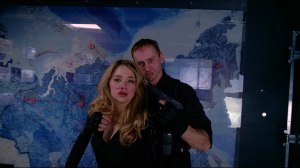 Hardcore Henry is a kinetic, propulsive, adrenaline-fueled immersive experience that ultimately is a bit too immersive and narratively flimsy. This isn’t a movie. There aren’t any characters to care about and the story is really the thinnest of tissue to connect from one action sequence (or game level) to the next, stopping at points for free-flowing exposition, weapons upgrade, or a checkpoint. It’s less a fully functioning movie and more of a visual experience, and whether that experience will ultimately justify its gimmick will depend on your threshold for the first-person POV and its scarce story. Here’s what I don’t understand about people saying Hardcore Henry is the future of movies. It’s an immersive experience but movies are already a medium that we can get lost in and transported, no first-person perspective necessary for our empathy to kick in. The recent cinematic action highs, like Snowpiercer and The Raid 2 and Mad Max: Fury Road and Edge of Tomorrow, all delivered exuberant thrills without having to strictly see through their protagonist’s eyeballs. Action moviemaking is more than a you-are-there visceral immediacy; it’s about building new worlds and blowing them up in fantastic ways. I did not feel pushed to the margins of any of those aforementioned film titles. I was completely absorbed and marveled at their ability to entertain and build payoffs. The idea is that Hardcore Henry is all payoff but if you want to wax philosophical, it’s more like an action movie’s pornographic cousin, cutting out the “boring bits” like developing characters that we care about, establishing setups, creating organic complications, and wrapping it all together in the blanket of a story that provides greater audience satisfaction. Those movies are more than just a stuntman’s sizzle reel; they’re movies. Hardcore Henry is only an experience, and it was an experience I wanted to turn off.
Nate’s Grade: C+
Share this:

Batman vs. Superman: Dawn of Justice (2016)
 Batman and Superman have been a collision course for a while. The two most famous superheroes were once scheduled to combat in 2003. Then the budget got a tad too high for Warner Brothers’ liking and it was scrapped. Flash forward a decade and now it seems that money is no longer a stumbling point, especially as Batman vs. Superman: Dawn of Justice cost an estimated $250 million dollars. I wasn’t a fan of director Zack Snyder’s first take on Superman, 2013’s Man of Steel, so I was tremendously wary when he was already tapped to direct its follow-up, as well as the inevitable follow-up follow-up with 2017’s Justice League. You see DC has epic plans to create its own universe of interlocked comics franchises patterned after Marvel’s runaway success. Instead of building to the super team-up, they’re starting with it and hoping one movie can kick off possibly half a dozen franchises. There’s a lot at stake here for a lot of people. That’s what make the end results all the more truly shocking. Batman vs. Superman isn’t just a bad movie, and I never thought I’d type these words, it’s worse than Batman and Robin.
Eighteen months after the cataclysmic events of Man of Steel, Metropolis is rebuilding and has an uneasy relationship with its alien visitor, Superman (Henry Cavill). Billionaire Bruce Wayne (Ben Affleck) is convinced that an all-powerful alien is a threat to mankind, especially in the wake of the dead and injured in Metropolis. But how does man kill a god? Enter additional billionaire Lex Luthor (Jessie Eisenberg) and his acquisition of a giant hunk of kryptonite. Bruce runs into a mysterious woman (Gail Gadot a.k.a. Wonder Woman) also looking into the secrets held within Luthor’s vaults. Clark Kent is pressing Wayne for comment on this bat vigilante trampling on civil liberties in nearby Gotham City, and Wayne is annoyed at the news media’s fawning treatment over an unchecked all-powerful alien. The U.S. Senate is holding hearings on what responsibilities should be applied to Superman. Lois Lane (Amy Adams) is worried that her boyfriend is getting too caught up in the wrong things. Lex Luthor is scheming in the shadows to set up one final confrontation that will eliminate either Batman or Superman, and if that doesn’t work he’s got a backup plan that could spell their doom.
 I think it’s only fitting to tackle each of the particular heavyweights in this huge showdown and devote time to dressing down why exactly the movie fails them.
Let’s start with Batman because quite frankly he’s the character that the American culture prefers (his name even comes first in the title for a Superman sequel). Ben Affleck (Gone Girl) was at the bad end of unrelenting Internet fanboy-fueled scorn when the news came out that he was going to play the Caped Crusader, but he’s one of the best parts of this movie, or perhaps the better phrasing would be one of the least bad parts. He’s a much better Bruce Wayne than Batman but we don’t really get much of either in this movie from a character standpoint. There isn’t much room for character development of any sort with a plot as busy and incomprehensible as Batman vs. Superman, and so the movie often just relies upon the outsized symbolism of its mythic characters. We have a Batman who is Tough and Dark and Traumatized and looking for (Vigilante) Justice. We only really get a handful of scenes with Batman in action, and while there’s a certain entertainment factor to watching an older, more brutal Batman who has clearly given up the whole ethical resolve to avoid killing the bad guys, under Snyder’s attention, the character is lost in the action. The opening credits once again explain Batman’s origin story, a tale that should be burned into the consciousness of every consumer. We don’t need it, yet Snyder feels indebted to what he thinks a Batman movie requires. So he’s gruff, and single-minded, and angry, but he’s never complex and often he’s crudely rendered into the Sad Man Lashing Out. He’s coming to the end of his career in tights and he knows it, and he’s thinking about his ultimate legacy. That’s a great starting point that the multitude of live-action Batman cinema has yet to explore, but that vulnerability is replaced with resoluteness. He’s determined to kill Superman because Superman is dangerous, and also I guess because the Metropolis collateral damage crushed a security officer’s legs, a guy he’s never met before. The destructive orgy of Metropolis is an excellent starting point to explain Bruce Wayne’s fear and fury. I don’t know then why the movie treats Wayne as an extremist. I don’t really understand why there’s a memorial for the thousands who lost their lives in the Metropolis brawl that includes a statue of Superman. Isn’t that akin to the Vietnam Wall erecting a giant statue of a Vietcong soldier stabbing an American GI with a bayonet? This may be the most boring Batman has ever been onscreen, and I repeat, Ben Affleck is easily one of the best parts of this woefully begotten mess.
Next let’s look at the other titular superhero of the title, the Boy Scout in blue, Superman. The power of Superman lies with his earnest idealism, a factor that has always made him a tougher sell than the gloomy Batman. With Man of Steel, Warner Brothers tried making Superman more like Batman, which meant he was darker, mopey, theoretically more grounded, and adopted the same spirit of being crushed by the weight of expectations and being unable to meet them. Cavill (The Man from U.N.C.L.E.) was a Superman who didn’t want to be Superman, where dear old Pa Kent advocated letting children drown rather than revealing his powers (Father’s Day must have been real awkward in the Kent household). It wasn’t a great step and I wrote extensively about it with Man of Steel. The problem is that Superman and Batman are supposed to be contradictory and not complimentary figures. If one is brooding and the other is slightly more brooding, that doesn’t exactly create a lot of personal and philosophical conflicts now does it? It clearly feels that Snyder and everybody really wanted to make a Batman movie and Superman just tagged along. Superman clearly doesn’t even want to be Superman in the Superman sequel, often looking at saving others with a sigh-inducing sense of duty. He’s still working as a journalist and making moral arguments about the role of the media, which seems like a really lost storyline considering the emphasis on blood and destruction. He wants Superman to be seen as a force of good even if others deify him. That’s a powerfully interesting angle that’s merely given lip service, the concept of what Superman’s impact has on theology and mankind’s relationship to the universe and its sense of self. Imagine the tectonic shifts acknowledging not only are we not alone but we are the inferior race. We get a slew of truly surprising cameos for a superhero movie arguing this debate (Andrew Sullivan?) but then like most else it’s dropped. Clark is trying to reconcile his place in the world but he’s really just another plot device, this time a one-man investigation into this bat vigilante guy. The other problem with a Batman v. Superman showdown is that Superman is obviously the superior and would have to hold back to make it thrilling. We already know this Superman isn’t exactly timid about killing. The climax hinges on a Batman/Superman connection that feels so trite as to be comical, and yet Snyder and company don’t trust the audience enough to even piece that together and resort to a reconfirming flashback.
 Arguably the most problematic area of a movie overwhelmed with problems and eyesores, Eisenberg’s (Now You See Me) version of Lex Luthor is a complete non-starter. He is essentially playing his Mark Zuckerberg character but with all the social tics cranked higher. His socially awkward mad genius character feels like he’s been patched in from a different movie (Snyder’s Social Network?) and his motivation is kept murky. Why does he want to pit Batman and Superman against each other? It seems he has something of a god complex because of a nasty father. He is just substantially disappointing as a character, and his final scheme, complete with the use of an egg timer for wicked purposes, is so hokey that it made me wince. If you’re going with this approach for Lex then embrace it and make it make sense. Late in the movie, Lex Luthor comes across a treasure-trove of invaluable information, and yet he does nothing substantive with this except create a monster that needs a super team-up to take down (this plot point was already spoiled by the film’s marketing department, so I don’t feel guilty about referring to it). If you’re working with crafty Lex, he doesn’t just gain leverage and instantly attack. This is a guy who should be intricately plotting as if he was the John Doe killer in Seven. This is a guy who uses his intelligence to bend others to his will. This Lex Luthor throws around his ego, nattering social skills, and force-feeds people Jolly Ranchers. This is simply a colossal miscalculation that’s badly executed from the second he steps onscreen. The movie ends up being a 150-minute origin story for how Lex Luthor loses his hair.
The one character that somewhat works is Wonder Woman and this may be entirely due to the fact that her character is in the movie for approximately twenty minutes. Like Lois, she has little bearing on the overall plot, but at least she gets to punch things. I was skeptical of Gadot (Triple 9) when she was hired for the role that should have gone to her Furious 6 co-star, Gina Carano (Deadpool). She didn’t exactly impress me but I’ll admit I dropped much of my skepticism. I’m interested in a Wonder Woman movie, especially if, as reported, the majority is set during World War I. There is a definite thrill of seeing the character in action for the first time, even if she’s bathed in Snyder’s desaturated color-corrected palate of gloom. Realistically, Wonder Woman is here to introduce her franchise, to setup the Justice League movies, and as a tether to the other meta-humans who each have a solo film project on the calendar for the next four years. Wonder Woman gets to play coy and mysterious and then extremely capable and fierce during the finale. One of the movie’s biggest moments of enjoyment for me was when Wonder Woman takes a punch and her response is to smile. I look forward to seeing more of her in action and I hope the good vibes I have with the character, and Gadot, carry onward.
 The last act of this movie is Snyder pummeling the audience into submission, and it’s here where I just gave up and waited for the cinematic torment to cease. The action up to this point had been rather mediocre, save for that one Batman fight, and I think with each additional movie I’m coming to the conclusion that Snyder is a first-class visual stylist but a terrible action director. The story has lacked greater psychological insights or well-rounded characters, so it’s no surprise that the final act is meant to be the gladiatorial combat Lex has hyped, the epic showdown between gods. In essence, superheroes have taken a mythic property in our pop-culture, and Batman and Superman are our modern Mt. Olympus stalwarts. This showdown should be everything. The operatic heaviness of the battle at least matches with the overwrought tone of the entire movie. It’s too bad then that the titular bout between Batman and Superman lasts a whole ten minutes long. That’s it, folks, because then they have to forget their differences to tackle a larger enemy, the exact outcome that every single human being on the planet anticipated. I’m not even upset that the film ends in this direction, as it was fated. What I am upset about is a climax that feels less than satisfyingly climactic and more like punishment, as well as a conclusion that no single human being on the planet will believe. Snyder’s visual style can be an assault on the senses but what it really does is break you down. The end fight is an incoherent visual mess with the screen often a Where’s Waldo? pastiche of electricity, debris, smoke, fire, explosions, and an assortment of other elements. It’s a thick soup of CGI muck that pays no mind to geography or pacing. It’s like Michael Bay got drunk on Michael Bay-filmmaking. What the hell is the point of filming this movie in IMAX when the visual sequences are either too hard to decipher or something unworthy of the IMAX treatment? Do we need an entire close-up of a shell hitting the ground in glorious IMAX? The Doomsday character looks like a big grey baby before he grows his spikes. I was shocked at how bad the special effects looked for a movie that cost this much money, as if ILM or WETA said, “Good enough.” Once it was all over, I sat and reflected and I think even Snyder’s Sucker Punch had better action.
Another problem is that there are just way too many moments that don’t belong in a 150-minute movie. There’s an entire contrivance of Lois disposing of a valuable tool and then having to go back and retrieve it that made me roll my eyes furiously. It’s an inept way of keeping Lois involved in the action. How does Lois even know the relevancy of this weapon against its new enemy? Then there’s her rescue, which means that even when the movie shoehorns Lois into the action to make her relevant, she still manages to become a damsel in needing of saving. She feels shoehorned in general with the screenplay, zipping from location to location really as a means of uncovering exposition. Then there’s the fact that there is a staggering THREE superfluous dream sequences, and we actually get a flashback to one of those dumb dream sequences. The most extended dream sequence is a nightmarish apocalyptic world where Batman rebels against a world overrun by Superman and his thugs. There’s a strange warning that comes with this extended sequence of future action but it doesn’t involve this movie. Batman vs. Superman suffers from the same sense of over-extension that plagued Age of Ultron. It’s trying to set up so many more movies and potential franchises that it gets lost trying to simply make a good movie rather than Step One in a ten-step film release. In the age of super franchises that are intertwined with super monetary investments, these pilot movies feel more like delivery systems than rewarding storytelling. Payoffs are sacrificed for the promise of future payoffs, and frankly DC hasn’t earned the benefit of the doubt here.
 I must return to my central, headline-grabbing statement and explain how Batman vs. Superman is a worse movie than the infamous Batman and Robin. I understand how loaded that declaration is so allow me to unpack it. This is a bad movie, and with that I have no doubt. It’s plodding, incoherent, tiresome, dreary, poorly developed, and so self-serious and overwrought to the point that every ounce of fun is relinquished. It feels more like punishment than entertainment, a joyless 150-minute exercise in product launching. By the end of the movie I sat in my chair, defeated and weary. Here is the most insidious part. Batman vs. Superman: Dawn of Justice obliterates any hope I had for the larger DC universe, let alone building anything on par with what Marvel has put together. If this is the direction they’re going, the style, the tone, then I don’t see how any of these will work. What’s to like here? “Fun” is not a dirty word. Fun does not mean insubstantial nor does it mean that larger pathos is mitigated. If you’re going to have a movie about Batman and Superman duking it out, it better damn well be entertaining, and yes fun. It’s not a Lars von Trier movie. The Marvel movies are knocked for not being serious, but they take their worlds and characters seriously enough. They don’t need to treat everything like a funeral dirge, which is what Batman vs. Superman feels like (it even opens and closes on funerals). This movie confirms all the worst impulses that Man of Steel began, and because it gutted all hope I have for the future of these oncoming superhero flicks, I can’t help but lower its final grade. Batman and Robin almost killed its franchise but it was in decline at the time. As campy and innocuous as it was, Batman vs. Superman goes all the way in the other direction to the extreme, leaving a lumbering movie that consumes your hopes. The novelty of the premise and seeing its famous characters standing side-by-side will be enough for some audience members. For everyone else, commence mourning.
Nate’s Grade: D
Share this:

London Has Fallen (2016)
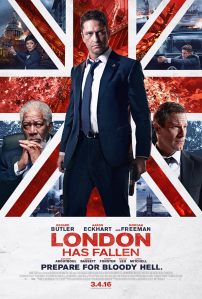 Years after the events from Olympus Has Fallen, Secret Service agent Mike Banner (Gerard Butler) is escorting President Asher (Aaron Eckhart) to London to attend a funeral. It’s there where chaos strikes and Muslim terrorists, disguised as British agents and local police, unleash a series of attacks and explosions throughout the city. Mike is able to rescue the president but the two are essentially in enemy territory looking for an escape, and the terrorists have seized London and plan on executing President Asher live on the Internet for his drone strikes in the Middle East.
The first mission for an action movie is to entertain with its action sequences, and it is here where London Has Fallen falls. The budget has been reported as high as $100 million dollars, and if this is true it may be the biggest waste of $100 million dollars I’ve ever seen on film. The movie just looks cheap. The locations (Bulgaria often doubling for London) look too vague and interchangeable with empty streets. Also, for a city that has over ten million inhabitants, why are these streets so empty? There were people milling about outdoors after 9/11, and the president wasn’t rumored to be somewhere on the streets in that scenario. Another sign of the movie’s cheapness: I’m certain that the shots of the emergency vehicles in London were stock footage. Now this wouldn’t be the first film to pad its establishment scenes with purchasable B-roll footage, but the offense is simply how poorly the movie is at hiding this fact. The footage is clearly from a lower video/film quality and not referenced as a media perspective, so the quality of the movie will suddenly drop for a brief few seconds to watch a cadre of ambulances race off. But back to these lackluster action sequences. There are very few variations on the standard run-and-shoot variety with little regards to geography. The initial escape from the first attack has some sizzle but it devolves into a series of chases and stands being made in small locations. The final assault on the bad guy’s compound unfolds as a tracking shot to kick things off and it’s here that you get a full sense of the movie’s limited ambitions. The action isn’t accelerated or given a visceral kick from the long take; it’s just guys shooting off screen, walking, shooting, with the occasional explosion. There’s no added benefit from the tracking shot, and yet somebody must have thought it would be so cool to do so and patted themself on the back.
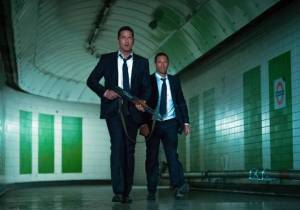 Another issue is that Butler’s character is nearly indestructible and without any vulnerability. Olympus Has Fallen didn’t wow me but it hewed closed to the Die Hard plot points and that’s a great formula to model your action movie after. In that scenario, Mike Banning was outnumbered and had to rely upon his stealth to be most effective. In the sequel, Mike has to protect the president but it’s really just the story of two buds running from place to place, having the occasional chat, and then Mike easily murdering any slew of bad guys, then repeat until the climax. It doesn’t make use of locations enough to cast out the sinking feeling of redundancy. Repetitive action sequences rely upon the concept of “more is better” when what we really demand is “more but different.” The best action movies are the ones where each sequence can stand on its own, push the story forward, makes smart use of its geography, and develops organically. There just aren’t enough of these in London Has Fallen. Our lead character is boring because he is never seen in a vulnerable position. He is told how outnumbered he is and his quippy reply is a trailer-ready line: “You should have brought more men.” This guy doesn’t sweat and only growls and stabs (lots of stabbing in this) and the R-rated violence does little to give this man anything resembling a personality. Mike is a dullard, and his personal arc of whether or not he’ll turn in his resignation from the Secret Service is one of the least believable moments of indecision you’ll ever witness. Gee, I wonder if Stabby McLoves to Stab is going to step away from his stab-heavy vocation.
With the action failing, it becomes even more apparent, and shockingly so, just how unpleasantly xenophobic and grotesque the movie’s overall political message becomes, so much so that you’d have to imagine a contingent of Trump supporters watching with baited breath and cheering mindlessly. It’s not uncommon for the bad guys in Hollywood action films to be darker-hued foreigners, so that wasn’t exactly something shocking, and the movie opens with a stab at creating a legitimate and politically pertinent grievance, a drone strike with unexpected collateral damage that obliterates a wedding party. The bad guys here have a cause that at least goes beyond blind ideology, though perhaps vengeance is actually a lesser motivation than something larger akin to ideology. They aren’t really fleshed out beyond this simple concept of vengeance or given anything larger to play with because they’re simply just villainous cardboard cutouts. And yet, most of this is expected with the territory of a typical action thriller. It’s when London Has Fallen decides to go the extra ugly mile when the movie starts becoming something far more unseemly and uncomfortable. I’m not expecting the most culturally nuanced portrayal of geo-politics, but this movie is practically a campaign ad for anti-Muslim nationalism. Our hero brutally stabs a nondescript bad guy and definitely enjoys inflicting pain. He kills another guy while screaming, “Go back to Fuckheadistan” (note to the geographically challenged: not a real standing nation as of this writing). Then it’s not enough that our hero is beating our secondary villain, he also has to deliver a speech about America’s standing and just what these pesky terrorists will never understand: “100 years later, we’ll still be here, and you’ll be dead.” What highlights these moments is that there aren’t any other political aspects in this movie, even a scant dismissive comment on something like gun control, so it feels like London Has Fallen has purposely chosen to highlight this anger and distrust of foreigners with its hero. It comes across like giving voice and credence to your crackpot uncle who, naturally, is voting for Trump to sweep them illegals and dusky-faced folk from the borders of ‘Merica.
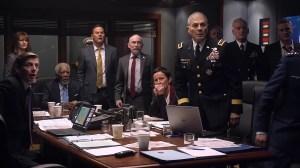 There’s an ongoing subplot in London Has Fallen that answers the question of how many Oscar nominees can you cram into a room and waste their talents. The answer, it would appear, is four, folks. Interspersed between Mike and the president on the run is Vice President Morgan Freeman (yes he has a character name but it’s really VP Morgan Freeman) deliberating in the White House with the assembled cabinet. There’s Melissa Leo (The Fighter) returning as the Secretary of Defense, Robert Forster (Jackie Brown) as a general, and Jackie Earl Haley (Little Children) as DC… something. Every time the movie has to cut back to this room full of wasted talent you’re reminded just how sad this movie is becoming. These characters don’t even have any larger bearing on the plot or any agency into the ongoing conflicts. Instead they are presented as exposition devices and reaction shots. These are some terrific thespians, including two Oscar winners, and here they are barking exposition or delivering forlorn reaction shots. We have four Oscar nominees and they’re stuck in a room, looking horrified into the camera lens, and slowly uttering lines like, “My God.” I do not begrudge actors taking paycheck roles (everybody’s got bills to pay) but this entire scenario is just an insulting waste of time.
Nobody is going to argue that Olympus Has Fallen was one of the greater works of cinema but it was a mildly enjoyable action thriller that was diverting enough to remind its rowdy audience of the Cannon genre films of the 80s. It was bloody, brutal, and fitfully entertaining (my preference was the other 2013-Die–Hard-in-a-White-House flick, White House Down). It was good enough, mostly because it hugged Die Hard closely and repeated the same plot mechanics to success. Now on its own, the sequel has to manufacture its own plotline and it doesn’t fare as well. Director Antoine Fuqua didn’t want to return for the sequel after reading the script, and this is a guy who made King Arthur and Shooter. Shooter, people! His replacement is an Iranian-born filmmaker, which just adds another level of questions for the finished product, and make no mistake, London Has Fallen is just that – product. It’s not really meant to be savored or enjoyed so much as it is processed and consumed and forgotten. The action doesn’t work well and is poorly orchestrated, often repetitive, the characters are boring, the villains are one-note, the capable actors are wasted, the overt political messages that continuously emerge are ugly and pointedly xenophobic, and the end even turns a drone strike, the same tool we saw wipe out an innocent wedding gathering to open the movie, into a crowd-pleasing climactic moment of payback. London Has Fallen is a misguided nationalistic action movie and then some.
Nate’s Grade: C-
Share this:

Kingsman: The Secret Service (2015)
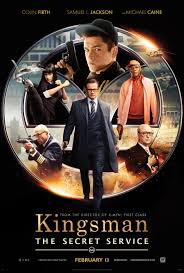 Director Matthew Vaughn’s Kingsman: The Secret Service is my favorite James Bond movie. It’s everything you’d want in a spy thriller while charting its own edgy direction. It’s a combination of Bond and My Fair Lady, and I never knew how brilliant that combination could be until Vaughn got his hands on the graphic novel source material. Newcomer Taron Egerton lays on plenty of star-making charm as a spy-in-training under the guidance of a dapper gentleman brawler Colin Firth. The spy hijinks are fun and stylish but what Vaughn does just about better than any other big-budget filmmaker is pack his movie with payoffs small and large so that the end result is a dizzying rush of audience satisfaction. The action sequences are exhilarating, in particular a frenzied church massacre made to appear as a single take. I never would have thought of the tweedy Firth as an action hero, but he sure plays the part well. There’s also an awesome villainous henchwoman who has blades for legs, and the film makes fine use of this unique killing apparatus. Kingsman explodes with attitude, wit, dark surprises, and knowing nods to its genre forbearers. Vaughn is a filmmaker that has become a trusted brand. He has an innate ability to fully utilize the studio money at his disposal to create daringly entertaining movies that walk to their own stylish beat. This is a cocksure adrenaline shot of entertainment that left me begging for more.
Nate’s Grade: A
Share this:

Deadpool (2016)
 Deadpool is easily the most fan service of comic characters, so it makes sense that his big screen spotlight is a movie that feels a fan service movie. The “merc with a mouth” is a character that doesn’t take himself seriously and neither does his big screen adventure, which is the biggest appeal of an otherwise standard super hero formula hiding under waves of winking irony, crass humor, and gleefully bloody violent mayhem. Ryan Reynolds plays Wade Wilson, a hired gun that undergoes a risky experimental treatment by a shady black ops organization to cure his terminal illness. It makes him generally indestructible with a rapid healing ability but his flesh is also horribly scarred and Wade is afraid his girlfriend Vanessa (Morena Baccarin), a hooker with a heart of gold, will reject him. Even in the opening credits, you know this isn’t going to be a typical super hero movie. The time is ripe for a film that knowingly ridicules the tropes of the super hero film industry, and Deadpool scores some big laughs when its making fun of itself and its super peers. The dark humor can often surprise with how go-for-broke it can get, like Wade and his Vanessa’s flirty one-upsmanship of hypothetical sexual trauma. There’s a clever montage of Wade and Vanessa’s romantic history told through sexually-specific holiday celebrations, and the inclusion of a couple of low-rent X-Men provides a comic foil for Deadpool to bounce off from. The action is fun and the movie is entertaining from its opening credits to the now-mandatory post-credits bonus. Reynolds is spiritually attuned with the irreverence of the anti-hero, finally plugging into a part that makes full use of his charm, motor mouth, and physicality. Deadpool’s runaway box-office success (grossing more than any X-Men film and on at least half the budget) will hopefully allow Hollywood to feel comfortable allowing their less than family-friendly comic titles to stay true to their intentions. Then again maybe they’ll just take all the wrong messages and think that audiences just want to hear more swearing from people in spandex. Deadpool is a super hero movie that prioritizes fun over everything else, and while it may not be for everyone, at least it’s trying to be for someone different.
Nate’s Grade: B
Share this:

13 Hours: The Secret Soldiers of Benghazi (2016)
 Michael Bay is the kind of filmmaker that naturally attracts negative attention and derision, so when he fast-tracked a movie about the Benghazi embassy attacks, and in a presidential election year too, there were plenty that cried foul. Bay’s not exactly known as the subtlest filmmaker, and many feared a Benghazi movie under his guidance would only reaffirm the worst. 13 Hours: the Secret Soldiers of Benghazi (a subtitle that never appears in the movie, by the way) is a surprisingly serious and generally apolitical action movie that reaffirms the strengths and weaknesses of Bay as a filmmaker.
On September 11, 2012, an armed mob stormed an American outpost in Benghazi, an attack that left four Americans dead. After Libya had toppled its decades-long autocrat, a power vacuum emerged and militants filled its place. An unclassified CIA annex in Benghazi was established to track the possible sale of munitions from the old regime. The CIA chief, Bob (David Constabile), has been forced to hire a security team of former Army Rangers and Navy Seals to protect his agents. Jack Silva (John Krasinski) is a family man reuniting with his old pal Tyrone “Rone” Woods (James Badge Dale), the head of the hired security team. The other guys (Pablo Schreiber, David Denman, Dominic Fumusa, Max Martini) welcome Jack, explaining the rising tensions in Benghazi and how they’re generally frustrated by the CIA know-it-all attitudes. They’re wary of the State department outpost for Ambassador Chris Stevens (Matt Letscher), wary of the security detail watching him, and wary of the Libyan local forces providing assistance. Flash forward to the night of the attack and Rone and his team are stymied in their early attempts to rescue the ambassador. Afterwards, the focal point of the fight shifts to that very CIA annex and one hellish night of intense combat.
 This is Bay’s return to the realm of more “serious filmmaking,” a world he hasn’t considered since 2001’s lackluster Pearl Harbor, and while the standard Bay elements of boom are present and accounted for, the drama doesn’t stack up to the action. First, the good news is that the action in 13 Hours is often thrilling, beautifully staged and photographed by Dion Beebe (Collateral), and unlike Bay’s Transformers films, easy enough to follow along. It’s a chaotic incident where plans and communication are broken down, but Bay is able to keep the geography and the immediate and secondary goals of each action sequence clear. While the storming of the embassy isn’t quite as nerve-racking as Argo, it’s still plenty thrilling and communicates the fog of war and dawning horror of those trapped on the inside. The centerpiece is the attack on the CIA annex, which both sides anticipate and prepare for. It establishes the geography of the field of combat, the different access points, and the most likely ambushes. From there, it’s our outnumbered professionals versus a horde of armed Libyans, a standoff reminiscent in classic Hollywood action cinema. Over the course of those titular 13 hours, our security force faces wave after wave of attacks, each once becoming more sophisticated and bringing heavier firepower. Bay’s camera captures the explosions and gunfire in his usual balletic decadence. Say what you will about the man and his jingoistic tendencies, but he’s an ace visual stylist who bathes a sheen of popcorn entertainment to visceral struggle. When the action is heated, that’s when 13 Hours packs its most powerful punch.
Unfortunately, there are lulls in between the fighting, and it’s during these moments that we realize how poorly written our characters are. With the battle looming ahead, the mitigated character development emphasizes easy clichés we’ve come to expect, like the family man who needs to realize his family should come first, etc. These six guys are little more than stock characters on the screen, differentiated more by appearance and the occasional reading material than any significant personality differences. The dialogue is also rather clunky, falling too often upon tough guy speak to make up the difference. The way I was able to separate them in my head was through the actors’ previous roles (“There’s Pornstash, there’s Roy from The Office, there’s the guy from The Pacific who was the bad guy in Iron Man 3, and boy did Jim from The Office get buff”). Krasinski (Aloha) is the audience’s entry point into this world and given the most attention, so he’s ostensibly our main protagonist. He’s a strong presence to anchor the film despite the character’s shortcomings. I enjoyed watching Krasinski in such a different sort or role and started thinking about he and his wife, Emily Blunt, must have traded workout regiment advice. “Jim from The Office” with a six-pack is a surprising sight.
There’s a strange defining conflict for the first hour of the movie, namely Bay and Hogan narrowing personal clashes down to a slobs vs. snobs mentality of war. Bay has a history of fetishizing machismo and military hardware, so it should be no surprise that his movie lionizes the beefy, strapping military men serving as security. They’re placed against the eggheads of the CIA, who take every moment to remind our burly, bearded security guys that they were educated at Ivy League schools and know so much more about the Middle East. They often sound haughty when they’re scolding the security force for interfering even when it’s clear they’re saving their lives. The perspective aligns with the idea that the military-experienced, no-nonsense men of action are being ignored and looked down upon by the CIA ninnies who look at them as unnecessary babysitters. Naturally, with the hindsight of history, we know the concerns of Rone and his guys will be vindicated and the CIA snobs will be grateful they had these blue-collar American heroes. The entire role of Bob is to condescend and ignore our guys and their warnings. Bob even says early in his introduction that he’s on the brink of retirement and they won’t ruin it for him. Until the attack on September 11, we’re stuck with this reductive class warfare clash.
Another interesting aspect is that the movie makes use of its audience’s relative ignorance when it comes to the specific people involved in the Benghazi firefight. I doubt that many people know the names of the four victims excluding Ambassador Stevens. Because of that uncertainty we don’t know which of our six security characters will live, and the screenplay seems to know this, which is why it takes time to present each of the six with some sort of looming tragic back-story. We have multiple characters sending loving messages to their young children, learning they’re wife is pregnant, and making all sorts of “final” decisions, the kind that set up these characters in most movies for an early demise (if you write your girl during war or talk about your post-retirement plans, you’re guaranteed to die). I was slightly amused that the movie established each character to have a moment where it potentially sets up this tragic outcome.
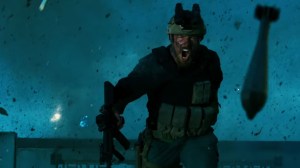 One of my big questions walking into Bay’s Benghazi movie was exactly whose version of events was the story going to follow. After eight congressional investigations, and a prominent Republican slipping by admitting one of the guiding purposes is to tarnish Hilary Clinton as a presidential candidate, I was worried that the movie was going to be a hacky, manipulative promotion of propaganda. There’s a reason that eight congressional investigations, including one that has lasted longer than Watergate, don’t seem to satisfy those calling for blood: they keep coming to the same inconvenient conclusions, namely that there was no stand down order, no conspiracy, no cover-up. There’s been a flurry of rightwing fury brewed over stoking unfounded rumors of conspiracy with Benghazi; it’s a fundraising industry unto itself for politicians. Therefore, I was initially worried that the movie was going to reinforce a version of events that eight (and counting?) congressional committees have refuted. I was relieved then that Bay’s movie keeps its focus pretty much squared on the heroism of the security team. In a way it reminded me of Black Hawk Down as it strived to recreate a series of harrowing life-and-death events with its focus more on the brotherhood and bravery of the ones in harm’s way rather than the broader political context. There is the infamous “stand down” order; however, it’s played almost incidentally, as Bob is trying to process all the chaos unfolding and the best recourse. As presented, it doesn’t sound like “stand down and let them die,” and more, “wait and let me think for a minute.” The fight to get air support from Italy doesn’t mention the fact that those Italian fighter jets sitting on the runway were not combat ready and were for flight training. There’s only one other passing dialogue exchange that touches the political, when the guys recount that the news is telling them it was a protest, which they scoff at and then let it go. That’s it. I imagine the audience that would be most excited for a Benghazi movie will be deflated. For everyone else, the sidestepping of politics lets the movie stand on its own better.
An article from Vox.com raises the issue of whether any movie about Benghazi can possibly be apolitical. It appears like the topic of Benghazi has been so cravenly politicized that any rendition of the events of that fateful day will reinforce or contradict some narrative, be it the security contractors, the CIA, the politicians on both sides of the aisle. And the absence of what others declare with certainty will only make those same people cry “cover-up.” It’s a shame that this topic is so radioactive that an objective approach celebrating the courage of those involved, mourning the loss of life, and asking for better from those in power seems impossible given the current divisive political environment. Did it have to come to this? Bay’s Benghazi is easily his most restrained movie in his bombastic career, paying reverence to the people who paid the ultimate sacrifice. The action is well staged and often visually striking, but Bay wants this movie to be more than a series of escalating action sequences. You feel he wants this to be his version of a Zero Dark Thirty-style thriller. Except it’s not. You watch the movie and sense there’s a more intelligent, nuanced, and ambiguous movie here that can make cogent points about foreign policy and the state of the Middle East. This is an action movie where the good guys shoot the relatively faceless bad guys. 13 Hours is an acceptable action movie but that’s all it ever asserts to be. Is that enough after all?
Nate’s Grade: B-
Share this:

Star Wars: The Force Awakens (2015)
 May 19,1999 is a day that lives in infamy for legions of Star Wars fans. The day hoped died. I remember trying to convince myself that The Phantom Menace was good but a second viewing confirmed my earlier fears. These movies were not going to be the same as the original trilogy, and George Lucas confirmed that with each successive release. I’ve had debates with teenagers who swear that the prequels are better films. They aren’t. This isn’t a matter of opinion; this is fact. After Revenge of the Sith was released in 2005, you could sense that Lucas was burned out and had no desire to further awaken the ire of the fandom. Then in 2012 he surprised everyone by selling the Star Wars empire, along with other properties like Indiana Jones, to Disney for four billion dollars. Immediately Disney let it be known that they wanted to get new Star Wars movies into production ASAP. They tapped J.J. Abrams to spearhead the first steps in a new direction. No other movie has felt the weight of hype and expectation like Episode VII: The Force Awakens. Fans don’t want to be hurt once more by someone they loved. For millions of fans that grew up on the original trilogy, The Force Awakens will be the Star Wars movie they have long been waiting for. It erases the bad feelings of the prequels and re-calibrates the franchise. However, it is also flawed and seems too indebted to nostalgia. It’s certainly good but I cannot put away my nagging reservations (far, far less than what I felt with the prequels).
Thirty years after the events of Return of the Jedi, the First Order has risen in place of the evil Empire. The First Order is lead by General Hux (Domhnall Gleeson) and aspiring sith lord Kylo Ren (Adam Driver). They’re searching for the droid BB-8 and its owner, Resistance pilot Poe Dameron (Oscar Isaac). The droid has a map that leads to the whereabouts of the last known Jedi – Luke Skywalker (Mark Hamil). A Stormtrooper who adopts the name of Finn (John Boyega) runs away from his mission and joins forces with Rey (Daisy Ridley), a scavenger waiting for her family to return to her world. The duo finds BB-8 and seeks to return the droid to the Resistance. They run into Han Solo (Harrison Ford) and Chewbacca (Peter Mayhew) and a few other familiar faces on their journey to the Resistance base and to escape the reach of the First Order.
 Abrams has captured the essential magic of what made the original trilogy so enjoyable and timeless. The prequels carried the burden of setting up characters we had come to love, and so as we watched younger versions of them or characters integral to their development, it was hard to ignore just how little we cared. It didn’t feel like Lucas himself cared that much, more content to direct his green screens than his actors. The special effects had improved but for much of the three prequels it felt like watching disinterested actors recite poorly written lines while they run around fake environments with no semblance of reality. The details that Lucas emphasized were ones that were unnecessary, like treaties and trade tariffs and the notorious midichlorians, which made the force into a blood disorder. The prequels harmed the legacy of the franchise. It takes only seconds for you to feel like you’re in better hands when you read the opening text crawl. No trade disputes. No galactic senate. It sets up its central chase and the important players in three brief paragraphs. And then we’re off and the movie rarely lets up.
We pass the torch to a new generation of characters and it’s here that Force Awakens is able to leave the large shadow of the original trilogy. The characters are great. Finn gives the viewer an entry point into a world we’ve never explored onscreen in any real depth, the life of a Stormtrooper, the cannon fodder of the series. He has moral crises and goes AWOL from the duties he has been raised to do. He doesn’t want to be a mindless killing-machine and forges his own destiny. Watching him embrace a sense of individuality is entertaining. He’s charming and excitable but also fearful of what may catch up to him. Then there’s the hero’s journey with Rey, a plucky heroine who comes of age over the course of the movie’s 135 minutes. Ridley has the presence and poise reminiscent of Keira Knightley, and the screen just adores her. It also helps when her character is easy to root for. Boyega (Attack the Block) and Ridley are terrific and even better paired together. They have a great chemistry and much of the humor is born from the characters rather than lame visual gags like in the prequels. It’s fun to hear characters verbally spar with actual good dialogue. Driver was the first actor hired and it’s easy to see why. If you’ve been watching the man on HBO’s Girls, you’ll know that he has a magnetic presence that separates him from the herd. He plays a villain that so badly wants to follow in Vader’s footsteps but the thing that holds him back is the “temptation of the light.” In one moment, a badass and imposing villain with super force powers had now also become an interesting character wrestling with his influences. Isaac (Ex Machina) is suave and cocksure as an ace pilot. His affection for the other characters is touching, particularly the robot BB-8. This little guy is going to be the toy that every child on Earth demands for the holidays. BB-8 is adorable from its first moment on screen and made me forget about R2D2. The big worry with Force Awakens was that its new characters would be compelling on their own. After one movie I’m looking forward to more adventures with the new kids on the block.
 Abrams has restored the sense of fun and awe that resonated from the original trilogy and the biggest compliment is that Episode VII feels like a Star Wars movie (more on which below). The action sequences are quick and filled with great visuals and shot arrangements. For those worried about Abrams’ penchant for lens flairs in the Star Trek reboots, they are completely absent in Force Awakens (Fun fact: for Star Trek Into Darkness, computer effects had to go in and take out lens flairs because Abrams later admitted he had gone a bit overboard). There are some beautifully orchestrated shots and sequences all around here. The first 40-minutes is the best part of the movie, before the older stars come back for their due. The rest of the film is enjoyable, no doubt, but I was more pleased with the original material. The technical expertise has never been higher. Like Mad Max: Fury Road, there’s a joy with watching characters interact with a real world of practical effects. Watching the characters run around real environments and real sets rather than immense green screens just makes it feel more real and vital. I enjoyed how worn and weathered the technology in this world comes across. The special effects are judiciously utilized and are excellent as anticipated. It’s easy to sense the reverence that Abrams and others have for the series as well as their determination to not repeat the mistakes of the prequels. The first mission for Episode VII is to reset the course, to wash away the bad taste of the prequels that haunt many. Abrams has gone back to what works with these movies and recreated the playbook. It’s a movie that will satisfy the hardcore fans and reawaken their love for the series.
And yet it almost feels like Force Awakens is a swing too far in the other direction, an overcorrection to the prequels that turns a reboot into a loving homage that approaches facsimile. I was amazed at just how closely Episode VII follows the plot beats of A New Hope (mild spoilers to follow – for real, if you don’t want to be spoiled in the slightest, and I’m no monster and won’t dare include anything that would substantially deter your viewing, skip to the spoiler safe area). Here goes: once again we start with an escape from an evil starfleet ship, only to land on a desert planet. The hunt is for a droid with valuable information. Our dispirit band of characters collect on the desert planet and flee, only to be eventually pulled back to the evil base of operations, which once again is a giant floating orb that specializes in planet destruction and this orb seems to have the same pesky design flaw that plagued Death Star 1.0 and 2.0. How does this one design flaw still exist? Are there not backups and redundancies? It would be like Titanic 3.0 going down by hitting another iceberg. There are more parallels involving the characters and personal revelations that mirror Episode IV but I won’t go into detail on those (end of spoilers). Suffice to say, it felt like I was watching a cover act remind me how much I enjoyed the first Star Wars release. Perhaps Abrams felt his rabid audience needed to go backwards before going forward, pay homage to what had been built by practically reliving its plot in a galaxy not so long ago as it once was (it still is likely the same distance: far far away). It’s a movie that cannot escape the nostalgia of its predecessors, and so it indulges it instead. In deferring to fan demands, Force Awakens has moments that waver into the dangerous territory of fan service. This will harm its overall staying power once the glow wears off from audiences overcome with relief.
 Thankfully, the new main characters are compelling and I’ll be happy to follow their continuing adventures with Episodes VIII and IX and who knows. Abrams and company have set up the next generation of fan favorites that have the chance to grow out of the sizable shadow of the original cast. However, not all elements are given that same nurturing care. The Force Awakens is so briskly paced that it rarely has time to establish the new history of its universe. We get character relationships and reunions but I couldn’t help but feel that the larger plot they inhabited felt rushed. The First Order seems rather vague and their rise to power needed at least some explanation. Instead we’re dropped right into a timeline with an Empire knockoff. It’s just easy fascism placeholder. Why are the Republic and the Resistance two separate entities? The villains with the exception of Kylo Ren are pretty one-note and also callbacks to the bad guy types from Episode IV. Captain Phasma (Gwendoline Christie) is in the movie for a lousy three minutes. I’m also not a fan of either of the two motion-capture performances courtesy of Oscar-winner Lupita Nyong’o (12 Years a Slave) and mo-cap pioneer Andy Serkis (Rise of the Planet of the Apes). I hated Nyong’o’s character and her performance. The character design for both of these creatures is rather weak and weirdly unimaginative. There’s also a habit of characters being naturals at things that would ordinarily require expertise. The worlds we visit and the creatures we encounter are all a bit too similar to earlier sources and distinctly unmemorable. We don’t learn much via our locations and geography and so it feels a tad interchangeable and meaningless, which is a shame.
The Force Awakens is a mostly exciting return to the rich world of Star Wars with characters we care about, old and new, lively action that feels substantial and real, and a sense of fun that isn’t at the expense of your full brainpower. Abrams had two missions: 1) eliminate the disappointment over the prequels, and 2) set up new characters and stories for future installments. Both have been accomplished. Abrams may have been the perfect candidate to restart the Star Wars series as he has a history of making films as loving homage to his cinematic influences. Super 8 was Abrams’ homage to Spielberg, and Episode VII is very much homage to Episode IV. The well-trod story allows for the series to reset comfortably while setting up its new characters to take a greater storytelling burden from here on out. I hope future installments give us more development to make the worlds and the history matter just as much as Rey, Finn, Kylo, Poe, and BB-8. This may be an unpopular opinion but I feel that Abrams’ rollicking 2009 Star Trek reboot is a better Star Wars movie than The Force Awakens. Abrams and company prove you can make a new and good Star Wars movie. Now my own new hope is that writer/director Rian Johnson (Looper) will be able to steer the franchise into a fresher direction with Episode VIII. In the meantime, fans can sleep well once again.
Nate’s Grade: B+
Share this:

In the Heart of the Sea (2015)
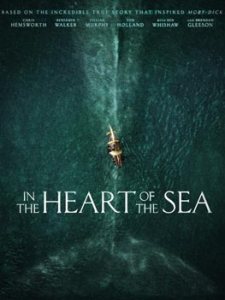 In 1822, the men aboard the Essex, a whaling ship sailing from Nantucket, Massachusetts, encountered a beast unlike any they have ever seen. Captain Pollard (Benjamin Walker) and his first mate, Owen Chase (Chris Hemworth), were at odds throughout the voyage, that is until they encountered a 100-foot long white whale. The creature destroyed the Essex, forcing the crew to drift at sea and hope to find land, but the whale follows them as well. Tom Nickerson (Tom Holland as a young man, Brendan Gleeson as the older version) recounts this traumatic survival tale to author Herman Melville (Ben Whishaw), who is desperate to write this true story.
There’s an old-school throwback vibe to In the Heart of the Sea with its high seas adventure, but there’s just not enough attention to adventure, character, or even plot for this movie to really set sail properly. The first act feels so sluggishly long. It’s trying to set up life on a whaling vessel in the early 19th century but I didn’t feel like we got a coherent sense of life aboard the seas or how the various components worked. I didn’t know that whalers row out from the main ship, so there’s that. The opening act sets up the dull conflict between Chase and Pollard, which can be summarized as blunt upstart vs. unchecked privilege. The conflict doesn’t evolve from this dichotomy. Both men are boring in their unyielding simplicity. Hemsworth (Avengers: Age of Ultron) made a stronger impression in Rush, but a humorless movie role is not in his best interests as an actor. When the action does arrive, it can be genuinely thrilling. Director Ron Howard does a slick job of conveying the danger and destruction of the whale attack. Sadly, it’s over too soon and then the remainder of the movie is 45 minutes of a survival drama adrift in the ocean reminiscent of last year’s Unbroken. This period of isolation forces the characters to make some hard choices, yet we don’t feel the impact of those choices because the narrative, too, feels adrift. Implausibly, the giant whale has followed them for thousands of miles. Are whales really this vindictive? The documentary Blackfish makes me wonder but it still feels unbelievable. What was the whale waiting for? For the men’s spirits to be completely broken before it might attack again? We’re told this whale is a “demon” but who exactly are the bad guys in this story?
 I believe another stopping point for this story is that the culture has moved beyond the acceptance of whaling as an honorable profession, to the point that I, and I assume others, was on Team Whale after witnessing a bloody hunt. It’s pretty gross, especially when they’re harvesting the whale body for the precious oil. Perhaps modern audiences, so far removed from hunting as an essential component of life have become more squeamish, or perhaps modern audiences just recognize something as barbaric when they see it. As a result, it’s hard to root for these guys. When the giant whale attacked it felt like retribution. My sympathies were more for the large mammal than the bipeds on ship. At the end of the film (some spoilers), the white-haired moneyed men of Big Whale Oil are worried what the truth will do to their industry. They want the surviving crewmen of the Essex to deny the existence of this gargantuan whale. This makes little sense to me other than awkwardly forcing a Big Business cover-up for relevancy. First off, whaling seems like a pretty unsafe working environment to begin with, especially considering voyages could last up to three years. Would the reality of one big bad whale destroy an industry? I doubt it since there is such money to be had. If anything it might rejuvenate the timber industry to reinforce the ships to make them more durable against larger whale attacks.
At first I thought a framing device was entirely superfluous; why do we need to watch Melville elicit this tale rather than simply just watching the tale itself? It seemed like a distraction, but as the movie progressed I understood that this framing device was its own sub-story and had its own complexity, namely the older Tom coming clean to the decisions that still haunt his soul. It’s an unburdening for both gentlemen, as Melville admits his deep fear that he is a mediocre writer (he’s no Nathaniel Hawthorne) and that he will be unable to tell this story as well as it truly deserves.
As these two men are allowing themselves to become more vulnerable and sharing their demons and doubts and worst fears, I started to realize that this framing device was weirdly more compelling than all the whale action. That’s because older Tom and Melville are the best drawn characters in the movie, which seems like a screenwriting mistake of sizable proportions. Obviously the nautical survival stuff should be the most compelling, and yet I as more taken with two men sitting by an oil lamp discussing their lives. Older Tom is infinitely more interesting than younger Tom; part of this is because young Tom hasn’t experienced the full effect of the events that shape older Tom, but most of this is from the very clear fact that young Tom is kind of a mute witness in this movie. He rarely speaks and is just kind of there, taking up space. There’s one personal harrowing moment when he’s thrust inside a hollowed out whale carcass to extract more blubber, but that’s the only personal perspective offered through young Tom. A question concerning the framing device: how is older Tom retelling events he had no participation or witness to? Another issue is that the characters on board the Essex are bereft of anything that would allow us to feel for them beyond simple human survival. Chase and Pollard are given one note to play and their eventual understanding and cooperation is fine but it feels like fleeting details in a story, lost to memory or disinterest.
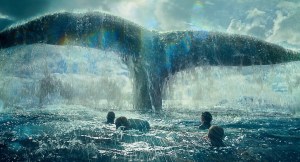 From a purely technical aspect, this is one of the better Howard films. The cinematography by Anthony Dod Mantle (Slumdog Millionaire) is rich and often breath taking, with plenty of stunning aerial and underwater images. The whale attack sequence is harrowing and thrilling. Howard finds ways to imply the harsher aspects of this life without going overboard, maintaining that PG-13 rating. While the look of the film has an enhanced color palate thanks to the extra boost of CGI filters, I still appreciated the vibrancy of the on screen images. As I said with the similarly boosted Mad Max: Fury Road, I’d rather have vibrant and bright colors than a drab and washed-out color palate. Even as the movie drifts and the characters fail to grab you, at least the visuals are pretty. While sitting through the second half, I started to rethink my own prejudices concerning Howard as a filmmaker, a man who lacks a distinctive style but has a definite feel for how to tell a story. I’m not going to excuse him for The Grinch and other misfires, or his tendency to settle for maudlin in place of subtlety, but the man is a born filmmaker.
In the Heart of the Sea is an old school movie that feels too sluggish, too underdeveloped, and too free of characters for the audience to invest in. When the framing device scores the biggest emotional pull, you better start rethinking your rip-roaring high-seas adventure. Master and Commander this is not. As the inspiration for Moby Dick, I wish I had just watched a remake of Melville’s actual novel (now with extra chapters about rope!). If you ever wanted a movie that ends on a blurb by Nathaniel Hawthorne as a payoff for Melville’s artistic neurosis, then your wait is over. In the Heart of the Sea feels like a whale of a tale that is hard to believe, which ends up inspiring a far greater story, which made me yearn for just watching that superior tale. Sometimes the “truth” behind famous stories is less interesting.
Nate’s Grade: C+
Share this:

The Hunger Games: Mockingjay Part Two (2015)
 The Hunger Games: Mockingjay Part Two may be the bleakest Young Adult-adaptation ever put to film. It’s a franchise that began with the televised spectacle of children killing children, so it’s never exactly been the cuddliest environment for our emotions. This is a conclusion that is overwhelmingly dark and pushes the boundaries of the mainstream PG-13 ratings. If you’re expecting a happy ending, look elsewhere.
Katniss Everdeen (Jennifer Lawrence) is the face of the revolution between the Capitol and the thirteen districts of Panem. Peeta (Josh Hutcherson) has been returned but he is recovering from intense brainwashing from the Capitol. He doesn’t know whether Katniss is a friend or foe. The fight is now being taken directly to the Capitol and President Snow (Donald Sutherland). The cagey leader of District 13, President Coin (Julianne Moore), wants Katniss to stay behind with the members of her propaganda team. Katniss sneaks off to the front lines of conflict with her District 12 pal/potential love interest Gale (Liam Hemsworth). The Capitol’s gamemakers have designed a series of fiendish surprises for the rebels on every block. While Katniss and her team are behind the fiercest fighting, she is still a high-profile target sought for prompt elimination.
Mockingjay Part Two doesn’t hold back when it comes to the ugly realities of war, namely the innocent casualties in the pretext of an ends-justify-the-means pragmatism. I was reminded of World War II stories and photographs as Katniss and crew stumble through the bombed-out ruins of Capitol neighborhoods. There’s something eerie in the silence amidst miles of rubble. In Part One we saw similar carnage with Katniss’ home district, incinerated by Snow, and to the film’s credit it doesn’t pretend that only one side of this conflict suffers. It’s not exactly a cutting edge commentary on the atrocities of war but it’s still appreciated. Put simply: plenty of bad things will happen and others will attempt to justify these bad things, and at one point that includes the knowing slaughter of innocent children as a political gambit (for you book readers, the body count remains the same. Sorry if you were hoping for a reprieve for certain characters). The series has explored the nature of trauma and nobody gets out free. When Katniss is making her way to the Capitol, it can be easy to forget all the prior character work animating her decision-making. When a Capitol loyalist points a gun at her head and asks for a reason he shouldn’t kill her, she says, “I don’t have one.” In a sense, that can be looked upon as lazy screenwriting or, and I’ll give the movie the benefit of the doubt here, perhaps acknowledging the realities of entrenched conflict when it comes to class warfare.
 The attention to social and political commentary has helped give The Hunger Games a bit more maturity than the rest of its YA ilk who often rely upon simplistic oppressed/oppressor conflicts that naturally fall into authority vs. individuality. I appreciate that the filmmakers have followed author Suzanne Collins’ approach to human conflict, which doesn’t dabble in black and white but a larger series of grays (50 shades of them? I’m sorry). This intelligence has given the franchise a depth that could be easily ignored, either by audiences looking for their next fix or studio execs that demand dumbing things down. Part Two forgoes the political gamesmanship for more traditional action suspense sequences, several of which are quite entertaining. There’s an underground chase with snarly mutants that is terrifically teased out suspense-wise. I do appreciate conversations started on how exactly one moves on from tyranny and how easy it is to follow in the same footsteps in the name of justice. However, if you don’t predict where Katniss’ final arrow is going, then you aren’t paying attention to the lessons on recrimination being underlined by explicit on-the-nose dialogue.
There are a few improvements including finally making Peeta an interesting character. He was the noble, nice guy, the somewhat boring conscience for Katniss, but after being returned from the Capitol’s brainwashing, he’s struggling to identify what is real and what is false. It’s still hard to believe that Coin would allow his inclusion on Katniss’ team making its way to the Capitol that is until you remember that Coin also sees Katniss as a political threat for post-war leadership. The love triangle has long been the least interesting aspect to the entire Hunger Games series and part of this falls upon the character of Peeta, who, removed from the manufactured romantic narrative for the cameras, has struggled to be ore than a weak link. Here he can be a threat at any moment, triggered by whatever daunting stimuli that may make him slip back into psychosis. He becomes a ticking time bomb and something far more risky than a romantic alterative. When Peeta becomes a “bad boy” is when he finally becomes worthy of our attention.
If Mockingjay Part One was all protracted build-up to the climax, then Part Two is all climaxes, and yet given the lugubrious allowances afforded by filling the running time of two separate movies, the movie is oddly anticlimactic as well. We’ve been waiting for the confrontation between Katniss and Snow for three whole movies, and Part Two picks up immediately after where Part One ended, and yet we’re still made to wait. Coin wants Katniss to still be primarily a propaganda tool and stay miles behind the front lines, which causes more of Katniss chaffing against authority like she does. Once she does get to the gates of the Capitol, the movie follows a familiar deadly games setup, this time in a more open terrain but the basics are the same: Katniss and crew have to battle a series of deadly booby-traps to reach their goal and kill the bad guy. In a sense, the plot mechanics are similar to video game stages needing to be cleared. It’s a setup that predictably picks off the more expendable members of Team Katniss One, though I’ll give them credit for spreading out the sacrifices. The losses would hit harder if we actually cared about any of these characters on a personable level. Oh well. I also could have used more screen time for many of the supporting actors, notably Moore, Woody Harrelson, Elizabeth Banks, Jenna Malone, Natalie Dormer, and the late Phillip Seymour Hoffman. This is the last we’ll ever see of Hoffman on screen, and that fact made me quite melancholy by the end.
With the games long gone and the revolution at hand, The Hunger Games has always had some difficulty figuring out how to fill the space before the inevitable showdown with President Snow. In Part One we were mostly stationed in the bunkers of District 13 while we watched the other districts revolt. Like Katniss, we’ve been itching to get to the front lines, especially after Part One’s more plaintive pacing. Once we get to the action it’s more like mop-up duty, which robs the movie of some sense of satisfaction, which turns into a key theme. With the games we had the veneer of “paying” roles as media manipulation for survival, and with Part One we had the study of propaganda. With Part Two, it’s all dour action. I hope viewers aren’t expecting a fantastic finale between Snow and Katniss and their collective forces because then you shall be disappointed. The filmmakers, hewing very close to the novel, have the conclusion to the revolution play out in more realistic and grounded terms, which add points for realism and relevance, but it does detract from some sense of overall satisfaction.
 Director Francis Lawrence (I Am Legend) has guided the franchise with sturdy skill and a keen eye for visual arrangements, but if there’s one significant visual complaint I have it’s that these movies are too damn dark. I’m not talking thematically, as I’ve already explained above, but simply from a light level. These movies are just hard to see. Lawrence seems to favor low-light environments to create an ambivalent mood. That’s fine, but I’d also like to see what’s happening on screen. In the last movie we spent a majority of our time in dank underground bunkers, but Part Two is an outdoors kind of picture, so why is it still so hard to distinguish what’s happening?
With the approaching end of The Hunger Games (until Lionsgate milks more money from its lucrative cash cow) it’s appropriate to take stock of its legacy. No other YA franchise has tapped into the cultural zeitgeist like The Hunger Games, but its ultimate legacy will probably be cementing the once promising young actress Jennifer Lawrence firmly into the upper echelon of Hollywood. In the time since our first foray to Panem, Lawrence has won an Oscar, been nominated for another, and proven to be one of the hottest stars on the planet, the kind of actress that esteemed directors are fighting to work with and studio heads want to tap as their lead. Much like Katniss’ meteoric rise to renown, Lawrence has become her own version of the Girl on Fire. She has been better than the Hunger Games movies for some time, and yet Lawrence hasn’t failed in her primary duty to provide an anchor for the audience. Her gritty, conflicted, and commanding performances in the franchise have been a unifying resource for audiences and a reminder of her considerable talents. The Hunger Games: Mockingjay Part Two brings to a close a massively successful film franchise and an important chapter in the ascendancy of Ms. Lawrence. It’s thrilling, bleak, and inhabits most of the hallmarks that have come with the Hunger Games films, though in somewhat less supply to make way for the onslaught of action climaxes. There’s more anticlimax then you’d expect, and I credit the filmmakers for sticking with it even at the detriment of the experience. Mockingjay Part Two does enough to end the franchise on an appropriate if somber note. I’ll see everyone at the proposed theme park (seriously, look it up).
Nate’s Grade: B


 nathanzoebl
You must be logged in to post a comment.