Minus One (2010)
 As I’ve been looking into more Ohio independent films to highlight and review, I had several in local filmmaking circles recommend me the 2010 drama Minus One (currently available on Amazon Prime). It’s a war drama filmed entirely in Columbus, Ohio. It’s an example of what can be done when indie filmmaking accentuates the most important parts of storytelling, ones that do not require Hollywood budgets. It’s a heartfelt drama and one that is easy to plug right into.
A trio of National Reserve soldiers have been given the call that they are to report for duty. In three days, they will be transported overseas and onto a base in Iraq. David (Jon Osbeck) is a career veteran and in charge of rounding up the other guys in town. James (Roger Bailey) is a 30-something veteran still trying to build a family. Robert (Remy Brommer) is a young student whose days were about playing video games with his pals and sneaking time in with his girlfriend. The three men try and put their lives in order before they leave and face the possibility of not returning.
 Minus One is the kind of meaty drama that can be done on a shoestring budget, which makes it a smart play for indie filmmakers because the drama and characters are what sustain it. There’s something immediate and engaging about a group of men spending their last few days before shipping out. It’s a situation that feels like grieving, the uncertainty and anxiety hanging on everyone’s faces. Will this person ever return home to me? Will things ever be the same? It’s a premise that forces confrontations and that naturally leads to drama and catharsis. The trio of characters all have personal relationships that will need to be touched upon before their departures, although James really gets the short end dramatically. He’s scared about going back for another tour but his wife is supportive and loving and they’ll see it through. James seems to serve more as a contrasting data point in between the character chart, the middle ground between the novice (Robert) and the strong-but-silent veteran (David). The situation demands introspection, reflection, and the conflict of action versus inaction. Will you make amends while able? Will you continue to drift away from those who were at one time so crucial? Will you take ownership over your own faults and the pain you may have caused others? By starting at this point, each scene becomes a learning opportunity for the viewer, trying to deduce connections between established characters and new supporting faces, as well as getting a fuller sense of their daily lives through habits and breaks from routine. Not every scene does this, and there are some scenes that just restate the same learned info, but as a whole Minus One is a well-constructed drama that puts the emphasis on character and conflict and patience. It takes its time to fill in the blanks.
Each character is taking stock of their life and what this moment means, but they’re also taking stock of how it affects the people around them in their lives. Robert being called into service effectively ends his relationship with his girlfriend, and the both of them know it during a party. His mind is preoccupied and she gets up to leave, remarking she has an exam in the morning. You can tell Robert is a little hurt by this reality, wanting to soak up the time they have remaining before he’s gone, and then accepts that reality, that he’s already gone. She says goodbye, hugs him, and they hold onto one another, and what’s unsaid seems to be understood by both parties. This is more than a nightly goodbye. They both know it’s the end and must move on. David is also trying to make right with his ex-wife and little daughter, trying to fix one small thing, one achievable act of kindness, one point that can be fondly remembered, by fixing the broken front porch swing. As his ex-wife relays, David has been a family man in name more than deed, failing to fulfill promises and being present for his loved ones. The duties of the job took their toll. This is a small town and losing three of its own to the war effort will have repercussions. Especially during trying times, it’s clear that our lives and actions can extend far beyond us.
 Osbeck (Dark Waters, The Public) has the most challenging role given that he is the most hardened to the call of duty. He delivers a finely textured and weathered performance with enough glints to hint at reserved pools of emotion, from regret with his ex-wife and a lingering ember of hope, to resigned acceptance and gratitude to the many familiar faces in town. Watch the guy talk to his daughter and try not to get a sense of how good Osbeck is at bringing this character to life. His isn’t a showy performance and often underplays the scenes, which feels more appropriate for the role. Bailey and Brommer (Speak) do fine jobs especially when they’re pitted against each other. Both men are fearful but dealing with it in different manners, which puts them at odds. Robert is ignoring the certainty and changes, trying to parrot the Army’s slogans and racist terminology for the enemy overseas as a means of covering up for his gnawing fear. He’s gung-ho for war, and this greatly irritates James, who knows better than to blithely celebrate war as if it was glamorous. I wish their blowup could have gone on longer and cracked both characters open even further.
Other acting standouts include Jennifer Schaaf (Heather’s Painting) as David’s ex-wife who is trying to navigate her complicated feelings of sympathy and personal boundaries, Jane Mowder (The Street Where We Live) as Robert’s mom, especially during the scene where she has to process the news her son is shipping out, Misti Patrella (Classholes) as the grieving widow who has turned to the bottle and has a shared history with David, and the irreplaceable Ralph Scott (Bong of the Living Dead) as the small-town police chief who provides a much-needed wry sense of levity. He has such a natural way of inhabiting a character. Scott is so prevalent in Ohio-produced indie filmmaking that I assume if he’s not in the film he must have been holding the camera somewhere.
There is one significant misstep for the movie and it literally comes in the closing minute. I’ll dance around spoilers to keep things kosher. The film ends as you would expect with our trio being driven out of town and heading to the airport for their international travel (this should not be a spoiler). We’re then treated to post-script text informing us what happened to the three soldiers once they reached Iraq. Firstly, it’s not necessary to give resolution when so much of the story exists in the uncertainty of what will happen next. It feels like ending 12 Angry Men with a post-script that said, “Oh, the kid was really guilty the whole time.” It goes against the thematic emphasis of the preceding story. We don’t need a resolution because these men are representative of the United States soldier as a whole, so it’s better left open-ended. The other drawback is that this post-script covers some pretty major dramatic changes, and to do so in a handful of words in the close is inherently anticlimactic and unsatisfying and a bit clunky. If this was going to be the conclusion to certain characters, then learning about it this manner was not the right choice. Better to have kept things ambiguous and open-ended than serve up developments this way.
 This impulse also surfaces during one of the movie’s most dramatic points, a nearly six-minute monologue by David about his time overseas and a checkpoint that went badly. We begin the moment on Osbeck’s face recounting the painful memory, and then the movie haphazardly cuts back into flashback of the event as narrated. This decision seems like a reasonable one, visualizing the traumatic experience, but it takes away from the moment. It interrupts the focus on Osbeck’s performance where the viewer is studying him for the slightest changes. It’s a strong monologue and the emphasis should be on Osbeck’s face alone. Another reason why this choice doesn’t work is the reality of doubling the Middle East in Columbus, Ohio. This requires a stylistic choice that amounts to “ghost trails” in editing software (think “drunk vision”). It’s being used to signify the past but it’s also being used to cover up the environmental differences. Even with this effect, the forest of the checkpoint still stands out as incongruous. I do think a flashback could have strengthened this moment but it needed to be very judicious. The point of the monologue isn’t how he and his friend got into trouble, it’s about his friend’s sacrifice he blames himself over, which means the emphasis needs to be on his friend. David describes seeing his expression in that final moment, an understanding of his inevitable demise, and that is exactly what should have been the flashback focus. All you needed was a closeup of the man’s face, fixed, emoting every damn thing he can before a flash wipes away the memory. That way the emphasis is on the performance and gets rid of production replication shortfalls.
Minus One is a fairly simple story told in a straight-forward manner. The emphasis is on the relatable characters, the simmering conflicts and the personal revelations of each coming to terms with how their lives will be changing, and the uncertainty that they must come to terms with. This is a story that has been told before, both in film and simply a lived experience of millions, and it will continue to be told afterwards because, at its core, it’s a universal story. It’s saying goodbye to a loved one and coming to terms with responsibility and sacrifice. Yet, Osbeck, serving as writer and co-director with Marc Wiskemann (Holding Patterns), doesn’t rest on making these men symbols (admittedly some of the three have more depth than others). It does no disservice to say Minus One feels like a competent made-for-TV movie; from a technical standpoint, the visual compositions and shots are very standard, placing the focus on the actors and giving them space, and material, to deliver, and they generally do. It’s a small movie about big things and I enjoyed the little touches that better rounded out the world, like David revealing, with a delightful smirk, the secret to how he always gets the daily trivia question correct at his local coffee shop. It’s those small touches that give Minus One a personality. I disagree with the very ending and how it impacts the overall resonance of the movie but it doesn’t sabotage the whole experience. Minus One is a somber, reflective, and touching little homespun drama with plenty of sincerity and heart to spare.
Nate’s Grade: B-
Share this:

In the wake of COVID-19, some changes…
Everyone is feeling the effects of COVID-19 and the entertainment industry, in particular movie studios and theaters, have been dramatically affected. I will be continuing to review new films when I can, albeit many will likely be smaller indies unless Hollywood embraces Video on Demand. I’m also going to make a real effort to continue seeking out Ohio-made indies and providing reviews for them. I will continue what I did for my huge 1999 in Rewind article and look back at my original teenage reviews and assess my current feelings on the movies and my old writing, for the year 2000, 2001, 2002, 2003, and now 2004. I’ll be on the lookout for amazingly new so-bad-it’s-gotta-be-seen movies (have you seen Love on a Leash?). In short, I’m going to keep writing. I hope you keep reading.
Share this:

Guns Akimbo (2020)
 Imagine waking up one day and having real-working handguns bolted into your hands. That’s the wild premise to Guns Akimbo (akimbo means, in this context, “flung out haphazardly”), a frenetic action comedy that never takes itself too seriously. Miles (Daniel Radcliffe) is a computer programmer who takes it upon himself to harass online trolls. One of these trolls, the proprietor behind the death match game show Schism, takes it personally. He drugs Miles and has his cartoonish goons give him the gun-hands. He’s the latest contestant on Schism, and the top-ranked assassin Nix (Samara Weaving) has been selected as his competition. Miles has to fend for his life, while not arousing panic or the police, and he can’t even open a door.
It’s a bonkers, proudly juvenile action comedy that starts off at a breakneck speed and rarely lets up, and there’s a good reason for that – Guns Akimbo is a lot of flash and little else. It’s a movie that’s constantly in your face with its stylistic tricks, crass humor, wanton violence, and bizarre touches, and for a decent portion of the movie it kept me entertained. The rush of colors, movement, and profane insanity can be enjoyed on a certain level that doesn’t require much in the way of thinking. If you need a turn-off-your-brain action comedy, Guns Akimbo can work on that level, but if you think a little more the illusion begins to dissolve. I start to question the reality of this world, which seems more akin to something from The Purge but lacks the satirical through line of the Purge franchise. The satire of Guns Akimbo feels tacked on and often forced, much like the setup of its premise. There’s really nothing about firearms or gun culture covered, which seems bizarre considering the premise. The “troll culture” aspect of the movie is barely covered, setting it up as a straw-man argument to lambaste the general indifference to human suffering. We never really return to it except for brief moments to score easy points. Miles is a troll to trolls, and they get so incensed that they go to extreme lengths for vengeance from… being trolled? Is this to imply how fragile online trolls are as people? The world of the movie seems to acknowledge its Running Man-style online death game shows but the rest of the world goes on normally without commenting. It feels like someone just dropped in a fantastic element into the normal world and nobody acknowledges it as such. I thought maybe at the end it would turn on the Schism viewers but no. They’re basically like those five or six audience faces we jump around for reaction shots, like in The Truman Show. The satire of the movie feels more like a superficial finish.
 From the first sequence of stylized violence on, I made a note of how overly edited the action was. It wasn’t quite to the hyper-edits of Michal Bay’s kaleidoscopic realm but it was noticeable and made it harder for the action to be understood and appreciated. You get the premise of the scenarios, two cars chasing after one another and firing, but it’s presented in such a blizzard of images, sounds, and colors that it’s more the impression of the scene rather than a development. This impression was always present when we watch Nix storm through a drug den and lay waste to every armed goon inside. Here is a scenario where all I want is some stylized violence and fun fight choreography, but what I got was more of the same incomprehensible jumble. Nix shoots. Bullets hit skulls. Blood splatters. The camera is constantly zooming, or careening, or flipping upside down, and after a while I just gave up and accepted it’s all only impression-based. It’s about the immediate energy and not what’s actually happening onscreen. I wasn’t going to get any interesting fight choreography. I wasn’t going to get any memorable bits of crazy action. It was like a junkier version of Wanted, with a super-powered player running through a level and clearing over-matched opponents. Without more, the same action can get boring. The same happens in a junkyard clash between gangs. The only action sequence with a satisfying development was a car chase where Nix attacks with the spinning wheel of her motorcycle. Guns Akimbo has decided to overwhelm your senses to distract from its action restrictions.
As a crazy comedy, Guns Akimbo is more successful and fun. I found the physical comedy to be a consistent and enjoyable source of entertainment. While the action might get boring, watching Miles simply deal with the logistics of his gun-bolted hands made me laugh and cringe constantly. How does one go to the bathroom with gun-hands? Put on their pants? Open a door? Drive a car? It’s a dose of slapstick that doesn’t have to dip into edgy material in order to make its mark. Radcliffe is genuinely fun to watch during these sequences, as it plays to his strengths of melding awkward clumsiness and nervous high-strung energy. Thankfully Radcliffe is set for life thanks to the Harry Potter movies because he has consistently chosen really weird and interesting film roles, almost to the point where his presence in a (non-studio) movie is enough to guarantee a watch. He brought stunning humanity to a farting corpse in 2016’s Swiss Army Man and gave a tour-de-force physical performance. He’s an actor who commits no matter how silly the role, and it’s a delight to watch him try and make sense of the escalating madness around him with his unique physical disability. I was enjoying even the smaller moments like Miles’ difficulty hiding his alarming ailment with transparent lies or his interaction with a mentally ill homeless man (a scene-stealing Rhys Darby).
 As the movie kept going, I felt my interest growing and that was because of the increased presence of Weaving as Nix, who is clearly the star of this crazy movie. Weaving should have been a Hollywood star after Netflix’s The Babysitter, and she was just as wonderful as the heroine in last year’s Ready or Not. Her character isn’t exactly much more than a murder pinup, a comic character come to life. She’s nearly unrecognizable in her punk rock assassin attire, including literal bullet teeth. She’s all nihilist attitude and clunky one-liners (“Suck my clit” needs some work). She has a tragic back-story that sets her up for vengeance and that’s all that’s needed from what could be a completely interchangeable back-story. It only serves as a needed character motivation point, one that is more compelling even in its shallow nature than Miles, who is on the run for his life but really is about trying to save his ex-girlfriend (Natasha Liu Bordizzo) who serves mainly as a damsel in distress for the last act. While I enjoyed Radcliffe as a performer, this is Weaving’s movie from the moment she struts into the frame. Her charisma pops off the screen even as her character is criminally blasé. She’s the kind of character that will pick up a dismembered middle finger just to give someone the gesture. Nix is more so a collection of weird and hip and sexy tics than an interesting character, but it’s Weaving and her jubilant, dangerous degree of fun that makes the character a scrubby version of Harley Quinn.
Guns Akimbo is like tasty junk food that can satisfy a very specific cinematic craving but you know, even as you’re consuming it, that this won’t be anything special. I wish the film had gone further in any direction, whether it was with the comedy, whether it was with more finely choreographed action, or whether it was in more outlandish set pieces like in 2007’s Shoot ‘Em Up. If you want to be a crazy cartoon, be a crazy cartoon. Give me even more characters like Nix and over-the-top violence that does something different besides geysers of head shot wounds. Guns Akimbo might work as a lesser Crank movie. This movie seems either to be too satisfied with itself or knowingly hiding its shortcomings with energy, edits, and attitude. I can’t tell which. Guns Akimbo is easy on the brain and maybe a little too easy on itself. My 13-year-old self would have loved this movie.
Nate’s Grade: C+
Share this:

Emma. (2020)
 If you’re going to see a Jane Austen movie, chances are you already know what you’re signing up for. This new edition of Emma. (with extra punctuation at no charge) feels like a slightly more arch version, given a dose of the stilted whimsy of Wes Anderson. It’s only a dash but it’s definitely enough to set the movie apart from its more austere brethren, which will either make it a fresh and reinvigorating take on the material for an audience or a quirky misfire not playing to the strengths of its source material. I fall somewhere in the middle, as I’m not the biggest fan of Austen’s comedic voice but appreciate her point of view and the way she can drop you into these very specific, very rarefied world of class, privilege, and ignorance. The movie’s pacing is quite slack and the scene-to-scene urgency can seem a bit in doubt, which works with the more arch portrayal but also makes the movie feel very long and borderline tedious at parts. The technical asides of Emma. are impressive, with the glorious costuming and art direction transporting an audience back to that early pastoral 19th century time period. Ana Taylor-Joy (Glass) is a sprightly choice as the titular matchmaker and her best moments are when she embraces the extremes, whether it’s being haughty, awkward, contentious, or the occasional dose of slapstick. She navigates the complicated minefield of others affections, trying to stay above it, while finding herself drawn to the free-spirited Mr. Knightly (Johnny Flynn), who is the only reason this movie is rated PG thanks to a brief flash of rear nudity. Mia Goth (Suspiria) is winning as a demure women feeling the highs and lows of love thanks to Emma’s friendly intervention. It is such an amusing change of pace for Goth, often performing as a sexpot. The real standout are the comic actors doing the most with their supporting turns. Bill Nighy (Detective Pikachu) is highly amusing as the fussy hypochondriac father and Miranda Hart (Spy) is a welcomed presence as the oblivious, constantly nattering Miss Bates. It’s Emma’s show, though, and Taylor-Joy is an enjoyable lead surrounded by an exquisitely manufactured world of old. If you’re an Austen fan, Emma. is worth a watch. If you’re not, this won’t exactly be the movie that brings you over into the fanbase.
Nate’s Grade: B
Share this:

The Way Back (2020)
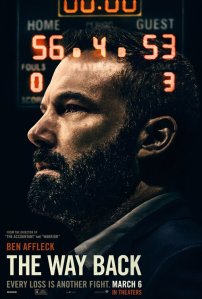 Not to be confused with 2013’s The Way Way Back, or 2010’s The Way Back about Gulag survivors, this movie entitled The Way Back is about Ben Affleck as an alcoholic basketball coach, and it’s thoroughly fine. We follow Jack (Affleck) as he tries to get his life back on track following the death of a child and the end of his marriage. His alma mater needs a new coach and the former high school basketball star might have found a job that could lead him to be a better version of himself. There’s nothing inherently bad in director Gavin O’Connor’s drama. The acting is pretty good, the docu-drama style gives it a credible sense of realism, and the movie doesn’t downplay the destructive pull of addiction. The problem is that it never feels like it goes deep enough in any aspect. I feel like I just watched a by-the-numbers sports drama attached to a by-the-numbers addiction drama. I kept waiting for more insights with the characters, but the story kept falling back on “dead child” as the explanation for everything. I kept waiting for the characters to distinguish themselves with personalities, but the team to the assistant coaches to Jack’s own ex-wife (Janina Gavankar) are left underdeveloped and more as stand-ins for approving or disapproving figures. There’s plenty of dramatic potential here and it feels like The Way Back doesn’t have the courage or nuance to keep going. I was thinking back to McFarland U.S.A. and how great that movie opened up its world, its community, its culture, getting to know the different characters and their needs, pressures, and hopes. I was absorbed by that movie and with The Way Back I was left mostly unmoved. Affleck (Justice League) is delivering a good performance that touches upon his own challenges with alcohol. He’s the reason to see the movie, but there isn’t much else to warrant your attention. It’s competently made and refrains from getting mawkish, which is something considering how easy it could given the susceptible subject matter. I was just left relatively unmoved because I was kept from emotionally connecting with these people and getting to know and care about their lives from this story. It’s no The Accountant.
Nate’s Grade: C+
Share this:

Onward (2020)
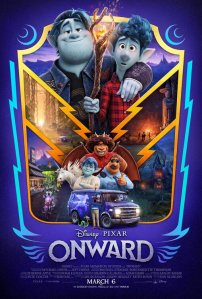 In a modern fantasy suburbia, Ian Lightfoot (voiced by Tom Holland) and older brother Barley (Chris Pratt) have been gifted with a magic staff from their long-departed father. Barley was only a young child when their father died, and Ian never knew him, and now both are granted an opportunity via magic to bring their dear old man back for one more day. The magic spell is interrupted and, as a result, only one half of their father is brought back to life, the lower half, chiefly his legs. The boys must travel on an epic quest in order to bring the rest of their father back to life before all of him disappears again.
Onward is the first time Pixar has ventured into a fantasy realm and the mixture of the modern with the high-fantasy setting allows for some fun juxtaposition. The teenage worries about fitting in, testing your boundaries, and finding out your sense of self can be very relatable, even in a world of trolls and elves. I enjoyed the combative and compassionate brotherly dynamic between Ian and Barley, and Holland (Spider-Man: Far From Home) and Pratt (Avengers: Endgame) are terrific together and really do feel like feuding family members. Their high energy performances translate well to animation. The Pixar creative team does enough to provide little distinguishing character touches for both, enough to provide some extra shading so they don’t quite feel like cartoon versions of their more famous Marvel counterparts. Ian is all awkward and lacking in confidence whereas Barley is overloaded with self-confidence and an unshakable sense of arrested development. I enjoyed the small number of memories relating to their father that Barley holds onto, and I enjoyed how Ian listens to a brief, ordinary test recording of his father on a cassette tape and creates a dialogue between father and son. It’s such a sweet moment that also demonstrates Ian’s ache. I enjoyed how the screenplay connects the external to the internal, namely the obstacles on this quest to the personal trials for Ian and Barley. It allows more meaningful payoffs and more rewarding character growth for our duo. I enjoyed spending time with both boys and was glad their quest was more about them than magical ephemera.
 Amazingly, what works best in this movie is its emotional core, which sounds slightly bizarre considering it’s a road trip with a pair of legs. As Onward progresses and settles down with its better honed second half, it puts more emphasis on the relationship between the brothers, their hopes and worries for one another, their sacrifices and shames, and ultimately it becomes a movie about two boys trying to find closure with the memory of their dearly departed dad. The genuine emotion of the brothers is enough to pave over most of the undeveloped elements of the world and storytelling (more on that below). I would have thought, going in, that Onward would present a so-so story with an intriguing world of possibility. I’m surprised that my experience was the exact opposite. The story and central relationships are what kept me going, and it’s what ultimately earned some teary eyed responses from me late in the movie. The topic of seeking closure is a personal one for me and something I value highly, so it was very easy for me to plug my own yearning and vulnerability into these characters. They’re going through all this dangerous trouble not just to see their departed father one last time but also to say goodbye, and that got me big time. It gave the entire movie a new weight that I wasn’t expecting. Who wouldn’t want another chance to tell a loved one how much they miss and appreciate them?
The whole concept of being stuck with a loved one’s lower torso allowed me many moments of contemplation. First, I wondered what their father must be going through to only experience the world through his legs. It felt limited. How do you communicate to others? The film finds its ways. How do you express emotions simply from a pair of disembodied legs? The film finds its ways. As Ian and Barley drag him along on a zipline leash, I kept thinking about the dad. What is he thinking in this moment? Is he waiting for some kind of comforting confirmation from his sons to tell him where he is and what is happening? I kept thinking how confused he must be. To the filmmakers’ credit, they don’t ever emphasize the potential hell of this half-existence. He’s presented often as a figure of comic relief, especially as his upper torso pile of clothes sloshes around and tumbles off. In a way, the pair of legs reminded me of the visual metaphor of the floating house in 2009’s Up, the manifestation of the protagonist’s heavy grief. They’re tethered to this half-formed memory of their father, unable to fully interact with him and let him go. I was worried that Onward was going to be the Pixar equivalent of Weekend at Bernie’s and it is not.
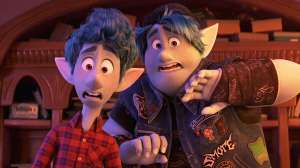 There are some issues with the movie, nothing major, but enough to make it feel under developed, especially in comparison to the Pixar movies of past. The imagination is there, however, the world-building of this fantasy world is decidedly lacking. There are some cute asides like unicorns as the equivalent of trash-eating raccoons, but as a whole the fantasy world feels underdeveloped to its full potential. There’s a significant story point where the current world has forgotten its magic roots thanks to the ease of technology and its inoculating effects, which seems like a pretty straightforward message for our own lazy world. Again, though, Onward doesn’t dig deeper into this theme or what it could mean for the larger mythology of its own world and its history and the rules governing its magical creatures. I started to wonder whether Pixar could just have set this story anywhere.
Likewise, the supporting characters don’t amount to much and feel like leftovers from earlier drafts where they had richer involvement. The ongoing subplot with their mother (Julia Louis-Dreyfus) teaming up with the fabled beast-turned small business owner Manticore (Octavia Spencer) offered little other than occasional exposition. The Manticore is supposed to best represent how the new world has traded its culture and history for comforts and safety, but it’s not clearly realized and integrated. My pal Ben Bailey reflected that the Manticore seemed like a one-scene character that the filmmakers didn’t want to drop, and so she was stretched through the rest of the film to diminished returns. The last act has a sudden and arbitrary monster to defeat that feels like the kind of thing expected in these sorts of movies, which is a rarity for Pixar and thus a slight disappointment.
Lastly, much of the humor just doesn’t work. The jokes can be stale, safe, or one-note, like a team of very tiny pixie bikers. It’s often silly without exactly being clever. There’s more fleeting visual humor with the incongruous nature of fantasy in a modern setting. There’s less slapstick than you would think considering one of the main characters lacks a torso. I chuckled a few times but, much like the fantasy setting, felt the humor was kept at an superficial level of thought.
Onward isn’t top-tier Pixar but it’s a solid mid-tier entry, an enjoyable adventure with a resonant emotional core that makes me forgive many of the film’s other aspects that don’t quite work. The brothers are the best part, their interactions are the most interesting, and their heartfelt journey and hopeful desire for closure is what ultimately left me emotionally satisfied. The jokes and world and supporting characters don’t feel as developed, but it hits with its core relationship and its emotional center, so Onward works where it counts the most with its storytelling. Mid-tier Pixar is much like mid-tier pizza — still satisfying and better than a lot of other options.
Nate’s Grade: B+
Share this:

The Invisible Man (2020)
 Does everyone remember the Dark Universe, the attempted relaunch of classic Universal monsters that were going to be played by the likes of Javier Bardem, Angelina Jolie, and Johnny Depp? It’s okay if you do not, though the stars got paid regardless. It was all going to be kicked off with Tom Cruise in 2017’s The Mummy, and one under-performing movie later the entire cinematic universe was discarded by spooked studio bosses. But IP will only stay dormant for so long, and so we have a new attempt to relaunch the same horror figures that first terrified audiences almost 90 years ago. Writer/director Leigh Whannell has a long career in genre filmmaking, having started the Saw and Insidious franchises with James Wan, but it was 2018’s bloody action indie Upgrade that really showed what he could do as a director. He was tapped by powerhouse studio Blumhouse to breathe life into those dusty old monsters, going the route of lower budget genre horror rather than blockbuster action spectacles. The Invisible Man is an immediately gripping movie, excellent in its craft, and proof Whannell should be given the remaining monsters to shepherd.
Cecilia (Elisabeth Moss) has recently run away from her long-time abusive boyfriend, Adrian (House on Haunted Hill’s Oliver Jackson-Cohen). Just as she’s taking comfort in friends and her sister, Adrian takes his own life and lists Cecilia as the sole beneficiary, but there’s a catch. She must undergo a psych evaluation and be cleared. Cecilia is ready to move on with her life and start over but she can’t shake the feeling that Adrian might not be dead after all and is still watching her.
 Whannell has grown as a genre filmmaker and has delivered a scary movie that is confident, crafty, and jarringly effective. From the intense opening sequence, I was generally riveted from start to finish. The shots that Whannell chooses to communicate geography and distance so effectively allow the audience to simmer in the tension of the moment. Whannell’s visual compositions are clean and smart. Another sign how well he builds an atmosphere of unease is that I began to dread the empty space in the camera frame. Could there be an invisible man hiding somewhere? Could some small visual movement tip off the presence of the attacker? Much like A Quiet Place taught an audience to fear the faintest of noise, The Invisible Man teaches its audience to fear open space. It places the viewer in the same anxious, paranoid headspace as Cecilia. It’s also a very economical decision for a horror filmmaker, training your audience to fear what they don’t see. And there is a lot more in a movie that is not seen. The suspense set pieces are so well drawn and varied yet they all follow that old school horror model of establishing the setting, the rules, and just winding things up and letting them go, squeezing the moment for maximum anxiety. It’s reminiscent of the finer points of another old school horror homage, The Conjuring franchise. At its most elemental, horror is the dread of what will happen next to characters we care about, and The Invisible Man succeeds wildly by placing an engaging character in shrewdly designed traps.
I jumped even during its jump scares and that happens so rarely for me. The jump scares don’t feel cheap either, which is even more impressive. They’re clever little visual bursts of sudden spooks, and they feel just as well developed as the other scary set pieces, complimenting the nervous tension and compounding it rather than detracting. There is one moment that happens so fast, that is so unexpected, that I was literally blinking for several seconds trying to determine if what I was watching was actually transpiring. It was so shocking that I was trying to keep up, and yet, like the other decisions, it didn’t feel cheap. I’m convinced this one “ohmygod” buzz-worthy moment will go down in modern horror history, being discussed in the same vein as the speeding bus in the first Final Destination film. I have this level of praise even for the jump scares.
 The movie doesn’t soft-pedal the abuse that Cecilia endures, nor does it exploit her pain and suffering for tacky thrills. This is a socially relevant reinterpretation of the source material. The movie examines toxic masculinity and gaslighting but with a supernatural sci-fi spin, but it never loses the grounding in the relatable plight of its protagonist. Cecilia is a character that has suffered trauma that she cannot fully even process, so that even when she’s on her own, she’s still discovering the depth of how exactly this very bad man has reshaped her perception and fears. We don’t need to see Adrian explicitly abuse Cecilia to understand the impact of his toxic relationship. Within minutes, Whannell has already told us enough with how terrified and cautious she is when making her late-night escape from the bed of her sleeping monster. Her all-consuming fear is enough to fill us in. This is a woman who is taking a big risk because she feels her life depends upon it. Later, nobody believes her fantastic claims about her ex still haunting her and posing a threat, convincing her it’s all in her head, and some of them questioning whether the abuse was made up as well. The correlations with domestic violence and gaslighting are obvious, yes, but this dramatic territory is given knowing sympathy and consideration from Whannell. It’s not something tacked on simply to feel bad for our heroine, or to feel relevant with headlines of monstrous man accounting for years of monstrous actions preying upon women. It’s a complete reinvention of a classic to suit our times as well as taking advantage of what that classic source offers. This is how you can adapt stories we’ve seen dozens of times to feel fresh.
Much of the film rests upon Moss (The Handmaid’s Tale) and she is truly fantastic. We’re living in an exciting new era where horror movies have reclaimed their social relevance, and they are providing talented actresses to unleash Oscar-caliber performances (Florence Pugh in Midsommar, Lupita Nyong’o in Us, Toni Collette in Hereditary, Ana Taylor-Joy in The Witch). The role requires Moss to demonstrate much through a series of emotional breakdowns. It’s not just getting glassy-eyed and looking scared. Cecilia is a survivor struggling to regain her security while also being heard, and her breaking points of sanity and desperation cannot be one-note. Moss is no stranger to enduring the indignity of condescending men from her TV roles, and she was beautifully unhinged in a memorable moment from Us. She’s the perfect actress to take Whannell’s character and give credence to her vulnerability, uncertainty, and inner strength.
 The movie isn’t perfect but it accomplishes a clear majority of its artistic aims with confidence and style. It’s too long at over two hours. I’m glad Whannell doesn’t waste too much time whether or not Cecilia believes her bad man has gone invisible. The supporting characters are a bit underwritten and utilized primarily as Sympathetic Figures Turning to Concerned Figures and then as Potential Targets. This extends to the relationship between Adrian and his brother (Michael Dorman). There has to be more that could have been explored there, especially as it relates to Cecilia. The musical score is heavy on loud, ominous tones and rumbling interference. The special effects are sparingly used, and the invisible suit was initially a design that made me shake my head. In practice, it actually looks pretty interesting and threatening. There is one misstep that feels glaring. Before the end of the movie, there have been a few “hey what about… ?” instances, but they were easy to put out of mind. Whannell drops one major announcement late in the movie but seems to gloss over the extra leverage it provides Cecilia, and her inability to capitalize on this turn of events seems odd considering her antipathy for her attacker as well as the weakness that she can exploit.
As I walked out of my screening for The Invisible Man, I kept reviewing just how many different moments, elements, sequences, and choices added up to a thoroughly suspenseful, satisfying, and entertaining trip at the movies. Whannell has a natural feel for genre horror as well as how to treat it in an elevated manner where it can say real things about real issues while also doing a real good job of making you really anxious. Intense from the first moment onward, this is a streamlined, finely honed horror movie for our modern age. Even the jump scares work! This is already turning into a promising year for indie horror, and The Invisible Man is the first great film of the new year and the new decade.
Nate’s Grade: A-
Share this:

The Lodge (2020)
 The Lodge is a patient, methodical, and unsettling horror movie that establishes an eerie atmosphere, pushes the viewer to question what is going on, and then, upon finally revealing its last secret, sits back and lets the real horror play out to sickening effect. This is from the same writing/directing team behind 2014’s Goodnight Mommy, and you’ll start to wonder whether or not Severin Fiala and Veronika Franz really dislike children. The movie had me on edge early with a sudden jolt of violence, and I felt uneasy from there to the bleak ending. It’s about a father (Richard Armitage) taking his two children for a holiday retreat with his new girlfriend, Grace (Riley Keough), the person the kids blame for breaking up their parents’ marriage. She wants to get to know them and bond but the kids are having none of that. To make matters worse, the kids discover that Grace is the lone survivor of a religious suicide cult. Once at the family lodge in the snowy woods, strange events and messages torment Grace and the kids until they question where they are, what may have happened to them, and if there is an escape. The first act is the family in the wake of trauma and the children viewing Grace as the interloper worthy of their scorn. The second act becomes an existential horror movie that questions whether there has been a shift into the supernatural or divine. The last act reveals what’s really been going on and it’s the consequences of bad choices. The ending trajectory feels fated from the earlier setups, so when everything is falling apart, the danger feels incredibly real. I was so anxious during the ending sequences that I was holding my breath and covering my face. I didn’t know how far this movie would go, and while it pulls back at the very end, the implications are clear even if they aren’t explicit onscreen. Keough (Logan Lucky) plays a character with real depth as a woman trying to reclaim her life from deep-seated trauma, and when events spin out of control, that trauma resurfaces and starts to take over her thinking, placing her on autopilot, which then pushes the film into the realm of tragedy. She’s fabulous and impressively restrained as her character mines layers of self-doubt, bone-deep teachings, and shock. The atmosphere of the film is very fitting for the setting, chilly and isolated and dread-filled. The camera movements are often very deliberate to draw out tension and uncertainty. It all comes together for a very creepy little movie that gets under your skin. The Lodge is not going to be an audience-friendly outing due to its pacing and ending, but consider it an A24 horror film that somehow got away under a different studio.
Nate’s Grade: B+
Share this:

Sonic the Hedgehog (2020)
 When the first footage of a live-action Sonic was unleashed, it became the Internet’s new nightmare, until the Cats trailer was released. The strange, unsettling design made the classic Sega speedster just creepy to behold, and you could count his baby teeth in his human mouth. The producers did something unheard of in response to the onslaught of negative criticism — they listened. They redesigned the character to be more akin to a familiar 3D model from the games and delayed the movie several months in order to accommodate the special effects time crunch. The new and improved Sonic the Hedgehog movie benefits immensely from this redesign, though I routinely kept imagining what the original nightmare-inducing design would look like at different points in the film (a side-by-side DVD special feature, eh?). This is a kids movie very much geared toward that audience but I was mostly charmed by the inclusion of Sonic (voiced by Ben Schwartz) into our world. He’s paired with a straight-laced small-town cop (James Marsden) and given a road trip to retrieve his portal-creating magic rings. Jim Carrey plays Dr. Robotnik, a mad scientist hired by the U.S. military to find and capture the alien responsible for the mysterious power surges. Carrey’s unrestrained, intense physical performance is a nostalgic delight for 90s kids who grew up on his rubber-faced silliness, and he often made me laugh through sheer force of personality alone. However, I appreciated that the screenplay actually shows effort. There are sly, unexpected jokes that didn’t have to be there and yet the filmmakers didn’t rest on their laurels. I enjoyed the buddy dynamic between Sonic and Marsden and the more mawkish moments didn’t make me gag. It’s not anything groundbreaking or operating on higher levels of sophistication like Pixar, but it’s a generally enjoyable and brisk experience that’s colorful, fun, and accessible to Sonic fans and non-fans alike. Perhaps this will signal a new age where studios are more beholden to the demands of a noisy fanbase, and perhaps that’s not exactly the best thing moving forward for art. But it worked in this instance. The fans won.
Nate’s Grade: B-
Share this:

The Street Where We Live (2019)
 I was fortunate enough to actually hear co-writer/director John Whitney and co-writer/star Dino Tripodis discuss their hardscrabble indie drama, The Street Where We Live. It’s an Ohio indie that was filmed over the course of several weekends from the fall of 2015 to the summer of 2016, had its festival run throughout 2017-2018, and became available for the general public to watch via Amazon Prime in 2019. I was lucky to hear both men talk about their experiences making this movie on a small budget under a constrained time frame, as well as their hopes for it, paying homage in particular to the hard-working mothers that both men credit for their upbringing.
We follow Mary (Kristina Kopf), a recently unemployed factory worker, struggling to stop her family’s descent into greater financial ruin. Her children, Jamie (Katie Stottlemire) and Thomas (Dylan Koski), are trying to hide the shame of their living conditions, though it’s getting harder. Things go from bad to worse as this family tries to regain their stability.
 The film does a very good job of communicating the vulnerability and struggle of poverty as well as how susceptible a majority of people living on the fringes are. As has been said, many Americans are simply two paychecks away from disaster; in a survey, a majority of Americans would be unable to pay for a sudden expense of $400, meaning most Americans lack even that amount when it comes to personal savings. That day-to-day anxiety of simply getting by, of persevering and not prospering, is best expressed by the layers of sad, quiet resignation that hang on lead actress Kopf’s face. Hers is a performance steeped in quiet suffering (more on that later) and her fight for dignity and opportunity. This isn’t a very dialogue-driven movie and instead is more like one long sigh slowly eliminating all breath. One calamity leads to another in a succession of setbacks, and it’s clear to understand just how difficult it is to reset your life when that chasm seems more insurmountable by the day. You don’t have enough money to pay electricity leads to not enough money to pay for rent, leads to living in your car and washing in the bathrooms of gas stations, leads to having your car towed, leads to an impound that expects even more money if it cannot be immediately paid, and all the while that deficit grows and grows. The Street Where We Live is at its best when it’s opening up about the slippery slope of poverty and how it’s not some choice, not the result of trenchant laziness, but just bad timing, bad luck, and limited opportunities. In that way, the film works extremely well as an empathy project to convey the toll of poverty on the human condition and one’s hope.
Much like the mumblecore sub-genre of indie dramas, the observational little details and natural give-and-take are what help give the movie its sense of authenticity. This feels like a world where Whitney and his crew are well versed and can supply exacting insights. There are a few devastating moments in the movie, one of them being how out-of-touch a person can feel in a quickly changing marketplace. Mary has held her factory job for years and is applying for, what she has been told, is a simple secretarial position in an office, something she feels she can at least keep up with even if her typing skills are mediocre. Instead, she’s pummeled with questions of technical insurance jargon, and each one further shatter the idea that a “simple secretarial” job is within reach for Mary. Her sinking realization that this job is closed to her is such a hard moment to watch and Kopf, once again, plays it tragically and beautifully. It’s a small sucker punch of a moment, and from here she’s fighting even to get underpaid dish washing gigs. There are some aspects that are stretched a bit in order to maintain the family’s tragic desperation (one would think Mary wouldn’t have to venture all the way out of the state to contend for a paying job). It’s excusable because we’re meant to feel the crushing uncertainty of a character struggling with what is the best of her limited bad options. The only aspect of The Street Where We Live that didn’t feel realistic was the seconds before the factory workforce was about to find out their jobs were all gone, because I have to think everyone was suspecting the worst and wouldn’t be so amped for noisy chit-chat prior to the news.
The acting is another component that helps compliment the movie’s valued sense of reality. The Street Where We Live and its success hinges on two fulcrums: 1) its everyday realism, and 2) Kopf. The characters feel very recognizable and the performances rely on subtlety more than histrionics. More is gained by watching the pained expressions of ordinary people than listening to a character explode in a well-polished monologue about the hardships of living in poverty. There are a few emotional outbursts but they’re saved for the end, and even these moments are crafted to better maintain that well-earned sense of cinema verité.
 Much of the film’s impact is reliant upon Kopf (Constraint, Axe Giant) and the micro-expressions that cross her face. Hers is a role about suffering in silence, her weathered gaze its own shattering scream, and you study her to see how she’s coping with each new added indignity. A terrific moment is when Mary is trying to square a very personal, moral-crossing decision she made for the greater good of her family only to have a cruel man use his small amount of power to further wound. You feel how powerless this woman is and while you want her to punch the creep, there will be no release. You want the “movie moment” where she can upstage her tormentor but it won’t happen. Kopf has long been a staple of Ohio indies and there’s a very good reason why. Tripodis (Bottom Feeders) has an immediate well-worn charm that’s heartwarming. One of the best scenes in the movie is his character Ben and Mary sharing a small moment of compassion after hours of hunting for recyclables to turn in for meager money. This moment is so naturally written, with their interplay feeling relaxed, natural, and organic, that I instantly wanted more. Stottlemire (Tragedy Girls, My Friend Dahmer) has begun to branch out into bigger movies and her burgeoning talent is clear to witness. She follows Kopf’s lead and works in underplayed tones to great effect. Koski gets the least to do as Thomas, like him strumming his father’s guitar is all that is needed to communicate his longing to connect to his past. There are also small roles and cameos from other central Ohio indie faces like Ralph Scott (After), Daniel Alan Kiely (Bong of the Living Dead), Heather Caldwell (After), and Richard Napoli (After), and several others.
If there is one thing holding back the film from achieving a greater level of success and viewer engagement, it’s that the characters are defined entirely by their ongoing suffering. I call it the Lars von Trier School of Storytelling (not that it’s only associated to the Danish sadist) where you establish a character that takes the slings and arrows of their society, but this props up a protagonist as more of a symbol/metaphor/martyr than a human being. This approach can still work when given a major theme that is complex enough to take on the extra brunt of attention. However, this approach can also make the protagonist feel less active, more reactionary, and also less complex. If you were deconstructing Mary as a character, I know very little about her as a person. I know she had a job for many years. I know she lost her husband. I know she doesn’t feel comfortable asking others for help. I know she’s willing to make sacrifices for her children. Internally, I don’t know much about her, nor do I know much about her personality, interests, flaws, quirks, the things that make people more fleshed out, nuanced, and appealing. Mary certainly serves a purpose and she voices this in the film’s very last scene as Whitney unleashes his thesis statement about how our society should be better with its inherent social promises. For some, this will be a minor quibble and for others it will be, in essence, a cap for their empathy levels.
 The Street Where We Live is an affecting and honest little movie about the everyday hardships many people face when their lives are suddenly in free fall. It’s a potent drama packed with small, telling details that better create a world that feels lived-in, compassionate, and authentic. The acting is mostly sharp and anchored by a standout performance from Kristina Kopf. The technical details are pretty solid overall for a movie made for less than $13,000 and under the start-stop circumstances that the filmmakers had available. The cinematography and editing can feel like there wasn’t much in the way of additional options, but the look of the movie, muted greys and rusty browns, adds to the overall dreary tone. It’s a sparse film in execution but that’s because it doesn’t need bells and whistles and fancy camera setups to make its story felt. It’s a deeply empathetic movie that could open some hearts about the struggles of others. It’s so easy to fall down and much harder to get back up without a support system. The movie might be hitting repeated points without enhanced characterization but it still hits its marks. The Street Where We Live is the kind of movie where its small budget can actually be a plus, not just in forcing creative ingenuity from the filmmakers but also in lending a blue-collar validity. It’s a story that resonates because of its universal themes and lessons in empathy, and it’s worth watching to see what a group of well-meaning artists can do when inspired to do good.
Nate’s Grade: B


 nathanzoebl
You must be logged in to post a comment.