Category Archives: 2019 Movies
Cadia: The World Within (2019)
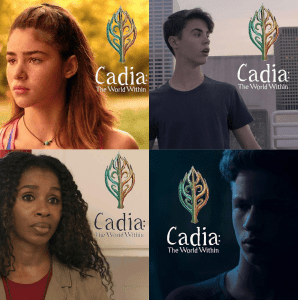
 Cadia: The World Within (pronounced Kuh-Dee-uh) is a fantasy film that was made in my hometown of Columbus, Ohio and directed by an alumnus of my own college. 24-year-old Cedric Gegel (The Coroner’s Assistant) wrote and directed Cadia, which was inspired by a story he was making up to entertain 12-year-old triplets backstage during a theater show. He spent years revising and elaborating that tale and elected to make it a big screen adventure, and starring those same triplets in starring roles. He even attracted known actors like Corbin Bernson and one of the two Harry Potter twins. I attended the special Capital University screening before Cadia begins hitting festivals and seeking distribution. As I have in the past, I happen to know several people that were involved in this production, primarily behind the camera, and I promise to try and be as objective as possible in this review.
Three teenagers are dealing with the recent loss of their mother. Renee (Carly Sells), David (Keegan Sells), and Matthew (Tanner Sells) are now living with their Aunt Alice (Nicky Buggs) and their Grandpa George (Bernson). One day, a magic set of stones takes the kids to another world, Cadia, where they meet Elza (John Wells) shortly after escaping a monster. They learn there are dueling factions in this realm, and Tannion (James Phelps) wants one of the siblings to tap into an elemental power supply to rewrite the cosmos for the better.
 I’m going to caution that this review will likely sound more negative than I intend. I want to be supportive of local filmmakers and encourage their efforts, and any movie by itself is something of a miracle considering the countless people who work in tandem to bring together a vision. The people behind Cadia seem like genuinely sweet and thoughtful individuals who cared about the movie they were making. I wish them all well. However, it does nobody good to avoid constructive criticism where it’s warranted, because ignoring problems is unhelpful. The characters of Cadia might even agree with that sentiment. So, dear reader, let’s dive into what doesn’t quite work here and keeps Cadia from being more than the sum total of its many influences and good intentions. Much of the faults chiefly come down to the writing.
Fantasy stories are tricky because they need to be transporting but also accessible, otherwise they will feel like they’re being made up on the spot or like a private story that wasn’t intended for a wider audience (Lady in the Water, anyone?). With Cadia, the influences are easy to pick up on (Narnia, Harry Potter, Peter Pan, the Bible) but the rules and understanding of this new world feel too murky and unclear. It’s a magic world with… warring factions that are at war because… power? I never understood who just about anyone was and what their purpose served beyond allegiances. It’s too vague and the world feels too small and undeveloped, making it feel less a new world and more like a weekend excursion. What is the relationship between this family and the history of Cadia exactly as it comes to Grandpa George? Did this world come into existence with George telling the story and thus linking it to this particular family and giving them larger importance, or did it exist on its own? Why do some people have powers and what are the extents of those powers, the limitations, the costs of those powers? Is dead mom alive in this world or simply a ghost? Are there more potential ghosts? What started the factions? There are teleporting stones but are they direct portals or can they be manipulated? It feels like this should be of greater importance just from a novelty of how they can be clever (and cheap to execute). There’s one malevolent monster witnessed but otherwise it’s just a bunch of people hanging out in the woods. Too many of the too many characters are just sitting around, seemingly like they’re waiting for something to do. Cadia operates on a level that assumes you know what is happening or find this new world intriguing, but as a viewer it feels like you’re missing vital critical info to make that happen.
Fantasy world building is essential because the new world has to be teeming with interesting life and details, the stuff a viewer could immerse themselves within. Barring that, the fantasy details can be shaped and pruned to serve the thematic journey of a character, externalizing the internal. I thought Cadia was going here. It kind of does and kind of doesn’t. The central trio are dealing with their grief over their late mother, except when the movie doesn’t need them to. I thought the world of Cadia would present itself as symbol for the grief and anger of a character, luring him or her as temptation to reverse course and save dear dead mom, and therefore we would learn a lesson about healing and about facing loss. This element is present, yes, but “element” is the proper term; it’s not a theme or anything larger in plotting, it’s merely there as needed like any other sudden magic power that goes without explanation or question. Overall, the fantasy world just felt under developed in detail and scope.
 I was hoping for the thematic personalization because there’s a general lack of urgency when it comes to any looming sense of danger. For being transported to a new world, these kids take it all in amazing stride. Even after a long-clawed monster chases after them, the kids are so casual and nonplussed the next scene even as they have just barely eluded this monster. Nobody seems in a hurry to return home. We’re constantly told of warring factions but the only outward danger felt is from this one monster, and even when the kids are close their fear seems fleeting. The characters they encounter don’t present (immediate) danger, which makes the film feel rather loping and without conflict and danger. It’s lacking potent stakes. What’s stopping these kids from returning? What’s stopping anyone from anything? The world of Cadia is too plain and safe, which coupled with its undeveloped nature, only makes things less interesting. If the world doesn’t present interest, it can at least present a palpable threat, and Cadia does not.
Another miscue that hampers the stakes is that the film keeps cutting back and forth between the kids in Cadia and the adults on Earth. Why? Do we really need to see Aunt Alice having coffee with her friend while the kids are lost in a new realm? Do we really need two check-ins with Grandpa George to literally watch him put together a puzzle? Cutting away from the discovery of the magic world to watch characters do mundane things back home is detrimental to pacing and establishing a growing threat. Can it be much of a threat if the kids seem chill and we cut back to puzzle formation? Without a threat, without an interesting setting, and without a personalization toward one of the main characters, Cadia feels like a less-than-magical retreat.
The characters also suffer from both being underwritten and simply having far too many of them. The main trio of real-life triplets are left as archetypes; there’s the more introverted one (The Nerd), the more rebellious, aggressive one (The Jock), and the… girl (The Girl). Seriously, that’s her characterization. The other brothers get starting points on a scale to grow from but her characterization is simply not being the things her brothers are, and also being a girl. It’s not like the characters are running away from confronting the hard truth of death and Cadia will allow them to better process their grief, like A Monster Calls and I Kill Giants. Other characters talk more about their mother than the actual children of that mother mourning that mother. It’s difficult for me to go much further in describing the characters because once they travel to the fantasy realm their characterization gets put on hold as they encounter a slew of dull new people.
 There are several scenes where we introduce a group of new, personality-free characters. That’s the other necessity with fantasy, writing larger, expressive, and memorable characters. There’s a Lost Boys-esque group of centuries-old Cadia dwellers, but this group could have been one person, could have been twelve, because there aren’t differentiated characters within, only actors fulfilling space in the frame. This isn’t the fault of the actors. They just weren’t given material to work with. A way to establish a memorable character is through a memorable entrance or at least with significant contrasts. Cadia has trouble with this even as it presents characters on opposite sides of its vague conflict that is eventually resolved through platitudes about love that could have been reached at any time prior to the characters’ fortuitous arrivals. The narrative feels polluted with extraneous characters that exist for no other reason than to squeeze another actor onscreen. Characters should have a purpose for their inclusion and the narrative shouldn’t be more or less the same without their involvement. With Cadia, you could eliminate 80% of the characters and still tell this story. Do we need a lady in the river? Do we need two untrustworthy schemers to tempt the kids? Is the cousin needed? When the big fight arrives, with side-versus-side, your guess is as good as mine who they are, why they are important, and what they’re even doing here.
The dialogue is also heavily expository, where characters are tasked with asking questions or making statements so that the audience will know critical points of information. Characters talk in inauthentic manners, the kind of stuff that seems like they know an audience is watching. “I know you’re having a hard time dealing with mom’s death,” sort of thing. Or you’ll have characters talk so point-of-fact, like this exchange: “Who’s good and bad?” and then, “Well that depends on who ‘you’ is. Good and bad depends.” It’s pretty on-the-nose, but even ignoring that, the two sentences in response are redundant, conveying the same idea. Naturally exposition is going to be needed when establishing an alternate, living world, but when it feels like characters are going from person to person to only digest info because the plot demands it, then it feels less like a film narrative and more of a museum display guiding you to the next exhibit.
The acting is a high-point for the movie. The triplets all handle their first big screen acting job reasonably well and demonstrate future promise. My favorite was probably Carly Sells as Renee, which is even more impressive considering she has the least amount of material to work with of the three. She has a particular sense of poise that lends to better imbuing life to her character. Keegan Sells is at his best in the beginning as he’s internalizing his grief and frustrations. Tanner Sells has a nonchalance to much of the world, which can be funny. Bernson is a lovable grump that doesn’t feel too off from his father figure in TV’s Psych. He doesn’t have much to do in the film but he’s a welcome presence who feels glad to be there. Phelps (Harry Potter) and Wells (Piranha Sharks) do a fine job as the resident schemers, concealing their intentions. Brittany Picard (Alan and the Fullness of Time) had a nice ethereal charm even in brief moments as the departed mother Maggie. Why wasn’t she in more? If mom is potentially alive, or at least corporeal in Cadia, why isn’t that a narrative resource to be tapped for further drama especially as it pertains to acknowledging loss? I was most impressed by Buggs (Powers) who was the one immediately processing the emotions of grief. She sells her scenes with subtlety and grace. Another pleasant standout was Grace Kelly (Kill Mamba Kill!) as Jade, the school guidance counselor. She has a presence that grabs you, and the fact that she’s a Marine athlete makes me yearn for her to have a starring action vehicle that can show off a full range of her capabilities. She’s a breakout star waiting to happen, so somebody make it happen.
 The technical merits are pretty agreeable for being a low-budget feature, but there are a couple aspects that I think take away from the overall achievement. The cinematography is very limited in how it presents the scenes, which follows the pattern of master and then shot-reverse shot. There are very long running takes with a swooping Steadicam that centers the action. It can be impressive at points but at other points, as the scene carries on without variation, I began to wonder if this was continuing because, frankly, that was all they had to work with. The editing can also be curious with certain choices. There’s a scene where Aunt Alice runs out of the coffee shop, having learned of the children’s disappearance. Instead of the scene ending there, the moment holds for another four or five seconds on Jade’s reaction, which is fine considering later revelations. But even after that we hold on the scene and a waitress comes to ask about taking away the coffee cups, and Jade says, “Yes, you can take them.” Why was any of that necessary? The scene just carries on awkwardly after its import has literally left the building. During the family dinner, the camera circles around the table for a full minute while they gab and reach for the food. Did we need a full minute of them vamping while eating? Is this included simply because they wanted to maximize the amount of Bernson screen time they could? The costumes are pretty standard fantasy garb except when they’re not. During the big showdown, there are characters dressed in flowing robes and tunics, and then there are others just in ordinary clothes. There’s one woman in like a polka-dot skirt and it just directly draws your eye. This incongruity almost made me chuckle, and then polka-dot skirt lady is given prominence in the fight too. It’s unfair to be too critical on any technical limitations of a low-budget film as long as they don’t impede the vision and intent of the filmmakers, but these decisions occasionally took me out of the movie.
I honestly feel conflicted about writing this review because I knew it was going to have some significant criticisms. It’s genuinely impressive that a film like Cadia: The World Within got made, attracted known actors, and pulled it all off on a low budget with many artists who were eager to sink their teeth into a bigger project. I definitely think there is an audience for Cadia and that there will be plenty of people that genuinely enjoy the movie on its own terms. Afterwards, at the screening, one such fan asked about the possibility of a sequel (Gegel respectfully demurred). For me, the fantasy world felt diminished, opaque, and too often as ordinary as the “normal world.” The characters are kept at an archetypal level, or are superfluous additions, and the plot seems to lack urgency, propulsion, or needed steps to tap into larger emotions and themes or intrigue. It felt like watching a bunch of people having fun with make believe and putting on a show, and they just happened to have larger names involved in the fun. Cadia is a family fantasy that might play well for its intended audience but unfortunately is a fantasy that feels less than magical.
Nate’s Grade: C
Share this:

Stuber (2019)
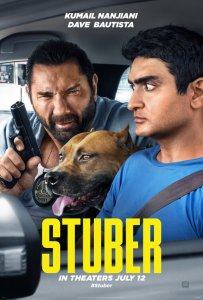 The problem with the alchemy of action comedies is that once the action starts too often they forget to be comedies. Stuber (a portmanteau of our title character and “Uber”) follows the exploits of Stu (Kumail Nanjiani) as a passive, awkward, insecure retail employee and Uber driver and his newest fare, Vic (Dave Bautista), an aggressive police officer who just had Lasik eye surgery. The opposites-attract setup is a comedy staple and Nanjiani (The Big Sick) and Bautista (Guardians of the Galaxy) are well chosen for their roles. The problem with the movie is that only one of them gets to do or say anything funny. Nanjiani is entrusted with all the film’s humor, relegated to his riffing while under duress or sardonic detachment. I laughed here and there but Stuber is missing inspired set pieces and larger payoffs. Too many of the jokes seem obvious or lazy. There’s one genuine gut-busting gag involving a can of propane in a high-speed chase, but this seems like the only application of tweaking action movie cliches. There are some disposable storylines about finding a mole in the police department, tracking down a Very Bad Guy (one of The Raid actors, curiously kept from doing martial arts after the opening segment), Stu telling his unrequited love how he feels, and Vic making it on time to appear to his adult daughter’s art gallery show. It doesn’t matter. What matters is the enjoyable oil-water chemistry between the two male leads. The majority of the jokes occur just from their frantic interactions, enough so that I wish the exterior storylines had been shaved away. The film’s tone is too uneven, and when in doubt it falls upon action beats over comedy beats, and some times the violence is just a bit too harsh for the material. It can kill the good vibes quickly. This is more Pineapple Express to me than 21 Jump Street, and while I don’t regret having watched Stuber, it’s a movie that is hardly deserving of a five-star rating. Three stars, at best.
Nate’s Grade: C+
Share this:

Escape Room (2019)
 If you’ve ever been looking for a PG-13 Saw movie, then Escape Room might just be the film for you. It follows a group of strangers who have been invited to a next-level escape room, one of those group challenges where people work as a team to solve a series of puzzles to “escape” from a locked room with a variety of dangers. The movie version kicks things up by making the Escape Room essentially Cube, filled with a series of elaborate death traps that pick off our characters outlandish room by outlandish room. The enjoyment of the movie is the curiosity of the rooms and the various challenges. The production design is inventive and impressive for its minor budget. The puzzles aren’t exactly things that an audience can solve in the moment. They mostly involve clues that won’t make sense because we can’t explore the room, so it’s just waiting for characters to solve things and make connections. The fun doesn’t come from the puzzles but more what the rooms will do next. The assorted characters have a personal connection that is flimsy and leads to a late reveal of who is responsible for this wicked game. The movie is fun as you’re watching it as long as you accept that little will make sense. Once it extends beyond the rooms and tries building a mythology and a conspiracy behind the rooms, that’s where Escape Room starts to fall apart. It’s a relatively minor but enjoyable thriller that lives in the moment and, in the future, should find more time to spend in the rooms and the crazy challenges. Much like The Maze Runner, once the characters are outside the maze, I just don’t care. It works enough that I wouldn’t mind more, if the filmmakers get their priorities right.
Nate’s Grade: B-
Share this:

Spider-Man: Far From Home (2019)
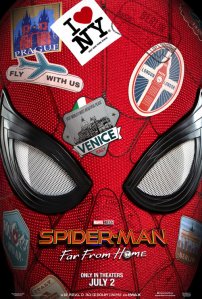 Spider-Man: Far From Home arrives as the tasty dessert to the epic five-course meal that was Avengers: Endgame. It picks up weeks after the events of the climactic chapter, starting right away with the consequences in a clever, albeit light manner. Peter Parker (Tom Holland) is excited to go on a class trip to Europe and has big plans to confess his true feelings to his crush, MJ (Zendaya). He’s pulled into hero work by a testy Nick Fury (Samuel L. Jackson) who needs Spider-Man to stop a group of inter-dimensional elemental monsters. Quentin Beck (Jake Gyllenhaal), dubbed “Mysterio” by the Italian media, is the last survivor of that other dimension and looking for assistance to thwart them and save this Earth. Peter tries to live a “normal life” and balance his superhero duties, but his secret life is increasingly intruding upon his actual life, especially as the world looks for the next superhero to step up in the absence of Tony Stark. Far From Home is an enjoyable road trip movie that feels like Junior Spy Hijinks for the first half. It’s funny but I definitely felt like the filmmakers weren’t fully engaged in telling that story, so I was left a tad disengaged. There’s a big reason for this and it’s a turn that comes halfway through, and from there out the movie is mostly great. The action sequences are directed with flair and even better visual acuity by returning director John Watts (Cop Car), there are some vivid nightmarish hallucinations that are glorious and disorientating. Gyllenhaal (Nightcralwer) becomes much more interesting in the second half and makes better use of the actor’s comic and dramatic range. It almost feels like some of the staid back-story from the first half is a satirical point of the second half, but you have to get through it all first. This bait-and-switch storytelling structure leads to certain pluses and minuses, and had it gone on much longer it would have more negatively affected the overall enjoyment factor. The first post-credit scene is definitely a game-changer in the world of Spider-Man and has a fantastic character debut that made me cheer and will be big especially for fans of the recent hit PS4 game. Far From Home doesn’t have the polish and brilliant structure of 2017’s Spider-Man: Homecoming but it’s a Spidey sequel that doesn’t lose track of the characters, presents an interesting villain as something we haven’t quite seen before, and has a good sense of humor while still being able to thrill and chill. The MCU is in a different world now after Endgame and with Holland and company leading the way, I could use more of this Spider-Man pronto.
Nate’s Grade: B
Share this:

Yesterday (2019)
 What if you were the only human who knew The Beatles ever existed? That’s the high-concept premise of Yesterday from director Danny Boyle (Slumdog Millionaire) and famed writer Richard Curtis (Love Actually, Notting Hill). We follow Jack Malik (Himesh Patel), and to say he is a struggling musician is an understatement. His best friend and manager Ellie (Lily James) is a constant source of encouragement and unrequited affection. He’s ready to quit when suddenly a world blackout results in him getting hit by a bus. He wakes up in a hospital badly bruised and apparently the world has never heard of The Beatles songs. Jack uses his unique knowledge and launches his musical career by passing on their material as his own. Suddenly he’s a superstar with a craven new manager (Kate McKinnon) and opening for Ed Sheeran. As he catapults to a new level of fame, he starts reconsidering his feelings for Ellie and fame in general.
Yesterday is a fantasy fitting of The Twilight Zone but cheerful and whimsical that it could fit well into the pantheon of Curtis’ other famous romantic comedies. It’s a relatable wishful scenario where you have the inside track to take advantage of pre-established works and zooming ahead to fame and fortune. It’s like a direct passage to the goal of creative acclaim. The movie is generally fun as it works on dramatic irony for laughs, as Jack introduces person after person to the songwriting of the Beatles. It’s a fun magic trick that doesn’t lose its charm. Even the musical score adopts several familiar melodies from The Beatles and Boyle highlights certain landmarks and their connections to the history of the tunes. I enjoyed Jack trying to remember the lyrics for “Eleanor Rigby” and coming up with various alternatives. There’s an amusing running joke about what else is missing from this parallel universe, including Coca-Cola and Harry Potter (there’s a great joke missed having Jack try and spectacularly fail to write Harry Potter). It’s a regular source of silliness and Boyle visually trains the film to automatically do a Google search for the missing item and what is found instead. There’s no rhyme or reason for what is missing; I doubt Curtis is trying to speculate that without Coke we wouldn’t have the Beatles and so on. The movie has an easy charm and affection that makes even its looser moments more agreeable. I was hoping for more moments of subversion, like when Jack is trying to play “Let It Be” for his parents for the first time and they keep absentmindedly interrupting. What if certain Beatles songs didn’t break through as popular today as they did in the 1960s? Does “I Want to Hold Your Hand” seem to quaint for modern listeners? There aren’t many surprises in store with Curtis’ script, which uses the fantasy gimmick as a vehicle to tell a pretty ordinary love story.
 The problem with the gimmick is that there really is no downside for Jack. He zooms to international stardom. There is a small idea that he feels like a fraud by getting famous from the creativity of others but this is barely toyed with. Here’s one instance that could have better highlighted that inner turmoil: while on tour with Ed Sheeran, the musician challenges Jack to an impromptu songwriting contest, to go off to their respective corners and in ten minutes come up with a brand-new song. As presented, Jack comes back and plays “The Long and Winding Road” and everyone is spellbound. He wins. The scene could have played out with Jack trying his own material on the piano, either a tune we saw him working on before his accident or something truly original from the moment, and he could watch the crowd looking indifferent. His panic would flash in and he would cave, resorting to a Beatles song to win them over again. That moment could have showcased his internal dilemma of feeling like a fraud but his need to impress and win easy adulation. There is real downside for his passing off the Beatles songs as his own (spoilers to follow for the paragraph). At the very end, on the world’s stage, he announces the truth and that he didn’t write one of his hit songs, instead giving credit to John, Paul, George, and Ringo. Except even after this declaration, he doesn’t suffer any consequences. He maintains his fame, fortune, happiness, and gets the girl. Surely the media would seek out these cited songwriters and they would not know what he was talking about at all. Then what? Apparently nothing, as the world must have just accepted Jack as possibly being mentally ill.
Since so much of the film hinges on the romance between Jack and Ellie, it makes the obstacles keeping them apart feel foolishly arbitrary and annoying. It feels like there should be no stopping these two crazy kids from getting together but the movie manufactures questionable reasons. Firstly, Ellie is practically throwing herself at her friend in every scene for the first half, obviously hinting at her desire to be seen as something more than a friend and manager. At one point she even point-blank asks him why he doesn’t seem to view her as a romantic option (it’s not like Jack is being mobbed by other women), and the man doesn’t even articulate a reason. He just stares dumbfounded at her, as if he too is realizing a plausible reason hasn’t been conveyed. He doesn’t say, “I never knew,” because of course he knows, and he doesn’t say, “I didn’t want it to ruin our friendship,” or anything else along those lines. There isn’t even a protest. Then when he is famous, he starts thinking about becoming romantically involved, and Ellie says she doesn’t know if she can manage his new lifestyle. He’ll be in L.A. and she’ll be in her English small town, and he must choose one life over the other. This is a false choice. He’s rich and famous. He can live wherever the hell he wants, including a small English town with her. This is even glimpsed during the end credit epilogue, meaning it was completely an available option. The reasons both of these characters reject one another are just unreasonable. Lily James is playing a charming woman and should not have this much trouble having a man want to be with her.
 Because of this forced and arbitrary conflict, keeping the lovers apart until finally letting them at each other, Yesterday is ultimately capped with its enjoyment level. It’s pretty much a gimmick that is meant to serve a more traditional rom-com, which Curtis knows how to do easily. Why then has he seemed to put so little effort in why these two should be kept apart? The yearning you need to feel in every rom-com feels one-sided and then switches over, making the chase feel like running in place for the sake of stretching out this conflict. It doesn’t make sense. There were realistic obstacles available with this premise, from Jack’s ego taking over thanks to everyone projecting the Beatles acclaim onto him, and he could just have become a shallower person that Ellie stops seeing as a desirable mate. That’s the easiest thing and Yesterday doesn’t even do that. Other women aren’t ever an option too. When Jack hits the big time, he isn’t fending off groupies and other industry sorts that want a piece of him. At no point does Ellie have any competition for his heart or any other part of him. They’re good together too, cute, and seem obvious that they should be together, so this foolish keep-away game feels grating.
Here’s a closing question: if the Beatles songs were released in a contemporary market, would they be the era-defying hits that they were? I’m somewhat doubtful. For an experiment, show Yesterday (or even 2007’s Across the Universe) to teenagers generally unaware about the Beatles catalogue. Do they instantly take notice? Do they ravishingly consume the songs and seek more? I’m sure some will; just because music is old doesn’t mean it can’t connect with a new, appreciative audience. However, would these songs be global hits instantly launching the songwriter to stardom? The Beatles are an indelible part of our culture and have influenced generations of artists. It’s hard to overstate their artistic influence but partly because of the time and place of that influence. Would Beethoven be as influential if he had gone unknown by history until the twenty-first century? Anyway, Yesterday is a cute but rather slight movie that reminds you about the power of music and the annoyance of contrivances withholding a happy ending until the final say-so.
Nate’s Grade: B-
Share this:

F*** You All: The Uwe Boll Story (2019)
 Notorious German director Uwe Boll hasn’t made a movie since 2016 and says he is done, retired, and not turning back to movies. What’s somebody like me, who has spilled thousands upon thousands of words on the man, to do? Why watch a feature documentary on the man and his unorthodox methods. F*** You All: The Uwe Boll Story is potentially the “last” Boll film, so it felt right to review it for my ongoing Boll retrospective and as a sendoff for a man I’ve chronicled for fourteen years.
The documentary also confirmed for me several speculative questions I’ve posed over the long course of my reviewing of his catalogue of hits and misses and misses. There is a reason he gets bigger name actors like Ben Kingsley and Jason Statham, or at least did for a while, and that’s because he doesn’t cast his movies until a few weeks before they are set to shoot. Then he asks for actors that are available his shooting dates and offers a check, and it’s sudden but it can work. Even he admits it’s a crazy process because the actors have no rehearsal time, you might not even get people right for the roles, but it’s only a problem if one cares about that sort of thing, and then he laughs knowingly. I’ve also suspected for some time that the screenplays for Boll movies are incomplete or heavily rewritten on the spot, and this is confirmed as well. Guinevere Turner is a fine writer, having worked on several Mary Harron movies including American Psycho, The Notorious Bettie Page, and the recently released Charlie Says. She is also the sole credited writer to Bloodrayne. To say this movie is below her standards is an understatement. As she details, only twenty percent resembles her original script. But, she notes, Boll paid in full. If you’re going to be relegated to schlock cinema, at least get paid for it. In general, Boll flashes disdain for what he feels are the excesses of filmmaking, wasted time to work on nuance or camera setups for dynamic shooting. The cast say they rarely get more than two takes even if they beg for more. Sometimes Boll won’t even be looking at the monitor as a scene plays out. His producer instincts dominate his writer/director instincts, and it becomes a product to mash out.

Perhaps the most insane example of this was in 2010 when Boll elected to shoot three films simultaneously. He got a budget for the third Bloodrayne movie, which was finally set during the time period of the video game, Nazi Germany. Boll says he secured financing by promising two movies for the price of one, shooting the specific parody Blubberella on the same sets, with the same actors, and following the same plot. Actress Lindsay Hollister was on set and scribbling joke ideas with the Bloodrayne 3 screenplay. When it came time to writing the script for Blubberella, she assumed an actual writer would be utilized. When she sat down for a read through, she was shocked to discover the Blubberrella “shooting script” was merely her copy of the Bloodrayne script with her notes in the margins. The Bloodrayne movie was the priority and had to look the best, so it got the majority of the time, and then according to Hollister they would get a take or two to film the Blubberella version and just go with it. It didn’t matter if the movie didn’t make sense. It only mattered that it was made (“I just have to get it to 77 minutes,” Boll candidly told Hollister). On top of this insane setup, several weeks into production Boll added a third film, live-action recreations for Auschwitz, detailing the horrors of the gas chambers. He had to keep track of three separate film productions simultaneously making use of the same schedules. It’s not a surprise that the films didn’t turn out well, but just imagine juggling tone, going from a cheesy genre movie, to a goofy satire of that cheesy genre movie, to a deadly serious Holocaust recount. That would make my head explode and I only watched all three movies.
As a documentary, F*** You All seems too conflicted with resurrecting Boll’s image. The real ammunition this story has are the crazy, juicy behind-the-scenes anecdotes that should spill from baffled actors. There are a few but this currency is too quickly depleted. Instead writer/director Sean Patrick Shaul (who worked on Boll’s 2013 film, Assault on Wall Street) is trying to break open the contradictions of Boll, the man who seems to love being a director but not actually directing, who seems to love making movies but doesn’t want to put that much effort into making them better. That’s fine territory but too often Shaul seems to mitigate the director’s own bad behavior as simply his interpersonal style. He provokes outrage and has no filter and thrives on making people uncomfortable, but he doesn’t know when to quit. There’s one gross moment where Boll is bullying and belittling actress Natassia Malthe (the replacement Rayne for the sequels) for not going naked in his movie. He presses her that she’s done nudity before and should be volunteering to expose herself again. He says the audience comes to his movies for “blood and boobs,” and Malthe concurs with him, recognizing what kind of movie she is starring in, but that doesn’t give him entitlement over her body. We’re repeatedly reminded by cast that they would work again with Boll in a heartbeat or genuinely enjoy him (Malthe is not interviewed) because he’s direct and gets things done, albeit not always the best of things. It feels a bit like trying to convince your skeptical pals that your drunk, obnoxious friend is really a good guy if you just got to know him. Boll is an interesting subject. I just wish the filmmaker had probed further to better examine those contradictions that make him who he is.

Boll lives for publicity stunts and perhaps none was bigger than when he challenged four of his critics to a public boxing match. It’s hard to think of any other situation where a much-derided filmmaker was literally challenging his critics to a physical fight and they miraculously took him up on it. Apparently, the critics thought it was going to be a silly joust and more a stunt. Oh no. Boll had been practicing for months, taking breaks on sets to get in a 5K run, and he’d been an amateur boxer for most of his life. He pummeled the out-of-shape film critics (Sam Peckinpah would be proud). Was he seeking vengeance against his tormentors or was it all a stunt? It’s hard to say. The legend of Uwe Boll and the actual man get blurry, as Boll would lean into his infamy as the “worst filmmaker ever” to gather further worldwide attention and further funding.
Boll has successfully transitioned into the restaurant industry, forming one of the most acclaimed dining establishments in all of Canada. He’s even stated how if a dish needs three days to be properly prepared, then that’s what it takes, which seems like the opposite of his approach to filmmaking. Perhaps that’s a sign that his passion has transferred from film to food and that his would-be retirement will keep. He talks about how the rise in streaming platforms has mitigated the DVD and home video markets, directly siphoning away the funds that he would take advantage of for his slate of movies. He says filmmaking is no longer a good investment and thus he cannot continue. This might be true specifically for Boll’s avenues for cash flow, but it sure hasn’t stopped the influx of genre and exploitation indies. Take a look at Kickstarter or any other crowdfunding site and they’re inundated with low-budget horror productions (I’ve supported a few myself). I do think Boll could find a market if he desired, even if his Kickstarter for Rampage 3 failed to meet its target. I also don’t think Boll will stick with his retirement. Much like Kevin Smith and Steven Soderbergh, other filmmakers who swore retirement, I think this period will be but a breath, a pause until Boll finds something that inspires him.

However, if this is his final stamp on the world of filmmaking, I feel like some summation is in order. I’ve been watching and reviewing this man’s movies for over fourteen years, specifically seeking out each new release to add to what amounts to a would-be Master’s thesis of criticism about one of the most reviled directors to ever work in Hollywood. Is Uwe Boll the worst filmmaker of all time? I can answer decisively…. no, he is not. For all the vitriol he provokes, some of his own doing, he has a competency that others cannot even hope to achieve, like Neil Breen or Mark Region (After Last Season might be the most painful movie I’ve seen). Boll definitely has his shortcomings as a writer and director, which his own cast and crew will agree, but I would love to have the man as a producer. He’s a born hustler and his ability to gather necessary resources and money is what kept him in business for decades. He could be a modern-day Roger Corman. If this is the end of Uwe Boll, Director, then it’s been a long, strange journey, and one that has given me reflection on my own relationship to filmmaking and film criticism. To quote, of all people, the band Fall Out Boy, thanks for the memories, Uwe, even if they weren’t so good.
See you again?
Nate’s Grade: C
Share this:

Midsommar (2019)
 I was not a fan of Hereditary. It had some admirable craft and a potent sense of dread, but it felt like it was being made up as it went and little came to much without exposition that was literally highlighted. I worried the same was about to transpire with writer/director Ari Aster’s newest indie horror darling with the critics, Midsommar. It has many of the same faults I found with the earlier Hereditary yet I walked away mostly pleased from his campy, weird, and disturbing follow-up. I’m still processing why I hold one over the other, so come along with me, dear reader, as I work through this conundrum.
Dani (Florence Pugh) and her boyfriend Christian (Jack Reynor) are hanging on in a relationship past its prime. Each is wondering whether to end it, and then tragedy strikes and Dani’s family is killed in one large suicide. She’s lost to her grief and Christian feels compelled to comfort her and guilty to leave. He invites her to a retreat he had been intending with his friends (Will Poulter, William Jackson Harper) to the idyllic home of a Swedish-born pal, Pelle (Vilhelm Blomgren). The group travels to the northern reaches of Sweden to attend the pagan mid-summer festival, an event that happens once every ninety years, but things are not what they appear and soon it may be too late to leave.
 From a technical perspective, Aster has some serious skills even if they don’t fully amount to much. His decision to film the majority of the film in bright sunlight provides a disarming contrast to most horror films that use darkness and our primal fear of it as the backdrop for their scary shenanigans. It produces a different landscape for the movie and the illusion of tranquility that will be shaken. The photography by Pawel Pogorzelski is often gorgeous in its framing and deliberate shot compositions. Aster’s command of technical craft and his ability with actors gives him such a great starting point with his projects. I just wish they amounted to more than the sum of their parts, and I’m not sure Midsommar is different.
It’s hard not to notice that Midsommar is decidedly less ambitious and more streamlined than Hereditary, and I think this has positives and negatives. First, it makes the film more condensed and accessible. It’s also a smart move to personalize the story through the experiences of Dani and her recovery from trauma. The plot presented is pretty predictable; you’ve seen enough other cult movies to know what should be ominous and what decisions will be regretted. I strongly suspect that Aster recognizes that his audience knows these things and that’s why the narrative isn’t built around what will happen next but more so how will Dani respond to what will happen next. There’s a deadly ritual at about the hour mark that just about everyone and their invalid grandmother will be able to see coming, though that doesn’t take away from the sick brutality of the moment and some stomach-churning prosthetics. However, even though I knew it was coming, the dread was more palpable for me because I knew it would trigger Dani, so I was lying in wait to observe her response and how it reopened her fresh emotional trauma. Midsommar is filled with these moments, where the audience may know what’s coming but not exactly how Dani will respond, and that personalization and emphasis on her perspective made the simplification work.
On the other end, Midsommar is very obvious with its very obvious influences. I’m hesitant to cite by name these influences because it gives away the game as far as where the plot is headed, but if you’ve seen the trailer then you likely already have a healthy guess. Again, it feels like Aster knows what his audience is anticipating because the homages are apparent. There’s literally a bear suit at one point and a homemade lottery system to determine participation. It’s all right there, in your face, and yet the movie doesn’t move beyond these unsubtle reference points. Midsommar ends exactly where you would expect it to end and without a more satisfying sense of resolution to tie things up. While it hinges on the choices made by Dani and her response to them, it doesn’t go into the consequences or implications of those choices, and leaves the audience hanging for more meaning never to materialize.
 Lord knows they could have carved some of that needed resolution from the overindulgent 140-minute running time. Much of Midsommar is methodically paced to build its unnerving and inquisitive atmosphere, to better immerse the audience in the peculiar rites and customs of this secluded cult. But a little goes a long way and after so many rituals it can become repetitious. There’s at least twenty minutes that could have been trimmed to makes this movie less meandering. The woman sitting behind me at my screening openly complained, during yet another ritual, “When is this going to be over?”
I was genuinely surprised to be laughing as often as I did, and that’s because Midsommar has a very intentional camp element at its disposal. The cult rituals and behaviors are meant to be creepy but also goofy as we view them from the perspective of the outsider. It’s the same perspective that informs the whole movie. We’re learning alongside the characters about what this hidden world is like, layer by layer, and there’s a sense of discovery that helps drive the film and kept my interest attained. These are pretty stupid characters because they should be turning around and running for home time and time again, and yet they stay behind. It becomes an unexpected dark comedy watching them ignore the many warning signs that are obvious to the audience. It’s dumbfounding that after everything these characters would still drink what they are served. Horror is rife with stupid characters being ignorant to obvious dangers, but this movie turns it into consistent humor. There are moments of pure weirdness that just forced me to laugh heartily, and it definitely feels like that is the intended response. How else should one respond when a nude woman interrupts sexual coitus to start singing in your face?
The characters aren’t exactly the Ugly American depictions we’ve come to expect in movies where we root for their demise in a foreign setting. Nobody matters except for Dani and Christian, and even he is more a foil for her. He’s not a bad person but he’s also not helping her. The movie is dominated by Dani and her emotional journey. There are many scenes of her breaking down and Pugh (the breakout from the underseen Lady Macbeth) is our emotional anchor. Her performance is more grounded than Toni Colette’s in Hereditary and a respite for the audience to come back to. The empathetic community of the pagan cult provides a comfort she is searching for. Pugh feels like a normal person struggling under trauma and relatable relationship woes.
 With two horror movies under his belt, Aster’s style and signatures as a filmmaker are coming more into focus. He emphasizes atmosphere and mystery at the expense of plot. His movies have creepy images and moments, and Midsommar definitely has its spooky share, but these moments can also feel rather arbitrary. Why does someone wear a bear suit and not a moose suit? It doesn’t matter because it’s just atmospheric ephemera that doesn’t tie into the plot. Why is there a “seer” with elephantitus who happens to be the byproduct of inbreeding? Because it looks weird, and never mind that that much inbreeding would take generations. The world building feels at the behest of the imagery and not the other way around. Also, you’ll know you’re watching an Ari Aster film if there’s older full-frontal nudity, an emphasis on mental illness, suicide, religious cults, and wailing women. I mean like loud, painfully prolonged caterwauling. There are even moments where the cult acts like a chorus to the cries, climaxes, and wailing of others, and it goes from being weird to being obnoxious rather quickly.
I predict Midsommar is going to be another hit with critics and self-styled horror elites and leave most general audiences bewildered and frustrated (Hereditary received a D+ rating from opening day audiences via CinemaScore). It’s hard for me to see a broad audience willingly hopping aboard Ari Aster’s wavelength, which seems engineered to be insular. It prizes creepy atmosphere at the behest of plot and structure, the pacing can be stubbornly slow and repetitious, and you’re left wondering if anything amounted to anything. At least with Midsommar I feel like stripping down the narrative and streamlining made me more empathetic with the main heroine and her reactions, but it does make for a less ambitious and more predictable film that, despite being in bright sunlight, is content to stay hidden in the shadows of its influences.
Nate’s Grade: B-
Share this:

Toy Story 4 (2019)
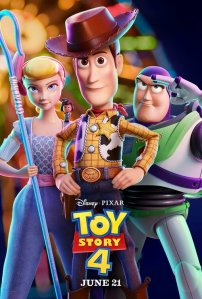 The Toy Story franchise has been the gold standard for Pixar with three excellent movies, the last of which was released back in 2010. When the Pixar bigwigs announced they were making a fourth entry, I felt some degree of concern. The hidden world of toys still felt like an interesting world with more stories to be told, but did we need to revisit Woody and Buzz and the gang? Everything ended so beautifully and perfectly with the third movie, with the toys getting their sendoff from their original owner and a new life in the possession of a new child, little Bonnie. I’ve been more wary about this movie than just about any other Pixar film because the audience had something that could be lost, namely closure. If they harmed that perfect ending in the crass desire to extend the franchise for an extra buck, it would have been aggravating and depressing to disturb something that felt so complete. It’s like when Michael Jordan came out of retirement (the second time) to be a shadow of himself for the Washington Wizards in order to sell tickets for the team he was part owner of. Nobody wanted that. I’m happy to report that Toy Story 4 is a treat of a movie and a worthy addition to the franchise.
Bonnie is gearing up for kindergarten and nervous about the change. She isn’t allowed to take toys with her to school, though that doesn’t stop Woody (voiced by Tom Hanks) from tagging along. In her desire for a friend, and with a little assist from a certain cowboy, Bonnie creates a fork-figure named Forky (Tony Hale), and amazingly it comes to life. Woody tries valiantly to convince Forky that being a toy to a child is the greatest gift but he’s also really reminding himself now that he sees his influence waning with Bonnie as he’s selected for play time less and less. During a family road trip, Forky escapes and Woody leaps to find him, both of them coming into the clutches of Gabby Gabby (Christina Hendricks), an antique doll missing a functional voice box who has her sights set on Woody’s voice box. It’s at this small-town pit stop for a carnival that Woody discovers Bo Peep (Annie Potts), an old flame he never thought he would see again. She’s assured, happy, and preaching a life of being independent from a kid. Woody has defined himself for so long by one identity, and now he must decide which to follow.
 In many ways, Toy Story 4 takes themes and questions from the third movie and improves upon them, making what could have been a retread feel like a do-over you didn’t know you desired. It’s been many years since I saw the third film but I recall the major themes being the fear of change, reconciling one’s self-identity, and the courage of letting go and starting over. The toys had to recognize that their owner was growing up and their old place wasn’t going to be the same. This same issue finds new life in Toy Story 4 primarily through the lens of Woody, who finds himself on the decline with his kid’s interest. He’s not offended or upset by this but is still trying to provide what assistance he can as a beloved toy, even if that relationship becomes more and more one-sided. His identity is in selfless sacrifice for another, but with the re-emergence of Bo, he is now contemplating a life on his own, a life without a kid. This alternate path never seemed a possibility until his former flame stepped back into his life. It challenged Woody in a way that feels more personal and more relevant than it did with 3, especially with the removal of a larger external threat to occupy the attention of our main characters. This places a renewed focus on Woody’s internal dilemma beyond his role as leader and protector.
Toy Story 4 might also be the weirdest movie of the franchise, which really elevates the comedy into another realm. I thought the characters played by Jordan Peele (Us) and Keegan Michael-Key (Predator) were going to quickly wear out their welcome; they seemed to be a heavy part of pre-release teaser trailers. The filmmakers don’t overdo them and use them in clever ways, which is a compliment that can be applied to every new character in this sequel. The plushies by Key and Peele have a hilarious running gag of their increasingly absurd plans to attack a woman, and one instance deliciously prolongs the eventual punchline, becoming more bizarre and macabre to the point that I lost control from laughter. Keanu Reeves (John Wick 3) is fun as a very Canadian Evel Knievel motorcycle driver, and the weird references to the Canada-ness of it are played completely straight, making it even funnier (his laments with the French-Canadian boy’s name made me snicker every time). There’s a trio of action figures, Combat Carls, and one of the three is always left hanging for high-fives and he just leaves his arm up waiting, silently pleading, and then lowers it in defeat, and it’s hysterical even just as a background gag. The ventriloquist dummies are routinely played for creepy laughs and physical humor. There’s a running joke where Buttercup, the unicorn voiced by Jeff Garlin, is always suggesting getting Bonnie’s father sent to jail no matter the circumstances. It’s these touches of weirdness that make the movie stand out that much more from the three others.
 The villain of Toy Story 4 is given a surprising sense of poignancy, enough that I genuinely sympathized with her plight. She’s a damaged doll used to being behind glass, isolated and separated from the children she wishes to be part of. She views her salvation in fixing in her damaged voice box, her perceived disability. She’s after what Woody has physically, the voice box, but it’s a means to an ends to have what Woody has had emotionally, the love of a child in need, the connection she yearns for. I won’t spoil what happens with her but even when there are setbacks the film and the characters don’t give up on Gabby Gabby. Her perspective and desires are still seen as valued, and the eventual resolution of her character put a lump in my throat. She wasn’t really the villain after all. She was just another toy in pain looking for acceptance and having to adjust her identity. I feel like there is a conscious disability empowerment message implanted in Toy Story 4, namely that those who are disfigured, disabled, or seen as “broken” can continue to be valuable and that their lives don’t end.
If this serves as the finale of the franchise, it will end on a fitting and resonant high-point. As much as Toy Story 3 was about change and acceptance, this sequel does a very respectable effort of personalizing that message even more to one central character’s dramatic arc. It also works wonderfully playing off of our collective investment in the character over the course of four movies and twenty-four years. There are some drawbacks to this approach. It makes the majority of the other toy characters feel like they have little to do on the sidelines, other than fret about retrieving Woody and Forky. Buzz is given a cute joke about listening to his inner voice but it doesn’t amount to much more than a cute joke. The inclusion of Forky feels like an exciting and even daring addition, tackling some existential questions and how and when toys are “made” and brought into being, and he presents these for a while. Once we get to our carnival setting and Forky is captured, he seems to be forgotten about. He’s more a motivation point for Woody than overtly anything else. I suppose you could make the analysis that Forky represents how Bonnie is moving on even with invented toys at the expense of Woody. However, these are minor quibbles considering the quality and emotional involvement of what Pixar has produced.
It goes without saying that the animation is beautiful but what amazed me is how expressive the faces of the characters could be, even when they were relatively inflexible toys. The relationship between Woody and Bo actually has a surprising amount of nonverbal dramatic acting to communicate nuance. As the years go by, I continue to be further and further amazed at the Pixar animators and their abilities.
 As protective I was over Toy Story 3’s perfect ending, I am happy to say that Toy Story 4 more than justifies its own existence in this hallowed franchise and even improves from the third film. The themes are something of a repeat but the filmmakers have elected to focus almost entirely on Woody and his personal journey, and it makes the loss and possibility more robustly felt. In many ways the film is an exploration on relationships and the need to redefine ourselves, to move onward when the time is right, and to try something new even if things get scary. Between Woody and Gabby Gabby, ostensibly the hero and villain of the piece, they’re looking for meaningful connections where they can. They may be secondhand, they may be disabled, but that doesn’t mean they aren’t worthy of affection. This is a joyous movie that finds time to be wonderfully weird and often funny. It might not have the set pieces or ensemble showmanship of the prior Toy Story tales, but what it does have is a character-based emphasis on the most complex figure in this universe of toys. The conclusion is moving and satisfying and I don’t mind admitting that tears were shed. I even teared up at different other earlier points. Toy Story 4 could have gone a lot of different ways but I’m relieved and appreciative with this new sendoff we’ve been granted.
Nate’s Grade: A
Share this:

The Dead Don’t Die (2019)
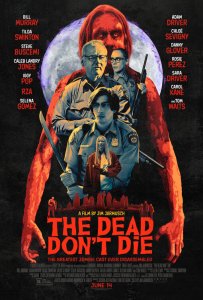 If you’re a Jim Jarmusch fan, you can probably stop reading now. I encourage you to continue but I don’t know if anything will be of help for you from here on out because, frankly, I don’t understand you. Jarmusch is a longtime staple of indie film and I’ve watched three of his films (Only Lovers Left Alive, Broken Flowers, Ghost Dog) and disliked all three to varying degrees, and that’s fine. There are plenty of hallowed names in filmmaking that are just beyond me, like Terrence Malick and Nicolas Refn, but I can at least partially understand what the fans of those auteurs value, an immersive visual, sensory experience at the sacrifice of narrative and coherency. When it comes to Jarmusch, I just don’t understand the appeal whatsoever. This is a man who found a way to make vampires crushingly boring, and now he finds a way to do the same with zombies. The Dead Don’t Die is the widest release of his career and it might be the worst movie I’ve seen in a theater all this year. It certainly feels like the longest.
In a sleepy small Ohio town, the police force consists of Chief Robertson (Bill Murray), Ronnie (Adam Driver), and Mindy (Chloe Sevigny). They’re going about their typical day, warning Hermit Bob (Tom Waits), listening to the alarmist worries of Farmer Frank (Steve Buscemi), and picking up supplies at the hardware store run by Hank (Danny Glover) and Bobby (Caleb Landry Jones). There’s a traveling group of students, lead by Zoe (Selena Gomez), as well as a group of kids in a juvenile detention center. Then the dead come back and small-town life will never be the same.
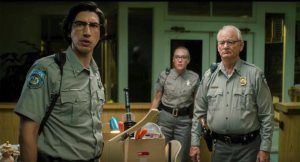 Anyone walking in expecting a zany comedy from the premise and cast, not to mention marketing materials, will be sorely disappointed, because what The Dead Don’t Die better resembles are the humorless anti-comedies of late-night Adult Swim blocs. It’s not so much that there are jokes, it’s more the absence of jokes, and somehow that might be the joke? The humor is stuck in one mode throughout the film. A character will slowly say something understated or obvious (Example: “That’s not good”) and then the reaction of others will be delayed, and then after that nobody will say anything for several painful seconds later. That’s about it, folks. It’s hard to find humor with that. The deadpan jokes are too obvious and too uniform to really strike any potent comedy targets. The consumer “satire” is brittle to the point of breaking. Various zombies will shamble around and say one-word items of whatever was important to them, ranging from “Coffee,” to, “Fashion,” to, “Chardonnay.” It’s like the one-word utterances are the entire joke (Hey, this dead guy liked fishing, isn’t that a riot?). It’s not satire and it’s not funny. How about the characters of Rosie Perez and Tilda Swinton being named Posie Juarez and Zelda Winston? Is that the kind of humor that sounds appealing? How about Tilda Swinton flexing a samurai sword to slice and dice the undead. Is that supposed to be cool? Is it supposed to be funny? Is it supposed to be funny that it’s trying to be “cool”? What is anything?
Later, the film inserts a new comedy element with meta asides where people seem to know they’re in a movie, and yet again the jokes are obvious and uniform, except now it’s even lazier, relying upon the meta recognition to simply stand in the place of a joke. If anything can happen in the small town, especially toward its crazy end, then why do these things have to happen? Or better yet why don’t better things happen? Because of the deadly pacing it makes every attempted bad joke feel that much more unbearable.
This movie is only 105 minutes but it felt so much longer. the pacing not just as a whole but scene-to-scene and even line-to-line from conversations is deadly still. Every moment feels stretched out but it doesn’t ever feel like you’re going anywhere. Characters will be introduced and given meet-cute moments and little indicators they might be significant players later, and then we’ll just find them dead. Other characters will be introduced and then never leave their locations, having no bearing on the larger story. It’s rare that I could honestly say there are entire supporting swaths of this movie that could be cut completely and not impact the story at all. It makes the many storylines we hopscotch across feel like they don’t matter and are generally wasting our valuable time.
 Then there’s the ending where Jarmusch just instructs Tom Waits to unleash a torrent of narration bemoaning how society deserves whatever downfall it incurs and that we’re all just zombies anyway. It’s so clumsy and overbearing and unearned after an entire movie where the cultural criticism amounted to a racist saying he doesn’t like his coffee black and then pointedly staring at the only black man in the movie. Even if we got more moments like that I might say some of the ending vitriol is justified, but the commentary gets muted in the middle until Waits has to finally tell us what the point is. There are scant political and environmental references but they feel like tossed asides themselves.
I don’t blame the cast for any of this although I can’t say what on the page must have seemed attractive. Murray is always going to be an amiable screen presence and Driver is a fun partner, slipping into a skillful deadpan and straining to find humor where there is precious little. Everyone feels wasted on screen because even if you’ve never seen these actors before you know, instantly and instinctively, that they have been far better.
The Dead Don’t Die is further proof that I am not a Jim Jarmusch fan. I can’t fathom how someone can actually be a fan of this writer/director. I was tempted to walk out at several points but I held in there. The jokes are too obvious and barely jokes, the pacing is awfully slack, and the whole movie is reprehensibly boring. Even when it has moments of weirdness it finds ways to make it boring. The structure does little to nothing with a large ensemble of very good actors. The movie and premise had potential. The idea of a zombie outbreak in a small town where everybody knows everybody is ripe for comedy and tragedy. Ultimately The Dead Don’t Die feels like one egregiously long in-joke that the audience isn’t privy to. The joke’s on us, folks.
Nate’s Grade: D
Share this:

Late Night (2019)
 Late Night follows the fictional long-running TV talk show host Katherine Newberry (Emma Thompson) who has been informed by her network exec that his current season will be her last season. She will be replaced and the show will be retooled. Along comes Molly (Mindy Kaling), an aspiring comedy writer who works in a chemical plant. She’s hired on the spot to serve as a token and offer more diversity in Newberry’s all white, all-male writers room. She has to find herself, find her voice, stand up for herself, and try to get the show to change with the times if it’s going to potentially survive the eager network axe.
For fans of the inner workings of show business, and the ups and downs and push and pull of creatives, Late Night was made for you. I’ve always been fascinated by the nuts-and-bolts of creative ventures in the entertainment industry and especially a writer’s room where people hash out ideas, build out a storyline, and generally bring our TV to life. I enjoyed the short-lived show where Jim Rash would interview different TV showrunners about their writer’s room processes and how they would resolve creative decisions. It’s one reason I loved HBO’s The Larry Sanders Show, a deeply satirical and self-deprecating look at the bowels of Hollywood. So if you’re like me and enjoy the inner workings of creative people working in tandem, then Late Night is already starting on fertile ground for you. Kaling’s world is informed by her years of television writers room experience, as well as running her own show, and that experience better informs the reality of Late Night, from the joke-writing process, to the wariness of content that may push away sponsors, to the means of staying relevant in a vastly changing landscape of how people get their media and entertainment. You feel Molly’s sense of triumph, and disappointment, when her first joke is placed into the monologue and then removed. The movie feels informed and real to its tiniest detail, which makes it all the more interesting.
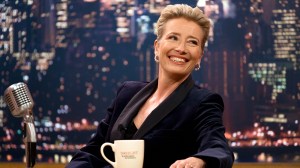 The film is consistently funny because Kaling is writing with such a sharp grasp of her characters. Right away the dynamic between Katherine, a cynic with an acid tongue, and Molly, an idealist but a novice who is pushing for reforms, establishes so much wonderful conflict and eventual resolution. It’s universally enjoyable watching a character come into her own, transform the lives of others for the better, and to have characters who butted heads form a mutual friendship and understanding. That’s all present, but with Kaling’s command of writing the characters come first. They drive the story, and while the destination is rather predictable with this sort of thing, that doesn’t make the journey any less satisfying. The character of Katherine Newberry is interesting because she’s a woman who has established her own perch in late night, but she’s still older, white, and from an elitist, privileged bubble. She’s stuck in the middle, which makes her such an interesting character to explore and push into new territory. Kaling has mined some talk show headlines for her story’s drama and it doesn’t feel cheap. Past mistakes are given weight and force characters to reckon with them in a way that acknowledges the extent of the ramifications and the people that have been hurt. Kaling also has a generous sense of writing for her supporting players, giving many a small moment to make an impression and enough for serviceable secondary character arcs.
There’s a definite message afoot with Late Night and it goes about it in a way that makes it far more accessible — as entertainment. Rather than dragging out a soapbox, the movie does the smarter ploy by demonstrating why a homogeneous writers room of the same kind of voice/perspective can be limiting and potentially regressive. Molly is the long-overdue change agent to the show, to the characters, and to the old ways of thinking of what television, and by extension the entertainment industry, had to be simply because it had always been that way. The film’s sense of advocacy for representation is strong and a central tenet, but this doesn’t get in the way of telling a good story with enjoyable characters. By demonstrating through its tale, Kaling has smartly packaged her movie as an empathy test designed to expand the perspectives of its audience, to get them to think how difficult it may be for a woman, let alone a woman of color, to find work in her chosen field. It’s the kind of movie you could take your grandparents to and have them nod along in approval.
Allow me to get a little personal here as I reflect on the topic of representation. I think recognizing one’s self and one’s stories is a huge deal. The power of empathy is potentially endless but that doesn’t mean that all stories need to be told from the familiar template of a straight white dude encountering conflict and change. With good storytelling, anybody can feel for anybody’s plight, but that doesn’t mean that those in the industry should stop trying to give voice to others who have historically been marginalized. TV, and particularly late night TV, is something of a boy’s club and needing more women. A recent analysis on late night TV concluded, with the exception of TBS’ Samantha Bee, that the typical late night talk show writing staff is only one quarter female. More people deserve more opportunities to shine because we, as a society, benefit when we have a plurality of stories from a plurality of voices and perspectives. It makes us all better.
 During the summer of 2018, I wrote a rom-com Web series (The Spirit Inside Me) that was told from the perspective of a bisexual woman and dealt with an eventual romance with another woman. You better believe I consulted with my queer friends to make sure every script didn’t feel like it had been written by a straight dude. Then we started to make it a real thing throughout the fall and winter of 2018/early 2019, and the mission statement of the series, and for me, was to try and get as many women involved in the production as we could. There were nine total episodes and I wanted to try and line up as many female directors as possible (if able all of them would be directed by women). Our show was from a feminine perspective, concerning an unorthodox LGBTQ relationship, and I wanted a feminine perspective to imbue as many facets of the production as possible. We put out notices for crew and emphasized that we were looking for women first. You would have thought I had just insulted people’s mothers the way some men responded back. They told me this was “reverse discrimination” and insulting and that the best talent should win out. I dismissed these whiny grievances and continued to seek and hire women. I know many women, even in our small community of filmmaking, don’t get as many opportunities as men. I wanted to give them those experiences. I felt it would make our series better and, personally, it just felt like the right thing to do because I could. With the show currently in editing (stay tuned!), it’s actually one of my happiest decisions as I really enjoyed seeing several women rise to their opportunity and shine. I’m not writing this to pat myself on the back or seek woke plaudits. This is such a slight example of mine over the overwhelming obstacles women face breaking through in a male-dominated industry that doesn’t want to share, but I felt it was worth sharing, dear reader.
Late Night was a movie that kept me smiling and feeling good all over. It warmed my heart, it made me laugh, and it gave me a group of characters to latch onto that earned my affections. Thompson is tart and witty and wonderful. Kaling is lovable and charming and hopeful. They make for a dynamic, combustible combination. Late Night is a fine example about the benefits of diversity, representation, and empathy, and it’s also a cute and funny movie that will make you happy by the time the credits roll. Tune in.
Nate’s Grade: B+


 nathanzoebl
You must be logged in to post a comment.