Author Archives: natezoebl
Lilo and Stitch (2002)
 Disney’s track record the last few summers is not exactly sparkling. Did anyone out there see Dinosaur or Atlantis? Anybody? You know you’re in for a different take when the film’s heroine, Lilo, in her opening scene punches another little girl and tries to beat her to the ground. Lilo is a troubled child living with her older twenty-something sis, Nani, in Hawaii after a car accident claimed their parents’ lives. Nani is stretched thin trying to find a job, look after her troublesome little sister, and also stay a step ahead of the social services representative. Lilo is saddened at her situation and deeply longs for a friend.
In a galaxy far far away, a mad alien scientist is on trial for creating the ultimate in destructive evil-ness – a manic six armed blue dog lookin’ thing named Stitch. Through a series of circumstances Stitch manages to daringly escape and runs off to Earth, a protected planet because of a rare endangered species I won’t spoil. Stitch meets up with Lilo at an animal shelter and she immediately takes a liking to this offbeat pet. Stitch isn’t the friendliest or most well-behaved creature but he eventually warms up to his new family. You can pretty much take it from there.
What makes Lilo and Stitch so much better than the last few Diz offerings, besides a total lack of songs, is that it’s a fresh and Disney animated film. The focus is on an unconventional family with no pristine smooth edges around them (hello opening) and the material is shown a remarkable level of maturity. That isn’t to say that Lilo and Stitch isn’t funny, because it has many charming and hilarious moments, many due to the sputtering and wild Stitch.
Not all the elements entirely gel well, especially the sci-fi with the family struggle. The animation has an old-fashioned look to it complete with backgrounds that look dusty, like the ones that were used in the 1970s. The characters have a slight anime tinge to them, like half-moon mouths and noses like dinner rolls. Lilo and Stitch is the hippest Disney outing in a long while and the best non-Pixar animated film since the underrated Hercules.
Nate’s Grade: B
Share this:

The Bourne Identity (2002)
 If you were in a fight who would you want to back you up? Ben Affleck has some heft. He has taken on a meteor, lesbians and even a crazed Sandra Bullock. Or maybe you’d take Matt Damon. “Wait, the same Matt Damon who stars in all those overly-serious period piece dramas?” you might reasonably ask. Well the very same Damon proves himself quite feasible as a thriller hero in The Bourne Identity and might just open a few new doors for himself – in between those overly-serious period piece films.
The flick starts off with a fishing vessel pulling a floating Matt Damon out of the Mediterranean. He has two bullets in his back; a Swiss account number embedded in his hip and no idea who he is or where he came from. He journeys to a Zurich bank where he uses the account number to unlock a safety deposit box. Inside he uncovers a series of different passports, stacks of all kinds of currency and a loaded gun. The box does however yield a name in Paris, Jason Bourne. He offers Marie (Franka Potente) a slew of dollars if she’ll transport him out of the country to where he can find his true identity and flee any police pursuits. It seems Bourne’s previous handlers do know his identity but are hurrying to dispatch other European assassins to make sure that no one else does. They’ve posted pictures of Bourne and Marie for any of their many eyes and ears to report back on.
 Damon does begin to recover certain memories and reflexes. Early on he dispatches two Zurich police officers in a park quite handily but still remains clueless to his identity. Once in Paris Damon and Potente become an inseparable team trying to elude snipers, police, and any sort of danger while attempting to fit the puzzle pieces together. The film then descends into a series of great chase scenes and action pieces with bits of story in between. We as an audience root for Damon’s triumph, even if he may well truly be a cold-blooded killer.
The Bourne Identity is a loose translation of the Robert Ludlum spy novel of the same name. The 1980 Cold War novel has been retooled to where the bad guys aren’t Ruskies but CIA bureaucrats (Chris Cooper and Brian Cox) wanting to save face. But in today’s age I think most people would actually wish that the CIA is as powerful and technological advanced as portrayed in the movie.
Damon is a stranger to the action ropes. He’s more accustomed to ride pretty horses in picturesque Texas or gaily kill people in picturesque Italy. While Affleck’s saved the world, like, three times in cinema already Damon has been playing golf. You get the idea. That’s what makes it so surprising how capable Damon is in this unfamiliar territory. He scales walls, he drives a stick shift through a high speed car chase and man does this guy know kung-fu. You just better not have any ball point pens lying around. Run Damon run!
Franka Potente, is there a lovelier woman in the world than you, of the fire head variety in Run Lola Run? She is more than just a “romantic interest” even if that’s the lot she’s been given. She’s a surprising choice to coincide with Damon but a gamble that works marvelously. Hey, it bought my ticket. The chemistry between Potente and Damon doesn’t exactly speak of sparks but they look beautiful onscreen alongside each other.
 Doug Liman is the director who put the swinger in Swingers baby. He also directed 1999’s most free-spirited thrill ride Go, so the man knows how to stretch a budget and propel an exhilarating vicarious feeling off the screen. The Bourne Identity is Liman’s first studio backed adventure and he should make his financial parents proud. He has a direct sense of mood and scale, setting the entire film amongst the wonderful backdrop of European cities. The look of the film is great, from the cool colors, the wet snow, to the luscious locales.
The film actually tries to shoehorn more profanity into a PG-13 movie than might be allowed. Potente, while in a hairy situation, will often keep muttering German profanities. After like the 30th time it becomes almost comical that studio execs or the MPAA would just let it slip through just because it wasn’t in English.
Damon eventually does come to learn of his former self as a trained CIA assassin and, as with all memory-recovery movies where the person’s previous life was dubious; they decide to be a better human being. If only more people would lose their memories.
The Bourne Identity is a slick spy caper with arresting visuals and some great propulsive action sequences, in particular a standout car chase through the back streets of Paris. Liman has crafted an intelligent spy thriller for the post Cold War era that makes perfect use of an anti-hero and his conflicts of memory.
Nate’s Grade: B+
Share this:

Star Wars: Attack of the Clones (2002)
 Yes, it’s easy to say that Attack of the Clones is better than Phantom Menace, but hey, most anything was better than watching that movie about trade and taxes. The truth of the matter is that for a long while Clones is just as boring as Menace, especially anything involving Anakin onscreen. It’s slow moving, dull, and remarkably poorly written. Lucas cannot write dialogue and someone needs to take away his yellow writing notebooks before he strikes again. The movie only shows life during the last 45 minutes when it finally cooks with a non-stop rush of action. Before then though I would recommend resting up for this period.
Can anyone ever say “no” to the Jedi master in plaid? What Lucas needs desperately is collaboration, writing and directing. Lucas needs to loosen up the reign of his empire before the three Star Wars prequels undermine the original set. He may have the technology to create any manner of CGI creature but he has no power to get his actors to show any of the realistic and animated life. It seems all Lucas cares about is directing blue screens and leaving his actors out to dry.
 And that much ballyhooed romance between Anakin and Amidala? Oh ye God, what romance? You could find something more alive in a monastery. Portman and Christenson have as absolutely no chemistry (unlike the romantic pairs in another, huge Hollywood movie out now). Portman has perfected the staring ahead method. I don’t know if that’s supposed to be romantic. Now I like Natalie Portman, I really do. Her performance in The Professional gets me every time, but her acting is stiff and overly serious here.
I thought Anakin could not get any more annoying than Jake Lloyd’s awful “yippee”-filled run in Menace, but I’m starting to reconsider this begrudgingly. It’s easy to see why Christenson was chosen, he looks like the lost N’SYNC member. His acting on the other hand is not with the force. The Clones Anakin mopes around and when he gets upset he whines in a falsetto voice. It’s actually quite funny to see the future Darth Vader, evil master of the Dark Side and much feared, whining like a six year old throwing a tantrum. This Anakin needs a time out and a lolly.
When Anakin returns to become a protector for the senator, upon their first meet in ten years he shoots her the puppy eyes and says, “I see you have grown as well — grown more beautiful.” Subtlety, thy name is not Anakin Skywalker. The very next scene where they’re alone he’s trying to put the moves on her, though he does not try and use the force to undo her bra. Then somewhere along the line his dogged persistence just wears Amidala down and she relents. She says, “I’ve been dying a little bit day by day, ever since you re-entered my life.” Ugh. You’re likely to find more romantic passages in a Harlequin bodice ripper at 7-11.
 The romance in Clones is like spontaneous romance. There is no beginning, the nurturing of it is not shown, we don’t see the eventual progress. All that happens is he shows up and then instant romance. It just happens. I don’t think so. It’s like a kid went to a girl’s third grade birthday party, then they meet in high school for the first time since that day and are instantly in love. Do you buy that? Well I certainly don’t.
The scenes revolving around Obi-Wan are the only ones worth opening your eyes for. Ewan McGregor has got the Alec Guiness voice down and proves to be a capable leading hero. His voyage to see the clone army and Jango Fett is the subplot that we want, but the movie keeps skipping back and forth between this and the inept romance. By this time everyone knows that Yoda shows off his fighting mettle with a light saber. This is a great idea and the audience I saw it with was having the time of their life during this moment. It’s the only part of the movie that taps into the feeling of whimsical fun of the original trilogy.
Lucas curtailed the criticism of Menace saying it was the setup for all five other movies. I imagine he’ll say the same thing with this one, except that it was setup for four movies. Yes it’ll make a huge amount of bank. Yes it’s a technical achievement but what good are all the bells and whistles if we as an audience are bored? You’ve got one more Star Wars left George, please do it right.
Nate’s Grade: C+
Share this:

Spider-Man (2002)
 Hollywood take note, Spider-Man is the prototype for a summer popcorn movie. It has all the necessary elements. It has exciting action, great effects used effectively, characters an audience can care for, a well toned story that gives shades of humanity to those onscreen, fine acting and proper and expert direction. I recommend movie execs take several note pads and go see Spider-Man (if they can get in one of the many sold out shows). What summer needs are more movies in the same vein as Spider-Man, and less Tomb Raider’s and Planet of the Apes.
Peter Parker (Tobey Maguire) is a dweebish photographer for his school yearbook clinging to the lowest rung of the popularity ladder. He lives with his loving Aunt and Uncle who treat him like a son. Peter has been smitten with girl-next-door Mary Jane Watson (Kirsten Dunst) ever since he can remember, but he’s been too timid to say anything.
At a field trip to the genetically altered spider place (there’s one in every town) Peter is snapping pictures when he is bitten by one of the eight-legged creatures. He thinks nothing of it and awakes the next day to a startling change. He has no need for his rimmed glasses anymore and has a physique that diet ads would kill for. He also discovers he can cling to surfaces, jump tall building in a single bound and shoot a sticky rope-like substance from his wrists. Hairs on his palms and shooting a sticky substance from his body? Hello puberty allusion! Peter tries to use his new abilities to win the girl and when that doesn’t work out he turns to profiting from them. He enters a wrestling contest in a homemade costume and proceeds to whup Randy Savage. Following the fight Peter’s Uncle Ben is dying after being involved in a car jacking Peter inadvertently let happen. Haunted by grief Peter becomes Spider-Man and swings from building to building as an amazing arachnid crime stopper.
 But every hero needs a villain, and that is personified in the Norman Osborn (Willem Dafoe), scientist and businessman. Osborn is experimenting with an aerial rocket glider and a dangerous growth serum. When the military threatens to cut his funding and shop elsewhere Osborn haphazardly undergoes the serum himself. What it creates is a duality of personalities; one is Norman, the other is a sinister and pragmatic one. The evil alter ego dons the glider and an exoskeleton suit and calls himself the Green Goblin. The Goblin destroys all that are in his way, and has his yellow eyes set on the pesky Spider-Man.
The casting of mopey-eyed indie actor Tobey Maguire over more commercial names like a DiCaprio or a Prinze Jr. (I shudder to think of a Freddie Prinze Jr. Spider-Man) left some people scratching their heads. Of course the casting of Mr. Mom to portray the Dark Knight likely got the same reaction in the 80s. Maguire plays the nerdish and nervous Peter Parker to a perfected awkwardness with his sensitive passivity. When he explores his new powers with exuberant abandon then begins crime fighting, we as an audience are with him every step of the way pulling for Peter.
Kirsten Dunst was also a surprising casting choice but works out very well. She allows the audience to fall for her along with Peter. Her chemistry with Maguire is great and could be a major reason why rumors have surfaced about the two leads taking the onscreen romance off screen.
Willem Dafoe is one of the creepiest actors in the business (though he made an effective creepy-free Jesus) and delves deliciously headfirst into the cackling menace of Spider-Man’s nemesis. Dafoe, with a face that looks like hardened silly putty and jutting rows of teeth, relishes every maniacal glare and endless evil grin. But instead of being one-note he adds certain amounts of sympathy and understanding as Norman Obsorn. No one could have done this role better than Dafoe.
 Director Sam Raimi was most known for his cult splatter house Evil Dead series, but he’s got a new resume topper now. Raimi was chosen over a field of directors because of his passion for the character and story. Raimi brings along integrity but with a joyous gluttony of spectacular action sequences. He expertly handles the action and daring-do all the while smoothly transitioning to the sweet love story. He has created the movie Spidey fans have been dreaming of for 40 years.
Spider-Man swings because of the respect the source material has been given, much like 2000’s X-Men. The story follows the exploits of the comic fairly well but has some stable legs of its own. The multitudes of characters are filled with life and roundness to them, as well as definite elements of humanity. You can feel the sweet romance budding between the two young stars, the tension and affection between Osborn and son, but also the struggle with Norman and his new sinister alter ego.We all know villains are the coolest part anyway. Isn’t that the only reason the last two Batman films were made?
There’s the occasional cheesy dialogue piece but there is that one standard groaner line. In X-Men it was Halle Berry’s query about what happens when lightening hits a toad. In Spider-Man it was the response to the Green Goblin’s offer to join him, to which he asked “Are you in or are you out?” (Obviously channeling George Clooney). The dreaded response: “You’re the one who’s out Goblin. Out of his mind!” Sigh. Maybe a well placed “freaking” before “mind” would have made the line better.
Spider-Man is the best kind of popcorn film: one that leaves me anxiously anticipating the sequel (which will come out two years to the day the first one was released).
Nate’s Grade: A-
Share this:

My Big Fat Greek Wedding (2002)
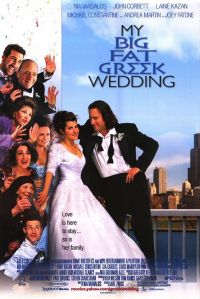 Toula Portokalos (Nia Vardalos) opens by telling us that as a Greek woman she has three responsibilities, “1) Marry a Greek boy. 2) Have lots of Greek children. 3) Make lots of food.” Toula works in her family’s restaurant letting life pass her by, while her father pleads with her to get married even though she is already “old” at 30. It doesn’t seem like that day will ever come for Toula, nor is she looking forward to it, until a handsome stranger (John Corbett, Aidan from Sex and the City) catches her eye in the restaurant. Through more encounters the two seem to have sparks flying off from the heat they generate. He pops the question and Toula happily says yes. There’s only one slight problem – he’s not Greek.
My Big Fat Greek Wedding isn’t anything provocative or innovative but it does have its charming moments and engaging humor. These “ethnic family comedies” are really a double edged sword to work with. You see, they will exaggerate the cultural eccentric-ness of the characters to the point of gross parody but then rely on them to become endearing lovable characters who the audience appreciates for the very same reasons it’s laughing at them. And while Greek Wedding can be found guilty of this notion as well it really does take someone from the inside to come up with this stuff, so there must be some love there to start with.
Vardalos, who also wrote the script, is a perfect casting choice exactly because of her everyday looks. This isn’t someone like Jennifer Aniston trying to pull off being poor and un-pretty; this is a normal looking gal pulling off normal. It works exceptionally and Vardalos certainly knows how to hit a joke. The supporting cast of goofy yet lovable Greeks is played with admirable gusto by the many assembled players. A favorite of mine is the elderly grandmother who continues to try and escape from their home. And yes, an N’SYNC member is in this movie. Why I will never know. Is he even Greek? Is “Fatone” a Greek name?
My Big Fat Greek Wedding is a big helping of family comedy and easy to see why it’s become as crowd pleasing as it is. It’s nothing new or extravagant, but hey, I’d easily go see this again than ever venture close to a theater showing XXX or Blue Crush or Pluto Nash or The Master of Disguise or…
Nate’s Grade: B
Share this:

Changing Lanes (2002)
 Don’t be misled by fancy marketing, Changing Lanes is no more a thriller than In the Bedroom (now that was some fancy misleading marketin’). At its core Lanes is a morality tale hiding under the clothing of thriller ilk. But while the film is surprisingly engaging the majority of it centers on Ben Affleck and Samuel L. Jackson doing a good or bad deed and countering one. And in this dilemma the deck is stacked for audience favorability. Jackson is a down-on-his-luck father fighting an impending divorce and trying to get a loan to purchase some real estate so his wife and kids won’t move away. Affleck is a cocky lawyer in a big firm who had an affair with his secretary (the chipped-tooth looking Toni Collette). Who do you think is the “good” guy? The film seems to bend over backwards to try and make Affleck not so bad, like showing him remorseful and pushed to the edge, under threats from his father-in-law and firm partner (Sydney Pollack), and being urged into a dark unethical territory by his own wife (Amanda Peet).
Jackson underplays his role, despite the snippets of vocal outbursts, and earns the compassion of the audience. Affleck plays Cocky Lawyer Man Who Becomes Humble and does a fine job. The supporting cast really shines in Changing Lanes especially Peet. Her one true scene involving her chilly sit-down with her husband is great in its sharp veer from what is expected.
Changing Lanes was directed by Roger Mitchell (Notting Hill) with a bit of nerves. Some scenes are shot from obtuse angles and the score has an inappropriate electronica taste. In the end though, Changing Lanes is an involving morality tale with some good lead performances.
Nate’s Grade: B
Share this:

Human Nature (2002)
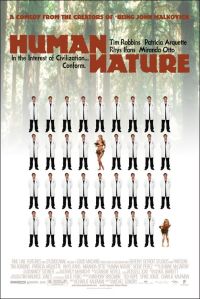 Screenwriter Charlie Kaufman jumped on to Hollywood’s A-list when his feature debut Being John Malkovich was unleashed in 1999. Malkovich was a brilliant original satire on identity, be it celebrity or sexual, and was filled with riotous humor but also blended beautifully with a rich story that bordered on genius that longer it went. Now Kaufman tries his hand expounding at the meaning of civilization versus animal instinct in Human Nature. As one character tells another, “Just remember, don’t do whatever your body is telling you to do and you’ll be fine.”
Lila (Patricia Arquette) is a woman burdened with excessive body hair ever since she was old enough for a training bra (with the younger version played by Disney’s Lizzie McGuire). Lila feels ashamed by her body and morbidly humiliated. She runs away to the forest to enjoy a life free from the critical eyes of other men. Here she can commune with nature and feel that she belongs.
 Nathan (Tim Robbins) is an anal retentive scientist obsessed with etiquette. As a young boy Nathan was sent to his room for picking the wrong fork to eat his meal with. He is now trying his best to teach mice table manners so he can prove that if etiquette can be taught to animals it can be ingrained toward humanity.Lila and Nathan become lovers when she ventures back into the city, eliminating her body hair for now, because of something infinitely in human nature – hormones. The two of them find a form of content, as neither had known the intimate touch of another human being.“Puff” (Rhys Ifans) is a grown man living his life in the woods convinced by his father that he is an ape. One day while walking through the woods Nathan and Lila discover the ape-man and have differing opinions on what should be done with him. Nathan is convinced that he should be brought into civilization and be taught the rules, etiquette and things that make us “human.” It would also be his greatest experiment. Lila feels that he should maintain his freedom and live as he does in nature, how he feels he should.
What follows is a bizarre love triangle over the reeducation of “Puff,” as Nathan’s slinky French assistant Gabrielle (Miranda Otto) names him. Lila is torn over the treatment of Puff and also her own society induced shame of her abundant amount of body hair. Nathan feels like he is saving Puff from his wayward primal urges, as he himself becomes a victim of them when he starts having an affair with Gabrielle. Puff, as he tells a congressional committee, was playing their game so he could find some action and “get a piece of that.”
 Kaufman has written a movie in the same vein as Being John Malkovich but missing the pathos and sadly, the humor. ‘Human Nature’ tries too hard to be funny and isn’t nearly as funny as it thinks it is. Many quirky elements are thrown out but don’t have the same sticking power as Kaufman’s previous film. It’s a fine line between being quirky just for quirky’s sake (like the atrocious Gummo) and turning quirky into something fantastic (like Rushmore or Raising Arizona). Human Nature is too quirky for its own good without having the balance of substance to enhance the weirdness further. There are many interesting parts to this story but as a whole they don’t ever seriously gel.
Debut director Michel Gondry cut his teeth in the realm of MTV making surreal videos for Bjork and others (including the Lego animated one for The White Stripes). He also has done numerous commercials, most infamously the creepy-as-all-hell singing navels Levi ad. Gondry does have a vision, and that vision is “Copy What Spike Jonze Did As Best as Possible.” Gondry’s direction never really registers, except for some attractive time shifts, but feels more like a rehash of Jonze’s work on; yep you guessed it, Being John Malkovich.
Arquette and Robbins do fine jobs in their roles with Arquette given a bit more, dare I say it more, humanity. Her Lila is trapped between knowing what is true to herself and fitting in to a society that tells her that it’s unhealthy and wrong. Ifans has fun with his character and lets it show. The acting in Human Nature is never really the problem.
While Human Nature is certainly an interesting film (hey it has Arquette singing a song in the buff and Rosie Perez as an electrologist) but the sum of its whole is lacking. It’s unfair to keep comparing it to the earlier Malkovich but the film is trying too hard to emulate what made that movie so successful. Human Nature just doesn’t have the gravity that could turn a quirky film into a brilliant one.
Nate’s Grade: C+
Share this:

Panic Room (2002)
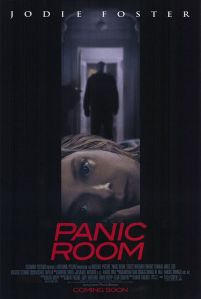 Meg Altman (Jodie Foster) is a newly divorced woman shopping around Manhattan for a new place to sow her wild oats thanks to a healthy marital settlement. The brownstone in question is truly spacious. It comes complete with four floors and a working elevator installed by the invalid former owner. Megs teenage daughter Sarah immediately takes a shine to her new digs and urges mom to sign the dotted line. It seems besides a great location the place also comes complete with a secret room that houses a separate phone line, a wall of monitors all corresponding to cameras, as well as medical supplies and a silver commode. This panic room is surrounded by four feet of concrete and sealed by an airtight steel door. It seems its the ultimate in home protection.
But before Meg and Sarah can barely unpack a trio of burglars enters the home with the hopes of securing the reclusive former owners riches. Meg grabs her daughter and scurries into the panic room just in time to seal the door behind her. She communicates to the men to take what they want and leave. One of them writes on a piece of paper that what they really want is inside the panic room. The burglars aren’t going anywhere, are well equipped and know the panic room better than she does. Meg and her daughter are safe but trapped with little voice to the outside. Thus the pieces are all set and an intricate game of moves and counter-moves takes place to see who has the upper hand, in and out of the panic room.
 Panic Room is that rare treat as a movie alive and well with energy, tenacity and a double-dose worth of entertainment. The movie flies by and youre left catching your breath or checking your pulse at certain junctures. The suspense continues in an arching fashion and keeps giving the audience new situations to be taken with.
It’s been two years since the public has last seen Jodie Foster in a movie and its good to have her back. Her performance is nominal but she’s put through what must be the most physically strenuous film of her career. She has that rare versatility as an actress to wear corsets and frilly-wear one film and then to be holstering a gun and barking at transsexual serial killers the next, all while maintaining complete confidence and integrity at either.
It seems that today we have a staggering lack of female action leads that could kick your ass. Sigourney Weaver once owned this throne but now the only thing we have to offer is pinups. We have Angelina Jolie’s scary glares. We have the pout of Michelle Rodriguez, who has since blown what promise she showed in Girl Fight by starring in two horrible consecutive films about zombies (one of these said zombies being Vin Diesel). And I dont think I even need to go into Milla Jovovich. So it’s refreshing knowing that Foster, even while pregnant for part of filming, can swing with the big boys and surely roll some heads and take some names.
The actors portraying the burglars play basic criminal archetypes, but do passable jobs with them. Forest Whitaker is the soft-spoken security expert who refuses to play rough if the situation calls for it. Jared Leto is the comically impulsive grandson who feels slighted by not being granted a sum of the inheritance. Dwight Yoakam (yes the Dwight Yoakam) is the questionable addition with an itchy trigger finger and a determination to get his mitts on the money.
 Director David Fincher, the auteur that gave us a head in a box with Se7en, returns with his kinetic kick and brooding finesse. Fincher is a vastly talented visual director and adds more richness to the film with lovely cinematography and an astutely mature sense of tension.
However, Fincher’s sensory excesses get the better of him the longer the film goes. Does the audience really need to have the camera travel through the handle of a coffeepot? Does anyone really need the camera to swirl into the bulb of a flashlight so we see how it works? It may come to the point where you’re anticipating the next superfluous camera movement, and praying that it isn’t plunging into Yoakam’s nostrils. Once or twice is fine, but after awhile the nomadic camera movements become far more distracting to the film. The ending is also a bit anti-climactic for my taste.
Panic Room, despite a few missteps, is a great exercise in suspense. You may get so wrapped up youll find yourself, as I surprisingly did, reverting to the annoying habit of talking to the characters on screen and trying to instruct them. Panic Room is the kind of movie you wish Hollywood made more often: something with genuine thrills that leaves you pinned to your seat and bubbling with anticipation, before turning you into a puddle of warm goo.
Nate’s Grade: B
Share this:

Metropolis (2002)
 It has the screenplay penned by Katsuhiro Ôtomo, writer/director of Akira. The director is Tarô Rin, director of numerous anime including X. And it’s based upon a classic manga by the same name. If you understood any of this, especially if you successfully identified anyone, then you are a prime candidate for Metropolis.
Metropolis is a future wonderland of a city, with the coronation of Duke Red’s gigantic Ziggurat building, to which he plans to rule the world. He’s evil. Detective Shunsaku Ban and his nephew Kenichi have been hired from Japan to find an illegal organ trader who they believe has some connection to Duke Red. Sure enough, with his help the duke is building the most powerful robot named Tima who also happens to look pristine like his deceased daughter. His adopted son Rock takes offense, kills the organ trader, and chases Kenichi and Tima through the subterranean bowels of the city. Then there’s some chase scenes. And… um… the disaster montage ending. There’s your story folks.
Time for an anime checklist. Androgynous heroes? Check. Sprite looking females with super duper powers? Check. Bad guys with snozes like Toucan Sam? Check. Robots, robots, robots? Check. A story that bites off more than it can chew? Check. Gratuitous nudity and grotesque gore? Nope. Well this is a PG-13 movie.
Metropolis is without a doubt one of the most beautiful animated films I have ever seen. The dazzling vistas of the city are a wonder to behold. Metropolis is an amazing movie to watch. To say it is candy for the eyes is an understatement; it’s Girl Scout cookies for the eyes. The visuals are astonishing but the story lacks any character development. The script borrows heavily from Blade Runner, Brazil and the original Fritz Lang silent masterpiece Metropolis. There’s also a rather dumbfounding sequence where the montage of destruction, including the annihilation of the Ziggurat, set to Ray Charles’ “I Can’t Stop Loving You.”
For anime fans it all won’t matter. The film is a sight to behold. It’s gorgeous but flaccid in its thinking and plotting.
Nate’s Grade: B-
Share this:

Kissing Jessica Stein (2002)
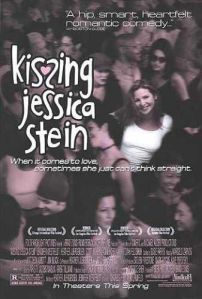 Kissing Jessica Stein stars Jennifer Westfeldt as the perfectionist title heroine searching for true love in the Big Apple. She answers a personal ad sent by Helen (Heather Juergensen), an art gallery manager trying her hand at women for the first time. What begins in comedic awkwardness turns to the fires of passion. Which leads to much more awkwardness as Jessica attempts to keep her secrets and the true identity of her “friend” from her mother.
Juergensen and Westfeldt wrote the script based on characters they have nurtured for several years, and their comfort level with the material shows. Each gives a wry and charismatic performance, with Westfeldt proving herself an acting revelation. It must be nice for her to have something else to her résumé than being one of the “girls” in Two Guys, A Girl and a Pizza Place.
Kissing Jessica Stein tiptoes a fine line with some characters possibly becoming gay or Jewish stereotypes; however, they never do fall into the abyss of Caricature Land. Tovah Feldshuh, playing Jessica’s mother, might make you wince at the thought that she’d be mired as a Mike Myers “Coffee Talk” portrait. But she has scenes where she shows real tenderness that is very affective.
At times the movie feels a bit too wrapped up in its own precocious-ness. There’s even a standard montage of bad dates that becomes annoying much sooner than it ends. Those looking for deep lesbian issues needn’t apply here. Kissing Jessica Stein hits its targets on a surface level, which can be deemed appropriate for an innocuous romantic comedy. The downer closing 10 minutes seems to come from nowhere and betray the feel of the movie.
The film plays by conventional rules for the most part but these don’t diminish the healthy humor in the least. Kissing Jessica Stein is a charming and fun experience and would serve as a good date movie for prospective couples.
Nate’s Grade: B


You must be logged in to post a comment.