Author Archives: natezoebl
Red Dragon (2002)
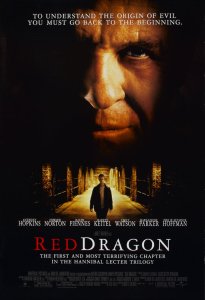 The following is a conversation overheard between two studio producers:
Person #1: So this Hannibal movie made like a ton of green. What else can we do to squeeze out some more money?
Person #2: Hey, do you remember a movie called Manhunter based on the first Lector novel?
Person #1: Nope.
Person #2: That’s fine because nobody else does.
It’s official folks: Hannibal Lector, America’s favorite cannibal, is now more comical than scary. See the element that 1991’s Silence of the Lambs carried with it was a stealthily gripping sense of psychological horror. It hung with you in every closed breath you would take, surrounding you and blanketing your mind. I mean, there aren’t many serial killer movies that win a slew of Oscars. And while the follow-up, last year’s Hannibal, gleefully bathed in excess at least Ridley Scott’s sequel was so over-the-top with its Baroque horror that it was entertaining. So what’s Red Dragon, the latest Lector flick based on Thomas Harris first novel like? Well it’s like the bastard child of Lambs and Hannibal after a drunken one-night-stand neither would be proud of in the pale light of morning.
 In an extended prologue we see the capture of the good doctor with a good appetite, Hannibal Lector (Anthony Hopkins, completing his trilogy of the character). FBI Agent Will Graham (Edward Norton) seeks his advice on a profile of a serial killer, not knowing that Lector more than fits the bill. A violent struggle ensues that leaves Graham with a long scar across his abdomen and Lector locked away for nine consecutive life sentences.
Turns out there’s another madman on the loose. The Tooth Fairy, dubbed by tabloid journalist Freddy Lounds (Phillip Seymour Hoffman), has butchered two families in their homes and inserted shards of broken mirror into their eyes. The FBI coaxes Graham out of retirement to try and track down the Tooth Fairy. But it seems in order to make any significant ground he must seek help from an old advisor – Hannibal Lector.
The crux of the film follows Graham’s attempts to figure out the identity of the Tooth Fairy, which we learn fairly fast is pretty boy Ralph Fiennes. Seems Fiennes has a cleft palette and years of physical and sexual abuse to toil over. He desires to transform into a mythical Chinese creature known as the Red Dragon. But wait, the lonely Fiennes is befriended by a lovely blind woman (Emily Watson) who identifies having people look differently at her. Can her affections melt the cold heart of a cold-blooded killer? Well, if they did thered be no other half of this movie.
What Red Dragon feels like is more of a checklist of what we expect to see in a Hannibal movie than anything of creative nourishment. It’s like a slimmer version of Lambs plot. Once again there’s an FBI agent who recruits Hannibal for advice on tracking down a serial killer. Once again there’s a disturbed killer trying to transform himself. Once again Hannibal Lector scares the crap out of anyone at will. Check, check, and check. Creative stagnation? Double check. The most disappointing aspect is the rudimentary feel this whole exercise has. Even though Red Dragon is a prequel it still seems like it’s begging to meet our expectations of two earlier films.
The first stab at the Red Dragon novel was in 1986 by director Michael Mann (Ali, The Insider) with the thriller Manhunter. William Peterson (before his work at CSI) was a more brooding Graham, Tom Noonan was a spookier Tooth Fairy, and the tension was stacked better. There were no comparative expectations.
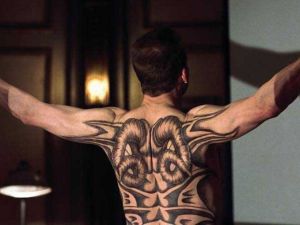 Norton is the finest actor of his generation but has certain trouble breathing life into Graham. The character is far more straight-laced than what we’ve been told is an expert at delving into the minds of killers. Grahams relationship with Lector doesn’t have any of the complexity, or interest, that Jodie Foster’s Clarice Starling had. He can even be very flat-footed in his detective work for a specialist. He stares at the home videos of the two slain families for about an hour wondering what the connection is while we in the audience shout it out to him. Lets go to the videotape Ed!
Anthony Hopkins returns as the devil in the flesh and seems to have another grand old time. Lector worked in Lambs because he was caged up, like a wild animal not meant for four glass walls. You never knew what would happen. He’d get in your head and he would know what to do with your gray matter — not that he didn’t have a culinary degree in that department with Hannibal. With Red Dragon, Hannibal is just window dressing to another serial killer. He’s a supporting character in a story that he has nothing to do with. He’s reduced to comic relief with his sudden attacks of chattering teeth and velvety voice. The amazing supporting cast of actors all do well, especially the beaming Watson who will shine in anything you put her in. Just try.
Ultimately the story of Red Dragon is far from flawless and meanders for quite a while. It would have been a marginally competent movie had it not been trying to replicate Silence of the Lambs so damn hard. So, is this the last youll see of Hannibal Lector? No as long as clinging cash registers can still be heard. Cue evil laughter.
Nate’s Grade: C+
Share this:

Secretary (2002)
 Secretary is a new romantic comedy with a few kinks to it. Its actually the most romantic S&M movie ever. It’s the first S&M romantic comedy since maybe Garry Marshall’s disastrous 1994 Exit to Eden. Im still trying to get the image of Rosie O’Donnell in a bondage mask out of my ongoing nightmares.
Lee Halloway (Maggie Gyllenhaal) is fresh from a stop at a mental institution for her hazardous habit of cutting herself to feel relief. Her overbearing mother stashes the entire kitchen cutlery in a locked cabinet. The sheltered Lee resorts back to a kiddy make-up box stashed under her home bed. Instead of colorful brushes and arrays of lipstick, she has a selection of sharp objects. Lee goes job hunting to step back from her habit, and is hired as a secretary to E. Edward Gray (James Spader). He is a rigid taskmaster who delights in pointing out typographical errors with his red marker, his weapon of choice. Gray enjoys his dominance and Lee complies, even if its routing through garbage. He ticks away Lee’s flaws like a checklist of annoyance but also appears to have genuine concern for her. When he notices her wounds Gray confronts her and convinces Lee to stop cutting herself.
The turning point arrives when Gray orders Lee into his office one afternoon. He commands her to bend over his desk and then delivers a sound spanking. Lee stares at her purple rump with fascination, like something has been awakened inside her. Soon enough Lee purposely makes typos so she can re-assume her spanking position.
 Maggie Gyllenhaal is a cinematic find with a fearless and breathtaking performance that is at once delicate, nervous, self-controlled, seductive and delightful. Gyllenhaal, with her heart-like face and pert lips, radiates star quality. She allows the audience into Lee’s head and we quickly fall in love with this peculiar yet charming heroine. If there is any justice in this world Gyllenhaal should at least get an Oscar nomination (she didn’t). Spader can do this left-of-center creepy character stuff in his sleep.
Secretary on the surface may seem like a fetish flick but it’s no different than boy (sadist) meets girl (masochist) and falls in love. Director Steven Shainberg treads carefully around serious subject matter, like Lee’s self-mutilation, to focus on these two very special characters. Secretary isn’t making any loud statements on sadomasochism or post-feminism, it’s just showing us that S&M is the route these two people take to find true love. It doesn’t judge them for their unconventional tastes and neither should we. This is one of the finest romances in recent memory and it seems to come from one of the most unlikely places.
Sadomasochism has been predominantly shown involving pain or some leather-masked madman evoking torture. Secretary may be the film that shows there can be pleasures with pain. Some people regard what Lee and Edward do as sick, perverted, or downright wrong. Secretary is a foot in the door to get people to understand what willing sadomasochism really is about. We all have fetishes and interests, and S&M is the number one fetish truth be told. This isn’t your everyday romance.
Obviously, this is a movie that will not appeal to everyone. The relationship between our leads is surprisingly complex but gentle and even sweet (if thats the proper word for an S&M romantic comedy). Secretary shows that it truly takes different strokes and, despite an overly silly ending, is the most pleasing romance of the year. Youll never look at red felt pens the same.
Nate’s Grade: A
Share this:

One Hour Photo (2002)
 Do we regularly invite strangers to view the picturesque and personal moments of our life like marriages, celebrations, and maybe even a handful of hastily conceived topless photos? Well we all do every time we drop off a roll of film for development.
Robin Williams continues his 2002 Tour of the Dark Side (Death to Smoochy, Insomnia) as way of Sy, your friendly photo guy working at your local Sav-mart superstore. Sy takes an intense artistic pride in the quality of prints he gives. He knows customers by name and can recite addresses verbatim. One family in particular Sy has become fond of is the Yorkins, mother Nina (Connie Nielsen), father Will (Michael Vartan) and nine-year-old Jake. The Yorkins have been coming to Sav-mart and Sy for over 11 years to have their photos developed. He tells Nina that he almost feels like Uncle Sy to the family. For Sy, the Yorkins are the ideal postcard family with perennially smiling faces and the happiest of birthdays. He fantasizes about sharing holidays with them and even going to the bathroom in their posh home.
 Sy is an emotionally suppressed and deeply lonely man caught in his delusions. In one of the eerier moments of the film we see that Sy has an entire wall made up of hundreds of the Yorkin’s personal pictures. When Sy attempts to become closer to the objects of his infatuation that’s when things begin to unravel at a serious pace. The more Sy learns that the Yorkins are not the perfect family he yearns for the more he tries to correct it and at any cost.
One Hour Photo is an impressive film debut by music video maven Mark Romanek (best known for the NIN “Closer” video). Romanek also wrote the darkly unrepentant story as well. One Hour Photo is a delicate voyage into the workings of Sy’s instability with lushly colorful metaphors. Romanek’s color scheme is a lovely treat, with vibrant colors popping out and Sy’s life being dominated by cold, sterilized whites. His direction is chillingly effective.
This may be the first time we can truly say Robin Williams has not merely played a version of Robin Williams in a movie. Sy’s thick glasses and thinning peroxide-like hair coupled with an array of facial pocks allow us to truly forget that the man behind the mask is Mork. His performance is unnerving and engrossing. The supporting cast all work well. Nielsen (Gladiator) is a sympathetic wife even if her hair looks like it was cut with her eyes closed. Vartan (Vaughn on ABC’s wonderful Alias) plays understandably wary of Sy’s friendliness. The great Gary Cole has a small role as Sav-mart’s manager who grows tired of Sy’s outbursts and peculiarities.
 One Hour Photo is rife with nervous moments and titters. Williams almost has an uneasy predatory feel to him when left alone with Jake. The greatest achievement the film has is that is depicts the scariest person youll ever see, sans hockey mask, and by the end of the film you actually feel degrees of warmth for this odd duck.
Not everything clicks in Romanek’s dark opus. A late out-of-left-field revelation by Sy feels forced and needlessly tacked on. The Yorkin family photos all appear to be taken by a third party, since the majority of them involve all three of them in frame. The climax to One Hour Photo also feels anything but climactic.
A compellingly creepy outing, One Hour Photo is fine entertainment with beautiful visuals and a haunting score. And maybe, in the end, it really does take an obsessive knife-wielding stalker to make us realize the importance of family.
Nate’s Grade: B
Share this:

The Good Girl (2002)
 Jennifer Aniston, a Friends favorite, has been getting attention for her less than attractive turn in adultery with The Good Girl. However, the movie’s biggest flaw is Aniston herself. The Good Girl can try and make her look as disheveled as they can, and they can try and make her wear as much unflattering baggy clothing as possible, but in the end we’re still watching Mrs. Brad Pitt groan about the purgatory that is Middle America. An actress of better caliber could likely pull off the rub, but alas, Aniston is not quite that actress yet.
Aniston narrates the disenchantment as Justine with her dead-end job working at a Wal-Mart-esque chain store and her dead-end marriage to perennially stoned house painter Phil (John C. Reilly). She longs for an escape and a change of pace from a grind where there appears none. Then one day a new teenage co-worker named Holden (Jake Gyllenhaal) comes into her life and seems to represent the danger and vitality Justine has felt missing in her life for so long. Her affections are at first stalled in apprehension, but soon Holden and Justine are ducking into motels and finding excuses to get busy in the stock room. But soon enough the honeymoon ends. Justine learns more distressing items about the emotionally dependent and unstable clerk, like his real name is Tom (“Tom is my slave name” he tells her). What once seemed exciting is now becoming more perilous to cover up.
 The Good Girl then descends into blacker territory with some unexpected turns, but also some more unbelievable moments. When confronted by Phil’s best friend Bubba (Tim Blake Nelson) about her infidelity she is given a rather unpleasant ultimatum that she gives in too way too easily. The longer the affair and messy cover up continues the more audience loyalties shift toward the victim, Phil. He admits he isn’t the smartest man or the best husband, but his feelings are authentic for his wife. And the more the audience views him the more they see that he truly does love Justine.
And again, we have to come black to that road block of a lead. A more accomplished actress could pull off this bittersweet role with aplomb and believability. A better actress could have slowed down the audience shift in loyalty away from her unfaithful protagonist. The supporting cast of The Good Girl has a lot more bite to them. Gyllenhaal (Donnie Darko) now seems to be an expert in the disturbed youth. Reilly starts off as a loaf but transforms into a sympathetic character that has his own touching moments of unannounced affection to Justine. Nelson gives the film some of its funniest moments along with the lethally deadpanned Zooey Deschanel. The lone stereotype in the bunch is played by Mike White (who wrote the film) as an overly enthusiastic Christian do-gooder.
It’s a pity The Good Girl has its anchor around the neck of Aniston and willing to go as far as she will take it, because The Good Girl is indeed a good film with some wicked moments of comedy and a well-written story. It’s just that Aniston’s acting limitations gravitate what could have been a better film.
Nate’s Grade: B
Share this:

S1mone (2002)
 Director Viktor Taransky (Al Pacino) needs a hit like a crack addict (my apologies to Chris Rock). His new movie is in the can but his temperamental star (Wynona Ryder in a juicy cameo) pulls out and demands all footage of her be left on the cutting room floor. The studio is close to dropping Taransky’s film deal, and the studio head just happens to be Taransky’s ex-wife (Catherine Keener).
Under this intense pressure Taransky retreats to mourn his failed potential, until an eccentric one-eyed computer engineer gives him the key to his solution. It seems that instead of interacting with actors and their egos and trailer demands, Taransky has found a new movie star — one completely made up of ones and zeroes named Simone. Taransky edits Simone into his film and soon after the nation is in love with the digital blonde. Simone mania sweeps the nation and soon her smiling image graces all sorts of memorabilia. The public can’t get enough of the mysterious Simone who never goes to public functions and only seems to speak or appear for Taransky.
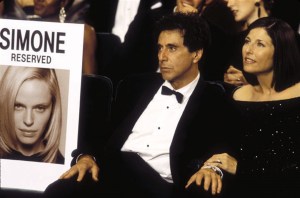 Writer/director Andrew Niccol (Gattaca) has some fun with the premise but tries to have his cake and eat it too when it comes to his satire. S1mone starts out satirizing egotistical stars, then the Hollywood system, then the press, then the public as star worshipers. The movie is all over the map trying to have something witty to say about all these different topics but is too busy to settle down on any one for a while. The satire S1mone embodies feels deflated from all the work it’s trying to do.
Pacino has always been able to do comedy but seems wearier than ever. He indulges in his comic like over-the-top aggression he’s been doing since Dick Tracy. Keener plays another of her icy businesswomen roles although she thaws quite easily and quickly in the film.
There’s a rather funny subplot involving Pruitt Taylor Vince and Jason Schwartzman as tabloid reporters on the prowl of the elusive Simone that deserves much more attention than it gets. The bulk of the movie could have been these two entertaining characters.
 When Taransky finds that his creation has become more than he can handle he tries to discredit her through a series of very funny public appearances and avante garde film choices. But then S1mone sadly goes back to its more mediocre roots. Taransky tries to get rid of Simone but it all horribly backfires.
As the film progresses you start to realize all the gaping holes that come up – like how can Taransky, a self-described computer illiterate, handle the most technical computer program of all time? How come no one would find out that Simone lacks a birth certificate, social security number or even tax records for her studio work? And why does the audience have to sit through the disgustingly cute daughter of Taransky and Keener, who just happens to be a computer whiz-kid, besides the fact she’ll have a late fourth quarter save of dad?
It’s not that S1mone is necessarily a bad film; it just has this missing piece to it when you watch it. Some scenes are funny, many drag, and the whole thing needed to be tighter and punchier. And to clear up any confusion, it is indeed an ACTRESS who plays Simone. Her name is Rachel Roberts.
Nate’s Grade: C+
Share this:

XXX (2002)
 By the time you see Vin Diesel surf on a snack tray in his pimp coat you’ll know there is no hope for humanity anymore. Easily the dumbest action movie ever that doesn’t have Steven Seagal’s name to it.
Nate’s Grade: D
Share this:

Austin Powers in Goldmember (2002)
 Is anyone else getting tired of watching the same re-heated jokes again and again with the Austin Powers franchise? Making Goldmember is basically considered money in the bank, so I’m sure the creative people toiling behind the scenes don’t want to rock to boat of a financially proven formula. But when you become creatively stagnant then what was once entertaining turns sadly redundant.
I think there was four actual things I laughed at in the whole movie, and that in no way should justify admission price. I might be alone in my thinking but I feel the Austin Powers spy-spoof series is just getting less and less funny the more financially successful it becomes. Do we need to see more scenes with the grotesque and unfunny Fat Bastard? Do we need more scenes with the requisite underwritten female role (this time played by Beyonce Knowles)? And do we really need Austin at all? I mean if you want to talk about the weak link in this comedy troupe, it’s the name bearer himself. Whenever the film has to switch back to Powers the comedy drops to the floor. I would gladly pay good money to see an entire Dr. Evil movie. Michael Caine is the only solid addition to this movie.
It doesn’t matter what goes on in this some hour and forty minutes of screen time, because it will be huge. Many of the jokes fall flat, are devoid of wit, and just go for the cheapest and most scatological way out. Im not saying I expected much seeing the latest Austin Powers movie but I did expect to laugh, and not doing so is the biggest sin for a comedy.
Nate’s Grade: C
Share this:

K-19: The Widowmaker (2002)
 There’s a rule of thumb I’ve come to find in Hollywood, something so certain you could set your watch to it. No, not the Emmys nominating Frasier for everything. I’m talking about man-owl Larry King, who seems to dabble in the land of film reviews. Kindly readers beware, if you see an ad for a film and it has Larry King’s salivating blurb in it, run away. Run away like the plague, like Pamplona. Just run. The only films I can remember off hand (though this theory has come true every time) are 15 Minutes and Wind Talkers. And now there is the horrifically titled sub-sub movie K-19: The Widowmaker.
K-19 should not be confused with K-9, the Jim Belushi teams up with a dog to fight crime film. No this one takes place in the early 60s in the thicket of the Cold War. An opening title sequence tells us Russia has enough nuclear weapons to blow up the world two times, but the United States has enough to blow up the world six times over. Whoo! U-S-A! The maker of widows is itself a docked submarine in the Russian navy in preparation for combat. Before it even leaves the shore it is said to be cursed, having five men die already from its widow maker-y hands. Liam Neeson is the captain of K-19 and well respected and beloved by his crew. However, Neeson is willing to put the lives of his men ahead of the agenda of the state, so the Communist government places Harrison Ford on the sub and gives him the reigns of command. Ford is a rigorous taskmaster who puts his men through countless drills and does not exactly see eye-to-eye with the more empathetic Neeson.
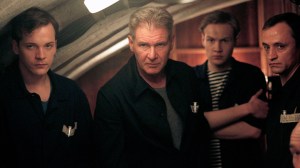 The story’s real turn comes about midway in, when after successfully launching a test missile above the arctic ice the nuclear core of the sub springs a leak. If something is not done to slow down the heating core the men could be vaporized in a mushroom cloud. Except that patrolling the waters nearby is a Unites States destroyer and thus would be destroyed as well, surely igniting the start of World War III. Crew members take shifts to enter the radioactive filled core area to try and do what they can. The situation gets even direr when the men come out looking like something from a George Romero film.
K-19‘s biggest fault is fictionalizing what would have been an interesting hour block on The History Channel. The Neeson and Ford characters feel like two sides of a debate, not exactly characters. The whole movie has been Americanized with heroic proportions. Instead of compelling drama were left adrift with what the studio wants as a summer movie with material that should no way be associated with it. I mean, the horribly dishonest marketing campaign actually has a crew member shout ”Torpedo headed straight for us!” then shows a torpedo surging ahead. There was never a torpedo in the entire movie or a scene where they were being attacked! Somewhere in this ho-hum story is an exciting tale of the courage these men were forced into as well as the strain of not being able to tell their friends or family about anything that happened.
Submarine movies have so many limitations to them thats its hard to make a unique one anymore. Everyone knows there’ll be a point where they go beyond THE RED AREA with the needle and hear the hull ache and creak. Everyone knows they’ll have to stop an onslaught of water leaking. Everyone knows that if you talk about writing a letter to your girlfriend at home in case you die well, the fates have it in for you. Either you love seeing these things a million times in cramped space or you grow tired of the expectations.
 Director Kathryn Bigalow (Strange Days) manages to give it the ole college try with the long camera movements inside and the close-ups of men glaring at one another. Although technically able, Bigalow doesn’t do anything to transcend the limitations she has to work with. And while she meets her mark as a director it is neither spectacular nor worthwhile.
Ford has a horrible Russian accent he likes to flirt around with through the film. I dont exactly know if people are supposed to like his character, being rigid and pragmatic at the expense of human life. Neeson, on the other hand, is quite capable and shines in his role. The rest of the crew alternates between Russian accents to even some Australian ones I heard.
K-19: The Widowmaker tells us that this story could not be told until the fall of communism, except at the end it shows a clip of the Berlin Wall coming down and the crew then gathering to finally remember their fallen comrades. Some people just don’t have their dates right, and some people just don’t know how to take an interesting unknown slice of history and tell it well. Damn you Larry King.
Nate’s Grade: C
Share this:

Halloween: Resurrection (2002)
 So, what could be timelier than releasing a Halloween slasher film around
July? The plot (i.e. flimsy device to set up killing horny teenagers by) is something that you might actually see on MTVs Fear show. Busta Rhymes is the head of an online entertainment company and has proposed a contest where the lucky few get to spend a night in the creakily and poorly lit house of serial killer Michael Myers. Their prize seems to be nothing more than the notoriety of being seen live on the net. College student Sara Moyer (Bianca Kajlich) is one of the lucky winners along with her stars-in-her-eyes gal pal and culinary obsessed friend (Save the Last Dance’s Sean Patrick Thomas). Some other people get picked including the requisite smart girl and weird guy. And then there’s the horn dog played by the insufferable Thomas Ian Nicholas of American Pie fame. For some randomly selected process its kind of odd that three people who are all good friends got picked. Eh, oh well.
So, what could be timelier than releasing a Halloween slasher film around
July? The plot (i.e. flimsy device to set up killing horny teenagers by) is something that you might actually see on MTVs Fear show. Busta Rhymes is the head of an online entertainment company and has proposed a contest where the lucky few get to spend a night in the creakily and poorly lit house of serial killer Michael Myers. Their prize seems to be nothing more than the notoriety of being seen live on the net. College student Sara Moyer (Bianca Kajlich) is one of the lucky winners along with her stars-in-her-eyes gal pal and culinary obsessed friend (Save the Last Dance’s Sean Patrick Thomas). Some other people get picked including the requisite smart girl and weird guy. And then there’s the horn dog played by the insufferable Thomas Ian Nicholas of American Pie fame. For some randomly selected process its kind of odd that three people who are all good friends got picked. Eh, oh well.
Anyway, the kids go exploring through the decrepit remains of the house with cameras strapped to their heads. Why the house wasn’t knocked down after the first baker’s dozen of murders is anyones guess. The kids try and look for any clues to explain the psychological nature of Mr. Hack-N-Slash. Michael Myers eventually makes a homecoming complete with his favorite set of cutlery and goes to town. People go missing and eventually the participants, with Busta at the wheel, figure out that this whole thing ain’t make believe.
 Now this movie could have been a lot worse, although the scene where Myers kills a cameraman with a tripod leg is dearly pushing it. Jamie Lee Curtis even shows up for about five minuets in the beginning before having an early confrontation with Myers. Let’s just say that Curtis seemed to want out bad, and realistically who can blame her?
I realize there are certain leaps of logic when even entering into the darkened theater to take in a slasher flick, but Halloween: Resurrection doesn’t just defy logic, it slaps you across the face with it like a cold fish. Myers is no super human entity, to the contrary, and should actually be pushing 50. But man, can he still jump out of walls needlessly like the Kool-Aid man. And can he still dangle from poles with one arm like a champ. Talk about upper body strength.
There’s a scene toward the beginning of the film in the basement of the mental hospital Jamie Lee resides in. Two guards retreat down there and one of them stops to purchase a vending machine goodie while the other goes ahead only to meet his doom. The lone guard now timidly searches around the nearby laundry machines and discovers his colleagues head inside the tumbling machine. If you look closely, and do some marginal thinking, youll find out that in order to achieve this spook Mr. Myers actually had to put money into the laundry machine. Talk about your commitment to fear.
 This whole bloody ordeal is streamed live across the Internet with something like 50 camera choices. Now the Internet, if no one told you, is not exactly a small thing. Wouldn’t someONE someWHERE be watching one of the camera angles where they DO happen to see the killings and phone someone? Maybe everyone in the world just has a dial-up modem. You must realize that this bare-bones cheesy reality show concept was likely from everyone making a movie as they went along.
Let’s face it folks, the thrill of this whole thing is gone. Somewhere along the way, I’m guessing 1983, the whole concept just got stagnant and poorly executed. But now with the rise (or resurrection if you will) of the slasher genre in our post-irony world we get things like Jason in Space! And Michael Myers in an episode of MTVs Fear! The draw is supposed to be the tightly wound suspense but, and maybe it’s just me, where is the suspense when you could care less about the cheese-heads that are supposed to be the heroes and you KNOW what’s going to happen to them?
Busta Rhymes, the thespian, is going to need more time to hone his craft. LL Cool J took up the rapper-come-Halloween-victim role in the last film, 1998’s Halloween: H20 (which flagrantly did not take place underwater at all). To compare the acting prowess of the two rappers is like questioning the cooking ability of the Star Trek starship captains. It’s just very inconsequential and should never be asked rightfully. Tyra Banks is in this movie for some reason even though her scenes account for about a weekend of work. Everyone else in the cast is forgettable, even the cute Uma Thurman-looking redhead who has the most head-scratching nude scene in an underground crypt.
Halloween: Resurrection is sloppy, dumb and above all things not scary. It seems Michael Myers is the ultimate boogey man – he’s survived seven straight duds.
Nate’s Grade: C-
Share this:

Mr. Deeds (2002)
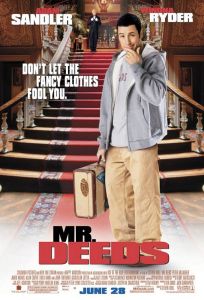 Adam Sandler seems like the reason they created the “no shirt no shoes” policy for restaurants. His niche is playing the lovable goodhearted goofball that triumph over the pretentious jackass and somehow wins the heart of the fawning one-dimensional love interest. Sandler appeals to the masses as our nation’s greatest warm-hearted simpleton. He’s the Jimmy Stewart of slobbery. So why mess with that? Well for starters, if you want entertainment anymore you might want to.
Mr. Deeds, Sandler’s latest idiot opus, is disastrously, even tragically unfunny. In the film Sandler stars as the only known heir of a multi-billionaire media mogul. Longfellow Deeds (Sandler) is a simple New Hampshire pizza delivery boy who treats people with respect and kindness. However, the mantra cruel to be kind must be alive and well because Sandler mercilessly beats people to about an inch of their life throughout Mr. Deeds for brutish comic effect.
 Peter Gallagher and his monstrous eyebrows serve as the stand-in villain. Hes a greedy tycoon who wants the Deeds fortune all to himself. Gallagher actually plays his part well and seems to at least have some fun with the broad comedy role. Wynona Ryder, on the other hand, does not. Ryder has never proven she can handle any comedy other than black, and slapstick just ain’t her thing. She painfully goes from scene to scene clueless as a tabloid journalist hiding her identity so she can get the scoop on Deeds, only to fall madly in love with him.
The film has some glimmers of comedy, mostly from its supporting cast including John Turturro as a very sneaky Spanish butler. It’s nice to see Turturro in something this high profile and get some recognition this journeyman deserves. There’s also a really funny cameo served up by a former tennis giant himself known for his boorish temperament. Steve Buscemi should be charged with grand theft movie because his three minutes on screen as the crazy-eyed local are funnier than anything with Sandler onscreen.
 The movie becomes far too redundant of Sandler’s other comedies to the point where seeing former stars like Rob Schneider in his Big Daddy character is somehow supposed to be funny. This kind of stuff is strewn throughout the film. It feels like everyone’s going through the motions. Now I’m not a total Sandler basher, because I do believe the man can be funny when worked right. Billy Madison is still hysterical to me upon every viewing and I do get some fun watching The Wedding Singer, but Mr. Deeds is sub-par Sandler even for Sandler.
I’m sure most of the people buying tickets for this have no idea that the concept is based upon the Capra film starring Gary Cooper. But what good is Gary Cooper? He didn’t write cutesy greeting cards or save a litter of kittens from a raging inferno like Sandler’s Deeds. In the end, this mostly laugh-free comedy is short on imagination, energy and entertainment.
Nate’s Grade: C-


You must be logged in to post a comment.