Author Archives: natezoebl
The Time Machine (2002)
 The Time Machine is one of the most famous works of fiction in history. It was writen long long ago by the great H.G. Wells. It presents a fantasy glimpse into our future, but in it Wells also gave readers the opportunity to ponder what would happen if they could go back and change their own lives. People have used the story as a cautionary allegory to our own times, like the 1960 film version of The Time Machine. Now, a bigger budget Hollywood remake attempts to put another spin on the Wells classic.
Alexander Hartdegen (Guy Pearce) is an absent-minded professor interested in cracking down the physics of time. He’s chided by some of his peers for crackpot theories and his fascination with any new gadget. He’s supposed to meet Emma (Sienna Guillory) at Central Park and tonight’s the big night he plans to propose to her. He eventually catches up to Emma and the two go strolling off into the park. Shortly after popping the question the two become victims of a mugging and in the fray Emma is left dead. The death drives Alex to create his fanciful time machine, which only happens to take four years time.
Alex gives his big brass LA-Z-Boy looking machine a try and travels back to that fateful night to avoid Emma’s death. Alex avoids the mugger all right, but while purchasing flowers his fiancé gets plowed over by a runaway carriage instead. It seems that one cannot change the past. Alex decides to give the future a chance and travels to a very Back to the Future 2 looking 2037. Someone astutely asks Alex if his time traveling machine makes a good cappuccino.
 When Alex hops a little further into the future the moon is breaking up because of ill-fated lunar construction. Moon rocks are hurtling toward the surface and disrupting everyone’s day. (It was in this moment that a scene of rocks smashing into the World Trade Center was cut for taste) Alex jumps back into his machine but is konked out by some lunar cheese and falls asleep at the wheel. The next thing you know Alex is in a mysterious future world.
The place where The Time Machine really bogs down is once Alex arrives in 80,000 something or other. The child-like thrills and adventure of Alex zipping between the past and near future are buried underneath the standard post-apocalyptic movie world. The people dress in loin cloths and rags (though some of the female natives wear revealing tops that look like see-through chain mail) but still have perfect teeth. When Alex doesn’t understand the linguistics of 80,000 AD the next words that he hears are English from shapely native Mara (pop star Samantha Mumba). It’s amazing that English survived 81,000 years when Latin didn’t last a mere 2,000 and change.
It turns out these people who live in huts resembling hot air balloons along the faces of cliffs are called Eloi. The Eloi don’t have anyone looking old enough to carry an AARP membership and are apprehensive to speak of why. Perhaps it’s because creatures resembling something that would belong in The Mummy Returns pop up from the sand to capture whatever slow moving prey they can and return to for an underground feast.
The creatures, called Morlocks, are the offshoots of evolution. Seems after the whole moon destruction thing (whoops!) those who took refuge below the surface have evolved into dusty hunchbacked cannibals. Their rowdy ranks are controlled by Uber-Morlock (I’m not making up that name) who resembles an albino bassist for Poison or Skid Row. It’s actually acclaimed actor Jeremy Irons under all that pancake makeup and fleshy spine-showing prosthetic. The less said about Irons the better.
It’s during this part that The Time Machine reverts into a half-baked Stargate. Alex encourages the Eloi race to stand up to their oppressors and fight for their freedom. He becomes part of the Eloi community, rallies the troops into rebellion, and also has to save the damsel in distress.
The Time Machine remake isn’t the political statement the 1960 film was on man’s folly with technology, particularly nuclear weapons. What this suped-up version is all about is special effects and plenty of them. The effects are for the most part dazzling, especially the scene where Alex travels to 2037 and we see the development of New York City with skyscrapers assembling themselves.
 Simon Wells (The Prince of Egypt) directed this remake and is actually the great-grandson of the famous adventure’s author, H. G. Wells. Trivial Pursuit fans everywhere rejoice. Wells had to sit out the last 18 days of shooting due to “exhaustion” and Gore Verbinsky came off the bench to finish the directorial duties. The film clocks in at a scant 90 minutes but there are definite moments of drag.
Pearce (Memento) is a hunky hero and for the most part is admirably gung-ho with the role. Samantha Mumba’s motivation must have been to stand and look pretty the entire film, which is all she really does. To think that Mumba might be the most talented of the recent singers-come-actors (Mandy Moore and Britney Spears) is a distressing thought all its own.
As The Time Machine kept dragging into its Mumba-filled period I began day dreaming of an alternate, darkly comic version. In my head, Pearce’s character keeps traveling back again and again to save his beloved only to lose her a different way each time. I could picture a humorous montage of his girlfriend dying an assortment of colorful deaths and Pearce just getting more frustrated and jaded. I could picture them skating only to have her plunge below the ice. I could picture the couple dining at a fine restaurant only to have her choke and Pearce just throw his napkin onto the table and sigh loudly. I was enjoying my alternate take on The Time Machine so much that I didn’t want to return to the one that was playing.
The Time Machine has its moments of thrills and excitement but they are mostly condensed to the opening third. This remake doesn’t have the political edge or wow-factor the original did. It plays more to the rules of conventional Hollywood than the wide open possibilities Wells wrote about. Pearce tries valiantly and the special effects are really something, but more often than not The Time Machine is not worth your time.
Nate’s Grade: C
Share this:

We Were Soldiers (2002)
 Randall Wallace and Gibson last teamed up on Braveheart and came away with a bushel of gold statuettes. Their latest collaboration is a Vietnam war flick called We Were Soldiers based upon the novel by Lt. Col. Hal Moore and photographer Joe Galloway. It details the chaos of the battle at Ia Drang where 400 US soldiers were surrounded in a valley by 2000 North Vietnamese fighters and held their own for three long days.
The opening chunk of We Were Soldiers concerns the domestic side of the soldiers. Lt. Col. Hal Moore (Mel Gibson) is a man of great honor and battlefield heroics complete with five kids and a determined and loving wife Julie (Madeleine Stowe). Does anyone have any problems identifying the hero yet? Moore has been commanded to assemble an inexperienced band of soldiers and mold them into the 7th Cavalry division. His men include new father Lt. Jack Geoghegan (Chris Klein), helicopter pilot Maj. Bruce Crandall (Greg Kinnear) and grizzled veteran Sgt.-Maj. Basil Plumley (Sam Elliott). They’ve been called in to be apart of one of the first strikes of the Vietnam War in 1965. Gibson rallies the troops and they head toward the East. What followed could be deemed a suicide mission as the 7th Cavalry and other divisions were surrounded by the advancing Vietcong and fought to the teeth for their survival.
Director Randall Wallace (who last directed and adapted for the screen Man in the Iron Mask) is a director that doesn’t know a thing about subtlety in his mess of patriotism. Wallace just doesn’t hammer his points and views; he’ll bludgeon you to death with them. Gibson ensures his men that he will be the first one into battle and the last to leave. Sure enough, as the helicopter is setting down we see a big close-up of Gibson’s boot hitting the earth and a thunderous echo follows. The point has been made. Wallace also manages to squeeze in a bit where he can skewer the media. A horde of reporters show up at the end of the battle, ducking at any noise they hear, and stick their mics in Gibson’s face asking absurd questions like “How do you feel about the loss of your men?” Oh Wallace, you are such a shrewd satirist.
 The violence in the film is incredibly graphic, as with the tradition of most recent war movies like Black Hawk Down. The violence almost reaches a sadistic level where we see slow motion shot after shot of people with a geyser of blood spewing from head wounds. The blood flows freely and often but loses its impact. I would even go as far as saying that much of the violence in ‘We Were Soldiers’ is overkill under Wallace.
The makeup that accompanies some of the battle wounds is surprisingly disappointing (as is a lot in the film). One character, after an accidental blast from napalm, has half his head looking like a burnt marshmallow. The shoddiness of the look inspires more laughs under your breath than gasps.
The battle of Ia Drang shows reactions from both sides of those fighting. Every now and then the film cuts back to the Vietnamese side in their underground lair. The leadership over explains all their strategic movements in large flailing gestures. It’s like a cheap play-by-play for the audience. We Were Soldiers also follows the recent trend of trying to humanize the enemy. But these attempts are easily seen as the hollow politically correct handouts that they are. One scene shows a Vietnamese soldier writing in a book to his honey back home. It’s nice to see clichés transcend ethnicity.
 The film succumbs to the usual war movie clichés and Hollywood formula. The problem with making a supposed “emotional” Vietnam movie is that the definitive Vietnam movies concerning the madness of battle (Apocalypse Now and Platoon) and the crippling after-effects (The Deer Hunter and Born on the Fourth of July) have already been made. We Were Soldiers portrays Vietnam before the politics got in the way and concentrates on the courage of the men who dutifully entered into battle at the heed of their country’s call. I can’t help but feel that the men who bled and died in that battle don’t deserve a better movie.
Gibson as Moore gives a stoic performance and adds a level of humor to the figure, but there’s no questioning the mettle of this soldier. Gibson’s character is almost an exaggerated propaganda action figure. Moore’s courage is unquestionable and that’s the way they want it. Madeleine Stowe is a terrific actress but is generally wasted here. Most of the movie she spends her time hugging people while wearing some horrible Cher wig and looking eerily like Hillary Swank in The Gift. Chris Klein looks entirely out of place, as does his wife played by curly-coifed Felicity actress Keri Russell. Greg Kinnear spends the entire movie sitting in a helicopter chair barely seen. They could have saved some money and hired an extra.
We Were Soldiers is an okay film but it should have been much more. Gibson elevates what could have been worse but Wallace isn’t doing the film any justice. Wallace is too heavy-handed with his direction and flag-waving message and seems to have his film begging to be taken seriously. We Were Soldiers can pass the time all right, but there are better things you could do then watch this force-fed old-fashioned narrative.
Nate’s Grade: C
Share this:

Crossroads (2002)
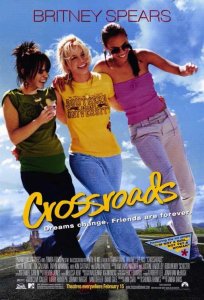 When informed that her feature film debut was receiving shrieks of laughter during advanced screenings for critics, Britney Spears said she was glad because she never likes the same films the critics do. Well Ms. Not That Innocent, the truth hurts; you’re not a girl, not yet an actress. Crossroads is really the filmic adventures of Britney Spears and her ever-present navel. The navel should get second billing, but alas, we do not live in a society of equality for navels.
The film opens up with three 10-year-old best friends burying a box of wishes and dreams and promising to be bestest friends forever and ever. They make a pact to come back and dig up the box on the night of their high school graduation. Flash to the present and the word “bestest” isn’t what it used to be. Lucy (Britney Spears) has become the virginal nerd preparing to give her speech as valedictorian. Kit (Zoe Saldana) has become the haughty popular snob, obsessed over getting married ever since she got her first Bridal Barbie. Mimi (Taryn Manning) is pregnant and become the trailer trash girl that everyone sees fit to remind her of. Despite their growth apart they all do come together to reopen their box of dreams. Mimi informs the others that she plans to head to California to audition for a record deal in an open contest. Kit decides to use this opportunity to check up on her boyfriend at UCLA who has been strangely evasive. Lucy complains that by having her nose in a book her entire high school experience she never got to go to a football game or even “hang out.” Somewhere a small violin is playing. She decides to jump at this chance and possibly see her mother in Arizona, who ran out on Lucy and her father (Dan Akroyd) when she was only three. The wheels of their adventure are provided by guitar-playing mystery Ben (Anson Mount). He pilots them on their travels to the Pacific coast, though the girls think he might have killed someone, but oh well.
 Crossroads is filled to the brim with every imaginable road trip cliché. The girls “open up” after getting drunk, have a scuffle in a bar, reap in the sights of nature, and perhaps create some sparks of romance with their hunky heartthrob of a driver. The car also inevitably breaks down and the girls have to find a way to scrape some quick cash together. They enter in a karaoke contest and Britney proceeds to sing Joan Jett’s “I Love Rock and Roll” with her two gal pals providing backup. But no, this isn’t the last time you’ll hear Ms. Brit sing. In an effort to pad as well as become a showcase for its star, Crossroads gives us many scenes of the girls just singing to the radio. Besides Jett, Shania Twain’s “Man I Feel Like a Woman” and Sheryl Crow’s “If It Makes You Happy” are also on the chopping block. You’ll also be accosted by the movie’s single “Not a Girl, Not Yet a Woman” several times, including one scene where Poet Britney is asked to share her poem and it ends up being the song’s lyrics.
Saldana (Center Stage) is not given much, as the attention is always centered on Britney, so she merely comes off like a token conceited character. Only Taryn Manning (crazy/beautiful) comes away with a little dignity. She gives Mimi a lot more heart than should be there and shows some honest reflections for her character. She also, coincidentally enough, looks like a dead ringer for Joan Jett with her black bangs.
Crossroads is nothing but a star vanity project for Spears, with some not-so-subliminal Pepsi product placement here and there. This was not a script looking for a lead; this was something Britney’s management team suited for her, and Crossroads is perfectly suited for Britney. It allows for many ogling periods of booty shaking. The majority of the film’s drama doesn’t even concern her, and when she does have to act her scenes are cut short to help her when the real drama unfolds. The movie’s true intentions are revealed when Britney is shown in her pink underwear twice in the first 15 minutes.
 Crossroads moves along on gratuitous skin shots of Spears half-naked body every 20 minutes until it reaches its torture chamber of a final act. In this very melodramatic period we get abandonment, date rape, infidelity, and even a miscarriage in one of the film’s most shameless plot devices. Of course none of these horrors matter, especially a psychologically damaging miscarriage, because Britney has to get to her BIG audition in order to perform, yep you guessed it, “I’m Not a Girl, Not Yet a Woman.” She also has to wear what looks like kitchen drapes while she sings.
You’ll walk out of the theater wondering many things. Why does Britney wear pink in EVERY single scene she’s in? There’s even one scene where she changes from a pink top to another pink top and is FOLDING a third pink top into a suitcase. Are we to believe that Akroyd and Spears share some kind of genetics? In what high school would Britney be considered a nerd?
Hopefully Crossroads will be the pop princess’ last foray into film, but I strongly doubt this is the last we’ve seen of Britney Spears. Crossroads is a terrible girl-power trip. Only Spears’ target demographic will enjoy this melodramatic mess. Truly, the two largest groups that will see this film are adolescent girls and creepy older men who fawn after adolescent girls. Crossroads is exactly everything you’d expect.
Nate’s Grade: F
Share this:

Donnie Darko (2001)
 Donnie Darko (Jake Gyllenhaal) is your normal malcontent teenager in late 1980s Reagan America. He bickers with his older sister, worries over the right moment he’ll kiss his new girlfriend, and tries to ignore the advice of many imprudent adults. Donnie’s your typical teenager, except for his imaginary friend Frank. Frank is a sinister looking six-foot tall rabbit that encourages Donnie into mischief and gives a countdown to the impending apocalypse. And I haven’t even gotten to the time travel yet.
One night as Donnie wanders from his home at the behest of Frank, an airline engine mysteriously crashes through the Darko home and lands directly in Donnie’s room. The airlines are all at a loss for explanation, as it seems no one will take responsibility for the engine or knows where it came from. Donnie becomes a mild celebrity at school and initiates a relationship with a new girl, Gretchen Ross (Jena Malone). One of his classes consists of watching videos of self-help guru and new age enlightenment pitchman Jim Cunningham (Patrick Swayze). His school has even, under the persistence of self-righteous pain Kitty Farmer, persuaded Cunningham to speak and try to help students conquer their “fears.”
 Donnie is also seeing a therapist for his emotional problems and taking medication for borderline schizophrenia. Around this time is when Donnie starts to inquire about a strange old woman, obsess over the possibilities of time travel, as well as see weird phosphorescent pools extend from people’s chests. He also floods his school at the urging of Frank. This is no Harvey type rabbit.
The longer Donnie Darko goes on the more tightly complex and imaginative the story gets. First time writer-director Richard Kelly has forged an excitingly original film that is incredibly engaging with charm and wit. He masterfully mixes themes of alienation, dark comedy, romance, science fiction, and a sublime satire of high school. Donnie Darko is the most unique, head-trip of a movie unleashed on the public since Being John Malkovich. Kelly has a created an astonishing breakthrough for himself and has ensured he is a talent to look out for in the future.
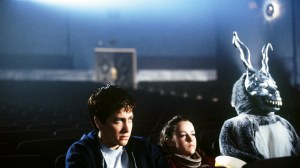 Gyllenhaal (October Sky) is superb as disenchanted Donnie, a Holden Caulfield for middle suburbia. His ghastly stare conveys the darkness of Donnie but his laid-back nature allows the audience to care about what could have merely been another angst-ridden teenager. Swayze is hysterical as the scenery-chewing Cunningham. The rest of the cast is mainly underwritten in their roles, including stars Drew Barrymore (who was executive producer) and ER‘s Noah Wyle, but all perform admirably with the amount they are given. Not every plot thread is exactly tidied up but this can easily be forgiven.
Donnie Darko is a film that demands your intelligence and requires you to stay on your toes, so you can forget any bathroom breaks. The film is one of the best of 2001 but also one of the funniest. You’ll be honestly surprised the amount of times you laugh out loud with this flick. The theater I saw this in erupted every half a minute or so with boisterous laughter.
Donnie Darko is a film of daring skill and great imagination. You don’t see too many of these around anymore.
Nate’s Grade: A
Reviewed 20 years later as part of the “Reviews Re-View: 2001” article.
Share this:

Monster’s Ball (2001)
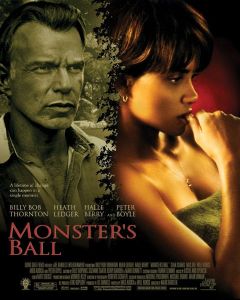 Monster’s Ball has already garnered two Oscar nominations, including one for the lovely Halle Berry for Best Actress, and received numerous end of the year accolades. Is Monster’s Ball the startling ruminations on race that you’re being told? Well
yes and no.
Set in the South, Hank Grotowski (Billy Bob Thornton) and his son Sonny (Heath Ledger) are prison guards at the state penitentiary and preparing for an execution. The man to die is Lawrence Musgrove (Sean Combs) who will be leaving behind an overweight young son and making a widow out of Leticia (Halle Berry). The tension in the Grotowski home escalates especially as Hank has chosen to care for his own ailing father (Peter Boyle), who still finds the time to spout out racist rhetoric through an oxygen mask. One last confrontation leaves a permanent mark of emptiness on the family.
 Leticia is struggling to just make ends meet and fight an impending eviction. Her car keeps breaking down on her, she’s been let go from her job as a waitress and she has to raise a son by herself all the while trying to encourage him to lose weight. Leticia is breaking down and her world around her is crumbling. One night Leticia gets into an accident walking home along the roadside and needs assistance badly. The one who pulls the car aside to help is actually Hank. As time goes by he helps Leticia however he can whether its giving her a ride home from the diner or just staying with her so she won’t be alone.
Hank and Leticia come together out of mutual need and grief. They are two people entirely wrong for each other that kindle a passion that seems to transcend race. Leticia needs someone to take care of her, after having a husband on death row and fighting to stay above the poverty line. Hank needs someone to take care of, out of a mixture of compounded loneliness and grief.
Thornton reprises the repressed protagonist of The Man Who Wasn’t There with his portrayal of Hank. His lips are pursed, looking a tad like Mr. Limpet, and he expresses more with a furrowed brow and stare than words could manage. Thornton’s performance is good, and the audience does really end up rooting for Hank, but the performance doesn’t resonate, possibly because of the writing for the character. I guess one could say Monster’s Ball is Halle Berry’s legitimization as an actress. Berry gives the performance of her career and has moments where she’s on the verge of ripping your heart out.
Monster’s Ball is not exactly the scorching portrait of race relations that it has been hyped to be. It’s really more of a story about two characters with race being underscored except for a convenient occasion where it can become the catalyst to a fight.
The film also takes some of its metaphors rather simply. The connection between father and son includes Hank and Sonny using the same prostitute. Hank eats every night in the same diner and always orders a bowl of chocolate ice cream (get it?) and black coffee (get it?).
 All the ballyhoo over the explicit sex scene (thank you so much news-fluff) is undeserving. The sex scene is no different than a hundred seen before and many on Showtime during the late hours. The scene serves its purpose thematically in the story for its characters but it really isn’t “hot and steamy” as it’s been dubbed to be. Move along, folks.
Besides the acting Monster’s Ball has some other accomplishments up its sleeve. The cinematography is gorgeous and uses lights and darks to an incredibly effective degree. There are many scenes where you might be paying more attention to how the scene looks than the scene itself. The music is also commendable for the simple task of not becoming intrusive and actually enhancing the story. This is what scores are intended to do.
Monster’s Ball may be the biggest suck-in-air-uncomfortably movie to come out in a long time. I found myself enacting this measure every time someone did something horrible, said something racists or surprisingly died. This may be because I had the entire theater to myself for my own amusement. Monster’s Ball is certainly a well-written and well-acted film. It’s just not up to snuff when it comes to Best Picture speculation.
Nate’s Grade: B
Reviewed 20 years later as part of the “Reviews Re-View: 2001” article.
Share this:

Rollerball (2002)
 The year is 2005 and the number one sport, at least in the former Soviet Union for some reason, is a mixture of roller derby, football and some kind of ESPN X-game. The man behind Rollerball is Alexi Petrovich (Jean Reno), who still thirsts for that lucrative cable contract with the U.S. and just might do anything to get it. Play suspicious music here.
Jonathan Cross (Chris Klein) is an NHL draft pick in trouble with the law after a stupid high speed street race. His pal Marcus Ridley (LL Cool J) tells him of a new extreme sport catching on in Central Asia, and Jonathan accepts his offer. The two are enjoying their success in Spandex but start to have reservations when they notice Petrovich including more violence as a ratings booster. Jonathan can’t just look the other way. Because he’s the good guy. So after a botched escape (shot infuriatingly all in what seems like night vision green) he collects his fellow ballers to rebel against Petrovich and whatever. As you can easily see, the story of Rollerball is not exactly its strong point. Not that there is a strong point in Rollerball.
 The original Rollerball came out in 1975 and was full of political themes like corporate dictatorships and Orwellian observations on a dominated, passive society where war and nationalism have been replaced with a roller sport. Though the themes of this James Caan vehicle were a bit heavy-handed at times, the action was rather impressive especially as the corporations try their best to squash Caan in a bloody onslaught of an ending. The 1975 Rollerball had a political message and some nice action. What does the 2002 version have? Try banality and plenty of it.
Klein came to the limelight through movies like American Pie and Election, and if his dimwitted deer-in-headlights look wasn’t doing it for you before then God help you with his performance in Rollerball. Rebecca Romijn-Stamos plays Klein’s teammate and lover on the Rollerball circuit. Reno deserves a trophy for even delivering the majority of his lines with a straight face.
Oh how the mighty have fallen John McTiernan. You once directed such great 80s action movies like Die Hard, The Hunt for the Red October, and Predator but now you spend your days remaking old Norman Jewison films. It began with the lukewarm remake of The Thomas Crown Affair and now a boring re-cooking of Rollerball follows it up. Can a remake of F.I.S.T. or Fiddler on the Roof be the only thing we have to look forward to now?
 The most jarring problem with Rollerball, and there are so many to choose from, is the hack editing choices made. The way the movie plays one wonders if they threw all their footage in a wood chipper and grabbed whatever pieces they could and glued them into a movie. Scenes exist but appear in no discernible pattern or order. All one sees in their chair is a whirl of colors and you might be wondering if you stepped into Kaleidoscope: The Motion Picture.
The story behind this Rollerball was that it was originally slated to come out August of 2001 but after test screenings that left people howling the studio bumped it to the winter and cut it from an R to a more commercial PG-13. Lost in this cost-cutting maneuver are gore (which you would think would be important for a violent future gladiator sport) and a nude scene involving Romijn-Stamos. Which version would you have rather seen?
Rollerball is a laughably noisy and empty film that will leave your head spinning for all the wrong reasons. It’s likely the worst flick you’ll see for 2002 right now, that is, until the following week when Britney’s near-certain train wreck of a film debut opens. But until that time Rollerball is the true champion – of boredom and stupidity.
Nate’s Grade: D
Share this:

Training Day (2001)
 Denzel Washington won an Oscar for this? Instead of Malcolm X? For THIS?! Yes he gets to huff and puff as he plays against type as a dirty cop, but is this reason alone to give an Academy Award to such a forgettable and collectively implausible film? Ethan Hawk, his co-star, is actually better in the film. All I can say is right actor, wrong movie. It’s like rewarding Kevin Spacey for Pay It Forward over the other screamingly better movies. It doesn’t make sense. There are plenty of hip-hop stars making cameos or small roles (Dr. Dre, Snoop, Macy Gray) but most of the time Training Day feels like tired and dead air especially as the contrivances begin to pile onto one another the longer this day goes. And Denzel is huffing and puffing but the house still stands. Man, the voters must really have not wanted Russell Crowe to win.
Nate’s Grade: C-
Share this:

The Count of Monte Cristo (2002)
 Call it swash without the buckle. While The Count of Monte Cristo does an adequate job of telling the Alexander Dumas story (heavily editing chapters and making the leads friends in this version) the whole experience feels very rote. The sword fighting scenes are nowhere what they were billed as and the direction is surprisingly lackluster. Only the actors allow this film to arise mediocrity particularly with a devious turn from Guy Pierce (Memento). Kevin Reynolds (Robin Hood: Prince of Thieves) directed this film and proves he doesn’t need Kevin Costner to screw something up. Somewhere Costner is laughing. Actually, somewhere Costner is likely crying in his beer wondering what happened to him. “I was the king of the cinema…”
Nate’s Grade: C+
Share this:

Black Hawk Down (2001)
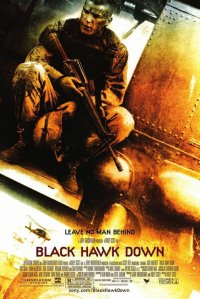 In the fall of 1993 Somalia was a nation being torn by civil war with feuding warlords and slowly being crippled by rampant hunger. The UN intervened to try feeding the starving nation but warlords like Mohamed Farrah Aidid cut off many of its shipments of food. The United States had plans to capture two top lieutenants of Aidid’s in the capital of Mogadishu. Over 100 Delta units and Army Rangers were sent into the heart of the Mogadishu market to execute the operation.
Things didn’t go well from the start as casualties began to pile up and first one, then two Black Hawk helicopters were shot down from ground fire. Medical vans and Humvees were continually blocked access to help the stranded soldiers by civilian roadblocks consisting of smoldering debris. It wasn’t supposed to take longer than 45 minutes. It ended up lasting over 15 hours. In the end 18 American lives were lost, over 70 were wounded, and over a 1000 Somalian lives were lost. What’s truly amazing is the courage the men displayed, and the fact that being surrounded by a sea of armed Somalians that more lives weren’t lost.
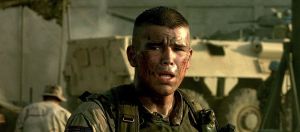 Black Hawk Down is essentially a two-hour action sequence. The emphasis of the film is on the stark recreation of the Somalia skirmish and it is indeed an achievement in grueling realism. You truly feel like you have been thrown into the middle of this firefight. With all the gunfire and chaos it leaves little time for getting to know characters. This is probably why they have names written on their helmets so the audience can attempt some semblance of who’s who.
The film is by no means for the faint of heart. Saving Private Ryan had some intense violence, but it was mainly condensed for the opening and closing 20 minutes. Black Hawk Down, on the other hand, is two straight hours of non-stop blood and gore. The violence and the intense realism are not gratuitous but indicative of the horror these men faced. If you can’t stomach a soldier plunging his entire forearm into the chest cavity of another to cut off a bullet wound – stay at home and read a good book.
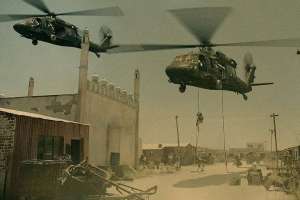 Ridley Scott is on an ultra-violent hot streak after directing big name Hollywood tokens like Hannibal and Gladiator. His handling of Black Hawk Down is masterful, just for the simple fact of keeping the audience free from confusion. Throughout the duration we know who is where, where they want to go, and the general geography of the hot spot. The staging of the entire battle is beautifully filmed and the recreation of the Mogadishu market place is amazing in its fine detail. Some criticism has been projected at the film for portraying the Somalians as basically black people with guns. This is entirely true, but one must remember that the film is told from the American point of view.
The acting, as expected in a war film, takes a back seat to the heroic histrionics and the fireworks. Josh Hartnett is sullen in his duty as Staff Sergeant Matt Eversmann but always a comfortable figure to see on screen amidst the chaos. Ewan McGregor plays a soldier promoted to action instead of desk work and adds some touches of humor to the fray. Tom Sizemore is the most recognizable person as the often-frustrated Lt. Colonel Danny McKnight who fearlessly strolls across the battlefield while bullets whiz by.
Black Hawk Down for some will be the right movie at the right time, though it was never intended to be. The riveting action is more than entertaining and worth admission price, but you might leave pondering on the sacrifice few know the full details. Just make sure to go to the bathroom before the film starts.
Nate’s Grade: A-
Share this:

Sexy Beast (2001)
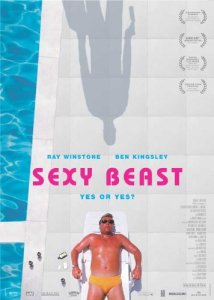 Never, under any circumstances, do you want to piss off Gandhi. Sexy Beast is a British crime story where the ferocious mad dog Don Logan (Ben Kingsley) is trying to recruit a retired hand (Ray Winstone) into one last job back in London. Winstone is enjoying the sun of California with his middle-aged ex-porn star wife who he loves dearly. But Don does not take “no” for an answer. Kingsley is the true focal point of the film and is astounding and brutally terrifying as the wound up gangster. He gives an electrifying performance that is the polar opposite of India’s non-violent leader. When Kingsley vanishes from the screen Sexy Beast suffers and becomes a variation of the old crime film, except a very short one at that being under 90 minutes of running time. Video director Jonathon Glazer has done a fine job for his debut but there isn’t much to this tale without Kingsley’s memorable efforts.
Nate’s Grade: B


You must be logged in to post a comment.