Author Archives: natezoebl
The Da Vinci Code (2006)
 Dan Brown’s The Da Vinci Code has been a best selling novel for three years running. Continents of trees have been felled to produce the 50 million published copies worldwide. Brown’s novel details a centuries long cover-up of some crucial background on Jesus Christ, as well as certain omissions about the role of women in Jesus’ discipleship. The book has been condemned by Christian watchdog groups as heresy, never mind that it is clearly labeled “Fiction.” Debunking fiction is simply redundant. Now Hollywood has adapted The Da Vinci Code into a massive movie, directed by Ron Howard. I must be one of eight who have not read the book, so I entered the theater with little expectation and no idea where the story would take me. Is this a great threat to the Christian church, as some argue, or is it just another dime-store thriller that lucked into becoming a national phenomenon?
Robert Langdon (Tom Hanks) is a Harvard professor of symbolism lecturing in Paris. He’s called in by a police captain (Jean Reno) about a local murder. The curator for the famous Louvre museum has been killed and his death leads to a series of coded clues about a deeper conspiracy involving Leonardo Da Vinci. Sophie (Audrey Tautou) is an investigator, and the granddaughter of the museum curator. She helps Robert escape and the two of them set off on an adventure through France and England, finding clues that lead them closer to the location of the Holy Grail. They get help from Leigh Teabing (Ian McKellen), an old friend of Roberts that has his own theories about what the Catholic Church may be so desperate to keep hush-hush. All the while Silas (Paul Bettany), an albino monk, is on the warpath to dispatch all who know too much, including Robert and Sophie.
There are just so many harebrained, hokey moments in The Da Vinci Code that can rip you right from the movie. Why does Sophie have to pay someone to leave a park bench when she and Robert can just walk out of earshot? Why does a bank teller, with his own devious intentions, drive Sophie and Robert to safety and then threaten them at gunpoint? Surely letting them be captured by the police would have served his needs better. Oh, the bank also has a payable escape clause, like it was a Scooby-Doo mansion. But the hokiest moment comes in the opening minutes. The museum curator, an old man who couldn’t hobble away from his attacker, gets shot in the gut, a quite painful place for a bullet to lodge itself. So he’s fatally shot in the stomach, but the man still has time to scribble coded messages on three separate paintings at different points in the museum, strip down, pose, write a message on the floor and a symbol on his chest. And remember, he’s an old man on top of all this. It’s like he had a checklist he pulled out in case he was ever mortally wounded at the Louvre.
 The characters aren’t any better. There’s little to any depth to these people and most of them are irrational stock roles. The Jean Reno cop character is laughable in how doggedly he’s convinced Robert is his man. Apparently, a priest told the cop Robert confessed. Case closed? Perhaps the cop, in his furtive rush to judgment, should do some outside research. The museum curator?s time of death, something any crime scene tech could denote, would prove that Robert would be ruled out, given that the man was giving a lecture in front of hundreds of alibis. That’s verifiable science, but no matter. Would not a place as heavily trafficked as the Louvre, with so many priceless pieces of art, have security cameras? I think that alone would tell you who murdered the museum curator. These details make the Reno character stupid and unbelievable. The police work hasn’t been this sloppy since the Police Academy saga.
There’s a late scene where a character addresses another and more or less says, “No one will suspect us, my partner. Let us split our winnings together. I will take your identity to my grave. What? Yes I will take a drink from your flask you’re offering me but not drinking from yourself.” The film could not hit you over the head harder with what is to come. I’d expect these kinds of half-hearted character turns from a rote made-for-TV thriller, but The Da Vinci Code has too much intended intellectual prestige to wallow in this manner.
This is not a good film adaptation. This isn’t structured like a thriller, let alone a movie. There?s no sense of momentum and the story is really an ongoing series of mini-climaxes, sputtering out to no payoff. Puzzle-solving and word games can work on the page, with the reader feeling like they’re right along, but onscreen it cannot work in a story of images. Howard highlights certain letters a la A Beautiful Mind, but then it simply becomes less a puzzle and more just witnessing how a character’s mind breaks down the code, nothing more. As a thriller, Brown seems to do just enough to push his narrative further, but he frequently writes himself into a corner and relies on plot contrivances to save his ass. There’s a scene at Leigh Teabing’s mansion involving a gun standoff, and how does Brown get his characters out of it? By conveniently having a bird fly and distract the evil gun-bearing monk. Talk about a cheat. The Da Vinci Code‘s lame behavioral explanations and short cuts are expected in a rote thriller, but Da Vinci doesn’t want to be seen as one.
But that’s the fundamental error of The Da Vinci Code: it wants to have it both ways. The film, and I’d judge that the novel as well, wants you to shut your brain off and swallow these trite lapses in judgment and reality, forgiving the movie for zero character development and polluting the narrative with stupid genre stock roles, but then it also wants you to pay close attention and activate your brain to untangle the origins of symbols, conspiracies, and church doctrine. This flick was destined to fail at birth. You can’t be a brainy thriller and fill the story with hokey moments and lapses in thought, and likewise you can’t be an enjoyably straight forward thriller if you bookend all your action sequences with talky sit-downs to explain the minutia of your story. The Da Vinci Code is thusly pulled in two directions and grinds its gears to the very end.
 This is not a very entertaining flick, in fact is nearly put me to sleep a half dozen times. The Da Vinci Code has tiny bursts of action, and most are easily swept away before the viewer can get a grip. These moments are then succeeded by lengthy, ponderous sessions of heavy exposition. It’s like characters will breathe a sigh of relief at another ludicrous escape and then say, “Well, now let’s discuss in detail some more convoluted theories.” The dialogue reeks, and characters spout plot points whenever they’re needed. The conspiracy doesn’t even make sense. Why would the Church protect a secret that could supposedly destroy its hierarchy? If Jesus was not divine then what difference does it make to go after relatives 2000 years removed? And if Jesus did have heirs would there not be thousands in 2000 years time, not one convenient individual? Even The Da Vinci Code‘s ending seems to soft peddle its “dangerous” message, where Robert, after learning all he has, says it’s all about what you believe.
If it wasn’t for Bettany and McKellen I really would have nodded off. Silas is by far the most interesting character in the whole film, and the only one with a penetrable personality. A deeply religious albino killer monk is a great character, and Bettany makes him scary but also frightfully sympathetic. I was rooting for Silas to knock off the film’s heroes and go on a better adventure of his own. McKellen is handed most of the monologues and he gives his character all the gravitas needed. Thank God for these two actors, because Hanks is miscast and Tautou isn’t nearly as endearing as her work with Jean-Pierre Jeunet. There’s a really good international cast assembled for The Da Vinci Code and the movie manages to mishandle most of them.
The Da Vinci Code played out on the big screen is ponderous, talky, boring, poorly adapted and poorly written. Some things work better on a page than onscreen, and I guess if this is the final product than the whole damn things works better on the page. The story is brimming with lame, hokey moments you’d see in a lazy TV thriller, but then the story also wants to talk you to death with its convoluted storyline. The action sequences are brief, the dialogue is smothered by lengthy exposition, and the plot just isn’t that entertaining. The cast is mostly wasted in thankless stock roles. So let me get this straight. After seeing The Da Vinci Code, the biggest threat the Christian church is facing is … bad movies? I think they’ll be alright.
Nate’s Grade: C-
Share this:

American Haunting (2006)
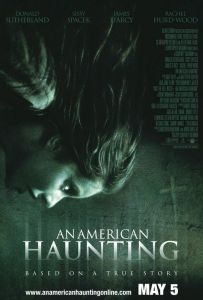 Courtney Solomon made one of the worst movies I have ever seen, 2000’s abomination Dungeons and Dragons. It is bad on a rarely seen cataclysmic scale. The shot selections were awkward, the handling of the actors was cringe-worthy, the story lightweight but ridiculously stupid, and the special effects were like something a third grade diorama contest could best. Dungeons and Dragons holds my record, in all the many films I’ve seen, as having the worst line readings of all time. Fortunately, the film is one of those so-bad-it’s-hilarious entries to stop it from being an absolute wash. Now six years later Solomon is back with An American Haunting. Normally his name alone attached to a movie would guarantee my avoidance, but I checked this out for you, dear readers. Let’s just say Solomon has a looooooong way to go before he even reaches the competence of Uwe Boll
In 1818 Tennessee, the Bell family moves into a new residence. John Bell (Donald Sutherland) has cheated an outcast woman on her land loan. This woman, branded a “witch,” curses the Bell family. Things are fine for a while, but then young Betsy Bell (Rachel Hurd-Wood) is being attacked by an invisible spirit night after night. Her father and mother, Lucy Bell (Sissy Spacek), are powerless to stop the haunting. Before you can ask, “Why don’t they let their daughter sleep in a different room?” they’ve reached out to a preacher and schoolteacher (James D’Arcy) romantically curious with Betsy. No one can stop this haunting and John Bell searches to gain atonement for his sins to spare his family.
 So, let’s get this whole thing straight, spoilers be damned. An American Haunting is marketing itself as a film based on the only medically credited murder to a ghost. Never mind how you verify that, just go with it for a second. This couldn’t be any more wrong. We learn at the end (“learn” wouldn’t be the right word since the film requires voice over to explain itself) that Betsy had been raped by her father. But wait, it gets better. Betsy had subconsciously developed a protector spirit to guard off further molestation and to punish her father. So right there the ghost in An American Haunting isn’t even a ghost, just the angry manifestation of an abused girl. There is one death accredited to the ghost, that of John Bell. However, the movie presents his wife poisoning him, not the ghost. So then the murderous ghost is neither. Plus, one has to wonder how shocking John’s loss is if he was willing to kill himself to lift the curse from his family. How believable is a “true account” of a medically documented haunting death when people were blaming demons for things for ages? I mean, there must be written accords from medical professionals of the day attributing the Black Plague to man’s sins. Just because an official said so centuries in the past does not make it medically sound today. If that were true no one would last through puberty without flogging themselves to death (and I did NOT mean it like that). An American Haunting is not true, is not about a ghost, and isn’t about a ghost committing murder.
Writer/director Solomon has made some strides in his filmmaking, but the results are still laughably the same. He’s gotten a better feel for actors and … that’s about it as far as improvement goes. An American Haunting is a creaky old timey ghost story that couldn’t scare a soul. It feels more attune to a 1970s made-for-TV flick. Solomon cribs all his scare tactics from Spook 101, which means lots of stagy jumps and creaky noises. The most annoying decision Solomon makes is that when he wants to convey the point of view of our ghost, he quickly swoops the camera down and up, spinning around the room like a paper airplane. I’m surprised more ghosts don’t get motion sickness if this is how they roll. You’ll either grab your stomach from the camerawork or the story.
 Solomon’s story is just painfully uninteresting. Some good actors do their best to liven up a pretty run-of-the-mill haunting tale. An American Haunting is insufferably boring and lame. The first half is also exceedingly repetitive, as we watch the spirit creep into Betsy’s room and beat the daylights out of her. I don’t know how many times Solomon expects us to still be entertained, let alone scared, by just repeating this scene verbatim. Apparently, if a ghost keeps smacking you it won’t wake up the people sleeping right beside you. I always did wonder. An American Haunting is lackluster and boring, but it’s the arbitrary current day scenes that open and close the film that makes it truly awful. A modern-day mommy discovers Richard’s diary of the haunting and sits herself down for a good read. Then once she gets to the end she sends her little daughter off to spend time with her ex-husband/daughter’s father. And then Betsy’s protector spirit pops up in the car, looking very sad as she’s driven away. An American Haunting is trying to make us connect that the modern-day woman’s husband is molesting her daughter, but the movie expects you to make a lot of jumps to get there. I don’t think “spirit pointing” will hold up in the court of law. And truly, if the Betsy protector spirit was really trying to be helpful, shouldn’t it be less vague and just spell it out? These modern segments feel tacked on and needless if the whole of the film is spent on the 19th century ghost story. An American Haunting requires gobs of text at its conclusion to explain that it was, technically, a ghost story by its new and expanded definition.
The only nod I can give Solomon and his tale is that they cover my number one complaint of all haunted house movies: why the hell don’t the people just leave? Your house is haunted with the spirits of the damned, so you’re just going to wait it out? MOVE people. Find another place to live! An American Haunting features a spirit that can travel outside the bounds of its house and attack carriages, no less.
An American Haunting is marketed as a true-life ghost story, the only in our nation’s history where a murder was credited to a spirit. However, this movie doesn’t have the foggiest idea how to scare an audience beyond stagy high school theatrics. It’s not a ghost story, unless you swallow whole the film’s flimsy recanting of what a ghost is, it doesn’t feature a murder by haunting, and it isn’t even true, unless you can additionally swallow ye olde folksy, biased medical accounts. I’m sorry, but I don’t buy this. This movie isn’t so bad that it’s funny; it’s just boring. People as a whole should steer clear from this dull, amateurish fright flick. The only screams you’ll hear during An American Haunting are unintentional laughter.
Nate’s Grade: D
Share this:

Mission: Impossible III (2006)
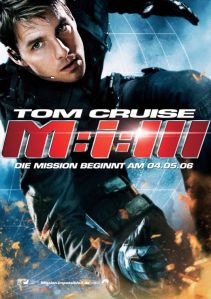 Few celebrities have had the intense flame-out Tom Cruise has experienced in a little over a year’s time. First there was the PDA-heavy relationship with Katie Holmes, never a wet tongue-kiss away from a camera. Then there was the couch aerobics on Oprah Winfrey’s set, bleating his over-the-top declarations of love like Roger Rabbit. This was followed by a series of testy interviews about his war of words on psychiatry and prescription drugs. Entertainment Weekly just ran a cover story asking, “Is Tom Cruise worth his paycheck?” He’s gone from Hollywood’s most bankable actor to a national punch line. To bring new life to Cruise’s spy series, he tapped TV mastermind J.J. Abrams to make his feature debut after Cruise churned through two seasons of spy series Alias DVDs. Abrams is a gifted franchise starter, first with Alias and then with Lost, and with Mission: Impossible III he does the best he can to erase the memory of Tom Cruise, daredevil of furniture.
Ethan Hunt (Cruise) is out of field work at the Impossible Mission Force, training recruits for the big time. He’s settled into a comfortable home life with Julia (Michelle Monaghan), a woman he’s blissfully engaged to be wed. Ethan’s happy home is disrupted when IMF needs his services. It seems one of his trainees (Keri Russell, Felicity goes badass) has been captured by an arms middleman Owen Davian (Phillip Seymour Hoffman), a man that will get any deadly force to the right bidder. Hunt reluctantly goes back into the field, assembling a team that includes Luther (Ving Rhames), Zhen (Maggie Q, quite fetching), and pilot Declan (Jonathan Rhys Meyers). Their mission goes badly and Hunt is reprimanded for his cavalier actions. He’s determined to snag Owen and get justice. This leads to an incredibly stuffed game of cat-and-mouse, each jockeying for leverage. There’s some super powerful device called the “rabbit’s foot” that everyone wants but it’s not really important. What is important is that Owen is eager to strike back at Ethan’s most vulnerable point — harming Julia.
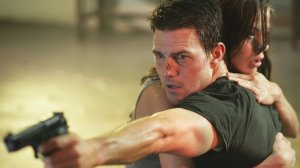 This movie is quite possibly one of the greatest TV adaptations of all time. No, not the Mission: Impossible series but Alias. Just like J.J. Abrams’ TV brainchild, this slick, propulsive caper puts a smart spin on familiar ground. We’ve got the flash-forward narrative trickery, the super gadgets, the undercover teamwork, the world-trotting sprawling vistas, and anchoring the whole thing with an emotional counterpoint, trying to lead a double, “normal” life and keeping your loved ones equally safe and in the dark. There’s a great scene in the middle of a mission where Ethan and Luther casually discuss the impossibilities of living a normal life given what they do. Luther warns that those close to you will only end up getting hurt, and by this point thanks to a startling, right-to-the-point opener with a gun to sweet Julia’s head, we know he’s right. That’s what makes the third go-round different: Abrams has injected some emotion into the darn thing. Ethan is pressed back into service and then becomes something of a knight in shining Kevlar, trying to save his beloved in the crossfire of international espionage. There are a handful of scenes between Cruise and Monaghan and they sell the emotional drama in tender quiet looks. As a result, the audience and Ethan are rooted to their seats beyond just the assembly line of pyrotechnics. Just like Alias (at least up until Season 3 when it jumped the shark with the long-lost sister). It’s like if True Lies was played straight and Tom Arnold was mercifully forgotten.
Ah, but what pyrotechnics they are. Things get heated with a trip to the Vatican and they literally do not let up, all the while raising the stakes by pulling Ethan’s home life closer to the danger of his job. You’ll be left breathless absorbing all the exhilarating action sequences, which to my best estimate are more than the first two flicks combined. The stunts are superbly death-defying. What makes action sequences so enjoyable, pay attention you Hollywood rubes, is when the stage is set and then we watch organic complications. Abrams has a tremendous feel for action and playfully extends virtuoso sequences of awesome carnage. An attack on a bridge is simply outstanding and gave me an overload of geeky joy. We’re given the tight, controlled setting, and then Abrams introduces the outside conflict and keeps developing it masterfully step by step. There’s air attacks, there’s running back and forth amongst the wreckage, there’s searching for guns while escaping attack, and then there’s flying leaps over gaping concrete holes. I was jumping in my seat with boyish glee. The slow-mo gun toss between Cruise and Russell? Awesome. The swing-shot jump off a gigantic skyscraper in Shanghai? Awesome. The use of Simon Pegg (Shaun of the Dead) as gadget guru? Awesome. Mission: Impossible III is, if nothing else, an incredible adrenaline rush orchestrated by a man with a finger directly on the pulse of his audience. By summer popcorn standards, Mission: Impossible III is everything you could hope for. Sure it’s highly implausible but it’s just so damn fun.
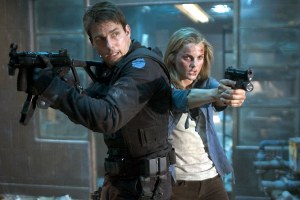 Abrams has created quite a breakthrough for himself. Long regarded as a TV visionary for his tangled, engrossing pop-pulp like Alias and Lost, Abrams shows what he can do with a bazillion dollars and one of the world’s most recognized stars. Abrams intelligent, deft handling of his material, elevating tired genre devices with flash and reverence, reminds me of a young Steven Spielberg. This is a man that respects his material and respects his audience, but still knows how to bring home an entertaining movie. I’ve followed Abrams’ career since getting hooked on Alias in 2001, and I’m confident he will become the best friend a movie geek could ever have (Star Trek fans should be clicking their heels about Abrams’ rumored involvement). Even though Mission: Impossible III is Abrams’ film debut (and on record the most expensive ever for a first time film director) he already shows more command, more wit, and more hipness than most of Hollywood’s graying old guard.
Finally, this is the first Mission: Impossible film to utilize the team aspect of the TV show. Granted, Cruise still does most of the running, jumping, climbing trees, but thankfully this movie is more than the Tom Cruise Kicks Everyone in the Face Show a.k.a Mission: Impossible II. The supporting cast all have their one great moment and part of the fun is their interaction, seeing the pieces fit into place. Just like last summer’s Batman Begins I would like to see another movie immediately with everyone involved. Make it happen. This is the Mission: Impossible world I want to explore in greater detail.
Mission: Impossible III is not bulletproof. The movie seriously needed more time for its villain. Hoffman does a great job of bringing his bad man to grumpy life. He goes about business with a detached nonchalance, like a plumber fixing his 10,000th clog. It may sound silly but it works because Hoffman gives his character a lizardy, unscrupulous sense of ethics. He really will put a bullet between the eyes of anyone, possibly while reheating some food in his microwave. That’s the greatness of Hoffman’s villain, how ordinary he sees his line of work and what it calls him to do. Now, with such a terrific villain it would behoove Mission: Impossible III to give him plenty of screen time. Sadly, Hoffman has about three real scenes, and his end is anticlimactic and so is the film as a whole. And what does IMF have to do to curb moles? There’s been one in all three Mission: Impossible movies. Maybe they should offer better vacation plans.
Tom Cruise may have done a lot to wear out his welcome with the public but he knows to surround himself with good people. The decision to let J.J. Abrams helm Mission: Impossible III has finally given this franchise vision and sustained excitement. This movie is far more emotionally based than any other in the series and there’s a genuine emotional reason for all the fireworks this time. The team aspect is finally addressed and Hoffman makes a truly lecherous, scary villain. But the bread and butter of this flick are its breathless action sequences, brilliantly choreographed by Abrams, a name destined for even greater things. Abrams knows how to spin genre clichés into clever, loose, twisty, funny, thrilling, emotionally centered gold. I don’t care if Cruise abused a couch and the public’s good will; Mission: Impossible III is an extravagant popcorn movie and a great way to start the summer. If only they were all like this.
Nate’s Grade: B+
Share this:

An Unfinished Life (2005)
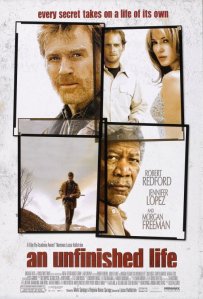 Einar (Robert Redford) is a gruff rancher living with his long-time friend and ranch hand, Mitch (Morgan Freeman), who has been recovering from a bear mauling. Jean (Jennifer Lopez) and her young daughter (Becca Gardner) have run away from her abusive boyfriend and seeking temporary refuge with Einar. There’s still a lot of tension and unspoken anger between the two. Einar blames Jean for the death of his son from a car accident. As their stay continues each member imparts wisdom to the other, hard exteriors get warmed, and lessons about forgiveness are learned.
This is melodrama with a capital M. An Unfinished Life is clunky, the movie hasn’t the foggiest idea when it comes to subtlety, the characters all shout out their feelings all the time, and worse yet, it’s also incredibly transparent. A scene where Lopez breaks a dish and Redford goes nuts is just too much. Of course they’re talking about his dead son but the moment is played to the hilt that I half expected every line to end in a wink (“It’s just a dish” wink “Maybe it’s more than a dish to me!” wink “Maybe that was my favorite dish!” wink). Honestly, it was at this point that the film lost me. The metaphors are another symptom of the film’s overly ramped-up obviousness; Redford might as well be pointing at the bear to pantomime that it?s supposed to represent his pain and anger. And Freeman’s eventual forgiveness of his attacker is meant to encroach upon Redford to do likewise to the source of his pain, and many other moviegoers, Jennifer Lopez. I cannot find a movie emotionally involving when it doesn’t even bother to mask its grand statements.
Seriously, this movie is brimming with sprawling earnestness meant to cover the narrative shortcomings. This is a simple tale that could have suckered the audience in with its framework to showcase complex characters and their personal interactions, like a Million Dollar Baby, but even though An Unfinished Life is simplistic it still manages to beat you over the head. Every line of significance is underlined so you get it. It’s like director Lasse Hallstrom was making a seething parody of these overarching, small-town, large cast, homesy feel-good flicks he’s specialized in for a decade.
The acting is all fine. Redford is fun to watch and get his Jeremiah Johnson back on. Lopez makes you forget how much you hate her in other movies. Freeman is settling into a weird groove as a disfigured narrator. The acting of the ensemble really isn’t the issue with An Unfinished Life.
Despite all its earnest intentions and lush scenery, An Unfinished Life is too much melodrama squeezed into such a small space. It’s an old fashioned tale that feels too convenient, too simplistic, too perfunctory, and too unhappy with being any of those things. This feels like a Hallmark card turned into a movie by someone who has no grasp for human emotion. Everything is shouted when it needs to be a whisper and explained when it needs to just be experienced. And yet there will be an audience for this slow burn small-town tale of forgiveness and accountability. It may please people immensely, but I prefer a little subtlety to my drama. I won’t say the film is bad but I’ll never say An Unfinished Life is particularly good, even as melodrama.
Nate’s Grade: C
Share this:

Stay (2005)
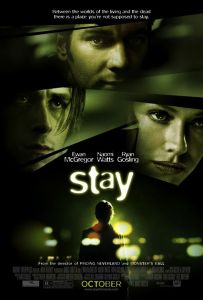 This is a movie that piles on the mystery and clues but once the finish does arrive I was left saying, “That’s all there is?” There’s so little to this film that, in retrospect, it’s simply blowing off the dust on An Occurrence at Owl Creek (I may have said too much). The trickery Stay throws at you is slightly intriguing but mostly confounding and, once the reveal tidies everything up, wholly unsatisfying. Part of the problem is that I didn’t care about any of the characters, so I didn’t really care about their plight. Yes I get it that there is a reason for how shallow they are, but the only thing Stay had to keep me going was my waning interest in what the hell is going on with everything. I’m not the biggest fan of Marc Forster (Finding Neverland) as a director, and he serves Stay to good and harmful effect. Forster gooses the film with all sorts of visual trickery like jump cuts, using twins and triplets as extras in backgrounds, repeating scenes, playing around with blocking, and lots and lots of spiral staircases (hello, Vertigo). And you do realize that most of these disorienting stylistic decisions have a seemingly coherent reason in retrospect, but it also effectively pushes the audience away from the story, aided by the fact that no one can get into the characters. The entire affair seems pointless and empty but it is pretty to look at. I’m sure I’d garner more from a second look, but I really just don’t want to see Stay again.
Nate’s Grade: C+
Share this:

Howl’s Moving Castle (2005)
 The flick is wonderfully imaginative, as to be expected from Miyazaki. The Pixar people really do an excellent job of bringing these films to an American audience and treat the English dubs with reverence. I’m not someone who’ll bemoan an English dub when it comes to anime but it’s nice to see effort and respect. The story is a bit similar to Princess Mononoke with the warring factions, the mystic and the industrial, and Miyazaki’s refusal to paint in black and white. There are so many delightful touches here from the fire demon to the door portal to one segment that just involves two old ladies ascending stairs for three minutes. And yet it’s the spirit Miyazaki infuses and the attention to story and character that sets his films apart. There’s a genuine sense of magic while watching his films and Howl is no different. The only bit of contention I had with the movie is how abrupt the ending is. Howl’s Moving Castle is a bit soaked with confusion and some narrative cop-outs (“Surprise! I’m the prince responsible for the war!”). I would have loved another 30 minutes in this world as well as a better opportunity for Miyazaki to bring his story down with a smoother landing. Still, saying this is a slightly lesser Miyazaki film is like saying a million dollars is less awesome than 2 million dollars. Howl’s Moving Castle is another sterling addition to a master storyteller.
Nate’s Grade: A-
Share this:

United 93 (2006)
 I’ve heard a lot of talk about whether America was ready for United 93. Almost every magazine or newspaper article you’d read about director Paul Greengrass’ real time account of 9/11 began with the question, “Is it too soon?” That’s mostly a personal decision. My response: of course not. They were making World War II movies while Europe was still burning and while Pearl Harbor was still recovering. Speaking of which, doesn’t anyone feel that a 9/11 movie would be much more powerful and respectful now, five years removed from one of the worst days in American history? We can still remember that awful day, and most importantly, we can use art as a means of catharsis when the subject remains relevant. Does anyone seriously want to wait 20 years down the pipe for a 9/11 movie to be produced by Jerry Bruckheimer? Was 2001’s Pearl Harbor the kind of movie we’ll get when it’s “not too soon?” While I’d never insist people see United 93 if they weren’t ready, I will say it’s definitely a movie that demands to be seen sooner rather than later.
On September 11, 2001, four planes were hijacked in the sky by members of the terrorist group Al-Quaeda. Two crashed into New York’s World Trade Center building. Another crashed into the Pentagon in Washington, D.C. A fourth plane, United 93, was delayed on its initial takeoff, meaning the four hijackers on board were already behind schedule. After the hijackers had taken control of the plane and turned it back around, presumably headed toward the White House, the passengers started making phone calls from the flight and piecing together the scenario. They weren’t going to land at any airport; they were a bomb on wings. The passengers came together with a heroic plan to take back the plane and use a fellow passenger, with flying experience, to help them land. Their valiant effort ended in United 93 crashing in Shanksville, Pennsylvania.
 United 93 is one of the most nerve-racking movie going experiences I have ever seen. Because of our prior knowledge of the events, every little thing carries so much dread, from a man who just makes the plane to simple phone calls, unknowingly their last, that end so regularly in “I love you.” Hitchcock said tension was watching a happy couple unaware of a ticking bomb below their picnic table, and he was right. United 93 is grueling to sit through, but that doesn’t mean the film isn’t rewarding. We’re going through the same situation and harrowing steps of realization as the passengers. The final phone calls on board may be the most emotionally wrenching thing I’ve seen in a movie since 2000’s Requiem for a Dream. The final 30-minutes of the film, concentrating on the passengers retaking the plane, is some of the most intense cinema I’ve seen in years. My heart was beating outside of my chest and I was shaking, even after I got out of the theater. I spent the next hour at my house walking around trying to shake it off but I couldn’t. This is an incredibly powerful and sobering film that will stay with you like a bad dream.
Witnessing the unfolding events of United 93, a spellbinding example of you-are-there cinema verite, you really feel like you’re watching a living documentary. There’s nothing sensational or overly political that happens within United 93. Greengrass even has the temerity to present the hijackers as human beings, granted human beings capable of ferocious acts of horror. The first moments of the movie are the hijackers preparing, praying, reciting the Koran, and going about their plot. You see them sweat, get antsy, and the lead hijacker evens seems a bit hesitant about following through, especially since this coordinated attack was botched by United 93’s delay on the tarmac. Some would call such a portrayal ludicrous, citing a scene where a hijacker calls his girlfriend to say his last “I love you” as apologetic claptrap. Some would take offense that the hijackers are not demonized, have horns sprouting from their heads, or laugh maniacally at spilled blood. But just like Spielberg’s portrayal of Palestinians in Munich, human evil is much more nuanced than simply painting a mustache on. United 93 shows every side to 9/11 like what a good documentary should do. This isn’t propaganda, this isn’t exploitation, this is respectful filmmaking. Yes, we?ll never know what happened on flight 93, and much of the film is speculation, but it’s speculation built around research and reverence.
 Greengrass is in fine form, recreating the same sense of building desperation and terror that he so elegantly assembled in 2002’s Bloody Sunday. The antic handheld camerawork may give people some headaches, but no filmmaker does a better job of putting you in the moment than Greengrass. His decision to use real people portraying themselves, like FAA head Ben Sliney, creates a greater feel for authenticity, even having the film’s stewardesses played by real United stewardesses. None of it feels gimmicky, nor is Greengrass interested in telling a jingoistic, hyperbolic action adventure. The famous “Let’s roll” line is just another line said amongst many in the planning process for taking back the flight. The violence is sudden and shocking but never sensationalized. United 93 ends exactly as it should too. You?ll probably hear sobbing in your theater at that point; I did.
There have been complaints that the character development in United 93 is lacking. But really this is a story about 2 hours on one morning, told in real time, and how much talking do strangers do on a flight? Some, sure, but not a lot. To answer critics, if we’d gotten to know these characters extensively it would either break the fabric of reality and turn these people into eagerly sharing, easily emotive figures, not people, or would require extensive flashbacks which would remove us from the visceral feeling of the story. That’s why Greengrass cuts back to NORAD and the FAA, because there’s stuff happening there; the slow realization of fright, the disbelief, the staggering amount of confusion and miscommunication. They can’t even get anyone from the White House on the phone to even establish a chain of command. If we had staid onboard we would be watching people read magazines or eat peanuts for 30 minutes. I never once felt less for these people because of the characterization concerns.
 The “ordinariness” of the passengers is what works best, because it just as easily could have been you or me, but would we have reacted the same? Had it been “Tom Cruise starring in United 93″ then it never would have worked. This excels on how realistic everything comes across, and any Hollywood moment that would shatter that realism is absent (thank God there’s no product placement). One of the more amazing aspects of United 93‘s conclusion is just how fast everything came about. These people had little time to act, much less take stock of the waking nightmare the day was turning into and formulate a plan. The movie is a touching tribute to a group of ordinary people that became something more on one of our darkest days.
Naturally, United 93 is not going to be a film for everyone. It’s unflinching, grueling, and altogether hard to sit through. It does a stupendous job of recreating that tragic day and allowing our own knowledge of the events to build an overwhelming sense of dread. Greengrass excels in this arena of storytelling and he’s worked his docu-drama magic once more, painstakingly allowing the viewer feel like they are a participant, to the point where we even get a rush of hope that maybe the passengers could take back their plane and save themselves. The question of whether it’s too soon for a major 9/11 movie has to be decided on an individual level. I don’t recall anyone griping about the thousands of documentaries and the A&E Flight 93 TV movie, all of which, yes, made money off 9/11 too. I think for us as a society, we need this movie to remind ourselves of the heroism and sacrifice of a few. It’s very easy to get lulled back to complacency, but the masterful United 93 will not allow that. This is a powerful story told without a hint of melodrama and it will be guaranteed to be near my Best of the Year list when 2006 rolls to a close.
Nate’s Grade: A
Share this:

Scary Movie 4 (2006)
 David Zucker was apart of the team that gave the world Airplane!, The Kentucky Fried Movie, Top Secret, the Naked Gun flicks, Ruthless People, and even Ghost. When the Wayans brothers left the Scary Movie franchise for greener pastures (greener meaning richer), it was Zucker and his stable of writers that came in and gave Scary Movie 3 a fresh kick. Now less than three years later we have Scary Movie 4 poking at the same material, and once again this franchise is starting to feel like a bore.
Cindy Campbell (Anna Farris) is in the home health care business looking after a supposedly haunted house. Inside the house resides those pale, wide-eyed, meowing ghosts from The Grudge. Next door resides Tom Ryan (Craig Bierko), a crappy father watching after his two crappy kids for the weekend. Things get a tad hectic when giant Tr-ipod robots rise from the ground and start zapping everyone. A war of some worlds looks to be in progress. Cindy and Tom go their separate ways, each trying to stay alive and return to each other. Cindy meets her old pal Brenda (Regina Hall) and they journey into the heart of a secluded village, one surrounded by monsters. Somehow they’ll find a way to stop the aliens from destroying the planet. Meanwhile, President Harris (Leslie Nielson), briefed that the country is under attack, is very interested to know what happens to a duck in a children’s story. The only thing missing is a Passion of the Christ parody (talk about a horror movie).
 This is a franchise of diminished returns. Zucker and company feel like they’re badly grasping for something. Scary Movie 4 relies far too heavily on juvenile scatological behavior (a urine sponge bath is simply gross, not a gross-out) and very repetitious slapstick. Your level of enjoyment with Scary Movie 4 will rest solely on the question of how many times you can laugh at someone getting hit in the junk. Zucker’s gone practically overboard on the physical comedy, making this the filmic equivalent of “Football in the Groin.” The sad thing about this franchise is how safe it all feels now. It seems to have its demo sights set squarely on teen males, less discerning folk who will pee their pants with groin kick #86 and roll in the aisles uncontrollably with groin kick #113. I’m no prude when it comes to slapstick mind you; a well-timed kick to the groin can be downright Shakespearean, but when an entire film is stuffed with people knocking the stuffing out of themselves, then the joke loses its original flavor. No one wants to keep chewing on something once its flavor has long vanished.
I seriously think there should be a one-term limit when it comes to the comedy teams working with the Scary Movie films. Scary Movie 2 felt like a bad Xerox copy of Scary Movie, heavily smudged and lacking definition. Seriously, how many times can you go back to the giant semen geyser well? So too does Scary Movie 4, Zucker’s second in the series, resonate with the same hackneyed feeling. Zucker’s first movie dialed down the raunch and upped the PG-13 slapstick, and now his second film feels like a less executed duplicate. In Scary Movie 3, the joke was that the creepy psychic kid could never foresee his own clobbering. Therefore, there was an extra comedic layer to watching a kid accurately predict when a woman would start her period but not when a car back into him. In Scary Movie 4, it’s simply been reduced to watched a kid get beaten a lot. Jokes rarely connect when you rob them of context or set-up or just repeat them ad nasuem. Scary Movie 4 feels a bit overly content just to be a copy of a copy. That’s simply depressing.
 Even the jokes feel out of touch, smacking of a minimal effort. The Scary Movie franchise was never a place for biting satire, but everything seems so curiously outdated. Viagra jokes in 2006? I guess so. When the film does reference modern items (Myspace, Yahoo maps, Michael Jackson) it still feels awkward. The Brokeback Mountain parody, while shocking in how comparatively restrained it is, comes across dead in the water because our market is over-saturated with gay cowboy jokes. It’s like in 1999 when even your invalid grandmother was doing a Blair Witch Project parody (turns out the witch was just the nurse trying to get her to take her pills). I do realize that the plot parodies are mostly a jumble, bits blended together to house the film’s rapid-fire gags. The Million Dollar Baby parody is probably the best sequence in the film and even that spoofs a cultural event 10 years old. If Scary Movie 4 is targeting teens, to the detriment of the film’s funny, then why even bother referencing pop-culture outside their cognizance? I wonder if the inevitable Scary Movie 5 will have a pointed satire on the Iran-Contra scandal.
Zucker just feels too pleased with himself. His movie parodies are spot-on when it comes to technical execution, replicating even the camera angles from his source material. It’s a pity he has little to add with his tweaking. Any form of comedy gets old with repetition but slapstick especially. I would think a man like Zucker would know this.
Farris is the best thing that Scary Movie could have ever hoped for. She’s one of the most gifted comedic actresses working today. She’s at home whether it’s the physical, whether it’s delivering a silly line with pitch-perfect dumb blonde finesse, or whether it’s just making exaggerated facial contortions. There’s a music montage of Farris making funny faces that works so well because of how much Farris throws herself entirely into the joke. Too bad the movie lets her down.
Nate’s Grade: C-
Share this:

Silent Hill (2006)
 Video games will never be translated into a good movie. There, I said it. I caught some grief before by this opinion. Think about it. Unlike say comic books, video games are dependent on user interactivity, on game involvement, and not necessarily story or character. A video game requires an audience to be interactive, whereas movies require an audience to be passive, letting a story envelope around them and take them some place. Video games just aren’t structured in a way that lends itself to storytelling. Just look at some recent results: House of the Dead, Alone in the Dark, Doom, Bloodrayne, Double Dragon (remember that movie?), Mortal Kombat 1 & 2, Street Fighter, etc. Granted three of those are Uwe Boll films, but what does it say when the best video game adaptation yet was Super Mario Brothers?
Now comes Silent Hill based on the very popular horror video game series. The screenplay is written by Roger Avary, who used to be Quentin Tarantino’s writing partner and wrote and directed one of my all-time guilty pleasures 2002’s Rules of Attraction. I guess I foolishly expected more, but with Silent Hill what I got was further fuel to my theory that no video game will make a good movie.
Rose (Radha Mitchell) and her husband Christopher (Sean Bean) are very troubled about their adopted girl, Sharon (Jodelle Ferland). She has the habit of sleepwalking and uttering “Silent Hill” repeatedly. So what’s a 21st century mother to do? Look up Silent Hill online, put her tyke in the car, and drive to the ghost town herself, much to the dismay of her husband left behind. It seems that Silent Hill was a town in West Virginia that had a horrible coal mining accident in the early 70s, killing many and condemning the town. We’re told the fires are still burning underground to this day. Along the way, a roadside motorcycle cop (Laurie Holden) gets suspicious of Rose and chases her. They crash their vehicles along the road and wake up to falling ash. Rose’s daughter is missing and she looks inside the nearby Silent Hill, a presumably deserted town. Then there are routine air sirens warning of an approaching darkness. The world changes form and nasty creatures come to life, like disjointed bodies, charcoal-skinned children, and malevolent evil spirits. It’s about here where I’d just say, “Oh well. I can adopt again.”
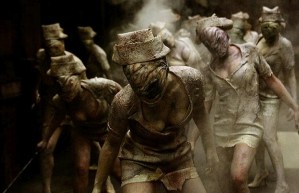 The movie is paced and structured like a video game, which means it’s just as tedious to sit through. The first two acts of Silent Hill center on Rose going from Point A to Point B, finding clue that leads her to a new point, and repeating this tiresome exercise. There?s a scene where there’s a giant hole in the floor and Rose has to navigate across scattered beams to get to the other side. It’s portrayed exactly like a video game level, as are most of her encounters. Worst of all, the movie follows a code of logic that dares to only exist in video games. Why does Rose instinctively know she needs to reach inside the mouth of a corpse to find a sign? How does she know a hidden room lay behind a portrait? Why does Rose know that light attracts the “Thriller” dance team/nurses with potato sacks on their heads? How come the evil presence that basically created this limbo world of the undead cannot penetrate a church? The plot is mostly incoherent and intentionally surreal, but that doesn’t excuse the fact that the story is just plain awful.
Silent Hill completely collapses once the third act begins. It was plodding up until that point, but now the film becomes downright ridiculous and painful. We’re amongst a crazy group of fundamentalist witch burners that, for whatever reason, dress in hazmat suits to venture outside their grounds. It’s at this point that the surreal nature stops and we find the answer to our questions: another vengeful spirit from beyond the grave. Ho hum. The protracted climax goes overboard and practically rapes the stellar ending of Carrie. Also, Silent Hill expects its Big Reveal to be shocking or surprising, but it cannot be anything except redundant because the film spelled it out an hour ago.
The dialogue is howl-inducing. There’s a moment that Rose says, “Don’t worry honey, everything’s going to be okay. You’re going to be alright.” And this immediately precedes the little girl watching the religious cult burn someone’s face off. There’s another moment, more than an hour in, where Rose says, “Something bad happened here.” You think? All of the dialogue can be fitted into two categories: either expository or instructional. It’s like to be true to a video game they also decided to lift the terrible dialogue as well. The plot meanders for the longest time, allowing Rose to visit place to place, and then Avary decides to bludgeon his audience with a 5-minute chunk of exposition meant to clarify everything up to that point.
The acting is pretty bad. Mitchell gives a valiant effort and has a nice scream, but she can’t escape the dead weight of the dialogue and total lack of characterization. Bean is entirely wasted and his “American” accent seems to waver quite a bit for such short screen time. Holden is more a fetish figure fantasy than a character, evidenced by her tight leather pants being the first thing we ever see of her. Still, it’s somewhat interesting seeing the romantic lead from 2001’s The Majestic kickin’ some unholy ass. It’s hard to say if any actors of any caliber could have redeemed the film, but this collection of thespians doesn’t even try to put a polish on the dialogue. You can tell because the howler lines are still howlers.
 Lest I forget, this thing is OVER two hours long. There’s no reason Silent Hill should even be teetering over 100 minutes, especially for a film as sparsely plotted as this one, that is, before Avary’s exposition head rush. I don’t know why the filmmakers included the pointless subplot involving Christopher on the search for his wife. The subplot adds no deeper insight, affords no opportunity to help shape the plot, and only serves to whisk the audience out of the moment and remind them how pointless Silent Hill is quickly becoming. And is it ever pointless.
Director Christophe Gans (Brotherhood of the Wolf) has a great taste for visuals, Silent Hill‘s only positive marks. Some of the images in this movie are truly horrifying and have, reluctantly, stuck in my head days afterwards. The Pyramid Head man, with a 20-foot sword, makes little sense but is a jarring and memorable image. When those loud sirens sound there is a slight amount of dread, but really it’s more of a morbid curiosity at what kind of hellish transportation will happen next. The excellent production design and cinematography also contribute to the film’s eerie, striking, sometimes suffocating atmosphere. But, alas, an interesting visual palate cannot save a slow, dimwitted, inane movie. Otherwise What Dreams May Come may have worked. But it didn’t.
Silent Hill is pointless, plodding, incoherent, far too long and far too boring. The bad dialogue, acting, and plot don’t seem to help matters either. Gans creates a moody atmosphere with some powerfully nightmarish imagery, but that’s the only thing Silent Hill has going for it. Whether it be a man with a Pyramid for his head ripping the flesh off someone like a coat or a little demonic girl dancing in a literal blood shower, Silent Hill has its small potent visual moments. However, these small moments of visual potency cannot make up for the giant black hole of suck. This movie is simply dreadful and designed too faithfully as a video game adaptation, which means the same gaps in logic and pacing are present. I certainly expected better from Avary. I told my friend Dan that I was embarrassed we’d forever know we saw Silent Hill on its opening night, so much so that I bought him food after the show to make up for dragging him along. This is the first movie I’ve ever attended where I heard booing afterwards from my audience. I would have joined them but I was too busy getting out of the theater as soon as the end credits rolled.
Nate’s Grade: D
Share this:

Thank You for Smoking (2006)
 As soon as I saw a trailer for Thank You for Smoking I was in love. I found the book for cheap and read it with months to spare before the film reached my local theater. Admittedly, my expectations were high because the book was wonderful, and Thank You for Smoking as a movie is equally wonderful and a very good film adaptation.
This is a wickedly funny satire that skewers all sides in the political debate about Big Tobacco, and the film doesn’t take a stand, which is refreshing. It has a firm grip on its humor and gleefully gives its finger to political correctness. There?s a lunch group called the M.O.D. (Merchants of Death) squad where reps for Alcohol, Firearms, and Tobacco, of course, argue over whose product is harder to spin. It’s likely the snort-because-you-can’t-believe-they-said-that movie of the year. The tar-black humor in Thank You for Smoking rolls off so casually. This is a comedy that respects the intelligence of its audience and doesn’t dumb down its barbs or its satire. Aaron Eckhart was born to play the role of Nick Naylor, tobacco’s master spin artist and public charlatan. Naylor is conniving, slippery, and yet immensely likable not in spite of these traits but because of them. Eckhart is downright charming and you can see how he could dupe a nation, even if he’s only doing it for the challenge. Thank You for Smoking has one of the finest assembled casts in a long time, and every member fires on all cylinders. This is a film brimming with confidence and it’s evident with every frame. You almost might feel guilty for wanting to capture a contact buzz from how polished, assured and witty the flick is.
I never thought I’d say so but it sure looks like adapter/director Jason Reitman has a far more promising future right now than his dad, Ivan. Jason, the son, keeps the movie brisk, packed with characters, subplots, jokes, and a visual whimsy. This is a terrific adaptation of a terrific book, and Reitman really hones in on the mechanics of debate and lobbyist practices with aplomb. A scene where Nick teaches his adoring son the tricks of debate with ice cream is outstanding. Thank You for Smoking crackles with dialogue to die for, like Nick’s boss BR (J.K. Simmons) saying, “We sell cigarettes. They’re cool, and addictive, and available — the job is practically done for us.” My only complaints with the film, besides that it’s too short at just 90 minutes, is the manufactured danger seems a bit too slight and too easily overcome. Nick quite simply vanquishes whatever threat his reporter sex buddy Heather (Katie Holmes) posed. Otherwise, Thank You for Smoking is a superb movie all around and there’s no reason you shouldn’t see it. Take the hit.
Nate’s Grade: A


You must be logged in to post a comment.