Author Archives: natezoebl
Bloodrayne (2006)
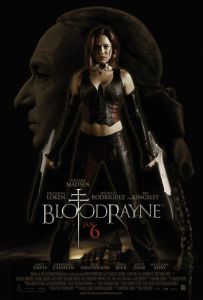 Bloodrayne is based on a video game of the same name that follows a svelte, red-haired vampire with two long pairs of swords she wields on her arms. In the video game she fights against Nazis in World War II. Now that is a movie I would love to see. Everyone hates Nazis (well, most everyone), and to see a sexy half-naked vampire run around and kill them … that just spells awesome. But then along came director Uwe Boll and his German financiers. Boll has turned back the clock and made his Bloodrayne an origin tale set amongst some old European landscape dotted with castles and vampires. He filmed in the real Transylvania in Romania. I don’t know if this location added any more authenticity. It couldn’t have made the film any worse.
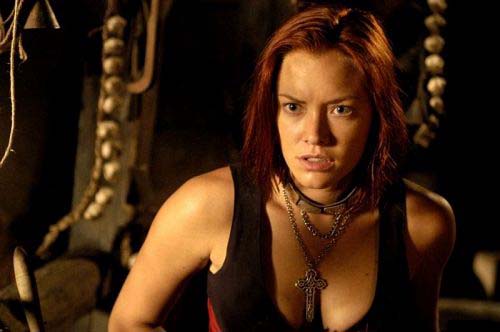
In some place centuries ago, there’s a dhampir named Rayne (Kristanna Loken). A dhampir is a half-human, half-vampire hybrid, and we’re told most do not survive conception. Rayne has become a circus sideshow, where her captors torture her and then feed her blood, observing her nimble body heal itself. The Brimstone society is an organization devoted to fighting vampires. Vladimir (Michael Madsen) leads a small group, including Katarin (Michelle Rodriguez), on the hunt for Rayne. They believe she could help them defeat Kagan (Ben Kingsley), the most fearsome vampire in the land for some reason. Kagan is on the hunt for three guarded objects (an eye, a heart, and a rib) that will give him power beyond imagination. Rayne breaks free from her circus life, thanks to killing just about all of them, and joins the Brimstone group. You see, she’s got a score to settle with Kagan. He raped her mother and years later returned and killed her while Rayne watched. Complicating matters is the fact that he’s also Rayne’s biological father.
 If Bloodrayne had merely been a straight-faced, mystical, Medieval gore fest, I might have even credited it for being a decent genre flick. But it’s the assorted anachronisms and rudimentary scope that chafe Bloodrayne, never letting it settle. Take for instance the weirdest scene in the entire movie. Now, for a movie about vampires, prophecy, secret orders, and Michelle Rodriguez even attempting a British accent (one word of advice: don’t), the strangest moment is Billy Zane’s “special appearance.” The opening credits in Bloodrayne call it that, but how does someone have a “special appearance” in an open-and-shut narrative? This isn’t an ongoing TV series. Zane has two scenes. The first has him dictating a letter like a mid-level executive, straining and stretching to fill an inter-office missive. He actually says modern phrases like “No, scratch that,” and “et cetera, et cetera, et cetera, signed Your Father.” That’s it. That’s the scene. It serves little purpose other than to make you think Billy Zane sucks when it comes to personal skills.
Boll fails to curtail these anachronisms that hurt Bloodrayne’s tone and execution. His lack of interest in details or sense also puts the film at a disadvantage. There’s a late scene where Katarin suddenly is wearing a modern purple women’s jacket, like she just got it off the rack from TJ Max. Why does Vladimir wave his sword around all the damn time, but when it comes to actual combat he tosses it back and forth in his hands like a hot potato? A character has a hidden room of weapons, but it’s not much of a secret room when the lever to open this space is dubiously displayed for all to see. Domastir (Will Sanderson, making his fifth appearance in a Boll film) has a hilariously bad haircut that looks like crop circles were shaved into his head. Why, after Rayne has joined the Brimstone fighters late in the film, do we need her in a training montage? I’m pretty sure by that point Rayne can hold her own.
Kagan is never examined as to why he is so dangerous. We have no understanding why the film’s villain should even be feared. He’s on a quest for super power but what Bond villain isn’t? In fact, Bloodrayne has an altogether ho-hum view on vampires. In this movie they’re vulnerable to water as well as sunlight, but they’re also just as vulnerable to steel. The vampires fight with swords and die by them just as easily. One wonders what the allure of vampirism even is if this is all you get. There’s a scene early on where Rayne spots a female vampire chatting away in the open. She makes a come-hither motion with her finger and the lady vamp follows along obediently. Then Rayne bites her neck and drinks her dry, while the lady vamp does nothing but gets bug-eyes and goes limp. Apparently, the lack of sunlight must have negative effects on brain power and deductive thought. What Boll needs to learn is that if you’re going to have a movie where humans and vampires battle, at least give the vampires something beyond pointy teeth and bad hair. Seriously, was there a mullet discount at the wig store?
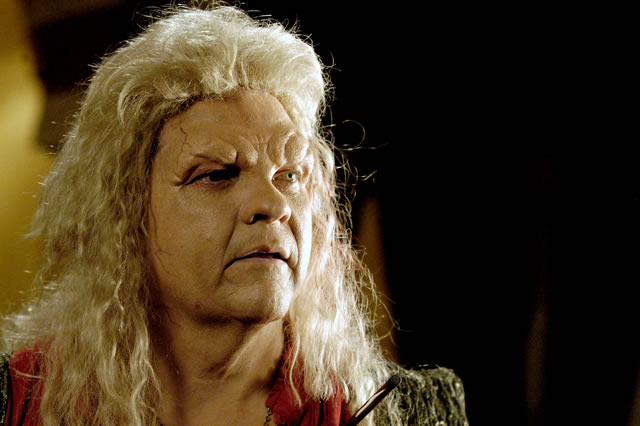 Then there’s the goofy series of one-scene actors. Meat Loaf appears as slovenly vampire pimp Leonid, surrounded by nubile nude women. He speaks like he’s taken a bottle of Quaaludes and has, what can best be described as, a dead and bleached muskrat on his head. The scene gets worse when Leonid is battling our Brimstone fighters. They take out several of the windows in his parlor and destroy Mr. Loaf by the influx of natural light. Now how stupid of an interior decorator did Leonid have? You would think a vampire running a blood parlor and place of otherworldly gathering would attempt to obscure very breakable windows. It’s the ignorance of these details and more that makes Bloodrayne ridiculous while still being pitiful of scope. If Boll is going to tell such a dull and cut-and-dry story, it’s not encouraging that he can’t even be bothered to get the details right.
The movie is poorly plotted from the start. Bloodrayne is aimless and doesn’t so much conclude as it does run out of bodies to kill. The ending will leave most scratching their heads not because it’s confusing but because the movie just peters out. More than most, Bloodrayne feels structured like a video game, with its plot points regarding the search and acquisition of super items that Kagan is after. The screenplay is credited to Guinevere Turner, co-writer of the American Psycho adaptation and frequent collaborator with director Mary Harron. I refuse to believe Turner’s responsible for the mess left on screen since Boll has the habit of rewriting whole scripts. The dialogue is unintentionally hilarious, with clichéd nuggets like, “Keep your friends close and your enemies closer,” and, “He wants a fight and a fight he shall get.”
The direction is shamelessly derivative. There’s a lot, and I mean a lot, of long exterior scenes where we see people on horseback riding along the substantial wilderness. It’s like Uwe Boll watched the Lord of the Rings series and said, “I can do that … but crappy.” These long exterior scenes conflict with the movie’s small playing field. Every town and every castle feels like a stone’s throw away, and the world feels like it’s populated by about 100 people. Boll never makes it clear what the setting of Bloodryane is. It feels like Vague Europe Land.
Boll doesn’t even manage to get his action sequences right. He’s got a bigger stage this time and some more money for effects but the results are still the same. To hide the fact that his actors had no time for fight training, Boll edits his fight scenes to the disorienting millisecond. The intent is to hide the stunt performers doing all the work. The result is that you can’t even tell what the hell’s going on in Bloodrayne. This also hamstrings his action choreography making it little beyond two figures clashing and one falling dead. The explosions of blood are overdone, with every gash shooting showers of red like the human body was connected to an off camera fire hose. Agreeably, there are a lot of splashes of blood but nothing too memorable or gruesome. It kind of has the feel of what bored teens would come up with during a sleepover with their dad’s camcorder. The violence and vampire angle are the two things that will appeal most to teenage men, but neither aspect is properly explored or satisfying. Bloodrayne presents a simple fable and doesn’t even bother to control its simple world of extraordinary creatures.
 I thought the sex scene in Boll’s Alone in the Dark was preposterously out-of-the-blue, but the gratuitous sex scene in Bloodrayne puts it to shame. Rayne is plagued by nightmares of her vampiric urges, as well as her mother being killed by Kagan. One night she has a vivid nightmare where she relives slaughtering her circus. She’s startled awake. What’s her first instinct? She grabs Sebastian (Matthew Davis), pins him against her cell bars, and proceeds to ride him like she has the upper body of a weight lifter. Maybe this is the lone benefit of being a vampire: a wider selection of sexual positions. The sex is sloppy and unerotic in its ludicrousness. Boll also manages to make sure his camera gets every loving detail of Loken’s nipples being lapped at. Boll figures that this gratuitous sex scene (it really couldn’t get any more gratuitous if they were skydiving) is meant to bond the characters into a romantic relationship. This forced romance is, like many elements in Bloodrayne, also inept. It stretches believability when this moment is all we have to go on why Rayne and Sebastian feel for one another. When they part Sebastian is crestfallen, though I think it’s more because he just lost the only girl he’ll ever meet that can perform gymnastic sex. Talk about a perfect score on the parallel bars.
The acting in Bloodrayne is about what I’d expect from a Uwe Boll movie. Loken (Terminator 3) is an attractive woman, yes, but the figure of Rayne is more a fetish fantasy than a flesh-and-blood character. There’s more attention to her revealing wardrobe than her character. Loken overplays her one facial expression, which looks precisely like she just caught wind of a fart. Her English accent is also very droning. Madsen (Species, Kill Bill) seems drunk the whole time. Rodriguez (SWAT) can do little more than scowl, but in Bloodryane she gets to scowl with a comically bungling British accent. And then there’s Sir Ben Kingsley. He spends most of his screen time confined to a throne as if he’s subconsciously trying to pass this movie like a stubborn bowel movement. He looks more like a terminally ill founding father with a penchant for silks than the evil Lord of Vampires. Kingsley hasn’t exactly been judicious with some of his film choices (Thunderbirds, A Sound of Thunder, Suspect Zero) but you’d think an Oscar-winning actor would have better sense than to work with Dr. Boll.
Bloodrayne is the best of Boll’s troika of video-game adaptations, but even that statement is without praise. This lame sword-and-sorcery tale is merely bad, instead of absurdly bad like most of Boll’s oeuvre. The difference is one tiny adverb, folks. The film is limited in scope but still careless and absent-minded with its details. The action sequences are heavy on blood and short on orientation, edited within an inch of their life. Bloodrayne is full of Boll’s typical lapses in plot and characters, and there’s plenty of stupid to go around for everybody. The plot is made up of nonsensical guest shots by slumming actors, and the villain himself seems as menacing as someone’s toilet-bound grandpa. In the world of film it’s tricky to judge films on a scale of badness, because that scale is surprisingly varied. Bloodrayne is clearly bad, but it’s also more entertaining than his previous films. Maybe Boll is learning after all, though at this rate of progression he’ll reach “mildly tolerable” by the time the sun explodes.
Nate’s Grade: D+
Share this:

Alone in the Dark (2005)

Edward Camby (Christian Slater) is a paranormal investigator trying to rediscover what happened in his past. He was apart of 20 orphans taken by Fischer (Frank C. Turner), your basic mad scientist type. Camby was the only child to escape Fischer’s poking and prodding. The other orphans have become sleeper agents/zombies to assist him in opening a dimensional gate to another world, a world with bloodthirsty creatures that live in darkness. This world and its creatures were first discovered by an ancient Native American tribe who mysteriously vanished. But before doing so, they thoughtfully broke the dimensional key and hid the pieces all over North America. Aline Cedrac (Tara Reid) is a scientist/archeologist that specializes in this Native American tribe and its artifacts. She teams up with her old flame, Camby, to help stop the mad doctor. Monitoring the whole situation is Commander Burke (Stephen Dorff), the man in charge of the United States government’s bureau of the paranormal. He leads his no-nonsense super troopers to the location of the dimensional gateway, which just happens to be underneath Camby’s childhood orphanage.
Alone in the Dark is a good film for people that felt House of the Dead was too intellectual. It should be obvious after reading the plot synopsis, but Alone in the Dark is a movie of unparalleled stupidity. What was the point of making orphans sleeper agents/zombies? They’re very easily disposed of and not very effective. I don’t know whether or not this is because they didn’t have a mom and dad growing up. What does this mad doctor hope to achieve by opening the door to creepy crawly monsters? I guess he thinks the monsters will be grateful and give him some kind of bureaucratic job, instead of, you know, gutting him and drinking his blood. I’ll never understand why villains align themselves with creatures whose only purpose is killing. How does Camby end up having a childhood flashback from a perspective that isn’t his own? The plot of Alone in the Dark is a gigantic mess. What other film in recent memory fits together ancient Native American tribes, monsters from an alternate dimension, government agencies, orphanages, zombies, and Tara Reid? You know you’re in bad hands when they open the film with a ten paragraph scrawl to explain what the film, by itself, cannot. And then they add narration because they don’t trust their audience to read.
 The film is called Alone in the Dark and tells us that killer creatures lurk where we cannot see them. This is a fine platform to engineer some good scares; really stir the audience into fearing what they cannot see. As always, nothing will be scarier than a person’s mind at work. Boll doesn’t agree. He doesn’t even toy with the idea of hiding his creatures and building tension gradually. Boll prefers to show you his monsters immediately and often, therefore eliminating any attempts at suspense. Now the characters aren’t running away from what they can’t see; they’re running away from lame CGI rat/alligator creatures. The monsters look laughable and should have stayed in the shadows for as long as possible. It’s hard to spook an audience once they see what they’re supposed to be afraid of. Boll’s impatience for suspense and his love of cheesy special effects cripple Alone in the Dark.
Alone in the Dark has no pulse when it comes to action. Boll stages his action sequences like different stations on a gameshow. Characters (contestants) run from station to station, picking up weapons and shooting at whatever, and then advancing to another stage with a different weapon. Much of the action just comes out of nowhere and ends in its own confused way. Boll likes to season his poorly choreographed action sequences by cranking up loud rock music and mixing in excessive, gimmicky special effects. For no reason, Camby and Aline and the soldiers will be shooting and Boll just all of sudden decides this scene should be in a strobe light. Or he’ll shove in a cheap slow-mo follow-the-bullet effect. Boll likes testing out different effects that serve little purpose other than to call attention to itself. Boll has confused this with style.
Speaking of action coming out of nowhere, Boll manages to squeeze in an out-of-the-blue sex scene. Aline visits Camby in the morning, sees him sleeping, and decides on the spot to crawl into bed and have sex with him. Reid and Slater have no chemistry whatsoever. It’s like watching water buffalos go at it. Then the sex is never referred to again. This is just another pristine example of how carelessly Uwe Boll handles plot and characters. Rarely does Boll even bother with a transition scene to explain how a character got from Point A to Point B.
Boll’s direction is lazy and derivative. There are scenes that openly ape superior movies, like Alien, Raiders of the Lost Ark, Starship Troopers, and even Boll’s own House of the Dead for crissakes. The plot is a cut-and-paste job of the series finale of TV’s Buffy the Vampire Slayer. Both deal with an army of creatures living under an everyday school building and involve a special key to unlock the gateway. And like in Buffy, some noble individual sacrifices himself to destroy the gateway’s underground entrance. No, scratch that. The plot itself is virtually a copy of Super Mario Brothers, the first video game based movie. Both films involve some magical key needed to unlock two alternate dimensions of creatures. No, scratch that. This is one big rip-off of Darkness Falls, since both involve crazy creatures that can only attack from the dark. Whatever it is, Alone in the Dark is Boll’s opportunity to showcase his un-originality. That is, if you can pry him away from inserting more pointless slow-mo bullet effects.
 The acting is wildly all over the map. I wonder if Boll will ever be able to direct actors. The line delivery is terrible all around. Slater is subdued and permanently cranky. Maybe somewhere inside that Jack Nicholson grin he’s realized he’s slumming it. Reid acts like an irritable child. Dorff seems to be the only actor having any fun, though I don’t know how intimidating this diminutive actor comes across as a military man. The actors of Alone in the Dark confuse loud with emotional.
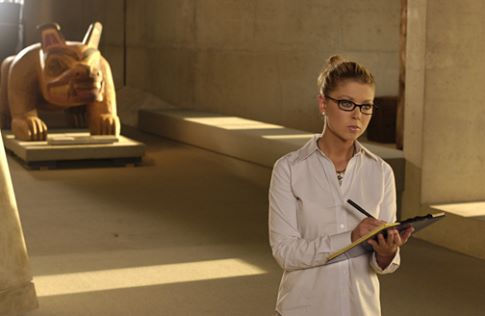
Let’s take some time out to spotlight Reid and her character. The way Alone in the Dark convinces us that Reid is a scientist is by giving her some black rimmed glasses and putting her hair in a pony tail. It’s just that easy, folks. Apparently being a scientist didn’t help Reid with her geography; she pronounces Newfoundland “New-FOUND-land” (the correct pronunciation is “New-fin-lan”).
The dialogue reeks of poorly concealed exposition. A chatty security guard serves as the writer’s sloppy conduit to establish back story: “You don’t know about the Indians? Let me explain,” “You don’t know who Aline Cedrac is? Let me explain,” “How’s your boooooyfriend, Aline Cedrac?” Alone in the Dark relies on gobs of thick exposition to cover up its insurmountable plot holes. The movie thinks it’s like a cool detective noir. It’s not. You never heard Sam Spade say, “Fear is what protects you from the things you don’t believe in.” Huh? Does that make any sense?
Alone in the Dark is symptomatic of all of Boll’s directorial flaws. He has no feel for tone, he has no control over actors, he makes bad stylistic decisions that detract from the film, and he has no time for subtlety. Boll spoils all of his surprise by showing the monsters up and front instead of letting the human mind fill in the blanks for terror. This is a brain-dead action film that doesn’t even trust its audience to read. Alone in the Dark is a film so incompetent, so ridiculous, so convoluted, and so moronic that it must bend the laws of space and time simply to exist. This makes House of the Dead look well thought out. If this is indicative of what Boll has in store for his video game adaptations, then you can expect many duds yet to come on Boll’s path to eventual audience oblivion. If anyone dared venture to a theater to see this movie, they’d find themselves alone in the dark all right. And shamed. Deeply, deeply shamed.
Nate’s Grade: F
Share this:

House of the Dead (2003)
 House of the Dead is Uwe Boll’s first foray into the video game-to-movie niche he’s carved himself. It’s based on a first-person-shooter by Sega that lets players blast their way through a haunted house and its undead tenants. There’s not much to the game. In interviews Boll has remarked at how he hated the film’s jokey script and rewrote much of it on the fly, trapping the film between the genres of horror and action. In the DVD jacket, executive producer/co-writer Mark A. Altman says, “House of the Dead is no Citizen Kane.” This may be the understatement of the millennium, comparable only to Napoleon saying Russia might be a tad cold.
Matt (Steve Byers), Greg (Will Sanderson), Simon (Tyron Leitso) are meeting with fellow college students Alicia (Ona Grauer), Karma (Enuka Okuma), and Cynthia (Sonya Salomaa). They’re ready to party at the rave of the century. This rave of raves takes place on the ominously named Isle del Muerte (The Island of the Dead). I suppose this proves that no one on the rave planning board speaks Spanish. The kids eventually hitch a ride to the island from Captain Kirk (Jurgen Prochnow) and his first mate (Clint Howard). Hot on Kirk’s heels is Casper (Ellie Kornell), a border agent after Kirk for gunrunning. Once they arrive at the island, the kids are shocked to find the rave site vacated, destroyed, and swarming with zombies. Everyone makes a run for it and regroups with some of the rave’s survivors, led by Rudy (Jonathon Cherry). The groups team up, armed by Kirk, and set out to shoot their way home. But there’s also a very evil figure roaming about that has more sinister plans for the island’s fresh meat.
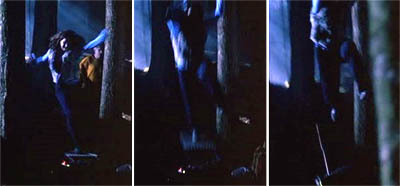 House of the Dead isn’t a horror movie at all. Boll has no idea how to stage scenes with tension. He has no feel for mood or atmosphere, which are the foundations of a good horror flick. So instead, House of the Dead is a riotously dumb action movie. But under Boll’s direction, it’s not even good at that. The action is repetitious and pedestrian. Boll’s big melee sequence becomes boring because it doesn’t progress. There’s just ten minutes of wall-to-wall shooting zombies, but there isn’t any order to it, no rhyme or reason. If you want a perfect example of Boll’s inept staging, skim to 47:20 into the DVD and watch. You’ll see a zombie leap onto a jumping platform and launch himself into the air. House of the Dead actually has scenes where we see exposed jumping pads and landing mats.
Boll gets drunk on special effects very easily. He loves the bullet time effect and throws it in at odd points. Every single character gets a tiresome slow-mo camera spin as they fire a gun. After the ninth and tenth time, the thing gets old. The characters don’t even have the same weapons in the shots before the slow-mo jazz. Boll doesn’t use flashy effects to benefit his narrative, unlike The Matrix. Boll actually thinks using clips from the actual video game is a good device to transition between scenes. There will be moments where screen shots of the game just pop up. Boll is a kid with toys and no clue when to put them back into the box.
This movie’s silliness is jaw dropping. The so-called rave of the century seems to be poorly attended, and the better for it since it takes place on the Island of the Dead (Isle del Muerte). Is that really the best place to host a social gathering? Perhaps everyone gets what they deserve for being stupid. Kirk, after shooting several zombies, limply remarks, “Now I know why they call this the Island of the Dead.” The line should be accompanied by a rim shot. The movie doesn’t even live up to the lofty ambitions of its title.
 By far the most ludicrous story element is the film’s villain, Castillo (David Palffy). It seems that before he stalked the island in a hooded cloak, looking like Robert DeNiro in Mary Shelley’s Frankenstein, he was a Spanish pirate/doctor. He tried to experiment on living tissue in order to unlock the secret of how to be immortal. He was imprisoned on a Spanish ship and was shipwrecked on the Island of the Dead (what are the odds?). He’s concocted a special Kool-Aid that will bring the dead back to life, though I don’t know why he’s still stuck on an island if he can’t drown. I guess he’s been biding his time and waiting for stupid college students so he can see some T&A.
The characters are made up of people interested in attending a rave, but when the action hits they’re all instantly adept at weaponry and kung-fu. That’s not the typical raver I know, and these people must be super ravers if they’re going to the rave of the century. Simon is described as “the biggest underwear model in America,” and for all I know underwear models encounter a lot of gunfire on the runway. The DVD jacket has character profiles where it lists their name, age, weapon of choice, and skill. After having watched House of the Dead, the skills are laughable at best. Simon the runway model’s skill is “tactical planning.” I also seriously question Rudy’s “leadership” skills since he gets everyone killed.
Of course everyone in the movie is profoundly stupid. While trapped in the island’s only house, Rudy says the kegs of gunpowder are useless without a charge, and then he walks past a series of lit candles. The whole house upon arrival is filled with lit candles (who has the time for that, by the way?). Alicia is convinced that the rave site being deserted, destroyed, and zombie-infested is all a practical joke, as if Ashton Kutcher is just around a tree poised to yell, “You suckas just got punk’d!” There are numerous moments where a character will wander into the dark and say, “[Insert name], is that you?” Kirk takes the last stick of dynamite and plans to sacrifice himself by blowing up some zombies good. He lights the stick, wanders outside their barricaded stronghold, and blows himself sky high. What Kirk failed to do was move far enough from the house, because he also blows the front door wide open and the zombies filter inside.
The acting doesn’t even rise to the level of camp. The actors feel unrestrained and marooned, typical of a Uwe Boll film. The man has no feel for actors and this explains why his films have some of the worst line readings I’ve ever heard (2000’s Dungeons and Dragons is still the worst). Casper acts like a crabby fitness instructor. The dialogue is bad as is, but when added with the poor line readings it turns every spoken sentence into something of unintentional hilarity. Take this nugget from Simon: “We got to the boat but it wasn’t there.” Well, then did you actually get to it?
House of the Dead can be enjoyed for the depths it plumbs. The dialogue is cheesy and leaden. The movie is bad enough that if you have some friends over, drink steadily, you’ll have a blast laughing and hurling popcorn at the screen. The movie does have a decent amount of blood and gore and the make-up effects are good but limited. You can enjoy House of the Dead in a fun derisive way, and it’s hard to argue with the price some retailers charge (I bought it on Amazon.com for 75 cents plus shipping). The DVD commentary is also good for a laugh, that is, if Boll’s self-flagellating remarks are serious. At one point he compares his zombie action movie to Schindler’s List. Boll also marvels at an actor’s ability to carry objects and make them seem heavy. I’m not sure if Boll is serious or just making fun of the movie like everyone else.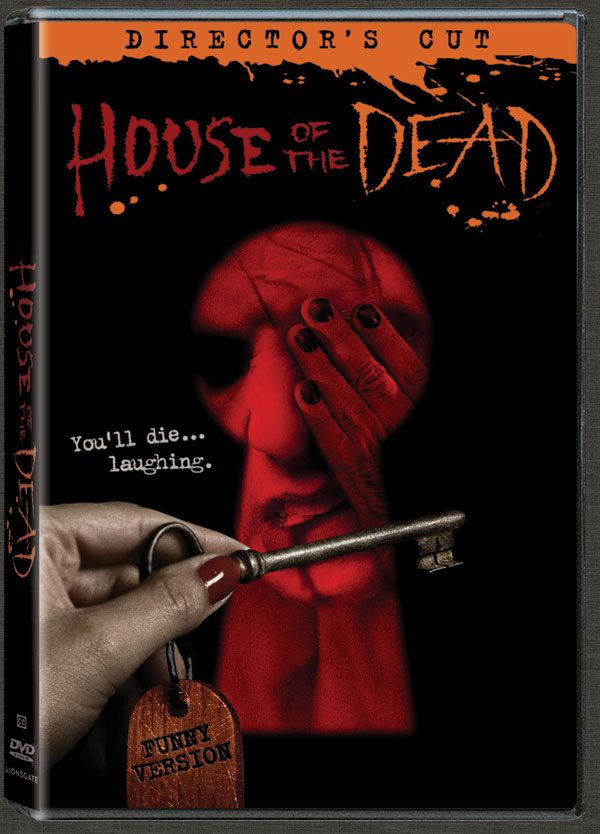
House of the Dead is a dull action movie within the framework of a horror flick. The characters are powerfully stupid, the action is redundant, the effects are chintzy and overused, and the direction is lackluster. Boll has added little in transitioning a game about poppin’ zombies onto the silver screen. The video game is flimsy and the movie based upon it manages to be even flimsier. House of the Dead is incredibly dumb entertainment and the fact that a sequel is well underway cannot be a good sign for human existence. I never thought I’d utter these words but . . . Clint Howard, you’re too good for this.
Nate’s Grade: D
Note: Boll re-released a recut House of the Dead as a comedy. I haven’t seen “the funny version” but I can’t imagine that it could possibly be any funnier than the original.
Share this:

The Break-Up (2006)
 Real-life couples have a rocky track record when they star together. Sure, for every Mr. and Mrs. Smith there’s also a Proof of Life, Vanilla Sky, or, God help us, a Gigli. The trouble is that what captures the fancies of two actors rarely translates to the big screen. Was anyone more the wiser why Jennifer Lopez and Ben Affleck got together on the set of Gigli? Now here comes The Break-Up, an anti-romantic comedy starring Vince Vaughn and Jennifer Aniston. They’ve been playing a coy game with the media about whether they’ve been dating since the movie wrapped a year ago. Audiences will have difficulty seeing whatever magic the two felt, because The Break-Up isn’t romantic in any sense of the word.
Gary (Vaughn) and Brooke (Aniston) meet cute at a Chicago Cubs game and begin a two-year relationship. Then one evening, after a terribly uncomfortable dinner between their folks, both decide to call off their romantic entanglement. Neither is willing to leave the condo they co-own, so each engages in a battle to convince the other to leave. Gary wardens off the living room as his space. Fine, Brooke invites her brother’s glee-club to perform in her area. He gets the pool table they had talked about waiting to purchase. She throws his clothes into the hall listening to Alanis Morissette. She invites dates over. He has a night of strip poker with actual strippers. At the same time, Brooke is questioning whether she can save their relationship and work things out.
 Audiences expecting a cheeky romantic comedy will be soundly disappointed. The Universal marketing weasels have lied to you! After the 30-minute mark, The Break-Up doesn’t have much comedy, let alone romance. This is really more of a gutsy mainstream drama that prefers to exist in a world similar to ours where heartbreak and yearning are often unresolved. This is a respectably good, if flawed, relationship drama that doesn’t pull its punches. The Break-Up has a very Chasing Amy air to it; both films present atypical Hollywood relationships and both seem to sense a happy ending would just be insulting. Actually, in another similarity, both The Break-Up and Chasing Amy have their comedy completely dissolve by film’s end.
The biggest flaw The Break-Up has is that we don?t generally care if Brooke and Gary get back together. The only good times of yesterday we see are via photographs that are shown during the opening credits. Beyond this brief photo collage, we?re basically starting at the end of their union. There’s a fair amount of gender stereotypes to go along with the characters and their behaviors (men are from Mars, women from Venus?), though it didn’t bother me as much as it would have in a typical romantic comedy. Brooke is a bit of a nag but an altogether good person who just goes about her reconciliation plans in the wrong manner (push him away to have him come back, make him jealous, the famous double-speak). Gary, on the other hand, is pretty much a jerk. The tagline for The Break-Up says, “Pick a side,” but the movie already picks for us. Gary is a lazy, egotistical, unappreciative, selfish jackass and you’re really puzzled why Brooke would keep trying to resuscitate their relationship. Again, part of this is because The Break-Up doesn’t ever show us a moment of these two crazy kids in love. We really have no interest in seeing these unhappy people be unhappy with each other for a longer period of time.
The Break-Up has a lot of intentionally pained awkwardness to it, partly because good portions of the movie is about voyeuristically watching an unhappy couple argue. The Break-Up‘s relatability, something nearly unheard of in the overly saccharine, simplistic world of romantic comedies, is a double-edged sword. Couples may wince and pass knowing looks, thinking, “We’ve had that fight. I too crossed the line like that. I too went about that the wrong way.” Audiences will see pieces of themselves onscreen, but do mainstream audiences really want to see pieces of themselves screaming at each other for a whole movie? I doubt it. I think displeased moviegoers are going to tell their friends to stay away in droves, unless they’re avid tabloid followers.

Vaughn continues his motor mouth lout shtick, though it’s somewhat impressive that he willingly puts himself in such an unflattering light. He’s also a bit puffy in the movie. Aniston is an actress I haven’t been overly enthusiastic with, to say the least, but she’s a winning personality even if she’s replaceable. She seems to be in a frazzled rut. Despite whatever real-life passion the filming ignited, the leads have little chemistry together onscreen. This would be a bigger concern if the film was starting at the end of their relationship, though. The supporting cast of Vaughn’s friends and co-workers is rich with talent. A late scene between Vaughn and Favreau about hiring a hitman to take out Brooke’s supposed new beaux is solid gold. The wonderful John Michael Higgins (Arrested Development), as Brooke’s socially inept brother, provides the biggest laughs. And for those wondering what ever happened to Ralphie from A Christmas Story, here he is all growed up and emasculated by Joey Lauren Adams.
Director Peyton Reed (Bring it On, Down with Love) has a good feel for human comedy and interesting shot selections. He normally keeps his movies brisk and airy. The dialogue is above average and feels naturalistic. I am surprised that I have heard so little about Aniston’s brief nude scene. Then again, I don?t watch that recycled Entertainment Tonight TV vomit. It’s kind of neat to note that there was a 1998 movie itself called The Break Up; they just didn’t have the hyphen. Remember that hyphen in a few months when you’re at your local video store [Author’s note: R.I.P. video stores].
I give Vaughn and the filmmakers credit for trying something challenging and attempting to have a mainstream audience go along. The Break-Up is uncomfortable in how painfully awkward and relatable it is. Whether audiences want to flock to a movie about unhappy people who don’t belong together is a good question. This isn’t as nasty a comedy as The War of the Roses; no, this film is kind of stuck in a thematic middle ground of a gutsy, if flawed, relationship drama. Those expecting promises of comedy and romance might feel cheated. The Break-Up is like a real-life experience: it’s somewhat painful, somewhat expected, and perhaps better once it’s finally over.
Nate’s Grade: B-
Share this:

Homeroom: Heart of America (2003)
The film spans one morning of a “normal” high school in Oregon (it looks like the school is a three-story motel). It’s the last day of school and everyone is ready to jump into the real world. The storylines are rife with every high school cliché that can be found. Drum roll please, and they are:
1) Good Virgin (Stefanie MacGillivray) is dumped by Jerky Jock (Will Sanderson) because she refuses to put out. The majority of this storyline takes place in the guy’s car where he sadistically tells her all the details of the many other girls he was “forced” to sleep with (“The whole school f*cks. Everybody except you.”). One of these girls is the transient High Girl (Elisabeth Rosen), who has fallen in love with Jerky Jock over the course of him using her for sex.
2) High Girl has no parental involvement and lots of free time. She thusly gets high a lot and trips out for most of the movie. Dealer Dude spends all day implausibly hanging around the high school with sacks of drugs to sell. He’s stopped by Idealist Guidance Counselor (Maria Conchita Alonso) who wants to make a difference.
3) Good Student apparently wasn’t good at contraceptive planning because she’s pregnant. She wants an abortion and her life back. She’s also upset with her Boyfriend who wants to keep the baby and support her but is also willing to support whatever decision she makes.
4) Mean Creative Writing Teacher (Michael Paré) gets a good talking-to by the school principal (Jurgen Prochnow). The teacher is struggling with his own writing and taking out his frustrations by being overly critical of his students’ works. His grades appear to be unfair and unprofessional. One of his students is High Girl.
5) A team of bullies regularly beat up and humiliates Barry (Michael Belyea) and Daniel, who masterminds a plot for revenge. Daniel (Kett Turton) is tormented by his abusive father (Clint Howard) who just laughs when he sees bruises and black eyes on his son. The bullies are lead by King Bully (Brendan Fletcher) who is visited by his older brother, Former King Bully (Steve Byers), who reminisces about the good ole days of beating people up because they were different. These storylines mix and match until our inevitable shoot-em-up conclusion.
 Heart of America is based on a story by Boll and written by Robert Dean Klein (Blackwoods). The plot structure is competent and the film is mildly entertaining, which was a great surprise for me. The cinematography is above average for its budget and the score is quiet and reflective. Heart of America, with all its shortcomings, is still a better movie than Gus van Sant’s school shooter opus, Elephant (I dread to see this statement on the front of a re-released DVD).
Despite all of its simplicity, Heart of America makes some boneheaded decisions. It closes with lengthy text detailing other school shooters in the previous years. The text takes away from the drama and has no significant purpose other than to say, “You’ve just watched kids shoot up their school. Here’s how some other kids did it. If you’d like to learn more, visit your local library.” Heart of America also lacks subtlety; every item that is meant to carry a message of significance is hit so hard you’ll wonder if a gong is rattling. Then again, Boll isn’t well known for subtlety. This should explain Heart of America’s aches and pains with revealing its twists and revelations.
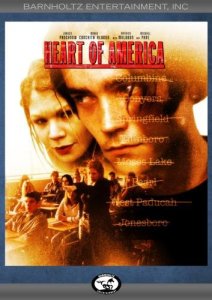
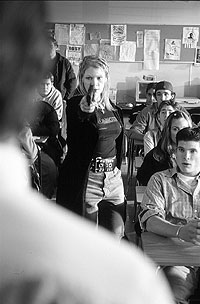
For two acts we’re led to believe that Daniel and Barry are the ones who are going to shoot up their school. Daniel IM’s his co-conspirator and reminds them not to “punk out on him.” Then minutes before the bloodbath it’s revealed that his co-conspirator is . . . another person! It’s High Girl, who takes a gun and gladly goes about killing classmates. Heart of America intentionally teases the viewer whether Barry will not follow through and this twist is intended to be something of a surprise. Trouble is someone should have told that to the DVD manufacturing folks. On the Heart of America DVD cover (as you can see for yourselves above) are the faces of Daniel and High Girl side-by-side. Superimposed over them is a list of school shooting locations that have been crossed out (it’s little wonder that Boll held back from the final one saying, “Anytown, U.S.A.”). Below all of these images is another picture of High Girl, this time standing in class and pointing an accusatory finger at some unforeseen figure. Any person intending to watch Heart of America will instantly associate High Girl with Daniel and already be thinking they’re Bonnie and Clyde. You can’t have a twist when you’re advertising it on the front cover of your DVD. Would The Sixth Sense have been as effective if the poster had Bruce Willis walking through walls like Ghost Dad (no respect to Ghost Dad intended)?
The most disturbing moment in Heart of America doesn’t even take place around the school. It involves a story Big Brother tells his bully clan about his greatest accomplishments. One of these is inviting a mentally challenged girl into his basement, getting her drunk, and then assaulting her. At first I thought it was rather unwarranted and unethical to have flashbacks of Big Bro’s story so that we can actually see the assult. Then it hit a slightly interesting juxtaposition, as Big Bro’s positive recount of his victim’s experience doesn’ match what we see happening. So I was willing to let it slide for a while until the film hit a deplorable low – a gratuitous nude scene of the mentally challenged girl (dubbed “Slow White”). You can tell it’s gratuitous too because most of the scene isn’t even shot at angles that expose her. It’s disturbing on the level that Boll was knowingly trying to shoehorn in some nudity and elicit titillation. The decision actually detracts from the power of the scene because it feels so tackily gratuitous.
 Once the end credits start to roll, the casual viewer will think two things: 1) What is that awful, tonally inappropriate pop song playing that actually has the lyrics, “The roads you made are the ones you pave,” and 2) what the hell was the message of Heart of America? In the first ten minutes or so we see teens on drugs, teens on medication, teens with no parental involvement, teens with parental abuse, and teens bullying to feel better about themselves. Do any of these things cause school violence, or is it some kind of magic combination? I never expected Heart of America to fashion a thesis on why kids grab guns and shoot up their schools but the ending feels ridiculously, artlessly devoid of meaning.
To further get into this point of discussion I will be spoiling all of the major plot lines of the movie, so in the rare instance anyone is remotely interested in watching Heart of America, scroll down. You won’t be missing much, trust me.
As expected, Daniel and High Girl get revenge primarily upon their tormentors. What I don’t get is that before High Girl sweeps into her classroom for her vengeance, she tells Dealer Dude, “I couldn’t have done it without you.” Huh? Does she mean she wouldn’t have gone to these lengths had she not be high? Or is this statement farther reaching, like blaming Dealer Dude for being apart of a system that has turned her into a degenerate drug user? I have no idea, but High Girl struts into class and kills Creative Writing Teacher, who had made fun of her and forced her to read her poetry aloud. Got it. But then she aims her pistol at Jerky Jock, whispers “I love you,” and then shoots Good Virgin to death. Apparently High Girl did not catch the news that Jerky Jock had dumped her minutes earlier. So what is the point of Good Virgin’s storyline? The only thing I can surmise is that if you don’t have sex you will be killed. If Good Virgin had given up her goodly virginity then Jerky Jock wouldn’t have been on the prowl, and he wouldn’t have used High Girl for throwaway sex, and then she wouldn’t have shot Good Virgin in jealousy. You see how this works? It’s the exact opposite of a horror movie. Daniel also shoots and kills Good Student’s boyfriend/father of her baby. What is that saying? Why couldn’t any of the shooters have clipped Patrick Muldoon’s nails-on-the-chalkboard horndog sex ed teacher? It seems Boll has a soapbox but he has nothing understandable to say.
Heart of America makes the audience not only side with the school shooters but also practically roots for them. Daniel and Barry undergo constant bullying from the get-go. The film, in its simplistic approach, plays the bullies as irredeemable assholes and Daniel and Barry are the hapless victims. Heart of America practically justifies its characters resorting to violence. Sure some innocent people get caught in the fray, but then aren’t they all to blame somehow? Again, I have no idea what Boll is trying to say.
Despite Boll having no command with actors (Muldoon is a constant reminder of this), the younger actors in Heart of America give pretty good performances. Turton (Saved!, Walking Tall) really festers with anger and discontent but also gives insights into a fragile kid just wanting to live. Belyea really works his nervous indecision to a nub, going so far as to hide his mother’s car keys so she won’t chance going to his school. Fletcher (Freddy vs. Jason) is a grinning monster as a bully but, in the film’s lone turn at character depth, also shows how uncomfortable he is being a bully. It seems that he too is just doing it to fit in. Fletcher’s pained and awkward reactions are a welcome sign of humanity, though it seems to be too little too late when we the climax hits. Rosen seems decidedly disconnected and dead-eyed scary.
 It’s puzzling that the top listed actors in Heart of America’s credits are as follows; Jurgen Prochnow, Michael Paré, Patrick Muldoon, and Maria Conchita Alonso. All four of those actors amount to about ten minutes of total screen time; Muldoon essentially has a grating cameo. Why are the kids not credited as the rightful stars of the show? The adults all give terrible performances (seriously, I cannot overstate how awful and creepy Muldoon is) but the kids are all right. The most shocking fact about the cast is that somewhere in this mix is Emmy-nominated Mad Men actress Elisabeth Moss. Look for her in here somewhere as “Robin Walters.”
Heart of America works with paint-by-numbers characters and Boll only doles out one color. The jock is a jerk. The virgin is good. The bullies are mean. The stoners are high. Very seldom does the film delve any deeper than these cursory characterizations. Because of this simplicity Heart of America strains credibility during its more unrealistic moments. At one point, King Bully and his posse force Daniel and Barry to eat dog poop and the moment is played as a defining point of drama. Does this stuff really happen? If it does then it certainly doesn’t happen often enough to be included in Boll’s depiction of a “normal” school. Then again, Boll’s idea of a normal American educational environment also involves raping mentally challenged girls. The name of the movie itself indicates how typical everything is supposed to seem.
This is a thought-provoking film, with the main thought being “What the hell is the movie trying to say?” Heart of America wades in a kiddy pool of high school clichés. The characters are paint-by-numbers and lack definition beyond their social title (Virgin, Jock, Bully, etc.). This film is awash in unresolved statements and stacks the deck so the audience will practically root for the school shooters. With no help from Uwe Boll, the younger actors are the movie’s stars and give good performances despite the limited range of their characters. You won’t know anything deeper after watching Heart of America. It’s Boll’s Big Statement Film but your guess is as good as mine as to whatever that is. Violence breeds violence? Parents need to spend more time with their kids? Don’t force kids to eat poo if they’re not ready? Heart of America is unrealistic, strained, unfocused, shallow and clumsy, and it’s also Boll’s best work to date.
Nate’s Grade: C
Share this:

Blackwoods (2002)

Blackwoods is Uwe Boll’s second English-speaking film. The video’s box advertises the film as a modern Most Dangerous Game with the befuddled Patrick Muldoon as the prey. This got me thinking about what it would be like if society allowed the recreational hunting of untalented actors. I think it could be a big moneymaker. I’ve already started talking with some investors and things look very promising.
Matt (Muldoon) is a smooth playboy from the big city. He’s off to travel with his girlfriend, Dawn (Keegan Conner Tracy), to meet her parents. Dawn grew up in a very small town well off the beaten path. This requires a trip through the Blackwoods, what she calls the hard-to-see forested area when night hits. The lovebirds get a good talking to about excessive speeds by the town’s sheriff (Michael Paré), who finds Matt curiously familiar. They shack up at a seedy motel run by a seedy owner (Clint Howard). After some vigorous time between the sheets, Dawn goes off to the bathroom to freshen up. Matt is tormented by visions he cannot quite place but they involve something to do with a car accident. He wakes up to find Dawn has disappeared. On top of all this, a man with an axe breaks into the room. Matt fends him off and goes looking for what happened to his sweetheart. No one seems to believe him. Then he finds a decrepit house out in the woods. He gets knocked out and locked in the basement. Inside, Matt is put on trial for murder by a local family, who plan to become hillbilly judge and jury. And when they badger the witness, they really badger the witness.
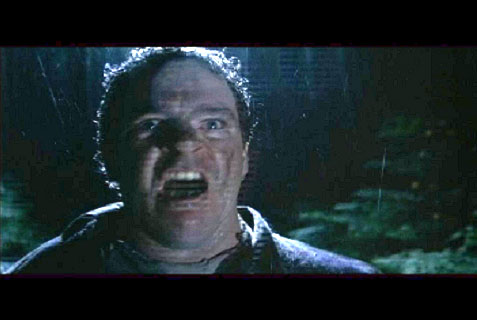 Blackwoods almost stumbles accidentally into being an interesting film. The premise of hillbilly justice on the big city folk would make for a good horror movie, no question. I mean, for decades horror movies have been preaching the dangers of small rural towns and their inhabitants. Boll has found himself a fitting premise for a horror movie. But Boll and co-writer Robert Dean Klein aren’t interested in making a horror movie; they want to make Blackwoods into a psychological thriller. They want something more. It’s these pathetic gasps for cleverness that doom Blackwoods. The eleventh hour twists Boll and Klein pack feel contrived and uninspired (the very end shamelessly rips off Final Destination). The ending twist, designed to tie everything together, raises far more questions than answers. You’ll probably be able to see it coming a mile away. Sometimes simpler is the way to go, fellas.
It’s hard to feel for Matt when he’s such an arrogant dope. There are two standout moments that reflect how stupid Matt is. The first is after Dawn goes missing in his motel room. Matt is baffled and tries to work it all out in a bathroom, as most men do. His room is then broken into by an axe-wielding intruder. Matt manages to hide and avoid him. Minutes later, the axe-wielding intruder returns and the two get into a brawl. Matt wins and the intruder runs away again. After this ruckus, Matt lays down on the motel bed and goes to sleep. He dozes off in a room that has been broken into twice by a man with an axe! The second incident happens late in the film as two hillbilly brothers chase Matt through the Blackwoods. One of the brothers has a gun and the other more sporting brother has a bow and arrow. Matt kills the brother with the gun and takes his weapon. Suddenly an arrow zips over his head and sticks in the tree. Behind him is the other brother, and even though this brother is currently unarmed and at a distance, he convinces Matt to drop his pistol. The ending twist only adds more fresh accounts of Matt’s idiocy.
Boll uses a heavy amount of blur-technique for very long stretches of time. Very long. An entire sex scene is blurrified into submission. Boll tries juicing up action sequences by adding the blur effect, which only infuriates an audience already sick of it. The effect is arbitrary and unwelcome. Boll has confused shaking the camera with artistry. Shaking the camera does not equal art, no matter how many notes you take while watching The Blair Witch Project. The stylistic choices Boll makes as a director seem so self-consciously motivated to goose up a limp story.
Blackwoods falls apart because it’s clueless when it comes to plot structure and mood. Boll isn’t one for trusting an audience to pick up his clues. Oh no, he’ll aggressively make sure you get every hint that something is important. When Matt grabs a knife we get an extra special close-up of it followed by a crescendo of music. Boll is shouting the importance of this item. And the funny thing is the knife isn’t even important. The same crescendo happens when a waitress gives Matt the stink-eye, and when Dawn takes a post-coital walk to the motel bathroom. We should pay attention to these things, Boll screams in our ears. Later, Matt assures Drew that “thing’s will be fine.” Cut to blurry image! Matt says, “My mom never let me do things on my own.” Cut to blurry image! Someone says, “You’re paranoid about something, though I don’t know what.” Cut to more blurry images! Because of the back and forth structure, Boll serves up a witless Cliff Notes of important plot points he wants to underline. Blackwoods kills any surprise it could have generated because of these superfluous cuts meant to engender a sense of foreboding. There’s a difference between feeling something will happen and knowing, and Boll’s ham-fisted plot structure and direction drain the film of any involvement. You can’t be mysterious and clever while spoonfeeding an audience and hitting them over the head.
Boll uses inappropriate songs at key moments and it wrecks the mood. The sex scene is bad as is because of the blurring and strange editing. What makes the scene drop-dead awful is the song choice that plays over. It’s some odd pop song with odd arrangements that cripples any intended drama. It’ll really take the tingle out of your dingle. Moviemakers of the world take note, if you want your scene to have some power or importance, do not attach a song that will elicit titters from an audience. Nowhere in Saving Private Ryan could you find the song, “She Thinks My Tractor’s Sexy.”
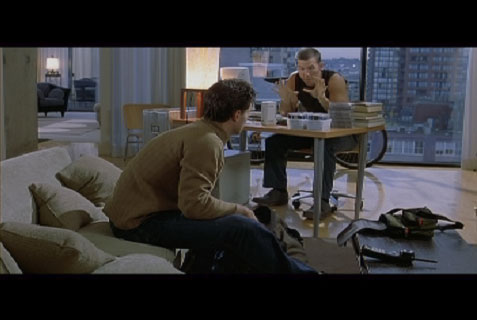 At the end of Blackwoods I counted the number of artist’s songs used in the film; there are five songs by I Saw Elvis, four Songs by April Daze, and three songs by Charlemane. It seems Boll is more interested in using songs he can get his grubby opportunistic Germanic hands on.
Blackwoods has a score that is overly anxious. There are your standard high-pitched jump moments, but the score also wedges itself into scenes to a comical degree. Take a scene where Matt is being interrogated by the sheriff. The sheriff dictates what he has been told of Matt’s motel room attacker, and ends by noting, “Guy dressed all in black.” The music dramatically swells. We’re meant to distrust the sheriff. Matt says cautiously, “Did I say that?” Sheriff: “Yeah.” Matt: “Oh. Okay.” And the music immediately ends. I kid you not; during Matt’s chase scene in the woods there are tuba sounds on the score. Not a tuba apart of an orchestration, just a tuba. It’s like they recorded this score during take your child to work day.
The acting in Blackwoods could be rivaled by lousy high school theatrical productions. Most of the actors are quite stiff and give terrible line deliveries. Boll truly has no idea what to do with his actors and it shows. Actors will punctuate the dialogue in peculiar places and frequently overact like no one’s watching. Muldoon (Starship Troopers) is a pretty actor without much else going for him. His acting range goes from indignant to quiet anxiety, neither of which is convincing. I think his eyebrows out-acted him. Paré (Eddie and the Cruisers, TV’s Greatest American Hero) looks and acts drowsy the whole movie, like any second he’s in danger of keeling over into dream land. Tracy (40 Days and 40 Nights, White Noise) plays the most challenging part and has some fun with it. Her moments of petulant anger are a welcome sight amongst this acting dead zone.
Boll could have had an effective, loosely entertaining horror movie with Blackwoods. Instead, he and his co-writer attempt to grasp at something smarter and fall flat on their faces. Blackwoods is dull, inane, cluelessly structured, poorly acted, and devoid of any nuance. Boll’s tortured direction relies on a lot of arbitrary and annoying stylistic choices. This creaky psychological thriller thinks it’s clever by playing with flash forwards and contrived Big Twists, but Blackwoods is nowhere near as smart as it thinks it is. Maybe Boll’s penchant for blurring the film was the right move; in a few days that’s all this forgettable movie will become.
Nate’s Grade: D
Share this:

Inside Man (2006)
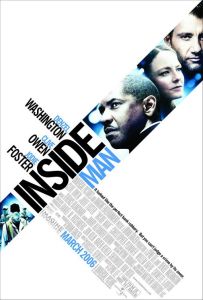 Spike Lee is one of the most recognizable names in film. Usually, the edgy, pointedly opinionated director sets his sights on racial strife, human relations, and satire. So what is Lee’s name doing attached to the Hollywood heist flick, Inside Man? For starters, it’s his most commercial film of his career, a sharp, engrossing thriller that doesn’t blunt his distinct voice.
Dalton Russell (Clive Owen) has set forth the perfect bank robbery. He and a handful of associates, dressed as painters with their faces obscured, have locked down a bank in downtown Manhattan. They’ve rounded up everyone inside, robbed them of their trusted cell phones, and ordered them to wear identical painter suits and masks. Detective Keith Frazier (Denzel Washington) is tasked with resolving this standoff, which the media is all too eager to cover in its escalation. What could the crooks be after? Well, bank owner Arthur Case (Christopher Plummer) is certainly nervous about a key document he has inside a safety deposit box, a document linking him to scratching the backs of Nazis. He pits Madeline White (Jodie Foster) to retrieve the document at any cost, and she has the tenacity to wedge herself between her political contacts and the police. All the characters keep their cards held close and try and outfox the other, while figuring out what exactly is going on inside that bank.
This movie is a born crowd pleaser. The heist and ensuing complications really grab an audience early on. There’s a certain thrill watching Dalton, so cool and clam, plot out his bank robbery like the script is still in hand. The crooks are always one step ahead of the police as well as the audience, and I mean that in the best terms. It’s great fun just wondering how Dalton’s team is going to get out of their many jams, and the results are rarely unsatisfying. Inside Man knows exactly when to tantalize with intrigue, inject humor (“Penalty of code 36DD?”), or tighten the tension. The filmmakers know exactly what button to press and at what time. For a two-hour plus film, Lee keeps the film at a swift pace and smoothly weaves his characters in and out. The draw of Inside Man is watching the tit-for-tat game between Frazier and Dalton, too stone-faced pros trying to outsmart each other. Lee smartly allows his characters and story to take center stage and refrains from goosing a strong genre flick with some annoying, superficial artistic artifice.
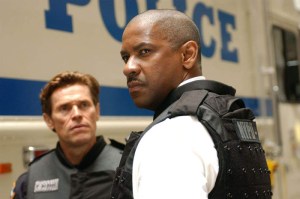 Inside Man is a heist that’s refreshingly grounded in reality. Nothing is altogether too out there or complicated to the point where you’d need a score sheet to follow along. Dalton is the movie’s star and Inside Man gives him the center stage to draw us in and keep us guessing. In fact, the flick is so grounded in the plausible that mainstream audiences might be put off by the fact that there isn’t any super twist saved for the end. I think the same audiences Inside Man is so fine-tuned to entertain will discover the lack of a last-second twist as underwhelming. I hope we’re not to the point, as an audience, where we’d rather have an illogical, forced twist ending than something that closes our story with satisfying maturity and finesse. The biggest plot hole you’ll have to swallow with Inside Man is that a businessman would keep a document that linked him to the Nazis. What’s that about? Sentimental value? I’m also still a bit hazy on the motivation of our crooks.
Even though this is a crowd-pleaser, the film is not without its missteps. Inside Man has one of the worst scores I have heard for a movie, ever. Allow me to explain why I feel so brutally, and I do. The score flashes inappropriate mood all throughout the film, robbing many sequences of drama and calling attention to itself. Take for instance a phone conversation between Frazier and Dalton; we cut back and forth between the two and each actor has a different music score. Frazier’s is a jaunty jazz riff, while Dalton’s is the more traditional brooding orchestral number. Because of the schizophrenic musical score this moment becomes funny. The best example of how this score is dreadful is during a scene late where SWAT storms inside the bank. The camera takes their point of view and creeps through the bank lobby, and then you hear a horn (trumpet?) reverberate. It gets louder and then quieter in beats, like a high school brass orchestra just whizzed by in a race car. Then it keeps going but in another direction. At first I was confused, and then I thought, “Did Dalton actually set up a horn section to distract the police?” No, it’s just the awful Inside Man score that totally takes you out of the movie. Scores should enhance the movie, not turn drama into comedy.
Lee also doesn’t help his story by including so many flash-forwards in time. They mostly rob Inside Man of key suspense points. Now we know the bank robbers get away, we know their identities are still unknown, and we know no one died. Luckily, the charisma of the leads and the clever storyline can survive Lee shooting the movie in the foot. The movie also has what feels like the longest denouement since 2003’s Return of the King 20-minute hug fest.
 The quality cast definitely gives Inside Man a boost. Washington is on autopilot but is still charming as ever while being intense and intuitive. Foster is like a female version of Mr. Wolf (Pulp Fiction) but full of steely determination. It says something when really talented actors like Willem Defoe and Chiwetel Ejiofor take tiny roles. As it should be, Owen is the standout. He’s so menacing and composed that you not only want Dalton to get away with the bank holdup, you want him to humiliate and embarrass his opponents even more. I?m convinced that in the world of film there’s no cooler actor than Clive Owen at this point. He adds a touch of badass to every role, with the notable exception of Derailed. At this point, I would pay to hear him recite the phone book and walk away going, “Wow, I didn’t know Aaron A. Anderson of 1200 West Avenue sounded so kickass!” Clive Owen is that cool.
Inside Man is a sharp, intelligent, mostly satisfying heist flick with a terrific ensemble. Lee’s most mainstream picture ever is a born crowd-pleaser, despite some missteps here and there (flash forwards, a poor score). The acting all around is top-notch, and the flick works as a tight and mature genre piece, simultaneously covering all its genre bases and playing up the smarts. I hope audiences appreciate the sense of believability with the film and don’t walk away irked that there is no super last-second twist. Inside Man isn’t anything groundbreaking but it knows how to tease an audience and tell a good guessing game of a tale.
Nate’s Grade: B
Share this:

Sanctimony (2000)

Sanctimony is the English-language introduction to the filmography of Dr. Uwe Boll and the very last movie I had yet to see for my first edition of my expansive column. Boll wrote and directed the movie about a clever serial killer that’s baffled law enforcement. It’s interesting coming into Sanctimony with all the Uwe Boll homework in the back of my head. I know what flaws I’m looking for, I pay attention to the retched line delivery from the actors, and I genuinely know what I’m getting into. It’s seems that Boll works somewhat in a bubble; almost all of his technical crew is the same from film to film, and Michael Paré, Jurgen Prochnow, Clint Howard, and Patrick Muldoon seem to be the stable Uwe Boll Players. Sanctimony is where it all began and where everything went so horribly awry for moviegoing audiences.
A killer is loose and terrorizing Seattle, cutting out the eyes, ears, and tongues of his victims. The media has dubbed him the “Monkey Maker killer” (think “speak no evil, hear no evil, etc.”). Detective Renart (Paré) and his partner Dorothy Smith (Jennifer Rubin) are assigned the case. After some investigation of a stabbed homeless girl, their initial suspect seems to be Tom (Casper Van Dien), a wealthy and cynical stockbroker. His lawyer balks at any charges and Tom goes free. Coincidentally, more bodies start piling up haphazardly. As Renart puts more pressure on Tom, he starts targeting those close to him, like his pregnant wife (Catherine Oxenberg, who seduced Van Dien in 1999’s The Omega Code). Tom has some master plan ready to shock the world, and only the dogged persistence of Renart can stop his wicked ways.
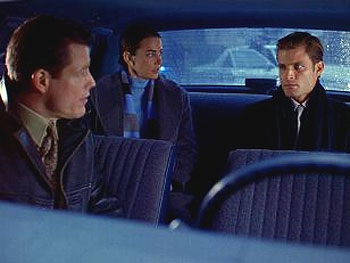 Sanctimony is really a crossbreeding of what Boll liked best about Seven and American Psycho. Like David Fincher’s masterpiece, Boll really wants his serial killer to be slicing and dicing with a message; this killer gets his kicks from cutting out different body parts. Tom eventually goes after his pursuer’s pregnant wife, just like Seven, and clumsily aims for some kind of myopic preaching. Tom sure does like to spit out a diatribe about the plague of humanity, even after he’s just dismembered a call girl. Boll seems very intent on crafting Tom into a Patrick Bateman-esque character, one whose soul has been lost to the bottom line of the business world (how many hotshot stockbrokers are based in Seattle?). But while American Psycho was complex, satirical, and deeply metaphorical, Sanctimony is stupid. Boll wants Tom’s speeches to have terrifying power to them, but instead they come across as theatrical and lifeless. Tom says, “Raping and pillaging have been the official government policy of any government that’s ever thrived.” If you’re impressed by this assertion, Sanctimony might just be the movie for you. If you yawn at this sub-standard Political Science 101 ejaculation, then you’re likely beyond the film’s short-armed reach. Boll’s writing has a vague inauthentic feel, like he learned everything about crime procedural from TV. In the year 2000, a character actually summarizes America with the words, “apple pie and baseball.” By now I think the only people that characterize America that way are conservative politicians and out-of-touch, disdainful foreigners.
Boll’s serial killer thriller plays all the genre clichés. First, naturally, there’s the clever serial killer who must torment his persecutors as a game. Then there’s the umpteenth example of a cop haunted by the lives he can’t save and his stalwart dedication to the case straining his marriage. When will these wives ever understand? Renart and Dorothy naturally get thrown off their case, thus finally allowing them to solve it as in every cops-and-robbers movie. Maybe movies should just begin with the cop thrown off their case; it would save everyone a hell of a lot of time as far as casework. Partners must always die to spurn our hero into action, though I’d have to assume Dorothy’s too young to be days away from a blissful retirement. Killing her seems ill advised too, especially since her last known whereabouts would be a dinner date with Tom. Way to be the number one suspect and give yourself borrowed time, dude.
I hate to admit it, but despite all its glaring simplicity and predictable bumps in the road, Sanctimony is passably entertaining, that is, until the ridiculous ending draws near. As with most serial killer films, the killer is practically a super being with an agenda. Except, in Sanctimony, Boll doesn’t even give his vengeful hand of God an agenda but just an inescapable rage. The film climaxes with Tom going on a shooting spree at his wedding party and then being gunned down by Renart. Boll uses lots of slow-mo and swelling dramatic music, but the scene had no set-up from earlier and makes little to no sense. What was his master plan? Was Tom trying to outlive his looming terminal illness and create a name that will long live on, likened to the horror he has wrought? He said he couldn’t stand the curse of people, so was his plan to just take out as many people as possible? If so, surely leaving the cops obvious tell-tale signs was not helpful, especially if he was just going to out himself on live TV as a murderer anyway. Sanctimony ends with far too many loose ends and unexplained motives that, in hindsight, seem to suggest Boll’s clever serial killer wasn’t so clever after all.
Since the heroes of Sanctimony are so rote and familiar, the only place for Boll to make artistic strides is in his depiction of his killer, Tom. This is where Sanctimony and Boll really drop the ball. Before we know anything about him, Boll has already introduced us to Tom’s office, which should more accurately be described as a lair. It’s gigantic, poorly lit, and surrounded by ominous rock faces. He even has an array of monitors at his super desk of villainy. The only thing missing is a desk full of files labeled, “Plan, Evil.” We never really understand what Tom’s motivations are, though Boll thinks he’s helping by lining up speeches about Tom’s views on people (hint: it’s not optimistic). Even his choices of murder have no lasting message; Tom just kills whoever is weak and available. If he’s an ordinary killer then what’s the point of even basing a flick around him?
Sanctimony presents a lot of Tom’s ire but never digs any deeper. He attends a laughable S&M club where they make snuff films in the back for your viewing pleasure. The leader of this demented boys club wants to harness male fury as motivation, for what I don’t know. So what does Tom do next? He goes home and chokes and attempts to rape his fiancé, clearly indicating that this unique support group is not working. She rejects him, so Tom walks the empty Seattle streets (!) with his knife openly drawn and stabs a homeless girl. Was he frustrated over his failed rape attempt? Is he reacting against a woman asserting power over him? We’ll never know, because Sanctimony is only interested in skirting the waters of characterization. In Boll’s movie, people fall into types and aren’t given anything else to work with. Tom is the killer. He kills. That’s all you’re going to get. Even though the movie is only 87 minutes long, Boll is disinterested in spending time with his characters. He’s rather just draw up a sketch from someone else’s work and move along.
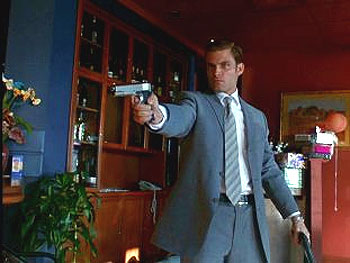 The acting is somewhat better than most Boll movies and yet still a degree below typical straight-to-video blandness. Van Dein (Starship Troopers) is amusingly believable as a stone-faced serial killer. His limited acting range actually strengthens the character’s sense of frustration. He’s got a menacing stare to boot. Paré (Hope Floats) phones in his performance but gets some points for being in the film’s most weirdly awkward moment, when Renart has to step in as nude model for his wife and her giggly photographer peers. Bizarre doesn’t go far enough in describing the scene. Rubin (Little Witches, Amazons and Gladiators) is the hard-nosed female cop trying to make it in a man’s world, and gives a decent if unmemorable performance. I was more intrigued by her ever-present striped scarf, which seems to follow her everywhere from the shooting range to inside her home. Roberts has very little screen time and is still third billed.
Sanctimony is Uwe Boll’s stab at the serial killer genre, so it shouldn’t be surprising that it’s formulaic and bereft of suspense and imagination. This is a generic rip-off of far better serial killer flicks. The characters are all brief sketches and genre clichés, and Boll can’t even come up with a compelling agenda for his killer. I kept waiting for Sanctimony to fully explain itself, but once the wedding shoot-out is complete the film leaves you addled and perturbed. Boll has castrated his drama, rendering it unimportant, lazy, and sloppy. Boll may have several ideas floating around his head but he never brings them in for a clarification. Whatever intellectual goals he may have intended for Sanctimony will be lost on an audience grasping for meaning and entertainment. How dumb is this movie? Well, it defines what “sanctimony” means in the opening credits via dictionary. It should be very ominous when a movie is forced to define its own title. Ominous, indeed.
Nate’s Grade: C-
Share this:

X-Men: The Last Stand (2006)
 The story behind the making of X-Men: The Last Stand is more interesting than most. Bryan Singer had directed the first two X-Men films and had done a fine job establishing many loveable characters and the universe that housed them. Warner Brothers has been trying to get their Superman franchise flying for so long, going all the way back to 1996 when Kevin Smith wrote the script, Tim Burton was to direct, and Nicolas Cage was going to be the man in tights. Since then directors and drafts of screenplays have come and gone, including Brett Ratner, best known for directing both Rush Hour movies and a slate of mostly mediocre movies. Then Warner Brothers poached most of the X-Men 2 team to make Superman Returns, hiring Bryan Singer as director, plus X2‘s screenwriters, cinematographer, editor/composer, and maybe even the cat that licked Wolverine’s claws. Fox was left without a captain for X-Men 3. They daringly picked Matthew Vaughn (Layer Cake) but then he dropped out for family reasons. Then Fox went with their second choice … Brett Ratner. Both directors had essentially switched projects. Hollywood’s funny like that.
It’s been a few months since the events in X-Men 2. Scott “Cyclops” Summers (James Marsden) is still mourning the loss of his love, Jean Grey (Famke Jannsen), who sacrificed herself to save the rest of the X-Men. He’s tormented by her voice, whispering all around him and pleading with him to return to Alkali Lake, the site of her death. Miraculously, Jean returns from the dead but she’s much different. Her persona has broken and the Phoenix has taken over, a destructive killing force unparalleled on earth.
Magneto (Ian McKellen) has great use for such a force. There’s been news of a new drug that suppresses the gene that causes people to be born as mutants. This discovery has been dubbed a cure. The question persists, is should being different be curable and what would that even mean? Magneto sees the writing on the wall, knowing that any cure would only be voluntary for so long. He collects new mutant fighters along with his stalwarts the shape-shifting Mystique (Rebecca Romijn) and fire starter Pyro (Aaron Stanford), a former student at Xavier’s School for the Gifted.
 Over at Professor X’s (Patrick Stewart) school, the mutant students are each questioning life with a cure. Rogue (Anna Paquin) is considering it so she can finally touch her boyfriend, Bobby “Ice Man” Drake (Shawn Ashmore) without killing him. Plus, so he’ll stop spending so much time with Kitty “Shadowcat” Pryde (Ellen Page), a girl who can walk through matter. Storm (Halle Berry) and Wolverine (Hugh Jackman) are left to run the team after some disastrous setbacks. Henry “Beast” McCoy (Kelsey Grammer) is a man covered in blue fur and appointed as head of Mutant Relations for the president. He senses the growing danger and anxiety the administration has with mutants and joins the X-Men to do what he feels is right.
It feels like that in a rush to production that character development, subtlety, and subtext were chucked out the window to make time for more boom-boom action. The first two X-Men flicks juggled the characters and introductions but still managed to squeeze in one great moment for the characters we cared about. The plot moved at a mature pace, insightful and touching on elements of psychology, politics, and personal struggles to fit into a society that fears you. There was some sophisticated, relevant stuff bandied about this franchise in between the kick-ass action. But with X-Men 3, you basically have Halle Berry doing less with more. She’s got more screen time, in part to her demands, and now she can use that extra time onscreen to show us how perfectly bland her character is as the film’s most laughable moral ideologue. The idea of a cure for the mutant gene is vastly interesting with all kinds of great avenues for character introspection and socio-political debate. But X-Men 3 renders all of its debate to be merely superficial, another in a series of plot points to get the action moving quicker.
The X-Men franchise was already overpopulated with lots of characters vying for screen time, so I don’t understand the decision to add even more characters to the ensemble and cut down the running time to a brisk 100 minutes. As a result, certain characters sit out for long stretches of the film, are inactive during key moments, some are mostly forgotten, or some meet unjustifiably hasty ends. If I was still an ardent comic book fan, and a follower of the X-Men, I might view the third film as heresy. Why even bother bringing the character of Angel into the movie if he’s just going to be on for two minutes, including a forehead-smacking deus ex machine moment? The Dark Phoenix storyline is the most pivotal storyline in the comic’s history, so why even bother dragging it into X-Men 3 if it’s just going to be Zombie Jean Grey? It feels like Ratner is off screen with a pole poking Janssen whenever the story needs her to wake up and stir up some stuff.
 I hope comic fans enjoy the brief glimpses of some of their favorites, because X-Men 3 does a good job of throwing characters into a meat grinder. I had to check online to just to find out who they were, and even then my realization was followed by, “Her? Him? What?” And what the hell is up with Porcupine Face? That has got to be the worst mutant ability of all time. What’s he going to do to his enemies? “Hey, will you come a little closer. I have a secret to tell you. Closer … closer … closer still … that’s right, now please lean against my face.”
The movie trades character for action, so is the action even good? Ratner is a workmanlike director devoid of any personal style, which further brands X-Men 3 as ordinary. The action sequences aren’t anything extraordinary, there just happens to be more of them. The climax pits mutant against mutant in short-lived bursts. A battle between Ice Man and Pyro should be awesome, but Ratner stages the showdown like he was choreographing his neighbor’s kids. This battle lasts a whopping 45 seconds. The climactic end battle, the “war to end all wars,” is rather sloppy. Ratner keeps cutting back and forth between his pairing of Good mutant vs. Evil mutant (why do the two black girls seem forced to fight each other?), but his showdowns are all too quick to quicken the pulse. Wolverine’s brawls in the woods never rise up to the adrenaline-soaked fights in X-Men 2. The special effects and make-up are just as good; they’re just not being put to as good a use. If Ratner is going to dump character for action he has to make his action exceptional. The movie feels on autopilot.
Ratner is not fully to blame for the shortcomings of X-Men 3. Screenwriters Simon Kinberg and Zack Penn (Elektra) have crafted an overly rushed story that is more tailored for getting the job done than telling a good story. They present some big ideas and interesting elements, like a love triangle between Rogue-Ice Man-Shadowcat, but then most of the promise is either skipped over or dropped. They’re trying to juggle too many balls at once, and it just makes me miss Singer and the X2 screenwriters and how effective they were in defining character even in the smallest of moments. Some of the X-Men 3 dialogue is awfully stilted, like “You of all people know how fast the weather can change” and “Sometimes when you cage the beast, the beast gets angry.” There’s also a silly subplot about Storm teaching Wolverine what it means to be responsible. Try and count how many times you roll your eyes with that one. How many times are they going to have the president look blankly at a TV screen and gasp, “My god”? There’s some clever use of mutant powers during battles (mostly involving Shadowcat) but there’s just as many routine moments as well.
 The acting is all over the map. Jackman owns his role as Wolverine. McKellen and Stewart bring a needed dose of grandeur to the proceedings. The X-kids are enjoyable, and Ellen Page (knocking ’em dead in Hard Candy) makes a very nice addition to the fold. I’ve likely enjoyed Paquin the most in this series, next to Jackman of course, so it’s so frustrating that she just plays Jealous Girlfriend at Window. I think it’s criminal how little she’s examined in the movie, especially since the supposed cure has the most questions and ramifications for her. Grammer is essentially Frasier in blue fur, but that’s essentially what Beast is so it works. He has a very nice moment when he sees what life would be like minus his mutant likeness. It’s really hard to judge most of the performances because of how short they appear in the movie.
X-Men: The Last Stand is far from boring but it’s more serviceable than special, and lacks the maturity and imagination that its previous films held. This was a franchise full of limitless potential, so to see it drop to something ordinary is sad, especially if this is the rumored end of the franchise (a record opening gross over Memorial weekend says otherwise). This franchise feels dumbed down; yes it’s still entertaining on a mass market level but it doesn’t have the creativity and precision that Singer’s movies had. X-Men 3 is fast-paced and not without its great geek moments, but it’s also the least emotionally involving of the films. When the deaths and departures come you’ll probably shrug your shoulders because of how the film presents them. X-Men 3 is fine, but I expect better from this franchise.
Nate’s Grade: C+
Share this:

Poseidon (2006)
 The Poseidon production design is rather fantastic and director Wolfgang Peterson (Troy) has a real handle on large-scale carnage, but Poseidon is a stripped down action flick that lacks the suspense and emotional involvement to bring strength to its attempts at harrowing survival. Some sequences, only some, are nail-biting, like a very claustrophobic escape through an air vent slowly filling with water. We’re presented a situation and then Peterson cranks up the tension and utilizes different characters working together. The sequence has the added benefit of utilizing the child to save them, unlike most films of this nature where irritating kids just become a liability to your own safety. The fact that this sequence, the film’s high point in my view, is also the least expensive of this $160 million dollar movie’s sequences is not lost on me. The film’s premise of working through the bowels of an underwater ship is filled with potential. The original Poseidon Adventure was cheesy, yes, but it was a lot of fun. This slick remake brings the action fairly early, having its “rouge wave” flip the ship at the 15-minute mark. Because of this decision the audience has no attachment to the film’s collection of characters, given fleeting seconds to establish some sense of personality. You really don’t care at all what happens to these people in the ensuing danger. The female characters add nothing to the story except to fall into the constant need of being rescued. Peterson paces his obstacles mercilessly right after the other, but he runs into the problem of killing off all his expendable (read: non-white) cast off too quickly. That lessens even the small amount of tension the film had going. Poseidon is way too big-budget and serious to go for camp. The special effects are above average and the pacing is swift. Frankly, you could do worse this summer for entertainment than spending 100 minutes watching this movie.
Nate’s Grade: C+


You must be logged in to post a comment.