Author Archives: natezoebl
Little Miss Sunshine (2006)
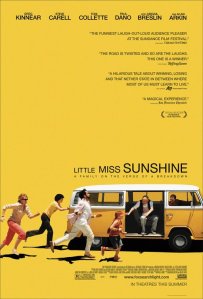 Slowly but surely, Little Miss Sunshine is gaining momentum as the breakout comedy of the summer. It’s gotten some of the most glowing reviews of the year and is poised to capture the hearts of not just fans of indie cinema but also patrons of the big suburban multiplexes, your red state soccer moms and NASCAR dads. After having seen Little Miss Sunshine, I feel like I must have missed the bandwagon.
Little Olive (Abigail Breslin) is bursting with shriek-worthy excitement. She just found out she’s a regional contestant in the national Little Miss Sunshine child beauty pageant. Her family crams into a beaten down, canary yellow Volkswagen bus and heads off on a cross-state journey for Olive. Along for the ride are Olive’s fractured family — older brother (Paul Dano), who has taken a vow of silence until he becomes a fighter pilot, stressed-out but supportive mom (Toni Collette), ambitious self-help failure dad (Greg Kinnear), a potty-mouthed, heroin-snorting grandpa (Alan Arkin), and a suicidal gay uncle (Steve Carell). It’s a long road to the pageant, especially with such an eclectic group of people whose only thing in common are their chromosomes.
 I just couldn’t shake the overwhelming feeling that Little Miss Sunshine should be more. It’s not really much of a comedy. There are some funny moments, and pushing the bus is a running gag with better legs than I would have guessed, but the film has a lot of stretches where the laughs are low to nonexistent. It’s not really much of a character piece either. None of the characters are that well defined or allowed to stretch out. The family members are all archetypes of indie film weirdness: the gay intellectual, the verbally inappropriate grandparent, the self-deluded father, the frazzled mother, the loner brother, and the precocious tyke. Little Miss Sunshine does a fine job of setting up its family of cracked characters but then seems to twiddle its thumbs when it comes to development. The only character insights come in a scattered few small moments with Olive. Dad is essentially poisoning his family with his self-help claptrap, casting the world into “winners” and “losers.” There’s a heartfelt moment brilliantly played Breslin where she confesses to grandpa that she doesn’t want to be a loser because her dad would stop loving her. Aside from that, Little Miss Sunshine seems to wind its characters up and then leave them be. I wanted more of just about everything but the movie wouldn’t budge.
The movie spends quite arguably too much time at the Little Miss Sunshine beauty pageant. Child beauty pageants are a well deserved, albeit easy, satirical punching bag, and they creep the hell out of me. Seriously, turning little girls into highly sexualized Barbie dolls seems cruel, unnatural, and very very creepy to me. There was a stupendous documentary that aired on HBO years ago called Living Dolls that traced the life of a six-year-old girl and her stage mother. It was a harrowing film, and the obsessive mother is one of the most disturbing villains I’ve ever seen in a movie, scripted or otherwise. In the film you see how people transform little girls into flirty, overly made-up little adults. It’s sickening.
The reason I bring this up is because Little Miss Sunshine because they lift a direct metaphor. In Living Dolls the main girl is playing one of those tiny slide puzzles where the finished result is an honest to God yellow smiley face. It’s a perfect metaphor of this child attempting to find happiness when no one seems to want her to live as a child. And then I saw the exact same moment in Little Miss Sunshine. Rip-off or accidental homage, you decide. In the same vein, every time Kinnear invokes the name of his literary agent, Stan Grossman, I kept thinking of Fargo.
In Sunshine, the family is aghast at the pageant scene but support Olive anyway. Then things get way too easy. The film concludes with the 5,785th rendition of the weirdos celebrating what makes them who they are, their weirdness, and sticking it to the thumb-nosing naysayers. Then the movie abruptly ends. That’s all, folks. Little Miss Sunshine was already built on the aching backs of two very familiar indie staples, dysfunctional families and road trips, and offers little else to justify its existence.
 It’s hard to really drag this film through the mud. It was proficiently made by the music video directing team of Jonathon Dayton and Valerie Faris (Smashing Pumpkins’ Tonight Tonight). The acting is generally good. The better actors rise to the top despite their limited character depth. Carell is a big name in comedy right now, and he gives a rather subdued, sarcastic performance that will resonate best with audiences. Kinnear is better at playing smug types than pathetic types. His character really is the villain of the piece, so it’s nice to see his transformation even if it is awfully spontaneous. Collette always looks to be on the verge of a nervous breakdown. Breslin (Signs) is pretty cute and will pierce your heart during the aforementioned talk with grandpa.
There are some amusing moments and fun pieces of dialogue, and the film has its heart in the right place. The screenplay needed to go through a few more drafts to strengthen character and story. I can honestly say my favorite part of Little Miss Sunshine was listening to its very Sufjan Stevens-like soundtrack full of meloncholic horns, cellos, violins, squeezebox and electronic whispers. I would recommend the soundtrack ahead of the movie.
I feel some shades of guilt as I gather my opinion, however I cannot deny the overwhelming urge that Little Miss Sunshine should have been more. It needed more comedy, more character depth, more attention to story, and more opportunity for its ensemble of actors to sink their teeth into the material. This appointed indie darling is intermittingly amusing, has some laughs, and may be worth a free afternoon or as a rental. To me, it’s also a big example of wasted potential. Little Miss Sunshine is a beauty that needs more work before it can shine on a greater stage.
Nate’s Grade: C+
Share this:

Snakes on a Plane (2006)
 Snakes on a Plane. It’s a title, it’s a catch phrase, it’s a way of life. For a tiny horror movie with a blunt title, this flick has caught the imagination of Internet geeks everywhere, myself included. I couldn’t believe the movie was real at first, but then I slowly got onto its weird wavelength and brought my friends along too. For the past year buzz and hype’s been building, fans have made their own songs, T-shirts, trailers, and potential sequel titles (the equation is [animal] + [location]). Due to such unexpected rabid fan support New Line Cinema spent 5 days shooting additional scenes of gore and nudity to bump Snakes from a PG-13 to an R-rating. It’s hard to squeeze in a lot of nudity into a movie predominantly set on a plane not owned by Hugh Heffner. But has Snakes on a Plane run the danger of peaking before the movie ever opened?
FBI Agent Flynn (Samuel L. Jackson) is transporting a witness to a murder. The big bad Hawaiian gangster doesn’t want the witness to testify against him. His solution is elegant in its ludicrousness: the gangster has stashed a hidden supply of various poison snakes in the plane’s cargo hold. A timed release sets the snakes free to slither around the flight and bite as many passengers as possible. Flynn reports to his base, “You know all those scenarios we counted for, well I’m smack dab in one we didn?t count on.” You see, no one suspects snakes on a plane.
 The big question is whether Snakes on a Plane is just another bad B-movie that will line a video store shelf or a truly So Bad It’s Good Movie. In the accompanying months, this movie has caught on like wildfire by hipsters looking for grand, ridiculously stupid entertainment with a wink. Snakes on a Plane is indeed ridiculously stupid but it does so without the wink. The movie never steers for camp, which is sad. This is more like the silly trifles that routinely air on the Sci-Fi Channel (in anticipation, the network aired a whole night of cheesy direct-to-video reptile thrillers). There’s nothing wrong with those dumb escapist flicks, but then again there?s nothing essentially special or memorable about them.
The real funny thing is that if you haven?t seen Snakes on a Plane already, you’ve probably missed the best reason to go see it. This is the type of So Bad It’s Good movie that needs to be seen in a theater with a rowdy crowd, ready to hoot and holler at the mass stupidity on display on the big screen. This is an experience that demands to be shared with like-minded individuals in shared derision. I doubt it will translate as well on DVD. Something will be lost if you ever watch this movie by yourself (even more will be lost if you’re sober).
Without the rowdy viewing atmosphere, the movie itself sort of sucks. The acting is all over the place, the CGI is at times painfully fake like they had a rushed deadline, and the action gets a tad repetitious. You can only watch snakes bite people for so long before it all gets old. People get bit in the face, eye, tongue, neck, ass, breast, and, in one very unfortunate circumstance, the male member itself. Some of the gore effects are grossly fun. The opening pre-snake 20-minutes of the film feels like a lame episode of Hawaii 5-O complete with lame villain. I don’t know how in the world the bad guys found this witness so quickly when they didn’t see his face, license plate, or any identifying characteristics. Every time the movie cuts away from the plane to a handful of subplots on the mainland it loses its flow, and it takes a long while to get things back.
The sheer nakedness of the film’s conception is amazing. We’re all aware that movie studios can create their product in the most artistically void way possible. Snakes on a Plane was cobbled together by an exec?s idea of combining aviophobia (fear of flying) with another common public fear, ophidiophobia (fear of snakes). The absurdity of the entire premise is on full display while watching the movie. If you allow the images to sink in, especially panicked passengers swatting at the reptiles, you will be seized by uncontrollable laughter. Who really would ever have thought of snakes being on a plane? I love that the evil gangster confesses that “he exhausted every other option.” I would have loved to be in that meeting room just to see all the plans that didn’t cut it compared to “poisonous snakes drop into cabin.” If this movie ever catches fire it could spawn a whole new wave of horror films that are mash-ups of common fears. So keep your eyes peeled next summer for Snakes on a Public Speaking Venture (“Oh no, there are snakes everywhere, and I have to speak in public about it!”).
 Snakes on a Plane, unbelievably, tries to play it too straight and serious. There are so many improbabilities and inaccuracies in the film. It has snakes springing like rockets and moving as if they had 1,000 legs, and yet the film won’t fully commit to camp. After a year of hype and a lightning rod of a title, it’s hard not to be disappointed that Snakes on a Plane isn’t something more than… well, snakes on a plane. But then again maybe the simplicity is the whole genius. Maybe there’s still another layer of satire I have yet to penetrate, but I think I’m grasping out of hope for something more that just isn’t there. The movie is entertainingly bad but it doesn’t ever reach the stratosphere of bad, a world inhabited by the likes of Manos, The Land of Faraway, Showgirls, Glitter, and Bulletproof Monk, to name but a few.
There’s plenty of clichés and stereotypes galore. A stewardess, Claire (Julianna Margulies), is on her last flight before retirement. Flynn’s police partner bites it. A novice needs to be talked through landing the plane. The elitist blowhard gets his. There is a flaming gay male flight attendant that’s supposed to be funny. There’s even a laugh-out-loud moment where Flynn hugs Claire and says, “I need you to be strong for me.” Is the movie making fun of these clichés or just relying on them for a story? Does a difference even matter?
I will say that I was waiting in great anticipation for THE line of the summer: “I’m tired of these…” Once it came I couldn’t help but recite it along with Jackson.
Snakes on a Plane is a victim of a year’s worth of hype. It’s ridiculous, stupid, terrible, but then we all knew that when we bought a ticket. What we hoped for is that this blunt horror flick would be a campy send-up of B-movie silliness. Snakes on a Plane is less a canny parody of stupid thrillers than another example of them. The movie’s most ludicrous decision is trying to play this mess as serious material. If the flick had been a little more open to self-analysis then it could have been a real fun ride. Snakes on a Plane is bad, but after the absurdity of its premise dies down it’s never really that entertaining. It’s more mediocre. If you’re late to the Snakes on a Plane phenomenon then you’ve already missed its glory days.
Nate’s Grade: C
Share this:

Brick (2006)
 I appreciate movies that try something different. That isn’t to say I love all movies that try, like Gus van Sant’s latest collection of watch-grass-grow cinema. More often than not I appreciate stabs at originality even if it results in colossal failure. That’s why I can never beat too much on M. Night Shyamalan. When Brick came out last spring it had my attention immediately. Writer/director Rian Johnson placed a hard-boiled detective story in the contemporary setting of a high school. And true to my promise on my podcasts, I bought it the day it came out on DVD. For fans of crime fiction and excitingly bold cinema, rent this movie.
Brendan (Joseph Gordon-Levitt) is a kid that knows the ins and outs of the high school scene. He’s currently looking into what happened to Emily (Emile de Ravin), his ex-girlfriend who was last seen trying to fit in with the popular types. She was in some form of danger and contacted Brendan for help. With the help of The Brain (Matt O’Leary), an old friend, Brendan must negotiate a web of unsavory characters, each with their own game. There’s Dode (Noah Fleiss), a burnout who was last seen crushing on Emily. There’s Laura (Nora Zehetner), a rich girl accustomed to hanging out with bad boys. It all leads to The Pin (Lukas Haas), the man controlling the area’s drug supply and who, we’re told, is “way old, like 26.” The Pin’s been volatile ever since a brick of heroin went missing. If Brendan’s head isn’t spinning piecing together all the clues, surely the audience’s will be.
 Brick is a film that refuses to simply be an afternoon afterthought. This is a movie that demands you sit on edge, poised to decode its complicated detective jargon and twisty storyline. It takes a while to first get into the movie because of its stylized dialogue and how straight everyone plays it. Johnson has recycled the same hard-boiled talk you’d expect coming from the mouths of Humphrey Bogart and Lauren Bacall. I heard that some theaters actually gave a glossary of terms and verbal exchanges for people who went to see Brick. Whether that’s true or not, your brain is working overtime to decipher what is being said, and I love that. I love that Brick doesn’t take time out to explain its terminology but expects you to keep up as best you can. I don?t want to scare readers off, because even if you don’t know any noir vernacular you’ll be able to know what’s going on, but it’s just cooler to be in on the fun. The snappy dialogue is only one part of Johnson’s extremely intelligent, very meaty script.
Brick relies on a gimmick, yes, but what an inventive and clever gimmick. There’s just an extra level of fun for film noir fans, spotting the same archetypes (mysterious damsel in over her head, femme fatales, goons, underworld boss) and locations (gin joints become house parties, detective offices become teen bedrooms). Brendan even gets chewed out by his superior who wants results… his assistant vice principal (Shaft‘s Richard Roundtree). There’s such a common language of film noir and its staples, and part of Brick‘s enjoyment is placing all of them. I’m fully aware that Brick will exist more as an artifact in a film class than as a film casual moviegoers will actively watch. The plot is blissfully twisty with many intriguing players, and once it’s all laid out it actually holds together. Brick is rewarding for those willing to stay attentive.
The movie succeeds because of how committed everyone is. The gimmick seems doomed to fail but the movie has creativity in spades. Of course it’s all highly unrealistic but it all works splendidly within the world it creates. Because the filmmakers play it all straight, you never look at the movie from an outside perspective. You’ll never laugh at it unless you’re giggling about how much fun it is. Unlike other recent brainteasers like Syriana, you do have an emotional connection to the movie and you do care about the characters and are interested to see where the story goes (and it’s not nearly as confounding as Syriana). I love that Brendan outsmarts everyone and sometimes he does it by taking a pounding. I love that he takes so many beatings that he actually gets sick from swallowing so much blood. It’s the attention to details like that where Brick shows its commitment to the world it has created. Brick is reveling instead of deconstructing the detective genre, like the audaciously cheeky Kiss Kiss Bang Bang.
 There are some humorous winks that remind you of Brick‘s gimmick, which is surprisingly easy to forget. The Pin’s mother serves juice to her son’s “friends;” The Pin walks along a beach discussing the details of his operations and then drops a peculiar non-sequitur, asking Brendan if he’s ever read J.R.R. Tolkien (“His descriptions of things is really good. He makes you want to be there.”) That moment has haunted me still months after I viewed Brick in a theater. The Pin is a scary bad guy but it’s that line that makes me go back and say, “Yeah, but they’re just kids.”
Johnson masterfully handles his actors. Gordon-Levitt is fast becoming one of the most versatile young actors. He’s the moral anchor of the movie and Levitt carries the film on his back. He’s great handling the dialogue but even better making Brendan seem human in a highly stylized tale. Zehetner leaves quite an impression as a smoky seductress who may be the biggest player in the film. Haas plays his villain role to eerie perfection.
Brick is an exciting, disarming, demanding, vibrantly different movie that is stone cold cool. This is not the easiest movie to get into, but once you open up to its freshly retro wavelength then Brick is one greatly rewarding movie. Johnson has built a movie around a gimmick but it all holds together so well thanks to his total commitment. The dialogue is heavy in noir slang and the story is crammed with twists and surprises. I loved this movie from the first frame to the last. Johnson has found a refreshingly original movie by going back in time. They don’t make ’em like this anymore.
Nate’s Grade: A
Share this:

Talladega Nights (2006)
 When it comes to clowning around, no one does stupid more smartly than Will Ferrell, a man perpetually in a state of arrested development. Talladega Nights: The Ballad of Ricky Bobby succeeds both as a satire on uplifting, redemptive sports movies and on the culture of NASCAR. The product placement is obscene in this movie, but then again, the same can be said with NASCAR racing. PowerAde had a contractual obligation to be cited at every family meal prayer, which itself turns into a competitive sport. Title buffoon Ricky Bobby (Ferrell) is so arrogant that he gets an ad for Fig Newtons on his windshield (“This ad is dangerous… but I do love Fig Newtons.”). Even the title is a perfect send-up. The redneck riffs are never very mean-spirited, but I like that the Southern bar keeps disco on the jukebox to “profile.” The sports clichés are picked apart, like the absentee father (Gary Cole) reappearing to learn the error of his ways. There’s a heavy reliance on slapstick and pretty much everyone in the movie is either a cad, a buffoon, or a jackass, so there are limits to that comedy.
True to 2004’s Anchorman, this movie hits its high points with the spontaneous moments of tangential weirdness, from sports announcers explaining how to put out invisible fire to Ricky Bobby learning to drive with a live cougar as a co-pilot. Talladega Nights doesn’t quite hit the absurdist highs of the infinitely quote-able Anchorman, and the movie spins its wheels all too often, but it’s got a greater number of solid belly laughs than most any movie out there today. Sacha Baron Cohen plays Jean Gerard, the gay, French Formula-One driver that upsets the stock car world. Cohen has great fun in an English language mangled performance Peter Sellers would have loved. When Ferrell and Cohen are face to face, you feel like anything can happen between these two quick-witted comedy titans. Ferrell has assembled another game cast of gifted improvisational artists and their blend of loony comedy feels like jazz. The downside with such a huge cast of very funny people is that not everyone gets the face-time they deserve (Oscar nominee Amy Adams comes to mind).
Talladega Nights is a big broad comedy with a great cast and some inspired chuckles. What other movie this summer could climax so perfectly with a man-on-man smooch and the observation, “You taste like… America”? Only one, baby, and it’s Ricky Bobby.
Nate’s Grade: B
Share this:

Pirates of the Caribbean: Dead Man’s Chest (2006)
 America loves its pirates, plain and simple. We as a nation are infatuated with the characters and the high-seas adventure of 2003’s Pirates of the Caribbean: Curse of the Black Pearl. We?re starving for more, and when the first in a two-part sequel was released it only became one of the biggest movies of all time. Pirates of the Caribbean: Dead Man’s Chest has shattered box-office records, rolling up $100 million in two days and a record $135 million weekend gross, easily surpassing former champ Spider-Man‘s supposedly invincible $118 weekend tally. America loves its pirates more than Spiderman, Star Wars, and who knows, maybe even Jesus. After all, Dead Man’s Chest did just kick out The Passion of the Christ from the top ten all-time grossers. Mel Gibson sure has a lot of grief at this moment.
Jack Sparrow (Johnny Depp) is a wanted man on the high seas. The East India Company, whose emissary now controls the Caribbean town of Port Royal, is after Jack and his special compass. But Captain Jack has bigger fish to fry. Davey Jones (Bill Nighy), ruler of the seas, wants what was promised to him: Jack’s soul. Jack made a bargain with the sea creature and now his time is running out. He must assemble a crew and track down the whereabouts of a buried chest. Inside this chest is the still-beating heart of Davey Jones, and he who controls the heart controls Jones, and thus the seas. That is why the East India Company is so interested in Jack. They’ve made an arrangement with groomis interuptis Will Turner (Orlando Bloom), who had his wedding hijacked and his bride (Keira Knightley) locked away. If he can retrieve Jack’s compass, then he and Elizabeth will be pardoned for aiding and abetting a known pirate. Will and Elizabeth each set off to find Jack Sparrow and to gain their freedom.
 The filmmakers have taken notes in the school of sequels from The Empire Strikes Back. Like the second Star Wars chapter, we’re left with the heroes separated and licking their wounds, evil appears to have the upper hand, and the lives of some beloved characters are left in doubt. Just as long as there’s no Ewoks, Disney has guaranteed my place in line on opening day 2007 for Pirates 3.
It?s hard to fully judge this Pirates sequel because it’s part one of a two-part story. I’m holding out my final say, especially if this movie just turns out to be an expensive 150-minute teaser trailer for Pirates of the Caribbean 3. I can?t fully judge many story and character arcs because we don?t know where movie #3 will carry them. Maybe it’ll end up being like the middling Matrix sequels, where subplots and characters were dropped as if the Wachowski brothers had screenwriting butterfingers (it’s a film critic’s unwritten duty to deride the Matrix sequels at any chance). At least this movie ends with a jolt that I did not see coming.
Most surprisingly, Dead Man’s Chest suffers little from the creative deadlock of sequels. Dead Man’s Chest is more a sci-fi monster fantasy than a swashbuckler. The supernatural edge has swallowed the series whole. Take for example Jack’s broken compass. What once was an oddity befitting its owner is now seen as another element of magic. Some of the interest seems lost if things are simply explained away as being magical. The story, unlike the Matrix sequels (See: above), expands and enriches its universe. Some leftovers from the first film made me cringe. I thought we were headed for a bad track, where the movie uses the audience’s memory as a cheap storytelling device. Familiar characters might pop up every which way, smiling, and saying, “Hey ho, remember me?” Miraculously, the leftovers are integrated so well with the new tale that they really do matter and don’t come across as cheap shortcuts. Norrington (Jack Davenport) and the two comic relief cursed pirates are all smartly woven back into the troupe, and each impacts the story in a non-obtrusive manner. Even the undead monkey is used well.
I made it a point to keep my expectations in check for Pirates of the Caribbean: Dead Man’s Chest. It would be naive to think that you could catch lightning in a bottle again. Yes, now with audience expectation we lose the originality and unpredictability that made the first Pirates adventure so joyously delicious. And yet I found myself getting riled up just the same and being whisked away by spirited entertainment. My expectations may have been tempered for Dead Man’s Chest but I still greatly enjoyed the ride. It seems that my opinion sharply differs from my overly negative critical colleagues; my own sister said Pirates 2 was one of the worst movies she’s ever seen. That seems a bit rash. She hasn’t even seen any Uwe Boll movies.
 There are moments that seem to stretch the credibility of the story. It’s been said before that it’s not the impossible that bugs you but the improbable, and this holds true for Dead Man’s Chest. I’m able to believe Davey Jones and his creepy crawly crew, but I’m not able to believe that Elizabeth Swan could single-handedly best them all at once in sword fighting. The movie becomes dangerously close to eye-rolls in parts, but generally steers clear of moments that rip you out of the story. Of course a Pirates film would be nothing without Johnny Depp. He’s the main reason the first film was so memorably embraceable and entertaining. It?s not every day someone gets nominated for a Best Actor Oscar playing an addled, swishy comic pirate. He’s truly the star and has been one of our finest actors long before he had any box-office clout. He’s created a character so beloved that he’s crossed over into the cultural lexicon. How many Jack Sparrow outfits do you see come Halloween? I had a friend directing a high school performance of A Midsummer Night’s Dream and every young actor wanted to audition as Captain Jack interpreting Shakespeare. Come to think of it, Jack Sparrow would certainly liven up some of the bard’s dusty works.
Depp is still hilarious and likeable even when he’s being a scoundrel. We simply love this character; I love this character. The unpredictable nature of Jack feels squeezed dry by the demands for familiarity with sequels, but Depp finds new ways to enthrall in Dead Man’s Chest. Some people are going to be uncomfortable with Jack being more dastardly, willing to trade others’ lives to save his own hide. I think desperation is an interesting place to put this character. Besides he has his big hero moments as well.
New dimensions are added to the other characters. Knightley gets to be shrewd and try her hand at pragmatic treachery. It eats her up inside at the end and Knightley, a nice comedic actress, allows us to see the rough seas of guilt within her. Bloom will always be Bloom, meaning he’ll be handsome, British, and seemingly too little for grownup movie stuff. Will is given a whole new set of daddy issues when he actually gets to spend time with dear departed dad (Stellan Skarsgard). Best of the rest (“the rest” being everyone other than Depp) is an unrecognizable Nighy, who saunters his deck with the fiery air of a preacher. Nighy manages to make Davey Jones even more interesting. Naomie Harris (28 Days Later) makes her presence felt as a witchy woman responsible for Jack’s compass.
The action sequences are gigantic and well constructed. They expand with organic complications and a lively, graceful sense of humor. An already fun sword fight atop a watermill wheel gets even more pleasing when the giant wheel breaks free and the fight continues. Three characters climb inside and out, all vying for a key that keeps changing hands thanks to gravity. A human-sized fruit-kabob tied to Jack has a wonderful payoff for something that seemed completely random. The special effects are gorgeous. You can practically taste the slime and sea salt from the creatures. Davey Jones is a fantastic design and I’m dying to know how they did his tentacle beard. Whether it be motion capture, CGI, or puppetry (was someone billed in the credits for “operating” Bill Nighy? Does that sound like a fluffer?), it’s all dazzling to behold. The Kraken is ferocious and so well designed that it’s destined to give an entire nation?s children nightmares for weeks. Coupled with the equally super expensive Superman Returns, it seems that nowadays if you want special effects that will retain their wow-factor, it helps to have a $200 million dollar budget. Director Gore Verbinsky has a terrific eye for shot compositions; I am convinced that if you give this man good material then he will give you popcorn gold. If you give him bad material, well, then you get shiny but pointless stuff like The Weather Man.
 I know this movie, at its center, is empty. It’s grand throwaway entertainment, a true popcorn romp, but yes, when you get down to it the film has little to it. It’s an explosion for the eyes and has some great characters and action choreography, but Dead Man’s Chest is nothing more than very pricey, very tasty cotton candy.
Pirates of the Caribbean: Dead Man’s Chest feels less like a rehash and more like the start of an exciting new voyage. It’s darker, bigger in scale, scarier, louder, brasher, but still barrels of fun. Time will tell whether the back-to-back sequels will support enough intrigue to cover two very long, very expensive action movies. But Dead Man’s Chest has the key Pirates ingredients returning: clever screenwriting duo Terry Rossio and Ted Elliott, and, naturally, the irreplaceable Johnny Depp. An early eye gouging might set the icky tone, but this is one sequel that compares favorably to its source. We’re left in a very Empire Strikes Back position, but not after running out of breath keeping up with the many treasures of Dead Man’s Chest. Nothing will recapture the magic of the 2003 original but this is one summer sequel that delivers without letdown. Then again, after Pirates 3, it could all be for naught. See you in 2007!
Nate?s Grade: B+*
*Final grade pending the outcome of Pirates of the Caribbean 3.
UPDATE: Having just seen the third film, I’m somewhat conflicted. Many items from Dead Man’s Chest have little payoff in the third film, At World’s End. So while I wouldn’t grade Dead Man’s Chest any higher after seeing where it concludes, I still find it to be too fun to rate any lower. Its final grade stands.
Share this:

Lady in the Water (2006)

Writer/director/twist-abuser M. Night Shyamalan must have been smarting from the cool reception to his last high-concept thriller, 2004’s The Village. Shyamalan has built a reputation for smart, eerie, complex movies, as well as forced twists and endings that leave the films in shambles. He went back to basics. Lady in Water started as an ongoing story he told his kids at bedtime. His kids participated in the creation of the story. If we didn’t learn from last year’s The Adventures of Sharkboy and Lava Girl, movies where children helped shape the story should be left as bedtime stories. Lady in Water is further proof of this.
Cleveland Heep (Paul Giamatti) is the fix-it man at an apartment complex. Someone’s been swimming in the pool late at night and clogging up the filter. The unexpected culprit is Story (Bryce Dallas Howard), a waif of a girl. She says she is a “narf,” a sea nymph who’s crossed from her world, the Blue World, to ours. Her purpose is to plant the seed of change by finding a special individual. When her mission is complete a giant eagle will carry her back to her world. Cleveland accepts being her guardian and protector and assists her on her quest. He mingles with the apartment complex’s eclectic residents, trying to figure out who fits what role to help Story. There is one hairy problem. A scrunt, a wolf-like beast with twigs and long grass for fur, is after Story. An evil monkey creature is overseeing the whole weird affair.

Early on, Lady in Water was advertised as “a bedtime story by M. Night Shyamalan,” and just like your typical bedtime story, the thing feels entirely made up on the spot. The story sounds like a little kid making up a book report: “There’s this grass wolf, see, and it’s after this sea lady, and there’s these evil monkeys that oversee everything, and an eagle carries her away when she’s done, but she’s like the unknown Queen of the sea ladies, and she has helpers but can’t say who they are, and they all have special abilities, except some of them can only do stuff, and no one can see her leave.” What? Was Dio an unaccredited co-writer for this? Lady in Water feels like Shyamalan is haphazardly throwing spontaneous obstacles and rules into his story, hoping something sticks when it just muddies up the story.
Naturally, there are many unanswered questions brought about by the supernatural subject matter. Why is it an eagle that plucks Story away to safety when she?s fulfilled her mission? Wasn’t part of the schism between man and the Blue World because man moved to land? Wouldn’t something aquatic make more sense to rescue her? What about the entirely unnecessary evil monkey judge? Why is it even there? Why does it just sit there idly if the scrunt breaks the rules (and if the scrunt is a rule-breaker then why not just bust inside Cleveland’s home and eat the chick)? For that matter, if the monkey judge is so evil then why does it even respect the rules? Why don?t the evil monkey judges side with the already evil scrunts? Why do the scrunts hate the narfs so? Who established these systems of rules for narf contact and scrunt hunting? Do the monkey judges allow the narfs to get killed as long as it’s during the right time? Is it like a boxing match (“Touch gloves, to your corners, and no biting after the bell”)? And of course everyone believes this tripe. Shyamalan could fall back on the excuse that his tale is a bedtime story and not meant for extensive examination. Sure, not everything needs to be explained but that doesn’t mean Shyamalan can get away with being lazy.

There’s no finesse in the writing. Shyamalan seems to have taken his frustration with the dwindling critical reception of his works hard. The movie critic character, Mr. Farber (a droll Bob Balaban) is one of two items, either the embodiment of his ire, a figure out of touch with human emotion and the public’s trust, or Shyamalan making a preemptive strike. The critic complains there are no more original stories left in Hollywood; well, Mr. Smarty Pants, what do you think of a tale of narfs and scrunts? The problem is that the film critic is not unlikable, just cynical, and despite how dismissive Shyamalan may wish to be, the critic’s complaints and observations about the film industry are solid. In Lady in Water, characters do speak their feelings so casually. People explain back-stories and motivations like it was written on foreheads. The critic character is so inconsequential as well, so the notion that Shyamalan spends so much energy on him makes it feel like a score being settled.
What’s more irritating is how self-involved the movie comes across. The whole purpose of Story’s venture to our world is to inspire a gifted writer, a writer whose work will be seen as unchecked genius that will cause great change throughout the world. Nations will renounce war, men and women will greet each other as brother and sister, and the world will be a profoundly better place to live, all thanks to one artistic genius that changed the world. And who plays this artistic genius lying in wait? M. Night Shyamalan. In conjunction with the critic character, perhaps Shyamalan is proclaiming that his movies will stand the test of time, despite what those fuddy-duddies at their typewriters say. Lady in Water is either an intense example of artistic insecurity or an unflappable, monstrous ego.
Shyamalan is too gifted a filmmaker to make outright bad movies. However, he is prone to making very misguided choices. The addition of the monkey judge just mucks things up and more unanswerable questions. Are the monkeys like the regional overseer? Is there a tri-state office run by a giraffe with twigs on its head? Shyamalan’s plot is too formless and relies on some garish ethnic stereotypes, like the nattering Jewess and the screechy, rail-thin Korean teen. His sense of direction takes a back seat to his writing. Many moments are filmed out of focus, or the camera bounces around trying to capture whoever’s talking, always seemingly just out of reach. His visual aesthetic feels noticeably simpler. There’s a certain unapologetic yearning in Lady in Water to be a Steven Spielberg film, from the John Williams-like score, to the assembly of characters wanting to believe again, to the heaping helping of schmaltz. Lady in Water is proficiently crafted (special thanks to cinematographer Christopher Doyle) but the movie is an unmistakable artistic misfire.

Giamatti is a dependable sad sack, and he deploys an array of stutters and tics to convey how damaged Cleveland Heep is. He’s good but then he always is, no matter how stupendously awful his material may be (he did survive Big Momma’s House). Howard is one of the more beguiling and intriguing young actors in the movies right now. She bewitched me in The Village, but in Lady in Water she befuddled me. It’s hard acting as a made-up creature. Howard relies on lots of vacant, supposedly, ethereal staring. She comes across as less supernatural and more like a club kid on ecstasy.
Lady in Water is not an unmitigated disaster but it’s definitely not good by any stretch of the imagination. M. Night Shyamalan seems to fray with every new movie, and Lady in Water is by far the man’s most ridiculous and self-involved flick. He’s too great of a talent to write off, even during his misfires, but we can’t be expected to iron out his narrative kinks every time. Shyamalan’s films generally center on broken people looking for their place in the universe and finding a grander plan for their pain. Hopefully, after the birth pain of Lady in Water, Shyamalan can find his place in the artistic landscape and spare us more half-baked bedtime stories.
Nate’s Grade: C-
Share this:

The Devil Wears Prada (2006)
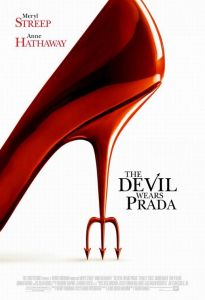 One part fantasy, one part incisive satire on the fashion industry, The Devil Wears Prada, on paper, may not be more than another formulaic entry where a young innocent gets caught up in the temptations of power and influence. I know little about the fashion industry other than what I can gleam from TV’s insanely watchable Project Runway and even I was charmed. Andrea (Anne Hathaway) is an idealistic journalism student paying the bills working as the assistant to Runway magazine’s ferocious editor in chief, Miranda (Meryl Streep). Andrea’s plain style of dress draws sneers and snickers from her rail-thin, nose-raising colleagues, and some smart snark from Miranda, who always seems to eviscerate people without raising the timber of her voice. The movie is typical with its rise-and-fall power structure, but even though it may be lightweight, The Devil Wears Prada is lots of fluffy fun, and all signs of life point to Streep. It’s almost a foregone conclusion that you’ll get a worthy Streep performance, but she’s totally unleashed in The Devil Wears Prada. Every time she sweeps into a scene she commands attention and steals the movie. We’re all just living in this woman’s world on borrowed time, and she knows it. Streep is in grand comedic form, dominating the movie with glares; just an inching of her facial expression can cause titters. It’s a juicy role and, mark my words, the most Oscar-nominated actress in history is going to get another nom for this performance. Hathaway proves to hold her own as well beyond those dark doe-eyes and cherry stem lips. The movie starts to drag in a third act trip to Paris, and Andrea’s empathy seems to get a bit out of tune (she feels worse about being better at her job than a co-worker than missing her boyfriend’s birthday). The Devil Wears Prada is an enjoyable, easily digestible piece of high-gloss fluff elevated by Streep’s dominating turn as a fashion lioness.
Nate’s Grade: B
Share this:

Superman Returns (2006)
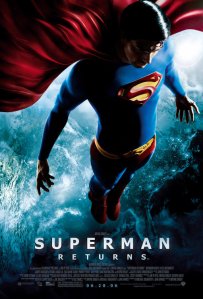 It’s been a total of 19 years since we saw Superman grace the silver screen in the mega-bomb Superman IV: The Quest for Peace. The big question is… did we miss him at all? I know a lot of people that say they just can?t get into Superman as a character. He’s always been a do-gooder, someone with infinite power but too great a sense of nobility to abuse it. Does the Man of Steel still hold relevancy in today’s more erratic, cynical, fearful world? Is it possible to make an indestructible alien relatable or empathetic? Director Bryan Singer is interested in finding out, and he brought nearly his whole X-Men 2 team with him. Instead of retooling the franchise Singer has adopted the idea of starting shortly after the events of 1980’s Superman II. (Yes, I know Richard Lester is credited with directing Superman II but it’s still contentious that Richard Donner, who helmed the first super outing, directed a majority of the sequel. From here on out, Donner will cited as the director of Superman and Superman II).
Superman (Brandon Routh) has been absent for five years trying to look for pieces of his home world, Krypton. Lex Luthor (Kevin Spacey) and his moll (a cheerfully batty Parker Posey) have got some big plans up their villainous sleeves. Using crystals from Superman’s home world, they plan on building a new continent of land to prosper with. He also has a nice supply of kryptonite to make his own fortress with. When Clark Kent does arrive back in town, coincidentally along the same time Superman rescues Lois Lane (Kate Bosworth) in a plane crash, he’s shaken by the changes that have taken place in his absence. Lois is engaged to Richard (James Marsden), nephew of The Daily Planet‘s editor in chief, Perry White (Frank Langella). She’s also won a Pulitzer Prize for her article, “Why the World Doesn’t Need Superman” (a kiss-off letter to a lover if ever there was one). To top it all off she also has a five-year-old son, which would put him within the realm of having a super dad (Lois and Supes took a roll in the hay at the Fortress of Solitude in Superman II). The Man of Steel has a lot on his plate, obviously.
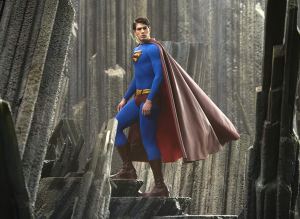 This is rumored to be the most expensive movie of all time, with budget predictions going as high as $260 million. If that?s true than Singer let’s you see every dollar onscreen. As a movie going experience, Superman Returns has little to no equals. The special effects are astounding and the imagery is simultaneously iconic and awe-inspiring. We now exist in a world where we can see a man in a red cape zoom through the sky and have it become believable. Singer, after two X-Men flicks, has a terrific eye for glistening visuals and boy does he know how to conduct Hollywood bombast with equal parts genuine character. His loss was considerably noticeable with X-Men 3, which wilts in direct comparison as unfair as it may be (it’s like the difference between a Van Gogh and a third grader’s imitation of a Van Gogh). The difference is that you can feel the respect the filmmakers had for superman; not so much with X-Men 3. But alas my countrymen, I come here to praise Superman not to bury X-Men 3. The sheer breathtaking visual artistry of Superman Returns demands to be seen on as big a screen as possible. Singer has crafted a wonderful tableau for the eyes and ears, filled with religious symbolism, opening the wonderful possibility of the movies just a little wider.
Singer’s film is a show-stopping pop spectacle, which is good, because the story itself, upon fresh perspective and distance, is good, but not great. The story doesn?t pursue character as strongly as last year?s fellow franchise reboot, Batman Begins, nor does it interlace themes as well. The characters in general are pained but left with little other expressions. Lex Luthor’s evil scheme is grand in cataclysmic scope but at the end of the day it’s still a real estate scam. It’s like if Donald Trump was human or less evil (he’s definitely got the same hair stylist as Luthor). How exactly is Luthor planning on keeping control of a new continent of land? I would think the world would have some way of establishing order. Once again a villain’s scheme is ruined by the less dastardly, more squeamish baddie in the entourage. In fact, the villains are on their own for a long while, embarking on their own tangential movie to play alongside the return of superman. The first hour is slower paced and the final climax could have used an additional boost, but these are quibbles. Superman Returns could have done a lot more with their characters, especially considering their take-off point is two films hence, but this movie is more about reassembling the pieces. To that end, Singer’s satisfying retread is forgivable for its shrift characterization.
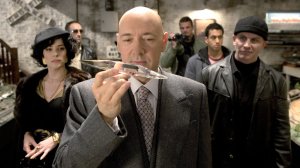 Do not let any misgivings about character and story betray how awesomely entertaining Superman Returns is when it turns on the magic. Even at a bladder-unfriendly 2 hours and 40 minutes in length, the film has little drag and a great sense of confidence of a crowd pleaser that knows how to play to an audience while respecting their intelligence. The movie is self-indulgent (how many slow-mo shots do we need of Superman in the air?) but it never falls short on thrills. Between plane crashes, bank robberies, sudden explosions, and spontaneous, cavernous land masses, you’ll likely be glued to your seat waiting for the outcome, which even with a nigh indestructible being isn’t always a given.
The action is grand in scale but Superman Returns also has the unmistakable stripes of a chick flick. Lois is jilted, moves on to a good man, and suddenly the man of her dreams, the one she thought was gone for good, reenters her life. The film’s sharpest plot point is the complication of its love triangle with Richard and a child in tow. The romantic yearning and interplay give the film its biggest emotional involvement. Even though the filmmakers are deliberately vague, the answer of who’s the father should be rather easy to deduce. Still, the audience has an increasing desire to know the paternal truth.
Singer’s louder, brighter Superman is a loving tribute to the Richard Donner Superman films, you know, before Richard Pryor, evil twins, and the rather rash, though very effective, decision of hurling the world’s supply of nuclear weapons into the sun (the less said about The Quest for Peace the better). It even exists in the same universe so we don’t have to go the origin tale route, though we do get flashbacks to Clark’s past. Marlon Brando’s original performance as Jor-El, father of Superman, is reused and John Williams’ theme gets a new polish. Even the opening title graphics, so horribly dated like a “cutting-edge” Atari game, are the same from the Donner era. There’s such reverence for nostalgia and a fondness for what makes Supes Superman, and that’s why it gets closer than even the Donner flicks, which are good but have weathered with age and can come across as too silly or cheesy.
Even Routh looks uncannily like Chistopher Reeve. Routh is an interesting choice; he’s chiseled, handsome, and questionably appealing. He comes across more like a being finding his place, like a kid fresh out of college, than a being of incalculable power protecting our blue planet. At any rate, Reeve played the comedy better, being both suave hero and clumsy earthling. I wish Superman Returns would go further exploring the perils and expectations of being Superman, a life devoted to servitude and always being an outsider. There’s a small scene where he orbits the Earth listening to 1000 overlapping voices crying for help before zeroing in on one. Otherwise, the movie doesn’t pay much notice to the burdens of Superman, which may unfortunately keep many at a distance.
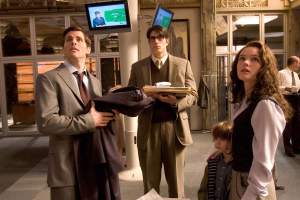 Bosworth is just too young for her role; she resembles Lois Lane’s baby sister, not the feisty Margot Kidder incarnation that left such an impression. This Lois Lane doesn’t so much bicker as she does harrumph. It’s like they took the role, dolled her up, muted her, and then told her to play Lois Lane as if she had stayed up all night binging on Sex and the City reruns. Bosworth is at the mercy of her character, a figure pressed into danger more than she is into emotion. There are some nice moments, like a midnight stroll through the atmosphere with her knight in blue tights. I just wish there were more.
But at least there’s two-time Oscar winner Spacey, who’s terrific as the infamous Lex Luthor. He’s got a funny quirkiness and a perfectly deadpan sarcasm. The opening that reveals how Luther earns back a sizeable fortune is hilarious and perfect to a T. Everyone else seems a bit dour but Spacey is having a ball; he’s even employed Kumar as part of his muscle (you’re a long way from White Castle, Kumar). However, Spacey’s spirited take is a lot more menacing than Gene Hackman’s version, which always came across as an oily used car salesman, more huckster than arch villain/evil genius. Spacey has a really strong disdain for the Man of Steel and his eyes sparkle at the opportunity to get vicious. I’m all for a darker, angrier, down-and-dirty villain to better torment Superman. Not to be out done, used car salesmen have their moments of intimidation.
The story may be good, not great, but Superman Returns is a first-rate cinematic spectacle. Singer and his X-Men 2 team have crafted a nostalgic, reverent movie that smartly addresses whether today’s world has outgrown a big blue Boy Scout. The action sequences and special effects are astounding, and, for the first time in a Superman movie, they are wholly believable. This helps when the main guy wears his underwear on the outside and shoots lasers from his bullet-proof eyeballs. The film stalls when it comes to characterization and the interplay of strong unified themes, but much is forgivable because Singer has worked his ass off getting a storied franchise back on its feet with dignity.
After three super hero films in a row, each with an escalating budget and running time, I’d say the man needs a break, perhaps a tiny independent movie to rejuvenate the batteries. But after watching Superman Returns, what I really want is for Singer to get right back to work as fast as possible. We’ve got this world back in order. Now it’s time for Superman to truly take flight.
Nate’s Grade: B+
Share this:

The Lake House (2006)
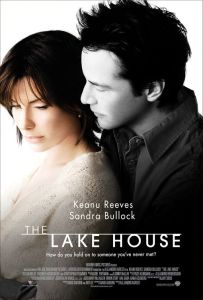 The first time I saw the trailer for The Lake House, a time-travel romance that reunites the stars of Speed, I said to myself at its conclusions, “If this lake house drops below 55 miles per hour…” I know, I’m a comedic genius, that much is obvious but what I was really reminded of was a 2002 film called Happy Accidents, a delightful gem of a movie with a similar time-travel romance. In that film you felt like anything could happen with its intricate plotting and off kilter, potentially seriously disturbed characters. Now it seems like Hollywood’s on board. The Lake House is based on an Asian film I’ve never heard of (though, in all honesty, I’ve never heard of 99.99% of them; sorry Asian cinema). This new East-West The Lake House doesn’t come across as that romantic but it’s hard to deny its points of interest.
Kate (Sandra Bullock) has taken a new job in Chicago and is moving out of a giant glass house on stilts that overlooks a lake. She leaves a note for the new resident, Alex (Keanu Reeves), an architect that struggles to fulfill his talent and his father’s (Christopher Plummer) legacy. Alex is confused; to his recollection, no one has lived in this house for years. Kate writes back and slips her notes into the nearby nostalgic mail box. But there’s something magical with this mail box. Kate is living in the year 2006 and Alex is living in the year 2004. Neither understands how it’s possible they’re even communicating by transporting letters through the mailbox. What’s even worse is that they’re falling in love with each other through their correspondence. Talk about your long-distance relationships.
 To go along with this kind of movie you really need to take it at face value. Once you start that slippery slope of questioning paradoxes of time travel or the narrative plot holes, you’ll be left in the cold for the remainder of the film. Yes, there are all sorts of logic paradoxes to clog the brain with, like the fact that every time Alex does something thoughtful, like plant a tree by Kate’s building, she won’t notice because she’s never had memories of anything being different. The characters themselves just shrug at the movie’s concept and accept this bizarre predicament. No explanation is given for this short circuit in the time space continuum, and frankly, no explanation is needed. The Lake House is not emphasizing the “why” but more the “what now?”
The Lake House is still a Hollywood romance in most senses. There’s little doubt that a happy ending is just around the corner, but at least the wrinkles and the road map to that point are not altogether predictable. The typical big moments are foreseeable, including that ever popular 11th hour misunderstanding, but The Lake House manages to tickle with surprise in the details of its journey. You don’t so much pull for the leads to get together but just see them tackle this mighty daunting obstacle before them.
The biggest flaw of The Lake House is that you never really believe these sad pretty people are falling in love. There is something indelibly romantic about falling in love with someone just from their words, constructing a potential soul mate with the few puzzle pieces given to you through long correspondence. Unfortunately, there’s nothing in those many pieces of parchment that Alex and Kate pass along that pinpoints why either pen pal would fall for the other. Both seem to have spotty luck with the opposite sex or are at least seeking more from a mate. But if The Lake House is any indication, these people have been chiefly seeking celibacy and verbosity in a mate. They talk about their lives, they talk about their pasts (in Kate’s case is a bit more extended), but it’s not too long before they start swooning and clutching those letters ever so tightly. The audience is left to fathom what invisible combination must have been unlocked that these sad pretty people have fallen for each other. While a lack of sustainable, let alone believable, romance in a romantic drama might be disastrous, at least The Lake House has a conceit strong enough to engage the brain even if it fails to engage the heart.
 The time jumps manage to keep the audience on its toes, plus there’s some fun in witnessing Alex and Kate try to locate each other and become bewildered. Director Alejandro Agresti (Valentin) and playwright David Auburn (Proof) play around with different techniques like split-screens and dissolves to present their lovers together. The conversational back-and-forth voice over does present problems; how exactly can they interrupt each other? The Lake House leans a little too hard on faith that we want to see these people end up together. Problem is that Kate and Alex are essentially void of depth; two characters defined more by the clunky subplots around them than their own personalities. Bullock and Reeves don’t help matters much, each perpetuating a vacant pretty android quality, like they’re waiting for a button to be pushed to explain human emotion.
I don’t know about you but if I was writing to someone in the past I’d use my knowledge and tell them to play certain lottery numbers or sports bets (“The Red Sox win what?”). Maybe it’s simply unromantic to start the basis of a relationship on gambling earnings. Then again, maybe it’s just unromantic to start a relationship with Keanu Reeves anyhow.
The Lake House is an old fashioned Hollywood romance but with some intriguing wrinkles and a playful structure. There’s a degree of predictability, the high-wattage stars fail to generate even low-wattage heat, but with the time-slip premise the film cannot be judge as familiar. The unusual situation and obstacles presented are more interesting than the main characters. Their love feels artificial and neither Kate nor Alex is rather deep, involving, or particularly smart (e-mail anyone?). Despite the limited help by the leads, The Lake House is a pleasant, different, if not terribly romantic Hollywood drama. For Hollywood, sometimes “pleasant and different” is enough for an enjoyable evening with the stars and someone special by your side. For everyone else, rent Happy Accidents.
Nate’s Grade: B
Share this:

Cars (2006)
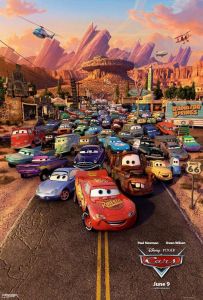 While I’d never call Pixar’s latest animated film a disappointment, it is the company’s first speed bump in their unprecedented reign of unmatched quality. Cars is technically dazzling; it’s almost redundant to say a CGI film is the best-looking ever because the technology keeps improving with time but Cars is incredible to watch. The lushly painted vistas, the way light gleams on surfaces, the blurs of color, the near-photographic likeness of cars themselves, this is a beautifully animated film, obviously. What isn’t as beautiful is the lackluster storyline. I can feel Pixar’s heart in the right place but they don’t put enough effort to touch our own hearts. Cars lacks the depth of Pixar’s other features. The two Toy Story films managed to take a kiddy concept of the secret life of toys when no one’s watching and infuse it with serious moral dilemmas and a mature insight into mortality and community. In Cars, the main storyline involves a cocky hot rod Lightning McQueen (voiced by Owen Wilson) who lives in a glitzy world that revolves around him. He goes off the beaten path and finds himself trapped in Radiator Springs, a tiny town that’s all but been dried up since the interstate took folks away from them. There, Lightning learns there’s more to life than material riches from this eclectic mix of good, honest small-town folk. What I’ve just described to you could be the plot of hundreds of movies championing the likes of small town folk. They surprisingly never really go much deeper, though Paul Newman is terrific as an old time car that had a taste of the glory and arrogance way back.
This is the first Pixar movie to exist in a world without humans, which begs the question how living automobiles were able to construct their world minus opposable thumbs. Cars themselves are weirdly inexpressive creatures.
The climax to Cars is suitable and heartfelt but the movie, at two hours in length, sputters a while in the middle. This is the first film directed by Pixar’s big cheese, John Lasseter, since 1999’s Toy Story 2, so excuse me for expecting a little more. Still, the movie is certainly fun, exciting, more cute than funny, and it has a genuine sweetness to go with its visual prowess. I just wish the 8 credited screenwriters, including Lasseter himself, had revved up their imaginations a bit more beyond the conceptual stage. Cars isn’t a great movie, but coming from Pixar, it’s still very good. Hey, anyone that can make the voice of Larry the Cable Guy tolerable deserves my thanks.
Nate’s Grade: B


You must be logged in to post a comment.