Author Archives: natezoebl
The Debt (2011)
 A tense and mature spy thriller that’s as well written as it is acted, The Debt is a thriller that even stops to ponder some serious moral ambiguities along the way. Back in 1965, a group of Israel agents (Jessica Chastain, Sam Worthington, Marton Csokas) were sent to Berlin to capture a notorious ex-Nazi doctor (Jasper Christensen) and bring him back for justice. When things don’t go according to plan, the group must decide what is justifiable in the name of moral cost. In 1997, the aged former agents (Helen Mirren, Cirian Hinds, Tom Wilkinson) have to deal with the full consequences of their actions. A far majority of the film takes place in the 60s, and it’s for the best considering that’s where most of the tension and interest reside. As a thriller, drama, and non-linear mystery, there’s always something going on. The film is not without its genre clichés, but the sequences of holding Christensen (Quantum of Solace) hostage rise beyond genre mucking. He is a true monster and his dialogues with the various agents are chilling, reminiscent of Hannibal Lector’s tête-à-têtes. The cast is uniformly good, even Worthington, but the real star is Chastain (The Help, Tree of Life). She is magnetic. It’s a shame that The Debt felt it needed to tie up its loose ends in a conventional ending that discards the film’s more ambitious moral quandary. I suppose the toll of false identities and moral relativism just doesn’t make audiences happy like good old-fashioned vengeance. I guess that’s a debt everyone would rather have paid.
Nate’s Grade: B+
Share this:

Contagion (2011)
 For the germophobes amongst us, you probably want to skip seeing the new thriller, Contagion. Like for life. Never see this film if you’re the type that needs a paper toilet seat cover before sitting down to do their business. Contagion is a movie that makes you reevaluate basic human interaction. You may not leave the house again without covering yourself in plastic and a year’s worth of Purel. Director Stephen Soderbergh (Che, Ocean’s Thirteen) has assembled an all-star cast to drop like flies like only Hollywood’s most talented can do. Contagion is an intelligent, unnerving, technically authentic thriller that will make you cringe just watching people cough.
Contagion’s main character is a virus that begins its origin in a Hong Kong casino and quickly spreads from there. A British model takes it to the UK, a Chinese waiter goes home infected, a Japanese businessman keels over dead on a return trip home, and Beth Emhoff (Gwyneth Paltrow) comes home from her business tripe back to Minneapolis and goes into seizures. The next day, she’s dead and soon after having her brain dug out for an autopsy. The spooked docs alert the Centers for Disease Control immediately; something is definitely wrong with Paltrow’s brain (insert Coldplay joke here). The head of the CDC, Dr. Ellis Cheever (Laurence Fishburne), and his specialists track the expansion of the virus. He dispatches Dr. Erin Mears (Kate Winslet), to Minnesota to coordinate inter-agency action and interview Beth’s husband (Matt Damon), who appears to be immune to the virus. He’s in shock and isolated from his remaining daughter. He’s still trying to make sense of how quickly everything fell apart for his family. Capitalizing on fear, anti-establishment medical blogger Alan Krumweid (Jude Law) steers a panicked public toward a homeopathic medical alternative that he just so happens to have a financial stake with. The World Health Organization sends Dr. Leonora Orantes (Marion Cotillard) to investigate the Hong Kong casino and overview hours of security footage to glean the origins of the virus. But she, like others, soon find themselves in ever-increasing danger as the world races against time to beat this new threat.
For those expecting an action-thriller with plenty of doctors barking moral quandaries and racing against time to escape government agents… you will be sorely disappointed. Contagion is much more cerebral, cool, like a scientific procedural that plays the premise out in a realistic fashion, which means it’s often short the fireworks that mainstream audiences have come to expect from disaster movies. The CDC is really the main setting as they try and determine the origin of the virus, breaking down the virus, and projecting its rate on infection and contamination. Soderbergh has onscreen titles indicating how large the population centers are for the plot settings, reminding us simply with text how vulnerable to danger all those people are. The real pleasure of the film is watching A-level Oscar actors puzzle out how to solve this multi-faceted crisis. The movie does a minimal amount of explanation and expects an audience to be able to keep up with its scientific analysis. Soderbergh’s film is much more in keeping with The Andromeda Strain than Outbreak (find that monkey and all will be happy again!). You witness smart people doing smart things and still making little traction. This isn’t necessarily Irwin Allen territory of disaster. It’s a disaster that seems all too reasonably possible rather than being trapped in the belly of a ship that has turned upside down. Getting sick is a lot harder to avoid especially in our modern world. Globalization has done many wonders for the world, but by making the world a smaller place it also means that we’re all much more susceptible to the spreads of pandemics. No longer can geography be held as a total defense. We’re all one flight away from the spread of the next great illness (as the end credits to Rise of the Planet of the Apes also remind).
Soderbergh and screenwriter Scott Z. Burns (The Informant!) cast a wide net all over the world to see the ramifications of crisis. Things go rather quickly. By the end of the first week, the CDC is coordinating its resources and media strategy to not inflame panic. Easier said than done when ignorance and fear are in large quantities. The reaction to the news, the intra-government squabbles over resources and money, the exploitation of fear by opportune business types, the rising resentment of those left out of the loop, and even the kidnapping schemes for those known to have access to medicine. Contagion works because it gets the details right without losing track of the big picture. The film feels eerily plausible at every beat. Nurses are on strike refusing to be near the sick until uniform safety protocols are established. Funeral homes refuse to handle infected bodies out of health concerns. These are absorbing details that feel completely authentic yet would easily have been overlooked in other disaster pictures. The movie even addresses recent pandemic fears related to H1N1, SARS, and the perceived “overreaction” when these potential worldwide disasters turned out to be milder bugs. A government agent asks the head of the CDC if some terror organization could have weaponized the bird flu. “They don’t have to. The birds are already doing it,” the CDC head replies.
While Burns lies out a host of characters and scenarios with increasing tension as stakes mount and the death toll rises, Contagion just kind of drifts into an ending for the last 20 minutes. I was expecting another big wallop, some kind of sudden plot turn that reestablished an ongoing threat, but it wasn’t to be. The tension just sorts of lets out slowly like a balloon, playing against movie laws. That means that Contagion, wile tense, eschews a dramatic buildup for a climax. Burns and Soderbergh instead to play out their realistic “what if” experiment to its conclusion, which makes for a realistic if somewhat inert final act. There’s no chasing monkeys or butting with government agents willing to sacrifice infected town for “the good of mankind”; it’s just government employees doing good work and trying to minimize damages. It’s exciting to watch smart characters break down a nasty new virus and try to understand it and get ahead of it, but once they succeed, it’s not as exciting to watch the aftereffects of people getting better and returning to a normal existence (minus 30 million people on the planet – the solution to fixing unemployment?).
 Because the emphasis is on the cross-sections of plot and scientific breakdown, the emotional connection to the characters is limited. There are a lot of famous faces that appear in this movie; even bit parts are taken up by the likes of Bryan Cranston (TV’s Breaking Bad), John Hawkes (Winter’s Bone), Demetri Martin (Taking Woodstock), Enrico Colatoni (TV’s Veronica Mars). Damon (The Adjustment Bureau) is probably the closest thing the film has to an emotional center. He’s immune to the virus but he has to watch his family fall apart with the knowledge that his wife was Patient Zero. On top of that, he has to deal with the fact that she was cheating on him. That’s a healthy brew of emotions to confront in such a heightened situation, and Damon does a nice job of putting a human face to the mass tragedy. Winslet (The Reader) is superb as a CDC investigator, so duty-bound that even when she awakes to discover she has become infected she goes through protocol trying to investigate who serviced her room so that others will not share her fate. Law (Sherlock Holmes) is suitably sleazy as a moral relativist trying that uses his army of Internet followers to discredit the government’s response. Fishburne (Predators) has terrific poise as the man in charge of scrambling the response forces, keeping his cool, and being the public face of the government response until an all too human scandal tarnishes him. But perhaps the best performer is Jennifer Ehle (Pride and Glory, The King’s Speech). She plays one of the chief CDC scientists studying the virus and takes some extreme measures to test a potential vaccine. She has a scene with her sick father that is likely the most emotionally affecting moment in the film. Her sturdy determination even when most vulnerable is selfless.
Contagion is a smart by-the-book procedural thriller that may not be dramatic enough for audiences fed by Hollywood disaster films. The film is far more analytical and detail-oriented to its benefit and sometimes detraction. It’s got stars galore and some plenty of rising tension, but the film also follows a realistic blueprint toward a rapid world response to a new pandemic, which means that well-developed characterization is spared amidst all that fraught scientific lingo. As a result, Contagion feels more like a docu-drama than an amped-up Hollywood thriller with its finger firmly pressed upon American anxieties. Contagion is a bit overextended and data-heavy. It’s a stripped down indie in studio clothing. Soderbergh’s movie is a bit too lean and clinical to be fully satisfying and emotionally engaging, especially with its somewhat inert ending. It’ll sure make you look at free bowls of peanuts differently. And Gwyneth Paltrow’s skull.
Nate’s Grade: B
Share this:

Tabloid (2011)
 Legendary documentary filmmaker Errol Morris (The Thin Blue Line, The Fog of War) has always had a knack for telling quirky stories involving quirky real-life interview subjects. From people who taxidermy their dead pets to a capital punishment engineer/Holocaust denier, Morris has a gift for making his subjects comfortably candid, and then the man gets out of the way of a good story. And if nothing else, Tabloid is a juicy story that seems too good to be true. As one journalist says, “It had everything.” In 1977, Joyce McKinney, former Miss Wyoming beauty queen, was charged with kidnapping a Mormon man, who she claimed was her boyfriend and had been brainwashed by church leaders. This kidnapping included handcuffing the man to a bed and “three days of food, fun, and sex.” Taking place in Britain, the sensational “Case of the Manicaled Mormon” fascinated the U.K. and turned McKinney into a prized media figure. When she escaped back to the U.S. posing as a deaf mute with a suitcase full of wigs and disguises, it made her even more famous. British tabloids were in a McKinney arms race, trying to out-scoop the other, unearthing secret lusty bondage pictures. Amazingly, McKinney agreed to appear on camera and tell her story, and boy does this woman speak her mind. Morris does not present McKinney up for easy ridicule. She presents a perky version of events, and it’s easy to feel the pull of this woman who is a natural storyteller. Whether her version of the “truth” is real is another matter. I wish Tabloid had dug a little deeper and had more ambition to it. The nature of tabloid journalism, sensationalism, and the ambiguous nature of truth gets ultimately swept aside by the bizarre twists and turns of the story and the outsized personality of McKinney. Tabloid certainly isn’t close to the best documentaries Morris has fashioned, but it’s a fascinating story that sells itself.
Nate’s Grade: B
Share this:

Apollo 18 (2011)
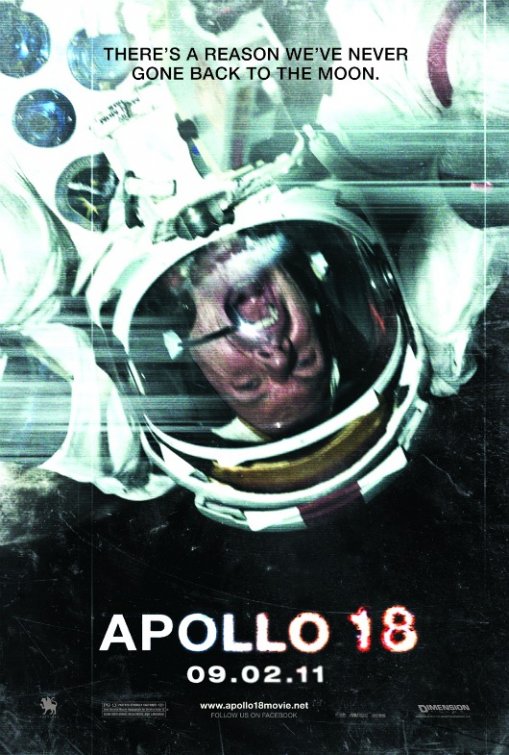 Apollo 18 is the latest in a swelling subcategory of films known as “found footage,” movies that purport to be discovered documents and aesthetically adhere to this premise. That means lots of handheld camerawork, selective editing, and other efforts meant to convey that what the audience is watching is not a movie made by professionals. It’s a professional attempt to look unpolished and amateurish, which is like having a four-star chef make you Taco Bell. 1999’s The Blair Witch Project popularized the found footage concept, and to this day there are still people today hoodwinked into believing it as unvarnished reality. Maybe that’s why NASA issued an actual press statement this week wishing to inform the general public that Apollo 18 is a work of fiction. I don’t think they have much to worry, because very few people will be seeing Apollo 18 and even fewer will enjoy it.
Apollo 18 concerns the failed secret mission of three astronauts (Warren Christie, Lloyd Owen, Ryan Robbins). The astronauts were sent to the moon for the Department of Defense, which means this is the second film of the year to concern a covert reason for landing on the moon. The two astronauts who actually land of the moon’s surface discover a dead Cosmonaut and some strange occurrences. They realize that they have been lied to by their own government and placed in a danger that few can comprehend.
But an intriguing premise can only get you so far and Apollo 18’s clumsy execution makes the movie disintegrate upon reentry, or, any critical thought. A secret NASA mission that went horribly wrong sounds like a great start to a conspiracy thriller, that is until you realize all you’re being presented with is the fake found footage. That means that we spend an eternity watching guys in suits float around, biding their time. Then they go outside and wander around the lunar surface. Then they hear an occasional noise. Or did they? Then they go back to floating around, to make up for the lost time they weren’t floating around. Really, this movie is an hour of nothing. It fails to create a sustainable atmosphere of dread or even basic curiosity. But when locked into the found footage concept, we are generally left with a lot of time on our hands. You would think that the basic premise that people have reassembled this footage would lead to cutting a lot of the filler and just getting to the good parts. It seems almost resentful that this hypothetical editor trying to showcase a long-buried truth would decide that the important stuff can wait. I was so thoroughly bored with Apollo 18 that I started counting stars.
 The structure of the story is just too insular and limited in scope. I strongly feel that Apollo 18 would have benefited greatly by opening up its storytelling parameters. It could have kept the found footage motif, but instead of being an entire 90-minute movie the found footage would be one component of a wider faux documentary. Interviews with science experts, conspiracy theorists, former NASA employees speaking under the protection of anonymity, and even family members, particularly the now grown-up son of one of the astronauts holding out hope, would add some balance. It would make the story feel larger and more authentic, let alone give the audience something new to watch. There could have been a parallel story of the discovery of this evidence, the process of getting it authenticated, and the potential dangers that would be exposed. It all seems a little too slapdash and simplistic to just say the footage was uploaded to a website. Anything, really, is what I’m looking for to broaden Apollo 18. There’s so much more that could have been added, but alas we’re stuck with three blander-than-bland, interchangeable characters collecting moon rocks and battling interstellar cabin fever.
Now I’m about to enter into the orbit of some serious spoilers concerning the ending to Apollo 18, so skip to the next paragraph if you wish to remain pure. The entire premise of this mission gone wrong (why did NASA create Apollo 18 uniform patches for a secret mission? It seems counterintuitive to create merchandise for something meant to be covert) is that there is something on the moon that the higher-ups in government want to investigate. This dangerous mystery claimed the life of a Russian cosmonaut, whose body is discovered by our American squad. When exactly the Russians put a man on the moon is never explained; yet another ingredient that would have worked better as a faux documentary. So you have one dead man on the moon, but soon the body count rises. It’s not some strange cosmic virus that infects the astronauts, leading them to psychotic episodes and murder. No, that would have been too plausible. You see, the villain of Apollo 18 is the moon rock. The rocks themselves somehow can transform into spider-like creatures that like to scurry around. Never mind the fact that we’re dealing with life that evolved in an environment without any atmosphere, but what have these moon rocks been doing for billions of years? It seems to me that after Neil Armstrong stepped onto the moon, the rocks must have been like, “There goes the neighborhood.” After twelve moon walkers, my only explanation for the motivation behind these killer rocks is that they just got sick and tired of being disturbed so often (“You stomp around like you own the place, you leave your trash behind, that’s it!”). A post-script tells us that these moon rocks were brought home and sent as “gifts” (their emphasis, not mine) to leaders and dignitaries of foreign countries. What are the implications with this? That the United States has kept its place atop the world because of the threat of moon rocks? Do the moon rocks even work on a planet with a vastly different climate than the arid moon? For that matter, since Apollo 18’s mission ended circling the moon, how the hell was any of the film footage retrieved? It wasn’t broadcast, so how did NASA or any truth-seeker come a hold of this damning evidence of killer lunar rocks? And to think we once thought that the moon was made of cheese. Oh how naïve we all were.
Apollo 18 is probably the most boring of all the found footage horror movies thus far. It does nothing to justify being 90-minutes, lacks any minor thrills or chills, and seems creatively stagnate. There are some cheap jolts, including having a character awake from a dream screaming twice. This Paranormal-Activity-on-the-moon fails to live up to the possibilities of its intriguing premise, instead settling for something aiming for slow-burn but achieves no-burn. The laughable conclusion is meant as a payoff but only for the nuttiest of geologists. Apollo 18 sticks with its core limited concept to the bitter end. This is a disappointment from all angles. It fails to scare, it fails to stimulate, and it fails to entertain big time. In space, no one can hear your boredom.
Nate’s Grade: C-
Share this:

Columbiana (2011)
 Apparently, Columbians and several academic professors of Columbian descent have taken offense with the implications of the new action film from the stewardship of producer/co-writer Luc Besson (name a French action movie from the last 20 years and he’s likely had some hand in its development). The criticism being drawn is that Columbiana paints an unflattering picture of life in the South American country of the, almost, same name. I suppose that could be one charge against the film, but why be so limiting? Columbiana doesn’t make anybody look good, except for its star Zoe Saldana (Avatar, Star Trek), who could even stand to eat a few more sandwiches if you ask me.
10-year-old Cataleya (Amandla Stenberg, soon to breakout in a big way as Rue in next year’s Hunger Games) has the misfortune of watching her parents gunned down in front of her eyes. Her father ran afoul with the local drug lord, though we’re never told why. The drug lord’s main henchman, Marco (Jordi Molla), is looking for a microchip Cataleya’s father gave her. The girl stabs Marco in his hand and leaps out a window, darting through the streets of Bogotá with goons chasing after. She makes it into a U.S. embassy and offers up this microchip filled with significant data (what we’re never told) as her passport to America. She eventually finds her way to Chicago, where she lives with her Uncle Emilio (Cliff Curtis, doing an accent on loan from Scarface). She wants to be a killer to avenge her parents, and her uncle agrees to help. Flash forward 15 years, and the adult Cataleya (Saldana) is working as a hired assassin. Her calling card is painting the cataleya orchid on the chests of her victims. Why? To attract attention from the right parties. She’s playing a dangerous game, as they always do, romancing an artist (Alias’ Michael Vartan), staying a step ahead of the authorities, and working her way up the Colombian goon food chain to get back at Marco and his boss.
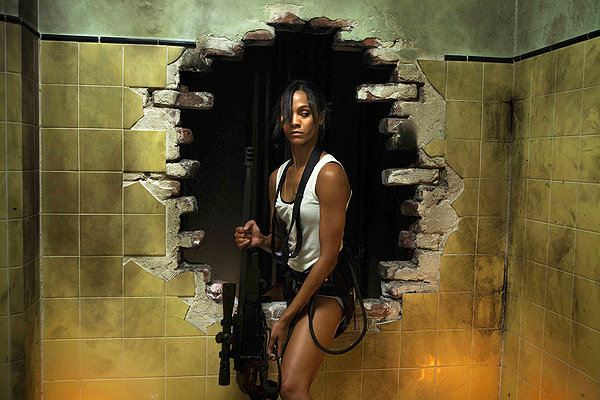 This is one of the dullest action movies I’ve had the privilege of sitting through. I was actively counting down the minutes until it would be over about halfway in. It’s not because Columbiana is particularly bad, it’s just so staggeringly routine, a French-styled action thriller cobbled together from the leftover bits of previous French-styled action thrillers (take one part La Femme Nikita, some faux Professional gravitas, add some District B13 parkour, how about a few outlandish Transporter getaways, and bake for 30-40 minutes). There are a few decent action sequences but lots of time in between, time that lets the film’s momentum lag and allows space to start contemplating all the questionable aspects of the picture. There are so many lazy, recognizable pieces onscreen, from the idiot FBI agents, who are always late on the trail, to the underwritten romantic love interest who is only there for booty calls and to accidentally be endangered, to the oblique bad guys who are just bad, and sometimes rather bad at being bad. These guys couldn’t outrun a 10-year-old girl in Columbia, what makes me think they’ll get their act together and take out the adult version? And I absolutely hate it when movies, set in other lands, have the characters speak one line in their native tongue and then transition immediately into English spiced with the occasional foreign phrase. Columbiana has the notoriety of making me yearn for the days where a female assassin picking off men twice her size was a novel concept/image.
Turn after turn, beat for beat, the plot has characters behaving in contrived ways because the story would not work without these contrivances. Cataleya says she’s an expert killer, but much of her expertise involves an insane number of coincidences and variables that are impossible to account for. We’re talking about the bathroom habits of guards, the amount of coffee consumption, the placement of specific prison cells, the precise number of guards and their own attention spans, the fact that every single person would not notice security cameras being messed with, and even nitty-gritty stuff like the amount of water in a plastic cup and the exact size of a hole that would allow the right amount of liquid to drip and pool into a spoon. Not to mention the fact that this also works on the assumption that police finding a plastic cup and a spoon inside a security panel would not find any of this suspicious. What the hell? That’s not rigorous planning and flawless execution? That’s divine intervention and/or good luck. At least in other hitman films that would study their prey to make it look like an accident. Not our Cataleya. She’s been taking out goons and leaving her calling card in an effort to attract attention from a certain Columbian cartel leader. The problem is that it takes her 15 years and over 22 murders before her skills attract media attention. That’s a frustration that the Son of Sam might identify with. But how would murders in Chicago attract attention in Columbia?
The only thing noteworthy for an enterprise that is so inherently generic is the weird moments that catch your attention. First, Saldana’s emaciated, wiry, potentially malnourished frame certainly draws your attention. Has there ever been a skinnier assassin on screen? There’s a reason that this woman is able to constantly squeeze inside air ducts and other cramped spaces; she’s practically a contortionist with her body. Now the actress has always been petite but her diminished physicality makes everything she does seem so much less believable. When she’s slinking around with a humongous assault rifle, you’d think the rifle weighs more than Saldana. And then when she engages in hand-to-hand combat, you keep waiting for some bad guy to grab her by the scruff of her neck and just hold her at arm’s length, a safe distance from potential kicks. Despite all her steely glares, Saldana just does not come across as a believable hitman. To top that off, the way director Olivier Megaton’s (Transporter 3) cameras seem to worship her lithe, leggy body gives an unsettling support for Saldana’s teeny tiny body. Now people can be just as discriminatory toward thin people as they can be with the overweight, but with Columbiana, Saldana’s skinny body negatively impacts the reality of a story already riddled with logic gaps.
 Then there’s Cataleya’s uncle who himself is something of a criminal under lord. She wants to grow up and be a killer and he just sort of shrugs and says, “Okay,” in the same tone of voice as if she had said she wanted to be a cowboy. But this is Movie World, a place where Cataleya’s father tells his driver, “We’ve got maybe an hour at most before he kills my whole family,” and then spends that fateful hour in such a lackadaisical fashion. He stops and walks around his car, sits down his little girl to have one last talk, waits for his wife to pack; there’s no sense of urgency here. People, you got one hour to supposedly live, you don’t pack a suitcase you just get in the car and run! But getting back to Uncle Emilio in Chicago. After he enrolls her in school, she’s sulky because she doesn’t think there’s anything she can gain from American education. She just wants to learn the ways of a killer. Her uncle, in a misguided feat to teach her a lesson, pulls out a gun and shoots randomly into a street, causing a car to crash and dozens of witnesses to huddle. “What can I teach you if you don’t learn?” he says, somehow giving the least inspiring case for public education. Then, preposterously enough, he and Cataleya scamper off at a mid-trot, casually eluding the police and all the dozens of witnesses who have clearly been able to see them this whole time.
Columbiana is one of those cookie-cutter action movies that just coasts on the apathetic expectations the audience has when they knowingly plop down money for a generic genre picture. And generic is certainly Columbiana. It’s a fairly standard revenge picture with some fairly standard action, devoid of any discernible kinetic style that might make for memorable sequences. Columbiana would not exist if it weren’t for a wealth of clichés and contrivances; the whole enterprise is bursting at the seams thanks to all its shortcuts in story and character. What does the title even mean? Is the film Columbia-esque? Is the depiction of skinny assassins and preposterous, illogical action supposed to be reminiscent of life in the country of Columbia? I think the film paints a worse picture of Chicago than Columbia, but at any rate this is an action thriller that can’t be bothered to thrill. Columbiana is generic to the point of desperation, where even the sight of Saldana in a skintight cat suit can become underwhelming in time, a tragedy of international proportions.
Nate’s Grade: C
Share this:

Rise of the Planet of the Apes (2011)
 I owe the makers behind Rise of the Planet of the Apes a huge apology. I have been vocally dismissive of a new Apes film from the first moments I heard about the project. I just thought rehashing this material was a stupid move. Then I heard James Franco (127 Hours) was going to be the lead, and I sighed. Then I saw the trailers and verbally impugned them in my theaters. Upon the conclusion of the trailer I yelled, “You can still shoot them!” and my criticism drew applause from those around me. The concept that we suddenly made apes smarter and they could now enter the Bronze Age, brandishing spears, didn’t overwhelm me. Just because the apes suddenly had tools didn’t seem like enough to topple mankind from the top of the evolutionary ladder. So in the months and weeks ahead I sneer, jeered, and overall dismissed Rise of the Planet of the Apes. And then the reviews came out and they weren’t just good, they were ecstatic. I went begrudgingly into the theater, waiting to hurl my own feces at the screen (figuratively, of course). Then I was completely taken aback by how much I unabashedly loved it.
Will Rodman (Franco) is a young scientists working hard at create a miracle cure for Alzheimer’s. His corporate company has been testing their drugs on chimps to mixed results. One day a promising ape, made smarter by a dose of ALZ 112, goes bananas and is put down by security. The lady ape left behind a baby ape that has taken on traits from the ALZ 112. Will takes the little chimp home to care for the “company property.” But then he ends up adopting the chimp, which his ailing father (John Lithgow) names Caesar. Due to the super drug, Caesar shows remarkable intelligence and looks to be getting even stronger. It looks like Will might have found his cure, and his boss (David Oyelowo) will make billions. But then complications ensue, as they always do, and Caesar is taken to an animal preserve facility run by a crooked father/son team (Brian Cox and Harry Potter’s Tom Felton). Caesar is mistreated and distraught to adjust to a life in pens. He makes plans to escape but then decides to rally his fellow imprisoned apes to a greater cause with the help of some of the ALZ 112.
Even through Franco is the headliner he’s really nothing more than a supporting character, a catalyst. The real star of the movie is undoubtedly Caesar the chimp. After about he 45-minute mark, Franco is reduced to making frowny faces while he scowls, trying to ascertain where his favorite monkey is. His dialogue is mostly reduced to different iterations of yelling Caesar’s name in different locations (the guy even manages to smirk in his sleep in one scene). But the major surprise is that Caesar is not only a compelling leading character but also a well-developed one at that. This is a living, breathing character brought to life thanks to top-notch computer wizardry and the talents of Andy Serkis, the leading authority for soulful motion-capture performances. Caesar may be the greatest single special effect of all time, not because of its life-like quality (it’s close, but again the creature’s features seem too waxy). But the reason Caesar is so impressive is because of the depth of emotion that can be read onscreen. This is a textured performance where you can read varying emotions through the looks of eyes, the twitching of facial muscles, the biting of lips. The emotions are genuinely recognizable; he flashes guilt, anger, frustration, heartache, disbelief, betrayal, fear, shame, just about everything in the book. From a DNA standpoint, chimps and humans share 96 percent of the same genes, so it’s understandable that we can relate to the plight of our distant relatives. Serkis is responsible for providing the groundwork for CGI creations like Gollum and King Kong, so he’s the world’s go-to guy when it comes to providing a framework for animators (Robert Zemeckis, why have you never called this guy?). It’s an amazing special effect accomplishment and works side-by-side with the storytelling to make Caesar a complicated, interesting, and deeply empathetic hero. He’s a terrific center for the movie and a figure that you root for, even with the tacit understanding that cheering on the apes’ escape is also tantamount to cheering the decline of the human race. But by God, during the apes-run-amok climactic sequences you are cheering for mankind’s downfall hardcore.
The Planet of the Apes saga (six films) is, let’s be honest here, rather abysmal. Everybody loves the first movie but the quality sharply drops from there, with four sequels in four years each managing to answer the depressing question, “Can this thing really get any worse?” The 2001 Tim Burton “re-imagining” was just embarrassing and filled with loopy logic (how can the apes take over Earth’s past when Marky Mark crashes on a DIFFERENT planet in the FUTURE?). Given that, the filmmakers behind Rise of the Planet of the Apes did not have to achieve much to separate themselves from the monkey-stank of the sci-fi franchise. The film serves as a prequel to the series but it’s easily the best film since the original. Easily. For one, the storytelling is not overwhelmed by the allegory of sci-fi packaging. The world is decidedly our own and the problems the characters grapple with are fairly relatable. Will may be responsible for the annihilation of the human race but his motivation is pure – he wants to save his ailing father. That’s a believable motivating force that would push the character to action over caution, testing his special serum without fully examining all the side effects. You know what they say about the road to Hell (my friend Eric Muller always suspected Franco would be linked to the end of civilization)? But in a Planet of the Apes movie there is a wealth of thoughtful human drama. Animal rights are one of the more obvious messages the movie deals with, but the film takes a character-driven approach following the animal himself. You care about these characters and when one CGI ape was cradling a dying CGI ape, I swear I was getting choked up over those computer pixels. That’s how emotionally involving this new Apes film can be. It’s refreshing to have a Hollywood action film that has more on its mind than blowing stuff up all good like.
 But when the action shapes up, mostly during a stirring man vs. apes climax, the film easily delivers. The nimble screenplay by Rick Jaffa and Amanda Silver (their first film since 1997’s Relic!) is a terrific example of economical big-budget pacing. Every scene moves the story forward and doesn’t waste a frame. The final running time is only 105 brisk minutes but it squeezes in so much entertainment and emotion. Director Rupert Wyatt keeps the thrills coming on a human-scale, never letting the enormity of the events getting too out of hand. Sure suddenly there are like 500 apes all of a sudden and all of them are super smart, but I can roll with that. The stakes are always clear and the action is easy to follow and easier to get swept up in. There are a few shout-outs to the original film’s iconic lines, which will either come across as fun or ham-handed. And thankfully a plausible scenario is put forth to explain why the humans would be overtaken by the apes. That’s not to say that everything is smartly woven into the narrative. Several of the side characters are but crude renderings. Frieda Pinto’s (Slumdog Millionaire) underdeveloped love interest could be completely taken out with minimal effect on the plot. Likewise the Evil Business Head seems to have nothing but speeches that remind you his sole interest is making lots of moolah.
Rise of the Planet of the Apes is a Hollywood movie with a soul. Finally late in the summer a major studio movie emerges that has the right balance of brains, brawn, and thrills. It’s an exciting action movie, a poignant drama from an animal’s point of view, a tour de force of special effects that manage to make the film more emotionally involving, and a sci-fi prequel that’s actually worthy of its name. Serkis’ gifts for physical performance are invaluable to the emotional core of the movie. By going back to its DNA, Rise of the Planet of the Apes has given new life to a franchise whose best days were 40 years ago. I don’t see where the series can go from here. A prequel to the prequel seems superfluous. A sequel would only really showcase the waning days of humanity and also seem superfluous. Then again, until the moment I was watching Rise of the Planet of the Apes I would have said this very movie was superfluous too. Instead this is the finest summer spectacle of the year and destined to make my top ten list for the year. If you can’t beat them, join them, damn dirty apes and all.
Nate’s Grade: A
Share this:

Captain America: The First Avenger (2011)
 In the summer of superheroes, you’ll be excused for feeling some fatigue when it comes to men in tights. Captain America: The First Avenger is a surprisingly enjoyable sepia-tinted action film that flexes enough might to pleasantly hark back to the days of 1940s adventure serials. Taking place almost entirely in the era of World War II, the film, and its hero, and unabashedly square and earnest. Steve Rogers (Chris Evans) begins as a 90-pound weakling determined to fight for his country and gets transformed into a behemoth of beefcake by the Army. Captain America is devoid of the dark brooding that has come to encapsulate modern superhero movies, but it’s also playing its B-movie silliness straight. The flick has more in common with Raiders of the Lost Ark and Sky Captain than most other superhero product. Better yet, the movie finesses the in-your-face patriotism of the title character. I mean the guy is called Captain America. Yet the film finds a way to resonate a sincere nationalistic pride without falling back into Michael Bay-level jingoism. And who’s going to make for better villains than Nazis? Director Joe Johnston (The Rocketeer, Jurassic Park 3) turns out to have been the perfect choice to helm this rah-rah retro enterprise. The pacing is swift, the acting is engaging, the special effects are terrific particularly Evans’ transformation into a weakling, and the film is unexpectedly emotional at points. This is a comic book movie that would appeal to an older generation not normally interested in superheroes, namely people like my dad.
Nate’s Grade: B
Share this:

Bloodrayne: The Third Reich (2011)
 It took five years and three movies, but notorious film director Uwe Boll has finally gotten to the original time period of the Bloodrayne video game. The popular game concerns a lithe, redheaded half-vampiric lass killing nefarious Nazis in World War II. You would have thought that would make for a decent starting point. But Boll instead took his time, possibly always envisioning a trilogy to do the character and his storytelling ambition proper service. Or it was just a way to make more money. So after stops in 18th-century Romania and the Wild West, Rayne comes home, so to speak in Bloodrayne: The Third Reich. What if somebody was adapting the Grand Theft Auto franchise into a film and took Boll’s dawdling approach? The first film would probably start with horses and buggies.
Rayne (Natassia Malthe), our favorite dhampir, is back at slaying them dead. She teams up with Nathaniel (Brendan Fletcher) and his band of resistance fighters on the Eastern front. They rescue one train filled with prisoners and get into a shootout with Commandant Ekhart Brand (Michael Paré). But Rayne makes the unfortunate mistake of biting the Commandant before impaling the guy. She has unknowingly turned the Nazi officer into a vampire like her, one that can walk in daylight. You would think after 200 years of existence she would have a handle on this. The Commandant is educated in the ways of the vampire by a mad scientist, Dr. Mangler (Clint Howard), who enjoys torturing human and vampire alike for science. At one point the doc says, while slicing up a living body,” Vampires no longer have any bonds to the moral laws of man.” That seems like a pot/kettle situation to me. The Commandant assembles his own undead army of vampire soldiers. Rayne feels responsible for this ugly mess and vows to kill the Commandant again and to a satisfying degree of dead this time.
 For a while, Bloodrayne III looks like it might be the best in the trilogy, admittedly a dubious honor. Despite all my misgivings, Bloodrayne III almost works on its own lowered-expectation exploitation genre level. Almost. The campy combination of Nazis and vampires is a wild premise, though hardly original, and should reap some ripe and schlocky exploitation entertainment. The locations in Croatia are terrific and add just enough authenticity for a story about a vampire lady killing Nazis. In fact one sequence plays like Boll’s take on Tarantino’s Inglourious Basterds, involving a tavern showdown where people play a tense game of secret identities. There are moments that work, little bursts of promise, but they get reaped all too quickly. Boll’s action choreography is sadly limited in scope and editing. He sticks too close to his characters, never allowing for complicated tussles or expanding the scope of the action. There are a few serviceable explosions, some minor gore effects, but Boll does nobody any favor when the action is too brief and brittle. Everything feels pared down so most of the fights involve minimal players and the sequences themselves mostly give way to redundant posturing.
The failings of Bloodrayne III are roughly the same failings that dogged Bloodrayne II: Boll does not embrace his film’s inherent cheesiness. I wrote about 2007’s Bloodrayne: Deliverance: “Boll seems uneasy about embracing its supernaturally campy potential. Bloodrayne II has little blood, zero gore, no nudity, no sex, and a pitifully scant amount of action. In other words, it’s missing all of the exploitation elements that make a movie like Bloodrayne II worth watching.” While Boll has seen fit to correct the absence of certain genre elements, notably blood and boobs, he still cannot seize the pulpy premise into Grand Guignol. Nazi vampires, an immortal Hitler, a 200-year-old ass-kicking woman with signature arm-blades AND Clint Howard as a mad Nazi scientist and this is the best you can do? That’s unacceptable. The supernatural potential is wasted here. Rayne’s vampire side is barely utilized. She bites people, she jumps high once, but there’s nothing really vampiric about her beside one scene where she complains about having to drink pig’s blood. She might as well be anything else if you’re not going to take advantage of what makes a vampire a vampire. At one point, the Commandant turns his best tracker into a vampire for the purposes of finding Rayne (her secret hideout turns out to be a not very discreet large castle). That idea had great promise, all things considered, but like most of the other fights, it’s one-and-done. Rayne takes out the guy and we move along. Rayne is betrayed by one of the brothel girls who has her eyes set on running the business (“You’re a cocksucking entrepreneur,” someone declares, though I wouldn’t put that exact terminology on a resume). She gets turned into a vampire too. All right, she could work as a character that could get close to Rayne. But then she too is dispatched with mercurial swiftness. Why the hurry? Bloodrayne III runs a total 72 minutes before end credits. The film could have used a lot more fleshing out, and it could have benefited from being less serious with something so flatly ridiculous.
It wouldn’t be a Boll movie without the whiplash-inducing shifts in tone. One second we’re dwelling on the campy idea of Herr Hitler becoming a powerful vampire (there’s even a goofy dream sequence where Rayne is terrorized by Adolf with fangs) and the next minute the film descends into soft-core porn territory. Rayne visits a brothel to get an oiled massage, because apparently being a centuries-old undead slayer of evil can really cause some killer knots that only hookers are properly trained to knead away. Anyway, Rayne saves one of the brothel girls from an abusive Nazi john, and the women of the brothel wish to show their gratitude via some sex “on the house.” We’re then treated to a solid four minutes of heavy breathing and gauzy soft-focus shots of hands, nipples, and crevices. To Boll’s credit, it’s on par with most soft-core porn productions. When Rayne is beating the Nazi john she becomes a feminist mouthpiece: “I can’t punish you for the legions of women who have been brutalized by men, but I’ll give it my best shot.” If Sucker Punch proved anything, it’s hard to stand on a feminist soapbox when your characters are pure male fantasy figures. The onscreen lesbian tryst would fit the context of the film better if Boll kept a continuity of tawdry sensuality. I don’t recall any other lesbian leanings in previous entries but I suppose spontaneous lesbians/opportune bisexuality just goes with direct-to-DVD territory. The only other element of sexuality occurs late in Bloodrayne III, like ten minutes to credits. Rayne and Nathaniel decide it’s time to get it on. Oh, did I mention that they come to this decision while in the back of a German transport truck on the way to Berlin. Nonetheless, an awkward and deeply unerotic sex scene follows before their rescue. They appear to be making the most of their time, though curiously both participants leave their fingerless gloves on while they copulate. I call it “hobo lovemaking.
Boll doesn’t seem to understand what a truly juicy concept vampire Nazis are so we are treated to a lot of talking. But it’s not talking that really establishes character, setting, or plot; it’s mostly a jumble of self-aggrandizing, hyperbolic asides as heroes and villains are constantly reconfirming the stakes. Vampire Nazis. Trust us, we get it. But alas, the Commandant keeps gripping his fists and speaking about being “power incarnate” and how everyone shall bow to his power and how he’s “the prodigal son of the Third Reich,” which I don’t think is the proper analogy to apply. Dr. Mangler (too on-the-nose or an attempt to reference Dr. Mengele? You be the judge) will not let any situation to bray about the obvious go to waste, sometimes with peculiar anachronisms. Over the course of the film, this talkative evil scientist will reference Shakespeare, say “the world is your oyster,” and even, “The times they are a changin’, gyspy.” He even slams the father of penicillin, saying, “Alexander Fleming had his fungi. I have [Rayne].” But the worst offenders have to be Rayne and Nathaniel. At one point they bellow, “He’s not just a vampire! He’s a vampire with an entire German army behind him!” You know, in case you couldn’t grasp the subtleties of the narrative. Rayne is given to long passages of voice over where we get to listen to her wax poetic about man’s inhumanity to man, the cycle of violence, and other hilarious grasps at being mistaken as having, you know, depth or thoughts. This is the same character who ends the film saying, “Guten tach, mother fuckers!” Yeah, this one’s a regular Rodin.
 The film is populated entirely with Boll’s stock players, so you know the acting returns will be fairly diminished. Malthe (Elektra) returns for her second go-round as the titular half-vampire half-human heroine. For what reason, I could not say. Perhaps the former Maxim model had a large gas bill one winter. Malthe hasn’t advanced much as an actress in the layover between sequels. Malthe looks deathly pale in the film with alabaster skin. Apparently in the 60 years since the events of Bloodrayne II, she decided to keep the cleavage-accentuated fighting outfits but lose her skin tone and her heretofore signature red hair. But fear not video game aficionados because this Rayne has streaks of bright red amongst her otherwise jet black tresses. I suppose she found the one Hot Topic open on the Eastern front. Malthel looks the part, no matter what improbable form-fitting outfit she chooses to slay evil in, until she opens her mouth and destroys the illusion. To be fair, the Rayne character is mostly defined by costuming and weaponry. Don’t believe me? Read the user reviews by fanboys and see what they quibble over most.
It wouldn’t be a Boll film without his lucky charm, Paré (11 Boll film appearances!). The plainspoken actor was actually a fine fit in Bloodrayne II as a cowpoke. He’s not so well a good fit as an evil Nazi officer. Paré is never truly threatening in any capacity as a Nazi or a vampire. That’s pretty sad. He’s given tough guy things to say, and he bites people, but he never comes across as menacing. He’s letting the uniform do the acting for him. Likewise, Howard (first Boll appearance since 2003’s House of the Dead) gets lost in the broad generalization of his character. Howard always seems like he’s on the verge of breaking into third person. He seems lost in a daze too often. Howard comes across as more Igor than mad scientist. He’s definitely not going to be one the scientists other countries offer asylum for at war’s end.
Bloodrayne: The Third Reich could have been a ridiculously yet enjoyably campy B-movie that knew how to play to its strengths – vampire Nazis, attractive woman killing vampire Nazis. You would think that salaciously junky concept would write itself. The problem is that Boll seems to have made a movie that seemed like it would write itself. It’s not enough to just have a handful of genre elements (vampires, Hitler, lesbians!), you have to present those elements in an appealing manner. The premise is workable but the plot, characters, action, and tone are not given necessary attention. I never thought I would say this, but there’s just not enough holding together a movie about vampire Nazis. The dialogue is mostly characters talking in circles, rehashing what should be obvious, explaining why the bad guys should be threats when they fail to be credible onscreen. The film might be the best of the ongoing trilogy, but what exactly is that saying? Barely covering 75 minutes, with negligible action and an overall rushed pace, Bloodrayne III is a sterling example of disposable entertainment that hasn’t even been given the necessary components to be “entertainment.” Instead it’s just eminently disposable. The saddest part is knowing it’s only so long before this character gets resurrected for a fourth movie. Perhaps by then Boll will have figured out what to do with his vampire-killing lead. Fourth time’s the charm, right?
Nate’s Grade: C-
Share this:

Beginners (2011)
 Burying a parent is one of the most gut-wrenching hardships of life, a passage I have thankfully not had to endure yet in my own life. Writer/director Mike Mills (Thumbsucker) turned his own heartbreak into a subdued, life-affirming movie called Beginners. This gentle movie is comic, poignant, and frustratingly limited thanks to a miscalculation in its structure.
Oliver (Ewan McGregor) is reeling from the loss of his elderly father, Hal (Christopher Plummer). After the death of his wife, in his seventy-fifth year, Hal came out as being gay his whole life. And he decided to have some fun in those last years too, notably with a hunky younger boyfriend (Goran Visnjic, remember him, ER fans?). We get several flashbacks with Oliver and his ailing father, who was diagnosed with stage four lung cancer soon into his gay reemergence. In the present, Oliver, as a dissatisfied graphic designer, is trying to find his bearings after burying both of his parents. Hal’s dog, a Jack Russell terrier, is mourning as well, refusing to be left alone. As a result, Oliver takes the small dog with him wherever he travels, including social events. He meets Anna (Melanie Laurent) at a friend’s costume party. He’s dressed as Sigmund Freud and she mimes having laryngitis. Anna, a young actress who spends most of her life in hotels, invites him back and the two explore the possibility of a relationship. She’ll be off to another film shoot in a month, but the two become inseparable during the time they have together. Anna learns about Oliver and his complicated relationship with the complicated man he knew as his father. Oliver, and in flashback Hal, are beginners on a road to making sense of their lives.
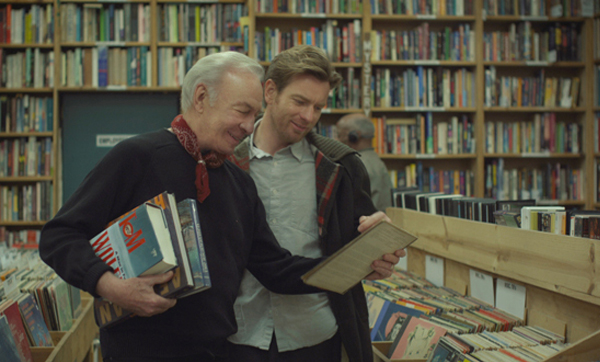 What eventually holds Beginners back is its clipped structure. The film diverges into two main storylines, father and son (60%) and son with new love (40%). The new love stuff is presented fairly linearly, however, the father/son material is not, consisting of memories that can be triggered by objects or offhand sayings. Like (500) Days of Summer, memories are presented not in a linear fashion but through a connection of theme or tone. Rarely do we recount memories in a chronological fashion, and as such Oliver is beset by deluges of images of his father ailing at various points. But it’s like Mills took that fleeting memory approach to heart because Beginners is a slave to the altar of jump cuts. The editing, and the narrative, is constantly leaping forward; scenes rarely last longer than 30-45 seconds, making the film feel like somebody had their finger mashed against a stubborn fast forward button. As a result, the film feels hurried and unsettled, and this clipped structure mollifies the emotional impact of the movie. It’s because the romance only feels like someone’s remembrance of those burgeoning happy beginnings. The film doesn’t feel like it is in its own present; we’re in 2003 and Oliver will occasionally inform us, in High Fidelity-styled notation, of life at that moment. It feels like the entire enterprise is an assembly of past memories ping-ponging off one another. Another hurdle is that Anna and Oliver’s main conflict concerns their fear of happiness. Each had parents who wed as unhappy people, had unhappy unions, and both are fearful that they too will commit to living unhappy lives. It’s not an impossible feat, to be sure, but it does make it somewhat harder to relate to your characters when the main relationship problem is that they cannot accept happiness. While psychologically interesting in larger scope, due to the structure of Beginners, this conflict for Anna and Oliver seems petty and insufficient. The antsy story structure limits the emotional resonance of the movie. What should be a nourishing meal about the human condition ends up being a tidy snack instead.
Don’t get me wrong, Beginners is still a fairly moving film in its own right. Just the very nature of the story, dealing with the last months of an ailing parent and what to do next, is destined to hit poignant pockets of drama. Plus you have gifted actors doing fine work to wring out those tears. Mills’ tale is semi-autobiographical, which allows for several personal insights that can wound, like direct shots of honesty. Oliver narrates the steps taken after a parent’s death, including the mundane yet painful trivialities needed to convince every bill collector that their client has left the Earth. When Hal is informed that he has a spot of cancer the size of a quarter in his lung, the screen flashes to black as the doctor continues her somber diagnosis. A quarter appears. Then five nickels, finally twenty-five pennies. It’s a small little visual insert, and yet it manages to seem like a believable, personally relatable moment when delivered such thundering news. Something the size of a quarter will be responsible for your father losing his life. Five nickels. Twenty-five pennies. The scenes with father and son, coming to terms with saying goodbye, reflecting on lives lived and lives deferred, is what gives Beginners its beating heart. The clipped present-day romance plays more like a post-script attempt to forge a neat resolution after all that heavy grief.
Plummer gives a performance that is equal parts weighed with the gravity of death and the electricity of life. After his wife’s death, Hal finally has an opportunity to embrace who he has been his whole life. Mills and Plummer are delicate with how they handle the relationship between Hal and his wife (Mary Page Keller in flashback). Neither hated the other, and both did express love, but they were together in a marriage of convenience, both of them hiding who they were from preying eyes (Oliver’s mother hid that she was Jewish). Plummer’s celebration of life, the twinkling realization of accepting who you truly are, is an uplifting path for his character, and thanks to both Mills and Plummer it never feels like he’s dancing on the grave of his long-suffering wife. He’s not celebrating her death; he’s embracing who he is in the twilight of his years. He’s looking for a small amount of kindness and comfort while finally being socially recognized without fear or intimidation. Plummer is delightful during Hal’s happier moments and heart wrenching during the realities of his failing body. Plummer deftly bites into one of those juicy, Oscar-bait roles.
 McGregor acts very well even if his character is kept in a very tight box of emotional expression. His character seems to sleepwalk from scene to scene; often little is said and much left to the imagination through pregnant pauses or gestures. McGregor does a fine job of balancing the different timelines of grief his character is experiencing. He’s in comic shock about his father’s newfound immersion in a gay lifestyle, he’s in mourning about the recent loss of his father, he’s in annoyance tinged with guilt about the burdens of taking care of a man that was often absent in his own life, leaving him in the care of his mother, resigned to a life of dutiful despondency, and he’s infatuated with the possibility of romantic love, a cleansing force. It’s a lot for one actor to keep straight and McGregor does an admirable job. Laurent does not fare as well. The Inglourious Basterds‘ actress is forced to rely mostly on wry smiles and her penetrating eyes. She also cocks her head to the side a lot, or a least that’s how I recall. She’s given something of a thanklessly underwritten role but she manages to be adorable from her first moment onscreen, which is her most vital acting accomplishment here. She’s supposed to be that happy ending we want Oliver to have.
Beginners is a moving, charming, and perceptive movie. If only there was more of it. The clipped, hurried jump cut-heavy structure keeps the audience at a certain distance and capping the emotional resonance. The father/son stuff is going to be easier to empathize with, both good times and bad, than two good-looking thirtysomethings afraid of being happy because their parents are screwed up. Ultimately, the film’s pretenses of a budding, quirky romance will take away from the more genuine father/son bonding late in life. You’ll get weepy at turns, maybe even swoon here and there, but the rewards are sadly too momentary, never cohesively assembling into a full-fledged narrative. Beginners has an equal number of hard truths and light moments of whimsy (the subtitled dog is a hoot), but ultimately it’s a movie that makes you wish it had left a better impression when it had the chance.
Nate’s Grade: B-
Share this:

Horrible Bosses (2011)
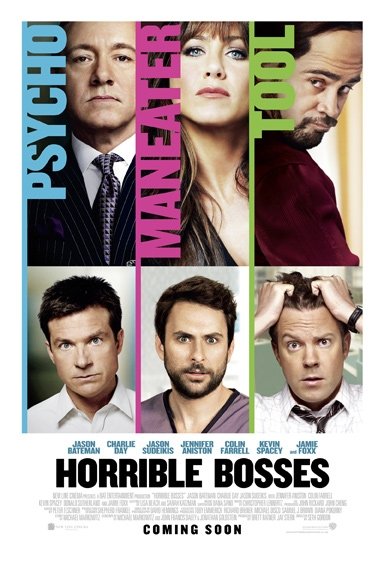 The true joy of Horrible Bosses, besides the vicarious premise, is the interaction and camaraderie of a rock-solid cast of comedians. Jason Bateman (Juno), Jason Sudekis (TV’s Saturday Night Live), and Charlie Day (TV’s It’s Always Sunny in Philadelphia) play the three put upon friends who conspire to kill their not so very nice bosses, respectively played by Kevin Spacey, Colin Farrell, and Jennifer Aniston. The comedy is amusing from start to finish, prone to plenty of guffaws and a few big laughs. The film strikes a delicate tone while being nasty without being too brutish or oft putting. This is not a scorched-earth sort of comedy despite its murderous implications. The guys are more bumbling than threatening, which makes even their criminal pursuits clumsy and endearing. It’s got plenty of surprises and I enjoyed how most of the storylines and players wound up back together. It’s a satisfying movie that veers in some unexpected directions. But the real reason to see Horrible Bosses is just how damn funny the cast is. The snappy screenplay establishes a solid comedic setup and lets the leads bounce off one another to great hilarity. Whether arguing over who would be most raped in prison, the ins and outs of killing on a budget, or the dubious nature of hiring hit men under the “men seeking men” section online, the three leads all bring something different to the comedic table, and watching them interact and play around with the situation is a delight. It’s a buddy comedy with a dash of Arsenic and Old Lace. While the characters are more exaggerated stock types, the comedy, kept at a near breathless pace by director Seth Gordon (King of Kong, Four Christmases), is refreshing, smartly vulgar, and not afraid to get dark. Watching Aniston play against type as a sex-crazed man-eater is enjoyable, but hands down, no one does sadism with the same joy as Spacey. That man could melt a glacier with the intense power of his glare. Horrible Bosses is a relative blast of a comedy, one that maintains a steady output of laughs with some easy targets.
Nate’s Grade: B+


You must be logged in to post a comment.