Author Archives: natezoebl
Colossal (2017)
 Gloria (Anne Hathaway) has a monster of a problem. She’s lost her job, her boyfriend (Dan Stevens), and is forced to move back home to her parents’ empty house. She gets a job at her childhood friend Oscar’s (Jason Sudeikis) bar. Then one night the news is filled with a 100-foot tall lizard monster magically appearing in Seoul, South Korea. This lizard only seems to appear at a certain hour, and Gloria realizes that she is somehow connected to this giant beast and responsible for its movements. What’s a working girl to do?
Colossal is a different kind of monster movie, that’s for certain. It’s got a dynamite premise that allows for plenty of different tones. There’s an inherent wackiness in a party girl discovering that her actions have a very extreme set of consequences. For a while it’s a slice-of-life picture about coming home and readjusting to the rigors of adult life, something Gloria has been putting on hold while soaking up the pleasures of New York City and the patience of her live-in boyfriend. She’s picking up the pieces of her life and sometimes an acquisition of furniture like a futon can feel like a small triumph. There’s a simple rhythm to these early scenes and writer/director Nacho Vigilondo (Time Crimes) slowly reveals more and more about character histories and relationships, remarkably free of ungainly exposition. There is a remarkably accomplished and sly sense of discovery with the movie, first with the implications and abilities of Gloria’s monster avatar and with the movie itself. There’s a cheeky sense of fun watching Gloria discover her connections to the monster and the special effects are pretty good for such an odd indie film. What are the monster’s intentions? Where does it come from? Why is this patch of land and Gloria so special? Fortunately Vigilondo doesn’t stop there. From a rules standpoint, there’s only so much to learn through trial and error, but it gets even more complicated when Gloria decides to tell her buddies the news. Now it’s about keeping her secret and making sure these often drunk, often-misbehaving guys don’t cause an international incident.
 Hathaway (The Intern) is at turns hilarious and heartbreaking and she completely owns the movie, which she filmed while in her second trimester of pregnancy (explains the omnipresence of heavy coats). She has to play a woman who has self-absorbed and self-destructive qualities while not shutting out audience empathy. Hathaway brings out multiple dimensions in her flawed character. She can be cowed easily through guilt and intimidation, failing to meet up to her own standards she holds for herself, but she can also derive a quiet strength that pushes her to take a stand and make a change. Hathaway is apt at the blending of comedy and drama and she’s a star with genuine acting chops. Despite her struggles and setbacks, we want her to succeed and she feels all too human.
It’s midway through where Colossal makes a sharp turn into territory I didn’t see coming and reveals its true intentions, which are much darker and uncomfortable. Fair warning to readers, I’m going to try and avoid specific spoilers but even talking about the second half of the film serves as a spoiler in itself, so keep reading if you so choose. Beforehand, the movie has presented itself as a fun, slightly whimsical take on a down-on-her-luck party girl discovering a weird power. The monster serves as metaphor and I thought it was going to be a relatively obvious metaphor for alcoholism, something she had to work through and get her life back together, putting away childish things and integrating back to the world of responsible adults she’s been avoiding. Then the turn happens and you realize that the monster isn’t a metaphor for alcoholism but for abusive relationships. As you can imagine, this is more or less when the comedy slowly comes to a halt.
 It backdoors you into reconsidering everything that’s come before and ingeniously plays the charms of its actors against your preconceived notions. It’s a movie about abuse and manipulation and the capitulation to that abuse. Whether the source of that abuse is derived from alcoholism is up for debate, but I insist it’s a complicated mixture of substance abuse, unchecked entitlement, and toxic masculinity. Oscar becomes our villain, and it may feel like a sudden shift to many viewers, especially those who were expecting him and Gloria to end up romantically linked by film’s end. Colossal can be seen following a more familiar rom-com formula of the girl who goes home, reconnects with old friends, and becomes romantically linked, and the movie uses your expectations against you. Because of that, you may excuse Oscar’s behavior, downplay it, and rationalize that he, like Gloria, is trying to gather his bearings and grow up. That’s not the case. That’s not the case at all, and the movie explores this notion by giving a serial abuser new unfettered power to endanger a multitude of human lives, people who are invisible to his angry outbursts and thus made even more expendable in his mind.
This tonal turn dominates the second half and I can imagine many people will be put off and disappointed by how heavy and uncomfortable a giant monster movie has become. An emotionally abusive person will stop at any manipulation to keep people within his or her orbit so they constantly have targets for abuse. We get several scenes that examine this dynamic as Oscar tears apart his friends one veiled menacing monologue after another, pushing their insecurities and influencing control over them. He’s the “nice guy” who thinks the world owes him more than he’s ever gotten, but a choice reoccurring flashback reveals he’s always been this way. Oscar didn’t turn into a jerk, he was this way from the start, and he’s just gotten better at hiding his darker intentions, and he’ll likely always be this way without redemption. Sudeikis (We’re the Millers) digs into his character’s misanthropy without going overboard, which makes him a far more realistic depiction of an abuser taking advantage of other people’s good graces and chances.
 Colossal transformed into one of the more unexpected and surprisingly emotionally involving stories I’ve seen recently. I was set to enjoy the silly monster movie shenanigans being turned on their head with oblivious Americans unknowingly wrecking havoc on the Eastern world. Instead of global consumer commentary I got something much more personal and unexpected. I never knew where the movie was going to go next and found myself more and more intrigued by every scene. If the filmmakers could upend my expectations and keep me on the edge of my seat, then they did their jobs. The finale is magnificently executed as it employs just about all the rules we’ve learned concerning the monsters, space-time, and the sour relationship between Oscar and Gloria. It feels like a true culmination of events that is dramatically and emotionally cathartic.
Much more than advertised, Colossal is an exciting movie for how different it ends up becoming, and yet it’s still everything as advertised. Hathaway is highly enjoyable during her character’s various highs and lows trying to make sense of her life. Vigilondo shapes an unpredictable narrative that subverts and overcomes formula expectations and audience sympathies. It’s an involving and personal tale given an expansive scope and feel. Monster as metaphor is not a new concept. It’s an externalization of our fears and labors and an expression of their cataclysmic destructive power. It also provides a focal point for a hero to overcome, and Colossal feels like somebody took a slice-of-life indie mumblecore observational character piece and gave it a dash of fantastical genre elements. I want to watch it again to see if I can catch nuances I missed, especially relating to characterization and performance. If you can hang on after the movie makes its midway shift, I think Colossal is a unique filmgoing experience that sees its vision to the end.
Nate’s Grade: B+
Share this:

Free Fire (2017)
 I don’t understand the praise and hype heaped upon filmmaker Ben Wheatley. He’s got a nice eye for visuals but whenever I see his name attached as a screenwriter, my expectations sink. His 2016 film High Rise was on my list of the worst films of last year. To my mind, Wheatley is Nicolas Refn (Neon Demon) lite, and I don’t even care for Refn. With that being said, the premise and star power for Free Fire looked enough to even out my immediate hesitation about watching another Wheatley film. It looked like fun. How could it not be? Well I’m now debating whether I disliked Free Fire more than High Rise, a scenario with no real winner.
In 1978, two gangs meet in a Boston warehouse to make an exchange of guns and drugs for money. Things go wrong, tempers flare, and bullets are exchanged. Both parties are pinned down, fighting for cover, and looking to come out alive and on top. There’s Cillian Murphy, Oscar-winning Brie Larson, Armie Hammer, Michael Smiley, and Sharlto Copley among this dingy dozen.
Exiting my theater screening, I got into a discussion with my pal, Ben Bailey. He was adamant that the story premise of Free Fire could not be done as a feature film and was, at best, the sort of material for a 20-minute shoot-em-up short. I argued that with the proper development there could be a scraggly feature film here but the key phrase is “proper development,” something that is sorely lacking from Free Fire. Ultimately it feels more like Ben’s assessment: 20 minutes of thin material and thought stretched out to an interminable 85 minutes.
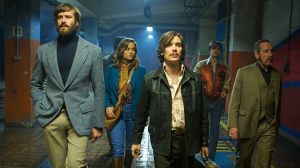 Once the shootout commences, it feels like Wheatley just succumbs to the cacophonous confusion of the action and more or less gives up. For a solid twenty minutes or so, the movie is nothing more than a series of disjointed shots of people firing and people taking cover from wooden boxes and planks, rarely if ever coalescing to produce a sense of direction, momentum, and geography. I didn’t know where anybody was and especially in relationship to anyone else. That is a crucial factor in action sequences especially in a limited location action sequence. You need to know who is where and establish different mini-goals and new challenges. Wheatley only introduces new elements late into the proceedings, and when he does they are anticlimactically resolved. When complications do arrive they are brushed aside and we go back to shooting. Why not involve the guns in those crates as something to be fought over to gain extra leverage? That seems like an obvious goal but not to the characters on screen. I lost track of which characters were with which side, and the movie even tries to make the same joke, as if knowingly acknowledging this aspect forgives Free Fire for its plotting misfires.
As minute after minute of blind shooting went on, I started making connections to a question I have had with Terrence Malick (Tree of Life, Song to Song) movies, namely how does one edit these things? If you’ve never seen a modern Malick movie, first consider yourself fortunate, but the man is known for his whispery, stream-of-consciousness spiritual connections with nature. My question with Malick movies: how does someone know that this shot of light through the leaves needs to be here, and definitely before this shot of a caterpillar moving along a tree branch? How do you edit what is bereft of a traditional coherency? I wondered the same question during Free Fire. Without those mini-goals, how does one edit just gunshot after gunshot after gunshot without any credible change in the story’s impetus as guidance?
Compounding my boredom and general confusion is the reality that these criminal lowlifes are dull characters and not worth the investment. Wheatley and co-screenwriter Amy Jump fail to provide interesting personalities or quirks or anything memorable to enliven these tough-talking bad-shooting bad guys. Some of them have accents, one of them is a woman, one of them likes to smoke pot, but really they’re all slight variations on the same excitable, profane, and shallow archetype, the kind of character that gets their own poster in marketing with a nickname like “The Kid” or something cool-sounding like that, but it’s all posturing. I thought that Free Fire might be reminiscent of the rise of Tarantino knockoff films in the 90s (The Big Hit, 2 Days in the Valley, Things to Do in Denver When You’re Dead, Suicide Kings) but this movie actually made me yearn for a Tarantino knockoff.
 These people are so lifeless. I didn’t care who lived and who died. They were all boring. Some faces are recognizable like Hammer and Smiley and Murphy but a majority of the characters are not, at least initially visually distinctive. It’s a failing of creativity to separate them, make them distinct. Much of the acting is just reacting to squibs going off and squirming on the ground. If you have a fetish for Brie Larson (Kong: Skull Island) wriggling, this is your film. By default the best actor is Copley (Hardcore Henry) as he seems to be on an uncontrollable improv stint, rapidly saying whatever things comes to mind. Something has to fill the audio between gunfire.
Free Fire wants to be a scuzzy, crazy, fun movie that knows it’s trashy and revels in its bad taste and loony characters with nose-thumbing glee. Instead, Free Fire is a nihilistic and tedious enterprise lacking entertaining characters, coherent action, and most importantly any general sense of fun. Watching characters that are unmemorable, who you don’t care about, fire guns indiscriminately for a long time is not a movie, and it’s most certainly not a good movie. It’s a glorified training manual for firearms. Free Fire takes too long to get started with poorly developed characters and when it does kick into action the movie doesn’t really improve too much. Free Fire is a Tarantino knockoff that doesn’t have the courage of its own B-movie convictions. It thinks just dressing the part is enough, substituting style and a blithe attitude for not even substance but the appearance of substance. It only has one truly memorable, queasy death, so even when it comes to bizarre violence it falters. This is one movie that wants to look cool and irreverent but ends up merely firing blanks.
Nate’s Grade: D+
Share this:

The Fate of the Furious (2017)
 I’ve written before that all I demand from the ever-ascendant and popular Fast and Furious franchise are its eye-popping action set pieces that teeter into madcap lunacy and impressive stunt work. A fiery meteor could crush all the characters, short of The Rock, and I wouldn’t shed a tear. Despite the super serious plaudits about the importance of family and loyalty and blah blah blah, I’m only here for the action spectacle that obliterates the laws of physics. I’ve said before there’s a fine line between stupid action and stupidly awesome action, and the Fast and Furious franchise has planted its flag like few others. Nobody today goes to the level of action spectacle that the Fast and Furious films achieve, bringing to life exciting action set pieces that feel fully plucked from the imagination of an exuberant child, and I don’t mean that at all disparagingly. These movies deliver like few others nowadays. We’re a long way from undercover cops and underground street racing. Vin Diesel and his team are essentially superheroes and their power involves doing amazing things with cars. I’m not a gearhead, I don’t care a lick about automobiles, but I’ve come to eagerly anticipate this franchise. It delivers ridiculous action on a ridiculous scale like few others. It’s earned my confidence. The Fate of the Furious, the eighth film, still delivers the high-octane goods even if it can’t quite keep up with the best of the franchise’s entries.
Dom (Diesel) has been preaching the virtues of family for years but now he’s turning his back on them. The notorious cyber terrorist Cipher (Charlize Theron) extorts Dom into helping her get her hands on nuclear codes. Dom’s crew (The Rock, Michelle Rodriguez, Ludacris, Tyrese Gibson, Nathalie Emmanuel) is wondering whether the man they know is still there. Government agent M. Nobody (Kurt Russell) reassembles the team to track down Dom, and they’re working with some unexpected help. Deckard Shaw (Jason Statham) has been released from maximum-security prison to thwart Cipher.
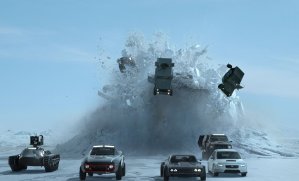
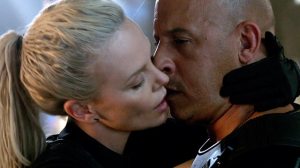 This is a franchise that soared to new heights of commercial success after it left behind its inhibitions of the imagination. It’s a franchise that lives or dies depending upon its giddy action set pieces. As I wrote about Furious 7: “The set pieces of the last few films have been stunners, and at its height, the franchise can make you feel giddy like a child watching the unreal unfold with such delight. There’s a tremendous and infectious high watching a well-executed action scene on such a large scale. With every movie our expectations are hungrier, and the franchise has found a way to satiate our action movie demands.” Fortunately for the eighth film, there are two standout action set pieces that are some of the stronger ones in the history of the franchise. The first is a car chase through New York (though filmed primarily in Cleveland) that builds and changes as it continues, an essential element for any great action sequence to stretch forward. At one point Cipher takes control of an armada of hackable, self-driving cars and pilots them as a collective weapon of mass destruction. They resemble a herd of runaway bulls. The destructive fleet leads to some impressive sights such as a bevy of cars plummeting from a parking garage. It’s a strong sequence that also finds room for the other characters to try and take down Dom, and it allows Dom the ability to outsmart them, adding the personal element. The other standout is the entire third act set around the Arctic Circle in Russia that climaxes with the dizzying heights of a nuclear sub chase and The Rock manually redirecting a speeding torpedo. There are multiple points of action and mini-goals that lead logically to the next, allowing escalation to mount. It’s dangerously over-the-top even for this franchise and it’s generally awesome and I loved it.
Eight movies in and Fast and Furious is really becoming an expansive ensemble series. The core team has been picking up players here and there with each additional movie, building its diverse definition of a diverse family. This is getting to be a crowded film and there’s just not enough room to go around for everyone to contribute meaningfully, which means it’s more likely from here on out, unless there is some judicial pruning, that characters stay religiously archetypal. Ludacris is the tech guru, but isn’t Emmanuel now also the tech guru, or does she only specialize in the tech subgroup of hacking? Why do I need Scott Eastwood (The Longest Ride) to join the gang as the awkward rookie trying to look cool? Isn’t that a milder version of what Tyrese Gibson offers as the comic relief bravado? Admittedly, I only started really paying attention to this franchise once it added The Rock, but I’m still unsure what Rodriguez brings to the dynamic beside history and romance. This general sense of the characters settling into their expected roles is exemplified in the in-car banter and one-liners. It appears often that they’re just talking to themselves for these lines. I could do with far less Tyrese reaction shots and Rodriguez one-liners. Theron is also generally wasted as the new villain du jour. She’s got the icy glare down and looks to be having fun, but she’s not given anything interesting to do. Without going into greater spoilers, I will say that Dom’s heel turn is wrapped up by the end of its 135-minute running time. No need to turn it into a multi-film arc.
 Paul Walker’s character is understandably absent and I’d hate for them to bring him back after the very sweet and surprisingly poignant sendoff at the end of Furious 7, but he does still exist in this universe. I can agree with characters not wanting to get him involved in their dangerous missions across the globe, but at the end when they’re all dining as one big family, wouldn’t they also invite Dom’s sister, brother-in-law, and their children too? It gets into the Avengers territory where you start wondering why the Avengers haven’t assembled for the world-destroying threats from their respective solo film adventures.
The best post-Rock addition to the franchise has easily been Statham (Spy) and he proves it with his limited but highly entertaining time on screen. His appearances were a fun disruption in the previous film and he served as the most formidable villain. Reintegrating him onto the team was a smart move because he adds charisma, unpredictability, and a new dynamic that also seeds conflict. It was also smart because more Statham means including hand-to-hand combat action sequences that can involve a higher degree of stunt choreography, even if the former Transporter is starting to show his age. His scenes with The Rock were a natural highlight. However, adding Deckard onto the team to tackle a bigger baddie presents some weird questions. By the film’s end, everyone seems rather chummy with the man who straight up murdered their friend Han (Sung Kang). Sorry dude but it seems like everyone is rather relaxed with your murderer and big government having unlimited and regulation-free surveillance powers. My advice to future Fast and Furious installments, and there will be various, is to try and include as much Statham as possible (it’s essentially a repeat of The Rock Rule).
Where the movie has rougher terrain is in the area of drama and comedy. Look, nobody is going to confuse the Fast and the Furious films as great works of human drama. Director F. Gary Gray (The Italian Job, Straight Outta Compton) takes over for James Wan (The Conjuring) who took over for Justin Lin (Star Trek Beyond), and the discrepancy is noticeable. While having two excellent set pieces that place highly along the big board of the franchise, they’re not as well shot. Gray’s command of visuals is more than adequate but lacks the sizzle and vision of his predecessors. Wan was able to adopt the house style of the franchise and deliver a satisfying though lesser experience (Lin is king). Gray has a harder time with the material. The CGI approaches cartoon levels at points and Gray doesn’t better maintain tone. He doesn’t know when to pull back, which is unusually exemplified in the comedy asides. Everything that gets a laugh will be repeated until it becomes somewhat annoying, in particular a scene with Statham and a baby. It begins fun and cheeky, and Statham even uses the baby carriage as part of the fight choreography, but then it overstays its welcome like the other comedy bits. The dramatic moments are also far too overwrought, even for this franchise. It can be a bit much.
 This is a franchise that revels in the ridiculous, that embraces being a big dumb action movie in the best way, delivering imaginative and often eye-popping action that deserves the full big screen treatment. Fate of the Furious falls somewhere in the middle of the franchise from a quality standpoint. It’s not as good as seven, which wasn’t as good as six, which wasn’t as good as five, but it’s still good enough. It’s definitely lesser and the new director doesn’t have the same natural feel for the preposterous as previous directors, and even after eight films I’m still mostly indifferent about the far majority of the characters on screen. As I’ve written before, though, thankfully the movie has the good sense to know what the audience is paying to see. It’s here for the fast cars, eye-popping stunts, and gratuitously framed camera angles highlighting women’s derrieres (I think there’s a contractual law that a close-up of booty shorts must make a grand entrance in the opening minutes of every film). Fate of the Furious is just enough of what I want from the franchise, though it’s getting harder to keep up with every new movie. Furious 9 and 10 are already in the works, and it’s only a matter of time before we get Fast and Furious in Space. It’s getting further and further removed from a sense of reality but as long as it keeps up with incrementally raised expectations and employs enough charming actors to compensate for Diesel’s enormous lack of charisma, then they’ll keep fans like me happy in the short run.
Nate’s Grade: B
Share this:

Going in Style (2017)
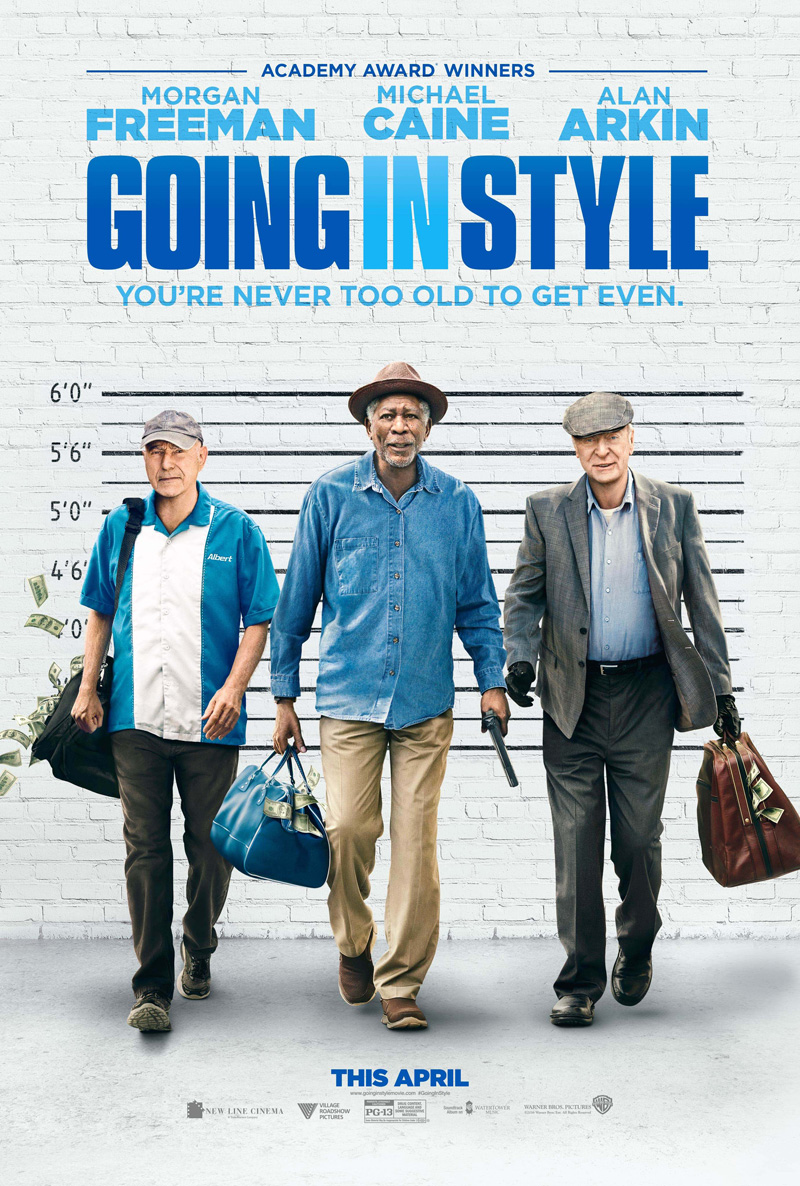 If seeing Michael Caine, Morgan Freeman, and Alan Arkin pal around and bicker for 90 minutes is enough reason to see a movie, then Going in Style offers that and precious little else. This is a movie that offers little more than three great old codgers doing their schtick as they plan to rob the bank that is cheating them out of their hard-earned pensions. The old-guys-acting-up routines vary from mildly amusing to sad and desperate, like a sequence where the trio inexplicably decide to practice their criminal impulses by robbing a convenience store. It’s all so broad and obvious and lackluster. There’s a scene where they get high and the mere utterance of the word “munchies” seems like it’s intended to be a comedic payoff. Going in Style is a remake of a 1979 movie where George Burns, Art Carney, and Lee Strasberg take to a life of crime to animate them from a forgotten existence. It was strangely serious and had pockets of depth about the kind of care the elderly were receiving and how invisible their needs became to our country. This update loses any seriousness for exasperated and hollow hijinks. One-time indie darling Zach Braff (Garden State) takes his turn as a hired gun directing for the studio system. I don’t know if he was easily cowed by the acting veterans or the studio, but his comedy instincts honed over several seasons from Scrubs feel muted here. My theater was packed with people old enough to get their social security checks and they were barely chuckling politely. It’s predictable every step of the way and ginned up with contrived conflicts. Still, if all you want to see is a group of octogenarians crack wise and act foolish and you have no other pressing demands, Going in Style may be just enough to get by.
Nate’s Grade: C
Share this:

Ghost in the Shell (2017)
 When news broke that Hollywood was going to make a live-action version of the much-beloved 1995 anime Ghost in the Shell, fans were understandably nervous and excited. The original movie was a major hit that crossed over into the mainstream much like Akira, another movie Hollywood has long been trying to bring to life (run away, Jordan Peele!). People got extra worried when they heard that Scarlett Johansson was going to play the main character and cries of “whitewashing” were hurled across the chasm of the Interwebs. The “white washing” charge, which in context is possibly misapplied, might have been the smaller worry. The 2017 Ghost in the Shell remake is missing just about everything that made the original a standout. It’s a ghost, if you will, of its former, superior self.
In a cyberpunk future, Major (Scarlett Johansson) is an android fighter working for a special operations group tasked with taking down cyber criminals. The Major was injured in a terrorist attack and her brain was placed in a robotic shell (looking like ScarJo is one of the upgrade features). Every so often she gets hallucinations of events she cannot recall. After an encounter with the hacker criminal Kuze (Michael Pitt), a fellow android, she begins to doubt the true intentions of her superiors and what they have told her.
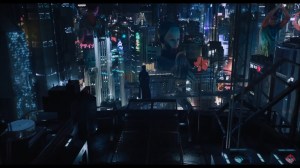 If you’re a fan of the original Ghost in the Shell, you might be depressed from what the live-action Hollywood adaptation does to its noteworthy source material. If you’ve never seen the anime, then you might find some scraps of entertainment to be had in what is essentially a drizzly cyberpunk product dumbed down for the largest mass audience that would be adrift with any minor hint of ambiguity. The 2017 Ghost in the Shell is not a good movie and it’s an even worse Ghost in the Shell movie. First off, we don’t need live-action versions of superior animated films just to have them, and this same statement goes for the equally underwhelming Beauty and the Beast remake. Just because a film lacks “real people” does not mean it is missing some crucial element, and I bristle at the notion that animated films are somehow inherently inferior or not “real movies.” With that being said, Ghost in the Shell will invariably disappoint fans of the original anime. There are visual signifiers and shots that it mimics with fealty; it’s just the overall story, characters, narrative complexity and mystery, and everything else that lacks that same level of fealty. Who cares if the main character is a shell of herself because, hey, they recreated this one shot fairly accurately, and that’s why we go to the movies, right?
Whereas the original was thoughtful and trusted the intelligence of an audience, the 2017 Ghost in the Shell resorts to explaining everything all the time, and even that it does badly. This is a muddled and frequently incoherent plotline, and the magnitude of its ineptitude is even higher considering how stupidly obvious the screenwriters make every twist and turn. This is the most obvious, simplistic conspiracy you could possible write. When Major wakes up in the opening scene and is being told what happened, the audience should already be alert with suspicion. This secret conspiracy goes in the most obvious direction (the good guys might not be the good guys after all) in a manner that should be transparently obvious to anyone except those unfortunate souls who have never seen another movie before in their lifetimes. So much of the plot is the untangling of this mystery, the Major’s real back-story, who the true villains are. To make it as obvious as possible and still devote so much time is not a good decision. The movie is constantly tagging characters to explain all exposition, leaving no subtleties to chance. The sadder part is that the plot is still muddled for long stretches even with all this handholding to straighten things out for the neediest.
 The world building and themes are kept at a distance, further denying the movie depth and substance. With any science fiction world, let alone one borrowed from other famous cinematic influences, it’s important for the viewer to get a sense of how the world operates. This can be done with small moments and larger moments, enough to properly contextualize this brave new world. With Ghost in the Shell, we’re told that mankind has become increasingly intertwined with machines and that cybernetic enhancements are en vogue. Except we never see this in the outside. We see loads of floating hologram advertisements, an overblown visual motif, but outside of our three main characters, this aspect that they felt merited inclusion in text before the movie gets underway is weirdly absent. It makes the characters feel less like they belong in an environment that makes sense. The larger themes of self-identity, the nature of humanity, and the questions over body autonomy are glossed over with the faintest of observations. Major is discovering her identity, but it leads her to what may be the most tired of conclusions. You would think having a robotic body would create some sort of existential reflection. You would be mistaken. Sure, Major feels unsure of herself and out of place, though why should she since we’re told man-robot hybrids are all the rage in this vague future landscape. I’m surprised someone didn’t just start explaining what the title meant at any given point.
The movie feels entirely surface-level and that’s where it has one redeeming value — its visual presentation. Director Rupert Sanders (Snow White and the Huntsman) is an above average visual stylist who benefits from strong production design and cinematography. At least the visual aesthetics could keep my attention, even if part of that attention was occupied in playing a compare-and-contrast game with certain scenes. The special effects are suitable and stylish enough, borrowing more than a few elements from the original. The action sequences are relatively muted, occurring in bursts but never really developing further. There’s an initial attack, then a response, and sometimes a chase, but that’s about it. The tech also doesn’t seem to factor in the combat. The strike team has the ability to communicate telepathically, but if they can do this why would they ever turn off this secret channel? It’s also lazy as it means we can just focus on filming scenes and record whatever dialogue we need later, as if the screenplay was incomplete.
 The 2017 Ghost in the Shell live-action version is a disappointing cyberpunk thriller that pays lip service to its source material, copying the movements but losing sense of the substance and soul. I’d advise people to merely watch the 1995 anime instead or the TV series that followed. It all feels like an expensive, slick, yet peculiarly ramshackle production that loses sight of the bigger picture by worrying at every turn whether a mainstream audience is going to need help understanding the most obvious. Johansson can be a great actress, which is important to remind yourself because she goes on kickass heroine autopilot with this movie. The action is short and inadequate, the visuals are impressive albeit derivative to the source material and its myriad influences, and the story has nuance, ambiguity, philosophy, reflection, and general substance replaced with a generic conspiracy structure that renders much uninteresting. The 2017 Ghost in the Shell doesn’t quite go to the insulting derisive lows of the Dragonball Z live-action remake, but it’s certainly not a good use of anyone’s time, and that includes you, the audience.
Nate’s Grade: C
Share this:

The Zookeeper’s Wife (2017)
 Antonina Zabinski (Jessica Chastain) and her husband Jan (Johan Heldenbergh) are the keepers of the Warsaw Zoo. Their lives are thrown into turmoil when Germany invades and occupies Poland. Their animals are slaughtered or moved to the Berlin Zoo, under the care of Nazi party member and amateur geneticist Lutz Heck (Daniel Bruhl). Feeling impotent to the horrors around them, Antonina and Jan risk everything to hide Jews in their zoo and eventually smuggle them out to safe houses.
The Zookeeper’s Wife is one of those slice-of-life stories about good people risking much to save lives during the Holocaust that come from obscurity to remind you that there are still fresh, invigorating stories from a topic that can feel tapped out after 70 years. However, it’s also an indication that you need the right handling to do it justice. The Holocaust is by nature such a horrific subject matter that it’s hard to do it justice with a PG-13 or below rating, but it can be done with the right amount of artistic restraint as long as the overall story doesn’t feel hobbled with limitations. Reluctantly, The Zookeeper’s Wife feels a bit too sanitized for the story it’s telling. When it comes to cruelty and human atrocity, you don’t need to shove the audience’s face in the mess to fully comprehend its distaste, but overly avoiding the reality can also be a detriment. The Zookeeper’s Wife, as a PG-13 movie, does not feel like the ideal way to tell this real-life story. It feels too restrained and some of those artistic compromises make for a movie that feels lacking and distracting at points. Fair warning: there are plenty of animal deaths in this movie, though they are all dealt with off-screen with implied violence. The edits to work around this can be jarring and would take me out of the picture. This is only one example of an element that, in order to maintain its dignified PG-13 rating, unfortunately undercuts the realism and power of its story.
 For a Holocaust story set in Poland, the stakes feel abnormally low. The zoo is a sanctuary compared to the Jewish ghettos. The danger of hiding over 300 Jewish people over the course of the entire war feels absent, which is strange considering it should be felt in just about every moment. There are a handful of scenes where we worry whether they will be caught but they’re defused so quickly and easily. After Antonina is caught talking to a very Jewish-looking “doctor” in her bedroom by the housekeeper, they just fire the housekeeper who leaves quietly and never comes back again. It’s a moment of tension that can be felt and it all goes away in a rush. This scene also stands out because the narrow escapes and close calls are surprisingly few and far between. Even when Antonina’s son commits stupid mistake after stupid mistake, including impulsively insulting a Nazi officer to his back, there’s little fear of some sort of retribution. The movie can also lack subtlety, like watching Heck say three times he’s a man of his word and will be trustworthy. We all know he’s going to fall short. There’s also a moment where Jan is literally loading children, who each raise their arms in anticipation, onto a train car. It’s like getting punched in the stomach with every child. Much of the time spent on the zoo is with the quiet moments trying to make the Jewish survivors feel like human beings again (the animals-in-cages metaphor is there). The details of the smuggling and hiding are interesting but cannot carry a movie without more.
The biggest reason to see this movie is the promise of another leading Chastain (Miss Sloane) performance. Ever since rocketing to prominence in 2011, Chastain has proven to be one of the most reliably excellent actors in the industry regardless of the quality of the film. She’s been dubbed a Streep in the making and Zookeeper’s Wife allows her to level up to her “Sophie’s Choice acting challenge stage” and try on that famous Slavic accent that turns all “ing” endings into “ink.” Chastain is terrific as a person trying to navigate their way through the unimaginable, calling upon reserves of courage when needed, and she’s at her best during the moments with Herr Heck. She has to play the dishonorable part of the possible lover, and Heck definitely has his heart set on Antonina. The scenes with the two of them draw out the most tension and afford Chastain a variety of emotions to play as she cycles through her masks. In some ways I wish the more of the movie was focused on this personal conflict and developed it even further.
There was a small practically incidental moment that got me thinking. As stated above, the film has a PG-13 rating and one of the reasons is for brief nudity from Chastain. Now the actress has gone nude before in other movies so that’s not much of a shocker, but it’s the context and execution that got me thinking. Antonina and Jan are lying together in bed after sex and Chastain does the usually Hollywood habit of the bed sheet being at her shoulders while it resides at the man’s waist (those typical L-shaped bed sheets). No big deal. Then, during their discussion over what to do, Antonina rolls over and exposes her breast for a second before she covers herself up again. The reason this stood out to me, beyond the prurient, is because it felt like a mistake. It seems obvious that Chastain was not intended to be seen naked in this intimate post-coital conversation but it was used in the final cut anyway, which made me wonder. Was the take so good, or so much better than the others, that director Niki Caro (Whale Rider, McFarland, USA) and Chastain said “the hell with it” and kept the briefly exposed breast? Did they enjoy the happily accidental casual nature to the nudity, creating a stronger sense of realism between the married couple? Or in the end was it just another selling point to help put butts in seats? I’m thinking best take is the answer. You decide.
 I am convinced one of the main reasons that Chastain wanted to do this movie, and I can’t really blame her, is because she would get to hold a bunch of adorable animals. Given the subject matter, I was prepared for a menagerie of cute little creatures, but I started noticing just how many of them Chastain is seen holding. She holds a rabbit for a monologue. She holds a lion cub. She holds a baby pig. She holds a monkey. She even kind of holds a rubbery baby elephant doll (talk about Save the Cat moment, this movie takes it even more literally). There may very well be animals I simply have forgotten she held. I would not be surprised if in her contract there was a rider that insisted that Ms. Chastain hold at least one small, adorable animal every third day of filming on set.
Stately and sincere, The Zookeeper’s Wife is an inherently interesting true story that should have more than enough elements to bring to life a compelling film experience. It’s an acceptable movie that’s well made but I can’t help but feel that there’s a better version of this story out there. It feels a tad too safe, a tad too sanitized, a tad too absent a sense of stakes, like it’s on awards-caliber autopilot. Chastain is good but her Polish accent becomes a near metaphor for the larger film: it’s polished and proper but you can’t help but feel like something is lacking and going through the motions of what is expected. This is a worthy story and I’m sure there are great moments of drama, but The Zookeeper’s Wife feels a bit too clipped and misshapen to do its story real justice.
Nate’s Grade: B-
Share this:

The Shack (2017)
 When it comes to faith-based movies, especially those based on best-selling books, you know that they’re going to be preaching to the choir and more determined to give its intended audience the message it wants first; everything else is secondary. With The Shack, I got the start of an interesting film scenario and then it became the most boring, laborious, and theologically trite Ted Talk ever. I was fighting to stay awake and it was a battle that I was losing. The opening twenty minutes presents a story with dramatic possibility: Mack (Sam Worthington) is a family man who is grieving the loss of his youngest daughter. On a camping trip, she was abducted by a pedophilic murderer and killed in a shack in the woods. Mack is a shell of himself and his family doesn’t know how to reach him. He gets a mysterious invitation from “Papa,” his wife’s nickname for God, inviting him to the murder shack. So far so good. There’s even a fairly interesting back-story for Mack about his alcoholic and abusive father. Young Mack eventually poisoned his bad dad’s drinks with hazardous chemicals to protect he and his mother. However, all remote sense of entertainment is snuffed out once Mack enters the confines of the titular shack. Inside are human avatars for the Holy Trinity of Christianity, with Oscar-winner Octavia Spencer serving as a homespun “Papa.” The next 100 minutes is a series of talk show interview segments with each person to engage in full on flimsy spiritual psycho-babble to explain why God lets bad things happen and forgiveness is key. The movie stops being a dialogue and becomes a lecture series, and each one just kept going on and on. The characters stop being characters and become different mouthpieces for the spiritual cliches. It’s like the filmmakers threw up their hands and gave up. This is not a movie. It’s a inspirational exam told by the most cloying professors. The lessons learned feel trite (who are you to judge, God is with you through good times and bad) and the movie curiously leaves a lot of dramatic implications unresolved. Did Mack kill his father with the poisoned drink? Did this killer pedophile ever get caught, and if not doesn’t that mean other children are at risk? It’s like once Mack enters that mystical murder cabin, the movie loses any sense of structure, pacing, stakes, and dramatic propulsion, and that’s before the silly race across the water with Jesus. I would also say Worthington (Avatar) is not the best choice as the lead actor due to his limited dramatic range and growl-pitched voice. Other movies have dealt with heavy loss but rarely has one felt so detached from making that loss personable and empathetic. The Shack is a maudlin fable that wants to make people feel good even during the dark times. That’s admirable but it doesn’t make this 135-minute sermon any more of a worthwhile movie to watch.
Nate’s Grade: C-
Share this:

The Belko Experiment (2017)
 An efficient B-movie with a crazy high body count, The Belko Experiment is just about everything I wanted. The residents of the Belko office in Bogata, Columbia are informed by a disembodied voice that if they do not kill two people in the next 30 minutes, there will be further casualties. Everyone thinks it’s a joke until four people’s heads explode (the company placed “tracking devices” in them in case they were kidnapped). The office workers are now informed that if they don’t kill 30 people in the next two hours then 60 will die. The typical breakdown in order and moral relativism follows, although perhaps a bit too quickly for our main antagonist to assume his role. The bigger surprises for me were what Belko was lacking. There isn’t any real satire of office politics, corporate subcultures, or even capitalism and American culture. There is also only one office-specific kill, which is a real creative shame. I was expecting the Belko-ites to take their office supplies and turn them into post-apocalyptic-styled weapons. There is also much more implied gore and violence than you would expect; it’s certainly a bloody film, but it seems oddly restrained. I was expecting some level of commentary to provide further substance, but it was merely a well-developed, kill-crazy B-movie. With that being said, The Belko Experiment held my attention early with its foreboding clues that something wasn’t quite right, and it does a great job of visually identifying about twenty characters for us to follow through the stages of carnage. Writer James Gunn (Guardians of the Galaxy) definitely relishes his return to his horror roots, like a refresher on how awful human beings can be to one another. He purposely subverts our expectations at several points, though sometimes he’s hitting the same beat too often. Even the mostly satisfying ending provides as much of an explanation as you would require for a premise that has no serious rationalization. The Belko Experiment is like a Twilight Zone episode given extra length and extra violence. It does just enough with its attention-grabbing premise and familiar setting to justify a casual viewing if one has a certain taste for Battle Royale meets Office Space.
Nate’s Grade: B
Share this:

Power Rangers (2017)
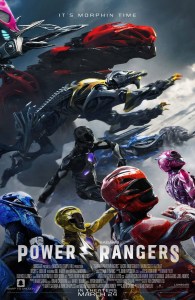 If you were a 90s kid, you know about Power Rangers. Who would have known that a TV show that combined Japanese monster fighting footage with cheesy teen drama and slapstick would become a pop phenom and nostalgic touchstone for a generation of kids? As Hollywood is want to do with anything nostalgic, it was only a matter of time before the series got its own mighty morphin’ big screen revision.
In the coastal town of Angel Grove, five teenagers meet in detention and are destined for monster-smashing greatness. Jason (Dacre Montogmery) is a star football player and natural leader. Billy (RJ Cyler) is a nerdy whiz kid on the spectrum. Kimberly (Naomi Scott) is a former cheerleader who has been abandoned by her friends. Zack (Ludi Lin) and Trini (Becky G) are barely at school, both of them tracking their loner paths. One day the fivesome come across strange glowing rocks that imbue them with powers like super strength and agility. “Are we like Spider-Man or Iron Man?” Billy asks, to help orient a superhero savvy audience. They’re neither, of course, for they are the Power Rangers, an intergalactic warrior organization meant to protect worlds from threats. Zordon (Bryan Crantson) used to be a ranger millions of years ago and is now a floating head. He assembles the teens because of the looming threat of Rita Repulsa (Elizabeth Banks), a former ranger tuned bad and bent on your standard world destruction. The angst-ridden, misunderstood teens must come together to stop Rita and save the Earth.
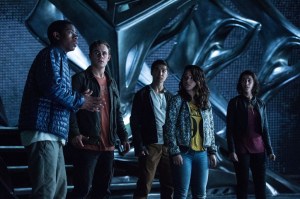 What tone does one adopt for a $100 million dollar reboot of a popular decades-spanning franchise intended for children that involves such names as Zords, Rita Repulsa, Zordon, Goldar, and the catch-phrase, “It’s morphin’ time”? Apparently the answer is a cross between Chronicle and Iron Man. For a show that even the most ardent fans would say was anything but serious, we have a fairly serious take on the material, at least serious enough when it wants to be. The filmmakers take a somewhat grounded approach to the sillier elements and that means a lot of palpable Breakfast Club-style teen angst and alienation, and it works. I was genuinely surprised that the second act’s focus on the teamwork and training of the five rangers was my favorite part of the film. It is an origin movie so expect a learning curve as the characters adjust to mastering their powers and abilities and the alien technology. You can’t just throw out a movie about space ninja cops that ride inside giant robot dinosaurs and battle monsters at the behest of a giant alien floating head without some setup. The training sessions cover a lot of ground but in fun ways that also build sequentially. The ascension of skills and confidence helps the characters open up and bond, and while some moments can be clunky (are any of their parents concerned where these kids go for seeming days on end?) it’s pleasant and satisfying to watch the outsiders finally find an understanding community of peers. The teen stars leave a positive impression, most notably Cyler (Earl of Me, Earl, and the Dying Girl) and Scott (The 33), who definitely seems poised for bigger things.
The characters have enough relatable conflicts, drama, and insecurities to produce just enough shades of characterization to make them interesting and worth rooting for. Those conflicts are also somewhat surprisingly adult and modern, often in clash with their parents’ requests, something that might lead to some weird conversations in the car if parents bring their young kids. Jason is fighting against his popular image, Billy has a hard time fitting in and making friends because of being autistic, and Zack is the caregiver to his dying mother, and these guys are in a lesser tier of adult conflicts, so think about that. Trini is stifling against her parents expectations and labels, notably implying her own sexual orientation that seems to be tearing her up on the inside, something that she cannot even fully articulate at this time. Maybe the movie is trying to have it both ways by not referencing the word “gay” but it at least felt like a more valid inclusion of conflict and diversity than the recent live-action Beauty and the Beast. Lastly, Kimberly used to be the chief mean girl and the reason why she was jettisoned by the popular set is because she was cyber bullying a would-be friend. She spread a private nude picture her friend sent her boyfriend and shared it throughout school (Jason tries to helpfully mitigate this by saying, “Thousands of pictures are sent in school,” which begs the question about Angel Grove’s underreported sexting epidemic). The team dynamic and the characters opening up to one another were enjoyable enough that I didn’t mind the relative dearth of action for 90 minutes of the two-hour running time.
 It’s a backdoor superhero movie that finds some interesting dark twists on its source material. The original TV show sought, in the most 90s way, “teenagers with attitude,” but the would-be rangers were just sort of normal teenagers. The 2017 movie at least provides that attitude and edge in a way that doesn’t feel as generic as a kid riding a skateboard and drinking a Mountain Dew eight inches away from his face. The TV show was campy and colorful and relatively trifling, and the movie version attempts to put more danger and loss into the emotional stakes. Zordon is given a new back-story; no longer is he simply a disembodied mentor, now he has a scheming reason for the rangers to succeed. It’s a small thing but it opens up the character of a floating alien head, and I cannot believe I just wrote that sentence. The friendship between our core group of characters matters so that, in the end, when it looks like they might lose, it does feel like something is going to be lost. With that being said, this isn’t a reboot that’s all gloom and doom. The reality of waking up one day and having super powers is played to the hilt of teen wish fulfillment and it makes for a fun series of self-discovery moments. These are teenagers adjusting to their new powers (heavy-handed puberty metaphor?) and enjoying the new potential unleashed for them. Their fun is contagious as is their camaraderie.
In fact, the conclusion where the rangers do morph and don their armored suits and drive their robotic dinosaur Zords may be the weakest part of the movie. The ultimate payoff feels a bit lackluster and mechanical, as if it’s simply falling back on cataclysmic citywide destructive action because that’s what is expected in these kinds of movies. Every person should anticipate a giant monster on giant robot brawl to conclude the story as it concluded every one of the 830 episodes. It’s just not that interesting especially since the big bad Goldar is simply a big personality-free heavy that looks like he’s made from runny Velveeta cheese. Rita, as portrayed with screechy, kooky camp by Banks (Pitch Perfect 2), feels like she’s been transported from a different Rangers universe. She literally gobbles gold to summon her colossal champion. She didn’t feel like an effective antagonist, and that’s even before her wicked scheme correlated with shameless product placement. Rita, Goldar, and their overall evil scheme makes for a rather perfunctory conclusion that feels like a downturn from the earlier, better events. Director Dean Israelite (Project Almanac) has a directorial style I’ll dub “Michael Bay lite” considering how much his hyperkinetic, blue-tinted, light flared universe jibes with fellow Bay production disciple, Jonathan Liebesman (Teenage Mutant Ninja Turtles). His visual compositions can get excessively busy at the worst times, making it hard to fully engage in the onscreen action especially during the climax. There isn’t that much action until the final confrontation, and I think this unexpectedly works as an asset to a franchise-starter that functions as an origin tale. Akin to the elongated tease from 2014’s Godzilla, there is a sense of relief from watching the rangers in their full suits and fighting with full powers. However, it lacks more payoffs. The movie expects that delaying the final presentation of its heroes is good enough to arouse audience satisfaction, and it’s not.
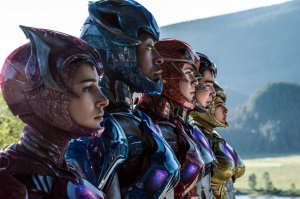 The revised, souped-up Power Rangers (nee Mighty Morphin’ Power Rangers) is a fitfully entertaining movie that works more often than it doesn’t. Fans of the TV show will probably be pleased with the big budget big screen heroics and the reverence shown, though older fans might feel a bit closed off from the teen-centric tone. The relatable angst and group camaraderie made for efficient characterization that helped make the rangers feel like people rather than suits of armor and superfluous gymnastics. I enjoyed the characters enough so that I didn’t miss the scattershot action and its slow motion stylistic indulgences. The special effects are fine and transparent its filmic influences, from Chronicle to Iron Man to even The Breakfast Club. It feels familiar but yet still different enough from the cheesy TV show, so it manages to justify itself. As far as my own history, I was just a bit too old once Power Rangers hit, so it was never my nostalgia. I found the new movie an acceptable origin tale that walks a delicate tone that allows serious moments to have weight and non-serious moments to be fun. If you’re a Power Rangers kid, I’m sure you’ll find enough to sate your demands. If you watched the trailer and thought it looked like something worthwhile, you might find enough to be suitably entertained, especially with well-calibrated expectations. If you’re anyone else, then I doubt there’s enough to necessitate your mighty morphin’ dollars.
Nate’s Grade: B-
Share this:

Beauty and the Beast (2017)
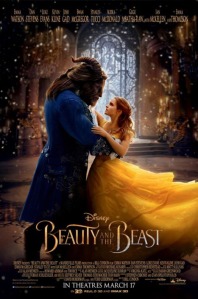 Disney has been on a tear lately with its slate of live-action remakes but Beauty and the Beast is the first title to come from the relatively recent Renaissance period of the early 1990s. The 1991 classic, based upon the French fairy tale, was the first animated film ever nominated for Best Picture, and back when the Academy was only proffering five nominees for the category (Toy Story 3 and Up earned Best Picture nominations after the category expanded up to ten). This is a beloved movie still fresh in people’s minds. I was curious what Disney and director Bill Condon (Dreamgirls) would do with the material, what potential new spins, and how faithful they might be. Regrettably, the 2017 Beauty and the Beast is a charmless, inferior remake of a Disney classic. In short, there is no reason for this movie to exist.
Belle (Emma Watson) is a small French town’s least favorite daughter, namely because she always has her nose in a book and wants “more than this provincial life.” Gaston (Luke Evans) is the most popular man in town and a dreamboat that ladies savor, and maybe also Gaston’s silly sidekick, LeFou (Josh Gad). The hunk is determined to marry Belle at all costs but she wants nothing to do with the brute. Belle’s father (Kevin Kline) falls prisoner to a ghastly Beast (Dan Stevens), a monster who used to be a prince who was cursed for his vanity. The Beast’s servants were also cursed, turned into living objects, like cowardly clock Cogsworth (Ian McKellen), lively lamp Lumiere (Ewan McGregor), and a tea kettle (Emma Thompson), feather duster (Gugu Mbatha-Raw), harpsichord (Stanley Tucci), dresser (Audra McDonald), and probably a chamber pot somewhere. Belle trades places with her father, becoming the Beast’s captive. The servants encourage the Beast to put on a charm offensive and change his ways to woo Belle, because if he cannot earn reciprocal love before the last pedal falls from an enchanted rose, then they will all be doomed to live their current fates.
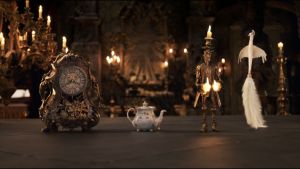 I figured, at worst, I would be indifferent to the live-action version of a great animated musical, especially since they were following the plot fairly closely. I was not indifferent; I was bored silly, and as the boredom consumed me I felt the strong urge to simply get up and leave. Now I didn’t do that, dear reader, because I owed all of you my complete thoughts on the complete film. I’d be lying if I didn’t say I debated escape, which is a rarity for me (I’ve never walked out of a movie, but Beauty and the Beast now joins a small number of films where I considered the inclination). The source of my urges spring directly from the realization that I knew exactly what was going to be coming at every step, even down to shots, and I knew it was going to be worse than the source material. It felt like watching the soul slowly get sucked out of the 1991 film. It was imitation that squeezed out all the delightful feelings from the original, stamping out joy and replacing it with an awkward, stilted facsimile. There’s also the problem of live-action being a medium that distorts some of the charming elements from the animated movie. The anthropomorphic servants are especially unsettling to watch.
The new additions are few and completely unnecessary, adding a half hour to a classic’s efficient running time. It’s kind of like remaking Casablanca and adding forty minutes of stuff that doesn’t belong, which might as well be known today as Peter Jackson Syndrome. With Beauty and the Beast, there are four or five new songs added, and they are awful and needless. Two of them are back-stories for Belle and the Beast/Prince, both of which were already covered earlier either explicitly or implicitly. They are the clear clunkers and further evidence that the 2017 additions are artistic anchors hampering an otherwise great musical. The Prince is given more screentime pre-Beast transformation but it covers the same ground that a simple voice over achieves in the original. I don’t think much is added seeing Stevens get gussied up and partying with the pretty people of his village except as an excuse for costuming excess. Some of the elements added also feel remarkably tacked on and feebly integrated, like the Beast’s magic teleportation book. He has a book that will take the user anywhere in the world, which Belle uses once to visit her parents’ old home and learn redundant information. At no point is this powerful magical device ever used. Why introduce a teleporting book and never bring it up again, especially if only to reveal something superfluous? Why does the Beast need a magic mirror to spy on people if he can teleport there? These are the unintended questions that befall poorly planned story elements that nobody asked for.
 The 2017 Beast also wants to celebrate itself for being more inclusive, feminist, and forward thinking than its predecessor, but this claim is overblown. Much has been made out of Condon’s claims of an “exclusively gay moment” in the movie devoted to LeFou, which wouldn’t be that surprising considering his Gaston-adoring behavior walks a homoerotic line in the original. This “exclusive” moment is LeFou dancing with another man and seeming to enjoy himself, or at least not hating the idea. It lasts for a grand total of two seconds on screen as part of a closing epilogue scanning across our happy characters reunited on the dance floor. It seems like much ado about nothing, especially since the 1991 film had the exact same comic beat of a man discovering an unknown joy of dressing in women’s clothing. Watson has been an outspoken actress, a UN human rights ambassador, and has said in multiple media interviews that it was important to make Belle a more actionable feminist figure. There was certainly room for improvement considering it’s a romance that many have cited as a clear case of Stockholm syndrome. If a modern remake of Beauty and the Beast were going to make socially conscious strides, it would be here, naturally. It’s pretty much the same movie except now she creates a washing machine by completely occupying the town fountain. That’s it. Considering that the movie added thirty minutes to the running time, you would think a majority of that would be judiciously devoted to building a plausible bridge from the Beast being Belle’s captor to being her lover. Nope. It’s a more forward thinking movie in fairly superficial ways that feel overly designed to warrant applause, like the inclusion of two interracial couples in the small staff of a seventeenth century French castle.
I went in and thought, if all else, I would at least have the instantly humable and highly pleasurable songs to fall back on. Then I realized this imagined respite was a fallacy. Like every other element in the film, the singing was going to be worse than the originals, and it was. The biggest aural offender belongs to our heroine, Miss Watson (The Bling Ring), whose singing vocals are Auto tuned within an inch of their lives. I have no idea what Watson’s singing voice sounds like in real life but I can almost assuredly bet it does not sound like what comes out of her mouth in this movie. The Auto tune effect was immediate, and overwhelming, and it felt like daggers in my ears for the entirety of the film. Auto tune flattens out a singer’s vocals and makes them sound tinny, unreal, almost like the comedown from sucking helium. I listened attentively to the other performers and it seemed like Watson was the only one given this exaggerated treatment. I’ve said before I’m not a fan of Watson as an actress, feeling she plateaued at a young age from the Harry Potter series, and her performance here will not change my mind. Similarly, the Beast’s vocals are so enhanced with bass that it would be hard to judge Stevens authentic singing voice. McGregor (T2 Trainspotting) has proven his singing chops before but a French accent was clearly something that got away from him. Evans (The Girl on the Train) is acceptable as a singer but lacks something of the brio that makes Gaston a larger-than-life pompous ass. Gad (Frozen) is right at home with musical theater. If I had to pick a musical highlight I would cite “Be Our Guest” simply for the visual barrage of colors and playful imagery that is absent most of a rather dreary looking movie. The other performers are adequate and sing their parts with equal parts gusto and reverence, but they’re all clearly weaker singers than the less known cast of the 1991 edition. It leaves one with the impression of a shabby celebrity karaoke version of a better movie.
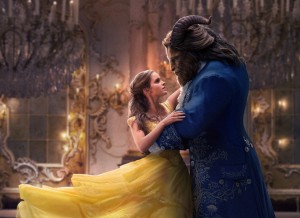 Beauty and the Beast isn’t just a disappointment, it’s an artistic misfire on multiple fronts that is looking for applause but doing too little to even earn such consideration. It wants to be forward thinking for a contemporary audience but they’re empty gestures, as it just copies the 1991 movie down to similar shot selections. The 1991 movie is great, no question, but I don’t need a Gus van Sant Psycho-style remake that only serves to make me appreciate the original more. This movie has no reason to exist outside of the oodles of cash that Disney will probably collect from repackaging its much beloved classic to a new generation of fans and an older generation seeking out millennial nostalgia. The singing is off, especially from a painfully Auto tuned Watson, the new songs and scenes are pointless, and even some of the production design resembles a play that ran out of budget halfway through. If you’re a fan of the original, you may find entertainment just reliving the familiar beats and notes from the 1991 film, just to a patently lesser degree of success. It’s not like Disney’s other live-action remakes of their extensive back catalogue of titles. The Jungle Book and Pete’s Dragon were sizeable improvements, and the agreeable Cinderella found some welcomed maturity to go with its fairy dust. Those movies found new angles, and in some cases had little relationship to their original material as in the case of the wonderful and heartfelt Pete’s Dragon. These are examples of filmmakers who were inspired by their sources but told their own stories. Beauty and the Beast, in contrast, is just the hollowed out husk of the original, now made putrid.
Nate’s Grade: C


You must be logged in to post a comment.