Blog Archives
A Very Long Engagement (2004)
 Deep in the heart of WWI trenches, we begin this sprawling tale by narrowing in on five French soldiers. Each man has been accused of self-inflicting a wound to escape service, and each man is sentenced to spend the rest of their likely short lives in No Man’s Land, the stretch of bare land between the two trenches. One of these men is Manech (Gaspard Ulliel), a young country boy engaged to the charming Mathilde (Audrey Tautou). When she learns his fated punishment and fails to hear word from Manech, she steps out to launch her own investigation into the possible whereabouts of Manech or the possible details of her fiancé’s demise. She enlists her family, solicits strangers, and puts ads in newspapers to unravel the truth. Along the way she hears various stories from all sorts of people and attempts to form them into a clear picture of what went on in that trench, good or bad.
A Very Long Engagement could be flippantly described as “Rashomon in a trench,” but from the get-go it grabs you by the lapels and will not let go. Once again, Jeunet tells his story in a criss-crossing narrative. Front and center we learn about each doomed man’s life in snapshot, and while the device has a slight eulogy feel, it’s a fantastic way to show the depth of characters in such brevity. A Very Long Engagement is an immeasurably rich film where each detail is threaded into the film to create a magnificent artistic tapestry beyond compare. The tiniest details in the film like Mathilde’s tuba playing (the only instrument whose sound mimics a distress call), to the mail carrier choosing to slide his bike over gravel just further enhance the vibrant, animated world of Jeunet.
 Jeunet is quite possibly the most visually gifted director working today (he turned down Harry Potter 5). He couldn’t film an ugly shot composition if he tried with all his French might. As expected, A Very Long Engagement is gorgeous to look at. The production design is massively intricate, the cinematography, while computer assisted, has a shimmering radiance to it. This is simply the best looking film of all 2004, Hero be damned. You could pause any second in this film and use it as a glossy postcard. Jeunet has the technical credentials to fasten together complex and beautiful worlds. A Very Long Engagement is a technical marvel and gorgeous to experience.
Tautou, also as expected, is wonderful once more. She’s the anchor of the film and the audience feels every heartbreak and glimmer of hope this talented actress explores. The supporting cast is full of familiar Jeunet players and each performance adds to the richness of the film. They feel like characters and not stock roles or cliches.
There is some difficulty with following the storyline. There are so many subplots built upon other subplots that the film’s momentum takes a bit of a dive in the second act. A Very Long Engagement can also get very confusing when it comes to remembering so many names. There are maybe 30 characters to keep track of and as the subplots mount new characters are added to the pile, including a widow played by a surprisingly fluent Jodie Foster. It’s best to employ some kind of memory trick to keep the many colorful characters of Jeunet’s world straightened.
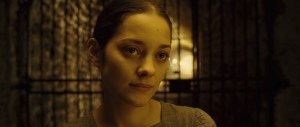 The focus of A Very Long Engagement is on Mathilde’s investigation into what really happened in that trench. She wants to know what happened to her beloved, and as her search picks up steam we get further glimpses of her relationship with Manech. One of my biggest problems I had with 2003’s Cold Mountain was that Jude Law was travailing through hell and back to get back to his beloved Nicole Kidman even though their relationship pre-war lasted as long as a Super Bowl commercial. It’s not that I disbelieve the overpowering nature of love, but I need more from my characters than shifty glances and a quick ejaculation of love (get your mind out of the gutter). Now, in A Very Long Engagement, Jeunet opens by showing the measures Manech will endure to return to his beloved, however, as the film goes on we also see enough peeks into the depths of their relationship beforehand, which dates all the way back to when they were children
A Very Long Engagement forges such a grand and sweeping love story that the audience gets just as immersed as Mathilde about the search for her man. There are so many lovely, intelligent moments between Mathilde and Manech, like their first sexual encounter. Every time Manech lights a new match Mathilde removes an article of clothing until, under the soft light of the newly lit match, she’s nude and blows the match out herself. The characters’ overriding love also taps into small truisms like when Mathilde makes arbitrary games for herself to ensure her love’s safety. (“If I can count to ten before that car passes, then he is alive.”) Mathilde’s faith and devotion are driving her investigation and the audience is behind her 100% of the way, fully invested in this mystery. When we reach our conclusion, I don’t mind telling you I was bawling like a baby.
The film has a merry whimsical tone during its origami-like narrative, but when it hits the trenches the film gets down and dirty. Jeunet shows a fascinating view into the hardships of everyday trench life as well as the machinery of death. Storming the other side’s trench, or “going over the top” as it was called, is seen in all its sordid features. There are hearty splashes of blood and gore that can be jarring.
There’s one terrifying scene in A Very Long Engagement involving the explosion of a makeshift hospital. The hospital is inside a hangar for zeppelins (hydrogen gas) and a missile has crashed into the roof with its nose sticking inside. One of the zeppelins becomes loose and slowly floats to the missile nose with unforgivable certainty. People are running around trying to shield themselves from the inevitable, but it does nothing. The moment is played so agonizingly slow that we become overwhelmed with terror. This was the life of WWI warfare.
 Having said this, the stark war violence doesn’t exactly gel exceedingly well with the whimsical romantic elements. For some, A Very Long Engagement will seem like two very tonally different movies butting heads and intruding upon the other (perhaps Amelie Goes to War?). Sometimes it does take a while to adjust to one tone after spending time with the other. I feel that the emotional investment in the characters and the anticipation of unraveling the mystery serves as thematic glue over the disproportionate tones. Some will feel chaffed by the two stark tones, but I think the power of the love story will conquer most hearts into experiencing the bloodshed of war to earn the shedding of tears by the film’s romance.
Jeunet has re-teamed with Tautou and created another masterpiece. A Very Long Engagement took hold of me from the start and mesmerized me with its beauty, grace, cruelty, excitement, and warmth. This is a great mystery and a great love story with great visuals and great characters. The opposing tones (whimsy vs. violence) won’t work for everyone, and the film takes one too many divergent paths in the middle, but A Very Long Engagement is a film of such startling originality and feeling that it should be treasured. I was floored by what Jeunet had to offer and deeply moved by the time I had to leave the theater. They don’t make them like this much anymore. Now if you’ll excuse me, I have something in my eye.
Nate’s Grade: A
Share this:

National Treasure (2004)
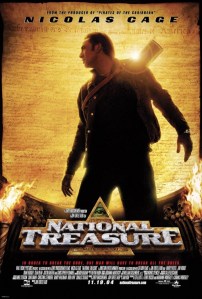 The premise for National Treasure, the newest Jerry Bruckheimer action film, is something of a mess. According to the film, during the Crusades a magnificent treasure was found. The Knights Templar swore to protect it, and the Masonic order carried the vow through the ages. The founding fathers of the Unites States were among this Masonic order, and they went about hiding the fabulous riches and set up a series of elaborate clues to discover its whereabouts. These clues include symbols on the back of our currency and, get this, a secret invisible message on… the back of the Declaration of Independence. Yes, the Declaration of Independence is a treasure map. The silly premise for National Treasure equates the Declaration of Independence with a Denny’s place mat. Can something this outlandish make for a good movie? Well, it depends on your working definition of “good.”
Benjamin Franklin Gates (Nicolas Cage) is somewhat of a laughing stock amongst his peers. His family name is cursed with the crazy belief in some long lost treasure hidden by the founding fathers. His father (Jon Voight) rues the family name being attached to such foolish theories. Of course such foolish theories in Hollywood are always right, no matter how stupid (did I mention the Declaration of Independence is a treasure map?). Ben and his treasure hunting partner Ian Howe (Sean Bean) find a definitive clue, but then Ian double-crosses on Ben and, gasp, wants the treasure for himself. This turns into a race to see who can steal the Declaration of Independence, though Ben wishes to steal it to protect the document and the treasure. Along the way, Ben teams up with a techno-nerd (Justin Bartha) and a hot government official (Diane Kruger) to crisscross historical monuments and sites to unravel the clues before Ian can.
 National Treasure is dumb. Little to absolutely nothing makes sense in this film. This is an obvious, embarrassing attempt to ride the popular coattails of The Da Vinci Code and Americanize the quest. Except that National Treasure really comes across as some half-baked movie version of a kid’s educational game show.
There are so many holes, so where do I begin? First off, why would the founding fathers make it so pointlessly, hopelessly elaborate to find this stockpile of treasure? I’m talking crazy complicated, like having one clue involve finding a ship buried in the Arctic Circle. Yes, the Arctic Circle. Supposedly, the founding fathers decided to hide the treasure because they didn’t want the British to get their grubby, nice-fitting gloves all over it. Something tells me that the founding fathers had more important things going on, like, oh I don’t know, a war! It’s purely absurd to have Washington, Franklin, Jefferson, Adams, and all the rest more interested in hiding some treasure than breaking from England and building an independent nation based on their ideals.
There are some other head-smackers, like the fact that an assembly of clues has been left entirely undisturbed in 200 plus years, like a single special brick. And, for that matter, how does Cage cut through mortar so easily with just a pocket knife? If there’s a gigantic catacomb under D.C., then what’s holding up the city? How come 200 year old oil still burns as well? Wouldn’t that have dried out by now?
 Cage reverts back to his manic show-offy character behavior. In Bruckheimer movies, Cage seems to have theoretic spurts here and there, like he keeps sticking some extremity in an off-screen light socket. He’s generally likeable but his character comes across more like some social studies teacher’s daydream. Bartha and Kruger add less-than-snappy one-liners, but their presence never becomes grating. Bean seems to be playing the stock bad guy role he always is, whether it be GoldenEye, Don’t Say a Word, or Patriot Games.
Sure, even the Indiana Jones films had plot holes (how does closing your eyes guard you from the wrath of God?) but their thrilling adventures overcame any quibbles. National Treasure, on the other hand, is an adventure lacking anything thrilling. This is the first action film to put me to sleep. I can forgive an action/adventure flick being dumb but being boring is a capital offense.
The action sequences in National Treasure are never fully thought out; they usually involve Cage and his cronies outrunning Sean Bean’s group of thugs (repeat). The film’s best moment is the actual theft of the Declaration of Independence. This is the lone sequence in the film that feels like thought was put into drawing out suspense, thinking of natural and interesting complications, and, surprisingly, having the sequence not be overcome by idiocy. After this scene, National Treasure descends into ill-conceived chase scenes strung between crazy elaborate clue hunting. By the time the film reaches its anticlimactic ending, you may have rustled through your change, eyeing the backs of quarters and dimes to ensure there’s no hidden message about a sequel.
National Treasure is a ridiculously stupid, inexcusably boring, ineptly plotted historical adventure for people who get their history solely from movies. Bruckheimer and Cage have an up-and-down partnership, but National Treasure starts with the worst film premise of the year and can?t go much further. Fans of clue-hunting adventure tales may excuse the gaping plot holes, and National Treasure has found a sizeable audience willing to go along for the ride, but the movie doesn’t contain much thrills, entertainment, or anything historically resonant. National Treasure should have stayed buried.
Nate’s Grade: C
Share this:

The Forgotten (2004)
 Fair warning: This screed contains huge spoilers about the movie as I rip it apart. The press release for The Forgotten says, “What if you were told that every moment you experienced and every memory you held dear never happened?” And now, upon having seen The Forgotten, I say, “Oh, if only.”
Telly (Julianne Moore) is still grieving the loss of her nine-year-old son who died in a plane crash 14 months ago. She’s seeing a psychiatrist (Gary Sinise) and slowly coming to terms with her loss. One day she discovers all remnants of her son missing. His clothes, baseball glove, even his appearance in pictures has vanished. She accuses her husband (Anthony Edwards) of stealing them, but then is shocked when her hubby and doc both tell her that Telly never had a son. She’s been delusional for years since a miscarriage and has created an imaginary son. Telly refuses to accept the possibility that she’s nuts, and finds initial resistance and then acceptance from another parent (Dominic West) who also remembers a daughter that died in the same plane crash. Together they set off to learn the truth, all the while being hunted down by the NSA for some mysterious reason.
 The Forgotten shares a very dubious honor. Only twice in my life have I been strongly tempted to walk out on a movie, and that was while watching Lost in Space and The Thin Red Line. Six years later, The Forgotten became the third. It got so bad during the second half that I was fashioning my moveable armrest into a crude headboard for me to sleep upon. I was that bored. I can explain the reasons for my boredom very easily: terrible plot structure.
The Forgotten opens with Telly grieving over the loss of her son, and Moore is so good at grief that she can hook an audience as soon as her face crinkles into sadness. Around the 20-minute mark, Telly is told that she never had a son and has been delusional the whole time. Now, stop right there. That’s a great premise. If the makers of The Forgotten had stretched this part of the movie to about 90 minutes, put some thought and skill toward it, then we could have had something fascinating and heartfelt. Instead, you’re given the easily expected and the very boring.
At the 20-minute mark, Telly is told she has no child and she’s crazy. At around the 30-minute mark, none of this matters. The movie doesn’t even allow an opportunity for Telly to even doubt for a sheer second about her wild hunch that everyone in her life, including The New York Times, being apart of some global conspiracy to hide the fact she had a child. And of course, because she?s our heroine and this is Hollywood, her incredibly outlandish theories will be proven right. I understand that, but to reveal her theory’s accuracy only TEN MINUTES later is ridiculous. The Forgotten wastes no time proving Telly’s wild ranting as being correct. It’s as if The Forgotten feels that its audience is cultivated from the dumbest common denominator.
At the 40-minute mark the “A-word” is used, and before the 60-minutes mark, the audience knows everything. The last hour of the film is so obvious; no, it’s beyond obvious. It’s super obvious. It can’t even be obvious because The Forgotten has told you EVERYTHING. You’re not waiting around for predictability to play its way out, because you’ve been told everything. All that’s left is to sit and watch dull chase scenes (a book editor outrun NSA trained agents? Please).
There will be some heavy spoilers in my discussion of the film’s plot. I’m posting fair warning now, but doubt they’ll be too surprising given the ads on TV for The Forgotten (who else would you think was responsible?).
I have no idea what the makers of The Forgotten were thinking. They blow all their secrets in the first half and then mill around for another hour. It’d be like if The Sixth Sense revealed Haley Joel Osment sees ghosts and Bruce Willis is dead in the first hour, and then for another hour they sit uncomfortably and ask about the weather. Anyone think that movie would have worked the same? This is why I was so bored. I could have fallen asleep and accurately predicted everything that would happen in the second hour. There didn’t even need to be a second half to this film. It was all irritatingly explained to us in the first hour. Once the mystery’s gone, the only thing the audience has to keep its faltering attention are the questions of whether Telly can win back her son, and who will be vacuumed out of the universe next. That’s not much to justify another tension-free, revelation-free hour of awful movie.
The ending is also steeped in lunacy. So apparently all-powerful aliens love to play experiments on us and basically control our whole lives. Peachy. Telly is apart of an experiment, and the creepy, slim alien tells her that she’s the anomaly. All the other test subjects have forgotten, but not her, and the little green men want to know why. What’s even more peculiar is that this specimen of a supposedly advanced race is mad at Telly for gunking up the project, and he’s (its?) going to beat her until she forgets and the project is finished. But the alien just said she was the lone anomaly. By definition the project worked if everyone else succeeded. I’m no advanced race and I figured that out. Guess I’m smarter than the screenwriter of The Forgotten.
Once again, humans miraculously triumph over supposedly all-powerful alien species. I realize an audience wants to see our heroes succeed at the end and conquer evil, but is it even plausible when this evil can alter everyone’s existence at a moment’s notice? In the end, Telly gets her son back and her life is fulfilled. The makers of The Forgotten expect you to take this for a happy, victorious ending. Don’t. Sure, Telly has her kid back, but what’s to stop these all-powerful aliens from doing it again. For that matter, since she was the anomaly, wouldn’t they continue to perform experiments on her to see what makes her tick?
 What makes The Forgotten even more irksome is that it’s a blatant rip-off of Alex Proyas’ visionary 1998 sci-fi noir, Dark City. The plot of Dark City is about all-powerful aliens that experiment with human beings. They plant different memories into their heads, allow their human test subjects to live multiple identities, to see what makes us work. A reluctant doctor helps the aliens but is really rooting for the one test subject that seems beyond their power. The aliens are baffled about this anomaly. This is practically the entire plot for The Forgotten; trade Shell Beach for Quest Air, lose all the style, thrills, imagination, and pacing of Dark City, and what you’re left with is The Forgotten.
It’s not enough that The Forgotten is possibly the most ineptly plotted movie ever, or that the trailer and commercials gave away too much (I knew the ending before stepping into the theater), the ails of The Forgotten are exacerbated by the fact that it’s a shallow, homely, incompetent rip-off of Dark City.
I do not fault Moore. She is one of the finest working actresses today and will elevate anything she is in to some degree. She’s stranded by the material. The only performance I even took any note of was the surprise appearance of Lee Tergesen. He’s shown equally impressive comedic chops (USA’s Weird Science) as dramatic chops (He was the closest thing to a hero on HBO’s Oz). It’s always fun to see personally beloved character actors, even if it is in an abomination like The Forgotten.
Director Joseph Ruben (Money Train, The Good Son) finds astonishing ways to make The Forgotten even worse. He overplays his hand early, like having many overhead shots cued with weird, aerial noises. There’s also an ominous and extremely mobile cloud formation that spells out the antagonists. The second half is filled with pointless chase scenes, and Ruben can’t manage to make any part of them exciting. He does have one interesting jump moment while Telly is riding in a car, but I already saw it this year in the superior Bourne Supremacy.
The Forgotten may end up being the worst film of 2004, and with a year dotted by the likes of Hellboy, Van Helsing, Catwoman, and National Lampoon’s Gold Diggers, that may be all I need to say. I suppose someone out there may find something redeemable about The Forgotten (if they haven’t already seen Dark City), but the film’s tepid pacing, mind-numbingly foolish plot structure, and mounting illogical doom the poor audience to two hours of head-smacking boredom. This is a first-class Hollywood train wreck. It doesn’t work as a drama about grief, it doesn’t work as a psychological thriller, and it really doesn’t work as a half-baked X-Files episode. The Forgotten is a really great title, because in a few weeks it’ll be exactly that.
Nate’s Grade: F
Share this:

Cellular (2004)
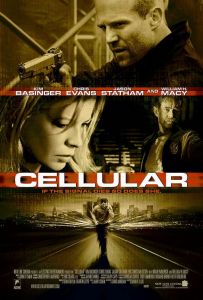 Cellular, a new thriller, relies on the simple device of a cell phone for the crux of its plot. With cell phones becoming ever more present, and ever more an eyesore in our daily lives, it was only a matter of time before they had their own movie. They’ve slimmed down from their heavier 1980s days, and become more useful, allowing one to surf the Web, take candid pictures of people in gyms, and are able to ring in the tone of the new hot rap song of the week. The premise for Cellular may be pitch-perfect for our modern society, but will an audience answer its call?
Jessica Martin (Kim Basinger) is a high school biology teacher caught up in some scary events. She’s been kidnapped by a gruff man (Jason Statham), and locked in an attic. She’s informed that her son and husband will be found and kidnapped, unless she tells him what he wants to know. Unfortunately, she’s clueless as to what her kidnappers want. There is a wall phone in the attic, and one kidnapper smashes it with a sledgehammer and walks away satisfied. Jessica goes to work re-configuring the shattered phone pieces, tapping wires until she can reach out and touch somebody.
Ryan (Chris Evans) is a hunky beach bum who’s chastised by his ex (Jessica Biel, I know, I didn’t believe it too) for being too irresponsible. He’s driving around in his cool ride when he gets a panicky phone call from, you guessed it, Jessica. At first he thinks it’s a practical joke until he overhears her kidnappers threaten her. Reluctant to help, Jessica asks him to stop the kidnappers from reaching her family. Ryan runs around town all day scrambling to help Jessica’s family and solve the case. He also enlists the help of a retiring police officer (William H. Macy), who’d rather open a day spa than do desk work.
 The premise for Cellular is near-genius and provides an abundance of smart, problematic possibilities. Ryan runs around and is always in danger of losing the signal. At one moment his cell phone is about to die from low battery charge. Another time the lines get crossed. Every step seems believable and the characters’ reactions seem credible. With Cellular, the audience thinks along with the characters step-by-step. When Ryan encounters stumbling blocks, the audience is with him in solving them, and this makes for a very engaging and thrilling movie.
The acting in thrillers is usually a minimal speed bump but the actors in Cellular do fine work. Basinger attempts to make up for her role in The Door in the Floor and plays harried and teary like a pro, but her best moments are when she uses her biology teacher know-how in precarious situations. She’s like a female MacGyver. Cellular is really a coming-out for Evans as a leading man. He’s had small roles before in The Perfect Score and Not Another Teen Movie, but this is his first leading-man role, and he handles the running, shouting, and panting with aplomb. Statham does his usually fine work of sneering and acting menacing. It’s also fun to watch William H. Macy, usually playing an every-man or a sadsack loser, play a bloodhound cop that morphs into an action hero.
The pacing in Cellular is breakneck. In the first 10 minutes, we witness Jessica’s kidnapping, and the momentum built up from that point is exhilarating. There is rarely a moment to catch your breath in Cellular. The action sequences are exciting but not redundant, and the tension readily mounts, especially when the audience is given more information than our heroes. There’s also some fun jabs at our country’s cell phone lifestyle.
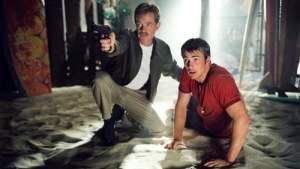 Director David R. Ellis worked as a stunt coordinator for 20 years, before advancing into the director?s chair and helming 2003’s schlocky gore-fest Final Destination 2. Ellis knows how to keep his plot moving, and something is always happening in Cellular to draw our attention or to push us on edge. Cellular was written by Larry Cohen, who also penned Phone Booth and probably won’t rest until he’s the Robert Rodat of telecommunications (Rodat wrote Saving Private Ryan and The Patriot, and seems destined to write a movie about every American war). Might I envision an erotic thriller with the “Can you hear me now?” Verizon guy just around the corner? Only time will tell.
As with any thriller, there are going to be lapses in logic that have the possibility of stopping the story dead in its tracks. Cellular‘s biggest logic loophole occurs right at the start, and if you can get behind it then you can enjoy the rest of the ride. Instead of smashing a telephone, why not yank it out of the wall and fully decommission it? Or, even better, why leave your kidnapped victim in a room, out of your sight, with a phone? Would it not have been easier to just tie her to a chair in plain sight? The mind boggles. The real answer we all know, of course, is because then we wouldn’t have a movie. There’s also a sequence late in the film where the bad guys discuss their evil plan on cell phones, which seems a tad careless considering anyone with a police scanner could listen in. As I said, gaps of logic are expected in this movie terrain and it’s your ability to rise above them that will determine if you enjoy the film.
Cellular is a thriller that dials the right numbers. It may have some gaps in logic, but it delivers when it comes to sharp suspense, smart action and a great premise. Fans of action thrillers should lick their lips with what Cellular has to offer. Just remember to keep your cell phones turned off during the movie, unless, of course, you’re surfing the Web, sneaking pictures of some girl, or jammin’ to the rap song of the week.
Nate’s Grade: B
Share this:

Open Water (2004)
 What a summer it has been for independent films. This summers most talked about movie wasn’t Spider-Man 2; no, it was Michael Moore’s Fahrenheit 9/11. This summer’s greatest triumphant underdog wasn’t Shrek; no, it was Napoleon Dynamite. And this summers scariest movie wasn’t The Village or the Exorcist prequel; no, it was Catwoman. A fine runner-up, though, is the 2004 Sundance smash, Open Water.
Susan and Daniel (Blanchard Ryan and Daniel Travis) are a couple vacationing in the islands. They sign up for a scuba diving voyage, but due to a counting error by the boats crew, are left stranded in the middle of the ocean. Susan and Daniel at first seem nonplussed, but as the hours wear down they begin to question how they’ll ever be rescued. Panic really starts to set in as they realize they have no control over where the current decides to take them. They turn to each other for support but that also doesn’t pan out. Sharks pop up here and there and Daniel tries to use what he learned on Shark Week to asses their danger. As the hours pass, and dehydration sets in, the sharks become more numerous, and Susan and Daniels’ fears become overpowering.
Writer/director/editor Chris Kentis creates a solid, tightly wound mood. His film was shot on a shoestring budget and sometimes it shows in the picture quality. He knows how to effectively draw out a scene and cut it to build tension. The plot could have been written on a napkin, and the characters are somewhat bland, but that doesn’t stop Kentis from masterfully drawing us in and making us care. Open Water is only 79 minutes long, and about 10 of that is the opening vacation footage, but Kentis makes the most of his time.
 The acting by the two relative unknowns is passably good. Ryan and Travis never trip up and become actors wading in water; they feel like real people. This is a testament to the writing and proximity to actual sharks, but Ryan and Travis should also be credited for keeping the illusion together. Early in the film, Ryan also bares all in a surprising full-frontal nude scene that I doubt few going to see Open Water ever heard a whiff about. I guess when you go on talk shows and all they ask you is, ”What was it like being around real sharks?”
One of the reasons that Open Water is so effective is how realistic it is. The film is based on a true incident at the Great Barrier Reef in the 90s. A scuba-diving couple was left behind by their tour boat and eventually died of thirst days later. Their bodies washed ashore. Now, slowly dying of thirst wont exactly ratchet up the terror, so one must forgive the inclusion of dangerous sea life this film brings to the table.
Open Water succeeds in creating a taut atmosphere. The greatest trick to establish tension in thrillers or horror films is to make the audience afraid of what they dont see. To a lesser extent, The Blair Witch Project tried this with rocks, stick figures, and an anticlimactic sit-in-the-corner ending. Open Water will succeed where Blair Witch failed for some (like me) because the fear of the unknown involves ferocious animals that can rip you apart, that are always just below the surface. Once a character starts openly bleeding, we dread the gruesome inevitability. That’s a whole lot scarier than rocks.
 I do not get scared by movies easily. When a jump scare occurs onscreen, and I can see the audience leap in waves, it registers nothing with me. Perhaps my body has just grown to predict them and register them as nothing special. I mean, can you remember one jump scare from a scary movie (the bus in Final Destination notwithstanding)? Jump scares are lame. Open Water, however, builds tension effortlessly. Your fear simmers the longer the couple bobs in the water. As time passes by, and they drift further and their chances of rescue diminish, the more helpless things become. When sharks begin to circle the couple, our fear is starting to strangle us. There’s a fantastic moment late in the film set at night. The screen is pitch black except for the occasional glimpse afforded by strikes of lightening. This is a film that really makes you uneasy and stays with you long after you shuffle out of the theater to your land-locked home.
Open Water‘s two leads have a certain blandness to them, but instead of being a detriment, this allows the audience to easily place themselves inside the characters. We become involved because we see ourselves and our own harried reactions. The dialogue in Open Water also feels 100% authentic to the situation. The characters stick to tired optimism, trade in gallows humor, discuss what they know about sharks and sea life, and eventually bat blame around for being in this incredible situation. Nothing about the way these characters speak feels ironic, or snappy, or fake. The characters feel real, their dialogue feels real, and the danger feels very real.
Open Water is a minimal, suspenseful, smart, and scary exercise in reality. Some people will be bored by the plot, complaining of endless scenes of people bobbing around the ocean and the series of climactic near misses. Fans of mainstream horror may not feel compelled by the minimal efforts of Open Water. However, for those out there who like scary films they can place themselves inside, Open Water is a low-budget chiller that will get under your skin. Think of it as The Blair Witch Project with sharks . . . but good.
Nate’s Grade: B+
Share this:

The Village (2004)
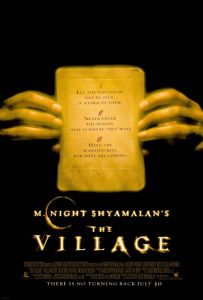 When saying director names you can play a fun little game of word association. Someone says, “George Lucas,” and things like big-budget effects, empty storytelling, and wooden dialogue come to mind. Someone says, “David Lynch,” and weird, abstract, therapy sessions dance in your head. The behemoth of word association is M. Night Shyamalan. He burst onto the scene with 1999’s blockbuster, The Sixth Sense, a crafty, moody, intelligent thriller with a knock-out final twist. Now, though, it seems more and more evident that while The Sixth Sense was the making of M. Night Shyamalan, it also appears to be his undoing. His follow-up films, Unbreakable and Signs, have suffered by comparison, but what seems to be hampering Shyamalan’s growth as a writer is the tightening noose of audience expectation that he kowtows to.
With this in mind, we have Shyamalan’s newest cinematic offering, The Village. Set in 1897, we follow the simple, agrarian lives of the people that inhabit a small secluded hamlet. The town is isolated because of a surrounding dense forest. Mythical creatures referred to as Those We Dont Speak Of populate the woods. An uneasy truce has been agreed upon between the creatures and the villagers, as long as neither camp ventures over into the others territory. When someone does enter the woods, foreboding signs arise. Animals are found skinned, red marks are found on doors, and people worry that the truce may be over. Within this setting, we follow the ordinary lives of the townsfolk. Ivy Walker (Bryce Dallas Howard) is the daughter of the towns self-appointed mayor (William Hurt), and doesnt let a little thing like being blind get in the way of her happiness. She is smitten with Lucius (Joaquin Phoenix), a soft-spoken loner. Noah (Adrien Brody), a mentally challenged man, also has feelings for Ivy, which cause greater conflict.
 Arguably, the best thing about The Village is the discovery of Howard. She proves herself to be an acting revelation that will have future success long after The Village is forgotten. Her winsome presence, wide radiant smile, and uncanny ability to quickly emote endear the character of Ivy to the audience. She is the only one onscreen with genuine personality and charisma, and when shes flirting and being cute about it you cannot help but fall in love with her. And when she is being torn up inside, the audience feels the same emotional turmoil. I am convinced that this is more so from Howard’s acting than from the writing of Shyamalan. She reminds me of a young Cate Blanchett, both in features and talent.
It seems to me that Shyamalan’s directing is getting better with every movie while his writing is getting proportionately worse. He has a masterful sense of pacing and mood, creating long takes that give the viewer a sense of unease. The first arrival of the creatures is an expertly handled scene that delivers plenty of suspense, and a slow-motion capper, with music swelling, that caused me to pump my fist. The cinematography by Roger Deakins is beautifully elegant. Even the violin-heavy score by James Newton Howard is a great asset to the film’s disposition.
So where does the film go wrong and the entertainment get sucked out?
What kills The Village is its incongruous ending. Beforehand, Shyamalan has built a somewhat unsettling tale, but when he finally lays out all his cards, the whole is most certainly not more than the sum of its parts. In fact, the ending is so illogical and stupid, and raises infinitely more questions than feeble answers, that it undermines the rest of the film. Unlike The Sixth Sense, the twist of The Village does not get better with increased thought.
Shyamalan’s sense of timing with his story revelations is maddening. He drops one twist with 30 minutes left in the film, but whats even more frustrating is he situates a character into supposed danger that the audience knows doesn’t exist anymore with this new knowledge. The audience has already been told the truth, and it deflates nearly all the tension. Its as if Shyamalan reveals a twist and then tells the audience to immediately forget about it. Only the naïve will fall for it.
 Shyamalan also exhibits a problem fully rendering his characters. They are so understated that they dont ever really jump from the screen. The dialogue is very stilted and flat, as Shyamalan tries to stubbornly fit his message to ye olde English vernacular (which brings about a whole other question when the film’s final shoe is dropped). Shyamalan also seems to strand his characters into soap opera-ish subplots involving forbidden or unrequited love. For a good hour or so, minus one sequence, The Village is really a Jane Austin story with the occasional monster.
The rest of the villagers don’t come away looking as good as Howard. Phoenix’s taciturn delivery seems to suit the brooding Lucius, but at other times he can give the impression of dead space. Hurt is a sturdy actor but can’t find a good balance between his solemn village leader and caring if sneaky father. Sigourney Weaver just seems adrift like shes looking for butter to churn. Brody is given the worst to work with. His mentally-challenged character is a terrible one-note plot device. He seems to inexplicably become clever when its needed.
The Village is a vast disappointment when the weight of the talent involved is accounted for. Shyamalan crafts an interesting premise, a portent sense of dread, and about two thirds of a decent-to-good movie, but as Brian Cox said in Adaptation, ”The last act makes the film. Wow them in the end, and you’ve got a hit. You can have flaws and problems, but wow them in the end, and you’ve got a hit.” It’s not that the final twists and revelations are bad; its that they paint everything that came before them in a worse light. An audience going into The Village wanting to be scared will likely not be pleased, and only Shyamalan’s core followers will walk away fully appreciating the movie. In the end, it may take a village to get Shyamalan to break his writing rut.
Nate’s Grade: C+
Share this:

The Punisher (2004)
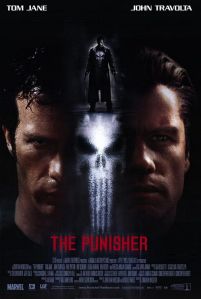 It’s probably a bad omen when the co-writer of Armageddon makes his directorial debut (J.J. Abrams is a fluke). The Punisher is one of the ugliest movies I have ever seen. The action isn’t exciting; it’s pat, poorly shot and grotesque. The story isn’t interesting. It’s not enough that The Punisher has his family killed; he has to have his ENTIRE family killed during a reunion. When he does exact his vengeance, the film stops an audience from engaging with the characters and pushes them away by callous misstep after callous misstep. This is just sadistic, ugly, and over-the-top while simultaneously being entirely, sadly predictable. By the time John Travolta gets dragged by a slow-moving car through a field of explosions, you may have thrown up in your mouth, swallowed it, and thrown up again.
Nate’s Grade: D
Share this:

Man on Fire (2004)
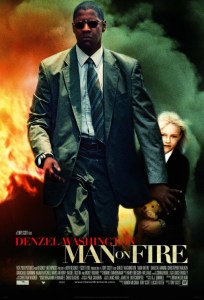 By far, the most entertaining moment of Man on Fire occurs shortly after the movie ends. A message comes on screen more or less saying, Mexico City is a very special place and we thank them. Now, after having watched a lengthy 2 hour and 25 minute film that shows Mexico City as a chaotic equal to the Middle East, a city that experiences four kidnappings a day we are told, these ending sentiments feel like a mea culpa. To say a place is great after showing it to be a corrupt war-zone is hilarious. I doubt Mexico City will be using Man on Fire to lure tourism, just like I doubt Germany uses Hogan’s Heroes for its tourism.
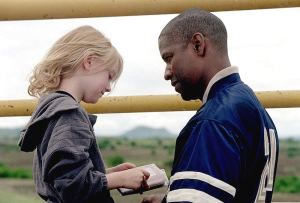
The man on fire is Creasy (Denzel Washington), a former soldier with a drinking problem. Hes hired dirt cheap to be the bodyguard for Pita (Dakota Fanning), the daughter of a wealthy Mexican politician (Marc Anthony). Creasy is pragmatic about his job and shirks Pitas attempts at friendship. Eventually, the precocious tyke gets the better of him and Creasy forgoes his self-loathing for coaching Pita on how to swim better. Creasy has found his recovery in the form of Pita’s love, but his world is ripped apart when Pita is kidnapped and Creasy is left for dead. When he recovers, he vows merciless vengeance on anyone involved in Pita’s kidnapping.
 Denzel Washington is competent in his role, but there aren’t many films that wouldn’t be better by having a Denzel Washington performance in it. Fanning has a robotic nature to her delivery. The wacky Christopher Walken is in this movie somewhere, but you would be hard-pressed to find him in the last hour or so. It’s kind of nutty that Walken of all people plays the voice of reason in a revenge movie.
Director Tony Scott (Crimson Tide, Top Gun) has flat-out forgotten or lost interest in telling stories. His direction of Man on Fire is erratic and heavy on stop-the-action-dead visual flourishes. Scott is a slave to visuals, but so many of them are jarringly miscalculated that the audience can never fully immerse themselves in the film. It’s like a kid fiddling with a new camcorder and wanting to try all the super cool special features (Whoa, I can make things slower … now grittier stock … now sepia … now I can make a mirror of things … etc.).
It takes over an hour to get to the key kidnapping plot point. Until then the audience is relegated to watching scenes of Creasy find redemption through the eyes of a child. Denzel and Fanning have a nice mentor camaraderie, but after an hour the audience is impatiently waiting for the inevitable kidnapping that the movies foreshadowing has been tripping all over.
 When Man on Fire does hit the kidnapping, the ensuing movie gets very messy, and boy does it get ugly. Creasy goes on a grisly killing spree that turns him from a sympathetic loner into a one-man wrecking crew. Vengeance is an easy emotion for an audience to get behind a character, but Man on Fire goes way beyond audience empathy. Are we to cheer when Creasy goes about ruthlessly killing unarmed people and threatening families, pregnant women, and kids? I didn’t cheer. I was somewhat appalled that the filmmakers expected us to revel in this violence as if it was more than justified. It’s just ugly, plain and simple. It is also sickeningly sadistic.
The most bizarre thing about Man on Fire is the subtitles. When I think back on this film in the future, that is the one thing that will stand out for me. These arent your ordinary stay-at-the-bottom-and-do-as-you’re-told subtitles. Oh no. These subtitles dance, jump around, float, fade, expand and shrink in size, and do about everything but make balloon animals (or, I should say, subtitle animals). It’s like a living comic book; however, this is yet another visual trick that draws the audience out of the film. The unusual subtitles call too much attention to themselves, especially when they just pop up for a single word, spoken in English, as if to clue in the audience that this point of information will be vital somehow.
Man on Fire is a sadistic action film that is too full of itself for amusement. By the time that mea culpa comes onscreen its almost a relief to laugh again. The hard-driving ugliness of Man on Fire might make you forget how to. Fans of revenge films may find some redeemable qualities, but Man on Fire is one gruesome 145 minutes to squirm through.
Nate’s Grade: C-
Share this:

Taking Lives (2004)
 While viewing Taking Lives my mind wandered quite a bit. There was one point where I actually gave credence to a theory that Taking Lives was so intensely bland that is was parodying the glut of serial killer films. Then I just concluded that the movie was dumb. Angelina Jolie plays one of those hard-as-nails criminal investigators who just happen to be drop dead gorgeous. She’s on the hunt for a Canadian serial killer who murders then assumes the lives of his victims. He’s been doing this for over 20 years. My main question is … how? Taking someones identity has so many variables to it. What if any family member found you? Theyd know for sure you wouldn’t be their loved one. Oh yes, and the killer masks the identity of his victims by cutting off their hands and smashing their faces in. Would that even work? All you have to do is draw some blood and do a DNA test. Taking Lives is so by-the-book that it even dares to have a scene where the serial killer calls Jolie and claims that he and her are exactly alike. The ending veers so far off track into the land of implausibility that its almost entertaining. Almost. The only reason to even poke your head in a theater to see this is for a gratuitous nude scene involving Jolie, and even that you’ve seen before in better movies.
Nate’s Grade: C-
Share this:

The Butterfly Effect (2004)
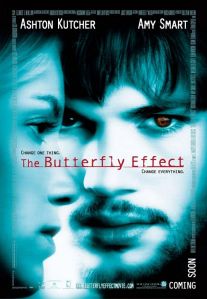 Notice: I found Ashton Kutcher, star of The Butterfly Effect, on a trip to buy dog food, and cordially asked him to write a review. This is what he sent me. It’s totally him. I wouldn’t make this stuff up. That would be dumb.
“So, like, this Nate guy asked me to do a review of my new awesomest movie, The Butterfly Effect. Dude, like anyone needs a review for the most awesomest movie ever. I mean, like, the term awesomest movie ever should say, like, everything. The only thing possibly more awesome than The Butterfly Effect would be trucker hats … or two chicks totally making out. And I only said possibly more awesome, which doesn’t mean it is more awesome, because, dude, like I said before, The Butterfly Effect is the most awesomest thing ever. You cant dispute that. Dont even try. Im awesome!
Like, the story goes like this, man. I play this guy, like I know big stretch there, but he’s not the most awesome guy ever, which is what you’d be thinking since its the most awesomest movie ever. But no, he’s like this kid who blacks out and has this wickedly twisted childhood where he stars in his neighbors kiddie porn, has his dog set on fire, and, like, his dad is all crazy, or, like I like to say, insane in the ole membrane. Ha, I totally made that up right now. I’m awesome!
So, you’re like saying, ’Dude, that movie sounds less than awesome. Yes, sir, I am having definite doubts about the awesomeness of this movie. Like, do I need to go to the movies to, like, feel bad? I got my parents to do that for me. That and school.’ Hey man, I’m there, I know what you feel. Cause right when you are like, “‘Dude, when is Demi gonna show up playing his mom?’ I find these old journals of mine and, dude, use them to travel back in time. I know, the awesomeness has returned. And I use the journals to go back and try and punk time, man. I try and make things better and change the future but I like totally just make it worse. I know, double punkd, man! I try and fix the life of this hot girl in the movie (she showed her boobs in that Road Trip movie, did you see that? That part where she shows her boobs, oh man … It is awesome) but things don’t work out. Like she becomes a crack ho at one point. Dude, total punkd. I’m awesome!
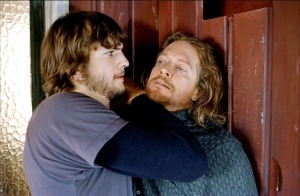 I should be taken as a serious actor. I didn’t hit my head on something and I grew a beard, what more do people need to know I got the goods? I mean, I don’t want to keep saying it but …
beard. C’mon! When actors want to be taken seriously they, like, grow beards. That’s why all those people in movies before 1970 (I know, it surprised me too that there were older movies) got awards and stuff. Beards, dude. Beards. When Billy Dee Shakespeare, like, invented acting, he totally imagined dudes, and chicks too, with beards. Thats why girls cant be taken as serious actors, cause they cant grow beards. But dude, don’t tell that to Demi, because she totally has one wicked ferocious beard, if you know what I mean. Ha. I’m awesome!
I should be taken as a serious actor. I didn’t hit my head on something and I grew a beard, what more do people need to know I got the goods? I mean, I don’t want to keep saying it but …
beard. C’mon! When actors want to be taken seriously they, like, grow beards. That’s why all those people in movies before 1970 (I know, it surprised me too that there were older movies) got awards and stuff. Beards, dude. Beards. When Billy Dee Shakespeare, like, invented acting, he totally imagined dudes, and chicks too, with beards. Thats why girls cant be taken as serious actors, cause they cant grow beards. But dude, don’t tell that to Demi, because she totally has one wicked ferocious beard, if you know what I mean. Ha. I’m awesome!
So, like, if you ever wondered what it would be like to see me, Ashton Kutcher, the most awesome man alive who ever lived, no the most awesome human being -the most awesome thing - ever, as a frat boy, or like, some poor dude with no arms, then you should see my new movie, The Butterfly Effect. After all, it is the most awesomest thing ever. That’s awesome. So, like, you people reading (is that what school is for?) should go see my movie. Ill tell you why in two words: beard.”
Nate’s Grade: C+


You must be logged in to post a comment.