Blog Archives
The Interpreter (2005)
 This is a polished political thriller that hearkens back to the day of the 1970s, where Hollywood was willing to put out smart, complicated, involving political intrigue and have faith that adults would enjoy. The premise is sound and director Sydney Pollack sure knows how to add layers of complication and mystery as well as make you doubt everyone’s involvement. A scene where all the film’s major players somehow get on the same down town bus is a masterpiece of nuanced suspense. The ending, not so much. Nicole Kidman, as the white African U.N. interpreter that hears a planned assassination one night, is credible but a bit weightless in her part. It’s not enough the pretty girls are taking the ugly girl parts (Monster,The Hours), but now they’re taking African parts? Granted, the idea of a white African allows for a new insight into the struggle for ethnic and cultural identity. Sean Penn gives a nicely rattled performance, giving his character more edge then it even deserves. The Interpreter is a geo-political thriller that trusts its audience and mostly delivers a good time.
Nate’s Grade: B
Share this:

Hostage (2005)
 A tense thriller that turns the hostage genre on its ear with a brilliant personal twist. Not only must the sheriff (Bruce Willis) try and talk a group of disturbed kids (led by the freaky Ben Foster) out of holding a mob accountant and his family hostage, but he must also try and recover soemthing inside the barricaded house because HIS family is being held hostage by the mob. It makes for some gripping decisions, as every move has two to three intentions, and Willis looks like he’s being put through the wringer. The movie is a great modern turn on the genre, until, that is, it all goes to crap in a preposterously violent showdown. Still, Hostage is a nice turn for Willis and a smart turn for the thriller genre.
Nate’s Grade: B
Share this:

Sin City (2005)
 Like film noir on steroids. Director Robert Rodriguez has made the most faithful comics adaptation ever; giving life to Frank Miller’s striking black and white art. The visuals are sumptuous but the storytelling is just as involving, a perfect mix of noir/detective elements and subversive, highly memorable characters. Sin City may be the most violent studio film … ever, but the over-the-top tone keeps the proceedings from becoming too nauseating, even after limbs are lost, heads roll (and talk), and dogs pick away at living bodies. This is a very ball-unfriendly movie; lots of castrations. The blood even looks like fluorescent bird crap. The stories become somewhat repetitious (anti-hero saves distressed woman), but Miller and Rodriguez keep their tales tight, pulpy, comic, and unpredictable. My friend turned to me after it was done and said, “That was a great movie.” I could not argue.
Nate’s Grade: B+
Share this:

The Ring Two (2005)
 I loved The Ring. Loved it. So I had some trepidation when I found out they were making a sequel. Surely it wouldn’t have the punch of the first film. To see Ring Two I went to a theater frequented by somewhat affluent teenagers and pre-teens. Big. Mistake. People were chattering away the entire time, laughing stupidly, and shouting ridiculously lame jokes: (on seeing a damp bed: “Oops, somebody wet the bed”). There were two managers that had to patrol the theater to keep order. Worst of all was a team of easily riled prepubescent girls that sat behind me, shrieking like banshees even during movie trailers. The same thing happened to me when I went to see The Village at the same theater. I must attract the most annoying people in the crowd. The sound quality in my theater was also very poor. Now, I can’t help but think that this was some divine act to warn me how bad Ring Two was going to be.
Rachel (Naomi Watts) has taken her son Aidan (the creepy David Dorfman) to a new town to start a new life. It’s been years since the incident with the videotape, and Rachel feels guilt about her role in spreading the killer tape. She’s got a new job at a small town newspaper but yet she can’t escape her past. A teen has been found with a contorted face, soggy floor, and a certain videotape. Rachel finds the tape and burns it. Samara, the evil young girl who started the evil tape, is none too pleased. Seems the evil tyke wants to be a real girl with a real mommy, and is slowly taking over Aidan. His temperature is dropping, he’s not sleeping, and bad things are happening. Rachel confronts more of Samara’s history to learn what it takes to stop her and get her son back.
 Everything that worked in the first film feels forced and meaningless when rehashed in Ring Two. In the previous film, there was context for the image of a tree on fire and Rachel yanking a fly right out of a TV screen. In Ring Two, these plot points are now reduced to being contrived signs of doom. There’s a scene where we’re supposed to be scared because a single fly comes out of a faucet. Huh? The fly and the tree made sense in The Ring, but in the sequel they are stripped of their context and seem alien. And dumb. After everything fit so tightly together in The Ring, it’s disappointing that little makes sense in the sequel.
Watts is such an enormously appealing actress that even in dreck like this she can come off as luminescent. With the two Ring films and Peter Jackson’s upcoming King Kong, Watts could establish herself as the scream queen of her generation. She’s a gifted actress and melts into whatever role she plays.
Ring Two‘s director, Hideo Nakata, knows a thing or two about the territory. He did direct the original Japanese Ringu films, which the American remakes are based upon. Nakata generates a fun sense of anticipatory dread. He also lucks into the occasional eye-opener like a bathtub whose water flows up and fills the ceiling. Nakata has a confidant touch but I miss the sheen of Gore Verbinsky’s direction.
What’s sorely missing is a killer premise like in The Ring. The premise was razor sharp, presenting a videotape as a virus and human nature’s willingness to taste forbidden fruit as the vehicle for its spreading. There was a sense of urgency because of the looming seven-day death deadline. In Ring Two there is no sense of urgency at all. In fact, the film takes an overly leisurely pace. It’s quite awfully boring. Samara wants a mommy and can?t really be stopped until a late revelation. This leads to a lot of impotent pacing and waiting. Except for a snappy opening, Ring Two completely ditches the videotape virus storyline that made its predecessor so compelling. As a result, it also ditches suspense and most of its intelligence.
 The Ring had a strong central mystery and a sense of urgency, which both blended to create tightly wound tension. Ring Two sputters around and relies on gimmicky jump scares as its main source of spooks. We see a character look into a mirror, look away, and then look back and something else is right there! Does this really work for anyone still? I just assume when a character ducks out of the way of a mirror that something’s coming. It’s these kinds of creaky, transparent tricks that Ring Two goes back to over and over to goose an audience. Because the story isn’t engaging the filmmakers have to resort to gimmicks. Since we’ve seen the results of Samara’s murders (the grotesque facial distortion) is it even scary to see it again when we know exactly what we’re about to see? The essence of horror is the unexpected. Finding the expected is about as scary as looking at leftovers in the fridge.
There’s a great moment early in Ring Two. Rachel and Aidan are driving through a forest and are followed and then attacked by a horde of deer. It’s the lone sequence in this sequel that feels different and exciting. It’s somewhat crazy, somewhat marvelous, and very weird. Too bad Ring Two relapses from there on into a turgid horror flick.
The Ring was a smart, tense, expertly crafted film that rose beyond genre conventions. Ring Two is nothing but genre conventions and repeatedly goes back to the well to drub up scares that aren’t there anymore (unless you’re the prepubescent girls that sat behind me). Watts is still in fine form and there are some visually striking moments. However, Ring Two is bereft of excitement and scares and has become just another tired, languished sequel. When I walk out of a horror moving saying, “I guess the best thing about that film was either Sissy Spaceck’s crazy cameo or deer,” then you are in a world of bad. Ring Two is meek, dumb, and boring. Let this one go straight to video.
Nate’s Grade: C-
Share this:

The Jacket (2005)
 In The Jacket, Adrien Brody plays a mentally disturbed soldier sentenced to spend his days in a treatment facility. He gets strapped into a straight jacket and locked inside a morgue drawer as part of his “therapy.” Inside these closed quarters, for whatever unexplained reason, Brody has the ability to travel through time. This got me thinking about some other weird/lame ways people travel through time in films. In 2004’s The Butterfly Effect a bearded Ashton Kutcher is able to jump through time by reading his childhood journals. Sure this is weird, and may give false hope to a nation of gloomy journal-scribbling teenagers, but when it comes to incompetent time travel techniques, 1980’s Somewhere in Time is number one with a bullet. Christopher Reeve’s character desperately wants to travel back to 1912. So he removed all modern furniture, clothing, and anything post-1912. Then he lies down on his hotel bed and keeps repeating to himself that he’s living in 1912. Somehow this works and Reeve gets to embark on romance, 1912-style y’all.
Jack Starks (Brody) is a helpful and well-meaning guy that just can’t catch a break. As a soldier in the 1991 Gulf War, an Iraqi kid he was trying to befriend shoots him in the head. When he returns home he starts a long trek through the Northeast. Starks helps out a mother and daughter whose car has stalled. He befriends the non-gun wielding little girl, Jackie, but her drunken mom nearly accosts Starks and they drive away. Then he gets a ride with a drifter (Brad Renfro). They get pulled over by a cop. The drifter kills the cop; Starks gets knocked out and framed for the murder. He’s sentenced to spend the rest of his days in a clinic for the mentally disturbed. And you thought you were having a bad day.
 The operator of the clinic (Kris Kristofferson) has some unconventional methods of therapy, like locking Starks in a straight jacket and sliding him into a morgue drawer. Inside this confined space Starks can zip through time to 2007. In the future he goes home with an angsty young woman (Keira Knightley) who, surprise, ends up being an adult Jackie, the girl he helped at the side of the road. They’re both confused and freaked out, but what spooks Starks even more is the knowledge that he dies on New Year’s Day, 1993. Starks must now get into that jacket so he can visit 2007 some more, fall in love with Jackie, and piece together clues to prevent his soon-to-be death.
Brody seems to be having as much bad luck post-Oscar as Halle Berry and Nicole Kidman. He’s in some funk playing glum character after glum character. Brody and his gaunt figure do have a natural haunted quality and he does excel at emoting grief and horror (hence the 2002 Best Actor Oscar for The Pianist). Brody gives the film more intensity than it deserves.
Knightley is a decent actress but has little to work with. Her role is wrapped in a slab of Gothic traits posing as characterization. When she talks it sounds like she has a cold. I don’t know if this is because of her attempted American accent, the glum character, or maybe she just had a cold from all that outdoor shooting in the snow.
Director John Maybury has the irritating habit of filming scenes entirely in jagged close-ups. Two people will be talking and then -WAM!- huge close-up of an eyeball. Then -POW!- giant mouth filling up the screen. Then -WAM! (again)- more of the same. This editing decision is a distraction but it also lacks purpose. It doesn’t effectively communicate character emotion or scene tension; it just annoys the crap out of you.
 The Jacket is fairly interesting for a good while. The premise is almost ingenious: a man must travel to the future to collect information to prevent his mysterious death in the past. The Jacket adds further intrigue with the question of whether Starks really is traveling through time. Maybe he truly is disturbed and this is all in his head. Sadly, but as expected, The Jacket disproves this tantalizing possibility after an hour of tease.
When the film does transition into its final half, the possibility it showcased seems to go slack. The answers seem either overly tidy or simply anticlimactic, like the truth behind Starks’ death. The Jacket opens strong and strings us along with some intriguing prospects but the end results merely peter out the film’s potential until The Jacket seems completely drained of blood.
Their relationship also has some unexpected creepy moments. Starks, in 1992, visits the little girl he will eventually have sex with in 2007. Yes she’s an adult when they take their tussle in the sheets, but having him later visit her when she’s a child is just plain cre-eeeee-py.
For a while, The Jacket aims to be an intelligent mind-bender but the film squanders its potential. The answers don’t seem nearly as thought-out as the film’s initially intriguing questions. Brody gives the movie more brooding intensity than it deserves. The Jacket is irritatingly directed, alternating between pale shots of white wilderness, extreme close-ups, and overkill on style. The Jacket seems like a nice fit for a while but becomes too frayed to be memorable.
Nate’s Grade: C+
Share this:

Constantine (2005)
 I’ll admit it; I’m a sucker for Christian mythology played against thriller and action settings. I may be the only person to have watched all of The Prophecy flicks, and probably the only person that eagerly chows down on the cheesy sequels to The Substitute, yet shy away from seeing the first film. I’m captivated by the imagery, the discussion of Heaven and Hell and its mythical logistics, and just the psychology of supernatural biblical beings. With this in mind, I was strongly anticipating the release of Constantine. What I got wasn’t exactly what I expected but I’d be lying if I said I wasn’t entertained.
John Constantine (Keanu Reeves) is a very troubled man. Since his youth he’s had to live with his gift that allows him to see through earthy disguises and witness angels and monstrous demons walking among us. He’s parlayed this ability into a modest side job of exorcising demons and sending them back to Hell. Constantine figures his loyal service should grant him passage into the pearly gates, but Archangel Gabriel (Tilda Swinton) reminds him that that’s not how it works. Constantine is doomed to go to Hell because he tried taking his own life, and if that’s not enough he also has terminal lung cancer from smoking like a chimney. “In other words, you’re f***ed,” Gabriel confides to Constantine.
 Police detective Angela Dodson (Rachel Weisz) is investigating the suicide of her twin sister (also Weisz). She swears her mentally disturbed sis wouldn’t do such a thing, and she seeks out the help of Constantine. He challenges her beliefs, stating that God and the Devil (Peter Stormare) have a wager over the souls of mankind but cannot directly interfere. But now something is breaking this rule and it looks like demons may be getting closer to entering our plane, and it looks like Angela’s dead sister may have known more than people would have thought.
The plot of Constantine is rife with contrivances, aborted subplots, underwritten and nearly forgotten supporting characters, and sketchy logic (staring at a cat can transport you to Hell? No wonder I’m a dog person). Often the film feels overwhelmed by good special effects, as they seem to be the crux of the film?s purpose of being and not, on the other hand, a theological playground of ideas. Constantine gives veiled glimpses of something smart, but routinely shuts that door to focus more on annoying jump scares.
In fact, Constantine seems rather old-fashioned with its theology, still clinging to the Roman Catholic belief that suicide is a one-way ticket to the fiery abyss. I understand its use as motivation for our lead, but will progressive audiences accept something they may find archaic? I suppose it could be worse. Constantine could have briefly gone to Hell for eating meat on a Friday.
It’s interesting that after spending two years making The Matrix sequels, Reeves would choose to attach himself to another big-budget theological action flick. His acting never really rises beyond morose loner but somehow he does make for a satisfying, brooding hero. Reeves? low-key monotone speaking voice allows him to spout cheesy dialogue with a straight face and mercifully keeps the audience grounded.
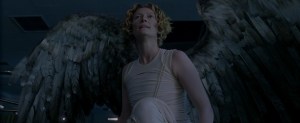 The true stars of Constantine are the memorable supporting players in this celestial smack down. Swinton uses her androgynous looks to forge what David Bowie might be like as an angel: angular, mysterious, waif, and somewhat creepy. Stormare delivers a performance so kooky and tic-heavy, that it could only be compared to the weirder moments of Christopher Walken. Both actors liven up the film and seem to be having the most fun by far with their cheeky roles.
The genius of Constantine is in its one-upsmanship game it holds with the audience. Granted, suspension of disbelief is needed to even go along for the ride, but when we start learning that Hell has its own line of bibles (and they’re longer) we’ve gone beyond suspension of disbelief and into wacky Anne-Heche-speaks-to-aliens land. While sitting through Constantine, we the audience think, “There’s no way this movie could get any sillier.” And then it does! We think, “Alright, that was crazy. Now there’s no way after that this film could get any sillier.” And then it does! Constantine is an amazing ascent into movie madness. After a while, I became drunk from the film’s insanity and wanted it to get even crazier, if possible. It almost seems like there’s a drinking contest between the movie and the audience, and Constantine isn’t afraid to piss its pants to win.
By the time Lucifer shows up, clad in all white like Tom Wolfe, and the Dark Lord appears to have Tourette’s Syndrome and/or a speech impediment, Constantine has hit the bottom of its Kool-Aid cup. Sure the film’s cinematography is slick, and the premise is intriguing, but the real draw of Constantine and the real enjoyment of the flick is how bat-shit crazy it is. I cannot even think of comparable films. I hope David Lynch was taking notes if he saw this.
For a while there, it seems director Francis Lawrence wanted Constantine to be a companion to Wesley Snipe’s Blade character. Maybe the two of them can set up a play date and go destroy otherworldly creatures. There’s a visually striking sequence late in the film involving Constantine in a room full of demons. He’s “contaminated” the water system by placing a giant cross inside, thus holy-fying the water before he can bottle it and sell it to the masses. He holds a lighter to the sprinkler system, demons growling all around him ready for their kill, and then water sprays down across the room. “Holy water?” one female demon says in a stunned voice, watching her flesh sizzle away. Then Constantine marches through the wet room blowing away demons into splashes of ash with his comically unwieldy cross-shotgun. It’s filmed wonderfully with dark hues and is a great idea; however, it’s a bit of a rip-off of the opening sequence in the first Blade.
 This seems to be a repeated sentiment in Lawrence’s direction. He has a sharp visual eye and several camera angles come from odd yet exotic places, but his film is borrowing so heavily from so many other films. What you’re left with is the impression of a stylish if very derivative looking action film. One exception is when Lawrence shows us glimpses of the blistering burnt orange world of Hell. It seems Hell is an exact model resemblance of Earth, only with the fire, brimstone, and crawling demons with their heads sliced open (there is a scary level beneath the surface where we witness a sea of people being tortured). The second or third time we traveled to Hell, I began to wonder what my house would look like and the logistics of upkeep for the homeowner in Hell. Surely the heating bills wouldn’t be the same.
Constantine is funny, frustrating, confusing, gorgeous, and just plain insane in the ole membrane. The film exhibits a rare and engaging form of insanity that may glue audience eyeballs to the screen to see what happens next. I’ve seen Constantine twice (don’t ask why) and even though I knew all the weird plot turns I still found myself getting an enjoyable contact buzz from the film. Who knows how long such a novelty can sustain itself, though. Comic book fans, especially those with a spiritual bent, should get a kick out of Constantine as will anyone else searching for a pristine example of how wonderfully out of control Hollywood moviemaking can be. Sometimes in a good way.
Nate’s Grade: B-
Share this:

Assault on Precinct 13 (2005)
 It seems that in American cinema, we have a long history of people being holed up in one location and fighting off outside forces. There’s instant drama in fending off forces that outnumber you, and Hollywood knows this. There are historical dramas (The Alamo), fantasy flicks (Lords of the Rings), and nearly every other horror movie (Night of the Living Dead) that have a central conceit of the good guys being outnumbered and with no place to go. Assault on Precinct 13 (a remake of the 1976 John Carpenter cult film) is the latest in this mini-genre. The film has big stars like Ethan Hawke, Laurence Fishburne, Gabriel Bryne and a mustachioed Brian Dennehy (there really should be no other kind) but even star power with facial hair can’t stop Assault on Precinct 13 from feeling run-of-the-mill.
On New Year’s Rockin’ Eve, Sergeant Jake Roenick (Hawke) is left to tidy up precinct 13, which will be shut down in days. The precinct secretary (Drea De Matteo) and seen-it-all veteran Jasper (Dennehy) will keep Roenick company. But alas, they have more company than they expected. A bus transporting prisoners makes an emergency stop at the precinct because of a blizzard. The bus has three small time criminals (John Leguizamo, Ja Rule, Aisha Hinds) and one very big fish, crime kingpin and cop killer Marion Bishop (Fishburne). Late in the night the precinct is besieged by a team of dirty cops led by Marcus Duvall (Byrne). It seems Duvall and his squad of corrupt cops have had many deals with Bishop, enough that they can’t let him live. Jake takes command of the precinct’s motley crew, prisoners included, and attempts to have everyone work together to fight off the invading forces.
 Hollywood upped the budget for this remake but they also upped the plot holes to match the firepower. How are the bad cops going to explain all those dead police officers in commando outfits? There’s likely enough forensic evidence everywhere to point a finger at the long arm of the law’s involvement. I suppose they could have burned the whole place down when they were done, but to paraphrase that great philosopher Ricky Ricardo, “Luuuuuucy, you got some ‘splainin’ to do.”
The acting is a non-issue. Hawke and Fishburne get to trade cool glances, Matteo gets to shake her Sopranos Joisey accent, and Dennehy gets to eat any scenery that isn’t bolted to the ground. I have no idea what Leguizamo was going for. His disturbed junkie performance reminded me of Mr. Ed, because whenever he spoke it looked like Leguizamo’s lip was being pulled up by an invisible string. Some may call this acting; I call it fun to watch.
Assault on Precinct 13 is constructed from so many familiar action elements you may think you’ve seen this movie before. Hawke plays a cop haunted by a bust gone wrong that, surprise, killed his partners. When the siege does go down, of course everyone can pick up a weapon (even a 1920s Tommy gun) and instantly become a trained marksman. There’s the whole “who can we trust” plot element that spurs Mexican standoffs between the cops and the crooks. All the characters are stock types, from Hawke’s reluctant hero, to Matteo’s saucy secretary, to Dennehy’s single-minded hothead to Fishburne’s calm and collected criminal mastermind badass. When a character opines a theory that someone on the inside is really working for the dirty cops, you should be able to immediately follow the falling anvils.
 Even when it comes to the action, Assault on Precinct 13 is too familiar. Because nothing interesting is going on inside the precinct, the audience relies on the spurts of action for their money’s worth. It all gets a little bland after awhile. Cops try breaking in. They get shot. They try breaking in with more cops. They get shot. Granted, replace “cops” with “monsters” and you have 30% of horror movies. There needs to be escalating action and some overall cause and effect with the plot, especially with action movies set in one isolated locale. In Assault in Precinct 13, rarely does the previous moment matter because both sides seem to shrug and move on. The only notoriety director Jean-Francois Richet brings to the action is a peculiar fetish for long takes of fresh head shots. He does enjoy the slow trickle of blood out of a bullet to the cranium (I counted 5 times; turn it into a drinking game at your own danger).
Assault on Precinct 13 is indistinguishable from what Hollywood pumps out every day. The characters are stock, the dialogue is short but stale, the plot holes seem to swallow the film whole, and, most tragically, the action seems meaningless except when paring down the cast (there’s a ten-minute whirlwind that cuts the good guys in half). People hungry for action might find something worthwhile but most will probably walk out of the theater with the same shrug the actors seem to exhibit. Assault on Precinct 13 is a routine action flick that replaces escalation with excess.
Nate’s Grade: C
Share this:

A Very Long Engagement (2004)
 Deep in the heart of WWI trenches, we begin this sprawling tale by narrowing in on five French soldiers. Each man has been accused of self-inflicting a wound to escape service, and each man is sentenced to spend the rest of their likely short lives in No Man’s Land, the stretch of bare land between the two trenches. One of these men is Manech (Gaspard Ulliel), a young country boy engaged to the charming Mathilde (Audrey Tautou). When she learns his fated punishment and fails to hear word from Manech, she steps out to launch her own investigation into the possible whereabouts of Manech or the possible details of her fiancé’s demise. She enlists her family, solicits strangers, and puts ads in newspapers to unravel the truth. Along the way she hears various stories from all sorts of people and attempts to form them into a clear picture of what went on in that trench, good or bad.
A Very Long Engagement could be flippantly described as “Rashomon in a trench,” but from the get-go it grabs you by the lapels and will not let go. Once again, Jeunet tells his story in a criss-crossing narrative. Front and center we learn about each doomed man’s life in snapshot, and while the device has a slight eulogy feel, it’s a fantastic way to show the depth of characters in such brevity. A Very Long Engagement is an immeasurably rich film where each detail is threaded into the film to create a magnificent artistic tapestry beyond compare. The tiniest details in the film like Mathilde’s tuba playing (the only instrument whose sound mimics a distress call), to the mail carrier choosing to slide his bike over gravel just further enhance the vibrant, animated world of Jeunet.
 Jeunet is quite possibly the most visually gifted director working today (he turned down Harry Potter 5). He couldn’t film an ugly shot composition if he tried with all his French might. As expected, A Very Long Engagement is gorgeous to look at. The production design is massively intricate, the cinematography, while computer assisted, has a shimmering radiance to it. This is simply the best looking film of all 2004, Hero be damned. You could pause any second in this film and use it as a glossy postcard. Jeunet has the technical credentials to fasten together complex and beautiful worlds. A Very Long Engagement is a technical marvel and gorgeous to experience.
Tautou, also as expected, is wonderful once more. She’s the anchor of the film and the audience feels every heartbreak and glimmer of hope this talented actress explores. The supporting cast is full of familiar Jeunet players and each performance adds to the richness of the film. They feel like characters and not stock roles or cliches.
There is some difficulty with following the storyline. There are so many subplots built upon other subplots that the film’s momentum takes a bit of a dive in the second act. A Very Long Engagement can also get very confusing when it comes to remembering so many names. There are maybe 30 characters to keep track of and as the subplots mount new characters are added to the pile, including a widow played by a surprisingly fluent Jodie Foster. It’s best to employ some kind of memory trick to keep the many colorful characters of Jeunet’s world straightened.
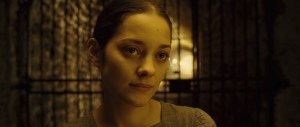 The focus of A Very Long Engagement is on Mathilde’s investigation into what really happened in that trench. She wants to know what happened to her beloved, and as her search picks up steam we get further glimpses of her relationship with Manech. One of my biggest problems I had with 2003’s Cold Mountain was that Jude Law was travailing through hell and back to get back to his beloved Nicole Kidman even though their relationship pre-war lasted as long as a Super Bowl commercial. It’s not that I disbelieve the overpowering nature of love, but I need more from my characters than shifty glances and a quick ejaculation of love (get your mind out of the gutter). Now, in A Very Long Engagement, Jeunet opens by showing the measures Manech will endure to return to his beloved, however, as the film goes on we also see enough peeks into the depths of their relationship beforehand, which dates all the way back to when they were children
A Very Long Engagement forges such a grand and sweeping love story that the audience gets just as immersed as Mathilde about the search for her man. There are so many lovely, intelligent moments between Mathilde and Manech, like their first sexual encounter. Every time Manech lights a new match Mathilde removes an article of clothing until, under the soft light of the newly lit match, she’s nude and blows the match out herself. The characters’ overriding love also taps into small truisms like when Mathilde makes arbitrary games for herself to ensure her love’s safety. (“If I can count to ten before that car passes, then he is alive.”) Mathilde’s faith and devotion are driving her investigation and the audience is behind her 100% of the way, fully invested in this mystery. When we reach our conclusion, I don’t mind telling you I was bawling like a baby.
The film has a merry whimsical tone during its origami-like narrative, but when it hits the trenches the film gets down and dirty. Jeunet shows a fascinating view into the hardships of everyday trench life as well as the machinery of death. Storming the other side’s trench, or “going over the top” as it was called, is seen in all its sordid features. There are hearty splashes of blood and gore that can be jarring.
There’s one terrifying scene in A Very Long Engagement involving the explosion of a makeshift hospital. The hospital is inside a hangar for zeppelins (hydrogen gas) and a missile has crashed into the roof with its nose sticking inside. One of the zeppelins becomes loose and slowly floats to the missile nose with unforgivable certainty. People are running around trying to shield themselves from the inevitable, but it does nothing. The moment is played so agonizingly slow that we become overwhelmed with terror. This was the life of WWI warfare.
 Having said this, the stark war violence doesn’t exactly gel exceedingly well with the whimsical romantic elements. For some, A Very Long Engagement will seem like two very tonally different movies butting heads and intruding upon the other (perhaps Amelie Goes to War?). Sometimes it does take a while to adjust to one tone after spending time with the other. I feel that the emotional investment in the characters and the anticipation of unraveling the mystery serves as thematic glue over the disproportionate tones. Some will feel chaffed by the two stark tones, but I think the power of the love story will conquer most hearts into experiencing the bloodshed of war to earn the shedding of tears by the film’s romance.
Jeunet has re-teamed with Tautou and created another masterpiece. A Very Long Engagement took hold of me from the start and mesmerized me with its beauty, grace, cruelty, excitement, and warmth. This is a great mystery and a great love story with great visuals and great characters. The opposing tones (whimsy vs. violence) won’t work for everyone, and the film takes one too many divergent paths in the middle, but A Very Long Engagement is a film of such startling originality and feeling that it should be treasured. I was floored by what Jeunet had to offer and deeply moved by the time I had to leave the theater. They don’t make them like this much anymore. Now if you’ll excuse me, I have something in my eye.
Nate’s Grade: A
Share this:

National Treasure (2004)
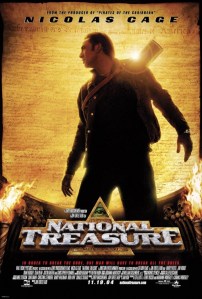 The premise for National Treasure, the newest Jerry Bruckheimer action film, is something of a mess. According to the film, during the Crusades a magnificent treasure was found. The Knights Templar swore to protect it, and the Masonic order carried the vow through the ages. The founding fathers of the Unites States were among this Masonic order, and they went about hiding the fabulous riches and set up a series of elaborate clues to discover its whereabouts. These clues include symbols on the back of our currency and, get this, a secret invisible message on… the back of the Declaration of Independence. Yes, the Declaration of Independence is a treasure map. The silly premise for National Treasure equates the Declaration of Independence with a Denny’s place mat. Can something this outlandish make for a good movie? Well, it depends on your working definition of “good.”
Benjamin Franklin Gates (Nicolas Cage) is somewhat of a laughing stock amongst his peers. His family name is cursed with the crazy belief in some long lost treasure hidden by the founding fathers. His father (Jon Voight) rues the family name being attached to such foolish theories. Of course such foolish theories in Hollywood are always right, no matter how stupid (did I mention the Declaration of Independence is a treasure map?). Ben and his treasure hunting partner Ian Howe (Sean Bean) find a definitive clue, but then Ian double-crosses on Ben and, gasp, wants the treasure for himself. This turns into a race to see who can steal the Declaration of Independence, though Ben wishes to steal it to protect the document and the treasure. Along the way, Ben teams up with a techno-nerd (Justin Bartha) and a hot government official (Diane Kruger) to crisscross historical monuments and sites to unravel the clues before Ian can.
 National Treasure is dumb. Little to absolutely nothing makes sense in this film. This is an obvious, embarrassing attempt to ride the popular coattails of The Da Vinci Code and Americanize the quest. Except that National Treasure really comes across as some half-baked movie version of a kid’s educational game show.
There are so many holes, so where do I begin? First off, why would the founding fathers make it so pointlessly, hopelessly elaborate to find this stockpile of treasure? I’m talking crazy complicated, like having one clue involve finding a ship buried in the Arctic Circle. Yes, the Arctic Circle. Supposedly, the founding fathers decided to hide the treasure because they didn’t want the British to get their grubby, nice-fitting gloves all over it. Something tells me that the founding fathers had more important things going on, like, oh I don’t know, a war! It’s purely absurd to have Washington, Franklin, Jefferson, Adams, and all the rest more interested in hiding some treasure than breaking from England and building an independent nation based on their ideals.
There are some other head-smackers, like the fact that an assembly of clues has been left entirely undisturbed in 200 plus years, like a single special brick. And, for that matter, how does Cage cut through mortar so easily with just a pocket knife? If there’s a gigantic catacomb under D.C., then what’s holding up the city? How come 200 year old oil still burns as well? Wouldn’t that have dried out by now?
 Cage reverts back to his manic show-offy character behavior. In Bruckheimer movies, Cage seems to have theoretic spurts here and there, like he keeps sticking some extremity in an off-screen light socket. He’s generally likeable but his character comes across more like some social studies teacher’s daydream. Bartha and Kruger add less-than-snappy one-liners, but their presence never becomes grating. Bean seems to be playing the stock bad guy role he always is, whether it be GoldenEye, Don’t Say a Word, or Patriot Games.
Sure, even the Indiana Jones films had plot holes (how does closing your eyes guard you from the wrath of God?) but their thrilling adventures overcame any quibbles. National Treasure, on the other hand, is an adventure lacking anything thrilling. This is the first action film to put me to sleep. I can forgive an action/adventure flick being dumb but being boring is a capital offense.
The action sequences in National Treasure are never fully thought out; they usually involve Cage and his cronies outrunning Sean Bean’s group of thugs (repeat). The film’s best moment is the actual theft of the Declaration of Independence. This is the lone sequence in the film that feels like thought was put into drawing out suspense, thinking of natural and interesting complications, and, surprisingly, having the sequence not be overcome by idiocy. After this scene, National Treasure descends into ill-conceived chase scenes strung between crazy elaborate clue hunting. By the time the film reaches its anticlimactic ending, you may have rustled through your change, eyeing the backs of quarters and dimes to ensure there’s no hidden message about a sequel.
National Treasure is a ridiculously stupid, inexcusably boring, ineptly plotted historical adventure for people who get their history solely from movies. Bruckheimer and Cage have an up-and-down partnership, but National Treasure starts with the worst film premise of the year and can?t go much further. Fans of clue-hunting adventure tales may excuse the gaping plot holes, and National Treasure has found a sizeable audience willing to go along for the ride, but the movie doesn’t contain much thrills, entertainment, or anything historically resonant. National Treasure should have stayed buried.
Nate’s Grade: C
Share this:

The Forgotten (2004)
 Fair warning: This screed contains huge spoilers about the movie as I rip it apart. The press release for The Forgotten says, “What if you were told that every moment you experienced and every memory you held dear never happened?” And now, upon having seen The Forgotten, I say, “Oh, if only.”
Telly (Julianne Moore) is still grieving the loss of her nine-year-old son who died in a plane crash 14 months ago. She’s seeing a psychiatrist (Gary Sinise) and slowly coming to terms with her loss. One day she discovers all remnants of her son missing. His clothes, baseball glove, even his appearance in pictures has vanished. She accuses her husband (Anthony Edwards) of stealing them, but then is shocked when her hubby and doc both tell her that Telly never had a son. She’s been delusional for years since a miscarriage and has created an imaginary son. Telly refuses to accept the possibility that she’s nuts, and finds initial resistance and then acceptance from another parent (Dominic West) who also remembers a daughter that died in the same plane crash. Together they set off to learn the truth, all the while being hunted down by the NSA for some mysterious reason.
 The Forgotten shares a very dubious honor. Only twice in my life have I been strongly tempted to walk out on a movie, and that was while watching Lost in Space and The Thin Red Line. Six years later, The Forgotten became the third. It got so bad during the second half that I was fashioning my moveable armrest into a crude headboard for me to sleep upon. I was that bored. I can explain the reasons for my boredom very easily: terrible plot structure.
The Forgotten opens with Telly grieving over the loss of her son, and Moore is so good at grief that she can hook an audience as soon as her face crinkles into sadness. Around the 20-minute mark, Telly is told that she never had a son and has been delusional the whole time. Now, stop right there. That’s a great premise. If the makers of The Forgotten had stretched this part of the movie to about 90 minutes, put some thought and skill toward it, then we could have had something fascinating and heartfelt. Instead, you’re given the easily expected and the very boring.
At the 20-minute mark, Telly is told she has no child and she’s crazy. At around the 30-minute mark, none of this matters. The movie doesn’t even allow an opportunity for Telly to even doubt for a sheer second about her wild hunch that everyone in her life, including The New York Times, being apart of some global conspiracy to hide the fact she had a child. And of course, because she?s our heroine and this is Hollywood, her incredibly outlandish theories will be proven right. I understand that, but to reveal her theory’s accuracy only TEN MINUTES later is ridiculous. The Forgotten wastes no time proving Telly’s wild ranting as being correct. It’s as if The Forgotten feels that its audience is cultivated from the dumbest common denominator.
At the 40-minute mark the “A-word” is used, and before the 60-minutes mark, the audience knows everything. The last hour of the film is so obvious; no, it’s beyond obvious. It’s super obvious. It can’t even be obvious because The Forgotten has told you EVERYTHING. You’re not waiting around for predictability to play its way out, because you’ve been told everything. All that’s left is to sit and watch dull chase scenes (a book editor outrun NSA trained agents? Please).
There will be some heavy spoilers in my discussion of the film’s plot. I’m posting fair warning now, but doubt they’ll be too surprising given the ads on TV for The Forgotten (who else would you think was responsible?).
I have no idea what the makers of The Forgotten were thinking. They blow all their secrets in the first half and then mill around for another hour. It’d be like if The Sixth Sense revealed Haley Joel Osment sees ghosts and Bruce Willis is dead in the first hour, and then for another hour they sit uncomfortably and ask about the weather. Anyone think that movie would have worked the same? This is why I was so bored. I could have fallen asleep and accurately predicted everything that would happen in the second hour. There didn’t even need to be a second half to this film. It was all irritatingly explained to us in the first hour. Once the mystery’s gone, the only thing the audience has to keep its faltering attention are the questions of whether Telly can win back her son, and who will be vacuumed out of the universe next. That’s not much to justify another tension-free, revelation-free hour of awful movie.
The ending is also steeped in lunacy. So apparently all-powerful aliens love to play experiments on us and basically control our whole lives. Peachy. Telly is apart of an experiment, and the creepy, slim alien tells her that she’s the anomaly. All the other test subjects have forgotten, but not her, and the little green men want to know why. What’s even more peculiar is that this specimen of a supposedly advanced race is mad at Telly for gunking up the project, and he’s (its?) going to beat her until she forgets and the project is finished. But the alien just said she was the lone anomaly. By definition the project worked if everyone else succeeded. I’m no advanced race and I figured that out. Guess I’m smarter than the screenwriter of The Forgotten.
Once again, humans miraculously triumph over supposedly all-powerful alien species. I realize an audience wants to see our heroes succeed at the end and conquer evil, but is it even plausible when this evil can alter everyone’s existence at a moment’s notice? In the end, Telly gets her son back and her life is fulfilled. The makers of The Forgotten expect you to take this for a happy, victorious ending. Don’t. Sure, Telly has her kid back, but what’s to stop these all-powerful aliens from doing it again. For that matter, since she was the anomaly, wouldn’t they continue to perform experiments on her to see what makes her tick?
 What makes The Forgotten even more irksome is that it’s a blatant rip-off of Alex Proyas’ visionary 1998 sci-fi noir, Dark City. The plot of Dark City is about all-powerful aliens that experiment with human beings. They plant different memories into their heads, allow their human test subjects to live multiple identities, to see what makes us work. A reluctant doctor helps the aliens but is really rooting for the one test subject that seems beyond their power. The aliens are baffled about this anomaly. This is practically the entire plot for The Forgotten; trade Shell Beach for Quest Air, lose all the style, thrills, imagination, and pacing of Dark City, and what you’re left with is The Forgotten.
It’s not enough that The Forgotten is possibly the most ineptly plotted movie ever, or that the trailer and commercials gave away too much (I knew the ending before stepping into the theater), the ails of The Forgotten are exacerbated by the fact that it’s a shallow, homely, incompetent rip-off of Dark City.
I do not fault Moore. She is one of the finest working actresses today and will elevate anything she is in to some degree. She’s stranded by the material. The only performance I even took any note of was the surprise appearance of Lee Tergesen. He’s shown equally impressive comedic chops (USA’s Weird Science) as dramatic chops (He was the closest thing to a hero on HBO’s Oz). It’s always fun to see personally beloved character actors, even if it is in an abomination like The Forgotten.
Director Joseph Ruben (Money Train, The Good Son) finds astonishing ways to make The Forgotten even worse. He overplays his hand early, like having many overhead shots cued with weird, aerial noises. There’s also an ominous and extremely mobile cloud formation that spells out the antagonists. The second half is filled with pointless chase scenes, and Ruben can’t manage to make any part of them exciting. He does have one interesting jump moment while Telly is riding in a car, but I already saw it this year in the superior Bourne Supremacy.
The Forgotten may end up being the worst film of 2004, and with a year dotted by the likes of Hellboy, Van Helsing, Catwoman, and National Lampoon’s Gold Diggers, that may be all I need to say. I suppose someone out there may find something redeemable about The Forgotten (if they haven’t already seen Dark City), but the film’s tepid pacing, mind-numbingly foolish plot structure, and mounting illogical doom the poor audience to two hours of head-smacking boredom. This is a first-class Hollywood train wreck. It doesn’t work as a drama about grief, it doesn’t work as a psychological thriller, and it really doesn’t work as a half-baked X-Files episode. The Forgotten is a really great title, because in a few weeks it’ll be exactly that.
Nate’s Grade: F


 nathanzoebl
You must be logged in to post a comment.